Bank Manager Burned a Black Man’s $1M Bearer Check "for Fun" — Unaware He OWNS the Entire Bank
Bank Manager Burned a Black Man’s $1M Bearer Check "for Fun" — Unaware He OWNS the Entire Bank
Sweetheart, be honest with me.
Where does a man like you find a check like this?
Ma’am, your issuing desk can verify it.
One call.
Oh, it’s real paper.
Gorgeous paper. The only fake thing here is the story that carried it in.
Babe, careful.
That’s a collector’s item.
They stopped printing those with disco. There.
Banking error resolved. Now, sweep your lottery ticket off my floor and use the side door, sweetheart.
The front is for customers. Babe, tell me you caught the flame. Careful.
My daughter is sleeping. Daddy of the year, everybody.
Somebody bag those ashes. Biohazard.
Have you ever watched somebody burn a million dollars just to feel tall that check was real? The silence in that lobby is about to get very expensive because the man with the sleeping little girl owns every
brick of that building, and she just lit his first deposit.
Comment where you are watching from. Drop a like and let us rewatch. Sydney Moss was 38 years old, and he learned everything he knew about money in a laundromat that smelled like soap and hot metal.
His mother ran it alone 16 hours a day on a street where banks did not build branches. Every Friday, she rolled her quarters into paper sleeves, put on her good coat, rode two buses to the nearest Summit National window, and made the deposit in person, chin level, while tellers sighed at her coins. Sydney once asked why she did not just keep the cash in the coffee tin like everybody else.
She pressed the rolls into his hands and gave him the sentence that built his whole life.
Money you’re proud of goes in the front door, baby.
She died the year he turned 30 and never saw what the sentence became. Sydney started with one armored van bought at auction with a cracked windshield and a prayer.
He drove it himself nights moving cash for check cashers and corner groceries, the customers big carriers would not touch. One van became 12. 12 became a fleet across four states, 400 employees, the safest delivery record in the industry.
This spring a national carrier bought his company and Sydney Moss walked away with more money than his mother’s street had ever seen at one time.
He could have bought an island.
Instead he watched Summit National Bank, 108 years old, 60 branches, the same bank that had sighed at his mother’s quarters, stumble toward collapse under lazy management.
And quietly, through a group that bore his name, he bought it. All of it.
The papers were signed last Tuesday. The announcement was set for Monday.
Until then, exactly nine people on earth knew the new owner’s face.
At home Sydney was two other things first. He was a widower because three years ago a rainy interstate took Adele, his college sweetheart, a pediatric nurse with a laugh like church bells, breathtaking in every photograph on his hallway wall.
And he was a father because Adele left him Milly, four years old, a small determined person who wore yellow because bees wear yellow, sang to her cereal and slept anywhere the moment she felt her daddy’s back under her.
Every big decision since the funeral Sydney made the same way. He asked what Adele would say and what Milly would need in that order. The check was his ritual.
$1 million of the sale drawn as a bearer instrument, old school on purpose because he intended to walk it through the front door of his own bank and hand it to a teller like any customer off the street. The first million goes in the front door. His mother never got a marble lobby.
Her son was going to give her one anyway. The bank he now owned came with people he had not chosen. Kendra Slade, 34, ran the downtown flagship, blonde and polished and camera pretty.
A manager whose numbers looked good because the complaints underneath them kept disappearing. She ran her lobby like a velvet rope, deciding on site who belonged in it. Chad Cain, 41, worked the wealth desk 20 ft away, all cologne and capped teeth and wore the other half of her engagement.
They were the branch’s golden couple.
They called each other babe across the marble and they had a private group chat where the customers they laughed at were the content. Above them both sat Stanley Maybry, 61, regional president, silver-haired and steady, one of the nine faces in that deal room. He had spent the week preparing the transition briefing and he had a 9:00 a.m.Saturday appointment with the new owner who had asked specifically for no lobby welcome, no coffee cart, no fuss.
And at window three worked Robin, 24, the youngest teller in the building, still new enough to believe the procedures manual meant what it said. Saturday morning put all of them under the same chandeliers, a manager with a lighter in her drawer and an audience to impress.
A fiance a president upstairs with a briefing folder, a teller with a green screen and a man in a dark leather jacket coming through the front door with his daughter asleep on his back, $1 in his breast pocket and his mother’s sentence in his chest.
None of them knew they were about to become the most watched bank lobby in America. Saturday started with pancakes shaped like nothing in particular and a negotiation about socks. Milly wanted the yellow dress because dance class was at 9:30 and bees, she explained with lawyer patience, wear yellow to work.
Sydney packed her dance bag, tucked the envelope with the check into his breast pocket, and laid out the morning like a delivery route. Bank at 8:40, meeting upstairs at 9:00, twirling by 9:30, ice cream contingent on behavior hers and his. They walked the 11 blocks because Adele used to say the city belongs to people who walk it.
Somewhere around block seven, the talking behind him slowed, then stopped, and 40 lb of sleeping daughter settled into his back like warm cargo. Sydney shifted her higher, hooked his arms under her knees, and carried her the rest of the way past the coffee line, past the flower cart, up the granite steps of the downtown flagship, and through the heavy brass front doors, the way his mother had taught him money should travel.
The lobby at 8:40 was church quiet, marbled the color of cream chandeliers from another century, a Saturday line of 11 customers. Sydney took his place at the velvet rope and waited his turn like anybody a tall man in a dark leather jacket swaying gently side to side, the automatic metronome of a parent carrying sleep. Window three called him forward.
Robin 24, a name tag and a cowlick gave him the first genuine smile of the morning and dropped it halfway when she read the check. A bearer instrument, seven figures in a lobby that mostly moved rent money. To her credit and the manuals, she did exactly what page 40 of training said.
She excused herself politely, ran the issuing verification, called the confirmation line, and watched her screen come back green. Verified, authentic, funds rested.
8:41 a.m.She was reaching for the deposit form when a manicured hand closed on the check and lifted it off her counter.
I’ll take this one, sweetheart.
Kendra Slade had crossed the lobby the way weather crosses a valley. She had seen the leather jacket from her office, then the amount, and decided the math did not add up in a way that might entertain her. Go count your drawer.
Ma’am, it verified.
The screen, it’s Drawer, Robin.
Robin sat down slowly. She did not close the verification window.
Later, that would matter more than anything else that happened before 9.
Kendra held the check at arm’s length like a photograph of a fish somebody else had caught.
Then she looked at Sydney Moss, top to bottom, jacket to boots, sleeping child to unshaved jaw, and performed her decision for the growing line. Identification?
He gave her the license, calm as a man laying down a winning card he did not need. She studied it the way people study counterfeit 20s, tilted it, frowned at it, and set it aside.
Something with your address, utility bill? He produced one, folded from the envelope, because a man who ran cash logistics for 15 years arrives prepared. She barely glanced at it.
And a second photo ID.
Ma’am?
Sydney’s voice stayed level one register above a whisper, the volume of a man protecting a sleeping child.
The check verified at your own window one minute ago. The issuing desk is one call.
I’ll wait while you make it.
Oh, will you? Kendra smiled at the line behind him recruiting them. Sir, this is a bearer instrument.
Do you know what that is?
It’s what fraud looks like when fraud dresses up.
A ripple of nervous laughter from somewhere near the ropes. She fed on it. Step out of line, please.
You’re holding up my actual customers.
She walked the check to the side rail, and he followed because she still had a million dollars of his mother’s front door pinched between two red nails.
At the wealth desk, Chad Cain looked up from his phone, read the room the way scavengers read a shoreline, and drifted over with his thumbs already typing. Babe, lobby, you have to see this guy. For 6 minutes, Kendra Slade put on a show she had performed before for smaller rooms and smaller stakes.
She started with the keyboard. Long red nails, theatrical slowness, one key at a time.
Hmm, funny. No record of any instrument this size, none.
The record was glowing green on Robin’s screen 30 ft away, and Robin opened her mouth, and Kendra raised one finger without turning around the way you silence a dog.
Then came the interview. Where do you bank normally? No, let me guess, one of those apps.
A pause for the ropes to chuckle. And what is it you do for work exactly?
She drew air quotes around work with two fingers slow, so the phones could catch them. Consulting music, something with cars, logistics, Sydney said.
Logistics.
She repeated it the way you repeat a child’s imaginary friend’s name.
Sweetheart, men who move a million dollars don’t carry it in a jacket pocket.
They have people, lawyers.
They don’t stand in my Saturday line smelling like a second-hand store with a toddler strapped to their back.
The line had stopped being a line and become an audience. Two phones out near the ropes, then four.
An older woman in a Sunday hat murmured something that was not approval, and the man beside her looked at his shoes. At the wealth desk, Chad had given up pretending to work. Babe, he mouthed, delighted hands steadying his phone against a marble pillar, content.
Kendra held the check up to the chandelier next, pinched at one corner like evidence at a trial she was also judging. You have to admire it, honestly. The paper stock, the watermark, the fakes are getting so good.
She tilted it, let the light run down the face of it. Practically art.
Somebody worked hard on you, didn’t they?
Ma’am, Sydney’s voice did not rise.
It leveled the way concrete levels. The check verified at window three at 8:41.
Your teller ran it. The screen is still open.
Call the issuing desk.
It’s one call and it’s printed right there under your thumb.
For half a second, something flickered behind Kendra’s lashes, the oldest instinct in banking, the one that says, “Verify.”
She glanced almost toward Robin’s window then.
Chad’s phone caught the chandelier light and the audience shifted its weight waiting to see who won and the flicker died of embarrassment.
She had a room. Rooms were the one currency she never left on the table.
“I’m not calling a number printed on the fraud, sweetheart.
That’s adorable.
That’s like asking the burglar for references.”
Laughter again, thinner now, uneasy. She fanned herself with the check.
$1 million moving air onto a smile.
“You know what I think?
I think you found this or made this or somebody made it for you and you picked my branch because you thought a Saturday girl would blink.
” “Look at me, honey.
Do I blink?”
“Twice since you took it.”
Sydney said quietly.
“Both times when I said the word verify.”
The older woman in the Sunday hat laughed out loud one sharp note and swallowed it.
Kendra’s smile recalibrated 2° colder.
She set the check down flat on the marble rail between them smoothing it once, almost tenderly, like a card she was about to fold.
“Last chance for an easy morning.”
She said.
“Tell me where you really got this and maybe we keep the police out of your weekend.”
“Call the number, ma’am.”
Hm. She looked at him a long moment. Something in his calm was starting to irritate her, an itch she could not name, the absence of the fear she was owed.
People were supposed to shrink at this counter. It was her counter.
Behind her shoulder, Chad angled his phone and whispered, “Babe, closer.”
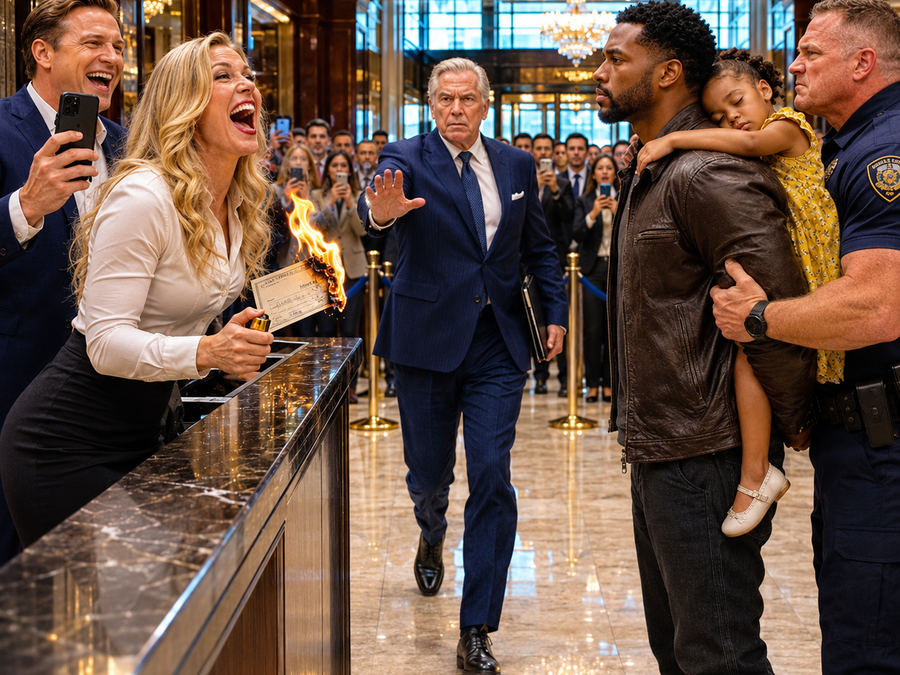
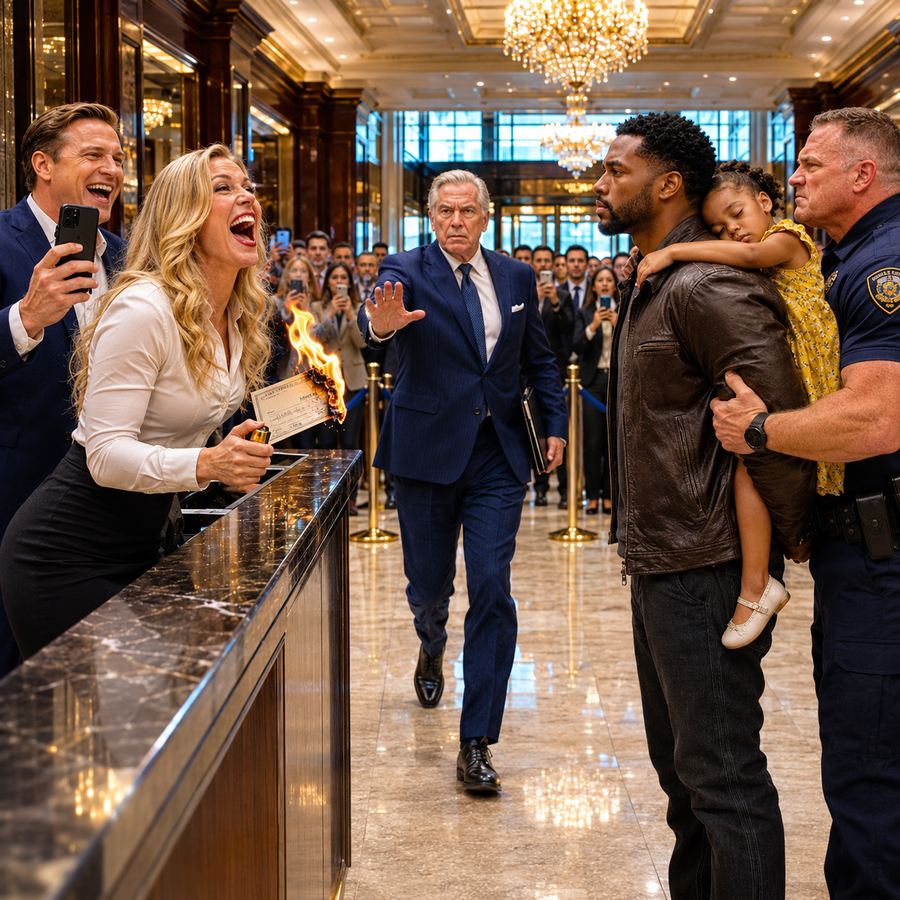
And the audience, 11 customers deep plus every teller pretending not to watch, saw the branch manager of Summit National slide open her drawer, feel around without looking like a magician who has done the trick too many times, and come up with a slim gold lighter.
“You know what we do with fraud, sweetheart?”
she asked, thumb resting on the wheel, smiling her camera smile straight down the lens of Chad’s phone.
“We destroy it.
Little Saturday tradition, for fun.”
The flame stood up straight.
At her own window, Robin’s hand moved 3 in toward her phone and stopped.
On Sydney’s back, Millie sighed in her sleep, the deep untouchable sleep of 4-year-olds, and her small shoe knocked once against her father’s hip like a clock ticking toward 9.
You watched her light it. Here is what $1 million sounds like when it burns.
Nothing. That was the obscene part.
A silk shirt sound a whisper of chemistry, a room of 40 people holding their breath while fire walked down the face of a cashier’s check in a neat orange line, eating the watermark she had called art, eating the word million, eating the promise a laundromat woman’s
son had carried 11 blocks against his heart.
Sydney Moss stood absolutely still and let it happen. He could have snatched it back. Every muscle from wrist to shoulder voted for it, but 40 lb of daughter slept between his shoulder blades, rising and falling, and a lunge across a marble rail was not a thing a sleeping child gets to be part of.
So, he planted his boots and made his spine a wall, and watched a year of his mother’s Fridays go up in a stranger’s manicure.
The lobby saw a man doing nothing. The lobby was wrong. He was doing the hardest thing in the building.
Kendra Slade watched his face while it burned hunting for the flinch, and the flinch never came, and that ruined it for her a little. So, she raised the stakes the only direction she knew.
She let the burning check fall. It landed on the marble between them, curled, blackened, and died. A scorched shadow bloomed under it, a gray ghost of a rectangle on 108-year-old stone.
Somewhere near the ropes, the woman in the Sunday hat said, “Oh lord.
” Out loud to nobody.
There. Kendra dusted her fingertips together. One, two.
Banking error resolved. She leaned over the rail, dropped her voice into its sugared register, and delivered the eulogy.
Now, sweep your lottery ticket off my floor and use the side door, sweetheart. The front is for customers. Babe, tell me you caught the flame.
Chad turned the phone on himself, thumbs up, then back on the ashes. Content secured.
His grin took up the bottom third of the frame. Kendra snapped her fingers twice at the security post. Walk him out.
Side door. The young officer crossed the lobby without hurry, a big kid 2 years out of a football program doing the job the badge said.
His hand closed around Sydney’s arm, firm, procedural.
And Sydney Moss looked down at the hand, then up at the officer, and said the six words the whole internet would know by Sunday night. Careful, my daughter is sleeping.
No threat in it, no plea, just a fact laid down with the weight of a full vault, and the grip loosened on its own, the officer’s fingers deciding before the officer did.
He glanced at the small yellow shape rising and falling against the leather, at the tiny shoe swinging in the air, and his hand dropped away entirely. He stepped back half a pace. It cost him something to do it in front of his boss.
Later, that half step would save his job.
Oh, for God’s sake.
Kendra was already reaching for the desk phone, dialing with the end of a pen, performing efficiency. Yes, police, please.
Summit National, the downtown branch. I have a fraud in progress, a male attempting to pass a counterfeit instrument, seven figures. A beat, her eyes on Sydney, bright and pleased.
He’s refusing to leave.
I’d say agitated, yes.
There’s a child involved.
The words a child involved landed on the lobby like something spilled.
The Sunday hat woman’s mouth fell open.
A man by the ropes lowered his coffee.
Even Chad’s grin flickered one frame before recovering.
Sydney’s expression did not change at all.
But something behind his eyes closed a door and locked it quietly forever. Agitated.
He was standing so still a photograph would have blurred first.
There’s a child involved.
His daughter’s breath ticked against his neck, metronome steady.
Adele used to fall asleep on his shoulder on the night bus home from her double shifts, exactly this weight. He breathed where the memory told him to breathe.
Daddy of the year, everybody. Kendra hung up and spread her arms to her audience, closing the show.
Somebody bag those ashes. Biohazard.
And window three obeyed her. Robin came around the counter with an evidence bag from the fraud kit, knelt at the scorch mark in her cheap work flats, and swept the remains of one million dollars into plastic with a bank card gently, corner by corner, including the largest surviving piece, a charred triangle with half a watermark and the
letters lion still legible. She zipped the bag, wrote the date, the time, the words destroyed by branch manager K Slade, 8:49 a.m.witnessed on the label line, and stood up with it held against her chest like a small shield.
Kendra, busy accepting Chad’s replay, did not see the label.
She saw a good girl cleaning her floor. Robin walked the bag back to window three, set it beside her keyboard, and pressed print on the verification screen that had been glowing green since 8:41.
Verified authentic. Funds reserved. The printer hummed.
It was the loudest thing she had ever done in her life, and nobody in the lobby heard it at all.
8:52 Upstairs, Stanley Maybury checked his watch, squared the transition folder under his arm, and stepped into the executive elevator, running the morning’s script in his head.
The new owner had asked for no fuss, so there would be no fuss. A quiet handshake in the lobby.
Nine minutes early, because you do not make that man wait. The doors closed on his own reflection. Silver hair, charcoal suit, the calm of a man who believed the hardest part of his week was a briefing.
The doors opened on a smell. Paper smoke. Faint, wrong, unmistakable in a marble lobby where nothing had burned in 108 years.
Stanley Maybury stepped out, and his eyes went across the crowd. The raised phones, the velvet ropes bent out of their geometry, and found the center of it.
A scorch mark on the stone, a drift of ash, and standing over it. Dead calm in a dark leather jacket with a sleeping child on his back.
The man from the deal room. The man whose signature had been drying on the ownership papers since Tuesday. The man he was riding down to meet.
Stanley Maybury did not run. Running frightens lobbies. He crossed the marble at the pace of an incoming verdict, and the crowd read his face and parted, and the room went quiet in a wave that started at his shoulders and broke against the teller line.
Kendra saw him coming and lit up. Reinforcements, management, the cavalry in charcoal. Stanley, thank god.
She came around the rail, heels clicking, gesturing at the ashes, at Sydney, at the whole inconvenient morning. This gentleman attempted to pass a counterfeit bearer instrument, seven figures.
I handled it. Police are en route.
It’s all completely under Stanley Mayberry stopped at the scorch mark and looked down at the ashes, at the gray ghost of a rectangle burned into his flagship’s marble, at the charred triangle in the evidence bag glinting on window three.
Then slowly up at the branch manager of the downtown flagship, mid-sentence, mid-gesture, lipstick perfect. He said nothing. The sentence Kendra was building lost its engine halfway.
Control. Stanley, it was fraud, obvious fraud. Ask Chad, he filmed the whole Nothing.
Stanley’s eyes did not blink and did not leave her and 30 years of Sunday school came back to her at once.
The specific silence of a grown-up who has already seen everything you were about to lie about. Her smile lost altitude.
Her hand came up and touched her collarbone, fingers finding the little gold necklace there and held on. Around the lobby, 40 phones caught the exact moment the temperature left her face. Stanley.
She said again, smaller, and it was not a greeting anymore. It was a question. Okay, I need everybody to appreciate what we just watched.
This man stood there like a mountain while she burned a million dollars because flinching would wake his baby girl.
The teller bagged the ashes with the manager’s name on the label and now the one man in the building who knows exactly who daddy is just walked off that elevator.
Y’all.
The silence is the trailer. Wait for the movie.
Stanley Mayberry broke his silence, but not for her. He turned to the man in the leather jacket, and in front of 40 raised phones, the regional president of Summit National Bank inclined his silver head the way men bow in old photographs.
Mr.Moss, sir. The word sir came out load-bearing.
I came down to walk you up myself. I am 9 minutes early, and it appears I am also far, far too late. Sir.
The word moved through the lobby like a dropped glass.
Kendra Slade’s face did the arithmetic and got nothing.
Sir was for board members. Sir was for auditors.
Sir was not for leather jackets with toddlers attached. Stanley. Her laugh came out two sizes too small.
What is happening right now? Stanley Mayberry straightened, and the kindness left his voice the way heat leaves a room with an open door.
Ms.Slade, as of last Tuesday at 4:00 in the afternoon, Summit National Bank, this branch, the other 59, the tower upstairs, the vault under your heels, 108 years of it, has exactly one owner. He let it hang for one full second.
You are looking at him. Nobody moved.
Chad’s phone stayed up filming because his hands had not yet caught up with his life.
The gentleman you have been performing for, Stanley continued, each word placed like evidence on a table, is Sydney Moss, founder of the Moss Group, the new owner of this bank, and the signer as of Monday of every paycheck in this building. He came here this morning unannounced at his own request to make his first deposit at a public window, like a customer, through the front door. Stanley looked down at the scorch mark between them.
That was the deposit. The lobby made a sound, all 40 people at once, the low oof of a crowd watching the replay confirmed the impossible.
The Sunday hat woman said, “Lord again.”
Differently this time.
Somewhere near the ropes a man whispered, “He owns it to nobody twice.”
And Chad Cain lowered his phone one slow inch at a time the way you lower a weapon you have just realized is pointed at yourself. The video.
Time-stamped narrated his voice, “On it, babe.
Tell me you caught the flame.
” He looked at the screen in his hand and understood with perfect clarity that he had spent his morning manufacturing the plaintiff’s exhibit.
He took one step backward toward the wealth desk, toward the exits, toward any version of the morning that did not include him.
The step landed him squarely in frame of three other customers’ phones.
There is no backward on a morning like that. There is only footage.
Kendra laughed. It was the wrong instrument for the moment, and she played it anyway, bright and brittle.
“That’s No.
Sir, I’m sorry, but banks have procedures.
That instrument was suspicious. Bearer checks are a red flag at any institution. Ask anyone.
I protected this branch.”
“It verified at 8:41.”
Said a voice that had not spoken to a manager in its whole career. Robin stood at window three, evidence bag in one hand, printout in the other.
Cowlick, trembling voice steady.
“I ran it before you took it off my counter, Ms.Slade.”
“Issuing desk confirmed.
Funds reserved.
The screen’s been open the whole time.”
She set the printed page on the counter and smoothed it flat.
“You didn’t check.”
“You told me to count my drawer.”
Every phone in the lobby panned from Robin to Kendra like a tennis crowd.
Sydney Moss crouched, then unhurried, careful of the sleeping weight on his back, and picked the largest piece of his mother’s million off the marble where Robin’s sweep had missed one corner.
A charred triangle, half a watermark. He stood holding it up to the chandelier light exactly the way Kendra had.
And looked at it, and then at her. And when he finally spoke past a calm he had been carrying like cargo all morning, his voice reached the back wall without rising at all.
You burned paper, ma’am.
The money never noticed. He set the triangle gently on the rail between them.
But you should know the paper mattered. My mother deposited quarters at a Summit window every Friday for 22 years. Tellers sighted her the whole time.
She told me money you’re proud of goes in the front door.
He glanced once at the brass doors, then back. You told me the front door is for customers.
We agree. Monday morning we are going to have a long conversation about who counts. Mr.Moss.
Kendra’s voice had found a new register nobody at that branch had ever heard.
Low and fast and skinless. Sir. If I had known who you were, I know.
Sydney said quietly.
That’s the problem.
Nothing that happened here this morning was a mistake about a check. It was a mistake about a man. You made it on camera comfortably in uniform for fun.
He turned to Stanley.
Nobody touches today’s camera files.
The officer keeps his job. He listened when it I ran it before you took it off my counter, Miss Slade.
Issuing desk confirmed. Funds reserved.
The screen’s been open the whole time.
She set the printed page on the counter and smoothed it flat.
You didn’t check.
You told me to count my drawer. Every phone in the lobby panned from Robin to Kendra like a tennis crowd.
Sydney Moss crouched, then unhurried, careful of the sleeping weight on his back, and picked the largest piece of his mother’s million off the marble where Robin’s sweep had missed one corner.
A charred triangle, half a watermark. He stood holding it up to the chandelier light exactly the way Kendra had and looked at it and then at her.
And when he finally spoke past a calm he had been carrying like cargo all morning his voice reached the back wall without rising at all.
You burned paper, ma’am.
The money never noticed. He set the triangle gently on the rail between them.
But you should know the paper mattered. My mother deposited quarters at a Summit window every Friday for 22 years.
Tellers sighed at her the whole time.
She told me money you’re proud of goes in the front door.
He glanced once at the brass doors, then back. You told me the front door is for customers.
We agree. Monday morning, we are going to have a long conversation about who counts.
Mr.Moss.
Kendra’s voice had found a new register nobody at that branch had ever heard.
Low and fast and skinless. Sir, if I had known who you were I know.
Sydney said quietly.
That’s the problem.
Nothing that happened here this morning was a mistake about a check. It was a mistake about a man. You made it on camera comfortably, in uniform for fun.
He turned to Stanley.
Nobody touches today’s camera files.
The officer keeps his job. He listened when it mattered.
And the young lady at window three did everything right. Everything. Understood, sir.
Stanley Maybrick’s reply came back crisp as a signature.
Consider it done.
On Sydney’s back through all of it, Milly sighed, turned her cheek against her father’s shoulder, and slept on one small shoe swinging over the ashes of a million dollars like a pendulum keeping the only honest time in the building.
The police Kendra Slade had summoned arrived at 3 minutes past 9. Two officers moving briskly for a fraud in progress, and walked into the strangest call of their month. Kendra met them at the ropes at a half run, smoothing her skirt, rebooting the camera smile.
Officers, thank God this man attempted to pass a counterfeit instrument. I reported it.
Seven figures.
He’s been refusing Ma’am.
The older officer was looking past her at a scorch mark on marble, at an evidence bag on a teller window with handwriting on the label, at 40 phones, at a regional president standing shoulder to shoulder with the accused, and the accused standing like a closing argument with a little girl in a yellow dress asleep on his back. Who burned what exactly? The lobby answered before she could.
A dozen phones extended toward the officers at once, screens first a garden of evidence turning toward the sun. On every one of them from every angle, the same silk sound, the same orange line, the same manicured hand dropping fire onto the floor. The older officer watched 11 seconds of one expressionless.
His partner read the label on Robin’s bag.
Destroyed by branch manager K Slade 8:49 a.m.witnessed.
Ma’am, is this your lighter?
What Kendra Slade said next, she said fast, and the lobby never forgot the order.
It wasn’t.
Then it was.
But then Chad told me to Chad’s head snapped up from his phone like a man hearing his name read off a list of the missing.
I what, babe? I filmed it.
Filming isn’t a crime.
He heard his own sentence land, heard what it confessed, and put both hands and the phone behind his back. Which is not where evidence goes to disappear.
Sir, we’ll need that phone.
The morning came apart in an orderly American way after that. A report was opened, not the one Kendra had ordered.
The words that went into it were destruction of a negotiable instrument and false report to law enforcement and detained without cause, and the older officer read the check’s face value off Robin’s printout twice to be sure the zeros were real.
Nobody put handcuffs on anybody in front of a sleeping child. They did not have to.
Some arrests happen at the dignity level first and catch up with the wrists later. Stanley Maybury executed his part with the efficiency of a man who had been given four words upstairs and intended to earn them.
Ms.Slade was suspended effective immediately pending termination for cause, and the sentence was delivered at her own counter, at her own window, in front of her own line, standing on her own scorch mark. She surrendered her badge and her master key, and her hands shook doing it, and the gold lighter went into a second evidence bag, and the necklace at her collarbone got wound one full turn around her fingers.
12 years, she said to Stanley, to the lobby, to physics. I gave this branch 12 years.
You gave it a scorch mark, Stanley said. The stone is 108. It will outlive both of us.
Go home, Ms.Slade.
Chad Cain attempted resignation by proximity, drifting toward the exits with his lanyard already off and made it exactly nine steps before Stanley’s voice crossed the lobby.
Mr.Cain, the wealth desk is closed. Human Resources will see you Monday at 8:00.
Bring the phone you gave the officers, they’ll have copies by then.
The word babe did not appear anywhere in Chad’s answer.
Or in anything he said to Kendra Slade in front of witnesses ever again. The engagement did not survive the walk to the parking garage. Her voice through the stairwell door, his lowered one, the specific acoustics of two people discovering their love had been a duet about an audience and the audience was gone.
And Sydney Moss looked at his watch. 9:19 He thanked the officers quietly.
He shook the young security guard’s hand one pump deliberate in front of everyone and the kid stood 2 in taller.
He told Stanley Monday 9:00 we’ll finish the briefing and Stanley said, “Front steps, sir.
I’ll be early.”
Then the new owner of Summit National Bank walked across his lobby, past the ropes, past the phones, and out through the heavy brass front doors because his daughter had a dance class at 9:30.
And a man’s word to a 4-year-old is also a negotiable instrument.
She twirled at 9:31. She never knew about the fire until she was 12. The video went up Saturday afternoon and did what fire does.
Not Chad’s video, his was in an evidence locker by lunch.
It was the Sunday hat woman’s angle that traveled 41 seconds steady, handed the flame, the drop, the sugared line about the side door, and then a tall man in a leather jacket saying six calm words to an armed guard while a little girl in yellow slept through history on his back.
Careful, my daughter is sleeping. By Sunday night the sentence was a headline, a hashtag, a sermon in 1,100 churches, and a tattoo appointment in at least one documented case.
The clip crossed 40 million views before Monday’s announcement made it a business story, too, and the internet learned that the man in the leather jacket owned the marble she had made him stand on.
Monday brought lawyers the way winter brings pipes to light. They found things.
They found the HV flags first. 212 customer profiles at the downtown flagship quietly coded high vigilance over 6 years. A private little designation Kendra Slade had invented, which triggered extra identification, longer holds, and managerial review, meaning her.
The audit team ran the demographics twice because the first run looked like a typo. Nine of every 10 flagged customers were black.
The 10th was usually brown. Not one flag had ever caught an actual fraud.
They found the complaints next. 11 formal discrimination complaints against the branch in 3 years.
Every one investigated internally. Every one closed as unsubstantiated. Every one closed by the same login.
Hers.
One complainant had written, “She made my son empty his pockets at the counter.
He was nine.”
The reply on file thanked him for his feedback and offered a coupon for a free coin counting.
Then they found the group chat because Chad Cain’s phone was in evidence, and Chad Cain’s sync settings were set to never lose a memory.
The chat was named Lobby Follies. It went back 4 years.
It was customers filmed without their knowledge, captioned by the golden couple for the entertainment of 11 friends. The woman in the Sunday hat was in it.
The security guard’s predecessor was in it.
A man asleep at the loan desk after a double shift was in it with a caption Sydney Moss read once flat in a conference room, and never repeated aloud. After that, nobody negotiated hard.
The criminal file came first. Destruction of a negotiable instrument, filing a false police report.
The prosecutor, a Summit National account holder herself since college, declined to be creative and simply followed the paper. Kendra Slade pleaded before summer. 18 months probation, full restitution, and 400 hours of community service.
Which the county, showing a sense of humor nobody expected of a county assigned to a financial literacy program, teaching teenagers how to open their first bank account. At the plea hearing, the judge looked at her over his glasses for a long moment and gave the internet its second favorite sentence of the case.
“You were trusted with a public window,” he said.
“You used it as a stage, and other people’s dignity as the script.
The fine is money.
The prohibition is the sentence, because that was the part with teeth.”
Federal regulators reviewed the file, the flags, the complaints, the closures, and issued the banking industry’s quiet guillotine, a prohibition order.
Kendra Slade is barred for life from employment at any insured institution in the United States. She can hold money. She can spend it.
She can no longer stand behind it. The order runs one page. It does not mention the lighter.
It does not have to. Chad Cain was terminated for cause before his Monday meeting finished its coffee.
His deposition, taken that fall, entered the case’s folklore for a single exchange.
Asked whose idea the burning was, he answered in four sentences, each one a step farther from the woman he had proposed to at a rooftop bar with a drone. Her lighter, her drawer, her idea.
“I just filmed it.
” He said it while she watched from across the table and witnesses report she nodded slowly, the way you nod when a machine finally shows you its receipt.
The engagement was over by then anyway. The ring surfaced weeks later in an online listing that became its own small legend.
Worn once, never near a fire again, serious buyers only. The civil side ended in a settlement Sydney Moss designed, like a delivery route precise and pointed somewhere.
He declined personal damages every dollar. In their place the bank funded what the paperwork calls the front door accounts and what everybody at Summit calls the quarters program. Free first accounts for first jobs, matched savings for every teenager on the Southside who opens one.
And in the lobby of all 60 branches a change to a fee schedule that made a dead laundromat owner’s son sign with a slower pen than usual.
Coin counting forever is free, no NDA. That was his only other condition and the lawyers across the table read it twice because they had never seen it requested in that direction.
Publish it all, he said. The flags, the closures, the chat, the fix. A bank is a promise with a roof on it.
You cannot rebuild the promise in the dark. Robin was promoted twice in four months, teller to operations lead, operations lead to branch manager, the youngest in Summit National history over her own written objection that it might look like a reward.
Stanley Mayberry overruled her in one sentence that got framed in the break room by persons unknown. It is a reward, read the memo, for doing your job when it costs something. That is the only thing this bank has ever actually sold.
The young security officer kept his post and something else. In the retraining that every branch completed by Christmas, the final module, the one on de-escalation, ends with 11 seconds of Saturday footage and a freeze frame on his hand letting go.
The module is titled by somebody in corporate with a poet streak, The Grip Is Optional. And the scorch mark on the flagship marble, which a contractor quoted six figures to polish out, is still there. Sydney Moss looked at the quote, looked at the stone, and wrote two words in the margin.
It stays. Six months later, on a Saturday morning at 8:40, the front doors of the downtown flagship opened for a man dark leather jacket and a small determined person in a yellow dress. And this time, the small person was extremely awake.
Milly Moss had turned five. She had $11.
60 in a pickle jar, tooth fairy revenue, plus a lemonade operation her father described to investors as aggressive but sound. And she had an appointment she had requested herself at dinner, with a fork held up for silence.
“I want to put my money in the bank,” she announced.
“The front door bank.
” Daddy’s bank had never officially been explained to her.
Four-year-olds hear everything anyway. Five-year-olds file it.
The young security officer saw them coming and got there first. He held the heavy brass door wide with one arm and tipped an invisible hat.
“Miss Milly.”
She marched past him into the marble like a landlord, which, in a manner of speaking, she someday would be. Robin was waiting at window three. Branch manager now, youngest in company history, Calic undefeated, but on Saturdays she still worked 1 hour at her old window, her own quiet rule, for the same reason the scorch mark stayed in the floor.
Some things you keep where you can see them.
She counted Milly’s $11.
60 twice with enormous ceremony, slid the first passbook across the marble, and watched a five-year-old sign her name with her whole arm and three different colors of determination.
“Is this the front door?”
Milly asked, pointing back at the brass.
“The only door we use, baby.”
Sydney said. The passbook went home in the dance bag.
The pickle jar retired with honors lives on Robin’s old counter to this day, bolted down, brass-plated, collecting coins for the quarters program beside a small card that tells the whole story in nine words.
“Money you’re proud of goes in the front door.”
Stanley Maybry still takes his Saturday coffee on the front steps at 8:30, a standing appointment with the owner, no agenda, two cups.
He was offered the chairman’s title and took it on the condition that his office stay on the regional floor close to the lobbies where, as he puts it, the bank actually happens.
On his desk sits a copy of the transition folder from that morning, never opened, a souvenir of the briefing that a burning check made unnecessary.
On Sydney’s desk, across the tower, sits a small glass paperweight, and inside it a charred triangle of paper with half a watermark engraved beneath in small brass letters, “First deposit.”
Every year now, one Saturday in spring, all 60 branches run what the calendar calls front door day. Free coin counting with no limit and no sighing, first accounts for first jobs, and a teller at every window trained to treat a paper sleeve of quarters like a wire transfer from Zurich.
Last spring, a woman came through the flagship doors with four rolls of quarters and a nervous chin and left with an account, a match deposit, and Robin’s direct line.
Nobody asked her what she did for work. Air quotes have been retired at Summit National. Permanently by executive order nobody ever had to write down.
And late that same afternoon, when the lobby had emptied, Sydney Moss stood alone for a minute at the edge of the scorch mark, the gray ghost of a rectangle that outlived the woman who made it.
Millie’s hand found his.
She looked down at the mark, then up at her father, 5 years old, doing quiet arithmetic of her own.
“Did something break there, Daddy?”
“No, baby,” he said, and squeezed her hand and looked at the front doors with his mother’s whole street standing behind his eyes.
Something got proved.
THE END.