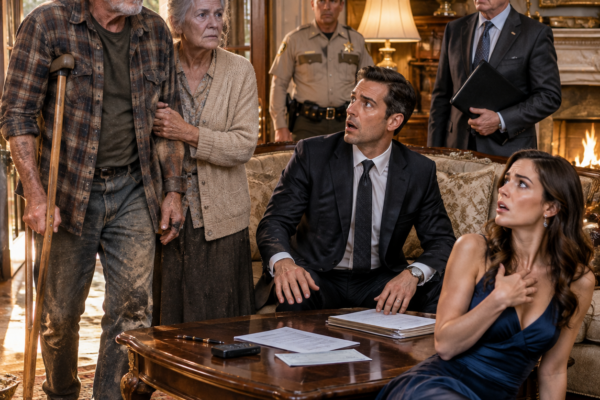
Part 1| Single Dad Hid His Navy SEAL Past as a Janitor—Until He Saved a CEO From Three Dangerous Men!

Part 1| Single Dad Hid His Navy SEAL Past as a Janitor—Until He Saved a CEO From Three Dangerous Men!

Let her go.
The words came from the last man anyone would have expected to challenge three strangers on the 41st floor. Marcus hailed the night janitor.
It was 2:17 in the morning at Polaris Health Systems. Elena Ward stood trapped between her desk and the wall of glass that overlooked downtown Chicago.
Rain streaked the window behind her.
The city below blurred into gold and gray smears. Three men had entered her office after midnight.
One guarded the door. Another stood beside a leather folder holding papers she had refused to sign.
The third blocked her only path to the hallway.
None of them had bothered to lower their voices.
Then the door opened and Marcus rolled in with a yellow cleaning cart, gray coveralls, and the tired expression everyone in the building had learned to ignore. Wrong floor, buddy.
One of the men said, leave now. Marcus looked at Elena.
Her face told him enough. Her jaw was tight.
Her hands were hidden behind her back and her eyes were doing something he recognized.
They were counting exits and finding none.
For 11 months, executives had walked past him without learning his name. They saw a mop, a cart, and a man earning an hourly wage while they talked about million dollar contracts.
They saw a uniform and nothing inside it. Nobody saw the 11 years he had spent in the Navy.
Nobody saw the training he had buried with his old uniforms.
And nobody knew why a former SEAL had chosen to disappear into the night shift.
Elena swallowed.
Marcus go, he didn’t move.
The fluorescent lights hummed above them. Saw some somewhere beyond the office, the elevator chimed into an empty hallway.
The sound was small and lonely and it carried further than it should have.
Marcus’s eyes moved once around the room, door, desk, window.
Three men, one frightened woman.
Old habits returned quietly like a tide coming in over sand. His breathing slowed, his shoulders loosened, his hands became very still.
Last chance, the man by the door warned.
Marcus rested one palm on the handle of the cleaning cart.
I’m not here for trouble.
The man smiled then walked away.
Marcus’s expression never changed.
I can’t do that.
12 hours earlier he had been asleep at his kitchen table.
A small hand tapped his shoulder.
Dad, Dad, you’re going to make me late.
Marcus lifted his head, his neck ached and a piece of toast sat on a paper towel beside his elbow.
Gray morning light slipped through the blinds of the apartment. The refrigerator hummed.
Down the hall a neighbor’s radio muttered the weather.
Lily already had her backpack on. The ponytail she had tied herself leaned noticeably to one side like a small flag in a crosswind.
You made breakfast, he asked.
For me, she said, you were sleeping. Marcus looked at the clock on the stove.
7:06 a.m.He had gotten home less than an hour earlier. He had meant to rest his eyes for a minute.
That minute had apparently turned into a long one. You should have woken me, kiddo.
I just did.
She pushed the toast closer.
Eat.
He smiled despite himself.
Lily had inherited her mother’s stubbornness.
And unfortunately for Marcus, she had also inherited her mother’s gift for winning arguments before he realized one had started.
He ate the toast.
It was slightly burned at one corner. It was the best thing he had tasted all week.
Her mother had died 4 years ago.
Marcus still reached for two coffee mugs some mornings before remembering. The apartment was small with a couch that sagged in the middle and a kitchen table that wobbled unless you slid a folded napkin beneath one leg.
But it was clean and it was warm and every wall held a piece of Lily. A crooked drawing of a lighthouse, a school photo with a missing front tooth, a list of rules for the household written in purple marker with rule number one underlined twice.
Dad must sleep. He fixed her ponytail at the front door.
She pretended to be annoyed.
He pretended not to notice that she held still the whole time. Outside the sky hung low over Chicago.
The rain had softened into a thin steady mist that beaded on the windshield of his old sedan. The wipers squeaked in a slow rhythm.
Buses sighed at the curb.
A man on the corner sold umbrellas from a cardboard box and nobody was buying.
On the drive to school Lily mentioned an assignment. She said it lightly.
The way people say things they have been carrying for a a while. Every kid has to do a presentation about what their parents do for work.
That sounds fun.
It’s a poster with pictures.
Marcus nodded. So, so, what are you going to tell them?
Lily watched the wet street slide past the passenger window.
Her breath fogged a small circle on the glass that my dad cleans offices at night.
That’s what I do, I know.
A pause followed.
The wipers swept once, twice.
A truck passed and its tires hissed against the pavement.
Then she she added, quieter now, a girl in my class said janitors are people who couldn’t become anything else.
Marcus kept his eyes on the road.
His hands stayed exactly where they were on the wheel, ten and two, steady as he had trained them to be. But something tightened in his chest, slow and deep like a rope pulled taut underwater.
Lily turned toward him. Her chin lifted just a little.
I told her she was wrong.
He did not answer right away. He could not.
A thousand quiet things moved through him at once.
Lily knew him as the man who packed her lunches and cut the crusts off her sandwiches without being asked. She knew him as the man who fixed loose bicycle chains in the hallway, who braided nothing well but tried anyway, who worked nights and sometimes fell asleep mid-sentence at the kitchen table.
She knew nothing about the locked box beneath his bed, nothing about the Navy SEAL trident resting inside it wrapped in a faded cloth, nothing about the photographs of men who never came home, their faces young and sunburned and laughing at some joke he could no longer remember.
He had buried all of it for her, not because he was ashamed, but because he wanted her to have a father instead of a ghost, a father who was home for dinner, a father who did not flinch at fireworks or sit with his back to the wall in restaurants, though he still did, sometimes, when he thought she wasn’t looking.
The school came into view, a red brick building with a flag drooping in the rain. Parents in raincoats guided children across the crosswalk.
A crossing guard in a bright vest waved them forward with tired patience. Marcus pulled to the curb and put the car in park.
The engine ticked.
For a moment, neither of them spoke. Then he turned in his seat and looked at his daughter fully, the way he looked at things that mattered.
Listen to me, kiddo.
She listened.
She always did when he used that tone. It was not a loud tone.
It was the one he saved for truths.
Be ashamed of honest work, not mine, not yours, not anyone’s.
Lily’s eyes searched his face.
A man who mops a floor so other people can walk across it safely is not smaller than the man who walks across it.
He is holding the building up in his own way.
You understand?
She thought about it with the full seriousness of a nine-year-old. So the girl was just wrong.
The girl was just wrong, Marcus said. Maybe someone taught her to be.
That’s not her fault, but you don’t have to believe it.
What if she says it again?
You tell her what I told you, and you don’t say it meanly.
You say it like you know it’s true.
Lily nodded slowly. The tension left her shoulders, and she leaned across the console and hugged him hard, her backpack bumping against the gear shift.
She smelled like toast and strawberry shampoo. Okay, dad.
Okay. She climbed out into the drizzle and turned back and tapped the window.
He rolled it down. Sleep today, she said.
Rule number one.
Yes, ma’am.
She grinned, spun around, and ran toward the doors with her ponytail swinging.
He watched until the heavy school door closed behind her. Only then did he let his hands drop from the steering wheel.
They were not quite steady. He drove home through gray streets, and the city rose around him in glass and steel.
In the distance stood the tower where he would spend the coming night, 41 floors of light and secrets, Polaris Health Systems.
Its logo glowed faintly even in daylight, a pale star against the clouds. He had never wanted that building to matter to him.
It was a job, paycheck, a place where nobody asked questions and nobody remembered his face. That was the point.
But somewhere on those upper floors was a woman who worked until dawn most nights, alone behind a wall of glass. He had seen her more than she knew.
Elena Ward, the CEO, whose father had built the company from nothing and whose grief still lingered in the office like a perfume nobody could name.
Marcus called her ma’am when he passed her in the hall.
She nodded back, distracted, already thinking of something else.
Neither of them knew yet how many hours remained before that nod would change everything. He parked outside his apartment and sat for a long moment in the quiet car.
Rain tapped the roof. The engine cooled.
Somewhere inside him, an old instinct stirred, faint but unmistakable. The same feeling he used to get before a mission turned.
He told himself it was only fatigue. He climbed the stairs, set an alarm, and lay down on the sagging couch.
Sleep came in pieces.
In the last gray moment before it took him, he thought of Lily’s small voice saying, I told her she was wrong.
He thought, with a warmth that hurt, that she had been braver at nine than he had ever been at 38.
Behind his closed eyes, the day moved forward toward night, toward the elevator, toward the 41st floor, toward a door he would open without knowing what waited behind it. He was just a janitor.
That was what everyone believed.
That was what he wanted them to believe.
But the habits of 11 years do not die. They only wait, patient and silent, for the one moment when someone else needs them more than he needs to hide.
A job doesn’t tell you what a person is worth, kiddo, he said.
It only tells you how they spend their hours. Lily considered that for a moment, chin tilted, the way she did when she was weighing a rule and deciding whether it deserved her respect.
Then she smiled.
Good, because that’s basically what I told her.
Marcus smiled back.
It was a small smile, tired at the edges, but it was real. Neither of them knew that before the next sunrise, an entire company would learn the same lesson.
Neither of them knew that the quiet janitor everyone overlooked would have to become the man he had spent years trying to leave behind.
After he dropped Lily at school, he stayed at the curb for four slow seconds. A line of impatient cars waited behind him.
Someone tapped a horn softly, almost apologetically.
He did not move yet.
He could still hear her voice, the girl who believed janitors were people who had never become anything else. Lily did not know that her father had finished some of the hardest military training on Earth.
She did not know he had learned another language for deployments.
She did not know about the nights he had crossed Blackwater or the years he had spent walking into places most people would never see on any map.
She did not know about the small metal box beneath his bed. Marcus had made a decision long ago in a hospital hallway that smelled of bleach and grief.
Being her father mattered more than being remembered as anything else.
So he had folded the old life into that box, locked it and slid it into the dark. He lifted his hand in apology to the car behind him.
Then he pulled away from the curb. That evening the rain had thinned to a fine gray mist by the time he reached Polaris Health Systems.
Chicago glowed wet and silver around the tower. The glass front of the building caught the street lights and bent them into long trembling ribbons.
It was just before 10:00.
The lobby was quiet, the marble floor polished to a dull shine, the air cool and faintly metallic. Walt Granger sat behind the security desk with his reading glasses balanced low on his nose.
A crossword lay folded beside a mug that had stopped steaming an hour ago.
At 61 Walt had spent 20 years in the Air Force before discovering that civilian security meant more paperwork and worse coffee. He was also one of the few people in the building who looked Marcus directly in the eyes.
That mattered more than Walt would ever know.
You look terrible, Hale, Walt said without looking up. Good evening to you too.
You sleeping at all? Sometimes.
Walt shook his head slowly, the way a man does when he has heard that answer too many times.
He pressed the button and the turnstile clicked open. Then he lowered his voice, though the lobby was empty.
Something strange is going on upstairs.
Marcus stopped beside his cleaning cart.
The wheels ticked once against the floor and went still.
Strange how? 39th floor went badge restricted this week.
My card quit working yesterday. Nobody bothered to explain why.
Marcus already knew.
His own maintenance access to that floor had died three nights earlier. He had noticed it the way he noticed everything, quietly and filed it away without comment.
Probably an internal audit, he said. Walt gave him a long skeptical look over the top of his glasses.
Audits don’t usually bring private contractors through my lobby after midnight.
Marcus kept his hand on the handle. His voice stayed easy.
Contractors, four of them, Sunday night, no company badges, no logos, nothing.
Gordon Price signed them in himself.
Marcus glanced toward the elevator’s brushed steel doors.
A dim reflection of a tired man in a gray uniform. Gordon Price had been the chief operating officer for almost two decades.
Men like that did not sign in visitors.
They had assistants for that.
They had people whose whole job was to make sure powerful men never touched anything as small as a clipboard.
Maybe he likes meeting new people, Marcus said.
Walt laughed, a dry rattle in his chest.
And maybe this coffee tastes good.
Does it? It tastes like regret, Hale.
Marcus almost smiled.
He nodded once and pushed the cart toward the elevators.
Behind him, Walt’s pen scratched at the crossword again, slower now.
The sound of a man who was no longer thinking about the puzzle. The doors opened with a soft chime.
Marcus rolled the cart inside and watched the numbers climb. For the next two hours, he followed the same routine he had followed for 11 months.
Trash, glass, restrooms, floors, quiet work performed after important people had gone home to their dinners and their sleep.
The building hummed around him, a low and steady breath of ventilation and distant machinery. Rain ticked against the windows in uneven bursts as if someone outside were testing the glass with a fingernail.
He worked with his head down.
That was the uniform’s real gift.
Nobody looks at a man pushing a mop. They look through him, past him, around him.
They say things in front of him they would never say in front of a camera. And yet Marcus noticed things.
He noticed because noticing had once kept people alive. 37th floor, he found a conference room that did not feel right.
Four chairs had been dragged to one end of the long table. A single chair faced them from the opposite side, alone, set squarely in the center.
It looked less like a meeting and more like a place where one person sat while others decided something about them. He straightened a trash bag and said nothing, but he stood there a moment longer than the job required.
On the 38th floor, he knelt to wipe beneath a cabinet and found a charger plugged into the wall, a neat white cord, ordinary in every way, except that beneath it, tucked out of sight, a second connection ran into the same outlet, thin, black, not part of any office he had ever cleaned.
A man who had never been trained to look would have called it clutter.
Marcus did not touch it.
He only let his eyes rest on it for two full breaths, memorizing the angle, the length, the way the cable curled toward the wall. Then he stood, wiped his hands, and moved on.
Near the north stairwell, he found the third thing.
It was a ceiling camera, one of the small white domes that watched the corridors like patient insects. He had passed beneath it every night for almost a year.
He knew its angle the way he knew the creek of his own kitchen floor.
Tonight it was wrong.
It had been turned slightly away from the freight elevator, 8° maybe, almost nothing.
Almost nothing was exactly the point. 8° was enough to carve a narrow blind spot into the hallway, a strip of floor where someone could step from the freight elevator to the stairwell door without ever appearing on a screen.
It was the kind of adjustment that only a person who understood cameras and understood why they mattered would think to make.
Marcus stood beneath it with a cleaning cloth in his hand.
The corridor was silent. A pale emergency light buzzed faintly at the far end, and the sound seemed louder than it should have been.
He felt the old awareness stir in his chest. It was not fear.
It had never been fear.
It was something colder and more patient, the quiet click of a mind returning to work after a long and dreamless sleep.
Not your problem, he whispered.
The words were barely a breath. He had repeated them for years in the dark, in the shower, in the long gray hours before dawn.
They were less a thought than a prayer.
See everything, touch nothing, go home to Lily.
He folded the cloth in his hand.
He told himself it was a security matter and that Walt would handle it or someone else would.
He told himself that a man with a nine-year-old daughter and a rent payment did not get to be curious, but he kept looking at the camera. Somewhere in the building, an air vent shifted inside.
Rain slid down the long window at the end of the hall in crooked, glittering lines.
And for a moment, Marcus saw his own reflection in the glass. Tired man in a gray uniform, shoulders slightly rounded, hands slightly too still.
A man who looked like nobody.
A man who had trained himself carefully and for a very long time to look like nobody. He drew a slow breath, set the cloth in the cart and wrapped his fingers around the handle once more.
Then he rolled the cart toward the elevator, the wheels whispering across the carpet, and pressed the button for the next floor up.
He continued upstairs at 11:43. Voices carried around the corner from the executive hallway.
Marcus recognized Gordon Price before he saw him.
The man’s voice had a polish to it, a smoothness like a stone worn down by money.
The board will understand what I tell them, Gordon said into his phone. He laughed once softly, the way a man laughs when he has already decided how a story ends.
Marcus kept his head down. He had a cloth in his hand and a section of wall in front of him, and he went on wiping.
A second set of footsteps followed several feet behind, heavier, slower, a broad-shouldered stranger in a dark coat and no Polaris identification clipped anywhere on him. Lanyard, no badge, nothing at all.
Marcus lowered his eyes and wiped the same stretch of wall twice.
Gordon passed without a glance. He never looked at Marcus.
11 months he never once had. The stranger did, half a second no more, a flat measuring look, the kind that weighs a man and files him away.
Him?
The stranger asked. Gordon barely turned his head, just the cleaner.
That was all, three words tossed over a shoulder like a gum wrapper. They kept walking toward the elevator.
Marcus stayed exactly where he was, cloth against the wall, shoulders soft, breathing even.
He stayed that way until the doors slid shut and the hum of the cabin faded down the shaft.
He lifted his eyes.
The camera above him angled wrong, the restricted floor below where strangers had signed in under Gordon’s name.
The empty hallway ahead, long and dim and listening.
For the first time in years, the old instinct inside him was no longer whispering. Something was wrong.
He folded the cloth once slowly and set it on the cart. Then he pushed on toward the executive floor.
At 11:50 that night, Marcus reached the top of the building and found Elena Ward still working behind the glass walls of her office.
was not unusual.
In 11 months he could count on one hand the times he had seen her leave before 10. She sat in a pool of lamplight, sleeves pushed to her elbows, a screen glowing against her face.
Behind her Chicago spread out in black glass and wet neon, rain tracing the windows in long patient lines.
At 34 Elena carried the weight of nearly 1,200 employees and a company her father had spent three decades building. She carried it alone.
Marcus had noticed something most executives probably never did.
She rarely ate a real dinner. Coffee cups mostly, a bag of almonds once, a cold sandwich left half unwrapped until morning.
He had noticed because noticing was what he did.
It was the one habit his old life had never let go of. Six weeks earlier he had been vacuuming outside her office near midnight.
Machine droned against the carpet. Then the door opened and Elena stood there, one hand lifted, waving for him to stop.
He switched off the vacuum. The silence rang.
Can I ask you something?
She had said, Yes, ma’am.
Do you ever take a break? He looked at her, unsure whether she was joking.
Executives did not usually ask. Around 3:00 in the morning she laughed, a soft surprised sound as if she had forgotten she could.
What do you eat at 3:00 in the morning? Whatever my daughter leaves in the refrigerator.
That answer changed her face.
Something in it loosened just slightly. You have a daughter, Lily.
She’s nine.
Elena leaned against the door frame.
She seemed to forget the file in her hand.
My father worked nights when I was little, she said.
He used to leave notes beside my breakfast so I would know he’d been thinking about me.
For a moment she was no longer the chief executive officer.
She was simply somebody’s daughter remembering a man she missed.
That sounds like a good father, Marcus said.
Elena looked toward the dark city beyond the windows.
Her reflection looked back at her, small against all that glass. He was, she said quietly.
I’m still trying figure out whether I can run this place without him.
Marcus said nothing. He had learned long ago that silence was sometimes more respectful than reassurance.
Anyone could say it will be fine.
Only a few people knew how to stand beside someone’s grief and simply let it be there.
Before she turned back to her desk, Alina had asked his name.
Marcus ma’am.
Marcus, she repeated as though testing the weight of it. Thank you for the vacuuming.
He had almost smiled at that.
The following night he found a granola bar on the reception desk.
A small yellow note was tucked beneath it, written in quick slanted handwriting.
For 3:00 in the morning. He stood looking at it for a long moment.
Then he put it in his pocket. Another appeared the night after, then another, always in the same spot, always with the same note.
Marcus never thanked her directly. It did not seem like the kind of kindness that wanted thanks.
But every wrapper disappeared before sunrise and every night he found himself glancing at that desk before he glanced at anything else.
He kept the notes, all of them.
They lived in a drawer at home beside Lily’s school drawings, where he told himself they didn’t mean anything.
Tonight there was no granola bar. The reception desk sat bare under a single down light.
Marcus noticed it the way he noticed everything.
He noticed too that Alina’s office door stood partly open and that the light inside had a crowded quality.
More shadows than a lamp and one woman should make.
Gordon Price was in there.
So were two men Marcus did not recognize. He slowed the cart without stopping.
A man who stops in a hallway is a man who wants to be seen stopping.
He let the wheels roll on, easy and unhurried, until he reached a tall steel cabinet near the wall, only a few strides from the open door. Then he took up his cloth and began wiping fingerprints from the polished metal, one slow stroke at a time.
The surface gave him back a curved, distorted view of the room.
Narrow slice of it enough. Alina stood behind her desk.
She had not sat down.
That told him something already. People who plan to be calm sit.
People who are holding the line stand.
$11 million, she said.
Her voice was level, but it was the level of a wire pulled tight.
Payments to vendors with no real offices authorized through operations. Signed off under accounts I never approved.
She drew a breath.
Explain it to me, Gordon.
You’re looking at incomplete records, Gordon replied.
His tone was warm, patient. It was the voice of a man humoring a child.
This is what happens when you review a quarter in the middle of the night, Elena. Numbers look strange without context.
I am the chief executive officer.
Each word fell like a stone onto glass.
There should not be records in this company that I am forbidden to see.
Marcus moved the cloth to the next section of steel.
His hand did not hurry. His heartbeat did not rise.
Those had been the first things they taught him years ago in another life.
Keep the hand slow when the mind is fast.
One of the two strangers shifted his weight.
Marcus watched him in the reflection. Hands loose, coat open, eyes drifting to the door, then the window, then the door again.
Not a man waiting for a meeting, a man waiting for an instruction.
The second one stood very still. That worried Marcus more.
Your father trusted people, Gordon said. He let the sentence hang a moment, soft and almost sorrowful, sometimes too much.
Elena’s chin lifted.
In the cabinet’s gleaming surface, Marcus saw her shoulders go rigid.
Do not, she said, and her voice hardened into something he had never heard from her before. Use my father to explain missing money.
The words cracked across the room. Nobody answered.
The rain tapped at the windows. Somewhere deep in the walls, a ventilation fan turned over, a low and tireless breath.
Marcus listened to the silent stretch. He knew that kind of silence.
He had lived inside it in dark places with other men in the last seconds before something broke. His fingers stopped moving on the cloth just for a moment.
In the steel, he watched Gordon Price straighten his cuffs, unhurried, almost graceful.
The smile slid off his face as smoothly as a coat being taken off.
What was left behind was flat and cold and entirely without apology. Gordon spoke again, and this time his voice dropped, quiet and careful, the way a man speaks when he no longer needs to pretend.
Sign the transition agreement, Gordon said. You keep your office.
You keep your stock.
You keep your father’s name on the building.
Marcus’s hand stayed still on the cloth for half a second.
He looked at the steel and kept his face blank. Everything, he thought, except control.
It was a generous offer. It was also a leash with a ribbon tied around it.
Elena answered at once.
Her voice did not shake.
Get out. Nobody moved.
Rain ticked against the tall windows, thin and steady, as if the whole city were counting. Somewhere behind the walls, the ventilation system exhaled a long, low breath.
The two strangers went first.
They stepped into the hallway without a word, their shoes silent on the carpet. Gordon followed, tugging at his jacket as though he had only come to discuss the quarterly numbers.
He did not look at Marcus.
None of them did.
That was the thing about the cart and the gray uniform.
People looked straight through it the way they looked through a coat rack. Marcus had spent a long time learning how to be that kind of furniture.
Tonight it was the most useful thing he owned. The elevator chimed, the doors slid shut, the floor settled into quiet.
Marcus went on cleaning.
He wiped the glass of the outer office, then the brass rail by the stairs, slow and even like any other night.
But his mind was no longer on the glass.
It was walking the building floor by floor, listing doors and corners and sightlines the way it always did when something felt wrong. Nearly an hour later, he came back for the trash.
The lights in the corner office were low. The desk lamp threw a small yellow circle across the carpet, and in that circle he found her.
Elena Ward sat on the floor beside her desk with her back against the wood, her shoes off, her feet tucked under her. A legal pad lay beside her, the page still blank.
The pen had rolled away.
She looked younger like that, not like the chief executive of Polaris Health Systems whose face stared out of magazines.
Just a tired woman in an expensive room holding up a building that had her father’s name on it.
Marcus paused in the doorway.
He knocked softly on the frame, though the door was already open. I can come back.
No, she did not lift her head right away.
Stay, please.
He stepped in and reached for the bin beside the desk.
Neither of them spoke for a moment.
The only sound was the rain and the faint electrical hum of a city that never fully slept.
How much did you hear? She asked.
Marcus could have lied.
A man in his position was supposed to.
I just empty the bins.
It would have been easy and it would have been safe and it would have kept him invisible. But he had stopped lying to people who were drowning a long time ago.
Enough, he said. Elena let out a breath that was almost a laugh.
She pressed the heel of her hand against one eye.
He is going to tell the board I am too inexperienced to lead this company.
That I am grieving, that I am not ready. She said the last word like something sour.
My father built this place from nothing and Gordon is going to take it from me by being kind about it. Marcus set the bin down.
He thought about the words he was about to say and about whether they were his to say. Then he said them anyway.
Then do not argue about whether you are experienced enough.
She looked up. Her eyes were red at the edges but sharp.
What?
That is an opinion, ma’am.
He can win an argument about opinions.
He has a room full of people who owe him favors.
He kept his voice level.
$11 million is not an opinion. Elena went completely still.
It is a number, he went on.
Numbers do not care who is grieving.
Numbers do not care who has been here longer. She stared at him.
Marcus kept his eyes on the bin then made himself lift them. He came here after midnight, he said, with two men who do not work in this building.
He offered you everything except access to the books.
A man who knows he is winning does not usually need that much pressure.
The room went so quiet that he could hear the tiny tick of the wall clock. Elena rose slowly.
She did it the way someone gets up after a hard fall, checking each part of herself before trusting it.
She stood barefoot on the carpet, looking at the man with the gray uniform and the quiet hands. Who are you, Marcus?
He picked up the bin.
The plastic handle was cool against his palm.
The man who cleans this floor, ma’am.
He turned and walked toward the hallway and Elena, watching him go, noticed something she had noticed before and never understood. When he had first come into her office tonight, before he said a word, his eyes had gone to the door, then to the window latch, then to the stairwell sign at the end of the hall.
He had checked every exit before he ever looked at her. She stood there a long time after he had gone.
Marcus pushed the cart toward the service elevator and told himself to keep moving.
You said too much, he thought.
You gave her more than you should have.
That is enough.
Clock out at 6:00, pick up Lily’s cereal, go home.
It was a good plan.
He had made worse ones and lived. The service elevator was slow and smelled of bleach and old metal.
He wrote it down in silence, watching the numbers fall. His reflection looked back at him from the brushed steel doors.
38 years old, a little gray at the temples, a man who looked like he belonged to no one’s story.
$11 million, the words would not leave him alone. At 12:48 the doors opened on the 39th floor and he went to check the stairwell.
He did it every night. It was routine, the kind of thing a janitor does when he wants to be sure the fire doors latch.
He stopped. A folded piece of cardboard had been wedged under the bottom of the fire door.
It was small and neat, cut to fit. It kept the latch from catching.
Anyone with a key card could walk in from the stairwell without ever tripping the lock.
Marcus crouched and studied it.
Then he stood, looked up and down the hallway and listened. Nothing moved.
The emergency lights hummed red at the far end.
He did not remove it.
He pulled it free, looked at the way it had been cut, then pushed it back exactly as he had found it. Same angle, same depth.
If someone came to check, they would find nothing disturbed.
That was the first rule of watching.
Do not let them know you are watching.
7 minutes later, on the landing between 38 and 37, he found a paper coffee cup.
It sat on the concrete step upright.
With the lid on, he reached out and touched the side with two fingers. Still warm.
There was no break room nearby, no vending machine, no reason on earth for anyone to stand in a cold stairwell after midnight drinking coffee, unless they were waiting, unless they were counting footsteps. Marcus straightened slowly.
The stairwell seemed to lean in around him.
He could hear his own breath and underneath it the distant drip of water in a pipe.
Someone was here 10 minutes ago, he thought, maybe less. He went down.
At 1:14 he entered the freight elevator lobby on the second basement level. It was a plain, ugly room, all gray concrete and yellow safety paint.
Pallets stood against one wall. A single fluorescent tube flickered over a fire equipment cabinet.
Beneath the cabinet, tucked into the shadow, sat a black nylon bag.
His first instinct was simple, keep walking. A man with a daughter and a rent payment did not need trouble.
The bag was not his. The building was not his.
Whatever war was starting upstairs belonged to people who could afford to lose it. His second instinct was older.
It lived somewhere beneath thought, in the part of him that had been trained in cold water and darkness and had never fully gone to sleep. Look closer, he crouched.
He did not touch it. The bag was clean, almost new, except along one corner there the fabric was scuffed and dull, the kind of wear that comes from being set down on rough concrete again and again, carried to an office, carried to a job.
It was not an executive’s laptop bag.
It was not maintenance equipment.
He knew what janitors carried.
He knew what executives carried.
He knew what this was.
Marcus closed his eyes. For a moment the freight lobby disappeared and he stood somewhere hot and loud and far away with sand in his teeth and a voice in his ear counting down.
He let the memory pass over him like a shadow and keep going.
Not your mission, he whispered. The word sounded thin in the empty room.
He opened the zipper.
The sound was small and terribly loud. Inside lay two sets of flexible restraints, coiled and bright.
A compact radio switched off, a roll of heavy gray tape. Each item had been placed with care.
Whoever packed this bag had done it before and had done it without hurry.
Beneath them lay a folded sheet of paper.
He eased it out and opened it on his knee.
It was a floor plan, printed clean and crisp.
He recognized it before he read the label, the long window wall, the conference table, the desk with the lamp, Vanessa’s office, Elena’s.
The name came to him as the room did, and it settled somewhere heavy in his chest.
Three positions had been marked in pencil, one near the entrance, one beside the conference table, one near the windows where she liked to stand and look at the river.
Three marks, three men. His breathing slowed, it always did when things got dangerous.
His heart went quiet and the world narrowed down to edges and distances.
It was not courage, it was only something his body remembered.
He had seen plans like this one before.
They were never for talking. Beneath the floor plan, something else lay flat against the bottom of the bag.
Two photographs, face down, their corners curled from the heat of a hand.
He turned the first one over, walking out of a coffee shop downtown two days ago.
Her coat was dark and her hair was pulled back. She held a paper cup in one hand and her phone in the other, and her head was turned slightly as if she had heard something behind her.
She had not seen the camera, she had never seen it.
Someone had been standing across the street, patient and still, watching her live her ordinary life.
His jaw tightened.
Two days, he thought. They have been watching her for two days.
The fluorescent light buzzed above him, rain drummed faintly on some distant roof.
Marcus sat very still on the cold concrete with the first photograph in his left hand and the second one beneath his right.
He did not want to turn it over. He had a feeling deep and cold and certain, the way a man feels the ice crack before he hears it.
Whatever was on the other side was not part of the plan for Elena. His fingers moved anyway.
The photograph came up slowly and the light fell across it.
A school gate, a brick wall with a painted sun, a line of children in bright coats.
Near the front, a small girl with a red backpack and a stubborn chin, glancing back over her shoulder at someone who was not in the frame.
Marcus stopped breathing.
He knew that backpack. He had bought it himself on sale in August.
Knew that chin.
It was Lily. Lily was standing outside her school in the same red backpack she had worn that morning.
The photograph had been taken from across the street, from a place where a grown man could stand for a long time without anyone asking why.
Marcus stared at it until every sound in the building fell away.
The fluorescent hum, the elevators ticking in their shafts, the ventilation breathing through the ceiling, all of it vanished beneath a single thought, cold and simple.
They knew his daughter. They knew her school.
They knew her gate.
They knew the way she carried her shoulders when she was pretending not to be nervous.
Somebody had stood on that sidewalk with a camera and watched a nine-year-old girl walk into the one place she was supposed to be safe.
His hands did not shake. That surprised him a little.
Years ago, they would not have shaken either. But years ago, he had not had anything this small and this precious to lose.
He slid the photograph back under the floor plan.
He folded the flap the way he had found it.
He checked the zipper, then the angle of the bag against the wall, then the dust on the floor beside it.
Every object returned to its exact place.
A man who is careful with small things is rarely sloppy with large ones. He walked into the utility room, shut the door, and pressed both palms flat against the cinder block.
Breathe in, hold, breathe out was an old rhythm. Four counts in, four counts held, four counts out.
It had once kept his head clear in places where everyone around him had forgotten how to breathe at all. Now it fought against the picture in his mind, crooked ponytail, red backpack.
A stubborn chin turned over one shoulder. Breathe in, hold, breathe out.
The rain tapped against the narrow window, steady and patient.
Somewhere far below, a train groaned along the elevated tracks. The world was going on as if nothing had changed.
That was the strangest part. Always was.
He took out his phone and called Walt Granger.
Walt picked up on the fourth ring.
His voice was thick with the particular boredom of a man who had spent too many nights watching empty hallways. Security, Walt.
Listen carefully.
Don’t ask questions yet.
A pause. The boredom drained out of it.
Okay.
Is Gordon Price still in the building?
Keys clicked. A chair creaked.
He badged out at 12:16, walked past my desk like I was part of the furniture. Has anyone come in since then?
The clicking stopped. Three visitor passes.
12:32.
Sponsored by Price, Walt’s voice changed then, lowered and sharpened.
Hail, what is happening?
Call the police. Tell them there may be an unlawful security situation on the executive floors.
Keep the main elevators downstairs if you can do it safely. Where are you?
39. Where is Mrs.Ward?
Marcus looked up at the ceiling, one floor above him, past concrete and steel and 100 ft of quiet wiring.
The chief executive of Polaris’s health systems was sitting alone in her office.
She was probably still staring at numbers that did not add up. She had no idea that three strangers had been given her building like a gift.
Her office, he said. Walt said nothing for a moment.
Marcus could hear him breathing slow and heavy.
Very quietly, Hail, who are you? Marcus looked once more at the photograph in his memory.
The small girl, the bright coat, the gate.
Tonight, he said, I’m the man who noticed.
He ended the call. He opened the utility room door and stepped into the hallway, and that was when he heard it.
A low mechanical groan deep in the shaft, the freight elevator waking up. Cables took up weight, gears turned.
Somebody was riding it, and they were rising.
He counted the seconds without meaning to. The car slowed.
The groan softened to a hum. Above the steel doors, the little number glowed and held.
39.
Chime.
No voices, no footsteps on the tile.
Whoever was inside knew enough to keep quiet, and quiet men were the dangerous kind. Marcus stood perfectly still, hidden in the shadow beside the supply closet, and watched the doors for a long, cold moment.
They did not open.
The car sat there humming as though it were listening back.
Then the number flickered.
It did not climb.
It dropped one floor too and settled somewhere below. Test, maybe.
A message sent to someone watching a screen, or a carefully timed pause before the real approach began. He did not like any of those answers.
Marcus turned toward the north stairwell instead of the executive hall.
Every old instinct in his body told him to run to her door.
He had the training for it. He had the hands for it.
He also knew what that confidence cost. It had buried better men than him in places with no names.
Rushing into a room because you could was not courage.
It was vanity wearing courage’s boots.
Information first, always information first. He used his maintenance key on a narrow gray door tucked behind the stairwell landing, and it opened onto a security closet no bigger than a coat room.
A single monitor glowed on a desk. A dusty keyboard waited under it.
He had cleaned this room a hundred times and had never once touched the screen. He touched it now.
The executive camera feeds blinked up one by one, the elevator lobby empty, the long corridor with its dark wood and its framed portraits empty.
Alina’s office, a glass box suspended above the city.
She was standing behind her desk, phone in one hand, the other hand pressed flat against her collarbone. She looked tired in a way that had nothing to do with the hour.
She looked like someone holding up a roof by herself.
Her father’s photograph sat beside her monitor.
Marcus had dusted that frame every night for two years.
He had never once said a word about it. He switched to the freight elevator camera and studied the angle.
The lens had been nudged.
Only a narrow slice of the floor outside the doors was visible.
Several feet of hallway beyond it simply did not exist on the recording.
Someone had made that blind spot with care, the way a locksmith leaves one pin loose. Anyone could step out of that elevator and walk straight into the dark without leaving a trace.
He called Walt again.
Police are coming, Walt said before Marcus could speak. 8 minutes they say.
Good, stay downstairs.
Don’t tell me to stay downstairs.
I did 20 years in the Air Force. Your left knee complains whenever it rains.
A long silence followed.
Walt said it’s unnecessarily personal.
Marcus almost smiled.
It surprised him how much he needed it. Lock the lobby.
Keep the elevators grounded if you can.
That matters more than coming up here. Walt let out a rough breath.
He knew it was true. He hated that it was true.
What exactly are you planning to do for 8 minutes?
On the screen, a shadow slid across the glass wall beside Alina’s office.
It was thin and quick and gone.
She did not turned. She had not seen it.
Marcus felt his heartbeat settle into something slow and flat and useful. Buy her eight minutes, he said.
He ended the call and slipped the phone into his pocket. Eight minutes, it did not sound like very much.
In a quiet building at 2:00 in the morning, it was an ocean. In the wrong hands, it could be a lifetime.
In the right ones, it was enough.
He stepped out of the closet and closed the door softly behind him. The hallway stretched ahead, lit by the pale emergency strips along the baseboards.
His cleaning cart waited near the supply closet where he had left it. One wheel turned slightly inward, the yellow bucket gleaming dully under the lights.
A mop leaned against the handle.
A bottle of glass cleaner sat in its holder. A gray rag hung over the rail.
Looked ridiculous, a man walking toward danger with a mop. Then he remembered exactly why it worked.
People saw categories before they saw human beings. A tailored suit meant authority.
A sidearm and a badge meant threat.
Gray coveralls and a yellow bucket meant nothing at all.
They meant furniture that happened to breathe.
In 11 years of service, he had learned how to disappear into jungles and deserts and the shadows of burning cities. In three years of mopping floors, he had learned something stranger.
The easiest place to hide was in plain sight, doing a job no one wanted to look at.
He wrapped both hands around the cart’s handle.
The plastic was cool and a little tacky from old cleaner. He rolled his shoulders once, loosening them.
He let the fatigue settle back into his posture, the slight stoop, the dragging step, the half-lowered eyes of a man who had learned not to be noticed. The janitor returned to his face like a coat he had worn for years.
Somewhere above, a single set of footsteps began to cross the carpet. Soft, measured, too careful to belong to anyone who had a right to be there.
Marcus began to push the cart toward the stairs. The wheels squeaked, the same little squeak they always made.
He did not fix it.
Tonight, that sound was the most honest lie he owned. Said he was tired.
It said he was harmless.
It said nobody in this building needed to worry about the man with the mop.
He climbed toward the 40th floor and then toward the 41st, one slow step at a time, listening to the rain and counting.
Seven minutes.
Marcus pushed the cart into the stairwell and lifted the front wheels over the lip of the first step.
He carried it up one flight, slowly the way a tired man carries anything he is paid to carry.
The concrete walls held the cold.
Somewhere above him, a pipe ticked as the rain drummed on the roof. At the landing, he set the cart down and rolled it through the door onto the 40th floor.
The squeak followed him into the executive hallway, one wheel, always the same wheel.
He let it.
The sound was a small, stubborn kind of cover, and he had learned long ago that the best cover was the thing nobody bothered to hear.
The carpet swallowed his boots.
The lights along the ceiling hummed at half power, throwing pale circles on the walls.
Rain streaked the glass at the far end of the corridor and turned the city into smears of gold and gray.
30 ft ahead, Elena’s office door was closed.
A line of light ran beneath it.
Behind the frosted glass, shapes moved.
A man’s voice came through, smooth and patient, the voice of someone who believed the outcome was already decided.
Sign the agreement, Ms.Ward.
Marcus did not slow. He did not speed up.
He kept the pace of a man at the end of a long shift, shoulders a little rounded, eyes on the floor. Elena answered.
Her voice was low and clear.
No, this does not need to become difficult.
Leave 20 ft. He counted the steps without meaning to.
It was a habit older than the janitor’s coveralls, older than his daughter, older than the quiet apartment on the north side.
11 years had taught his body to measure distance before his mind caught up. Another voice said something too low to understand.
A chair creaked.
Paper slid across wood, 10 ft. Elena spoke again, and this time the steel in her voice had cracked at the edges.
Move away from me. The old calm settled over Marcus like a coat he had hung up years ago and never quite thrown away.
It was not anger.
Anger was loud, and anger made men sloppy. This was something quieter, colder.
The hallway sharpened around him, the grain of the door, the reflection in glass, the gap beneath the frame where a shadow shifted its weight.
Door desk, three men, Alina, the exit behind him, police, several minutes away.
He thought of Lily, thought of her asleep somewhere across the city, one arm flung over her head the way she had slept since she was two.
She had no idea that a stranger had stood outside her school with a camera. She had no idea that the photograph was sitting in a bag on this very floor.
He had made a promise after leaving the Navy in a hospital corridor that smelled of bleach and loss. She would never inherit the fear he had carried home, not a drop of it.
5 ft.
Marcus put one hand on the office door and pushed it open with the cleaning cart.
The wheels rolled over the threshold.
The squeak filled the room. Four faces turned toward him.
One man stood near the entrance, broad through the chest, hands loose at his sides.
Another waited beside Alina’s desk with a folder open in front of him.
A pen laid across the pages like a small, polite weapon. The third stood near the windows, blocking her path, close enough that she had pressed her back against the glass.
Alina stood behind the desk.
Her blazer was rumpled. Her hair had slipped loose on one side.
Her chin was still lifted as it always was, the way her father’s had been in the portrait in the lobby.
But her eyes went wide when she saw him. Marcus, she said.
Leave.
He lowered his gaze as though embarrassed.
He let his shoulders sag.
He let the man at the door see exactly what he expected to see.
Sorry, ma’am.
Wrong floor. The man nearest him relaxed at once.
Marcus watched it happen.
The tension drained out of that thick neck and the hands loosened a little more.
In that man’s mind, the janitor had been weighed and filed.
You heard her, the man said.
Go. Marcus nodded slowly.
He reached for the cart handle. Then Alina spoke again so quietly that the words barely carried across the room.
Please.
Marcus stopped.
It was a small word.
It was the smallest word in the language, and he had heard it before in other rooms, in other voices, in places where the walls were made of mud and the sky was full of smoke. He knew exactly what it cost a person to say it.
He knew what it meant when someone who never asked for help asked for it anyway. At the door, frowned.
Keep moving, janitor.
Marcus raised his eyes. Something in his face had changed, though he could not have said what.
slope of his shoulders was gone. The apology was gone.
What remained was level and still and very patient.
Step away from her. His voice did not rise.
It did not need to. For one second, nobody spoke.
The lights hummed.
The rain ticked against the windows.
On the desk, a phone screen lit up and dimmed again.
Then the man laughed. It was a short, dry sound, the laugh of someone who had just been handed a joke.
Or what?
Marcus looked at Elena, then at the door behind him, then back at the man.
There does not need to be an or what.
A smile slid off the man’s face.
Far below, thin and distant, police sirens were beginning to climb toward the building. But up here, behind the glass and the carpet and 40 floors of silence, nobody could hear them yet.
All anyone could hear was the soft hum of the lights and the squeak of a yellow cleaning cart as Marcus eased it forward and set it between Elena and the three men. The man nearest him took one slow step.
He expected the janitor to retreat. Men like him always expected it.
They had spent their whole careers walking toward people who stepped back.
Marcus did not step back.
He only shifted the cart a few inches, adjusting the angle until the bulk of it, the bucket, the bins, the long handle of the mop sat squarely in the line between Elena and the rest of the room. It looked like nothing.
It looked like a man tidying up. But he had put a wall of plastic and steel where a wall had not been, and he had done it without lifting a hand.
Move, the man said.
I am asking you to leave. You are not in a position to ask.
Marcus said nothing.
He let the silence work.
It was an old trick.
Most people could not stand a silence that did not belong to them.
Elena stood perfectly still behind the desk. She had spent her career watching executives fight one another with lawyers and contracts and carefully chosen words.
She knew how power looked when it walked into a room. It wore good suits.
It spoke in long sentences. It filled the space around it.
Marcus carried none that gray coveralls, scuffed work boots, a name patch most people in this building had never bothered to read.
And yet his voice was quieter than everyone else’s, and somehow that changed the room.
The three men had come in expecting a woman alone and a deal to be closed.
Now they were standing in the middle of something they could not quite name, and it was shaped like a man with a mop. The second man closed the folder slowly.
Who is this guy?
Nobody, the first man answered. Marcus heard the word and almost smiled.
Nobody.
He had been nobody for 11 months, and it had been the most useful thing he had ever been. Nobody could clean outside closed offices without being noticed.
Nobody could stand in the corner of an elevator while senior executives said things they would never say in front of someone they considered important.
Nobody could empty a trash can and read the shredder bin and learn more than a surveillance team learned in a year. They had built his invisibility for him.
Every glance that slid past him, every careless word spoken over his head, every door held open without a thank you had been a brick in it. Tonight for the first time he was going to use it as a shield.
He did not look at the men. He kept his attention on them anyway, the way a man keeps his hand near a hot stove in the dark.
The one by the door, the one by the desk, the one by the window who had not moved and who was therefore the most dangerous of the three.
Marcus said, he had never said her first name aloud, not once in 11 months.
It had always been ma’am and Mrs.Ward on the rare days when he felt bold.
The name came out of him soft and steady, and he saw her blink at the sound of it.
He never took his eyes off the men.
Come stand behind me.
She hesitated.
Her fingers were curled against the edge of the desk, white at the knuckles.
Everything she had ever learned told her to stay where she was, to hold her ground, to never give a room the satisfaction of watching her step back. She had held her ground in boardrooms.
She had held it at her father’s funeral.
Please, Marcus said, was not an order.
It was not a plea.
It was something steadier than both, a hand held out in in dark. Something in his tone made her move.