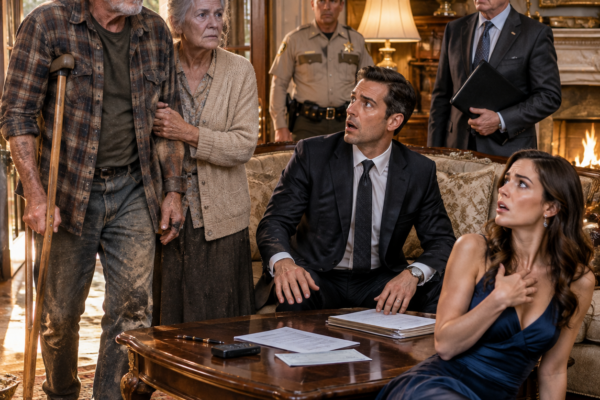
Part 2| Single Dad Hid His Navy SEAL Past as a Janitor—Until He Saved a CEO From Three Dangerous Men!

Part 2| Single Dad Hid His Navy SEAL Past as a Janitor—Until He Saved a CEO From Three Dangerous Men!

PART 2
She came around the corner of the desk in three quick steps, close enough that he felt the warmth of her sleeve against his arm. Her breath was shallow.
Her perfume was faint, something like cedar and rain.
He did not turn his head.
He simply let her slip behind his shoulder into the narrow shadow the cart and his body made together, and the room which a moment ago had belonged entirely to the three men held its breath. The man by the window shifted to cut her off.
Marcus rolled the cart a foot forward. It was a small movement, a janitor easing his work along, but it opened a lane between the desk and the glass, just wide enough for one person, and Elena saw it the moment he made it.
She slid through it. She crossed behind him, her shoes whispering over the carpet and stopped with her back almost against his.
No one shouted.
No one lunged. The room had gone quiet in the way a frozen lake goes quiet.
Every sound pressed flat under something heavy.
The first man reached for the cart.
Marcus turned it sideways slowly, almost lazily, and the man had to stop short or collide with a bucket of gray mop water. He stopped.
His jaw tightened.
The second man started toward the office door.
The cart’s other end now sat in the narrow path, the wheels locked at an angle, the handle in Marcus’s hand.
The man looked at it. Then he looked at the door which was suddenly farther away than it had been a moment ago.
Their confidence did not break. It curdled.
They had come prepared for a chief executive, a frightened woman, a locked office, a signature on a page.
They had not prepared for a night janitor who seemed to know exactly where everyone in the room ought to stand. Marcus knew it.
He kept his shoulders loose and his face tired and ordinary. The ordinary face was the best tool he had.
Take a breath, ma’am, he said quietly without looking back.
Slow eyes on the hallway. Walk when I tell you, not before.
Elena went still.
It was only a sentence, but the cadence of it, low and even with the little pause before the last words, touched something far back in her mind. Place she had not visited in years.
She felt it the way you feel a stare that isn’t there in the dark.
Her stomach dropped and she did not know why. She gripped the of his coveralls.
She did not decide to. Her fingers simply closed around the rough gray fabric and held.
The grip hit Marcus somewhere under the ribs.
It was the exact way Lily held his jacket in crowded parking lots. One small fist bunched in the cloth, trusting him to steer.
Nine years old, and she still did it, though she would have denied it under oath.
Something inside him settled.
His pulse slowed.
His hands, already steady, grew steadier. You military?
It was the third man who asked.
He had said nothing until now.
He was older than the others, lean with a patient face and eyes that did not wander.
And they were not on Marcus’s uniform.
That was what made the skin tighten along the back of Marcus’s neck.
They were on his feet, his stance, the measured distance he kept from the desk, from the door, from every pair of hands in the room.
This one had been trained. Marcus filed it away.
No, he said.
The man studied him for a long, flat second.
It was not an answer.
It was only the one he had been given. You have a daughter, the first man said.
He said it lightly, almost kindly, like a man mentioning the weather.
Marcus’s expression changed, so slightly that Elena, standing a breath away, nearly missed it.
A quiet shift around the eyes like a door closing somewhere deep in a house.
Blue backpack, the man went on. Elementary school, two blocks off the lake.
Pigtails, most mornings she likes to walk the last stretch alone. Elena inhaled sharply.
Her fingers dug into the fabric. Marcus did not move.
He did not blink.
Every sound in the room seemed to pull back from him, the hum of the vents, the tick of the rain on the glass, the low rattle of the cart’s wheels as it settled.
Do not talk about my daughter.
His voice was not louder. That was the thing.
It was softer.
It was so soft that the first man’s smile flickered just once before he caught it and pinned it back in place.
The man thought he had found leverage, a soft place to press. He had found the opposite because in that instant Marcus no longer had to wonder.
The photograph in the hidden bag, Lily on the sidewalk outside her school, her backpack slung over one shoulder, her face turned towards something out of frame.
It had not been an accident. It had not been a mistake.
Someone had stood on that sidewalk and watched his child and they had done it on purpose.
Cold settled over him, not rage.
Rage was loud and sloppy and got people killed. This was older and quieter.
It was the cold he had carried through 11 years of dark water and darker doors and he had spent years trying to put it down. It came back to his hand like a tool he had never really lost.
Here is what happens, the first man said. Easy again, you walk away.
You push your cart out that door and go home, be a father.
Marcus’s gaze moved, first to Elena’s white knuckles on his coveralls, then past her shoulder to the open hallway, the pale strip of emergency lighting, the long stretch of carpet leading to the secure reception area.
That’s exactly what I’m doing, he said.
For a heartbeat, nobody understood him. Far below a siren rose.
It came up through the glass, thin and wavering, a thread of sound threading between the buildings. It was faint.
It could have been headed anywhere, but in a room where every nerve was stretched tight, it landed like a dropped plate.
One of the men turned toward the window, another glanced at the door.
Their attention fractured only for a moment, half a second, maybe less.
But half a second was all Marcus had been building towards since the moment he rolled that cart through the doorway. Hallway, he said.
Elena moved. She did not run.
He had told her not to. She walked, her hand still wound in the back of his coveralls until she had to let go.
The cloth slipped from her fingers.
She stepped into the corridor and felt the air change, cooler, emptier, the stale air of the outer floor.
The men surged.
Marcus gave them nothing.
He pushed the cart a foot to the left. He stepped a half step to the right.
He let the bucket slosh, let the handle swing, let the whole clumsy, rattling apparatus of his trade come between the three of them and the woman in the hall.
He never struck. He never shoved.
He simply stood where they needed to be over and over like water finding every crack. Excuse me, he said once, almost apologetically, as the second man tried to slide past.
Wet floor.
The man’s boot hit the damp tile.
His foot skated. He caught the door frame, swearing under his breath.
Behind them, Elena kept walking. Marcus tracked her by the sound of her heels, the clicks growing fainter, then clearer as she reached the carpet of the reception area.
11 paces, 12. She was out of the line of sight of the office now.
He let himself breathe once.
Then the elevator chimed, a small, bright sound in the dark.
The indicator above the steel doors blinked to life.
40 41.
The doors slid open and the hallway filled with voices.
Boots on carpet, the crackle of radios, a hard commanding shout that rolled down the corridor like thunder. Police, stay where you are.
The three men froze.
Marcus did not wait to be told twice. He raised both hands, palms open, fingers spread, and stepped back from the cart in one smooth motion.
He kept his eyes down.
He kept his breathing slow.
A man in a gray uniform with a mop handle at his feet.
Nothing else about him mattered. Flashlights swept the room.
Officers poured in, weapons low, voices overlapping.
They took the three men to the carpet one by one. Zip ties rasped.
Someone read out rights in a flat, tired voice. The first man, the smiling one, did not smile anymore.
The third man, the patient one, looked back over his shoulder at Marcus as they hauled him up.
He did not say a word. He did not need to.
Marcus met the look. He held it.
Then it was gone, swallowed by the hallway.
Elena stood behind a line of uniforms near the reception desk, her coat sliding from one shoulder. She was staring at him.
She did not understand what she had just seen.
She replayed it and it refused to fit.
Three armed men had owned that office they had owned her.
Then a night janitor in a faded uniform had rolled in with a mop bucket and without throwing a single punch, without raising his voice above a murmur, Marcus Hale had taken the room away from them.
His hands were still up.
His face was still tired. And yet, an officer looked from Marcus to Elena and back again.
He was young, pale, a little out of breath.
He said, Who is he? Elena did not look away from Marcus.
I was hoping someone could tell me.
Detective Nora Quinn reached the 41st floor at 2:41 in the morning, and the first thing she noticed was that everyone kept looking at the janitor.
It was subtle. Officers glanced his way and then glanced off.
The two uniforms guarding the corridor angled their shoulders toward him without seeming to know they did it.
Even the building security staff clustered by the elevators kept their eyes drifting to the man in the gray coveralls like compass needles drifting north.
Quinn was 50 and tired and good at her job. She had worked enough scenes to know that the person everyone watched was rarely the one who had shouted loudest.
She took it in. The overturned chair in the executive suite.
The broken lock on a supply panel.
The three men seated on the floor against the far wall, handcuffs behind them, each one separated by an officer and a wall of silence. A blanket had been draped over the shoulders of a woman near reception.
Alina Ward, she sat very straight, her hands folded, her eyes red at the rims and furious at the center.
At the elevators, Walt Granger stood with his arms crossed and his weight set back on his heels. He was 61, broad through the chest, his gray hair flattened by a cap he had taken off in a hurry.
He was watching Marcus with something between concern and disbelief, the way a man watches a dog he has fed for years suddenly stand up and speak.
Quinn caught Walt’s eye.
He gave her a short, helpless shrug.
She crossed the carpet.
Marcus stood near the cart with his hands loose at his sides.
He had lowered them once the officers cleared him, but he had not moved far. His posture was easy, too easy.
A man who has stood in a lot of rooms where easy was the only thing keeping him alive.
Yes, ma’am.
His voice was low, polite, unhurried, a voice made for hallways at 3:00 in the morning.
It gave her nothing.
She flipped open a notebook, though she hardly needed it.
I’m told you discovered suspicious equipment on this floor earlier tonight.
You contacted building security and that you kept miss.
Ward safe until officers arrived, she looked up.
The rain ticked against the long black windows. Somewhere down the hall, a radio hissed and fell silent.
Marcus held her gaze, steady and unreadable, and waited to see what kind of detective she was.
That is what happened, Quinn said. Mostly.
But there is something your statement leaves out.
She tapped her pen once against the page.
You recognized the camera blind spot before building security did.
Marcus said nothing. The silence stretched.
Rain slid down the windows in long, crooked lines, and the city beyond them blurred into smears of gold and red. Quinn did not hurry.
She studied him the way a person studies a lock, patient, looking for the place where it would give. Most people mop around a turned camera, she said.
You noticed it. You timed it.
You walked the hallway twice to check the angle.
That is not a janitor’s habit.
She tilted her head. Military?
A long time ago. Which branch?
She hesitated.
Only a heartbeat, but she caught it.
Navy.
11 years. Across the room, Elena looked up from the glass of water someone had pressed into her hands.
She had been staring at the carpet.
Now she stared at him. In all the weeks she had passed him in the corridors, in all the nights she had worked late and heard the soft hum of his cart somewhere beyond her door, he had never told her that.
Once, she felt it settle in her chest, a strange, quiet ache, like finding a room in her own house she had never known was there. What did you do in the Navy, Mr.Hale?
Quinn asked.
Work I do not discuss, ma’am.
Quinn held his gaze for several long seconds.
He did not look away.
He did not look proud either. He simply looked like a man setting down a weight he had carried so long he had forgotten it was heavy.
Then she nodded. Fair enough.
She closed her notebook halfway.
We found the bag you described. It was exactly where you said.
The photographs are being processed now.
Something sharpened behind his eyes. It was small, but Elena saw it.
His whole body seemed to lean toward the next words before she spoke them. My daughter, he said, an officer is already heading to your address.
He did not wait for more. His hand went into his pocket and came out with his phone, and the screen lit his face a pale, cold blue.
Three missed calls, all from Margaret Doyle, the retired school teacher who sat with Lily whenever his shifts ran late, the woman who kept peppermints in her cardigan and a stern look for anyone who tried to skip dinner. She never called at night, not unless something was wrong.
He pressed the number it rang once.
Marcus, her voice was low, steady, stripped of its usual warmth.
Is Lily with you?
The floor seemed to tilt under him. No, she is with you.
She is.
She is right here a breath.
I did not want to say it on the message. Lock every door you hear me.
Stay away from the windows. His grip tightened until the phone creaked.
What happened? 20 minutes that ago someone came to the porch.
Marcus closed his eyes. Behind them he saw the narrow front steps, the porch light with its cracked cover, the little pot of dead geraniums Lily kept insisting she would revive by spring.
Margaret went on.
Good coat, clean shoes. He said there was a gas leak on the block and the utility company wanted everyone outside.
He had a clipboard.
He even had a badge on a lanyard.
Did you open the door? A pause dry as chalk.
I taught middle school for 32 years, Marcus.
I know what a lie sounds like when it has practiced in the mirror. Gas companies do not send men in good shoes at 3:00 in the morning.
In spite of everything, in spite of the cold knot twisting beneath his ribs, Marcus almost smiled. Where are you now?
Upstairs in Lily’s room.
She is next to me. I told her we were playing a quiet game.
Her voice cracked just a little, then mended itself.
The police just pulled up.
I can see the lights through the curtain. He let out a breath he felt he had been holding since the moment Lily had spoken that morning about the boy at school.
Stay with them, Margaret.
Do not open the door for anyone but a uniform.
I am coming home. I know you are.
He ended the call.
For a moment he stood still, the phone hanging from his fingers, listening to the rain and the distant tinny chatter of radios. Then he turned toward the elevators.
Quinn stepped beside him before he had taken three paces. We will take you.
I can find my own way.
I am sure you can.
Her tone was not unkind, but you are not driving alone tonight. Before he could answer an officer across the room called her name, low and urgent.
She crossed to him and the two spoke with their heads close. Marcus watched her face.
It was a hard face to read, but he had spent a lifetime reading people who did not want to be read. He saw her jaw set.
He saw her eyes flick toward him once, then away. She came back slower than she had left.
The vehicle parked outside your building, she said. Our patrol found it two blocks from your apartment.
Dark sedan, engine cold, no one inside, and it is registered to the corporate fleet.
Poloris. Elina stood so quickly the water spilled over her wrist.
That is impossible.
Apparently not, Quinn said.
Elina opened her mouth, then closed it.
Her eyes went distant, calculating, and Marcus could almost watch the thought move across her face. Fleet records, authorization codes, someone with a signature, someone with access, someone close.
Walt Granger had come up from the lobby in the last few minutes, still in his security jacket, his gray crew cut damp from the rain.
He lowered himself onto the arm of a couch with a grunt, folded his thick arms and said nothing, but his eyes never left Marcus. Marcus looked toward the three detained men.
They sat in a row along the far wall, wrists bound, officers standing over them. Two stared at the floor, the way hired men do when the money has stopped making sense.
The third did not. The third was watching him.
He was lean, 40s maybe, with the flat gray patience of someone who had waited in far worse places than this. Their eyes met across the room.
The man’s mouth moved, a faint, almost courteous curve, and he spoke a single word, quiet enough that only a few heard it.
Slade, Marcus stopped.
It was not a dramatic stop.
He did not flinch. He did not step back.
He simply ceased the way a clock ceases when the spring gives out.
The sound of the room dimmed around him.
The rain, the radios, the shuffle of boots on carpet, all of it fell away, and what was left was one thin, cold word.
Walt frowned and pushed himself off the couch. Hale, what does that mean?
Marcus did not answer. Elina watched him.
She had seen him stay calm while three strangers took over her office.
She had seen him stay calm when Quinn told him his daughter had been photographed outside her school.
She had thought in some distant corner of her mind that nothing could crack him. She saw the color leave his face in one slow, terrible draining.
Marcus, she said softly, who was Slade?
He turned toward the tall windows. Chicago spread beneath him, wet and glittery.
A thousand lit rooms where people slept without knowing how thin the walls were.
Somewhere out there, past the river and the dark water of the lake, was a small apartment with a cracked porch light.
Seventeen years collapsed in an instant.
A briefing room with no windows, a map pinned flat under fluorescent hum.
A folder of intelligence that looked clean, that looked right, that carried every mark of being true.
Leaning over it, tired and sunburned and sure, who trusted the plan because they trusted him, and he had trusted the source.
He heard the helicopter blades. He heard the radio go to static.
He heard the silence afterward, which was worse than any sound.
Four men had not come home.
Victor Slade had been a civilian then, an intelligence contractor, polished and soft-spoken, with the kind of friends who sat in rooms above Marcus’s pay grade.
He wore good suits on bases where nobody wore suits. He smiled easily.
He remembered your wife’s name.
Afterward, Marcus had written 43 pages, 43 pages of dates, sources, times, and the exact places where the information had been wrong. Wrong in ways that could not be accidents.
He had delivered them with hands that would not stop shaking, and he had believed with the stubborn faith of a man who still trusted the system that somebody would read them. Slade had denied everything.
Calmly, gracefully, he had even offered condolences. The inquiry closed without charges.
Marcus had stayed another year hollow, going through the motions.
Then his wife had fallen ill, and later she was gone, and a small girl with her mother’s eyes had needed someone to braid her hair and make pancakes on Sundays.
He had put the uniform in a box.
He had put the box in a closet.
He had built a quieter life out of night shifts and school lunches and the plain, steady work of keeping other people’s buildings clean.
He had believed the past was buried.
He had been wrong. Someone I knew, he said at last.
His voice came out rough as though it had to climb a long way to reach the surface. Before Lily was born.
Elena stepped closer, close enough that he could smell the faint trace of rain still caught in her hair. Is he behind this, Marcus?
He did not answer right away. He looked at the three men on the wall, at the officers, at the evidence bag being sealed and labeled, a plastic shell that held a photograph of his child in a yellow raincoat, walking out of school with her backpack hanging from one shoulder.
If Victor Slade knows where my daughter goes to school, he said slowly, then this was never only about your company.
The words hung there. No one moved, even Walt, who had never been short of something gruff to say, only let out a long, heavy breath through his nose.
Quinn studied Marcus a moment longer. Whatever she saw, she kept it to herself.
Then we move now, she said. The drive home felt longer than it should have.
The squad car hissed along wet streets, wipers sweeping, the dashboard glowing dull amber. Marcus sat in the back with his hands flat on his knees.
He did not speak.
He counted intersections. He watched the mirrors.
Old habits rose in him like water filling a hollow, and he let them because for the first time in years they were useful. By a quarter past 4 in the morning, he was sitting at his own kitchen table.
The apartment was small and warm and smelled faintly of toast and lavender soap. A single lamp burned over the stove.
Outside through the thin curtains, he could see the pulse of blue light from the patrol car rising and falling against the wall.
Two officers stood in the hall beyond the door, their voices muted, their shadows long under the frame. Margaret sat at the end of the table in her faded cardigan, her gray hair pinned loosely, a cup of tea going cold between her hands.
She had not let go of the cup since he walked in. Her eyes met his, and he saw in them everything she was too disciplined to say.
Lily sat beside him. She was wrapped in a blanket that was too big for her.
Her hair tangled from a sleep that had not lasted, her bare feet swinging above the floor.
She did not cry. She was a stubborn girl, and stubborn girls did not cry in front of other people.
But she had pressed herself against his arm so tightly that he could feel her heartbeat through the blanket, quick and light like a small bird caught in a hand. Dad, she whispered.
I’m right here, kiddo.
Mrs.Doyle said a man came to the door. I know.
She said he lied.
Lily lifted her eyes large and dark and far too watchful for nine years old.
Why would somebody lie to get into our house?
Marcus looked at her for a long time.
He thought of 43 pages in a drawer somewhere. He thought of a voice saying one word across a quiet room.
He thought of a closet at the back of this very apartment, a box on the top shelf that he had not opened in years. He put his arm around her and drew her close and he felt her small hand curl into the front of his work shirt.
I do not know yet, he said quietly. It was the truth and it was not the whole truth and he hated himself a little for the difference.
But I am going to find out.
Lily rested her head against his chest.
Her breathing slowed, then caught, then slowed again. Outside the blue light kept turning against the wall and beneath the sound of the rain, so faint that only a man trained to listen for it would have noticed, a car engine somewhere down the street turned over and began to idle.
Margaret Doyle had finally agreed to make coffee, though she refused to leave Lily alone for even a minute. She carried the kettle from the stove to the table and back again with the child always in sight like a woman guarding a candle in a draft.
Lily watched her father.
She sat very straight in the kitchen chair, her sneakers not quite touching the floor and she did not touch the cereal in front of her. Dad, she said, why were the police here?
Marcus had spent nine years protecting her from the part of his life that existed before she was born.
He had built a wall, brick by careful brick, and she had grown up safe behind it.
But the wall had a crack in it now and a man was out there in the dark leaning on it.
Silence no longer felt like protection.
It felt like leaving a door unlocked.
Because somebody from my past may be trying to scare us, he said. What past?
Marcus glanced at Margaret.
The older woman gave him the smallest nod, the kind a teacher gives a student who has finally decided to tell the truth.
He looked back at his daughter. I was in the Navy, kiddo.
That I was a Navy SEAL. Lily stared at him.
The kitchen clock ticked. Rain tapped at the window, softer now, nearly done.
Like the special operations guys?
Yes.
Her eyes went wide, then they narrowed because she was nine and stubborn and had been lied to by adults before.
You clean offices. Marcus almost laughed.
It rose in his chest and came out as a breath.
People can do more than one thing in a lifetime. Lily considered this.
She could see her turning it over, testing the weight of it the way she tested everything. Full 10 seconds passed.
The girl in my class is going to feel really stupid, she said at last.
Margaret covered a smile with her coffee cup. Her shoulders shook once.
Marcus leaned closer.
Listen to me. This is not something to brag about.
It is not who I am.
It is just something I used to do.
Lily nodded, but then her face changed.
She had seen something in his. It was the way his eyes went somewhere far away and stayed there too long.
She had seen it on certain nights when he thought she was asleep.
Did bad things happen? He could have said no.
It would have been easy.
Instead, he said the thing he had carried for 17 years. Some good people did not come home.
Lily reached across the table and took his hand.
Her fingers were small and cold and certain.
She did not ask another question. She only held on and Marcus let her.
And for a moment, the kitchen was the only place in the world.
At 6:30, Walt Granger pulled up in a borrowed sport utility vehicle with mud on its fenders and an address written on the back of a gas receipt.
He climbed out slowly, one hand on his lower back and looked the apartment building up and down like a man checking a perimeter. Hail, he said, my brother-in-law has a cabin up north, small place.
Maybe four acres of trees and a lake you can barely see from the porch.
He’s in Montana visiting family till the end of the month.
Who knows about it? Nobody at Polaris, nobody at all.
Walt tapped the receipt.
I haven’t even told my wife the whole story and she’s heard all my stories.
Marcus took the paper.
He did not thank him. Between them, thanks had never been the currency.
He only held Walt’s gaze a moment longer than necessary and Walt gave a short, gruff nod, the kind that said the debt, if there was one, had been paid in advance.
By sunrise, Lily and Margaret were inside the cabin, nearly 50 miles from downtown Chicago. It sat at the end of a gravel road that curled through bare oaks and pines, and the lake beyond it lay flat and gray as hammered tin.
from a neighbor’s chimney was the only thing moving.
place smelled of cedar and old wood smoke. There was a braided rug, a stone fireplace, and a bookshelf crowded with paperbacks gone soft at the corners.
Lily wandered through it with her backpack still on.
She touched the quilt on the couch.
She pressed her nose to the window.
It’s like a movie, she whispered.
Stay away from the windows, kiddo, Marcus said gently, just for now. She stepped back at once.
That was what frightened him most.
She did not argue.
She simply obeyed because somewhere in her small chest she understood that this was not a game. Marcus walked the cabin the way he had once walked a hundred other places.
Doors first, then windows, then the angles of approach, the long gravel road, the tree line, the dead ground behind the shed. He checked each latch with his thumb.
He found a rusted hatchet in the wood pile and carried it inside and set it near the back door without a word.
He did not like the stillness. Stillness was where things hid.
He had just tested the last window in the front room when he heard tires on gravel. Headlights swept the wall.
Everything in him went quiet. His breathing slowed.
His shoulders dropped half an inch.
He moved to the door without a sound and stepped onto the porch, pulling it shut behind him, and the cold bit through his work shirt. Dark sedan rolled to a stop beside the Souve.
The engine died.
The driver’s door opened and Alina Ward climbed out with a laptop bag over her shoulder, her coat wrinkled.
Her hair pulled back in the kind of hurry that meant she had not slept.
Marcus did not move from the top step. How did you find me?
Detective Quinn.
His expression tightened.
She did not give me that address.
She gave it to the officer who drove me here.
Alina climbed the porch steps and lifted the bag slightly as if it were proof of good intentions. Marcus, I found something.
You need to see it inside, please.
He looked past her down the empty road, at the trees, at the pale morning sky. Nothing moved, nothing but a crow lifting off a branch and settling again.
Inside, he agreed.
She sat up at the dining table, the laptop humming softly between a salt shaker and a stack of old magazines.
Margaret hovered near the kitchen doorway with a dish towel over her shoulder and Lily tucked beside her, both of them pretending not to listen.
Elena opened a series of company records.
Her fingers moved quickly, but he noticed they shook at the edges.
Polaris has been developing Helix for three years, she said.
It is a diagnostic system my father believed could change how hospitals identify certain conditions.
Early, before symptoms, he called it the last thing he would ever build. She swallowed.
The entire code repository was copied again and again over the last four months.
Not once, repeatedly, always at night. Marcus bent closer.
He read the dates, he read the access logs.
Timestamps in the small hours, long after the building had emptied.
Hours when only a janitor and a guard were supposed to be walking its halls.
Who had access? Gordon, three senior engineers, she hesitated, and one outside security consultant.
She turned the screen toward him. The name sat at the top of the vendor page in clean, expensive letters.
Slade Strategic Advisory.
Beneath it, a principal contact listed only by initials.
VS Marcus stopped breathing. It was a different name, a fresh coat of paint, a polished lobby, a logo meant to look trustworthy.
But the initials were not different.
They had never been different. They had been burned into his memory in a hot, dark place 17 years ago.
Elena kept going, her voice careful as if she sensed the floor changing under her.
The payments to his firm went through one of the same shell vendors tied to the missing $11 million.
Marcus looked at the screen for a long moment.
The cabin was so quiet he could hear the refrigerator humming in the kitchen. Victor Slade, he said.
Elena turned.
You know him? I knew what he was 17 years ago.
He told her only what mattered.
He kept his voice flat because flat was the only way he could say it at all.
Slade had supplied intelligence for a military operation.
The information was wrong.
Not mistaken, he said. Wrong in a way that felt chosen.
11 people died across the operation and the terrible days that followed.
Marcus had filed a formal statement afterward, naming Slade again and again, line after line, in careful official language that could not hold the weight of what it described. Inquiry followed.
Slade denied everything.
Lawyers arrived in pressed suits and nothing Marcus could prove was enough to hold him responsible.
And then he disappeared, Marcus said. Elena shook her head slowly.
He changed industries. Her fingers returned to the keyboard.
Numbers filled the screen, neat columns, invoice after invoice.
His firm has billed Polaris almost $2 million since last year.
For security advisory work, my father would never have hired him.
Gordon signed everyone.
Marcus said nothing. Behind him, he felt Margaret go still.
He felt Lily’s eyes on his back, curious and frightened both.
Something moved across Elena’s face then, a flicker quick as a bird’s shadow.
She was looking at him, not at the screen. Her gaze dropped to his hands, then rose again.
She opened her mouth as if to ask something and closed it.
He knew that look.
He had seen it in the elevator and again in the corridor on the 41st floor when he had spoken a few quiet words to steady her.
She was reaching for a memory and it kept sliding out of her grip.
He turned away before she could catch it. The phone buzzed in his pocket.
It was a flat, ugly vibration against his hip.
He drew it out. The screen showed no name and no number, only a string of blank digits, cold as a locked door.
Elena saw his face and went pale.
Marcus.
He lifted a hand, a small gesture enough to stop her.
Lily had gone silent at the kitchen doorway.
Margaret’s fingers closed on her shoulder.
Marcus answered. He did not speak.
He pressed the phone to his ear and listened to the line, to the faint hiss, to the shape of a room on the other end.
A big room, carpeted, quiet, a room where nobody was ever in a hurry.
Then the voice came through. It was older now, a little rougher at the edges, a little softer in the vowels.
The voice of a man who had spent 17 years learning to sound harmless. But it was unmistakable.
He would have known it in the dark. He have known it in his sleep.
17 years Ethan.
The wrong name, a mockery. Marcus says nothing and across the table Elena saw his jaw harden, saw the stillness settle over him like cold water over stone.
Slade she mouthed. On the other end the voice laughed softly.
You spent all that time hiding behind a mop and somehow I still found you.
Marcus did not answer that.
He pushed back from the table and walked toward the window, his steps slow, his shoulders loose.
Anyone watching would have thought he was stretching his legs. Elena knew better.
She had learned in a few short nights that his calm was never the absence of anger. It was anger kept on a short leash.
Stay away from my daughter, he said. Your daughter was never the business.
Slade sounded almost bored.
Helix is worth hundreds of millions.
You were simply an unexpected complication.
Marcus looked back across the cabin.
Lily lay curled on the old couch, one sock half off, her cheek pressed into Margaret’s knitted blanket.
Her breathing was slow and even. A strand of hair had fallen across her mouth and lifted a little with every breath.
Why photograph her silence?
It stretched down the line long enough that Elena heard the cabin settle around them.
A pipe ticked in the wall. Somewhere outside a bird tried a single note and stopped.
Then Slade answered and his voice was smooth again because even disciplined men need a reason to stay out of the way. There it was, not a lie, worse, a plain admission spoken like a business term.
Marcus’s voice stayed quiet.
You still make the same mistake. Which one?
Marcus’s eyes moved to Elena’s laptop.
The payment records glowed on the screen, row after row of shell vendors and clean tidy numbers. 17 years of unfinished truth sat in front of him at last and it looked so ordinary.
Just figures, just dates. You think fear makes people obedient.
Slade said nothing.
The silence on the phone had weight now. It felt like a man waiting, like a man who expected the soldier from his memory to step forward.
He wanted the angry one. He wanted the one who would shout and make a mistake and hand him the advantage.
Marcus did not give him that.
You want Helix, he said. You want Elena blamed for losing it.
You want Gordon Price to stand in front of the board and say she was too inexperienced to protect her own company. Elena looked up sharply.
Hearing it aloud in that level voice made it real.
Her father’s name was on the lobby wall.
Her father’s years were inside that technology.
Someone had planned to hang the loss around her neck like a stone.
Slade gave a quiet laugh.
Still putting pieces together faster than everyone else. Not everyone, Marcus said.
Elena found the money. The laughter ended.
It did not fade.
It stopped, cut off cleanly. And in that small gap, Elena heard something she had never heard from Victor Slade in any of the stories.
She heard a man recalculating.
And you left too many records, Marcus continued. Records disappear, not anymore.
Elena was already moving. She understood before he finished the sentence.
Her hands found the keys and the sound of typing filled the cabin, quick and sharp as rain on a tin roof.
She gathered the payment files first, the access logs, the repository records, the vendor contracts with their forged signatures. She wrapped them into one encrypted package and checked the seal twice.
She sent the first copy to Detective Nora Quinn.
She sent the second to Polaris’s outside counsel, a woman her father had trusted for 20 years.
She sent the third to two independent members of the board, people who had never once been invited to Gordon’s dinners.
Slade heard it. Of course he did.
The keyboard clattered through the phone like small gunfire. What are you doing?
Making sure the truth has more than one address, Elena said. She was surprised by her own voice.
It did not shake for months. She had felt like a woman standing on a floor that was slowly being sawed away beneath her.
She felt the boards under her feet, solid in hers.
Slade tone hardened.
You have no idea who you are dealing with. Marcus turned his gaze to the window.
Beyond the glass, the quiet trees stood close around the cabin, dark trunks and dripping leaves.
The lake lay somewhere beyond them, pale and still. Morning light was beginning to slide across the wet grass, thin and gold, touching one blade at a time.
That line worked better 17 years ago, he said. Elena almost smiled.
Almost she pressed her fingers against her lips instead and held the laugh in.
Slade tried another approach. Marcus had expected that men like him always had a second door.
Stay at the cabin until Friday, Slade said, and now he sounded reasonable, even kind.
Keep your daughter safe. Let the company solve its own problems.
By the weekend this will be over and nobody you love will be touched.
It was a good offer. Marcus could admit that it was clean and quiet and it asked for so little.
Just stillness. Just one week of looking away.
He glanced toward Lily. She had rolled onto her side and her hand had come out from under the blanket, small and open, resting on the cushion like she was waiting for someone to hold it.
Years ago, every major decision in his life had started with the same question.
What keeps Lily safe? Once that question had made him walk away from the Navy, from the only brotherhood he had ever known, from the man he had been, he had paid that price gladly.
But he understood something now that he had not understood then.
Hiding was not the same as keeping her safe.
It only taught her that fear gets to choose.
No, Marcus said. A pause.
Used to understand missions. I understand them better now.
His voice did not rise.
It did not need to.
A mission is not revenge. It is bringing people home, he ended the call.
The cabin went very still.
Elena let out a breath she had been holding for what felt like minutes.
Marcus set the phone on the windowsill and stood there, one hand flat against the frame, looking at nothing.
Are you all right?
she asked softly.
Ask me tomorrow.
It was not an answer.
It was more honest than one. 9:30 that morning, Detective Quinn had what she needed.
Elena had never seen a police officer move so quickly without raising her voice. Quinn read the files twice, called a judge she trusted, and by the time the coffee in the cabin had gone cold, the additional warrants were signed.
At the Polaris Tower, the board meeting was set for 10. The long glass room on the top floor had been prepared for it.
Water glasses lined up, leather chairs squared to the table.
Gordon Price arrived at the elevator in a charcoal suit, folder under his arm, smiling the way he always smiled, as though the building had been built to hold the door for him. He never reached the boardroom.
Two officers met him in the corridor, and behind them stood a man from the district attorney’s office.
The folder in Gordon’s hand was very thin, Elena would later think.
A man carrying a lie always seemed to carry so little.
The records did the rest. His authorization credentials appeared again and again on the approvals for the shell vendors, each one stamped, each one dated, each one signed in the careful hands of someone who believed nobody would ever look.
The security logs told the other half.
Slade’s contractors had moved through restricted areas of the building on nights when the cameras had been conveniently turned to face the wall.
Slade had expected Elena to be alone. That was the heart of his plan.
Isolate her, frighten her, make her small, a lonely woman in a tall tower with no one to call.
Instead, every document he had tried to bury was moving through channels he could not touch. Detective, a lawyer, two board members who read their messages carefully and did not scare easily.
The truth had become a river with too many branches to dam.
The final break came from someone no one had thought to count.
Walt Granger sat in the security office on the ground floor, paper cup of bad coffee going cold beside his keyboard. He had been on shift since dusk.
He should have gone home hours ago.
He had not.
Something in him, some old habit from his Air Force years, would not let him sleep while a thing was left half done.
He had a nickname for the visitor archive.
He called it the attic.
Nobody opened it.
Nobody cared about last year’s sign-in sheets, the temporary badges, the consultants who came and went with their leather bags and their polite smiles.
Walt cared.
He scrolled slowly, one name at a time, his reading glasses sliding down his nose. He did not hurry.
Hurrying was how a man missed things. He had told Marcus that once over a thermos on a slow night, and Marcus had nodded like it was wisdom.
Then he stopped. A consulting alias, a name he had seen before, signed twice under slightly different handwriting.
He leaned closer. He pulled up the badge photo, grainy and dim, taken by a lobby camera that had never been The face was older than the one Marcus described.
The hair was grayer, but the eyes were the same, flat and patient, the eyes of someone who counted exits when he entered a room.
Victor Slade had walked through the front doors of Polaris once, twice.
Walt checked the dates and his coffee hand went still.
The first visit matched the week of the first unauthorized copy of Helix.
The second matched the week someone had stood outside Lily’s school with a camera.
Walt set down his cup very carefully as though it might break. For a long moment he only sat there, listening to the hum of the monitors and the old building breathing around him.
Then he picked up the phone.
By afternoon the investigators found Victor Slade in a private office south of Chicago on the ninth floor of a glass building that looked like every other glass building.
The blinds were drawn.
The rain had finally thinned to a gray mist. Slade had not run.
Men like him never did. They believed the door would always open for them.
It was not quite over though.
Marcus knew that the moment Detective Nora Quinn called him.
She told him Slade had asked for one thing before he surrendered.
The last word face-to-face in the parking lot. Marcus stood across the asphalt beside her, hands loose at his sides.
His pulse was slow and steady.
It always was when it mattered. Federal agents moved in a tight line.
Slade walked between them in a charcoal coat, unhurried, a man leaving a meeting that had run long.
His hand twitched toward his sleeve.
Marcus saw it before anyone else did, a small thing, a shift in the shoulder. He did not reach for a weapon, did not need to.
He stepped forward, said one quiet word and said it the way he had once said it in the dark to frighten people.
Don’t.
Slade froze. Two agents had him by the arms before the sleeve opened.
A small black device clattered onto the pavement and skidded under a car. The lot went silent.
Water dripped from a gutter somewhere above.
Marcus could have closed the distance in three strides. Years ago he would have.
He felt that old polarize in his chest, the one that wanted an ending written in blood.
For one long breath he let himself feel it, then he let it go.
Slade was pulled upright. His polished mask had slipped, and what showed beneath was small and tired.
He looked across the lot and his eyes found Marcus. You could have stopped me yourself, Slade called.
Marcus said nothing. Slade smiled, bitter and thin, the old Marcus would have.
This time Marcus answered.
His voice was low and it carried. The old Marcus thought finishing the mission meant defeating somebody.
Slade waited for once.
He had no clever reply.
I learned better.
The car door closed.
The sound was soft and final. Marcus turned away before the vehicle pulled out because Slade no longer deserved his attention.
He found that he was breathing easily as though a weight he had carried for years had simply been set down. Quinn stepped beside him.
She did not say well done.
She only nodded once, the way a fair person does.
The evidence will hold, she said. Every page of it.
I know, Marcus said.
Elena made sure. Gordon Price was arrested that same evening in a restaurant with a napkin still tucked in his collar.
The board had already voted him out. The shell accounts were traced.
The $11 million began at Long Road Home. Three weeks later, Polaris Health Systems held an all company meeting in the main atrium.
Hundreds of employees filled the floor and the balconies above. The glass walls glowed with clean morning light.
Somewhere near the back, a child laughed and a few people smiled without knowing why.
Elena stood at the front in a simple dark suit.
She looked tired in the honest way of someone who had finally stopped pretending.
Her father’s portrait hung behind her.
For the first time in months, she did not look away from it. She told them the company had survived.
She told them it had not been the lawyers or the executives or the money. It had survived because people others overlooked had chosen to pay attention.
Then she said his name, Marcus Hale. Marcus stayed near the back wall in a clean blue shirt he had ironed twice.
Every eye turned toward him.
He felt them like heat on his skin.
He would have preferred a locked door and a long dark hallway.
Walt, standing beside him in his best uniform, gave him a firm nudge.
Go on, Hale.
Nobody’s going to bite.
You sure? Mostly.
Marcus walked forward.
The applause began slowly, then grew until it filled the whole atrium.
Elena waited until it faded, then she spoke more quietly for him alone.
Years ago, a young aid volunteer was pulled out of a hostage site by a masked man who told her calmly that she was going to be all right. She never learned his name.
She carried his voice with her for a very long time. Marcus felt his throat tighten.
At the night you led me out of my office, she said, I just was not ready to believe it.
Thank you, Marcus, for then.
For now, he could not speak. He only nodded, and it was enough.
She offered him the position of head of corporate security.
He listened to every word, and then he told her he would accept on one condition.
I need my afternoons free, he said, when my daughter needs me.
Elena smiled, and it reached her eyes. That is not a condition, Marcus.
That is a priority.
The following Friday, Marcus sat in the back row of Lily’s classroom.
The chair was too small. His knees nearly touched his chest.
The room smelled of crayons, floor wax, and rain on windows.
Margaret Doyle sat beside him, hands folded, a quiet look of pride on her face. Its other side, a little stiff and a little nervous, sat Elena.
She had asked to come.
She had said she would not miss it.
Lily stood at the front, holding her poster with both hands.
Across the top in large blue letters, she had written, My dad is a janitor. A few children shifted in their seats.
Marcus felt his heartbeat in his ears. A boy near the front raised his hand, but Lily, your dad was a Navy SEAL.
The room held its breath.
Lily looked past the boy, past the rows of desks, straight at her father. She did not hesitate.
She never did. That is something he did, she said.
She smiled wide and certain.
Being my dad is who he is.
No one laughed. No one whispered.
A small, stunned quiet settled over the room, soft as snow. Marcus lowered his eyes.
He pressed his lips together and fought the tears, and he lost. They slipped down anyway.
Beside him, Elena reached over and rested her hand on his arm, light and steady, and she did not say a a word.
He had spent years believing that dignity meant carrying the past in silence. Lily had just shown him something better.
Dignity was knowing that the most important thing about a man was not the uniform he once wore, the title on his office door, or whether the world ever recognized his strength.
It was who he chose to protect when nobody was watching. For a few quiet seconds, the entire