Part 3: What Was Behind the Hatch in the $1 Carousel?
She came over it a minute before the water did.
Its under now, a foot and rising. Dana stood on the bottom step with the water running off her.
She did not look at her brother. She looked at the open and the long cedar room, and her mouth shook, and she said, I didnt know it was this.
No, said Harold.
I didnt, either. She came down the aisle between the quilted shapes to the last rack in the second row.
She unwrapped the dish towel.
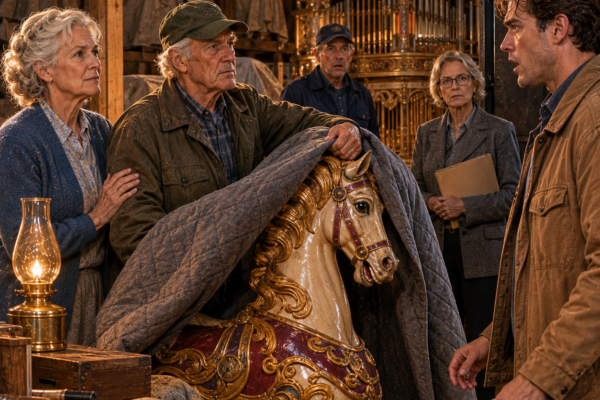
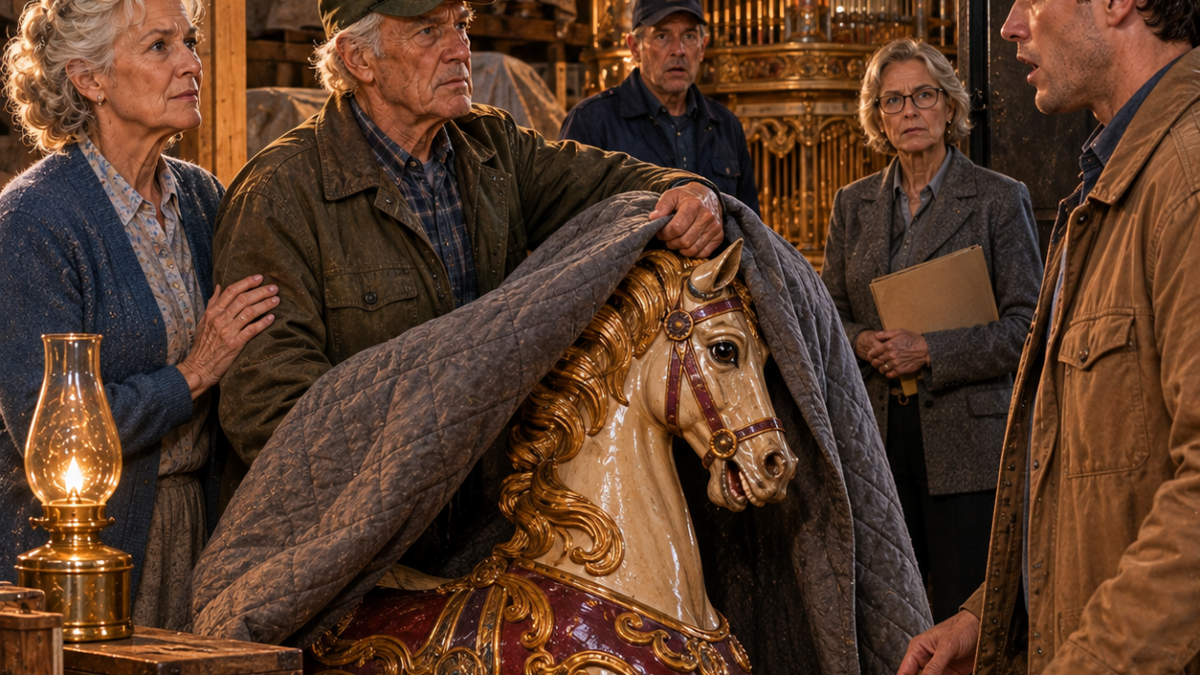
Inside lay a small carved horse, no bigger than a spaniel, leaping with its four legs tucked and a chip out of one ear, painted cream and plum.
She set it on the bare quilt gently and stepped back. Then she took from her sweatshirt pocket a second thing, a little pine horse, no longer than a mans hand, worn smooth as soap, and held it out to her mother.
I took it out of the box before the car turned around, Dana said.
Ive had it in my pocket for 2 weeks. I kept it from Garrett, and I kept the other one from Dad, and I kept being quiet, and Im so sorry.
I thought if I said anything out loud, it would all fall in. Bee closed her hand over the little horse.
She did not say anything.
She put her other arm around her daughter, soaked as she was, and held on. You didnt swear, Harold said, over the top of Danas wet head.
You were quiet too long, but you didnt swear. Dad, come in out of the rain, said Harold, and that was all, and it was a great deal.
At half past 4:00, the tunnel door, which Duncan had sandbagged on Friday, gave a long wet groan and began to leak. By 5:00, Kyle had gone up to look and come back to say the track was a creek, and the bridge was gone from sight.
Judith Sedan stood in a foot of brown water.
Tamaras phone found no signal on any step.
Volker was sitting on the bottom stair with his briefcase between his feet, and he said to no one that he supposed he was not going home tonight. There were nine people in the organ room that evening, and a pony in the vault.
It was 18 ft by 14, built for one man and a clock, and they sat on the floor and the stairs and the cedar racks, and nobody minded. The wind went over the hill like a train, and the hatch above them boomed once and held.
Bee had her coffee, Duncan had soup in the thermos and four pears, and Judith produced from her bag a roll of mints she had been hoarding since Monday. They shared it all out in paper cups.
Water came in under the creek door in a slow silver thread and Duncan put his boot against it and said very calmly that it would find its level and stop at the third brick as it had always known to.
At 20 past 7:00 by Harolds watch, the lever on the clock released with a small bright click.
The organ drew its breath.
Out of the brass came a waltz, swinging and slow with the bell and the drum under it. And in the closed room under the roaring hill, it was not faint at all, but huge and golden filling the brick to the vault.
Over the waves, Tamara put her hand to her mouth.
Kyle Brannigan, who poured concrete, took off his cap again. Garrett sat against the wall with his knees drawn up and his head against the cold brick.
And Harold watched his sons face change as the music went round him.
When the last note had faded, Harold reached into his jacket and took out his fathers letter. He crossed the room and put it into Garretts hand.
Read it, he said.
Theres a line about you. Garrett read it by the lamp slowly, his lips moving a little.
He read it twice.
He folded it and held it a while and then he said so quietly that only his father heard, He knew me better than I did.
He did, said Harold. He loved you anyway.
They tend to. Nobody slept much.
But toward midnight, the wind dropped and the rain softened to a long tapping and Judith, who had found a yellow legal pad in her bag, wrote down by lamplight what everyone could live with.
Harold said what he wanted and she wrote it.
And Garrett, without being asked, added to it.
$61,400 would come back to his parents by Monday with interest.
The pickup, the phones, the albums, the brass key ring, his own house, and the half-built dome would be sold to pay the guarantee, and Garrett would work and be poor and learn to like it. The sale of the park would stand because Harold would not unmake what he had signed, but Meadowgate would bend its road around the creek, and every Saturday for a year Garrett would take tickets at the gate of the carousel, and any child who could not pay would ride free.
Round and round, said Garrett, looking at the paper, and room for everyone.
Harold looked at him. I read it on the underside of the hatch, said his son, on the way down.
I was reading it before I knew I was.
The morning came up clear and washed and cold, with the creek brown and shining and fallen back to its banks. They climbed out one by one into the gold.
The pavilion roof had held, though the cupola leaned. The maples were stripped half bare.
Down at the bridge the old stone deck came back out of the water, black and dripping, with a single plank across it, and Garrett walked down to it alone in the long light and stood there a while.
A man in a camel jacket looking at a river. Harold watched him from the platform.
He did not call him back, and he did not shut the door.
By spring there was a new roof on the pavilion.
It was Penroses money that did it, a good price for eight of the horses paid by a museum that would keep them in a glass hall and say Pennock on the card. The other 23 Harold kept, and the jumper with the chipped ear, and the two swan chariots, and he set them on the platform himself, one by one, with Duncan at the other end of the rope.
The old pine horses went on the inner row because Harold would not hear of retiring them.
Dapple stood in the gate in a new halter with the brass plate polished taking apples from children.
On the first Saturday of May, Garrett Pennock stood at the little ticket window in a borrowed cap.
He took the tickets and tore them in half and when a boy of six with empty pockets stopped at the gate and stared at the floor, Garrett said, Round and round and room for everyone.
and waved him through.
He did it 52 Saturdays in a row.
Nobody in the park knew when he stopped doing it for the paper and started doing it for the boy.
But Harold knew and Bee knew and the pony knew.
And on the last Sunday of September, a year and four days after the morning in the kitchen at dusk with the first cool of the autumn coming down through the maples, a woman came up the track on foot and stopped at the edge of the grass.
She was 29, thin with a duffel bag over one shoulder and a sleeping bag tied to the strap and she stood there as though she was not sure she was allowed any nearer. Her name was Marisol Ibarra.
She had been told that morning that her room above a laundromat in Wenlock was gone and that her cousin could not take her and she had walked nine miles because she had run out of other directions.
An old man in a green cap was oiling a brass pole on the platform.
He looked up and saw her and put down his oil can. Evening.
said Harold Pennock. Youve come a long way.
Bees got soup on.
She opened her mouth to explain and he shook his head.
He didnt ask what had happened or where she was going or how long. He held out his hand.
A small gray pony came across the grass with her old head low and blew warmly into the strangers hand.
And from the doorway of the small white house they had built against the east wall of the pavilion, Bee called out that there was cornbread and a room, and she was not to fuss about it.
Its not much, Harold said, but theres room. At 20 past 7:00, the pavilion lit up.
Every bulb burned gold under the green copper cupola, and the old waltz started, soft at first and then full, rising out of the floor and the walls and the dark under the hill. The painted horses began to turn.
Marisol stood very still with her bag on her shoulder and looked at them, and her face did something she hadnt let it do in a long time.
Harold stood beside her with his hands in his pockets.
He said it quietly, the way his father used to say it at the ticket window, to a child with nothing. Round and round, he said, and room for everyone.
9 miles past the last street light, the carousel at Starlight Park turned in the dusk, its painted horses rising and falling under a roof that no longer leaked, and the music went out over the creek and the maples and the long dark fields, calling anyone who needed it home.