Cops Harass Black Woman Veteran—Unaware Her Daughter Is the Police Chief Taking Over Today
Cops Harass Black Woman Veteran—Unaware Her Daughter Is the Police Chief Taking Over Today
YOU THINK THIS BAKERY IS YOURS?
I’LL TAKE IT FROM YOU.
YOU’RE NOT the first man who tried.
The first thing Officer Gary Pruitt did when he walked into Dot’s Corner Bakery that Tuesday morning was smile.
Not the kind of smile that means anything good. The kind that means he already knew how this was going to end.
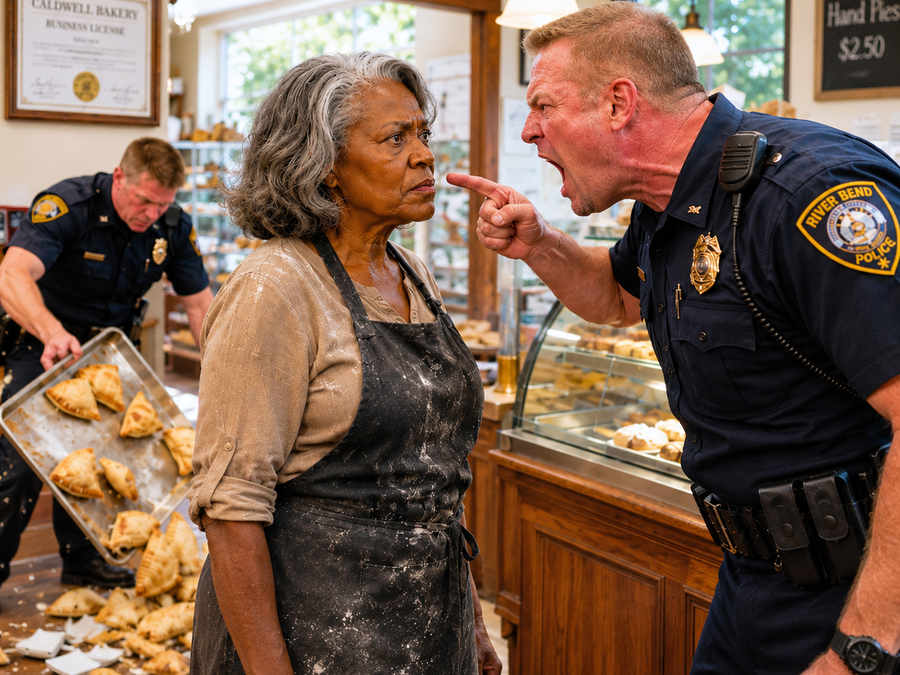
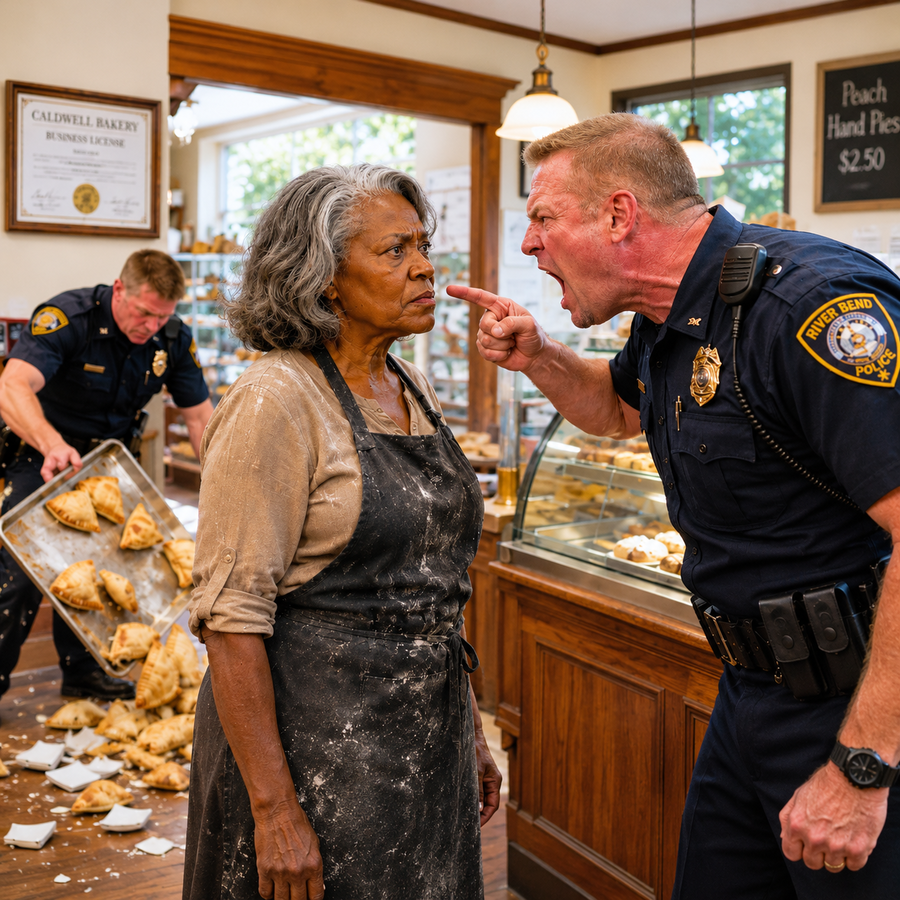
He picked up the complaint form from his clipboard slowly, deliberately, and slapped it down on Dorothy Caldwell’s counter so hard the ceramic sugar dish rattled off the edge and shattered on the floor.
A little girl sitting by the window flinched. Her mother pulled her close.
Pruitt leaned forward close enough that Dorothy could smell the coffee on his breath. Uh women like you, he said voice low, almost gentle, old black women who think they built something in this town, they need to be reminded of their place.
Dorothy set down her mixing spoon slowly, deliberately, the way a person sets something down when they want their hands free. My place, she said quietly, is right here.
Has been for 23 years.
And I’m not going anywhere.
Pruitt’s smile didn’t waver.
He turned to Officer Hanley and nodded once.
Hanley moved to the display case, the one Dorothy had built herself, the one that held four dozen peach hand pies she’d been up since 4:00 a.m.making, and knocked it with his elbow.
The entire tray crashed to the floor. Pastry and broken ceramic across the tile. Pruitt looked down at the mess, then back up at Dorothy, tilting his head like he was genuinely puzzled.
Shame, he said. Looked like it took a while to make.
Guess some people just aren’t cut out for this business.
I served this country for 22 years. Dorothy said her voice steady, each word measured and clean. I have buried friends.
I have held dying men in my hands. You think a broken tray is going to move me?
Something flickered behind Pruitt’s eyes.
Not respect. Something closer to irritation. The irritation of a man who expected fear and got something else entirely.
He walked to the wall where her framed business license hung, the original, the one she’d received in 2001, the one she’d had laminated, and pulled it off the hook.
The frame hit the floor. Glass across the tile.
He didn’t look at it.
He looked at her.
Don’t worry, he said, folding the license and slipping it into his breast pocket.
Where this is going, you won’t be needing it.
Dorothy did not move.
She stood in the middle of her own kitchen, flour on her shoulders, glass at her feet, 23 years of her life being folded into a stranger’s pocket.
And she looked at Gary Pruitt the way a woman looks at something she has already decided she will outlast.
You think you’re the first person who tried to take something from me?
She said softly. You are not. What Gary Pruitt did not know, what none of them knew, was that two blocks away at Millhaven City Hall, a ceremony was about to begin.
And the woman chosen to hold the Bible for that ceremony was standing right here, covered in flour, surrounded by broken glass, watching him smile.
The radio on Dorothy Caldwell’s kitchen shelf had been playing the same jazz station since 2003.
She hadn’t changed it once.
Not when the signal got fuzzy in winter. Not when her daughter Vanessa offered to buy her a Bluetooth speaker for Christmas 3 years running. Not when the morning DJ retired and was replaced by someone 20 years younger who talked too much between songs.
The music stayed. The station stayed.
Some things Dorothy believed you do not fix if they are not broken.
She had opened Dot’s Corner Bakery on a Thursday in April of 2001, 6 months after she hung up her army uniform for the last time.
The building had been a hardware store before that, then a laundromat, then nothing, just a vacant space on the corner of Oak Street and 5th Avenue with a cracked front window and a for lease sign that had been sun bleached to near illegibility. Dorothy had seen it and thought, yes.
She couldn’t have explained why.
She just knew. 23 years later, the cracked window was long replaced.
The walls were painted a warm amber that her late mother had called the color of late afternoon. Glass cases along the front held whatever she had made that morning. Peach hand pies on Mondays, cornbread loaves on Tuesdays, sweet potato pound cake on Fridays, which was the reason the line sometimes stretched half a block.
A chalkboard menu above the register changed weekly. Photographs lined the wall beside the door.
Dorothy in uniform, young and straight-backed, somewhere in the Saudi desert in 1991. Dorothy and her unit, seven women and four men, arms around each other in the way people hold each other when they know they might not all make it home. Dorothy receiving the Army Commendation Medal.
Her expression serious because she understood what it cost.
And in the center of them all framed in dark wood, a photograph of a woman named Eleanor Price, Dorothy’s closest friend killed in a vehicle accident outside Dhahran February 1991, smiling at the camera.
Like she had no idea what was coming. Dorothy had enlisted because of Eleanor.
Had stayed 22 years because of the work. Had come home because Millhaven was where she was from. And she had decided at 51 years old that she was done going where she was sent and ready to go where she chose.
She was 68 now. Her hands still moved with the precision of someone trained to work under pressure.
She could frost a three-layer cake in under 4 minutes. She could, as she sometimes told her daughter, still read a wound and know whether it needed stitches or surgery.
The body remembers what it learned long after the mind thinks it has moved on. The morning of that Tuesday had started the way most mornings started.
She was at the bakery by 4:15. Coffee brewing by 4:30.
First batch in the oven by 5:00. She had proofed the dough the night before, a habit never skipped. And by 6:00 a.m.the shop smelled the way it always smelled, warm sugar, cinnamon, browning butter.
The particular comfort of something made from scratch by someone who knew what they were doing. Her first customers arrived at 7:00 when she unlocked the door. Old Mr.Pearson, who came every Tuesday for a corn muffin and stayed 40 minutes.
The Nguyen sisters who split a peach pie between them and argued warmly about everything.
A young man she didn’t know who ordered a coffee and sat in the corner with his laptop and headphones.
By 8:30, the morning rush had settled into that comfortable middle hour when the shop was neither empty nor full, just alive quietly, the way she liked it. She was behind the counter at 8:47 when the bell above the door rang.
She did not look up immediately. She was crimping the edge of a pie crust, a motion her hands could do without her eyes, and she finished the motion before she raised her head.
Gary Pruitt stood in the doorway. She had seen him before.
Everyone on Oak Street had seen him before. Tall, thick through the shoulders with close-cut brown hair going gray at the temples and small pale eyes that never quite settled on anything.
They moved constantly cataloging, assessing, looking for angles. He had been on the Millhaven force for 17 years. He had a reputation, the way some men have a smell.
You noticed it before you could name it. Behind him came Officer Scott Hanley, younger, softer around the edges with the particular expression of a man who has told himself enough times that he is just doing his job that he has almost started to believe it.
And behind Hanley, Officer Ray Thompson, who Dorothy had never seen smile at anything except other officers’ jokes.
Mrs.Caldwell, Pruitt said in the tone of a man who has decided to be pleasant for exactly as long as it is useful.
Hope we’re not interrupting.
You are, Dorothy said, but go ahead. Something moved behind his eyes. He walked to the counter unhurried and set down a clipboard with a form attached, a health department complaint filed the previous evening.
Dorothy read the header upside down without leaning in. She had spent two decades learning to read things she was not supposed to be reading.
Noise and odor violations, Pruitt said. Neighbor complaints, smoke from your ovens apparently.
And the ventilation system. Dorothy looked up from the form.
My ventilation system was inspected six months ago. Passed without a single citation. Things change, Pruitt said.
The little girl by the window was watching. Her mother had stopped pretending to read her phone. Mr.Pearson had set down his muffin.
Dorothy looked at Gary Pruitt across the counter of her bakery in the middle of her morning, in the building she had made from nothing, and she said very calmly, “What is it you actually want, Officer?”
Pruitt smiled. That was when she knew this was going to get worse before it got better.
Roger Mills arrived at 9:14. Dorothy had known he was coming before he knocked.
The timing was too precise. The paperwork too ready. Pruitt had produced three separate violation forms from his clipboard within minutes of arriving, which meant they had been filled out before he walked through the door.
You do not fill out violation forms for a business you have not yet inspected, which meant someone had decided before 8:47 that morning that Dot’s Corner Bakery was going to be in violation of something.
The inspection was a formality. Mills was a prop. He was a thin man with rimless glasses and a clipboard of his own.
And he moved through Dorothy’s bakery the way certain people move through spaces that belong to others with a performed authority, touching things he had no particular reason to touch, pausing at arbitrary intervals to write something down.
He opened the oven door without asking. He pressed his palm flat against the prep table and examined it as though he expected to find something.
He crouched beside the baseboards near the sink and stayed there long enough for everyone in the room to wonder what he was looking at, then stood up and wrote three lines. Under ventilation output exceeds municipal threshold. He said to Pruitt, not to Dorothy.
Surface temperature inconsistency on the secondary prep station.
And I’m seeing potential cross-contamination risk near the That is a clean kitchen.
Dorothy said. Her voice did not rise.
I have run a clean kitchen for 23 years. My last inspection score was 96. The threshold for closure is 70.
Mills looked at her over his glasses.
Regulations update, ma’am.
Thresholds adjust. Now show me the updated regulation code. A pause.
Mills looked at Pruitt. Pruitt looked at Dorothy and smiled.
The paperwork will be filed with your copy of the violations. Standard procedure. There was no updated code.
Dorothy knew it. Pruitt knew she knew it. This was the point, not the citations, not the inspection.
The point was the audience. Mr.Pearson was still at his table, muffin untouched, now watching with the careful stillness of a man who has seen this kind of thing before and knows that sometimes the most dangerous thing you can do is move.
The Nguyen sisters had gone quiet. The young man with the laptop had taken out one earbud and was staring at his screen with the exaggerated attention of someone listening to everything around him. Officer Thompson moved to the display case.
He did not ask permission. He lifted the edge of the tray holding the peach hand pies, 48 of the made-from-scratch 4:00 a.m.dough, and tilted it almost thoughtfully the way a child tests the edge of something before deciding to push it all the way.
“Don’t.”
Dorothy said. Thompson looked at Pruitt.
Pruitt nodded barely, just a fraction of a chin drop. The tray went over.
48 peach hand pies hit the tile floor in a cascade of pastry and filling and breaking ceramic. The sound was enormous in the small space. The little girl by the window began to cry.
Pruitt turned to the child’s mother with an expression of exaggerated concern.
“Sorry about the mess, ma’am.
Health hazard.
We’re going to need to ask everyone to clear the premises while we complete the inspection.”
Prego. The mother gathered her daughter and left without a word.
Mr.Pearson stood, slowly put on his hat, and paused at the door. He looked at Dorothy.
His expression said, “I’m sorry.
I don’t know how to help.”
Dorothy gave him the smallest nod. He left.
Within 4 minutes, the bakery was empty except for Dorothy, three officers, and Roger Mills. Pruitt walked to the wall beside the register.
He looked at the photographs, the desert, the unit Eleanor Price smiling in her frame with the polite disinterest of a man looking at wallpaper. Then he reached up and unhooked the framed business license from its nail. The frame swung, hit the wall, dropped.
Glass broke across the floor. He did not pick it up. He unfolded the license from the frame, creased it once along the center, and slid it into his breast pocket.
“We’ll be holding this pending review,” he said.
“And I’m going to need you to close for the day.
Post the notice on the door.
We’ll be in touch about next steps.”
Dorothy looked at him. Then she looked at Hanley, who was studying the floor with intense concentration, as though the tile pattern required his full attention.
“Officer Hanley,” she said.
Hanley looked up.
He couldn’t help it.
“You know this is wrong,” she said.
Not an accusation. A statement clean and direct offered to him like a question he still had time to answer correctly.
Hanley opened his mouth, closed it, looked at Pruitt. Pruitt was already moving toward the door, pulling a pre-printed closure notice from his clipboard, because of course it had been pre-printed.
Of course it had. And pressing it against the front glass with one hand while he peeled the backing off the adhesive strip with his teeth. The notice went up.
Red letters on white paper, temporarily closed, health violation. By order of Millhaven Health Authority.
Outside on the sidewalk, three neighbors had stopped walking. A woman Dorothy recognized from the dry cleaner two blocks down. A man who brought his truck in to the mechanic across the street.
A teenager on a bicycle, one foot on the ground, watching. Dorothy walked to her door and stood in the frame of it inside her own closed bakery looking out. I have stood in worse places than this.
She said quietly to no one in particular. Or perhaps to Eleanor, whose photograph was still on the wall where it had always been. And I am still standing.
She reached into the pocket of her apron and took out her phone. She dialed.
It rang twice. Mom. The voice on the other end was immediate alert.
The voice of someone who picks up because they have learned that when this particular person calls it matters.
What’s wrong?
The uniform had arrived two weeks ago, pressed and sealed in a dry cleaner’s bag that Vanessa had hung on the back of her bedroom door and not touched since.
Every morning for 14 days, she had looked at it while she made her bed. The deep navy of the fabric, the silver insignia on the collar, the badge pinned to the chest pocket by the tailor who had done the final fitting, catching whatever light came through the window.
Chief of Police Millhaven. The words were formal and final in the way that only certain things are wedding vows, military commissions, the names on headstones. She had not let herself feel it yet.
There would be time for that later. Right now, there was still work.
Vanessa Caldwell was 42 years old and had spent 18 of those years in law enforcement the way some people spend time in a vocation, not as a career, but as a calling, the kind that finds you before you are fully ready for it and does not let go. She had started as a patrol officer in Birmingham at 24, made detective at 28, moved to the state police at 31, to the criminal investigations division at 34, to commander of the southwestern district at 39.
Every promotion had been earned in the specific way that promotions are earned when the system is not inclined to give them to you through documentation, through results, through a record so clean and consistent that there was simply no argument left to make against it. She had applied for the Mill Haven Chief position 6 months ago.
She had applied because Mill Haven was where she was from. Because her mother was there alone, 70 miles from the nearest family.
Because she had read the department’s complaint records going back 8 years and understood immediately and with the clarity of someone who knows what a pattern looks like that something was deeply wrong.
She had not told her mother she applied. Dorothy Caldwell had a particular way of carrying pride that made it almost impossible to disappoint her. And Vanessa had not wanted to create an expectation she might not be able to meet.
She had told her the week she received the confirmation over the phone on a Sunday evening. Dorothy had been quiet for a moment.
Then she had said, “Well, I suppose I’ll need to find someone else for Sunday dinners.”
Which was her way of saying she was proud beyond words. This morning, Tuesday, Vanessa had been sitting in the back of a black department SUV outside Mill Haven City Hall at 8:30 reviewing her remarks for the 11:00 ceremony when Marcus Webb had knocked on the window.
Marcus was the city’s senior staff reporter.
A slight man in his late 30s with a good instinct for questions and the patience to wait out long answers. He had been covering the chief transition for 6 weeks.
He was by Vanessa’s assessment honest.
She had stepped out. Shaken his hand, begun the interview in the careful way she had learned to speak to journalists.
Direct, precise, never more than you intend to give.
“What’s your first priority taking over the department?”
Marcus had asked.
“Accountability.”
she had said.
“Transparent complaint processes.
Every report filed, every report reviewed, every outcome documented and accessible to the public.
No exceptions.”
Marcus had written that down. He had looked up to ask a follow-up question. Her phone had rung.
She had seen the name on the screen and felt something shift in her chest, not alarm, not yet, but the particular attention that a body gives to things that matter.
She had held up one finger to Marcus, turned slightly, and answered, “Mom.”
“What’s wrong?”
Dorothy’s voice was level.
That was in some ways the most alarming thing about it. Her mother had a particular register of calm that she deployed in proportion to the severity of what she was managing.
The worse the situation, the quieter and more deliberate the voice. Vanessa had learned this as a child and had never forgotten it. The voice on the phone right now was very quiet and very deliberate.
Dorothy told her what had happened. She did not exaggerate.
She did not editorialize. She gave times, names where she had them, a description of each officer, a summary of each action. She was, Vanessa thought, giving a report.
22 years of military discipline did not disappear. You just applied it to whatever situation you were in.
When Dorothy finished, Vanessa said, “Don’t move.
Don’t sign anything.
Don’t let anyone remove anything else from the premises.”
“I know,” Dorothy said.
“I’m coming.”
“I know that, too.”
Vanessa ended the call. She turned to Marcus, who had the practiced stillness of a journalist who knows when to stop asking questions and start watching.
“I need to make one call,” she said.
“Then I need you to come with me.”
She dialed Lieutenant Kyle Bennett, her department liaison, and spoke for 90 seconds.
She needed Pruitt’s full personnel file complaints, disciplinary records, financial disclosures.
She needed the health department’s inspection logs for the Oak Street corridor going back 5 years.
She needed it in 10 minutes. Then she opened the SUV door and retrieved the uniform bag from the back seat.
She had not planned to put it on until the ceremony. She put it on now, standing beside the vehicle on a public street, because she understood that what she was about to walk into was not separate from the ceremony.
It was the first act of it. Marcus Webb stood nearby, notepad in hand, saying nothing.
His camera operator had appeared from somewhere and was already recording. Vanessa buttoned the jacket, straightened the collar, looked down at the badge, then she started walking toward Oak Street.
Behind her, Marcus fell into step.
“Chief,” he said, the first time anyone had called her that, “Should I be recording this?”
“Yes,” she said without slowing down.
“Make sure you get everything.”
At 9:41, Sergeant Earl Bowman’s phone buzzed on his desk.
He read the message without picking up the phone. Just tilted the screen toward him, read it, and set it face down.
Then he leaned back in his chair and folded his hands behind his head, the way a man does when he is satisfied with how the morning is going. The message was from Pruitt Oak Street handled.
Old woman won’t be a problem.
Bowman had been with the Millhaven Police Department for 21 years. He had outlasted four chiefs, two city managers, and one federal inquiry that had come uncomfortably close before quietly dissolving. He had learned over those 21 years that the most important skill in his profession was not marksmanship or interrogation or even paperwork.
It was patience, the ability to wait out inconvenience. Problems in his experience resolved themselves if you gave them enough time and enough pressure. Dorothy Caldwell was not the first business owner on Oak Street who had needed to understand how things worked in Millhaven.
She would not be the last. But she would like the others eventually understand.
He picked up his phone and deleted Pruitt’s message.
Then he walked to the window of his office, which looked out over the parking lot, and felt the particular contentment of a man who believes he controls things he does not actually control. What Bowman did not know was that Officer Kim Torres had been standing 4 ft behind him when the message arrived.
She had not been close enough to read the text, but she had been close enough to see his face when he read it, the small upward movement at the corners of his mouth, the deliberate stillness that followed.
And she had been doing this job long enough to understand what that expression meant on that particular man’s face.
Torres was 26 years old and had been with the department for 14 months. She had joined because she believed in something, which she now understood was either her greatest strength or her greatest liability, depending on the day. She had spent 14 months watching things she did not like and telling herself she was still learning, still finding her footing, still too new to know whether what she was seeing was as wrong as it felt.
She was done telling herself that. She walked back to her desk, sat down, and took a small notebook from her top drawer, personal not department issued.
She wrote the time.
She wrote Bowman’s name.
She wrote received message, read it, deleted it, expression indicated satisfaction. Then she wrote everything she could remember from the previous hour.
The call Pruitt had made at 8:20 requesting Mills meet him at Oak Street at 9:15, the pre-printed closure notices she had seen in Pruitt’s clipboard when he left the building, the way Thompson had been told specifically, and in those words, to be thorough.
She wrote until her hand hurt. Then she looked at what she had written and made a decision. In the large conference room at the end of the hall, Chief Robert Daniels was accepting a sheet cake with his own face printed on it in frosting.
Someone had found a photograph from his early years on the force, young, dark-haired, considerably thinner, and had it transferred to blue and white buttercream.
The room was full of people holding plastic cups of sparkling cider and saying the things people say at retirement parties, “28 years, can you believe it, huh?
What are you going to do with yourself? You earned it.
You really earned it.”
Daniels was 61 and looked in this moment profoundly comfortable. He had built something in Millhaven.
It was not the something he would have described in public, but it was a structure nonetheless, a careful arrangement of looking away at the right moments, of filing certain things and losing others, of knowing which complaints would be pursued, and which would be closed within 72 hours without explanation. It had required patience and consistency, and he had provided both. Now he was leaving and the arrangement would continue because he had chosen his successors carefully, or so he believed.
Back on Oak Street, the closure notice was drawing attention from further up the block. A woman named Beverly Okafor, who ran the hair salon three doors down, had come to stand outside her own shop and read the red letters on white paper.
She had been on Oak Street for 11 years. She had her own memories of Pruitt.
Inside the closed bakery, Dorothy sat on the wooden stool she kept behind the counter, the one she’d had since 2003, the one with the cracked leg she kept meaning to fix.
She sat straight, hands in her lap, looking at the flour still dusting the floor around the fallen display tray. She was not looking at the floor the way a defeated person looks at a mess.
She was looking at it the way a person looks at something they are going to clean up. Hanley stood near the side wall.
He had not left with Pruitt and Thompson, which was either conscience or cowardice, he was not entirely sure himself. He cleared his throat.
Ma’am, I want you to know that I don’t Dorothy said without looking at him.
I just meant I know what you meant. Now she looked at him.
Wanting to say something isn’t the same as doing something, officer.
I’ve known that distinction since before you were born.
Hanley closed his mouth.
Torres’ voice crackled through his radio, clipped and quiet.
Hanley, don’t touch anything.
Don’t let anyone remove anything from the premises.
Senior command is en route. Hanley looked at his radio, then at Dorothy.
Dorothy had heard it, too. Something moved across her face, not surprise, not relief, something more complicated than either of those.
She looked at the photograph of Eleanor Price still hanging straight on the wall above the broken glass. Outside at the far end of Oak Street, a black SUV turned the corner. The SUV stopped 20 ft from the bakery door.
Vanessa stepped out and the first thing she did was nothing. She stood beside the vehicle for a moment long enough to take in the full picture.
The closure notice on the glass, the flour and broken ceramic visible through the window, Dorothy on her stool visible through the same window sitting with the precise stillness of a woman who has been waiting. Pruitt and Thompson near the door, Hanley inside.
Mills consulting his clipboard near the counter like a man performing business. She took all of it in.
Then she walked forward. Beverly Okafor standing outside the hair salon recognized her first.
Then the man from the auto shop across the street. A murmur moved through the small crowd that had gathered on the sidewalk.
Not loud, just the particular sound of people recalibrating what they thought was about to happen. Pruitt turned at the sound of footsteps.
He looked at Vanessa the way men like Pruitt look at women in uniform when they have not yet been given a reason to be afraid with a rapid practiced assessment that cataloged, ranked, gender, and race in approximately 2 seconds and arrived at a conclusion before it had examined all the evidence. He saw the commander insignia. He calculated incorrectly that this was manageable.
Commander, he said with the smooth professionalism of a man who has navigated difficult conversations before. This is a health department matter.
We have it under control. Officer Pruitt, Vanessa said, step away from the door. He did not move immediately.
The pause was deliberate, a test, small and deniable. The kind that operates below the threshold of insubordination, but communicates everything above it. It lasted approximately 3 seconds.
Vanessa did not repeat herself. She looked at him with the expression of someone who has already decided what happens next and is simply waiting for him to catch up to that fact. Pruitt stepped aside.
Vanessa walked past him into the bakery. She did not look at him as she passed.
She went directly to her mother and for a moment, brief, private, conducted with the economy of two people who know each other deeply enough not to require much, she placed one hand on Dorothy’s shoulder.
Dorothy covered it with her own hand. Then Vanessa straightened and turned.
She picked up the violation forms from the counter. She read each one in its entirety, which took 4 minutes, during which no one spoke. Marcus Webb stood in the doorway, camera operator beside him, red light blinking.
Vanessa took out her phone.
She dialed the state health department’s regional office, which was a 40-minute drive from Millhaven.
She identified herself by name and rank. She read the violation codes from each form.
There was a pause on the other end of the line. Then the voice on the other end said carefully, Commander, those codes were updated in the 2019 regulatory revision.
They no longer apply to food service establishments under 5,000 square feet. Thank you, Vanessa said.
I’d appreciate that in writing.
My email is on file with your office. She ended the call and turned to Roger Mills. Which regulation code she said covers baking odor as a ventilation violation for a residential adjacent commercial space in a district zoned RC2.
Mills opened his mouth. Specific code. Vanessa said.
Chapter, section, subsection. Show. Mills looked at Pruitt.
Don’t look at him.
Vanessa said. Look at me. The room was very quiet.
Hanley by the wall had stopped pretending to look at the floor. He was watching Vanessa with an expression that moved in real time from anxiety towards something that might have been distantly relief. The relief of a person who has been waiting for someone to say a thing out loud that everyone in the room already knew.
Mills could not produce a code because there was no code. There had never been a code. Vanessa set the violation forms on the counter in a neat stack.
She took out her own notepad and wrote a single line. Then she looked at Pruitt. Badge and firearm.
She said. Set them on the counter. The silence that followed was a different kind of silence than the ones before it.
This one had weight.
Pruitt’s jaw tightened.
Commander, you don’t have the departmental authority to I’m going to stop you there.
Vanessa said. And her voice was so calm it was almost kind.
The way certain very steady things appear gentle until you test them. Check your watch, officer. You might want to reconsider that sentence in about 20 minutes.
No one in the room understood what that meant.
Pruitt’s eyes moved to her face searching for the angle, finding nothing readable.
This is a personnel matter between yourself and Chief Daniels. He said falling back on the scaffolding he trusted.
And I’ll be taking this up with You’ll set your badge and firearm on the counter.
Vanessa said. Or I will have you escorted from this building by officers who outrank you. Those officers are currently parked on Fifth Avenue and will be here in under 3 minutes if I call them.
This is not a conversation, Pruitt. It is a directive. Something in his face changed.
Not submission, not yet. But the recognition that the ground had shifted in a way he had not anticipated and could not immediately explain.
He set the badge on the counter. Then the firearm unholstered carefully beside it.
Vanessa looked at Mills.
You’re done here.
Mills gathered his clipboard and left without another word.
Outside, Marcus Webb lowered the phone he had been holding toward Vanessa’s voice like a microphone.
And looked at his camera operator. The camera operator nodded. They had everything.
Dorothy watched her daughter from the stool behind the counter. She had not moved since Vanessa arrived. Her hands were folded in her lap, still dusted faintly with flour, and her expression was something that could not be easily named.
Not pride exactly. Though that was part of it. More like the feeling of seeing something you always believed was true.
Finally made visible to the rest of the world.
Vanessa’s phone buzzed.
City Hall. She looked at the screen.
Looked at the time. 58 minutes until the ceremony. She answered.
The voice on the other end was Deputy City Clerk Raymond Foster, who had been coordinating the 11:00 ceremony for 3 weeks and had the particular anxiety of a man for whom logistics were a moral issue. Chief Designate Caldwell, we have approximately 52 minutes and the dais is set up.
The council members are arriving. Mayor Howell is already in the building and where are you?
Where are you right now? Oak Street, Vanessa said. Corner of 5th.
A pause. Oak Street.
Yes. The ceremony is at City Hall.
I know where the ceremony is, Raymond. Another pause, longer.
Should I Is everything I need you to bring the ceremony here. Vanessa said.
To Oak Street, in front of Dot’s Corner Bakery.
Bring the mayor, bring the council, bring whoever is supposed to be there. Bring the Bible. The silence on the other end lasted long enough that she could hear him breathing.
Commander, the dais, the sound system is We won’t need a dais, she said.
We won’t need a sound system.
Bring the Bible and bring the people.
That’s all.
She ended the call. Pruitt had heard enough to understand the shape of what was happening, though not yet its full dimensions.
He stood near the counter where his badge and firearm sat and his eyes moved between Vanessa and the phone in her hand with the rapid calculation of a man trying to reassemble a picture from pieces that were not fitting together the way they should. What exactly? He said slowly.
Why am I on Oak Street at 11:00? Vanessa looked at him. Wait and see.
It took 17 minutes.
First came two black sedans, then a city van, then Mayor Sandra Howell’s town car, which pulled up to the curb with the mild confusion of a vehicle that has been redirected mid-route and is not entirely certain why.
The mayor herself emerged looking pressed and pleasant in the way politicians do when they have not yet understood that something is wrong. Behind her came three city council members.
Deputy Clerk Foster carrying a leather-bound Bible and a folder of ceremony documents with the expression of a man walking through a dream he cannot wake from. A photographer from the city communications office. And Marcus Webb, who had stepped back to the sidewalk and positioned himself with the careful stillness of someone who understood he was witnessing something that would not happen twice.
Beverly Okafor had not gone back inside her salon. She stood on the sidewalk with her arms folded watching.
The man from the auto shop had crossed the street. A woman from the laundromat at the end of the block appeared in her doorway.
Word traveled the way it always travels on a street where people have lived alongside each other for years without announcement. Through a quality of attention that passes from person to person like a current.
Mayor Howell’s eyes moved from the closure notice on the bakery door to Dorothy sitting visible through the window to Pruitt standing inside without his badge.
And her pleasant expression underwent a series of rapid adjustments before settling into something that was not quite any one emotion, but contained elements of several. Commander Caldwell, she said carefully. This is an unusual venue.
Yes, Vanessa said. It is. She turned to Deputy Foster.
Raymond, are you ready? Foster looked at his folder, looked at the sidewalk, looked at the small gathering of officials and neighbors and one camera operator standing on a public street in front of a bakery with a closure notice on the door.
“I, yes.
Yes, I’m ready.”
“Good.”
Vanessa walked into the bakery and stood in front of her mother. Dorothy looked up at her from the stool.
She had not been told what was coming. Vanessa had not called ahead, had not prepared her. But Dorothy Caldwell had survived a war and raised a daughter and run a business for 23 years and she was not a woman who needed to be prepared for things.
She looked at her daughter’s face and understood.
She stood up from the stool. She took the Bible from Deputy Foster who had followed Vanessa inside. She held it with both hands the way she had held things that mattered steady from beneath, bearing the weight without drawing attention to the effort.
Vanessa stood before her mother in the middle of Dot’s Corner Bakery, flour on the floor, broken ceramic near the display case, the closure notice visible through the front window behind them, and raised her right hand.
Outside, the
crowd had grown to perhaps 30 people. Nobody had announced anything. They had simply gathered the way people gather when they sense that something real is happening in a world that often offers them only performances.
Deputy Foster read the oath. His voice was steadier than expected.
Vanessa repeated each line with her eyes on her mother’s face.
Her voice did not waver. When the final words were spoken, faithfully discharge the duties of the office upon which I am about to enter, Dorothy pressed the Bible upward slightly, the way you lift something precious. The people on the sidewalk Not thunderously, genuinely the sound of people who had not planned to applaud and were doing it anyway because it would have been wrong not to.
Marcus Webb wrote in his notebook without looking down. Mayor Howell clapped with everyone else and hoped her expression communicated the appropriate things, though she was no longer certain what the appropriate things were.
Chief Robert Daniels, who had followed the small caravan from City Hall, mostly out of confusion, and was now standing at the back of the sidewalk crowd with a piece of his own retirement cake still on a paper plate in his hand, looked at Pruitt through the bakery window and felt for the first time in a long
while something very close to afraid. Vanessa lowered her hand. She looked at her mother for one more moment long enough for something private to pass between them, the compressed communication of women who know each other at depth.
Then she turned. Pruitt was still standing near the counter. His badge was still beside him.
His face had gone the particular color of a man who has just understood all at once the full dimension of his mistake. Vanessa walked toward him slowly and the room went very quiet.
“Now,” she said, “where were we?”
The bakery had never been this full of people who were not there for the food. Council members stood near the window. The mayor occupied the space beside the register with the careful stillness of a woman deciding in real time which version of herself to be.
Marcus Webb stood at the edge of the room where the light from the doorway caught the notepad in his hand. And in the center of it all, Gary Pruitt stood behind the counter with no badge, no firearm, and no more room to maneuver. Vanessa did not raise her voice.
She had learned a long time ago that volume was what you used when authority was in question. Hers was not in question.
Not anymore.
Officer Pruitt, she said, I’m going to ask you some questions in front of these witnesses and I want you to think carefully before you answer each one.
Do you understand?
Pruitt’s jaw was tight.
I understand.
When did you file the complaint that initiated this morning’s inspection?
A pause. Yesterday evening. At what time?
Around 7:00. And the closure notices you brought with you this morning, the pre-printed ones, when were those prepared?
Another pause. Longer. The kind that answers the question before the words do.
I had them prepared in advance as standard. You prepared closure notices for a business before the inspection that supposedly justified them had taken place. Chaptico, it was not a question.
Pruitt recognized that and said nothing. Torres stepped forward from the wall.
She had been standing there since Vanessa arrived notebook in hand waiting for this moment with the patience of someone who has been rehearsing it for 14 months without knowing that was what she was doing. She set the notebook on the counter.
Chief, this is a contemporaneous record of events from 7:58 this morning. Times, actions, specific statements. I can attest to its accuracy.
Vanessa looked at her. Thank you, Officer Torres.
Hanley by the sidewall exhaled. Then he took three steps forward and stood beside Torres.
His voice when he spoke, was not loud, but it was steady in the way that things are steady when they have finally stopped fighting their own weight.
“I can confirm everything she wrote.”
he said.
“All of it.”
Pruitt turned to look at him. Hanley did not look back.
Vanessa’s phone was in her hand.
She opened the file Bennett had sent prepared in under 10 minutes because Bennett was very good at what he did and read from it without preamble.
“11 civilian complaints against Officer Gary Pruitt filed between 2018 and 2024.
Three of those complaints were from black business owners on the Oak Street corridor. All 11 were closed by Sergeant Earl Bowman within 72 hours of filing without investigation, without documentation of resolution, and without notification to the complainants.
” She looked up from the screen.
In the doorway, Sergeant Earl Bowman stood frozen. He had walked from the station to Oak Street because someone had called him, he was not sure who now in retrospect, and told him Pruitt needed support.
He had arrived expecting to find a manageable situation. He had instead arrived at the precise moment his name was being read aloud in a room full of witnesses, a camera operator, and the new chief of police. His face did what faces do when the ground disappears beneath them.
Mayor Howell shifted.
She turned slightly toward the door, an instinct more than a decision, and found that the angle of Marcus Webb’s camera had shifted with her.
She turned back.
“This is, I want to be clear, that the city’s position is one of full cooperation with, Mayor.
” Vanessa said without looking at her.
“Not yet.”
Howell closed her mouth. Pruitt tried one final angle. He had been turning it over since Vanessa arrived, testing its weight, and now he deployed it with the precision of a man playing his last card.
“Chief Caldwell,” he said, and his voice carried a performance of reasonableness that almost disguised the desperation underneath.
“I want to raise a formal concern about conflict of interest.
The subject of this inspection is your mother.
I think it’s fair to ask whether you have the objectivity to” “You’re right,” Vanessa said.
Pruitt blinked.
“Which is why at 9:53 this morning I submitted a full report of this incident to the State Attorney General’s Office and requested that an independent investigative team be assigned.
” She looked at her phone screen and read the timestamp.
“They confirmed receipt at 10:07.
That was before I arrived on this street. There is no conflict of interest in my actions this morning because I had already removed myself from the investigative process before taking any action.
What I am doing now is my job responding to a scene where departmental misconduct was actively occurring.
” Pruitt had no more cards.
Bowman, still in the doorway, took a slow step backward. Torres looked at him. Just looked at him steady and clear, and he stopped moving.
Daniel stood at the far edge of the sidewalk crowd paper plate in hand cake untouched. His face had gone the color of old chalk. He understood with the particular clarity of a man whose careful architecture is collapsing that his name was in those 11 files.
That his signature was on those closure forms. That the retirement he had imagined, quiet, comfortable, unexamined, was no longer the retirement he was going to get. Inside the bakery, Dorothy sat on her stool and watched all of it with her hands folded and her back straight and her eyes moving occasionally to the photograph of Eleanor Price on the wall.
Eleanor, she thought you would have had something to say about all of this. She almost smiled.
Almost. By 2:00 that afternoon, three things had happened that Gary Pruitt would spend the rest of his career thinking about.
First, he and Sergeant Bowman had been placed on administrative suspension pending an independent investigation conducted by the State Attorney General’s office.
The suspension was effective immediately, which meant that by the time Pruitt drove home from Oak Street, his access badge no longer worked on the department’s rear entrance.
He discovered this when he tried to return for his personal items and found the door unresponsive. He stood in the parking lot for a moment, key fob in hand, and then got back in his car. Second, Roger Mills had his inspector certification flagged for review by the State Licensing Board pending an inquiry into the validity of the citations he had issued that morning.
The inquiry had been initiated by a single phone call from Vanessa’s office placed at 12:41.
Mills learned about it via email at 1:57 while eating lunch at his desk and believing the day had gone reasonably well.
And the third, Chief Robert Daniels, who had been scheduled to complete his final day of service, receive a plaque and exit the Millhaven Police Departme
nt at 5:00 p.m.with a pension and a handshake, was instead invited by the Attorney General’s representative who arrived at 2:15 to remain available for cooperation with the investigation into the handling of civilian complaints during his tenure.
The word invited was used in the specific way it is used when the alternative is not preferable.
Daniels’ retirement party had ended at noon.
The plaque was still on his desk. He did not take it home that evening.
Mayor Sandra Howell stood before a microphone outside City Hall at 3:30 and read a statement that her communications director had written and she had approved without changing a word because she did not trust herself to find better ones.
The statement expressed the city’s commitment to transparency, its support for the independent investigation, and its confidence in the new chief’s leadership.
It did not use the words apology or wrong in any form, which Marcus Webb noted in his article with the precision of a man who understands that what is omitted is often more informative than what is said. Vanessa stood beside the mayor during the statement and said nothing. She did not need to.
The camera had been on Oak Street that morning and the footage was already being edited and by 6:00 it would be on the regional news and by 8:00 it would be somewhere considerably larger than that. In Birmingham, in a rented apartment on the third floor of a building on Jefferson Avenue, a man named Calvin Oats watched the Oak Street footage on his phone. He had seen the notification in his news feed at 1:45 and had sat down on his couch and watched the whole thing twice before he could move.
Calvin had owned a grocery on Oak Street for 9 years. He had loved that store the way people love things they have built with their own hands and their own money and their own stubborn refusal to give up. In 2018, Pruitt had come to him with the same proposition he had brought to Dorothy.
The same language, the same smile, the same patience that was really a threat. Calvin had refused.
Three months later, the violations had arrived and the inspections and the slow suffocating pressure that made each day more expensive and more exhausting until the math stopped working. He had sold in 2019 and left Millhaven and told himself he was moving forward. He watched the footage a third time.
He set his phone down on the cushion beside him and sat quietly for a long while. Then he picked it up and dialed a number he had not dialed in five years.
On Oak Street at 4:15, Vanessa stood in front of her mother with a single piece of paper in her hand, the business license. Creased once along the center where Pruitt had folded it. She had retrieved it from the property inventory that Torres had compiled.
Everything removed from the bakery that morning cataloged, bagged, and documented within two hours of the suspension order. She held it out to her mother. Dorothy took it with both hands.
She looked at it for a moment.
The paper was slightly soft from being in someone’s pocket.
She smoothed it flat against her palm carefully, the way you flatten something you intend to keep.
“There’s a new frame at the hardware store two blocks down,” Vanessa said.
“I already called.
They’re holding one.”
Dorothy looked up at her daughter.
“You called a hardware store?”
“I called a hardware store.”
Dorothy made a sound that was somewhere between a laugh and something that required her to press her lips together briefly before she trusted herself to speak again.
“All right,” she said.
“All right.”
Vanessa turned to the front door. The closure notice was still on the glass, slightly bubbled at one corner where the adhesive had not fully set. She peeled it from the bottom, first slow and even the way you remove something you want to come off cleanly.
It came away in one piece. She folded it once and handed it to Torres who had not left. She turned back to her mother.
“Open your doors, Mom.”
Dorothy walked to the front door of Dot’s Corner Bakery, turned the deadbolt, and pushed it open.
The smell came out before anything else, warm sugar and cinnamon and browning butter, the residual warmth of an oven that had been running since 4:30 in the morning. It moved into the street air like an exhale. The people on the sidewalk, Beverly Okafor, the man from the auto shop, the woman from the laundromat, the neighbors who had stayed, the ones who had come back, began to applaud.
Not in the organized way of ceremonies, in the spontaneous way of people who had been holding something for a long time and were now releasing it. Later, when the crowd had thinned and the light had gone golden and the street was quietening toward evening, Vanessa found her mother in the back kitchen.
Dorothy was cleaning the prep table, methodical, unhurried, the motion of someone who has done this 10,000 times and finds it steadying. Vanessa leaned in the doorway.
Dorothy did not turn around.
“You did good today,” she said.
“We did good,” Vanessa said.
Dorothy set down the cloth. She turned and looked at her daughter.
Really looked the way a mother looks when she is memorizing something.
Then she reached up and placed her palm against Vanessa’s cheek just for a moment.
I raised you right here. She said softly.
In this kitchen. You know that. I know.
Vanessa said. I know. Three months is not a long time, but sometimes it is long enough.
By the end of those three months, Gary Pruitt had been formally terminated from the Millhaven Police Department following the conclusion of the Attorney General’s investigation, which found systematic abuse of authority, fabrication of code violations, and coordinated targeting of minority-owned businesses along the Oak Street Corridor spanning six years.
He
was facing two counts of extortion, one count of civil rights violation under federal statute, and a separate civil suit filed by four business owners, including Calvin Oates, who had driven back to Millhaven from Birmingham specifically to add his name to the complaint. Earl Bowman was terminated the same week, facing charges related to obstruction of justice and deliberate suppression of civilian complaints.
The 62 closure orders he had signed over six years were being reviewed individually, each one reopened and re-examined by an independent auditor appointed by the AG’s office.
Roger Mills lost his certification. The hearing took 40 minutes. Robert Daniels did not receive his pension on schedule.
His case was still under review, which was the particular legal purgatory of a man who had spent decades building careful walls, and was now watching them taken apart brick by brick with great thoroughness. Mayor Sandra Howell completed her term.
She did not announce a re-election campaign. Scott Hanley cooperated fully with the investigation.
He gave a recorded statement that ran to 47 pages and contained details no one else could have provided about the internal operations of Pruitt’s system.
In exchange, he kept his badge. He was required to complete a full ethics retraining program, 12 weeks, mandatory, and was reassigned to a different district under close supervision. He completed the program without complaint.
On the last day, he wrote a letter to Dorothy Caldwell. He did not mail it for 2 weeks. Then he did.
Dorothy read it at the bakery counter on a Wednesday morning between the first and second baking rounds. She read it twice.
Then she folded it carefully and put it in the drawer beneath the register in the same place she kept Eleanor’s last letter from 1991.
Officer Kim Torres was promoted to captain in the second month. She was 26 years old, which made her the youngest captain in the history of the Millhaven Police Department.
At her promotion ceremony, held at her request informally in the department break room with folding chairs and coffee from a diner two blocks away, Vanessa pinned the rank to her collar and said quietly, so only Torres could hear, “You did this on the first day.
Everything else was just catching up.”
Torres looked at the wall for a moment to compose herself.
Then she said, “Yes, Chief.”
The civilian oversight board was established in the second month. It had seven seats.
Dorothy was elected to the first one by a community vote that was not close. She attended meetings in her apron if they were scheduled during bakery hours, which she did not apologize for.
She asked questions at every meeting, specific and detailed, and she did not accept answers that were not specific and detailed in return. Other board members began doing the same thing gradually through a kind of osmosis that occurs when someone in the room makes it clear that vague answers are not sufficient. Calvin Oats came back to Millhaven in the third month.
He had been offered a settlement as part of the civil proceedings, enough to start over.
He signed a lease on a storefront two doors down from Dot’s Corner Bakery, the space that had been a vacant dry cleaner since 2020, and began the slow, specific work of rebuilding something he had already built once before.
He stopped by the bakery on the day he signed the lease. Dorothy was behind the counter.
She saw him come in, and she came around from behind the counter, and they stood in the middle of the room and held each other for a moment without saying anything, the way people hold each other when they have both carried something too heavy for too long.
“You’re back,” Dorothy said.
“I’m back,” Calvin said.
Vanessa implemented the reforms over the 3 months with the same methodical consistency she had applied to everything else. Body cameras mandatory. Complaint reporting system public-facing and searchable.
Every complaint assigned a tracking number provided to the complainant. Response timelines posted quarterly.
The first quarterly report was published at the end of month three. It was four pages long and written in plain language. Vanessa had written the plain language requirement into the policy personally.
On the day the new bakery sign went up, Dot’s Corner Bakery, gold letters on a dark green background, replacing the old painted letters that had been fading since 2015, a small crowd gathered on Oak Street.
It was not an organized event. There had been no announcement. People simply came the way they had come on the day Vanessa took the oath on the sidewalk because something real was happening and they wanted to be present for it.
Veterans came. Three of the men and women who had served in different years and different places, who had driven from different parts of the county, because the story had traveled and they had recognized something in it. They stood near the door in civilian clothes.
And when Dorothy came outside and saw them, she stopped walking and stood very still for a moment. Then she walked to them and shook each hand. Vanessa stood beside her mother as the sign went up.
She was not in uniform. She wore a plain gray jacket and her hair down, and she looked in this light less like a chief of police and more like a daughter who had driven home to be somewhere important.
Dorothy looked up at the sign. Then she looked down at her hands, the hands that had held the IV lines of dying men, that had needed 23 years of dough, that had held the Bible while her daughter swore an oath on a sidewalk covered in broken ceramic.
She looked up at the photograph visible through the window. Eleanor Price smiling with no idea what was coming.
Or perhaps Dorothy had thought this more than once with every idea and smiling anyway. Eleanor would have loved this, Dorothy said.
Vanessa looked at the photograph. She would have eaten half the pies before the sign was up.
Dorothy laughed. A real laugh, full and unguarded, the kind that surprises the person having it. She opened the door.
The smell came out again, warm sugar, cinnamon, browning butter, the particular comfort of something made from scratch by someone who knew exactly what they were doing, and it moved into the street. And the people on the sidewalk breathed it in, and the morning continued.
Inside the bakery on the wall beside the register, in a new frame with a small crack in the glass that Dorothy had decided to keep, hung the original business license. And beside it, matted and sealed behind museum glass that Vanessa had ordered specifically, the closure notice. Red letters on white paper.
Temporarily closed. Dorothy had been the one who decided to frame it.
“Why?”
Vanessa had asked.
“Because” Dorothy had said, pressing the backing into place with the heel of her hand, “I want to remember what they thought was the end of something.
” Dignity is not something that can be taken from a counter or folded into a pocket.
Dorothy Caldwell did not win because her daughter wore a badge. She won because she never stopped standing straight in a war in a kitchen in the middle of her own broken bakery floor.
The badge only made visible what was already true.
Courage doesn’t wait for backup.
THE END.