Part 2: What Was Behind the Hatch in the $1 Carousel?
I need 3 days of penetrating oil, a jack and a clean seat for the sprocket.
A pause, and Id like you to see Judith Kell in Wenlock first. She keeps your fathers will.
Shell want to read your papers.
I have no papers.
Garrett has them all. Then you have a lawyer asking questions, said Duncan, and thats the beginning of papers.
On Wednesday he drove them to town, 9 miles over the washboard road with B in the middle holding the thermos. Wenlock was a small county seat of brick storefronts, one traffic light and a courthouse clock that ran 4 minutes slow.
Judith Kells office was upstairs over the bakery, up a narrow flight that smelled of yeast and cinnamon.
She was 68, tall and spare with a gray bob and half-moon glasses on a beaded chain, and she offered no peppermint and no sympathetic word. She offered a chair, a cup of coffee, and an hour of silence, during which she read the quick claim deed from Harolds pocket, the power of attorney she called up from the courthouse records, and the closing statement from Friday.
At the end, she let her glasses fall on their chain.
Three things, she said plainly, because youve had enough of men who dont.
Please, said B. First, paragraph 12 of that power of attorney gives your son the right to sell your real estate.
You signed it. It is valid and the sale to Meadowgate Homes stands.
I wont pretend otherwise. She let that settle.
Second, the lot was always yours. Your son left it out of the sale and recorded it in your names again.
I suspect so it would feel like a gift and a roof to put you out on. It also means nobody touches it without both your signatures.
Not your son, not a bank, not a developer.
If anyone wants it, they come to you.
She tapped the deed.
Third, a power of attorney is a duty, Mr.Pennock, not a gift.
The man who holds one must act for your benefit, not his own, and a court looks very hard at that. I am not saying he broke the law.
I am saying I would like to see where the money went.
He told us the savings were in a management account, said Harold.
Did he?
Then Ill make a call.
In the meantime, here is something that is public record.
She turned her screen toward them. There is a building on Route 7 in Dunmeer, an indoor sports dome, half built.
A pickleball dome to be called the Smash Dome.
A contractor filed a lien in August for $400,000 and the construction loan carried a personal guarantee. The man who signed it is your son.
Harold looked at a photograph of a steel frame against a gray sky with a torn fabric roof flapping in the wind. He understood, in the silence that comes when a thing has been in front of you a long time, why Garrett had stopped buying the good coffee.
Why the truck was sold.
Why the phone lay face down?
How much? said B.
Seven hundred forty thousand dollars, said Judith.
Due the first of December.
Downstairs a door opened and shut, and the smell of cinnamon rose through the floorboards.
A man who owes that and holds his parents signature on a sale of five million, she said more gently, is not the same as a thief, but he is very close to a man who is frightened.
She put her glasses back on.
Duncan says you have a question about your fathers estate. Dads will.
I was executor.
I never saw it again after the funeral. Garrett said hed put it in the safe.
Mr.Dane drew it in 1991 and redrew it in 2008, and I took over his files when he retired.
I have it. She hesitated.
Theres a clause in the later one that has always puzzled me.
He used a phrase I had never seen in a will.
I wrote it in the margin of my own copy.
Wherever they may be found. Harold felt Bs hand close on his arm.
They rode home in the late sun with the ponys head waiting over the fence rail at the park gate. Duncan said nothing for a long time.
At the bridge, he slowed the truck up the track, and then he stopped and said quietly, Harold.
Ahead of them, around the pavilion in the low gold light, somebody had planted stakes, thin wooden stakes with bright orange ribbons in a long line all the way around the 12-sided building and the maples and the tool room. A man in a navy windbreaker stood on the platform with a clipboard looking at the carousel the way a man looks at a stump.
Mr.Pennock, he called as they got down.
He came toward them with his hand out and a pleasant tired smile. Kyle Branigan, Meadowgate Homes.
Im sorry to turn up like this. I had hoped to catch your son.
He glanced up at the cupola. Weve a road to cut through here and a row of townhouses behind it.
Well have this whole structure cleared by Christmas.
Kyle Brannigan was 44 with sunburned ears and the careful manners of a man who spent his days telling people no.
He stopped when he saw the stovepipe smoking behind the tool room, the quilt airing on the rail, the ponys head over the edge of the platform.
His smile went out slowly like a pilot light. Mr.Pennock, he said, Your son told us youd gone to stay with family, that the grounds were empty.
Were the family, said B.
He put us here Monday.
Kyle looked at his clipboard and at the ribbons and at them. I see.
He cleared his throat.
Ill be straight with you, maam, since nobody seems to have been.
This lot is the one piece of ground we dont own.
Our road to the townhouses has to come through here or it bends around the creek, and that costs us 200 units. Your son promised us this pavilion would be gone by the end of the year.
His contract has a completion clause.
A bonus. He shook his head.
I shouldnt have said that.
How much?
said Harold.
Kyle looked at the old mans face, at the cracked knuckles and the green cap. Its a lot, he said.
More than this lot is worth 10 times over.
Now theres a thing, Duncan Orr said very softly behind them.
I pour concrete, Mr.Pennock.
I dont do this.
Kyle folded the stake map into his pocket. If this ground is yours and not your sons, he had no business promising it.
Ill tell my office tonight and theyll want paper. Do you have a lawyer?
Judith Kell, said B.
Then theyll call her.
He touched the bill of his cap awkwardly and walked off down the track.
He pulled three stakes out of the grass as he went. Then he stopped pulling them as though he had run out of conviction and drove away.
Thursday and Friday belonged to the iron door.
Duncan came at 8:00 each morning with a can of penetrating oil and a long-necked brass oiler, and he and Harold lay on their backs in the narrow space behind the organ, feeding oil to the pivots a drop at a time. It was the first real work Harold had done with his hands in 8 years, and by the second afternoon, something in his shoulders had come loose.
Bea washed the tool room windows with creek water and newspaper.
On Friday morning, Duncan brought word from town.
The management account stood in Garretts own name. Judith had sent a letter by courier, and a lawyer for Meadowgate had already telephoned her office.
Garrett came at 10:00 to 5:00.
The sedan stopped at the end of the track, and he got out carrying a grocery bag, and he looked tired and tender and thinner than he had on Monday.
He had brought a pound of the good coffee.
Bea took it from him without a word and set it on the bench and went on peeling her apple. I wanted to see how you were managing, Garrett said.
He sat on the edge of the platform with his hands between his knees, the way he had sat at 9 years old when he was sorry. Dad, I know how this looks.
I know it was hard.
Ive hardly slept. Have you?
said Harold. Ive been thinking about this place.
He drew a folded paper from his jacket.
The county is going to inspect that roof.
Theyll post it unsafe, and then its a liability, and youll lose it for nothing.
I found a way to take the weight off you. Meadowgate will pay $20,000 for the lot tonight as it stands.
Thats an apartment in Wenlock, Dad, close to a doctor, close to Moms church. He smoothed the page on his knee.
Let me carry this the last of the way.
It was the same voice.
It took things out of your hands one at a time and called each one a kindness. Harold did not take the paper.
He had not argued with anyone in his life and what he said now, he said quietly, the way he would have said a bolt.
Where is our $61,400?
Its safe. Ill move it when youre settled.
Where are Ediths albums? said B.
In storage. Ill bring them.
You said that on Monday, Harold said. You said it in my kitchen.
He folded his hands on his knee. Ill think about it, son.
I wont sign it tonight. Something moved behind Garretts eyes, a small bright flash of fear and was gone.
Dad, I wouldnt wait. Meadowgate wont hold that number.
Then they wont. For a moment, Garrett only looked at his father.
Then he got up and brushed the dust off his khakis and said, I only want whats best for you and went away down the track.
He did not look at the pony.
He did not look at the cage. The sedans dust hung gold in the low sun and B set down her knife and said, in a voice that shook only at the end, Thats the first time hes ever heard you say no.
I didnt say no, said Harold.
I said not tonight.
Its the same word in your mouth.
On Saturday morn, Duncan was waiting at the organ room with a wooden box under his arm. The air was cool.
The lamp was trimmed and the pony stood at the top of the stairs with her chin on the hatch rim, watching.
Duncan set the box on the work table and opened the lid. Inside, wrapped in a cloth, lay a bronze sprocket wheel the size of a saucer, gleaming like new honey.
Before that door moves, tell me in the comments who in your family kept something safe for you and never said a word.
Then stay with Harold because the door was about to open on the one thing his father had carried down in the dark. Duncan fitted the jack under the lower edge of the door.
He worked slowly with a copper mallet and a drift pin and with a patience Harold had last seen in his own father.
The old sprocket came off in three blows.
The new one slid on its shaft as if it had been waiting 19 years. Duncan threaded a fresh chain from his tool roll over the pulley, hooked it to the counterweight, and stepped back.
Your door, he said, your hand. Harold wiped his palms on his trousers.
He took the chain.
The links were cool and smooth, and he felt the weight take hold at the other end, a great patient pull, like a man being asked to lift something he had been carrying all his life. He leaned.
Nothing.
Then a groan that went down his spine, a long iron groan from somewhere deep in the wall, and the door shivered, and a line of dark opened at its edge. Dust sifted down.
The line widened to a hand, to a foot, and then the whole black door swung inward on its pivots with a long sigh, and a breath of air came out to meet them.
It smelled of cedar. It was the smell of a chest in an attic and of a thousand Christmases and of something older than either, a clean, sweet, red breath that had been shut up in the dark for 19 years.
Harold stood in it with the chain still in his hand. Bea came up beside him with the lamp.
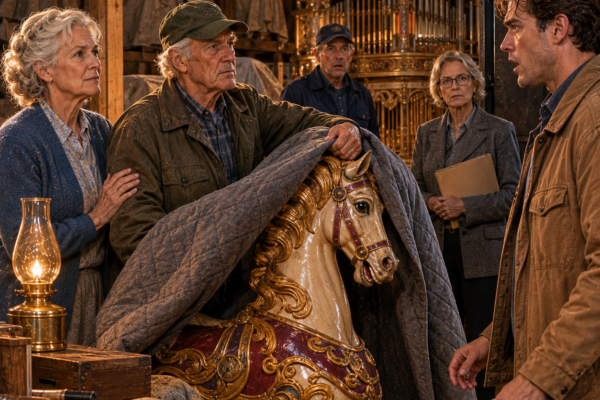
Beyond the door was a long room lined in cedar planks, 24 ft by 16, as dry as a drawer. And down the length of it on racks of sawn timber in rows lay shapes under gray quilts.
They were the size of ponies.
They lay as horses lie in a stable at night, each in its own stall, each with the long curve of a neck beneath the cloth.
There were so many that Harolds breath caught. Go on, Duncan said at his shoulder, very gently.
He went to the first rack.
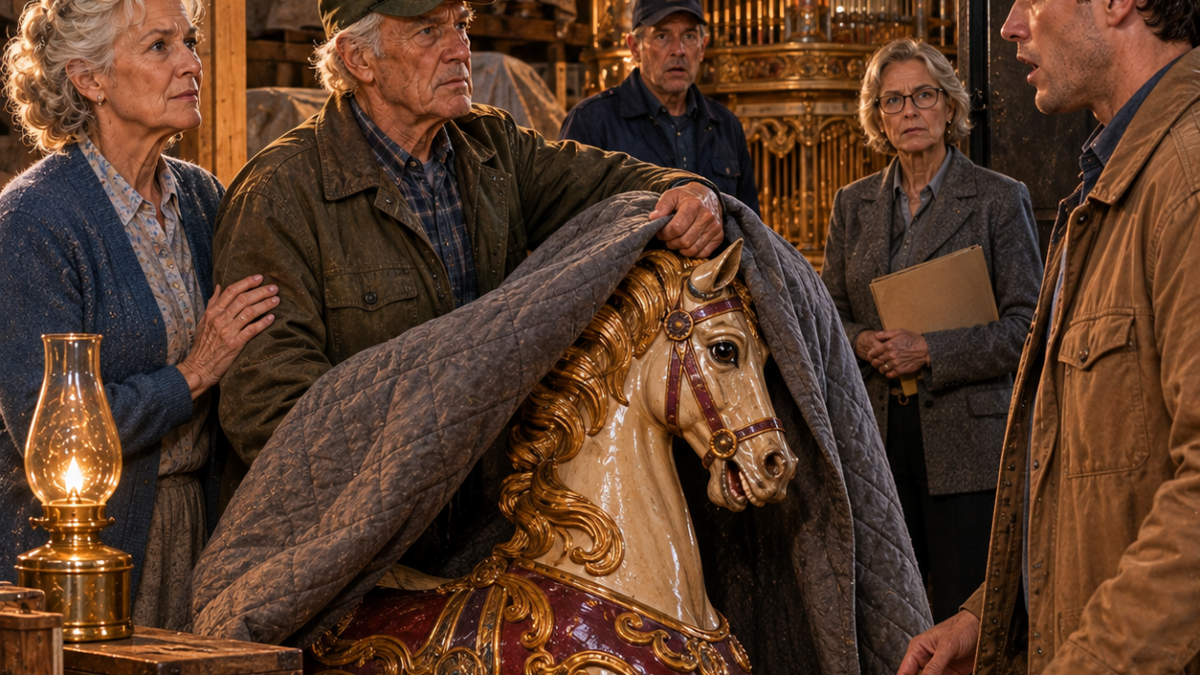
He took a corner of the quilt and drew it back, and under the lamp, as if the years had never been, a horse looked up at him. It was a stander, with its head flung high and its mane flying in carved gold and an eye of dark glass that seemed to hold the lamp.
The saddle was a spill of painted roses. The paint on its flank was the color of cream and the color of a ripe plum, so fresh and so deep that Harold put out his hand, and then, afraid, did not touch it.
A little brass plate on the pole said, One.
He had ridden this horse at 6 years old, the summer of 1967, on the outside row with his fathers big hand flat against his back, and he had not touched it since he was 10. Round and round, and room for everyone, his father used to say to a child at the gate with no ticket, and waved the child up onto the nearest horse.
Harold had thought, even then, that it was the best thing a man could say. He stood in the cedar dark with his palm against the carved neck and felt the muscle of it, and the years came off his shoulders like a dropped coat.
Lord, said B.
Oh, Harold, theyre all here.
The pony walked past them into the room. She went down the aisle between the racks without hurry and stopped at the very end, where a plain ladder-back chair stood against the cedar wall with a tin cup on its seat.
She put her nose against the cup and sighed and did not move.
Alvins, said Duncan. He sat there Sundays.
Shed stand just where she is and hed talk to the horses and shed listen. He looked away.
I used to wait outside.
Harold went down the aisle slowly, lifting corners as he passed. A leaping horse with its four legs tucked, a little sleepy-eyed mare with a garland, a long-maned black with a carved lightning bolt, two chariots at the far end with swan prows and gilded wheels, wrapped like children.
He counted. He counted again with his lips moving the way he had counted rides at closing every night of his working life.
On the chair, under the tin cup, lay a folded sheet of ledger paper.
It had been cut cleanly with a razor and when Harold laid the stub he carried in his shirt against its edge, they matched.
Pinned to it with a rusted pin was a second paper, a bill of sale on the letterhead of a bankruptcy trustee, dated the 13th of October, 1971. For 32 carved horses and two chariots, $9,000 paid in full.
He read the ledger page aloud in a voice he hardly knew. October 14th, 1971.
32 horses and two chariots carried down by Duncan and me. Edith told.
The truck took the kiddie train.
Harold sat on the fence in his yellow slicker and watched it go and I watched him watch it and I have never been so ashamed of a lie. I will tell him when he is old enough.
Every year he is older, I find I am a coward. Nobody said anything.
Dust turned slowly in the lamplight and somewhere above them the great clock ticked on, patient as a pulse. The lamp burned steady.
Bea put her hand against her mouth, and Harold folded the page along its crease, and held it against his chest, and bent his head.
It was a while before he saw what was wrong.
Duncan, he said, thickly, how many did you carry?
32.
I count 31.
He turned.
31 wrapped, and Dads chair. Rack number 32 is empty.
Duncan crossed the floor in four steps. The last rack in the second row stood bare, with only a folded quilt on it.
On the quilt lay a small square card, and the old man picked it up and read it, and his face went through three expressions, and settled on none.
Read it, said Harold. Its your fathers hand.
Duncan held it to the lamp. The little jumper with the chipped ear, given to Dana, June 2008, the week she turned 18.
She has promised she will know when. The cedar air did not stir.
Harold took the card and read it twice.
Dana, Bea whispered.
She stood in my kitchen Monday morning, Harold said slowly, with that box in her arms, and Beas little wooden horse lying in it, and she never said a word.
He looked at the empty rack, and then at the dark door they had come through.
19 years.
Shes known for 19 years.
The waltz began at 20 past 7:00 that evening, and for the first time, Harold and Bea heard it from inside the walls that made it.
They had not gone up to the tool room.
They sat on the cedar floor of the vault, with their backs against a rack, and the pony dozing at the far end beside Alvins chair, and the sound came through the brick at their shoulders, soft and swinging and sweet, the bell and the drum under the pipes. 31 horses lay in their quilts all around them.
Beas hand found his in the lamplight.
When the last note hung and melted, she said, Edith would have loved to see this. And he said, She did.
She knew all along. And they sat a while longer in the quiet.
Two old people in a room full of sleeping horses with nowhere in the world they would rather be.
Felix Dunphy came on Sunday afternoon because Duncan telephoned him from the trailer on Birch Road and said only, Bring your gloves.
He was 62, round and soft-spoken in a bow tie the color of a plum, the curator of the Penrose Carousel Museum. And he went down the nine brick steps without a word with his bag clutched to his chest like a man entering a church.
He stopped at the door of the vault. He stood there for a full minute.
Then he knelt on the cedar boards, put on a pair of white cotton gloves, and drew the quilt from the first horse.
Oh, he said.
He said it very quietly, the way people say it to a newborn.
Oh my goodness. He worked for 4 hours with a lamp and a little glass and a notebook.
He lay on his back and looked under saddles. He turned a horses ear to the light.
At last he sat back on his heels and the three of them waited with the patience of people who have been waiting a long time. Giacomo Ferraro, Felix said, born in Naples, worked in Philadelphia, 1910 to 1926.
Every one of these is signed under the saddle, DF, and dated 1924. The companys own books list this set as lost, sold at auction and scattered.
His voice shook.
For 50 years collectors have said the Starlight set was gone.
I have given lectures on it.
Mr.Pennock, this is the finest unbroken set of Ferrad horses in the world with their original paint and their original glass in a cedar room that has not moved a degree in half a century. I have never seen anything like it.
I dont expect to again.
What are they worth? said B, because somebody had to.
Felix took off his glasses.
At a proper auction with the bill of sale and the signed ledger to prove where theyve been, 31 horses and two chariots would bring $3,900,000.
I would not be surprised by more.
He cleared his throat. And your fathers card mentions a 32nd, a leaping jumper you said, with a chipped ear.
If that horse is what the card says, it is worth another 200,000 by itself. It is the one that was carved for the masters own daughter.
Nobody said a word. Harold sat down on his fathers ladder-back chair as if his legs had been taken from under him.
$4,100,000 in all.
He thought of 138 acres and a closing statement.
He thought of a son in a navy pullover saying, 5. 2 million.
It was the only way, and he began to laugh helplessly without any sound with his hand over his eyes until B sat down on the floor and put her head against his knee. Could they ride again?
he said when he could.
Could somebody put a child on that horse?
In a building that doesnt leak, said Felix gently, with a roof and a floor and someone who knows how to oil a pole. Then I know what to do with a part of it, Harold said.
On Monday morning, the 27th, Duncan drove them to Wenlock again and the stairs over the bakery smelled of cinnamon and Judith Kell was waiting behind her desk with a thick file and two cups of coffee. She had been told in three sentences on the telephone.
She did not smile, but she took off her glasses and polished them on her sleeve for longer than they needed and said, Sit down, please.
I have wondered about one clause in that file for 19 years.
She read the clause from the second will in a clear, flat voice. I give to my son, Harold Alvin Pennock, my Pharaoh horses and chariots, wherever they may be found.
Thats all, she said.
No address. Alvin wouldnt put the location in a document that a bank clerk might read.
And you see what he was guarding against.
She laid her palm on the file.
In law, a gift of one specific thing fails if the thing is no longer the givers at his death. Lawyers call it ademption.
A man who wished that gift to fail would only need someone to swear under oath that the horses were sold in 1971, which you understand your father told the entire town.
Garrett had the will, Harold said slowly, in the safe.
He had a copy.
He read that clause, I think, a long time ago and it frightened him and he never forgot it. She drew an envelope from the file.
It was cream-colored, creased and soft from the keeping, sealed with tape. This came to me in July of 2024.
It was left by hand. The note on the front says, To be given to my father only and only if he comes to you asking about the horses.
She slid it across.
It has been in my safe for 3 years. Youve asked.
Harold opened it with his thumb. His wife leaned close and he read it aloud as he had read his fathers letter.
Judith Kell, if my father ever comes to you asking about grandpas horses, please give him this.
In June, my brother asked me to sign a paper saying grandpa told me the horses were sold in 1971. Grandpa told me the opposite.
The week I turned 18, he put a small wooden horse into my arms and said, The rest are safe, and when your father needs them, somebody will tell him. I have been waiting 16 years for somebody.
I told Garrett I would not swear to a lie. I did not tell Dad.
I did not know where the horses were, and I was afraid of what my brother would do with even one word. That is not an excuse.
I have the little horse in my closet. I have kept it clean.
Dana. The room was quiet.
Down on the street, the bakerys doorbell rang.
She stood in the kitchen, Bee said at last.
She was trying to say it steadily.
She held that box. She never took her eyes off it.
She took the wooden pony out of the box, Harold said. He was looking at the paper.
I didnt see her do it. Bea, I think she took it out of the donation box the minute Garrett put it in.
He folded the letter. She didnt say anything, and she was wrong not to, but she wouldnt swear, and she kept the horse clean.
He looked at his wife. Theres a door there, I think.
I dont know yet how wide.
Wide enough to knock on, said Bee. Judith had finished her coffee.
Now, she said, The part you will like less. She turned a sheet.
Mr.Brannigans attorney has been extremely forthcoming since I put it to him that a contract which promises delivery of ground the seller does not own is not a contract. Under the Meadowgate agreement, your son receives a completion bonus of $1,100,000 if he delivers the pavilion lot and has the structure cleared by the 31st of December.
Harold sat very quietly. When he spoke, it was in the voice he had used all his life for diagnosing a slipping belt, patient and low.
Id like to say it aloud, Judith, and you tell me if Ive it wrong. He folded his hands.
Garrett owes $740,000 on that dome, due the 1st of December.
Thats what the sale money was for, I think, though it wont cover it.
The bonus would, but the bonus needs this lot, and the lot was ours, and he couldnt take it with a stroke of the pen. So, he had to make us sign it away.
He gave us the lot with the deed, so wed be grateful.
He took the phones, the truck, and the savings, so wed have no way to argue and no money to try. He said, Let me carry it, so wed hand it to him on our own.
He took a breath, and Dana wouldnt swear if we ever learned there were horses, and I came asking, the will would stand.
So, he needed us out before anyone started asking. He looked up.
The one thing he never knew was what was under his own feet. That is exactly what I think, said Judith Kell.
I dont think he wanted to hurt us, Harold said. I think he was terrified.
Those two things, said Judith, are not mutually exclusive. No, said Harold, Ive learned that.
She did not stop at being clever. She took a sheet of letterhead and wrote on it in her square lawyers hand a formal notice that the pavilion lot was not for sale, that the horses and chariots stood in the estate of Alvin Pennock and passed to his son by will, that Garrett Pennock would account in writing for every dollar held under the power of attorney, and that his parents would receive him, his wife, and his lawyer at the pavilion on Saturday, the 2nd of October, at 2:00 in the afternoon, to settle the matter.
Id like it to happen where it can be seen, she said. Papers will be enough, but a man does better when he has to say it in front of the thing he took.
The reply came by courier on Thursday, on Garretts good letterhead, in four lines.
They would be there.
He was glad his parents were open to a resolution. He would be bringing a revised number.
On Wednesday, Duncan had brought the radio.
It was a battered gray transistor he kept on the dashboard of the truck, and he set it on the tool room bench with the dial tilted toward the window and turned it up. A flat voice was reading a forecast, steady and unhurried.
The remains of a tropical storm that had come ashore on the Gulf were moving up through the middle of the country, weakening, and would meet a cold front over the county on Saturday.
3 to 5 in of rain in 6 hours. Creeks and low roads would flood.
It would begin, the voice said, a little after 4:00 in the afternoon. Duncan switched it off.
He stood looking out at the creek. Shes come up to the bridge deck twice in my life, he said.
In 1985 and in 2011. 3 in and the culvert fills.
5 and the road goes under at the bridge and nobody leaves this park till it drops.
He rubbed his mustache.
That tunnel will flood to the roof, Harold.
Ill be sandbagging the creek door Friday, but Id not trust a sandbag with that much water behind it.
And the organ room sits 10 ft over the highest mark the creek ever left.
He nodded slowly. Your father picked the hill for it, I think.
I used to ask him why he dug so deep for a room that only held a clock.
He told me a good roof was worth more than a good lock. A small dry smile.
Its the driest ground in the county.
Harold looked at the sky.
It was a pale, clean blue with a single thread of high cloud, the sort of sky that tells you nothing. Then well sit it out down below, said B, if it comes.
Saturday morning broke warm and strangely still.
By noon, the maples hung dead straight and the birds had gone quiet. Harold and Duncan swept the platform and carried out the old kitchen chairs and set them in a half circle in the shadow of the cage.
B put a pot of coffee on the stove.
The pony stood in the doorway of the tool room with her ears turning slowly, listening to something none of them could hear.
At 10:00 to 2:00 the first car came up the track.
It was Judiths gray sedan, driven with great care over the ruts.
After it came the white Meadowgate pickup with Kyle Brannigan at the wheel and a younger man in a suit beside him holding a leather briefcase upright on his knees. Then, a minute behind, Garretts sedan and Garrett climbing out of it in a camel jacket Harold had never seen with Tamara on his arm and a folder.
He came across the grass with his hand out and his kind face on. Dad, he said, Mom, Im so glad youre willing to talk.
Ive brought something better.
He drew a paper from the folder. $45,000.
Its a fair price.
Its a clean break and nobody has to say another word about the past.
Harold looked at the paper and then at his son for a long time. Sit down, Garrett, he said.
Well talk about the number, but first theres something I want you to see. He turned and walked into the cage.
The others followed him one by one. Judith with her file and the young lawyer in his suit and Kyle and Tamara with her phone in her hand and a look beginning on her face.
Only Garrett stayed where he was, on the grass, with the paper in his fingers, and his smile slowly stopped, because his father had stooped at the leather stool, and lifted the third board, and the second, and put his hand on an iron ring that Garrett had walked over his whole life.
They went down the nine brick steps one at a time into the cool smell of oil and old leather.
Harold lit the lamp, and then a second, and the gilded organ came out of the dark with its wooden drummers and its ranks of brass.
And somebody behind him said, Good lord. It was Kyle Brannigan with his cap in his hand.
Harold crossed to the iron door, which stood open, and drew back the quilt on the first rack. The horse looked up at them with its glass eye.
Nobody spoke. The young lawyer in the suit, whose name was Volker, took a step forward, and then another, and stopped as if he had walked into a wall.
Tamaras phone dropped to her side. She said, Garrett.
in a small voice. And Garrett, who had come down last, stood on the bottom step with the paper still in his fingers, and looked at the vault, at the long cedar room, at 31 shapes in gray quilts.
Grandpa sold them.
he said. They were sold.
Dad, they went to Philadelphia. The crates went to Philadelphia.
said Harold.
Your grandfather and Duncan carried the horses down through the creek that night. I have the bill of sale.
Judith opened her file on the work table, and laid out three papers in a row as a woman lays out cards. The bill of sale of the 13th of October, 1971, the page cut from the roll book, and Alvins will.
The horses were never sold.
she said evenly. They belonged to your grandfather when he died, and he gave them by name to your father.
They are not part of the park.
They are not part of the Meadow Gate sale, and no one in this room, including me, may touch them without Mr.Pennocks say-so.
She looked at the young lawyer.
Mr.Volker, I assume youll want to tell your client that the pavilion lot is not for sale, and that the completion bonus is not going to be earned. Ill tell them, said Volker hoarsely.
He was looking at the horse.
Garrett, said Harold. His son did not answer.
He had gone down the aisle, past the racks, and stopped at the end in front of a plain ladder-back chair with a tin cup on its seat.
The pony stood beside it as she had stood for 19 years, and looked at him with her cloudy patient eyes. He put out a hand, and she let him touch her nose.
I walked over that floor, he said in a voice no one had heard from him before. Every day I was a boy, I walked over the hatch.
He stopped.
I came here to say $45,000.
I know, said Harold.
Id like to say something. Garrett turned, and his face was wet, and it was the face from the picnic grove with the broken kite.
And Id like you to let me finish. He took a breath.
I was nine, and the bank took grandpas truck.
I watched dad come home and sit at the kitchen table with his hands open and nothing in them, and I counted every dollar we didnt have, and I swore I would never be a man who counted.
Then I borrowed on a building because everyone said it was a sure thing, and it wasnt, and I couldnt tell anyone, and the number grew in the night. I didnt think I was stealing.
I told myself I was holding it.
I told myself that for 3 years.
Thats the truth, and its no better than a lie, and I know it.
For a long moment, no one moved. The clock ticked on the far wall, patient as a pulse.
I believe you, Harold said. Im not going to say its all right.
I know.
Your grandfather said you had his pride and none of his patience. He wrote it in his letter.
He said you were good-hearted. Harold held his sons eyes.
Both of those were true, Garrett. Youll have to decide which one to be.
It was a little after 4:00 when they heard the car. They heard it through the iron door, through the brick, a small engine laboring on the track, and then, above it, a long, soft roar that was not an engine at all.
The wind had come. Rain hit the pavilion roof like thrown gravel.
Duncan went up the stairs three at a time with his coat over his head and came back drenched and out of breath, and behind him, hair streaming in a gray sweatshirt, carrying a bundle wrapped in a dish towel against her chest, came Dana. The bridge, Duncan said.
 [Tap here for the Next Part ]