A Snowstorm Trapped a Single Dad With an Older Billionaire—She Said, “Don’t Tell Her About Tonight-Part 6
========== PART 6 ==========
She didn’t do any of the things the PR firms had recommended.
She went about her life
including the parts of her life that were starting slowly and imperfectly and with significant navigation required
to include a man in a small mountain town and his daughter
and she let the press form whatever opinion it was going to form.
The press
being the press
spent 2 weeks on it and then found something else to occupy itself with.
Cade heard about the board meeting from Octavia a week after it happened when she was sitting in his kitchen again
which had become
in some quiet and unremarked upon way
a place she sometimes sat
and he asked how the week had been.
She told him about it without particular emphasis.
He listened.
“They weren’t wrong that it costs you something,” he said.
“Reputationally, whatever.
I know.
I’m not going to pretend that’s not real.
I know that, too.”
She looked at him.
“Do you know what 30 years of protecting an empire gets you
Kate
at the end?
When you look at what’s actually there.”
He waited.
“A very well-protected empire,” she said.
“That’s all.”
She looked at the kitchen
at the refrigerator drawings
at the butcher block counter with the small gouge in the corner that he’d never gotten around to fixing
at the ordinary light coming through the ordinary window.
“I spent 30 years choosing the empire every time there was a choice to make.
I’m choosing differently now.”
He was quiet for a moment.
“Bryn has a soccer game Saturday,” he said.
She looked at him.
“It’s at 10:00.
The field at Ridgecrest Park.”
He met her eyes.
“If you wanted to come.”
She was quiet for 3 seconds.
“I’ll be there at 9:50,” she said.
“There’s nowhere near enough parking.
” “I’ll manage.”
He almost smiled.
“I know you will.”
She looked back at the window.
“Kate,” she said.
“Yeah.”
“She said don’t try to replace her mother.”
She paused.
“What did Elena like?
What mattered to her?
Not for me to imitate, I mean it.
I won’t do that.”
“I just She stopped, started differently.
Bryn came from someone.
I want to understand who.”
It was the most unexpected thing she could have asked.
He sat with it for a moment.
Then he talked about Elena
not the loss of her
not the grief version of her
but the actual her.
The loud laugh
the spreadsheets
the way she’d argued about everything and meant none of it personally.
The way she’d loved Saturday mornings and hated Mondays with an unreasonable passion
and had made the best use of a free afternoon of anyone he’d ever known.
Octavia listened.
She didn’t say, “I’m sorry.”
And she didn’t say, “She sounds wonderful.”
in that wrote way people said it.
She asked two questions
specific
real questions and listened to the answers.
When he finished, she was quiet for a moment.
“She sounds like someone Brynn was lucky to come from.”
she said.
“She was.”
he said.
They sat in the kitchen with the afternoon light coming through and the coffee going cold and everything wasn’t a perfect moment.
His shoulder still pulled when he reached too far and her schedule was a genuine problem and Brynn was 8 years old and the road ahead of all three of them was going to have plenty of difficult parts in it.
But it was a real moment.
Two real people in a real kitchen having a real conversation about things that mattered.
That was, Cade had come to understand, as good as it actually got.
And for the first time in a long time, it felt like enough.
The trial took 11 months.
Not 11 months of constant courtroom drama.
That wasn’t how these things worked and anyone who expected otherwise hadn’t dealt much with the legal system in its actual form
which moved with the particular grinding patience of something that had been doing this for centuries and had no interest in anyone’s schedule.
There were motions and continuances and pre-trial hearings and procedural arguments that produced paperwork in quantities that Cade
when Octavia described them
found genuinely difficult to imagine.
There were delays caused by attorneys and delays caused by judges and one delay caused by a juror who developed a medical condition three days into selection.
Luther Cade pleaded not guilty in the first hearing and guilty in the seventh when his own legal team apparently explained the weight of the forensic evidence in terms he could no longer find productive to dispute.
Reg Hollander had been cooperating since the mountain road and his cooperation had produced names and records and digital communications that reached well beyond Luther into the corporate network that had funded the entire operation
a rival holding group called Meridian Capital Partners that had been running a quiet pressure campaign against Bellrose Holdings for the better part of 2 years.
Four executives at Meridian Capital were indicted.
Two took plea arrangements.
Two went to trial and lost.
Luther was sentenced to 4 years with eligibility for supervised release after 30 months.
Reg Hollander received a reduced sentence for his cooperation.
The Meridian executives received various outcomes that their respective attorneys characterized as victories and that objective observers characterized as appropriate.
Octavia said very little about any of it publicly.
She attended the hearings that required her presence and did not attend the ones that didn’t.
And she gave her victim impact statement in a flat
precise voice that made two jurors visibly uncomfortable and that the financial press replayed extensively because it contained its final two sentences
the most concise description of corporate predation anyone had delivered on record that year.
She did not, notably, look at Luther when she delivered it.
Kate attended the sentencing hearing.
He sat in the gallery three rows back and Octavia didn’t know he was coming because he hadn’t told her.
He arrived after she was already seated and left before the room fully cleared.
And she found out he’d been there 3 days later when a courthouse reporter mentioned it in a sidebar piece.
She called him that evening.
“You were there,” she said.
“Yeah.”
“You didn’t tell me.”
“I didn’t want you thinking about me when you needed to think about other things.”
A pause.
“That’s either very considerate or slightly maddening.”
“Probably both,” he said.
She was quiet for a moment on the other end of the line.
He could hear the particular quality of her silence.
He’d learned to read her silences over the past months the way you learn to read weather in a place you’d lived long enough.
This one was the kind that had something underneath it that she was deciding how to handle.
“Thank you,” she said finally, “for being there.
” “I know how long you waited for that day,” he said.
“Seemed like something you shouldn’t have to sit through with only attorneys for company.”
Another pause, longer.
“Cade.”
Her voice had something in it he didn’t hear often
something less processed
less managed.
“Do you understand that almost no one in my life would have the thought to do that?”
He didn’t know what to say to that, so he said the honest thing.
“That’s a problem with your life, not a virtue in me.”
She made a sound that was halfway to a laugh and halfway to something else.
“Saturday,” she said.
“I want to take you and Brynn somewhere.”
“If she’s amenable.”
“Where?
The estate,” she said.
“It’s been a year.”
“Almost exactly.”
“I had the restoration completed last month.
They finished the east wing damage, the window, the generator room.”
“Everything.”
A pause.
“I want to go back and have it be different than it was.”
He understood that.
He understood it better than she probably expected him to.
“I’ll ask Brynn,” he said.
Brynn’s response when he asked was characteristically Brynn.
She looked up from the book she was reading
thought about it for approximately 4 seconds
and said
“Is the heating fixed?”
“I fixed it myself,” he said, “personally.
” “Then yes,” she said, and went back to her book.
The drive up the mountain on a Saturday morning in November was a different experience than it had been a year ago.
Different sky
high and clear
the particular blue that came after the season had committed to cold
but before the serious snow arrived.
Different road
fully plowed
sand grit along the edges
no drama in the guardrails.
Brynn sat in the backseat with her book and her earbuds in
one earbud out so she could hear if spoken to
which was her standard configuration for car trips of any length.
Octavia met them at the gate.
She was standing outside the gate rather than waiting inside it
which Cade noticed and didn’t remark on.
She was in a dark coat and boots
her hair down
and she had the look of someone who had been waiting for a few minutes and had filled the time by thinking rather than by checking her phone.
Brin took the earbud out when she saw her.
“Hi,” Brin said through the open window.
“Hi,” Octavia said.
“Your gate is taking a long time to open.”
“I know.
It’s been doing that.
I have someone coming to look at it.”
“My dad could probably fix it
” Brin said
not as a compliment exactly
as a fact.
Brin Cade said, “What?”
He could.
Octavia looked at Cade with an expression that was doing several things at once.
“I’m sure he could,” she said.
The gate finished its slow arc and Cade pulled through.
The estate looked different in November daylight than it had in a blizzard.
The obvious thing to say was that it looked better
and it did
but it also looked more human.
The storm had stripped something from it, or maybe the year had.
It looked like a place that had been through something and was still standing
which Cade found more interesting than the pristine version he’d arrived at the first time.
The east wing was fully repaired
new window
new exterior stonework where the door had been forced
fresh timberwork on the shed roof.
You could see where the new material met the old if you knew to look.
Cade knew to look.
He looked
and he thought that the seams were visible in a way that wasn’t quite invisible and wasn’t quite ugly.
Just present, just honest.
Brin spent the first 40 minutes exploring with the focused energy of someone conducting an inspection.
She examined every room she was permitted to enter with the same measuring attention she brought to everything
asking questions that were either completely practical
“Why is this ceiling higher than the other one?
What’s that pipe for?
How old is this lock?”
or completely unexpected, “Did you always live here alone?
Do you like it better in winter or summer?
What do you do when you want to be outside, but it’s raining?
Octavia answered every question
not with the patient condescension that some adults applied to children
offering
simplified versions of real thoughts.
She answered the way she answered everything directly
with more information than the question technically required
as if Brynn were a person whose intelligence warranted taking seriously.
Which Cade thought
watching this from the corridor doorway
she absolutely was.
He’d worried in the earlier months about how this would go.
Not whether it would happen.
He’d stopped being uncertain about that somewhere around the fourth or fifth time Octavia had sat in his kitchen on a Saturday morning and stayed through lunch without either of them acknowledging that.
Staying through lunch had become a thing that happened.
He’d stopped being uncertain about Octavia.
What he’d worried about was Brynn.
Not because Brynn was fragile.
She wasn’t
in fact
the least fragile person he knew per pound of body weight.
But because she was nine now
and nine-year-olds were starting to understand permanence in ways that four-year-olds didn’t.
And the permanence of what she’d lost was something that lived in her in ways that sometimes surfaced without warning at school concerts.
When other kids’ mothers were in the audience
at birthday parties where family configurations reminded her of the shape of her own
in quiet moments when she into went her room without explanation.
And he knew enough to give her 20 minutes before knocking.
He’d worried that Octavia
for all her directness
for all her genuine effort
for all the ways she’d surprised him
might be one more thing that reminded Brynn of absence rather than presence.
He’d been wrong, or not entirely right, which wasn’t the same as being wrong.
What had actually happened was slower and stranger and more real than what he’d feared.
Brynn hadn’t adopted Octavia.
She hadn’t warmed to her in the movie since the gradual thaw
the sudden breakthrough
the moment where everything changed.
What had happened was more like two people who had decided to be honest with each other and were finding out one Saturday at a time what that built into.
Brynn asked Octavia hard questions.
Octavia answered them.
Octavia occasionally said things that were too blunt for a child and had to be walked back
and Brynn occasionally said things that were too direct even for Octavia and produced a silence that required navigation.
It was imperfect.
It was ongoing.
It was, in other words, exactly what real things looked like.
He watched them now
Brynn perched on the reading table in the library
Octavia standing with her arms crossed in the particular posture that meant she was engaged rather than guarded.
A distinction Cade had taken months to learn to read
and he thought about something his father had told him once when he was much younger and thought he understood things he didn’t yet understand.
His father had said, “The people who stay aren’t the ones who found it easy.
They’re the ones who found it worth it.”
He hadn’t known what that meant then.
He understood it now.
Lunch was sandwiches at the kitchen island.
Cade made them because Octavia had not improved in the kitchen in 12 months
a fact she acknowledged with complete equanimity
and they sat in the afternoon light with the estate quiet around them and Brynn talking about her school’s upcoming winter performance in which she had been assigned the role of
a narrator.
A cat casting decision she had complicated feelings about.
“Narrators just explain what’s happening,” Brynn said.
“Everyone else gets to actually do things.”
“Narrators control the story,” Octavia said.
“Everyone else is just inside it.”
Brynn considered this.
“That’s a different way to think about it.
That’s a different Most things are different depending on which side of them you’re on.”
Brynn looked at her.
“Is that why you like running companies?
Because you’re the narrator?
Cade stopped mid-sandwich.
Octavia was quiet for exactly 2 seconds
the pause of someone who has been asked something that landed more accurately than expected.
“That’s probably part of it,” she said.
“Yes.
Does it get lonely?”
Brynn asked.
“Being the one outside the story?”
Another pause, longer.
“It did,” Octavia said, “for a long time.”
Brynn nodded with the particular gravity of someone who had decided to accept an answer rather than pursue it further.
Then she picked up her sandwich and said
“My teacher says I have a good narrator voice.
She says I project.”
“I believe that completely,” Octavia said.
After lunch, Brynn asked if she could look at the wine cellar.
Cade and Octavia looked at each other across the kitchen island.
“Why the wine cellar, sir?”
Cade asked.
“Cuz you got weird when I walked past that door earlier,” Brynn said.
“Both of you.
” Octavia pressed her lips together briefly.
“We hid in there,” Cade said, “during the blizzard.
When the situation was he paused complicated.”
Brynn looked between them, the look she had when she was assembling pieces.
“That’s that’s where you were when the bad man was in the house.
Luther, yes.”
She thought about this.
“Can I see it?”
They took her down to the sub level.
The wine cellar was unchanged stone walls
wooden racks
the overturned crates they’d sat on still in the corner.
Someone had restored power to the small overhead fixture
so it was lit now rather than dark
and the space looked smaller in light than it had seemed that night.
Brynn walked in and turned around slowly, taking it in.
“It’s small,” she said.
“It felt smaller that night,” Octavia said.
“Were you scared?”
Brynn asked her
the same question she’d asked Cade the day he picked her up from school.
Direct, genuine, no performance in it.
Octavia looked at the stone walls.
“Yes,” she said, “very.”
“Did you tell Dad that?”
“Not until later.
Not until it was over.”
Brin nodded.
He hates it when people pretend they’re not scared.
He says it wastes time.
He mentioned something like that, Octavia said, with a glance at Cade.
“He’s right,” Brin said.
“Being scared doesn’t mean you run away.
It means you pay attention.”
She said it the way she said things she’d absorbed from repeated exposure
matter-of-fact
owned
no longer credited to its source because it had become her own.
Cade recognized his words in her mouth and felt something tighten in his chest in the way that certain moments did not painfully
just fully.
They were in the cellar for 10 minutes.
On the way back upstairs
Brin asked Octavia what she and Cade had talked about that night
stuck down there with no power in a bad situation outside.
“Many things,” Octavia said.
“Like what?”
“He told me about you,” Octavia said.
“Mostly.”
Brin looked up at her.
“What did he say?”
“That you were funny, the real kind, not the performed kind.”
Octavia looked back at her steadily.
“That you noticed things other people missed
that you said the truest version of what you observed at the most inconvenient possible times.
” Brin was quiet for a moment.
“Then that’s accurate.”
“I noticed,” Octavia said.
They went back to the main floor and eventually
as afternoons do
the light began to change going golden and then lower
the way it did fast in November in the mountains.
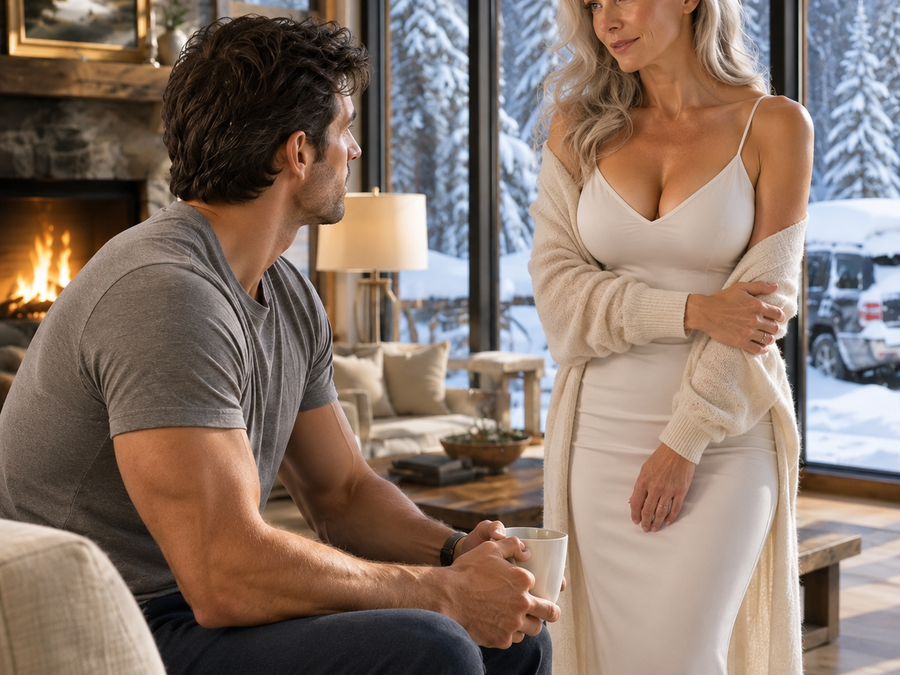
They settled in the sitting room with the fire going
all three of them
and outside the window the first snow of the evening had started.
Not a storm
just snow falling the normal way
covering the restored courtyard and the outbuildings and the meadow in the slow accumulation that mountain evenings in November produced without drama.
Brin was on the floor with her book
she’d retrieved it from the car at some point without anyone noticing
and Cade and Octavia were on the sofa
not quite touching
in a way that had its own language by now.
A proximity that Brin had stopped pretending not to notice several months ago.
It was Brin who looked up from the book and looked at the window.