“Don’t Cry, I’m Here.” Single Dad Saved an Older Billionaire Woman—Then Uncovered Her Secret-Part 7
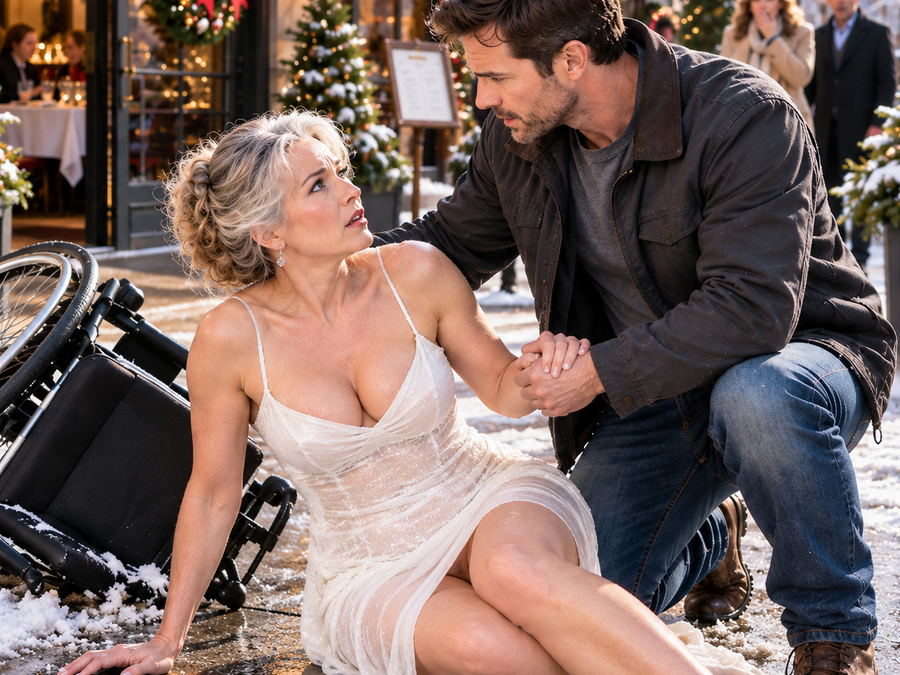
========== PART 7 ==========
Handle the rest, Vivienne repeated.
I’m working on it, he said.
Thomas pulled up outside.
The automatic doors opened and the February cold came in and the mountains were still there on the horizon
white and enormous and permanent.
They went out into it together.
The first shop opened in April.
It was not a grand opening.
There was no ribbon.
There was no press release which had been Nolan’s explicit condition and which Vivien had accepted without argument
though Dana had winced visibly when he said it.
The Ashford Meridian Communications team had prepared a full launch package photography
a feature story
a social media rollout
and all of it sat in a folder on someone’s desktop unused because Nolan had said
“The first customers who come through that door deserve to come through it without feeling like they’re part of an announcement.
Let the work speak first, then talk about it.”
Vivien had looked at Dana.
Dana had closed the folder.
The shop was on River Street
the space Nolan had known about since before any of this
started a former automotive service bay with a parking lot large enough for the lift installation and a grade level entrance that needed no modification.
He had spent six weeks overseeing the conversion himself
working alongside the two mechanics he’d hired
a woman named Rosie Delgado
who’d done adaptive equipment installation in Colorado Springs for 8 years and had applied for the position 40 minutes after the listing went up
and a younger man named Tom Burch
who’d spent 3 years doing fleet conversions in Denver
and who within 2 weeks of starting
had proven to have a natural intuition for the work that Nolan recognized immediately because it was the same intuition he’d had At 24
the
sign above the door said Vance Mobility Ashford Meridian.
Simple, functional.
Cara had voted for a larger font and been overruled
though she’d been right about the color
which was a dark blue that caught the morning light.
Well, the first customer arrived before they officially opened.
A man named Gerald Hooper drove a 2014 Dodge Ram into the parking lot at 7:45 on the morning of April 3rd
45 minutes before the 8:30 start time.
He was 57
a former electrician from a town called Waverly
20 mi east of Cedar Point
and he’d lost full use of his right leg 18 months earlier following a work injury.
He’d been waiting 14 months for an opening at the nearest adaptive shop in Denver
which had a 6-month backlog
and had already rescheduled his appointment twice.
Someone had given him Nolan’s number.
Nolan was there early.
He was always there early and he let Gerald in.
And they sat in the waiting area with bad coffee from the machine that hadn’t been replaced yet.
And Gerald told him what he needed.
A right foot override and a left foot accelerator installation so he could drive his truck again.
He’d been driving his truck for 23 years.
His wife had been driving him places for 18 months
and he did not say this with bitterness exactly
but he said it with the specific weight of a man who understood exactly what he’d lost and wanted it back.
Rosie assessed the vehicle.
She gave Gerald a quote.
The quote under the division’s pricing structure came to $280 a month on a 12-month plan.
Gerald looked at the number for a moment.
Then he looked at Nolan.
That’s not a real price, Gerald said.
It’s the real price, Nolan said.
The shop in Denver quoted me.
I know what the shop in Denver quoted you, Nolan said.
This is what we charge.
Gerald looked at the quote again.
He had the look of a man trying to find the catch.
Not suspicious.
Exactly.
Just experienced in a way that made him careful.
Why?
He said.
Nolan thought about how to answer.
Because a guy I used to work for charged what the work was actually worth
he said
not what the market would bear.
There’s a difference.
He paused.
And because somebody decided this division should serve the people who need it
not just the people who can afford to wait.
Gerald folded the quote and put it in his shirt pocket.
He picked up his truck 3 days later.
He drove it out of the lot himself right foot on the brake the way he’d driven for 23 years.
And Nolan stood in the parking lot and watched him go and felt something settle in his chest that had been unsettled for a long time.
Rosie appeared beside him.
He didn’t say thank you, she observed.
He drove his own truck home.
Nolan said he doesn’t need to say thank you.
Rosie looked at him for a moment.
You’re going to be annoying to work for, she said in a good way.
By July, they had a 3-we backlog.
By September
it was 6 weeks
which was both a problem and a form of evidence.
Viven looked at the numbers Nolan sent her a monthly operations report that was more detailed than she required and less polished than her finance team preferred
which she’d told him was exactly right
and she flew to Cedar Point on the first Saturday of October.
This was by then not unusual.
She came roughly once a month, sometimes more.
She had begun keeping a small bag packed at her Denver apartment specifically for Cedar Point visits
which Irene had observed once with an expression she’d carefully chosen not to describe aloud.
The visits were operational
reviewing the shop
discussing expansion planning
working through the procurement agreements with Rosie and Tom
and they were also increasingly something else
something that had no clean operational category.
She stayed at the Cedar Point Inn when she came
which was the town’s only hotel and was fine in the way that small town hotels were fine
clean
predictable breakfasts that were heavy on carbohydrates.
On her third visit
Cara had told her with the directness of a 9-year-old that it was a waste of money and she should just stay in the guest room
which had a good mattress and a reading lamp and was currently being used to store exactly one box of winter clothes and a folding table.
Vivien had declined.
on her fourth visit she’d accepted
which was how October found her in the guest room of Nolan’s apartment on a Friday night reading briefs for a Monday board meeting while Nolan made dinner in the kitchen and Cara did homework at the table and the apartment had the specific quality of a place where people were comfortable existing in the same space without narrating it.
Cara was in fourth grade now.
She’d acquired opinions about things
strong ones
systematically organized and delivered with confidence that slightly exceeded her supporting evidence which Vivien found privately delightful.
She had opinions about the font on the shop sign
about which documentary about marine biology was scientifically accurate
about the correct way to load a dishwasher
and about whether Viven’s Tuesday morning board call schedule was too aggressive given the time zone differential with the European office.
That last one had
been delivered over breakfast one Saturday and had been in point of fact correct.
Nolan had looked at his eggs and said nothing with the expression of a man who had learned that sometimes Cara arrived at the right answer through a process he didn’t entirely follow and the appropriate response was just to let it land.
That October Friday
Cara finished her homework and put it in her backpack with her characteristic thoroughess and then said to no one in particular
“I think you should go on a date.”
Nolan set down the pan he was holding.
Vivien did not look up from her briefs.
Homework done.
Nolan said yes.
Cara was unimpressed by the redirect.
I’m just saying.
Mrs.
Hartley says it’s obvious and she’s 81 and she can tell.
Mrs. Hartley should focus on Jyn Rummy.
Nolan said she beats me every time, so she has plenty of attention left over.
Cara looked between them.
I like Viven.
I’ve liked her since Christmas.
I’m just pointing that out.
Viven set down her brief.
She looked at Kira.
Then she looked at Nolan
who was looking at the pan in his hand with the expression of a man who had run out of ways to appear busy.
“Kira,” Vivienne said carefully.
“Can I ask you something?”
Kira nodded.
“Does it bother you that I come here?”
“That your father and I work together, spend time together.”
“No,” Carara said.
“It was immediate and uncomplicated.
You make him less tired.”
Nolan looked up.
“When you’re here, he talks more at dinner,” Cara said.
“And he laughs more.
He laughs at home anyway, but it’s She paused, searching for it.
The way children did when they were trying to describe something real.
It’s different when you’re here.
More.
She picked up her backpack.
I’m going to brush my teeth.
She went down the hallway.
The kitchen was very quiet.
Nolan put the pan back on the stove.
He stood with his back to her for a moment
and she watched the a set of his shoulders and said nothing because she had learned by now that he needed a moment sometimes when something true had landed and he was deciding how to hold it.
Then he turned around.
“She’s not wrong,” he said.
Vivien looked at him.
“No,” she said.
“She’s usually not.
They did not, as it happened, go on a date in the traditional sense.
What they did was take a drive on a Saturday morning in November.
Just the two of them
Cara at Mrs. Artley’s with legitimate enthusiasm in Nolan’s truck up into the mountains.
No particular destination stated the pass road as it happened heading north
the same road.
They didn’t discuss it.
He’d started driving and she’d watched where the road was going
and she’d understood
and they’d both been quiet as the mountains rose around them.
The pull out had been improved.
It was not dramatic a widened gravel pad.
A low barrier installed at the right height to stop a vehicle without blocking a wheelchair’s line of sight.
A proper accessible parking space marked clearly.
A path from the parking area to the overlook that was graded and surfaced.
The overlook itself was a modest cleared space where the trees stepped back and the valley opened below
enormous and hushed.
Nolan had filed the community improvement application in February.
The forest service had approved it in June.
He’d done most of the physical work himself on weekends with Tom Burch and Dale Riley helping on a Saturday in August
and none of them had told anyone who funded it
which had been the condition.
It was logged in the Forest Service records as an anonymous community contribution.
He helped Viven from the truck to her chair she led him
not because she needed it exactly
but because there was a difference between needing something and choosing to accept it from someone you trusted
and they went to the overlook.
The valley below was November pale
the aspens long bare
the sky high and cold and blue in the specific way it only got at altitude after the summer was fully done.
The mountains on the far side were white already
their peaks catching the late morning sun.
They stayed for a while without speaking.
That was something they developed over the months
a genuine comfort with silence that wasn’t empty
wasn’t avoidance
was just two people occupying the same space and not requiring noise to fill it.
Then Vivien said quietly, “I was lying right there.
She meant the embankment below the road.
She didn’t gesture.
She didn’t need to.
They both knew where it was.”
“I know,” he said.
I remember thinking, she stopped, started again.
I remember thinking that nobody knew where I was
not the exact where
that it was possible
very possible
that the storm would close in before anyone found me.
She looked at the valley.
I had been alone for a long time before that night.
not lonely necessarily, alone.
And lying in that snow, I thought, “This is what you chose.”
All those years of choosing the company, the work, the next deal.
This is the shape of that life.
She paused.
I wasn’t afraid of dying.
Exactly.
I was afraid of what it meant that no one knew I was there.
Nolan was quiet.
And then headlights, she said.
And then headlights, he said.
She looked at him.
I keep thinking about the version where you drove past, she said.
No, I didn’t drive past.
most people.
I’m not most people,” he said.
“Not arrogantly, just plainly.
The way you stated a thing you’d simply always known about yourself.
” She looked at him for a long moment.
The wind moved across the overlook
and she pulled her coat closer
and he didn’t move to help because she didn’t need it
and there was a difference.
He’d understood for a while now between being available and hovering.
He’d learned that difference from her.
Actually
watching the way she navigated a world that often couldn’t decide between those two things.
I’m not good at this, she said.
At what?
At She made the slight helpless gesture she almost never made.
The one that appeared when she was at the genuine edge of her own fluency.
Allowing something.
Allowing someone.
I’m good at building things, at managing things, at protecting things.
I’m not good at the part where you just She stopped.
Let it be what it is, he said.
Yes.
She looked at him.
That he looked back at her.
The mountains were behind him, enormous and unhelpful, offering no advice.
I’m not asking you to be good at it, he said.
I’m just here.
Same as I was on that road.
He paused.
I’m not going anywhere, Vivien.
She held his gaze and then she reached out and took his hand
which was not something she did easily or automatically
which was why it meant what it meant.
He held on.
They were not, in the months that followed, dramatic about it.
There was no announcement
no press
no version of this story that went public before they were ready.
Viven’s legal situation with Preston was still moving through the court system.
These things moved slowly
as she’d said they would
and the division was in its expansion phase
and Nolan’s life in Cedar Point was not built for spectacle.
So
they were simply what they were
incrementally and imperfectly
two people who had found each other in an unlikely place and were choosing repeatedly to be in the same direction.
It was not uncomplicated.
Viven was 50.
Nolan was 32.
This gap was invisible some days and very present on others.
Not because either of them made it so
but because the world had opinions about it that arrived uninvited.
A board member who made a remark at a February dinner that Viven addressed with a precision that left the room very still.
a woman at Carara’s school who said something to another parent that got back to Nolan through the specific channels of small town information and which he handled by saying nothing and continuing to show up.
He was good at continuing to show up.
Viven was good at many things, but this was not on her original list.
She learned it.
She learned it the way she’d learned to drive with hand controls deliberately through repetition
accepting that there would be days she executed it poorly
and the appropriate response was to correct and continue rather than to let imperfection become evidence against trying.
Cara turned nine in March and 10 in the following March.
And somewhere in between
she stopped thinking of Viven as a visitor and started thinking of her as the person who was always there
which was its own quiet revolution.
The second shop opened in Grand Junction in August of the first year.
The third opened in Pueblo 3 months after that.
By the following summer
there were seven shops across Colorado and two in neighboring states.
And the weight list problem was becoming manageable in the way that a real business became manageable.
Not perfectly, not without friction, but sustainably.
The pricing structure held.
Nolan had made it a point to review every quarterly pricing report himself
not because he didn’t trust Rosie or Tom or the operations team that had grown around them
but because he’d made a promise to people like Gerald Hooper
and he was not going to be the person who let it drift.
Viven never challenged him on it.
Not once.
When the finance team presented alternative pricing models at the annual review
presented them as options
framed carefully the way you framed things to a person who had operational independence.
Vivien listened to the presentation and then said
“Nolan’s authority over pricing is structural
not discretionary.
If the margin is insufficient, we find efficiencies elsewhere.
That’s not a discussion.”
And the presentation moved on.
He found out about this later from Dana
who told him with the specific satisfaction of someone who thought he should know.
He called Viven.
“You didn’t have to do that,” he said.
“I know,” she said.
“I told them what the terms were when we signed the agreement.
I was just reminding them.
You could have let me fight that fight.
You were in PBLO opening the third shop, she said.
I was in the room.
It seemed inefficient to wait.
He exhaled.
Thank you, he said.
You keep thanking me, she said.
Now we’re even.
Preston Marlo was convicted in September of the second year.
The verdict came back on a Tuesday afternoon.
wire fraud
financial fraud
criminal conspiracy
and the charge related to the wheelchair sabotage
which the prosecution had argued successfully as criminal endangerment and malicious tampering with adaptive medical equipment.
Raymond Hol was convicted in Dallas 2 weeks later on related financial charges.
Viven was in a board meeting when Dana sent her the message.
She read it under the table, which she never did, but she read it.
And then she set her phone face down and completed the meeting
which took another 50 minutes and covered Q3 projections and a market expansion analysis for two new European regulatory territories.
When the meeting ended and the room cleared
she sat alone for a moment at the conference table.
She did not feel the way she’d expected to feel.
She’d thought there would be something clean about it
the verdict
the finality of it
the official confirmation that the record showed what happened.
And there was something clean.
But underneath it was something more complicated.
Not grief she wasn’t going to grieve
Preston
but a residual weariness
the specific exhaustion of something that had cost a great deal and was now finally finished costing.

