“Get Her Out!” They Mocked the Disabled Nurse—Then a Navy SEAL & 7 K9s Exposed Their Biggest Mistake
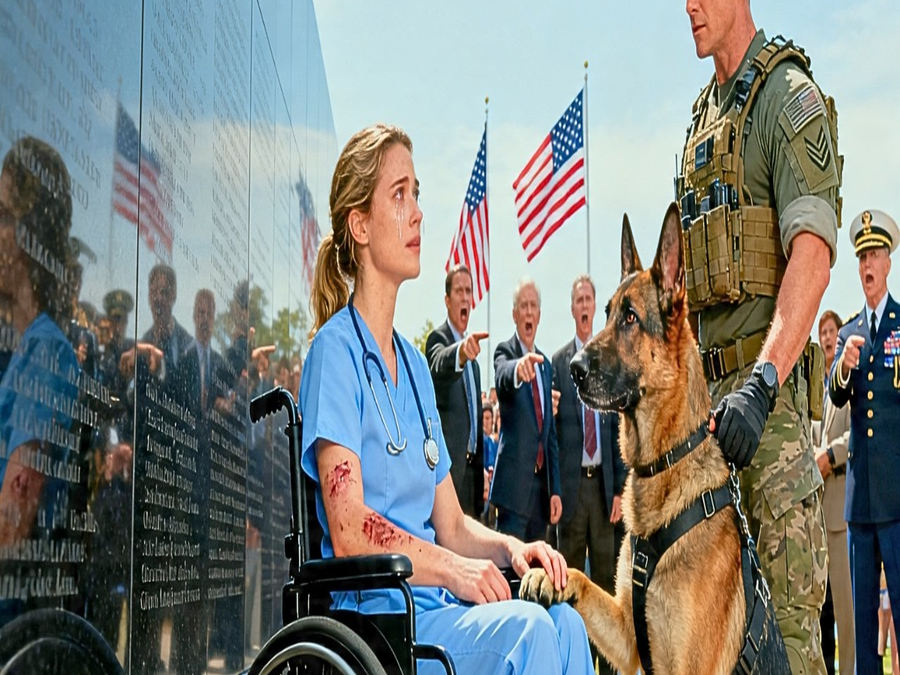
“Get Her Out!” They Mocked the Disabled Nurse—Then a Navy SEAL & 7 K9s Exposed Their Biggest Mistake
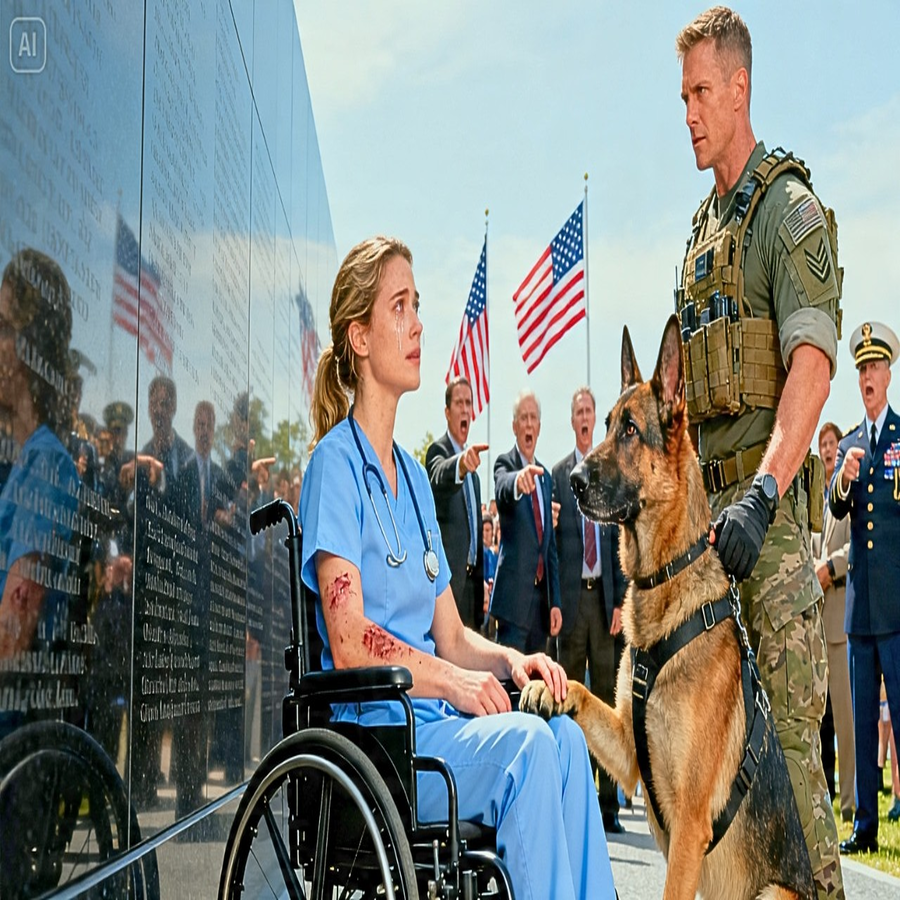
She arrived alone.
No uniform, no medals, no one waiting for her.
Just a 20-year-old girl in a wheelchair pushing herself through the iron gates of Stonehaven Veterans Memorial while decorated officers watched with narrowed eyes.
They laughed, quietly at first, then not so quietly.
Security moved to intercept her.
Guests whispered behind pressed hands because what could someone like her possibly have to do with heroes?
Then the dog broke formation.
A scarred German Shepherd
decorated combat veteran
multiple combat deployments
abandoned his handler mid-ceremony and ran straight for the girl they’d been mocking.
And the crowd went absolutely silent.
The ceremony was supposed to start at 10:00.
By 9:45, the parking lot at Stonehaven Veterans Memorial was already packed.
Town cars and pickup trucks sharing asphalt with military-issue SUVs.
Everyone moving with that particular self-importance that came from knowing you were dressed better than the occasion required.
The memorial itself was a stretch of manicured lawn backed by a granite wall carved with names
flanked on both sides by rows of American flags that snapped and shuddered in the late October wind.
Folding chairs had been arranged in precise columns.
A podium stood draped in bunting the color of old blood.
Colonel Warren Briggs arrived at 9:52 in a black Lincoln
shook four hands before he reached the grass
and spent the next 6 minutes glad-handing his way toward the front row without once looking at the names on the wall.
Across the lot, a white catering van idled near the side entrance.
The driver leaned out his window smoking
squinting at the people filing through the main gate.
“Big turnout,” he said to no one.
It was.
Stonehaven’s annual remembrance ceremony had grown considerably in recent years
partly because the town had given three sons to Fallujah and two more to Kandahar
and partly because the local councilman had discovered that military pageantry pulled well in election years.
There were news cameras today.
Two local affiliates
one regional outlet
a photographer from the state paper who had already taken 11 shots of the folded flags and was working his way toward the K9 unit stationed near the honor guard.
The dog’s name was Atlas.
He was a 5-year-old German Shepherd
78 lb of muscle and scar tissue
and he stood at perfect heel beside his handler
Staff Sergeant Daniel Grayson
with the kind of stillness that came from genuine discipline rather than fear.
Atlas had a Bronze Star
not the kind issued to men for paperwork
but the operational citation
awarded after he’d located an IED cache that would have killed a 12-man patrol in the Kunar province.
He’d also taken a piece of shrapnel to his left hind leg during extraction
which had healed wrong before anyone noticed
leaving a raised keloid scar beneath the fur that Grayson sometimes pressed his thumb against when the nights got bad.
Atlas didn’t fidget.
He didn’t track the movement of the crowd.
He stood
and he breathed
and occasionally his dark eyes moved in the slow systematic scan of something that had been trained to notice threats before they materialized.
He wasn’t scanning for threats right now.
He was watching the gate.
Maravoss arrived at 9:58.
She came through the main gate alone
which was the first thing people noticed.
The second thing they noticed was the wheelchair
a manual chair
lightweight aluminum
the kind you saw at airport rental counters.
She was pushing herself with both hands
her knuckles pale against the cold metal of the rims
dressed in a second-hand gray cardigan over dark jeans and flat shoes that didn’t quite fit the October chill.
She had small backpack looped over the handles behind her and a single white chrysanthemum laid across her lap.
She was 20 years old.
She looked younger
the way people do when they haven’t had enough of anything for long enough.
Not quite fragile, but worn at the edges.
Dark circles under brown eyes.
Jaw set.
She moved toward the main seating area without hesitation
navigating the slight incline from the gate with the practiced efficiency of someone who’d been doing this long enough that it wasn’t something she thought about anymore.
The first comment came from somewhere in the third row.
Is this the right event?
A woman’s voice
pitched low
but not low enough
carrying the particular frequency of someone accustomed to being overheard.
I don’t see a registration table.
There’s a community shelter two blocks over
a man beside her said
and the woman laughed
covering her mouth with her gloved hand.
Mara didn’t stop.
She found a space at the end of the third row
near the aisle
and she angled her chair to face the podium.
She placed the chrysanthemum in her lap with both hands
smoothing the petals once
and then she sat still and looked at the wall.
Grayson noticed her in 3 minutes after she sat down.
He noticed her because Atlas did.
The dog’s head turned almost imperceptibly
his nose lifting
something shifting in the quality of his attention.
Grayson tracked the direction of the dog’s focus and found the girl in the wheelchair at the end of the third row.
Probably smells the flower
Grayson thought
and returned his eyes to the middle distance.
He’d been out of active service for 14 months.
Medical separation
concussion protocol that had extended into something more complicated
a cascade of follow-on evaluations that ultimately produced a stack of paperwork and a handshake from a colonel who couldn’t quite meet his eyes.
He was 31 years old.
He’d served 11 years
made chief petty officer
done four deployments with SEAL Team 7
and came home to a town he barely remembered with a body that still flinched at car backfires
and a lease on a two-bedroom apartment he used like a storage unit.
He was here today because Grayson and Atlas had served together for two of those deployments.
Grayson as the dog’s tactical handler
Atlas as the thing that found the things that killed people before they killed people.
When the ceremony committee reached out asking if he’d return for the ceremony
he’d almost said no. Then he’d looked at Atlas and figured he owed the dog that much.
Atlas was still watching the girl.
The ceremony began 7 minutes late.
Colonel Briggs opened with a prepared speech about sacrifice and duty that managed to invoke both Lincoln and a football analogy within 90 seconds.
There were three readings
two musical performances by the high school choir
and a full honor guard presentation that included a rifle volley that sent a flock of starlings erupting from the oak trees along the perimeter wall.
Mara sat through all of it without moving.
The wind came in steady off the north
cold enough to redden her cheeks
and she didn’t zip her cardigan or reach into her backpack for anything warmer.
She just sat with the flower in her hands and watched the ceremony proceed around her.
The trouble started during the wreath laying.
A man in a VFW hat
60s
thick through the chest
working on his third Styrofoam cup of coffee from the hospitality table
made his way down the aisle toward the row behind Mara and stopped.
Excuse me.
He was talking to Mara.
You’re blocking the aisle.
I’m in a designated spot, she said.
Her voice was quiet and even.
There are accessible spaces marked along the aisle.
There are also people who need to get through.
Then they can step around me or use the other aisle.
The man’s jaw tightened.
He made a show of squeezing past her chair.
He had enough room.
He chose not to use it
and his coffee tilted
a splash of it catching the back of Mara’s hand.
He didn’t apologize.
She looked down at her hand and dried it against her jeans without expression.
The woman from the third row leaned toward her companion again.
I heard she just showed up.
No invitation, no connection to anyone.
Someone said she might be one of those advocacy protesters.
For what?
Who knows?
Something.
Mara heard this.
She heard most of it.
She kept her eyes on the wreath being laid at the base of the granite wall
her hands folded over the chrysanthemum in her lap.
Her jaw set.
Grayson heard it, too.
He was positioned 10 ft to the left of the honor guard
near enough to the crowd to observe and far enough to maintain a clear line of sight.
It was force of habit.
He couldn’t stand in a public space without triangulating exits and sightlines and potential cover.
He’d done it so long it wasn’t strategy anymore.
It was just how rooms looked to him.
He’d heard the comment about the advocacy protester.
He’d watched the coffee incident.
He’d also watched the girl’s face during it.
The way her expression hadn’t changed exactly
but something behind her eyes had gone very flat in the specific way that meant she was deciding what to do with the information that this was not a safe situation.
He recognized that expression.
He’d worn it himself.
Atlas shifted beside him
a small movement
weight redistributing
the dog’s head lifting slightly.
Grayson put one hand on the dog’s shoulder
the trained calming contact
and felt the muscles beneath his palm coiled in a way that had nothing to do with threat response.
Easy, Grayson said quietly.
Atlas didn’t relax.
One.
The disruption came at the tail end of the wreath ceremony
when the ceremony coordinator
a thin man with a clipboard and the nervous energy of someone who had been organizing this event since August
made his way down the aisle toward Mara’s position.
Ma’am, he kept his voice low, professionally solicitous.
I’m going to need to ask you to relocate.
Mara looked up at him.
I have a right to attend a public memorial ceremony.
Of course
but we’ve had some concerns raised by other guests
and we want to ensure everyone has a comfortable experience.
I’m not making anyone uncomfortable.
The concerns relate to He stopped, recalibrated.
Our accessible seating is actually located near the rear of the This spot is accessible seating.
It’s marked.
A small audience had formed.
Three rows of people, some pretending not to watch, some not bothering.
The woman from the third row was watching openly.
The VFW man had turned around in his seat.
The coordinator’s smile went stiff.
Ma’am, I’m going to need to ask you to come with me.
I’m not going anywhere.
I’m sorry, but I’ll need to involve That was when Atlas moved.
Grayson felt it happen before he saw it.
A sudden release of tension beneath his hand, like a cable snapping.
He looked down.
The dog was already gone
20 ft across the grass in 3 seconds
covering ground with the kind of speed that his age and his scarred leg should have prevented
and didn’t.
Atlas.
Hier.
Grayson used the German command.
The dog didn’t break stride.
The crowd saw a decorated military working dog in a service vest running full speed directly toward a girl in a wheelchair
and for 2 or 3 seconds
the collective response was something very close to panic.
The coordinator stepped back.
The people in adjacent rows half rose from their chairs.
Someone made a sound between a gasp and a shout.
Atlas reached Mara and stopped.
Not a trained stop.
Not the planted feet squared shoulders stop of a working dog completing an exercise.
He stopped the way a person stops when they’ve been running towards something they can’t quite believe and need a moment before they trust it’s real.
Then he stepped forward and put his head in her lap.
He was trembling.
Grayson could see it from across the grass.
A fine continuous vibration moving through the dog’s entire body.
Mara went completely still.
For a second, no one said anything.
The coordinator’s clipboard dropped to his side.
The VFW man in the hat had turned completely around in his seat
coffee forgotten.
Then Mara’s hand came up slowly and settled on the back of Atlas’s head and the dog pressed harder against her knees and the trembling didn’t stop
but it changed the way rain changes from the kind that’s coming for you to the kind that’s just weather.
Grayson walked across the grass.
He didn’t run.
Running would have made it a crisis and he decided before he took the first step that this was not a crisis.
This was something else.
He didn’t have a word for it yet, but he knew what it wasn’t.
He positioned himself between the coordinator and Mara’s chair without making a production of it.
Just stepped into the space and stopped
which communicated what he needed to communicate.
“Give him a minute.”
He said.
The coordinator blinked.
“Sir, the dog is supposed to be in” “Give him a minute.”
The coordinator looked at the dog.
The dog did not look at the coordinator.
The coordinator stepped back.
The ceremony had stalled completely.
Colonel Briggs stood at the podium with the specific expression of a man whose agenda has been derailed by something he can’t adequately categorize.
The honor guard held formation professionally
impressively
their eyes not moving
but the rest of the crowd had given up any pretense of attending to the ceremony.
Everyone was watching the dog and the girl.
Grayson crouched down beside Atlas, not touching him.
Hey.
He kept his voice low.
What are you doing, man?
Atlas didn’t look at him.
He was looking at Mara.
His tail had started moving
not the frantic wag of excitement
but something slower and more deliberate
like a metronome.
Grayson looked at the girl.
She was crying, not dramatically.
Her face wasn’t crumpled.
She wasn’t making any sound.
Just tears running down her face while she stroked the dog’s neck with both hands.
Her chrysanthemum fallen to the grass beside the wheel of her chair.
I’m sorry.
She said.
She was talking to Grayson without looking at him.
I don’t know what’s happening.
I don’t know why he came to me.
You know dogs?
I used to.
She paused.
Her voice was very controlled.
A long time ago.
Grayson looked at Atlas
then he looked at the girl’s hands on the dog’s neck.
Not the tentative hands of someone dealing with an unfamiliar animal
but the hands of someone who knew exactly where to press and how to hold.
He almost said something, then he didn’t.
Behind them, the whispering had started again.
He could hear it without trying
the crowd reforming its opinion in real time.
The cognitive work of people deciding what they were seeing, staged.
That was the word he heard twice.
Attention, viral video.
Someone near the back mentioned a leash law.
He didn’t turn around.
Mutt.
The coordinator tried once more
at a distance this time
speaking to Grayson instead of Mara.
Sergeant Grayson, I need to ask you to call the animal back to position.
He’s not responding to commands right now.
Then perhaps we should He’s not a threat.
He’s not going anywhere.
Grayson finally looked at the coordinator.
The ceremony can resume.
He’s not bothering anything.
The optics?
Then let them be what they are.
He turned back around.
The coordinator retreated.
Someone in the crowd laughed, a short, uncomfortable laugh.
The kind that fills silence when no one knows what to do with what they’re watching.
Mara wiped her face with the back of her hand.
She looked at Atlas
still pressed against her knees
still trembling in that new settled way.
“What’s his name?”
she asked.
“Atlas.”
She was quiet for a moment.
“How old is he?”
“Five.”
“He was trained at Lackland
deployed twice
once to Afghanistan
once to Iraq.
He’s been with me the last 18 months.”
“Is he” She stopped.
Started again.
“Is he okay physically?”
Grayson looked at her.
“He’s got a bad leg, old shrapnel wound.
Why?”
She didn’t answer right away.
Her right hand had moved along Atlas’s flank
still stroking
still automatic
and had stopped somewhere near the dog’s left hindquarters.
“Just asking,” she said.
But her voice had changed.
Something in it had shifted from grief to something she hadn’t decided how to name yet.
Grayson watched her hand.
He watched it stop over the dog’s left hind leg.
He watched her fingers find through the fur the raised line of a scar she could not have known was there.
And her face
her carefully composed
steadily controlled face
went very still in a way that had nothing to do with composure.
“Hey,” Grayson said quietly.
“You okay?”
She didn’t answer.
Her eyes had dropped to the dog’s leg
both hands now parting the fur carefully
tilting her head to look.
Atlas stayed motionless beneath her hands, letting her look.
“Hey.”
Grayson’s voice went lower.
What is it?
Mara raised her eyes to his.
They were dry now.
The crying had stopped, replaced by something harder and more complicated.
Something that looked in the October light a lot like recognition.
The scar, she said.
Tell me how he got it.
Grayson studied her face for a long moment.
Shrapnel, he said.
Extraction from a compound in Kunar province, 2021.
She shook her head very slightly.
That’s not the only scar he has there, she said.
There’s a surgical scar underneath.
About 3 cm on the inner surface from suturing.
Grayson went very still.
He’d never told anyone about the surgical scar.
It predated Atlas’s military service
predated Lackland
predated his own time with the dog.
He’d noticed it during an early grooming check and flagged it in the medical records as a pre-existing condition.
The record said origin unknown.
The vet at Lackland had estimated it was approximately 2 years old at the time of Atlas’s intake.
2 years before his intake put it at 2018.
Atlas’s intake records listed him as a donation from an anonymous civilian source.
The air between Grayson and the girl changed in some way that didn’t have a name.
How do you know that?
He said.
Mara looked at the dog.
Atlas looked back at her.
The trembling had stopped entirely.
Because I made it, she said.
Because I made it, she said.
Grayson didn’t move
didn’t speak
just stayed crouched beside Atlas with his forearms on his knees and his eyes on the girl.
Reading her the way he’d learned to read people in places where reading someone wrong had consequences that couldn’t be walked back.
She wasn’t performing.
He’d watched enough people perform under pressure to know the difference.
The slight overreach of expression
the half-second delay between feeling and showing.
Mara had none of that.
She was looking at the scar on Atlas’s leg with the flat
========== PART 2 ==========
certain look of someone identifying something they’d made with their own hands.
The way a carpenter recognizes a joint they cut years ago in a piece of furniture they’d forgotten they’d built.
“Talk to me,” Grayson said.
She didn’t answer immediately.
Her fingers were still against the dog’s leg, not moving, just resting there.
Atlas had turned his head to look at her profile
and he held that position with the patience of something that had learned to wait.
“How long has he been in service?”
she asked.
“4 years, give or take.
He came through Lackland in late 2019.
” “His intake records, do they say anything about where he came from before?”
“Anonymous donation, civilian source.”
Grayson paused.
“Which you apparently already knew.”
She looked up at him then.
Something in her expression shifted.
Not relief, exactly.
More like a person reaching the end of a very long calculation and arriving at the number they’d been afraid to get.
“I didn’t know,” she said.
“I hoped, but I didn’t know.”
Behind them
the ceremony had resumed in the uncertain
limping way of events that have been derailed and are trying to pretend otherwise.
Colonel Briggs had returned to the podium.
The choir was attempting a second verse
but the crowd’s attention had fractured.
Half of it dutifully aimed at the granite wall and the flags
the other half orbiting the girl in the wheelchair and the dog that wouldn’t leave her.
The woman from the third row had her phone out.
She wasn’t subtle about it.
She held it at chest height
camera facing forward
and she spoke quietly to the man beside her while keeping the lens pointed at Mara.
“$100 says this is planned.
She knew the dog would be here.
Probably looked it up.
The man beside her made a noncommittal sound.
He was watching Atlas and something in his face had gone uncertain in a way he didn’t entirely know what to do with.
“Dogs don’t fake it,” he said finally.
“Neither do good actors.
” Across the aisle
a retired army captain named Elise Harmon had stopped pretending to watch the ceremony 10 minutes ago.
She was 63
two tours in Desert Storm
and she had the particular quality of attention that came from spending 20 years in environments where noticing correctly was the margin between operational and catastrophic.
She was noticing things now.
She noticed the way Atlas’s body language had changed from the moment he reached the girl.
The dissolution of working dog discipline into something older and less trained
something instinctive.
She noticed the way Grayson had positioned himself between the girl and the coordinator without making it look like a positioning.
She noticed the way the girl’s hands moved on the dog.
The specific knowledgeable handling of someone who understood dog anatomy
the way civilians generally didn’t.
She kept her observations to herself and waited.
The coordinator reappeared at Grayson’s shoulder.
He’d brought reinforcements
a security guard in a black jacket
mid-30s
the kind of guy who’d been hired for an event like this because he had the right build and a calm face
not because he’d ever been trained for crowd management.
“Sergeant Grayson.”
The coordinator’s voice had hardened into something with more authority than it actually possessed.
“We need the animal back in position.
The ceremony is in its final segment
and the canine presence is part of the closing tribute.”
“I heard you the first time.”
“Then I need” “You need to lower your voice
” Grayson said
“because you’re standing 3 ft from the dog
and you’re not reading him right.
” The coordinator looked at Atlas.
The dog had not moved
was still against Mara’s knees
still watching her face.
To an untrained eye, he looked calm.
To someone who knew dogs
particularly working dogs with combat histories
the stillness was not calm.
It was containment.
“He’s fine,” the coordinator said.
“He’s tolerating.”
Grayson finally stood up, straightening slowly.
He had 3 in on the coordinator
and he didn’t use them as a threat
just let them exist.
There’s a difference.
“You get between him and her right now
you’re going to have a situation that’s a lot worse for your optics than a dog standing next to a wheelchair.
” The security guard shifted his weight, not toward them, away.
He’d read Atlas correctly.
The coordinator’s jaw worked.
Then he pivoted toward Mara.
“Ma’am, I’m going to ask you one more time to allow us to “No,” Mara said.
It was a small word
delivered without heat
and it landed in the conversation like a closed door.
The coordinator stared at her.
She looked back at him with the particular patience of someone who has run out of the kind of energy it takes to be conciliatory.
“You asked me to move from public seating during a public ceremony.
I declined.
You called security.
The security guard hasn’t said anything because there’s no legal basis for removing me.
The dog came to me voluntarily.
That’s between him and his handler.
I’m not creating a disturbance.”
She “The disturbance is you.”
The coordinator opened his mouth.
Nothing came out.
Grayson looked at the girl with new attention.
That had been precise
not aggressive
not emotional
just surgically accurate about the situation in a way that people who were actually fragile and frightened generally weren’t.
“I think we’re good here,” Grayson told the coordinator.
The coordinator left.
The security guard went with him, looking relieved.
Ah, Grayson crouched back down beside Atlas, closer to Mara’s eye level.
Before, he said, the scar.
You said you made it.
I did.
That scar is from a veterinary procedure.
I’ve seen the pre-intake exam.
The vet at Lackland estimated it was done by someone with surgical training.
Or someone who watched enough tutorial videos and had a very specific reason not to let a dog die in a parking lot.
Grayson went still.
What do you mean?
It wasn’t quite a question.
Mara seemed to register that.
The flatness of his voice, the quality of waiting in it.
She looked at Atlas for a moment.
The dog had closed his eyes just briefly.
The slow blink of an animal that was exhausted in a way that went beyond physical.
I found him in November, she said.
2018.
In a parking lot off Route 7, about 40 miles east of here.
He wasn’t a puppy.
He was maybe 4 months old.
Big for his age, but thin.
Someone had tied him to a cart return and left.
She paused.
He had a gash on his left hind leg.
Deep enough to need sutures.
I don’t know how long he’d been there.
You took him to a vet.
I couldn’t afford a vet.
She said it without apology
the way people state facts they’ve made peace with.
I had $60 in my account and a medical textbook I’d bought from a thrift store 6 months earlier because I was trying to figure out if I could pass the prerequisites for nursing school.
A very small pause.
I used what I had.
Grayson looked at the scar on Atlas’s leg.
The clean line of it.
Better than he’d have expected from improvised surgery.
Better than some things he’d seen in the field.
You sutured a dog’s leg yourself.
I cleaned it, closed it, and kept it clean for 2 weeks.
He let me.
She looked at Atlas with something that wasn’t quite a smile and wasn’t quite not one.
He was very patient.
And then?
She was quiet for a moment, not evasive, just taking time with it.
I kept him for 8 months in my apartment
which didn’t allow dogs
which I handled by never telling my landlord and never opening the door when management came by for inspections.
Her voice stayed even.
I was working two jobs.
He needed more than I could give him, space, training, stimulation.
He was smart in a way that was becoming a problem in 400 square feet.
So, you donated him?
I found a program that accepted civilian donations for K9 candidates.
I drove him there.
I didn’t leave my name.
She looked down at the chrysanthemum on the ground beside her wheel.
She hadn’t picked it back up.
I didn’t think I’d see him again.
Grayson sat with that for a moment.
“Why are you here today?”
he asked.
“This ceremony specifically?”
“I come every year.”
“You don’t know any of the people being honored.”
“No.” She looked at the granite wall, at the names carved there.
“But, I come anyway because I thought” She stopped, adjusted.
“I thought maybe if I kept coming
I’d feel less like I’d done something I shouldn’t have.”
“Surrendering the dog?”
“Yes.”
Grayson looked at her.
She was 20 years old.
She’d sutured a dog’s leg with a thrift store textbook and kept him hidden in a no pets apartment for 8 months
and driven him to a training program and left her name off the paperwork
and come to a veterans memorial every year since
alone
to stand in as witness for a thing she’d done that she couldn’t fully account for.
Atlas had opened his eyes again.
He was looking at Mara’s face with the steady attention of a dog that has decided something is where it belongs.
“His name?”
Grayson said.
“Did you give him one?
Before Lackland?”
She nodded.
“What was it?”
She didn’t answer right away.
The wind moved through the flags overhead with a sound like something breathing.
Then she looked at the dog
and Atlas looked back at her
and she said quietly
almost too quietly to hear
a single word.
“Scout.”
Atlas made a sound.
It wasn’t a bark, and it wasn’t a whine.
It was something between those things
low and rough The sound a dog makes when language is insufficient
and the body makes its own translation.
He pushed his head harder against her lap.
His tail started moving again.
Grayson watched this and felt something shift in his chest that he didn’t want to examine too closely in public.
The ceremony ended at 11:22.
The closing tribute
a rifle volley
a bugle rendering of taps from a recorded track
because the town’s budget didn’t extend to live musicians
proceeded without further incident.
Atlas stayed where he was through all of it.
Grayson stayed where he was
too
and the ceremony worked around them the way water works around something that isn’t moving.
As the crowd began to disperse, the dynamic changed.
Some people left immediately
cars
a handshake here and there
the catering van pulling away before the last notes of taps had finished.
But a significant portion of the crowd didn’t leave.
They drifted
the way people do when something unresolved is still in the room.
They found angles to stand at that allowed them to continue watching the girl and the dog without technically staring
and they talked to each other in low voices.
And the atmosphere around Mara’s position had the specific texture of a jury that hasn’t reached a verdict.
The woman from the third row
her name was Patricia Thorne
and she was the wife of a county commissioner
and she had 800 followers on a local social media group where she posted frequently about community standards
was not subtle about where she stood.
She approached directly without working through intermediaries
which Grayson gave her a point for even as he watched her come.
“I just want to understand.”
Patricia said.
She addressed Grayson rather than Mara
which was a choice she’d made and which said something specific.
“Is this animal supposed to be in service right now or not?”
“He’s at a public memorial ceremony.”
Grayson said.
“His service obligations are flexible in ceremonial contexts.
” “And is it normal for a working military dog to abandon his post and run to a stranger?”
“No.” “So, something unusual is happening.”
“Yes.”
“And you don’t find it suspicious that this She paused
selected her next word carefully
deployed it anyway.
“This young woman happened to be sitting exactly where the dog ran?”
“She was sitting in the accessible seating area.
The dog ran to her from 20 ft away.
I don’t see the causal mechanism you’re implying.”
Patricia looked at Mara then.
Mara looked back at her without any particular expression
not hostility
not deference
just the flat patience of someone waiting to see where this goes.
“You don’t have any connection to the military.”
Patricia said.
“That’s not a question.”
“I’m making an observation.”
“Then I’ll make one, too.”
Mara said.
“Attending a public memorial doesn’t require a military connection.
It requires showing up.”
“Which I did.”
“Which anyone can do.”
She held Patricia’s gaze.
“Including people who have reasons for being here that aren’t obvious to strangers.
” “What reasons do you have?”
“Mine.”
Patricia’s expression tightened.
“I think you came here knowing this dog would be here
and I think whatever’s happening right now is calculated.”
The word landed with the weight Patricia intended, and Mara absorbed it.
A different person might have flushed, or protested, or explained.
Mara did none of those things.
She looked at Atlas
who was still against her knees
and she did the thing Grayson had seen her do twice now under pressure.
Her face went very still, and she waited.
“I don’t know you,” Mara said, “and you don’t know me.
You looked at me when I came in
and you decided something
and that thing you decided has nothing to do with me
and everything to do with what I look like to you.
” Right.
A pause.
“I don’t need to defend myself to you.
You’re making quite a scene.”
“The dog is making a scene.”
For the first time
something like dry humor moved briefly across Mara’s face.
Not quite a smile, gone before it fully formed.
“I’m just sitting in it.”
Captain Harmon had moved closer during the exchange without appearing to.
She stood now at the edge of the loose circle of observers
hands in the pockets of her jacket
watching.
When Patricia Thorne walked away
not retreating exactly
but leaving with the deliberateness of someone who has decided the conversation is beneath them
Harmon stepped forward.
She looked at Atlas for a moment, then at Mara.
“He’s tracking your face
” Harmon said
“not your hands
not the movement around you
your face.”
She paused.
“That’s a bond behavior.
Takes months to develop.”
“I know,” Mara said.
Harmon looked at her
really looked
the kind of attention that took inventory without announcing itself.
“How long?”
she asked.
“Eight months, five years ago.
” Harmon absorbed this without visible reaction.
“How old were you?”
“15 when I found him, 15 when I kept him, 19 when I let him go.”
Something moved across Harmon’s face
not quite surprise
something more precise than that.
She looked at Grayson.
She donate him?
That’s what she says.
Lackland’s anonymous civilian program.
Records match the timeline.
Harmon looked back at Mara.
You drove him yourself?
I don’t drive.
I took the bus.
Mara paused.
Two transfers.
He sat on my lap the whole way because I didn’t have a crate.
He was too big for my lap.
He sat on it anyway.
Grayson looked down at Atlas.
The dog was now lying down
his body fully against the footrests of Mara’s wheelchair
his chin on her left knee.
He had the posture of an animal that has decided it has arrived somewhere and has no intention of leaving.
“He won’t respond to commands right now
” Grayson said to Harmon
but the observation was for himself as much as anyone.
He’s been trained to Schutzhund three standard.
He’s never refused a command in 4 years, not once.
Harmon made a small sound, acknowledgement, not surprise.
“The body remembers differently than the brain,” she said.
“I’ve seen it in people.”
She looked at Atlas.
Make sense it works the same way.
“Hot.”
The crowd was thinning but hadn’t emptied.
The VFW man in the hat
his name was Roy
and he’d served two tours in Vietnam
and he’d spent the last 40 years feeling quietly certain that he understood service and sacrifice in ways that most people simply didn’t
was still in his seat.
He’d refilled his coffee.
He was watching the dog.
He’d said the thing about the shelter two blocks over.
He knew he’d said it.
He’d been saying things like that his whole life
small observations
edge comments
nothing that rose to the level of cruelty
just the slow accretion of dismissal that people who looked like Mara received in spaces that were implicitly not built for them.
He wasn’t feeling great about himself at the moment.
He wasn’t sure what to do with that exactly.
It wasn’t the kind of thing he was accustomed to feeling at a memorial ceremony
and it sat in him with the awkward weight of a confession he hadn’t made anywhere except his own head.
He watched Atlas lying at the girl’s feet with his eyes half closed.
Roy had two dogs.
Retrievers.
Fat, happy, stupid in the way that happy dogs are stupid.
They had never looked at him the way Atlas was looking at that girl.
Not once, not ever, and he’d had them for years.
He didn’t know exactly what that meant.
He knew it meant something.
He sat with his coffee and didn’t say anything.
And the Grayson’s phone buzzed.
He checked it.
Lieutenant Colonel Ferris
his former CO
who was somewhere in the back row and had apparently witnessed the entire proceeding.
The text said, “What is happening?”
Grayson replied, “Long story.
Stand by.”
Another text immediately.
“Is the dog okay?”
Grayson looked at Atlas.
He was pushing his nose against Mara’s hand
and Mara was absently scratching behind his ear.
And he looked
if Grayson was honest with himself
better than he’d looked in months.
Less of that background restlessness that working dogs carried when they were between deployments.
The low-level seeking behavior of something that had been bred and trained to find things and didn’t have enough things to find.
He typed back, “Yeah, he’s okay.”
Then, after a second, “I think he’s actually okay.”
Word to “Why did you come back?”
Grayson asked Mara.
She’d been quiet for a few minutes
one hand on Atlas
watching the remaining crowd the way he’d learned to watch crowds
tracking the movements
reading the configurations
the social topography of who was standing near whom.
“Every year,” she said.
“Like I told you, guilt.”
“Maybe.”
She considered that.
“Or maybe I needed to know it meant something
that giving him up meant something
that it wasn’t just She stopped.
I was 19.
I was working at a diner on the morning shift and a pharmacy on the evening shift
and I was eating oatmeal and canned soup
and I was putting money aside for nursing school
and I loved that dog more than I’d loved anything in a long time.
She said it without drama
========== PART 3 ==========
the way people talk about things they’ve finished grieving.
And I couldn’t give him what he needed, so I gave him to someone who could.
Grayson was quiet for a moment.
What happened to nursing school?
Something shifted in her face, very briefly.
Car accident.
About 4 months after I surrendered him.
She didn’t look at the wheelchair.
He noticed she never looked at the wheelchair
the way some people don’t look at the thing in the room that defines the room.
It took about 2 years before I stopped being mostly angry
another year before I could think about any of it clearly
and then I found out there was a veteran ceremony here every October
and I started coming.
Why here specifically?
The program I donated him to, their documentation mentioned this county.
Stonehaven military district.
She paused.
I thought if he’d made it
if he’d become what I thought he could be
that maybe someone here would know him.
Her voice was very controlled.
I never thought I’d actually see him
but Grayson sat with that for a long moment.
He thought about the intake records.
Anonymous civilian source.
He thought about the surgical scar on Atlas’s hind leg.
Preexisting condition, origin unknown.
He thought about a 19-year-old girl on two buses with a dog too large for her lap that sat on it anyway
and the thing she’d given up
and the thing that had come back to her in the cold October air of a ceremony where the first words she’d heard were about the shelter two blocks over.
“He found you,” Grayson said.
Not a consolation, just the truth as it stood.
Mara looked at Atlas.
Atlas was looking at her.
He found me, she agreed.
The coordinator approached one final time
visibly reluctant but compelled by some sense of administrative duty he couldn’t fully let go of.
He stopped at a respectful distance.
He’d recalibrated his approach considerably since the earlier exchange.
We’re beginning breakdown, he said.
I wanted to let you know He paused.
You’re welcome to stay as long as you need.
Mara looked at him.
He held it for about 2 seconds and then looked somewhere near her left shoulder.
Thank you, she said.
He nodded and left quickly.
Harmon
who had remained nearby through all of it
looked after him with a dry expression.
Progress, she said.
Of a kind, Mara said.
Grayson stood up fully, stretching.
His back had opinions about the length of time he’d been crouching
and he’d long since stopped having the conversation with it.
He looked out at the memorial
the flags still moving
the granite wall in the low October sun
the folding chairs being collapsed and stacked by two teenagers in event staff vests.
The VFW man, Roy, had finally gotten up from his seat.
He was standing 20 ft away with his coffee, looking at them.
Not moving toward them, not moving away, just standing.
Grayson looked at Atlas.
The dog had not moved from Mara’s feet.
He was lying fully relaxed now
chin on her left knee
watching the world go by with the heavy-lidded patience of a large animal that has stopped worrying about the immediate future.
He hadn’t eaten since morning.
Grayson had offered him water twice.
He He’d ignored it.
He had not responded to his name
to the command heel
to the gesture commands they’d trained to as backup.
He had
in 4 years of working together
never once behaved in any way that Grayson hadn’t been able to account for
hadn’t been able to trace to training or instinct or identifiable stimuli.
This, he couldn’t account for.
He could only observe it.
The dog had run across a field toward a stranger and refused to leave.
And the stranger had put her hand on a scar no one outside a veterinary intake record had known existed and called the dog by a name no one had used in 5 years.
And the dog had pressed his head into her lap and trembled.
Grayson pulled out his phone.
He opened the Atlas’s service file
the one he kept locally separate from the official canine management system
and scrolled back to the intake documentation.
November 2019, physical assessment, vaccinations.
Prior veterinary notes
left hind leg
pre-existing surgical scar
approximately 2 years old
clean suturing
no complications.
November 2019 minus 2 years, November 2017.
Grayson did the math again and landed in the same place.
“You said you found him November 2018,” he said.
“Yes.”
“The intake assessment put his surgical scar at approximately 2 years old
estimated from the scarring pattern.”
Mara looked at him.
“The scar wasn’t 2 years old when they assessed him.
It was 11 months old.
Scar tissue can be hard to age accurately.
Which means the intake estimate was off.
Which means the intake estimate was off,” she confirmed.
“Probably because the person doing it didn’t have a specific reason to look more carefully.”
Grayson put the phone away.
“I want to talk to you more about this,” he said.
“The full story.
All of it.”
Mara looked at him with a careful expression
not guarded exactly
but measured.
The look of someone who has been in situations before where more talking turned out not to be in their interest.
“Why?”
she asked.
He gestured at Atlas.
“Because whatever you are to him
” he said
“I’d like to understand it before I have to explain it to anyone else.
” Mara looked at the dog for a long moment.
Atlas looked back at her
and his tail moved once
slow
deliberate
and settled.
“Okay,” she said, “but I need coffee first.
I’ve been in this wind for 2 hours and I can’t feel my hands.”
The flatness of the complete ordinariness of it after everything surprised a sound out of Grayson that was almost a laugh.
“Yeah,” he said.
“Okay.”
He looked up as he said it and found Roy standing 10 ft closer than he’d been before
holding his coffee cup with both hands
looking at the dog with the specific expression of a man who has reached a conclusion about something and doesn’t entirely know what to do with it.
Roy met Grayson’s eyes.
He said nothing.
Then he looked at Mara, and looked at the ground, and looked away.
It wasn’t an apology.
It wasn’t anything with a name yet
but Atlas raised his head from Mara’s knee and looked at Roy for 3 seconds
and his tail moved once
and then he put his head back down.
The coffee came from the hospitality table near the side entrance
a cardboard urn of it
the kind that had been sitting since 9:00 and tasted like it.
Grayson filled two cups without asking how she took it
brought them back
and Mara accepted hers with both hands and drank it black without complaint.
It something about her
he thought
that she didn’t ask for anything different.
Atlas had moved only enough to let Mara’s wheelchair roll the 12 ft to the table’s edge
and then repositioned himself against her left wheel
lying down again
his body a warm anchor against the cold aluminum.
The breakdown crew worked around him.
Nobody said anything.
There was a quality to the dog’s stillness now that discouraged interference the way a closed door discourages entry.
Not locked, not hostile, just definitively shut.
Roy was gone.
He’d left during the few minutes it took Grayson to get the coffee
quietly
without drawing attention
the way people leave when they’ve decided they need to think about something before they do anything else with it.
His folding chair sat empty in the third row with a slight indentation where he’d been sitting for the better part of 2 hours.
Captain Harmon had stayed.
She stood a few feet back
hands still in her jacket pockets
in the patient way of someone who has decided she’s staying and doesn’t need to announce it.
Patricia Thorne had gone.
The photographer from the state paper was still there.
He’d stopped shooting the granite wall 40 minutes ago and had been angling toward Mara and Atlas with the systematic patience of someone who understood that the story had relocated.
Grayson noticed him on the third reposition.
“You want to put that away?”
Grayson said.
The photographer stopped.
“I’m on public property.”
“So am I.
So is she.
And she hasn’t consented to anything.”
He held the man’s gaze.
“Put it away.”
The photographer read something in Grayson’s face that completed the calculation faster than argument would have.
He lowered the camera.
He didn’t leave, but he lowered the camera.
Mara had watched this exchange over the rim of her cup without comment.
When Grayson came back and sat on the edge of the hospitality table
too low for a proper seat
he folded his long frame against it anyway
she said.
“You didn’t have to do that.”
“I know.”
“I’m used to being photographed without consent.
It’s kind of the standard operating procedure when you show up somewhere in a chair.”
“I know that, too.”
He drank his coffee.
“Doesn’t mean it’s acceptable.”
She looked at him for a moment as if updating something.
Then she looked at Atlas.
“Tell me about him,” she said.
“The deployments, what he did.”
Grayson was quiet for a beat.
Not reluctant
more like selecting the right entry point into something large.
First deployment was Afghanistan, Kunar Province.
We were attached to a Ranger element running interdiction ops in the Peck River Valley.
He paused.
Month three.
We were moving up a draw toward a compound we’d had eyes on for 6 weeks.
Atlas flagged at a hairpin 40 m before the approach.
Full alert, dropped, locked, wouldn’t advance.
I called it and we held.
He looked at the dog.
EOD came up 40 minutes later and found a command wire IED buried under 12 in of compacted dirt.
Sophisticated.
The kind that doesn’t give you any visual signature until it’s already done what it was built to do.
Mara was listening with the stillness she used for listening.
No filler sounds, no perform reactions, just attention.
12 men in that patrol, Grayson said.
12.
She nodded slowly.
And the second deployment?
Iraq.
Mosul
2021
during the follow-on clearing operations in the northern districts.
We were running K9 sweeps ahead of a civil affairs team that was trying to assess a school complex for use as a distribution point.
Third building, Atlas flagged a classroom.
Turned out someone had built a cache into the wall cavity.
Ammunition
two RPGs
and enough TATP to take out the building and everything adjacent.
He paused.
There was a family living in the building across the alley.
Three kids.
Mara’s hands tightened slightly around her cup.
He got hit during extraction, Grayson continued.
We were moving back to the vehicle when someone opened up from a rooftop two blocks north.
Single burst.
A round clipped the wall and threw shrapnel.
He went down and I didn’t know how bad it was for about 30 seconds
which were He stopped.
They were a specific 30 seconds.
But he was okay.
He was okay.
Shrapnel fragment, left hind leg, in and out mostly.
The field vet cleaned it and we were back operational in 9 days.
He glanced down at Atlas.
He didn’t complain once.
Not when it happened, not during treatment.
Just looked at me like he was waiting for me to tell him what came next.
The wind moved through the flags again.
Someone on the breakdown crew dropped a folding chair and the metal clang of it crossed the lawn and Mara didn’t flinch
but Atlas’s ear rotated toward the sound and then rotated back.
“He’s the best partner I’ve ever worked with.”
Grayson said.
It came out more plainly than he had intended.
Not sentimental, just true in the way that factual statements are true.
And I’ve worked with some good people.
Mara was quiet for a moment.
Then she said
“When I found him
he was tied to a cart return with a piece of baling wire.
It had been on long enough to chafe.”
She looked at the dog’s neck
the service vest covering whatever scar tissue might still be there after 5 years.
He was trying to sit up when I came up to him.
He was clearly in pain and he was trying to sit up because I think he didn’t want to look helpless.
A pause.
I remember thinking that was either the saddest thing or the most admirable thing I’d ever seen and I couldn’t decide which.
Grayson didn’t say anything.
He didn’t think she wanted a response.
She was telling him something specific and the specific thing was that she’d understood the dog from the first moment
before the suturing and the apartment and the bus rides.
She’d understood him the way some people understand some animals
immediately and entirely
and that understanding had cost her.
Across the memorial lawn, Harmon was looking at them.
She caught Grayson’s eye and tilted her head slightly, a question.
He shook his head slightly, “Not yet.”
And she nodded and looked away.
Hmm.
It was the coordinator who broke it.
He came back across the lawn at 11:53 with the specific energy of someone who has made a phone call and received information that has changed the shape of his afternoon.
He was moving faster than before and he had someone with him
a woman in a gray suit
50s
sharp-faced
with the lanyard of a county official around her neck and the expression of someone arriving to manage a situation that has gotten out of hand.
The woman’s name was Deputy Director Sandra Okafor and she ran the county’s Veterans Affairs office and she had received a call 40 minutes ago from Colonel Briggs who had been at the ceremony and witnessed the incident from the front row and had concluded
in the particular way of men who have been in
charge of things for a long time
that the incident required administrative resolution.
She stopped in front of Mara’s chair.
Ms. She looked at her phone.
Voss?
That’s me, Mara said.
I’m Sandra Okafor, Deputy Director of Stonehaven County Veterans Affairs.
I’ve been asked to come and speak with you about the situation here.
She looked at Atlas, then at Grayson, then back at Mara.
I want to be very clear that I’m not here in an adversarial capacity.
That’s usually what people say right before they’re adversarial, Mara said.
Okafor’s expression didn’t change.
She had the professional composure of someone who spent most of her working life in rooms where people didn’t want to be managed.
I’m told you’ve claimed a prior relationship with this animal.
I haven’t claimed anything.
I recognized a dog I once cared for.
A military working dog.
A stray puppy I found in a parking lot.
His subsequent career wasn’t something I had advanced knowledge of.
Be that as it may, Okafor paused, recalibrating.
The county has some concerns about what happened today.
The disruption to a formal ceremony
the animal’s behavior
the She chose the word carefully.
The narrative that seems to be forming around this incident.
The narrative, Mara repeated.
People are talking.
There are photographs circulating.
I’ve been told a local news team may be a I didn’t ask for any of that.
No, but it’s happening.
Okafor looked at her directly.
I want to understand what you want out of this, Ms. Voss.
What you’re hoping to accomplish.
Mara looked at her with an expression that was almost remarkably calm.
I came to a public ceremony to pay my respects.
I was told to leave.
A dog recognized me.
I’d like to finish my coffee.
She held up the cardboard cup.
That’s what I want out of this.
Okafor’s jaw moved slightly.
She looked at Grayson.
And you are Sergeant Petty Officer Chief retired, Warren Grayson.
You’re Atlas’s handler, correct?
And you’re supporting this.
She gestured vaguely at the tableau of Mara
Atlas
the coffee cups
arrangement.
I’m observing that my dog ran to this person and refused to leave
which is a behavior I’ve never seen from him in 4 years
and I’m trying to understand why.
He paused.
Which seems like a reasonable thing to do.
The canine unit is registered under county military services.
The animal’s behavior reflects on With respect
Grayson said
and the phrase had exactly the weight it carried in military context.
Not respect, but a warning wrapped in formal language.
The dog is fine.
He’s lying down.
He’s calm.
He’s not a situation that needs administration.
Okafor looked at Atlas.
Atlas looked at Okafor with the benign
uninvested gaze of a large animal that has no particular feelings about bureaucracy.
The coordinator indicated that earlier today you were asked to relocate and refused
Okafor said to Mara.
I was in designated accessible seating.
Yes, I refused to leave it.
You were creating difficulty for other guests.
Other guests were creating difficulty for me.
I was sitting down.
Ms. Voss, deputy director.
Mara’s voice stayed level, but something underneath it changed.
The way the temperature in a room changes before the weather outside does.
I was mocked when I arrived.
I was told there was a shelter two blocks over.
Someone spilled coffee on my hand and didn’t apologize.
I was asked twice to leave public seating by people who had no legal basis for asking me.
And now you’re standing in front of me asking what I want to accomplish as if the thing that needs to be explained and justified and managed here is me and not any of that.
A pause.
So, I’ll ask you the same thing.
What do you want to accomplish?
Harmon
standing 8 ft back
made a small sound that was not quite a laugh and was definitely not disagreement.
Okafor looked at Mara for a long moment.
The professional composure was still in place
but something had moved behind it.
A recalibration
an adjustment to a reading of the situation that had come in slightly wrong.
I want to understand the situation accurately
Okafor said
and her voice had shifted.
Not softer exactly, but less administrative.
Then ask me a real question, Mara said.
A beat.
Did you know this dog would be here today?
Okafor asked.
No. Have you ever attended this ceremony before?
Every year for the past four years.
Okafor looked at her.
Why?
And Mara looked down at Atlas
and Atlas lifted his head and looked back at her
and she said
because I needed to know if what I gave up mattered.
The silence that followed was the kind that has weight.
Okafor stood in it.
The coordinator stood behind her, his clipboard lowered to his side.
Harmon didn’t move.
Grayson looked at the granite wall.
Then something happened that nobody had planned for.
Colonel Briggs came across the lawn.
He was a broad man with the kind of posture that military service gives you and age doesn’t take away.
========== PART 4 ==========
And he walked with the deliberate pace of someone who has decided to handle something personally.
He’d spent the last 20 minutes in the parking lot on his phone and he’d spent the 20 minutes before that in his front row seat watching a military working dog refuse every command issued by a trained handler in favor of a girl in a wheelchair.
And he’d spent the drive to the ceremony this morning thinking about the remarks he’d give about duty and sacrifice.
And the morning had gone a very different direction than any of those things.
He stopped a few feet from Mara’s chair.
He looked at Atlas for a moment
long enough that it was clearly not a cursory look
not the glance of a man building a case.
It was the look of a man checking his red on something.
Then he looked at Mara.
“I’m told you donated this animal to a military K9 program.”
he said.
“Yes, sir.”
“Anonymously?”
“Yes.”
“Why anonymously?”
Mara looked up at him.
Briggs was the kind of man who occupied space in a way that made the space feel smaller
not from physical size but from the specific gravitational pull of long-held authority.
Mara looked at him the way she looked at everything.
Straight, without flinching, without performing steadiness.
The steadiness was just there.
“Because I didn’t do it to be thanked.”
she said.
“I did it because it was the right thing and I couldn’t afford to keep doing it.”
Briggs was quiet for a moment.
“How old were you?”
“19.”
He looked at her wheelchair.
Not rudely
not the glance that people gave it when they were deciding what it meant.
But the way a person looks at a fact they are incorporating.
“The accident,” he said, “was that before or after?”
“After.”
“By how long?”
“4 months.”
Something moved across Briggs’s face.
He was 61 years old
and he had signed letters that sent men and women into places they didn’t come back from
and he understood
in the way that people who have held that kind of responsibility understand
the specific mathematics of what came after.
He understood what it meant that the thing she’d given up had happened 4 months before the thing that had cost her most.
He said nothing for a moment.
Then he turned to Okafor.
“Sandra, give us a few minutes.”
Okafor nodded.
She and the coordinator withdrew without argument.
Briggs pulled a folding chair from the nearest stack
one of the breakdown crew hadn’t gotten to yet
and set it up and sat down.
He was now roughly at eye level with Mara
which Grayson noticed was a deliberate choice.
“Tell me about the dog,” Briggs said, “from the beginning.”
She told him.
Not the compressed version she’d given Grayson
the full one
with the dimensions of things included.
The parking lot in November
the temperature
the baling wire
the way she’d been on her way back from a double shift and had her dinner in a paper bag that she’d set down on the wet asphalt while she worked the wire loose.
The specific problem of suturing a wound without proper equipment.
She’d used a sewing kit from a dollar store and fishing line.
She’d sterilized in boiling water because she’d read that gut suture could be approximated with monofilament in emergency situations if the wound was clean.
The 3 days she’d spent sleeping on the floor beside him because he was afraid at night
and she didn’t think he should have to be afraid alone.
The 8 months of hiding him.
The specific arithmetic of two jobs in one room and a growing dog and the slow accumulating certainty that she couldn’t sustain it.
The program I found
she said
they had a page on their website about civilian donation.
They said dogs needed to be of working age
healthy
with certain temperament indicators.
She paused.
He had all of them.
He had more than all of them.
He learned things faster than any dog I’d ever seen
and I’d worked at a kennel for 8 months when I was 16
so I had a baseline.
A pause.
I knew what he was.
I knew what he could be.
I just couldn’t be the one to get him there.
Briggs was quiet, watching her face.
I drove him to the assessment, she continued.
They held the evaluation in a facility about 90 miles from here.
I took the bus and it took 4 hours and when we got there
one of the handlers looked at him for about 2 minutes and said
this dog is something.
Just like that.
Her voice was very flat.
They asked for my contact information and I said I’d prefer not to leave it.
They pushed a little.
I said, I really preferred not.
A pause.
That was the last time I saw him.
The wind had gone quiet in the last few minutes.
The restless October edge of it settling into something steadier and colder.
The flags moved in long slow waves instead of snapping.
Briggs said, what did you call him?
Scout.
Atlas lifted his head from the footrest of Mara’s wheelchair.
His ears came up.
Not the sharp pivot of a threat response
but something gentler and more fundamental.
The physical echo of a name reaching something preverbal.
Mara looked at him.
Easy, she said quietly.
The same thing Grayson had said 3 hours ago when this started.
Atlas settled.
Briggs watched this.
I owe you an apology, he said.
Mara looked at him.
Not personally, he said.
Though I imagine the morning has been He stopped.
“What happened when you arrived today was not acceptable.
I was at the podium and I didn’t see it until it had already happened and I should have intervened and I didn’t.”
He said it plainly, without hedging.
“That was a failure and it was mine.”
Mara was quiet for a moment.
“You didn’t know who I was,” she said.
“You had no reason to Didn’t matter who you were.”
His voice was firm without being unkind.
“You were a person at a public ceremony and you were being treated badly.
That’s sufficient.”
Harmon, behind them, said nothing, but she stood a little straighter.
That was when Lieutenant Colonel Ferris came across the lawn.
He’d been in the parking lot.
Grayson had tracked him on the peripheral
doing the thing Ferris always did in complicated situations
which was to find a position of observation and stay in it until he understood the shape of the thing before deciding how to engage.
Ferris was 54
special operations background
two decades of experience in situations where the difference between intervention and interference was a matter of reading correctly
and he read situations correctly more often than almost anyone Grayson had served with.
He stopped beside Grayson.
He looked at Mara.
He looked at Atlas.
“Briefing,” he said quietly.
Grayson gave him the compressed version in about 90 seconds.
Found the dog
kept the dog
donated the dog anonymous
came to the ceremony every year
didn’t know Atlas would be here.
Ferris listened without interrupting.
At the end he was quiet for approximately 4 seconds.
“The surgical scar,” he said.
“She made it herself with fishing line.”
Ferris looked at the dog, then at the girl, then at the dog again.
“Huh,” he said.
“It contained several things.”
“Yeah,” Grayson said.
Ferris moved forward and pulled up the second folding chair beside Briggs’s
positioned it
and sat.
He looked at Mara with the kind of open
direct attention that was different from Briggs’s gravity.
Less formal
more like a man making a decision about someone that he wanted to make accurately.
“Petty Officer Grayson tells me you’ve been coming to this ceremony every year for 4 years
” he said.
“Yes, sir.”
“By yourself?”
“Yes.”
“Each time, same situation?
No connection to anyone here?
No invitation?”
“Correct.”
Ferris nodded slowly
processing this the way someone processes a targeting solution.
All variables, no assumptions.
“And you never tried to find out what happened to the dog after you donated him?”
“I tried once,” she said, “about a year after.
I called the program.
They said they couldn’t share information about specific animals for operational security reasons.”
A pause.
“I understood that, so I stopped asking.”
“But you kept coming here.
” “I kept coming here.”
Ferris looked at her for a long moment.
Something was happening in his expression that Grayson recognized from briefings.
The moment when the tactical picture became clear
and the plan that follows from it became obvious.
He looked at Atlas.
Atlas was watching Mara’s face with the fixed attention that Grayson had only previously seen the dog give to problems he was actively solving.
“I have a question
” Ferris said
“and I want you to answer it honestly
even if you think the honest answer makes you sound” He paused.
“less than completely selfless.”
Mara waited.
“When you gave him up,” Ferris said, “were you doing it for him or for you?”
The question landed in the space between them with the clean precision of something that had been aimed.
Mara was quiet for about 4 seconds.
“Both,” she said, “mostly him, but also because I couldn’t” She stopped.
Tried again.
“I was 19 years old and I was barely holding myself together
and he was the thing I came home to.
And if I’d kept him
I would have kept him past the point where I could actually care for him
right?
I would have loved him past his limit.
” A pause.
“I knew what I was doing.
I just didn’t know what I was making possible.”
Ferris nodded.
He looked at Briggs.
Something passed between them.
Not a signal, more like a confirmation.
Then Ferris looked at Atlas one more time.
And Atlas looked back at him with the dark
steady eyes that had found 12 men’s worth of survival in a Kunar riverbed.
And Ferris said quietly
and to no one in particular
“This dog saved my radio man’s life in Mosul.”
Grayson looked at him.
He’d known Ferris was in country during the Mosul operations.
He hadn’t known the specific.
Ferris didn’t usually offer the specific.
“Third building,” Ferris said.
“Canine flagged a classroom.
Radio man Delgado was 6 ft behind the dog when it stopped.
If it hadn’t stopped” He didn’t finish that sentence.
He looked at Mara.
“Delgado has a daughter now, 8 months old.
He named her after his grandmother.
He’s stationed at Fort Moore.”
He paused.
“He doesn’t know you exist.”
Mara looked at the ground.
“None of them do,” Ferris said.
“The patrol in Kunar
the civil affairs team
Delgado
the family in the alley.”
He leaned forward slightly.
“You saved all of them
and you don’t know their names
and they don’t know yours
and you’ve been coming to this ceremony by yourself for 4 years to stand in front of a wall of names that don’t include them.
” Mara pressed her lips together.
The control in her face was visible now
not breaking
but visibly maintained.
“That’s not exactly how I’d have she started.
It’s accurate, Ferris said, not unkindly.
Isn’t it?
She looked at Atlas.
He was looking at her.
His tail moved, that slow deliberate movement like a clock marking time.
I just found a dog, she said.
No, Ferris said.
You found a dog and you kept him and you fixed him and you gave him to people who could use him when you couldn’t.
And that chain of decisions made possible things that would not otherwise have been possible.
He paused.
That’s not the same as just finding a dog.
The breakdown crew had stopped working.
Grayson wasn’t sure when it had happened.
At some point the sound of folding chairs being stacked had ceased and the two teenagers in the event vests were standing still 30 ft away watching.
The photographer had his camera raised again
but Grayson let it go this time.
It felt wrong to stop it.
Atlas stood up.
He rose from the footrest of Mara’s chair with the careful movement of his scarred leg and he turned and faced her directly.
Not lying against her
not resting
but standing
squared
looking at her face with the focused attention of a working dog that has identified the objective and is waiting for the word to move.
Mara looked at him.
Scout, she said.
Just the word.
Barely above a whisper.
Atlas sat.
Squarely
precisely in front of her chair
the trained sit of a dog that knows what sitting means
that understands this posture as one of connection and readiness.
He held it without wavering.
Grayson realized his jaw was tight.
He’d been holding his jaw tight for several minutes without noticing.
Briggs had both hands on his knees and was looking at the ground between his feet.
Harmon had taken her hands out of her pockets.
She was standing with her arms at her sides
which on a woman of her background and bearing was the posture of attention
of standing at attention in a situation that required it.
The wind came back.
The flags lifted.
Mara reached out and put her hand on the side of Atlas’s face
her right hand
the one that had been spilled on that morning
the one that hadn’t been apologized to
and the dog leaned into it and closed his eyes.
The photographer’s shutter fired.
Grayson heard it.
He didn’t stop it.
He looked at the granite wall with the carved names and the October flags and the girl who had found a dog in a parking lot and fixed his leg with fishing line and hidden him in a no pets apartment and taken the bus 90 miles to
give him to strangers because she understood what he could become.
And then lost the use of her legs four months later and come back to the ceremony every year by herself to stand in for a thing she’d done that no one would ever know about.
Ferris said quietly, “She should be in those records.”
“She’s not.”
Grayson said.
“I know.”
A pause.
“She should be.”
Mara couldn’t hear them.
She was looking at the dog with the full attention of someone who has been given back something they’d stopped expecting to see again
and her face
that carefully maintained
steadily controlled face
had finally
in this moment
let go of the maintenance.
She wasn’t crying.
She was something past crying.
She was just there with the dog in the cold October air
and the dog was there with her.
And that was, for the moment, the only arithmetic that mattered.
Nobody moved for a moment after the shutter fired.
Then Briggs stood up
and the sound of his chair scraping against the asphalt broke whatever had been holding the tableau in place
and the world resumed its ordinary motion.
The breakdown crew going back to work
the flags moving
somewhere in the parking lot a car starting and pulling away.
Briggs walked to where the photographer was standing and held out his hand.
Not for the camera
just held it out open as the gesture of a man who was asking rather than taking.
“I’d like to speak with you for a moment,” he said.
The photographer looked at the hand
then at Briggs’ face
then lowered his camera.
“I’m press.
I have every right to “I know your rights.
I’m asking for a conversation.”
Briggs kept his hand out.
“A minute of your time, that’s all.”
They walked toward the far side of the lawn together.
Grayson watched them go, then turned back to Mara.
She had straightened in her chair.
The moment of release had passed
not suppressed
just finished
the way weather passes.
And she had the composed
slightly exhausted look of someone emerging from something they’d needed to go through.
She was scratching Atlas behind his right ear with a systematic
absent motion
and Atlas had his eyes half closed in the manner of a dog receiving attention that is his due.
“What’s he saying to him?”
Mara asked.
“Probably asking him to sit on the photos for now.”
Grayson watched Briggs make a gesture that was half explanation, half appeal.
“He’ll frame it as a favor.”
“Will it work?”
“Depends on whether the guy cares more about the story or the relationship.”
Grayson considered.
“Briggs is persuasive when he wants to be.”
Ferris had moved a few feet away and was on his phone
his back to the group
speaking in the clipped half sentences of someone issuing instructions rather than having a conversation.
Harmon stood where she’d stood for the last 20 minutes
watching everything with the patient attention of someone who has decided that watching is the most useful thing she can do right now.
Mara said, “What happens to him now, after today?”
“Atlas?”
“Yes.”
Grayson sat back on the edge of the table.
The cardboard urn of coffee was cold.
He drank some anyway.
“He’s scheduled for reevaluation next spring.
He’s five.
That’s mid-career for a working dog his size
but But leg slows him down in rough terrain.
The assessment will determine whether he continues in active K9 duty
goes to a lower intensity role
or transitions to a veteran adoption program.
What does lower intensity mean?
Facility work, hospitals, schools, support roles.
Mara was quiet for a moment.
And active duty?
Not likely.
The leg complicates it.
He can still detect
still alert
still track
but the physical requirements of a deployment environment are harder to meet when you’ve got mobility limitations.
He paused.
He has limitations nobody documented well because he compensates for them so effectively that they don’t show up until you’re looking specifically.
Something in Mara’s face shifted.
“He always did that,” she said.
What?
Compensate.
When I first found him
his leg was bad enough that he probably shouldn’t have been putting weight on it.
But every time I tried to look at it
he’d stand up
like he needed me to know he was still functional.
She looked at the dog.
I had to wait until he was asleep to properly clean it.
“That tracks,” Grayson said.
“It’s a terrible quality in a patient.
It’s a great quality in a working dog.”
She almost smiled at that.
Almost.
Ferris came back from his phone call with the expression of someone who has made several decisions and is now moving to execute them.
He stood in front of Mara with his hands at his sides
not at attention
but organized in that way that career military people are organized
the body reflecting the state of the mind.
“I need to ask you some things,” he said.
“Some of them are going to feel like I’m building a case.
I’m not.
I’m filling a record.”
“What kind of record?”
Mara asked.
“The kind that explains what happened here accurately.”
He paused.
“The official account of today is currently a K9 behavioral anomaly during a ceremonial event.
========== PART 5 ==========
I’d like it to be something closer to the truth.
Mara looked at him.
What do you need?
Your full name
date of birth
the address of the facility where you donated him
any documentation you still have from the process
the name of whoever processed your intake
if you remember it.
He pulled out a small notebook.
Actual paper, not a phone.
The kind of notebook that suggested someone had learned not to trust batteries.
I’ll also need contact information.
I don’t have documentation, she said.
I didn’t keep copies.
I didn’t think I’d need them.
I figured.
The program will have it.
He was writing.
I have a contact at Lackland.
We’ll pull the intake records.
The scar documentation you described
pre-existing surgical scar
approximately 2 years old.
That’ll be in the initial physical assessment.
That’s the chain.
He looked up.
How old was he when you found him?
Approximately 4 months.
The program’s vet him at about 15 months when I surrendered him.
That timeline matches.
You kept records?
In my head.
She paused.
I thought about it a lot.
Ferris wrote something.
The incident in the parking lot?
Do you remember the approximate address, street, cross street, anything?
Route 7 and Millbrook.
There’s a hardware store on the corner.
Used to be a Walgreens next to it.
I don’t know if it’s still there.
He wrote it down.
He asked three more questions.
The specific program she donated to
which she remembered as Midwest Working Dog Assistance Initiative.
The name of the handler at the assessment facility
which she didn’t remember.
The year and month, which she confirmed was March 2019.
Last question, Ferris said.
Why no name on the donation?
Mara looked at him steadily.
Because I wasn’t doing it for credit.
I was doing it because it was what the dog needed and I couldn’t provide it and I didn’t want anyone to feel like they owed me something in exchange for making the right decision.
Ferris put his pen down.
He looked at her for a moment with an expression that was not quite readable.
Not warm exactly, but something on that side of the line.
“Most people,” he said, “do things for credit even when they say they don’t.
Even people with good intentions.”
“I know,” Mara said.
“You’re 20 years old.
Yes.
How are you this He stopped, chose differently.
When did you get this way?”
It was a strange question to ask.
The kind of question that shouldn’t have worked but did because it wasn’t flattery and it wasn’t challenge.
It was genuine curiosity plainly delivered.
Mara thought about it for a moment.
“I’ve been broke most of my life,” she said.
“When you’re broke
you have to be very clear about what things are actually worth versus what people tell you they’re worth.
Credit, recognition, being thanked, those things don’t pay rent.”
She paused.
“The dog was worth saving.
That was the only math that mattered.”
Ferris nodded once, slowly.
He put the notebook in his jacket pocket.
Behind them
Briggs was walking back from his conversation with the photographer.
His expression was neutral in the way that means the outcome was acceptable.
The photographer was packing his camera bag with the movements of someone who has agreed to something he’s not entirely comfortable with but can live with.
It was Harmon who brought Roy back into it.
She’d moved across the lawn while Ferris was interviewing Mara.
Grayson had noticed her going but hadn’t tracked where.
And now she was walking back with Roy beside her.
He was still holding his coffee cup.
It was clearly empty.
He’d just been carrying it.
He had the look of a man who has been having a conversation with himself for an hour and losing.
He stopped in front of Mara’s chair.
He was taller than Mara by a significant margin when she was seated
which was always the geometry of these interactions
and he seemed briefly uncertain about what to do with that.
He looked at his coffee cup
then set it on the hospitality table
then looked at her.
“I said something this morning,” he said.
Mara waited.
“About the shelter, two blocks over.”
He said it with the flatness of someone quoting something they wish they hadn’t said.
“That was” He stopped.
Tried again.
“That was a cheap thing to say.”
“Yes,” Mara said.
“It was.”
He winced slightly.
He’d probably been hoping for more cooperation on the receipt of your receipt of the apology
and he wasn’t getting it
and Grayson found that he respected her for not giving it to him.
“I don’t have an excuse,” Roy said.
“I didn’t ask for one.”
He was quiet for a moment.
Atlas was looking at him
that steady
non-invested gaze
and Roy looked back at the dog with the expression of a man who finds it easier to make eye contact with a dog than with the person he’d wronged.
“He really knew you,” Roy said.
“The dog.”
“I could see it.”
“The way he ran to you, I I’ve had dogs 40 years.”
“That’s not a trained response.”
“No,” Mara said.
“It’s not.”
“You took care of him.”
“Once.”
“A long time ago.”
Roy looked at his hands.
They were thick
knuckled
the hands of a man who’d worked with them most of his life.
“My son served,” he said.
“Two tours, Marines.”
“He’s out now, works in construction, doing okay.”
He paused.
“When he came home the first time
he was different
you know
different the way they get
and I didn’t know what to do with him.”
He stopped again.
“I’ve been at this ceremony every year for 6 years because it feels like the right place to put He searched for the word and didn’t fully find it.
Whatever this is.
Mara looked at him.
The flatness in her expression had shifted, not warmth, but recognition.
She understood something about the impulse to come to a place and stand in it as a substitute for something you couldn’t fully articulate.
“I know.”
She said.
Roy nodded.
He didn’t reach out to shake her hand
seemed to understand that the gesture wasn’t available to him.
“Or not yet.”
He picked up his empty coffee cup, looked at it, set it back down.
“The dog’s record.”
He said.
“What Ferris was saying.”
“All those people.”
He looked at Atlas.
“Because of you.”
“Because of him.”
Mara said.
Roy made a sound that was mostly exhale.
He walked back toward where Harmon was standing and Harmon looked at Mara over his shoulder with an expression that said that was the best you were going to get.
And Mara gave her a very slight nod that said, “I know.”
Okafor had stayed on the periphery through all of this.
She was standing near the side entrance with her phone and she’d made two calls in the last 30 minutes.
And now she came back across the lawn with the particular walk of someone who has received information that has changed the shape of their responsibilities.
She stopped beside Briggs rather than approaching Mara directly.
“I pulled the canine program records.”
She said, low enough that it was aimed at Briggs, but not private.
“Midwest Working Dog Assistance Initiative.
Stonehaven County provided partial funding to them from 2017 to 2021.
Atlas’s intake is in the county partnership records.
Donated animal, civilian source, assessed and forwarded to Lackland.”
She paused.
“The pre-intake vet noted the surgical scar as the only prior medical history
described the suturing as {quote} consistent with someone with basic medical knowledge and careful technique.
” Briggs looked at Mara.
He said nothing.
“The program director I spoke with remembered the intake,” Okafor continued.
“She said the woman who brought him in was young and didn’t want to leave a name.
She said” Okafor checked her phone.
“She said the dog clearly didn’t want to leave the woman and the woman said something like he’ll be okay.
He just needs time.”
A pause.
“The director said she’d wondered about that donor for years.”
Grayson looked at Mara.
Mara was looking at the granite wall.
“Five years,” Grayson said.
She didn’t respond.
“You’ve been carrying this for five years
coming here
sitting in the cold
alone.”
“I wasn’t carrying it,” she said.
“I was just keeping track of it.
There’s a difference.”
“Is there?”
She was quiet for a moment.
The wind came back
a long steady push from the north that moved through the flags with a sound like something opening.
“He was the best thing that happened to me,” she said.
“In a year when not very many good things happened.
I was 15 and broke and my mother was working nights and I found this dog that refused to act like he was defeated even though he had every reason to be.”
She looked at Atlas.
“I don’t know.
When you’re that age and something shows you that kind of” She paused.
“A stubbornness, I guess, you hold on to it.”
“And when you let him go?”
“I held on to that, too.
” She looked back at the wall.
“The memory of making the right call when it was expensive.
That’s actually worth something even if nobody else knows you did it.”
Grayson sat with that.
Across the lawn
the two teenagers in event vests had given up any pretense of working.
They were standing with their hands in their pockets, watching.
One of them was maybe 17 and he had the look of someone who was filing this moment somewhere specific inside himself for later.
Huts.
Briggs walked back to Mara’s chair and stood beside it rather than in front of it.
A different posture than before.
Less formal.
Less a man in authority addressing a situation and more a man standing next to someone.
“I want to do something formal.”
He said.
“On the record.
Something that names what you did.”
He paused.
“I’ll be honest.
I don’t know exactly what the right mechanism is.
no standard protocol for this situation.
But there should be a record that says this animal’s service began with a $25 parking lot rescue by a 19-year-old girl who sutured his leg with fishing line because she couldn’t afford a vet.
” Mara looked up at him.
“You don’t have to do that.”
“I know I don’t have to.”
“I didn’t do it for I know why you did it.”
His voice was firm.
“But here’s what you may not have considered.
Every after-action report that mentions Atlas
Kunar Province
Mosul
the five other engagements I’m now learning about
those reports exist.
They’re in the record.
They name the dog.
They name the handlers.
They describe the outcomes.
And the thing that made those outcomes possible is listed as anonymous civilian donation.”
He paused.
“The record is incomplete.
I don’t like incomplete records.”
Mara was quiet.
“Also
” Briggs said
“I was rude to you this morning by proxy and I’d like to address that in a way that has some actual weight.
” Something that was almost a smile crossed her face.
Quick.
Crooked.
Gone.
“By proxy.”
She said.
“I was at the podium.
I should have been paying more attention to what was happening in the seating area.”
He looked at the ground briefly, then back at her.
“That’s on me.”
Okafor stepped forward.
“For what it’s worth
” she said
and her voice had lost the administrative quality it had carried earlier.
was just a woman talking now.
“I’m the one who came here to manage a situation.
I was told there was a problem.
I looked at you and I saw” She stopped.
“I made assumptions.
I want to be clear that those assumptions were wrong and that I know why they were wrong and that I’m sorry.”
Mara looked at her.
“It’s a more complete apology than I expected.”
Mara said.
“I’ve been thinking about it for 40 minutes.”
Okafor said.
“I wanted to get it right.”
Mara nodded once.
It wasn’t absolution.
It wasn’t offered as that, and Mara wasn’t performing forgiveness.
It was acknowledgement, which was what it was.
Grayson had been watching Atlas through all of this.
The dog had remained near Mara’s chair through the conversation
through Ferris’s interview
through Roy’s apology
and Briggs’s proposal
with the patient steadiness of an animal that has found its anchor and is content to let the world proceed around it.
But Grayson noticed something now.
Atlas had shifted position slightly so that he was not just near the chair
but between the chair and the open lawn
his body angled outward.
It was subtle.
It was the position of a dog that was not just resting, but covering.
Covering Mara.
In field deployment
Atlas covered Grayson the same way
not through instruction
but through habit so deep it had become instinct.
The positioning of a working dog that has claimed its person and is operating accordingly.
Grayson had been Atlas’s handler for 4 years.
Atlas had covered him in two countries and multiple engagements.
He had never seen the dog cover a third party.
He walked over and crouched beside Atlas
the way he’d done 3 hours ago when this started.
He put his hand on the dog’s side and felt the easy
settled breath of an animal that is not in distress
not in a working state
not in the watchful in between of a dog waiting for instruction.
Atlas was at rest, genuinely at rest.
Grayson had seen it so rarely in four years that he had to think for a moment about what it looked like.
“Hey.”
he said quietly.
Atlas’s ear rotated toward him
then his tail moved once
twice
and went still.
Grayson looked at Mara.
She was listening to Ferris explain something about the records process.
Her expression serious and attentive
one hand on the arm of her chair
and the other resting on Atlas’s back without looking at him.
The absent automatic contact of someone who has stopped needing to think about it.
He straightened up.
He’d lost people.
He’d had partners rotate out and partners who didn’t come back
and a marriage that hadn’t survived the second deployment
and a few friendships that had eroded in the particular way that close friendships erode when one person gets very far from ordinary life and the other one doesn’t.
He’d learned to be careful about attachment because the mathematics of his career made attachment expensive.
He looked at Atlas and the girl
and he thought about a dog that had run across a memorial lawn and refused to leave
and a scar that had been documented as origin unknown
and a name that had brought a working dog’s head up out of trained stillness.
He thought about the fact that in four years he’d never heard Atlas make the sound he’d made when Mara said Scout.
He pulled out his phone and called Sergeant Garo
his point of contact in the canine adoption and transition program.
Garo answered on the second ring.
“It’s Grayson.
I need to ask you something about Atlas’s transition timeline.
” “What about it?”
“The spring evaluation.
If it goes the way I think it’ll go
lower intensity or retirement
what’s the placement process?”
“Standard process.
We put them in the system, qualified applicants submit, we rank by criteria.
Priority goes to veterans, then law enforcement, then general.”
What’s the timeline between evaluation and placement?
Could be 2 months, could be 6.
Depends on the pool.
Grayson looked at Mara.
What if there’s a candidate identified in advance?
Someone with direct prior relationship to the animal?
A pause on the line.
Define direct prior relationship.
She raised him.
Before his military service?
She’s the anonymous civilian donor in his intake file.
A longer pause.
That’s Garrow started.
That’s not a documented prior relationship in the program’s terms because there’s no paperwork with her name on it.
I know.
We’re working on correcting the record.
If the record gets corrected and she meets the basic criteria
stable housing
ability to provide appropriate care Garrow paused.
I’d have to say that constitutes an exceptional circumstance.
The program has provisions for exceptional circumstances.
I’ve just never actually had to use them.
Start thinking about how they work, Grayson said.
I’ll follow up.
He hung up.
Ferris had finished his questions and was stepping back.
Mara was looking at the granite wall again, her hand still on Atlas’s back.
The two of them quiet in the October cold with the particular quality of stillness that happens when something that has been unresolved for a long time has started
slowly
to resolve.
Grayson walked back over and stood beside her chair.
I made a call, he said.
She looked at him.
About Atlas’s transition.
He paused.
It’s early.
There are no promises.
But I want you to know I’m making inquiries.
Mara looked at him for a moment.
Her expression was careful.
The expression of someone who has learned not to count on things until they are certain.
The particular caution of a person who has had enough things not work out that hope is a thing to be managed rather than felt freely.
“Don’t do that to me,” she said, “if it’s not going to happen.”
“I won’t do that to you,” he said.
“I’m telling you because I need you to understand that what you did 5 years ago
it’s in the record
it’s being corrected
and it has weight.
It should have weight in what happens next.”
He paused.
“That’s all I’m saying right now.”
She looked at Atlas.
Atlas looked at the middle distance with the calm
untroubled expression of a dog that has decided not to worry about what it can’t control.
“Okay,” she said.
The photographer had left.
The breakdown crew had finished.
The folding chairs were stacked
and the podium was being loaded into a van
and the memorial lawn was returning to the thing it was when there was no ceremony
just grass and flags and granite
the permanent architecture of memory.
Briggs stood at the edge of the lawn looking at the wall.
He’d been standing there for several minutes, not reading the names.
He knew the names.
Just standing in the proximity of them
the way people stand in places where something true is kept.
Roy was gone.
He’d left quietly
the same way he’d arrived at the edge of the scene earlier
without announcement
without making it a thing.
His empty coffee cup sat on the hospitality table.
Harmon walked over and stood beside Grayson, looking at Mara and Atlas.
“She’s going to be okay,” Harmon said.
Not a question.
“Yeah,” Grayson said.
“Dog, too?”
Grayson looked at Atlas
the easy posture
the settled breath
the tail moving once in slow acknowledgement of nothing in particular.
“Yeah,” he said.
“I think he actually is.”
Harmon nodded.
She put her hands back in her jacket pockets.
“For what it’s worth
” she said
“I’ve been doing this a long time
coming to these things
========== PART 6 ==========
watching how they go.”
She paused.
This is the first time I’ve ever seen the ceremony actually mean something.
Grayson didn’t say anything.
The flags moved overhead, long and easy.
The October wind having settled into something that felt less like punishment and more like weather you could stand in.
Mara looked up at them.
The chrysanthemum was still on the ground beside her wheel.
She’d never picked it back up
and she reached down now and lifted it
smoothing the petals once with her thumb and held it in her lap.
She looked at the wall.
The names carved there were not the names of the men Atlas had saved.
Those men were alive and unnamed in this record
in a county in a state
going about the ordinary business of lives they still had.
Delgado and his 8-month-old daughter
the 12 men from the Kunar patrol
the civil affairs team and the family in the alley.
She didn’t know their names.
She never would
but she was here and the dog was here and the record was being corrected
and that was more than she had expected when she pushed through the iron gate that morning alone with a second-hand chrysanthemum and the half-formed hope that standing in a certain place would
be enough.
It had turned out to be more than enough.
It had turned out to be the beginning of something she didn’t have a name for yet.
The chrysanthemum in her lap had one bent petal from where it had fallen and been picked up
and Mara didn’t try to fix it.
That was the detail Grayson kept coming back to later when he tried to reconstruct the afternoon in the way he always reconstructed significant events
linearly
with the causes and effects in their proper order.
He kept coming back to the bent petal that she didn’t try to fix because it was the kind of small true thing that told you more about a person than anything they said.
The memorial lawn was nearly empty now.
The vans were loaded
the crew was gone
the folding chairs had been hauled away in a flatbed that had pulled out 20 minutes ago.
What remained was the permanent structure of the place.
The granite wall
the flagpoles
the manicured grass going dry at the edges from the October cold
and the people who hadn’t left yet
which was a smaller and more specific group than the one that had gathered at 10:00.
Briggs was still at the wall.
He’d been there a long time.
Ferris was on his phone again
walking a slow circuit near the side entrance
his notebook in his other hand cross-referencing things.
Mara sat on the stone bench near the entrance path
the only permanent seating in the memorial
cold granite.
She sat on it without complaint.
Grayson stood a few feet from Mara’s chair.
An Atlas lay between them
covering
his chin on his forepaws
and his eyes moving between the two of them in the slow rotation of a dog monitoring two points he considers his responsibility.
Mara was looking at the names on the wall.
She’d been looking at it for a while, not reading.
There were hundreds of names, and she didn’t know any of them.
Just looking at it in the way you look at something that represents a scale of thing you can’t otherwise hold in your mind.
“Can I ask you something?”
Grayson said.
“Yes.”
“The nursing school plan
before the accident
were you actually going to do it?”
She looked at him.
“What do you mean, actually?”
“I mean
you were 19
working two jobs
keeping an illegal dog in a no-pets apartment.
People that age make a lot of plans.”
“I was going to do it,” she said.
There was no defensiveness in it, just the flat certainty of a fact.
“I had the prerequisites mapped out.
I was going to start the following January.”
A pause.
“The accident was in August.”
Grayson nodded.
He looked at Atlas.
“Are you still going to do it?”
he asked.
Something moved through Mara’s expression
not pain exactly
more like a door that had been partially open closing very slightly.
Then it reopened.
“I’m looking at a different program now,” she said.
“Veterinary technician.
There’s a community college 40 minutes from here that has a 2-year program.
Accessible facilities.”
She paused.
“It took me a while to figure out that what I wanted wasn’t specifically nursing school.
It was to know how to help things that were hurt.”
She looked at Atlas.
“Turns out there’s more than one way to do that.”
“When do you start?”
“January.”
For the first time since the morning
something genuinely warm crossed her face.
Brief.
A little surprised by itself.
“If the funding comes through I applied for two grants.
I find out in December.”
“What happens if they don’t come through?”
“I apply again.”
She looked back at the wall.
“I’m good at waiting for things to work out, Mom.”
Briggs came back from the wall at 12:40.
He walked directly to Mara’s chair and stood in front of it
and he had the expression of a man who had spent 40 minutes in the company of carved names and come back with something clarified.
“I’ve been making some calls,” he said, “on the record side.
Ferris is coordinating with Lackland.
They’re pulling Atlas’s full service history going back to intake.
We’re going to amend the donation record to include your name with your consent.”
“You have it,” Mara said.
“The amendment will make you the documented origin point of the donation.
That means your name appears in the intake record
which is attached to his service record
which is attached to every after-action citation he’s mentioned in.”
He paused.
“That’s quite a few documents.”
“I didn’t do it to be in documents.”
“I know.”
He held her gaze.
“But the documents exist.
They’re going to exist regardless.
The only question is whether they’re accurate.”
He paused.
“I’d like them to be accurate.”
Mara was quiet for a moment.
“Okay,” she said.
Briggs nodded.
Then he reached into the inside pocket of his jacket and produced something that Grayson hadn’t expected
a small leather collar
dark brown
worn at the edges where the leather had flexed 10000 times
the brass hardware gone dull from age and contact.
A tag hung from the D-ring, the small metal disc of a civilian pet ID.
He held it out.
Mara took it.
She turned it over in her hands
felt the worn leather
the weight of the hardware
the specific texture of something that had been handled and used.
She turned the tag toward the light and read it.
She went very still.
The tag said Scout on one side.
On the other side
an address on Route 7 and a phone number that she recognized after a moment as the number for the apartment she’d lived in from ages 15 to 19
a number she hadn’t dialed in years
but apparently had not forgotten.
“Where did you get this?”
she said.
It wasn’t entirely a question.
“It was in Atlas’s intake file,” Briggs said.
“In an envelope.
The program director held on to it.
She told Ferris that the young woman who brought him in had taken the collar off at the facility
couldn’t make herself leave it on him when she was walking away
and left it behind by accident.
The director found it after she’d gone
tried to mail it back
but the return address wasn’t on the intake form.
” He paused.
“She’d been holding it for 5 years.
She sent it to Ferris this morning by courier
which is either an extraordinary coincidence or the world has better timing than I’ve ever given it credit for.”
Mara looked at the collar.
Atlas lifted his head from his forepaws.
He looked at the collar in her hands
then at her face
then at the collar again.
His nostrils flared
taking in the age of it
the specific compound of old leather and time and the faded chemical signature of who he’d been before.
His tail began to move, slow at first, then with more conviction.
Mara looked at Grayson.
“Can I” She stopped.
Started again.
Is it okay if I put it on him?
Grayson looked at Atlas.
The dog was looking at the collar with the focused attention he usually reserved for work.
Yeah, Grayson said, go go ahead.
She unclasped the collar.
Her fingers knew how to do it without looking.
The same old mechanism she’d fastened and unfastened 8 years ago on a dog that had been small enough to sit in her lap and was now 78 lbs of scar tissue and service record.
She reached out and Atlas moved forward to meet her hands
dropping his head to let her reach his neck
standing with the patient stillness of an animal that trusts the person touching him completely.
She fastened it around his neck over the service vest.
The worn leather settled against his fur.
The brass tag caught what little sun had made it through the October overcast and threw a small brief reflection.
Atlas shook himself once
the full-body shake of a dog resettling
and then stood straight and looked at Mara with his ears up and his tail moving and an expression that contained no ambiguity whatsoever.
Harman
from her bench by the entrance
said something that Grayson couldn’t hear.
But she was looking at Atlas and the leather collar
and her face was doing something he’d never seen it do in 20 years of knowing her.
The thing that happened next was not planned.
Ferris had come back from his phone circuit and was standing near Briggs when the sound started.
Not from any specific source
just from the perimeter of the space
the way things sometimes start at the edges and move inward.
Grayson turned around and found that people had come back.
Not the whole crowd
not the catering van people
not the county commissioners
not Patricia Thorne
but some of the veterans who’d been at the ceremony had not apparently entirely left.
Roy was there, standing at the gate with his hands in his jacket pockets.
The army captain from the third row was there with two other people Grayson didn’t recognize.
One of the breakdown crew kids
the 17-year-old who’d been watching
was there at the edge of the path
which meant he’d come back on his own time.
They were just standing there
not organized
not ceremonial
just present
the way people are present at something they don’t have a name for but understand they’re supposed to witness.
Okafor was among them.
She’d left and come back.
Grayson hadn’t seen her go
hadn’t seen her return
but she was there now
standing with her phone in her hand and not looking at it.
Grayson counted roughly 20 people.
Briggs looked at them.
Then he looked at Mara.
He walked to the base of the granite wall where the wreath that had been laid at the ceremony’s beginning was still positioned
the ribbon of it stirring in the cold air.
He turned to face the gathered people
the informal arc of them
the non-formation formation of people who had come back because the thing they’d attended hadn’t finished.
“I’m going to say something
” he said
“that isn’t in any prepared remarks because I didn’t know this morning that it needed to be said.
” He didn’t use the podium voice
the amplified ceremonial projection of the morning.
He used his regular voice, which carried fine in the quiet.
“The animal standing next to that young woman was decorated in Kunar province in 2020 and again in Mosul in 2021.
His service record documents 12 separate operational contributions
including two IED cashes
one weapons cash
and multiple detection alerts that resulted in zero casualties in engagements where casualties would otherwise have been certain.
” He paused.
“He was donated to the Midwest working dog program in March 2019 by an anonymous civilian who was 19 years old
was working two jobs
found the dog injured in a parking lot
and spent eight months caring for him before concluding that he deserved more than she could give him.”
He paused again.
She sutured his leg herself because she couldn’t afford a veterinarian.
She donated him without leaving her name because she didn’t think she deserved credit for making the right decision.
She’s been coming to the ceremony every year for 4 years alone to stand in proxy for something she did that nobody here knew about.
The 20-odd people standing at the edge of the lawn were very quiet.
That young woman’s name is Mara Voss, Briggs said.
She is 20 years old.
She is not affiliated with the military.
She has no connection to anyone memorialized on that wall.
He looked at the granite for a moment.
And she is the reason that several of the people those names belong to are on that wall instead of coming home.
He stopped.
The wind moved through the flags.
Then Roy started clapping.
It wasn’t a big sound.
Two thick hands, an empty lawn, the acoustic dampening of open sky.
BCA, but it started.
And Harmon joined it from her bench
and the two people from the third row joined it
and the 17-year-old at the edge of the path
and Okafor
and the veterans Grayson didn’t know
and Ferris.
And within 15 seconds
the 20 people standing on that lawn were all clapping with the particular quality of applause that isn’t about performance
isn’t about a show
isn’t polite
isn’t filling silence.
It’s the sound people make when they want a person to know that they have been seen.
Mara sat in her wheelchair at the center of it
with the chrysanthemum in her lap
and the worn collar on Atlas’s neck
and the expression of someone who has spent 5 years being the only person in the room who knew the full dimensions of a thing
and has just been relieved
of that solitude.
She didn’t perform being moved.
She didn’t smile for the crowd or raise her hand or do any of the things people do when they’re conscious of being watched.
She just sat with it, the sound of it, the fact of it.
And her jaw was tight in the way that jaws are tight when you’re holding something that wants to come out.
And she pressed her lips together and looked at Atlas.
Atlas looked back at her.
His tail was moving with the slow certain rhythm it had been moving with since he’d first pressed his head into her lap 3 hours ago and refused to leave.
She put her hand on his head.
The clapping continued for a while.
Afterward
after the clapping had settled in the informal gathering had loosened into something more like conversation
people moving toward Mara in twos and threes rather than as a crowd
Grayson stood at the edge of things and watched.
He watched Roy
approach and say something brief
and Mara say something brief back
and Roy nod with his whole upper body.
The nod of a man accepting something.
He watched Harmon sit beside Mara for several minutes in what appeared to be genuine conversation.
Harmon talking with her hands in a way he’d rarely seen.
Mara listening with her full attention.
He watched Okafor give Mara a business card and gesture at her phone in the way that meant call me.
There are things I can actually do.
He watched the 17-year-old kid approach last
alone
and stand in front of Mara’s chair with the excruciating self-consciousness of a teenager doing something he’d decided was important
and say something that made Mara look at him with a directness that was clearly not what he’d expected.
He watched the kid’s shoulders drop.
Not in defeat, in relief.
And Mara say something else
and the kid nod
and walk away with the specific posture of someone who has been given something to carry.
Grayson didn’t know what was said.
He didn’t need to.
Ferris came to stand beside him.
“Records will be updated by end of week,” Ferris said.
“I talked to Garo.
He’s flagging Atlas’s transition file with the prior relationship notation.
It’s not a guarantee, but it’s in the system.
Good.
There’s also Ferris paused.
Briggs wants to do something at next year’s ceremony.
Some kind of formal acknowledgement.
He’s talking to the committee.
That’s up to her.
He knows.
He’s going to ask.
Ferris looked at Mara, then at Atlas.
How long do you think before the evaluation?
Spring.
April or May, based on what Garo said.
And if it goes to retirement?
She’s working on stable housing.
She’s starting school in January.
Grayson paused.
The math isn’t simple.
A dog like Atlas
his maintenance
his needs
the specific requirements of a working dog in a transition environment.
It’s not a rescue a puppy situation.
She knows that.
She knows it better than most people who’ve never done it.
Ferris made a sound of agreement.
He looked at the granite wall for a moment.
Delgado, he said, “I’m going to tell him.”
Grayson looked at him.
“He has a right to know
” Ferris said
“where the dog came from
the full chain.
” He paused.
I’d want to know.
She’s okay with that?
I’m going to ask her before I do anything.
A pause.
But I think she’ll say yes.
I think she’s been carrying the anonymity because she thought nobody needed the information.
Now they might.
Grayson thought about the radioman Delgado
8-months-old daughter named after his grandmother
stationed at Fort Moore.
Going about the ordinary business of a life that had continued because a dog had stopped at a classroom door in Mosul.
He thought about what it would mean to receive a phone call that explained the origin point of that story.
The specific arithmetic of it.
“Yeah,” he said.
“Tell him.”
But, the afternoon had gone gray by the time the lawn finished emptying.
The overcast that had been threatening since morning had delivered on its promise.
Not rain
just the specific low sky of late October that reduced everything to its essential colors.
The green of the grass and the gray of the stone and the faded red and white of the flags moving in the cold.
Mara was still there.
Everyone else had filtered out over the course of an hour.
Handshakes and business cards and the careful slightly formal warmth of people who have witnessed something together and aren’t sure what to do with each other yet.
Briggs had been last to go and he’d stopped at Mara’s chair and said something too quiet to carry across the lawn and she’d looked up at him and said something back and he’d nodded once and walked to his car.
Grayson had sent Ferris ahead.
Told him he’d handle Atlas’s end of day, that he’d see him later.
========== PART 7 ==========
Ferris had given him the look of a man who understood exactly what was happening and was choosing not to comment on it
which was its own form of comment and left.
Now it was just the three of them
Grayson
Mara
Atlas
on the empty lawn in the gray afternoon.
Atlas was lying beside Mara’s chair with his chin on her footrest.
The worn collar was still on his neck.
He hadn’t tried to shake it off
hadn’t seemed to register it as a change or had registered it and found it correct
the way something returning to its proper state feels inevitable.
“You should probably get him back.
” Mara said.
“Probably.”
Grayson agreed.
He didn’t move.
“Where do you take him?”
“At the end of the day?”
“My apartment.
He stays with me when he’s not at the facility.”
“He sleeps inside?”
“He’s supposed to sleep in the kennel area we set up in the second bedroom.”
Grayson paused.
“He sleeps on the couch.”
Something that was fully a smile crossed Mara’s face
complete
unguarded
the first one all day.
“That sounds right.”
she said.
“He steals blankets, too.
He’s figured out that if he moves gradually enough I don’t wake up and by 3:00 in the morning
I’m usually uncovered.”
He looked at the dog.
“I’ve tried every solution except the obvious one.”
“The obvious one being?”
“Getting a bigger blanket.”
She laughed.
It was brief and a little rough.
The laugh of someone who doesn’t do it constantly
who has to find the right thing to unlock it.
Atlas’s ear rotated at the sound.
His tail moved.
The laugh faded and they were quiet for a moment
and the quiet was comfortable in the way that quiet between strangers is sometimes comfortable when they’ve been through something together
and the pressure of the thing has altered the usual timeline of familiarity.
“Can I ask you something?”
Mara said.
“Go ahead.”
“This morning, when Atlas ran to me.”
She looked at the dog.
“You let him.
You could have called him back harder
used the correction
gotten him back in position.
You chose not to.”
She looked at Grayson.
“Why?”
He thought about it honestly, which meant not answering immediately.
“Because I’ve worked with him for 4 years,” he said.
“And in 4 years, I have never seen him wrong about something that mattered.”
He paused.
“I’ve been in situations where his read and my read were different
and I’ve learned the hard way a couple of times that his read was right.”
Another pause.
“He ran to you like he was correcting something
like something that had been out of place for a long time was finally back where it was supposed to be.
” He looked at Mara.
“I didn’t want to be the thing that stopped that from happening.”
Mara was quiet.
“You trusted him,” she said.
“I always trust him.”
She looked at Atlas
the dog who’d been Scout
who’d been a 4-month-old puppy tied to a cart return with bailing wire
who’d been a patient that held still for fishing line sutures in a small apartment while a 19-year-old girl talked to him to keep them both calm
who’d become something that found the things that killed people before they killed people.
Who’d come home with a
piece of shrapnel in his leg and gone back out 9 days later because that was what he was built to do.
“He trusted me first.”
She said.
“In the parking lot, he looked at me and he just” She paused.
“He just decided right away that I was safe.”
She was quiet for a moment.
“I’ve thought about that a lot over the years, being trusted like that.
By something that had every reason not to trust anything.”
“It changes you.”
Grayson said.
“Yeah.”
She looked at the granite wall one more time.
The names in the failing afternoon light
the permanent record of lives and their end points.
“It did.”
She left first.
She put the chrysanthemum
bent petal and all
at the base of the granite wall
which was not something she’d done in previous years.
Grayson watched her do it and didn’t ask why.
Some things happen at the right time without explanation.
Atlas walked beside her chair to the gate.
Not on a lead.
Grayson hadn’t attached one and the dog hadn’t needed one.
He walked at her left wheel with the practiced positioning of a working dog
close enough to be present
far enough not to impede
and at the gate he stopped when she stopped.
Mara looked at him.
She put her hand on his face
both hands
the way she’d done when she’d first put the collar on
holding him still so she could look at him directly.
“I’ll see you again.”
She said.
“Okay?”
Atlas held very still.
“I’m working on it.”
She said.
“Give me some time.”
She released him.
She turned her chair and pushed through the gate and onto the path beyond and Grayson watched her go.
The gray cardigan
the methodical movement of her arms on the wheels
the particular self-sufficiency of someone who has been doing this alone long enough that the aloneness has become a posture.
She didn’t look back.
Atlas watched her until she turned the corner of the path and was out of sight.
He stood at the gate for a moment after she’d gone
his nose up reading what the cold air was telling him.
Then he turned and walked back to where Grayson was standing and sat in front of him and looked up.
“Yeah.”
Grayson said.
“I know.”
It’s Three weeks later
Grayson was at the facility running Atlas through a maintenance drill
olfactory targeting
low intensity
the kind of thing that kept his detection skills calibrated without demanding anything from the leg.
When his phone buzzed
an email from a community college grant office 40 minutes from Stonehaven.
He didn’t know how he’d gotten on their mailing list.
He suspected Ferris
who had the habit of making things happen without explaining how
but the subject line said grant award notification and the name in the recipient line was Mara Voss.
It wasn’t addressed to him.
It had been forwarded once from an address that wasn’t in his contacts and the forward contained no message
just the email itself.
He read it standing at the edge of the training field while Atlas sniffed a row of target containers with the focused
business-like attention of something doing the thing it was made to do.
The email confirmed full funding for one Mara Voss for the veterinary technician program beginning January enrollment.
Both grants had come through.
He stood there for a moment with the phone in his hand.
The November sky was low and flat and the field smelled like cold soil and the specific industrial note of the training facility and Atlas had completed his row and come back and was sitting in front of him waiting for the next direction.
Grayson looked at the dog.
Atlas looked back.
“You want to take a drive later?”
Grayson said.
Atlas’s tail moved once.
“Thought so.”
He typed a text to Ferris, forwarded email, “Thank you.”
and put the phone in his pocket and and the next drill.
And Atlas worked with the clean
exact focus of a dog in his element
and the October morning had become November
and the world was in its ordinary motion.
And in an apartment 40 minutes away
a young woman was probably looking at the same email on her phone
alone
except for the memory of a dog that had found her across a memorial lawn
because some bonds are made in parking lots in November with bailing wire and fishing line
and the decision to not walk past a thing that needs you.
Because she had stopped.
Because she had stayed.
Because she had given up the thing she loved most at the worst possible time for the right reasons
and asked for nothing back.
And come to stand at a wall of names every year anyway
in the hope that the stopping and the staying and the giving had mattered to someone she would never know.
It had mattered to 12 men in a Riverbed.
It had mattered to a radio man named Delgado and a daughter named after his grandmother.
It had mattered to the family in the alley who never knew there’d been a dog in the building across from them.
It had mattered in ways that moved through time in chains too long and complex to trace from any single point.
Except the point where a 15-year-old girl crouched in a parking lot on a November night and looked at an injured puppy tied to a cart return with bailing wire
and decided that the cost of stopping was something she could absorb.
In April, Atlas’s evaluation came back the way Grayson had expected.
The leg held him to low intensity work.
The program offered him ceremonial duty
facility support
a comfortable secondary career.
Grayson filed the exceptional circumstance documentation with Garo the same day.
The paperwork took 6 weeks.
The home assessment took another three.
There were forms and veterinary clearances and a site visit from someone with a clipboard who walked through Mara’s studio apartment
which was larger than the one she’d kept a puppy in for 8 months
and noted the accessible outdoor space and the proximity to a park.
The day Atlas came home, Grayson drove him.
Not because Mara couldn’t arrange transport
she’d arranged everything herself with the methodical precision of someone who had been planning something for a long time
but because Grayson had kept the dog for 4 years
and he wanted to be the one to make the delivery.
He drove him in the backseat
no crate
window down 2 in because Atlas liked the air
the worn leather collar on his neck over the civilian registration tag they’d transferred from the old dog ID.
He drove the 40 minutes with the specific awareness of something ending that was also not ending
the change of state that wasn’t loss
just transition
the kind of thing you had to have a precise enough relationship with language to name correctly.
Mara was waiting outside her building
just outside the door
in her chair
in a different cardigan from the one she’d worn at the memorial
green this time
still second-hand looking
still not quite adequate for the temperature.
She had the same quality of stillness she’d had at the ceremony
not patience
something more active than that
the stillness of someone who is very present in a moment they’ve been thinking about.
Grayson parked.
He opened the back door.
Atlas got out.
He moved across the short distance of sidewalk between the car and Mara’s chair with the unhurried certainty of something following a line that had always been there
and he put his head in her lap
and he stayed there.
Mara put both hands on him.
She didn’t say anything.
Neither did Grayson for a moment.
He stood beside his car with his hands in his pockets and watched a dog find its person with a completeness that didn’t require any narration.
“He still steals blankets,” Grayson said eventually.
“I know.”
She didn’t look up.
“You told me.”
“I’m just saying, get a bigger one preemptively.
” “Already ordered.”
He looked at her
the green cardigan
both hands on the dog
her face doing the quiet thing it did when she wasn’t managing it.
“I’ll check in,” he said, “if that’s okay.”
“That’s okay,” she said.
He got back in the car.
He drove the 40 minutes back to Stonehaven with the backseat empty and the window down 2 inches out of habit
and the November air came through and the road went by and he thought about 4 years of working beside something that had been
before he knew it
already someone else’s.
Already belonging
already shaped by a parking lot and a thrift store textbook
and a girl who’d understood what she was looking at from the beginning.
He thought about the granite wall and the names and the names that weren’t on it
the living ones
the saved ones
and the chain that connected them to a piece of worn leather in a facility envelope that a program director had held for 5 years because she hadn’t been able to throw it away.
He thought about the bent pedal on the chrysanthemum that Mara hadn’t tried to fix.
He drove
and in an apartment 40 minutes south
a 20-year-old woman who was starting veterinary school in 6 weeks sat on her floor with a decorated German Shepherd leaning against her legs and a worn leather collar turning in her hands.
And she was not alone.
And the dog was not alone.
And whatever the parking lot had started in November 5 years ago had found its ending
which was not an ending
but the word for what happens when something finally arrives at the place it was always going to go.
The ones who stop when the world keeps moving
who give what costs them most and ask for nothing back.
Those people rarely make the wall.
But they are the reason the wall exists at all.
Remember them anyway.
One act of kindness toward the forgotten can echo farther than any act of glory
into lives you will never see
into futures you will never know.
Stop anyway.
Stay anyway.
It is always worth more than you think.

