“Leave Her There to Die,” They Said—A Navy SEAL & His K9 Uncovered a Secret That Destroyed Them
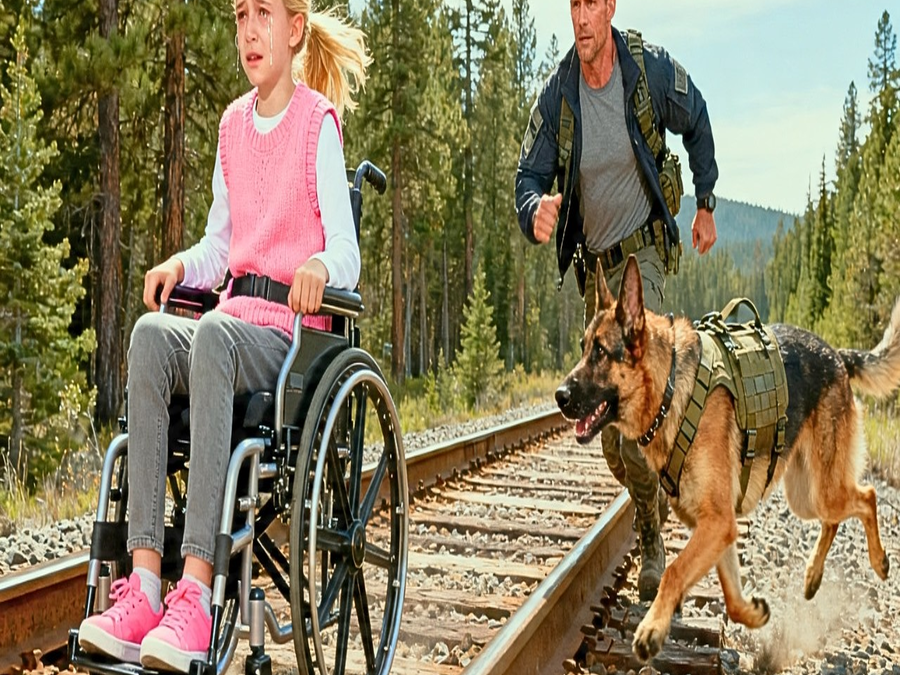
“Leave Her There to Die ” They Said—A Navy SEAL & His K9 Uncovered a Secret That Destroyed Them
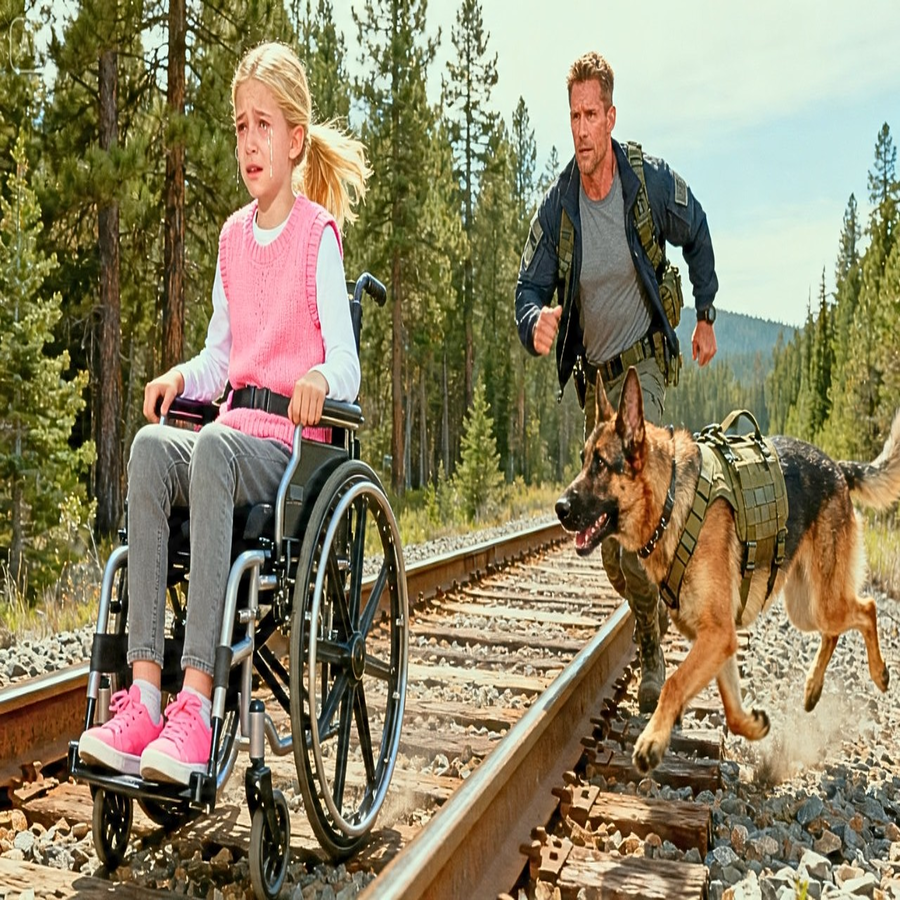
The dog smelled her before Nathan ever saw her.
One second Rex was trotting through tall Montana grass
nose working the October wind.
The next he locked up like he’d hit a wall.
Every muscle rigid
a low growl that Nathan had only ever heard in Fallujah and Ramati climbing from the shepherd’s chest.
Then Rex bolted.
Nathan ran after him through the grass and stopped cold at the embankment’s edge.
A 10-year-old girl bound at the wrists and ankles with nylon rope laid across active railroad tracks and from somewhere beyond the treeine the long mechanical shriek of a freight train’s horn.
She looked up at him.
She didn’t scream.
She just looked at him.
The rails were already trembling.
The town of Caldwell Crossing
Montana
didn’t appear on most maps and barely qualified as a dot on the ones that did include it.
Population 1400, give or take whoever had left that month.
A main street with a hardware store
a diner with a broken neon sign that had read open for 11 years regardless of whether anyone was inside
and a grain elevator that the county had condemned twice.
and somehow still stood.
It sat in a shallow valley between two ridgeel lines
cupped by ponderosa pine and dry brown grass
and the kind of silence that people from cities thought they wanted until they actually lived inside it.
Nathan Cross had moved there 8 months ago with a duffel bag
a separation agreement from the United States Navy
and a Belgian Malininoa named Rex
who had served four combat deployments alongside him and had no more use for crowds than Nathan did.
He hadn’t told anyone in Caldwell Crossing what he’d done for 11 years.
Not because he was ashamed of it
but because the conversation that followed was always the same.
The wide eyes, the questions, the did you ever have to.
And he was tired of performing the answer.
He’d bought a small parcel of land 3 mi outside town on a gravel road that most people gave up on before the end
fixed what needed fixing on the house with his own hands
and spent the first 6 weeks sleeping until 9:00 in the morning for the first time since he was 17 years
old.
The nightmares came anyway, of course, they always did.
But they came on his own terms now
in his own bed
in a room where the only sound was wind against pine needles and Rex breathing on the floor beside him.
He wasn’t healed.
He wasn’t even close.
But he was quiet.
And quiet was something.
It was a Wednesday in the third week of October when everything changed.
Nathan had been running the eastern fence line
checking for the section of post and wire that a bull elk had knocked down sometime the previous night.
Rex worked the perimeter beside him off leash
covering ground in the looping efficient pattern Nathan had trained into him during their time with Devgrrew.
always 20 to 40 meters out, always returning, always checking in.
The shepherd’s nose was a constant instrument, processing information.
Nathan couldn’t access
cataloging it
filing it in whatever architecture a working dog’s brain used for the world.
The morning was cold, 42° and dropping.
Nathan wore a canvas jacket over a thermal and moved quickly enough to keep warm.
The broken fence post tucked under one arm as he walked.
His breath made small clouds that the wind took apart immediately.
He found the down section and spent 20 minutes restoring it
which was the kind of work he didn’t hate.
Simple, physical, with a clear start and a clear finish.
Rex sat at the edge of the treeine and watched him work with the alert
judicious patience of a dog who had learned that watching humans perform manual labor was one of the better ways to spend a morning.
When Nathan finished
he straightened his back and looked out across the eastern pasture.
The railroad right ofway ran along the far edge of his property
an old Burlington Northern line that still carried freight twice a day
though the schedule had gotten irregular lately.
The tracks cut through a shallow cut in the hillside and emerged at the crossing where Caldwell Road intersected the right of way.
A crossing with a signal that worked maybe 60% of the time.
I was looking at nothing in particular, just looking.
That was when Rex went still.
It happened fast enough that Nathan’s brain registered the change before his conscious mind could name it.
One moment
the Malininoa was relaxed
turning in a slow arc back toward Nathan.
The next
he was locked
every limb rigid
weight forward
ears pinned flat to his skull.
His tail dropped to horizontal and stopped moving.
Rex.
Nathan’s voice was low and immediate.
What do you have?
The growl that came out of the dog was not the theatrical growling of a pet confronting a strange car.
It was the sound Rex made in the moment before he went forward.
The operative sound
the sound that in four deployments had preceded violence more times than Nathan could accurately count.
Then the shepherd broke hard and fast into the tall grass between the fence line and the tracks.
Rex, heal.
The dog didn’t stop.
Nathan moved.
He wasn’t a man who ran easily anymore.
His left knee had been reconstructed twice
and the scar tissue in his right shoulder complained whenever the temperature dropped below 50.
But he could still move when something inside him said move.
And whatever the same thing was that had kept him alive through Helman Province and three rotations in Iraq
was saying it now.
He hit the grass at a full run
following Rex by sound
the flattening of stems
the slight disturbance
and came up over the embankment onto the raised gravel bed of the railroad right of way.
He stopped.
The girl was maybe 30 ft away.
She was lying across the near rail
bound at the wrists with black nylon rope that had been looped three times and nodded with a precision that told Nathan something specific and cold about whoever had done it.
Her ankles were tied to the far rail with the same rope.
She was 10 years old
maybe 11
small
brown hair matted across her forehead
a brace on her left leg
the lightweight plastic and velcro kind that ran from the ankle to just below the knee.
She was staring at him
not crying
not screaming
just watching him with the wide
exhausted eyes of someone who had already been terrified for so long that the terror had burned through into something calmer and more awful.
Rex was already at her
not biting
but pushing at the rope with his nose
whining urgently.
From the northwest
beyond the treeine
from somewhere around the bend where the tracks curved
the horn
long
resonant
mechanical
Nathan ran.
What?
He covered the 30 ft in what felt like no time at all
and dropped to his knees beside her on the gravel
hands already on the rope at her wrists.
The knot was a modified double fisherman
tight
well-tied
the kind you didn’t undo in 5 seconds under pressure.
He reached to the sheath on his belt and pulled the fixed blade knife he’d carried for 9 years.
The one with the partially serrated spine and got the blade between the rope and her skin and cut.
“I’ve got you,” he said.
“You’re okay.
I’ve got you.”
She made a sound, not quite a word.
The horn again louder
the ground starting to transmit through the gravel now.
The first vibration low and constant that meant tonnage.
He got the wrist rope in two cuts moved to the ankles.
The angle was bad and she was lying against the rail and his left hand kept slipping on the gravel and he could hear the wheel squeal now.
The leading sound of a freight consist rounding a curve at speed.
Can you move?
He said when I cut this, can you roll my leg?
Her voice was barely there.
My leg doesn’t That’s fine.
That’s okay.
I’m going to carry you.
When I pick you up, hold on to me.
He got the ankle rope on the second cut
sheathed the knife in one motion
and lifted her.
She grabbed his jacket
both hands fisting the canvas at his collar
and he turned and ran
not toward the embankment
but parallel to it
away from the curve
because he didn’t have time to get up the slope and down the other side.
He got four steps.
The locomotive came around the bend.
It was a BNSF intermodal
two units of motive power hauling somewhere north of 100 containers.
And when it hit the straight section of track
it was doing approximately 58 mph.
The horn opened up
sustained
obliterating
and the bow wave of displaced air hit Nathan like a hand that wanted to push him over.
He got another step.
His knee buckled slightly on the uneven ground.
He caught it and kept going.
The locomotive thundered past behind him at a distance he later estimated at 4 ft
maybe five.
The slipstream grabbed his jacket and tried to pull him backward
and the noise was complete.
It wasn’t a sound anymore.
It was a condition, a weather system.
And then it was receding
the long succession of container cars hammering past
and Nathan stopped walking and stood in the grass beyond the embankment with the girl clutched against his chest and Rex pressed tight against his leg.
He stood there for a moment and breathed.
The train’s horn diminished into the distance.
The rattling of the cars faded.
The valley filled back in with the ordinary sound of wind.
The girl in his arms was trembling so hard he could feel it in his sternum.
“Hey,” he said.
He set her down carefully in the grass, keeping one hand on her arm.
“Hey, look at me.”
She looked at him.
“You’re safe,” he said.
“You’re okay.
It’s over.”
She stared at him for another 3 seconds.
Then she began to cry.
Not the controlled
exhausted
not crying she’d been doing on the tracks
but the real kind.
The kind that had been compressed under pressure for however long she’d been lying there
the kind that took over the whole body.
She pressed her face against his jacket and shook.
He let her.
Rex sat down three feet away and watched with the solemn
attentive expression of a working dog
trying to understand what was happening and categorize it correctly.
Her name was Emily Carter.
It took about 10 minutes to get that much out of her.
Nathan sat in the grass with his back to the embankment
Emily beside him
and let her come to it at her own pace.
He didn’t push
didn’t ask direct questions
just kept one hand near enough that she could grab it if she needed to
which she did twice.
He’d called 911 within 90 seconds of carrying her clear of the tracks.
The Caldwell County dispatcher had confirmed units were responding
ETA 18 minutes
because everything in Montana was 18 minutes from everywhere else.
He’d also called the emergency line for the county sheriff’s department directly because he knew from hard experience that what he was looking at was not a standard call.
the ropes
the knots
the specific placement of her body across an active rail line at a curve in the tracks where an engineer would have no time to react.
This was not an accident.
This was not even an impulsive act of cruelty.
This was engineered, planned.
Someone had stood here and thought about angles of approach and train schedules and the mechanics of what a locomotive does to a human body.
And then they had tied a 10-year-old girl to the tracks and driven away.
Nathan had been in rooms with men who planned things like that.
He knew what it meant about them.
Emily told him she was 10.
She told him her name.
She told him she’d been brought here in a car and that the man who’d brought her had not been alone.
There had been at least one other person, maybe two.
She wasn’t sure because they’d kept her blindfolded for most of the drive.
“How long were you on the tracks?”
Nathan asked.
She thought about it.
“I don’t know.
It was still dark when they put me there.
Then the sun came up.”
She paused.
I couldn’t move.
My leg doesn’t The brace doesn’t let me.
She stopped again.
You don’t have to explain your leg to me, Nathan said.
She looked up at him and something in her face relaxed slightly.
Not much, but enough that he could see it.
Who did this to you, Emily?
A long pause.
The wind moved through the grass.
My uncle, she said.
The name came out in pieces
the way things do when someone has been carrying them for too long.
Richard Hawthorne, her mother’s brother.
He’d been the one who took her in 18 months ago when Emily’s mother
his sister
had been hospitalized following a car accident that had also been responsible for the nerve damage in Emily’s left leg.
Emily had no father in the picture
no other family within reach
and the court had placed her with Richard as the nearest available relative.
For eight months, Richard Hawthorne had been a neutral presence in her life.
Not warm, not affectionate, but functional.
He traveled frequently.
He had a large house in Missoula and people who worked for him.
Emily had been enrolled in school and had settled into the peculiar provisional normaly of a child who has learned not to want too much.
Then she’d walked into his home office 3 weeks ago and seen something she wasn’t supposed to see.
“What did you see?”
Nathan asked.
She described it haltingly, documents on his desk.
She didn’t know what kind.
She was 10 years old
but she’d seen numbers and what looked like a lot of names and her uncle’s signature on many pages.
And on his open laptop
a spreadsheet with columns she couldn’t fully read
but a total at the bottom that she’d seen clearly because it was bigger than anything she’d ever seen.
She’d asked him about it because she was 10 and hadn’t yet learned that you don’t ask powerful people about the things they keep hidden.
Richard Hawthorne had looked at her across his desk for a long, still moment.
Then he’d smiled and said it was boring adult stuff and she should go back upstairs.
3 weeks later later
his men had put her in a car before dawn and driven her to Caldwell Crossing.
Nathan said nothing for a moment.
He looked out across the pasture.
A hawk was working thermals above the far treeine, tipping in slow circles.
“Emily,” he said carefully, “has anyone else heard any of this?
Anyone you’ve told?”
No.
She shook her head.
Who would I tell?
Itan.
The first deputy arrived at 17 minutes
slightly faster than the estimate
which Nathan noted
but didn’t comment on.
He was a young guy
maybe 26
named Breenidge
with the slightly dazed look of a first responder who hadn’t fully processed what the dispatcher had told him.
He saw Emily first
then Nathan
then Rex
and his hand went toward his hip before he stopped himself.
Sir, are you Nathan Cross?
Nathan said standing.
I’m the one who called it in.
I found her on the tracks about a/4 mile that way.
He pointed.
Her name is Emily Carter.
She’s 10 years old.
She’s been bound with rope to an active rail line.
I’ve been sitting with her since I carried her clear.
Breenidge blinked.
You You carried her off the tracks.
Train came through about 20 minutes ago.
You can call BNSF dispatch and confirm the time.
The deputy looked at Emily at the welts on her wrists where the rope had been
at the careful way she held her left leg.
Something in his face settled and went serious.
“Yes, sir,” he said.
“Okay.”
The next hour moved in the segmented stopandgo rhythm that Nathan associated with the early phase of any operation.
Controlled chaos disguised as procedure
everyone performing their role
and trying not to betray how far outside their experience they were.
Two more deputies arrived.
An ambulance from the Caldwell County Emergency Services
a woman from County Social Services
who introduced herself as Karen Elliot
and knelt in the grass beside Emily and spoke to her in the careful
even tone that people use when they’ve been trained to talk to frightened children.
Nathan gave his statement twice
once to Breenidge
once to the senior deputy
a lean woman named Castillo with 20 years on her face and eyes that track details automatically.
She wrote everything down.
She asked good questions.
She asked about the knots
which told Nathan she understood why that mattered.
The double fisherman, she said.
You sure about that?
I’ve tied that knot a few hundred times.
It’s a climbing knot, but people use it for rigging.
It’s not a knot most people know how to tie quickly under pressure.
He paused.
Whoever did this rehearsed it.
Castillo looked at her notepad.
And the girl says it was her uncle.
Richard Hawthorne, Missoula.
I don’t have any further information.
I do
she said quietly
and something in her tone suggested the name meant something to her that it didn’t yet mean to Nathan.
Before he could ask, her radio crackled and she stepped away.
So, they kept him there for nearly 2 hours.
Nathan didn’t argue about it.
He sat in the grass with Rex at his feet and answered every question they put to him and signed what they asked him to sign.
He watched them photograph the section of tracks where Emily had been found
collect the severed pieces of rope
document the tire impressions on the access road that ran parallel to the right of way.
He watched Emily get loaded into the ambulance.
She looked back at him once through the open doors before they closed.
He raised one hand, she raised hers.
When the ambulance was gone
Castillo came back and stood beside him
looking at the treeine.
“Richard Hawthorne,” she said.
His company’s name is Hawthorne Capital Partners.
========== PART 2 ==========
They operate three regional investment funds and have partial ownership in about a dozen businesses across northwestern Montana.
She paused.
We’ve had two prior complaints related to his operations.
Both were investigated.
Both were closed without charges.
Another paused.
The complaints were made by former employees and they went away.
They went away.
She closed her notebook.
The family’s money goes back two generations.
His grandfather built most of the first bridge system across the Clark Fork.
She said it with the flatness of someone who has spent a career watching institutional protection at work and has long since stopped expecting it to surprise her.
Nathan looked out at the tracks.
The freight train’s passage had left nothing visible behind.
Just two parallel lines of worn steel heading toward a curve in the trees.
Indifferent.
You said former employees made the complaints, he said.
That’s right.
What were the complaints about?
Castillo looked at him.
Financial fraud
securities violations
wire fraud
a beat
amounts in the high eight figures.
Nathan let that sit for a moment.
And a 10-year-old girl accidentally saw something she wasn’t supposed to see
he said.
That’s one way to read it.
Deputy Castillo.
He turned to look at her directly.
I’m going to give you my phone number and my home address.
Both are accurate.
I’m not going anywhere
but I’d like you to tell me honestly
does your department have the resources and the political clearance to pursue this as far as it needs to go?
She met his gaze.
She was quiet for a moment.
I appreciate the directness, she said.
Honestly, I don’t know.
That answer might depend on whether certain people in certain offices feel like their own positions are protected.
Right, Nathan said.
She handed him a card.
He took it.
I’m going to make some calls, she said.
State level
possibly federal
depending on how this develops
but that takes time.
I understand.
Mr. Cross, she paused.
Stay near your phone.
What?
He drove home with Rex in the back seat and the windows down despite the cold because he needed air moving through the cab.
He needed to think.
The house looked the same when he pulled up.
Same gravel drive
same porch with the single plastic chair he’d never gotten around to replacing with something better.
Same pine trees standing watch at the property line.
But he sat in the truck for a moment before going inside
running the morning through his head with the flat
methodical discipline of a combat debrief.
One
Emily Carter had been placed on active tracks at a curve designed to eliminate reaction time.
The planning indicated professional execution or at minimum someone who thought operationally.
Two, the motive was witness elimination.
She had seen financial documentation that Richard Hawthorne couldn’t afford to have discussed publicly.
Three
Hawthorne had resources
money
connections
and a demonstrated ability to make institutional complaints disappear.
Four.
Emily had survived, which meant Hawthorne’s plan had failed.
And men who made plans like that did not respond to failure by walking away.
Nathan got out of the truck.
Rex followed him up the porch steps and sat at the door
looking back across the property with his ears up.
Nathan reached past him, opened the door, and went inside.
He went to the back bedroom
the one he’d converted from a second storage room
and pulled the foot locker from under the bed.
He hadn’t opened it since moving to Caldwell Crossing.
He unlatched it now and pushed the lid back and looked at the contents.
Communications equipment
maps in a waterproof sleeve
his old plate carrier folded flat.
Two firearms
a Sig Sauer P320 M17
and a short-barreled Daniel defense rifle
both legally registered
both maintained.
He looked at them for a long moment.
He didn’t take anything out.
Not yet.
He went to the kitchen and made coffee and sat at the table and thought about a 10-year-old girl with a brace on her leg who had raised her hand at him from the back of an ambulance.
His phone buzzed on the table.
Unknown number, Montana area code.
He picked it up.
Mr.
Cross.
The voice was male.
Calm.
The precise weighted calm of someone choosing to be calm specifically because they want you to understand they don’t have to be.
Nathan said nothing.
My name isn’t important, the voice continued.
What’s important is that you understand the situation you’ve put yourself in this morning.
The girl is alive.
That’s unfortunate.
But she’s young and she’s frightened.
And what a frightened child tells an ambulance crew and what she tells a court 2 years from now are very different things.
You understand how the law works.
Nathan looked at this window above the sink.
The ponderosa pines were dark against the white sky.
I understand it pretty well, he said.
Then you understand that you went out this morning for a walk.
You found a child in distress.
You performed a commendable act of civic responsibility and that’s where your involvement ends.
You have no evidence.
You have no connection to anything further.
And you have a quiet life in a quiet town that I’d imagine you’d like to keep quiet.
Is that what I’d like?
A pause.
Fractional.
The first small flaw in the calculated calm.
Mr. cross.
The voice said, “You served your country.
People respect that.
But this isn’t your country.
This is a private matter.
Family matters are complicated
and the child’s version of events is the version of a child.
Think carefully about what you stand to gain by making yourself part of something you don’t fully understand.”
Nathan set his coffee mug down very carefully on the table.
“Here’s what I understand,” he said.
“A child was tied to railroad tracks.
The knots were professional.
The timing was calculated to the train schedule.
She told me who gave the order and I told the deputy and the deputy is making calls.
He paused.
I also understand that you’re calling me less than 2 hours after I made my statement
which means you have a source inside either the county sheriff’s office or the county dispatch.
I’m filing that detail away.
It’s the kind of detail that investigators find interesting.
Silence.
This conversation is done.
Nathan said, “Don’t call this number again.”
He ended the call and set the phone on the table and looked at it.
Then he stood up
went back to the bedroom
and took the plate carrier out of the foot locker.
He didn’t know what the next 24 hours looked like.
He didn’t know who this man was or how many people he had or how quickly they could move
but he knew one thing with absolute clarity.
The girl had survived
and whoever had put her on those tracks was now operating from the assumption that the situation could still be managed
that money and connection and the right kind of pressure applied in the right direction could still put the lid back on.
They were wrong.
Rex padded into the bedroom and sat down beside the foot locker.
He looked at the plate carrier
then at Nathan
then back at the plate carrier.
the way he used to look at his tactical vest before a mission.
The associative recognition of an animal who understood that certain objects meant certain things.
“Yeah,” Nathan said quietly.
“I know.”
The dog’s ears went forward.
His tail didn’t wag.
He was calm, focused, and fully present.
Nathan Cross picked up his plate carrier
checked the plates
and began to strap it on.
Outside across the valley
the railroad tracks ran empty and still in the October cold.
Somewhere in Missoula
a man with money and a damaged plan was making phone calls of his own.
And somewhere between them
in a county ambulance
in a brace that didn’t quite let her walk the way other kids walked
with rope burned wrists and hair still matted against her forehead
Emily Carter was still alive.
That was the only fact that mattered.
Nathan chambered around
set the safety
and reached for his phone to call Deputy Castillo back.
Castillo picked up on the second ring.
“It’s cross,” Nathan said.
“The call came in 11 minutes after I finished giving my statement to Deputy Breenidge.
Unknown number, Montana area code, mail voice, calm, rehearsed.”
He knew my name
knew I’d reported the girl
and he knew it fast enough that he either had someone in your dispatch center or someone in your department passed it along.
a pause on the line.
He could hear her breathing change slightly.
Not panic
just the recalibration of someone who’d suspected something and just had it confirmed.
What did he say?
That I should consider my involvement concluded.
That a child’s testimony is unreliable.
That I have a quiet life worth protecting.
Nathan set the plate carrier on the kitchen chair and reached for his coffee
which had gone cold.
He was careful.
Nothing overtly threatening, nothing you could charge on.
But the message was clear.
The message was clear.
Another pause.
I need you to write down everything you remember.
The exact phrasing, the time of the call, any background sound.
Can you do that in the next 30 minutes?
I’m doing it now.
Good, Mr. Cross.
She stopped, started again.
I made two calls while you were still on scene.
One to the state C division in Helena.
One to the FBI field office in Missoula.
A beat.
The FBI contact agent Darra Voss.
She knew the name Hawthorne.
She didn’t say how.
She said she’d call me back within the hour.
Nathan looked out the window.
The pine trees hadn’t moved.
How long has he been on their radar?
She didn’t tell me that.
But the fact that she didn’t say who is, that tells me something.
Yeah.
Nathan said it does.
He ended the call
found a legal pad in the kitchen drawer
and wrote down everything he remembered about the phone call.
The phrasing
the cadence
the specific word choices
commendable act of civic responsibility
family matters are complicated.
The language of a man who’d prepared the speech in advance
or had someone prepare it for him.
The fractional pause when Nathan had mentioned the knots in the train schedule.
He dated and timed the page, signed it, and photographed it with his phone.
Then he sat at the table and tried to think about Richard Hawthorne the way he’d been trained to think about a target.
Not as a villain in a story, but as a system.
What did he have?
How did he use it?
What did he protect?
And in what order?
Money.
Clearly
old money reinforced by newer money of the type that required certain documentation to not exist.
A network of institutional protection built over years
the kind that didn’t materialize quickly
which meant it had been cultivated deliberately
which meant Hawthorne wasn’t impulsive.
He was careful.
He planned, except he’d underestimated one thing, maybe two.
He hadn’t known Nathan Cross lived 3 mi from that railroad crossing
and he hadn’t accounted for a Belgian Malininoa with 11 years of operational scent work under his vest.
bought.
Richard Hawthorne was in his Missoula office when the call came in.
The second call from the man he employed for situations that didn’t appear in any official ledger.
He was 53 years old
silver-haired
built with the athletic compactness of a man who had spent his 40s discovering triathlon and his 50s maintaining it as proof of discipline.
He wore a charcoal Zegia suit on a Wednesday because he wore a suit everyday regardless of whether he had meetings because clothing was a form of argument and he’d always preferred to win arguments before they started.
He listened to what the man told him and said nothing until it was finished.
She’s alive, he said.
Yes.
And she spoke to the responding deputies.
To one deputy initially, a woman named Castillo has taken lead.
She’s made calls
state CD
and what we believe is the FBI field office in Missoula.
Richard stood and walked to the window.
His office was on the 14th floor of a building he partly owned
and from the window he could see three blocks of downtown Missoula and the Clark Fork River beyond
the same river his grandfather had bridged before Richard’s father was born.
He looked at it the way a man looks at something he considers his by inheritance.
“Who is Nathan Cross?”
he said.
former Navy special operations, 11 years, four deployments.
He separated 8 months ago and bought property outside Caldwell Crossing.
He has no criminal record
no civil actions against him
no financial vulnerabilities we’ve identified.
He’s clean special operations, Richard repeated.
The dog is also former military
Belgian Malinoa
dualcertified patrol and detection.
They operated together.
Richard was quiet for a moment.
Is he the type to be reasoned with?
I spoke with him and the man on the other end took a beat before answering.
No.
Richard turned from the window.
He went back to his desk and sat down and looked at the surface of it
clean
organized
each object in its designated position.
His grandfather had built the first bridge across the Clark Fork with nothing but capital and vision and the willingness to make difficult decisions quickly.
Richard had always understood that legacy as instruction.
We have 48 hours before any federal involvement reaches operational depth.
He said the state C is slower.
They’ll spend a week coordinating jurisdiction.
The FBI is the concern.
Agreed.
The girl is in county protective custody.
That’s a problem, but a manageable one for now.
The immediate problem is cross.
He straightened a pen on his desk 1 millm to the left.
He saw the ropes.
He spoke to the girl.
He’s already building a factual record and he’s smart enough to know how to do it.
Another pause.
I want him discredited, not harmed.
That creates a second problem.
Discredited.
Find something in his record
discharge status
conduct issues
anything from his service that we can use to position him as unstable.
A man with combat trauma who saw something ambiguous and jumped to conclusions.
I’ll look also.
Richard picked up the pen and turned it once in his fingers.
The two men who were with me at the crossing
they’ve been paid and told to stay quiet.
Make sure they understand what staying quiet means in practical terms.
They understand.
Make sure
Richard said
and there was no elevation in his voice
no particular emphasis
which was exactly what made it unambiguous.
Nathan spent the afternoon making his property defensible.
Not dramatically.
No sandbags, no perimeter wire.
He moved his truck to the back of the house rather than leaving it on the gravel drive where it served as a precise locator.
He identified the three approach vectors to the property with clear sight lines and confirmed that the tree line to the east offered the best concealment for anyone moving on foot.
He checked the locks on both exterior doors
which were adequate but not impressive
and reinforced the frame on the back door with a steel bar he found in the equipment shed.
He also took the rifle out of the foot locker
confirmed the chamber
ran a function check
and set it in the corner of the kitchen behind the refrigerator where it was accessible without being visible through a window.
He did all of this in the methodical
unhurried way of a man who has prepared positions before
and understands that preparation is not the same as fear.
Fear is what happens when you haven’t prepared.
Preparation is how you keep fear from making decisions.
Rex watched all of it with his ears up and his body low
but not tense
just ready.
He was good at ready.
At 3:40 in the afternoon, Deputy Castillo arrived in an unmarked sedan.
“She came alone,” which Nathan noted.
“He met her on the porch.
FBI contacted me back,” she said without preamble.
She preferred not to waste time on weather, which Nathan appreciated.
Agent Voss has an existing file on Hawthorne Capital Partners.
She wouldn’t tell me the scope over the phone
but she’s driving down from Missoula tonight.
She wants to speak with you directly.
Okay.
She also told me something else.
Castillo paused.
She looked at Rex
who was sitting at Nathan’s left heel
looking at her with the polite professional interest of a dog who has been taught that strangers are information until proven otherwise.
one of the two prior complaints against Hawthorne, the one from 4 years ago.
The complainant withdrew her statement 10 days after filing it.
She moved out of state within 30 days of that.
She paused again.
She was driving a new car.
Nathan said nothing.
The second complainant
Castillo continued
a man named Dennis Pru
who had worked as Hawthorne’s head accountant for 6 years.
He withdrew his complaint after his daughter’s school was vandalized
significantly vandalized.
He also moved.
She looked at Nathan steadily.
I’m telling you this because I want you to understand what we’re dealing with
and I don’t think you’re the type of person who needs it softened.
I’m not, Nathan said.
I also want you to understand that between now and when Agent Voss arrives
you’re in a gap.
The county doesn’t have the resources to provide you protective coverage without alerting Hawthorne’s source inside the department
whoever that is.
The FBI isn’t here yet.
You’re on your own property.
You have legal rights and you have She glanced at Rex the dog.
I’ve operated in worse gaps.
She looked at him for a moment.
Something moved in her expression.
Not pity exactly, more like recognition.
The look of someone who has met people who live in the space between normal danger and the other kind
and can tell them apart from the ones who just talk about it.
I believe you, she said.
She left him her personal cell number
different from the card she’d given him earlier
and drove back down the gravel road toward the highway.
Nathan watched the dust settle after her tail lights disappeared
and then went inside.
He ate a sandwich
standing at the kitchen counter
fed Rex
checked the property perimeter once before dark
and settled in to wait.
The first vehicle appeared at the property gate at 9:17 p.m. It was a black Chevy Tahoe
the kind of black that costs money
with tinted windows and aftermarket wheels that caught the security light Nathan had rigged to the gate post.
It sat at the end of the gravel drive for approximately 90 seconds without moving.
Nathan was at the kitchen window with the lights off watching.
Rex was beside him, ears pinned forward, body absolutely still.
The Taho’s lights went out.
It sat in darkness for another 30 seconds.
Then the engine started and it pulled away back toward the main road unhurried like it had just been checking.
========== PART 3 ==========
Nathan waited 4 minutes.
Then he called Castillo’s personal number.
Black Tahoe aftermarket wheels.
Sat at my gate for 2 minutes at 9:17.
No plates visible.
They came dark before they reached the gate.
He paused.
They were running a wrecky.
Castillo’s voice was controlled but tight.
Are they still in the area?
Unknown.
They went back toward Route Two.
I’m going to call Agent Voss and push her timeline up.
Can you hold your position?
That’s affirmative.
He hung up and set the phone face down on the counter.
Rex had moved to the back door and was standing there with his nose at the gap at the bottom of the door frame
reading whatever came through the cold air.
“What do you have?”
Nathan said quietly.
The dog’s tail didn’t move.
His ears stayed forward.
Nathan picked up the rifle from behind the refrigerator
kept the safety on
and moved to a seated position on the floor between the kitchen island and the exterior wall
a position that offered coverage and concealment simultaneously
where he could see both the front window and the back door.
He sat there in the dark.
At 10:41 p.m.
headlights came up the gravel road
faster this time
less cautious.
two sets of lights
but a vehicle pulled up behind them from the main road with a spotlight that lit up the driveway like a set lamp.
And a voice from a PA system said something that Nathan was too far inside to hear clearly
but which had the unmistakable cadence of law enforcement commands.
A lot of rapid back and forth, voices outside, engines idling.
Then his phone rang.
Castillo.
Two vehicles, she said.
We intercepted them at the end of your drive.
Hawthorne’s men
both armed
both carrying ID
linking them to a security company that he owns.
My offduty deputy was in the second car.
A short pause.
We’ve got them detained.
I’m requesting state support for the arrest.
Nathan let out a slow breath.
Copy that.
Agent Voss is 40 minutes out.
I’ll be here.
He set the rifle down on the kitchen floor beside him and sat with his back against the island.
Rex came over and pressed himself against Nathan’s right side
warm and heavy and solid
the way the dog had always managed to be when everything else was noise.
Nathan put his hand on the dog’s back.
Outside
the spotlights were still cutting through the dark beyond the window.
He could hear radio traffic from the vehicles at the end of the drive.
He stayed on the floor until Voss arrived.
She was 44
medium height with closecropped hair and the particular quality of stillness that comes from spending a career deciding how much to reveal and when.
She carried a leather portfolio under her arm and showed her credentials to Nathan at the door without being asked
which was a sign of professional respect that he cataloged and returned.
Mr. Cross.
She extended a hand.
Her grip was firm and brief.
I’m Agent Voss, FBI Missoula Field Office.
Thank you for staying put tonight.
Had nowhere else to be, Nathan said, and stepped aside to let her in.
She declined coffee
but accepted a glass of water
and they sat at the kitchen table.
Castillo had come in behind her
stood by the door
and Voss placed the portfolio on the table
but didn’t open it immediately.
I’m going to be direct with you, she said.
Richard Hawthorne has been a subject of federal financial crimes investigation for 26 months.
Securities fraud, wire fraud, and money laundering.
We believe the total exposure is in the range of 90 to $110 million across a network of affiliated entities.
The problem we’ve had is documentation.
Hawthorne is sophisticated.
His paper trail requires either a witness with direct knowledge or access to internal records that we haven’t been able to legally compel.
She paused.
Emily Carter walked into his home office and saw those records on his desk.
Nathan looked at her.
How do you know what she saw?
We spoke with her this evening at the county hospital.
She’s physically okay.
Some bruising
the rope burns
emotional distress that will need ongoing support
but she’s coherent.
And she is
Voss paused
and something in her face softened a fraction before she brought it back.
She’s remarkable.
She remembered details from what she saw on his desk.
Specific names, a column header, a number.
She tapped the portfolio lightly.
The details she described are consistent with financial instruments we already know are part of his structure.
She’s 10.
Nathan said she’s 10 and she has a photographic memory for numbers.
Voss said apparently she’s been that way since she was four.
Her mother’s medical records mention it.
She paused.
Hawthorne didn’t know that when he took guardianship.
By the time he understood what Emily had seen and what she was capable of remembering
he’d made his decision.
The kitchen was quiet except for the occasional pop of the wood stove and the distant sound of radio traffic from outside.
Rex was lying under the table, his head resting on Nathan’s foot.
“He sent two men to my property tonight,” Nathan said.
“They’re in county custody.
They’ll be processed and most likely bonded out by morning
but the arrest creates a record.
It also tells us something about Hawthorne’s timeline.
He moved faster than I expected
which means he’s more exposed than we previously assessed.
She looked at him steadily.
It also tells me that your involvement in this matter has become a significant variable for him.
I figured that out around the time he called my personal cell phone 2 hours after I made my statement
” Nathan said.
Voss’s expression sharpened.
“He called you directly?”
“Someone called me on his behalf, I’d assume.”
Nathan slid the photographed legal pad notes across the table.
I documented it as soon as I finished the call.
Times, phrasing, everything.
She looked at the photograph on his phone screen.
She looked at it for a long moment.
May I have a copy of this?
I already emailed it to Castillo.
She can share it.
Voss glanced at Castillo, who nodded.
Something passed between the two women.
Brief, professional.
The exchange of people deciding they can work with each other.
Mr. Cross.
Voss turned back to him.
I want to ask you something directly and I’d like a direct answer.
Go ahead.
your service record.
Dev Gru, four deployments, separated 8 months ago.
The circumstances of your separation are marked in a way that I don’t have full clearance to read.
She held his gaze.
I want to know if that designation is going to be a problem.
If Hawthorne’s people find it and try to use it
Nathan was quiet for a moment.
I was cleared of the inquiry, he said.
I know, but cleared and untouchable are different things.
The inquiry had to do with a judgment call I made in the field in 2021.
A call that the JAG investigation determined was within ROE.
The officer who initiated the complaint was subsequently separated for unrelated conduct issues.
He paused.
If Hawthorne finds it, he’ll try to use it.
He’ll portray me as unstable
a combat traumatized veteran who misread a situation and dragged a child into a manufactured narrative.
He said it flatly without heat.
It’s not a strong argument, but it doesn’t have to be a strong argument.
It just has to create enough noise to complicate Emily’s testimony, can it?
That depends on how quickly you move, Nathan said.
If Emily’s account is corroborated by physical evidence
the ropes
the tire tracks
the phone records before Hawthorne’s people can construct an alternative narrative
then no. If there’s a delay
there won’t be a delay.
Voss said.
She said it with the particular quiet authority of someone who has the weight of a federal apparatus behind them and knows exactly how much that weighs.
Then we’re fine, Nathan said.
But Agent Voss left at 12:30 a.m. with the documentation and a commitment to have a federal warrant application drafted by morning.
Castillo stayed another 20 minutes
drank the coffee she’d been declining for two hours
and told Nathan that the county was placing a deputy in an unmarked vehicle at the junction of his gravel road and route two for the remainder of the night.
I appreciate that, Nathan said.
After what I saw tonight, it’s the least, she stopped herself.
It’s standard protocol.
Sure, Nathan said.
She almost smiled.
Almost.
After she left, Nathan did a final perimeter check.
Property line
gate
the east tree line
where the shadows were deepest
with Rex beside him.
The night was very cold now
and the stars above the valley were the kind you only get at altitude and distance from anything electric.
He paused at the edge of the east pasture and looked up for a moment
which was something he hadn’t done in a long time.
Rex stood beside him
looking north
ears moving
reading something in the air that Nathan couldn’t.
You done good today, Nathan said.
The dog’s tail moved once, twice, then went still again.
They went back inside
and Nathan locked the doors
set the rifle within reach
and lay down on the couch rather than the bedroom because the bedroom had no line of sight to the front of the house.
He lay there in the dark with his arm over his eyes listening to the sound of the county car at the far end of the drive idling quietly and thought about Richard Hawthorne sitting in his 14th floor office looking at a river that his grandfather had bridged.
A man like that was not used to things not working.
He was not used to the failure of preparation.
He had built his world to specific tolerances and had maintained it there for years and the sudden unplanned survival of one small girl.
One small girl with a brace on her leg and a perfect memory for numbers had cracked the foundation in a way that money and connections and carefully rehearsed phone calls could not simply reseal.
He would try other things.
Nathan knew what other things looked like.
He closed his eyes and was asleep in 4 minutes the way combat operators sleep fully and immediately because the body understands that sleep is a resource and you take it when you can.
Rex lay across the doorway to the hall.
Neither of them moved until dawn.
The day that followed would be the one that broke Richard Hawthorne’s timeline
exposed the first of the names inside his organization
and forced a confrontation that no amount of careful speech or institutional protection was
going to prevent.
It started with a phone call Nathan didn’t make
one that Emily Carter from a hospital room in Caldwell County made herself.
The call Emily made was to a woman named Patricia Odum.
Nathan didn’t learn about it until 7:14 in the morning when Castillo called him while he was standing at the kitchen stove making eggs he wasn’t particularly hungry for.
She told him quickly without decorating it.
Emily had gotten hold of a nurse’s personal phone sometime after midnight after the ward had quieted and the deputy posted outside her room had stepped away to use the bathroom.
She’d called a number she’d memorized
a Montana landline
and had spoken for approximately 11 minutes before the nurse returned
and the phone was gently retrieved.
“Who is Patricia ODM?”
Nathan asked.
“Ele teacher, retired.
She was Emily’s teacher for 2 years before the accident.
Emily’s mother trusted her.”
A pause.
Emily trusted her.
What did she tell her?
Everything, apparently.
She’d been holding it for 3 weeks.
Everything she saw in that office
everything that happened after
the car
the tracks
all of it.
Patricia ODM wrote it all down by hand and called the FBI field office in Missoula at 6:45 this morning.
Another pause.
She asked specifically for Agent Voss by name because Emily had told her to.
Nathan turned the burner off.
The eggs could wait.
Emily told her to call Voss specifically.
Yes.
He thought about that for a moment.
A 10-year-old in a hospital bed in pain, scared, alone in the dark.
And she had not called for comfort.
She had executed a contingency.
She had found an asset
passed critical information through a trusted channel
and ensured it reached the right place with a specific name attached.
“That kid,” he said quietly.
“I know,” Castillo said.
“What does Odum have names?
specific names Emily heard in that office over the 3 weeks after she saw the documents.
People who came to the house
people Richard spoke to on the phone within Emily’s earshot because he never thought a 10-year-old was worth worrying about.
Castillo’s voice had an edge to it now.
Controlled, but there two of the names are sitting Montana state legislators.
One is a sitting federal district court judge.
The kitchen was very quiet.
A judge
Nathan said
a federal district court judge for the district of Montana
she paused.
Which is why Voss is driving back to Missoula right now to physically present this to her section chief rather than handle it over the phone.
Nathan set the spatula down on the counter.
He looked at Rex
who was sitting by the back door
watching him with the focused interest of a dog
who understood that the tone of a phone call was data.
That’s why the prior complaints disappeared.
Nathan said it wasn’t just money and connections.
Someone was deciding what got reviewed and what didn’t.
That’s what Voss thinks.
Castillo said.
She didn’t say it in those words, but she didn’t have to.
He looked out the window at the p already bright in the early light.
Two mu deer were grazing at the far edge where the grass met the treeine.
They didn’t know anything had changed.
The morning looked the same as every other morning.
“What’s Hawthorne doing?”
Nathan asked.
His attorney filed a motion at 7:00 a.m. requesting emergency guardianship review on the grounds that Emily is being held without parental or legal guardian notification.
He’s arguing that protective custody without guardian consent is unlawful detention of a minor.
A pause.
His attorney is very good.
How long does the motion buy him?
The hearing is scheduled for 11:00 a.m. If the judge agrees to a temporary order
Emily could theoretically be released to Hawthorne’s custody until a full hearing.
Tell me that’s not going to happen.
The county prosecutor is fighting it, but the assigned judge, she stopped.
Is it the same judge?
No, different one.
But in a jurisdiction this size, they know each other.
She said it without accusation
just the flat weight of a fact that couldn’t be changed by naming it.
Voss knows she’s working on it.
Nathan was already moving toward the bedroom.
I’m coming into town.
Mr. Cross, I’m not going to the courthouse.
I’m going to the hospital.
He pulled his jacket from the chair.
Emily shouldn’t be alone in there while her uncle’s lawyers are an hour away from potentially walking her out the door.
A silence.
Then the deputy at the door is one of mine.
His name is Pharaoh.
He’s solid.
Good.
I’ll be there in 20.
Yeah.
He modded in 16.
Rex in the back.
Rifle locked in the truck bed box.
the sig on his hip under the jacket in a manner that was legal in Montana and which he had no intention of advertising.
The Caldwell County Hospital was a two-story brick building that had been built in 1987 and updated just enough since then to remain accredited
which wasn’t saying a great deal.
He parked in the visitor lot and walked through the main entrance with Rex on a short lead.
And the receptionist looked at the dog and started to say something and Nathan said
“He’s a federal K9 support animal.
I’m here to see Emily Carter in room.
He looked at his phone where Castillo had sent the room number 214.
It wasn’t entirely accurate
but it wasn’t entirely false either given the FBI involvement and the receptionist was young and the dog was wearing his old tactical vest because Nathan had put it on him at the truck.
And authority in
any form was difficult to argue with before 9:00 in the morning.
Deputy Pharaoh was outside room 214
mid-30s
broad
with the careful posture of a man who had been told to take this particular post seriously and had decided to take it seriously.
He looked at Nathan, then at Rex, then back at Nathan.
Castillo called me.
He said, “Your cross.”
That’s right.
She said to expect you.
Pharaoh glanced at the vest on Rex dog going in.
If that’s all right with the patient.
Pharaoh knocked on the door, opened it a crack.
Miss Carter, there’s a man named Nathan Cross here.
He has his dog with him.
A pause.
He’s the one from the tracks.
From inside, a voice, small but clear.
I know who he is.
Let them in.
Emily was sitting up in the hospital bed.
She had a bandage on each wrist
neatly applied
and the brace was off her leg
which was elevated on a pillow.
She looked smaller in the bed than she had in the grass by the embankment.
smaller and more tired, but her eyes were the same.
That quality of watching, taking things in.
Nathan pulled the chair from against the wall and sat in it.
Rex walked to the bedside
paused
and then placed his chin very gently on the edge of the mattress beside Emily’s hand.
She looked down at him.
Something in her face went quiet in a different way.
She put her hand on the dog’s head.
“He’s soft,” she said.
“Don’t tell him that.
He’s got a reputation.
She almost smiled.
Not quite.
Nathan leaned forward, forearms on his knees.
I heard what you did last night, he said.
Calling Ms. Odum.
She looked at him.
Was it wrong?
No, it was the right call.
He paused.
How long had you been thinking about it?
Since the car, she said it simply.
When they put me in the car
I kept thinking if something happened
someone had to know.
Miss Odum knew my mom.
She’s the only person I could think of who would actually.
She stopped.
A lot of adults don’t really listen to kids.
I know, Nathan said.
But she would.
Emily looked at the window.
She did.
She did.
He confirmed.
He was quiet for a moment.
Emily
I need to tell you something
and I’m going to tell it to you straight because I think you’ve earned that.
She looked back at him.
Your uncle’s lawyers filed a motion this morning to get you released into his custody.
There’s a hearing at 11:00.
The county prosecutor is fighting it and the FBI is working to block it
========== PART 4 ==========
but I want you to know it’s happening so you’re not blindsided.
He watched her face.
Do you understand what that means?
She was quiet for 3 seconds.
It means he’s still trying.
Yes, even after last night, even with everything.
Not a question, just placing it into a framework she was already building.
Men like him don’t stop because things get complicated, Nathan said.
They stop when they can’t go further.
We’re working on making sure that happens.
He paused.
But you should know.
Emily looked down at Rex.
The dog’s eyes were half closed
still resting his chin on the mattress beside her hand.
“Will they let him take me?”
she said.
Her voice was level.
She was working very hard at keeping it level.
No
Nathan said
and he said it the way he’d been trained to say certain things
with the flat
undecorated weight of a statement that was being made rather than promised.
That’s not going to happen.
She looked at him for a long moment.
Then she nodded once with a small
deliberate motion that reminded him painfully of the way new operators nodded when they’d received a mission brief and accepted what it contained.
She was 10 years old.
The 11:00 a.m. hearing became a battleground that no one in Caldwell County had seen the equivalent of in recent memory.
Nathan wasn’t in the courthouse.
He’d returned to his truck after 90 minutes with Emily
long enough to be sure she was stable
that Pharaoh was solid
that the nursing staff understood the parameters and driven to the north end of town where a gas station parking lot gave him a clear view of the two roads out and a solid cell signal.
He tracked it through Castillo
who was inside
and through Voss
who was on the phone from Missoula
while her section chief worked federal channels at a speed that federal channels did not typically achieve before noon.
Hawthorne’s attorney was a man named Gareth Prime
who had driven down from Missoula in what had apparently been a very fast car and who was known
Castillo told Nathan in a three-s sentence text
as the most effective civil litigator in the Northwestern District.
He argued that Emily’s detention was procedurally irregular
that the protective custody designation had been applied without proper guardian notification
and that absent evidence of an imminent threat
evidence he characterized as the uncorroborated account of a traumatized child and a retired veteran with a flagged service record.
There was no legal basis for preventing the girl’s legal guardian from assuming care.
That last part landed the way it was designed to.
Flagged service record.
Nathan had known it was coming.
He’d known from the moment Voss had asked him about it the night before.
The county prosecutor
a woman named Diaz
who had been doing this for 14 years
pushed back hard.
She presented the physical evidence
ropes
photographs
the cut sections Nathan had left for the deputies
the tire tracks from the access road.
She presented Pharaoh’s account of the two armed men detained at Nathan’s property.
She argued that the pattern of behavior established an immediate and documented threat.
At 10:58
two minutes before the hearing was scheduled to close
a federal hold was placed on the proceedings.
Voss’s section chief had reached a federal magistrate judge in Helena
who had reviewed the preliminary filing
Emily’s account
as passed through Patricia ODM
the names of the two legislators
and the district court judge
the financial exposure
and had issued an emergency protective order placing Emily under federal protection pending a full review.
Richard Hawthorne’s motion died in the courtroom.
Castillo called Nathan at 11:04.
“It’s done,” she said.
“Federal protection effective immediately.
Prime filed an objection, but it has nowhere to go right now.”
Nathan looked out through the windshield at the empty gas station road.
A cold truck rumbled past going north.
Hawthorne’s reaction.
Prine left the courtroom on the phone, moving fast.
She paused.
That means Richard Hawthorne knows his window is closing
which means he becomes unpredictable.
Nathan said, “A beat of silence.”
“Yes,” she said.
“That’s what I’m worried about.”
I was right.
The call came in at 1:17 p.m., not to Nathan, to Pharaoh.
At the hospital
a tip from the county’s non-emergency line passed through dispatch.
There was a report of a suspicious person in the hospital’s lower parking structure.
a man matching the description of one of the two arrested individuals from the night before.
The one who’d bonded out at 8:00 a.m.
Pharaoh called it in and stayed at the door.
Nathan heard the radio traffic through the scanner app on his phone.
He downloaded it 2 hours earlier when he realized he was operating in an information gap and was moving before Pharaoh had finished his transmission.
He called Castillo in the truck.
The tip is a draw play.
He said they want Pharaoh off the door.
They know the protection order went federal and they know the window is closing.
If they’re going to move on
Emily
it’s now while the FBI isn’t physically on site yet and your department is stretched responding to a fake call.
That’s She stopped.
He could hear her thinking.
How confident are you?
Confidence level isn’t relevant.
Can you afford to be wrong?
A 1second pause.
No. Get every unit that isn’t responding to the parking structure call to the hospital entrance now.
He was already turning into the hospital lot.
I’m 90 seconds out.
Cross, you can’t.
I’m a visitor with a dog deputy.
I’m just visiting.
He didn’t wait for her response.
He came through the hospital’s side entrance
the one near the stairwell that he’d noted on his first visit with Rex on a three-foot lead and his jacket open over the Sig.
The hallway was quieter than the main corridor
lenolium floors
and the antiseptic weight of recycled air.
two nurses at a station who looked up when he passed and then looked back down because he was moving with the specific velocity of someone who belonged somewhere.
Second floor.
He took the stairs, not the elevator.
The stairwell door opened onto a corridor that ran east west.
Room 214 was 60 ft to his left.
Pharaoh was not at the door.
Nathan stopped.
He put one hand flat against Rex’s shoulder.
The dog locked up immediately.
full stop, reading the air.
The corridor was empty.
A cart of medical supplies outside a room 30 ft down.
A light above the nurses station at the far end blinking with a loose connection.
The ordinary ambient hospital sound.
HVAC.
Distant intercom.
Somewhere a door opening and closing.
Rex’s nose went up, quartering, working.
Then the dog pulled left hard and certain.
Nathan moved with him.
They covered the 60 ft to Emily’s door in a controlled walk that wanted to be a run but couldn’t be because running in a hospital corridor changes the sound profile and he didn’t know yet who was inside that room or whether they’d hear him coming.
The door was slightly a jar.
He could hear voices.
One voice specifically male low speaking with the controlled patience of someone trying very hard not to alarm a child while doing something the child did not want.
Don’t need to be scared.
Your uncle asked me to take you somewhere safe.
The people here aren’t keeping you safe, Emily.
Do you understand?
They’re keeping you here against your uncle’s wishes.
Nathan pushed the door open.
There was a man beside Emily’s bed
40-ish
heavy set
in a visitor’s jacket that was slightly too small across the shoulders.
He had one hand extended toward Emily and the other at his side
and he turned when Nathan came through the door
and his expression shifted through surprise into something practiced and flat.
Emily was pressed back against the headboard.
Her chin was up.
She was not moving toward the man’s extended hand.
Rex came through the door behind Nathan and locked on the man and made the sound
not the theatrical growl
the operative one.
And the man’s practiced expression cracked slightly around the edges.
“Sir, I’m going to need you to step away from the bed,” Nathan said.
“I’m a friend of the family.
I have authorization from the legal guardian.”
“There is no legal guardian.
federal protective order issued at 11:00 a.m. this morning.
Nathan moved to his right, widening the angle.
Step away from the bed.
The man looked at Rex.
The dog had dropped 2 in weight forward.
Every line in his body resolving into a single direction.
That dog needs to be leashed.
He is leashed.
Nathan held up the lead.
That’s as leashed as he gets when someone’s in a patient’s room without authorization.
He took one step forward.
I’m going to ask you once more.
Then I’m going to tell him to hold you here while I call the deputies that are currently 90 seconds from this floor and the rest of this conversation happens in custody.
The man’s jaw moved, a calculation running visibly.
Step away from the bed, Nathan said.
Now he stepped back two steps until his back was against the window.
Nathan moved between him and the bed without turning his back on the man.
He put his free hand back and touched Emily’s arm, confirming she was there.
She was okay.
without looking at her.
“You okay?”
he said, eyes on the man.
“Yes,” Emily said.
Her voice was tight but steady.
“Good.”
He reached with the same hand and found the call button on the bed rail and pressed it.
“Stay exactly where you are,” he said to the man.
“Don’t reach for anything.”
The man said nothing.
He stood against the window with Rex watching him from 8 ft away with the absolute unblinking patience of an animal who has done this before and knows that patience is the thing that makes the other party make mistakes.
40 seconds later, two nurses appeared at the door.
40 seconds after that, Pharaoh came through at a run.
Um, the man’s name was Carl Besson.
He had a concealed carry permit for the state of Montana and a 91 lipolet pistol in a shoulder holster under the two small jacket that he had not reached for.
Perhaps because of Nathan and perhaps because of Rex and perhaps because he was still doing calculations and couldn’t find a version of any of them that ended well.
He was placed in custody in Emily’s room while they waited for additional deputies
which created the specific quality of silence that a room acquires when someone in it is under arrest and everyone else is waiting to see what the next 20 minutes look like.
Nathan stood by the window with Rex at his heel and watched Besson sit in the bedside chair
hands behind him
staring at the floor with the resigned stillness of a man who has run out of options and knows it.
Pharaoh was on his radio.
The language was clipped and controlled and moving fast.
Emily had not made a sound since Nathan had touched her arm.
He glanced back at her.
She was sitting upright in the bed
braced back on her leg
hands flat on the blanket
watching Besson with the same steady
evaluating attention she’d turned on Nathan at the railroad tracks.
“Is he going to tell on my uncle?”
she said.
Nathan turned to look at her.
“Probably yes,” he said.
When people realize they’re looking at serious prison time
they usually start reassessing their loyalties.
She thought about that because he’s scared.
Because the math changes, she looked at Besson, then back at Nathan.
You weren’t scared, she said.
When you came through the door, he considered giving her the standard answer.
That fear and function weren’t mutually exclusive.
That the training was designed to let you operate inside fear rather than without it.
But she was 10, and she’d had enough adult complexity for one morning.
“I had Rex,” he said.
The dog’s tail moved once at the sound of his name.
Emily looked at Rex.
A long look.
Then her hands
which had been flat and still on the blanket
relaxed slightly.
The 36 hours that followed moved at the pace of institutional machinery that had finally been given permission to move fast
which is still not fast by any normal standard
but is substantially faster than it had moved for 26 months.
Carl Besson cooperated.
He began cooperating before his attorney arrived
which told Nathan something specific about what Besson understood his situation to be.
He gave names
operational details
phone records that he provided consent to access
consent given before the attorney arrived
which his attorney was subsequently very unhappy about
but which was legally binding and immediately useful.
Three men were named in Besson’s account
who had direct operational involvement in the events at the railroad crossing.
Two were private security contractors employed through one of Hawthorne’s companies.
The third was someone Nathan hadn’t expected
a man named Gerald Mast
who was Richard Hawthorne’s brother-in-law
who had been present at the crossing in an organizational rather than hands-on capacity
and who had fled to a rental property on Flathead Lake the morning after the arrests at Nathan’s Gate.
Mast was taken into custody by a combined FBI state CID team on a Thursday afternoon while he was attempting to access a storage unit in Pulson that turned out to contain
among other things
a hard drive with partially corrupted financial records that the FBI’s forensic team spent the next several days reconstructing.
The district court judge Emily had named a man named Harlon Veetch
who had been on the federal bench for 9 years
quietly retained private counsel and stopped responding to colleague communications within 48 hours of Emily’s account reaching Voss’s section chief.
He did not resign.
He did not make public statements.
He simply went still in the way that a large animal goes still when it knows it has been seen
hoping that stillness might still be enough.
It was not enough.
The two state legislators were contacted separately by the state attorney general’s office on the same morning
coordinated carefully to prevent either from warning the other.
Both retained attorneys within the hour.
Both made initial statements denying knowledge of wrongdoing that were Castillo told Nathan almost identical in their phrasing
which is the kind of similarity that investigators find interesting.
Nathan tracked all of it from his property from Castillo’s updates and a daily call with Voss that became the operational briefing he hadn’t had in 8 months.
He fixed fence.
He chopped wood for the stove.
He ran the property line each morning with Rex
and the dog worked the east perimeter with the same thorough efficiency he’d always applied
unconcerned with the fact that the nature of the work had changed.
On the fourth day, Voss called with something different in her voice.
We have Hawthorne’s accounting ledger, she said.
The actual one, not the formal books, the operational record.
Besson knew where it was kept and gave us the access pathway.
She paused.
Nathan, it’s $140 million across 8 years.
Most of it from funds that were supposed to be invested on behalf of about
00 individual clients
retirement accounts
family trusts
people who had no idea.
He was standing at the edge of the east pasture
the same spot where he’d stopped and looked at the stars the night Voss had first arrived.
People, he said, “At least the forensic team is still working through it.”
A pause.
The two legislators took money from those same funds through intermediary entities.
“Vetch’s connection is different.
He blocked three civil actions in 5 years that would have exposed the structure.
We can prove he had access to information that would have required him to recuse.
She paused again.
This is going to be a very large case, Nathan.
He looked at the treeine.
A magpie was working the edge of the pasture
pulling at something in the grass.
How long before you move on Hawthorne directly?
He asked.
The warrant is being finalized today.
We’ll execute within 24 hours.
Another pause.
I wanted you to know before it’s public.
I appreciate that.
There’s something else, a different quality to the pause this time.
Hawthorne made two wire transfers in the last 72 hours.
One to a bank account in Panama.
One to an entity we haven’t fully identified yet.
The Panama transfer is frozen.
We were ahead of it.
The second one, she stopped.
We’re working on it.
What was the amount?
$80,000.
A beat.
That’s a specific number.
It’s not a panic transfer.
It’s a payment.
Nathan understood what she wasn’t saying.
A payment to who?
We don’t know yet.
Her voice was careful.
Precise.
I’m telling you so you remain alert.
He ended the call and stood in the pasture for a moment.
$80,000 was not what you paid someone to disappear a problem permanently.
It was what you paid someone for a specific bounded task
a piece of work with a defined scope.
He looked back at the house.
Rex was sitting on the porch, watching him, 50 meters between them.
Open ground.
Nathan walked it steadily
not fast
checking the treeine and the gate and the road as he moved the way he always did now
the way his body had decided it was going to do for however long this lasted.
He was halfway across the pasture when his phone buzzed.
Castillo, he picked up.
Where are you?
She said.
No preamble.
My property, East Pasture.
Why?
Get inside.
Her voice was flat and immediate.
Now get inside and stay away from windows.
He was already moving.
Talk to me.
The second wire transfer.
Voss’s team just got a partial ID on the recipient entity.
It’s a shell, but they traced one layer.
She paused.
The pause was a fraction of a second
but it was there and it told him before she finished the sentence.
Nathan, one of our deputies was bribed.
We don’t know which one yet.
We think the target is Emily.
He hit the porch steps at a run
Rex off the deck and beside him before Nathan’s hand reached the door.
How confident is Voss?
He said confident enough to move Emily to a federal location right now.
She’s being transported as we speak.
A breath.
But the transport route passes through Caldwell Crossing.
Someone may know it.
We don’t know if the bribe deputy passed the route.
Nathan was inside, door locked, rifle in his hands.
What’s the transport vehicle?
FBI sedan, two agents, black.
She stopped.
A voice in the background on her end.
She said something Nathan couldn’t hear, then came back.
The transport just checked in.
They’re 3 minutes from the Caldwell crossing junction.
Another voice behind her louder.
Nathan.
Then he heard it through the phone from Castillo’s end.
Not traffic, not radio.
========== PART 5 ==========
A sound he recognized from years of environments where that sound meant a situation had just changed.
a single shot, then two more in rapid succession.
Then the line went to static.
Nathan had the back door open and Rex moving before the static had finished.
He hit the yard at a run
and the October morning was cold and bright and empty.
And somewhere 2 mi down Route 2 toward the Caldwell Crossing junction
an FBI transport vehicle had just driven into something that wasn’t supposed to happen.
He ran for the truck.
He drove the truck hard down the gravel road and hit route two without slowing at the junction.
The rear end sliding wide on the loose shoulder before the tires caught pavement and Nathan fed the accelerator and brought it straight.
Rex was in the back seat braced against the turns, not making a sound.
Nathan had his phone on the dash, speaker on trying Castillo’s number.
It rang eight times and went to voicemail.
He tried Voss, same result.
He tried the county dispatch non-emergency line and got a recording because it was before business hours and Caldwell County didn’t run a full overnight dispatch.
A fact that had seemed like a minor bureaucratic inconvenience until this exact moment.
He drove the Caldwell crossing junction was 2 mi from his gate on Route 2
a T intersection where the county road met the state highway that ran north south through the valley.
In the summer
there was a blinking yellow caution light that the county had never upgraded to a full signal.
In October
with the cottonwoods gone bare and the grass brown on either side
you could see 300 yd in each direction
which meant that when Nathan came around the last curve before the junction
he could see the FBI sedan from a/4 mile out.
It had gone off the road on the west shoulder.
Not violently.
The front end was nosed into the drainage ditch
the angle suggesting a controlled stop or a very slow collision rather than a high-speed wreck.
The windshield was intact.
Both front doors were open.
There were no people visible.
Nathan pulled up 30 yard short and stopped the truck.
He sat for 3 seconds reading the scene the way he’d been taught
not looking for what he expected to see
but cataloging what was actually there.
Sedan in the ditch, nose down, both doors open.
No bodies visible from this angle
which meant they were either down on the far side of the vehicle or they’d moved.
Tire marks on the shoulder suggesting a second vehicle had been present and departed.
Broad marks, heavy truck.
No other vehicles on the road in either direction.
No sound except wind and the truck’s engine idling and Rex in the back seat shifting his weight.
He killed the engine
drew the sig
got out low and moved to the rear of his truck
using it as cover while he scanned the rest of the intersection.
Nothing moved.
He called out, “FBI Nathan Cross.
Identify.”
A sound from the far side of the sedan.
Then a voice, “Sir, male, strained here.”
Agent Donnelly, I’m hit.
Nathan moved.
He went in a low
fast arc around the front of the sedan
keeping the bulk of the vehicle between himself and the treeine to the west because the treeine was the only viable position for a shooter and he didn’t know yet whether the shooter was still there.
The agent was on the ground on the passenger side.
Late30s dark jacket with the FBI identifier panel on the chest
right hand pressed hard against his left shoulder.
The wound was high.
Not the chest, not the lung, but bleeding steadily through his fingers.
His face was white and wet with the exertion of staying conscious.
The girl, Nathan said.
He was already kneeling, scanning.
Where’s this girl?
They took her.
His jaw was tight.
Black truck.
Two men.
It was fast.
They had a spike strip across the road.
We hit it before we saw it.
Ellis.
He stopped.
looked past Nathan.
Nathan looked.
The second agent, Ellis presumably, was on the ground 10 ft back, face up.
A woman, 50s, still breathing, visible chest rise, unconscious.
There was blood on her temple from what looked like a hard impact with the door frame when the car had lurched over the strip.
“How long ago?”
Nathan said.
“4 minutes, maybe five.”
“Which direction?”
“North on the highway.
They had a head start.”
He grabbed Nathan’s arm with his good hand.
She didn’t She didn’t go quiet.
She was fighting them, screaming.
She He stopped himself.
His grip was hard.
Don’t let them have her.
Nathan was already back at his truck, phone to his ear, trying Voss again.
This time, she answered on the first ring.
“I know,” she said.
Her voice had the controlled
stripped quality of someone operating on pure function.
“I’m tracking it.
We have air assets deploying from Missoula.
ETA 18 minutes.
The highway patrol has units heading north on US 93.
We need you to I’m already north on 93.
Nathan said the truck was moving.
They’re 4 to 5 minutes ahead of me in a black truck.
Big
probably 3/4 ton or larger based on the spike strip and the tire marks north on 93 from the Caldwell crossing junction.
Nathan, a pause.
The kind that carries weight.
You are not law enforcement.
I’m aware if you engage these people, Agent Voss.
He was up to 80 on the empty highway.
The pine ridges on either side moving past in dark walls.
You have 18 minutes to air support and unknown time to highway patrol.
Emily has 4 minutes on me and a vehicle that outweighs mine.
Tell me what you want me to do.
Silence, then don’t get killed.
Copy that.
He set the phone on the dash.
Rex.
The dog pushed forward between the seats, ears up.
Find her.
The dog couldn’t smell anything at 78 mph through a closed window.
And Nathan knew that
but saying it aloud focused something in himself mostly.
He drove.
He found the truck 3 and 1/2 minutes north of the junction.
It had turned east off US 93 onto a county road that Nathan might have missed
except that one of its rear brake lights was out.
Not deliberately, just a burned bulb.
and the single red light swinging left into the dark gave it away at the last moment.
Nathan took the turn hard and came down the county road with his lights off
running on the ambient gray of the overcast morning sky
gaining on the truck’s tail lights ahead of him.
The county road ran east into timber country
forest service land
logging roads
terrain that got complicated fast and had exactly the qualities that made it useful for people who needed to move without being seen.
Nathan had studied maps of the area in his first two months in Caldwell Crossing
the habitual orientation process of a man who needed to understand his ground.
He knew where this road went.
Approximately 2 mi east
it intersected a decommissioned logging spur that looped north for 4 miles before deadending at an old timber staging area
a flat
open fenced gravel pad that had been built to hold equipment and now held nothing.
isolated
accessible only from the one road
the kind of place that appeared on topographic maps and nowhere else.
He got within 200 yards of the truck and held that distance
lights still off
matching their speed.
42 mph on a narrow forest road.
The overcast was thinning slightly in the east.
The first gray white suggestion of full morning beginning to edge up behind the ridge line.
His phone buzzed.
Voss air asset is wheels up.
14 minutes.
They’re heading for a staging area off the old Milbour logging spur east of 93.
I’ll mark the GPS when I stop.
He kept his eyes on the tail light ahead.
They don’t know I’m behind them.
How close are you?
200 y.
A pause.
Nathan, there are two men in that truck.
Besson’s account and the intel from last night both suggest they will be armed.
You cannot engage two armed individuals alone.
Emily’s in that truck.
The silence that followed was 3 seconds long.
14 minutes, Voss said.
Hold them 14 minutes.
Working on it, he ended the call.
The logging spur turnoff came up on the right side of the road
marked with a weathered timber frame gate that had been left open.
Deliberately recently
the chain that usually secured it visible in the dirt where it had been dropped.
They’d scouted this.
They’d had a destination planned before they deployed the spike strip.
The black truck turned onto the spur.
Nathan gave it 20 seconds and followed.
The spur road was rougher
two tracks in packed dirt with a grass center strip
the tree canopy closing over it.
Nathan’s truck bounced over a wash out
and he slowed
watching the tail light threading through the trees ahead.
The road curved north and then opened.
The staging area was exactly as Nathan’s map memory had placed it.
A gravel pad roughly the size of a basketball court
bounded on three sides by a chainlink fence
and on the fourth by a wall of mature timber.
A metal equipment shed with a collapsed roof at the far corner.
The early light was enough now to make out shapes.
The black truck stopped in the center of the pad.
Nathan stopped at the edge of the treeine
30 yards back
still under the canopy.
He killed the engine.
Two men got out of the truck
both moving with the practiced deliberate motion of people who had done operational work before.
Not military exactly, but trained private sector.
Besson’s profile.
One went to the rear passenger door.
He pulled it open.
Emily came out fighting.
She couldn’t run.
The brace limited her gate
but she came out with both arms swinging
catching the man on the forearm hard enough that he stepped back before he got his grip on her.
She said something Nathan couldn’t hear at 30 yards.
The man said something back and took hold of her upper arm.
Nathan had the sig in his hand and the truck door open before he’d fully formed the decision.
He knew the tactical math.
Two armed men 30 yards of open ground, one of them already holding Emily.
A direct approach was a hostage situation
and hostage situations had failure rates that he didn’t want to calculate right now.
He put his hand on Rex.
The dog was trembling with readiness.
The full body contained vibration of a working Malininoa at the edge of deployment.
“Hold,” Nathan said quietly.
“Hold.”
He got out of the truck slowly.
He came around the front bumper into the edge of the light
hands visible
the Sig held low at his side
not aimed
not holstered
present.
“Hey,” he called out.
Both men turned.
The one not holding Emily had his hand at his jacket
which told Nathan where his weapon was and what his first move would be if Nathan gave him reason.
“Let her go,” Nathan said.
He walked forward at a measured pace, eating the 30-y steadily.
“It’s over.
FBI air is 12 minutes out.
Highway patrol is closer than that.
You took a federal witness in a federal vehicle.
That’s a mandatory minimum that doesn’t have a ceiling.
But if you put her down right now
the cooperation conversation starts here and not in a federal building.
The man holding Emily
mid-40s
thick through the shoulders with the flat effect of someone who had been paid enough not to feel things.
Looked at Nathan the way you look at something you’re trying to categorize.
“Who are you?”
he said.
“The wrong person to be talking to if you’re still holding on to that girl.”
“Back up,” the other man said.
He’d drawn a compact pistol, not aimed yet, held low like Nathan’s.
Back up now.
Nathan stopped walking.
He was 15 yards from them.
He could see Emily’s face, pale, set, jaw clamped.
She had stopped fighting.
She was watching Nathan with the waiting
assessing expression of someone looking for the moment to move.
He gave her the smallest possible nod.
She dropped her weight.
Not a run.
Her leg wouldn’t allow a full run
but a sudden complete downward shift
her knees going to the gravel
her arm pulling through the grip of the man who’d been holding her.
He grabbed for her and missed and stepped forward to recover.
And that step took him across Nathan’s line.
Nathan brought the sig up.
“Down,” he said to the man with the drawn weapon.
“Down right now.”
“Shoot him,” the first man said, scrambling for Emily again.
“Rex.”
Nathan said the word at normal volume and the Malininoa came off the truck at 40 lbs of muscle and 11 years of operational experience covering 15 yards in approximately 2 seconds.
And the first man heard him coming and turned and raised his arm and Rex took the arm above the elbow and the man went down hard on the gravel with the dog on top of him and made a sound that had no dignity in it at all.
The second man
the one with the drawn pistol
turned instinctively toward the sound.
Nathan covered the distance in three steps and hit the man’s gunarm with a controlled economical strike.
The kind of thing you do 10
000 times in training until it stops requiring thought.
And the pistol left his hand and skittered across the gravel.
Nathan had him turned and face down before the man had finished processing what had happened.
The sig at the back of his head.
“Don’t move,” Nathan said.
He wasn’t breathing hard.
He hadn’t been breathing hard since Helman Province.
Do not move.
The man did not move.
Rex was still on the first man’s arm.
The man was not moving either for different reasons.
A Belgian Malininoa bite exerts 450 lb per square in of pressure
which is a highly effective argument for remaining still.
Out, Nathan said.
Rex released on the word.
He stepped back and stood over the man monitoring.
The gravel pad was quiet.
Wind through the timber.
Somewhere east, a crow.
Emily.
Nathan didn’t take his eyes off the two men.
Emily, talk to me.
I’m here.
Her voice from somewhere to his left.
Unsteady, but present.
Are you hurt?
A pause.
My wrist.
They grab my wrist.
Another pause.
I’m okay.
He let out a slow breath.
Okay,
he said.
Okay.
I need you to do one thing.
My truck back at the treeine.
There’s a first aid kit under the passenger seat.
I need you to stay at the truck and not come back over here until I say so.
Can you do that?
Yes.
Go now.
He listened to the sound of her brace on the gravel
irregular but steady
moving away from him.
He looked down at the man beneath the sig.
Here’s what happens now, Nathan said.
You are going to stay exactly where you are.
In approximately 10 minutes
people with federal authority are going to land or arrive and take over this situation.
Between now and then
you are going to give me the name of whoever coordinated this with you.
The person inside the county department who passed the transport route.
He pressed the sig slightly against the back of the man’s skull.
Not hard, just enough to establish its presence.
Because that person is the last piece that Richard Hawthorne still has in play.
and I want it before the FBI gets here because once they get here
everything goes through channels and channels take time and I am finished with things taking time.
The man breathed against the gravel.
His name, Nathan said.
A pause.
The sound of Rex circling behind them.
Garrett, the man said, his voice was muffled by the gravel.
Deputy Marcus Garrett.
Nathan filed it away with the same flat precision he’d filed every other piece of information in the last 48 hours.
He reached into his jacket pocket with his free hand
pulled the strip of flex cuffs he’d taken from his kit before leaving the house.
He’d had them in his pocket since the morning
because of course he had
and bound the man’s wrists.
He crossed to the first man.
Rex had left him curled on the gravel, cradling his bitten arm.
The arm was badly bruised
and the skin was broken
but the bite had been a grip and hold
not a full combat bite
and the man wasn’t going anywhere under his own power regardless.
Nathan flexcuffed him too
checked his pockets
found a second pistol in an ankle holster
and set it out of reach.
Then he straightened up and took his first full breath in what felt like several minutes.
To the east
above the ridge line
the pale rotor sound of a helicopter working toward them.
His phone rang.
Voss, I see your location on the GPS share, she said.
The bird is 2 minutes out.
What’s your status?
Two suspects restrained on the ground.
No federal casualties.
Emily Carter is at my vehicle.
minor injury to her wrist.
He looked across the gravel at the black truck
at the staging area
at the old fence and the collapsed shed and the ordinary timber beyond.
I also have a name for you, the compromised deputy.
A beat.
Tell me, boss said.
He told her.
He heard her relay it immediately to someone else in the room without even fully completing the sentence.
The name passing from her to whatever mechanism existed to act on it
efficient and cold and final.
The helicopter is going to land in your location in 90 seconds, she said.
Can you mark your position?
Nathan walked to his truck
reached through the open window
hit the headlights.
They threw two parallel beams into the timber.
“Marked,” he said.
He walked back to where Emily was sitting on the passenger step of his truck
the first aid kit open on her knees
a bandage loosely wrapped around her right wrist that she’d applied herself.
She looked up when he came over.
She looked at his face
at the sig that he’d holstered
at Rex
who was sitting 3 ft from the two men on the gravel with the patient
absolute focus of a dog who understood that his job was not yet complete.
“Is it done?”
she said.
He looked at her at this bandage she’d applied herself methodically in the dark at the edge of a logging road while two men lay restrained on gravel 30 yards away.
At the way she was sitting upright
brace out in front of her
hands steadied on the first aid kit.
========== PART 6 ==========
He thought about a man on the 14th floor of a building he partly owned looking at a river he believed belonged to him by inheritance.
A man who had looked at a 10-year-old girl and decided she was a problem with a solution.
Almost.
Nathan said the helicopter broke over the ridge line to the east.
Its search light swept the treeine and found the gravel pad and swept across the two men in Rex and Nathan’s truck and Emily sitting on the step.
And in the white wash of that light
she looked very small and very young and very tired.
She also looked at the light without flinching, without looking away.
The helicopter began to descend.
Richard Hawthorne was still in Missoula.
He was still in his office or his house or wherever men like him retreated to when the architecture of their world began to show cracks.
He had lawyers filing motions and money in accounts and the names of people he believed he could call.
What he did not have
what he had perhaps never fully accounted for
in all the careful operational thinking of a man who had spent 8 years building something corrupt and waterproof
was a 10-year-old girl with a perfect memory for numbers sitting on a truck step in a logging clearing
waiting for the last piece of it to fall.
The helicopter touched down.
Doors opened.
Agents came out in jackets with the yellow lettering that meant federal authority and no more delays.
One of them came directly to Emily and Nathan watched the agent kneel in the gravel and speak to her at eye level the way Voss had done at the hospital.
That specific professional care and saw Emily nod and respond and saw the agent nod back.
Nathansson’s phone rang one more time.
Unknown number, Montana area code.
He picked it up.
Silence on the other end for a moment.
Then a voice he recognized.
The same voice from the first call 48 hours ago.
The measured prepared calm.
Except it wasn’t quite as measured anymore.
There was something underneath it now.
Not panic.
Men like the one speaking on behalf of Richard Hawthorne didn’t panic.
But the calculation was audible in a way it hadn’t been before.
The sound of a man who has been running numbers and not finding the answer he expected.
Mr. the voice said.
Nathan said nothing.
This has a pause.
The first one in the first call had been fractional.
This one was longer.
There are ways this can still resolve that are better for everyone involved
including the girl.
There are resources that could ensure her care
her treatment
her mother’s medical bills.
Stop, Nathan said.
The voice stopped.
I want you to listen very carefully
Nathan said
because I’m only going to say this once and then I’m never going to speak to you again.
He looked at the federal agents moving across the gravel pad.
At Rex
still at his post
ears up
monitoring at Emily
still on the step
watching the agents with that steady cataloging attention.
Richard Hawthorne is finished.
The ledger is in federal custody.
The judge’s communications are in federal custody.
Besson’s cooperation is on record.
The deputy’s name is being processed as we speak.
He paused.
And Emily Carter is sitting 30 ft from me in a logging clearing with six federal agents and a Belgian Malininoa and she is completely absolutely fine.
Silence on the line.
Whatever Richard told you he could guarantee
Nathan said
he can’t guarantee it anymore.
Tell him that and then tell him what the cooperation window looks like because it’s closing and it’s closing fast.
and the difference between what he gets if he comes in now versus what he gets if he makes us come to him is the difference between a decade and the rest of his life.
He paused one final time.
That’s the last thing I have to say to you.
He ended the call.
Stood there on the edge of the gravel pad with the helicopter’s rotors winding down and the morning coming fully up over the ridge line
gray and cold and clean.
One of the federal agents
a younger man
Crew
moving with the efficient authority of someone who had been briefed in the air
came over to Nathan.
Mr. Cross, he extended a hand.
Agent Morales, Agent Voss sends her regards.
“How quickly can you move on Hawthorne?”
Nathan said.
Morales looked at him, not surprised by the directness.
“We have a team staged in Missoula.
We’re waiting on the final warrant signoff,” he paused.
“30 minutes, maybe 20.
Good.
Nathan looked at the two men on the ground who were now being processed by two other agents.
He looked at Rex, whom he called over with a single word.
He looked at Emily
who was now standing with the assistance of the agent who’d knelt beside her
both of them walking slowly toward the helicopter.
She paused before she got to the door
turned
and looked at Nathan across the gravel.
He couldn’t read her expression fully at that distance
but she raised one hand.
He raised his.
She turned back and let the agent help her into the aircraft.
Nathan watched the helicopter lift.
Watched it bank east, gaining altitude.
The search light off now
just a dark shape against the pale October sky
shrinking toward the rgeline.
He stood in the clearing for a long moment after it disappeared.
Rex sat beside him, pressed lightly against his left leg.
Warm, solid.
Somewhere in Missoula
20 minutes from right now
a team of federal agents was driving toward a building on the 14th floor of which a silver-haired man in a charcoal suit was running numbers that had finally irrevocably stopped adding up.
Nathan Cross put his hand on his dog’s back
breathed the cold timber air
and waited for it to be over.
The drive back to Caldwell Crossing took 19 minutes.
Nathan drove slowly for the first time in 2 days
not because there was no urgency left
but because there was suddenly no urgency left
and the body doesn’t immediately know what to do with that.
His hands were steady on the wheel.
Rex had moved to the front passenger seat at some point on the logging spur road and stayed there
watching the highway scroll past with the same level attention he gave everything.
Voss called at the 13-minute mark.
“We have him,” she said.
Nathan kept his eyes on the road.
Richard Hawthorne was taken into federal custody at 7:52 a.m. at his residence in Missoula.
He did not resist.
He was dressed
suit
tie
like he’d been expecting it and had decided how he wanted to look when it happened.
A pause that contained something that wasn’t quite contempt
but was adjacent to it.
His attorney arrived 4 minutes later.
The attorney had clearly been prepositioned.
“Gerald Mast?”
Nathan asked
already in custody from Flathead Lake
being transported to the Federal Holding Facility in Missoula.
Another pause.
Deputy Marcus Garrett was arrested at his home at 7:44.
His wife was there.
She didn’t know.
A beat.
She seemed genuinely devastated.
Nathan thought about that for a moment.
The collateral circle.
The people adjacent to a corrupt man who had built their lives around what he provided and would now have to rebuild around what he’d actually been.
The two legislators
he said
both voluntarily surrendered to the state attorney general’s office this morning.
Their attorneys made the calls at 7:00 a.m. Both attorneys used the word cooperation in the first sentence
which tells you how their clients read the situation.
She paused.
Judge Veetch submitted his resignation from the federal bench at 8:03 a.m.
12 minutes after Hawthorne was in custody.
We’ll still pursue the criminal referral
but the resignation removes the immediate jurisdictional problem.
Nathan turned off Route Two onto his gravel road and came up through the pines toward the house.
The morning light was full now
the overcast breaking up in the west
patches of actual blue visible above the ridge line.
“How’s Emily?”
he said.
Voss’s tone shifted slightly.
Not softer exactly, but differently weighted.
“She’s at the Federal Medical Facility in Missoula.
Her wrist is a sprain, not a fracture.
She’s been evaluated by a trauma specialist.”
a pause.
She asked about you twice, apparently.
Nathan parked the truck and sat there with the engine running for a moment.
She asked about Rex, he said.
She asked about both of you in that order.
He could hear something in Voss’s voice that she wasn’t going to name.
She’s going to need ongoing support.
There are victims advocacy programs through the federal system.
She qualifies for several.
Her mother’s medical situation is being reviewed by the victim’s assistance division.
It’s not.
She stopped, started again.
It’s not going to fix everything immediately, but there are resources.
We’re going to make sure she has access to them.
Good.
A pause.
Nathan.
Voss used his first name, which she hadn’t done before.
What you did over the last 48 hours
the documentation
the positioning
the logging clearing this morning.
I’ve been doing this for 18 years.
She stopped there.
He waited.
I’ve been doing this for 18 years, she said again.
and didn’t finish the sentence, which was its own kind of statement.
You had 14 minutes.
He said, “I just covered the gap.”
“Yes,” she said.
“You did.”
He ended the call and went inside.
“Well
the federal indictments came down on a Thursday
3 weeks after Richard Hawthorne’s arrest.”
Nathan read about them the way most people read about distant events
through a screen at the kitchen table
coffee going cold beside him.
The charges against Hawthorne were extensive enough that the document ran to 61 pages.
Securities fraud
wire fraud
money laundering
conspiracy
obstruction of justice
witness tampering
kidnapping
and attempted murder.
The attempted murder charge referenced a 10-year-old child bound to active railroad tracks on the morning of October 18th.
The document used Emily’s full name, Emily Anne Carter.
Nathan read that part twice.
Gerald Mass took a plea on the conspiracy and kidnapping charges in exchange for cooperation testimony
which the federal prosecutors accepted because what Mass knew about the operational structure of Hawthorne Capital Partners was more valuable than the additional years his trial would have added to a sentence that was already going to consume most of the remainder of his functional life.
The two state legislators
men who had accepted money from accounts that belong to retired teachers and small business owners and family trusts
were each indicted on federal bribery and conspiracy charges.
One of them made a statement to the press on the steps of the state capital building in Helena
reading from a prepared text in a flat
drained voice
apologizing to his constituents in language so carefully constructed to admit nothing specific that it functioned primarily as a demonstration of the kind of person he
had always been.
Judge Harlon Veetch did not make public statements.
His resignation was accepted.
The criminal referral moved into a process that would take another 8 months to resolve
at the end of which he would agree to a plea that included the permanent surrender of his law license and a period of supervised release that would govern the remaining years of a career that had once been considered distinguished.
Carl Besson’s cooperation had been thorough enough and early enough that his attorney negotiated a sentence that
while substantial
contained a defined endpoint.
He would be in his mid-50s when he emerged.
He did not make statements.
He seemed
from what little Nathan saw of the case reporting
to be a man who had made a series of choices over a long period of time
and had arrived at a reckoning he’d probably known was coming.
The two men from the logging clearing took plea agreements.
Also
the man Rex had bitten had a reconstructed elbow that would give him trouble for the rest of his life.
He did not seem to feel this was worth discussing publicly.
Richard Hawthorne went to trial.
He insisted on it.
His attorneys filed motions for 14 months.
Jurisdiction
evidence
admissibility
procedural violations
constitutional challenges.
Each one argued with the precision and expense of people who understood that delay itself was a form of defense.
That every month the trial didn’t happen was a month in which witnesses memories softened
public interest shifted
institutional resolve was tested.
None of the motions succeeded in any meaningful way.
The trial lasted 6 weeks.
Nathan didn’t attend.
He watched portions of it through news coverage.
The way you watch something you already know the ending of
not for information
but for the particular closure of seeing the mechanism complete itself.
He saw Hawthorne on the courthouse steps once
arriving for the third day of proceedings
still in a suit
still with the athletic compactness of a man who maintained himself as proof of discipline.
He looked older than his photographs, not broken.
Men like that didn’t break in ways that were visible, but diminished.
The quality of authority that a certain type of person carries in their posture had drained from him in a way that no amount of careful tailoring could compensate for.
He saw briefly Patricia Odum’s name in the coverage.
The retired teacher whose handwritten notes taken in the middle of the night on a yellow legal pad had become part of the prosecution’s documentary record.
He thought about her sitting at her kitchen table at 2:00 in the morning
writing down the words of a child she’d once taught
understanding the weight of what she was transcribing and still writing.
He thought about that a lot, actually.
Emily testified on the fourth week of the trial.
The coverage Nathan saw showed her being escorted into the courthouse by two federal victims advocates.
Her mother
partially recovered from the accident now
walking with a cane on her left side.
Emily was wearing a dark blue coat that was slightly too large for her
the sleeves coming down past her wrists.
She walked with the brace.
She looked straight ahead.
Inside the courtroom, she testified for 4 hours over 2 days.
Nathan knew this because Voss called him both evenings
which had become something she did periodically.
Brief factual calls that were not quite personal
but were not purely professional either.
the calls of someone who had decided that keeping him informed was appropriate and was not going to overthink the reason.
She was extraordinary, Voss said.
After the second day, the defense attorney went after her hard.
3 hours of cross-examination.
He questioned her memory
questioned her comprehension
questioned whether she understood what she had actually seen in that office.
A pause.
She answered every question directly and completely.
She corrected him twice when he mischaracterized what she’d said.
She asked him once in the middle of a particularly long question to please not repeat himself because she had already answered that.
Nathan was quiet for a moment.
How did the jury look?
He said
like people who had just watched a 10-year-old girl explain 140 million of fraud from memory.
A beat.
The defense attorney sat down early.
The verdict came in on a Wednesday afternoon.
Nathan was fixing the section of fence on the east property line
the same section the elk had knocked down
which had come down again in a windstorm 3 days prior.
He heard his phone from his jacket pocket and pulled it out.
A text from Voss.
Three words.
Guilty.
All counts.
He stood in the October grass.
It was October again
almost exactly a year since he’d run through it
following Rex toward the railroad tracks
and looked at the message.
He looked at it for a while.
Rex was sitting at the base of the fence post watching him with the alert patience that was the dog’s default expression for most situations involving Nathan and stillness.
“It’s done,” Nathan said.
The dog’s tail moved once
twice
then he looked back at the pasture
nose working because the world continued to require attention.
Richard Hawthorne was sentenced eight weeks after the verdict.
The sentencing hearing included impact statements from 11 of the
200 clients whose retirement funds had been systematically drained over 8 years.
11 people who had driven or flown to a federal courthouse in Missoula
Montana to stand at a microphone and say out loud what had been done to them and what it had cost.
A retired school teacher who had lost her entire retirement account.
A family that had trusted the fund with the inheritance from a grandfather’s farm sale and watched it disappear.
a man who had worked in a lumberm mill for 31 years and found out at 62 that the account his employer had directed his retirement contributions to for the last decade had been systematically looted.
Nathan did not read all of the statements.
He read three of them and that was enough.
Hawthorne was sentenced to 23 years in federal prison.
He would be eligible for parole review after serving 17.
He would be 70 years old at that review.
His assets
the funds
the properties
the partial ownership stakes in a dozen businesses
the 14th floor office
the building he partly owned were seized in their entirety.
The proceeds were directed into a victim’s restitution fund administered by the federal court.
He would not recover the money.
He would not recover the reputation.
He would not recover the sense of inherited authority that had been the architecture of his self-conception since his grandfather’s bridge.
Nathan read the sentencing report once
set it down
and went outside to split wood for the coming winter.
The call he’d been waiting for without knowing.
He was waiting for it came on a Saturday in late November
3 weeks after sentencing.
He was at the kitchen table with coffee and the topographic map he’d been meaning to study for a route he and Rex were going to run in the spring.
A 4-day backcountry traverse in the Bob Marshall Wilderness that required some planning if you were doing it with a dog.
The map was spread open and weighted at the corners with a coffee mug
a knife
and his phone.
And he was looking at a drainage that crossed the route at the third day and wondering how the snow melt would affect the crossing in May.
The phone lit up.
unknown number.
He picked it up.
Mr. Cross
a girl’s voice
small but clear
a little formal
in the way of a child who has prepared what they’re going to say.
It’s Emily.
Emily Carter.
He set down the pencil he’d been holding.
“Hey, Emily,” he said.
A pause.
“I got your number from Agent Voss.
I hope that’s okay.”
“It’s okay.”
“I wanted to.”
Another pause, the formality cracking slightly.
I wanted to say thank you.
I know I said it at the hospital
========== PART 7 ==========
but that was I was still kind of messed up then.
I wanted to say it properly.
A breath.
So, thank you for Rex and for for everything.
Nathan looked at Rex
who was asleep under the kitchen table with his head on Nathan’s foot.
You don’t need to thank me, Nathan said.
I know I don’t need to, she said.
I wanted to.
He was quiet for a moment.
How are you?
A longer pause.
The kind that contains more than the answer that follows.
Better.
We’re in Billings now.
My mom’s walking better.
She still needs the cane sometimes, but not always.
I started at a new school.
A pause.
It’s okay.
The kids are She stopped.
It’s okay.
You finding your footing mostly.
A beat.
I’m in a math club.
We go to competitions.
How are you doing?
I won the regional last month, said without particular pride.
Just a fact.
Of course you did, Nathan said.
She made a sound that was almost a laugh.
Not quite, but close.
Mr. Cross, she said.
Can I ask you something?
Go ahead.
Were you scared that morning in the clearing?
Were you scared?
He thought about the honest answer for a moment.
He owed her the honest answer.
“Yes,” he said.
“Not the way people think of scared.
Not the kind that stops you, but yes.”
How do you do that?
Keep going when you’re scared.
He looked at the topographic map on the table
at the drainage that crossed the route on day three
at the route itself
winding through country that was going to be cold and difficult and worth every step of it.
“You keep your eyes on the thing that matters most,” he said.
“Everything else is just weather.
Silence on the line.
He could hear her thinking.
“Okay,” she said finally, like she was filing it.
Storing it the way she stored numbers precisely in a place where it would be available when she needed it.
Take care of yourself, Emily.
You, too.
A pause.
Tell Rex he’s still the best dog I ever met.
He’s the only dog you’ve met properly.
Yeah, she said, but still.
The call ended.
Nathan set the phone back on the map and looked at it for a long moment.
Then he reached under the table and put his hand on Rex’s back
the dog’s ribs expanding and contracting with the slow depth of deep sleep.
Rex’s tail moved once without him waking.
The associative recognition of a sleeping dog who knows whose hand it is.
The victim’s restitution fund made its first distributions the following spring.
Nathan read about it in a brief article that appeared in the regional news section of the Missoula paper.
Not front page
not a headline
just a factual three paragraph account of a federal process completing one of its steps.
1143 account holders.
Partial recovery, not full.
These things were never full
but substantial
enough for most of them to constitute something rather than nothing.
He clipped the article.
I wasn’t sure why.
He put it in the drawer in the kitchen with the legal pad pages from the first night
the ones with the documented phone call
which he also hadn’t thrown away.
In April
a woman named Karen Elliot
the county social services worker who had knelt in the grass beside Emily the morning of the rescue
called to tell him that she was coordinating with a regional child advocacy network that was putting together a training program for first responders on working with child witnesses of trauma.
and she wanted to know if he would come and talk to a group of deputies and social workers for an hour or two.
He said no at first.
She called again in May and asked again and this time he said he’d think about it.
In June
he drove to Missoula and sat in a conference room with 14 people
deputies
social workers
two victims advocates
and talked for 2 hours about what it looked like when a child had been through something and was holding it alone.
and about how the first five minutes of how you handled that either opened or closed something in them that was very hard to reopen once closed.
He talked about Emily with her permission which she’d given in a text message that said yes obviously with a brevity that made him smile.
I didn’t talk about himself.
He didn’t talk about Devgru or Iraq or the inquiry or the plate carrier in the foot locker.
He talked about the practical specific mechanics of being present for someone who has decided the world cannot be trusted and how that trust comes back in small increments
not in declarations
and how you had to be patient enough to wait for the increments and not go looking for the declaration.
He thought he did an okay job.
The woman who had organized it
Karen Elliot
told him afterward that three of the deputies had come up to her privately to say it was the most useful 2 hours of professional training they’d had in recent memory.
He drove home with Rex in the back seat
and the windows opened to the June air
which smelled of pine and rainwet earth
and the creek that ran along Route Two for a stretch in the lower valley
cold and clear
and running full with snow melt.
He was not healed.
He had not arrived somewhere.
He still woke some nights in the small hours with the particular residue of things that didn’t fully leave
and lay in the dark
listening to Rex breathe
and waited for the ordinary world to reassemble itself around him.
But he was useful.
He was present.
He had a dog and a piece of ground and a drawer full of pages that documented the 48 hours in which he had covered a gap that needed covering.
And occasionally a phone would ring and a girl in Billings would tell him about a math competition she’d won with the flat practicality of someone who had decided that winning things was simply what she did now.
One morning in July
he drove out to the railroad crossing
the one on the eastern edge of his property
where the Caldwell Road intersected the BNSF line.
He stood there for a while at the edge of the gravel embankment.
Rex worked the grass around him without being told
nose down
reading whatever the July morning had left in the stems.
The rails ran east and west through the cut in the hillside.
indifferent, patient.
They had carried freight through this valley for decades and would carry it for decades more
regardless of what happened on or near them.
Nathan stood there until Rex came back to his side and pressed against his leg.
Then he turned and walked back across the pasture to the house
and the morning went on around him
and the world was what it had always been
complicated and difficult
and full of people trying to do terrible things and people trying to stop them.
And Nathan Cross was one of the people trying to stop them
which was not a role he’d chosen by plan
but which fit him the way certain things fit you only after you’ve lived enough to understand your own shape.
He put water on for coffee and opened the back door for Rex
and stood at the kitchen window
watching the dog cross the yard in the July light
nose working
tail moving in the loose
continuous way that meant nothing was wrong.
Everything was being attended to.
The world was being checked and found acceptable.
He supposed that was enough.
He supposed that was actually quite a lot.
Some people spend their lives waiting to be needed.
The ones who matter are the ones who move when the moment comes.
Not because they’re fearless
but because they understand that the person in front of them cannot wait for someone who
Disclaimer: This story is fictional and created for entertainment purposes only.
Any names, characters, places, or events are fictitious or used fictitiously.
No real person or organization is intended to be portrayed.

