“No One Is Coming,” They Left a Disabled Girl to Freeze—Until a U.S. Marine & K9 Changed Everything
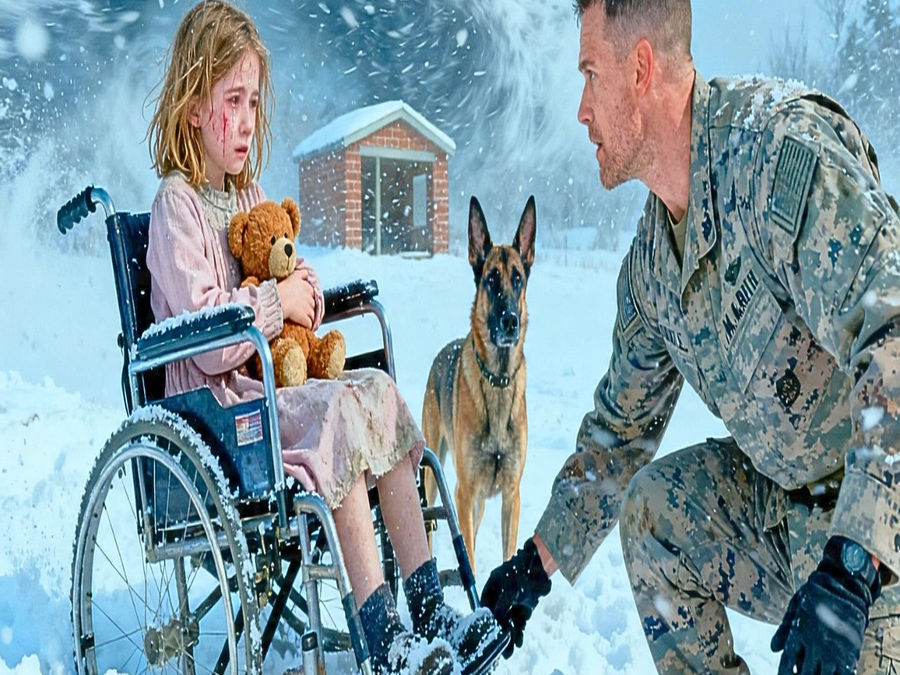
“No One Is Coming ” They Left a Disabled Girl to Freeze—Until a U.S. Marine & K9 Changed Everything
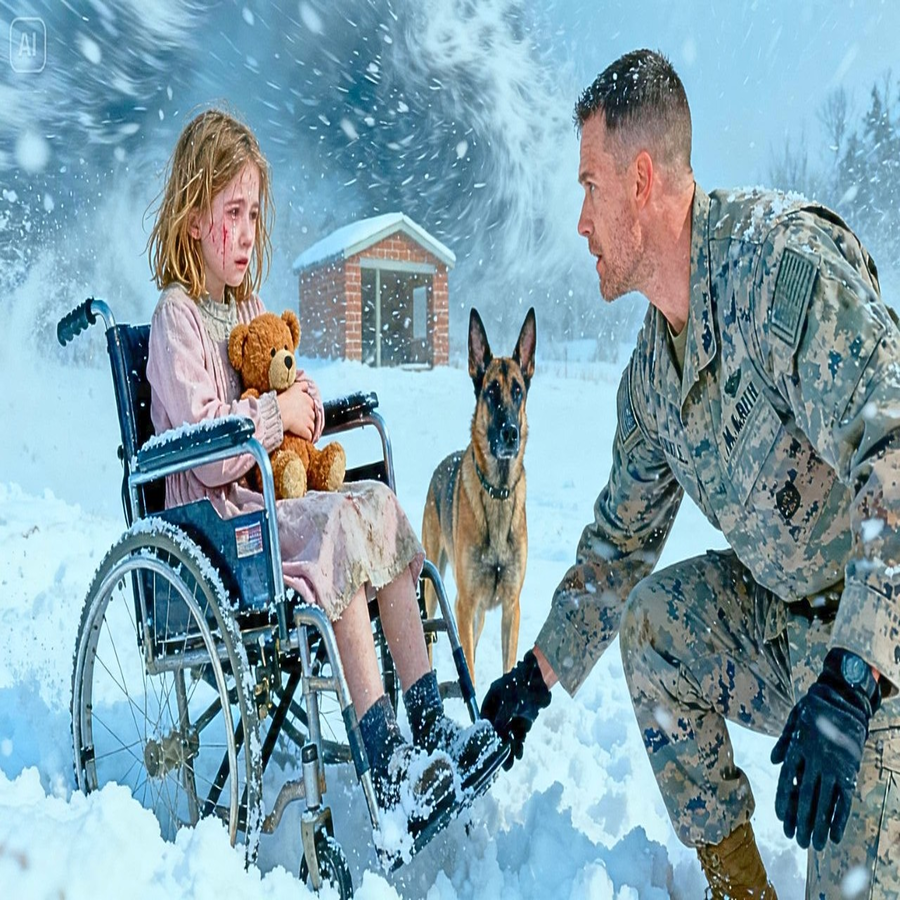
8 years old
alone in a blizzard.
No one called.
No one searched.
No one even filed a missing person’s report because the people who were supposed to love her were the ones who left her there.
A wheelchair in the snow.
A pink coat soaked through.
Eyes that had stopped expecting rescue.
This is the story of Lily Harper.
The child the system forgot.
The storm that almost finished the job.
And the one man who refused to follow orders when following orders meant leaving a little girl to die.
The dispatch call came through at 6:47 p.m. on a Thursday.
And by the time Ethan Vale pulled into the parking lot of the Silver Ridge Community Shelter
the snow was already bad.
Not bad like an inconvenience.
Bad like the mountain had decided it was done tolerating people and was in the process of burying them all.
He sat in the truck for a moment with the engine running
watching the wind shove a steel trash can across the lot like it weighed nothing.
The meteorologist had been calling this one for 4 days.
A once-in-a-generation blizzard.
The kind that rewrote infrastructure and closed counties for a week.
Highways already shut down 40 miles east.
National Guard activated.
Emergency shelters across Colfax County ordered to maximum capacity by nightfall.
Which was why he was here.
Ethan killed the engine.
The cold hit immediately even through his jacket.
That specific Colorado mountain cold that didn’t ease in, just arrived.
He climbed out and walked around to the back of the cab.
The dog was already up
alert
watching him through the kennel gate with amber eyes that never fully relaxed.
“Come on.”
Ethan said.
Koda dropped out of the truck in one clean movement
landed in the snow
and shook once.
Then he was beside Ethan, matching his stride.
Six years they’d worked together.
Koda was a Belgian Malinois.
People always assumed German Shepherd until they saw the build
the pace
the way the dog moved like he was always just about to launch.
Military working dog, K9 handler program, two deployments.
Now officially retired and belonging to no one except Ethan
which meant belonging to Ethan completely.
They went inside.
The shelter smelled like wet coats and institutional coffee and the specific kind of exhaustion that settles into rooms full of people who have nowhere better to be.
Folding tables, cots already going up along the far wall.
The overhead fluorescents made everyone look slightly unwell.
The coordinator
a woman named Maria Caldwell
late 50s
clipboard in hand
reading glasses pushed up on her head
spotted Ethan before he could find her.
Captain Vale.
She shook his hand with the grip of someone who’d been doing crisis management since before it was called that.
Appreciate you coming in.
Ethan’s fine.
He’d been out of the core for 3 years.
The rank still followed him around like a shadow he hadn’t shaken.
What do you need?
Crowd control’s the main thing.
We’re over capacity by 11 and still getting walk-ins.
She turned and gestured toward the main hall.
I’ve got two teenagers who are about half a second from a fight
one gentleman who I’m pretty sure is an active psychiatric distress
and a family of four who arrived speaking only Portuguese
and I do not have a translator.
I’ll take a walk around.
Please.
She glanced at Koda.
You going to be okay in here?
He’ll be fine.
Ethan paused.
Where do you want us to set up?
Wherever you think you’re most useful.
You know this work better than I do.
He didn’t argue with that.
He’d spent two full winters helping coordinate emergency relief operations.
First in Helmand province
where the logistics were a nightmare and the politics were worse
then later domestically when he’d transitioned out and found that the skills didn’t go anywhere just because the uniform had.
He started at the far end of the room and worked toward the entrance
slow and deliberate.
Coda moved with him
close but not rigid
reading the room the same way Ethan was.
The teenagers’ situation resolved itself once Ethan stood between them and said nothing.
There was something about his posture
not threatening
just immovable
that tended to de-escalate things before words were necessary.
One kid looked at him
looked at the dog
and decided the argument wasn’t worth it.
Smart.
The man in psychiatric distress was harder.
Ethan crouched down beside him
spoke quietly
learned his name was Dennis and that he’d been off his medication for 4 days
and that what he needed more than anything was someone to not crowd him.
Ethan gave him space and asked Maria to set aside a cot in the corner near the boiler room where it was warmer and quieter.
Small thing, it mattered.
The Portuguese family he handled through a combination of hand signals
Google Translate on his phone
and a 12-year-old girl in the next cot over who turned out to speak enough Spanish to bridge the gap.
Creative improvisation.
Another skill that didn’t retire when you did.
By 8:00 p.m. the shelter was running.
Not smoothly
nothing in a blizzard ran smoothly
but it was holding together.
The wind was screaming now.
You could hear it through the walls
a constant pressure
like the storm was trying to find the seams.
Ethan stood near the front entrance with a cup of coffee he hadn’t touched
watching the parking lot through the glass door.
Snow moved sideways, visibility was maybe 40 ft.
He’d seen worse, a lot worse, but not often stateside.
That was when Coda went still.
What?
Not the alert he used for people he recognized
not the relaxed attention he gave to general crowd noise.
This was different.
A full-body orientation
head up
ears forward
eyes locked on the side door at the far end of the corridor.
The one that led to the east wing of the building.
The one nobody was using because it opened directly into the storm.
Ethan watched him for 2 seconds, then he set down the coffee.
“Show me.”
He said quietly.
Koda moved.
Ethan followed.
They went down the corridor
past the supply closet
past the utility sink
past the bulletin board with its laminated emergency protocols.
And the dog stopped at the side door and looked up at Ethan once
and then back at the door.
Ethan put his hand on the push bar.
Cold radiated through the metal.
He pushed it open.
The wind came in like a fist.
He saw her immediately.
She was maybe 30 ft out
just past the edge of the building’s shelter
where the snowdrift ran against the exterior wall.
A wheelchair.
A standard manual chair.
The basic kind hospitals give out when insurance won’t cover the upgrade
half buried in snow.
Sitting in it, not moving, was a child.
Small.
Eight, maybe nine.
Wearing a pink coat that had probably been the right weight for October
and was doing almost nothing against this.
Her hands were in her lap.
Her head was slightly bowed.
She was not crying.
She was not calling out.
She looked like someone who had already decided no one was coming.
Ethan was through the door before he consciously decided to move.
The cold hit him full in the face
and he went into it anyway
head down against the wind
moving fast.
Koda was beside him, low and quick.
Five steps, 10.
The snow was past his ankles
and then he was crouching in front of the wheelchair
and his hands were on her arms
and he was close enough to see her face.
Brown eyes.
Lips pale at the edges.
A small
precise cut above her right eyebrow that had been cleaned but not properly bandaged.
She looked at him without speaking.
No surprise in her expression
just a kind of weary waiting
like she was prepared for whatever this turn of events would bring.
“Hey,” Ethan said.
He kept his voice level.
“What’s your name?”
A pause.
Then, very quietly, “Lily.”
“Okay, Lily.
I’m Ethan.
This is Coda.”
He kept his hands on her arms
checking without making it obvious
circulation
responsiveness.
Her fingers were stiff.
Not frostbite yet, but close to the window.
“You’ve been out here a while.”
She didn’t answer that.
“Can you feel your hands?”
“A little.”
“Okay.
That’s okay.”
He looked at the chair.
Standard push handles, no power assist.
Wheels already fighting the accumulated snow.
“I’m going to bring you inside.
Is that all right?”
She looked at him for a moment.
Then she looked at Coda
who had pressed himself gently against the side of the chair
blocking the wind.
“Okay,” she said.
Ethan pulled the chair backward
angling into the wind
moving with the kind of controlled force that didn’t ask permission from weather.
It wasn’t elegant.
Snow pushed back against every inch of progress.
By the time he got her through the side door and back into the corridor
his shoulders were soaked and his jaw ached from clenching against the cold.
He didn’t notice either of those things until later.
Um, Maria found blankets.
A shelter volunteer
a retired EMT named Frank
who showed up every winter and never talked about why
checked Lily’s core temperature and circulation
and confirmed the early stage exposure without alarm.
Warm fluids
dry blankets
a space near one of the heating vents that ran along the south wall.
Throughout all of this, Lily said almost nothing.
She answered direct questions in single words or short phrases.
“Yes.”
“No.” “A little.”
“I don’t know.”
She didn’t volunteer anything.
She didn’t ask for anything.
When Frank leaned in to check her fingers and she flinched backward in the chair
she immediately went still again
like she’d reflexively overreacted and was embarrassed by it.
Ethan noticed.
He didn’t say anything about it.
He pulled a folding chair close
not too close
and sat down and let the silence sit for a minute.
Coda settled on the floor between them
which was partly instinct and partly Ethan had given him a quiet signal.
You hungry?
Ethan asked.
A beat.
Yes.
There’s soup.
Might be pretty bad soup, to be honest with you.
Shelter soup usually is.
The corner of her mouth moved, just barely.
Almost.
Okay, she said.
He got the soup.
It was in fact pretty bad.
Thin and aggressively salted
the kind of thing that kept you alive without pretending to do anything else.
He brought a cup back
wrapped her hands around it
and watched the color slowly begin to return to her fingers.
Is someone coming for you?
He asked.
Casual, not accusatory.
She was quiet for a moment.
They said they’d be back.
Ethan kept his expression neutral.
Who did?
Victor and Aunt Renee.
She looked down at the cup.
They said they had to go get something and they’d come back.
Something settled in Ethan’s chest.
Heavy.
Still, like ordnance that hadn’t gone off yet.
How long ago was that?
She thought about it.
Before it got dark.
He checked the clock on the wall.
8:23 p.m. Dark had come at 5:12 p.m. More than 3 hours ago.
He didn’t let his face change.
He’d learned that in the core
the controlled expression
the neutral affect
the ability to absorb bad information without broadcasting it
it was a skill he used constantly and almost never talked about.
Okay, he said.
Let’s just focus on getting you warm right now.
He found Maria in the side office 20 minutes later
closed the door behind him.
The girl, he said.
Lilly Harper.
Do you have any record of her being brought in?
Maria was already at the computer typing, frowning at the screen.
No intake form, no guardian signature, nothing.
She pulled up the evening log.
We had a rush between 4:00 and 6:00.
It’s possible she came in with a group and we just She didn’t come through the front.
Ethan pulled a chair out and sat across from her.
She was outside.
East side of the building near the drainage wall.
Someone left her there, probably hours ago.
Maria looked up from the screen.
The expression on her face was the one people get when something they don’t want to be true is becoming undeniable.
You’re sure?
She was half buried and her hands were going white.
Nobody puts a child in a wheelchair outside a building in a blizzard and walks away by accident.
A long pause.
Then Maria reached for the phone.
I’m calling the duty supervisor.
Check your cameras first, Ethan said, before anyone else is in the room.
I want to see what we’re actually dealing with.
The shelter had three exterior cameras
old analog units
the kind with the fish eye lens and the timestamp burned into the corner in orange numbers.
The east side camera covered the area where Ethan had found her.
The footage was grainy and timestamped 4:51 p.m. A black SUV
no plates visible
angled wrong relative to the camera or deliberately parked that way.
Ethan couldn’t tell yet.
Two adults, both wearing dark coats, hoods up.
They’d come from the passenger side
one of them had the wheelchair already folded out
and together they’d lifted Lilly from the vehicle and placed her in it.
The whole thing took less than 2 minutes.
Then they got back in the SUV and drove out of frame.
And Lilly sat in the snow watching the vehicle leave
and she didn’t call after them.
She didn’t raise her hands.
She just watched, like she’d expected this.
Like some part of her had been waiting for exactly this to happen.
Maria made a sound beside him that wasn’t quite a word.
“Victor and Renee Halston,” Ethan said.
“That’s what she told me.
Said they were coming back.”
“I don’t know those names.
I need you to pull county guardian records
anything connected to Lily Harper.
DOB unknown, but she looks about eight.”
“I’m not sure I have access to Maria.”
He turned to look at her.
Not unkind, just direct.
“This child was intentionally abandoned in a life-threatening storm.
However much access you have, use it.”
She held his gaze for a moment, then she turned back to the computer.
Uh while Maria worked the system, Ethan went back to Lily.
She had eaten most of the soup.
Kota had shifted position.
Now he was beside the chair
his shoulder pressed lightly against her leg
and she had one hand resting on top of his head.
Not petting
just resting
like she needed to confirm something solid was there.
Ethan pulled the folding chair back out and sat down.
“You go to school here?”
he asked.
She shook her head.
“We moved.”
“From where?”
She thought about it.
“Denver first, then that other place.
I don’t remember the name.”
“How long have you been with Victor and Renee?”
Her hand moved slightly on Kota’s head.
“Since my mom went to the hospital.”
Ethan didn’t push on that.
“Are they your family?”
“No.” A pause.
“Victor is my mom’s cousin’s husband, I think.”
Another pause.
“They said they were helping.”
“Helping?”
Ethan kept his face still.
“Did they bring your chair?”
He nodded at the wheelchair.
“No, that was already mine.
” She looked at it briefly.
“I’ve I’ve it since I was five.”
“What when you were five?
She didn’t answer immediately.
She looked at Koda.
The dog had not moved.
Car accident
she said finally
flat
factual
like a statistic she’d memorized.
Ethan nodded slowly.
Okay.
They sat in silence for a moment.
The storm pressed at the walls.
Is it going to get worse?
She asked.
Tonight, yeah.
It’ll be worse tonight.
But we’re inside.
We’re inside, he confirmed.
She thought about that.
Okay.
Maria came and found him 22 minutes later.
She had a printout in her hand and an expression on her face that Ethan had seen before.
On officers delivering bad intelligence
on civilians absorbing news they weren’t built to absorb.
She handed him the paper without speaking.
He read it.
The county child welfare database had a file on Lily Harper
seven pages
but the first two told the story.
Mother
Jennifer Harper
admitted to a psychiatric facility in Adams County 14 months ago.
Prognosis unclear, unable to provide care.
Father unknown.
No other biological relatives identified as suitable guardians.
Temporary placement had been approved six months ago with a couple named Victor and Renee Halston on the basis of their claim to be extended family.
A claim that had been taken at face value by a county case worker who was carrying a case load of 64 families and had made one home visit in six months.
One visit.
There was a note in the file filed three months ago by a school nurse in what had apparently been Lily’s previous district.
The note flagged concerns.
Unexplained bruising on Lily’s forearms
inconsistent explanations from the guardians
a child who was notably reluctant to discuss her home situation.
The note had been forwarded to the county office.
There was no record of follow-up.
At the bottom of the file
added two weeks ago by someone in the county office
a flag indicating that the Halston guardianship had lapsed.
Paperwork had not been renewed
licensing requirements hadn’t been met
and that Lily Harper was technically without a legally approved guardian.
Technically.
As in, nobody had gone to check on her.
Ethan looked up from the paper.
“The Halstons don’t have current legal guardianship,” he said.
“Apparently not
which means they had no legal authority to have her in their custody.
That’s Maria stopped, started again.
“That’s what it appears to mean.”
“And yet she’s been living with them.”
“Yes.”
Ethan set the paper down on the desk.
He looked through the window in the door at the main hall
where Lily sat in her wheelchair with Coda beside her
wrapped in two shelter blankets
watching the room with those quiet
careful eyes.
He thought about the footage, the two minutes, the deliberate parking angle.
He thought about the school nurse note.
He thought about the word helping.
“Did you call anyone?”
he asked.
“I called the county emergency line.
They said they’d dispatch someone when the roads permitted.”
“When the roads permitted.
” “The blizzard.”
“I know.”
He stood up.
“Get me everything you have on the Halstons.
Any address, any contact, anything.”
“Ethan
she’s 8 years old and she’s in a mandatory closure shelter with no guardian
no emergency contact
and no one who’s filed so much as a call to find her.”
He picked up the printout.
“Someone needs to start building a record.
Tonight.”
========== PART 2 ==========
He went through Lily’s backpack an hour later.
She’d fallen asleep in the chair
sheer exhaustion
the aftermath of cold and fear
and the particular drain of holding yourself together for too long.
Coda was still beside her.
One ear swiveled toward Ethan as he approached, then settled.
The backpack was pink, matching the coat.
Worn.
The zipper on the main compartment had been repaired with a zip tie.
Inside
one change of clothes
child-sized
neatly folded
a pencil case
a library book about dogs.
He felt something move through him when he saw that
and he set it carefully aside.
A small stuffed rabbit
old enough that most of the texture had rubbed off the ears.
And at the bottom
tucked beneath everything else
folded twice
a piece of paper.
He unfolded it.
It was a partial medical document
the top half of what appeared to be a treatment summary from a pediatric clinic in Denver.
Lily’s name, date of birth, which confirmed she was eight.
A notation about ongoing physical therapy needs related to her mobility impairment.
A recommendation that her wheelchair be assessed for fit.
Apparently
she’d grown
and the current chair was too large
affecting her posture and her ability to self-propel.
Someone had written across the bottom of the document in red ink
in handwriting that pressed hard into the paper.
Do not discuss medical matters with anyone outside of this household.
That was it.
Seven words.
Red ink.
Written like a directive.
Written like a warning.
Ethan stared at it for a long moment.
He thought about the way she flinched when adults came close.
The way she answered questions in the minimum number of words.
The way she’d sat in the snow
not calling for help
like calling for help wasn’t something she’d learned was available to her.
He thought about the school nurse note.
Notably reluctant to discuss her home situation.
He refolded the document and set it on top of the library book about dogs.
Then he sat back in the chair beside Lily’s and watched her sleep
and listened to the storm work itself against the building
and he thought about what it meant to be eight years old and have already learned that adults couldn’t be relied on to come back.
At 11:15 p.m., Maria came to find him again.
“Emergency management just issued a shelter-in-place extension through 6:00 a.m.
” she said.
“No movement in or out.
County vehicles included.”
A pause.
The case worker they were going to send isn’t coming until morning.
I know.
You should try to sleep.
There’s a cot in the back.
I’m fine.
She looked at him for a moment.
You were a Marine.
Yes.
Was it She stopped herself, started differently.
Were you overseas long?
Two deployments.
Helmand.
One in Anbar before that.
He didn’t elaborate.
It wasn’t relevant to what she was actually asking
which was a different question entirely.
This is different from that, she said.
A lot of things are different from that.
He looked at Lily.
Some things aren’t.
Maria stood there for another moment
and then she said
I’ll check on the supplies and left him alone.
Around midnight, Lily woke up.
She did it the way children do when they’re not fully safe.
Fast
alert
eyes open before her head came up
scanning the room before she oriented herself.
Then she saw Ethan, and the scanning slowed, and she sat back slightly.
You’re still here, she said.
Yeah.
She looked at Koda
who had lifted his head when she moved and was watching her calmly.
Is he always that quiet?
When he’s not working.
What was he trained to do?
Ethan thought about how to answer that.
Find people, he said finally.
He’s good at finding people who don’t want to be found
and people who need to be found.
Both kinds.
She considered this.
Which kind was I?
The question landed like a weight.
The second kind, Ethan said.
She looked at her hands for a moment.
Victor said I was a burden.
Ethan didn’t respond immediately.
He let the statement sit.
Did he say that to you directly?
A lot of times.
Not defensive, not self-pitying, just reporting a fact.
He said it to Renee more, but I could hear.
How are your hands now?
Warm enough?
She flexed her fingers.
Better.
Good.
Another silence.
The overhead lights had been dimmed to half for sleeping hours.
The storm was still audible, but quieter now.
Or maybe they’d just adapted to it.
Am I going somewhere tomorrow?
She asked.
When the people come?
I don’t know yet.
Probably some conversations happen first.
Will you be there?
He looked at her.
If you want me to be.
She thought about it.
Yes, she said.
I want you to be.
Koda had put his head back down on his paws.
His eyes were still open.
Okay, Ethan said.
Then I’ll be there.
Lilly pulled the blanket slightly tighter around her shoulders and leaned back in the chair and looked at the dog for a while.
Eventually her eyes went heavy again and she drifted back under and the shelter settled around them.
The ambient noise of 30 people breathing
the fluorescent hum
the storm pressing at the seams of everything.
Ethan stayed where he was.
He was still there when the radio on his belt chirped at 1:34 a.m.
The county emergency operations frequency
priority traffic.
And the voice on the other end told him that all non-essential civilian personnel at community shelters were being consolidated to the main emergency hub across town
effective immediately and that transportation was 40 minutes out.
Copy that
he said into the radio and released the transmit button and looked at Lilly sleeping in the wheelchair with her hand resting on the back of a retired military dog.
Then he looked at the side door at the end of the corridor.
The one that still had snow packed against the base of it from when he’d come through.
And for the first time in 3 years
Ethan Vale looked at a direct order and felt something inside him go completely
dangerously quiet.
He didn’t call back.
40 minutes came and went.
The transport vehicle arrived
loaded up 11 people from the shelter’s non-essential roster and pulled out of the parking lot.
Ethan watched the tail lights disappear into the white and felt no particular urgency about the fact that he wasn’t on it.
Maria found him standing at the front window 10 minutes after the vehicle left.
You were supposed to be on that transport, she said.
I know.
The county coordinator is going to want an explanation.
Tell him I had a situation that required on-site management.
He turned from the window.
You still have access to the camera system?
She looked at him for a long moment
the kind of look people give when they’re deciding whether to keep pushing or redirect.
She redirected.
Yes.
I want to go back through the full day’s footage
not just the east wall
all three cameras
everything from noon forward.
Why noon?
Because that’s when they would have been scouting.
She didn’t ask what he meant by that.
She just led him back to the office.
The footage was tedious and the coffee was terrible and the clock on the wall said 2:09 a.m.
Ethan sat through it methodically.
The way he’d sat through surveillance reviews in forward operating bases in Helmand
watching grainy infrared footage of roads and tree lines
looking for the thing that didn’t fit.
The principle was the same.
Most of what you watched was nothing.
You watched it anyway because the thing you needed was usually invisible until you’d earned the right to see it.
At 12:47 p.m., the black SUV appeared on the south-facing camera.
It drove past the shelter once
slowed near the east side of the building
then continued.
Ethan watched it make a circuit of the block
visible on the north camera at 12:51
back on the south at 12:54.
It parked half a block away for 17 minutes.
Then it left.
They came back at 4:51, Maria said.
She’d been watching with him
standing behind his left shoulder
arms crossed.
Yeah.
He rewound the midday segment, watched the slow pass again.
They were checking the camera placement.
She was quiet for a moment.
You think they knew about the cameras?
I think they were being careful.
They parked outside the frame on purpose.
Hoods up.
Drove past first to see what angles the building had.
He paused the footage on the SUV moving past the east wall.
Someone told them to be careful or they figured it out themselves.
Either way, this wasn’t impulsive.
That’s She stopped.
Premeditated, Ethan said, flat.
They planned this.
The word sat in the room between them like something physical.
Maria uncrossed her arms and pressed her fingers briefly to her mouth.
Then she picked up the desk phone and started dialing.
I’m calling county emergency services again.
I don’t care what time it is.
While you do that
Ethan said
can you print me a still from that midday pass?
Best frame you can get of the vehicle.
He took the printout and the case file and the photograph of the red ink note.
He’d photographed it with his phone before replacing it in the backpack.
And he laid everything out on one end of the supply room table.
Old habit.
Build the picture before you decide what to do about it.
Don’t work from assumptions.
Work from what you can actually document.
What he had.
Security footage of a premeditated approach and deliberate abandonment.
A lapsed guardianship that meant the Halstons had no legal standing to have Lily in their custody for at least the past several weeks.
A medical document with a written directive telling an 8-year-old not to speak about her health needs to anyone outside the household.
A school nurse’s flagged concern about unexplained bruising that had never been followed up.
And a child who had been left outside in a blizzard and had not called for help because and this part was Ethan’s read
nothing documented
just pattern recognition from years of watching people under pressure.
She had learned that calling for help made things worse.
He stared at the layout for a while.
Then he picked up his phone and called a number from memory.
It rang four times before voice answered, rough with sleep.
This better be good.
It’s Vale.
A pause.
Sheets moving, someone sitting up.
Ethan.
It’s 2:00 in the morning.
I know.
I need a name run.
Colfax County.
Victor Halstead and Renee Halstead.
Current addresses
any prior contact with law enforcement
anything public record.
You working a case?
Not officially.
Then what are you doing?
Favor for a kid.
He looked at the printout.
Then you do it.
The voice on the other end
a former colleague named Danny Reyes
now working with a private investigations firm in Denver
was quiet for a moment.
Then, “Give me 20 minutes.”
10 would be better.
“20.”
Danny said and hung up.
The call came back in 14 minutes.
“Victor Halstead.”
Danny said.
“43.
Two prior addresses in Adams County.
Current registered address in Silver Ridge.
Looks like they moved up there about 8 months ago.
No criminal record, but there’s a civil filing from 3 years back.
Domestic dispute, neighbor complaint, no charges filed.
Renee Halstead, née Ferris, 41.
Clean record.
One thing of interest.
There’s a bankruptcy filing from 2 years ago.
Significant debt.
And here’s the part you’ll like.
6 months ago
Victor Halstead filed paperwork with the state to become a licensed foster parent.
Ethan was quiet.
“He was denied.”
Danny continued.
“Background check came back with some inconsistency in his financial statements.
They turned him down.
But here’s the thing.
The denial was for the foster care license.
The temporary guardianship for Lily Harper was processed through a different county office
different case worker
and the two records were never cross-referenced.
Of course they weren’t.
System’s not set up for that.
Different databases
different departments
everyone’s carrying four times the case load they should be.
A pause.
What are you thinking?
Ethan was thinking about what a temporary guardianship of a child with documented medical needs meant financially.
Monthly stipends from the state.
Reimbursement for medical expenses.
The kind of payments that would look useful to a couple with a significant debt load.
And no approved path to the foster care income they’d been trying to access.
I was thinking about a wheelchair that was too large and hadn’t been replaced.
About a child who hadn’t been to physical therapy in he didn’t know how long
but the medical document was dated 7 months ago and the clinic note at the bottom had been written in the kind of urgent language that suggested the recommendation was
long overdue.
He was thinking about where the money had actually been going.
“I’m thinking
” he said
“that someone used a little girl to access state funds and then got scared when the guardianship paperwork started requiring real documentation.”
Danny was quiet for a moment.
“That’s a serious allegation.”
“Yeah.
” Ethan looked at the red ink photograph on his phone screen.
“Do not discuss medical matters with anyone outside this household.”
“I know.”
“You want me to do anything else?”
“Not tonight.”
“I’ll call you tomorrow.”
He ended the call and sat with it for a few minutes.
The supply room was cold.
The building’s heating was working hard and losing ground.
He could hear the storm, muffled now, still constant.
Then he went back to check on Lily.
She was asleep again.
Genuinely this time, the deep kind.
Her head tilted to one side and her breathing slow and regular.
Coda had shifted position.
He was now lying fully on the floor beside the chair with his side pressed against the wheel and Lily’s arm had dropped over the edge of the armrest and her fingers were resting lightly on his flank.
Neither of them had moved deliberately to make that happen.
It had just happened.
Ethan stood in the doorway of the main hall for a moment and watched them.
Frank, the retired EMT, appeared beside him holding two cups of coffee.
He was a quiet man
broad shoulders
the kind of face that had spent a lot of years keeping itself neutral.
He handed one cup to Ethan without comment.
“You’re the one who found her?”
Frank asked.
“Coda found her.
I just followed.”
Frank looked at the dog.
“Good animal.”
“Yeah.”
They drank coffee and didn’t talk for a while.
The shelter had settled into the low hum of the 3:00 a.m. register
people sleeping fitfully
a few still awake but not moving
the building making its constant small adjustments against the pressure of the storm.
“I did pediatric ER work for 6 years
” Frank said eventually
“before I moved into field response.”
He paused.
“The way she flinches.”
“I know,” Ethan said.
“You’ve seen it before?”
“Different context.”
He looked at the cup in his hands.
“Same pattern.”
Frank nodded slowly.
He didn’t push it.
“She ask for anything when she was awake?”
“Just wanted to know if I’d be there tomorrow.
” Frank made a sound that wasn’t quite a response.
He finished his coffee.
“I’ll be back at 6:00 to do another check on her temperature and circulation.
Let me know if anything changes before then.”
“Will do.”
Frank moved off.
Ethan stayed where he was.
At 4:30 a.m.
Maria came out of the office with a different expression than she’d been wearing all night
less controlled
like the thing she’d been managing had shifted into a different category.
“I reached someone at County
” she said
“finally
a supervisor
not just the duty answering service.”
She glanced toward the main hall, then back at Ethan.
“They’re sending a detective.
Child welfare investigation.
He’ll be here as soon as the roads are passable.
They’re saying 8:00 a.m. at the earliest.
Good.
He wants everything we have.
The footage, the file, the note.
She paused.
He asked about Lily’s condition.
She’s stable.
She slept most of the night.
He also asked Another pause.
Careful now.
He asked if she’d been interviewed about what happened.
No. He said to make sure she isn’t not until he gets here.
That anything she says before a proper interview could complicate the evidentiary.
I know how it works.
He said it without sharpness.
Just fact.
I wasn’t going to interview her.
I was just sitting with her.
Maria looked at him.
You were a captain.
What did you do exactly in the Marines?
You’ve never actually said.
Ethan finished his coffee.
Intelligence and reconnaissance.
Force recon, later.
We found things.
We assessed situations.
We decided what the threat of picture looked like and passed that up the chain.
A beat.
Sometimes we didn’t wait for the chain to catch up.
She was quiet for a moment.
Is that what you’re doing now?
He set down the empty cup.
I’m sitting in a shelter watching a kid sleep.
That’s all.
She looked at him for another second, then looked away.
Get some rest, Ethan.
A few hours at least.
He didn’t.
But he sat down.
And that was something.
The morning came in pieces.
The storm diminishing from a roar to a steady howl
then to the kind of sustained wind that was uncomfortable but survivable.
The sky lightened behind the snow.
Gray first
then the pale flat white of a winter morning that had nothing to offer except the fact of being over.
People started waking up around 6:00.
Frank came back and did his check on Lily.
Temperature normal
circulation fully restored
no lasting effects from the exposure.
He said it with the measured relief of someone who knew how close the margins had been.
Lilly woke up at 6:40 and asked for water.
Then she asked for the library book from her backpack.
Ethan got both.
She read with the book propped on her knees, not looking up.
Ethan sat nearby and drank bad coffee and watched the windows.
Koda had finally fallen into a real sleep
stretched out on his side
feet moving slightly in whatever dogs dream about.
At 7:15, the lights outside the front windows were wrong.
Not the flat morning light, flashing red and blue, strobing through the snow.
Ethan was at the door before he processed the decision.
Two police cruisers in the parking lot
one Sheriff’s Department SUV
and a dark sedan
civilian county plates
parked at an angle that said whoever was driving it was accustomed to arriving somewhere and having it mean something.
A man got out of the sedan.
Tall
mid-40s
the kind of build that had been athletic once and was now just solid.
He wore a heavy coat and carried a briefcase and moved through the snow without looking down
which meant he was used to Colorado winters.
========== PART 3 ==========
He looked at the shelter entrance and then he looked directly at Ethan standing in the doorway
and something in his expression sharpened.
He came forward, extended his hand.
“Detective Marcus Reed, Colfax County Sheriff’s Office.
” His grip was firm, quick, professional.
“You’re Vail?”
“Yes.”
“Maria Caldwell called me.”
He looked past Ethan into the shelter.
“Lilly Harper is inside?”
“She’s awake.
She’s okay.”
Reed looked at him for a moment, something assessing in it.
“And you’ve been here all night?”
“Yes.”
“Why?”
Ethan met his gaze.
“Because she needed someone to be.
” Reed held the look for another beat.
Then he nodded.
Not agreement exactly
more like he’d gotten the answer he expected and had filed it somewhere for later.
“I need to see the footage and the file before I talk to her
and I need to talk to her alone.
Just Just me and a child advocate.
Standard protocol.
I understand.
I may need to ask you some questions as well about what you observed when you found her
the condition she was in
what she said.
Whatever you need.
Reed studied him one more time.
You former law enforcement?
Military.
Doing what?
Reconnaissance and intelligence assessment.
The detective processed that for a moment.
Then he said, “Follow me in.
I want to start with the footage.”
Reed was efficient.
He watched the footage twice
the midday scouting pass and the 4:51 abandonment
without speaking.
And the only indication that what he was seeing affected him in any way was the very slight tightening around his jaw during the 2 minutes when the Halstons placed Lily in the chair and drove away.
He made notes.
He asked Ethan precise
clipped questions
times
exact wording of what Lily had said
the physical condition of the backpack and its contents
the sequence in which he’d found the items.
He photographed the red ink document himself
bagged it in an evidence sleeve
and set it to one side.
When Ethan showed him Danny’s name run information
he’d written the key points from the call on a notepad.
Reed looked at the notepad for a long moment without touching it.
“How did you get this?”
he asked.
Phone call.
Public record search.
Nothing that wasn’t accessible.
The source?
A contact.
Nothing that would interfere with your investigation.
Reed looked at him.
You understand how this works?
If there’s a prosecution
anything derived from its background
Ethan said
“You find it yourself through your own channels.
I’m just telling you where to look.”
The detective held his gaze.
Then he wrote something in his own notepad.
“The financial angle,” he said, “the guardianship stipend.
It’s the part that explains why they didn’t just walk away from a situation that wasn’t working.
The money kept them from cutting losses.
And when the paperwork renewal required real documentation
the documentation would have exposed the financial mismanagement
maybe worse.
Reed nodded.
He was quiet for a moment, then You’ve done this before.
Not law enforcement work, but pattern analysis.
You see how things connect.
It’s a transferable skill.
The detective almost smiled.
Almost.
Let me go talk to the girl, he said.
They set up the interview in the side office.
Reed and a woman named Carol who had arrived with him and was identified as a county child welfare advocate.
She was small, early 30s, soft-spoken in a way that managed to not seem soft.
She’d brought a stuffed animal from somewhere.
Not a rabbit, a small gray bear.
And set it on the desk in a way that looked casual and wasn’t.
Ethan waited in the main hall.
Lily had looked at him before they took her into the office.
A quick glance over her shoulder from the wheelchair.
He’d given her a small nod.
She’d faced forward and gone in without saying anything
which was either composure or numbness
and he wasn’t sure which.
Coda sat beside Ethan on the floor of the hall, leaning against his leg.
The interview took 40 minutes.
When the office door opened
Carol came out first and then the wheelchair
and Lily’s face was doing the careful still thing that Ethan had learned to read as her effort to not look like she’d been crying.
Her eyes were slightly red.
She looked at Ethan across the room and he looked back and he didn’t say anything because sometimes the most useful thing was to not immediately fill the silence with reassurance.
She wheeled toward him, stopped a few feet away.
They’re going to find Victor and Renee, she said.
Yeah, they will.
She thought about that.
Victor said if I ever talked to anyone
nobody would believe me because she stopped
started again.
Because I was a problem kid.
Do you believe that?
She looked down at her hands.
I used to.
Ethan let that sit for a moment.
What about now?
She looked up at him.
That man believed me.
The detective.
Yeah, he did.
And you believed me last night, even when I didn’t say anything.
He met her eyes.
You didn’t need to say anything.
What happened was obvious.
She was quiet for a while.
Coda leaned forward and pushed his nose lightly against her knee
and she reached down and put her hand on his head.
What happens to me now?
She asked.
Detective Reed is going to make some calls.
There’s a process.
Welfare placement, evaluation, all of that.
It’s going to take some time.
Do I have to go somewhere today?
I don’t know yet.
Will you find out?
Yes.
She nodded.
She looked like she was working through something internally
running some kind of calculation
the kind kids do when they’ve learned that the world makes more sense when you plan for the worst and let the better things surprise you.
The dog book, she said.
In my backpack.
Can I keep reading it?
It’s yours, Ethan said.
Of course.
She reached back for the backpack on the handles of her chair
found the book
and opened it to where she’d left off.
Just like that.
Back to the book.
Because the book was manageable and predictable and stayed the same no matter what else was happening.
Ethan watched her for a moment.
Then he went to find Reed.
The detective was on his phone in the corridor
speaking quietly and quickly
the kind of call where you could tell from the body language that things were moving.
He saw Ethan coming and held up one finger.
Ethan waited.
Reed ended the call, turned.
We’ve got a location on the Holstons.
They went to a motel in Granby.
That’s about 40 miles west.
Storm caught them there.
He didn’t look sorry about that.
Two sheriff’s deputies are there now.
What are they looking at?
Abandonment of a child in life-threatening conditions, minimum.
Possibly more
depending on what we find when we go through their place in Silver Ridge.
He paused.
The financial piece I made some calls.
There’s a pattern.
This isn’t the first time Victor Halston has been in proximity to a guardianship arrangement that involved state funds.
There was a situation in Adams County 4 years ago.
Different child, different circumstances.
The case never went anywhere, but the file exists.
Ethan was quiet.
It went nowhere because the kid aged out of the system before anyone connected the dots
Reed said.
He said it like a man who’d seen this story before and was tired of where it ended.
Different county, different database, nobody cross-referenced.
He looked at Ethan directly.
Sound familiar?
Yeah.
Reed tucked his notepad into his coat.
The question now is Lily.
She can’t stay here.
Shelter’s going to close once the roads clear, probably early afternoon.
I’ve contacted two certified emergency placements in the county.
Both are available.
Good.
There’s also a third option.
Reed said it carefully, watching Ethan’s face.
You’ve established rapport with her.
She responds to you.
She responds to the dog.
In some cases
temporary custody can be arranged with a known trusted adult pending formal review.
What would that require?
Background check.
Which I’ve already run, incidentally.
He paused.
You’re clean.
More than clean.
There’s a commendation in your military file that I’m not supposed to have seen.
Then why are you telling me?
Because I want you to know I’ve done my homework.
Reed’s expression didn’t change much.
The process isn’t fast.
There’s paperwork, there’s an evaluation period, there’s a home visit.
And you’d be under no obligation.
The other placements are good people.
Ethan looked down the corridor toward the main hall.
He could see the edge of the doorway, the corner of the room where Lily sat.
Let me talk to her first, he said.
Reed nodded.
Take the time you need.
I went back and sat down across from Lily
and she looked up from the book
and Coda’s tail moved once against the floor.
Can I ask you something?
Ethan said.
Okay.
When you found out I might have to leave last night with the transport
what were you thinking?
She was quiet for a moment.
Her thumb kept her place in the book.
I thought, okay, adults leave.
That’s what they do.
She said it without bitterness, like a law of physics.
I thought I’d be okay because Coda was still there.
But Coda goes where I go.
I know.
She looked at the dog.
That’s why I was scared.
When you were going to leave, I was scared I’d never see him again.
A small pause.
And you, too.
Ethan looked at the girl in the too large wheelchair
holding a library book about dogs with a zip tied backpack on the handles
brown eyes steady and careful
and 8 years old
and already running equations about who could be trusted and for how long.
He thought about what Reed had said
the process
the paperwork
the home visit.
He thought about the mountain house outside Silver Ridge that he’d been living in alone for 3 years with a retired military dog and too many empty rooms.
He thought about what it would mean to say yes.
He thought about what it would mean to say nothing.
Lily, he said.
I want to ask you something, and I need you to answer honestly.
No right answer, just what you actually think.
She put the book down in her lap, both hands flat.
Painful.
Would it bother you
he said
if you didn’t have to go somewhere with strangers today?
She looked at him for a long time, long enough that he couldn’t read it.
Then she said very quietly, “Are you asking if I want to stay with you?”
“I’m asking what you want, honestly.
” Another long pause.
Outside the wind had dropped to something almost ordinary.
Morning light was pushing through the windows now
real light
the storm finally easing its grip.
“I don’t know you very well,” she said.
“No, you don’t.
But you came back.”
She said it like it was the most important data point.
“Last night, when you could have left, you came back.”
“Yeah.”
She looked at Coda, then back at Ethan.
“I want to stay with you,” she said, “if that’s okay.”
Something in Ethan’s chest shifted.
Not dramatically
not the way it happened in movies
just a quiet tectonic thing
something moving that had been still for a long time.
“It’s okay,” he said.
She picked the book back up.
Outside the storm was finally letting go.
And in the parking lot of the Silver Ridge Community Shelter
while the last of the snow clouds pulled apart above the mountains
a sheriff’s deputy was walking fast toward the entrance with a look on his face that meant the morning wasn’t finished yet because a call had just come through from the motel in Granby
and what they’d found in the Halstons’ vehicle was going to change everything about what kind of case this
actually was.
The deputy’s name was Garrett
and he moved like a man carrying news that had weight to it.
Ethan met him at the entrance before he made it through the door.
Old reflex.
Intercept before the information hits the room
assess the threat level
control the perimeter.
He’d done it in Helmand a hundred times in different configurations
and the instinct didn’t know it was retired.
“Detective Reed inside?”
Garrett asked.
“Office at the end of the corridor.”
Ethan read his face.
“What happened in Granby?”
The deputy looked at him
measuring
brief
then apparently decided Ethan was worth a ten-second summary.
“Found documents in the vehicle
financial records
some correspondence
and a second child’s name in a folder.
He paused.
Different kid, different county, six years ago.
Ethan stepped aside and let him through.
He stood in the entrance for a moment after the deputy passed
the cold air from outside still cutting through the gap before the door swung shut.
Then he turned and walked back to the main hall and pulled his chair 2 ft closer to Lily’s wheelchair and sat down without saying anything.
She looked up from the book
read his face the way kids who’ve spent too long around unpredictable adults learn to read faces
fast
subtle
cataloging.
“Something happened,” she said.
“Some news came in.”
“Nothing about you directly.”
He kept his voice even.
“Just some things being figured out.”
She looked at him for another second.
Then she looked back at the book.
She didn’t ask more questions
which told him she’d learned that asking more questions was rarely rewarded.
He sat with her and watched the corridor and waited.
Reed came out of the office 11 minutes later.
He walked to where Ethan was sitting and tilted his head toward the far corner of the room.
“Come with me, away from the girl.”
Ethan followed.
They stood near the supply shelves
low-voiced
the ambient shelter noise providing cover.
“The folder Garrett mentioned,” Reed said.
“It has the name of a child named Owen Marsh
9 years old at the time of the relevant events
which was 6 years ago.
Adams County.
” He kept his voice flat and professional
the way people do when the professional register is load-bearing.
“Victor Halston was peripherally involved in a guardianship arrangement in that case as well.
Different couple held the formal placement
but Halston’s name is in the financial correspondence.
He was functioning as a kind of broker
identifying vulnerable placements
connecting them to people willing to misuse the system
taking a cut of the stipend payments.”
Ethan looked at him.
A broker?
That’s the working theory.
We’re still untangling it.
Reed rubbed the back of his neck briefly.
The first physical tell Ethan had seen from him.
Owen Marsh dropped out of the system at age 11.
No current record of his whereabouts.
That case is being referred to a separate investigative team.
And Lily?
Lily’s situation is more straightforward, relatively speaking.
The Holstons had direct custody
direct financial benefit
direct responsibility.
He paused.
Paused.
Victor Halston is being transported to Colfax County now.
Renee Halston is being interviewed at the Granby Substation.
Another pause.
She’s talking.
What she saying?
Enough.
Reed looked toward where Lily sat across the room.
Renee claims Victor ran the operation and she was secondary.
Usual story, probably partially true.
The part that matters for Lily is that she’s corroborating the financial mismanagement.
The stipend payments were going into a joint account that Victor controlled
and the documented medical expenses were being submitted for reimbursement while the actual medical appointments were being canceled.
Ethan was quiet for a moment.
The physical therapy?
Not one session in 6 months.
The reimbursements were filed anyway.
Reed’s jaw was doing the tight thing again.
Fraudulent billing on top of everything else.
The red ink note?
Yeah.
Victor Halston’s handwriting, according to Renee.
He wrote it when the school nurse filed a concern report.
He was worried Lily would say something at her next appointment.
Reed looked at Ethan.
She didn’t have a next appointment.
He canceled it the same week.
The shelter noise went on around them.
Cots folding up, people beginning to move as the morning progressed.
The sound of the storm diminished to ordinary wind.
Ethan stood in it and thought about a 9-year-old named Owen Marsh who had dropped out of the system at 11 and couldn’t currently be found.
And about an 8-year-old across the room who had sat in the snow last night without calling for help.
She needs to know some of this, Ethan said.
Not from you.
And not yet.
There’s a protocol for disclosure to the child in cases like I know the protocol.
He said it without heat.
I’m not suggesting I go tell her.
I’m saying she’s going to ask me questions throughout today
and I need to know what I can answer.
Reed considered this.
Tell her that the people responsible for what happened to her are being dealt with.
That they’re not going to be able to come back for her.
That’s true, and it’s appropriate for her to know.
And the temporary custody arrangement we discussed.
I’ve made some calls.
There’s a judge in the county who handles emergency welfare placements.
Given the circumstances
her condition when found
the documented history
the fact that you’ve already established trust
he’s willing to authorize a provisional arrangement pending formal review.
Reed reached into his coat and produced a folded set of papers.
I need you to sign these today.
Home inspection will be scheduled within 72 hours.
You understand that the arrangement is provisional.
It can be revoked at any point if the review finds I understand.
Reed held the papers out.
Ethan took them
looked at them briefly
found the signature lines
borrowed a pen from his vest pocket and signed where indicated
handed them back.
The detective looked at the signature for a moment.
Then he folded the papers and put them back in his coat.
You’re sure about this?
It wasn’t quite a question.
No, Ethan said.
But I’m doing it anyway.
Reed almost smiled again.
He was consistent about not quite getting there.
I’ll have Carol start the transition paperwork.
Road should be clear enough by early afternoon for transport.
He paused.
One more thing.
The press is going to get hold of this.
The Halstons arrest, the circumstances.
Storm, abandoned child, former Marine.
It’s the kind of story that I’m not interested in being a story.
I know.
Oh
but you should be prepared for the possibility that some reporter makes the connection.
Reed looked at him steadily.
How you handle that is your business.
I’m just flagging it.
Noted.
The detective moved off.
Ethan stood by the supply shelves for another moment
then went back to Lilly.
Um
she’d gotten to the end of a chapter and had set the book down and was looking at Coda
who had woken up and was sitting at attention in front of her chair
ears up
tracking something in the middle distance that no human in the room could detect.
========== PART 4 ==========
“What’s he looking at?”
she asked when Ethan sat down.
Probably nothing.
He does that.
Goes on alert for things that aren’t there or things too small for us to notice.
Old habit from training.
He looked at the dog.
They condition them to stay in a state of readiness.
Even retired, it doesn’t fully switch off.
“Does that bother him?”
Ethan thought about it.
I don’t think so.
I think it’s just how he’s wired now.
He doesn’t know another way to be.
She was quiet for a moment.
“Is that how you are, too?”
He looked at her.
She was watching Coda
not him
which made the question feel less direct and more like she’d just been thinking out loud.
“Probably,” he said.
She nodded slowly, like that confirmed something she’d already suspected.
“Victor said military people were broken,” she said.
“That’s why you couldn’t get normal jobs.”
Victor was wrong about a lot of things.
“I know.”
She picked the book back up.
“I knew when he said it, but I didn’t say so.”
“Why not?”
She turned the page.
“Because saying so made things worse.
” Ethan sat with that for a while and didn’t push it further.
By 10:00 a.m., the shelter had dropped from 30 occupants to 11.
The roads were being cleared in stages
county plows working outward from the main routes
the smaller streets last.
Maria was running logistics for the departures
making sure everyone had a destination and a way to get there.
Carol
the child welfare advocate
spent 40 minutes with Lily reviewing what would happen next.
The provisional placement
what it meant
that it wasn’t permanent
but it was stable
that Lily would have rights in the process and a contact person she could call.
She explained it in plain language, not condescending, not overly bright.
She was good at her job.
Lily listened with the careful stillness she brought to everything important.
She asked two questions.
The first was whether she’d be able to keep her wheelchair.
Apparently
this had been an issue before
transitions between placements where equipment got lost or left behind.
Carol assured her it would come with her.
The second question was whether Coda would be at the placement.
“That depends on the placement,” Carol said carefully.
“If you’re going to Mr. Vale’s, Coda lives with me,” Ethan said from nearby.
“So, yes.”
Lily nodded and didn’t ask anything else.
At 11:30, a man arrived that nobody had called.
Ethan saw the car first
a white pickup moving too fast for a freshly plowed lot
parking at an angle that suggested urgency or entitlement
possibly both.
The man who got out was in his 50s
heavy through the shoulders
wearing a county ID badge on a lanyard that he held out slightly in front of him like a talisman.
He came inside and looked around the shelter with the expression of someone who was already composing a report in his head.
His name
it turned out
was Gerald Marsh
not a relation to Owen Marsh
just a coincidence of names that meant nothing.
And he was the regional director of Colfax County Child and Family Services.
He had driven from his home in Ridgmont
40 miles south
on roads that had been questionable because someone on his staff had seen Reed’s emergency filing and flagged it upward.
He found Reed first.
They spoke in the corridor for 5 minutes
then Reed brought him to where Ethan and Lily were sitting.
“Mr. Vale,” Marsh said.
His handshake was the performative kind
firm to the point of making a statement.
“Gerald Marsh, CFS.
I’ve been briefed on the situation.”
“Good.
” Marsh looked at Lily, who looked back at him with the careful eyes.
He gave her the practiced smile that administrators give children
technically warm
functionally hollow.
“How are you doing, sweetheart?”
She didn’t answer.
She looked at Ethan.
“She’s doing fine,” Ethan said.
Marsh turned back to Ethan
and the practiced smile dropped into something more businesslike.
“I need to discuss the placement situation with you, privately.”
They went to the end of the corridor, far enough.
Reed came with them, which Marsh didn’t look entirely pleased about.
“I’ve reviewed Detective Reed’s provisional arrangement paperwork
” Marsh said.
He held it in his hand, the papers Ethan had signed 40 minutes ago.
“I have some concerns.”
“What concerns?”
Reed asked.
His voice was neutral
but there was something in it that suggested he’d been expecting this.
“Mr. Vale has no formal training in child welfare
no prior foster care certification
no experience with children who have physical disabilities or trauma backgrounds.
” He looked at Ethan.
“I understand the report that’s developed under emergency circumstances
and I respect what you did last night.
I genuinely do.
But this child has complex needs
and our certified placement families are specifically trained to “The judge authorized the provisional arrangement
” Reed said.
“Judges authorize things, and regional directors review them.
That’s how the process works.”
Marsh didn’t raise his voice.
He had the smooth
practiced tone of someone who won arguments through institutional weight
rather than volume.
“I’m not overriding anything.
I’m raising concerns through the appropriate channel.
Ethan looked at him.
What specifically worries you about me?
Marsh met his gaze.
You’re a single man with a military background living alone in a mountain property.
You have no documented experience with I have documented experience managing personnel under extreme stress
coordinating emergency medical response in field conditions
and making judgment calls with incomplete information when the alternative is someone getting hurt.
He kept his voice even.
Last night I identified a child in life-threatening conditions
assessed her physical state
secured her
built enough trust that she slept safely through a blizzard
and by morning she was asking questions about a future she’d apparently stopped expecting to have.
That’s not nothing.
Marsh looked at him steadily.
Mr. Vail?
My house has three bedrooms
two bathrooms
a ramp on the back entrance that I built because a friend of mine uses a chair
and enough space that she’d have a room to herself with a door that locks from the inside.
A pause.
She’s never had that.
A door that locks from the inside, that matters.
The corridor was quiet for a moment.
Reed was watching Marsh with the expression of a man who was staying professionally neutral and finding it effortful.
There’s a process, Marsh said finally.
His tone had lost some of its smoothness.
I’m not the enemy here, Mr. Vail.
I’m trying to ensure the child receives appropriate care through appropriate channels.
Appropriate channels left her in a too large wheelchair with no physical therapy for 6 months while fraudulent reimbursement forms went through your office
Ethan said.
I’m not trying to insult you personally
but the appropriate channels have a documented failure in this specific case
and I’d appreciate you acknowledging that before you start questioning my suitability.
The silence that followed was a different quality than the ones before.
Marsh’s jaw worked once.
He looked at Reed, who returned the look without helping him.
“The home inspection will happen within 48 hours,” Marsh said finally.
“The provisional arrangement stands pending that inspection.
If the inspector finds anything concerning, fine,” Ethan said.
“And you’ll comply fully with all documentation requirements
weekly reports
scheduled welfare checks.
Any medical appointments for the child go through our approved provider list.”
“Fine.”
Marsh looked at him for another moment.
Something in his expression had shifted.
Not quite respect
but the recalibration that happens when someone you expected to fold doesn’t fold.
He tucked the papers back under his arm and turned and walked toward the exit.
Reed watched him go, then he looked at Ethan.
“You knew about the ramp,” he said.
“What?”
“The ramp on the back entrance.
You said you built it for a friend.”
Reed’s expression was reading something.
“The friend with the chair.”
“Yeah.”
Ethan looked down the corridor.
“Combat injury.
He visits a few times a year.
We go fishing.”
Reed nodded slowly.
“You’ve been running logistics on this since last night,” he said.
“Not accusatory, just observational.
” “I’ve been paying attention,” Ethan said.
“That’s different.
Oh
they left the shelter at 1:15 p.m. The roads were passable
not good
still packed with snow on the shoulders
but the main roads had been plowed down to asphalt and sanded.
The sky was the specific clean blue that Colorado produced after big storms
as if it owed you something.
Ethan’s truck was where he’d parked it the night before
now buried to the wheel wells on the driver side.
He’d spent 20 minutes with a folding shovel from his truck bed digging it out while Carol handled the paperwork transfer with Maria inside.
Coda had sat in the cleared space beside the truck and watched him work with the expression of a creature who understood effort without needing to assist with it.
When he brought the truck around to the front entrance
Lily was waiting in her chair on the shoveled section of sidewalk.
She had her backpack on her handles and the dog book in her lap and she was looking at the mountains.
Silver Ridge sat in a valley with peaks on three sides and after a storm like this they were white to the tree line
clean and indifferent.
Ethan had lived here long enough to know what they looked like in every season and he never got fully used to them.
“You’ve seen them before.”
He said following her gaze.
“Not like this.”
She turned back from the mountains.
“After snow.”
“They’re better after snow.”
“Yeah.”
She looked at his truck.
“Is that yours?”
“Yeah.”
“The kennel takes up” “For Coda.
” He went around to the passenger side and opened the door then looked at the gap between the running board and the ground.
He’d never specifically needed to think about this before.
“Can you” “I need help to transfer.”
She said it without embarrassment, just information.
“Someone holds the chair and I push up.
It’s not hard.
You just have to be in the right position.”
“Show me.”
She explained it with the brisk efficiency of someone who’d given these instructions many times to many people and had learned to do it fast before the helper’s discomfort became its own obstacle.
He listened
positioned himself correctly and she pushed up from the armrests and he provided the stability point and she was in the seat in about 4 seconds.
Clean, done.
Done.
“The chair folds.”
She said.
“The lever on the side.”
He folded it, lifted it into the truck bed, secured it.
Then he loaded Coda in the kennel
checked the latch and came around to the driver’s side.
Carol tapped on the passenger window before he could start the engine.
Lilly rolled it down.
“My number is in that folder.
” Carol said leaning in slightly.
“Any questions, anytime you call me, okay?
Day or night.”
Lilly looked at the folder on the seat between them.
Okay.
You’re going to be okay, Carol said.
Then she seemed to hear herself and corrected course.
I mean, you’re in good hands.
That’s what I mean.
Lilly looked at her.
I know, she said.
Not dismissive, just she knew.
Carol stepped back.
Ethan started the engine.
The road out of Silver Ridge wound southwest before turning north toward the mountain property
22 miles on routes that were still recovering from the storm.
He drove at a careful, consistent pace.
Not slow enough to be precious about it, just appropriate.
The truck had good clearance and good tires
and he’d driven worse in worse conditions.
Lilly sat with the folder in her lap and looked out the window.
She didn’t talk much, which was fine.
He didn’t either.
About 8 miles out, she said, “What’s your house like?”
Older, needs work in a couple places, big windows on the north side.
You can see the ridge from the living room.
Do you have a TV?
Yeah.
Do you have internet?
Yeah, though it gets slow in storms.
She nodded, processed this.
Do you cook?
He thought about that honestly.
I cook things that work.
I’m not going to pretend I’m good at it.
Victor was a good cook, she said.
A pause.
That was the only good thing.
He didn’t know what to say to that
so he said nothing
which was probably right.
A few miles further, she said, “Do you have neighbors?”
Closest one is about a mile down the road.
Name is Phil.
He has two dogs.
Are they friendly?
Phil is, the dogs are so-so.
He glanced at her.
Coda keeps them in line.
The corner of her mouth moved, almost.
“What do you do?”
she asked.
For work.
Emergency coordination, mostly.
I consult for county emergency management.
That’s why I was at the shelter last night.
Storm prep.
A pause.
I also teach a course at the community college.
Field response and emergency assessment.
Like training?
Yeah
I train first responders and volunteers on how to handle situations when the standard protocols don’t cover everything.
She thought about that.
Is that what you did last night when you didn’t get on the transport?
He kept his eyes on the road.
What makes you think I didn’t get on the transport?
Because you were there when I woke up.
She said it simply.
And the man on the radio told everyone to leave.
He hadn’t known she’d heard that.
He’d been careful about the volume.
I stayed because the situation required it, he said.
You broke the rule.
I used judgment.
She considered this distinction for a moment.
Is that different?
Usually.
Sometimes not.
He paused.
Last night it was different.
She seemed satisfied with that.
She looked back out the window.
The road climbed and the valley fell away behind them and the mountains filled the windshield.
I’ve never lived somewhere with mountains, she said.
What did you have?
Denver first, apartment buildings.
Then the Holstens place
that it was a house
but the street was flat and it smelled like the neighbor’s car.
She paused.
I like these better.
The mountains?
Yeah.
The house came into view at the end of a half-mile private track set back against a slope with pines on three sides and the ridge rising behind it.
It was what it was
that timber frame
two stories
the kind of construction that had been built to last and had lasted without being precious about it.
The windows on the north side were large, the way he’d described.
The back entrance had the ramp he’d built two summers ago for his friend Danny to use during the fishing trips
running from the gravel parking area up to a side door that opened into the kitchen.
He parked and got out and unloaded Cody first.
The dog hit the snow and immediately put his nose down
cataloging everything that had happened on the property during the storm.
Tracks mostly, deer probably.
Coda followed each one for a few feet then moved on to the next.
He got the wheelchair out and set it up beside the passenger door and helped Lily transfer down.
Reverse of the process.
She talked him through it again with the same flat efficiency and it took about 5 seconds and then she was in the chair and looking at the house.
“It’s big.”
She said, “Bigger than it needs to be.”
He came around beside her.
“You want to go in?”
She looked at the ramp then at him.
“You built that?”
“Two years ago.”
She looked at it for a moment longer.
He didn’t explain further.
Then she pushed herself forward across the packed gravel.
Her arms working with the practiced efficiency of someone who’d been doing this since she was five.
Up the ramp to the side door.
She tried the handle.
“It’s unlocked.”
He said, “I don’t usually lock it.”
She pushed it open and went inside.
He gave her the tour without ceremony.
Kitchen, functional, nothing impressive.
Living room
the north-facing windows
the ridge visible above the tree line
still white.
The two spare bedrooms upstairs
accessible by the staircase which was going to require some adaptation
and a downstairs space off the living room that had been a study and was now he’d been thinking about this since 4:00 a.m.
in the shelter
more useful as a bedroom for someone who needed ground floor access.
He showed her the downstairs room.
It was currently full of shelving units and boxes.
His old case files from the county work
a few things he’d been meaning to deal with for two years.
“I’d need to clear this out.”
He said, “Probably a day or two.”
“Until then I can take the couch.
” She said, “The couch isn’t a” “I’ve slept on worse.”
She said it without drama.
“I’m fine with the couch until the room’s ready.”
He looked at her.
She was in the doorway of the study looking at the shelving and the boxes with the same careful assessment she brought to everything.
“Okay,” he said, “but I’ll work on this tonight.
Should be mostly cleared by tomorrow.”
She turned back toward the living room and pushed herself to the large windows and looked at the ridge.
Koda came in through the side door.
He’d spent 10 minutes doing his full perimeter assessment of the property and went directly to Lily and sat beside her chair.
Automatic.
Like he’d decided that was where he lived now.
Outside the light was doing what late winter afternoon light did in the mountains.
Going gold fast
the shadows on the snow turning blue
the peaks catching the last sun in a way that made them look painted.
Lily watched it without saying anything.
Ethan stood behind her and watched her watch it.
Then his phone rang.
He looked at the screen.
Reed.
He stepped back toward the kitchen and answered.
“Yeah.”
“We have a problem,” Reed said.
“Victor Halston’s attorney made contact with the county an hour ago.
They’re filing an emergency motion to challenge the provisional placement on the grounds that it was authorized without proper adversarial process.
” Ethan was quiet.
“It’s a standard delay tactic,” Reed continued.
“The attorney does family law and he’s done this before.
Challenge the emergency authorization
buy time
try to create procedural grounds to push back against the larger case.”
A pause.
“Normally it doesn’t go anywhere
but the judge who authorized your arrangement is being replaced on the rotation tomorrow
and the replacement is” Reed stopped
started again.
“The replacement has a history of defaulting to institutional placement when provisional private arrangements get challenged.”
“What does that mean for Lily?”
“It means there’s a hearing day after tomorrow
and there’s a real possibility that the provisional arrangement gets suspended pending a full review
which could take weeks.
” Ethan looked through the kitchen doorway at Lily
who was still at the window
watching the light change on the ridge.
========== PART 5 ==========
Koda had pressed himself fully against the side of her chair.
“What do I need to do?”
Ethan asked.
“Show up,” Reed said, “and bring everything you have.
Because Victor Halston’s attorney is going to argue that you’re an unknown quantity with no child welfare credentials
that the arrangement was rushed
and that Lily’s needs are better served by a certified placement.”
“And what do you have?”
“Evidence.
A lot of it.”
“But evidence doesn’t always win these motions.
Process does.”
A pause.
“I’m going to refer you to the county’s welfare advocacy office.
There’s an attorney there
woman named Sandra Voss
who handles exactly this kind of challenge.
She’s good.”
“Okay.”
“Ethan.”
A pause.
“They’re going to come at you.
Halston’s attorney will try to make the story about you instead of about his client.
Your military record
your psychological evaluations from discharge
your living situation
your fitness as a single male guardian.
They’ll use everything that’s publicly accessible.
Let them.”
Reed was quiet for a moment.
“You sure?”
Ethan looked at the girl at the window.
The last of the gold light was catching the side of her face
and she still hadn’t moved
still watching the ridge like she was memorizing it.
“I spent six years finding people in conditions where the official assessment said it wasn’t worth the risk
” Ethan said quietly.
“I know how to operate when the institution decides the mission isn’t a priority.
” Another silence.
“I’ll email you Sandra Voss’s contact information,” Reed said.
“Do that.”
Ethan paused.
“And Reed
whatever they try to make this about
make sure the story that gets told at that hearing starts with a black SUV and a parking lot and a child in the snow.”
“That’s exactly where it starts,” Reed said, and hung up.
Ethan stood in the kitchen for a moment.
Then he put the phone in his pocket and walked back to the living room.
Lily turned from the window when she heard him.
“Everything okay?”
she asked.
He pulled a chair over and sat down so he was at her level.
Looked at her directly.
“There might be a process,” he said.
“Some people are going to try to argue about where you live.”
Her expression didn’t change much
but her hands tightened slightly on the armrests.
“Is it Victor?”
she asked.
“His lawyer.”
She was quiet for a moment then, “Are they going to win?”
Ethan looked at her steadily.
“No,” he said.
She held his gaze.
Something in her face did a complicated thing.
Not quite relief, not quite trust.
Something between them that didn’t have a clean name.
“Okay,” she said.
She turned back to the window.
The ridge had gone purple in the fading light.
The shadows were long.
Koda breathed slowly beside her, warm and solid and present.
Ethan sat where he was and let the room settle around them.
And outside the mountains stood exactly as they had for 10000 years
enormous and indifferent and in the specific way that enormous indifferent things sometimes were
quietly reassuring.
He spent most of that first night clearing the study.
Lily fell asleep on the couch around 9:00.
She’d eaten most of a bowl of pasta that he’d made without much confidence and she’d eaten without complaint.
And then she’d sat with Koda on the couch watching a nature documentary about wolves until her eyes stopped staying open.
He’d covered her with a blanket and moved the coffee table so the wheelchair was accessible if she needed it in the night.
And then he’d gone to work on the room.
Box by box, shelf by shelf.
He moved things to the garage
consolidated files
broke down the shelving units and stacked them against the garage wall.
The work was physical and straightforward and he did it quietly
checking on Lily twice
once at midnight
once at 2:00.
Both times finding her exactly as he’d left her
breathing slow
Coda a warm weight against her feet.
By 3:00 a.m. the room was cleared.
Bare floors, bare walls, a window that faced the back slope.
He stood in the middle of it and looked at the space and thought about what it had been and what it needed to become and made a list in his head.
Then he went to bed for 4 hours and woke up before the alarm.
Oh, Sandra Voss.
Operated out of a county welfare advocacy office on the second floor of a building in Ridge Mont that smelled like old coffee and thermal paper.
Her office was small
overloaded with files
and had a window that looked at a concrete parking structure.
She was maybe 50 with dark hair cut short and reading glasses she kept taking off and putting back on and the manner of someone who had been underfunded and overworked for so long that it had become their baseline and they’d stopped noticing.
She shook Ethan’s hand without ceremony and told him to sit down.
“Reed briefed me,” she said.
She was already looking at a file.
His file, apparently.
She’d assembled one fast.
You’ve got the provisional authorization
you’ve got Reed’s investigative report
and you’ve got the beginning of a paper trail that shows the Halstons were running a financial scheme rather than providing care.
” She flipped a page.
“On paper, your position is solid.
But she looked up over the reading glasses.
but the attorney on the other side is a man named Philip Cray.
He’s handled seven emergency placement challenges in this county in the last 4 years.
He’s won four of them.
How?
He doesn’t argue the merits of his client’s case
he argues the inadequacy of the alternative.
” She closed the folder.
“He’ll come in with a list of reasons you’re unqualified
under prepared
and statistically risky as a placement option
and he’ll frame it as concern for the child rather than protection of his client.
And because the judge on tomorrow’s rotation
Hartwell
has a documented preference for institutional placement in ambiguous cases
Cray doesn’t need to win on evidence.
He just needs to create enough uncertainty that Hartwell decides the safest bureaucratic move is to pause.
Ethan looked at her.
What do you need from me?
Everything you’re willing to give.
She picked up a pen.
Military record
specifically the parts that speak to judgment
not aggression.
Any training in emergency assessment or crisis response.
Your connection to the disability community.
You mentioned the ramp, the friend who uses a chair.
Danny Reyes.
He did three tours.
IED in Kandahar took his left leg below the knee and damaged his right hip.
Uses a manual chair most of the time.
He paused.
He’d testify if you needed him.
Sandra wrote the name.
Good.
The ramp matters more than people think.
It demonstrates pre-existing accommodation, not reactionary adjustment.
Cray will argue you’re scrambling to look appropriate.
The ramp predates all of this by two years.
She looked up.
What about your psychological discharge evaluation?
Clean.
He kept his voice level.
I requested additional evaluation voluntarily before my second deployment and again at discharge
all within normal parameters.
Cray will still reference the broader statistic
veterans with combat exposure
stress-related.
Let him.
Ethan looked at her directly.
I’d rather have that conversation openly than have it insinuated.
Sandra looked at him for a moment, then she wrote something.
Okay.
And Lily?
Her current state, her affect, her engagement with you.
Has she said anything that could be characterized as an expression of preference?
She asked me if we could get a second chair.
Sandra stopped writing.
What?
A second wheelchair, lighter, she said, “Easier to self-propel.
The one she has is too large.
She’s been using it since she was five and she’s grown.”
He paused.
“She said she’d look them up online before
but Victor said they were expensive and the insurance wouldn’t cover it.”
Sandra looked at him over the glasses.
“When did she tell you this?”
“This morning, over breakfast.”
He paused.
“She’s been researching wheelchairs on her phone since she was
I don’t know
since she had access to a phone and could look things up without someone monitoring her.
She knows the model she wants, the price, the weight.
She’s thought about it more than most adults would think about a car purchase.”
Sandra was quiet for a moment.
Then she put down the pen and sat back.
“An 8-year-old who has been systematically denied basic medical equipment and has spent her own time researching alternatives rather than asking the people responsible for her care.
Yeah.
Because asking made things worse.
That’s what she told me.”
Sandra looked at the parking structure through the window for a moment.
Then she sat forward and picked the pen back up.
“I want her at the hearing.
Is that It’s her hearing.
She has standing and a judge watching an 8-year-old in a too large wheelchair while her former guardian’s attorney argues she’s better off with certified strangers is a different experience than reading about one.
” She looked at him.
“Only if she’s willing.
I won’t push it.
I’ll ask her.”
He asked her that evening.
She was at the north-facing windows again.
She seemed drawn to them
the way people are drawn to views that are bigger than their current problem.
Coda was beside her.
The ridge had caught the last light and was holding it.
“There’s a hearing tomorrow,” he said, “about where you live.”
“I know.
You told me.”
“Sandra
the lawyer helping us
she thinks it would be useful if you were there.”
He sat down nearby.
“I It’s your choice, completely.”
Lily was quiet for a while.
She watched the ridge.
Will Victor be there?
No, he’s in county custody.
His lawyer will be there.
Will he say bad things about you?
Probably.
She turned from the window and looked at Ethan.
Will you say things back?
Sandra will.
That’s what she does.
Another pause.
What do I have to do if I go?
Sit in the room.
The judge might ask you a question or two.
Simple things, how you’re doing, whether you understand what’s happening.
You don’t have to say anything you don’t want to say.
She looked down at her hands on the armrests.
When Victor got in trouble before
with a landlord once
and with a man at his job
he always talked a lot and made himself seem like the reasonable one.
A pause.
He was good at that.
His lawyer’s probably good at that, too.
So, what stops them?
Ethan thought about it.
The truth is harder to talk around when it’s sitting in the room.
She was quiet for a moment.
Then she looked at him with those careful brown eyes.
“Okay,” she said.
“I’ll go.”
The courthouse in Ridgemont was not impressive.
County built in the 1970s
the kind of architecture that had been functional at the time and hadn’t aged with grace.
The hearing room was on the third floor
small enough that it felt crowded with eight people in it.
Judge Caroline Hartwell was in her mid-60s
silver-haired with a compressed expression of someone who had sat through 10
000 hearings and had developed efficient skepticism as a survival mechanism.
She looked at the room when she entered with the specific gaze of someone who was going to make a decision and wanted to make it correctly
and was not especially interested in being maneuvered.
Ethan had been in enough briefings
military
civilian
emergency management
to read a room.
He read this one in about 30 seconds.
Hartwell was not predisposed toward him.
She She predisposed against him, either.
She was predisposed toward evidence and toward not having her time wasted.
Philip Cray was exactly what Sandra had described.
Late 40s
good suit
the practiced ease of a man who had learned how to occupy a courtroom without appearing to try.
He set up at his table with the efficient movements of someone running a familiar play.
Lilly was in her wheelchair at the end of Ethan’s table beside Sandra.
She’d been quiet in the truck and she was quiet now.
She had the library book about dogs in her lap.
Ethan hadn’t told her to bring it, she’d just brought it.
And her hands were resting on the cover.
Cray opened by establishing his client’s position
which was as Sandra had predicted
the emergency authorization was procedurally rushed
the placement was irregular
the guardian had no child welfare credentials
and he Here he modulated his voice into
something that sounded like genuine concern.
The child’s complex medical and emotional needs deserve the structure and expertise of a certified placement program.
“Mr. Vale is not a bad person.”
Cray said at one point with the tone of someone saying something generous.
He responded well to an emergency.
But emergency response and long-term child rearing are different disciplines and the court would be doing this child no favors by confusing one for the other.
Hartwell listened.
She wrote things down.
Her expression didn’t change.
Sandra responded.
She was concise.
She didn’t perform, she presented.
The timeline of the abandonment documented.
The fraudulent billing documented.
The canceled physical therapy appointments documented with dates.
The school nurse report that had gone unfollowed up documented.
The red ink note in evidence.
She then presented Ethan’s record, not dramatized, just laid out.
Force recon.
Intelligence assessment.
Emergency coordination work with the county.
His course at the community college
the student evaluations
six years of consistent positive reviews
the ramp on the back entrance two years old documented by his neighbor Phil who’d helped him build it.
Then she said
“I’d like to submit one additional item
your honor
a letter from Lily Harper’s current physical therapist.”
Craig looked up from his notes.
“Lily Harper doesn’t have a current physical therapist.”
“She does as of yesterday,” Sandra said.
“Mr. Vale contacted the Ridgemont Pediatric Rehabilitation Center on Monday morning and scheduled an intake evaluation for Wednesday.
Lily was seen yesterday afternoon.
The therapist
Dr. Anna Chu
has submitted a letter noting that Lily presented with significant postural compensation patterns consistent with approximately six months of missed therapy and that she was and I’m quoting here cooperative
engaged
and notably well oriented for a child presenting in circumstances of recent trauma.
” A short silence.
Craig said
“Your honor
the timing of this appointment was two days after she came into Mr. Vale’s care
” Sandra said.
“Compare that to six months of canceled appointments under the previous arrangement.”
Hartwell wrote something down.
Ethan sat still and kept his face neutral and watched the judge’s pen move.
Craig’s examination of Ethan was precise and aimed at the psychological file angle as Sandra had predicted.
“Mr. Vale, you served in combat environments for a significant period.
Is that correct?”
“Yes.”
“And combat exposure
extended combat exposure specifically
is associated with certain stress-related responses.
Post-traumatic stress, hypervigilance, difficulty with civilian adjustment.
It’s associated with a range of out Ethan said, “Yes.”
“Have you received any mental health treatment since discharge?”
“I completed a standard exit evaluation and voluntary follow-up sessions with a VA-affiliated counselor for about a year after discharge.
Both found me within normal parameters.
Within normal parameters.
But you’d agree there’s no way to fully predict how prolonged stress responses might manifest in a domestic caregiving context.
There’s no way to fully predict how any aspect of anyone’s history might manifest in a caregiving context.
That’s true of everyone at this table.
Cray looked at him for a moment.
Mr. Vale
do you have any experience with children with physical disabilities?
Not formal experience, but I have A yes or no answer is fine.
Sandra said, Your Honor, the witness was answering.
Hartwell looked at Cray.
Let him finish.
Ethan continued.
Not formal experience
but I have operated in field conditions that required me to assess
transport
and provide care for injured personnel
including personnel with mobility impairments
under circumstances considerably more demanding than a
mountain house with a ramp and a physical therapy referral.
Cray pivoted.
You built that ramp 2 years ago for a friend.
Yes.
Not for a child.
Not in anticipation of this situation.
No. For a friend who lost part of his leg in Kandahar.
He kept his voice level.
The ramp exists because I thought about someone’s needs before I was required to.
Cray was quiet for a moment.
He looked at his notes.
He’d been deflected twice, and he was deciding whether to push or move.
He moved.
One final area.
Mr. Vale, you are single.
You live alone.
You work intermittently as a consultant and part-time instructor.
In what sense would you describe yourself as stable?
In every sense that matters.
He looked at Cray directly.
I own my property outright.
I have no debt.
My income, while not large, is consistent.
I have not moved in 3 years.
I have a dog who has been with me 6 years.
I have a friend who visits several times a year and knows my home well.
He paused.
Stability isn’t a function of how many people are in a house.
It’s a function of whether the people in the house can count on what happens next.
Kray sat down.
Um Hartwell asked Lily two questions.
The first, “Do you understand why you’re here today?”
“Yes.”
Lily said.
“Someone’s trying to say I should go somewhere else.”
“And do you have a preference about where you live?”
A pause.
Lily looked at the judge with those careful eyes.
“I want to stay where I am.”
“Can you tell me why?”
Another pause.
Lily looked down at the book in her lap, then back up.
“Because he came back
” she said
“when he didn’t have to
and he didn’t make a big thing about it.”
She stopped.
“I’ve been with people who made a big thing about taking care of me so you’d know they were doing something good.
He just did it.”
She was quiet for a moment.
“And the dog.”
Hartwell’s expression did something subtle.
She wrote it down.
Then she looked at Kray.
“The motion to challenge the provisional arrangement is denied.
The placement stands pending full review
which I’m scheduling for 90 days
not the standard 120.
I want this case moving.
” She looked at Sandra.
“Physical therapy continuation, documented.
Monthly check-ins with the welfare advocate, documented.
Home inspection completion within the current week.”
She looked at Ethan.
“Mr. Vale, this is a provisional arrangement, not a permanency determination.
Understood?”
“Understood.”
She looked at the room one more time.
“We’re done,” she said and stood.
Outside in the hallway, Kray walked past without looking at them.
He had the contained expression of a man recalibrating for the next argument
which was already waiting.
Sandra exhaled
not dramatically
just a breath that acknowledged something had landed correctly.
90 days instead of 120.
She’s moving it deliberately.
“Is that good?”
Ethan asked.
“It means she wants resolution, not procedure.
Yeah, it’s good.”
She started gathering her files.
========== PART 6 ==========
“Get the inspection done this week.
Document every medical appointment.
Keep records of everything.
Meals, school, anything relevant.
Make the 90-day review as boring as possible.
Boring?
Boring means nothing went wrong.
Boring is what you want.”
She looked at him over the glasses.
“Good job in there, by the way.
Cray tried the stability angle and you didn’t get defensive.”
“Nothing to get defensive about.”
She looked at him for a moment.
Then she nodded and moved off down the hallway.
Lilly was beside Ethan.
She had the book closed in her lap.
She was watching the hallway
the institutional lighting
the people moving through.
“It’s over?”
she asked.
“For today.
There’s more process, but for today, yes.”
She was quiet.
“Then?”
“He said you were unstable.”
“Cray?”
“Yeah.”
“Are you?”
Ethan looked at her.
“I have bad nights sometimes.
I’m not great at people in large groups.
I forget to eat lunch more than is probably healthy.”
He paused.
“But I show up for what matters.
That’s what I know about myself.”
She considered this.
“That’s enough.”
she said.
Like she’d run the numbers and arrived at a conclusion.
They went down the hallway toward the elevator.
Coda was waiting with the clerk who’d agreed to hold his leash.
It was a courthouse.
No dogs in the hearing room.
And when the elevator opened and Lilly came out in the wheelchair
the dog’s ears went up and his tail moved twice.
Lilly reached out and put her hand on his head.
The clerk smiled.
Ethan thanked him and clipped the leash and they moved toward the exit.
The home inspection happened 2 days later.
The inspector was a woman named Denise
county certified
who came with a clipboard and a checklist
and who Ethan suspected had been briefed on the Marsh Cray challenge because she was slightly more thorough than the standard protocol required.
She checked the ramp, the bathroom accessibility, the bedroom setup.
The study had been fully cleared and furnished by then.
He’d bought a bed and a dresser from a second-hand place in town
and Lily had spent an evening arranging things to her satisfaction
which had involved more deliberate placement of the dog book and the worn rabbit than the furniture itself.
Denise looked at the room.
She made notes.
She asked Lily
in Ethan’s presence
whether she felt comfortable in the space.
Lily said, “Yes.”
Denise asked whether she had what she needed.
Lily said, “Mostly.”
And then said she was getting a new wheelchair fitted next week
so that was being handled.
Denise wrote something down and moved on.
In the kitchen
while Lily was in the living room
Denise said quietly to Ethan
“The physical therapy referral was fast.
She needed it.
Most people in your position would have waited for the system to handle it.
The system hadn’t been handling it.”
Denise looked at him.
She was in her 40s
the kind of professional who’d seen enough cases to have strong opinions she kept mostly to herself.
“The insurance issue with the new wheelchair.”
She said.
“There’s a medical equipment fund through the county disability office.
Reed may not have mentioned it because it’s not part of his area
but the applications aren’t complicated.”
“I’ll look into it.”
“I can email you the form.”
“I’d appreciate that.
” She wrote something on the clipboard.
“The inspection is going to come back positive.”
She said.
“Not as a favor, just as a fact.
The setup is appropriate and the child’s affect is clearly improved relative to the intake documentation.”
She paused.
“For what it’s worth.”
“It’s worth something.”
Ethan said.
What?
Reed called that evening with the final update on the Halston case.
Victor Halston had been charged on four counts
child abandonment
fraudulent billing of state medical funds
negligent deprivation of necessary medical care
and misrepresentation in a guardianship proceeding.
Renee had accepted a reduced charge in exchange for full cooperation
which her attorney had apparently advised her to do from the moment she’d been interviewed in Granby.
The Adams County case
the one connected to Owen Marsh
had been reopened by a separate investigative team.
Paulston’s attorney was already trying to limit his client’s exposure on that angle
but the financial records found in the SUV were not cooperating with that effort.
“Owen Marsh,” Ethan said, “any progress?”
“Working on it.
” Reed’s voice was careful.
“He’s not a minor anymore.
He He’d be 19, 20 now.
We’re trying to make contact.
It’s” a pause.
“It’s complicated when someone ages out.
They don’t always want to be found.”
Ethan knew about that.
He knew it from a different context
but he knew about not wanting to be found.
“If you reach him
” Ethan said
“make sure he knows someone’s actually looking
not just processing.
” Reed was quiet for a moment.
“I’ll keep that in mind.”
They ended the call.
Ethan sat at the kitchen table for a while with the phone in his hand
thinking about a 9-year-old boy who had become an 11-year-old with no one cross-referencing the databases
and was now someone in his late teens who might or might not answer a call from a county number.
The study door, Lily’s room now, was closed.
He could hear faintly the sound of the nature documentary she’d become absorbed in.
Wolves again.
She’d watched the same series twice already.
Koda was lying in the hallway between the kitchen and the closed door.
His position in the house had reorganized itself around Lily without anyone directing it.
He slept near her at night
followed her in the morning
returned to Ethan in the early evening
and then drifted back
dividing himself between them with an accuracy that no one had asked for
Ethan looked at the dog.
“You’re a better judge of this than I am,” he said.
Coda’s tail moved once against the floor.
Then he put his head back down on his paws and watched the closed door.
“So, 3 weeks in,” Lilly asked him about the course.
They were at the kitchen table after dinner.
She’d started doing homework there
something about the table being better than the desk in her room
and he hadn’t questioned it.
He was reading a county emergency protocols document that needed updating.
“Did you like it?”
she asked.
“Being a Marine.”
He put down the document.
“Parts of it.”
“Which parts?”
He thought about it honestly.
“The clarity,” he said.
“You always knew what the mission was.
You might not agree with it or fully understand it
but it was defined
and you knew who was beside you.”
A pause.
“I like knowing who is beside me.
” “Do you miss it?”
“Some days.”
She chewed on her pencil, a habit he’d noticed.
“Why did you leave?”
“It was time.”
He looked at the document.
“I’d been doing the same kind of work for a long time
and I could feel it changing me in ways I didn’t like.”
“What ways?”
He looked at her.
“You know when you hold tension in a muscle for so long it stops feeling like tension and starts feeling like the normal state of the muscle?”
She thought about it.
“Like my shoulders sometimes.”
“Yeah, exactly like that.
I left because I needed to find out what I was like without that tension.”
He paused.
“Still working on it.”
She wrote something in her notebook.
Then, “Victor said people who leave things are quitters.”
“Victor was wrong.
Leaving something at the right time is harder than staying at the wrong time.
” She chewed the pencil again.
“He said that about my mom, too, that she quit.”
“What do you think?”
A long pause.
She looked at the notebook.
“I think she got sick.”
“Quitting is a choice.
Getting sick isn’t.
Ethan looked at her.
8 years old, running distinctions that took most adults years to arrive at.
Yeah, he said, that’s right.
She went back to the homework.
He went back to the document.
The kitchen was quiet in the way rooms get when the people in them have stopped performing comfort and just have it.
Outside, snow had started again.
Light this time
the ordinary kind
drifting past the north windows without menace.
Lily looked up at it and smiled.
Just briefly.
Just to herself.
And Ethan saw it and said nothing and looked back at the document and the snow kept falling past the window with the easy indifference of weather that had no agenda.
And the room held them both without effort
the way good rooms do when they’ve finally been given something worth holding.
The snow that had drifted past the kitchen window that night became 6 inches by morning and Lily discovered that fresh snow on a slope was something she had not yet formed an opinion about.
Ethan found her at the back door at 7:00 a.m.
chair positioned at the threshold
looking out at the white covered ground between the house and the tree line.
She hadn’t gone out.
She was just looking at it the way she looked at the ridge sometimes
cataloging
deciding what she thought.
“You want to go out?”
he asked.
“The chair will get stuck.”
Probably.
He looked at the slope.
“I could shovel a path.
Takes about 20 minutes.”
She looked at him.
“You do that.”
“I do that.
” She turned back to the snow.
“Okay.”
He shoveled while she watched from the doorway and Kota ran circuits of the cleared section with the aggressive joy of a dog encountering fresh snow.
And by the time the path was finished
she’d been smiling for 10 minutes without seeming to notice.
It was a small morning.
An ordinary one.
He thought about that while he put the shovel away.
How ordinary mornings were something she was still learning to expect.
How the absence of crisis was its own thing to adjust to.
The 90-day review came on a Tuesday in April.
The mountains were different by then.
The snowline had retreated up the peaks
and the valley was showing the first real color
that aggressive spring green that happened fast in Colorado and meant business.
Lily had started physical therapy twice a week with Dr. Chu
and the new wheelchair had arrived 6 weeks in
a lighter manual chair
the model she’d researched herself
in a dark blue that she’d chosen without hesitation when asked.
She was faster in it.
She sat differently in it
her posture adjusting as the correct fit allowed her body to do what it was supposed to do.
She’d also started school.
That had been its own process.
Enrollment
records transfer
an IEP meeting with the special education coordinator at the elementary school in Silver Ridge
a woman named Ms. Petroff
who was brisk and competent and had clearly done this many times.
Lily had sat in that meeting with her hands flat on the table and answered questions in her careful minimum word style.
And at the end, Ms. Petroff had said, “She’s going to be fine.”
to Ethan, and Lily had said without looking up, “I know.”
And Ms. Petroff had laughed, a real laugh, surprised out of her.
The first week of school had been hard, not catastrophically, but hard.
She came home quiet
ate dinner without talking
and then sat at the kitchen table doing homework with the focused silence of someone using the work as anchor.
He didn’t push.
He made food and let the silence be what it was.
By the third week
she’d mentioned a girl named Priya
who sat near her in class
and had asked about Kota because she’d seen the photo Lily kept in her binder.
By the fourth week
Priya had come over on a Saturday afternoon and spent 2 hours sitting on the kitchen floor with the dog
while the two of them talked about things Ethan couldn’t fully hear from the living room
which was as it should be.
So
by the time the 90-day review arrived
the case filed that Sandra submitted to Judge Hartwell’s court was
as Sandra had advised
boring.
Physical therapy
documented
consistent
progressing above expectation according to Dr. Chu’s notes.
School enrollment, complete, attendance perfect.
Academic performance assessed as above grade level in reading and at grade level in math with improving trajectory.
Medical equipment resolved.
Welfare check-ins with Carol, documented all positive.
Home inspection follow-up, completed, no concerns.
Guardian compliance with court requirements, complete.
Philip Cray did not appear at the 90-day review.
His firm sent a junior associate who presented a brief written statement on Victor Halston’s behalf
a formal objection maintaining the challenge on procedural grounds
and sat down.
The associate looked like he’d been handed an assignment he hadn’t asked for.
Sandra presented the file.
The judge read.
Ethan sat at the table and kept his posture still and his hands flat and waited.
Hartwell looked at the associate.
Does your client have anything substantive to add to the procedural objection?
Anything relating to the child’s current welfare or the guardian’s conduct in the interim?
The associate shuffled papers.
Not at this time, your honor.
Hartwell looked at him for a moment with the compressed expression.
Then she looked at the file.
Then she wrote something and said
“Provisional placement confirmed pending permanency determination.
Six months from today, we’ll have the full permanency hearing.”
At that point
she looked at Ethan over the reading glasses she’d apparently borrowed from Sandra’s playbook.
“At that point
Mr. Vale
you’ll need to have made a decision about whether you’re filing for formal guardianship or pursuing adoption.
The court will want clarity.”
Ethan looked at her.
“I’ve already made the decision.
A pause.
Which is?
Adoption.
If Lily agrees.
Hartwell studied him for a moment, then she made a note.
We’ll address that at the permanency hearing.
In the meantime, the current arrangement stands.
She closed the file.
We’re done.
Mhm.
He told Lily that evening.
They were at the north windows.
It had become their place for important conversations
as if the view made the words easier to say.
The ridge was green brown now on the lower slopes, white only at the peaks.
The light lasted longer this time of year
and the room was still bright at 7:00 p.m. He sat down and told her what he’d said to the judge.
She went very still.
I should have talked to you first, he said, before I said it in the room.
I’m sorry about that.
She looked at her hands, then at the window, then at him.
Are you sure?
She asked.
Yeah.
Why?
He thought about how to answer that honestly, rather than well.
Because you belong somewhere
he said
not as a case number or a provisional arrangement
just somewhere that’s yours.
With a door that locks from the inside and a dog and a view you’ve learned by heart.
She was quiet for a long time.
Outside a hawk moved across the lower slope
riding something thermal
barely moving its wings.
I’ve never been adopted, she said.
I know.
I don’t know how it works.
There’s more process, more paperwork.
Sandra will handle most of it.
A pause.
It won’t be fast.
Fast.
These things aren’t fast.
But at the end, at the end, legally, you’re my kid, and this is your house.
She sat with that.
The hawk had disappeared over the ridge.
Kota was in his spot beside her chair, his chin resting on his paws.
What do I call you?
She asked.
He hadn’t thought about that specifically.
Whatever you want, he said.
There’s no requirement.
She looked at him for a long time.
It was the look she got when she was running her calculations
weighing the data
assessing the reliability
deciding what the evidence supported.
“Okay,” she said finally.
“Okay, you’ll think about it or okay okay, I want to.”
She turned back to the window.
Both.
Victor Halston’s trial was set for September
7 months after the night of the blizzard.
Ethan followed it from a distance through Reed
who sent updates with the regularity of someone who understood that being informed was different from being consumed by it.
The financial fraud charges were the strongest.
The paper trail from the SUV had been comprehensive enough that Kraze’s firm had tried twice to negotiate a plea arrangement.
The DA rejected the first offer.
The second was still being evaluated when in late June
Renee Halston completed her cooperation agreement and gave a deposition that
according to Reed
was thorough enough to make the trial outcome a near certainty.
“She didn’t know about the other kid,” Reed said during one of their calls.
“Owen Marsh.”
She knew Victor had done something similar before
but she claimed she didn’t know the specifics.
“Do you believe her?”
“About half of it
” Reed said
“but what she knows about Lily’s situation is more than enough.”
Owen Marsh had been found in May.
Not found the way a missing person is found, but contacted.
He was 20, living in Fort Collins, working construction.
He’d agreed to speak with investigators, but not to testify.
Reed said they weren’t pushing it.
“He’s got a life,” Reed said.
“He built it himself.
That matters.”
Ethan understood that.
The trial, when it came, lasted 4 days.
Ethan didn’t attend.
He had no role in it except as the person who’d found Lily and reported what he’d found
which he’d already documented in full for the prosecution months earlier.
He was prepared to testify if subpoenaed.
He wasn’t.
Victor Halston was convicted on three of the four counts
sentenced to four years with the financial restitution order running against him for the full amount of the fraudulent billing plus interest.
His attorney filed an appeal within 48 hours
which Reed described as a standard move that was unlikely to go anywhere
and which Ethan filed in the part of his brain labeled things that are no longer my immediate problem.
Renee Halston received a suspended sentence and community service.
She had left Silver Ridge before the trial and moved somewhere in New Mexico.
Neither Ethan nor Lily ever encountered her again.
The night Reed called with the verdict
Ethan was in the kitchen making dinner.
He listened, said a few words, thanked him, and hung up.
Lily was at the kitchen table with her homework.
She looked up.
“Something happened,” she said.
Same sentence as that first morning in the shelter, same reading of his face.
Victor’s trial ended.
He was convicted.
She looked at him for a moment.
Her face did the complicated thing it sometimes did when information arrived that should feel simple but landed with more weight than the words could explain.
“Is that over now?”
she asked.
“Yeah, essentially.”
She looked back at the homework, picked up her pencil, put it down.
“I’m not happy about it,” she said.
“I thought I would be.”
“Yeah.”
“Is that weird?”
“No.” He turned back to the stove.
“When something’s been part of your life a long time
========== PART 7 ==========
even the bad things
when they end
it doesn’t always feel like what you expected.”
She was quiet for a moment.
“What does it feel like?”
He thought about it.
“Empty.”
“Not bad empty.”
“Just the weight of it was something you got used to carrying and now it’s gone and you notice the difference.”
She considered this.
“Will it feel better later?”
“Yeah, it does.”
She picked the pencil back up.
He turned the heat down on the stove.
Coda came in from the living room and walked a slow circuit of the kitchen and settled near Lily’s chair.
“Okay,” she said and went back to the homework.
The permanency hearing was in November.
It was a gray Tuesday
the kind that Colorado produced in the weeks before the first real snow of the season.
Not cold enough to be dramatic about
just a sustained chill with clouds that couldn’t decide.
The mountains were dusted at the peaks again
the ridge outside their north windows doing its annual transition back to white.
Sandra had submitted a comprehensive file
adoption petition
documented compliance
the therapist’s notes from Dr. Chu
the school records
Carol’s check-in reports
all of it.
Everything that said
in the aggregate
here is what this looks like when it works.
Lily was in the new wheelchair.
She’d customized it over the months.
A small sticker on the left armrest
a gear pouch on the back
a reflective strip that she’d requested specifically because she’d learned it made her faster to spot in parking lots
and she liked the idea of being easier to find.
She’d also grown
not dramatically
but enough that it showed in the fit of her coat
in the way she held herself in the chair
in the fact that Dr.
Chu had upgraded her therapy goals from basic compensation to active strengthening.
She was not the same child Ethan had pulled from the snow 11 months ago.
That child had been somewhere still alive in her
available for reference when things got hard.
But it wasn’t the whole picture anymore.
The hearing room was the same one from February set.
Third floor
institutional lighting
Hartwell in her seat with her reading glasses and her compressed expression and her pen.
Philip Craig was not there.
The appeal had been dismissed in August
and his firm had withdrawn from the matter in September.
There was no opposing party.
There was only Sandra and Ethan and Lily and the court-appointed review attorney
a young man named Torres
who had read the file and found nothing requiring advocacy except the child’s stated preference
which was thoroughly documented.
Hartwell read for a while.
She wrote things.
She looked at Lily.
“You’re 9 now,” she said.
“Since August,” Lily said.
“How’s school?”
“Good.
I’m in the advanced reading group.”
Hartwell nodded.
“And you want Mr. Vail to adopt you?”
“Yes.”
“You understand what that means?”
“Legally, he becomes my parent and this becomes my permanent home.
” She paused.
“And his name goes on my paperwork.”
“Does that bother you?
His name on your paperwork?”
Lily looked at Ethan for a moment, then back at the judge.
“No,” she said.
“I want it there.”
Hartwell looked at Ethan.
“Mr. Vail, final statement on record.”
He thought about what to say.
He’d written things down and crossed them out and started again several times over the past week.
In the end
he’d decided that what he’d said in this same room 9 months ago was still true and still the most honest thing he could offer.
“I showed up one night when it was cold,” he said.
“That’s all I did.
Everything after that was just not leaving.”
He paused.
“I’m not going to leave.”
Hartwell looked at him for a long moment.
Whatever she was measuring, she measured it.
Then she signed the order.
It didn’t feel like a movie moment.
Sandra shook hands and hugged Lily, which surprised both of them.
Torres said congratulations and left.
Reed
who had come and sat in the back of the room without being asked
nodded once at Ethan from the doorway before disappearing.
In the elevator
Lily held the copy of the order that the clerk had printed for them.
She was reading it the way she read everything important
carefully all the way through.
“It says Vail, {comma} Lily,” she said.
“Yeah.”
“That’s weird.
My last name was Harper.
It can stay Harper.
Hyphenated if you want.
Whatever you want.
She considered this.
Harper Veil, she said trying it.
Or just Veil.
Or just Harper.
Up to you.
She looked at the paper for another moment.
The elevator opened into the lobby and they came out into the gray November light through the glass doors and Coda was in the truck in the parking lot and they could see him through the window watching for them.
Harper Veil, she said finally decided.
Both.
Okay.
Because Harper was my mom’s name.
I don’t want to lose that.
He looked at her.
That makes sense.
And Veil is here.
Now.
She folded the paper carefully and put it in the gear pouch on her chair.
Both things can be true.
He unlocked the truck and got the door and helped her transfer in and loaded the chair and got Coda settled and came around to the driver’s side and sat there for a moment with his hands on the wheel.
You okay?
She asked.
Yeah.
He started the engine.
You?
She thought about it.
I feel different, she said.
Not like I thought I would.
Just different.
Good different?
She looked out the windshield at the November clouds.
The mountains behind them carrying their early snow.
Yeah, she said.
Good different.
They stopped on the way home at the diner in Silver Ridge
a place called Harriet’s that had been there since the 70s and served coffee that was genuinely good and pie that was inconsistent but often excellent.
Phil from down the road
was there
which was not a surprise because Phil was almost always there on Tuesday afternoons.
He saw them come in and waved from his booth.
How’d it go?
He called.
Done, Ethan said.
Phil raised his coffee cup.
No ceremony required.
They slid into the booth across from him.
Lily at the end, chair parked, the order paper accessible in the pouch.
She didn’t show it to Phil.
She didn’t need to.
Some things were just yours.
The waitress came and Lily ordered hot chocolate and Ethan ordered coffee and Phil ordered a second piece of pie without asking whether anyone was judging him
which nobody was.
School’s good?
Phil asked Lily.
Yeah, we’re doing a unit on ecosystems.
What ecosystem?
Mountain.
She looked at him.
I already knew a lot of it.
Phil smiled.
He was in his 60s
a retired civil engineer with laugh lines and the specific patience of a man who’d spent decades waiting for things to be built correctly.
He and Lily had developed an unlikely friendship over the months
based primarily on the fact that he talked to her like she was a person who knew things rather than a child who needed to be managed.
Because you live in one, he said.
Yeah.
She wrapped both hands around the hot chocolate.
I looked up the hawks, the ones on the ridge.
They’re red-tails.
The thermal they use in the afternoon runs along the east face.
You’ve been tracking them?
Since March.
Phil looked at Ethan with the expression he sometimes got.
Part amusement, part something more serious.
She’s going to be all right, he said.
Quietly enough that it was almost just between them.
I know, Ethan said.
He did.
He’d known it for a while.
Not from the hearing today
not from the signed order
or the new chair
or the school placement
or the therapy notes.
He’d known it the morning she’d asked him to shovel the path so she could go out in the snow and had watched Coda run circles in the cleared space for 20 minutes with her chin in her hands and the specific private expression of
someone who was happy about something and hadn’t quite accepted that they were allowed to be.
She was allowed to be.
Winter arrived for real 2 weeks later.
The first major snow of the season came overnight and left 10 in and a sky so blue it seemed manufactured.
Ethan shoveled the path before Lily was up
cleared from the back door all the way to the tree line
a longer path than she’d asked for and wider so the chair would have room.
She came out after breakfast and stopped at the threshold and looked at what he’d done.
“You went all the way to the trees.”
she said.
“Seemed worth it.”
She pushed out onto the cleared path.
The snow was piled on both sides
taller than the chair’s armrests
and above it the pines were weighted down and the ridge beyond was white all the way
and the air was the specific cold that felt clean rather than punishing.
The kind that made you feel like your lungs were working for the first time.
Koda exploded past her down the path
hit the snow at the tree line
and proceeded to lose his mind in the specific way that military trained dogs did when presented with fresh powder and no particular objective.
Lily laughed.
Not the almost smile
not the corner of her mouth
not the careful managed expression she’d brought with her from the shelter.
A real laugh.
Loud
immediate
surprised out of her by the dog careening face-first into a snowdrift and emerging with his ears full of snow and the expression of a creature who had no idea how that had happened.
Ethan stood at the back door and watched her laugh and felt something in his chest that he didn’t have an efficient word for and didn’t try to name.
She turned back to look at him
still smiling
her breath coming in small clouds in the cold air.
“He’s ridiculous.”
she said.
“Yeah.”
“He did the same thing last year with the snow.”
“He does it every year.”
“Does he ever learn?”
“No.” Ethan came out onto the path.
“That’s the good part.
” She looked at him for a moment with the eyes that had started out careful and stayed precise
but had lost the weariness that used to live beneath the precision.
Then she turned back to the trees and called Coda’s name
and the dog came rocketing back up the path and skidded to a stop beside her chair in a spray of snow that hit them both
and she laughed again
and Ethan stood in the cleared path in the mountain cold and let the moment be exactly what it was.
No more.
No less.
Just a man and a kid and a dog in the snow on a Tuesday in November in a place that belonged to all of them.
The red-tailed hawks came back to the ridge in February
riding the same thermals on the east face that Lily had mapped the spring before.
She had a notebook by then
a real one
spiral-bound with dated entries and rough sketches of wing shapes and columns for time of day and weather conditions and altitude estimates.
She’d started it herself
without prompting
the way she’d started most things that mattered to her
quietly
thoroughly
with a seriousness that had nothing to do with trying to impress anyone.
The notebook lived on the windowsill beside the north-facing windows.
And when the hawks were out
she’d go there and watch and write
and Coda would sit beside her
and sometimes Ethan would look over from whatever he was doing and see the two of them there
the girl with the notebook and the dog at her wheel and the mountains beyond the glass
and it would be so ordinary and so specific and so entirely theirs that the fact of it still surprised him sometimes.
He didn’t think he’d ever fully stop being surprised by it.
He didn’t want to.
Some rescues are visible
loud
dramatic
caught on camera
turned into the kind of story people tell to remind themselves that the world is capable of the thing they’re hoping for.
And some happen in the quiet
in the cold
in the 2 seconds between hearing a dog alert and following him into a storm
in the decision to not get on a transport vehicle
in a ramp built 2 years before anyone needed it
in a path shoveled all the way to the tree line because it seemed worth it
in every ordinary Tuesday that comes after.
the world will not always see you.
Systems will fail.
People with clipboards will decide you don’t fit the approved category.
The storm will come and the vehicles will leave and you will be standing in the dark with a question in front of you that has no guaranteed answer.
The only thing any of us can do is what Ethan Vale did.
Not because we know how it turns out
but because we looked at who was in front of us and decided they were worth showing up for.
That is the whole of it.
That is enough.

