She Waited 4 Months for Mom—Until a Navy SEAL & K9 Uncovered What Police Missed
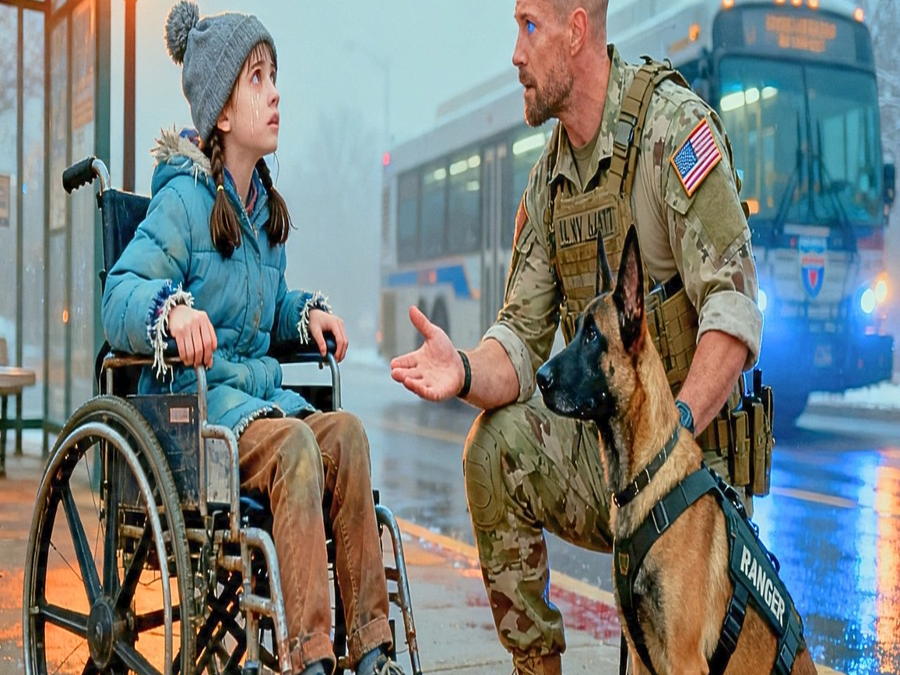
She Waited 4 Months for Mom—Until a Navy SEAL & K9 Uncovered What Police Missed
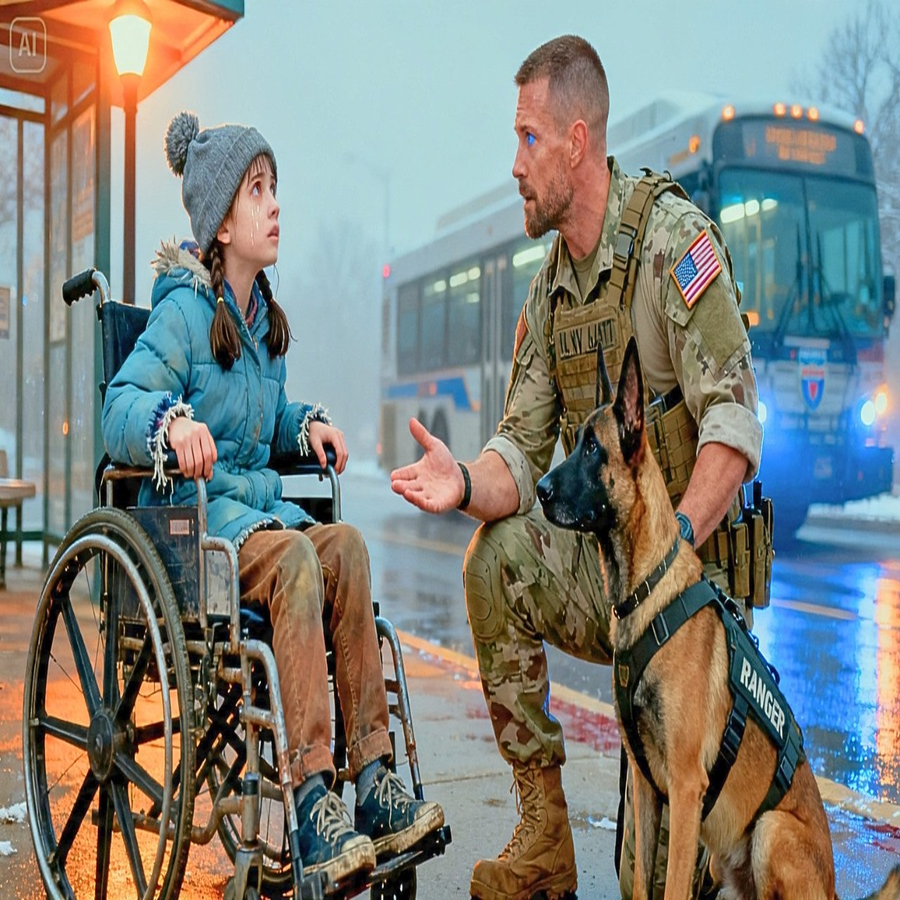
She was 10 years old
alone in the dark
and she had been waiting for four months.
Every single night, rain, cold, didn’t matter.
Maisie Bell wheeled herself to the same bus stop
positioned her chair beneath the same flickering street lamp
and stared down the same empty intersection.
Her mother had said a few minutes.
That was 119 days ago.
Town had given up.
The neighbors had stopped arguing with her.
Even the police had filed their reports and moved on.
But Maisie hadn’t moved an inch.
What nobody knew
what nobody had bothered to find out was that her mother’s was still alive and she was only 4 miles away.
The bus stop on Callaway and Fifth had one functioning street lamp.
The city had sent a work order to fix the second one three times.
Three times someone in the maintenance department had marked it completed without ever sending a truck.
So the second lamp stayed dark.
Its casing cracked from a winter that hadn’t been kind to Brierwood
and the first lamp kept doing the work of tube buzzing and flickering and throwing unsteady amber light across the shelter scratched plastic panels and the cracked concrete beneath.
It was the kind of stop nobody used after 8:00.
The last Route 9 bus came through at 7:40 and the shelter sat empty after that
collecting cigarette butts and fast food wrappers and the particular stillness that settles over public spaces after the public has gone home.
Except on most nights, it wasn’t quite empty.
Most nights
if you drove past slowly enough
you’d see a shape beneath that stuttering light.
small still facing the intersection with a kind of patience that looked less like waiting and more like something you couldn’t name something that sat between faith and refusal and the quiet devastation of a child who had decided that giving up was not something she was willing to do.
Her name was Maisie Bell.
She was 10 years old.
She had brown eyes that her mother once said could find the good in anything.
And she had been coming to this bus stop every night for 4 months.
She always brought the same things.
A grocery bag hung from the left handle of her wheelchair
the manual chair
not the power one that was currently broken
and sitting in the corner of her aunt’s living room waiting for a repair appointment that kept getting pushed back.
Inside the bag
a sleeve of crackers
a small water bottle with a green cap
and a Ziploc bag containing three sugar cookies wrapped in wax paper because her mother liked sugar cookies.
And Maisie wanted something to be ready when she came back.
She wore her winter coat
the puffy blue one that was slightly too big
because her mother had bought it a size up to last her another season
and she wore a knit hat that had a small pompom on top
slightly flattened now from weeks of use.
Her dark hair fell in two uneven braids
cuz she was still learning to do them herself.
She sat facing the intersection.
She watched every car.
Town of Brierwood
Oregon sits in the kind of geographic fold that makes it invisible from the highway tucked between a ridge of Douglas fur and a slowmoving river that floods 3 weeks every spring and then recedes like it’s embarrassed about the whole thing.
Population 11000
give or take the people who left for college and never came back.
It had a main street that still tried
a hardware store that had outlasted three recessions
two diners
a regional hospital 20 minutes out
and a quiet
persistent sense that most things that happened here were going to stay here.
Claire Bell and her daughter Maisie had moved to Brierwood 9 months before everything fell apart.
They’d come from a smaller town
one with fewer opportunities
and one very specific reason Clare needed to put distance between herself and her past.
She didn’t talk about that reason much.
She found a job doing data entry for a small insurance brokerage.
She enrolled Maisie in fourth grade at Jefferson Elementary.
She found a two- room apartment above a laundromat on Dunore Street that smelled like fabric softener and was warmer than it looked.
It wasn’t much, but it was theirs.
Maisie had cerebral palsy
diplegia
the kind that primarily affected her legs.
She’d been in a wheelchair since she was four.
She was sharp
funny
in a dry way that surprised people who expected something softer from a small girl in a chair.
And she had an almost aggressive optimism that Clare privately worried about and publicly encouraged.
The world had a way of wearing that kind of optimism down.
Clare hoped Brierwood would give Maisie enough time to build something under it before the wearing down started.
For a few months, it seemed like it might.
Then the overtime hours at the brokerage dried up.
Then the transmission on their secondhand Honda went.
Then the landlord on Dunore raised the rent $60
and Clare spent two weeks doing the math every way she could think of and kept coming up short.
They moved to a smaller place
one room in a shared house on Alcott with a bathroom down the hall and a kitchen they split with two other tenants.
Clare told Maisie it was temporary.
Maisie said okay and meant it
which made Clare feel worse somehow than if she’d complained.
Their paperwork situation had been a slow motion disaster for longer than Clare liked to admit.
The move between apartments had cost them.
A box one specific brown packing tape written on the side in Clare’s handwriting.
Dhakan men’s sinfarton had gone missing and somewhere between Dunore and Alcott.
Inside their birth certificates
Clare’s social security card
Maisy’s medical records
the folder of insurance paperwork
Clare’s Oregon ID gone.
Clare had filed the reports and started the replacement process.
But these things took time and money and a mailing address that stayed consistent and none of those things were currently abundant.
They had one working phone between them a prepaid.
Claire’s and the minutes ran low the week they moved to Alcott.
Clare had been stretching them
planning to reload at the end of the pay period.
She hadn’t gotten to the end of the pay period.
It was a Wednesday evening in mid-occtober.
The temperature had dropped earlier than forecast
the way Oregon weather liked to do sudden and unapologetic.
The warmth of the afternoon
replaced by a wind off the ridge that found every gap in your jacket.
Clare and Maisie had walked to the Savermore on Clement Street
which was the cheaper of the two grocery stores.
Maisie could reach by rolling the chair on the flat sidewalk without too much trouble.
They’d bought pasta
canned tomatoes
garlic
the specific brand of jarred sauce that Maisie tolerated
and Claire had been reaching for the Parmesan.
When she registered the total on the screen and did the math against the cash in her wallet and put the Parmesan back
Maisie hadn’t said anything.
She’d learned when to not say anything.
They walked to the corner.
The bus stop at Callaway and Fifth was three blocks down a reasonable staging point while Clare got Maisie settled
then ran back for the Parmesan while the path was flat and the store was still open.
“You’ll be right here
” Clare said
kneeling in front of the wheelchair
pulling Maisy’s coat collar up.
“I’m going to run back and get the cheese.”
10 minutes tops.
The Parmesan.
Yes.
You put it back because of the money.
Claire didn’t confirm or deny.
Do you want it or not?
Yes, a beat.
Thank you.
Sit tight.
Don’t move.
I’ll be right back.
She touched Maisy’s cheek just briefly
the back of two fingers
and then she turned and walked toward the intersection.
Maisie watched her cross.
She watched her disappear between the parked cars on the far side.
Then she waited.
10 minutes became 20.
20 became 40.
Maisie wasn’t panicking yet at the 40minute mark.
She was confused, which was its own particular discomfort.
Her mother was deliberate.
Her mother said what she meant.
10 minutes meant 10 minutes, not 40.
And Maisie had been running through explanations that got less charitable as time passed.
Long line at the register
ran into someone she knew
maybe her phone
except they barely had minutes left
and Clare never called unless it was urgent.
The 1-hour mark
a woman walking a small terrier slowed near the bus stop and looked at Maisie with the calibrated concern of someone who wasn’t sure if they should intervene.
You doing okay, honey?
I’m waiting for my mom.
Okay.
The woman looked at her phone, then at the empty road.
Do you know where she went?
The grocery store.
She went to get Parmesan.
The woman nodded slowly in the way.
Adults nodded when they were making a decision.
I’m sure she’ll be right back.
She kept walking.
At 90 minutes
a man from one of the nearby rowouses came out to smoke on his stoop and noticed Maisie.
He was a heavy set man in his 50s named Gerald.
And he had enough life experience to recognize that something was wrong.
He came over
got the story
and knocked on a few doors until he found a neighbor who knew roughly where the Bells lived.
The new girls
the mom and the kid in the wheelchair
Alcott Street
the shared house.
He walked Maisie home.
Maisie went because she was cold and because Gerald was clearly not a threat and because she told herself her mother was probably already there.
Had somehow missed her at the bus stop.
Was home waiting and panicked.
Clare was not home waiting.
Clare’s few belongings were there.
Her spare jacket on the hook by the door.
Her library book on the nightstand.
A bookmark at page 83.
Everything that said she lived here.
Nothing that said where she was.
The police were called.
A report was filed.
Officers walked the route between the house and the Savermore
checked the store’s parking lot
canvased the block.
They found nothing.
Or rather
they found nothing that they connected to Clare Bell
whose name was not in any local database because her ID was in a lost box and her phone was silent and she had only been in Brierwood 9 months and had kept largely to herself.
They told Maisy’s neighbor
an older woman named Pat
who took Maisie in for the night
that they’d look into it.
They looked into it the way you look into things when you have 23 other open cases and no physical evidence of a crime.
Claire Bell became a missing person report in a filing system that nobody followed up on.
Maisie became the kid staying temporarily with Pat.
And on the third night
while Pat was in the kitchen making tea
Maisie quietly put on her coat
wheeled herself out the front door
and went back to the bus stop.
She was there when Pat found her.
She was there when the neighbor on Gerald Street came to argue with her.
She was there when Maisy’s fourth grade teacher
Mrs.
Kowalsski drove out on a Tuesday evening and sat beside her on the bench for 45 minutes and gently tried every angle and got nowhere.
She was there when the temperature dropped below 40 and someone left a folded blanket on the handle of her chair and never identified themselves.
She was there when a local news station sent a reporter who did a 92 segment heartbreaking vigil girl waits for missing mother that got 300 shares and generated a week of phone tips that went nowhere.
She was there when November became December.
She had established a system.
Pat would make her dinner and Maisie would eat and then at 7:00 she would say she was going to bed and Pat who was 71 and moved slowly after dark and felt terrible about the whole thing but didn’t know what to do would sometimes fall asleep in front of the television and Maisie would slip out or Pat would be awake and they’d have the same argument and Maisie would listen politely and then go anyway because she was 10 years old and she had decided with a clarity that scared everyone
around her that her mother had said a few minutes and she was going to be there when those minutes were up.
The grocery bag on her wheelchair handle appeared sometime in November.
Nobody saw who put the first set of crackers in it.
It was just there one morning when Pat brought Maisie outside already stocked and Maisie looked at it for a moment and said thank you to nobody in particular and put it on her chair.
After that, it was never empty.
Someone always refilled it.
Brierwood had decided it couldn’t bring Clare back
but it could make sure Maisie had crackers.
The night Ethan Kay drove past the bus stop at Callaway and Fifth
he had been back in Brierwood for 6 days.
He he’d grown up here
more or less
in the way that military families grew up places
which meant he’d lived here during his father’s last posting and then again during the two years after high school before he enlisted.
The town had his mother’s grave in it
a fact that anchored him to Brierwood more than the town itself deserved.
He came back between deployments when he needed to be somewhere that wasn’t a base and wasn’t entirely unfamiliar
which described Brierwood precisely.
He was not technically on leave.
He was on what the Navy called a temporary duty transition period.
A gap between operational assignments.
The kind of interstitial space that happened when a SEAL team rotated off a high tempmpo deployment and the next assignment was being finalized.
12 weeks, maybe 14.
He had a rental on Garfield Street with a small yard which mattered because of Ranger.
Ranger was a Belgian Malaninoi
eight years old
retired from military working dog service 18 months prior.
He’d served six operational years alongside various handlers in environments that had included the kind of conditions that left marks on both dogs and men.
He’d been medically separated after a compound fracture to his left rear leg
a fall during a fast rope insertion that had shattered the bone in a way the veterinary surgeons described as complex.
and that Ranger had simply described in the way dogs did by getting up and trying to keep working until someone physically restrained him.
Ethan had adopted him because nobody else had stepped up and Ethan was not capable of letting that stand.
RER’s leg had healed with a slight hitch in his gate
a half-step hesitation on the left side that was noticeable only if you knew to look for it.
He was still fast, still alert, still precise in the ways that mattered.
He’d simply aged out of the operational requirements that made a working dog deployable
which Ethan thought was a deeply inadequate reason to stop caring about an animal who had given everything it had to a job it had never been asked to choose.
On this particular night
a Thursday
mid December
temperature in the mid30s with a wind that made it feel colder.
Ethan was returning from a late run to the hardware store.
Ranger in the passenger seat of his truck because Ranger went everywhere Ethan went when Ethan was home.
He came down Fifth Street because it was one of the routes he’d mapped in the first week.
The way he mapped everything and he was maybe 40 yard from the Callaway intersection when Ranger shifted.
It wasn’t dramatic.
Ranger didn’t bark or growl or lunge.
He simply sat up straighter
turned his head toward the passenger window
and stayed their ears forward.
body still the particular quality of focus that Ethan had spent years learning to read.
Ethan slowed.
He pulled to the curb half a block from the bus stop and cut his headlights.
He sat for a moment
looking through the windshield at the flickering amber light
the shelter
the shape beneath it
small
a wheelchair
a kid.
He got out.
Ranger dropped from the passenger seat and fell in at his left side.
the automatic positioning of a dog who had spent 6 years being exactly there and hadn’t stopped thinking of it as his job even in retirement.
His gate had the slight catch on the left.
He didn’t seem to notice or care.
Ethan didn’t approach fast.
He came in at an angle
keeping Ranger visible
stopping about 15 ft from the shelter and letting the kid see him in the streetlight before he got any closer.
She was watching him.
Hadn’t flinched.
just watching with those dark eyes that had clearly learned to assess strangers at bus stops after dark because that was now one of the skills her life required.
Ranger sat on his own
settling about 8 ft from the wheelchair
head up
looking at the kid with the open attention of a dog who liked people and wasn’t trying to hide it.
Ethan put his hands in his jacket pockets visible
non-threatening
and stopped moving.
“Hey,” he said.
Hey, she said.
A beat.
Cold night to be out here.
I know.
He looked at the grocery bag on the wheelchair handle.
Crackers.
The water bottle.
He looked at the intersection she’d been facing.
You waiting for someone?
My mom.
He nodded.
Didn’t push it immediately.
Let the silence sit for a moment the way you learned to let silences sit when you did a certain kind of work.
She know you’re out here.
Something moved across the kid’s face.
Not quite anger, not quite grief.
something compressed and difficult that belonged on the face of someone much older.
She’s the one I’m waiting for.
Ethan looked at the intersection again, looked back at her.
When’s she supposed to be back?
She said a few minutes.
She paused.
She went to get Pararmmesan.
He did the math in his head and it didn’t compute the way she said it.
Pararmmesan with the flat precision of someone who had said the word hundreds of times and attached it to something that kept not resolving.
When did she go?
Maisy met his eyes 4 months ago.
He didn’t say I’m sorry.
========== PART 2 ==========
He didn’t say that’s terrible or you poor kid or any of the other things people said to fill the space that opened up when someone told you something like that.
He just stood there for a moment
hands still in his pockets
looking at her with an expression she would later think about flat and focused like he was taking inventory of something.
Then he said, “What’s your name?”
Maisie Ethan.
He tilted his head toward Ranger.
That’s Ranger.
He’s retired military working dog.
She looked at Ranger properly for the first time the size of him.
The brindle coat
the ear
the way he was sitting so still with his head at exactly the right height to be level with her eyline from the chair.
He’s beautiful, she said.
Don’t tell him that.
It’ll go to his head.
She almost smiled.
Not quite, but almost.
He walked a few steps closer and sat on the far end of the shelter bench
leaving the middle section empty between them.
Ranger moved with him and settled at his feet.
And after a moment
in the unhurried way of dogs who have made a decision
Ranger stood and walked the distance to Maisy’s wheelchair and sat beside it very
and put his chin on the armrest.
Maisie looked down at him.
She didn’t say anything.
She put one hand on the top of his head.
Ethan watched this and said nothing.
People keep telling me to stop coming.
Maisie said she wasn’t looking at him.
She was looking at the intersection.
They say she’s not coming back.
A beat.
They say I need to accept it.
What do you say?
I say they don’t know that.
Her jaw was set.
Nobody’s found her.
Nobody’s found anything.
So they don’t know.
Ethan leaned his elbows on his knees and looked at the road.
No, he said they don’t.
She looked at him then
sharp
suspicious in the way of a kid who had heard a lot of adults agree with her and then pivot to the butt.
He didn’t pivot.
Tell me about that night, he said.
She told him.
She told him in the methodical way she’d clearly told it before the walk from the apartment
the Savermore
the parmzen
the bus stop
the 10 minutes that didn’t end.
But he asked different questions than anyone had asked before.
He asked her which direction her mother had crossed the intersection.
He asked if Clare had crossed with the light or against it.
He asked what Clare was wearing beyond the green coat
the specific shade
the length
whether it had a hood
what she had on underneath.
He asked about the time.
Not approximately, but as close as Maisie could get.
Did she have a watch?
Was there a clock visible from the stop?
How long had she been waiting when it got full dark?
Maisie answered each one.
He was doing something with the answers that she could see
but couldn’t name storing them somewhere
cross-referencing them against something internal.
He asked about their paperwork situation without making it feel like an accusation.
He asked about Clare’s routines
her work
whether she had anyone in Brierwood she might have gone to.
“She didn’t have people here,” Maisie said.
“She had me.”
“Okay,” he nodded.
“What hospital did they check?”
Maisie blinked.
What?
When they were looking for her.
Which hospitals did they check?
I don’t know.
Police said they checked.
She frowned.
I don’t know if they said which ones.
Ethan looked at the intersection.
A car moved through the traffic light.
Green to yellow to red.
The sequence repeating in the cold air.
She crossed here, he said, more to himself than to her.
Yes.
And you didn’t hear anything?
No sirens?
No. I was waiting.
Her voice was very quiet.
I wasn’t listening for sirens.
I was listening for her footsteps.
He sat with that for a moment.
Then he stood up and pulled out his phone
opened a notes app
and started typing.
What are you doing?
Maisie asked.
Starting a list.
A list of what?
He looked at her over the top of the phone.
Things I’m going to find out.
Pat Ellison was 68.
She’d given the wrong age to the reporter from the news station and hadn’t bothered to correct it.
and she had lived on Alcat Street for 31 years.
She had never in those 31 years opened her door at 10:40 at night to find a man she didn’t know standing on her stoop with a large dog and a 10-year-old girl in a wheelchair.
She processed this for a moment.
Who are you?
She said Ethan Cade.
I grew up here off and on.
I’ve been talking to Maisie at the bus stop.
He paused.
She needs to be inside and warm.
I wanted to make sure she got here.
Pat looked at Maisie.
Maisie said he asked a lot of questions.
Different ones than the police asked.
Pat looked back at Ethan.
What kind of different ones?
The kind where I’m going to need to make some calls in the morning, he said.
Pat had been a nurse for 34 years before she retired.
She had spent three decades of those years learning to read people quickly and accurately in high pressure situations.
and what she read in Ethan Cade on her stoop.
The posture
the steadiness
the absence of performance was a man who said what he meant.
She stepped back from the door.
“You’d better come in,” she said.
Put the kettle on.
They sat at Pat’s kitchen table for an hour.
He took notes
real notes
structured
organized
the kind that someone made when they were building something from the ground up
and intended to not miss anything.
He asked Pat what the police had told her about the search.
He asked about the missing person report
whether there had been any response to the news segment
whether anyone had followed up on the hospital checks.
They said they checked the regional hospitals, Pat said.
St. Agnes and Brierwood General, Willow Creek, that’s 20 minutes out.
It’s still the county.
Pat folded her hands around her mug.
They said they found nothing.
Ethan wrote something down.
What did they check against?
He asked.
if Clare had no ID on her and her name wasn’t in any local database.
He stopped.
Pat watched him.
What is it?
Maisie said she was sitting across from him
still in her coat
both hands wrapped around a mug of hot chocolate Pat had made without asking if she wanted one.
Probably nothing, he said.
I want to pull something in the morning.
What?
He looked at her steadily.
There’s a county incident database, he said.
It logs Jane and John does unidentified individuals who enter the hospital or emergency system without ID.
It doesn’t always get checked against missing person’s reports when there’s no obvious connection.
He paused.
Yours and your mom’s names weren’t in any local system because of the documentation situation.
And if she didn’t have ID on her when she he stopped again
careful watching Maisy’s face.
When something happened, he finished.
Maisie was very still.
“You think something happened to her?”
“I think something happened to her that night,” he said.
“I don’t think she left voluntarily.
Every detail you’ve given me is consistent with someone who didn’t leave voluntarily.”
He held her gaze.
That’s different from knowing what happened.
“I need to know what happened.”
“The kitchen was quiet except for the sound of the kettle settling on the burner.”
Maisie set her hot chocolate down.
“You believe me,” she said.
It wasn’t quite a question.
I believe the evidence
he said
which currently supports what you’ve been saying for 4 months.
A pause.
You want me to find her?
She looked at him for a moment.
This man she had known for less than 2 hours
sitting at her temporary guardian’s kitchen table in the middle of the night with a retired military dog asleep under the table with his chin on Maisy’s foot.
“Yes,” she said.
“Then I need you to do something for me.”
“What?
Go to sleep.
Let me work.”
she almost argued.
He could see at the instinct to refuse
to insist on being part of whatever happened next
the same stubbornness that had kept her at that bus stop for 4 months in freezing temperatures.
Then she looked at Ranger
who had opened one eye and was watching her with the patient attention of a dog who had learned that rest was not weakness.
“Okay
” she said
“but I want to know everything
every single thing
” he said.
“I promise.”
He left at midnight.
He sat in his truck outside Pat’s house for a few minutes before starting the engine
thinking through the sequence.
Ranger was in the passenger seat
awake now
watching him with the focused attention he brought to everything.
The county incident database
the hospital intake records for the 48-hour window after the night of October 15th
unidentified female patients
trauma admissions
neurological cases.
It was a long shot.
It was also the only shot nobody had taken.
He pulled out his phone and sent a text to a number he hadn’t used in 8 months.
A woman named Deborah who worked in county emergency management and owed him a favor she’d never asked about and he’d never collected.
Need to talk tomorrow morning.
It’s about an unidentified Jane Doe potentially in the county system from mid-occtober.
Can you access hospital intake records?
He stared at the dark screen.
Then he typed one more line.
There’s a kid involved, 10 years old.
She’s been waiting at a bus stop every night for 4 months.
He hit send.
The reply came 40 seconds later.
I’ll be at my desk at 7.
Call me.
Ethan set the phone on the dash and looked through the windshield at Alcott Street
quiet and cold and empty under the orange wash of the sodium lights.
Ranger put his head on Ethan’s shoulder.
Ethan sat there for another minute.
Then he started the truck.
He was on the phone with Deborah at 7:03 the next morning.
By 8:15, he had three names.
Three unidentified women admitted to county hospitals in the 10-day window.
Following October 15th 2 to St. Agnes
one to Willow Creek Community Hospital.
Ages ranging from early30s to mid-40s.
All admitted without identification.
all logged in the Jane Doe intake system that as he had suspected had never been cross-referenced against the missing person report for Clare Bell because Clare Bell’s report had been filed under a name with no associated database record.
He wrote down the case numbers.
He wrote down the admission dates
the presenting conditions
the wards assignments.
The Willow Creek admission was dated October 16th.
female
approximately 30 to 35 years old
dark hair
admitted following a vehicle pedestrian collision at the intersection of Clement Street and Marlo Avenue
six blocks from the Savermore on Clement
two blocks from Callaway and Fifth
presenting condition
severe head trauma
acute subdural hematoma
emergency surgery
transferred to neurological rehabilitation following stabilization
current status
inpatient
Willow Creek Community Hospital neurological rehabilitation unit ward C.
Belongings logged at
admission.
Ethan read them slowly.
Jeans
brown ankle boots
a green wool coat mid-length with two buttons missing.
He set the notepad down on the kitchen table.
He sat very still for a moment.
Then he picked up his phone.
He called Willow Creek Community Hospital at 8:22 in the morning.
The woman who answered the main line had the careful practiced tone of someone who spent most of their workday delivering information that people didn’t want to hear.
And she informed him pleasantly but firmly that patient information for unidentified individuals in the neurological rehabilitation unit could not be disclosed to members of the public over the phone under any circumstances.
and that if he had reason to believe a family member was a current patient
he would need to present himself in person with supporting documentation to the patient services office
which opened at 9.
I understand, Ethan said.
Can you transfer me to the patient services office voicemail so I can leave a message?
She transferred him.
He did not leave a message.
He hung up and looked at Ranger
who was sitting near the kitchen door
watching him with the attentive patience of a dog
who had learned that watching and waiting were sometimes the same thing as working.
“Right,” Ethan said.
He picked up his jacket.
He did not go to Willow Creek first.
He went to the Brierwood Police Department
which occupied a squat brick building on Commerce Street that looked like it had been designed in the 1970s by someone who believed that useful buildings didn’t need windows.
He parked in the visitor lot
told Ranger to stay
and walked in through the front door with his notepad under one arm
and the particular expression he’d developed over 14 years of walking into rooms where people were not expecting him and were not going to be happy about it.
The desk officer was a young guy
mid20s
with the tightly wound energy of someone in their first year on the job who was still trying to decide which version of themselves to be at work.
help you.
I need to speak with whoever handled the Clare Bell missing person’s case.
Filed mid-occtober.
A woman reported missing from the Callaway and Fifth area.
The desk officer’s expression shifted slightly recognition and beneath that something more guarded.
You a family member?
No, I’m a private citizen with information relevant to the case.
He set the notepad on the counter.
I have three Jane Doe intake records from county hospitals in the 10-day window following the disappearance.
One of them matches the physical description and geographic location of the incident.
I need to speak with the case officer.
A pause.
What kind of information?
Kind that should have been found 4 months ago.
He kept his voice flat, not aggressive, flat.
I’d like to speak with the case officer, please.
The case officer was a detective named Puit Sandra Puit
late 40s
the kind of woman who had learned to carry tiredness so efficiently that it barely showed except in the set of her jaw.
She came out of the back hallway with a coffee mug in one hand and a look that said she’d already had the kind of mourning that made additional complications unwelcome.
She looked at Ethan, looked at his notepad, looked at him again.
You’re the one who’s been talking to the bell girl.
Yes.
Pat Ellison called us this morning.
Said a man with a dog had taken an interest.
She tilted her head.
Who are you exactly?
Navy.
Currently on transition period.
She absorbed that.
You have a background in investigations.
I have a background in finding things people have stopped looking for.
Her expression didn’t change
but something behind it did a slight recalibration.
The kind that happened when someone revised their initial read of a person.
Come on back, she said.
He laid it out for her in 15 minutes.
The county incident database
which he noted carefully and without accusation
logged Jane do admissions separately from the missing person’s system and required a manual cross reference that the automated system didn’t perform the
three female admissions in the relevant window.
The Willow Creek admission in particular
the date
the location of the incident
the physical description of the patient.
Puit listened without interrupting.
She had a yellow legal pad in front of her and she was writing on it which told him she was taking it seriously even if her face was giving him nothing.
The green coat he said.
Maisie described it to me last night in specific terms.
Mid-length wool blend a shade she called dark green not olive not forth dark green two buttons.
She knew about the buttons because one of them had been loose for a while and her mother kept meaning to fix it.
He paused.
The Willow Creek intake log lists a green wool coat among the patients recovered belongings.
That specific entry.
Puit looked at him over the legal pad.
You accessed the hospital intake log.
I accessed the county incident database through a contact in emergency management.
The intake summary was included in the case file.
She was quiet for a moment.
You know
I can’t just send an officer out there based on a clothing description.
I know, he said.
I’m asking you to make a phone call
one phone call to Willow Creek Patient Services to ask them to pull the photo from the Jane Doe file and look at the missing person report for Clare Bell.
He met her eyes.
They filed that report in your system in October.
It’s sitting right there.
Puit looked at her legal pad.
She looked at him.
Then she picked up her desk phone.
It took 11 minutes.
Ethan sat in the chair across from Puit’s desk and listened to her half of the conversation
the careful procedural language of two institutions negotiating access protocols
the silences while people on the other end pulled files
the single moment when Puit’s pen stopped moving on the legal pad and didn’t start again.
She thanked the person on the other end and hung up.
She sat for a moment without speaking.
They’re going to need formal identification procedure.
She said finally photograph comparison isn’t conclusive.
The patient has been identified as Jane Doe for 4 months.
There’s a process for transitioning that status.
How long does the process take?
Done properly?
A few days.
They want to bring in a social worker coordinate with the rehabilitation team.
Detective Puit, she stopped.
How long has Maisy Bell been sitting at that bus stop?
Pause.
I can make some calls, she said.
Move it to today.
Thank you.
He stood.
She looked up at him.
Mr. Cade.
She said it with the particular tone of someone who was going to give him something and wanted him to understand it was a deliberate decision.
The photograph comparison was preliminary
but the intake coordinator at Willow Creek said the description was consistent.
She paused strongly consistent.
Ethan picked up his notepad.
I know, he said.
He went to Willow Creek, not to the patient.
Not yet.
That wasn’t his call to make and he knew it.
And he wasn’t the kind of person who pushed past the protocols that exist for reasons
even when the reasons were maddening.
But he went to the building to the parking lot and he sat in his truck for a while with Ranger in the passenger seat and he looked at the hospital’s main entrance and thought about a woman who had been in that building for 4 months without a name.
What that was like, he couldn’t fully imagine.
He’d been in enough field conditions to understand disorientation
the particular fragmentation that came with concussive trauma
========== PART 3 ==========
with the body’s system shutting down non-essential processing to manage a catastrophic event.
He’d seen men who couldn’t remember their own names for hours after a blast.
He’d been in proximity to enough head trauma to know what the recovery arc looked like when it was good and what it looked like when it wasn’t.
4 months neurological rehabilitation.
He thought about Maisie at that bus stop.
He thought about the matching crackers in the grocery bag refilled by strangers and the flattened pompom on her hat.
He thought about what it meant that the gap between them had been six blocks and a phone call and nobody had put those two things together for 4 months.
He drove back to Brierwood.
He didn’t tell Maisie yet.
This was the hardest decision and he stood by it because he had done enough work in enough highstakes situations to know the specific damage caused by premature information.
The hope raised and then fractured.
the secondary injury that came from being built up toward something that then didn’t materialize.
He didn’t know with certainty that the Jane Doe at Willow Creek was Clare Bell.
He had a clothing description and a location match and a timing that lined up.
That was a lot.
That was not the same as certainty.
So he went to Pat’s house and he sat at the kitchen table again and he told Maisie that he was following a lead and that it was a real lead and that he would tell her everything as soon as he had something definitive to tell.
Maisie looked at him for a long moment.
How real?
She said real enough that I’m not going to drop it.
It’s not an answer.
It’s the honest answer.
He held her gaze.
I’m not going to give you something that turns out to be wrong.
That’s worse than waiting.
She studied him.
She had the eyes of a kid who’d had a lot of adults tell her things that turned out to be wrong.
And she was deciding whether he belonged in that category.
Okay, she said finally.
But you come back and tell me today.
Today, he said, “Whatever I have.”
He got up to leave.
At the door, he paused and looked back at her.
She’d already turned back to the window
and she was watching the street
not the bus stop direction
just the street.
The way someone watched when they were trying to learn how to wait differently.
Ranger was still sitting beside her wheelchair.
He’d done that automatically just settled there
leash trailing
making himself available.
Ranger, Ethan said.
Ranger looked at him.
Ethan looked at Maisie, the dog.
Back at the door.
Stay, he said.
Ranger put his chin on the wheelchair armrest.
Maisy’s hand found the top of his head without her looking down.
an automatic gesture
the kind that happened when something had already become familiar.
Ethan left.
The formal identification process moved faster than Puit had suggested it would
possibly because Puit was making calls with a particular directness that moved things.
By 2 in the afternoon
a social worker from Willow Creek named Marcus Webb had contacted Pat Ellison and through Pat had obtained three photographs of Claire Bell
one from Maisy’s collection.
small printed photo she kept in the front pocket of her school bag and had been carrying since October
one from Jefferson Elementary’s emergency contact file
and one that a neighbor had found on their own phone
a group photo from a community potluck in September
where Clare was visible in the background.
The identification was not immediate in the formal sense
but Webb called Puit at 3:47 and Puit called Ethan 4 minutes after that.
The Willow Creek neurological team has been informed.
Puit said her voice was careful
the voice of a person delivering information with the full weight of its consequences.
The patients care team believes there’s a strong basis for positive identification.
They’re initiating the formal process now.
It’ll be confirmed tomorrow morning, but she stopped.
Doctor I spoke with said the patient has been showing recent improvement in memory retrieval.
Fragmented but increasing.
She apparently told a nurse last week that she kept thinking about a child.
A pause.
She described making spaghetti.
Ethan was standing in the parking lot of the hardware store
which was where he’d been when the call came in.
He looked at the street.
Does anyone at Willow Creek know about Maisie yet?
We’re coordinating disclosure now.
We want to do it right.
I know.
He paused.
How long is Wright going to take?
Was quiet for a beat.
I’ve asked them to move quickly, she said.
Webb is good at his job.
They’ll prepare the patient, Clare, before any contact is made.
They don’t want to rush that part.
Another pause.
But we’re talking about days, not weeks.
She’s been waiting 4 months.
I know, Mr. Cade, he exhaled.
Okay, he said.
Thank you.
He sat with Maisie that evening on the front stoop of Pat’s house while Ranger moved between them both slow and patient in the cold.
He told her what he could tell her, not everything.
He framed it carefully.
There was a woman at a hospital who might be her mother
and people were working to confirm it
and there was a process that needed to be followed to make sure it was done right.
So, nobody got hurt by moving too fast.
Maisie was quiet for longer than he expected.
She’s hurt, Maisie said.
It wasn’t a question.
She was hurt.
She’s been getting better.
How badly?
He looked at her.
He’d made a decision on the drive over that he wasn’t going to sanitize this for her.
She’d been sitting alone at a bus stop in December
managing the weight of 4 months of uncertainty
and she had the right to reality delivered without the softening that people put on things to make themselves more comfortable.
Head injury, he said.
A car hit her.
She had surgery and she’s been in neurological rehabilitation since October.
That’s why she couldn’t come back to you.
He paused.
Couldn’t remember.
The injury took her memory.
Maisy’s hands were in her lap, very still.
She didn’t know I was there, she said.
The bus stop.
She didn’t know I was waiting.
No, a long silence.
She kept her promise, Maisie said finally.
Her voice was tight in the way.
Voices got tight when someone was holding something in by force.
She said she’d come back.
She didn’t choose not to.
No, Ethan said.
She didn’t choose not to.
Maisie looked at the street.
The cold had settled into the evening in the particular way it did in December in Oregon damp and bone level.
The kind that didn’t announce itself until you’d been sitting in it for 20 minutes.
Can I see her soon?
There are people working on that right now.
They have to prepare her first.
to make sure she’s ready.
Make sure it’s safe for both of you.
Safe.
Emotionally safe.
She’s been through a lot, Maisie.
She’s going to remember things in pieces.
It might be It’s not going to be like the movies.
I know it’s not going to be like the movies
Maisie said with a flatness that was somehow more devastating than anger.
I’ve been at a bus stop for 4 months.
I know things aren’t like the movies.
He didn’t have an answer for that.
He just sat there with her.
After a while, she said, “Why did you stop that first night?
People drive past every night.
He thought about it.
Ranger noticed you first,” he said.
She looked at the dog.
Ranger was sitting between them with his eyes half closed
not asleep
just doing the thing he did
existing in the space between alert and rest
available without demanding anything.
He’s good at noticing things.
Maisie said, “Best I’ve ever worked with.
Did you take him with you when you were deployed?
Different dog in the field.
Ranger retired before I met him.
But yeah, dogs like him, they go places.
He looked at Ranger.
They do things most people don’t understand and most people don’t want to know about.
And then they get to a point where the job’s done and they need somewhere to just be.
Maisie was quiet for a moment.
Like a bus stop, she said.
He looked at her.
She was still watching Ranger, her hand resting on his back.
Waiting somewhere safe
she said
until the person you’re waiting for comes back.
He didn’t say anything.
The cold settled around them.
Down the street
a car turned the corner and its headlight swept briefly across the houses
and for a half second
Maisy’s head moved toward the light
the automatic turn.
The reflex that four months had built into her
and then she caught it and looked back at Ranger.
She was learning slowly how to wait differently.
The confirmation came at 9:17 the following morning.
Ethan was on his second cup of coffee when Puit called and she said
“It’s confirmed.”
And then she said the name Clare Bell out loud officially for the first time in 4 months.
And something about hearing it that way
with that weight behind it
made him set the mug down and stand up from the kitchen table without quite meaning to.
Care team wants 48 hours, Puit said, to prepare her to do this carefully.
48 hours.
That’s what they’re asking.
He stood at the kitchen window looking at the yard.
The grass was dead and frost edged at the margins and Ranger was outside doing his slow morning circuit of the perimeter old habit probably never going away.
“Okay,” Ethan said.
“I know it feels long.
It’s not about how it feels.”
“The right call.”
He watched Ranger Paws at the back fence, nose working.
“Is she how is she?”
when she found out.
Puit was quiet for a moment.
Webb was there, she said.
He said she asked for a photograph of Maisie.
Ethan waited.
Webb said when they showed her when she saw Maisy’s face
she couldn’t speak for a while.
Another pause.
She kept touching the photograph.
Webb said she had her hands shaking.
A beat.
He said she kept saying my daughter like she was relearning the words.
The yard was quiet and gray.
Ranger had stopped moving.
He was standing at the far end of the yard
looking back at the house
waiting to be let back in.
Ethan went to the back door and opened it.
Ranger came inside and shook the cold off himself and walked to his water bowl and drank.
And then he came to where Ethan was standing and sat and leaned against his leg.
Ethan stood there for a minute.
48 hours, he said to Puit.
48 hours, she confirmed.
And then we’ll arrange it.
He went to Pat’s house to tell Maisie.
She was at the kitchen table when he arrived doing homework long division.
The worksheet spread on the table with a pencil held in her left hand
the right hand curled in her lap.
She looked up when he came in and whatever she read in his face made her set the pencil down.
Pat was at the sink.
She turned around.
It’s her, Ethan said.
Kitchen was very quiet.
Maisie didn’t cry.
She sat very still and she pressed her lips together and she breathed in once very carefully.
the way people breathed when they were testing whether the air was different now.
She’s alive.
Maisy said she’s alive and she’s she’s okay.
She’s been getting better.
She’s going to need more time.
But she’s there, Maisie.
She’s real and she’s 4 miles away and she’s getting better.
Pat made a sound at the sink
a short compressed sound that she immediately controlled.
One hand pressed briefly to her mouth.
Maisie looked at her worksheet.
She picked up the pencil.
She set it back down.
When do I get to see her?
48 hours.
The doctors need to prepare her.
It has to be careful because of the memory situation.
But 48 hours?
She looked at him.
2 days?
She said, 2 days.
She nodded slowly.
The same nod she’d been using for 4 months
the one that said
“Okay
and I can wait.
” And also said underneath both of those
“I have already waited this long
so two more days is something I know how to do.”
Okay, she said.
Then she picked up the pencil again and looked at her long division.
And then something happened that he hadn’t expected.
Her hand started shaking just slightly
just for a moment
the pencil trembling against the paper before she put her palm flat on the worksheet and pressed down until it stopped.
She didn’t look up.
Thank you
she said very quiet
the words aimed somewhere between him and the table.
He stood there a moment.
I didn’t do very much, he said.
stopped,” she said.
Nobody stopped.
The 48 hours were the longest of the entire stretch
which was saying something.
Ethan spent most of them doing the practical work
coordinating with Puit with Marcus Webb at Willow Creek.
With a county social services contact
Puit connected him to about Clare’s discharge situation.
Because the reunion was only one piece.
After the reunion came the rest of it
Clare was going to need ongoing rehabilitation.
She had no identification, no housing, no income, no documentation.
Maisie had been staying with Pat Ellison on an informal arrangement that couldn’t continue indefinitely.
There was a system to engage
and the system was slow and required persistent informed advocacy to navigate
which was not something either a recovering woman with memory damage or a 10-year-old in a wheelchair could do alone.
He made a list.
he was good at lists.
He called the county social services office and was transferred three times and spent 40 minutes explaining the situation to a caseworker named Diane who turned out to be competent and genuinely troubled by the gaps in the original missing person’s response and who by the end of
the conversation had opened a priority file and assigned herself to it.
He called a legal aid organization in the county seat about expedited document replacement for individuals with demonstrated extenduating circumstances and spent 20 minutes on hold and then another 20 minutes with a parallegal named Jerome who was thorough and practical and said he’d seen stranger cases.
He called a housing assistance nonprofit he’d looked up the night before
left a message
and got two call back 2 hours later from a woman who asked a lot of the right questions.
He did not call Maisie during these 48 hours because she was doing her own version of the weight
and he didn’t want to disturb whatever equilibrium she’d built.
But on the evening of the first day
Ranger scratched at the back door to go outside
and when Ethan opened it
he found sitting on the stoop a small piece of folded notebook paper.
He picked it up.
Inside
in the careful handwriting of someone who was trying to write neatly
but was working against excitement or nerves
or both
was one line
“Pats showing me how to make spaghetti so I can teach mom if she forgot.
” He folded it and put it in his jacket pocket.
Marcus Webb called at 11 on the morning of the second day.
She’s been asking questions since yesterday.
He said she wants to know everything what Maisy’s been doing
where she’s been staying
what she looks like now
whether she’s a pause.
She keeps asking if Maisy’s okay, whether Maisy’s been scared.
What did you tell her?
Truth.
That Maisie found a way through.
Another pause.
She cried for a long time.
And then she asked if she could have a pen so she could write things down because she was afraid she’d forget.
Ethan was quiet for a moment.
She’s writing things down.
A whole page already.
Things she wants to say.
He was sitting in his truck outside the hardware store
which seemed to be where he ended up when important calls came in.
He looked at the street
the ordinary mundane street of a small Oregon town in December with its holiday lights and its gray sky and its people going about the unremarkable business of their days.
Tomorrow morning, Webb said, we’re going to do it tomorrow morning, 9:00.
I’ll send you the room number.
Is she ready?
Webb considered this.
I don’t think there’s a version of this where someone is fully ready
he said.
But she’s she’s present.
She knows where she is and what’s happening.
The memory is patchy, but she’s oriented.
A pause.
She remembers Maisy’s laugh.
She said she’s been hearing it for weeks in her sleep in the recovery exercises
just present in her head
and she didn’t know why.
She said it was the thing that felt most real.
Ethan said nothing.
“She’s going to be okay, Mr. Cade.”
Web said both of them are.
He sat in the truck for a while after the call ended.
Then he drove to Pat’s house and knocked on the door.
And when Maisie opened it, he said, “Tomorrow morning, 9:00.”
Maisie grabbed both wheels of her chair and just held them.
She didn’t say anything.
Her jaw was tight and her eyes were bright and she was holding herself very carefully together in the way she learned to hold things over 4 months of practice.
“Get some sleep,” he said.
“I’ll be here at 8,” she nodded.
He was almost to his truck when she called after him.
Ethan, he turned.
She was in the doorway, backlit by the warm interior of Pat’s house.
Ranger visible just inside behind her left wheel.
What if she doesn’t remember everything?
She said about me?
I mean, about us?
What if she looks at me?
And what if it’s not like she stopped?
He walked back.
He stood on the path, looking up at her in the doorway.
Then you remind her, he said.
You tell her about the parmesan, about the spaghetti, about the green coat.
He paused.
You know her better than she knows herself right now.
That’s not a problem.
That’s the thing you have to give her.
Maisie was quiet.
What if she looks different?
She said very small.
What if I look different to her?
He looked at her steadily.
You’re her daughter, he said.
That doesn’t have a different version.
She looked at him for a long moment.
Then she pulled back from the doorway
and Ranger moved aside to let her pass
and the door closed softly.
Ethan stood on the path in the cold.
He looked at the house and at the street beyond it
and at the December sky that was the color of an old bruise pressing toward dark.
He thought about the piece of notebook paper in his jacket pocket
========== PART 4 ==========
hats showing me how to make spaghetti so I can teach mom if she forgot.
He walked to his truck and drove home.
Tomorrow at 9:00
122 days after a woman crossed an intersection to buy Parmesan and never came back
Maisy Bell was going to find out what happened to those few minutes.
He was at Pat’s house at 7:50
not 8
like he’d said
7:50
because he’d woken at 5:30 and spent 2 hours doing the kind of non-productive activity that filled the space before operations
checking things that didn’t need checking
making coffee he didn’t finish
sitting with Ranger in the cold backyard while the sky went from black to gray to the flat white of a December morning in Oregon that couldn’t quite commit to being a real day.
Pat answered the door before he knocked.
She’d been up since 5:00.
He could tell by the quantity of food on the kitchen table
biscuits
scrambled eggs
a bowl of cut fruit that represented a level of domestic effort that people only produced when they needed something to do with their hands at 5:00 in the morning.
“She’s been awake since 3,” Pat said quietly, taking his jacket.
“Did she sleep at all?”
“Some.”
“A few hours.”
Pat looked at the hallway.
“She’s been very quiet.
He sat at the kitchen table.
Pat poured him coffee without asking and he drank it and they didn’t say much because there wasn’t much useful to say.
And after about 10 minutes, Maisie came down the hallway.
She was dressed carefully
more carefully than he’d seen her a dark blue sweater
clean jeans
her hair
and the two braids
but done more precisely than usual
which told him she’d redone them more than once this morning.
She was sitting very straight in the chair, her hands in her lap.
She looked at the table full of food.
I’m not hungry, she said.
Eat something anyway, Pat said.
Pat half a biscuit.
Something.
Maisie looked at Ethan.
He shrugged.
She’s right.
Maisie took half a biscuit and held it and didn’t eat it
which seemed to satisfy Pat’s requirement on a technicality.
Ranger came from the corner where he’d been lying and positioned himself beside the wheelchair.
the automatic move
the one he’d been making for days now
the spot beside her left wheel that had apparently become his designated location.
Maisie put her free hand on his head.
Is she nervous?
Maisie asked.
She was looking at the table.
Do you know?
Did Web say?
Ethan set his mug down.
Yes, she’s nervous.
Good.
A beat.
I mean, not good.
I mean, she stopped.
I just don’t want to be the only one.
You’re not, he said.
Not even close.
They left at 8:20.
Ethan’s truck had a back seat with enough room for the folded wheelchair
and Maisie transferred to the passenger seat with the practiced efficiency of someone who had been doing it her whole life.
A hand on the door frame
a pivot
a landing
the whole thing in about 8 seconds
while Ethan loaded the chair without being asked how.
Pat stood on the stoop, watching them go.
Her arms folded against the cold
and she raised one hand as they pulled out and didn’t lower it until they turned the corner.
Maisie watched the town go by through the passenger window.
Brierwood in December was the color of old photographs
the storefronts with their lights
the bare trees
the particular quality of winter light that made everything look both familiar and slightly past.
She’d been here 9 months, long enough to know the streets.
Not long enough for it to feel like home.
But Pat’s house had started to a little in the uncomfortable way that temporary things became loadbearing before you noticed.
Do I call her mom?
Maisy said.
He glanced at her.
What?
When I see her
do I say mom or do I I don’t know if she’ll She pressed her lips together.
If her memory is patchy, maybe hearing that word will be weird for her.
Maybe I should just use her name first.
Clare.
until she until I know what she remembers.
He drove for a moment.
What does your gut say?
Maisie looked at the road.
Mom, she said quietly.
Then that’s what you say.
She nodded once, looked out the window again.
The drive took 23 minutes.
Neither of them spoke much for the rest of it.
Ranger was in the back seat
his head forward between the front seats
close enough that Maisie could feel his breath on her arm
which seemed to be exactly what both of them needed.
Willow Creek Community Hospital was a low
sprawling complex
three wings connected by enclosed walkways
built at different times in a way that made the architecture tell its own story of incremental funding.
The neurological rehabilitation unit was in the west wing
third floor
accessible by an elevator that was slightly too small and slightly too slow and smelled like industrial cleaner over something older.
Marcus Webb met them in the lobby.
He was a compact man
early 40s
with the unhurried movement of someone who had learned that appearing calm was itself a form of help.
He shook Ethan’s hand
crouched briefly to be at Maisy’s level when he introduced himself and then looked at both of them with the straightforward assessment of someone doing a rapid situational red.
“How are we doing?”
he said.
“Fine,” Maisie said.
Webb looked at her.
“It’s okay to not be fine,” he said.
today specifically a beat.
I’m scared, she said like she was making a factual report.
That’s appropriate, Webb said without softening it or inflating it.
She is too.
That’s also appropriate.
He straightened.
Here’s what you need to know.
She’s oriented.
She knows where she is.
She knows the date.
She understands what’s happening.
The memory gaps are real, but her emotional processing is intact.
She remembers feeling even when the details are missing.
He paused.
She remembered loving you before she remembered your name.
I want you to know that Maisie was very still.
She remembered loving you before she remembered your name.
Webb repeated gently.
That’s was where you start.
Ward C was a long corridor with pale green walls and doors spaced at regular intervals
each with a small whiteboard outside it.
Nurses moved at the measured pace of people who had learned to read rooms quickly and respond without rushing.
Television played somewhere with the volume low
the indistinct murmur of daytime programming.
The kind of sound that hospitals used to fill silence without demanding attention.
Room C14 was third from the end.
The whiteboard outside had for the first time in 4 months a name on it.
Claire Bell.
Someone had written it in blue marker.
The handwriting was careful
deliberate
the letters evenly spaced the way you wrote something you wanted to last.
Maisie stopped the wheelchair in front of it.
She looked at the name for a moment.
Her hands were on the wheels
but she wasn’t pushing
just stopped
looking at those two words on that small whiteboard.
And whatever was happening in her face was happening below the surface where it didn’t show.
Just a stillness that was too complete to be the absence of anything.
Ethan stood behind her and to the left.
He didn’t say anything.
Webb stepped to the door.
I’m going to go in first, he said.
Give me 2 minutes, then I’ll come get you.
He knocked twice lightly and opened the door and went in.
And the door swung closed behind him.
Maisie sat.
The corridor was quiet except for the distant television and the soft footstep rhythm of a nurse passing at the far end.
Ranger sat.
40 seconds, a minute.
Maisy’s hands moved on the wheels, not pushing, just adjusting her grip.
She was breathing carefully.
in through the nose
a controlled rate
the kind of breathing you did when you were managing something that wanted to be unmanageable.
Ethan watched her.
Hey, he said quietly.
She looked up.
Whatever happens in there, he said, “You’ve already done the hardest thing.
4 months at that bus stop.
You didn’t stop.
You were right.”
He paused.
Give yourself that.
Whatever happens next, you were right.
Maisie looked at him for a long moment.
Then she looked back at the door.
The door opened.
Webb leaned out.
“She’s ready,” he said.
The room was small and low lit one window with the blinds halfopen winter light making pale strips across the floor.
A hospital bed adjusted to a sitting position.
A small rolling table with a water pitcher and a glass and a folded piece of notebook paper that Maisie registered without knowing what it was.
And in the bed, sitting up, handsfolded in her lap, Claire Bell.
She was thinner than the photographs.
Not alarmingly so
but noticeably the kind of thin that came from months of hospital food and a body that had redirected most of its resources toward healing something internal and urgent.
Her dark hair was shorter than it had been cut to jaw length
which Maisie noticed immediately because she’d only ever known her mother with long hair.
There were faint shadows under her eyes that spoke to the specific exhaustion of neurological recovery.
The particular fatigue of a brain doing work that was invisible and relentless.
She looked up when the door opened
and the moment she saw Maisie
the exact moment
the instant of recognition
her hands came apart in her lap
and one of them moved to her mouth
and her eyes went bright and wet
and she made a sound that wasn’t a word
just a sound
small and fractured
and completely involuntary.
Maisie stopped the wheelchair just inside the door.
For a few seconds, they just looked at each other.
Neither moved.
The room was very quiet.
Then Clare lowered her hand from her mouth and said in a voice that was working against itself.
Maisie and Maisie pushed the wheels forward
crossed the room in the time it took to take three breaths and she stopped beside the bed and Clare reached down both arms
reaching down and Maisie leaned forward out of the wheelchair and into them.
and Clare folded around her
both arms tight
her face pressed into the top of Maisy’s head
and she didn’t say anything else for a while
just held on with the particular grip of someone making up for time with both hands.
Maisy’s fingers found the fabric of Clare’s hospital gown at the back and held it.
She didn’t say, “Mom.”
She didn’t say anything.
Neither of them did.
Ethan stood in the doorway.
He had seen a lot of things in 14 years of operational service.
He had been present at moments of extreme resolution extractions
completions
the specific instant when a mission either came together or didn’t.
He had learned to stay present in those moments without being absorbed by them
to maintain the functional detachment that kept you effective.
He looked at the room for exactly 3 seconds.
Then he looked at the wall beside the door and stayed there until his breathing was even.
Webb gave them 20 minutes alone.
He waited in the corridor with Ethan and Ranger
and the three of them stood there in the pale green hallway while the distant television murmured and a cart moved somewhere and the hospital went about its ordinary business of being the place where extraordinary things happened to ordinary people every day.
How is she actually doing?
Ethan said better than 2 weeks ago.
The improvement curve has been consistent.
Webb looked at the closed door.
The memory retrieval is patchy in a specific pattern.
Procedural memory is largely intact.
Emotional memory is strong.
Episodic memory of the weeks before the accident is where the gaps are.
She remembers the general shape of her life.
The specific details of that night are incomplete.
He paused.
She doesn’t remember the accident itself.
She probably never will.
That’s typical with this type of trauma.
She remembers being in the store.
She remembers the Parmesan.
A beat.
She doesn’t remember the intersection.
Ethan processed this.
Does she know about the bus stop?
About what Maisy’s been doing?
She knows Maisy’s been staying with a neighbor.
Webb paused again.
We didn’t tell her about the nightly visits.
We thought it was better to let Maisie tell her herself when she’s ready.
He looked at Ethan.
Is that the right call?
Ethan thought about it.
Yeah, he said.
That’s Maisy’s story to tell.
When We Webb knocked and opened the door at the 20-minute mark
Maisie was sitting beside the bed and Clare was holding both of Maisy’s hands in her own
and they were talking.
Not dramatically, just talking.
The quiet back and forth of two people who had a lot of ground to cover and were starting at the beginning
which was the only place you could start.
Clare looked up when they came in.
She looked at Ethan.
Webb had clearly told her about him some version of it because there was recognition in her expression alongside the assessment.
She had Maisy’s eyes
or Maisie had hers
the same dark steadiness that looked at things directly and held what it found there.
“You’re Ethan,” she said.
“Yes,” she looked at him for a moment.
Then she looked at Ranger
who had come in quietly and was standing near the door
doing his usual thing of making himself available without imposing.
And that’s Ranger,” she said.
“That’s Ranger.”
She nodded slowly.
Her hands were still holding Maisy’s.
Maisie says he’s been keeping her company.
He took the assignment seriously.
Something moved across Clare’s face, not quite a smile.
Too complicated for that.
The expression of someone processing too many things at once and doing it in real time with limited resources.
“Thank you,” she said.
She said it to him the way Maisie had said it the night before
aimed at a space that was specific and meant and insufficient for what it was trying to carry.
Don’t, he said, not dismissively, just he shook his head once.
She held his gaze for a moment.
Then she looked back at Maisie.
Complications began at 11:14.
Ethan was in the corridor making calls the social services case worker Diane checking on the documentation replacement timeline when a man in a suit came off the elevator and moved down the ward with the specific velocity of someone who had somewhere to be and expected the environment to accommodate that.
He was 50s broadshouldered silver at the temples with the bearing of someone accustomed to being the most important person in rooms.
He stopped at the nursing station.
I’m here for the Bell patient, he said.
Room C14.
Claire Bell.
The nurse at the station
a composed woman named Patel
whose name tag Ethan had noted earlier
looked up.
Are you family?
I’m her husband.
Ethan stopped walking.
He turned around slowly.
The man was already moving past the nursing station toward the corridor as if the question had been answered to his satisfaction by the fact of his own statement.
He had a phone in one hand and a leather document folder in the other and he walked like someone who had never once in his life that considered that he might need permission to go somewhere.
Patel said, “Sir, I need to ask you to wait.
We have a patient protocol.
I’ve been looking for my wife for 4 months,” the man said, not slowing.
“I don’t need a protocol.”
Ethan stepped into the corridor.
He put himself between the man and the door of C14, not aggressively.
No posturing
just placed himself there with the particular quality of stillness that 14 years of being the last line between a thing and its target produced automatically.
The man stopped.
He looked at Ethan.
He was the kind of man who was used to making quick reads of obstacles and calculating them correctly.
He looked at Ethan and did that calculation
and the result seemed to give him a brief pause
but only brief.
“Who are you?”
he said.
friend of the family.
The family is my wife and my daughter.
He said it with the smooth certainty of someone who had said it many times and had it go uncontested.
Step aside.
Nobody goes in that room without Web’s clearance.
Ethan said.
Social worker.
You can wait at the nursing station.
I’m not going to.
That wasn’t a suggestion.
The man’s jaw tightened.
Something shifted in his expression from smooth to something harder underneath.
a layer that the surface manner had been sitting on top of.
He looked at Ethan with the reassessment of someone who had underestimated a variable and didn’t appreciate it.
I don’t know who you are, the man said, but I know my rights.
That is my wife.
That is my daughter.
I will not be kept out of that room, Mr. Ethan said.
Harlon, Douglas Harlland.
Mr.
Haron, your wife has been in neurological rehabilitation for 4 months.
She has a care team and a social worker and a protocol that exists to protect her recovery.
You go through the protocol.
He held the man’s eyes.
That’s how this works.
Harlon stared at him.
She’s my wife.
Then you can wait 10 minutes while Web is notified and you’re properly cleared.
A beat.
10 minutes isn’t 4 months.
Something in that landed differently than Haron expected.
He processed it, recalibrated.
He stepped back a half inch, barely perceptible.
But there fine, he said.
Get the social worker.
Ethan had web paged.
While they waited
he stood near the nursing station and watched Douglas Haron.
And Harlon stood near the elevator with his phone and his document folder and his expensive posture
and neither of them spoke.
Ethan ran what he had.
Clare and Maisie had moved to Brierwood 9 months ago.
Clare
according to Maisie
had moved to put distance between herself and something in her past.
They had no working phone
no Tim mentioned
and Clare had apparently not mentioned a husband.
Maisie
in all the conversations they’d had detailed
specific
exhaustive
had never mentioned a father
had never mentioned anyone coming back for them.
He thought about that.
He thought about what kind of woman moved her daughter to a town where nobody knew them with nothing but a few boxes and a prepaid phone and an intention to start over.
He thought about the box marked dacnmets serant that had gone missing in the move.
He thought about what you took with you when you moved like that.
He thought about what you left behind.
Webb came off the elevator at a brisk walk
reading the situation in approximately 4 seconds.
Ethan near the station
Harland near the elevator
the quality of space between them.
He went to Harland first.
Mr. Harland, Marcus Webb, patient services.
Let’s find somewhere to talk.
========== PART 5 ==========
Harlland looked past him at the corridor.
I want to see my wife.
I understand.
I need to speak with you first.
Web’s voice was the practiced unmovable calm of someone who had deescalated 300 versions of this.
Please.
Harlon looked at Ethan one more time.
Ethan looked back.
Harlon went with Web.
Ethan went inside C14.
He closed the door behind him and stood there for a moment
looking at Clare and Maisie
still in the same configuration
still talking
though the quality of conversation had shifted to something lighter in the last hour.
Maisie had found a small carton of apple juice from somewhere
and was drinking it through a straw with the absent-minded efficiency of a kid who’d been too nervous to eat breakfast
and was now making up for it.
Clare looked at him when he came in.
She read something in his face.
He hadn’t schooled it well enough.
Or she was more perceptive than the fragmented memory suggested
which was entirely possible.
What is it?
She said.
He pulled the chair from the corner of the visitor’s chair.
Standard hospital issue.
And sat down and he looked at her directly.
Someone came to the ward.
He said, “He says his name is Douglas Harland.
He says he’s your husband.
” The apple juice carton went still in Maisy’s hands.
The straw stayed in her mouth, but she wasn’t drinking.
Clare’s face changed.
It was not a subtle change.
The color went out of it, not gradually, but in one step, like a light cut.
The warmth that had been building over the past hour, simply gone.
Her hands, which had been holding Maisy’s tightened.
He found us, she said.
Not a question, not surprise.
Flat braced statement of someone who had been waiting for a thing and had just been told the wait was over.
Claire.
Ethan kept his voice level.
I need to know who he is.
She looked at him.
Her jaw was set.
The neurological fatigue that had been visible all morning
the effort of processing
of emotional navigation with a brain that was still rebuilding itself
had reorganized into something else
something older
a kind of alertness that didn’t come from recovery.
That came from years of
something specific.
“He’s the reason we left,” she said.
Maisie had put down the apple juice.
She was watching her mother.
“Mom,” she said, very quiet, just the word.
Clare looked at her daughter.
She held the eye contact for a moment
and something passed between them
the compressed shortorthhand of two people who had survived a specific thing together and didn’t need to name it out loud.
Then Clare looked at Ethan.
“How long do I have before he comes in?”
she said.
“Web is talking to him.
He can’t come in without clearance.
He’ll get clearance.
Douglas gets what Douglas wants.
Her voice was steady, but her hands weren’t.
They were clasped now, tight, the the knuckles slightly pale.
He always has.
Ethan leaned forward in the chair.
“Tell me what I need to know,” he said fast.
She told him, “Short and controlled and factual.
The way people told things
they’d rehearsed in their own heads many times because they’d always known a moment like this would come.”
Douglas Harlland was her husband of 11 years.
They had lived in Portland.
He was a commercial real estate developer
successful
visible in certain circles
generous publicly in the way that people use generosity as a kind of armor.
He had a lawyer who had spent four years helping him construct situations that looked from the outside like Clare’s failures
the custody documentation
the financial dependency he’d built so gradually she hadn’t seen the architecture of it until she was inside it.
The night she’d finally gotten Maisie and one box of documents
the important ones
and driven north
and then the box had gotten lost in the move.
“He’s been looking for us,” she said.
“I knew he would be.”
Douglas doesn’t stop but pause.
When I woke up here and I didn’t know who I was, he was still looking.
And I didn’t know to be afraid of that because I didn’t know to be afraid of anything.
She exhaled.
Now I do.
The custody situation, Ethan said.
What does the legal standing look like?
He has documentation.
I don’t.
The originals were in the box.
I have nothing.
You have Maisie.
He’ll say I abducted her.
Her voice was flat.
His lawyer will make a case that I took her and it disappeared and that the accident was he’ll use all of it.
She looked at her hands.
He’s good at using things.
Ranger had moved from the doorway to the center of the room
and he was sitting between the bed and the door
not dramatically
not bristling
just present in the way that made the room feel differently arranged.
Ethan sat back.
He thought for 3 seconds, a real 3 seconds, not a polite pause.
“Okay,” he said.
Okay.
What?
Claire said, “Web is not going to let him in today.
That’s step one.”
He looked at her.
Do you have a lawyer?
I had legal aid in Portland.
I have a contact.
Jerome County Legal Aid.
I called him 2 days ago about your documentation situation.
He pulled out his phone.
He’s going to need to know about Harland today.
He stood.
Can I tell him?
Clare looked at him.
She was doing the assessment again
the same one she’d done when he walked in.
the same calibration.
You called a lawyer two days ago, she said.
Before you even knew about Douglas, called about the documentation.
Same lawyer, different problem.
He held her gaze.
Can I tell him?
Yes, she said.
He stepped to the corner of the room and called Jerome and Jerome picked up on the second ring and Ethan gave him the updated situation in under 2 minutes.
Harland
Portland
the custody documentation question
the missing paperwork
the history
and Jerome listened without interrupting
and then said
“I need to make three calls
and I’ll call you back in an hour.”
Ethan hung up.
He turned around.
Maisie was sitting beside the bed with her hands in her lap
and she was not looking frightened.
She was looking at her mother with an expression that was too old for her face.
the expression of a kid who had already processed this possibility and had a position on it.
He’s not taking me, Maisie said.
Maisy Clare started.
I’m not saying it like a kid.
Maisy’s voice was level, firm.
I’m saying it like a fact.
He doesn’t get to come here and take me.
She looked at Ethan, right?
Ethan looked at her.
She was 10 years old and she had spent 4 months alone at a bus in in December and she was sitting in a hospital room telling him that she had already decided how this was going to go with the absolute conviction of someone who had not come this far to lose the thing they’d come this far to get back right he said.
Webb knocked at 12:40.
He came
in alone which told Ethan something.
He looked at Clare first.
He’s still in the building.
Webb said he’s asking to see you.
No. Clare said, “You have the right to refuse.
You’re an adult patient and you have the right to control access to your room.”
Webb was careful with this, laying it out cleanly.
No editorial.
He’s arguing that as your husband
he has some standing in your care decisions.
The hospital’s legal office is looking at it.
A pause.
He has an attorney on the phone.
Jerome’s working on it, Ethan said.
Webb looked at him.
How fast?
He said, “An hour.”
Webb checked his watch.
40 minutes ago.
Ethan’s phone buzzed.
He looked at the screen.
Jerome.
He stepped to the corner.
Jerome.
Okay, here’s where we are.
Jerome’s voice had the compressed energy of someone who had been on the phone for 40 minutes and found things.
Custody documentation from the Portland proceedings Harlland’s lawyer filed it.
But there were procedural irregularities in how the emergency custody modification was obtained.
I’ve got a colleague in Portland Family Law who’s looked at the original filing and she says there’s a real argument that the modification was improperly noticed
meaning the order may not be enforcable on its face.
A pause.
That’s the good news.
What’s the bad news?
We need time to establish it properly today.
Right now
the paperwork he has looks valid to anyone who isn’t looking hard enough.
Jerome paused.
I can file for an emergency stay in county court this afternoon.
That gets you a legal buffer
48 hours minimum
where nobody goes anywhere and nothing changes.
But I need Claire’s signature on several documents and I need them in the next 2 hours.
I can get them to her in 45 minutes.
Then Ethan hung up.
He turned around.
Clare was watching him from the bed.
Webb was watching him.
Maisie was watching him.
He looked at all three of them.
Jerome’s filing an emergency stay.
He said, “Claire, I need you to sign some documents in the next 2 hours.”
He looked at Webb.
Can someone bring a printer to this room?
Webb blinked once.
Then he said, “I’ll check.
” And Harlon doesn’t come in this room today.
Mr. Cade, I can I know you can manage it.
I’m saying it so Clare and Maisy hear it clearly.
He looked at them.
He doesn’t come in today.
Jerome files this afternoon.
We have 48 hours.
Claire exhaled slow
measured the breath of someone releasing something they’d been holding for longer than today.
48 hours, she said.
Then we start building the real case.
He paused.
You’re not going anywhere.
Maisie is not going anywhere.
He looked at Maisie.
Neither of you are going anywhere.
Maisie looked at her mother.
Clare reached out and took her daughter’s hand.
But outside the room
somewhere down the corridor
the elevator opened
and there was the sound of a man’s voice
Douglas Harlland’s voice
raised slightly
carrying the particular tone of someone who had been patient as long as he intended to be
and then Web’s voice
measured and firm
and then silence.
Ranger stood up.
He positioned himself at the door, facing it, and sat.
He didn’t make a sound.
He just sat there between the door and the two people in the room who needed the space behind him.
And he held that position with the complete and unhurried certainty of a dog who had spent 6 years knowing exactly where he was supposed to be.
Corridor went quiet.
Harlland’s voice didn’t come again.
Maisie looked at Ranger.
Then she looked at Ethan.
He’s not going to just go away, she said.
Is he?
Ethan looked at the door.
No, he said he’s not.
He pulled out his phone and started making the next call.
Jerome’s documents arrived at 1:18 in the afternoon.
Not physically
Webb had found a printer in the administrative office two doors down.
A machine that took 4 minutes to warm up and jammed twice before producing clean copies
which Ethan stood over with the particular patience of a man who had learned that impatience did not make machines work faster.
He brought the pages to C-14 himself
knocked once
and came in to find Clare sitting up straighter than she had all morning
the hospital bed adjusted higher
her hands folded in her lap with a stillness that wasn’t calm so much as prepared.
Maisie
was beside her.
She’d moved her wheelchair to the far side of the bed on Clare’s right
close enough that their arms touched.
She was doing homework
or she had homework open on the rolling table and a pencil in her hand
which was probably as close to doing it as anyone could reasonably expect today.
She looked up when Ethan came in and then looked back at the worksheet
which told him she was trusting him to manage the next part and was occupying herself accordingly.
He laid the pages on the bed.
“Jerome, walked me through each one,” he said.
Page one is the emergency motion for a temporary restraining order based on documented history of controlling conduct and the irregular custody modification.
Page two is the affidavit your account of why you left Portland
the circumstances of the relocation.
Page three is consent for Jerome to represent you in the custody matter.
He paused.
Read all three before you sign anything.
Clare picked up the first page.
She read it the way people read documents when they understood what they were reading.
Not quickly, not scanning, actually reading.
Her eyes moving through each line with the focused deliberateness of someone who had learned at some cost to understand exactly what she was agreeing to before she agreed to it.
She read for 7 minutes.
Then she picked up the pen Ethan had brought and signed all three pages without speaking.
She handed them back.
“How long for the restraining order?”
she said.
Jerome files this afternoon.
Emergency motion goes before a judge by end of day.
If it’s granted and he thinks it will be
Harland is legally prohibited from making contact for a minimum of 21 days.
He took the pages.
In those 21 days
Jerome’s colleague in Portland reviews the original custody modification.
If the procedural irregularity holds up, the modification gets challenged.
And if it doesn’t hold up
then we go to a full hearing and you tell the judge what you told me.
He met her eyes.
Everything.
Clare looked at the pages in his hand.
He has resources, she said.
His lawyer has been building this case for years.
He has documentation
financial records
declarations from people he’s paid or pressured
a narrative about me that he’s been constructing since before I left.
She wasn’t saying this defeatedly.
She was saying it the way you assessed terrain.
Cleareeyed, factual, knowing the ground before you moved on it.
I left with almost nothing.
The box I had is gone.
My credibility is a woman who took her disabled daughter and disappeared for 9 months.
Your credibility
Ethan said
is also a woman who was struck by a vehicle crossing the street and and spent 4 months in a hospital without knowing her own name while her daughter sat at a bus stop every night waiting for her.
He held her gaze.
That’s the story.
That’s the one a judge is going to hear.
Silence.
And Maisy’s account, he continued.
She’s 10.
She’s competent.
She knows exactly why you left Portland.
Clare looked at Maisie.
Maisie had put the pencil down.
She was listening with her chin slightly lifted the posture of someone who had already decided they were going to testify or whatever the equivalent was and wasn’t looking for permission.
I’ll talk to whoever needs me to talk.
Maisie said, “You might have to.”
Ethan said, “Are you okay with that?”
“He used to take my chair,” she said.
Flat factual, the words arriving without drama, which made them land harder.
when he was angry.
He’d put it in the garage so I couldn’t leave the room.
A beat.
I’ll talk to whoever needs me to.
The room was very quiet.
Ethan looked at Clare.
She was looking at Maisie with an expression that was beyond what faces were usually asked to carry the compressed weight of hearing your child say something that you already knew and had carried the guilt of knowing for years.
and hearing it said simply and without accusation
which was somehow more devastating than any accusation.
Okay, Ethan said.
He moved toward the door.
I’m going to get these to Jerome.
Stay in the room.
If anyone comes to the door who isn’t Web or me, you don’t open it.
Ethan Clare’s voice stopped him.
He turned.
He’s going to come back, she said.
He’s going to find a way around whatever Jerome files.
Probably, Ethan said.
That’s tomorrow’s problem.
Today’s problem is the filing.
He looked at her steadily, one thing at a time.
Harlland’s attorney called Jerome at 247.
Jerome relayed this to Ethan in a phone call that lasted 9 minutes and covered more ground than most meetings twice that length.
The attorney’s name was Pressman Gerald Pressman
Portland Family Law
senior partner at a firm whose name appeared in the kind of cases that generated press coverage.
He had contacted Jerome to propose in the language of attorneys proposing things they expected to be accepted
that the emergency motion was unnecessary and inflammatory
and that his client simply wanted an opportunity to speak with his wife and ensure the well-being of his daughter.
Jerome had told Pressman that his client was unavailable and that the motion would be filed as scheduled.
Pressman had indicated that his client had documentation demonstrating that Clareire Bell had a history of erratic behavior
had removed a minor child from the family home without consent
and had made allegations in the past that had been investigated and not substantiated.
Jerome had asked what documentation specifically.
Pressman had said he’d be in touch.
He’s going to file a counter motion, Jerome told Ethan.
try to get ahead of the TTRO by establishing his client as the responsible party.
It’s a standard play.
How standard vary and usually effective when one party has resources and the other doesn’t.
A pause.
The irregularity in the original custody modification is our best card.
My Portland contact, her name is Vasquez.
She’s sharp.
She’s been in the original court record for 2 hours.
And she says the notice period was short enough that it could have been a mistake or could have been deliberate.
Either way, it’s challengeable.
Another pause.
But Ethan, I have to be honest with you.
This is not a fast process.
We can slow Harlon down.
We can create legal space.
But a full resolution custody properly adjudicated.
Claire’s rights formally secured.
That’s months, not days.
Ethan was standing in the hospital parking lot.
The December sky had gone flat gray
and the temperature had dropped another few degrees while he’d been inside
the kind of cold that arrived quietly and stayed.
“What does Clare need in the next 48 hours?”
he said formally.
“The TTRO granted
which gets Harlon out of the building and legally bound practically documentation.
Whatever she can reconstruct about the history
dates
incidents
anything written down
a beat
the chair thing Maisie mentioned.
Do you know if there were other incidents like that?
I know enough.
I’m going to need specifics.
Not from Maisie.
She’s a minor and there are protocols
but from Clare
a detailed timeline as complete as she can make it.
The memory gaps are going to be a complicating factor.
The emotional memory is intact.
Ethan said Webb said so this morning.
She knows what happened.
She may not have every date and detail, but she knows what happened.
========== PART 6 ==========
Something.
Jerome paused.
Okay, I’m filing in 40 minutes.
You’ll hear from me by 5.
He went back upstairs.
He was 10 ft from C-14’s door when it opened
and Webb came out moving quickly
which immediately reorganized Ethan’s threat assessment.
“What happened?”
Ethan said.
Haron got to the floor.
Webb kept his voice low.
I don’t know how visitor badge someone let him through.
I’m looking into it.
He was in the corridor outside the room for approximately 4 minutes before a nurse flagged it.
He stopped walking.
He didn’t go in.
The door was closed and he didn’t go in
but Maisie saw him through the window panel.
Ethan looked at the door.
How is she?
She’s managing.
Webb ran a hand over his head.
She recognized him immediately.
Clare had her back to the door and didn’t see him.
Maisie didn’t say anything to Clare until he was gone.
And then she said it very calmly.
She’s paused.
She’s 10.
Ethan put his hand on the door.
Curity, he said.
Already called.
He’s been asked to leave the building.
He went.
A pause voluntarily
which means we can’t escalate it without the TTRO in place.
He didn’t technically violate anything.
He was in a common area.
He came to the floor specifically.
I know.
He wanted her to see him.
Webb was quiet for a moment.
Then that was my red, too.
Ethan pushed the door open.
Clare knew.
She’d gotten it from Maisy’s face.
Before Maisie said anything
the same perceptive read that had clocked something in Ethan’s expression that morning.
Mother and daughter sharing the same instrument calibrated to the same frequency.
She was composed in the way people were composed when they had decided composure was the only option.
Maisie was beside her
same position as before
but the homework was closed now
and she was holding Clare’s hand with both of hers
not dramatically
just firmly the grip of someone providing ballast.
Ethan came in and closed the door.
He didn’t sit down.
He’s been removed from the building, he said.
Jerome files in 30 minutes.
Once the TTRO is granted, he can’t come within 500 ft of this facility.
That’ll take until tonight, Clare said.
At minimum.
Yes.
So, until tonight, he can come back.
Security has been briefed.
He won’t get to this floor again today.
Clare nodded slowly.
She was looking at the window, the halfopen blinds, the gray December light.
Her hands were in her lap now, Maisy’s hands still covering them.
He did that on purpose
she said
coming to the corridor
making sure Maisie saw him.
She didn’t say it with anger.
She said it the way you named something you already understood.
He wanted us to know he’d found us.
He wanted us afraid before he started the legal argument.
A beat.
That’s how he works.
He arranges the emotional landscape first.
I know.
Ethan said.
You’ve known men like him.
I’ve known the type.
She looked at him.
What did you do with the type?
He looked back at her.
Depends on the mission parameters.
He said, which was an honest answer if incomplete.
Something shifted in her expression.
A very small thing, almost imperceptible, not quite humor.
Something adjacent to it.
The expression of a person who had been carrying something terrible and had just found an unexpected point of recognition.
Jerome’s good, she said.
Jerome’s good, she exhaled.
Okay, she said.
The TTRO was granted at 6:12 in the evening.
Jerome called Ethan first, then called the hospital’s legal office directly.
So, the notification went through official channels.
The order prohibited Douglas Harland from making contact with Clare Bell or Maisy Bell directly or indirectly or from approaching within 500 ft of Willow Creek Community Hospital for 21 days pending a full hearing.
Ethan was at the nursing station when the call came through.
He stood there for a moment after hanging up looking at the dry erase board above the station where room assignments were listed.
And then he walked to C-14 and knocked and opened the door.
It’s done, he said.
21 days.
Clare closed her eyes.
Not for long.
3 4 seconds.
Then she opened them and looked at Maisie and Maisie looked at her and neither said anything which said everything.
Ranger
who had been lying in the corner since Ethan had brought him up from the truck midafter afternoon
a decision that had required a brief negotiation with hospital policy that Webb had resolved with quiet efficiencies.
Stood up and stretched and walked to the bed and put his chin on the mattress.
Maisie laughed.
It was the first full laugh of the day
a real one
short and sudden and genuine
surprised out of her by the dog’s timing.
Clare looked at Ranger.
Then she reached out and put her hand on his head
and she laughed to a smaller one
more compressed.
The laugh of someone whose chest was still too full of other things
but real.
Ethan stood in the doorway and let the moment be what it was.
He stayed until 8.
The practical work didn’t stop.
It never did.
In Ethan’s experience
the practical work was the thing that kept moving even when the emotional weather was consuming.
Diane from social services called at 6:40 with updates on the documentation replacement timeline.
The county had expedited Clare’s state ID on humanitarian grounds
which was a phrase that apparently meant something specific in the relevant bureaucracy and had the effect of shortening a 6-week process to 10 days.
Housing assistance nonprofit called back with a case manager who had availability.
The following afternoon
the rehabilitation team’s doctor
a small
precise woman named Doctor Okafor
who Ethan had encountered briefly in the corridor and who had the particular quality of someone who had told many people hard things and had learned to be honest without being brutal
came by at 7 and spoke with Clare about the recovery timeline.
Ethan stepped out for that conversation.
It was not his.
He sat in the corridor with Ranger and waited.
And after 20 minutes, Dr. Okafor came out and paused beside him.
“You’re the one who found her,” she said.
“I did some calls.”
She looked at him with the assessing expression of a physician evaluating a patient’s chart.
She’s been showing the highest cognitive improvement scores of her time here in the last 2 weeks.
She said
“We see this sometimes patients plateau and then something internal shifts and recovery accelerates.”
She paused.
The nursing staff noted that she started writing things down about 3 weeks ago.
Lists, random words, fragments.
She paused again.
The word daughter appeared in most of them.
Ethan looked at the door.
“How long until she can discharge?”
he said.
“Medically, another 3 to 4 weeks of inpatient rehabilitation, ideally.
After that
outpatient
regular cognitive check-ins
a structured home environment
a beat.
It’s manageable if she has support.
She’ll have support.
Dr. Okafor looked at him a look that covered a lot of ground in a short time.
You’re not family, she said.
No, friend.
He thought about it, working on it, he said.
She nodded once in the way of a person who had decided something and didn’t need to announce it and walked back down the corridor.
When he went back in, Maisie was asleep.
She’d pulled her chair alongside the bed and reclined it.
The chair had a reclining function she rarely used
and she’d gotten close enough that her head was resting on her folded arms on the mattress.
Clare’s hand resting on her hair.
She’d gone out fast
the way kids went out when they’d been running on adrenaline all day
and the adrenaline finally spent itself completely.
Clare was awake.
She was looking at Maisie with an expression that had no name Ethan knew
or if it did
he wasn’t qualified to use it.
She looked up when he came in and put one finger briefly to her lips
which was unnecessary.
He’d read the situation from the door.
He settled into the visitor’s chair.
They sat quietly for a while.
Outside, the hospital sounds continued.
The soft footsteps
the distant equipment
the low register murmur of an institution that didn’t sleep.
She went to the bus stop every night, Clare said very quietly.
Not a question.
Ethan looked at her.
She’d clearly been thinking about it.
Webb told me
she said he didn’t want to
but I asked him directly and he told me.
She looked at Maisie for months every night.
Yes, alone until I came along.
And before that, alone.
Her hand moved slightly in Maisy’s hair, a small unconscious adjustment.
She brought crackers and water and sugar cookies.
He paused.
For you.
Clare’s jaw tightened.
She brought them for me.
She wanted something to be ready.
The room was very quiet.
Clare looked at the window for a moment.
The blinds were closed now.
Someone had come to close them at dusks, and Clare had let them.
I can’t get that back, she said.
Those four months.
I can’t
she stopped
not losing composure
just reaching the edge of something and deciding how close to go.
She shouldn’t have had to do that.
She’s 10 years old.
She should have been.
She’s okay, Ethan said.
You don’t know.
I do, he said not loudly.
just with the specific weight of someone who had spent hours with Maisie Bell at a bus stop in December and in Pat’s kitchen and in this hospital corridor and had paid attention the entire time.
She’s not broken.
She’s not traumatized in the way you’re afraid of.
She’s she figured out how to wait and she was right to.
He held Clare’s gaze.
She kept the faith and she was right.
That’s not damage.
That’s something she’s going to carry differently than damage.
Clare looked at him for a long time.
You believe that?
She said, I believe what I observed, he said.
And what I observed was a kid who decided the evidence didn’t support giving up and held that position under sustained pressure for 4 months.
A beat I’ve known trained adults who couldn’t do that.
Clare looked back at Maisie.
She’s stubborn, she said quietly.
Something almost fond in it under the weight.
Dreamly, she gets it from.
She stopped.
a short complicated breath.
I was going to say she gets it from me
which might be true
or it might just be who she is.
She paused.
I don’t know yet which parts of her are mine and which parts are just her.
You’ll figure it out, he said.
You’ve got time.
The next two weeks moved in the particular rhythm of institutional processes
responding to human urgency faster than usual.
Still slower than anyone wanted.
Jerome’s Portland colleague
Vasquez
filed a formal challenge to the original custody modification on the 12th day.
The procedural irregularity
the insufficient notice period
which Vasquez’s review had established
was not accidental
but had been engineered through a series of filings that created an artificial urgency was documented in a 40-page motion that Jerome described to Ethan as the kind of thing judges remember.
Pressman responded within 48 hours with a counter filing that ran 62 pages and included declarations from four individuals in Portland
attesting to Clare’s instability and poor judgment.
Two of them were former neighbors.
One was a woman who had worked briefly at the same company as Clare 6 years prior.
The fourth was a man whose name Ethan didn’t recognize and looked up and found connected through two degrees of separation to a company that Douglas Haron had done business with.
He sent that finding to Jerome with a note.
Look at the fourth declaration.
Jerome called back in 3 hours.
How did you find that?
He said habit.
Ethan said I’m going to need you to put that habit to work on the other three.
Jerome said
“If Harlon’s built his declaration list the way I think he has
there’s a pattern.
Send me the names.”
Ethan spent 4 days on it.
He was methodical in the way his training had made him methodical
not fast and reckless
but patient
building from confirmed facts outward
cross-referencing rather than assuming
documenting every step so nothing he found could be challenged on process.
He pulled public records
business filings
property regards
the kind of information that was technically accessible to anyone and practically inaccessible to people who didn’t know where to look or how to read what they found.
What he found was a construction
not crude
Douglas Harland was not a crude man
but a construction nonetheless
a network of relationships and financial dependencies that had positioned certain people to say certain things when asked.
The former neighbor had received a significant payment from a Shell company connected to a Harland adjacent real estate entity 14 months ago.
Around the time
Ethan noted that the original custody modification had been filed.
The woman from Clare’s former workplace had a cousin who worked for one of Harlland’s development firms.
The connections weren’t proof of anything individually.
Together, they told a story.
He compiled it and sent it to Jerome
who forwarded it to Vasquez
who incorporated it into a supplemental filing that Ethan read on his phone in the park in parking lot of the Savermore on Clement Street
the same Savermore on a gray Tuesday afternoon
and thought
“This is the kind of thing that either
works or doesn’t
and you don’t know which until a judge decides.”
He visited Clare every other day during those two weeks.
Not every day he was conscious of the line between present and intrusive
between being the person who had helped and becoming a fixture that crowded out what needed to grow back on its own.
So every other day
usually around 6:00
after Maisy’s school sessions
she was doing remote learning
a teacher named Kowalsski
who had apparently driven out to a hospital to continue working with her student
which Ethan heard about from Pat and found entirely in keeping with what he’d seen of Brierwood at its better moments.
He’d bring food sometimes
not hospital food
actual food from the diner on Fifth
the one that had been there through three recessions.
Clare’s appetite had improved steadily and she had developed specific opinions about what she wanted which was doctor told him an excellent cognitive sign.
Maisie would often be in the middle of something when he arrived homework a book an ongoing card game with a nurse named Teddy who came by on his break and she’d look up and say hey and go back to it which told him she’d integrated his presence into the
ordinary texture of the day which was what he wanted.
He and Clare talked
not always about the case
sometimes about other things
the random lateral conversations that happened when two people spent time together without an agenda.
She’d grown up in Idaho, the middle of three.
She’d been good at math.
She’d wanted to be an architect before she’d gone into data management because data management had paid immediately
and architecture school had required time and money she hadn’t had.
She’d met Douglas at 26 when the version of him that the world was shown was still mostly what he was or close enough that the difference wasn’t yet detectable.
She didn’t say much about the years between 26 and 37.
She didn’t need to.
He told her about the Navy.
Some of it the parts that could be told
the parts that had shaped the way he moved through rooms and assessed situations and built lists at kitchen tables at midnight.
He told her about Ranger without specifically enumerating the things Ranger had done
which Ranger seemed to appreciate.
She asked him once why he’d come back to Brierwood between deployments.
He told her about his mother’s grave.
She didn’t say she was sorry in the reflexive way people said it.
She just nodded once slowly.
The nod of someone who understood about places that held the weight of people you’d lost and how you needed to be near them sometimes.
Does it help?
He said coming back.
He thought about it honestly.
Some years more than others.
He said the hearing was scheduled for day 19 of the TTRO.
It was a family court proceeding in the county seat 40 minutes from Brierwood
a courthouse that smelled like every courthouse Ethan had ever been in
which was a smell compounded of old paper and industrial carpet
and the specific staleness of a building where difficult things happened regularly
and the building had absorbed all of it.
Jerome was there.
Vasquez had driven up from Portland.
Webb came as a professional witness Clare’s recovery
her competence
her status as a functioning parent.
Dr. Okafor had submitted a written declaration.
Pressman was there in a suit that cost more than most people’s monthly rent with two associates behind him and a leather document case that was notably thicker than Jerome’s.
Douglas Harlland sat at the respondent’s table in a charcoal suit and looked exactly like what he was a successful reasonable seeming man who had constructed an environment around himself in which he was always the reasonable one.
Clare sat at the petitioner’s table.
She’d been discharged from inpatient 3 days earlier
transferred to outpatient
living temporarily with Pat
who had expanded her informal arrangement without being asked and without complaint.
She was in a dark blue blazer that Pat had pressed for her the night before.
Her hair was growing back to its previous length.
She sat with her hands folded on the table
and she looked at the room with the clarity of someone who had rebuilt themselves from scattered pieces and was not interested in being and told they hadn’t done it correctly.
Maisie was not in the courtroom.
She was in a waiting area with a courtappointed child advocate
a requirement of the proceeding
and a coloring book that she was absolutely not coloring.
She was probably interrogating the child advocate with the specific focused questioning that Ethan had come to to recognize as her version of stress management.
He sat in the gallery.
He was not a party to the proceeding.
He had no standing legally.
He was a man in a gallery watching a judge settle the weight of people’s lives which was all he could be and he sat with that ranger was in the truck in the parking lot.
Ethan had cracked the windows.
Pressman went first.
He was good.
Ethan gave him that without reservation the man was smooth
precise
organized in the way that expensive preparation produced.
He laid out Harlland’s position in clear, sympathetic terms.
A husband and father who had spent nine months searching for his missing family
who had cooperated with law enforcement
who had maintained his home and his obligations in good faith while his wife had removed their daughter without legal authorization.
He presented the declarations.
========== PART 7 ==========
He presented the original custody modification.
He presented a financial record demonstrating Harlland’s provision for Maisy’s medical needs over the years.
The wheelchair equipment, the therapy appointments, the adaptive resources.
He was careful not to be overtly aggressive about Clare.
He framed her not as malicious but as unstable
a woman who had made poor decisions under stress
who had put her daughter at risk
who needed structure and support.
It was a sophisticated position because it sounded like concern while functioning as demolition.
The judge
a woman named Caldwell
somewhere in her 60s with reading glasses and an expression of comprehensive neutrality
listened without visible reaction.
Then Jerome stood up.
He was not as polished as Pressman.
He had a slight regional accent and a jacket that had been to a dry cleaner recently
but not recently enough.
He spoke without notes, which was either confidence or preparation.
and so thorough that notes were redundant.
He laid out the procedural irregularity first
specific documented
the filing dates
the notice period
the technical requirement that had been technically met but practically circumvented.
He cited case law.
He cited the supplemental filing on the declaration network
the financial connections
the timing
the pattern.
Caldwell’s reading glasses came down.
He looked at the documentation.
She looked at pressman.
Councel
she said
I’d like to hear your explanation of the notice period in the original modification.
It took 4 hours.
4 hours of motions and responses in the judge’s questions
which became more pointed as the afternoon progressed
and Pressman’s answers
which became less smooth
not dramatically
but perceptibly
the way a performance degrades under sustained scrutiny that it wasn’t designed for.
Clareire testified for 40 minutes.
She was not perfect on the stand.
Her memory had gaps that she acknowledged directly
and without apology
she said
“I don’t remember the specific date twice
and I know this happened
but I can’t give you the exact sequence once.”
And each time she said it with the flat honesty of a woman who had spent 4 months not knowing her own name
and had come out the other side with a very limited interest in pretense.
She described the chair.
She described the garage.
She described the night she’d left
the specific calculation she’d made
the documentation she’d taken
the route she’d driven.
She described waking up in a hospital without her name.
She described what she knew about Maisy’s 4 months.
The courtroom was quiet while she talked about the bus stop.
Harlland’s jaw was tight.
He was looking at his document folder.
He was a man accustomed to being in control of rooms
and he was in a room he could feel slipping.
Pressman cross-examined her.
He was careful with her memory gaps
probing them
testing them
trying to establish inconsistency.
He found some, not the consequential kind, but some.
Then Vasquez stood up.
She had two pages.
She presented them with the brevity of someone who had a very good hand and knew it.
the financial connection between the fourth declaration and Harland’s business network.
The timeline showing that the payment to the first declarant had preceded the custody modification filing by 31 days.
Public record of the third declarance employment with a firm in Harland’s business circle.
The pattern, Vasquez said, is not coincidence.
The pattern is construction.
Caldwell delivered a preliminary ruling at 5:47.
The original custody modification was stayed pending full review.
The emergency TTRO was extended to 90 days.
Douglas Harlland was ordered to have no contact with Clare Bell or Maisie Bell pending the outcome of the full custody proceeding
which Caldwell scheduled for 60 days out.
She looked at Pressman over her reading glasses.
Council
your client should be aware that the court takes a serious view of procedural manipulation
she said.
pattern documented in the supplemental filing is established at the full hearing.
There will be consequences beyond the custody question.
Pressman said something appropriate and lawyerly.
Harlon sat very still.
Ethan watched him from the gallery
the set of his shoulders
the minute recalibration happening behind his composed exterior.
He was not a man who accepted loss.
He was a man who regrouped and found another approach.
Ethan had known that variety of opponent before and he knew that today was a ruling
not an ending.
But it was today’s ruling and today mattered.
Jerome came to find him in the gallery.
90 days, Jerome said.
He looked tired in the satisfied way of someone who had done a large amount of work and had seen it produce something real.
It’s not over.
I know, Ethan said.
But it’s a good day.
Ethan looked at the courtroom Harlon and pressman in conference at their table.
Clare standing with Vasquez
the judge gathering her papers with the efficient authority of a woman who had a full docket tomorrow
and another difficult thing waiting at the end of every working day.
Yeah, he said, “It’s a good day.”
He went to find Clare.
She was in the corridor outside the courtroom
back against the wall
both hands pressed flat against the surface behind her like she needed to feel something solid.
She looked up when he came around the corner.
90 days, she said.
90 days, she exhaled.
He’s not done, she said.
No, he’s going to regroup and come back differently, probably.
She looked at him.
Are you going to be here?
She said.
She said it in the careful way of someone who had learned not to assume continuity from other people in 90 days for the full hearing.
He looked at her.
His transition period had two weeks left.
After that
his next assignment would be confirmed and he’d have orders and orders went where orders went.
And he’d known this since October and had not let himself make promises ahead of it.
He’d spent 4 months not making promises he wasn’t sure he could keep because he’d watched a 10-year-old girl understand viscerally what that cost.
I’ll be here, he said as much as I can be.
And Jerome’s here the rest of the time.
and Vasquez and Diane from social services and paused.
You have more people than you think.
She held his gaze.
That’s not the same as yes, she said.
No, he said.
It’s not.
The corridor was quiet.
From somewhere down the hallway came the sound of a door opening and then Maisy’s voice speaking to the child at advocate asking something specific with her characteristic directness
not waiting for the answer that was probably already coming.
Clare heard it.
Something in her face rearranged itself a settling.
The particular reorganization of a person who had just been reminded of what the weight they were carrying was for.
“Okay,” she said.
She pushed off the wall.
She walked toward her daughter’s voice.
Ethan watched her go.
He stood in the courthouse corridor with his hands in his jacket pockets and the particular quiet of a man who had done the thing he came to do and was still figuring out what that meant for everything that came after.
He found Maisie in the waiting area at the end of the corridor.
She was not sitting.
She had her wheelchair positioned at the window overlooking the courthouse parking lot
and she was watching something outside with the focused attention she brought to things that mattered
which turned out to be the pigeons on the ledge of the building across the street
just watching them.
the child advocate.
A tired-l lookinging woman in her 30s named Susan
who had clearly not anticipated Maisie Bell
was sitting in a plastic chair nearby
looking like she’d spent the last 4 hours getting a comprehensive education.
Maisie heard Ethan’s footsteps and turned.
She read his face in about 1 second.
We won, she said.
Preliminary 90 days before the full hearing, but we won today.
Yes.
She turned back to the window.
He came and stood beside her
looking at the parking lot and the pigeons and the gray December sky that was finally at 5:40 something in the afternoon
starting to go dark at the edges.
He’s not going away, she said.
No, he’s going to try again at the full hearing probably.
She was quiet for a moment.
But we’ll be ready, she said.
Question.
Just a statement of position filed and noted.
Yes, he said.
We’ll be ready, she nodded once.
Then Clare came around the corner and Maisie turned her chair.
And Clare crossed the waiting area in four steps and crouched in front of the wheelchair down to Maisy’s level
both hands on the armrests.
And for a moment
they just looked at each other very the way they had in the hospital room on the first morning.
That same quality of two people relearning something that had never actually been lost.
“Okay,” Clare said.
“Yeah,” Maisy said.
Clare put both arms around her.
Maisie leaned in.
Susan, the child advocate, looked at Ethan.
He looked at the pigeons.
The full hearing was 63 days later.
In the space between the preliminary ruling and the hearing
the world continued doing what it did moving
complicating
occasionally producing something good when you weren’t expecting it.
Jerome and Vasquez spent those 63 days building.
pattern they documented in the preliminary filing was excavated.
Further more connections
more financial threads
the architecture of what Harland had constructed
made visible piece by piece
each piece individually arguable and collectively damning.
Vasquez had a contact in Portland who covered family court cases for a regional publication.
And while nothing was published during the active legal process
contacts awareness of the case and its particulars was enough to make Harlland’s attorney cautious about escalating tactics that might eventually be on record.
Harlland’s fourth declaration
the one whose connection to his business network Ethan had found
was withdrawn without explanation 10 days after the preliminary hearing.
The other three remained
but their weight was different now that the methodology behind them had been exposed to sunlight.
Diane from social services coordinated Claire’s documentation replacement
which was complete by mid January birth certificates
Social Security
Oregon.
Maisy’s medical records reconstructed through the hospital’s records request process.
Jerome used them to file the foundational documents for the custody proceeding.
It was paperwork, bureaucratic and unsexy.
But Ethan had spent enough time in operational contexts to understand that the unsexy work was usually the weightbearing wall.
Clare moved out of Pat’s house in late January.
Not far
a two-bedroom on Alcott
three blocks from the old apartment
ground floor with a ramp access that a housing assistance volunteer came and installed one Saturday morning.
It was small and it needed paint.
And the kitchen faucet had a drip that Clare fixed herself with a YouTube tutorial and a basin wrench she borrowed from Pat’s garage.
She sent Ethan a photo of the fixed faucet.
The caption said, “First repair.
Don’t tell me I can’t do this.”
He sent back, “Told you nothing.
Good work.
He got his orders in January.
A training assignment.
Coronado, California.
8 weeks.
Running evaluations for a new SEAL candidate class.
not a deployment.
Structured hours
predictable location
the kind of assignment that happened during transition periods for operators who needed a defined lane while the next operational slot was confirmed.
He’d be able to travel on weekends if he needed to.
He called Jerome the same day.
I’ll be in California for 8 weeks, he said.
What do you need from me before I leave?
The supplemental documentation you found is solid, Jerome said.
I may need you to submit an affidavit about the research methodology
how you found the connections
what sources you used.
Straightforward.
I can send you the template.
Do it.
And Ethan
if the full hearing goes the way I think it will
your physical presence won’t be necessary.
Clare may want you there.
She knows my situation.
I know she knows.
I’m telling you anyway.
He drove to Brierwood the evening before he left.
Hat had made dinner the full table treatment again.
Biscuits and a roast and a pie that was better than anything Ethan had eaten in the past six months.
He sat at the table with Pat and Clare and Maisy’s and Ranger who had been granted Pat’s kitchen floor as a permanent operational area on the basis that nobody had the heart to tell him otherwise.
and they ate.
And it was the ordinary specific good thing that ordinary specific good things were impermanent and real and worth being present for.
After dinner
Maisie rolled into the living room and turned on the television and fell asleep in her chair within 15 minutes
which was Clare said quietly what she did now when she felt safe somewhere.
The sleep came fast and easy in safe places.
It took longer in new ones.
Clare and Ethan sat at the cleared kitchen table with coffee.
Pat had made herself scarce with the particular practice tactfulness of a 71-year-old woman who had been reading rooms for seven decades.
Coronado Clare said 8 weeks.
I’ll be back for the hearing.
You don’t have to be.
I’ll be back for the hearing, he said.
She looked at her coffee.
She’d gotten her hair trimmed again
closer to what it had been before the accident
longer now.
a shape she seemed comfortable in.
The shadows under her eyes were lighter.
She ate properly now
slept with more consistency
moved through her days with the particular quality of someone rebuilding stamina
not back to the original baseline.
Still working toward it, but working.
I don’t know how to do this, she said.
Whatever this is.
She gestured vaguely at the space between them and then seemed to think the gesture was imprecise and lowered her hand.
I don’t mean I know how to have a friend.
I just don’t know how to have someone who did what you did and then figure out what that means afterward.
Nobody does, he said.
You figure it out as it goes.
What if I figure it out wrong?
Then you correct and keep going.
He looked at her.
That’s the only methodology anyone has for anything.
She was quiet for a moment.
I’ve been terrible at that historically, she said.
You left Douglas
he said
with nothing in the middle of the night to protect yourself and Maisie.
That’s not a person who’s bad at correcting course.
He paused.
That’s someone who took a long time to see the door and then walked through it when she did.
Clare looked at him.
I didn’t walk, she said.
I ran fair.
Something shifted in her expression.
The corner of something that might eventually
given enough time and less pressure
become comfortable.
Not yet, but the groundwork.
Come back from Coronado, she said.
I’ll come back from Coronado, he said.
The full hearing was February 19th.
Caldwell’s courtroom.
Same mostly Jerome Vasque Pressman.
Though Pressman had two fewer associates behind him than before
which might have been coincidence and might not.
Harlon in a different suit
same posture
the same manufactured calm that Ethan now read as easily as radio traffic.
The hearing ran two days.
Day one was Pressman’s case
which was substantially reduced from the preliminary.
The withdrawn declaration had created a gap that he filled with different testimony
less connected to Harlland’s network
more credibly independent.
He had refined the narrative
not unstate
not a bad mother
but a woman who had made a fear-based decision that had put her daughter in harm’s way and a father who had consistently provided and consistently sought contact.
It was a better argument than the original.
Pressman had learned from the preliminary.
Day two was Jerome and Vasquez.
They had learned more.
Full documentation of the financial network came in on day two
not two pages this time
but 14 with a forensic accountants analysis that Vasquez had commissioned and that laid out the declaration building methodology in the kind of detail that left very little room for characterization as coincidence.
The accountant testified for 2 hours.
Pressman cross-examined and didn’t recover what he lost.
Clare testified again.
She was better the second time.
Not because she was performing she wasn’t a performer
but because she was more herself than she’d been in February
than she’d been in December.
More of her memory restored, more of her footing solid under her.
She answered Pressman’s questions with the direct
unhurried patience of someone who had nothing to hide and had stopped being afraid of people who expected otherwise.
She described the chair again
the garage
the night she left
the accident
or what she now understood about it from the medical record
and from the slow reconstruction of her own memory
which had continued improving through February with the patchwork persistence of something that had been shattered and was growing back
not as the original
but as something
functional and her own.
She described waking up not knowing her name.
She described the photograph.
She described Maisy’s face when she’d walked through the door of C14.
The courtroom was quiet in a specific way that courtrooms got quiet when something true was being said by someone saying it without decoration.
Caldwell looked at Harland once during this section of testimony.
He was looking at his folder.
Caldwell delivered her ruling on the morning of February 21st.
Full legal custody of Maisie Bell to Clare Bell.
supervised visitation rights for Douglas Harland subject to a structured protocol and contingent on his completion of a court-mandated behavioral intervention program.
A requirement Caldwell stated with the precise language of a judge who had made a decision and was not interested in discussing it.
She referred the pattern of declaration building to the state bar for review of Pressman’s conduct.
Not a finding, a referral.
Enough.
She looked at both parties and said what she had to say and gathered her papers.
The gavvel done.
Ethan was in the gallery.
He’d flown up from Coronado the night before.
6 hours of travel on two legs and he’d come straight from the airport to the courthouse with his bag still in the rental car.
And he sat in the gallery in the same jacket he’d been wearing since October because it was a good jacket and he hadn’t found a reason to replace it.
When Caldwell’s gavel came down, he sat for a moment.
Then he exhaled.
Jerome was shaking Vasquez’s hand.
Clare was at the table with her hands flat on the surface and her head down
not crying
just taking it in.
The posture of someone absorbing something too large to process upright.
After a few seconds
she lifted her head and turned and found Ethan in the gallery
and she held eye contact for a long moment
and she nodded once.
He nodded back.
Across the aisle, Douglas Harlland stood and straightened his jacket.
He looked at Pressman.
He looked at the space where Caldwell had been.
He did not look at Clare.
He walked out
not dramatically
========== PART 8 ==========
just walked through the courtroom’s rear door out into whatever came next for him
which was the bar review and the behavioral program and the supervised visitation protocol and the long work of a man who had built something carefully over years and watched a judge take 14 pages as in a forensic accountant and dismantle it in two days.
Ethan watched
him go.
He felt nothing specific.
No satisfaction
no particular conclusion
just the neutral recognition that the thing was done and the field was different now than it had been.
Maisie was outside on the courthouse steps.
She’d been with a different child advocate
this time younger
less tired looking
a man named Cal
who had clearly done his homework on Maisie
and arrived prepared
which she had apparently respected.
They were on the wide stone steps in the February cold.
Maisy’s breath making small clouds when Ethan and Clare came through the main doors.
Maisie looked at her mother.
Clare stopped on the top step.
“We got it,” she said.
Maisie was still for exactly 1 second.
Then she said, “Good.”
With the compressed specificity of a person who had already decided that this was the outcome and was glad the world had agreed.
Clare came down the steps and wrapped both arms around her.
From behind the awkward logistics of hugging someone in a wheelchair from behind
which neither of them seemed to notice or care about
and Maisie put both hands over her mother’s arms and held on.
Ethan stood at the top of the steps with his bag.
Ranger was in the rental car in the parking structure because airports and courouses had policies
but he’d be out in 20 minutes and Maisie knew it and Ethan had told her and she was going to want to see him.
Cal the child advocate looked at Ethan.
Good outcome, Cal said.
Yes, Ethan said.
You the one who found the mother.
I made some calls.
Cal looked at the parking lot then back at Ethan.
Somebody needed to, he said.
They drove back to Brierwood in two cars
Jerome and his
Ethan with Clare and Maisie and Ranger
who occupied the back seat with Maisie
and put his chin on her shoulder for most of the drive
which she allowed with the tolerant affection of someone who had decided this was now just a thing that happened.
Clare sat in the passenger seat and watched the road.
Somewhere past the midpoint of the drive
through the long stretch of winter bear trees and gray river
and the particular quiet of the route between the county seat and Brierwood
she said
“I want to see the bus stop.”
Ethan glanced at her today before we go back to the apartment.
I want to see it.
She looked at the road.
I need to see it.
He didn’t argue.
He parked on Fifth Street, a half block from the intersection.
The late afternoon light was the low
flat kind that February produced in Oregon
pale and exhausted
throwing long shadows from the power lines and the bare trees.
The second street lamp was still out.
Nobody had fixed it.
Maisie wheeled herself to the shelter without speaking.
She positioned her chair beneath the working lamp
the same spot
the same exact orientation
facing the intersection
and stopped.
Clare stood beside her.
Ethan hung back with Ranger at the truck.
They were quiet for a long time.
Maisie looked at the intersection
the traffic light cycling through its sequence
green
yellow
red
green
the same sequence it had run on the night of October 15th.
The same sequence it had run on every subsequent night she’d sat here waiting.
The same sequence it would run tomorrow when she was somewhere else entirely.
I used to count the light cycles
Maisie said when I was waiting to see how much time was passing.
Clare was looking at the bench
the cracked concrete
the scratched plastic panels of the shelter.
How many?
She said.
I stopped counting at about 200.
A beat.
That was in November.
Clare put her hand on Maisy’s shoulder.
I’m sorry, she said.
The words arrived without hedging
without the addition of explanations that would have been accurate and appropriate and somehow beside the point.
Just the words.
I know you didn’t choose it, Maisie said.
That’s not what I’m apologizing for.
Claire’s voice was very quiet.
I’m apologizing that you had to do it, that it was you alone in the cold.
She paused.
You shouldn’t have had to be that brave.
Maisie was quiet for a moment.
I wasn’t brave, she said.
I was just I couldn’t leave.
It would have felt like leaving you.
She looked at the intersection and I wasn’t going to leave you.
Claire’s hand tightened on her shoulder.
She didn’t say anything.
She didn’t need to.
The light went green.
Car moved through the intersection
ordinary
unhurried
its tail lights disappearing around the corner.
The light went yellow, red.
Maisie took one long look at the bench at the spot on the concrete where her wheels had worn a faint groove from months of exact positioning at the street lamp with its persistent flicker that had kept her company on every one of those 122 nights.
Then she reached up and put her hand over her mother’s hand on her shoulder and she turned her wheelchair away from the bench.
She pushed toward the sidewalk
toward the street
that led back toward Alcott
toward the small apartment with the ramp access and the fixed faucet and the kitchen that had enough room for the two of them and a dog who visited more than not.
She didn’t look back.
Clare fell in beside her.
Ethan watched them from the truck.
The two of them moving down the sidewalk together.
Maisy’s wheels on the cold pavement.
Clare’s hands still resting on the chair’s handle.
The low light catching the edges of them.
Ranger was sitting in the passenger seat.
He was watching them too.
After a minute, Maisie stopped and turned.
“Ethan,” she called.
He looked up.
“You coming?”
He looked at the bus stop one more time.
flickering lamp
the empty bench
the intersection that had held the weight of four months
and a little girl’s refusal to accept what everyone else had decided was the truth.
Opened the truck door.
Ranger jumped down.
They walked to catch up.
The apartment on Alcott smelled like fresh paint.
Clare had done two walls over the weekend.
A pale yellow that she and Maisie had chosen together from paint chips spread across Pat’s kitchen table while Pat offered opinions.
nobody asked for and they listened to all of them.
Second bedroom had a new curtain
dark blue with small white stars that Maisie had picked out herself and that was slightly too long and pulled on the floor in a way that was impractical and which nobody had mentioned.
Clare made spaghetti.
She’d made it three times since discharge each time
a minor act of reconstruction
the muscle memory of a recipe she’d cooked for years
reasserting itself through the gaps.
She wasn’t fully back.
Not in the kitchen the way she’d once been
but the shape of it was returning.
Sauce from scratch
the garlic
the specific brand of canned tomatoes
the parmesan on the counter before she started.
Maisie had stopped her the first time she’d done that and asked why.
Clare had looked at the cheese on the counter and then looked at Maisie and said
reminding myself.
Maisie had nodded and not asked anything else.
Tonight Pat came for dinner.
She’d brought bread and a salad that was mostly croutons
which was her approach to salad.
And Jerome came because Clare had called and said the ruling came through and Pat had already taken over the phone before Jerome could respond and invited him directly.
Ranger occupied the kitchen floor.
The apartment was small enough that five people and a large dog made it loud in a good way.
The particular loudness of a space that has been empty for a long time finally getting used.
They ate.
They talked about everything except the hearing
which they would talk about later in smaller pieces.
But tonight, they left it aside and talked about the other things.
Pat’s neighbor
who had finally fixed his roof after 2 years of arguing with his insurance company
Jerome’s opinion on the diner on Fifth versus the diner on Converse.
Maisy’s ongoing campaign to understand why Ranger could learn 30 operational commands but refused to learn stay off the furniture.
He knows the command.
Ethan said he disagrees with it.
That’s not how commands work.
Maisie said tell him that Ranger was on the couch.
Nobody told him anything.
After dinner, Pat and Jerome left together.
Pat had offered to show Jerome the shortcut to the highway that took 12 minutes off the drive to the county seat
which was either true or a social maneuver of some kind.
And either way they went, Clare was at the sink.
Maisie had rolled to the living room and found the television and was in the process of falling asleep again
which happened fast and without drama now.
The way sleep came to people who were no longer spending their nights on a bus stop bench in December.
Ethan stood at the kitchen counter.
I leave Thursday, he said.
I know.
Jerome has everything.
Vasquez is on call for any bar review response.
Diane’s file is active.
You have the housing contacts.
He paused.
You’re set.
Clare turned off the water.
She dried her hands on the dish towel hung from the oven handle
a deliberate
ordinary gesture.
I’ve been thinking
she said
about what you said at the courthouse
about figuring it out as it goes.
She looked at the towel in her hands.
I think I’ve been waiting to feel ready for things.
I waited to feel ready to leave Portland.
And by the time I felt ready
I was past the point where leaving was just difficult.
It was also dangerous.
She set the towel down.
I don’t want to do that again.
He looked at her.
What are you saying?
I’m saying I’m not going to wait until I know how it turns out.
She met his eyes.
I’m just going to be present for whatever this is and let it be what it is.
He was quiet for a moment.
That’s a reasonable approach, he said.
It’s terrifying is what it is.
Also that she looked at him with the particular directness of a woman who had looked at a lot of hard things and had stopped flinching at them.
Come back from California, she said.
You said that last time.
I’ll keep saying it until it stops needing to be said.
He looked at the living room where Maisie had fallen fully asleep.
Her chair reclined.
Ranger installed on the couch nearby with his chin on the armrest at exactly the height of her hand.
He looked at Clare.
I’ll come back, he said.
Thursday morning, 5:42.
He was loading the rental when he heard the sound of wheels on the sidewalk.
Maisie was in her chair at the top of the ramp in her coat
the pompom hat
both braid.
She had not redone them this morning.
They were the slightly imprecise ones she did herself
and she hadn’t fixed them.
And somehow that was the detail that got him.
“You didn’t have to get up,” he said.
“I know.”
She came down the ramp, stopped near the truck.
I wanted to.
He closed the tailgate.
She was looking at him with those dark eyes that had been staring down an empty intersection for 4 months and had not once looked away from what they were waiting for.
“Thank you,” she said.
“You don’t need to.
I’m not saying it because I need to,” she said.
“I’m saying it because it’s true.
” She held his gaze.
You stopped.
Nobody else stopped.
You stopped and you listened and you didn’t tell me to move on.
A beat.
That was the thing.
That was the whole thing.
He stood there in the early morning dark of an Alcott Street February with the rental car behind him and Ranger at his side.
And he didn’t say anything for a moment because there wasn’t anything to say that would be more than what she’d already said.
Take care of her, he said.
She takes care of me.
Maisie said, “That’s kind of the thing.”
He smiled.
A small one, genuine.
He opened the passenger door for Ranger
who loaded himself with the slight hitch in his gate and settled in the seat and looked out the windshield with the focused serenity of a dog who was going somewhere and was and was completely fine with that.
Ethan got in.
He started the engine.
He looked at Maisie in the side mirror as he pulled out small and solid and alive at the top of the ramp in her blue coat.
the pompom hat
both imperfect braids
and she raised one hand just briefly
and he watched her in the mirror until the turn at the end of Alcott Street took her out of view.
The road was empty and gray and going somewhere.
He drove.
Some people will drive past a child sitting alone in the dark and keep going.
And some people will stop not because they have all the answers
but because they still have the question
and they decide that the question is worth their time.
That decision
small and unremarkable and completely ordinary
is the one that changes everything.
To everyone watching from whatever corner of the world you’re in
wherever you’re waiting for something or some thank you for being here until the end
that means more than you know.

