The Boss Twisted Her Ankle… Then Asked the Single Dad, “Can You Carry Me to the Couch ”
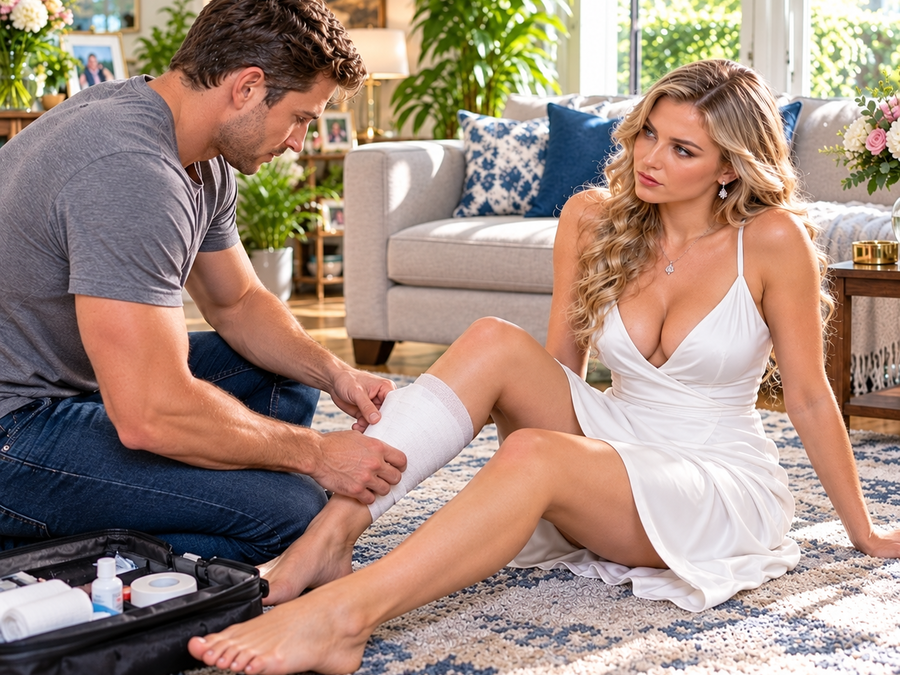
The Boss Twisted Her Ankle…Then Asked the Single Dad “Can You Carry Me to the Couch ”
Victoria Hart grabbed the edge of a rotting beam
felt the floor give way beneath her boot
and went down hard.
And the only thing that stopped her skull from meeting concrete was a pair of hands she had never once asked to touch her.
She looked up.
Marcus Reed looked back down at her.
Neither of them spoke for 3 full seconds.
Then she said the six words that would quietly destroy every wall she had spent a decade building.
“Can you carry me to the couch?”
He said yes.
And that moment
that one ridiculous
embarrassing
completely unplanned Saturday afternoon was the beginning of everything neither of them was ready for.
The site smelled like wet lumber and old rust.
Victoria had driven 40 minutes out of downtown on a Saturday morning
her Saturday morning
which she had not taken a real one of in approximately 3 years because James Callaway had left her a voicemail at 11:00 Friday night that started with the words
“Victoria
I need you to understand that I am not a patient man.”
James Callaway
was 64 years old
owned 17 commercial properties across the Pacific Northwest
and had a handshake that felt like he was checking whether your bones were made of the right material.
He was also the client behind a $14 million renovation contract that represented 11% of her company’s annual revenue.
So
Victoria had gotten in her car at 7:30 Saturday morning with no coffee
a protein bar she’d eaten in the parking garage
and a mood that her assistant Elena would later describe diplomatically as focused.
Marcus Reed
had been on site since 6:00.
She found him in the East Wing of the building
a sprawling half-gutted commercial space that had once been a furniture warehouse and was being converted into a mixed-use development.
He was crouched over a set of drawings spread across a folding table
a pencil behind his ear
a measuring tape clipped to his belt
and he didn’t look up when she walked in because he was in the middle of a measurement
and Marcus Reed did not look up from things he was in the middle of.
This was one of the qualities she had noted about him in his very first performance review.
Detail-oriented.
Does not interrupt his own process to perform attentiveness.
Asset.
The east wall framing is 4 in off on the third bay from the left, she said.
Because she had looked at the drawings in the car and she always did that.
Always came prepared.
Always walked into rooms already knowing what was wrong.
Marcus finally looked up.
Not startled.
Not flustered.
Just present.
I know, he said.
Flagged it Thursday.
Subcontractor is coming Monday to correct it.
She blinked.
You flagged it Thursday?
Sent a report.
Should have been in your Friday briefing package.
She hadn’t read the full Friday briefing package.
She had read the executive summary, which Elena pulled from the reports.
And apparently the east wall framing note had not made it into the summary.
This was not Marcus’s failure.
This was not Elena’s failure.
This was the natural consequence of running a company that had grown from 11 employees to 83 in under 4 years and not always having the bandwidth to read every word of every document.
She did not say any of that.
Right, she said instead.
Good catch.
Marcus looked at her for exactly one beat longer than necessary
not challenging her.
Not smug about it.
Just looking and then returned to his drawings.
Victoria walked the floor.
She walked it the way she walked every site.
Methodical, systematic, heel-to-toe on unfamiliar surfaces.
Eyes tracking the ceiling joists
the subfloor condition
the rough-in plumbing that was either slightly off or perfectly fine
depending on which set of drawings you believed.
She had been doing this since she was 26 years old
and her father had handed her a clipboard at a job site and said
“Don’t tell me what you think.
Tell me what you see.”
Her father had been dead for 6 years.
She still heard him on job sites.
She was thinking about the plumbing
specifically about whether the inspector had flagged the second floor rough-in
or whether that had also been buried in a Friday report she hadn’t fully read when she stepped into the south corridor.
The south corridor was not on the active work schedule for this weekend.
That was the first mistake.
She knew it was the south corridor because she could see it in her head
the drawings
the phasing schedule
the red outline that designated areas not cleared for general access until the subfloor reinforcement was completed.
She knew it
and she stepped through the doorway anyway because she was following a thought
the way she always followed thoughts
the way people who run companies sometimes forget to follow the basic safety rules they themselves wrote into the site policy manual.
The second mistake was the subfloor.
It looked solid.
The lighting was bad afternoon cloud cover had dropped in quickly over the last hour
the kind of low Pacific Northwest gray that turned working light into mood lighting
and from where she was standing
the floor looked like every other
section of flooring she’d walked that morning.
She put her weight on it.
It gave
not all at once
not catastrophically
just a quarter-inch drop that sent the wrong signal to every tendon and ligament in her right ankle.
And her body tried to correct
and overcorrected
and then the whole cascade happened in about half a second.
Her ankle rolled
her knee buckled
her shoulder hit the doorframe
and she went down.
She didn’t scream.
She made a sound involuntary
sharp
the kind of sound that escapes before you can stop it
and then she was on the floor.
One hand braced on concrete
the other instinctively cupping her ankle
and she heard footsteps moving fast from somewhere behind her.
Marcus came through the doorway.
He stopped when he saw her on the ground.
For one fraction of a second
she noticed this because she was still noticing things.
Because her brain didn’t stop.
His face went through several things at once.
Concern, assessment, something she couldn’t fully name.
Then he was kneeling beside her.
Don’t move it.
I’m fine.
You just rolled your ankle on a compromised subfloor.
Don’t move it.
I know what I did.
I was there.
He didn’t respond to that.
He was already looking at her ankle, not touching.
Just looking
his expression the same focused stillness he’d had over the drawings earlier.
Can you straighten your leg?
She straightened it.
The pain spiked, and she breathed through it, and she straightened it fully.
Good.
That means the ligament’s probably not completely torn.
Can you flex your foot?
She did.
That hurt more.
She kept her face neutral.
He saw through it anyway.
She could tell because his jaw tightened slightly.
We need to get you off this floor.
The subfloor in this corridor hasn’t been reinforced yet.
If it compromised under your weight once, it could do it again.
I’m going to help you stand.
I can stand.
Let me help you stand.
There was something in his voice that wasn’t quite an order.
He would never presume to give her an order
but it wasn’t a suggestion either.
It was just a man who had assessed a situation and arrived at a conclusion and was asking her to accept that conclusion without making it into a power negotiation.
She accepted it.
He braced her.
She got to her feet.
For approximately 3 seconds, it seemed like everything was going to be fine.
That she’d walk this off
that this would be a mildly embarrassing anecdote she’d never tell anyone.
Then she tried to take a step and the pain shot from her ankle straight up through her knee and she grabbed Marcus’s arm hard enough that she heard him exhale.
“Okay,” she said through her teeth.
“Okay, maybe not that.”
“Yeah,” he said quietly.
“Maybe not.”
He walked her half supporting
half carrying back through the doorway and into the main floor of the East Wing where the folding table still had his drawings on it and a battered metal folding chair sat in the corner.
He got her to the chair.
She sat.
She looked at her ankle which had already started to swell above the top of her boot.
Outside the rain started.
It came fast
the way Pacific Northwest rain sometimes did not a build-up
not a warning
just a wall of gray descending all at once until the windows of the empty warehouse ran with water and the sound filled the whole echoing space.
Victoria looked at the rain.
Then she looked at her ankle.
Then she looked at Marcus who was standing a few feet away
his phone already in his hand.
“I’m calling someone,” he said.
“No, you’re not.
You need medical attention.”
“I need ice in 20 minutes and I’ll be fine.”
“You need an X-ray to rule out a fracture.”
“It’s not fractured.
” “You’re a tech CEO, not an orthopedic surgeon.”
She looked at him.
He looked back at her.
This was, she realized, the longest unguarded conversation they had ever had.
Two years
83 employees
dozens of site visits
project meetings
quarterly reviews
and this was the first time they had looked at each other like two people instead of two job titles.
She didn’t know what to do with that.
“Fine,” she said.
“I’ll see a doctor, but I am not getting into an ambulance.
I’m not doing that.
Your car?
I drove a stick shift this morning.”
He absorbed this.
Right ankle, stick shift.
He did the math without saying it.
“I’ll drive you,” he said, “but the urgent care clinic is 30 minutes out.
And you’re not waiting on the floor for 30 minutes.”
He glanced around the warehouse.
Through the far doorway
she knew
was a small site office
a temporary structure that the previous crew had used during the first phase of work.
She’d seen it on the floor plan.
It had a couch, or something like a couch.
A cot, maybe.
She wasn’t sure.
She said, “There’s a site office through that door.”
He already knew that.
“Can you walk it?”
She tried to stand.
The ankle screamed.
She sat back down.
The rain got harder.
Victoria Hart looked at the man she had employed for 2 years and barely spoken to as a human being.
And she felt
for the first time in longer than she could calculate
genuinely uncertain about what to do next.
She laughed.
It came out before she could stop it short.
Sharp and completely genuine
because there was something darkly funny about this.
The woman who had built a company from three people and a second mortgage.
The woman who had fired her own fiance’s business partner rather than compromise a contract.
The woman who took no personal days and answered emails at midnight and had her assistant clear her calendar for the month her mother was in the hospital so that no one would ask questions and she would not have to answer them.
That woman was sitting on a folding chair in an empty warehouse
unable to walk while rain trapped her inside.
Marcus watched her laugh.
He didn’t seem confused by it.
He seemed like a man who had seen enough of life to understand that sometimes laughter is the first honest thing that comes out.
“Please don’t make this awkward,” she said once she’d stopped.
She looked at him directly.
“But can you carry me to the couch?
The silence stretched between them.
She watched the calculation move across his face, not reluctance.
Not discomfort, exactly, just awareness.
He was aware of who she was.
He was aware of who he was in relation to who she was.
He was aware that this was the kind of moment that had no professional road map.
Then he crossed the room.
“Arms around my neck
” he said matter-of-factly
like he was describing a process step on a site checklist.
She did it.
And then Marcus Reed picked up Victoria Heart like she weighed nothing.
She had expected it to feel like being handled.
She had expected to feel the particular indignity of needing help
that sour combination of vulnerability and defiance that lived in her chest like a low-grade fever.
She had expected to spend the entire 15-ft walk to the site office office cataloging everything she should have done differently to prevent this moment.
Instead, she felt nothing she’d been expecting.
She was aware of how solid he was.
Not in a way she had ever let herself be aware of before because she had very specifically
very deliberately not looked at Marcus Reed as anything other than a project coordinator who was exceptionally good at his job.
But
she was aware of it now
with her arms around his neck and her face level with his jaw and the rain loud against the roof.
She was also aware that he was careful.
He moved slowly.
He thought about the door frame before they reached it.
He adjusted his grip without her asking.
He made the whole thing
the undignified
unplanned
impossible thing feel almost easy.
He set her down on the cot in the site office.
She exhaled.
“Thank you,” she said.
“There’s a first aid kit somewhere in here, Marcus.”
He stopped.
Turned back.
“I said thank you.”
He looked at her for a moment.
Then something in his face shifted
not a smile
not quite
but the precursor to one.
You’re welcome, he said.
Don’t thank me until we know if it’s broken.
He found the first aid kit.
It had an ice pack that had to be activated by snapping it the chemical kind.
The kind that got lukewarm after about 10 minutes
but was better than nothing.
He handed it to her.
She pressed it to her ankle and closed her eyes.
He sat down on an overturned crate a few feet away and pulled out his phone.
I need to call ahead to the urgent care.
Let them know we’re coming.
It’s Saturday afternoon.
They’re going to be packed, I know.
That’s why I’m calling ahead.
She watched him make the call.
He was efficient on the phone.
Direct
polite in the way that people who have spent years solving other people’s problems are polite
not performed.
Just practical.
He got them on the schedule.
He gave her name without being asked whether to use it.
He ended the call.
35-minute wait when we get there.
If we leave within the next hour.
Okay.
The rain should ease in about 20 minutes according to the weather app.
My truck is right outside.
You drove a truck.
I have a daughter.
I always drive a truck.
She had known he had a daughter.
It was in his file
not that she read employee files the way some executives did.
As intelligence gathering exercises, but she knew the basics.
Marcus Reed, 35, single father, 8-year-old daughter named Lily.
Started with the company 23 months ago as a project coordinator.
Promoted to senior coordinator 11 months in.
Consistently the highest rated team member in client satisfaction scores and on-time delivery metrics.
She had known all of that.
She had not known until right now that it explained the truck.
What’s her name?
She asked.
She didn’t know why she asked.
She already knew.
Lily.
How old?
Eight.
Just turned eight in September.
Is she She stopped.
Started again.
Is she okay today with you being here on a Saturday?
He looked at her.
Like she’d asked a question he hadn’t expected.
She’s with my neighbor, Mrs. Patterson.
She goes over there most Saturdays I work.
They bake things and watch cooking shows.
The not quite smile again.
Lilly has opinions about soufflés now.
Very strong opinions.
Victoria laughed again.
Softer this time.
I didn’t think about it, she said.
When I called the crew in this weekend
I should have thought about arrangements.
For people who had She gestured loosely.
You had a $14 million contract at risk.
That’s not an excuse.
Marcus looked at her steadily.
I didn’t say it was.
I said it’s what happened.
Nobody complained about the Saturday call.
Ms. Hart, this is the job.
A pause.
What?
You’ve worked here for 2 years.
You can call me Victoria.
Another beat of silence.
Different from the others.
Okay, he said.
Not immediately.
Not reflexively.
Just eventually, like a man who meant it.
Victoria, the rain came down, the ice pack got lukewarm.
Marcus checked his phone twice
not anxiously
just methodically
and she found herself watching the way he moved in the small space.
The economy of it, the way he never did anything unnecessary.
He wasn’t the kind of man who performed competence for an audience.
He was just competent, quietly, without wanting credit for it.
She had seen a lot of men perform competence in her career.
She had seen fewer who simply had it.
You really don’t know how to ask for help.
Do you?
He said.
Not unkindly.
He was looking at his phone.
Not at her when he said it.
She opened her mouth to say something deflecting.
Something wry.
Something that would keep it professional.
What came out was, neither do you.
He looked up.
She held his gaze.
He didn’t answer that.
He put his phone back in his pocket and looked at the rain instead.
But the sentence sat between them in the small space of the site office like something that had been left on a table and couldn’t be unseen.
Neither do you.
She hadn’t meant to say it.
But she had said it because she had been watching him for 23 months not watching him the way she sometimes made herself not notice things.
Not in that way, but watching him the way she watched everything.
The way her brain cataloged and processed and stored information that her conscious mind hadn’t decided to act on yet.
And what she had cataloged about Marcus Reed over 23 months of project meetings and quarterly reviews and Friday briefing packages she sometimes didn’t read all the way through.
Was this?
He always volunteered for the hardest assignments without explaining why.
He always left before 7:00 because he had Lily and he never apologized for it.
And he always without fail had everything finished that needed to be finished before he walked out the door.
He ate lunch at his desk alone 4 days out of five.
👉 [Tap here for the Next Part ] 👈