Thugs Mocked a Quiet Single Dad in Front of the CEO—Until They Learned He Was a Navy SEAL-Part 7
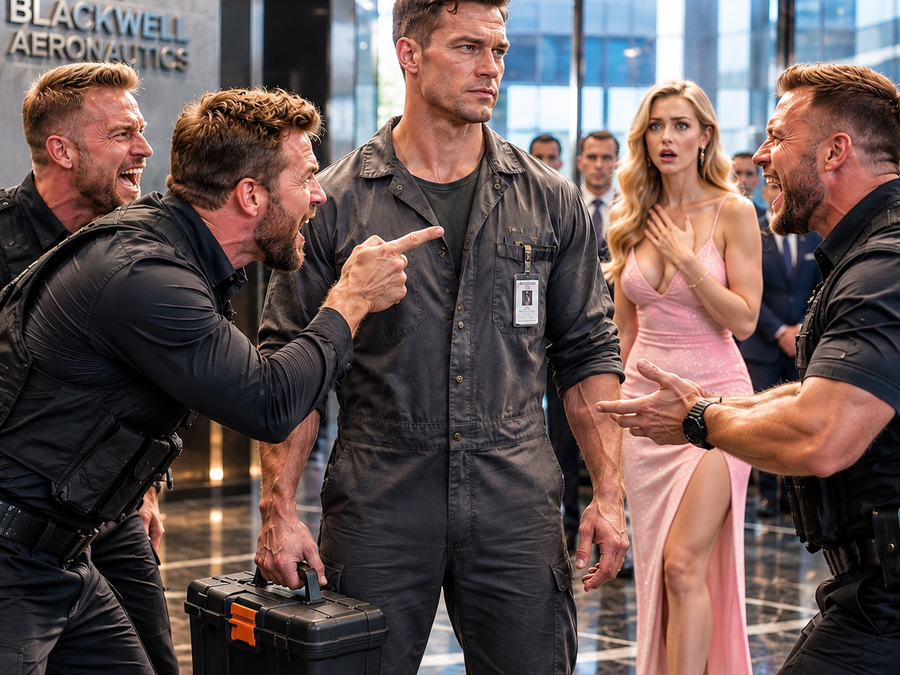
========== PART 7 ==========
She found him at the edge of the space near the east wall about an hour later during the program’s formal presentation segment when the room’s attention had organized itself toward the stage and the ambient social noise had dropped.
I was holding a glass of water and watching the presentation with the same quality of attention he brought to everything.
complete but unperformed.
“He won’t cause any more trouble tonight
” Dawson said quietly when she stopped beside him.
“I know,” she said.
“I was going to move when you started walking,” he said.
“Then I didn’t.”
She looked at him.
“Why didn’t you?”
He was quiet for a moment.
On the stage
a 23-year-old woman from the workforce program was describing what the training had meant for her.
Not in the polished language of a prepared speech
but in the halting
genuine way of someone who was trying to say something true rather than something impressive.
The room was very quiet.
Because you had it, Dawson said, “Because it was yours to have.”
She understood what he meant.
There was a version of the past 6 months where she’d been the person who was protected
managed
surrounded by improved systems and better protocols and had remained at the center of those systems as something to be kept safe.
That had never been the
design.
She’d been clear about that from the beginning.
But design and reality had a way of diverging
and she was aware that she could have allowed the divergence if she’d been a different person or if the circumstances had pushed in a different direction.
She hadn’t allowed it.
She’d walked across a room toward an uncomfortable situation instead of away from it.
Not because it was her job or her responsibility in any formal sense
but because she’d decided in a parking garage stairwell under fluorescent lights
not completely all right
that the cost of staying uninvolved was something she understood now in a way she hadn’t before
and she wasn’t willing to pay it.
You taught me that
she said
not sentimentally
just as a fact
the way she stated facts.
He looked at her.
“No,” he said.
“You decided it.
Those are different things.”
She thought about that.
“You gave me the language for it,” she said.
He seemed to accept that as a reasonable partition.
“Language helps,” he said.
The presentation ended.
The room came back to itself.
Helen Park was talking to two of the program participants near the stage
and from where Serena stood
she could see the animated quality of that conversation.
Helen leaning toward one of the young people
asking something that was clearly producing a real answer rather than a polite one.
Serena made a note to follow up with Helen about a partnership that had been forming in the back of her mind for 3 months and that she’d been putting off naming because she wasn’t sure yet if it was a good idea or just a thing she wanted to be a good idea.
She decided she’d call it a good idea and see what happened.
She’d been right about riskier calls.
At 9:15, Dawson’s phone vibrated in his jacket pocket.
She didn’t see him check it.
She was across the room by then, saying goodbye to a departing guest.
But she knew from the quality of his movement when she caught sight of him 20 minutes later that something had shifted in his orientation.
He was still professionally present
still doing what he was there to do
but he had the look of a man whose mind had begun to move toward a door.
She finished the conversation she was in
excused herself
and found him near the coat room.
“Maya,” she said.
He looked at her with a slight flicker of surprise
not at the question
she thought
but at how quickly she’d read it.
“Mrs§ Callaway, Callaway,” he said.
Maya asked her to text.
“She’s not sick, just he paused.
She doesn’t like it when the time gets later than we said.”
Serena understood that entirely.
A child who thought carefully about things
who noticed when the logic didn’t fit
who needed the people she loved to be where they said they’d be.
She understood it from the inside.
Go.
Serena said, “The event’s not Gareth is here.
Sandra is here.
I am demonstrably capable of being in a room without you in it.”
She said it without edge.
“Go home to your daughter.”
He looked at her for a moment.
There was something in his expression that she’d seen before.
The recalibration
the registering of something unexpected
but it had a different quality now than it had in those early months.
Less distance in it.
Good event, he said.
It was, she agreed.
He got his jacket from the coat room.
At the main entrance
he paused and turned
and she was still looking in that direction
and he gave her the brief
uncomplicated nod of one person communicating something to another person across a room without requiring words to do it.
Then he went through the doors
and the room absorbed his absence the way rooms do
without ceremony
without drama
the way ordinary things happen.
She stood where she was for a moment.
Helen Park appeared at her elbow
wanting to discuss a potential expansion of the program’s technical curriculum.
And Serena turned her attention to that conversation and gave it what it deserved
which was all of it.
Because Helen Park was worth listening to fully
and the conversation was genuinely interesting
and this was how she’d been trying to live her days lately
completely in whatever the current thing was
rather than partially in three things simultaneously.
She got home at 11:00.
Her apartment was quiet
in the way apartments are when you’ve come home from a large and noisy event.
The quiet felt active
almost textured
the contrast catching you for a moment before normalizing.
She took off her shoes at the door
which she always did
but usually didn’t notice
and stood in the kitchen for a moment without turning on anything more than the underc cabinet light.
She thought about the young server near the dessert table.
She thought about his face when she turned to him
that stunned quality
not quite believing that someone had moved.
She thought about how that was what she’d looked like
probably in a parking garage at 11:00 at night when a voice came from behind three men and said four words.
She thought about the accumulated weight of all the moments in all the rooms across all the years when nobody moved.
the couple near the car
the hotel employee who rerouted
the man with the phone
the people in her company’s own listening sessions who had described their specific moments of stillness
the comment they hadn’t challenged
the concern they’d set aside
the colleague they’d watched without speaking.
All of those moments existed because intervention was hard and non-intervention was easy
and the difference between the two often came down to something very small.
A second’s hesitation resolved in one direction rather than another.
The presence or absence of a person who had already decided what they were going to do before the moment arrived.
That was the thing she’d come to understand.
The decision happened before the moment, not during it.
During the moment, there was no time to weigh costs and benefits.
No space for the careful moral calculation that people imagined preceded the choice to act.
What happened during the moment was the expression of whatever had already been settled.
People who moved toward trouble when they saw it had already decided somewhere quieter and earlier that they were the kind of person who moved toward trouble.
People who looked away had decided the same thing about themselves
often without knowing they’d made any decision at all.
Dawson had made his decision a long time ago.
She wasn’t sure where exactly
someplace she’d never seen and couldn’t fully imagine in conditions that had required him to be the kind of person who moved rather than waited.
He’d come out of that carrying something most people who pass through ordinary life never have to develop.
And he’d made the choice
a daily
practical
unglamorous choice to use it for something as simple and non-negotiable as making sure his daughter had a father who came home at night.
That was the thing she’d turned over most in the months since she’d learned who he was.
Not the fact of what he’d been
but the nature of the choice he’d made afterward.
He could have built a different kind of life.
He could have remained inside the world of highstakes work.
Could have transitioned into private security or consulting or any of the other channels that absorbed men like him.
He would have been excellent at it.
He would have been compensated better for it than for replacing HVAC filters in a corporate building.
He hadn’t done any of that.
He’d chosen the HVAC filters
the parking gate mechanisms
the early mornings and the school drop offs and the dinner at 6:30 and the bedtime checks on the closet door.
He’d chosen ordinary.
The way you choose something that costs you nothing because it is already exactly what you wanted.
Not a sacrifice
not a compromise
but a genuine preference for a life that kept the most important thing at the center of it.
She’d been thinking about that in terms of her own life for months.
And the way you think about something that touches a question you haven’t finished answering.
What was at the center of her life?
Blackwell Aeronautics.
Certainly, she’d built it.
She believed in it.
She wasn’t going to pretend the work didn’t matter to her deeply
but work at the center of a life had a way of filling the space that other things might occupy if you let it.
And she’d been running her life on that model for 6 years
and the results had been professionally extraordinary and personally.
Not bad
exactly
but incomplete in a way she’d been too busy to fully examine.
She was examining it now.
She was 30 years old and she was examining it
which was better than examining it at 45 and finding out she’d been busy the whole time.
The relationship between her and Dawson had been developing in the way that real things develop slowly with no clear moment you could point to and say it changed here with awkwardness and missteps and the particular difficulty of two people who were both more comfortable managing their own interior lives than exposing them.
He was not a man who rushed.
She was not a woman who easily stopped moving long enough to notice what was standing still nearby.
They were
in other words
a fairly predictable set of obstacles to their own connection
and the fact that they had gotten as far as they had was a function of something that didn’t fit neatly into a description.
A mutual recognition
maybe of the kind of person the other one was
underneath the surfaces they showed the world.
She’d said something honest to him once on a Tuesday evening in early April when they’d been the last two people on the executive floor and had ended up in the small kitchen down the corridor from her office.
Both reaching for the coffee at the same time in a way that produced a moment of ordinary comedy that neither of them had entirely resolved when she’d said
“I think you might be the most straightforward person I’ve ever worked with.”
He’d looked at her.
“Is that good or bad?”
“Good,” she said immediately.
“Very good.
It’s unusual.
People mostly aren’t, he said.
People mostly aren’t, she confirmed.
Especially in rooms like this
especially with someone in my position
she’d looked at her coffee.
You say what you actually think.
You don’t calculate how it’ll land first.
I calculate, he said.
I just don’t calculate for what makes me look best.
She’d looked at him then
and something in his face was the same direct
unbothered quality that had been there in the parking garage and in the stairwell and in every conversation since the quality of someone who had spent enough time in situations where pretense was genuinely dangerous and had simply never brought pretense back with him.
“I’m trying to learn that,” she said.
“You’re doing all right,” he said.
It was not a sweeping declaration.
It was not a moment of cinematic clarity.
It was two people standing in a small kitchen with mediocre corporate coffee at 6:40 in the evening
saying honest things to each other.
She had decided sometime in the weeks that followed that she’d rather have that than the cinematic version.
The cinematic version was a story you told afterward.
The small kitchen at 6:40 was the actual life.
A month later
on a Saturday
she drove Mia to a science exhibit at the Natural History Museum.
This had happened because Mia had mentioned the exhibit to Dawson in Serena’s presence
and Serena had said she’d been wanting to go
which was true.
And Mia had looked at her with the candid assessment of an 8-year-old evaluating a statement for its sincerity and apparently decided it passed and had said
“We could all go Saturday.”
Not a question, a scheduling proposal.
Dawson had looked at Serena.
Serena had looked at Dawson.
Maya had looked at both of them with the patient expression of someone who has already identified the correct answer and is waiting for the adults to catch up.
Saturday works.
Serena said it was a good day, not uncomplicated.
Maya had opinions about the correct order in which to see exhibits
and Serena had a different view
and Dawson had the particular parenting skill of navigating a disagreement between two people who were both convinced they were right without fully taking either side.
Maya warmed to Serena in the way that children warm to people.
Not all at once, but through specific moments.
Serena knowing an unexpected fact about asteroid composition.
Serena buying her a museum pencil with the solar system on it without being asked.
Serena listening to Maya’s complete and detailed account of her feelings about the Pluto reclassification without interrupting or redirecting.
On the drive home
Maya fell asleep in the back seat with the museum pencil in her hand and the car was quiet.
And Dawson was looking out the passenger window at the city going by and Serena was watching the road.
And it was it was just an afternoon
a regular Saturday afternoon with two adults in the front of a car and a child asleep in the back in a city doing its normal Saturday things around them.
She thought, “This is what I was missing.
Not the grand gesture.
Not the dramatic revelation.
This the regular Saturday.”
She didn’t say it out loud.
She didn’t need to.
In June, Corbin Strike’s plea was finalized.
He received a sentence of four years with restitution payments to the company covering most of the amount he’d misappropriated.
Marcus Webb delivered the news to Serena in a brief email with the subject line.
Finalized.
She read it, replied with two words, “Thank you.”
and went back to what she’d been doing
which was a review of the second cycle of the intervention training program
now expanded to include all 300 employees at headquarters and being adapted for the company’s satellite offices.
The expansion had required Dr§
Row to bring in two additional facilitators
both of whom had completed a training of trainers program that Dawson had designed over the winter.
The adaptation for satellite offices had required thinking through how the core material translated to smaller teams with different communication dynamics which had produced three months of genuinely interesting problem solving between Dawson
Dr§
Row
and Serena herself
who had insisted on being involved in the adaptation process rather than simply approving the final product.
What she’d found working through that process was that she was good at this in ways she hadn’t fully understood about herself.
not the security architecture.
That was Gareth and Dawson’s domain.
And she was a capable participant, but not the expert in the room.
What she was good at was the organizational dimension.
Understanding where the gaps were in how a culture communicated with itself
where the formal systems and the informal reality had diverged
where a well-intentioned policy was failing because the human infrastructure around it hadn’t been built to support it.
She’d spent six years building a company
and she’d absorbed more about organizational behavior than she’d consciously cataloged.
And it was now available to her in a way it hadn’t been before because she’d been forced by a November night in a parking garage to look directly at the gap between what she’d thought she was building and what she’d actually built.
That was the thing about the worst moments.
They showed you exactly where you were.
She’d had a conversation with her mother in May that she still thought about regularly.
Her mother had driven up to the city for a weekend
the first time in 2 years
and they’d cooked together on Saturday evening
a moderately chaotic process involving a recipe neither of them had made before
and two kitchen drawers that turned out to contain essentially none of the right tools.
And somewhere in the middle of the chaos
her mother had said
without particular setup.
You seem different.
People keep saying that, Serena said.
Good.
Different
her mother said
the same word she’d used in the text months before.
So I’ve been told.
Her mother was quiet for a moment
stirring something that needed more attention than either of them was giving it.
What changed?
She said.
Serena thought about how to answer that.
She thought about the long version
the parking garage
the stairwell
Dawson
the listening sessions
the training program
the young server at the reception
Caitlyn at the front desk saying
“Doing nothing is still a decision.”
She thought about the Saturday at the museum and Maya asleep with the solar system pencil.
She thought about 6:40 on a Tuesday evening in a small kitchen with mediocre coffee.
“I learned something,” she said finally about what it costs to look away.
Her mother looked at her.
She had the look of a woman who understood that her daughter had said something true and that true things sometimes didn’t require follow-up questions.
“Good,” her mother said.
And then, “This is burning.”
They dealt with the thing that was burning.
Dinner turned out fine despite it.
They ate at the kitchen table and talked until midnight
which they hadn’t done since Serena was in college.
And Serena’s mother cried a little bit at one point for reasons that weren’t entirely clear to either of them.
And Serena didn’t rush past it the way she once would have.

