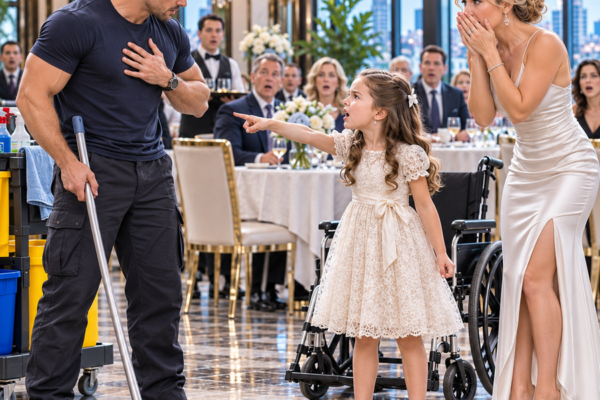
“Who Taught Her to Walk” Billionaire Stunned as Her Daughter Points at Single Dad Ex-SEAL Janitor-Part 8
========== PART 8 ==========
Claire O’Duya came in a green dress and stood near the back and cried a little
which she would deny if asked.
Marcus Webb flew up from Boston and arrived 40 minutes late because of traffic and spent the ceremony looking simultaneously apologetic and entirely at peace with himself.
Margaret sat in the front row and wore the expression of someone who had hoped for exactly this and had the patience to let it unfold in its own time.
Grant wore a dark suit that fit him well and stood at the end of the stone path that ran through the garden to the temporary arch they’d put up and waited and tried to be the kind of person who could stand still inside a moment without looking for the exit.
He was getting better at it.
He’d been getting better at it for a year.
The music started something simple
played by a string quartet that Vanessa had insisted on because she liked strings and Grant had no opinion about music strong enough to argue with someone who did.
Zoe appeared first.
She
was in a pale blue dress that she had approved after a three-week process involving four rejected alternatives and she walked with the deliberate composure of a child who had been practicing for a week and was not going to squander the preparation.
She held a small bunch of flowers that she’d arranged herself with Margaret’s guidance and carried it like it was important
which to her it was.
She took her place at the front and looked at her father with an expression that said
I’m holding it together and I need you to know that I’m holding it together.
He gave her the smallest nod.
She nodded back.
Then Ivy appeared.
She was in a dress the same shade as Zoe’s
her hair braided back and she stood at the start of the path with her chin up and her shoulders set
the same posture she’d had when she’d stood in the ballroom 18 months ago and told 200 strangers that she wasn’t broken.
She walked down the aisle, not perfectly.
Her gait was still uneven on some days
and this was one of those days
and she didn’t hide it or compensate for it or apologize for it.
She walked the way she walked
which was her own
which she’d earned step by step in a garden on a wall with her hand shaking and no one telling her she had to be anything other than what she was.
Zoe reached out her hand when Ivy reached the front.
Ivy took it.
Grant’s eyes filled.
He didn’t do anything about it.
He just stood at the end of the path and let his face do what it was doing because he’d spent enough years managing everything that he’d learned to recognize when a moment deserved better than management.
Vanessa appeared.
She had no one to walk her.
She’d considered asking a business colleague
had considered various ceremonial options
and had concluded that she’d been walking through difficult things on her own for long enough that she didn’t need to import a symbolic partner for the easy ones.
She walked the garden path by herself in a dress that was the color of winter light and looked at Grant the entire way.
He looked back.
She reached him and they stood face to face in the May garden with 40 people behind them and two girls at their side and the stone wall just visible over Vanessa’s shoulder.
And Grant thought, here, this is what the other side of loss looks like.
Not the absence of the past
not the replacement of it
but the continuation
the fact of still being here
still building
still willing to take the next step even when you can’t see where it lands.
The ceremony was short.
They wrote their own vows
which neither of them read from paper
which was either brave or reckless depending on how you felt about improvisation.
Grant’s were plainspoken and specific.
He said what he meant without reaching for poetry
which was the only way he knew how to say anything important.
Vanessa’s were precise in the way that everything she cared about was precise and had a moment in the middle where her voice did something she hadn’t planned and she stopped for a second and the garden was absolutely still and then she finished.
When it was done
Ivy looked up at Grant and said in a voice just loud enough for the front row to hear
can I call you Dad now?
The garden went quiet again.
Not the stricken kind of quiet
the full kind
the kind that happens when something true gets said out loud in a space where people are paying attention.
Grant crouched down the same motion he’d made in the garden two years ago
dropping to her eye level
giving her the full weight of his attention.
Yeah, he said.
You can call me that.
Ivy nodded satisfied
the way she nodded when a thing she’d decided was confirmed.
Zoe beside her leaned over and said in a loud whisper
I told you he’d say yes.
You tell me everything, Ivy whispered back, because I’m usually right.
The front row laughed.
The thing about being broken
Grant had learned had been learning since long before he came to this estate
since the years of recovery from his own injuries
since the months after Diane died when he’d wondered if the version of himself that had existed before would ever come back.
The thing
about being broken is that the word itself is wrong.
It implies a before state of wholeness that is then destroyed.
It suggests that the goal of recovery is return getting back to what you were
reassembling the original version.
But that’s not what happens.
What happens is that you become someone who has been through the thing
not despite the thing
not after the thing
but woven through with it.
Diane’s death was woven into him.
Zoe’s face across the kitchen table was woven into him.
12 years of operations he couldn’t talk about at dinner parties
and the specific quality of silence that followed them all of that was woven in
inseparable from whoever he’d been before
making something different
not lesser
not broken
just changed in the way that everything that survives something is changed.
Ivy knew this now.
She’d learned it in a garden with shaking legs and a man who didn’t reach out to catch her before she needed it
and she’d learned it from a girl named Zoe who told her that you could be sad and okay at the same time
and she’d learned it from her own body which had turned out to know more than the people charting it had wanted to admit.
She was nine and then ten
and the walking continued in its non-linear way better most days
harder on some
entirely her own.
She used the wheelchair when she needed it and left it in the corner when she didn’t
with the comfortable pragmatisms of someone who had made peace with their tools.
She went back to school in September of the year after the wedding
a real school with other children and a lunch period and the particular chaos of a fourth grade classroom that she found overwhelming for the first week and then began
carefully to love.
She made friends, not easily.
She was her mother’s daughter
cautious with trust
slow to extend it
but she made them.
Zoe remained her primary person in the specific category that Zoe had occupied since the morning she’d looked up from her chapter book and said hi with the complete absence of ceremony that had defined their friendship ever since.
They were
at nine and ten
inseparable in the way of children who have decided they are family regardless of the formal arrangements
and they navigated the new configuration of their lives with the adaptive ease of children who hadn’t had enough time to build the rigid categories that adults spend years defending.
Zoe called Vanessa Vanessa for three months and then
one morning at breakfast
called her mom without planning to and then looked at her own cereal with the expression of someone assessing whether they’d made a miscalculation.
Vanessa had looked at her for a moment.
Good morning, she said in her ordinary voice.
Zoe looked up.
Vanessa was smiling the real one, the eyes and everything one.
Good morning, Zoe said and went back to her cereal.
The Mercer program began accepting applications the following spring.
Its first cohort was eight veterans and twelve families.
By the end of the year, it was 20 veterans and 30 families.
By the end of the second year
it had waiting lists in three states and had become
almost despite itself
a model that other rehabilitation foundations were calling Claire O’Doyle to ask about.
Grant ran it with the same quality of attention he’d brought to everything present
honest
unhurried.
He recruited his people carefully
the way he’d once evaluated operators for particular assignments
not for their credentials
but for their quality of presence
their ability to sit with someone in the difficult place without needing to rescue them from it.
He drove to the facility in Westport twice a week and sometimes sat in on sessions and sometimes just talked to the mentors afterward
the way his best commanding officers had talked to him
not debriefing
not evaluating
just checking in.
He was not perfect at it.
He hired someone once who turned out to be wrong for the work
a decorated veteran who was excellent at his own recovery
but handled other people’s fear with a bluntness that injured rather than braced.
Grant had to have a very uncomfortable conversation about this
which he handled poorly the first time and better the second
and which resulted in a change to the program’s mentor selection criteria that made the whole structure more honest about what it was asking for.
He was wrong sometimes.
He was still learning.
He didn’t mind learning
which was something that had changed in him over the past two years
the willingness to be wrong without the wrongness being the end of something.
Diane had told him once
early in their marriage
that the thing she loved most about him was also occasionally the thing she wanted to throw a glass at
the certainty.
The way he moved through problems with such assurance that getting it wrong seemed to cost him more than it cost other people.
He’d been working on the cost of being wrong ever since.
Vanessa was better at it than he was.
She’d told him that early
without pride or self-congratulation
just the observation
I’ve been wrong at scale
financially and professionally
and the world didn’t end.
It made me cautious, but it didn’t break me.
A pause.
I was worse at being wrong personally.
That’s where my armor is.
Was, he’d said.
She’d looked at him.
Was, she agreed.
Quietly.
On a Saturday in October
two years after the wedding
Grant was in the garden
not fixing anything
not doing anything purposeful
just sitting on the low stone wall in the October afternoon with a cup of coffee going cold beside him
watching the last of the season’s light move across the grass.
Ivy found him there.
She came out through the garden door in her weekend clothes
jeans and as a sweater
her hair in a braid that was coming loose at the bottom
and she walked across the grass toward him with the easy confidence of someone who had long since stopped thinking about walking
for whom it had become simply a thing she did
unremarkable and hers.
She sat beside him on the wall.
For a moment neither of them said anything.
The garden held the particular quiet of October
the kind that feels like something settling.
Are you thinking?
Ivy asked.
A little, Grant said.
About what?
He thought about how to answer.
About how things end up looking different than you expected, he said.
Not worse, just different.
Ivy considered this.
Like how I thought walking would feel like flying
she said
but it actually just feels like walking
which is also fine.
Grant looked at her.
Yeah, he said, exactly like that.
She leaned her shoulder against his arm
the way she did sometimes when she had something to say and was deciding how to say it.
I don’t remember being happy before the accident, she said.
I mean, I know I was, but I can’t feel it when I try to remember.
It’s like knowing a fact about someone else.
A pause.
I remember being happy in this garden with you and Zoe.
That’s the first real one I remember.
Grant sat with that for a moment.
Then that’s where it started, he said.
Yeah.
She looked at the flagstone path in front of them.
I’m glad you didn’t walk away.
I almost did, he said honestly.
I know.
She’d known this for a year
he’d told her because she’d asked directly and she was 10 and she deserved the truth.
But you didn’t.
No, he said.
I didn’t.
The afternoon light moved across the garden.
From inside the house came the sound of Zoe and Vanessa in an argument about something
the specific cadence of two people who were too similar to not occasionally want different things and had long since learned that this was survivable.
Ivy tilted her head toward the sound.
They’re going to be at that for a while, she said.
Probably, Grant said.
We should go in eventually.
In a bit, he said.
They sat on the stone wall in the October afternoon and the light shifted and the garden was quiet around them
and Grant thought about the word family what it had meant to him before
the original version
the thing he’d thought was irretrievably behind him
and what it meant now
sitting in a garden in Connecticut with a 10-year-old girl who called him dad
and the sound of his wife’s voice carrying through an open window.
Not the same thing
something built rather than inherited
chosen carefully and sometimes badly and always honestly by people who had reason to stop trusting the world and had decided for their various reasons to try anyway.
That was the thing nobody told you about surviving loss.
They told you it got better, which was true but incomplete.
They told you time was the thing
which was partly true in the way that all incomplete truths are partly true.
What they didn’t tell you
what you had to learn yourself in gardens and kitchens and courthouses and ordinary Tuesday mornings was that life after the worst thing doesn’t get rebuilt.
It gets rebuilt differently
into something that couldn’t have existed without the breaking
that has the shape of what was lost in it
and the shape of what was found
and is entirely
stubbornly still going.
Ivy reached over and picked up his cold coffee without asking.
She took a sip, made a face, and set it back down.
That’s terrible, she said.
It’s been sitting there for an hour, Grant said.
Then why are you keeping it?
He looked at the cup.
Habit, he said.
She stood up from the wall and held out her hand.
Come inside, she said.
Mom makes better coffee.
He took her hand.
They walked back across the garden together
through the door into the warm light of the house where everything that mattered to him was waiting
and the door closed behind them on the October afternoon
and the garden settled into its quiet
and the stone wall held the last of the light for a while longer before the evening came.