A Female CEO Caught the Single Dad Looking and Teased Him—His Response Changed the Mood
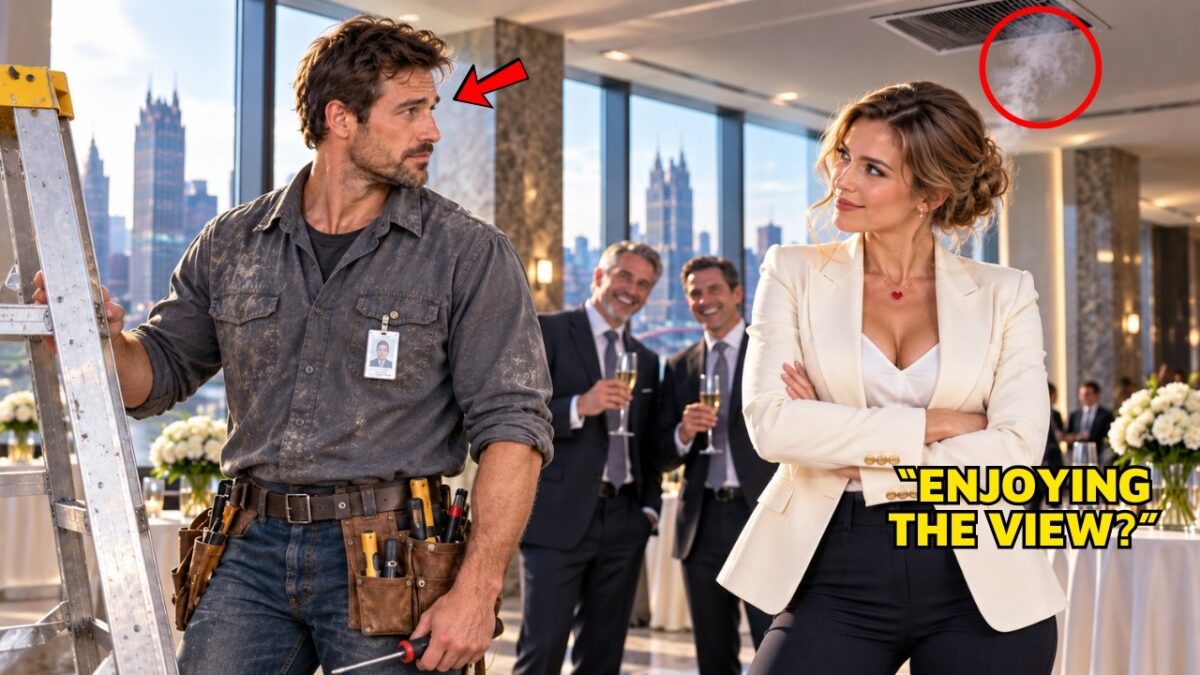
Careful, Mr.Calder.
Keep staring at me like that and someone might think you have expensive taste.
Marin Wickham said it with the easy confidence of a woman who had spent half her life controlling rooms before anyone else realized they needed controlling. A few executives near the champagne table laughed, not cruy, but loudly enough to make the moment public.
41 floors above downtown Pittsburgh, the reception hall of Wickham Meridian glowed beneath warm amber lights, all polished glass, marble floors, tailored suits, and conversations measured in millions of dollars. Near the far wall, Everett Calder stood on a 6-ft ladder with a screwdriver in one hand and a worn leather tool pouch against his hip.
His gray maintenance shirt was clean, but faded at the shoulders. A plastic identification badge rested against his chest.
He had been looking in Marin’s direction for nearly 10 seconds.
She had noticed.
Of course, she had. Marin Wickham noticed everything.
At 36, she was the chief executive officer of the company whose name stretched in silver letters across the lobby downstairs.
She had learned long ago what certain looks meant. Curiosity, ambition, attraction, sometimes all three.
So, when she caught the maintenance technician staring, she did what she always did when someone thought they had caught her off guard.
She turned the moment into hers.
“Should I be worried?”
she added, lifting one eyebrow.
Another ripple of laughter moved through the small circle around her.
Rhett climbed down one step, then another. He did not blush.
He did not smile nervously.
He did not look toward the floor.
That was the first thing Marin noticed. The second was how calm his eyes were.
“No, ma’am,” he said.
Graham Voss, standing beside Marin in a navy suit that probably cost more than Rhett’s truck, smirked into his glass.
Good answer.
Red ignored him.
His gaze moved past Marin again toward the wall behind her.
Marin folded her arms. Then what exactly were you looking at?
The room seemed to lean toward him. Rhett slipped the screwdriver into his pouch.
Somewhere above them, the ventilation system gave a low metallic hum.
Then came a faint click.
Rhett’s expression changed.
Not fear, recognition.
I was wondering, he said quietly, why somebody let you stand there with smoke coming through the vent behind you. Nobody laughed this time.
Marin turned.
A thin gray ribbon had begun curling from the narrow ceiling vent less than 8 ft behind her.
For one strange second, the entire elegant room froze.
Then Rhett moved everybody away from that wall.
His voice was not loud, but it carried. Graham, get them toward the east doors.
Graham blinked. Excuse me now.
Something in Rhett’s tone erased the difference between a man wearing a work shirt and a man wearing a $5,000 suit.
Marin stepped aside as Rhett crossed the room, pulled a small radio from his belt and spoke into it with calm precision. Facilities control shut down air handler 41B.
Possible electrical overheating in the west return. Kill the circuit before it spreads.
The music continued playing for another few seconds.
absurdly cheerful against the sudden silence until someone finally switched it off.
The faint smell of heated plastic reached the room.
Marin watched Rhett remove an access panel, checked the wiring, then stepped back. No panic, no performance, no glance around to see who was impressed.
Within minutes, the system was isolated.
The smoke thinned. Security and building engineers arrived, followed by a manager who began apologizing so quickly his words nearly collided.
Rhett simply handed him the access panel.
The motor relay overheated. It should have been flagged this morning.
Marin stared at him now. Really stared.
He wiped a streak of dust from his fingers with a shop cloth and picked up his tool bag.
“Mr.Calder,” she said.
He stopped.
“Yes, ma’am.”
For the first time that evening, Marin had no clever answer ready.
Around them stood people who had laughed less than 5 minutes earlier.
None of them were laughing now. Graham cleared his throat.
You could have just said something instead of staring.
Rhett looked at him then at Marin.
His voice remained even. I wanted to be sure before I interrupted people who looked important.
Marin almost smiled. Almost.
And now, she asked.
R glanced at the darkened vent. Now I am sure the building does not care how important anybody looks.
He turned and walked toward the service corridor before anyone could decide whether that had been a joke. Marin watched him disappear behind the gray metal door.
She had spent years catching men looking at her.
She had learned to recognize hunger, calculation, admiration, and envy before they ever opened their mouths.
Everett Calder’s look had contained none of those things.
He had noticed danger while everyone else was busy noticing her. And for reasons she could not yet explain, that bothered her almost as much as it intrigued her, because the mood in that room had changed when Red answered her.
But something quieter had changed inside Marin Wickham, too.
Before we continue, where are you watching from? Drop your city or country in the comments below.
And if you believe in dignity, grace, and second chances, hit like and subscribe.
These stories remind us that respect can begin in the most unexpected moments, and we are glad you are here.
Now, back to Rhett Calder. The gray service door closed behind Rhett Calder with a soft metallic click, leaving Marin Wickham standing beneath the dimmed reception lights with a question.
She did not like admitting she had. Why had he simply walked away around her?
The room slowly restarted. Conversations returned in cautious fragments.
Glasses were lifted.
Phones came back out. Someone from facilities assured Graham Vos that the overheated relay had been contained and there was no further risk.
Yet Marin barely heard him.
Her eyes remained on the service door.
“Well,” Graham said, adjusting his cuff.
“At least maintenance finally earned its paycheck tonight.”
Marin looked at him. He noticed something none of us did.
Graham shrugged. That is what we pay them for.
The sentence landed harder than he intended.
Marin said nothing. She had heard versions of it her entire life.
That is what assistants are for. That is what drivers are for.
That is what servers are for. Titles had a way of turning human beings into functions if you let them.
10 minutes later, while the reception resumed around her, Rhett was already three floors. Below, kneeling beside an open mechanical cabinet with a flashlight between his teeth.
“You could have stayed upstairs,” said Louise Herrera, the night facility supervisor, as he checked the damaged relay.
The chief executive officer was talking to you. Rhett removed the flashlight.
She had people talking to her. Luis laughed.
“Not like that.”
Rhett tightened a terminal screw.
“Like what?
like she wanted you to stay. Rhett gave him a sideways look.
You have been working too many night shifts and you have been single too long. Rhett shook his head and reached for his meter.
The relay failed because this contacttor has been running hot for weeks. Put in a replacement request before morning.
Luis studied him for a second.
Ralder was 39, quiet, reliable, and almost impossible to embarrass.
He arrived at 6:30 every morning, packed the same dented thermos, and left at 5:15 whenever his schedule allowed. He never joined office gossip, never asked which executive had been promoted.
Never seemed impressed by the people whose names appeared on the building.
You know who she is, right?
Luis asked. Rhett looked at him.
Marin Wickham. I mean, really, no.
Chief executive officer owns half the company.
Probably owns the elevator I used to get down here. Louise smiled and she was flirting with you.
Rhett returned his attention to the meter.
She was making a joke at you maybe and you walked away.
Rhett’s expression softened by half an inch.
I had work upstairs.
Marin was discovering that explanation was somehow more irritating than arrogance would have been.
By 9:15, the investors had gone.
The caterers were clearing plates and Pittsburgh shimmerred beyond the glass in thousands of white and amber lights.
Marin stepped away from the final cluster of board members and saw a figure crossing the lobby near the service elevators. Rhett tool bag over one shoulder jacket folded beneath his arm.
He was heading for the employee exit.
Mr.Calder. He stopped and turned.
Miss Wickham. She crossed the marble floor toward him.
Without the crowd, her voice lost some of its public sharpness. You disappeared.
The relay did not fix itself.
Most people would have stayed long enough to accept a thank you. Recon considered that.
You are welcome.
Then he turned slightly toward the doors. Marin almost laughed from disbelief.
That is it. He looked back.
Was there something else? She was used to people manufacturing reasons to remain in her orbit.
Consultants stretched meetings. Investors invented questions.
Men at charity dinners suddenly remembered stories they desperately needed to tell her. R called her seemed to be measuring the seconds until he could leave.
You are in a hurry, she said. His eyes moved to the clock above the security desk.
9:17.
Something changed in his face. Not impatience.
Concern.
I am late for another maintenance emergency for my daughter. The answer stopped her.
Rhett shifted the tool bag higher on his shoulder.
My neighbor is watching her. She has school tomorrow and I promised I would be home before she fell asleep.
Marin glanced toward the executive elevators where her own driver was probably waiting downstairs. How old is she?
Nine. And you are raising her alone?
He did not react to the sympathy that slipped into her voice. I am raising her.
The alone part is just logistics.
Marin held his gaze.
There it was again. No complaint, no invitation to pity him, just a fact spoken with quiet dignity.
The revolving doors turned at the far end of the lobby, letting in a breath of cool Pennsylvania night air.
Rhett nodded once.
“Good night, Miss Wickham.
Good night, Mr.Calder.”
He walked out.
Through the glass, she saw him cross toward the employee parking lot, where rows of practical sedans and work trucks sat beneath white security lights.
A few moments later, an old dark green Ford pickup started near the back row and pulled away.
Marin remained where she was. Graham approached from behind.
Your car is waiting. I know.
Everything all right. She watched the truck disappear onto Liberty Avenue.
Yes. But for the second time that night, Marin Wickham realized something had shifted without her permission.
Earlier, she had caught Rhett looking at her. Now she was the one watching him leave.
By the time Rhett called her, pulled into the narrow driveway of his brick duplex in Brooklyn.
The dashboard clock read 9:43. The porch light was still on.
that bothered him more than the late hour.
He shut off the old Ford, grabbed his tool bag, and hurried toward the house, but the front door opened before he reached the steps.
Tessa stood there in pink pajama pants and oversized Pittsburgh Penguin sweatshirt and mismatched socks, her sandy blonde hair pulled into a crooked ponytail that had clearly survived an entire day of school.
“You are late,” Red stopped at the bottom step.
“I know you said before 9.
I know that, too.”
Tessa folded her arms with the seriousness only a 9-year-old could manage.
Behind her, Mrs.Derty, their 72-year-old neighbor, appeared holding a mug of tea.
I tried telling her emergencies do not check a calendar. Tessa looked at Rat.
Was it a real emergency?
He climbed the steps and kissed the top of her head. A real one.
Did you fix it?
Mostly.
Her disappointment softened. Then I guess you can come inside.
Rhett smiled. That is generous.
The house smelled faintly of tomato soup and old hardwood.
A stack of school papers sat beside a grocery receipt on the kitchen table.
Rhett thanked Mrs.Derty, promised to repair the loose hinge on her backyard gate Saturday morning, then locked the door behind her.
He expected Tessa to head upstairs.
Instead, she slid a sheet of drawing paper across the table. It showed a tall glass building under a dark blue sky, each window carefully shaded in yellow pencil.
That is your building, she said. Rhett studied it.
You made it look better. I fixed the top.
Architectural criticism at 9 years old. It needed help.
Rhett laughed quietly and pulled out a chair. 10 minutes later, he was heating leftover soup while Tessa explained why the building needed a rooftop garden, a library, and somewhere employees could bring their dogs.
This was the part of Rhett’s life nobody at Wickham Meridian ever saw.
No tool belt, no service hallways, no gray uniform beneath fluorescent lights, just a father checking spelling homework with one hand while stirring soup with the other.
By 10:20, Tessa was asleep.
Rhett covered her with a quilt, switched on the small nightlight beside her bed and paused when he noticed a photograph on the dresser. Tessa at 4 sitting between Rhett and her mother at Kennywood, all three laughing into the summer sun.
He touched the edge of the frame but did not pick it up. Some grief became quieter with time.
It did not become smaller.
Across the city, Marin Wickham sat in the rear of a black sedan while Pittsburgh passed beyond the tinted window.
Her phone displayed 23 unread messages. Two board members wanted revised numbers.
Graham had sent notes about the reception.
Her assistant had moved three meetings before 8 the next morning.
Yet Marin found herself remembering four ordinary words.
I am raising her.
She had expected Rhett to say he was doing his best alone or that life was difficult or something that invited admiration.
Instead, he had refused to turn fatherhood into tragedy. The next afternoon, Marin saw him again, not at work.
Her driver had taken a detour around construction on Penn Avenue when traffic slowed beside a small neighborhood grocery store. Marin glanced through the window and recognized the old green Ford parked near the curb.
Red stood beside it with Tessa.
The girl was holding a bicycle upside down while Red adjusted the rear chain with a small wrench.
An elderly woman beside them kept apologizing.
It is fine, Mrs.Derty.
Red said the derailer just slipped.
Marin could not hear every word through the glass, but she watched him straighten the chain, spin the wheel, then crouch so Tessa could inspect what he had done.
He handed the wrench to his daughter.
She tightened something carefully. Rhett did not take over.
He waited.
When she finished, he nodded with unmistakable pride.
Then the older woman tried to press a few folded bills into his hand.
Rhett shook his head.
She insisted. He closed her fingers around the money and pointed toward the grocery bags in her cart.
The light changed.
“Keep going,” Marin’s driver said.
“Wait.”
The sedan rolled only a few feet before stopping again in traffic. Marin looked back.
Rhett was loading groceries into the older woman’s trunk while Tessa tested the repaired bicycle on the sidewalk.
Nothing about the scene was remarkable enough for a newspaper.
No cameras, no applause, no expensive room suddenly falling silent.
That was precisely why Marin could not look away. She had spent years around people who made generosity visible.
Donations announced from stages.
Checks presented beneath company logos. Kindness photographed from flattering angles.
Ralder seemed to practice a different kind. The kind that disappeared the moment it was given.
Her phone rang.
Graham. Marin let it ring twice before answering.
Yes, we need you back downtown. The Halpern group moved dinner to 6:30.
She glanced once more toward Rhett. I will be there.
The sedan began moving. Rhett never saw her.
Tessa never noticed the black car, and Marin, who had once assumed the quiet maintenance worker had been watching her, understood something she had not expected.
She was becoming curious about the man he was when nobody important was looking.
The next morning, Rhett Calder was halfway inside an open ceiling panel on the 38th floor when Luis Herrera called up from below.
“You have company.”
Rhett tightened one last screw before looking down.
Marin Wickham stood beside the ladder in a cream colored jacket and dark slacks holding a paper coffee cup in each hand.
No entourage, no Graham Voss, no assistant checking a phone behind her. Just Marin.
Rhett climbed down slowly. Something wrong with the ventilation?
Not that I know of. She held out one of the cups.
Coffee.
Rhett looked at it, then at her. Should I be concerned?
Probably. The corner of her mouth lifted.
I do not usually bring coffee to people who embarrass me in front of investors. You embarrassed yourself.
I just found the smoke. Marin stared at him for a beat, then laughed.
It was not the polished laugh she used at receptions.
It was shorter, warmer, almost surprised. Red accepted the cup.
Thank you.
Black, no sugar. His eyes narrowed slightly.
How did you know? Your thermos.
You have been studying my thermos.
Do not flatter yourself, Mr.Calder. would not dream of it.
The elevator chimed nearby. Marin stepped inside and held the door.
Come with me. Rhett glanced toward the open panel.
I am working.
So am I. Your work usually happen in an elevator.
Today it does. He hesitated then stepped inside.
The doors closed and the quiet mechanical hum replaced the noise of the office floor.
For several seconds, neither spoke. Rhett watched the floor numbers descend.
37 36 35 Marin watched him. So she said at last you really were not looking at me.
Rhett kept his eyes on the numbers. I did not say that.
Marin turned slightly. Excuse me.
He took a sip of coffee. You asked what I was looking at.
I answered.
That sounds suspiciously technical. Occupational hazard.
She studied his profile.
Which is it? Then Rhett finally looked at her.
Which is what?
Were you looking at the smoke or were you looking at me? Three quick questions.
One small elevator.
Nowhere for either of them to retreat.
The lights above them cast a soft reflection across the brush steel walls.
Somewhere below, cables whispered through the shaft.
Rhett’s expression stayed calm, but something gentler entered his eyes.
I noticed you, he said.
Marin waited. That is different from wanting something from you.
The smile disappeared from her face.
Not because she was offended, because nobody had spoken to her that way in years.
Men noticed Marin Wickham all the time.
They noticed the tailored clothes, the company, the family name, the invitations, the access.
Some wanted proximity, some wanted investment.
Some wanted the satisfaction of saying they had captured the attention of a woman other people could not reach. She had become so accustomed to detecting hunger that she sometimes mistook every glance for an appetite.
Rhett took another sip of coffee. Was that the wrong answer?
No.
Her voice was quieter now, just an unusual one.
The elevator stopped at 29.
A young analyst stepped in, saw Marin, straightened instantly, and spent the next four floors pretending not to notice the chief executive officer standing beside a maintenance technician. Rhett noticed the discomfort.
Marin noticed Rhett. Noticing it.
When the analyst stepped out, the doors closed again.
People get strange around you, Rhett said. That is one way to describe it.
Does it bother you sometimes? Then why tease them first?
Marin looked at him. That question reached farther than she expected.
Maybe it saves time. From what?
The elevator continued downward.
23 22 21.
She stared at the numbers now. From finding out what they actually want.
Rhett nodded once as though she had confirmed something rather than confessed it. Fair enough.
That is all you have to say?
You did not ask me to fix it.
She almost smiled again. The elevator reached the lobby and the doors opened onto morning sunlight spilling through the glass facade.
Red stepped out first.
Marin followed.
Near the security desk, two managers glanced toward them, then quickly looked away.
Rhett checked his watch. I should get back upstairs.
Mr.Calder. He turned.
Marin held his gaze for a moment longer than necessary. For the record, noticing me is allowed.
Rhett gave the faintest smile. Good to know.
And if you ever do want something, his expression changed.
Not enough to call it sadness, but enough to reveal that life had taught him caution, too.
I usually work for it.
Then he turned toward the service elevator. Marin watched him go, coffee cooling between her hands.
She had intended to tease him again to recover the balance she had lost the night of the reception. Instead, Ralder had done something far more unsettling than flirt with her.
He had made her wonder how long it had been since someone had seen her without immediately calculating what she could give them. By Friday afternoon, the story had changed shape without either of them touching it.
It began with looks across the lobby, then whispers in the breakroom, then a joke near the loading dock that reached Rhett called her before lunch. Careful, called her.
One of the junior property managers said as Rhett signed off on a maintenance request.
Keep this up and you might trade that tool belt for a corner office. Another man laughed.
Or at least a better parking spot.
Rhett capped his pen and handed the clipboard back.
You need anything else fixed? The first man grinned.
Just trying to help you aim higher.
Rhett looked at him for a moment. Calm, steady.
I am already aiming where I need to.
Then he walked away. The laughter faded behind him, but the words followed.
By 3:00, Graham Vos had heard the same rumors.
He found Marin Wickham outside conference room 12 reviewing numbers with her assistant.
We need to talk.
Marin did not look up. That sentence usually means you are about to make my day worse.
There is chatter about you and called her. Her eyes lifted.
Chatter. People are noticing.
People notice when I change lipstick. This is different.
Graham lowered his voice. He works maintenance.
You are the chief executive officer.
Optics matter. Marin closed the folder in her hands.
He prevented an electrical incident.
That is not what they are talking about.
Then perhaps they should work more. Graham exhaled.
Marin, I am not questioning him. I am questioning how this looks.
She held his gaze.
That is usually how people avoid admitting they are questioning someone.
Graham’s jaw tightened.
You know how these things go.
A few coffees, a few private conversations. Suddenly, everyone thinks he is getting access because he is charming you.
Marin’s expression cooled.
He has never asked me for anything. That does not mean people will believe it.
The hallway seemed colder after he left. Marin stood there with the folder pressed against her side, angry at Graham, angry at the rumors, and most of all angry because she knew exactly how quickly a room could decide what a person was worth.
That evening, Rhett was in the basement mechanical level replacing a pressure sensor when Marin appeared at the doorway.
The fluorescent lights buzzed overhead. Copper pipes ran along the ceiling.
A red toolbox sat open beside his knee.
Rhett looked up once, then returned to the sensor.
You should not be down here without safety glasses.
Marin glanced at the pair hanging from a hook and put them on.
Better marginally.
She stepped closer.
You have been avoiding me. I have been working.
You always work. That is generally why they keep paying me.
Rhett.
It was the first time she had used his first name.
His hand stopped only for a second.
Then he tightened the fitting.
What? Did I do something?
No.
Then why have you barely looked at me for 2 days? He set the wrench down.
Because people are talking.
Marin’s face hardened.
Let them.
Rhett stood.
Easy for you to say. I can shut it down.
That is exactly the problem. The room went still except for the low hum of machinery.
Marin folded her arms. Explain.
Rhett wiped his hands on a cloth.
If you defend me, they will say I needed you too. If you promote me, they will say I used you.
If you ignore it, they will say they were right. So, what do you want me to do?
He looked at her.
Nothing. That is ridiculous.
Maybe they are insulting you. I have survived worse than gossip.
You should not have to. Neither should you.
That stopped her. Rhett took a slow breath.
I like talking to you.
Marin’s expression shifted.
He continued before she could answer. That is exactly why I will not let them make it cheap.
The words settled between them. No anger, no accusation, just dignity.
Marin looked away first.
You think keeping your distance fixes it?
No.
Then what does? Rhett glanced toward the framed drawing taped inside his toolbox lid.
Tessa’s glass tower, yellow windows glowing against a blue pencil sky.
My daughter is nine.
I have spent most of her life teaching her that a person’s worth is not decided by the room they are allowed into.
He looked back at Marin. Do not make me teach her the opposite now.
Marin’s throat tightened.
She had prepared herself for resentment, for wounded pride, for some quiet demand that she choose him publicly. Instead, he had given her something harder, a principal.
She took off the safety glasses and placed them carefully on the hook. You really do make everything difficult.
Rhett picked up the wrench again. I repair buildings.
Difficult comes with the job. She almost smiled, but this time the feeling behind it was heavier.
Good night, Rhett. Good night, Marin.
She turned toward the door, then paused.
For what it is worth, I do not think you are trying to get anything from me. Rhett looked at her.
For what it is worth, that is enough. Marin walked back toward the elevator alone.
Behind her, the machinery hummed steadily, indifferent to status, gossip, and pride. And for the first time, she understood that the wall between their worlds had not been built by money alone.
It had been built by every person who believed respect should change depending on which side of the wall you stood.
That night, Marin Wickham did something she had not done in years. She went home before 10:00.
Her apartment overlooked the Manangahila River from 26 floors above the city. All glass walls, pale stone, quiet furniture, and the kind of view people photographed when they visited.
But Marin rarely noticed it anymore. She set her keys on the kitchen counter, loosened the collar of her blouse, and stood in the dark without turning on a single lamp.
Rhett’s words followed her from the mechanical level.
Do not make me teach her the opposite now. She had heard plenty of men speak about principles, usually in conference rooms, usually before compromising them.
Red had spoken as if dignity were not an argument, but a habit.
Marin walked toward a cabinet beneath the bookshelves and opened the bottom drawer. Inside was a small silver picture frame turned face down.
She stared at it for several seconds before lifting it.
The photograph was 6 years old. Marin was 30, smiling beneath white lights at a charity gala beside a man named Preston Vale.
Handsome, educated, connected, the kind of man newspapers described as a perfect match before either person had decided whether they were happy.
They had been engaged for 11 months. 3 weeks before the wedding, Marin discovered something that changed the way she heard every compliment he had ever given her.
Preston had been discussing their marriage with his father as if it were a merger. access to Wickham meridian board influence family voting shares.
He had not been unfaithful. He had done something Marin found harder to forgive.
He had made love sound like strategy.
When she confronted him, he did not deny it. Do not be naive, Marin.
Was any of it real?
Of course it was.
That is not an answer. It is the only answer adults get.
She had removed the engagement ring that evening and never put it back on.
After that, Marin became very good at noticing what people wanted before they asked. A compliment became negotiation.
A dinner invitation became positioning. A lingering look became a question with a price attached.
Sarcasm was easier. Teasing was safer if she made the moment a joke first.
Nobody could make her feel foolish later. Her phone buzzed against the counter.
Graham.
She let it stop. Then it buzzed again.
She answered, “What?
You sound cheerful.
It is late. It is 9:40 exactly.
Graham paused.
I wanted to make sure we are clear about Calder.
Marin’s expression changed.
We are not discussing him. Marin, I am trying to protect you.
From what?
From confusing novelty with judgment. She walked to the window.
You think because he works maintenance, he cannot possibly be someone I would choose to know? I think your life is complicated enough without creating another complication.
Marin looked down at the traffic moving across the bridge like threads of red light. That sounds almost reasonable because it is, which is why it bothers me.
She ended the call before Graham could answer. The next morning, Rhett was at home before sunrise.
Saturday meant no uniform unless the building called him in.
He stood in the kitchen wearing an old gray sweatshirt while pancakes browned on a cast iron skillet.
Tessa sat at the table drawing with colored pencils.
Dad. Yeah, you burned that one.
Rhett flipped the pancake. One side was nearly black.
Character. That is not what character means.
It does in this kitchen.
Tessa smiled and went back to her drawing. Rhett placed the better pancake on her plate.
His phone vibrated on the counter.
He expected Louise. Instead, the screen showed a number he did not recognize.
Hello.
A brief silence.
Then Marin’s voice.
I hope I am not interrupting.
Rhett looked at the burnt pancake.
Only a culinary emergency. Serious?
We may lose one pancake.
He heard her laugh softly. I wanted to apologize.
Rhett leaned against the counter. For what?
For making things harder.
You did not start the gossip.
No, but I treated the whole thing like a game before I understood what it cost you.
Rhett looked toward Tessa, who was now drawing a tiny rooftop garden on another skyscraper.
You do not owe me an apology. Maybe I owe myself one.
That answer surprised him.
Marin was quiet for a moment. I have spent a long time assuming that if someone gets close, they probably want something.
Red did not ask why.
Somehow that made it easier for her to continue. It became useful.
Then it became automatic.
Armor usually does.
Marin went silent. You understand that everybody has some?
Tessa looked up.
Who is it?
Rhett covered the phone slightly. Someone from work.
Tessa narrowed her eyes with theatrical suspicion.
Rhett turned away to hide a smile.
Marin heard enough to ask, “Is that your daughter?”
“Yes.”
“Am I getting you in trouble?”
“Apparently.”
“Good.”
There was a warmth in her voice now that had never existed in the boardroom. Rhett lowered his gaze.
“Marin, yes.
You do not have to explain yourself to me.”
She took a slow breath.
“I know.”
Then, more quietly.
That might be why I wanted to.
Neither spoke for a few seconds.
No polished executive, no maintenance technician, no chief executive officer, and no employee. Just two people standing in different kitchens on the same gray Pittsburgh morning.
Each realizing that respect had opened a door neither of them had planned to walk through.
And sometimes second chances did not arrive with grand promises.
Sometimes they began when one guarded person finally told the truth, and the other had enough grace not to use it against them. Monday morning began with rain against the glass of Witka meridian and a red warning light blinking where no warning light should have been.
Rhett Calder saw it at 6:42 while making his first inspection of the central mechanical room.
The building was still waking up.
Elevators hummed.
Cleaning carts rolled quietly across marble. Somewhere above, coffee machines clicked on floor by floor.
Red stopped beside the control panel and looked again. Supply pressure was fluctuating on the west ventilation loop.
Not enough to trigger an automatic shutdown.
Enough to make him uneasy. Luis: Yeah.
Pull the weekend logs for 41 through 44.
Luis Herrera glanced at the display.
Problem?
Maybe that is not a comforting word from you.
Rhett opened the cabinet and listened.
A relay clicked once, then twice.
Too fast.
He checked the sensor readings, then the manual gauge.
They did not match.
By 7:15, two engineers were standing beside him. By 7:40, nobody was joking.
The problem was larger than a failed sensor.
A damaged exhaust control had been intermittently pushing air back toward occupied sections instead of clearing it properly. Under normal office use, the system might limp along unnoticed.
But that evening, more than 300 investors, executives, reporters, and city officials were scheduled to fill the upper floors for Wickham Meridian’s largest development announcement in 5 years.
Rhett closed the panel. We cannot run the event up there.
One engineer frowned.
We can stabilize it for how long?
Maybe 6 hours. Maybe is not a safety plan.
At 8:10, Graeme Voss entered the mechanical room wearing a charcoal suit and an expression that made everyone straighten. Tell me this is minor.
Nobody answered quickly enough. Graham looked at Rhett called her.
Red handed him the preliminary report. The West exhaust loop is unreliable.
We need the event moved or postponed until the control assembly is replaced and tested.
Graham scan the first page.
The event starts at 6:00. Then we have less than 10 hours.
Can you make it work for tonight?
I can make it appear to work. Graham lowered the report.
That is not what I asked.
Rhett met his eyes. It is the answer.
The room grew quieter. Graham stepped closer to the control panel.
Do you understand what happens if we cancel tonight? Yes.
We have lenders flying in from Chicago. State officials.
Two pension funds.
A contract announcement worth hundreds of millions of dollars. Then move them somewhere safe.
Graham gave a humorless laugh.
You think a ballroom appears because maintenance asks nicely? Rhett did not move.
No, I think risk stays risk even when expensive people are inconvenienced.
Graham’s expression hardened.
The engineers say it can be stabilized.
One of them shifted uncomfortably temporarily. Graham pointed to the report then certified temporary operation.
Rhett looked down at the signature line. He knew what Graham was asking.
The words were neat, technical, almost harmless. temporary operating approval, limited event window, enhanced monitoring.
But beneath all that language was one simple truth. His name would say the building was ready when he did not believe it was.
I will not sign it.
Graham stared at him.
Think carefully. I have.
You are a maintenance technician, Rhett. Yes.
Not the chief engineer. No, not an executive.
No.
Then stop acting like this decision belongs to you.
Rhett slid the insigned report back across the workbench. My signature belongs to me.
Silence.
Even Luis looked down.
Graham’s voice became softer, which somehow made it colder.
If you refuse a direct operational request, I can remove you from this project. You can.
You could be suspended. I understand.
And you are still refusing.
Rhett looked at the blinking red light. Yes.
At 9:12, his access badge stopped opening the mechanical room. At 9:20, he was told to remain off duty pending review.
Rhett emptied his locker without drama, one thermos, one spare work shirt, a pair of gloves.
Tessa’s drawing from inside the toolbox lid.
Louise stood beside him, furious. This is wrong.
Rhett folded the drawing carefully.
Maybe you could fight it later. You could call Marin.
Rhett paused. No, she would stop this in 30 seconds.
That is exactly why I am not calling her.
Upstairs, Marin was walking into an emergency executive meeting when Graham placed the report in front of her. Facilities disagreement, he said.
We can still proceed.
Marin read the first page. Then the second, her eyes stopped at the blank approval line.
Who refused to sign? Graham hesitated.
That hesitation told her before he spoke. Called her.
Marin looked up.
Where is he?
Off duty. Pending review.
The room changed.
Graham continued quickly.
Marin, before you react, understand the stakes.
Moving tonight’s event could cost us the Harrington financing package.
It could shake the municipal partnership.
We may lose months. Marin turned toward the chief engineer.
Is the system safe? He adjusted his glasses.
We believe we can maintain acceptable conditions with constant monitoring. That was not my question.
The room went still.
Marin repeated it.
Is it safe? The engineer looked at the report.
I cannot guarantee that.
Graham leaned forward. Nothing is guaranteed.
Marin closed the folder.
Outside the windows, rain stre across Pittsburgh in silver lines. Her entire career had taught her how to measure cost.
Lost contracts, delayed projects, investor confidence, reputation. But Red had taught her something different without ever trying to teach her at all.
Integrity was cheap when it cost nothing.
She looked around the table.
Cancel the event upstairs.
Graham froze. Marin, move what we can.
Postpone what we cannot. You could lose the financing.
Then we lose it.
Over one technician’s judgment.
Marin’s voice remained quiet.
No. Over our own judgment.
Now that we know the risk.
Nobody spoke. She stood and reinstate Mr.Calder immediately.
Graham’s face tightened.
You are making this personal.
Marin looked directly at him. No, Graham.
That is what everyone has been accusing him of doing.
She placed the insigned report on the table.
He was willing to lose his job rather than put his name beneath something he did not believe.
If this company cannot recognize the value of that, then the problem in this building is larger than ventilation. By 4:30 that afternoon, the 41st floor no longer looked like a celebration waiting to happen.
Caterers were rolling silver carts back toward the freight elevators.
Floral arrangements sat unopened against the wall. A stage crew quietly disconnected microphones beneath the same amber lights that had glowed over investors only days earlier.
Outside, the rain had weakened to a gray mist over downtown Pittsburgh.
Inside Wickham Meridian, nobody was talking about inconvenience anymore. The independent mechanical inspector arrived shortly afternoon.
By 3, his report was complete. The damaged exhaust control was worse than Rhett Calder had suspected.
Under a full evening load, the failed assembly could have pushed contaminated return air back into occupied sections of the upper floors.
There was no dramatic announcement, no sirens, just a technical report placed on a polished conference table and a sentence nobody in the room could soften. The event should not have preceded.
At 4:45, Marin Wickham called the senior leadership team into the boardroom. Rhett was asked to attend.
He arrived wearing his gray work shirt because his access had been restored less than 2 hours earlier. Louise had offered him a clean jacket.
Rhett declined.
If they want maintenance in the room, he had said they can see maintenance. Now he stood near the end of a table surrounded by dark suits, laptops, leather folders, and people who rarely entered the parts of the building where he spent his days.
Marin sat at the head. Graham Voss sat three seats down.
His expression controlled but pale.
The inspector finished summarizing his findings.
Mr.Calder’s refusal to approve temporary operation was consistent with standard safety judgment.
In my view, postponing occupancy was the correct decision.
Silence followed.
Marin closed the report. Thank you.
The inspector left. The door clicked shut.
Graham leaned forward. No one is disputing the outcome.
Rhett said nothing.
Graham continued. But I think we are in danger of turning a routine facilities decision into something larger than it was.
Louise standing near the wall looked down. Marin did not.
Routine? She asked.
Graham spread one hand. Calder raised a concern.
We investigated. The event was postponed.
That is how the system is supposed to work.
Rhett’s eyes moved toward the insigned report sitting in front of Marin.
Graham saw it.
He did his job.
Three words. Clean.
Efficient.
dismissive.
A week earlier, Rhett might have let them pass.
Perhaps even now he would have if Graham had stopped there, but Graham looked around the table and added, “We should be careful about rewarding employees for creating drama around ordinary responsibilities.”
The room tightened.
Marin’s voice was quiet.
Creating drama? You know what I mean?
I would like to hear you say what you mean. Graham glanced toward Rhett.
I mean, we should not confuse refusing a signature with heroism. Rhett finally spoke.
I do not.
Every face turned toward him. His voice had no heat in it.
I am not a hero. Graham leaned back.
Good. Then we agree.
No. Rhett took one step closer to the table.
The fluorescent light reflected softly from the scratched plastic of his identification badge. We agree that I did my job.
He looked around the room.
What we do not agree on is what that job deserves.
Nobody interrupted him. Rhett rested one hand lightly on the back of an empty chair.
Monday morning, I was a maintenance technician when I found the problem. I was still a maintenance technician when I refused to sign, and I was still one when my badge stopped working.
Graham’s jaw tightened.
Rhett continued. Nothing about me changed when that inspector walked in today.
Marin watched him without moving. The report did not make me more qualified than I was yesterday.
It only made it harder to dismiss me.
A board member lowered his pen. Another closed her laptop.
Rhett looked toward Graham, but there was no triumph in his face. Respect is not what you give a man after you discover he was right.
The room became so quiet that the soft hum of the ventilation system could be heard above them. Rhett finished in the same calm voice.
It is what you owed him before you knew.
No one spoke.
Not Graham.
Not the board members who had joked about parking spaces. Not the executives who had once passed red in service hallways without learning his name.
Marin let the silence remain. Some truths became smaller when people rushed to fill the space around them.
Finally, Graham looked down at the report.
I handled it badly. Rhett nodded once.
You did. A few people shifted, surprised by the simplicity of the answer.
Graham looked up.
I am sorry.
Rhett studied him for a moment.
Thank you. That was all.
No humiliation, no demand for revenge, no victory speech, just accountability accepted and dignity left intact. Marin rose from her chair, effective immediately.
Operational safety decisions cannot be overridden by financial or event pressure without written engineering approval. No exceptions.
She looked around the table, and nobody in this company loses access to their workplace for refusing to sign something they believe is unsafe.
Her gaze rested briefly on Rhett.
Titles determine responsibility. They do not determine worth.
Rhett picked up his folder. Graham looked at him, called her.
Rhett stopped. For what it is worth, I should have listened.
Rhett gave the smallest nod.
Next time listened before the report, then he walked toward the door.
Marin watched him leave and something inside her settled into clarity. She had once believed power meant controlling the mood of a room.
Rhett Calder had shown her something stronger. Sometimes real power was telling the truth without raising your voice, refusing to trade dignity for approval and leaving everyone else to sit quietly with what they had finally learned.
3 weeks later, the drawing Tessa Calder had made of Wickham meridian hung in a place no one expected.
Framed beside the entrance to the 41st floor conference room, its crooked yellow windows and impossible rooftop garden surrounded by photographs of buildings worth hundreds of millions of dollars. Rhett noticed it on a Wednesday morning and stopped beneath it with his toolbox in one hand.
A small brass card below the frame read, “A building should make room for people.”
He stared at those words for a long moment before continuing down the hall. Things had changed since the canceled event, though not in the dramatic way Gossip had predicted.
Red had not received a corner office.
He had not been handed an executive title.
He had not asked for either.
Instead, the company revised its safety procedures.
Facilities employees were invited into planning meetings before major events, and Graham Voss had developed the unfamiliar habit of asking questions before giving orders.
Once passing Rhett near the elevators, Graham stopped and said, “Morning called her.”
No joke, no edge.
Rhett simply answered, “Morning Graham.”
Sometimes redemption looked less like applause and more like a man learning another man’s name.
Marin changed too.
She still ran meetings with the same precision.
She still challenged weak forecasts and impatient investors.
But she listened differently now.
She stopped cutting people off simply because she already believed she knew their answer. She began eating lunch occasionally in the employee cafeteria instead of behind the closed doors of the executive floor.
And when someone made a joke about rank or status, she no longer laughed politely to keep the room comfortable. Rhett noticed all of it.
He never mentioned any of it.
Then on a cool Saturday afternoon in early October, Marin walked into the gymnasium of Tessa’s elementary school, carrying no briefcase, no assistant, and no reason to be there except one.
Paper stars hung from the ceiling.
Folding tables lined the basketball court beneath hand painted signs that read, “Our future city.”
Parents moved between science projects, cardboard bridges, and miniature neighborhoods built from cereal boxes. At the far end of the gym, Tessa stood beside a model skyscraper almost 3 ft tall.
The roof held a tiny garden made from green felt.
A paper dog park occupied one corner. Rhett was crouched beside her trying to repair a loose cardboard wall with tape.
That wall is crooked. Tessa said it has character.
You always say that when you mess something up because I have character. That is still not what that means.
A familiar voice came from behind them.
I am beginning to think she is the engineer in this family. Rhett turned.
Marin stood there in jeans, a navy sweater, and simple white sneakers holding a small bouquet of yellow daisies. For one second, he said nothing.
Tessa did enough talking for both of them.
You came.
Marin smiled.
You invited me.
Dad said you might be busy. Marin glanced at Rhett.
Your dad underestimates my calendar management. Rhett stood.
Your calendar terrifies three departments. only three.
It is Saturday. Tessa took the flowers and immediately pulled Marin toward the model.
Look, these apartments are affordable and this is a library and this is where people can sit even if they do not buy anything. Marin bent closer.
That might be the smartest feature in the whole building. Dad helped with the elevators.
Of course, he did.
He said elevators should work before they look pretty. Marin looked at Rhett.
That sounds like him. For the next hour, she stayed.
Not as Marin Wickham, chief executive officer.
Not as the woman whose photograph appeared in business magazines.
She helped Tessa straighten paper trees.
She bought a chocolate chip cookie from the parent fundraiser.
She listened when a 7-year-old boy explained a cardboard water tower for six uninterrupted minutes.
Nobody asked her for an investment. Nobody cared what her company was worth.
And for perhaps the first time in years, Marin did not seem to miss being important. As the gym emptied, Tessa ran across the court to show Mrs.Dary her ribbon.
Rhett and Marin remained beside the model city.
Late afternoon sunlight came through the high windows, laying long golden rectangles across the polished floor.
Marin caught Rhett watching her.
She tilted her head. You were doing it again.
Rhett did not look away.
I know. Should I check the vents?
He smiled. No.
Then what is it?
There had been a time when Rhett would have protected the moment by making a joke. There had been a time when Marin would have done the same.
But second chances rarely entered through doors guarded by pride.
Rhett looked toward Tessa, laughing across the gym with her ribbon held above her head. Then he looked back at Marin.
This time I am looking at something I do not want to walk away from.
Marin’s smile faded into something quieter, something vulnerable.
That sounds dangerously close to wanting something. Rhett nodded.
Maybe I finally do.
And what would that be?
Dinner? She blinked.
Dinner? Nothing complicated.
No board members, no investors. Tessa will probably interrogate you about rooftop gardens.
She already has.
Then you survived the hard part. Marin laughed softly.
Friday. Friday.
She extended her hand as if sealing a business agreement. Rhett looked down at it.
Seriously, I am trying to meet you in familiar territory.
He took her hand, but instead of shaking it, he simply held it. Across the gym, Tessa saw them and grinned so widely that Rhett knew he would hear about it all the way home.
Marin followed his gaze. We are being watched.
Rhett smiled. I know.
Does that bother you?
He looked at his daughter, then at Marin.
Not anymore. Outside, evening settled gently over Pittsburgh.
Three people walked toward the parking lot together, past yellow leaves moving across the pavement and cars shining beneath the fading light. There was no limousine waiting, no miracle check, no grand announcement, just Tessa walking between them, talking too fast about where they should eat Friday.
While Marin and Rhett listened, Rhett had spent years teaching his daughter that dignity did not depend on the room a person was allowed to enter. Marin had spent years believing closeness always came with a price.
Neither lesson disappeared overnight. But that afternoon, one man stopped protecting himself by walking away.
And one woman stopped protecting herself by turning every vulnerable moment into a joke. Tessa reached for both of their hands.
Neither let go. Sometimes the miracle is simply that someone stays.
if Rhett’s choice, Marin’s change, or Tessa’s quiet hope stayed with you.
Tell us in the comments what moment meant the most to you.
And before you go, what time is it where you are watching right now?
And where in the world are you joining us from?
Wherever you are, we hope this story leaves a little more room in your day for dignity, kindness, respect, and second chances. Thank you for watching all the way to the

