A Navy SEAL Called Me a Fake Hero at My Wedding—Then His Best Man Exposed Our Last Mission
A Navy SEAL Called Me a Fake Hero at My Wedding—Then His Best Man Exposed Our Last Mission
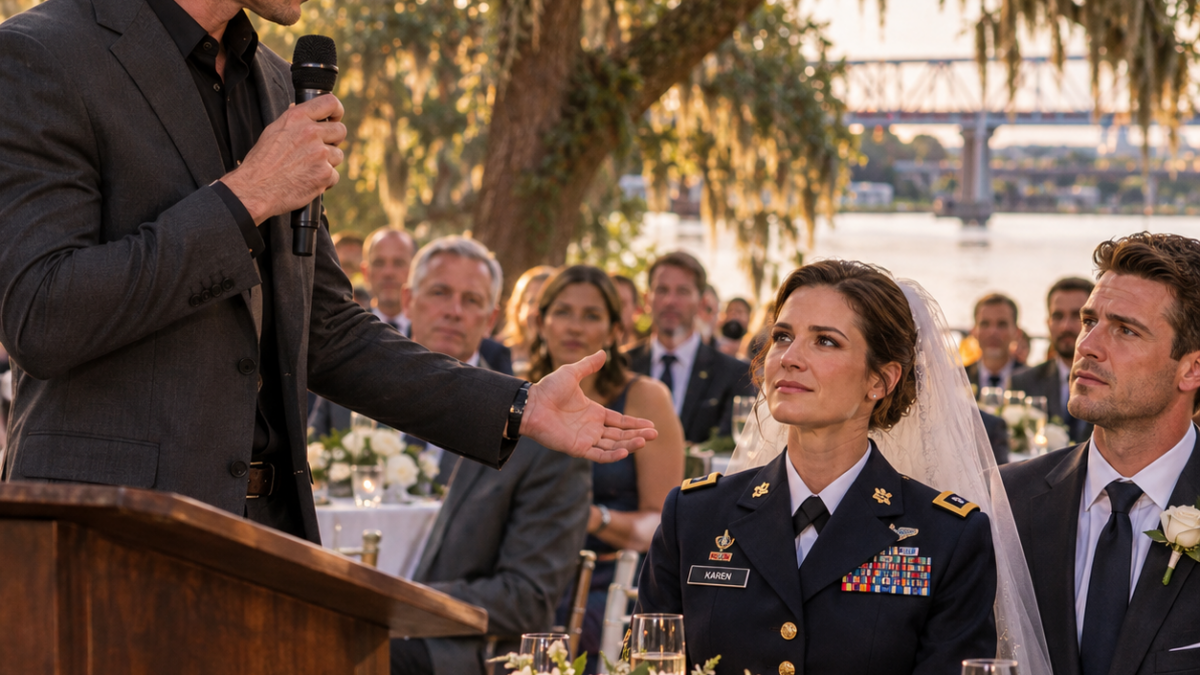
Two hundred wedding guests went dead silent when a decorated Navy SEAL walked up to the podium, took the microphone out of my father’s hand, and pointed straight at the medals pinned to my dress uniform. He looked out at the crowd and said I did not deserve to wear a single one of them, accusing me of faking my combat record to impress my new husband’s military family.
My hands went cold around my bouquet as whispers spread across the lawn. He thought he had ruined the biggest day of my life because my service file was classified.
What he did not realize was that the man standing beside the groom—his own best man—had been on that exact mission with us four years ago. Before I could say a word, his best man stood up, unbuttoned his jacket, and spoke into the silence.
My name is Karen Vance, and until the morning of my wedding, I believed the hardest days of my life were already packed away in a cedar chest at the back of my closet. I stood in front of the full-length mirror inside a small brick carriage house in Savannah, Georgia, smoothing down the dark navy wool of my Army service uniform.
Most brides spend months picking out satin gowns and lace sleeves, and I had actually bought a traditional white dress six months earlier that was still hanging in a garment bag in the next room. Three weeks before the ceremony, though, my grandfather passed away at 86 after spending 30 years in the military and always telling me nothing made him prouder than seeing his granddaughter wear the uniform with honor.
Putting on my dress blues, pinning my white bridal veil cleanly behind my bun, and fastening the row of ribbons over my left pocket felt like the only honest way to walk down the aisle with him still beside me. I spent eight years in the Army as an intelligence and trauma attachment, which looked nothing like sitting behind a desk in an air-conditioned basement reading reports.
For five of those years, I was attached to joint reconnaissance teams in remote mountain regions, handling forward signal intercepts and emergency field medicine when small units got cut off from main support. Because of how joint task forces operate, my official public duty roster listed me under a generic administrative logistics billet—standard Pentagon protocol for compartmentalized attachments so nobody can trace team movements back to your family.
I never felt the need to explain that to civilians, and once I left active duty to work as an emergency management consultant in Atlanta, I put the medals in a box and moved on with my life. That morning, looking at those ribbons in the mirror, my hands felt steady and warm.
I was 32 years old and marrying Dorian Mercer, a 34-year-old structural engineer who had spent the last two years making me laugh every single day. Dorian knew I had served in the Army and had seen tough deployments, though I kept classified operational details to myself—and he never pried, respecting boundaries in a way that made me feel completely safe.
The only person in Dorian’s family I barely knew was his older brother, Gavin, an active-duty Navy SEAL stationed on the West Coast during most of our engagement. Dorian spoke about him with a mix of brotherly loyalty and quiet distance—the way you talk about someone who always needs to be the loudest person in the room.
At 11:00 in the morning, Dorian and I stepped outside under the live oaks draped in Spanish moss to take a few quiet photos before the guests arrived. Just as the photographer raised her camera, a black rental SUV pulled up the gravel drive.
Gavin stepped out in his Navy dress whites, looking sharp and broad-shouldered, followed by a leaner man in a charcoal suit who walked with a slight, deliberate limp on his left side. Gavin walked straight toward us, ignoring the photographer as his eyes dropped immediately to the ribbons and the Joint Service Commendation Medal pinned to my jacket, without smiling or congratulating his brother.
– Well, Gavin said, his voice loud enough for the photographer and the wedding coordinator to hear. I didn’t realize we were doing full military dress today. Pretty bold choice, wearing combat ribbons in front of actual operators, Karen.
I kept my posture straight and offered him a polite nod.
– Good to see you, too, Gavin. Thank you for making the flight out.
Beside him, the man in the charcoal suit extended a hand with a warm, tired smile.
– I’m Leland Brooks, Gavin’s best man. Congratulations to both of you.
I shook Leland’s hand, noticing the faint silver scar peeking just above his shirt collar, completely unaware that I had already held his life in my hands four years earlier.
The ceremony under the oaks went off without a single hitch. Dorian’s voice broke slightly when he read his vows, and when he slid the gold band onto my finger, the tension from Gavin’s earlier comment faded into the background.
For a solid hour, I let myself breathe as 200 of our closest friends, relatives, and former colleagues filled the white canvas reception pavilion overlooking the river, clinking glasses while string lights flickered on against the late afternoon sky. Around 5:00, the catering staff poured champagne for the toasts, and my father, Arthur Vance, stood up at the wooden podium first.
He kept his remarks simple and warm, talking about how proud he was of the life I had built and how grateful he was to welcome Dorian into our family. He raised his glass, everyone cheered, and he started to step down so the band could begin the first dance.
Before my father even reached the bottom step, Gavin walked briskly across the dance floor and intercepted him without waiting to be introduced. He reached out, took the wireless microphone right out of my father’s hand, and gave him a tight, dismissive pat on the shoulder.
At the head table, Dorian frowned and leaned toward me, reaching for his napkin.
– I didn’t put him on the toast schedule, he murmured.
I placed a hand lightly over Dorian’s wrist to keep him seated.
– It’s fine, I whispered back. Let him say two words and sit down.
Gavin stepped up to the podium, adjusted his Navy dress white jacket, and tapped the microphone twice until a sharp feedback whine echoed through the speakers. The chatter across the 20 round tables died down immediately as 200 faces turned toward the front of the room.
– First of all, Gavin began, his voice booming through the PA system, I want to thank everybody for coming out to celebrate my little brother, Dorian. Anybody who knows Dorian knows he’s an honest, straightforward guy. He builds bridges for a living—he doesn’t cut corners and he doesn’t pretend to be something he’s not.
A polite ripple of applause went through the room, though a few people exchanged puzzled glances at his flat, serious tone. Gavin did not smile, turning his body slightly to face the head table and looking directly at the row of metals pinned over my heart.
– Which is why, Gavin continued, his voice dropping into a hard, lecturing cadence, it bothers me a little bit to sit here today and look at the uniform my new sister-in-law decided to wear to a family wedding.
A heavy hush fell over the pavilion—my mother’s fork froze halfway to her plate, and beside me Dorian’s posture went rigid.
– In the Navy SEAL community, Gavin said, pointing two fingers straight at my left lapel, we take service records seriously. People bleed for the ribbons they wear on their chest. So when my brother told me his fiancée was wearing her dress blues today, I did what any good older brother does—I had a buddy over at Personnel pull her public service summary.
My stomach tightened into a cold knot and my hands went numb around the stem of my water glass, though I kept my chin level and my eyes locked straight onto his.
– According to official Department of Defense records, Gavin announced loudly to the entire tent, Karen Vance spent her enlistment assigned to an administrative logistics unit—desk work, supply manifests. Yet she’s sitting up here today wearing a Joint Service Commendation Medal with combat distinction, acting like she kicked down doors overseas. You don’t deserve to wear those medals, Karen. Faking a combat record to impress a military family is disrespectful to everyone in this room who actually served.
Gasps broke out near the back tables as several guests turned in their chairs to stare at me, their expressions shifting from celebration to shock and awkward suspicion. Dorian shoved his chair back with a loud scrape against the floorboards, his jaw clenched so tight a muscle jumped in his cheek, ready to march straight up to that podium.
I caught the edge of Dorian’s dress jacket just as he rose halfway out of his chair: if he stormed up and started a shouting match with his brother in front of 200 people, the room would remember nothing else about our wedding day, and Gavin would walk away looking like the calm, reasonable veteran.
– Sit down, Dorian, I said under my breath, keeping my voice low and steady. Let me handle this.
Dorian looked at me, his eyes dark with anger, before slowly lowering himself back into his seat. I picked up my folded linen napkin, set it neatly beside my plate, and stood up.
The pavilion was so quiet you could hear the river lapping against the wooden pilings outside and the faint hum of the catering warmers near the back curtain. I knew why Gavin’s accusations sounded so convincing to everyone sitting at those tables: to someone outside joint special operations, a military personnel file looks like a simple open-and-shut ledger where every ribbon gets printed neatly under your unit code.
What Gavin counted on was that most people—and even standard Navy personnel clerks—do not have clearance to read behind a compartmentalized cover billet. Under Department of Defense Security Directives, when an intelligence specialist or field medic is seconded to a joint special operations task force, their parent branch masks their assignment under a routine support unit on unclassified databases—administrative cover—while you sign a strict 20-year non-disclosure agreement forbidding you from naming the task force, coordinates, or code names in public.
Gavin knew those rules existed because, as a Navy SEAL, he lived under them every day, making his ambush calculated: telling the full truth would violate federal security law, while staying silent would make me look guilty. Leaning both forearms on the wooden podium, Gavin held the microphone close to his mouth with a thin, satisfied smirk.
– Come on, Karen, he said, gesturing toward me in front of my aunts, my former colleagues, and Dorian’s parents. Set the record straight for everybody. Tell us the exact brigade, the theater, and the operation where a logistics clerk earned a combat distinction. We’re all listening.
Before I could take a step, Leland Brooks stood up from his chair, unbuttoned his charcoal suit jacket, walked smoothly onto the platform, and held out his hand for the microphone—taking it before Gavin could pull back—and the entire pavilion went dead silent at Leland’s first words, so quiet you could have heard a silver fork drop onto the carpet 50 feet away.
Standing beside the head table, I felt the warm river breeze blow through the open tent flaps, yet my arms were covered in goosebumps as four years of locked-away memories came rushing back all at once. I had never told Dorian what happened on that ridge, and I had never expected to stand in my wedding uniform listening to the man whose life I saved describe it to 200 strangers.
Leland kept his hands steady on the podium, looking out across the room so everyone could hear every word clearly.
– Four years ago this November, Leland began, his voice dropping into the flat, factual cadence of a military debriefing, our four-man reconnaissance team was inserted into a high-altitude sector to recover an encrypted communications relay before hostile fighters could reach the pass. Gavin was our team leader. I was walking point.
Gavin’s jaw tightened, his eyes darting toward his parents at the front table before snapping back to Leland.
– Leland, you’re out of line. That entire operation is still under command review.
– I’m not naming a single grid coordinate or country, Gavin, Leland cut in evenly, keeping the microphone aimed straight at himself. I’m talking about what happened to four men on a mountainside when the weather turned.
Turning his gaze back toward the crowd, Leland continued.
– At 0200 hours, a freezing sleet storm rolled into the valley and knocked out our satellite uplink. The only comms bridge we had left was a two-person Army forward signals and trauma attachment stationed on the upper relay ridge 600 yards above our position. We didn’t know her real name—over the encrypted net, we only knew her by her call sign: Vance.
At the head table, Dorian slowly turned his head to look at me, his eyes widening as the pieces clicked together. I kept my gaze fixed straight ahead, remembering the taste of sleet and copper in the back of my throat that night and the heavy weight of my 40-lb medical and radio pack digging into my shoulders while the wind howled across the rocks.
– Around 0315, Leland continued, a mortar round hit the limestone shelf right above our position. It triggered a rockslide that buried half our gear and threw me 12 feet down into a narrow washout. A piece of casing tore right through my body armor and punctured my left lung—I couldn’t breathe, I couldn’t stand, and my radio handset was crushed under six inches of shale.
I remembered hearing the sudden spike of static on my headset up on the ridge, followed by the sharp, panicked shouting of a team leader trying to regain control of a broken perimeter. Up on that ledge, my partner and I were ordered to pack up our relay dish and fall back immediately toward the primary extraction zone two miles north because incoming fire was closing the valley.
– When the secondary rounds started walking up the slope, Leland said, his voice tight as he looked straight at Gavin, Gavin gave the order to grab the encrypted comms hard drive and displace up the ridge. Our two rear guys tried to scramble down into the washout to reach me, and Gavin ordered them to leave me behind—he said I was already gone and that securing the drive was the only priority.
A collective gasp rippled through the front tables where Dorian’s parents and uncles sat, and Gavin’s face flushed dark red, his fists clenching at his sides.
– We were taking heavy fire from two directions! Gavin barked out loud, abandoning any attempt to sound calm. Command protocol puts mission-critical intel above recovery when an extraction window is closing—you know the rules, Leland, you don’t trade three live operators for one casualty!
– That’s right, Leland said softly into the microphone. You followed the textbook, Gavin. You took the hard drive, took the other two guys, and climbed out of that gully while I was drowning in my own blood at the bottom of the rocks—you didn’t even send down a flare.
Pausing with his eyes shifting from Gavin back over to me, Leland spoke steadily across the quiet room.
– And then the Army attachment on the relay ridge heard Gavin call me zeroed out over the open net—even though my biometric tracker was still pinging a weak pulse on her screen.
Nobody in the pavilion moved a muscle as Leland took a breath and continued speaking into the microphone. I stood beside the head table with my fingers resting lightly against the white tablecloth, watching the room absorb every word.
– When Gavin called my beacon dead over the encrypted channel, Leland said clearly across the tent, I was lying face down in freezing mud with my left lung collapsing, every breath sounding like wet gravel. I could hear the rotor wash of the extraction bird starting its final approach two miles north, and I knew I didn’t have 10 minutes left.
Up on the relay ridge that night, I had stared at the green pulse blipping weakly on my ruggedized tablet while my signals partner broke down the satellite dish and shouted over the wind that we had four minutes to reach the rally point or get left behind. Looking at the biometric readout and then down into the pitch-black washout below, I made a choice that would have gotten me court-martialed if it had gone wrong.
– I didn’t have backup, Leland told the 200 guests, gesturing toward me with an open hand. Gavin and the rest of the element were already halfway up the northern ridge with the hard drive. Then out of nowhere, I heard loose rocks sliding down the gully behind me—I thought it was an enemy patrol coming to finish the job.
Instead, it was me—a 28-year-old Army specialist sliding down 200 meters of wet shale in freezing rain with a 20-lb trauma kit strapped across my chest and my rifle slung behind my back. When I reached him in the dark, Leland was gray-faced and barely conscious, whispering the names of his parents into the mud.
– She didn’t hesitate for one second, Leland said, his voice tightening slightly as he looked out over the crowd. She cut open my thermal shirt in the freezing sleet, taped a vented chest seal over the shrapnel hole to stop my lung from collapsing, and ran a needle decompression right there in the dark while rounds were still cracking off the rocks above us. Then she rigged her tactical sling and a thermal emergency blanket into a drag litter.
I still remember the burn in my thighs and lower back that night: Leland weighed nearly 210 lb with his soaked gear and body armor. Stripping off his heavy ceramic plates to lighten the load, I hooked my forearms under the webbing of his vest and hauled him uphill 10 yards at a time, stopping every 30 seconds to catch my breath in the sleet while keeping my head below the ridgeline—my boots slipping on wet slate until my knees bled through my trousers and my hands went numb around his harness straps.
– It took her 45 minutes to drag me up that grade to the secondary landing zone, Leland said, looking directly at Gavin now. She stayed on the radio with a flight medic, calling out my vitals every three minutes so the bird wouldn’t lift off without us. When the helicopter finally touched skids on that gravel bar, she helped the crew chief heave me onto the floor, handed over my rifle, and didn’t even get on the bird herself because there wasn’t enough weight allowance left with the extra fuel load—she walked out with the ground relief column six hours later.
A stunned silence hung over the entire pavilion as my mother let out a quiet, shaky breath behind me and Dorian stared at me with a mixture of awe and fierce pride that made my throat tighten. Turning back toward the audience, Leland gripped the sides of the wooden podium.
– Three weeks later, Leland said, his voice ringing clearly through the speakers, Gavin received a Bronze Star with Valor and a promotion to senior team chief for recovering that communications drive. When I finally got out of the ICU at Walter Reed and read his official after-action report, there was one line at the bottom explaining how I survived: Gavin wrote that an unidentified local indigenous asset dragged me out of the washout.
Gavin’s mouth opened, then shut for the first time since he had grabbed the microphone, with nothing to say.
– That asset wasn’t a local, Leland finished, locking his eyes onto his former team leader. It was Karen Vance. She never filed a claim for credit, she never corrected the record, and she never bragged about it—even when you stood in front of her own family 10 minutes ago and called her a fake hero.
For three full seconds after Leland stopped speaking, the only sound inside the pavilion was the faint clatter of dishes behind the catering curtain and the wind rustling the live oaks outside. Swallowing hard as his eyes darted toward his parents and back to Leland, Gavin tried to project calm control without a microphone.
– You took a lot of shrapnel that night, Leland, Gavin said loudly. You were hypothermic, losing blood, and blacking out before the bird ever touched down—memory gets distorted under trauma. Every combat medic knows that if Karen had been attached to my element, her name would have been on my mission manifest. She wasn’t on my roster. Period.
– She wasn’t on your element’s manifest because she was attached to the joint signals relay on the upper ridge, Leland answered evenly, holding the microphone steady. Different command chain, same sector. And my memory wasn’t distorted when I woke up at Walter Reed with a vented chest seal stamped with an Army field serial number—a piece of gear Navy SEAL teams don’t even carry in their standard trauma kits.
Before Gavin could fire back another excuse, a chair scraped sharply against the floorboards in the front row, turning every head toward the table reserved for Dorian’s immediate family. Slowly and deliberately, Dorian’s great-uncle—retired Rear Admiral Hollis Mercer—pushed himself to his feet.
Hollis was 71 years old, silver-haired with the quiet, unmistakable bearing of a man who had spent 38 years in naval command and sat on two Pentagon joint oversight boards before retiring to Charleston. Though wearing a dark tailored suit rather than a uniform, the moment he stood up Gavin’s shoulders went completely rigid as Hollis’s voice carried across the quiet tent with effortless command authority.
– Gavin, Hollis said, his tone measured and ice cold. Look at me.
Turning toward the front table with his throat working to maintain posture, Gavin began to speak.
– Uncle Hollis—
– Not Uncle Hollis right now, Hollis interrupted smoothly. You are wearing a dress uniform in a public venue and you just made a formal accusation of stolen valor against an honorably discharged Army officer. So let’s clarify the exact administrative procedure you just invoked.
Taking two steps forward until he stood beside the edge of the dance floor with his hands clasped neatly behind his back, Hollis looked directly at Gavin.
– Four years ago this November, I was sitting on the Joint Special Operations after-action review panel at MacDill Air Force Base. I remember that winter mountain extraction very well—specifically because the encrypted communications drive your team recovered prevented a major regional breach, and because the casualty survival report drew praise from the Surgeon General’s office.
Gavin’s face drained of color, the flush in his cheeks vanishing within seconds.
– Under Department of Defense joint reporting directives and Article 107 of the Uniform Code of Military Justice, Hollis said, his voice ringing clearly so every guest heard the exact rule, a team leader filing an official combat after-action summary is legally required to verify the identity of any attached U.S. service member who renders life-saving aid during an extraction. Entering a false designation—such as listing an active-duty American soldier as an unidentified local asset in order to simplify your command narrative or keep sole credit on a valor citation—is not a clerical oversight. It is a falsified official statement.
A murmur spread through the room as the weight of Hollis’s words sank in, before Hollis turned his gaze gently toward me at the head table.
– Your name wasn’t on Gavin’s roster, Karen, because joint task force attachments are logged through the theater tactical operations center, not individual team manifests. That log does not disappear—it sits in the classified archive at Fort Bragg, cross-referenced by biometric beacon serial numbers and medevac flight manifests.
Turning back to Gavin with an unreadable expression, Hollis delivered the final blow.
– If you genuinely believe Karen fabricated her record, you are welcome to sign a formal challenge tomorrow morning, and I will personally pull the encrypted theater log for Naval Special Warfare Command. Would you like me to make that phone call on Monday, Gavin?
Staring at his great-uncle with a jaw locked so tight a vein pulsed along his temple, Gavin did not answer or say another word. Slowly, without looking at Dorian, his parents, or me, Gavin turned on his heel, stepped off the wooden platform, and walked straight out through the rear doors of the pavilion into the dusk.
The rear glass doors swung shut behind him, leaving a heavy, awkward silence for a beat before the bandleader quietly signaled the pianist to start soft background music while Dorian’s parents sat pale and shaken at their front table. Looking at me with a tight jaw before glancing toward the terrace outside, Dorian squeezed my hand.
– Stay here for two minutes, Dorian murmured, or come with me—either way, I’m not letting him drive off before he explains himself.
– I’ll come with you, I said quietly, wanting to hear the truth straight from Gavin’s mouth after letting everyone else speak for me all afternoon.
Stepping down from the podium and buttoning his shirt back up, Leland gave us a brief nod.
– I’ll walk out with you—someone needs to make sure he doesn’t try to spin this on the way to the parking lot.
Slipping through the side canvas flap onto the brick terrace overlooking the river in cool evening air smelling of damp marsh grass and salt water, we spotted Gavin 10 yards away leaning against the stone balustrade with his dress white jacket unbuttoned and his hands gripping the railing. Staring down at his shoes with sharp, uneven breaths, he didn’t turn around right away when our footsteps sounded on the brick.
– Save it, Dorian, he said, his voice flat and rough. I already know what it looked like in there.
– What it looked like? Dorian stepped up beside him, keeping his voice low so nobody inside could hear through the canvas, though anger burned in every syllable. You stood up at my wedding and called my wife a liar in front of 200 people. Gavin, why? You barely even met her this morning.
Letting out a bitter, humorless breath as he finally turned to face us without stage lights or a microphone, Gavin no longer looked like an untouchable war hero—only cornered and exhausted.
– Because when Dorian sent me the wedding program three weeks ago, Gavin said, avoiding my eyes and staring straight at Leland, I saw her maiden name printed under the family line: Karen Vance.
I frowned slightly.
– We never met face-to-face on that ridge, Gavin—it was pitch dark, sleet was coming down sideways, and I stayed on the secondary gravel bar until the ground relief column arrived.
– I didn’t know your face, Gavin admitted quietly, his shoulders slumping against the stone railing. I knew your name. Two years after that deployment, when my command was reviewing the casualty file, a clerk accidentally left an unredacted attachment sheet in the folder with a call sign—Vance—linked to an Army signals specialist from Georgia. I saw it for 10 seconds before the security officer pulled it back.
Leland’s eyes narrowed.
– You knew it was her the whole time.
– I put two and two together the night Dorian told me he was marrying a former Army medic named Karen Vance, Gavin muttered, rubbing a hand over his face. For four years, I’ve been the golden boy in this family. Mom and Dad have my Bronze Star framed in the hallway, and my fiancée thinks I single-handedly carried half my team off that mountain. If Karen married into this family and started comparing deployment dates with me at Thanksgiving dinner, it was only a matter of time before she realized I was the team leader who left Leland in that washout and wrote her out of the report.
Standing on the cold brick terrace listening to him, I felt every bit of anger inside me drain away, replaced by a quiet, sobering clarity: Gavin wasn’t some master schemer ruining my life for sport, just a deeply insecure man who had built his entire identity around a sanitized lie and tried to destroy my credibility first so nobody would believe me.
– I thought if I called your ribbons into question today, Gavin said quietly, looking down at the river, people would assume you were exaggerating your service and you’d keep quiet about yours.
Dorian stared at his older brother for a long moment, shaking his head slowly.
– She didn’t even care about your stories, Gavin, Dorian said softly. She wasn’t trying to outshine you—she was just trying to marry me.
Gavin did not return inside the pavilion that evening, walking down the gravel path to his rental car and catching an early flight back to the West Coast before midnight. Inside the tent, once Dorian and I returned to the head table, the mood shifted from tense shock to quiet, fierce warmth—my father raised his glass a second time, Dorian’s parents apologized privately with tears in their eyes, and we danced the rest of the night under string lights with the people who truly knew our hearts.
Two days later, while Dorian and I packed for a quiet honeymoon along the Blue Ridge Parkway, my phone rang with a Charleston area code—Rear Admiral Hollis Mercer.
– I hope I’m not interrupting your honeymoon, Karen, Hollis said, calm and direct. I wanted to let you know that I spoke with the deputy commander at Naval Special Warfare Command this morning. When a senior team leader falsifies an operational extraction summary and then publicly attacks the service record of the soldier who actually performed the rescue, the Navy does not sweep it under the rug.
Sitting on the edge of the bed holding the phone to my ear, I answered honestly.
– I didn’t file a formal complaint, sir—honestly, I just wanted to move past it.
– You didn’t have to file one, Hollis replied evenly. Leland Brooks submitted a sworn supplemental statement yesterday afternoon, and I requested a formal audit of the Joint Theater Archive from four years ago. All you need to do, if you are willing, is sign an authorization form allowing the Joint Review Board to unseal your encrypted deployment logs for internal verification.
Thinking of that night on the mountain ridge—the freezing sleet, Leland’s harness in my hands, and eight years of keeping my oath without asking for applause—I knew leaving a false official record on the books protected a lie rather than security.
– Send me the authorization form, I told him. I’ll sign it today.
Over the next six weeks, the review moved quietly through official military channels without a single headline or social media post—and because joint special operations records cross-reference satellite timestamps, biometric beacon pulses, and flight medevac logs, everything matched Leland’s testimony down to the minute. By late January, Gavin’s Bronze Star citation was formally amended to remove the fabricated casualty recovery claim, and he was permanently reassigned from operational team leadership to a non-deployable administrative training billet pending retirement eligibility.
Meanwhile, a certified envelope arrived at our home in Atlanta from the Department of the Army containing an updated DD-214 addendum and a formal citation upgrading my Joint Service Commendation Medal to reflect the combat medical extraction, signed by the joint task force commander—which I placed quietly inside the cedar chest alongside my grandfather’s ribbons rather than framing it on the wall.
The following weekend, before flying back to Colorado where he worked as a wilderness search-and-rescue instructor, Leland met Dorian and me at a quiet waterfront cafe overlooking the Savannah River—no uniforms, no microphones, just three cups of black coffee on a wooden picnic table in crisp morning air. Reaching into his jacket pocket, Leland slid a heavy brass challenge coin across the table—the unit coin he had been carrying in his flight suit pocket the night he was wounded.
– I never got to thank you while I was awake, Karen, Leland said quietly, meeting my eyes. You gave me four extra years of breathing, walking, and watching my niece grow up—I figured it was time you had this back.
Closing my fingers around the cool brass coin, I smiled.
– You earned every one of those years yourself, Leland. I just gave you a ride up the hill.
One year after our wedding in Savannah, life has settled into a rhythm so peaceful I sometimes stand in our hallway just to listen to the quiet. Dorian and I bought a two-story Craftsman house outside Atlanta with a wide front porch and an oak tree in the backyard reminiscent of the river bluff where we said our vows.
Most mornings Dorian leaves early for his structural engineering firm with a thermos of coffee in hand, kissing my forehead before heading down the steps, while I—seven months pregnant with our first child, a baby boy we plan to name Arthur after my father—spend weekdays working remotely as an emergency management consultant helping county hospitals and municipal agencies build realistic disaster response plans.
My Army service uniform still hangs neatly in a protective garment bag at the back of our master closet right beside Dorian’s framed architectural blueprint of our home, its heavy navy wool and crisp metal ribbon edges brushing my fingers whenever I reach for a sweater. Gavin and I have not spoken since that evening on the brick terrace; Dorian tells me his older brother is finishing the final year of his enlistment in a West Coast administrative training office, sending brief, polite check-in texts every few months without ever mentioning the wedding or that mountain ridge—and Dorian replies with measured kindness, knowing some bridges take years of quiet humility before anyone can safely walk across them again.
Leland Brooks, on the other hand, has become a permanent part of our lives, flying down from Colorado twice a year and already volunteering to teach our son proper climbing knots as soon as he is old enough to hold a rope—with no dramatic speeches about the past, just grilling burgers on the back patio and letting the silence between us feel comfortable and earned.
Looking back on that afternoon in Savannah when 200 people sat frozen while a decorated Navy SEAL pointed at my chest and called me a fake hero, I know today I did the right thing by holding my ground in silence: real courage rarely announces itself with a microphone, and when you have walked through freezing sleet in the dark to carry another human being to safety, you never need to prove your worth at a banquet table or tear someone else down to make your own shadow look taller.
Lies require constant maintenance, forcing you to look over your shoulder and panic whenever someone who knows the truth walks into the room—whereas the truth sits patiently in official records, in the scars people carry, and in the quiet integrity of how you treat others when nobody is keeping score. Ultimately, a lie requires endless energy to protect while the truth stands firmly on its own, and when the moment arrives, integrity always speaks louder than pride.