I Hired Grandpa’s Live-In Caregiver. He Scrawled “Marry Her” on His Board—She Didn’t Erase It
I Hired Grandpa’s Live-In Caregiver. He Scrawled “Marry Her” on His Board—She Didn’t Erase It
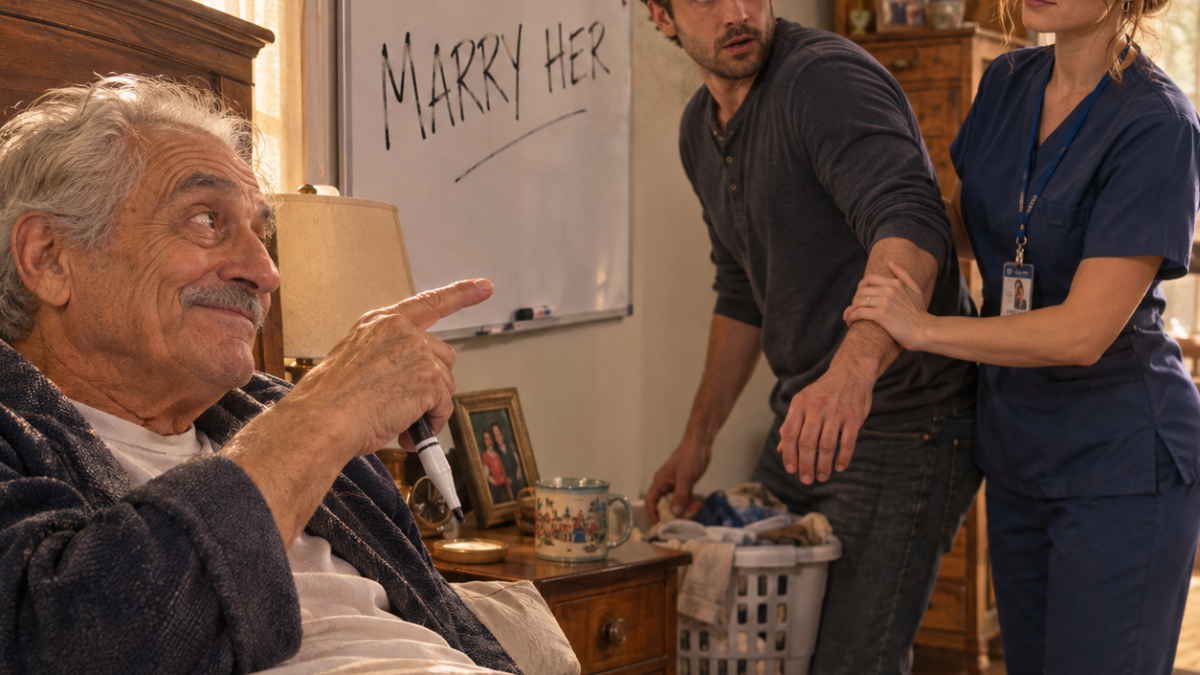
My grandfather wrote two words on his whiteboard that Tuesday morning, and he waited until I was standing in the doorway to finish them. Walter Bellini had not spoken a full sentence since his stroke in the spring, but he could still hold a marker, and the letters came out in shaky capitals that leaned downhill: MARRY HER.
I stood there with a basket of his clean laundry against my hip while he lifted one trembling finger from the board and aimed it across the room at Nina Voss. She was at the bedside table sorting his morning pills into a paper cup, and she read the words, glanced at him, and kept her face perfectly professional.
My name is Dario Bellini, and I dispatch buses for a living, which means I fix problems the second they appear. So I set the laundry down and crossed to the board with the heel of my hand already out to wipe it clean. I never got there.
Nina’s fingers closed around my wrist, quick and firm and not at all rough, with the grip of someone who moves grown men out of bathtubs for a living.
– Don’t, she said. That’s his work.
I told her it was obviously a joke at her expense and that she shouldn’t have to stand in a room while my grandfather embarrassed her. She let go of my wrist without stepping aside and said that Walter had been practicing his letters for three weeks and that she did not erase a patient’s writing because it made the room uncomfortable. She said it in the same even voice she used for blood pressure readings, and I noticed she still had not looked at me.
Behind her, my grandfather made a low, satisfied sound in his throat like a man who had just watched two pieces of a puzzle meet. I crouched beside the bed so my face was level with his, because I had spent three months learning that Walter hated being talked down to more than he hated the stroke.
– Nonno, do you know what you wrote? I asked.
His mouth worked on the word for a moment, the right side doing most of the effort, and then it came out thick, but unmistakable.
– Yes.
He tapped the marker twice against the board, once on the words and once on the empty space around them. The look he gave me was the same one he used to give me over a chessboard when I was 11 and about to lose a rook. I realized I had been about to wipe out my grandfather’s opinion because it was inconvenient, and that I would never have done it to him a year ago.
Nina leaned over the bed and told him the corner could stay as long as he liked, but the rest of the board belonged to what he needed, like water, pain, the bathroom, or the Browns game. Walter pointed the marker at her and tapped it once, which in our house meant agreed.
I should explain how a man who dispatches buses ends up in his grandfather’s spare room. Walter lived alone for 20 years after my grandmother died, and when the stroke put him in the hospital, I moved into the house outside Cleveland for what I told everyone would be a few weeks. Those weeks became three months, and I hired an agency to place a live-in nurse so I could eventually go back to my own apartment without leaving him unsupported.
Nina arrived six weeks ago with two suitcases, a travel mug the size of a fire extinguisher, and a way of talking to my grandfather as though his silences were just slow answers. Somewhere in her second week, I had decided that whatever I felt about the woman I had hired to live in his house was mine to carry quietly, and I had been carrying it ever since without much grace. Her room was at the end of the upstairs hall, and I walked past it every night with a great deal of unnecessary concentration.
For the rest of the morning, we both behaved as if nothing had happened, and we were not good at it. Nina changed Walter’s sheets while I made eggs, and when I carried a plate into the bedroom, she said without turning around that I could stop checking my wrist because she hadn’t bruised it. I told her I was only looking for evidence in case there was paperwork.
She said the agency did have an incident form for that—section four, grandson attempting unauthorized erasure—and she had left it blank out of professional kindness. I laughed a half second too late, and she turned back to the pillowcase a little sooner than the pillowcase needed her. Neither of us said anything about the board after that, but the words sat in the corner of the room like a third person who had decided to stay for lunch.
By afternoon, I was in the spare room folding shirts into boxes because the plan had always been that I would move back to my apartment as soon as the household felt steady. Walter was napping, and down the hall I could hear Nina doing his range-of-motion exercises and keeping up a running commentary about a retired quarterback she did not respect. When I went to get tape from the hall closet, I passed his door and saw that she had wiped the board clean for the afternoon schedule.
She had written “walk at three” and “stretches” and “new pills at six” in her small square handwriting, and she had set every line carefully around the corner, leaving a margin of exactly one hand’s width on every side of “Marry her.” The physical therapist had come and gone that day, and so had the woman from the agency who checked in on Tuesdays, and either of them would have cleared that board in two swipes if Nina had so much as raised an eyebrow. Nina had not raised one, and as far as I could tell, she had not asked my grandfather even once whether he wanted it to stay.
I stood in the hallway holding the tape and understood that I had made a decision about her before I knew anything. In the half second before I reached for the eraser, I had assumed she wanted the words gone, and I had been so sure of it that I never thought to ask. She had told me the board was Walter’s, and I believed her, but I could not tell if that was the whole answer or only the part she was free to say while she was on the clock.
I also could not tell what she had made of my hand going for the eraser so fast, or what it had told her about how I felt about being tied to her in a sentence. I did not know yet how long those two words would stay there. That evening, while she gave Walter his six o’clock pills and he took them with an impatient dignity that made me proud of him, I stayed in the kitchen doorway and rehearsed three different ways to bring it up.
Every one of them sounded like I was handing her a bill for something my grandfather had written. If I apologized for the eraser, I might make her feel she had to reassure me, and if I said nothing, I would be deciding for her again that the subject was closed. I could not ask what she wanted without turning Walter’s wish into a question she was obliged to answer, and I could not leave it alone either.
When she came out and said good night with her usual dry half-smile and the travel mug already in her hand, I still had not worked out how to say a single true thing to her without making it her problem. I did not solve it with a speech that night, so I tried to solve it with behavior the next morning. When I walked into my grandfather’s room on Wednesday, the words were still in the corner of the board—Marry her—with the same shaky downhill slant.
I looked at them once, the way you look at a stop sign on a route you drive every day, and then I turned to Walter and asked whether he wanted the window cracked. He watched me the way he used to watch a cheating card player, waiting for the joke I had decided not to make. I made a point of keeping my eyes on him while I opened the window, and I kept them there when I heard Nina come in behind me with his coffee and the blood pressure cuff.
It was harder than dispatching a snowstorm. Every part of me wanted to check her face for a reaction, so I assigned myself a job instead and spent 20 minutes shaving my grandfather with the electric razor he claimed to hate. Walter let me work without comment until I reached the jaw on the weak side, where he lifted the marker and tapped it once against the corner of the board as if testing whether I would flinch.
I said the Browns had a pass rush this year that was going to disappoint him, and he gave me a disgusted wave that meant I had failed the test in the best possible way. Nina wrote his pressure numbers on the chart and did not say a word, though I thought I caught the corner of her mouth moving. I found her alone in the upstairs hall around 11:00, carrying an armful of towels toward the linen closet, and the lanyard with her agency badge swung against her chest as she walked.
I had practiced three openings the night before and abandoned all of them, so I just stood in her way and said I owed her an apology. I told her I should have asked before I went for the eraser because I had decided what she wanted without checking, and that it was a habit of mine she had probably noticed. She shifted the towels to her other arm and looked at me properly for the first time since Tuesday.
– I stopped you because it was Walter’s board, she said. That’s what I was defending. It isn’t an answer on my own behalf, and I’m not going to give one while I’m wearing this.
She tapped the badge with one finger lightly, like a woman marking the edge of a property line. I nodded, and I felt both relieved and a little foolish, which was an odd combination to carry down a narrow hallway. The sensible next move seemed obvious, so I made it.
I told her that if the whole thing was awkward for her, I could keep my distance until I moved out on the 22nd, and I would do the lifting and the lawn and the pharmacy runs without crowding her workday. She set the towels on the closet shelf, squared the stack with both hands, and turned around with an expression I had last seen on a driver who tried to explain a missed stop.
– Dario, you just did it again, she said. Yesterday you decided I wanted the writing gone, and today you’ve decided I want you gone. And neither time did you ask me.
I opened my mouth, shut it, and discovered there was no good defense available.
– Section five, I said finally. Grandson proposing unilateral distance.
Nina laughed, a short real laugh that surprised both of us, and said the agency did not have a section five, but that she would be happy to draft one. The old humor was back between us, the dry back-and-forth we had worn smooth over six weeks of passing the salt, but neither of us used it to wave the correction away. When the laughing stopped, she was still standing there waiting, and I understood that the question had been real.
I asked what she actually wanted from me, and I asked it as a question I was prepared to have answered with something other than what I hoped. She took a moment with it, and her answer was smaller than I expected. She said she didn’t need me to disappear and she didn’t need me to hover, and that what she wanted was for me to keep arguing with Walter about his oatmeal and stealing her good coffee filters like the man who lived here.
– The usual, she said. If the usual is still available.
I told her the usual was available and had been for six weeks, and she picked up the empty laundry basket and went down the stairs without adding anything. I stayed in the hall a minute longer than I needed to, aware that I had been corrected and had somehow come out of it feeling more steady than I had in days.
After that, I tried to be the man she had described, which turned out to be an exercise in noticing what I normally did without thinking. I still brought Walter his tea at four, still read him the sports page in my worst Cleveland accent, and still left the corner of the board alone when I wiped down the tray beside it. When I felt myself getting self-conscious, I dealt with it myself by taking out the trash or fixing the loose hinge on the pantry door instead of narrating my discomfort to Nina and asking her to manage it.
She noticed, I think, because on Thursday she handed me a wrench without being asked, and on Friday she stopped mid-sentence in the kitchen.
– You’re being very normal, and it’s slightly unsettling, she said.
I told her I was working on it, and she said to keep going. The calendar on the refrigerator had been there since her first week, a plain paper one from the pharmacy with her schedule penciled in her square handwriting. Every other Saturday from 1:00 until 5:00, a relief aide from the agency took over Walter’s care so that Nina could leave the house, and this Saturday was circled.
I had read that square a dozen times without ever thinking about it because it was simply part of how the household ran. On Friday evening, while we were both unloading the dishwasher, she mentioned the aide would arrive at 12:30 to get the handoff, and I said that was good—she should get out of the house and not think about any of us. I heard how that sounded as soon as it left my mouth, a little too careful and a little too generous, and I added that I would make sure the aide knew where Walter kept his good blanket.
Nina put a plate in the cabinet and told me that sounded like the perfect amount of nothing. That night, I climbed the stairs past her door the way I had every night for weeks, except that this time I did not concentrate on the carpet. The line of light under her door was still on, and I could hear her moving around the room, probably packing a bag for the afternoon or just ignoring me in a very professional way.
I stood at the top of the stairs with a clear picture in my head of how easy it would be to ask what she planned to do with her four hours. I also knew that any question I asked in that house, with the board down the hall and her badge on the dresser, would arrive carrying everything else with it. Whether two people could choose even one small hour without dragging my grandfather’s two words or her whole workday along was something I did not know, and I did not yet see how we would find out.
The relief aide arrived at 12:30 on Saturday, a gray-haired woman named Pamela who carried a canvas bag full of crossword books and talked to my grandfather as if he were a coworker she respected. Nina walked her through the handoff in the bedroom—the two o’clock fluids, the transfer belt, the pillow Walter liked under his weak arm, and the good blanket, which I had already told Pamela about twice. My grandfather watched all of this with the patience of a man who had been handed off before and expected to outlast the people doing it.
The board beside his bed still had the usual schedule in Nina’s square handwriting with a hand’s width of margin around “Marry her” in the corner. When the handoff was finished, Nina rested her palm on the rail of the bed and told him she would be back at 5:00. Walter tapped his marker once against the board, which meant agreed, and he did not write anything else.
I was in the kitchen pretending to sort pharmacy receipts when she came downstairs at ten to one. She was wearing jeans, sneakers, and a gray Cleveland State sweatshirt with the cuffs pushed up, and her hair was down, which I had seen exactly twice. The lanyard was gone, and without it she looked like a woman I had met at a bus stop and not the nurse I had hired through an agency.
She stopped at the counter, picked up the travel mug I was pointedly not looking at, and said she was going to walk down to the creek.
– You can come, she said, or you can stay here and fold more shirts into boxes. Either way, I’d like it noted that I asked.
I understood immediately that how I answered would matter more than what I answered. If I said yes too eagerly, I would be treating the afternoon as something she had already agreed to, and if I hesitated, I would be handing her another decision I had made on her behalf. So I said I would get my shoes and that I wasn’t calling it anything.
She looked at me for a second with her head tilted, and a small, dry smile showed up that I had not been given in days.
– It’s not a date, she said, and I’m saying so out loud so neither of us has to guess.
I told her that was the most efficient clarification I had ever received from a woman, and she said the agency trained her for it. The creek ran through a strip of county park about a 10-minute walk behind the house, and the path to it started at the end of my grandfather’s cul-de-sac where the sidewalk gave up and turned into gravel. It was one of those warm September afternoons when the light comes through the maples at a low slant and everything smells faintly of cut grass and somebody’s barbecue.
For the first few minutes, neither of us said much, and I noticed that without the house around us, the silence was a different kind. In the kitchen, it had always felt like a held breath, but on the trail it felt closer to two people deciding how fast to walk. Nina set the pace, which was quicker than I expected, and I fell into it the way I would match a driver on a tight schedule.
Somewhere past the first footbridge, we started catching each other making assumptions, and it turned into a game neither of us announced. I told her I had figured she would hate the outdoors since she had spent six weeks inside my grandfather’s house with a travel mug the size of a fire extinguisher. She said she had grown up two streets from a quarry in Lorain and had been skipping stones since before I could parallel park, then picked up a flat rock from the bank and sent it four times across the water without looking at it.
I picked one up and managed two skips and a sink. She told me she had assumed a dispatcher would spend the whole walk explaining the best route, and I admitted that I had been planning the loop in my head since the driveway, so she turned us left at the fork purely to see my face. It was a good face to see, apparently, because she laughed until she had to put one hand on a fence post.
The attraction was there the whole time, and I could not have pointed to the exact moment it got louder. It was in the way she answered a question by looking straight at me instead of at the path, and in the way I kept my hands in my pockets because I did not trust them. At one point, the trail narrowed where a tree root had pushed up the gravel, and she steadied herself with two fingers on my sleeve and then left them there a second longer than the root required.
Neither of us mentioned it, and I kept walking at exactly the same speed, because I knew that if I slowed down, I would be announcing that I had noticed. For a stretch, we talked about ordinary things—her brother’s terrible dog and the transit authority’s new fare system—and every ordinary sentence seemed to carry a little more than its words. We sat on a bench by the water for a few minutes, and she took a long drink from her mug before she said what she had clearly been carrying since the house.
– Here’s what I can tell you, she said. What Walter wrote is Walter’s. I’m not going to erase it, and I’m not going to treat it like a contract either. Whatever I decide about you is mine to decide, and it isn’t going to be decided in his room or in the hallway upstairs with a towel in my arms.
She said it evenly, the way she told my grandfather what the next hour would hold, but she was gripping the mug harder than the mug required. I felt the pull of every question I could have asked next—whether she had decided, what she was leaning toward, whether the answer was already close—and I asked none of them. I told her that was fair and that I would rather she take as long as she needed than give me something fast because I had pushed.
Nina watched me for a long moment as though she were checking my pupils.
– That’s it? she asked. You’re not going to ask me anything?
I said she had just told me the decision was hers and that if I started negotiating it on a bench, I would be doing the same thing I had done with the eraser, only slower. She set the mug down between us and bumped my shoulder with hers once, firmly, like a person closing a door on a draft and an invitation at the same time.
– Okay, she said. Good.
Then she stood up and said we had 40 minutes before her shift started and that she did not intend to spend them being careful. We spent them badly in the best sense: we got a little lost on a side trail she insisted she remembered, we argued about whether the water was shallow enough to wade, and she told me the story of the first patient who had ever proposed to her, an 80-year-old retired welder who offered her his pension and a lake cabin if she would stay on. By the time we came back up the cul-de-sac, the barbecue smell had faded, and the afternoon had begun to lean toward evening.
At the end of the driveway, she looked at the house, and I watched her do something that took about two seconds and was entirely deliberate. She straightened her shoulders, tucked her hair behind her ears, and walked in ahead of me five minutes before her shift began, while I stayed on the porch long enough to look like a man who had gone out for the mail. When I stepped into the hall, she was already in the bedroom taking report from Pamela with the lanyard clipped back to her sweatshirt and a pen in her hand.
– Hi, Dario, she said in the same polite, even voice she had used on Tuesday morning, and she did not look at me twice.
I understood that she was not retreating from the walk because she had told me that the walk was hers and the assignment was hers too. She could carry both without letting either one touch the other, and I watched her do it as easily as she changed Walter’s sheets. My grandfather glanced from her to me from his pillows with an expression that was almost innocent, and I noticed that the board still carried only the daily schedule, the corner untouched with nothing new added for either of us to read.
I went up to the spare room and sat on the edge of a half-filled box of shirts, listening to Nina’s voice through the floorboards as she settled him for the evening. The afternoon had given us something neither of us had named, but it hadn’t given us a plan, and nothing about it had changed the house I was still living in or the work she was still doing under its roof. The calendar in the kitchen said the 22nd was nine days away, and I knew I could let those days run out the way you let a green light go to yellow, hoping the decision would be made by the signal.
I had spent my whole career making sure no one drove through that kind of silence, and I was starting to see that not asking her was a choice of its own and that it might cost us both. Walter used the open part of his board more that week than he had since the stroke, as though he wanted it on record that two words in a corner did not make him a man with only one opinion. On Sunday he wrote “no oatmeal” in letters so heavy the marker squeaked, and on Monday he wrote “Browns stink,” which Nina and I agreed was the first accurate thing he had said about the team all season.
He asked for his good cardigan with the single word “sweater,” and on Wednesday he wrote “window,” then “cracked,” then “closed,” like a small and very unfair government issuing orders. “Marry her” stayed in its corner through all of it with a hand’s width of margin around it, and nobody touched it, including him. Once I caught him looking at it while Nina was down the hall with the expression of a man rereading a letter he had no intention of answering, and I did not ask him about it because my grandfather had always told me what he wanted me to know on his own schedule.
I spent those days finishing the move the way I would close out a shift, one item at a time and without any drama. A friend from the garage, Luis, had agreed to bring his pickup on the 22nd, so I taped the last boxes and labeled them in marker, and I transferred Walter’s prescriptions to the pharmacy two blocks from his house. I taped a card with every phone number that mattered to the refrigerator door in handwriting large enough for me to read without my glasses, and I mounted a second grab bar beside the bathroom doorway after the physical therapist said Walter’s balance was improving faster than the old one could keep up with.
I also called the agency and confirmed the on-call nurse for nights, the weekly check-in, and the relief schedule, not because I doubted any of it, but because I wanted to see it written down. None of it was a reason to stay another day, and I noticed that I was careful not to let it become one. On Tuesday evening, Nina walked me through the plan for the first week after I left, standing at the kitchen counter with her clipboard and a pencil behind her ear.
She covered the overnight protocol, the two-person transfer for the bathtub, and the number to call if his speech got worse, and she went through it all in the voice she used for Walter’s chart. I asked whether she was comfortable being alone in the house with him at night, and she answered that the on-call nurse was 12 minutes away and that Walter had survived worse than me leaving. She said nothing about herself at all, and she did not soften it with a look or a pause that asked me to notice.
A week earlier, I would have studied that silence for hidden meaning, but now I just thanked her for the plan and put it in my shirt pocket. I had been treating those two words on the board like a debt she owed me an answer on, and I had finally understood that she owed me nothing, and neither did he. The paper calendar on the refrigerator had one more square I had never really looked at: Monday the 22nd was marked in her square handwriting with “off,” and underneath it, “P 9–6.”
When I asked the agency about coverage, the scheduler had explained that Nina was owed a banked day from her first month and had picked a date weeks ago before any of us knew what Walter would write on a Tuesday. I had chosen the 22nd back in August, long before she arrived, because it was the Monday my lease renewal ran out. So the day I was leaving and the day she was free had landed together by accident, and I found I could not tell whether that was luck or a very practical kind of trap.
I did not mention the square to her, and I decided I would not use it as an opening, because if I ever asked her for anything, it had to be something she could decline without it touching her job in this house. I told Walter on Sunday night, the night before I left, after Nina had gone upstairs to call her brother and the house had gone quiet. I pulled the chair up beside the bed the way I had every evening for three months and said I was moving back to my apartment tomorrow, exactly as planned.
He looked at me for a while, and then he lifted the marker and wrote “good” in the open space, in shaky capitals that no longer leaned quite so far downhill. I told him I would be here Thursday for chess and Sunday for dinner and whenever else he wanted, and that nobody was going to get rid of me just because I had a bed across town. He thought about that, tapped the marker once, and wrote “Sunday,” then “pasta,” then underneath, “my sauce,” in case I had gotten ideas about the recipe.
I laughed, and then I made myself say the harder thing because he had earned the courtesy of hearing it straight. I said that I had seen what he wrote on the board and that I knew he meant it, but that whatever happened between Nina and me would be ours to work out and I was not going to put it on him to fix. I said he had spent his whole life taking care of other people and he was allowed to rest from this one.
My grandfather watched my face with the patience of a man who had been waiting a long time to see whether I would grow up on my own. Then he put the marker down on the blanket and did something I did not expect, which was to reach over with his good hand and rap his knuckles twice against my forearm, the same way he used to knock on the table when I made a decent move. He did not write anything else and he did not point toward the stairs; he settled back against the pillows, closed his eyes, and I understood that he had said what he meant to say a week ago and that he was done making my decisions for me.
I sat with him until his breathing slowed, then carried the empty teacup down to the kitchen and rinsed it, though no one had asked me to. The house had its usual night sounds—the old furnace ticking and a floorboard overhead where Nina was still moving around. My boxes stood by the front door in a neat stack, labeled in my own block capitals, and the truck was coming at 10:00 in the morning.
I had made the plan to leave and kept to it, and I had not let a whiteboard or a hand’s width of margin change a single date on the calendar. What I had not decided was whether I would ask Nina for an hour of her own free time before I walked out the door, or whether I would carry my boxes to Luis’s truck and leave it unsaid. I turned off the kitchen light, still not sure which man I would be at 10:00.
Pamela arrived at 9:00 on Monday with her canvas bag of crossword books, and by quarter past she was sitting beside my grandfather’s bed telling him a seven-letter word for stubborn. Walter wrote the answer on the open part of his board before she finished the clue. I said goodbye to him there, in the same chair where I had spent three months of evenings, and I did it as his grandson and nothing else.
I told him I was taking the last boxes to Luis’s truck, that I would be back Thursday for chess, and that he should not let Pamela win at anything. He wrote “Sunday” in the open space, underlined it twice, and tapped the marker once against the board, which meant agreed. “Marry her” was still in its corner with a hand’s width of margin around it, and neither of us looked at it.
The boxes took four trips, and Luis backed his pickup into the driveway at ten to ten, whistling at the number of shirts one man could own. I carried the last box out to the truck bed and then stood on the porch for a minute because I had made up my mind about something and wanted to be sure it was mine. Nina was in the kitchen with her travel mug, in jeans and a gray sweatshirt with no lanyard anywhere on her.
The calendar on the refrigerator still said “off” in her square handwriting, which meant nothing she did in that room could be called work. I walked in and rinsed my hands at the sink for no reason, and she watched me do it with the look of someone who knew a stall when she saw one.
– I’m going to ask you something, I said, and I want it understood that it’s from me. It isn’t from the board and it isn’t from Walter. If you say no, nothing changes about your work or the house or how I treat you when I come for chess.
I had practiced a longer version in the shower, but all of it had sounded like a man trying to hand her an exit, so I cut it down to the part that was true. Then I asked her if she would have dinner with me, somewhere that wasn’t this house, on a night she chose. She set the mug down on the counter very slowly.
For a few seconds, the only sound was Luis outside, dropping the tailgate and complaining about a box labeled “books” that was apparently full of bricks.
– You asked me a question, she said. A real one, with a no built into it.
I said I had been told it was a habit worth developing. She laughed under her breath, nodded at me, and then she went quiet again, and I did not fill the quiet, which was the hardest thing I had done all month. She picked the mug back up and turned it a quarter turn on the counter, the way she did when she was sorting out the order of a day.
– Saturday, she said. Pamela covers from one, and I’m not driving back to this house to change first. There’s a diner outside Lorain about a mile from the quarry I grew up next to, and I’ll meet you there at two.
I said yes before she had finished the sentence, and she held up one finger the way she did when Walter tried to skip a pill.
– I picked the place because I’d like to be on ground I know, she said. And Dario, this one is a date. I’m saying it out loud again so neither of us has to guess.
It took me a second to hear the callback, because the first time she said it she had been walking out the door in a gray sweatshirt with her hair down. I told her it was the most efficient clarification I had ever received from a woman, and she said the agency had trained her for it—and then, a little more quietly, that the agency had nothing to do with this one. She walked me as far as the front hall, not the porch, and her hand brushed the back of mine on the doorframe, brief and deliberate, before she stepped back.
Luis drove with the windows down and did not ask a single question until we hit the highway, and then he asked only whether I looked that happy because of the apartment. I told him it was a mix of things. In the side mirror, the house got small at the end of the cul-de-sac, and I thought I saw someone in the upstairs window, though the glare made it hard to say whether it was Walter propped on his pillows or just the curtain.
I spent the week unpacking boxes in an apartment that smelled like closed windows, and on Thursday I drove back for chess and lost two games in a row to a man who could not say a full sentence. Nina was at the kitchen counter when I came in, back in her lanyard and her professional voice, and she handed me my grandfather’s evening schedule without any special look. She had told me the house was one thing and Saturday was another, and by then I believed her.
The diner sat on a county road where the houses thinned out, and she was already there when I pulled in, leaning against the hood of a faded blue Honda with her arms crossed and her sunglasses pushed up into her hair. Without the lanyard, the sweatshirt, or my grandfather’s bedside table between us, she looked like the person she had told me she was on the trail. We ate cheeseburgers in a booth by the window, and she told me about a summer when she and her brother had tried to sell quarry rocks to tourists who never came.
I told her that I once rerouted three buses around a parade and was still thanked for it by a woman who had not been on any of them. Nothing in the conversation depended on a pill schedule, a transfer belt, or a handoff report, and I noticed that we had no trouble finding things to say. Afterward, she walked me down a gravel road to the edge of the quarry, a wide, dark bowl of water with scrub trees leaning over it and a cold wind coming up off the surface.
She bent, picked out a flat gray stone, and sent it across the water in seven clean skips before it vanished. I found one of my own and managed three, which was one more than I had managed at the creek, and she announced that she was recording it as measurable progress.
– I want to tell you something, she said, stopping there with her hands in her sleeves and her eyes on the water. I’m not here because Walter wrote anything. I’d have said yes on Monday if it had never been on that board, and I think I’d have said it a month ago if I weren’t wearing a badge. I just didn’t want an answer that came with a patient attached to it.
I said I was glad she had picked the quarry because I had spent a long time wanting to know what she looked like when nobody was handing her a chart. She reached over, took hold of my sleeve with two fingers exactly where she had held it on the root-broken trail, and this time she did not let go at the end of a second. Her free hand came up to the side of my face, steady and warm and a little cold from the wind, and she kissed me before I could work out whether to ask.
It was unhurried, with the clear intention of a woman who had thought it over for six weeks and was not going to be rushed by the weather. When she stepped back, she was smiling in the dry, lopsided way I had been quietly collecting since September, and she said that if I wanted a form for that, there was no section for it.
I still drive to my grandfather’s house on Thursdays for chess and on Sundays for pasta, and he still makes me stand over his sauce while he writes corrections on the board. Nina and I fit our evenings around her schedule and Pamela’s, and we never talk about Walter’s side of the house at the table where we eat. She told me on a Sunday in October that she was not going to marry me on command, and I told her I had not asked, and we both looked at the corner of the board to see if he was listening.
“Marry her” is still there, a little faded with a hand’s width of margin around it, and every new order from my grandfather written well clear of it. He has never mentioned it to either of us, and I have come to understand that it belongs to him. I used to believe that fixing a problem meant doing something about it before the next bus came.
It took an old man with a marker and a nurse with a firm grip to teach me that some questions are not mine to settle, and that the best answer is the one the other person gets to give for herself. I think about that two-word line less as an instruction now and more as a place I was lucky enough to start from.
If you were Dario, would you have asked her before the truck pulled away, or waited until you were sure she would say yes? Tell me in the comments what you would have done, and if this story kept you company tonight, hit like and subscribe so you don’t miss the next one.