6 Men Cornered a Female CEO—Then a Single Dad’s Navy SEAL Past Left Their Leader Stunned
6 Men Cornered a Female CEO—Then a Single Dad’s Navy SEAL Past Left Their Leader Stunned
PART 1
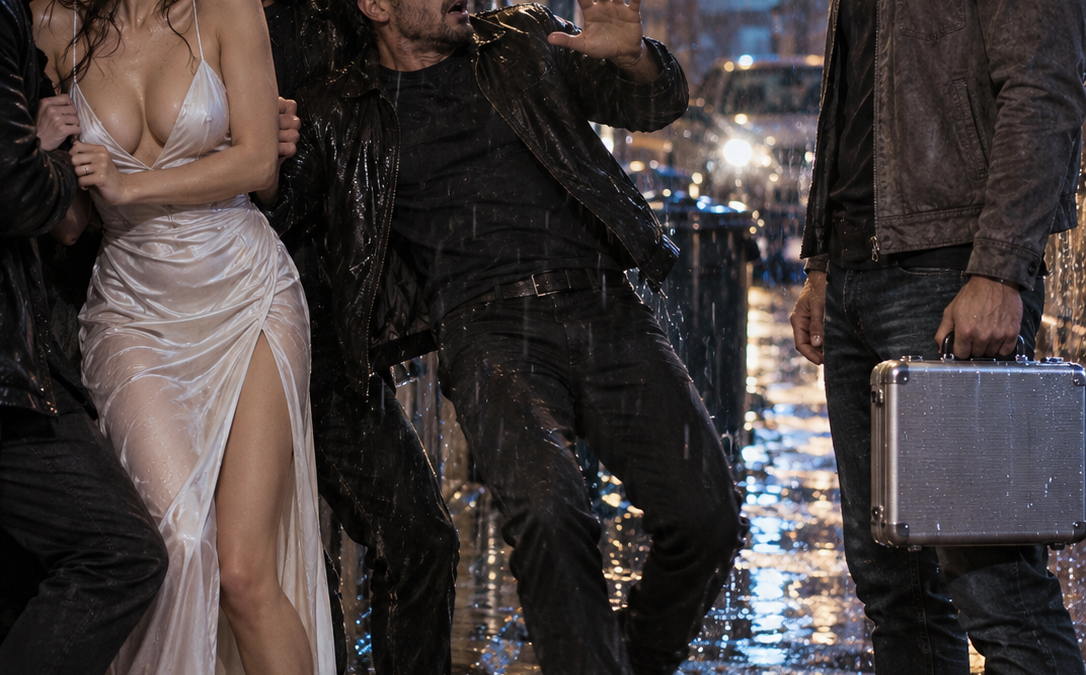
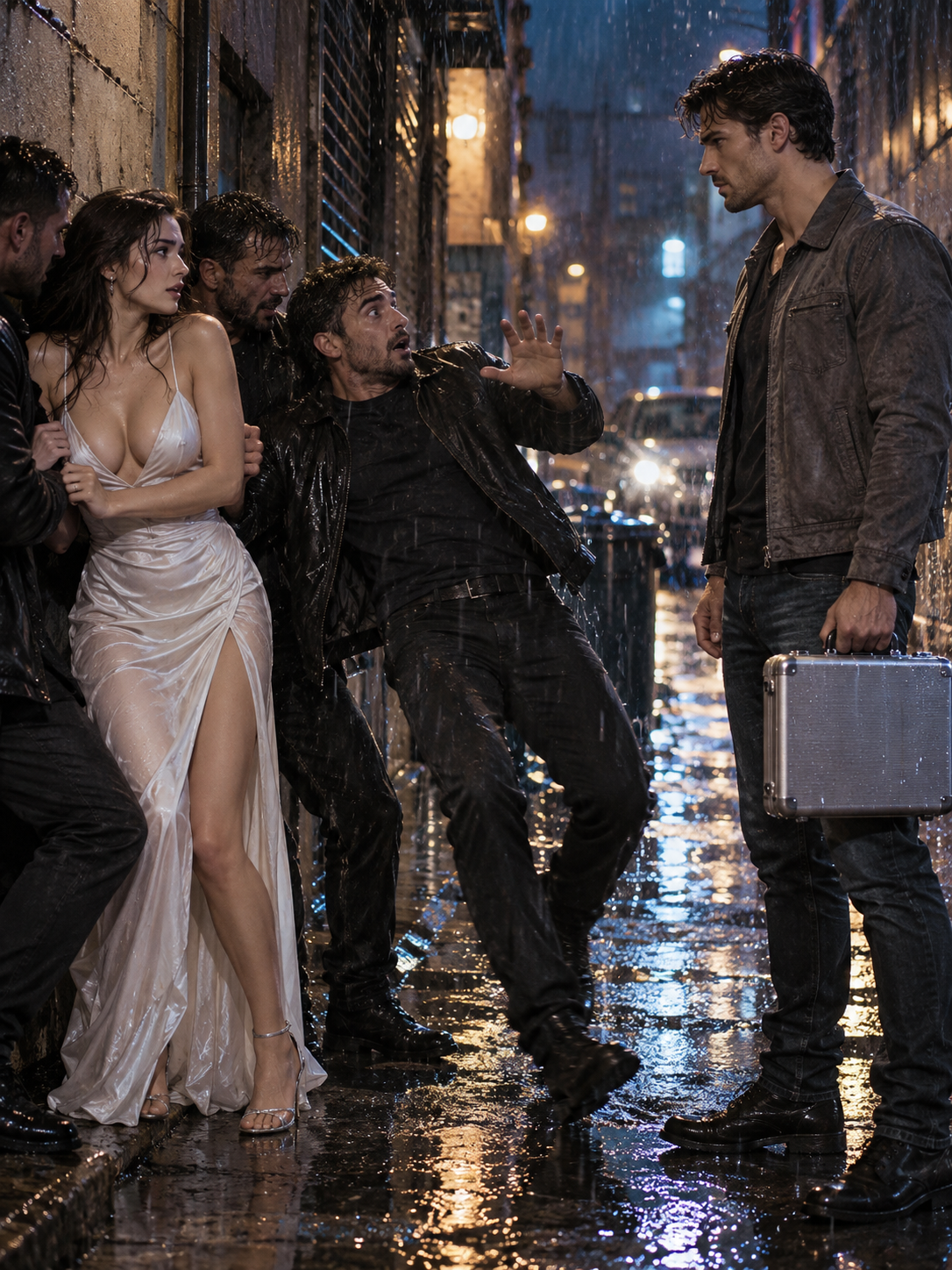
Six armed men surrounded her in a dark alley. Her driver was gone.
Her phone was dead.
And the man leading them already knew exactly which room she’d left, exactly what she was carrying, and exactly how many seconds she had before no one would hear her scream.
Vanessa Whitmore was the CEO of a billion-doll company, and she had never felt more alone in her life. She screamed for help into the freezing Chicago rain. And one man heard her.
A maintenance worker. A single father. A man who had spent 11 years making sure nobody remembered his name.
It wasn’t the kind of rain that Chicago apologized for.
It was the punishing mid- November kind that drove into your collar and soaked through your coat before you made it half a block. The wind off the lake had teeth.
The streets near the Holston Crown Hotel were mostly empty by 10:15. just wet pavement reflecting the orange glow of street lamps and the occasional cab cutting through a puddle without slowing down.
Vanessa Whitmore pulled her coat tighter across her chest as she pushed through the hotel’s side exit, the one the event staff used, the one without the cameras that pointed toward the lobby entrance.
She wasn’t being paranoid, she was being careful.
There was a difference, and after 12 years running Whitmore Meridian, she’d learned to recognize it.
The drive she carried was inside her coat pocket, small, barely the size of a thumb. But what it contained had taken her 3 weeks to obtain and two sleepless nights to begin understanding.
Financial routing data, shell company registrations, shipping manifests that didn’t match any declared cargo.
Somebody inside her own organization had been quietly carving out pieces of Whitmore Meridian for years, and the drive in her pocket was the first concrete proof she’d found that it was real and not a symptom of her own exhaustion.
She’d attended the meeting at the Holston Crown alone.
No assistant, no security detail.
She hadn’t wanted anyone to know she was looking.
The limousine was supposed to be waiting in the service alley along the hotel’s east wall.
Her regular driver, Marcus, had confirmed the pickup by text 40 minutes earlier. Running 2 minutes early.
Ms.Whitmore. Black Continental. Same plates.
The Black Continental was there.
Marcus wasn’t.
Vanessa stopped walking. She stood in the rain for a moment and just looked at the car.
Engine off. No visible movement inside.
The windows were dark in that particular way, not tinted, just empty. She pulled out her phone.
No signal. She moved three steps to her left. Still nothing.
She glanced up at the alley walls, old brick on both sides, the hotel’s utility infrastructure above her, a tangle of pipes and ventilation ducts.
It was a dead zone.
She’d never noticed it before because she’d never stood in this particular spot trying to make a call.
Go back inside, something told her. Use the hotel phone.
Call from the lobby. She turned.
That was when they came out of the shadows. Not all at once. That would have been less frightening.
They moved in ones and twos from different angles.
From the recessed doorway on her left, from the far end of the alley behind the Continental, from the narrow gap between two dumpsters she hadn’t even registered as a gap.
Six of them, big men dressed in dark clothing that wasn’t tactical enough to look like a threat from a distance, but was practical enough that she understood immediately none of this was accidental.
They formed a loose half circle in front of her, blocking the alley’s exit.
Vanessa didn’t run.
There was nowhere to run to. She stood still and did the thing her father had taught her when she was 12 years old.
And a older kid had cornered her behind their school building.
Don’t show them your hands shaking.
Keep your chin up.
Make them think you’re deciding something even when you’re not.
The man who stepped forward from the center of the group was perhaps 40, broad across the shoulders with a flat, unremarkable face that somehow made him harder to read, not easier. He moved like someone who had walked into difficult situations before and found them manageable.
His eyes went straight to her coat pocket. Miss Whitmore.
His voice was even, not threatening in the way movie villains were threatening, more like a contractor explaining a deadline. I need what you took out of room 1,114 tonight.
The cold settled deeper into her chest. Room 1,114 was registered under a name that had nothing to do with her.
She had booked it through a third-party contact specifically so it couldn’t be traced back to Whitmore Meridian’s corporate accounts.
She had told no one where she was going tonight.
I don’t know what you’re talking about, she said.
Her voice was steadier than she expected. The man tilted his head slightly.
The drive.
I’m going to need you to step back, Vanessa said.
All of you. Nobody moved. The man she would learn his name later.
Wade Mercer almost smiled. Not warmly.
The way someone smiles when they’ve already calculated the outcome and find the remaining steps tedious.
We can do this without any unpleasantness. Hand it over, get back in the hotel, and this conversation never happened.
And if I scream, then we take it anyway, and the conversation becomes considerably less pleasant. Vanessa looked at the six of them.
She looked at the continental.
She looked at the sliver of wet street visible beyond the alley’s mouth, empty and indifferent.
Then she screamed. Not a startled sound, she put her full lungs into it, sharp and deliberate, the kind sound designed to carry through rain and wind and brick.
It echoed off the alley walls and went nowhere useful, except to the far end of the service corridor, where a door she hadn’t noticed, was propped open with a yellow rubber wedge the kind maintenance staff used to hold fire exits, and where a man had just stepped out carrying a toolbox.
Grant Holloway had been at the Holston Crown since 6:00 that morning.
The hotel’s east wing had a recurring problem with its HVAC circulation on floors 9 through 14, a pressure differential issue that the building’s original contractors had wired incorrectly and that every subsequent maintenance team had addressed with increasingly creative short-term fixes.
Grant had spent the last 4 hours tracing the actual source of the problem through the building’s mechanical infrastructure, which nobody had asked him to do.
His supervisor had asked him to replace a faulty valve on the 14th floor. Grant had replaced the valve.
Then he’d kept going, following the pressure readings down through the systems the same way he’d once followed operational threads through enemy communication networks.
Not because anyone told him to, but because leaving a problem half-solved bothered him in a way he couldn’t entirely explain anymore.
He was 37 years old. He had a daughter named Clara, who was nine and currently staying with his neighbor, Mrs.Fiorretti three blocks away, which meant he had until midnight before Mrs.Fiorretti stopped being gracious about it.
He’d promised Clara he’d be home by 11:30, which meant he needed to be done with the 14th floor write up in the next 20 minutes, which meant he was moving faster than usual when he shouldered through the fire exit and into the service alley.
He heard the scream while he was still in the doorway. His body processed it faster than his conscious mind.
did the way certain things got rewired after enough exposure to situations where one second of hesitation had permanent consequences.
He was already scanning the alley before he’d fully registered what he was hearing.
Six men, one woman, no visible weapons drawn, but the body language of at least two of the men on the outer edge suggested they were carrying.
The woman’s coat was undisturbed, which meant whatever they wanted.
They hadn’t taken it yet.
The alley had one primary exit behind the six men and one secondary exit. The door Grant had just come through behind the woman. He set his toolbox down next to the prop door.
It made a metallic sound on the wet concrete. All six men turned to look at him. The woman turned two.
Her face was rigid with effort. The particular look of someone who had been holding themselves together totty through willpower alone for the last several minutes. She was maybe 30.
Well-dressed in a way that suggested function over display quality coat. Sensible heels for someone who clearly walked a lot.
No visible jewelry except a watch. Her eyes went to Grant and immediately recalculated.
Run, she said, not a request.
A warning, firm and certain, like she was trying to save him from something she couldn’t save herself from.
Grant didn’t run.
He looked at the six men for a moment.
The way you look at a problem you’re working out, no hurry to it, just assessment.
You should probably leave, he said. His voice was conversational, not loud.
The rain was louder.
The man at the front of the group, the one who’d been doing the talking, almost laughed.
The sound that came out, was somewhere between amusement and contempt.
“Get back inside, friend.
This doesn’t involve you.”
“It does now,” Grant said.
One of the men on the outer edge moved first, which told Grant something about their organization.
It told him the man at the front wasn’t actually controlling them.
He was just the one who talked.
The outer man came in fast and low, which was a reasonable approach against someone who wasn’t expecting it.
Grant was expecting it. What happened next was not clean or elegant or anything like the kind of confrontation that looked good in slow motion. It was fast and economical and looked from the outside almost like a misunderstanding, like the men kept almost grabbing Grant and somehow never quite managing it, like Grant kept moving slightly before they arrived, like the laws of physics were operating on a slight delay for everyone except him.
Three minutes, maybe less. By the end of it, two men were sitting against the alley wall with the stunned expression of people whose bodies had stopped cooperating with their intentions.
Two more were backing toward the continental, and the fifth was watching Grant with an expression that had shifted from contempt to something considerably more cautious. Nobody was seriously injured.
Grant had been deliberate about that. He turned back to the man at the front.
Wade Mercer hadn’t moved during the whole thing.
He’d stood in the rain and watched with his flat, readable face, and something in his expression had been changed the entire time from calculation to something slower and stranger.
He was staring at Grant’s neck.
Grant’s collar had shifted during the struggle.
The scar was visible, a jagged line running from just below his left ear down to the base of his neck. Old and fully healed, but unmistakable in its origin. Not a surgery scar, not an accident.
Somebody had put that there deliberately a long time ago.
WDED’s face went pale.
It was remarkable, actually. Not many things made a man like Wade Mercer look pale. But the color genuinely drained out of him, and his voice, when he spoke, had lost the contractor at a deadline steadiness entirely.
Northstar, the word landed in the wet alley like something dropped from a height. Grant went very still.
Behind Wade, one of the men who’d been backing toward the Continental, stopped moving.
Another, the one sitting against the wall with the stunned expression, looked up. His expression changed.
He lowered his head. The woman was watching all of this without understanding any of it.
Grant didn’t answer.
He picked up his toolbox from beside the prop door and looked at Wade for a long moment, 3 seconds, maybe four.
And in those seconds, something passed across his face that wasn’t quite pain and wasn’t quite recognition and wasn’t quite anything with a clean name.
Then he looked at the woman.
Come with me,” he said.
She stared at him.
“Now,” he said quietly before they decide to stop being surprised.
She moved.
He took her through the maintenance corridor and out through the hotel’s loading dock, around the building’s north corner, and two blocks east on foot before he slowed down enough to speak properly.
The rain was still coming. He handed her his work jacket without asking, not gallantly, practically, the way you solve an immediate problem, and she took it without thanking him, which he appreciated. Neither of them wanted to stop moving long enough for pleasantries.
“Who are you?”
she asked.
“Grant Holloway.
I work maintenance on the East Wing.”
She looked at him sideways. The look had multiple layers.
“That’s not an answer.
It’s the answer I’ve got right now.”
They stopped under an awning on Meridian Street.
The irony of the name wasn’t lost on either of them later while she tried her phone again.
Signal had returned.
“My security director,” she said mostly to herself, pulling up a contact.
I need to call Russell. Wait, Grant said. She looked at him.
Before you call him, what are you going to say? That I was attacked outside the Holston Crown.
That I need Before you say where you are, Grant said. Think about tonight.
Think about how those men knew which room you used, which exit you’d take, what you were carrying.
That’s not a guess.
That’s somebody with access to your calendar and your security protocols.
Vanessa’s thumb hovered over Russell Dayne’s name in her contact list.
Russell has been with me for 12 years, she said. I know, Grant said.
He didn’t know who Russell was, but he knew that tone.
That was the tone of somebody saying it can’t be him because the alternative was too large to stand inside.
Call him, Grant said.
But don’t tell him where you are, she called.
Russell picked up on the second ring, Vanessa. Is everything all right?
His voice was calm, warm.
the voice of someone who’d been her professional anchor through three corporate crises and her father’s death and the board battle two years ago that almost took the company from her.
“I ran into some trouble,” Vanessa said carefully.
“Outside an event tonight.”
“What kind of trouble?”
“Are you hurt?”
“I’m fine.
I just needed to hear a familiar voice.
It wasn’t a natural thing for her to say, and she could hear how slightly wrong it sounded even as she said it.
But Russell accepted it. Of course.
Do you need me to send someone?”
No, I’m fine.
I’ll call you tomorrow.
She ended the call. The rain drumed on the awning above them.
A cab moved through the intersection at the end of the block and kept going. He never asked where I was, Vanessa said. Not to Grant.
To herself quietly, the way you say something out loud, because saying it is the only way to make it real. 12 years.
And he didn’t ask where I was or whether I was safe or if I needed him to come.
He asked if I was hurt, past tense, like he already knew I wasn’t.
Grant said nothing.
He didn’t need to.
She had reached it herself. She stood under the awning in the rain soaked Chicago night with his work jacket over her coat and the drive still inside her pocket.
And she looked like someone whose floor had just shifted underneath them, not someone who’d fallen, but someone who’d realized the floor wasn’t what they’d thought it was, and now had to decide what to do about it.
Grant picked up his toolbox. I know somewhere we can talk, he said.
Somewhere nobody’s going to find us tonight.
She looked at him at the work uniform, the old toolbox, the scar along his neck that a man named WDE Mercer had looked at like he was seeing something back from the dead.
“You’re going to tell me who Northstar is,” she said.
“It wasn’t a question.”
Grant didn’t answer that either.
But he didn’t walk away.
He just started moving.
And after a moment, Vanessa Whitmore, CEO of Whitmore Meridian, daughter of the man who built it, the woman who’d fought a board of directors and two hostile acquisition attempts, and come out intact, pulled his jacket tighter across her shoulders and followed a maintenance worker into the Chicago rain.
She had no idea yet what she’d stepped into the middle of.
Neither did he entirely.
But Wade Mercer’s pale face stayed with Grant as they walked, and the name he hadn’t heard spoken aloud in 11 years, moved through him like something that had been waiting, not buried.
Exactly. Just stored somewhere dark and still.
The way you store things, you’re not sure you’re done with.
Northstar.
He hadn’t been that man in a long time.
He wasn’t sure, walking through the rain with a stranger beside him, whether that was still entirely true.
The place Grant took her wasn’t impressive.
That was the first thing Vanessa registered when they arrived. Not danger, not comfort, just the particular absence of anything that tried to be either.
It was a warehouse on the south edge of the Pilson neighborhood, a flat roofed concrete building wedged between a closed auto shop and a lot where someone started and then abandoned a construction project years ago. The surrounding block was the kind of quiet that came not from peace, but from neglect. No foot traffic, no cameras she could see.
The street light at the corner had been out long enough that the city had stopped bothering to replace it. Grant had a key. That was another thing she noticed.
Not a modern key, an old one, the kind cut for a deadbolt that had probably been installed before either of them was born.
He worked it into the lock without fumbling, which meant he’d done it in the dark before, possibly many times.
The inside smelled like dust and metal, and the particular stailness of a space that had been sealed against weather for a long time.
Grant moved to the far wall and hit a switch and a single overhead work light came on the industrial kind bulb in a wire cage, the kind that didn’t flatter anything it lit.
There were no windows at ground level. The light reached the middle of the floor and stopped, leaving the corners in shadow.
Vanessa looked around. There was a folding table near the east wall, two chairs, the plastic stackable kind, a portable space heater on the floor that Grant crouched down and clicked on without comment.
Along the north wall, a metal shelving unit held what looked from a distance like ordinary storage cardboard boxes, a few plastic bins, a rolledup canvas tarp.
But above the shelving, fixed directly to the wall, were things that didn’t belong in an abandoned warehouse.
Maps, laminated topographic maps, the kind with elevation lines and grid coordinates. Some had clear plastic overlays with handwritten notations in blue marker. photographs, 8×10 prints, black and white, pinned at the corners.
A whiteboard with writing on it, faded but not erased. Handwritten lists in two columns, the kind of columns that separated names from status or objectives from outcomes.
She walked toward the wall.
Don’t touch anything, Grant said.
Not harshly, just factually. What is this place? He was pulling two bottles of water from a bag on the folding table.
She hadn’t noticed the bag until now, which meant it had been placed there recently.
or he was very good at making things disappear in plain sight. He handed her one.
It’s somewhere nobody knows about, he said.
That’s not what I asked.
He sat down in one of the plastic chairs.
The heater was already pushing some warmth into the immediate air around them, though the building’s cold had the kind of depth that took a long time to move.
Grant looked at the water bottle in his hands for a moment and Vanessa had the impression he was something not whether to tell her exactly but how much of it to hand over at once. 11 years ago he said I walked away from a life.
This is what was left of it. She pulled the second chair around so she was facing him instead of sitting beside him and sat sat down.
The drive in her coat pocket pressed against her ribs. Outside the rain continued against the warehouse roof. A steady indifferent sound.
start from the beginning.
She said he didn’t start from the beginning.
Nobody who actually had a story worth telling started from the beginning. They started from wherever the weight was. And Grant started from the night.
His team walked into an ambush in a place he wasn’t going to name.
In a country that didn’t officially exist on any military record of that operation.
He told it without drama. That was the part that got to her more than anything else. The flatness of it.
The way he described things with the precision of someone filing an operational report, like emotion, was a variable he’d learned to route around because it interfered with accuracy.
There had been a six-man team, a high-risisk extraction, the kind that required specialized training and a specific kind of mind, not fearless, exactly, but comfortable in a way that most people weren’t with the understanding that a situation could go
wrong in multiple directions simultaneously, and you still had to keep moving.
Grant had run extractions before, more than he was going to tell her about tonight. His particular skill, and he sets the way someone might mention they were good at fixing HVAC systems.
Matter of fact, no ownership was threat anticipation.
Reading a situation’s vectors before they collapsed into outcomes.
They called it Northstar because he could orient a team in the dark, not because he was perfect.
He made very clear he wasn’t perfect.
He made a wrong call in the field once that cost a man two weeks in a hospital.
and he described that with more weight than is the extraordinary thing he’d done on the night.
Everything fell apart. That was how she understood. He was telling her something real.
The wrong call mattered to him more than the extraordinary thing. The intelligence we were working from told us a specific route.
He said, “I read the route.
I read the terrain, and something about it felt off to me.
Not obviously just a degree or two off from what made sense given the updated threat assessment we’d received 48 hours earlier.
So, you changed the route, Vanessa said. So, I changed the route.
He said it without expression. And the route I changed it to was where they were waiting for us. The room was quiet except for the rain and the heater.
There was a leak.
Grant said, “We knew that much afterward.
Somebody had fed our contacts compromised intelligence.
Somebody knew enough about how I thought, about how I worked to make the original route look wrong, so I’d move my team off it.
The ambush was waiting on the route I would choose as a correction.
Not the route we’d been given.
The route I would calculate my way into. Vanessa let that sit for a moment.
That’s not a lucky guess, she said.
That’s somebody who studied you.
That’s what it was, Grant said.
Yeah.
He’d been hit early in the engagement, the neck, which explained the scar, a wound that should have taken him out of the fight and very nearly did.
He’d lost significant blood in the first 20 minutes.
Two of his team were pinned in a structure with no viable exit.
The remaining four were scattered across a 300 meter radius in terrain that favored the people who’d set the trap.
What he did next took 36 hours.
He didn’t describe it as heroic.
He described it as a problem he solved one piece at a time with a neck wound that kept reopening every time he pushed it too hard, which meant he kept reopening it. He got one man out, then another, then circled back for the two who were pinned. The last extraction happened in daylight, which was the wrong time for extractions because by then he had no other options.
All six men made it. Grant came home and then he disappeared.
Why? Vanessa asked.
He was quiet for a moment.
Because I believed I’d put them there.
I’d been handed intelligence designed to manipulate my judgment and it worked.
Six men nearly died because of how I think.
That’s not something you fix by writing a report and moving on.
You blamed yourself for something that was done to you. I blamed myself for the thing that was done through me.
He said, “There’s a difference.”
She wanted to argue the point. She could see the shape of the argument.
Clearly, he’d been deliberately manipulated by someone with specific knowledge of his tactical psychology, which made him a victim of operational intelligence, not the author of a mistake.
But something in his face told her he’d heard this argument before, probably from people who knew him better than she did, and it hadn’t moved him.
Some conclusions people had to reach themselves.
“Who knew enough about you to build that trap?”
she asked instead. Grant looked at her steadily.
“That’s a question I stopped asking 11 years ago.
” “Why?”
“Because following it was going to take me somewhere I couldn’t come back from, and I had a daughter who needed a father more than I needed answers.”
Vanessa sat back slightly. the daughter.
She’d almost forgotten the daughter.
Or rather, she hadn’t been given that piece of information yet.
And it reframed everything. Not the story, but the man. The maintenance job that kept him forgettable.
The deliberate rejection of promotions.
The choice to be invisible wasn’t a man running from something.
It was a man building a wall between a past and a child who deserved to grow up without it. How old is she?
Vanessa asked. Nine.
He said it differently than he said everything else. A degree warmer.
Clara, she’s with someone tonight.
My neighbor. I need to be home by midnight. He glanced at his watch.
It was 11:20, which means we need to move through this. They moved through it. Vanessa pulled the drive from her pocket and set it on the folding table between them.
She explained what she’d found over the past 3 weeks, the irregularities in Whitmore Meridian’s international shipping network that she’d initially dismissed as clerical inconsistencies, and then slowly, as the pattern emerged, understood were something else.
Ghost routes, cargo that was logged at departure, but never fully accounted for at arrival. The discrepancy buried inside the kind of bureaucratic complexity that a logistics company of Whitmore Meridian size generated so naturally that it was almost invisible. Shell corporations appearing as third-party vendors with no discoverable ownership.
Warehouses listed in the system that didn’t match any physical footprint she could verify.
How long? Grant asked.
He’d been listening without interrupting, which she was not accustomed to in boardrooms.
The earliest thread I can trace goes back almost 12 years, she said. Which means it started approximately 2 years after my father promoted me to executive vice president and 18 months before he died. Who benefits if the company collapses?
I’ve been trying not to answer that question because the answer keeps pointing at someone I don’t want it to point at.
Grant waited. Vanessa looked at the drive on the table.
Preston Vale.
He’s our vice president of international operations.
He’s been with the company for 20 years.
My father trusted him completely. He was one of three people my father told me to rely on when he got sick and started handing me responsibility.
He helped me survive the first 2 years after dad died when the board was still testing whether I was going to fall apart. And now, and now, every thread I pull seems to go through a system or a decision or a contract authorization that he either controlled directly or had access to. She pressed her fingers flat on the table.
He’s 61 years old.
He came to my father’s funeral.
He kept me from making three serious mistakes in my first year as CEO. He is not the person I want this to be.
That’s the problem, Grant said.
She looked at him.
The reason he’s survived 12 years undetected, Grant said, is because he’s exactly the person nobody wants it to be.
The ones who want to be trusted are easy to watch.
The ones who’ve already earned it, you stop watching them.
That’s not your failure.
That’s what the position is designed to do.
It was a strange kind of comfort. Not the warm kind, not reassurance, just a clean and accurate framing of the situation that removed the self-lame from it long enough to think clearly.
Vanessa had the thought that this man had probably been very good at leading people through things they were afraid to walk into.
I need to know if I’m right before I do anything, she said.
If I move against Preston without proof that holds and I’m wrong, he destroys me with the board.
And if I’m right and I move too early, he disappears everything before it can be documented.
So you need a trap, Grant said. I need a trap.
He looked at the drive. What exactly is on it?
Routing data, shell company registration numbers, a transaction log that shows movement of funds through accounts that don’t appear in any of our public filings.
She paused. and the metadata from the original source files, which shows when they were accessed and by whom, which is why somebody very much wanted that drive tonight. Because the metadata points at Preston, it points at someone with his level of access.
It isn’t conclusive by itself.
Grant drummed two fingers on the table once, not nervously, just thinking.
The six men tonight, he said, Wade’s group.
They’re not corporate security.
Their movements were too coordinated for hired muscle and too restrained for military.
They pulled back when the situation shifted, which means they have operational discipline, but they’re not running on orders that permit extreme action.
Who are they working for? Vanessa shook her head.
I assumed they were Preston’s.
Wade warned me before they left.
Grant said, “Check her security team.
That’s not something you say if you’re working for the same person who compromised the security team.”
She stared at him.
You’re saying they’re not Preston’s people.
I’m saying Wade knows something about your organization and he chose to give you a piece of it instead of using it.
Grant stood up and walked to the shelving unit, looking at the maps on the wall above it without touching them.
He stood there for a moment with his back to her and she had the impression he was doing something with his face that he didn’t want her to see.
And he knew my name.
Northstar Vanessa said, “It’s not my name.
It hasn’t been my name for 11 years.”
But he said it without conviction.
The way you say something you’ve rehearsed so many times, it stopped feeling true.
She let it go for now. So, what do we do?
He turned around.
He looked tired, not the tired of a man who’d been up since 6:00 in the morning dealing with HVAC pressure differentials, though that was probably also true, but at the of someone who’d been carrying something heavy for a very long time and had just felt the weight shift.
You go home tonight, he said. Normal route, different car call, a car service, not your regular driver.
and don’t use the app you normally use.
Pay cash if you can.
Tomorrow you act like tonight didn’t happen.
You go to your office. You attend your meetings.
You don’t change anything in your routine that would signal to someone watching that you’ve been rattled.
And you?
I’m going to look at your shipping network.
Vanessa blinked.
You’re a maintenance worker.
I used to read operational intelligence for a living.
Grant said, “Suppains and logistics networks aren’t structurally different from distribution and resupply chains.
You look for the same things. The nodes where decisions get made, the points where the flow can be diverted without disrupting the surface appearance, the places where oversight is technically present but practically impossible.
” He picked up his toolbox.
“Send me what’s on that drive encrypted.
I’ll give you an address.”
“I don’t even know you.”
“You know I’m not working with Wade,” he said.
because if I were, I’d have let them take the drive in the alley.
She thought about that. It was a simple point, and it was airtight, and she resented slightly how clearly it was presented to her because it made the decision easy when she wanted to have reasons to be cautious.
I’ll send it tomorrow, she said.
Tonight, Grant said, “Before you sleep, whatever Preston has, he’s going to move some of it when he finds out tonight didn’t go the way it was planned.”
She pulled out her phone. Give me the address.
She left at 20 to midnight.
Grant walked her out to the street and flagged down a car service that had no association with any of her regular accounts and she got in without looking back because looking back felt like the kind of thing you did when you were already doubting a decision and she
couldn’t afford to doubt this one yet.
She needed to think and she couldn’t think while she was looking at a man who’ just told her 11 years of compressed history in the flattest possible voice and somehow made her trust him more than the people she’d known for a decade.
Grant watched the car until it rounded the corner and its tail lights disappeared.
Then he walked back inside and stood in the middle of the warehouse floor with the work light above him and the heater running in the corner and the maps on the wall that he hadn’t looked at directly all evening only peripherally.
the way you don’t look directly at something that costs you something to see.
He went to the wall. He stood in front of the photographs.
Most of them were operational images. Terrain, structures, faces captured at distance. But there was one that was different.
A group photograph, the informal kind, taken somewhere with too much sun and not enough shade. Seven men, not posed, caught in the moment between something difficult and something else. Grant was in it.
He was younger by 11 years and he didn’t have the scar yet and his face had an openness to it that the current version of his face had learned to avoid.
He was laughing at something someone off camera had said. Standing next to him in the photograph was a man with a flat unremarkable face and broad shoulders. WDE Mercer.
Grant touched the edge of the photograph without unpinning it. Check her security team. Wade had given him that.
In the alley, after everything, with five other men behind him and every tactical advantage in the situation, Wade had handed him a warning instead of a threat. That was not the action of an adversary. That was something else.
Grant’s phone buzzed.
A text from Mrs.Fiorretti. Clara is asleep.
Take your time, but the spare key is under the mat if I’m asleep when you get back.
He checked the time. 11:58. He took one more look at the photograph, then turned off the work light.
Outside, the rain was finally easing. The wet streets reflected whatever light was available, a thin silver quality to the air, the kind that comes when clouds start to break.
Grant pulled his collar up and walked the three blocks to where he’d left his truck, an 11-year-old pickup that he maintained because he understood how things worked and couldn’t justify paying someone else to understand them for him.
He drove home.
Clara was asleep on Mrs.Fiorretti’s couch with a quilt pulled up to her chin and her mouth slightly open, the way she’d slept since she was an infant.
Grant stood in the doorway for a moment. Mrs.Fiorretti was asleep in the armchair across from her, a book open on her lap, glasses still on.
Grant lifted the book carefully and set it on the side table, then carried Clara, who was heavier than he remembered from the last time he’d done this, and he registered that the incremental growing of her, the way it kept happening without his through the rainool back through the rainool night to their apartment on the third floor.
He put her in her bed.
She stirred but didn’t wake.
He went to the kitchen and sat at the table with his laptop and waited.
At 12:23, an encrypted file arrived at the address he’d given Vanessa.
He opened it and then he started reading the way he used to read intelligence briefings methodically without jumping ahead, building the picture from the ground up rather than letting the most dramatic element at the top distort his understanding of everything below it.
What he found over the next 3 hours was worse than he’d expected.
Not because any single piece of it was shocking, but because of how long it had been running, and how carefully it had been built, and how thoroughly it had been woven into the normal operational fabric of Whitmore Meridian, not bolted onto the outside of the company, but threaded through it, loadbearing, structural, the kind of corruption that had become part of the architecture over so many years that removing it without understanding the full scope would bring down things you
were trying to save along with things you were trying to destroy. He worked until almost 4:00 in the morning. Clara would be up at 7:00.
He would need to make her breakfast and get her to school and then drive back across the city to the hotel for his 6:00 shift. He closed the laptop.
He sat in the dark kitchen for a moment, just sat there with the refrigerator hum and the faint sounds of the street below.
And he thought about a name he’d walked away from 11 years ago, and the way it had come back to him in a wet alley in the voice of a man he’d once carried out of a burning corridor on a bleeding neck.
He thought about Vanessa Whitmore standing under that awning on Meridian Street with his work jacket over her coat.
The moment she’d said he never asked where I was, not to him, but to the air, to the night, to the new and unwelcome version of her world that was taking shape around her.
He thought about Clara asleep in the next room.
And he thought about the thing Wade had said in the alley, the thing that wasn’t really a question, Northstar, like a door half open, like something that had been waiting in the dark for someone to walk past it, close enough to feel the draft.
Grant Holloway pushed his chair back and went to bed. He did not sleep well, but he slept.
And in the morning, he made Clara scrambled eggs and forgot to buy orange juice, so they had apple juice instead. And she made a face about it, but ate her eggs without complaint.
And he drove her to school and watched her go through the front door with her backpack listing to one side, because she always overpacked it with library books she’d already read, but couldn’t bear to leave at home.
And then he sat in his truck outside the school for an extra minute, one hand on the wheel and one hand not looking at the door she’d disappeared through.
Then he put the truck in gear. There was work to do. The next 4 days, Vanessa did what Grant told her to do.
She went to her office. She attended her meetings.
She sat across from Preston Veil at a Tuesday afternoon operations review and listened to him walk through third quarter logistics performance with the ease of a man who had absolutely nothing to feel uneasy about. and she nodded in the right places and asked one question that she already knew the answer to just to hear how he he framed it.
And she came home that evening and stood in her kitchen for 10 minutes without taking her coat off because the simple aspect of performing normaly for 8 hours had cost her more than she’d expected.
She and Grant communicated through an encrypted messaging application he’d set up on a phone he’d bought with cash a burner.
He’d called it without embarrassment, the same way he called a wrench a wrench.
and their exchanges were brief and functional. He sent her questions. She answered them.
He asked for specific document sets, contract authorization chains, vendor registration records, warehouse access logs going back 7 years, and she pulled them quietly, one at a time, through her personal administrative credentials rather than routing the requests through anyone on her team. It took longer that way.
She didn’t sleep much.
On Thursday morning, Grant sent her a single line. I need to show you something tonight. The warehouse.
She arrived at 8:30. He was already there. The folding table covered in printed pages organized in overlapping groups.
The work light overhead replaced with two additional lamps he’d brought from somewhere.
So, the space was actually lit for once rather than merely illuminated.
He’d also brought coffee in a thermos, which she registered as a small and probably unconscious act of consideration that she chose not to mention because mentioning it would make it awkward.
He stood beside the table and walked her through it.
What he’d found in 4 days of working through her company’s data was not a simple embezzlement scheme.
Vanessa had expected embezzlement money moved sideways through vendor accounts, inflated contracts with shell companies paying kickbacks. That would have been damaging enough.
What Grant had actually mapped was something with more dimensions than that and more patience behind it.
Whitmore Meridian isn’t being robbed.
He said he had a pen in his hand and used it to point at specific documents without touching them. The habit of someone trained to preserve evidence.
It’s being hollowed out.
There’s a difference.
He showed her the Shell Corporation’s first 17 of them registered across four different countries.
each one appearing in Whitmore Meridian’s vendor network as a legitimate third-party logistics provider.
They charged real fees for services that were partially real, which was the part that made them survivable to audit. If the Shell companies had been pure fiction, an audit would have caught them.
Instead, they perform just enough actual function to justify their existence while routing a margin, sometimes 5%, sometimes 12, sometimes more into accounts that disappeared into layered holding structures she couldn’t see the bottom of.
That’s roughly $42
million over 11 years, Grant said, which sounds large, but it’s not the main event.
What’s the main event?
She asked. He moved to a different section of the table, the shipping routes.
He spread three documents side by side. Whitmore Meridian moves cargo for 230 contracted clients. Legitimate cargo, industrial equipment, medical supplies, agricultural products, consumer goods.
The contracts are real. The clients are real.
The cargo is real. He paused.
Most of it. Vanessa looked at the documents. She could see what he was showing her route modifications.
Small ones.
routing certain shipments through intermediate waypoints that weren’t in the original contracts and weren’t visible in the client-f facing tracking systems only in the internal operational logs.
Someone is adding stops, she said. Adding stops, substituting cargo at the intermediate points and recealing at destination.
The client’s cargo arrives intact and on schedule.
Nobody complains. Nobody looks closer. He set the pen down.
The question is, what’s being moved at the intermediate stops?
You don’t know.
I don’t know yet, but I know the warehouses.
He pulled a separate page from beneath the others. It had six addresses on it with notations beside each one.
These are facilities that appear in Whitmore Meridian’s operational database as leased storage units short-term rotating leases changed every few months, so they don’t establish a visible pattern.
They exist in the company’s records.
But when I cross referenced against the physical addresses, they don’t match anything real.
Vanessa said, “Two of them are parking structures.
One is a city park.
One is a building that was demolished in 2019.”
He looked at her steadily.
“Someone created physical infrastructure in your system that doesn’t exist.
And they’ve been routing real shipments through ghost coordinates for at least 6 years.”
Vanessa sat down in one of the plastic chairs. Not dramatically, she just needed to sit. She put both hands flat on her knees and looked at the table full of documents and thought about her father who had built this company over 30 years and died believing he was leaving it in good hands.
And she thought about the 30,000 people whose paychecks and health coverage and retirement accounts were threaded through an organization that someone had been systematically gutting from the inside. And for a moment the weight of it sat on her chest with a physical quality. How long before it becomes unservivable?
she asked.
At the current rate of extraction, the company’s operational reserves fall below the threshold required to service your debt obligations in approximately 14 to 18 months, Grant said.
He said it carefully, not gently.
There wasn’t a gentle way to say it, and he didn’t try to find one.
But the structural damage is already significant.
