6 Men Cornered a Female CEO—Then a Single Dad’s Navy SEAL Past Left Their Leader Stunned – PART 5
PART 5
And the receptionist, a young woman who’d seen him once before, the night of the boardroom, and who clearly remembered him, gave him a look that was trying not to be uncertain.
“Grant Holloway,” he said.
“I have a 3:00 with Ms.Whitmore.”
“Of course,” she said, adjusting her expression to professional smoothness.
“She’s expecting you.”
Vanessa’s office had a different quality than the first time he’d been in it.
The night of the boardroom, it had been after hours.
The light had been the particular amber of a building winding down, and Vanessa had been standing at the window in her coat, looking like someone who’ just finished a very long run, and hadn’t yet sat down.
Now it was midafter afternoon. The
city was fully lit and operational outside the windows, and Vanessa was at her desk with her jacket on, and three documents in front of her, and the specific alert but contained expression of someone managing several things simultaneously.
She stood when he came in and shook his hand, which he found slightly formal given everything they’d been through, and then seemed to find it slightly formal herself, and let go of it without the usual one pump conclusion.
“Sit down,” she said.
“I have something I want to discuss with you,” he sat.
She came around to the front of the desk, not sitting behind it, which he noticed, which meant she’d thought about how she wanted this conversation to feel, and leaned against it with the documents in her hand.
“I’m creating a new division,” she said.
inside Whitmore Meridian. Independent risk assessment and operational integrity, not corporate security.
That’s Russell’s old function, and I’m restructuring it separately.
This is something different.
an internal team that has the mandate and the access to examine any part of the company’s operations for structural vulnerability.
Not looking for crime necessarily, looking for the conditions that allow problems to grow undetected, the gaps between the official systems and what’s actually happening inside them.
Grant looked at her. You want someone who can read threats before they become outcomes.
I want someone who found in 4 days what 12 years of standard audit processes missed. Vanessa said. Yes.
He was quiet for a moment.
I’m a maintenance worker.
You’ve said that before, she said.
It was more convincing the first time. He almost smiled. Not quite.
What does the job actually look like? Small team.
You’d build it.
I’ll give you a budget and a mandate and the organizational authority to operate independently of any executive reporting line except me.
You answer to me directly and to no one else inside the company, which means nobody can do to this division what Preston did to Diane’s audit requests.
She paused.
You’d need to leave the hotel.
I know, and it would require you to be considerably less invisible than you prefer. I know that, too. She looked at him steadily.
I’m not asking for Northstar.
I want to be clear about that.
I know you’re done with that name, and I’m not asking you to pick it back up.
What I’m asking for is the person who sat at a folding table in a warehouse with a thermos of bad coffee and found something that nobody else was looking for because that person understood how broken systems actually work from the inside.
Grant looked out the window at the city for a moment.
He thought about Clara’s drawing on his nightstand the house with the yard and the improbable dog.
He thought about Bernard in the service corridor saying when the emergency ends and the regular life is still there waiting.
He thought about 11 years of being forgettable, of choosing invisibility as a form of protection, of building walls between what he’d been and what he’d become, and whether those walls were still doing the work he’d built them to do, or whether they’d become over time something he was maintaining out of habit rather than necessity.
I want a title, he said. Vanessa raised an eyebrow. What title?
Maintenance, Grant said. She stared at him for a moment. Then she laughed.
not the polished professional version of a laugh, but an actual one.
Caught off guard, surprised out of her by a word she hadn’t expected.
It changed her face in a way he hadn’t seen before, in which he noted without making anything of it or trying not to.
Director of maintenance, she said formally, “Just maintenance,” he said.
“I cannot put just maintenance on an organizational chart.
Then don’t put it on the chart.”
She looked at him for another moment, something warm moving through her expression that she let be visible without commenting on it.
“All right,” she said.
“Maintenance it is.
” Wade and the five other men met Grant at a diner on a Friday evening in the sixth week.
Not the warehouse.
The warehouse had served its purpose, and Grant had cleaned it out the previous weekend, taken down the maps and the photographs and the handwritten notes, packed the 11-year archive of a life he’d been storing in that building into three boxes that now sat in the corner of his apartment bedroom.
Not destroyed, not hidden, just stored somewhere he lived, which was different. The diner was on the north side, a Greekowned place that had been in the same location for 40 years, and served coffee in those thick ceramic mugs that kept it hotter than it deserved to be. They took up two booths pushed together, which made the configuration slightly awkward, but nobody suggested separating.
They ordered coffee and in a few cases pie and they sat in the warm noise of the diner, other tables occupied, a television above the counter showing a sports recap, the sounds of a kitchen operating behind a pass through window.
And for a while they didn’t talk about any of it.
They talked about the kinds of things people talked about in diners where they were living now, what they were doing, who had kids and who didn’t, whether the coffee here was better than the coffee at the place two blocks over that someone had suggested and been
overruled on.
The man with the scarred forearm, his name was Torres, and he’d been the one who lowered his head in the alley the night everything started, was doing private security consulting in Phoenix.
The tallest of them, a man called Reyes, who had said almost nothing the night in the warehouse, had gone back to school and was two semesters from a degree in civil engineering.
Another, Sutton, who’d been on the outer edge in the alley, who had been the first one to move, and the first one Grant had redirected, ran a landscaping company in Milwaukee with his brother-in-law, and described it without irony as the best decision he’d ever made.
WDE listened to all of it with the quiet attention of someone who had spent three years tracking the movements of six people and was now for the first time encountering them as simply men with jobs and coffee preferences and mundane complaints about traffic.
At some at some point the
conversation arrived without announcement at the thing they’d all come to talk about.
Preston’s attorneys are arguing diminished judgment.
Torres said he said it without particular heat, more like someone reporting a weather condition. saying the defense contractor work created a compromised mental framework that impaired his moral reasoning.
“That’s a creative argument,” Grant said.
“His attorneys are expensive,” Torres said.
“Expensive attorneys get creative.
Will it work?”
Grace asked.
“No,” Grant said.
“The Gary documents are too clean.
His own handwriting, his own words, his own rationale laid out in his own language.
There’s no version of that memo that reads as impaired judgment.
It reads as deliberate calculation. He wrapped both hands around his coffee mug.
He’ll negotiate a reduced charge in exchange for full disclosure of the contracting network he was serving.
That’s what his attorneys will eventually push him toward because the alternative is a federal trial where the Gary documents are exhibit one.
WDE nodded.
He’d reached the same conclusion through a different route.
And we testify, Taurus said.
It wasn’t a question.
We testify, Grant said, when they ask. Whatever it takes to close it completely. The table was quiet for a moment, the particular quiet of people who have just collectively agreed to something difficult and are sitting with the weight of that agreement before the conversation moves on.
WDE picked up his coffee cup. He held it up, not dramatically, just raised it the way you raise something when you mean it simply and without theater. To Grant, he said Taurus picked up his cup, Reyes Sutton.
The other two, six cups raised in a Greek diner on a Friday evening in Chicago, in the warm noise of a restaurant that had been feeding people for 40 years, and would go on doing so long after this particular Friday was forgotten.
“Nobody,” said Northstar.
Grant looked at the six cups raised toward him, and felt something move through his chest that he didn’t immediately have a name for.
Not pride, exactly. Not relief, though it had qualities of relief.
something more specific and harder to articulate the sensation of a weight that had been so long in one place that you’d stopped feeling it as weight and started feeling it as just the way your body worked.
And then someone lifted it and you became aware of how long it had been there only in the moment of its absence. He raised his own cup to coming home.
He said they drank their coffee.
Two months after Preston Vale’s arrest, Vanessa Whitmore gave a public statement, not a press release, an actual statement, delivered in person to a room of financial journalists and industry analysts with Diane Marsh standing off to her left and no prepared script on the podium in front of her.
She had notes, but she didn’t look at them much.
She described what had happened to Whitmore Meridian in language that was specific and accurate and not softened at the edges. She described the structural vulnerabilities that had been exploited. She described what had been found and how without identifying Grant by name at his explicit request, which she honored without argument, only as an independent analyst whose work had made the discovery possible.
She described the corrective measures that had been implemented and the cost of implementing them.
Then she said something that wasn’t in her notes.
My father built this company on a principle that I grew up hearing so often. I stopped registering it as wisdom and started hearing it as wallpaper.
She said, “He used to say that the most dangerous thing in any organization wasn’t incompetence.
It was unexamined trust.
” “The trust you extend without thinking about it because it’s been comfortable for a long time.”
He wasn’t talking about suspicion.
He was talking about attention, about the habit of actually looking at what’s in front of you instead of looking at what you expect to see.
She paused. I stopped looking for a while.
The work of what you’re going to read in our corrected filings is partly the cost of that.
I’d rather you know that clearly than have you find it out through a less direct route.
The room was quiet in the way. Rooms get quiet when something real has just been said. A journalist near the back raised her hand.
Can you speak to the structural changes you’re implementing to prevent a recurrence?
Yes, Vanessa said and spoke to them for another 40 minutes in specific and unvarnished terms. She was not the CEO her father had been.
She knew that her father had built things from the ground up.
Had the particular genius of the founder who could see the shape of something that didn’t exist yet and make it exist.
Vanessa’s genius and she could use that word now.
She decided not as arrogance but as accuracy was different. She could see the shape of things that were broken and understand what they needed to become.
She could hold the weight of difficult true things without needing to convert them into something more comfortable.
She could stand in a room after the most damaging period in her company’s history and refuse to offer a clean narrative when a true one was available.
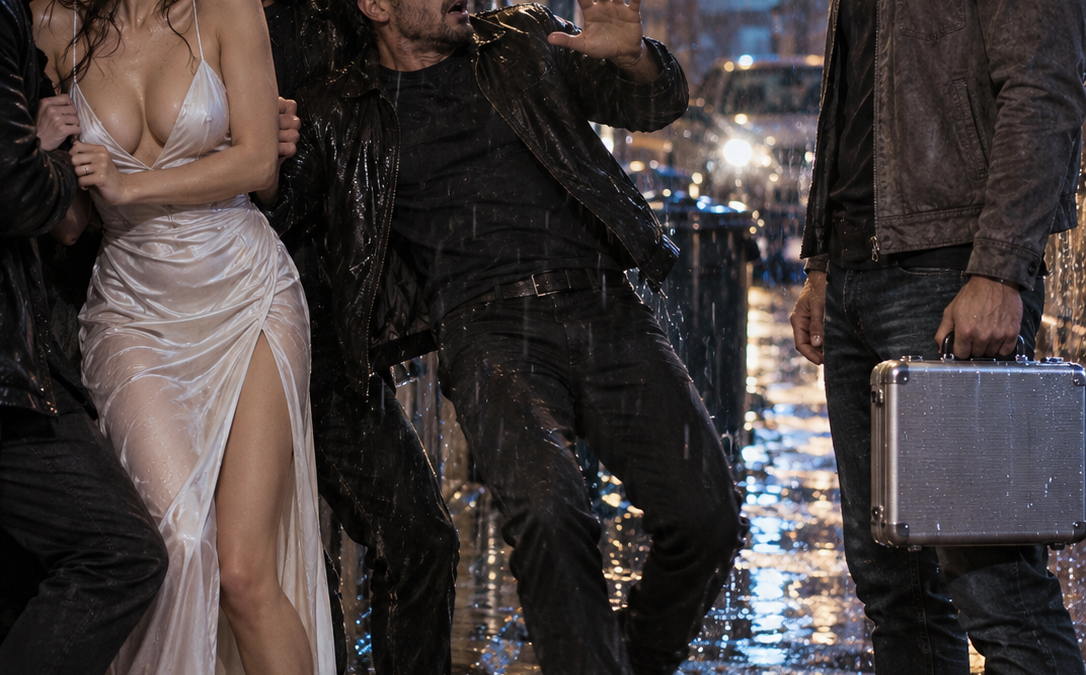
That was not nothing. Her father, she thought, would have understood. On the afternoon of a Wednesday in December, 3 months after the alley where everything started, Vanessa walked out of a meeting on the 38th floor and pressed the elevator button and waited.
When the doors opened, Grant Holloway was inside. He was in his work clothes.
He had not entirely abandoned the maintenance uniform, which she’d come to understand was not irony, but genuine preference, the clothes of someone who thought of himself primarily as a person who made broken things work again, and who did not find that identity diminishing.
He had his toolbox. He was apparently coming from somewhere on the upper floors, which made sense because the risk assessment division he was building occupied an office on 42 that was currently in a state of active renovation. They looked at each other for the half second it took to register the situation.
And something that was warm and uncomplicated moved between them, the way it had been moving between them for 3 months in the spaces around and between everything else. Vanessa stepped into the elevator, the doors closed.
They rode in silence for a few floors, the comfortable kind of silence that existed between people who had been through something and come out the other side of it, still choosing to be in each other’s vicinity.
Then the elevator slowed to a stop between floors and the ceiling light flickered, not alarmingly, just the particular stuttering of an aging building’s electrical system making itself known.
A voice from behind them from a senior executive named Callaway, who’d gotten on two floors up and whom neither of them had particularly noticed.
Maintenance. Can you fix that?
Grant looked at the ceiling at the flickering light at the specific wiring junction visible through the ventilation cover above the panel, which he had in fact already submitted a maintenance request about because he’d ridden this elevator six times in the past 2 weeks and noticed the irregularity each time.
He looked at Vanessa. She was watching him with an expression that had a smile in it. the kind that was contained rather than displayed.
The kind that meant she was genuinely pleased rather than performing pleasure. He looked back at Callaway, who was a man in an expensive suit holding a coffee cup and apparently expecting either a yes or a no.
I fix things people ignore, Grant said. Callaway blinked.
Is that a yes?
It’s a yes, Grant said.
The elevator resumed its descent. The light settled and held.
Grant set his toolbox down beside him and looked forward at the closed doors. And Vanessa stood beside him and looked forward at the same doors. And in the small mirrored surface of the door panel, their reflections were side by side.
A CEO in her jacket and a maintenance worker with a toolbox and the 11 years of space between who he’d been and who he was now compressed into something he could actually stand inside of without flinching.
The doors opened on the lobby. Callaway stepped out first, already on his phone. Other people moved in and out, the ordinary machinery of a large building operating on a Wednesday afternoon.
Grant picked up his toolbox. He and Vanessa walked out of the elevator together.
Not side by side quite enough to signal anything to anyone watching, but close enough that the space between them was different from the space between strangers. I have a 6:00 tomorrow, he said.
Clara’s school has a thing.
What kind of thing? A winter concert.
She’s playing recorder.
He said it with the particular expression of a parent who has heard a great deal of recorder practice and has opinions about it.
She’s asked me at least four times if I’m going to be there.
You’re going to be there, Vanessa said.
It wasn’t a question.
I’m going to be there, he confirmed.
She nodded. She sounds like someone worth showing up for. She is, Grant said.
And then after a beat that had something careful and unguarded in it at the same time, you could come if you wanted.
It’s a public school concert.
There’s no I mean it’s just she’s heard me mention you a few times and she’s asked.
He stopped.
Vanessa looked at him at the slight discomfort of someone who’d said a thing without entirely planning to say it and was now occupying the space after it.
What did you tell her? She asked.
I told her you were someone I worked with, Grant said.
She said that wasn’t the whole answer.
The lobby moved around them, and a 9-year-old girl who oversted her backpack with library books and drew pictures of houses with dogs in the yard had apparently, in her direct and economical way, identified something her father had been navigating with
considerably more complexity than the situation required.
“What time?”
Vanessa asked.
“6:30,” Grant said.
“At the school.”
“I’ll be there,” she said.
He nodded. The slight discomfort had left his face replaced with something simpler.
He shifted the toolbox from one hand to the other, a habitual gesture, the small physical adjustment of someone who was always carrying something and had gotten used to redistributing the weight.
He walked toward the building’s side exit.
She walked toward the main doors. At the point where those directions diverged, she glanced back once.
He didn’t look back because he was already moving toward the next thing, which had always been his particular quality.
Not the looking back, but the turning around when it mattered. the going back into the thing when the easier choice was forward.
She turned and walked through the main doors into the December cold. There is a version of this story where the lesson is about justice, about systems that fail and the people who expose them, about accountability and the long arc of consequence catching up with deliberate wrongdoing.
That version is true and it is satisfying and it is not the whole story. The whole story is about what people do with their guilt.
Preston Vale had guilt, had always had it, had simply converted it into control, into the management of outcomes that allowed him to feel that what he’d done had been necessary and measured and in some version of the ledger only he could see worth it.
That conversion is what guilt does to some people. It metastasizes.
It becomes a reason to keep doing the thing that created it because stopping would require admitting what you’ve built.
Grant Holloway had the same guilt and did something completely different with it. He carried it.
He let it live in him unchanged. Let it remain exactly as heavy as it had always been. Let it cost him things and refused to convert it into power or control or any of the mechanisms people used to make guilt manageable.
He disappeared not to escape it, but because he couldn’t trust himself, couldn’t trust the person who had led six men into an ambush with anything that mattered to others.
And he was wrong about that. He had been wrong for 11 years.
The truth, the truth that Wade and five other men had been trying to deliver for 11 years and finally got close enough to deliver in a wet Chicago alley was that Grant Holloway had not made a mistake. He had been deliberately and expertly played by someone who understood exactly how his mind worked and used that understanding as a weapon.
The guilt was real. The cause of it was not what he thought it was.
That is the thing about guilt carried honestly. It can be corrected.
It can receive new information and change. It is not permanent. It is not identity.
It is the record of what a person believed they owed to the world at a particular moment. And that record can be updated.
The update arrived in an alley, in a warehouse, in a Gary, Indiana cold storage building, in a boardroom where a man said a name he should never have known and exposed everything by trying to use it as a wound. And in a school auditorium in Chicago on a Thursday evening in December, a 9-year-old girl in a blue sweater played recorder with approximately two dozen other fourth graders. And the sound was exactly what recorder concerts always sound like earnest and slightly imprecise and completely genuine.
And in the third row from the front, a single father sat beside a woman he’d met in the worst moment of her recent life.
And Clara Holloway, looking out from the risers, found her father’s face in the audience and broke into the specific smile that children produce when they see exactly who they were hoping to see in exactly the place they were hoping to see them.
Grant raised his hand, just a small wave, the kind that said, “I’m here.
I see you.”
She went back to her recorder. Vanessa beside him watched the child play. There was a lot that was still unresolved between Grant Holloway and Vanessa Whitmore.
the strangeness of what they were to each other. The professional complication of the division he was building inside her company.
The basic practical reality of two people whose lives were structured very differently and who had met in circumstances that were not ordinary and were now trying to understand what they were to each other in circumstances that were poor. None of that was simple. None of it was going to resolve cleanly in the next few weeks or possibly months.
But she was in the third row and he was in the third row. And Clara was on the risers playing a recorder with more enthusiasm than technical precision. And the auditorium was warm.
And outside the December cold was doing what December always did to Chicago. And for a man who had spent 11 years making sure nobody remembered his name.
This particular room was full of people who did. After the concert, Clara found them in the auditorium lobby, backpack listing heavily to one side, despite there being no school tomorrow and no logical reason for the weight. She looked at Vanessa with the careful, direct assessment that children performed on new people who appeared beside their parents.
You’re the person from the work, Clara said.
I am, Vanessa said. Dad talks about work differently now.
Clara said he used to not talk about it much.
Clara Grant said, I’m just telling her what I noticed.
Clara said with the equinimity of someone who had been corrected on this kind of thing before and had a well-developed theory about when the correction was warranted. She looked back at Vanessa. Did you like the concert?
I liked it very much.
Vanessa said, and she meant it in the way you mean things when you’re telling the truth simply without layering anything on top of it.
Clara nodded, apparently satisfied.
She reached over and took her father’s hand, not needing anything from the gesture, just taking it.
the way children claimed the presence of people they trusted and looked up at him.
“Can we get hot chocolate?”
she asked.
“Yeah,” Grant said.
“We can get hot chocolate.”
The three of them walked out of the school into the December evening into the cold that came off the lake and into the lit ordinary streets of a city that had never noticed the particular drama of the past 3 months, and had simply continued being a city, indifferent, and enormous and full of people who were each carrying their own version of something heavy. each working
out in their own way what to put down and what to carry forward.
Grant Holloway had spent 11 years believing that the scar on his neck was the record of a night he had failed. What it was actually was the record of a night he had refused to leave anyone behind.
That distinction had always been true. It had just taken 11 years.
A rain soaked alley, a billion-doll company being quietly destroyed from within. a photograph in a Gary, Indiana filing cabinet and six men raising coffee cups in a Greek diner on a Friday evening for him to be able to receive it. Some things take as long as they take.
The important thing is that you’re still there when the truth finally arrives.
THE END.
