Billionaire Woman Vanished and No One Could Find Her—Only a Single Dad Found Her Alive and Saved Her
Billionaire Woman Vanished and No One Could Find Her—Only a Single Dad Found Her Alive and Saved Her
PART 1
Daniel Hayes tore the official search map off the command table, spread it flat against the hood of his truck and stabbed his finger at the one section nobody had touched. Seven days, hundreds of rescuers, three helicopters, and not one person had walked into that western drainage basin. Not one.
The woman was either dead or she was exactly there. Daniel folded the map, grabbed his pack, and walked toward the mountain alone.
What he didn’t know yet was that Victoria Langford hadn’t just gotten lost.
Someone had made sure she would never be found.
The last helicopter lifted off the valley floor at 4:47 in the afternoon. Daniel Hayes stood in the dirt and watched it go.
He didn’t wave.
He didn’t speak.
He just watched the rotors shrink against a sky that had finally, after a week of violence, gone quiet and pale and cold. The machine banked east, cleared the treeine, and then it was gone.
And with it went what was left of the largest search operation the San Juan Mountains had seen in 11 years. Around him, the command center was coming apart like a campsite after the last day of summer. Volunteers were loading folding tables into truck beds.
Someone was deflating a satellite tent with a sound like a long tired sigh. A woman from the county emergency office was walking the perimeter collecting orange flags from the ground, pulling each one up with a single practice tug and moving to the next.
Nobody was crying. Nobody was talking much.
That was the thing about a search that ended without a body. There was no moment to aim grief at. There was just the stopping the collective agreed upon decision that the mountain had answered all the questions it was going to answer and the answer was silence.
Daniel had been out here for 4 days.
He’d come on the third day of the official search, not because anyone called him, but because someone at the county office knew he knew this terrain better than most certified rangers.
He inspected wheds for a living.
He’d spent 15 years learning how rain moved through these valleys where water hid, how the land breathed during a storm.
When they needed someone who could look at a slope after a rockfall and understand what changed, they called Daniel Hayes.
Hi hadn’t found anything either.
Now he was supposed to leave. His truck was 30 yards away.
His daughter Sophie was at her grandmother’s house in Silver Creek, 40 minutes down the mountain.
And he’d promised, actually promised, not just said it the way tired fathers say things, that he would be home for dinner.
Real dinner, not a phone call, not a text saying, “Sorry baby, one more hour.”
Dinner at the table with her. He pulled out his phone. Two bars.
He typed a quick message. On my way soon. Love you.
Then he looked back at the command tent. One of the search coordinators, a heavy set man named Pollson, who wore the same tan jacket everyday and chewed on a coffee stirer like it owed him something, was bundling maps into a cardboard tube.
He glanced at Daniel. You heading out? Pollson asked.
In a minute. Pson nodded and went back to the maps.
Daniel didn’t move.
He told himself he was just catching his breath.
He’d been on rough terrain for 4 days and his knees had opinions about that.
He was 58 years old in his joints, even if the calendar said 38. He deserved one more minute before the drive.
But that wasn’t it, and he knew it.
He walked to the table. Hey.
He put a hand on the edge of the folding table. Can I look at those before you pack them? Pson shrugged.
Knock yourself out.
We’re done with them.
Daniel pulled the maps out of the tube and spread them flat, one on top of the other on the table. He pressed the corners down with his palms and leaned in. The search zone was divided into grids.
Each section that had been physically covered by ground teams was marked in green. Air searched areas were marked in yellow.
The colors overlapped and spread across the map like a quilt being assembled by someone in a hurry. He studied it.
He studied it the way he studied watershed charts, not looking for what was there, but looking for what wasn’t.
And there it was, one section, northwest, a narrow drainage basin that ran between two ridge lines before dropping into a steep collapsed ravine. Roughly four square miles of terrain. No green, no yellow, just white.
There was a handwritten notation in red at the edge of the section. AR search only extreme rockfall risk. Ground teams excluded.
Daniel stared at it. This section, he said, this western drainage. Why is it only air?
Pollson looked up. What? It says rockfall risk.
After those rains, the whole northwest face was moving.
We couldn’t put people in there.
The helicopters covered it. Flew it twice, maybe three times.
Flew it at what altitude? Pollson chewed the coffee stirer.
What they flew it at?
I don’t know, Daniel.
200 f feet, whatever standard. Standard for spotting a person standing upright in open terrain, Daniel said. Pson looked at him.
If she was in the drainage itself, Daniel said, not on the slope, but in the basin, if she was sheltered or partially covered, they could have flown over her six times and never seen her. Pollson was quiet for a moment. Then he said, not unkindly.
Daniel, her SUV was found on the east side. She was heading to the survey trail.
That’s the direction she went.
That’s the direction we assumed she went.
We found her bootprints on the east approach. One set of prints, Daniel said, dated the first morning before the storm, before the slide. She had a GPS survey device.
She had a route. She also had a reason to deviate from it, Daniel said. She was conducting an independent survey.
She wasn’t following a recreational trail.
She was going to specific land coordinates. He pointed to the map.
The western drainage basin sat roughly perpendicular to the area Victoria Langford had been surveying far enough off the main route that ground teams had never seriously considered it, but close enough that a person moving off trail for any reason could reach it. The slide happened on day one, Daniel said quietly, more to himself than to Pollson.
If the slide redirected the main creek bed, which it would have given the topography right here, then the terrain she was reading on her GPS device wouldn’t have matched what she was looking at in front of her.
She could have adjusted. She could have moved west trying to circle around the new slide debris. Pollson took the coffee stirer out of his mouth.
You’re speculating.
I’m always speculating, Daniel said.
That’s how waterheds work.
You look at what the water should have done and then you figure out what the water actually did.
She’s not water Daniel.
No, but she was following the terrain. Same rules.
There was a long pause. Someone nearby was loading a generator.
The vehicle door slammed. Pollson looked at the map.
Then he looked at Daniel. Then he sighed through his nose. The incident commander signed the termination order at noon.
He said, “Official record says we’ve exhausted reasonable search parameters.
I know what the record says.
If something happened to you in that drainage, nothing’s going to happen to me.”
Daniel, I’m not going in as a search team.
I’m just taking a hike.
Paulson looked at him for another long moment. Then he went back to his table and started stacking folders.
I didn’t hear that, he said.
And I definitely didn’t watch you take a photograph of that map.
Daniel had already pulled out his phone. I was back at his truck 5 minutes later repacking his daypack.
He’d brought three days of supplies when he came up for the search.
He had enough food for one more day, two energy bars, trail mix, a half brick of hard cheese, the end of a salami. He had his water filter and two full lers.
He had his emergency bivwac, his first aid kit, his handheld radio, and his compact headlamp.
He had the tools of a man who had learned the hard way that mountains don’t care about deadlines.
He sat in the driver’s seat of his truck and called his mother-in-law.
Elaine, “Hey, it’s me, Daniel.
” Her voice was warm and steady, the voice of a woman who had been listening to news about this search for a week.
Are they done up there?
Yes, ma’am.
They wrapped the command center about an hour ago. Are you coming home?
He looked at the mountain. I need one more afternoon, he said. A pause.
Daniel. I know. You promised her dinner.
I know, Elaine. She made a sign, Elaine said. Her voice had shifted just slightly.
She made a paper sign on the kitchen table.
It says, “Welcome home, Dad.”
with little drawings of flowers.
She’s been working on it since morning.
Daniel closed his eyes.
Tell her I’ll be there for breakfast tomorrow.
He said early.
I’ll bring those blueberry muffins she likes from the gas station.
A longer pause. The gas station muffins.
Daniel. Really?
She loves those muffins.
They’re terrible muffins.
Elaine, come home safe, she said.
That’s all I ask.
Come home safe and in one piece.
And don’t make me explain to that child why her father She stopped.
“Just come home.
” “I will,” he said.
He meant it. He ended the call and sat there for another 30 seconds looking at the phone.
Then he got out of the truck, locked it, shouldered his pack, and started walking. His phone buzzed just as he reached the trail head.
“Dad, are they done looking, Sophie?”
“Of course, Sophie,” he typed back.
“Yes, the official search is done.”
The three dots pulsed. Then did they find her? No, baby dots.
Then, “So, who’s looking for her now?”
Daniel stopped walking. He stood at the trail head with his pack on his back and the mountain in front of him and those words on his phone screen.
So, who’s looking for her now?
It was such a simple question. The kind of question only a 10-year-old asks because adults have already trained themselves to understand that resources run out, that insurance runs out, that official capacity runs out, that eventually the paperwork has to close.
Children haven’t learned that yet.
Children still live in the world where if someone is missing you, look until you find them, he typed back.
I’m going to take one more look.
Don’t worry.
Okay, Dad. Be careful. Always love you.
Love you more. He pocketed the phone, checked his compass bearing against the map photograph, and walked into the trees.
Daniel didn’t hike the way search teams hiked.
Search teams moved in organized patterns, grids, sweeps, linear progressions. They were trained to cover ground systematically and efficiently.
And for most situations, that was correct. That was science.
That was the right way to look for people. But Daniel moved the way water moved.
He found the path of least resistance. Then he deviated from it.
He looked for where the storm had pushed things where the slide had redirected things where the natural channels had been blocked or rerouted.
He wasn’t looking for Victoria Langford.
He was looking for the mountains behavior during the storm. And then he was asking where a person trying to survive that storm would have ended up. He moved through the first two miles without stopping.
The terrain was rough from the rain. Soft shoulders washed out sections of gametrail debris from the slide piled in long windowross against the lower treeine.
His boots sank an inch with every step into ground that hadn’t fully decided whether it was mud or not.
By the end of the second mile, he’d found nothing.
By the end of the third, still nothing. He sat on a boulder and drank water and ate one of his energy bars and looked at the drainage basin below him. From up here, he could see the full shape of it, a natural bowl, maybe a quarter mile across with steep sides and a floor that would have been a shallow creek before the storm.
Now the creek bed was gone. The slide had pushed the left wall of the drainage inward, dumping a mass of fractured rock across the floor of the basin.
It looked from up here like a place where nothing survived, but that was from up here. Daniel stood up and started looking for a way down.
He almost missed it. He would think about that for a long time afterward.
He almost didn’t see it.
He was 12 ft past it when something tugged at the edge of his attention.
Some trained instinct from years of reading terrain that said, “That is wrong.
Go back.”
And he stopped and turned there. High on a pine branch, maybe 9 ft up, caught on a broken stub of branch and lifting in the faint wind off the ridge. a piece of fabric, dark red, waterproof shell material, roughly 3 in x 5.
He stared at it. Victoria Langford had been photographed leaving her hotel on the morning of her disappearance.
In every photograph, she was wearing a deep red mountain shell jacket. Langford Renewable Systems corporate color was red.
Her team had joked in interviews with the press that she wore it like a uniform. He looked at the fabric, then he looked up at the branch.
The branch was 9 ft up. The fabric had been snagged from below, not blown in from somewhere else. The tear was directional.
The fibers stretched upward toward the tip of the broken stub. Something moving fast along the base of that tree had caught on the branch on the way past. Or someone.
Daniel reached into his pack and pulled out a small flagging tape. He tied it to the base of the pine, photographed the snagged fabric with his phone, and kept moving. He moved more slowly now.
Jag. 30 yards further, he found the stones, three of them, each roughly the size of a fist, placed in a perfectly straight line perpendicular to his direction of travel.
He stopped. His heart moved.
He crouched down and looked at them.
They hadn’t been placed by the stormtorm water moved rocks.
Yes, but not like this. Not in a deliberate line.
Not three rocks evenly spaced aligned north south with geometric precision. Someone had done this. Someone who wanted to leave a trail.
She was marking her route. Daniel said out loud to nobody to the mountain.
She was leaving markers. He looked around him. Then he looked ahead.
Then he started moving. He found the second set of three stones 40 m further.
Same pattern, same spacing. the threat another 30 m beyond that where the terrain began to slope more steeply down toward the base of the slide debris. She had been moving west, moving deeper into the drainage, moving away from every trail, every marked route, every area that the official search had touched.
Why? The question kept pace with him as he descended.
Why hadn’t she moved east back toward the trail head, back toward her SUV?
She was an experienced backcountry traveler.
Her file said she’d hiked extensively in Wyoming and Montana, that she’d done altitude training in the Cascades.
She wasn’t a novice.
She would have known that moving toward known terrain was the survival principle.
Unless moving toward known terrain wasn’t safe, unless she had a reason not to want to be found, not by just anyone.
Daniel filed that thought alongside the fabric and the stone markers and kept descending. He almost walked past the communicator, too.
It was half buried in a debris pile at the base of a collapsed embankment, a small orange emergency satellite device, military grade, the kind that cost $1,200 at an outdoor retailer, and was good for transmitting a distress signal to a rescue satellite from anywhere on Earth. If it was working, Daniel pulled it out of the debris and turned it over.
The unit was cracked along one edge, scuff marks on the casing, mud in the seams. It had been in the field for a week, which made sense.
But something else caught his attention immediately. The battery access panel on the back was open, not broken open, not storm damaged open.
Opened. The panel latch was intact.
The hinge was intact. Someone had opened this panel deliberately with their fingers or a coin and removed the battery. The internal battery, the emergency backup that powered the distress beacon, even when the main battery was dead, the one battery that even a completely demolished unit still used to transmit.
Daniel turned the device over in his hands. If Victoria had dropped this in the fall, it would have closed.
If the storm had battered it, it would have dented or cracked the panel.
But the panel wasn’t damaged.
It was open, clean, deliberate.
Someone had taken the battery out of Victoria Langford’s emergency communicator.
He looked at the device for a long time. Then he looked at the ground around it.
Most of the prints in the debris had been washed away or covered by slide material. But at the edge of the embankment, where the ground was more sheltered under the lip of the collapsed bank, the mud had held.
One print clear left boot large. Daniel wore a size 11.
He placed his boot next to the print. The print was bigger.
Victoria Langford was 5’6.
Her search profile listed her as wearing a women’s size 8 trail boot.
This wasn’t her print.
Daniel stood very still for a moment. Then he pulled out his notebook and wrote down what he had found in the sequence.
He had found it. The fabric, the stone markers, the communicator with its battery removed the bootprint. He stared at the list.
Then he wrote one more line.
She wasn’t alone.
He descended the last section of the drainage in near total silence. The wind had dropped.
The light was going golden and long, which meant he had maybe 90 minutes before he’d need his headlamp.
The slide debris at the base of the basin was formidable. A tumbled mass of fractured shale broken timber and compacted sediment that had come off the ridge face and piled up against the western wall of the drainage. In places it was 20 ft high.
In places, it was so dense and irregular that climbing over it was like navigating a collapsed building. But at its base, where the debris met the original wall of the drainage, there were gaps, natural voids in the debris field, spaces where the slide material had piled up against existing rock formations and left hollow spaces beneath. Daniel moved along the base of the debris field with his headlamp now active, sweeping it methodically across the face of the pile, looking for openings.
He found three. The first two were shallow and empty, packed with mud and leaves and the smell of stagnant water.
The third was different. It was narrow, maybe 2 and 1/2 ft wide at the opening, partially concealed by a curtain of slide debris that had come to rest at an angle against the wall.
Easy to miss. He almost did miss it.
But what stopped him wasn’t sight.
It was sound. Faint, barely there.
coming from behind the debris curtain. A cough. Daniel stopped moving.
He stood completely still and waited. There again, a cough. Human.
Unmistakably human.
The rough hollow sound of someone who hadn’t had enough water in days and whose body was conserving every ounce of energy it had left.
Daniel moved to the opening. He pushed the debris curtain aside. He swept the headlamp through the gap.
The chamber beyond was roughly 15 ft deep and perhaps 8 ft wide. The ceiling was low under 5 ft, formed by a slab of intact shale that had ridden the slide without fracturing, bridging the space between the debris pile and the drainage wall. It was by extreme chance structurally sound, a natural shelter that the mountain had inadvertently built.
The floor was muddy. There were signs of occupation and empty energy bar wrapper.
A collection of small containers fashioned from slide debris likely for catching rainwater that dripped through gaps in the ceiling. A burned down stub of an emergency candle, a piece of cardboard covered in handwriting.
And in the far corner of the chamber, slumped against the drainage wall with her legs extended and her eyes half open in the beam of his headlamp, was a woman. Her face was gaunt, her lips were cracked.
Her red jacket, the jacket they’d been searching for for seven days, was covered in mud and debris and dried blood from a gash on her forearm that she’d bound with a strip of cloth torn from what appeared to have been her shirt.
She raised one hand to block the light. Daniel lowered the headlamp immediately. Hey.
Hey, I’m not going to hurt you.
The woman’s eyes focused slowly.
She was fighting hard to stay conscious. He could see it in the set of her jaw, the deliberate tension in her shoulders. She was running on nothing but pure refusal.
“My name is Daniel Hayes,” he said.
“I’m a watershed inspector.
I’ve been helping with the search.”
The woman was very still for a moment, then in a voice that was almost nothing.
Barely a whisper, raw and wrecked and careful in a way that told him she’d been thinking about this moment and what to say in it.
She asked, “Did Whitmore send you?”
Daniel stared at her in the beam of the tilted headlamp, in the silence of the drainage basin, 7 days and a mountain away from the world.
Victoria Langford looked at the stranger crouched in the entrance of her shelter and waited to find out whether she’d just been rescued or whether she’d just been found.
Daniel took a slow breath.
I don’t know anyone named Whitmore, he said.
I’m here because I looked at a search map and there was one section nobody had checked.
She watched him. The official search ended today, he said. I came anyway.
A long silence. Victoria Langford closed her eyes.
Her head tipped back very slightly against the drainage wall.
The tension in her shoulders did something didn’t completely release, but shifted like a cable under load that had finally found a support point.
She opened her eyes. My leg, she said. The left one.
I can’t move it.
Daniel shifted the headlamp. Her left leg was pinned from midcfe down under a slab of shale that had broken off the ceiling sometime during the storm. A piece maybe 2 ft by 3 ft dense and heavy.
It was wedged against the wall and against another debris fragment in a way that made it impossible to simply lift. He looked at it for a long time.
How long? He asked. The second day, she said it came down the second day.
Five days?
He said, “Yes, you’ve been here 5 days with that on your leg.
I couldn’t free it alone.”
And I, she paused, swallowed, the effort of it visible.
I didn’t know who to call.
Your communicator, he said. I found it. The battery was removed.
Something moved through her expression. Not surprise. something older and harder than surprise.
“I know,” she said.
“You know, I know.”
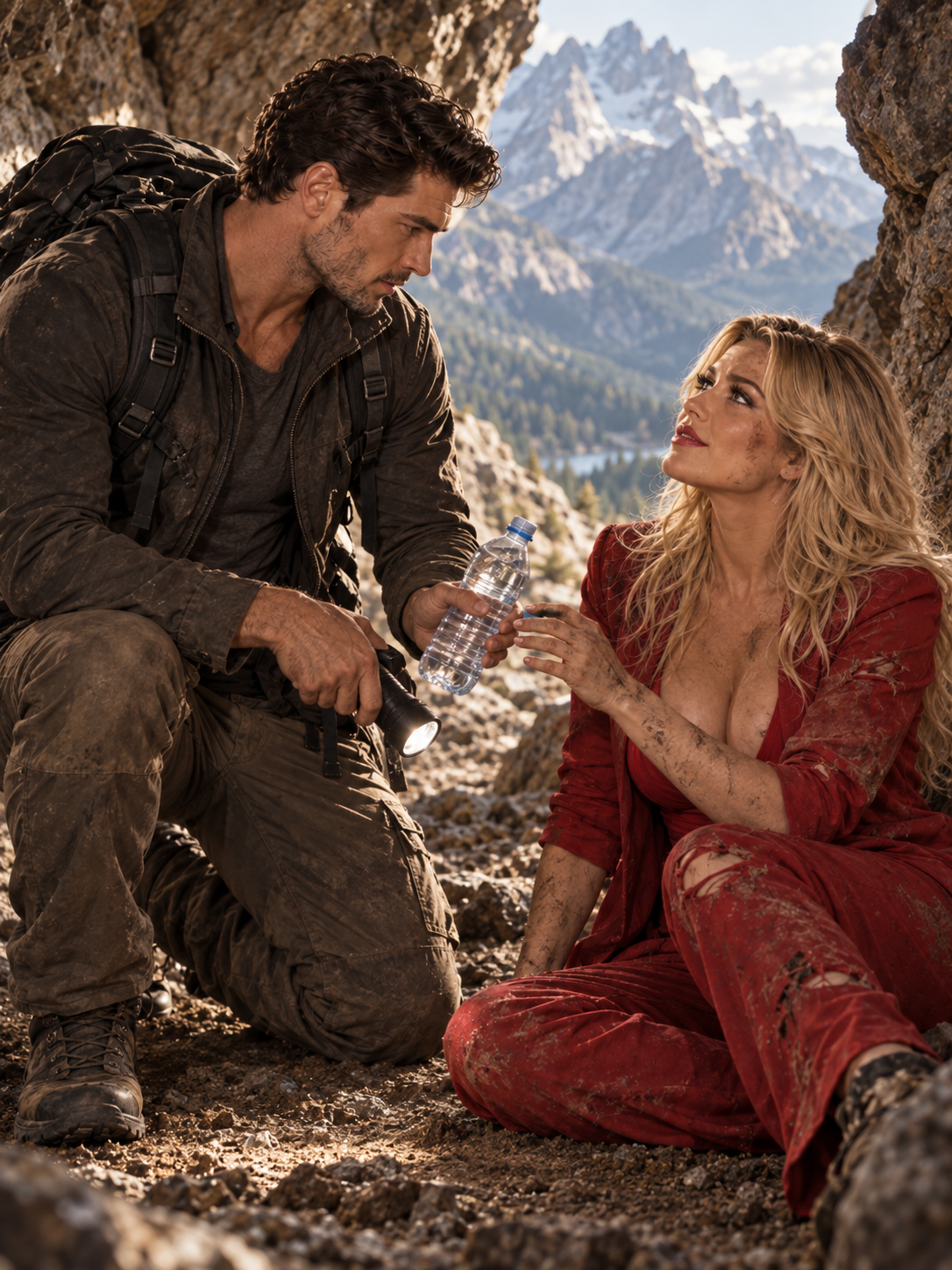
Daniel crouched lower and set his pack down. He opened it and pulled out his water bottle.
“Drink first,” he said.
“Talk second.”
He moved to her side, careful of the slab, careful of the space between them, and offered her the bottle. Victoria Langford, CEO of Langford Renewable Systems, self-made billionaire woman whose disappearance had led national news for six days, took the water bottle in both hands like it was the most valuable thing she had ever been given in her life. She drank.
And Daniel Hayes, widowed single father from Silver Creek, Colorado, sat down in the mud beside her and waited and thought about his daughter’s sign on the kitchen table and thought about what a person owed another person and decided that whatever it was, it was more than a search map
and a 6-day deadline.
It was more than that by a long measure. The water was gone in under a minute.
Not sipped, not rationed. gone the way.
Water disappears when a body has been measuring every drop against the ceiling of the sky for 5 days and still come up short. Victoria handed the empty bottle back to Daniel with both hands, and when he took it, he noticed her fingers. The nails were broken down to the quick.
The knuckles were split. The skin on her palms had the look of someone who had been doing physical work in wet conditions without gloves, raw and thickened and pale in a way that had nothing to do with cold. This was not a woman who had been lying in the dark waiting to die.
This was a woman who had been working more, he said.
It wasn’t a question.
He reached into his pack and pulled out his second leader. She took it more slowly this time and drank in controlled measures.
Four long swallows, then a pause, then three more. Slowly, he said. I know, she said.
I’m a fast learner.
There was something sharp in it even now, even with cracked lips and a leg pinned under 30 kg of shale and seven days of survival debt written into every line of her face.
“Daniel almost smiled.”
“You’re Victoria Langford,” he said.
She looked at him carefully, measuring the same look he imagined she gave people across boardroom tables when she hadn’t decided whether they were allies yet.
And you said your name was Daniel Hayes.
That’s right.
Watershed inspector. Yes.
From Silver Creek. Yes.
Not affiliated with the search and rescue team. Volunteer, he said.
I helped for 4 days and then the search officially ended and I He paused.
I didn’t leave a beat.
Why? She asked.
He looked at her steadily. because there was one section of the search map that nobody had walked.
“That’s not an answer,” she said.
“That’s a fact.
The answer is the reason behind the fact.”
Daniel sat back slightly, even pinned under a rock, dehydrated and barely functional, the woman was precise. He respected that.
“My daughter called me,” he said.
She asked, “Who was still looking for you?”
“Victoria was quiet.
” “She’s hen,” he said.
Something in Victoria’s expression moved.
Not cracked, not collapsed, just moved.
The way ice on a lake shifts when the temperature changes one degree in a direction it hasn’t been going.
What did you tell her? She asked.
I told her I was going to take one more look. Silence.
Deep and strange and oddly comfortable in a way that neither of them tried to name.
Then Victoria said very quietly, “The person who took my battery, he had big hands.”
“Daniel went very still.”
“Bigger than yours,” she said.
He wore a size 13 boot.
“I know because I checked the print after he left.
It’s the kind of thing you do when you’re trying to decide if what just happened actually happened.”
“Tell me,” Daniel said.
She took one more swallow of water, set the bottle down beside her hip, exhaled, and then she talked. She had come to Colorado secretly. That part was critical.
She needed him to understand that she had come without telling her security team, without telling her executive assistant, without telling her board.
She had purchased a commercial flight under a subsidiary company name, rented the SUV through a third-party account, and driven to Silver Creek with nothing but her survey equipment and a backpack she’d packed herself at 2:00 in the morning in her Denver apartment.
People in my position don’t do that, she said.
They have protocols, security protocols, communication protocols, emergency protocols. I broke every one of them. Why?
because the protocols run through the same people I was investigating.
She said she had been watching her own company’s land acquisition data for 8 months.
It had started with an anomaly, a parcel of land near the western edge of a Langford renewable systems infrastructure corridor that had been purchased 6 weeks before the corridor’s route was finalized internally.
purchased by a shell company through a chain of subsidiaries that eventually after 17 steps of legal architecture connected to a name that wasn’t on any org chart but that Victoria recognized whose name Daniel asked.
Not yet, she said. I need to know I can trust you first.
He nodded. Fair.
The land purchase was $12 million, she said. When the corridor was announced publicly, the land value tripled.
Whoever owned those parcels made $36 million in less than four months on information they got from inside your company on information that only six people had access to,” she said.
And one of those people was me. So the list of suspects was short. She had assembled this data quietly over 8 months, saying nothing, watching the transactions replicate.
Same pattern, different corridors, different parcels, different shell company names, but the same structural architecture, the same timing gap between internal decision and external purchase, and eventually the same terminus when you trace the ownership chain back far enough. Always the same name, a man who had reached out to her 3 weeks ago through an encrypted message. a man who claimed to have physical evidence, documents, transaction records, bank routing numbers that would name everyone involved and provide forensic proof that would hold up in federal court.
She had agreed to meet him in Colorado, in the mountains, somewhere off record. That was a mistake, Daniel said.
Obviously, she said without bitterness. I know that now.
I knew it was risky.
I didn’t know it was a trap.
The man had been waiting at the designated meeting point, a junction on a service road west of the main trail head. He had a folder.
She had started to look at it. And then his demeanor had changed in a single specific identifiable moment.
And Victoria Langford, who had spent 15 years in rooms where people tried to manipulate her, had recognized the shift for exactly what it was. She ran not toward her SUV, not toward the trail.
She ran west into terrain that was unfamiliar because unfamiliar terrain doesn’t have a predictable exit route and she needed unpredictability more than she needed familiarity.
She ran with her backpack and her satellite communicator and her waterproof notebook. She ran for 40 minutes.
She lost him in the trees on the lower slope. Then the storm came. How long before the slide?
Daniel asked. 3 hours maybe four.
I was sheltering under an overhang on the slope when I heard it.
It didn’t sound like what I expected.
It sounded more like She paused, searching, like a building deciding to fall. The slide had redirected everything.
The terrain she’d been navigating by changed shape.
Her GPS device was showing coordinates for a landscape that no longer existed.
She moved west by instinct, following the drainage, leaving the stone markers in case someone came looking from the right direction with eyes trained to see what most people don’t.
“You left those deliberately,” he said.
“The stones every 50 m oriented to magnetic north.
I took my compass off my wrist strap so I could use it as a level.”
“She paused.”
Nobody came. Nobody looked, he said.
No, the communicator, he said. Walk me through that.
Her jaw tightened briefly.
A flash of something that wasn’t sadness, something harder.
He came back, she said. The man from the service road on the second morning.
I don’t know how he tracked me.
Maybe he waited out the storm and followed the drainage logic the same way you did. He found the shelter before I heard him coming. Daniel waited.
I had the communicator in my hand, she said. I was getting ready to activate the beacon. He took it from me, opened the back panel, removed the battery.
She looked at Daniel directly.
Told me the search teams were already looking in the wrong direction and that if I tried to signal, he’d make sure they kept looking there.
He left you alive, Daniel said. He left me trapped, she said.
That’s not the same as leaving me alive.
That’s leaving the mountain to do what he didn’t want on his record.
The word record landed in the chamber like something physical. Daniel looked at her.
And the notebook, he said, “What’s in it?
Everything,” she said.
“Every transaction, every parcel number, every shell company, every routing record I could reconstruct from memory and from the photographs I took before the meeting.
It’s not the original documents he was supposedly bringing me, but it’s enough.”
She paused.
It’s enough for a federal prosecutor.
It’s enough for a board vote.
It’s enough.
Where is it? She gestured with her chin toward the deeper section of the chamber behind her.
In the wall behind the third loose stone from the left, I wrapped it in my emergency poncho. Daniel looked at the wall, then back at her. Graham Whitw Whitmore, she said.
That’s the name at the end of the chain.
That’s who you asked about earlier.
He’s my COO.
The name meant nothing to Daniel. But the way she said it meant everything flat and precise and absolutely certain with no pleasure in it, no triumph, just the exhausted calm of a woman who had spent 8 months being sure of something and then nearly died proving it.
He’s been telling the press how devastated he is, she said.
He’s been calling my disappearance a tragedy.
He’s been running your company, Daniel said.
He’s been preparing to run it permanently, she said.
A long silence settled outside the chamber. The mountain was quiet. The wind had dropped.
The light coming through the gap in the debris, what little of it there was, had gone amber with late afternoon, which meant Daniel had maybe 70 minutes before dark. He looked at her leg. The slab that pinned it was wedged between two points the drainage wall and a secondary debris fragment in a configuration that functioned like a lever.
Pulling the slab straight up wouldn’t work.
pulling it outward from the wall would shift its weight onto Victoria’s leg before it cleared.
The only workable angle was a lateral rotation rotating the slab around its lower edge away from the wall, but that required force applied from a very specific direction and a fulcrum point that didn’t currently exist.
He needed
equipment he didn’t have.
He needed the technical rescue team.
I can’t get the slab off you, he said.
Not as apology, as information. I know, she said.
I’ve been working that problem for 5 days.
I need to go get a signal and call in a technical team. She looked at him.
Nearest ridge with reliable signal is about 3 mi northeast, he said. 2 hours in the dark, maybe less if I push. He looked at her leg at her face at the chamber.
I’ll leave you the rest of my food.
I’ll leave you the thermal blanket and the emergency whistle if you hear anyone moving outside.
I know how a whistle works, she said. I know you do.
A pause. What if Whitmore has people monitoring the search frequencies?
She said, I’m not going to use the search frequency, he said.
I’m going to text the rescue commander directly with my location, with your coordinates and my name.
He thought about it for two seconds. No. She studied him.
Why not?
because I don’t know who else is watching,” he said.
“And because if there’s someone monitoring communications for any sign that you’re alive, your name is the trigger word.
” She was quiet for a moment.
Then you’ve thought about this.
“I’m thinking about it right now,” he said.
“But yes.”
He began pulling items from his pack. The thermal blanket, he unfolded it and draped it over her shoulders, tucking the edges carefully without touching the slab.
The emergency whistle whistle. He placed it in her hand and closed her fingers around it. The last of the food, the trail mixed the remaining cheese one energy bar.
“Eat slowly,” he said.
“Small amounts.
Your system will reject it if you rush.”
“I know,” she said.
“I’ve been managing that problem, too.”
He paused. He was looking at his note. He pulled it from his jacket pocket.
Inside the front cover was a photograph standard size, printed on regular paper and laminated the kind of thing you did when you wanted something sturdy enough to survive a field season.
A little girl with her father’s eyes and her mother’s smile, and a gap where one of her front teeth should have been holding a fish she’d caught on the first and so far only fishing trip they’d managed to take together.
Victoria was looking at it.
He hadn’t realized he’d opened the notebook to that page.
“Your daughter,” she said.
Sophie, she’s beautiful.
She is, he said, a beat. Go, Victoria said. Her voice was steady, steadier than he expected.
Go call your rescue team. And then she stopped. He waited.
Go home to her, she said. After when this is done, just go home. Daniel looked at her for a moment.
I’m planning to, he said, but you’re going home, too.
He moved toward the chamber entrance. Then he stopped. The whistle, he said.
Three blasts means I’m coming back.
Two means the team is close.
One means something’s wrong.
He looked at her.
Don’t open the back of the chamber.
Don’t try to move the slab.
Don’t sleep if you can help it.
I’ve been sleeping about 40 minutes at a time for 5 days.
She said, “My sleeping schedule is not your biggest concern right now.”
“All right,” he said.
Daniel. He turned.
What you said about the search map? She said, the section nobody walked.
She held his gaze. Thank you for walking it. He nodded once.
Then he pushed out through the debris curtain and started climbing. The climb was brutal in the dark. High had the headlamp, but the batteries were at about 60% and the terrain on the northeast slope was the worst of the drainage.
loose shale wet from the previous day’s rain with no trail and nothing but his memory of the map photograph and his knowledge of how this drainage ran to guide him.
He went down twice. The first time he caught himself on his hands and came up with his palms bleeding through the gloves. The second time he went down.
Harder rolled two feet down the slope before his boot found purchase and sat still for 30 seconds with his heart hammering, listening to the dark. Nothing. No sound, no movement.
He got up and kept climbing. The thoughts came in the rhythm of the ascent, the way they always did on hard terrain, one with each footfall, each breath, each decision about where to put his weight.
She wasn’t alone when she went in.
Whitmore’s man had taken her battery.
Whitmore had been on television for 6 days playing the grieving colleague. The search had ended, and Daniel was the only person in the world who knew she was alive. The weight of that was not abstract.
It was physical. It sat in his chest between his lungs and pressed.