CEO Walks Out on Her Blind Date With a Poor Single Dad—Unaware His Supercars Wait Outside – PART 4
PART 4
The three dots appeared immediately. Then Lily has piano rehearsal Thursday evening.
I’m free after 7.
She exhaled. Thursday at 7:00.
She typed back. You pick the place. I know a coffee shop, he wrote.
Good coffee. Corner table. No matchmaker required.
This time she did smile. Small, genuine, slightly undone.
The smile of a person who has had a very long day and has arrived unexpectedly at something that feels like solid ground.
She typed, “I’ll be there.
” And Nathaniel, I’ll be on time.
I know. He wrote back.
I’ll be early.
She left the office at 6:47. Her driver was waiting.
She got into the car and sat back and let herself be still for the first time in 14 hours. And the city moved past the windows, the rooftops of the historic district, the glint of evening on the harbor, the long shadows falling across streets she had walked and driven and developed and disputed for 20 years.
She thought about the Caldwell block, about iron work that couldn’t be replaced once it was gone, about the argument she had agreed to hear preservation and profitability more often than people think, and about the specific kind of attention required to see value in something that the surface suggested was ordinary.
She had not always had that attention. She was going to learn it. Her phone rang, an unfamiliar number, a Savannah area code.
she answered.
Ms.Ashford, a woman’s voice, careful professional.
My name is Clare Hart.
I’m a partner at Hart and Cullum.
I believe you’re now aware that our office forwarded certain documents to a third party earlier this week.
Vivien sat up.
I’m aware.
I wanted to make contact directly. A pause.
What I’m about to tell you was not included in those documents, and I want you to understand why.
Another pause. Marcus Whitmore approached our firm 14 months ago.
He represented himself as acting on your behalf. He asked us to prepare the Meridian operating documents. We declined, but not before conducting preliminary research into the transaction structure.
Her voice tightened slightly. When we declined, he went elsewhere, but we retained the research. And when the Caldwell block dispute came to our attention and we identified the connection between Asheford Capital and the Meridian structure, we made a decision about what to do with it.
Viven processed this. You chose Nathaniel Callaway deliberately.
We knew he had attended the Caldwell preservation hearings. We knew he was independent of your organization.
We knew he had the resources to act if he chose to. A pause. We did not know he had a personal connection to you.
That appears to have been fortunate. Viven thought about Gloria Hendris, about a blind date on a Thursday morning, about the 11-minute window in which she had made a decision that had almost meant she never received those documents at all. The coincidence of it, or the non-coincidence, sat in her chest like something very heavy and very precise.
Miss Hart, she said, I’d like to speak with you in person about the Caldwell block, about the preservation framework, she paused.
And about what it would take to get the iron work right, a pause on the other end, then with a warmth that hadn’t been in the professional voice before.
I think we can arrange that, Ms.Ashford. She hung up.
She looked out the window. Somewhere across the city, Nathaniel Callaway was picking up his daughter from piano rehearsal in a car that turned heads at every stoplight.
And Lily was asking him how things were going with the complicated lady. And he was probably telling her that things were getting less complicated.
And Lily was probably saying, “Good, because sorry matters.”
And she was right. She was almost always right.
And somewhere across the city in a home office that now felt very much like a trap he had built for himself. Marcus Whitmore was talking to his attorney and understanding increment by increment the full scope of what had come apart.
Two people, Vivien thought, one who had spent 14 months building something designed to survive, and one who had spent one morning deciding whether to protect a stranger. She knew which one had made the better choice. She knew more importantly which one she intended to be from now on.
The car turned onto her street. The evening was warm and the city was loud with it music from somewhere. The smell of jasmine from the garden two doors down.
All the ordinary insistent beauty of a place that kept being itself regardless of what the people in it were doing. She stepped out of the car.
She stood on the sidewalk for a moment.
She thought, “Thursday 7:00 corner table.”
She thought, “Don’t be late.”
She went inside. Thursday came the way important days always do, quietly without announcement, giving no indication that it intended to matter. Nathaniel dropped Lily at piano rehearsal at 5:30.
She had her sheet music tucked under one arm and her water bottle in the other hand, and she was already humming Clare DeLoon under her breath the way she did when she was nervous, which she would never admit was nervous and always insisted was just thinking, “Dad.”
She stopped at the rehearsal hall door and turned around. Is tonight the dinner with the complicated lady.
It’s coffee, he said.
And yes. She looked at him with the focused assessment of someone who had inherited his habit of reading situations carefully and had not yet learned to disguise it.
Are you nervous? No.
You’re doing the thing with your jaw.
I’m not doing anything with my jaw.
You do it when you’re thinking hard about something you don’t want to think hard about.
She shifted her sheet music.
It’s okay to be nervous.
Mrs.Patterson says nervous just means you care. He looked at his daughter at the 8-year-old certainty of her, the complete and uncomplicated generosity of it. Mrs.Patterson is a wise woman.
I know, Lily pushed open the door.
Don’t be weird tonight.
I won’t be weird.
You’re already being weird.
You ironed your shirt. He looked down.
He had in fact ironed his shirt. It was a different shirt, dark blue, not flannel. The kind of shirt that said he had made a considered choice without announcing that he had made a considered choice.
He had stood in front of his closet for 6 minutes, which was 5 minutes and 50 seconds longer than he usually stood in front of his closet, and he had not told anyone about that. Lily was already gone, the door swinging shut behind her, and he could hear her laughing at something inside. And he stood there for a moment in the quiet of the hallway, thinking about nervousness and caring and the specific courage required to sit down across from someone and try again.
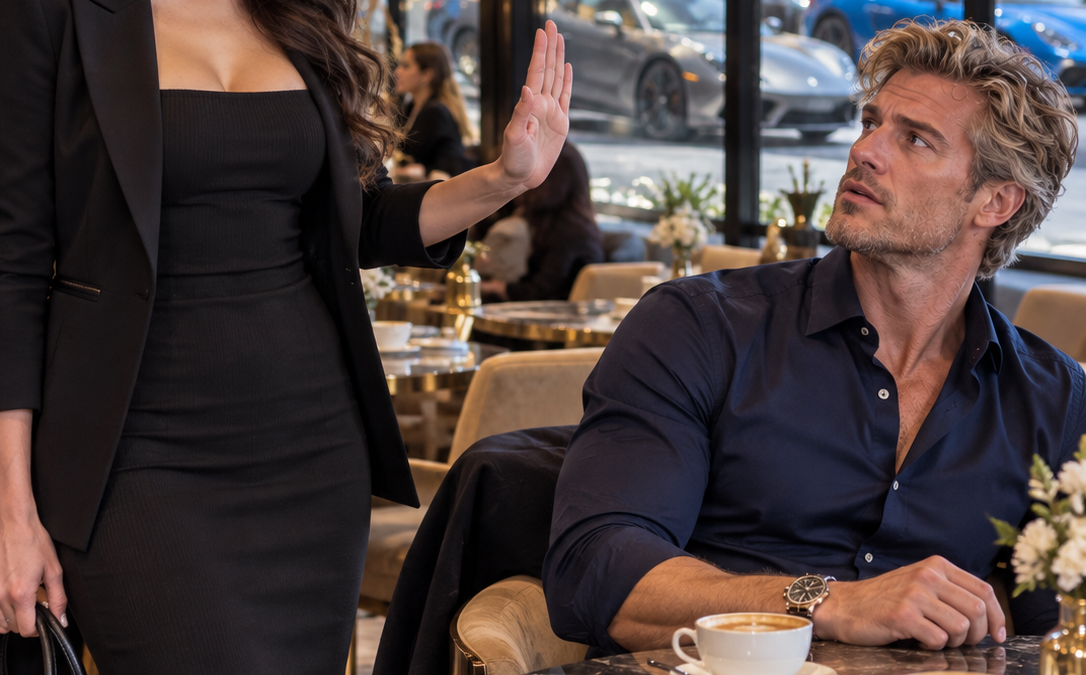
He got in the car. He drove to Magnolia Key Coffee. He arrived 12 minutes early.
He got the corner table. He ordered drip coffee and sat with both hands around the mug and did not check his phone because checking his phone would mean he was counting the minutes and he had decided he was not going to count the minutes.
She walked in at 6:58 2 minutes early.
She had said she would be on time and she had arrived early and that small specific thing, the fact that she had said it and then done it the 2 minutes of effort that no one would notice unless they were looking for it landed in his chest with a weight he hadn’t expected.
She saw him. She crossed the room without hesitating.
She sat down across from him. For a moment, neither of them spoke.
Not awkwardly. There was something almost comfortable in it, like two people recognizing that they had arrived at a place that required a second to acknowledge before filling it with words.
“Corner table,” she said.
“Corner table,” he agreed.
“Better coffee than I remembered.
You didn’t drink the coffee last time.”
She held his gaze. I know.
A pause.
I’ve been thinking about that.
About what I was so afraid of that morning that I couldn’t stay for a cup of coffee.
He waited. He was good at waiting. I think she said carefully that I had decided before I sat down that you were going to disappoint me.
And I was so busy protecting myself from the disappointment that I couldn’t see anything that was actually in front of me.
She looked at her coffee cup.
That’s not an excuse.
I know it’s not an excuse.
I just I wanted you to understand the mechanics of it because you deserved better than what you got and you deserve to know it wasn’t about you.
I know it wasn’t about me, he said.
She looked up. You do?
I knew it in the cafe. He turned his mug slightly on the table.
That’s the thing about that kind of exit.
It’s never actually about the person in the chair.
It’s about every person who sat in that chair before.
He paused. I just happened to be the one there that morning.
She was quiet for a moment.
That’s very generous.
It’s accurate.
He looked at her. Who sat in that chair before Vivien? The question was direct enough that it should have felt invasive.
It didn’t.
It felt like the natural next sentence of a conversation that had been circling this point for 4 days. She picked up her coffee.
She took a breath.
“My ex-husband was very impressive on paper,” she said.
“The right family, the right career, the right social fluency.
I spent four years married to a man who was exactly what he looked like.
and what he looked like turned out to be someone who found my success threatening and my schedule inconvenient and who left when the company got big enough that it couldn’t be ignored anymore.
A pause. After that, I stopped looking past the surface because the surface had seemed safe.
Someone who clearly didn’t belong in my world couldn’t threaten it.
She paused. That was the logic. It was stupid logic.
It was protective logic.
He said there’s a difference.
You keep doing that. Doing what? Finding the charitable interpretation.
She set her cup down. Most people would just agree that I was being a snob.
You were being a snob, he said. And you were also protecting something real. Both of those things are true at the same time.
He looked at her steadily.
I don’t think people are usually just one thing.
She stared at him.
