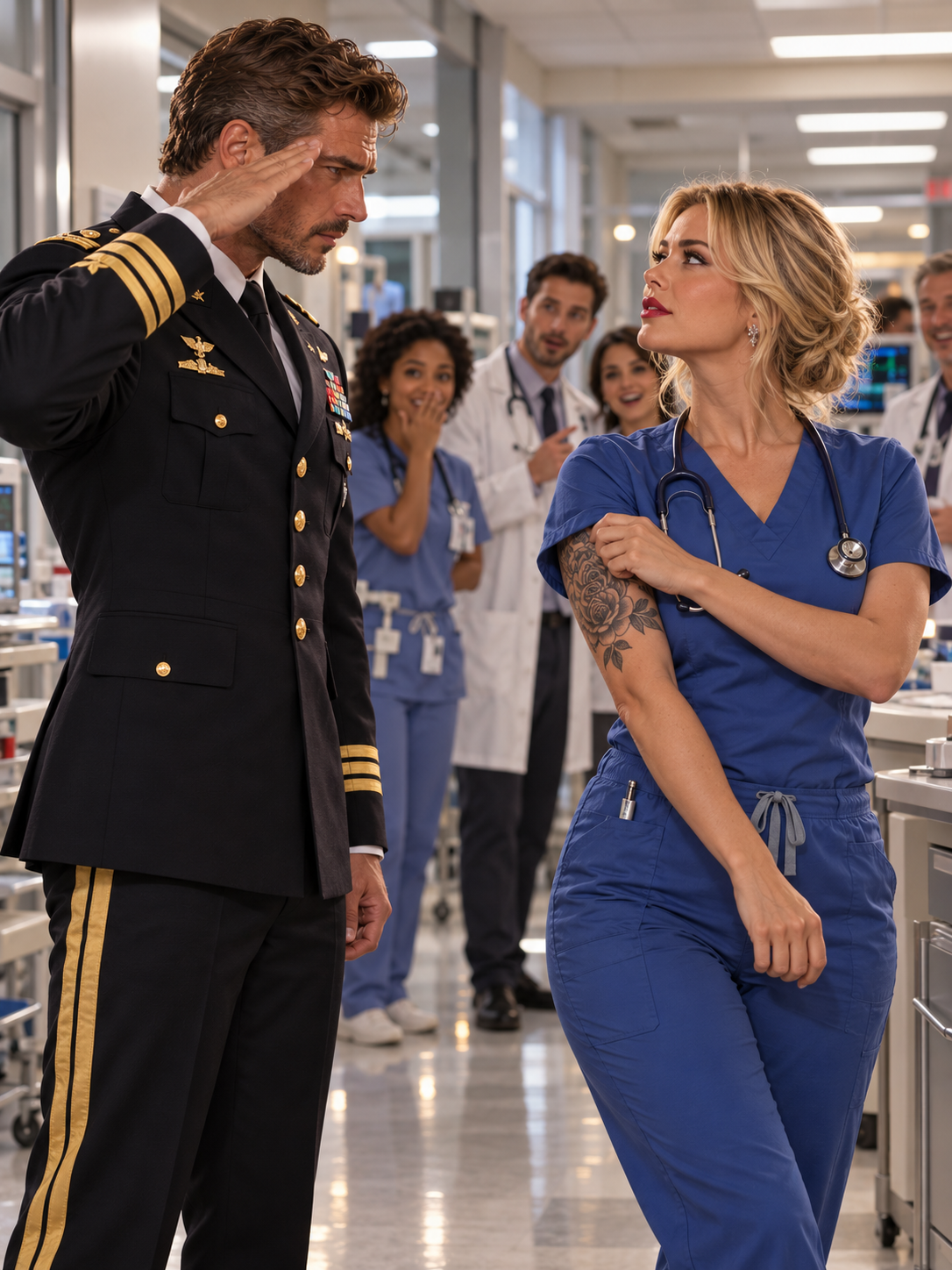
Doctor Mocked the Nurse’s Tattoo—Then a Navy SEAL Commander Saw It and Saluted Her
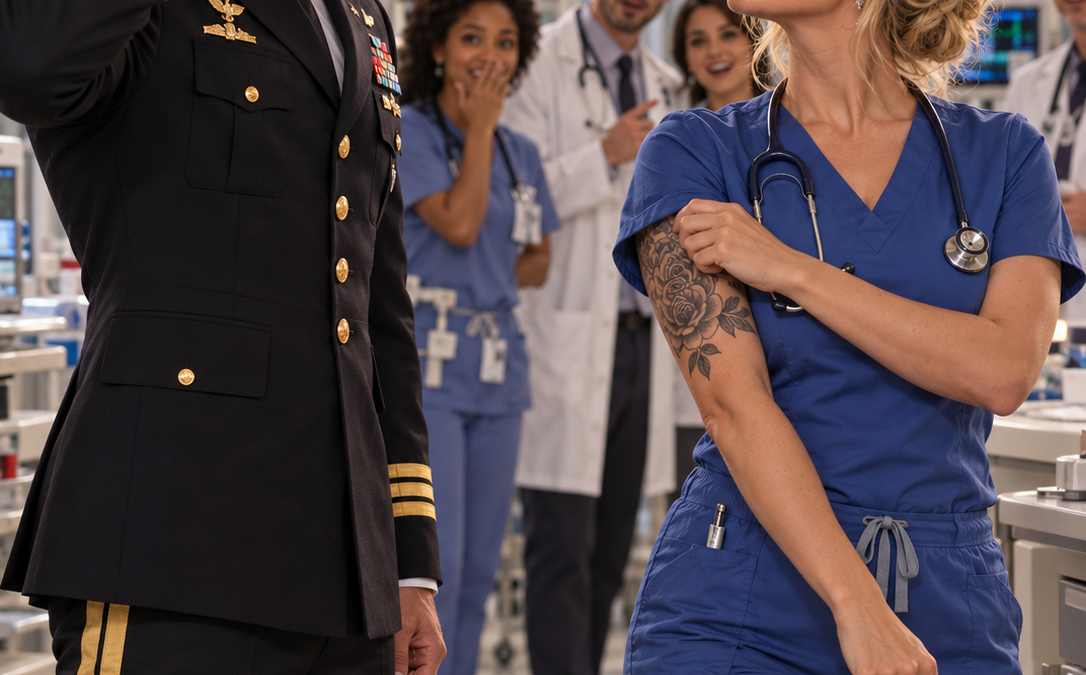
Doctor Mocked the Nurse’s Tattoo—Then a Navy SEAL Commander Saw It and Saluted Her
PART 1
A trauma code tore open her sleeve. The tattoo underneath stopped three doctors cold, then made them laugh.
What they didn’t know was that the crude black mark on nurse Callahan’s arm had been bu put there by Navy operators who who owed her their lives.
At Harrest Medical Center, she was the quiet one, the easy target, the woman nobody bothered to look at twice. Dr.Roman Steel had been mocking her for months. Tonight, he would try to have her thrown out of her own emergency department.
By morning, a decorated commander would walk through those doors, see that tattoo, and come to attention in front of the entire staff.
The trauma bay at Harrowest Medical Center smelled the way it always did after Midnight Antiseptic Over Blood with something sharper underneath that nobody ever talked about cuz naming it made it real. The fluorescent lights ran 2° too cold, and one of the overhead panels on the east wall had been flickering since Tuesday, creating a strobe effect that maintenance kept promising to fix and never did. Nurse Dra Callahan had stopped noticing the flicker months ago.
She was 37 years old, built lean and compact in the way that suggested she’d once carried weight that had nothing to do with the body.
with cropped dark auburn hair and gray green eyes that stayed level regardless of what was happening in front of them. She worked the overnight trauma rotation at Harrow Crest four nights a week, and she had been working it for 2 years and 4 months, and in that time, she had said very little about herself that anyone could actually hold on to. She had a Norfolk, Virginia address on her employee file.
She had a food truck she visited on Tuesdays. She had a one-bedroom apartment with a single bookshelf and no photographs visible from the door. What she did not have was a reputation for drama or for complaints or for anything that would make the people she worked with think about her for longer than a shift required.
That was deliberate. It was 11:48 when the radio crackled.
Her crest incoming trauma male mid30s construction accident blunt thoracic GCS 12 and dropping ETA 6 minutes. Dara was already pulling her gloves when the charged nurse on that side of the unit, a heavy set man named Pete Garvey relayed the call to the attending. She started rolling the crash cart into position without being asked.
She checked the defibrillator pads.
She confirmed the intubation kit was stocked because it hadn’t been properly restocked after the last case and she’d noticed at 10:15 and fixed it then which was why it was ready now.
The patient came in hot. Construction worker 22tory fall broken partway by rigging. Right chest staved in.
The paramedics working him hard with manual compressions because his pressure had started doing things that made the lead medic’s voice go tight on the radio even before they hit the bay doors.
The gurnie came through fast and the team moved the way trauma teams do when the clock is already running controlled noise.
bodies finding positions, everyone talking over, everyone in the specific productive chaos that looks like panic to people who’ve never seen real panic.
Dra went to the head of the bed. She had the airway within 90 seconds.
The tube seated cleanly on the first pass. She confirmed bilateral breath sounds, called out the placement, taped the tube while the attending, a compact, dark-haired woman named Doctor Felicity.
Odum called for the portable chest film and got a line going on the left. It was a good save.
The patient stabilized enough to go upstairs to the surgical suite with a blood pressure worth working with and an airway that wouldn’t kill him in the elevator.
Dra was documenting at the workstation when the shift changed around her and doctor Roman Steel came on.
She didn’t look up when she heard his voice.
She’d learned that looking up gave him an opening he didn’t need.
Roman Steel was 44, a trauma surgeon with a 12-year tenure at Harrow Crest that had made him effectively uncancable in the way certain hospital physicians became uncancable through a combination of technical skill, donor relationships, and the kind of institutional familiarity that made administrators feel like firing him would be removing a loadbearing wall. He was tall with thick dark hair going silver at the temples in a way that photographs well, and he knew it.
He had a runner’s build and a habit of standing where the light hit him best in rooms that had good light, and in trauma bays he stood at the foot of the bed like someone conscious of the angle.
His first three residents called him brilliant behind his back and said nothing to his face except yes, and noted, “And I’ll check on that.
” Dra had been working his trauma nights for 5 months.
She called him Dr.Steel and kept her assessments short and accurate and did not engage with anything that what this wasn’t patient care.
This irritated him in a way she was aware of and had decided was manageable. It was 12:40 when the next case came in a 17-year-old.
Motor vehicle versus guardrail left femur fracture, scalp lack, bleeding dramatically, but the neuroexam clean vitals holding textbook for the level of mechanism.
Dra had the kid’s hand while Steel examined the leg, and she was explaining to the terrified teenager what each machine was doing in plain language because nobody else was doing it.
and they kept asking with his eyes.
“That beeping is just your heart monitor,” Dar said.
“It’s a good sound.
It means we can see what your heart’s doing, and it’s doing fine.
Am I going to lose the leg?”
“The doctor’s going to look at everything and tell you exactly what’s happening.
You’re awake.
You’re talking.
Your pressure is good.
Those are the things we want.”
Steel glanced up from the X-ray. Callahan Fentinel 50.
He’s already had morphine from the field.
Doctor steel 40 minutes ago. 4 mg.
I’m aware 50 fentinyl.
She drew it. She gave it.
She documented the interaction and the dose and the reasoning she’d observed and the attending’s order because she always documented completely.
And this was not the first time Steele had stacked analesics in ways that made her internal alarm tick quietly in the background of a shift. At 1:15, the night slowed.
Dra was in the supply room doing a count when she heard steel and the overnight charge nurse coordinator Beex Harlo, 30, sharp in a way that came with ambition rather than experience talking in the corridor just outside.
She wasn’t trying to listen.
She was counting IV flush syringes, which required actual counting, and the door was open and their voices carried. She corrected me in front of the medics again. Steel said the morphine fentanyl thing.
She does it constantly. This subtle little pause before she draws anything.
Like she’s making a point.
Do you want me to talk to her? I want it on record.
She’s got an attitude problem she covers with this quiet act.
I’m tired of looking past it.
Dra put the last flush syringe in its place. She came out of the supply room and walked past them both without stopping because there was a patient in bay 3 whose catheter bag needed to be emptied and documented and that was a task that existed and needed doing and she was the person on shift to do it. Neither of them said anything as she passed.
She didn’t look at them.
The complaint landed in her file 3 days later. unprofessional conduct during patient care failure to follow attending physicians orders in a timely manner, creating delay in analesia administration. Dra read it in the breakroom on a Wednesday afternoon before her shift.
She read it twice. Then she folded the paper in half and put it in her bag and went to her locker to change into her scrubs.
She had been here before. Not at this hospital, not in this language, but in this specific topology, the paperwork that described something real through a lens angled to make her look like the problem.
She knew what it felt like, and she knew what she was going to do about it, which was the same thing she’d done before.
Document accurately, say nothing unnecessary, and keep working. She requested a meeting with the unit cybervisor, Patricia Moan, a 50-ish administrator who had been in hospital management long enough to have developed a vocabulary that communicated very little clearly.
Moan listened to Dar’s account.
She reviewed the documentation DAR had brought which was thorough and t timestamped and showed the mor morphine administration from the field the drug interaction consideration and the attendings override this does reflect a moment of hesitation before compliance. Moan said the hesitation was me verifying the prior dose in the record. Dar said that took approximately 4 seconds.
The patient was stable. The documentation reflects that. Dr.Steel characterizes it differently.
I understand that. I think what would be most productive, Moon said, is it if you made an effort to be more immediately responsive when an attending gives a verbal order. Even if you have a clinical concern, that concern should come after compliance, not before.
Dra looked at her. She thought about several things she could say and chose none of them.
I’ll keep that in mind, she said.
Moon made a note. The meeting ended. The complaint stayed in the file.
It was another 9 days before the sleeve slay happened. The trauma was a bad one.
middle-aged man, agricultural equipment, degloving injury to the right forearm, shock on arrival, the kind of case where the room got loud fast because there was a lot to manage, and the visual was extreme enough to rattle people who hadn’t been doing this long enough to file it properly.
Three of the newer nurses cycled through the bay. Dra stayed. She was managing the fluid resuscitation and monitoring the pressure trend and calling numbers to the team in a steady rhythm.
At some point in the controlled scramble, her her left sleeve caught on the side rail of the gurnie and tore open at the seam from wrist to elbow. The tattoo was visible for maybe 15 seconds before she pushed the sleeve back down.
It was not a pretty tattoo. It was not decorative in any conventional sense.
It covered the inside of her left forearm from 2 in below the elbow to the wrist. A broken trident laid sideways, crossed at its center by a military medical insignia that looked like it had been designed for function rather than aesthetics. Below the crossed image was a string of coordinates in a clean block font.
Below that, a date, March 7, 2015. The ink was old.
The line slightly spread in the way tattoos spread when they’ve been in skin for a decade or more.
It looked like something made in a hurry by someone with skill but no time or inclination toward beauty. It was the kind of tattoo you got to remember something you were going to carry regardless. Dra got her sleeve back in order.
She went back to the fluid count. The patient was stabilizing and she needed the last 15 minutes of this case to go well and they did.
Afterward, washing her hands at the sink, she became aware that Steel was behind her. She turned. He was looking at the sleeve, or rather looking at where the tattoo would have been if the sleeve had still been open.
Next to him was one of his secondyear residents, Doctor Park, who was staring at the ceiling in the specific way.
Residents learn when they don’t want to be part of something but can’t leave.
That thing on your arm, Steel said.
It’s a tattoo.
I know what it is. Looks like something you get at a state fair. Dr.Park found something extremely interesting to examine on the wall.
Dra dried her hands.
It’s from a while ago.
It looks like a gang symbol, Steele said.
Or something off a biker’s toilet wall.
He said it in a half- joking tone, the tone that preserved deniability that allowed the speaker to retreat to. I was just kidding.
Can’t you take a joke if anyone pushed back?
You might want to think about a sleeve guard or something. Patients can see that it stays covered.
Dar said it was covered. The seam tore. Just a suggestion, he said, and left.
Dr.Park exhaled. Sorry, he said quietly to nobody in particular.
Dra put her hand back in her pocket and went to check on the man in bay 2 who’d come in with chest pain an hour ago and hadn’t been discharged yet.
She didn’t say anything to Dr.Park.
There wasn’t anything useful to say.
Vex Harlo filed the second complaint the following Tuesday. professional conduct, concern, visible tattoo of an inappropriate and potentially distressing nature during patient contact. Patient in bay 6 observed the tattoo and expressed discomfort.
Dra read the form.
She looked up patient bay six from that date and found a 41-year-old man who had come in with a sprained ankle, been triaged, treated, and discharged in 40 minutes with no documented complaints of any kind in the nursing notes or the physician notes or the patient satisfaction form he’d filled out, which rated his care four
out of five stars and noted that the nurse was very calm and professional.
She brought this to Moon. Moon had clearly already spoken to Beex Harlo because her posture was different. This time closed off, leaning back, the body language of someone who has picked aside and is waiting for the conversation to end.
The concern is in the record, Moon said. Regardless of what the patient documented, the charge nurse observed an interaction she found problematic.
The patient satisfaction survey contradicts the complaint. Patient surveys are one data point.
The nursing notes from that shift show the patient had no concerns. Dra Moonfolded her hands.
I think the path of least resistance here is to wear a compression sleeve on that arm for the rest of your shifts.
It’s not disciplinary action.
It’s a practical accommodation that removes the issue.
The issue is a fabricated complaint.
Moon’s expression went flat.
That’s a serious accusation.
Yes, Dara said. It is.
There was a long pause. The compression sleeve, Moon said, is my recommendation. Dra bought a medical grade compression sleeve at the pharmacy two blocks from the hospital on her way home.
She wore it every shift after that. It covered the tattoo completely.
It was dark navy, regulation appropriate, and invisible under her scrub top when she moved her arms normally. She said nothing more about the complaint.
She went back to work. 3 weeks after the sleeve, on a Friday in late October, a line of coastal storms hit the Virginia coast back to back, the kind that came in off the Atlantic every few years and turned the roads into rivers and filled emergency departments and filled emergency departments with the secondary disasters that followed major weather car accidents on flooded road, hypothermia, falls, crush injuries from storm debris.
Harrest activated its mass casualty protocol at 9 in the evening when the singen storm cell made landfall and stayed on it until nearly 2:00 in the morning. Dar worked the whole thing.
She’d been scheduled for a half shift but mass casualty protocols suspended normal scheduling and she stayed because she stayed cuz the work was there and she knew how to do it and somebody had to.
By midnight, the acute volume had leveled off, and the department was running on residual chaos patients in hallway beds, overwhelmed documentation.
Staff who’d been on their feet for 8 hours trying to process paperwork that needed to be done before the next wave came in.
Dara was updating charts at the East Workstation when the radio traffic changed tone. She heard it before she consciously registered it.
The quality of the dispatcher’s voice, the compression in it.
Her crest be advised. Incoming mass casualty. Military personnel.
Rotary aircraft accident. Rural route 9.
Approximately four to six casualties. Varying severity. Lead vehicle ETA 14 minutes.
She was on her feet before the overhead. PA finished repeating it.
The department reorganized fast trauma bays 1 through four cleared. Surgical on call alerted.
Blood bank notified. Doctor Steel pulled from a non-urgent consultation in the main building and redirected to the trauma unit. Dra position turtle Sammy.
Dra positioned herself at bay 1, which was where the highest acuty case would go and started her slint again because she always started the checklist again. The first two ambulances came in together. lacerations, a broken radius, a probable concussion, but survivable, and the two residents who caught those patients were managing.
The third vehicle arrived 90 seconds later, and the back doors opened, and Darus saw the paramedic’s face and understood immediately that this one was different.
The patient was a man in his mid30s, big-framed, still in parts of a military flight suit that had been cut away in pieces. His color was wrong, the gray blue that meant his body was working too hard to maintain perusion.
There was a paradoxical motion on the right side of his chest when he breathed. The chest wall moving opposite to the way it should, which meant rib fractures bad enough to have destabilized the structural wall entirely.
His blood pressure was 70 over nothing when the medic called it and dropping. Dar took the head of the bed.
Steel moved to the foot. Assessed, called for the portable chest X-ray.
GCS, Dar asked the medic. Nine on scene seven in transport.
How long from injury to your arrival? 19 minutes.
Helicopter went down in water. He was partially submerged until the second team got to him. Dra looked at the monitor.
She watched the waveform. She watched the tracheal position and the neck veins distended both sides.
And she listened to the chest with a scope the medic handed her and heard what she heard and put the scope down. Tension pumathorax, she said.
Right side. Steel was looking at the tablet showing the incoming portable film.
Let’s get the CT first.
He won’t make it to CT.
Steel looked up.
The film The film will show what I’m already hearing.
Absent breath sounds on the right. JVD. Pressure dropping.
paradoxical motion. We need to decompress now.
Or he doesn’t have a blood pressure in 4 minutes.
The room had gone quiet in the way trauma rooms went quiet when two people stopped coordinating and started competing, which was a specific and dangerous silence.
Steel’s jaw tightened.
You’re a nurse, Callahan.
Get the X-ray positioning right and let me. The monitor screamed.
PA, pulseless electrical activity.
the heart’s electrical system firing into nothing.
Dra moved.
She didn’t ask.
She reached across the crash cart, took the 14- gauge needle, confirmed the landmark second intercostal space, mid-clavicular line, right side, and put it in. The rush of air was immediate. The monitor changed.
The pressure came back. It came back slowly, stuttering up through the 50s, then the 60s, then held at 72 systolic and climbed. The room exhaled.
Darra kept her hands on the patient and called out the next steps in a flat organized sequence. Bilateral large bore IVs, O negative blood from the cooler, warm saline running.
Chest tube placement needed within the next 10 minutes. Surgical standing by. The team moved around her and nobody asked who was directing because direction was happening and the patient was alive and those were the two relevant facts.
Steele stepped back from the bedside.
She didn’t look at him.
She was watching the monitor.
She was watching the patient’s color shift from the blue gray towards some something that might eventually become adequate.
She had one hand on his wrist, not because she needed to feel the pulse.
The monitor was showing the pulse, but because she had learned in circumstances, she didn’t talk about that patients in shock could sometimes feel a hand, and it mattered even when everything else was machines and math.
You need to step back from this patient. His voice was controlled. The control was the scary version, the one that meant the anger had found a container and was being aimed.
“I’m managing his airway,” Dar said.
“I’m telling you to step back.”
His pressure is 68.
I’m not leaving the airway.
I will have security remove you from this bay. She looked at him.
Then she looked at him and something in her face must have communicated something he wasn’t expecting because he stopped talking for a moment.
And in that moment, doctor Park who had been against the walls stepped forward. Dr.Steel, Park said carefully. The pressure is coming up.
Steel turned toward Park. You stay out of this.
I’m just saying this patient is responding.
I said stay out.
The compression sleeve on Dar’s arm had caught on the IV line during the needle decompression and pulled loose from its position and slid partway down.
She hadn’t noticed.
She was watching the monitor. The tattoo was visible from the elbow to 4 in above the wrist.
the broken trident and the crossed medical’s insignia and the coordinates and the date.
All of it in the cold bright light of a trauma bay at 1:30 in the morning. Steel saw it. Something crossed his face.
Something that wasn’t the medical argument and wasn’t the anger.
Something that came and went.
Then he turned toward the door and said, “Get security up here now.”
And the doors to the trauma bay opened before anyone could move. The man who walked through them was in a naval uniform, senior grade campaign ribbons that caught the light.
He was followed by two others in various states of battle dress and the immediate aftermath of a helicopter crash, one with a field dressing on his forearm, one with a split lip still seeping.
They’d come from the other ambulances.
They’d come from the ambulances.
They’d been treated and cleared well enough to stand, and they had stood and walked down the hall.
The officer stopped. He stopped in a way that took up space, the way people stop when they have learned to occupy a physical location with certainty. His eyes went to the patient on the bed.
Then they went to D. Then they went to her arm.
The tattoo was still visible. He crossed the room in four steps.
He was a tall man, early 50s, with a face that had been outside in bad weather for years and showed it. He stopped 18 in from Dra and looked at the tattoo the way someone looks at a name on a stone wall. His mouth moved.
He said something quietly enough that only Dra could hear. She heard the coordinates.
She heard them and she went very still. The officer waited and then Dra said in a voice that was also quiet that also did not perform itself for anyone in the room. Ridge 7, Kunar Province.
The officer’s eyes closed for one second.
Then he came to attention. His right hand came up sharp and clean to the brim of his cover.
He held it, and the trauma bay, which had been noise and motion, an argument seconds before, became the specific kind of silence that happens when a room full of people understands it has witnessed something it didn’t have the context for.
Dr.Roman Steel stood at the foot of the bed, his hand still raised in the direction of the door where he’d been calling for security.
The officer held the salute. He held it for three full seconds.
Then he brought his hand down and looked at Steel for the first time.
His voice didn’t rise.
It didn’t need to.
Doctor Steele said nothing. Do you know the officer said who you just tried to have removed from this room?
Nobody answered him. That was the thing that stayed with Doctor Park afterward when he tried to reconstruct the sequence of events in his own head.
Not what the officer said, but the silence that followed it. Roman Steel, who always had something to say, who filled every room he entered with the sound of his own authority, stood at the foot of that bed with his hand still half raised and said absolutely nothing. The officer let the silence sit.
He was not a man who rushed silences. Commander Aldrich Voss, he said after a moment.
Naval special warfare. And you are?
Steel found his voice. Dr.Roman Steel attending trauma surgeon. This is my department and this nurse was interfering with a patients.
Your patient, Voss said, is breathing because of what she just did. He said it without inflection.
Not as a rebuke. Exactly. More like a correction to a factual error.
the kind you’d make about a date or a dosage, something that simply had to be set right before anything else could continue.
Steel’s jaw moved.
The decompression was necessary. I watched it. Voss turned back to the bed.
How is he?
It wasn’t a question directed at Steel.
Dra had been pulling the compression sleeve back into position with her free hand, monitoring the patients pressure with the other part of her attention. She let go of the sleeve.
The tattoo stayed visible and she left it. Pressure is holding at 78 systolic. She said he needs the chest tube in the next 10 minutes and he needs surgical evaluation immediately.
The paradoxical wall motion suggests at least four to six rib fractures on the right side.
I’d want a fast exam to rule out cardiac tamponade before he goes upstairs.
Voss nodded once, absorbing it. Do what you need to do.
Sir, I’m the attending on this case.
Steel started. Then attend, Voss said and looked at him steadily until Steel stopped talking and looked away first.
It took Steel 4 seconds to look away. Dra counted them without meaning to.
The fast exam took 6 minutes. No paricardial eusion, which was the news they needed.
The chest tube went in with Park assisting. the procedure tense and clean and DAR managed the drainage and the output numbers while the surgical resident came down from the second floor and reviewed the patient and made the call to go to the O.
The transport team came at 152.
They took the patient, whose name she learned from the medic’s paperwork, was Petty Officer Firstclass Daryl Vines upstairs, and the trauma bay emptied of the specific energy that filled it when a life was actively in question.
What remained was the other kind. Voss was still in the room.
The the two operators who’d come with him had positioned themselves near the door in the way people position themselves when they’re not standing guard, but would be standing guard in approximately 0 seconds if the situation required it.
One of them, the one with the field dressing on his forearm, was watching Steel with a blank professional attention of someone cataloging information. Steel was at the workstation, typing, not looking at anyone.
Beex Harlo had appeared at some point during the chest tube.
Dra hadn’t seen her arrive.
Had simply become aware of her her presence the way you became aware of weather. She was standing at the corridor entrance, arms folded, watching with an expression that was trying to be neutral and landing somewhere closer to calculating.
Dara stripped her gloves. She dropped them in the biohazard bin.
She picked up the chart and started documenting the decompression, the fast, the the chest tube, the vitals trend, all of it timestamped and complete because that was what came next regardless of anything else happening in the room. Voss came to stand beside her.
He didn’t crowd her.
He left a professional distance, the kind that communicated respect for the task she was doing.
You’ve been here 2 years, he said.
It wasn’t a question.
He clearly already knew. 2 years and 4 months, she said, still typing.
How’d you end up in Norfolk?
It’s where I ended up.
He was quiet for a moment. I should have found you before this.
Dra stopped typing just for a second. Then she started again. You had no obligation to.
We had every obligation to.
She didn’t answer that.
she typed. The documentation was good, thorough, legally sound, the kind that would hold up to review. She was thinking about three things simultaneously.
the documentation, the patient going up to surgery, and the specific texture of this conversation, which was unlike any conversation she’d had in 2 years and 4 months at Arrow Crest, and was pulling at something she’d packed down carefully and did not particularly want unpacked in a fluorescent lit trauma bay at 2:00 in the morning.
Callahan. She looked up. Voss had his hands behind his back.
His expression was the carefully composed kind, but there was something working underneath it that he wasn’t fully containing.
Vines is going to be all right. Good. Because of you, because of the team, she said, and because he got here in time.
Voss looked like he wanted to say something else. He decided not to.
He gave her a single nod instead, the kind that meant more than it looked like from the outside, and then he turned and went to speak quietly to the two operators by the door. Dra went back to her documentation. Across the room, Steel was still at the workstation, his shoulders set in the posture of someone who had lost a confrontation and was reordering the narrative internally.
She could see his face in partial profile. He looked like a man doing math.
By 3:15, the department had returned to something like its normal overnight rhythm. Two patients in the main bays, a waiting room with four people in it, the kind of managed steadiness that followed a mass casualty event once the acute phase was over. Voss and his people had moved to a family consultation room near the surgical floor to wait for news about vines.
Steel had finished his shift notes and left the floor 20 minutes early, which he technically wasn’t supposed to do, but which nobody was going to challenge tonight.
Pete Garvey found Darra in the breakroom at 3:20. He was a good charge nurse, methodical, fair in the way that came from following rules consistently rather than from intuition.
and he had a specific face he made when he was about to say something he’d been sent to say rather than some something he’d chosen to say.
A slight tightening around the eyes that Dra recognized.
“Moon wants to see you tomorrow noon.”
“Okay,” Darra said.
She said to tell you it’s about tonight’s events.
He paused her words.
“Okay.”
Garvey sat down across from her. He was quiet for a moment.
Outside in the corridor, someone was rolling a cart past the wheels rattling over the seam in the floor that facilities had been promising to fix since the previous winter.
“For what it’s worth,” he said.
I saw the decompression. Darra looked at him.
“I’m not going to forget it,” he said.
He wasn’t offering to do anything.
He was just putting the fact into the room, making it exist between them.
“Thank you, Pete.”
He nodded and got up and went back to the floor. Dra sat with her coffee for a while alone. The break room was beige and had motivational posters that someone had put up years ago and that had faded unevenly, the colors bleaching out in the top corners first.
There was a microwave with a handwritten note on it that said, “Please clean after use in letters that had grown more emphatic over successive reddraftings.
” the current version rendered in block capitals with two underlines.
She turned her left arm over and looked at the tattoo. The ink was old enough that the lines had softened slightly at the edges the way old tattoos did, but the the coordinates were still legible and the date was still exact.
March 7, 2015. She knew the date the way she knew her own birth date, not as information she had to retrieve, but as something that lived in the body, preverbal, underneath thought.
She pulled the sleeve back down. She finished her coffee.
She went back to work. The meeting with Moon at noon the next day lasted 40 minutes and accomplished nothing good professionally.
Dra had slept 4 hours, which was standard after an overnight shift, and she had come to the meeting with documentation she’d printed out at home, the timeline of the needle decompression, the vitals, the attending physicians recorded delay, the subsequent stabilization, all of it pulled from the electronic record with timestamps.
She set it on the table
between them. Moon looked at it without touching it.
Dr.Steel has filed a formal complaint regarding your conduct during the trauma case last night. Dra had expected this.
She had expected it before she left the hospital at 6:30 in the morning, which was why she’d sat at her home computer for 45 minutes before sleeping.
He’s alleging insubordination, Moon continued.
and specifically that you performed a medical procedure, the needle decompression, without an attending physician’s order.
The patient was in pea arrest. Dar said emergency protocol 7C. Under emergency protocol 7C, nursing staff are authorized to perform life-saving interventions when an attending is physically present, but intervention is not immediately initiated and the patient is in active cardiac arrest.
The protocol exists specifically for this scenario. Moon had a copy of something in front of her and it was not protocol 7C.
Dr.Steele’s position is that he was in the process of formulating his clinical plan when you acted.
His clinical plan was to obtain a CT scan. The patient was in pea arrest. There was no time for a CT scan.
That’s your clinical interpretation.
It’s also the patient’s current vital signs.
Da said he went to the O at 152.
He’s alive.
Moon put her hands flat on the table. I understand the outcome was good, but the process the process was correct. It was correct per protocol, per timeline, and per outcome.
If I’d waited for a verbal order, the patient would have been dead before the order was given.
That’s a very strong statement.
It’s a documented statement, Dra said and pushed the print out forward.
Moon looked at it this time. She picked it up, scanned it, set it down. Her expression was the specific one Dra had seen before the expression of someone who had already decided and was now managing the conversation around the decision rather than making it.
There also concerns Moon said about the interaction with the military officer.
Dr.Steel feels that the officer’s behavior in the trauma bay was disruptive and that you I didn’t arrange for Commander Voss to be there.
He was a patients unit commander. He came to the bay to check on his man.
That’s standard in military casualty situations.
The salute. Moan said the public nature of it.
Darra looked at her. Dr.Steele feels it undermined his authority in front of the staff.
A senior senior naval officer saluted someone in the trauma bay. Dra said and the concern is that it was disruptive.
The concern is about the chain of command within this department. Dra was quiet for a moment.
She was thinking about several ways to respond and she chose the one that was most useful rather than most satisfying.
What is the department’s position on last night?
Moon took a breath.
We’re going to conduct a review of the incident.
Until that review is complete, till that review is complete, we’re asking you to limit your scope of practice to standard nursing functions and to refer all clinical judgment calls to the attending on duty.
You’re asking me to stop using clinical judgment.
We’re asking you to work within your defined scope.
My defined scope includes emergency life-saving interventions under protocol 7C.
We’re reviewing whether that protocol applies in this case.
Dra picked up her documentation.
She put it back in the folder she’d brought.
She stood up. When will the review be complete? 2 weeks likely.
And my schedule?
You’re on shift tomorrow night as normal.
We’re not suspending you.
Moan said it like it was a concession. Like Dra was supposed to feel grateful.
We’re simply asking for measured conduct while the review proceeds.
Dra nodded. She picked up her bag.
She got to the door and then turned back because there was one more thing.
The patient’s name is Daryl Vines, she said.
You might want to include that in the review along with his discharge status. She left before Moon could respond. She went back on shift the next evening and the shift after that and the one after that.
She wore the compression sleeve. She called out clinical findings in measured documented language.
She deferred to the attending on record for every decision that the protocol didn’t explicitly put in in her lane.
And she documented the deferrals and their outcomes with the same thoroughess she documented everything else. She was not performing compliance.
She was building a record. It was an old skill.
You learned it in environments where the paperwork outlasted the people, where the report filed correctly would exist a after the person who filed it had moved on or been pushed out, where documentation was the only thing that couldn’t be rewritten by someone with more authority and less integrity.
Steel was back on his normal rotation.
He didn’t speak to her directly.
He communicated through Beex Harlo, who communicated through the patient assignment board and the shift schedule, and the communication was legible.
If you knew how to read it, Dar’s patients were lower acuity.
Her bay assignments kept to the peripheral zones.
Her access to the supply room during steel’s shifts somehow always requiring a second key card that Beex was busy and couldn’t come sign for immediately.
small things individually dismissible collectively a pattern. Dr.Park caught her in the corridor on the third day after the review announcement. He fell into step beside her.
He was going the same direction or close enough to the same direction that it was plausible and he said without preamble. I wrote a statement. Dra kept walking for the review.
Yeah. He was looking straight ahead. I wrote down what I saw.
the monitor, the timeline, the decompression, all of it.
You didn’t have to do that.
I know. He paused.
I should have said something sooner about other stuff.
I didn’t.
She glanced at him. He was 29 years old and second year invisibly aware of what submitting a statement supporting a nurse against an attending might do to his residency progression.
And he’d done it anyway.
And she could see that awareness on him. It matters, she said, what you wrote.
He nodded and peeled off toward the resident’s room.
Dra kept walking. On the eighth day after the needle decompression, the review panel met for the first time.
Dra wasn’t present at the initial session.
She wasn’t supposed to be.
It was a document review, but she knew it had happened because Moon’s assistant called to confirm that her personnel file had been received by the panel and to ask whether she had additional materials to submit.
She had submitted 15 additional pages.
On the ninth day, she received a certified letter from the hospital center’s legal department informing her that Dr.Steel had retained private counsel and was pursuing a formal claim of misconduct against her to the state nursing board.
She read the letter standing at her kitchen counter, still in her coat from the commute. The morning light through the single east-facing window made a rectangle on the floor near the refrigerator.
She put the letter down. She made coffee. She called no one cuz there was no one she called when things went wrong.
This was not self-pity. It was information accurate and current.
She had structured her life in a particular way since leaving the army and that structure had served her. And part of it was not maintaining the kind of closeness that required disclosure when things broke down. She sat at the kitchen table and drank the coffee and thought about protocol 7C and what it would take to defend it.
and she thought about Daryl Vines on that gurnie and whether he’d made it through the O and she didn’t know because nobody at Heracest would tell her and she hadn’t had a way to ask Voss directly.
And then she thought about the nursing board timeline and what a formal complaint meant for her license and her ability to keep working. She was not panicking. She was inventorying.
There was a difference.
and knowing the difference was something she’d learned in circumstances that made a nursing board complaint look manageable and she was go going to hold on to that knowledge and use it.
She set the letter aside. She opened her laptop.
She had the name of a healthcare attorney from a professional association newsletter she’d never paid much attention to and she sent an email and she went back to her coffee.
12 days after the incident, Commander Voss appeared at the hospital again. Not in the emergency department.
In the main lobby, during visiting hours in civilian clothes, dark slacks, a gray pullover that looked like it had been practical somewhere cold. He was there when Dra came in for her shift through the main entrance because the staff parking lot entrance, the staff, when she saw him, had a broken turnstyle again, and she stopped when she saw him and he saw her stop. Vines is in step down.
He said transferred out of ICU this morning. Good. Dra said he wants to meet you.
She shifted her bag on her shoulder.
I’m not sure that’s appropriate given the current review.
I know about the review.
His voice didn’t change, but something in his posture, just a slight squaring up that she recognized as the adjustment a person made when they were about to address something directly.
I know about Steel’s complaint to the nursing board.
She looked at him. How? Because when one of my operators gets dropped in an ER unconscious, I make it my business to understand what happened after he got there.
He paused. All of what happened.
The lobby was busy, families moving past, volunteers at the information desk, the background noise of a hospital at 2:00 in the afternoon. Two orderlys wheeled a patient ted in a chair. The patient asleep or close to it, a getwell balloon tied to the armrest.
Commander Aldrich. Commander Voss.
She wasn’t going to use first names with this man in a hospital lobby.
She wasn’t going to use first names with this man at all.
Not because not because she was unfriendly, but because names like that implied a history.
She hadn’t decided to open up yet.
And she needed to be careful about what she opened. I appreciate that you want to help. The review is a legal process and it needs to run minus.
Steel altered his incident report from the night of the crash, Voss said. She stopped.
The version he submitted to the review panel, Voss said, is different from the version he charted initially.
The timestamps don’t match.
The sequence of events he described since of his own actions before your intervention is inconsistent with what three people in that room witnessed. Dara was quiet. How do you know that?
She said finally.
Because I requested the records through proper channels and I had someone who knows what they’re looking at compare the versions.
He said it without apology. I also have two of my operators who were in or adjacent to that bay who saw the whole thing and are willing to submit written statements.
They already left Norfolk.
Statements don’t require a zip code.
She looked at him for a long moment. The lobby kept moving around them indifferent and continuous. Why are you doing this?
She said. Voss was quiet for a moment in the specific way of someone choosing words because the available words were inadequate and they knew it.
March 7, 2015, he said finally, because of what that date means and what you did to make it not a worse date than it was, and because what’s happening to you in this building is wrong, and I have the ability to do something about it.”
D’s jaw tightened slightly at the
corners.
She thought about saying several things.
Send me your attorney’s contact information.
She said, “My attorney’s name is Karen Sultt.
They should talk.”
Voss nodded. He took out his phone. She gave him the number.
He gave her his. She went to her shift.
She held the needle decompression in her body memory, the way she always held procedures after the fact, the landmark, the angle, the resistance, the rush of air. And she held it with the same absence of drama she held everything. She had done the right thing.
She knew she had done the right thing. The question was whether the process that was supposed to determine what was right had been bent far enough in the wrong direction that it no longer could.
That was not a medical question. That was a different kind of question entirely.
She was 6 hours into her shift running a medication reconciliation on a postcardiac patient in bay 4 when Beex Harlo stopped at the open curtain. Moon pushed the review to 3 weeks. Beck said administrative complexity.
She said it in the tone of someone delivering a verdict dressed up as logistics. Dra looked up from the chart. All right.
Also, Beex glanced down the corridor briefly. something in the glance that was not quite casual.
A couple people on the floor have been asked to submit statements. Okay, including me. Beex met her eyes.
I wanted you to know that. Dara held her gaze for a moment.
I appreciate that.
Beex turned and walked back toward the nurse’s station.
Dra watched her go.
There had been something in Beex Harlo’s face that was new.
Not guilt exactly, but its first cousin.
a crack in the surface of the certainty she’d been wearing for weeks.
Dra went back to the chart. She finished the reconciliation. She moved to bay 5.
She kept working. At 11:40, a code came an elderly woman. Cardiac arrest in the parking lot.








