“I’m Pregnant,” My Ex-Wife’s Mother Said—Then I Froze When She Told Me Who the Father Was
“I’m Pregnant,” My Ex-Wife’s Mother Said—Then I Froze When She Told Me Who the Father Was
I am standing in my kitchen on a Saturday afternoon and the glass baking dish is still sitting on the counter where it has been for 9 weeks now.
I have not moved it. I have not washed it.
I tell myself I keep forgetting, but I know that is not true. The doorbell rings and when I open it, Mag Lawson is standing on my porch.
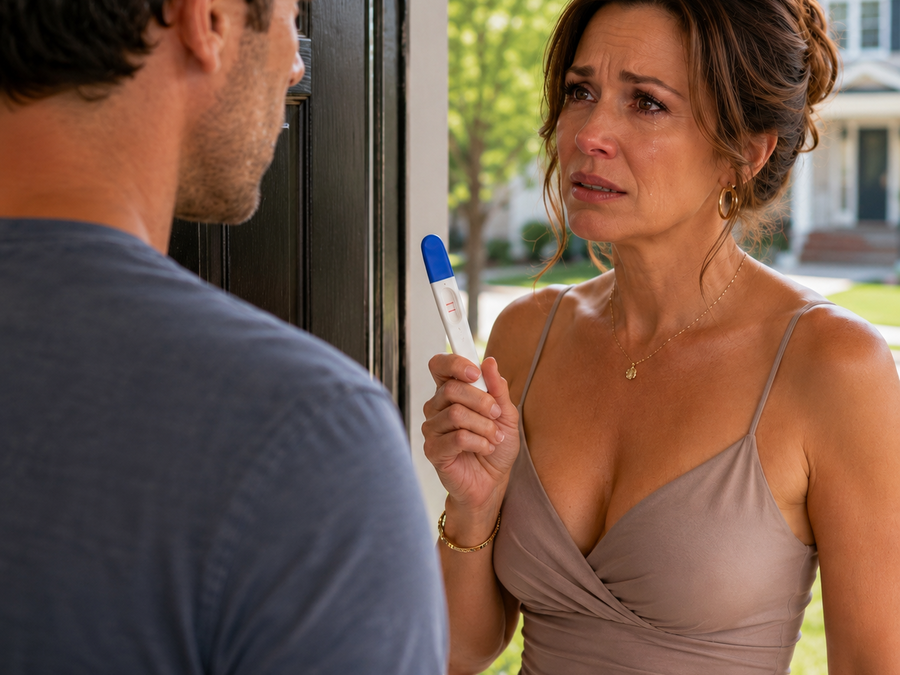
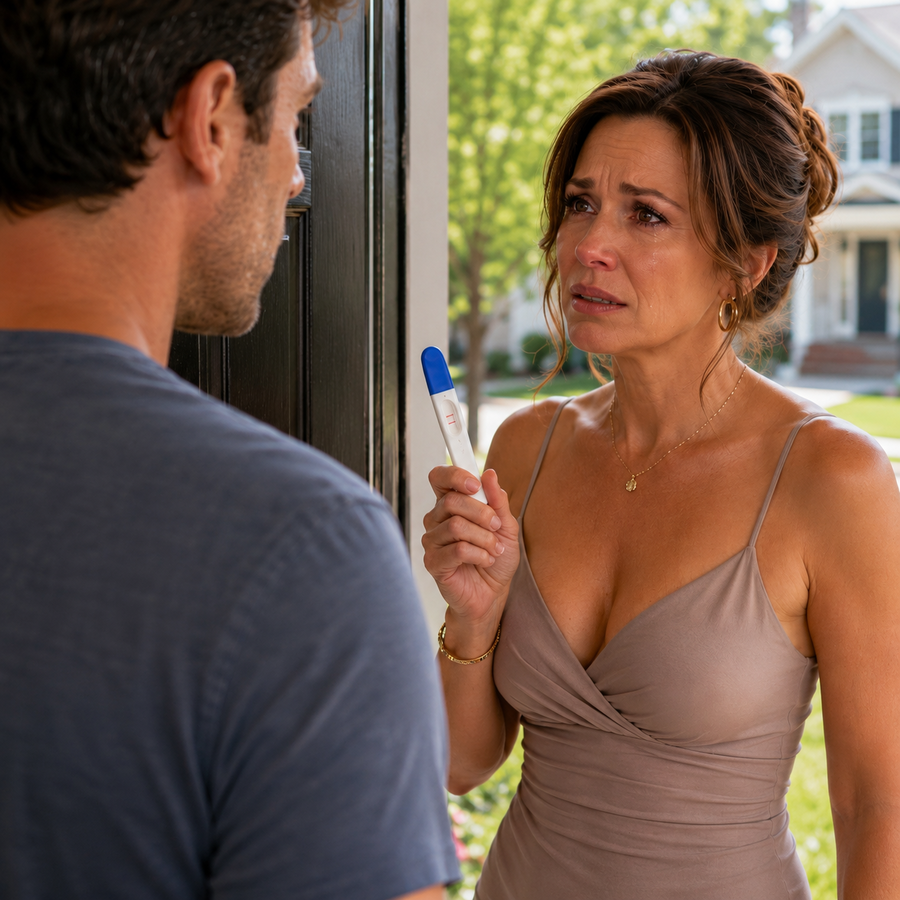
Her hair is pulled up in a hurry, loose pieces falling near her ear. She is wearing a tan camisole and the late afternoon sun is cutting across her shoulder. Turning the houses behind her soft and gold at the edges.
In her hand, held up between us at chest height is a pregnancy test. I do not move. My hand is still on the edge of the door.
And for a second, I think I misheard her because the words she is saying do not belong to any sentence I was prepared for.
“I’m pregnant,” she says.
Her voice is shaking, but every word lands clear. Two pink lines bright under the afternoon light. I look at them, then at her face, and something in my chest goes very still.
The way a room goes still right before a storm actually arrives. She is not finished. She says one more thing, one sentence after that, and it is that second sentence that stops the whole world from turning.
I do not answer. I cannot.
My hand is still gripping the door frame and the dish behind me, nine weeks untouched, suddenly feels like the only honest thing in this house. My name is Drew Harding. I am 31 years old and until 14 months ago.
I was a trauma surgeon at the largest hospital in Knoxville, Tennessee. These days, I do not practice.
I do not do much of anything if I am honest about it.
I grew up on the edge of this city in a house where my father rewired other people’s homes for a living and my mother worked the front office at an elementary school.
Ours was a quiet family, not much drama, not much noise, the kind of household where problems got solved at the kitchen table instead of shouted through walls. I was the first person in my family to go to college and after that the first to go to medical school which felt at the time like proof that a person could build something steady out of nothing but discipline and long hours. Surgical residency took 5 years and it nearly broke me more than once.
There were nights I stood in a hospital hallway at 4 in the morning and could not remember the last time I had eaten a full meal sitting down. But I loved it in a way I never quite loved anything else.
There is a kind of order inside an operating room that does not exist anywhere in the outside world. Every instrument has a place. Every step has a sequence.
Nothing in that room is left to chance. And for years, that room was the one place I trusted myself completely more than I trusted anything outside of it.
I met Tara Lawson 6 years ago at a hospital fundraiser. One of those evenings where everyone wears a suit they do not usually wear and drinks wine they would not usually buy. She came with a friend of a colleague and she talked fast and laughed loud, filling a corner of the room the way sunlight fills a window.
She was everything. The operating room was not unpredictable, warm, a little chaotic in a way that pulled at me before I even understood why.
I was 25. I had spent so many years inside sterile rooms that a woman who filled a space with noise and color felt like the first breath of fresh air I had taken in a long time.
The first time I met her mother was over dinner at Terara’s place.
A few months into dating, back when everything still felt easy and new. Me came out of the kitchen carrying an oval glass baking dish with a peach cobbler still steaming inside it. and she set it down in front of me before I had even taken my coat off.
“Eat,” she said, looking at me the way you look at someone you have already decided to worry about.
“You’re too thin.”
I laughed because nobody had said that to me since I was a teenager. And something about the way she said it made the whole evening feel less like a first meeting and more like a homecoming I did not know I had been waiting for.
Mag had raised Tara alone since she was 19 years old.
She ran a small bakery downtown called Lawson’s tucked between a hardware store and a shuttered barber shop.
And she was not a woman of many words. But you could taste every one of the words she did not say in whatever she put in front of you.
Every dish handed over like a small quiet apology for a sentence she never bothered to finish out loud. I married Tara when I was 27.
It was a small wedding held in Me’s backyard under two old oak trees.
String lights hung between the branches, folding chairs borrowed from the church down the street. That same year, I became an attending surgeon, the youngest one on the trauma floor, and for a while, everything I had built seemed to be holding together exactly the way I had planned it. The first year of the marriage was fine.
Then it was not. Tara wanted more than I was giving her a bigger house, a newer car, vacations I did not have the hours to plan for, let alone take. I was pulling overnight shifts back to back, coming home smelling like a hospital, too tired most nights to be the husband she had signed up for.
The distance between us did not arrive all at once. It arrived the way most distances do. One missed dinner and one short, tired conversation at a time until the space between us was simply the shape of our marriage.
Two years ago, I found the messages on her phone. I will not repeat what they said.
It does not matter now. Not the way it used to.
Not compared to everything that came after. What happened after mattered more.
In the end, my hands started shaking in the operating room. Not always, not dramatically, but enough that I noticed it before anyone else did, and enough that I could not pretend I had not noticed. I had spent my whole career trusting those hands without question.
When I stopped trusting them, I did the only thing that felt honest. I requested a leave of absence. Nobody made me do it.
I I made myself do it because a surgeon who does not trust his own hands has no business holding a scalpel over another person’s body.
The divorce was finalized 14 months ago. Around the same time, the leave of absence quietly became a resignation. A decision I made alone in an office, signing a form that closed a door I had spent a decade building.
I moved into a one-bedroom apartment across town, started living off what I had saved, ran early in the mornings when the streets were still empty, read more books than I had read in a decade, and mostly stopped talking to people altogether. Standing at my door now, Mag finishes the sentence she started.
And the father, she says, is you. Nine weeks ago, there was one night it happened at a retirement party for a man named Dr.Harold Briggs.
And now standing in my doorway with the sun still warm on the porch behind her. That single night has caught up with both of us at once.
I need to go back further than 9 weeks, though, because none of this started that night. It only became impossible to ignore that night.
During the marriage, Mag was always the person I felt most at ease with in Tara’s family.
Whenever I stopped by her house, she never asked how the hospital was going.
She would just say, “Sit down and pour two cups of coffee, black, no sugar, exactly how I liked it.”
Though I never once remember telling her that. She knew I was allergic to peanuts before I ever mentioned it.
And she never asked about that either. She simply watched quietly, the way people do when they are paying more attention than anyone around them realizes, and she adjusted without ever making it a conversation.
Two years ago, the night I found those messages on Tara’s phone, I did not go to a bar and I did not go to a friend’s place.
I got in my car with no destination in mind.
And somehow, without deciding to, I ended up parked outside Me’s house.
I do not fully understand even now why that felt like the only place to go. I sat on her back porch without saying a word, staring at the dark yard, and she came out a few minutes later, set a cup of coffee down in front of me, and sat beside me in silence for the better part of an hour. Neither of us said anything the entire time.
The porch light buzzed faintly above us. Eventually, I stood up and left, and she did not ask me to stay, and I did not offer any explanation for why I had come.
She told me much later, long after that night, long after everything else that followed it, that after I drove away, she sat there alone on that same porch and realized she wanted me to stay.
But I was her daughter’s husband, and there was no version of that thought she was allowed to keep.
So, she folded it up and put it somewhere she thought she would never have to look at it again. After the divorce, I disappeared. 13 months of it.
No colleagues, no old friends from the hospital, no Meg. I simply stopped showing up in my own life.
The way a light goes out in a house and nobody outside knows if anyone is still home. Then 9 weeks ago, Dr.Harold Briggs called me directly. He had trained me on my very first surgery, stood over my shoulder while my hands shook through a procedure I was certain I would fail, and he was retiring after almost 40 years of practice.
His voice on the phone was old but certain, the same voice that had once talked me through a bleeding artery without once raising in volume.
I’m retiring and you’re coming.
He said, “This isn’t an invitation.
It’s a requirement.”
I respected that man too much to say no, even after everything. The party was held in a private room at a restaurant downtown, maybe 45 people, candles on every table, a bar set up in the corner that stayed open long after dinner had ended. I arrived late and stood near the back in a suit I had not worn in over a year.
Not talking to anyone, wondering how quickly I could leave without it looking rude to a man who had shaped half of my career. That was when I saw me.
She was setting an oval glass baking dish down on the buffet table. A peach cobbler inside it, still faintly warm. The same dish carried the same careful way she always carried it, cradled against her forearm like something breakable.
I had not seen her in over a year. Something in my chest shifted just watching her set that dish down, quiet and unremarkable to everyone else in the room, entirely different to me.
Dr.Briggs, it turned out, had been Me’s family doctor for more than 20 years, treating three generations of her family through everything from broken bones to the flu.
He seated us at the same table. Whether by accident or on purpose, I could not have told you that night. And I still was not sure by the time the party ended.
We made small talk over dinner, careful and polite, the kind of conversation two people have when they are both aware of exactly how strange the situation is without saying so out loud. She asked how I was doing.
I’m fine, I told her the same answer I had given everyone for over a year.
She did not push further, which I was grateful for because I would not have known what else to say if she had. After dinner, people started filtering out in twos and threes, saying their goodbyes to Briggs, gathering coats and half empty wine glasses.
The bar stayed open. Mag had not left yet.
“Let me grab my dish before I go,” she said, glancing toward the buffet table, but the dish stayed right where it was, untouched.
And she sat down at the bar instead, as though some part of her had already decided she was not ready to leave. I sat down beside her without really thinking about it.
I ordered whiskey. She ordered a gin and tonic.
Then a second round, then a third. The ice long since melted in both our glasses by the time we noticed.
We did not talk about Terra. We did not talk about the hospital.
We talked about the bakery, about how Knoxville looked in autumn when the leaves along Kingston Pike turned every shade of orange at once. about a novel sitting on her nightstand that she could not decide whether to finish.
It was the first conversation I had held with another human being for longer than 10 minutes in 13 months and I did not want it to end. I remember laughing actually laughing for the first time since I had left the hospital. Looking back now, I think we were both drinking more than either of us would and for the same reason.
Not because we loved the taste of it. Because stopping meant standing up and standing up meant leaving. And neither of us wanted to leave yet.
Not with the room finally feeling warm again after so long. The bar closed close to midnight.
Me was in no condition to drive and my apartment was only two blocks away. I called a cab without asking.
The way you do something automatic when you are not thinking clearly enough to consider the consequences. We rode back together in silence. The street lights sliding past the window.
And once we were inside, everything that had been circling quietly under the surface for years finally landed all at once without either of us stopping it. The next morning, I woke up alone. The apartment was too quiet.
The glass dish was sitting on my kitchen counter, brought back from the party and left behind, though whether she meant to leave it or simply forgot it in her hurry to go, I still do not know. and I have never fully worked up the nerve to ask. I called her, no answer.
I texted, the message showed as red, but nothing came back. A week passed, then two, then four, then six.
Complete silence. The kind that starts to feel less like distance and more like an answer in itself.
The dish stayed on the counter that whole time. I did not wash it. I did not put it away.
I told myself it was because I kept forgetting. But the truth was simpler and harder to admit. Washing it would have meant admitting she was never coming back to claim it.
And some part of me was not ready to make that decision for her. There were moments during those 13 months of disappearing when I almost called her anyway.
Almost drove past the bakery just to see the lights on, just to remind myself that some part of my old life was still standing where I had left it. I never did.
I told myself it would be strange calling my ex-wife’s mother out of nowhere, a woman who had every reason to want nothing to do with the man who had failed at keeping her daughter.
I did not yet understand that the reason it would have felt strange had very little to do with Tara at all. At the party somewhere around the second round of drinks, Mag told me a story about her own mother, a woman I had never met, who used to say that the people worth keeping in your life were the ones who showed up without being asked twice. I remember laughing at
that.
Not because it was funny, but because I could not think of anyone in my life at that point who fit the description, except the woman sitting across from me holding a gin and tonic she had barely touched. I did not say that part out loud. I wish looking back that I had.
I think about that bar more than I probably should. Replaying it the way you replay a diagnosis you almost missed.
Searching for the exact moment where everything tipped from ordinary into something neither of us could undo. There was no single moment. That is what I have come to understand.
It was not one decision. It was a hundred small ones stacked quietly on top of each other over years until the night simply gave them somewhere to land.
I keep coming back to one detail from that dinner, small enough that I almost did not notice it at the time. Mag ordered the same drink Tara used to complain about. Gin and tonic, no lime.
And when the bartender brought it out with a lime wedge anyway, she quietly set it aside without comment, the way a person does when they have spent years not bothering anyone with small preferences. I remember thinking even then, half a drink in that I had never once seen her ask for anything for herself in front of her own daughter.
It struck me as sad in a way I could not fully name at the time, and it strikes me differently now knowing what I know. And then after 9 weeks of silence, the doorbell rang.
Back at my door, after she finishes saying, “The father is me.”
I stand there for what feels like the longest few seconds of my life. The street behind her keeps moving.
A car passes. A dog barks somewhere down the block, but nothing in front of me moves at all.
Then I step back and pull the door open wider.
I do not say, “Come in.
” I just open it.
She understands and she steps inside past me into the kitchen where the light is dimmer and the air is quieter. Her eyes land on the glass dish still sitting on the counter.
She stops walking entirely. Her fingers reach out and touch the edge of it lightly. The way you touch something you were not sure would still be there, something you half expected to have disappeared along with everything else.
She explains that she found out three weeks ago, sitting alone in a doctor’s office, staring at a piece of paper that changed everything she thought she understood about her own life.
It took her another 2 weeks after that to decide whether to tell me at all. She was afraid I would think she had taken advantage of that night.
She was afraid of what Tara would say. She was afraid of what the whole town would say once they knew.
Because in a town this size, everyone eventually knows. Why did you avoid me for 9 weeks? I ask her, my voice quieter than I mean it to be.
Because if I saw you again, she says, looking down at her own hands instead of at me.
I wasn’t going to be able to pretend that night was just about the wine.
She stops there like she has said more than she meant to and does not finish the thought and I do not push her to. We start seeing each other after that carefully in small steps. the way two people rebuild something without ever agreeing out loud that rebuilding is what they are doing.
We talk on the phone in the evenings. We go to her first prenatal appointment together, sitting in a small waiting room with pastel walls and old magazines, neither of us quite sure what to call the other one to the receptionist. It is slow and it is quiet.
And for a few weeks, it feels almost private, almost safe, like something we could keep just between the two of us. That does not last.
About 5 weeks after that first afternoon at my door, Kyle Bridger, Terara’s boyfriend, sees me leaving my apartment early one morning, coffee in hand, walking to her car in the gray light before sunrise.
He tells Tara before he has even finished his own coffee that day, and Tara wastes no time. She shows up at my place without knocking, walking straight into the garage where I do most of my work now. Sawdust still on the floor from the night before.
Kyle said he saw my mother leaving your place Tuesday morning. She says her voice is cold, controlled, the voice of someone who has already decided what conclusion she has drawn and is only waiting for me to confirm it.
Kyle stands behind her in the doorway, arms crossed, smirking in a way that makes my jaw tighten before he even opens his mouth. Bro, your ex-mother-in-law. Seriously?
He laughs.
The kind of laugh people use when they want to turn someone else’s life into a joke they can tell later.
I tell them both to leave. My voice stays low.
I do not argue and I do not explain myself because nothing I could say in that moment would land the way I needed it to. Tara walks out, but she turns back at the door, one hand on the frame.
I’m going to ask my mother, she says, and there is something almost triumphant in the way she says it like she has already won an argument nobody has had yet.
Three days later, she confronts Mag at the bakery in the middle of the morning rush in front of customers waiting in line for coffee and cinnamon rolls.
“Did you sleep with my husband?”
she says loud enough for half the store to hear the whole room going silent around her. Mag does not answer out there in front of everyone. She takes Tara by the arm and walks her into the back room and the door closes behind them.
I do not know exactly what was said behind that door. I only know the result. Mag calls me that night, her voice flat in a way I had not heard from her before, worn down to something almost mechanical.
Terra knows, she says. She knows about the baby, too.
She told me I disgusted her. There is a long pause after she says it, and I do not know how to fill it, so I do not try.
A week after that, Tara posts something online, a long paragraph telling her version of events. Her mother slept with her ex-husband and now her mother is pregnant and she is the one left picking up the pieces of a family that fell apart around her. She tags me.
She tags me. She tags the bakery by name so that anyone searching for it finds this instead of the storefront.
She writes it like she is the victim in all of it. And in some strange way reading it, I almost believe her for a second before I remember the messages I found 2 years ago on her phone.
Kyle shares the post. Her friends share the post.
Comments pile up under it faster than either of us can read them. The consequences come fast. Business at the bakery slows within days.
Regular customers stop coming in or start looking at me differently when they do. A quick glance and a tighter smile than usual. Word gets back to people I used to work with.
Knoxville is not that big. Not for a hospital community where everyone eventually crosses paths in a waiting room or a conference hallway. Some of them text me out of genuine concern.
Careful and awkward. A few send messages meant to sting.
The kind people send when they want to feel superior to someone else’s mistakes.
One former colleague calls me directly. Drew, what the hell?
He says and hangs up before I can even begin to answer. I had already lost my career. I had already lost my marriage.
Now there is a scandal with both our names attached to it, spreading through a town I used to walk through without anyone looking twice at me. And some mornings it feels like the ground keeps finding new ways to give out from under me.
one small collapse after another. Mag tells me one evening, sitting across from me at her kitchen table, that maybe she should leave Knoxville for a while until things quiet down.
Her voice is, even when she says it too, even the voice of someone who has already made peace with losing something rather than fighting to keep it.
Don’t go anywhere, I tell her.
It is the first fully certain sentence I have said out loud since I left medicine. My voice does not shake when I say it, and I notice almost distantly that my hand resting on the table does not shake either.
For the first time in longer than I can remember, both of them stay perfectly still. Mag looks up at me across the table, and for a moment, neither of us says anything else.
The kitchen light hums overhead. The same sound, I imagine, has filled this room a thousand quiet evenings before this one.
I think about all the versions of this conversation I could have had. the ones where I say something safer, something that leaves an easy exit for both of us.
This is not that conversation. And some part of me is relieved it never had the chance to be.
In the days after Tara’s post spreads, I find myself doing something I have not done in over a year.
I check my phone constantly, not out of habit, but because I am waiting to see how bad it will get, the way I used to wait for lab results on a patient I was not sure would make it through the night. Most of the messages are nothing. A few are worse than nothing.
One night, a stranger comments something cruel enough that I close the app entirely and do not open it again for 3 days. Me handles it differently than I expect. She keeps the bakery open every single day, even the mornings when only two customers walk through the door instead of 20.
If I close, she tells me, wiping down the same counter for the third time in an hour, it looks like I have something to hide.
I don’t I watch her say it and understand, maybe for the first time completely, why I ended up parked outside her house 2 years ago without ever deciding to drive there.
There is a particular kind of exhaustion that comes from being talked about by people who have never once spoken directly to you, and I feel it settle into both of us over those weeks. A low hum underneath every normal task. I go to the grocery store and catch a cashier glancing at me twice, a little too long, before she rings up my items without a word.
I do not know if she recognizes me from the post or if I am simply imagining it by then, seeing suspicion in every ordinary face because I have grown used to expecting it. Kyle shows up once more alone this time, standing at the edge of my driveway like he is deciding whether it is worth the walk up.
I do not give him the chance to decide. You said what you needed to say already, I tell him.
my voice, even my hands loose at my sides instead of clenched the way they want to be. He shrugs, mutters something under his breath that I do not bother remembering, and leaves without looking back. It is the last time I see him before he disappears from this story the same way he arrived in it, uninvited and unnecessary.
Me’s employee at the bakery, a young woman who has worked there since high school, tells me one afternoon that she does not care what people are saying, that Mag has never been anything but kind to her, and that she is not going anywhere.
Me tells me about it that night, her voice thick in a way it rarely gets, and I understand that small loyalties like that one are doing more to hold her together than anything I could say myself. I notice during those weeks how differently the two of us are built for this kind of pressure.
I am used to bad outcomes arriving quickly and demanding an immediate response. A code called a decision made in seconds. No time to sit with the discomfort of not knowing.
Mag is used to a slower kind of hardship. The kind that shows up over years instead of minutes.
The kind you learn to carry while still getting up every morning to open a shop. Watching her move through those weeks teaches me something about endurance that 5 years of surgical residency never did. Something about staying put through a slow storm instead of only ever training for the sudden ones.
There is a long silence on the phone after I tell her not to go anywhere long enough that I wonder if the call has dropped.
Then she says quietly, “I’ll be at the bakery.
Come by if you want to talk.
” I drive over that night after closing.
The streets emptier than usual. The neon sign in the bakery window still glowing even though the door is locked.
The lights inside are dim. Just the small lamp behind the counter left on. Mag is sitting on a stool and in front of her sits the glass dish holding two slices of cobbler she must have cut earlier and never touched.
Both of them going cold. I sit down across from her on the other stool. Neither of us says anything for a while, the silence stretching out long enough that I can hear the refrigerator humming somewhere in the back.
Then I ask her the question I have been carrying since the morning after the party, the one I have rehearsed and rejected a dozen different ways.
That night at Briggs’s retirement party, did you really only stay at the bar because you hadn’t grabbed your dish yet?
No, she says one word. She does not blink and she does not look away from me the way she has looked away from certain questions before. She tells me the truth from the beginning, laying it out slowly like she has been holding these sentences ready for a long time and finally has somewhere to put them down.
Two years ago, the night I sat on her back porch after finding out about Tara, something shifted in her she never planned for and never wanted. After I drove away that night, she sat alone on that porch and realized she wanted me to stay.
But I was her daughter’s husband, and there was no room in her life for that thought.
So, she buried it as deep as she could and tried not to look at it again. After the divorce, she wanted to reach out more than once, more than she is comfortable admitting out loud. But I had disappeared.
13 months with no contact between us. She did not know where I lived. She did not know if I was even still in the city or if I had left Knoxville entirely to start over somewhere new.
Then at the retirement party, she saw me standing near the back of the room in a suit that did not quite fit the same way it used to. And it was the first time she had laid eyes on me in over a year. I brought that cobbler for Harold, she tells me, turning the dish slightly on the counter between us.
But I stayed at that bar because of you. The wine gave me an excuse, she says, her voice steady, even as the words get harder.
But the reason was there long before the wine. It was there for years before that night ever happened.
She tells me why she left the next morning without a word, without so much as a note.
I thought if you woke up and looked at me, all you’d see was a 47year-old woman, your ex-wife’s mother.
A mistake you’d have to figure out how to explain to yourself.
I tell her my own truth, slower, in a voice I do not fully recognize as mine. The voice I used to use only inside operating rooms.
Careful and exact. I kept that dish on my counter for 9 weeks.
I didn’t wash it.
Not because I forgot.
Because if I put it away, there would be nothing left to prove you’d ever actually been there.
When you disappeared for 9 weeks, I tell her, watching her face the whole time.
What I felt wasn’t confusion.
It was loss. The same kind of loss I felt the last time I walked out of that hospital for good.
Losing something I didn’t fully understand I needed until it was already gone.
I don’t know what to call this, I tell her.
And I mean it.
But I know it isn’t the wine.
I knew that the second I saw you standing on my porch with that test in your hand. Then we talk about what actually has to happen next because feelings alone do not answer every question sitting in front of us.
The baby Mag is 47 years old. And while her doctor has confirmed the pregnancy is healthy so far, it will need to be watched closely. More appointments than a younger woman would need, more caution built into every stage.
She does not ask anything of me.
I’m telling you because you deserve to know,” she says, folding her hands on the counter.
“What you do with it is your decision.
I’m not asking you for anything.
It’s not my decision or yours,” I tell her.
And I believe it as I say it.
It’s ours.
Both of us, or neither of us gets to decide anything alone anymore. I say the rest out loud, too, because it needs saying, because pretending it away will not make it any smaller.
Tara isn’t going to stop.
The whole town is talking. Are you sure you can live with that? For years, not just for a season.
I raised a daughter alone, starting at 19 years old, Mag says. And for the first time all night, there is something almost like a smile at the corner of her mouth.
I’ve heard everything people have to say about a woman like me.
I can hear a little more. I stand up, cut into the cobbler with the side of a fork, and hand her a piece on a napkin. We eat together in the quiet bakery.
Nothing dramatic about it. Just two people choosing to face whatever comes next. Side by side, the flower dust still faintly visible on the counter under the lamp light.
When I leave, I take the glass dish with me, carrying it out to my truck, the same careful way she always carried it. This time, I tell her, glancing back before I close the door.
I’m keeping it.
Mag laughs quiet and short, but real. The first laugh I have heard out of her since she showed up on my porch with that test in her hand.
It’s just a dish, Drew, she says.
Though the way she says it tells me she knows exactly what I mean and is choosing to let the joke carry the weight instead of saying it plainly. I drive home with the dish balanced on the passenger seat, wrapped in a dish towel so it will not slide, and I catch myself glancing over at it at every stoplight. The way you check on something precious you are not used to being responsible for yet.
By the time I get home, the apartment feels different. Not because anything has changed inside it, but because for the first time in 14 months, I am walking back into it with somewhere I actually want to be tomorrow.
That night, lying awake, I think about the nine weeks of silence differently than I had before. I used to think of them as punishment, as her deciding I was not worth the risk. Now I understand them as fear, plain and simple.
The kind of fear that makes a person run, even when running is the last thing they actually want to do. I know that fear. I have lived inside a version of it myself in a hospital hallway, staring at hands I no longer trusted.
Before I fall asleep, I think back to something Mag said at the bakery, almost as an afterthought.
Right before I stood up to leave, she told me that for years she had watched me sit at her daughter’s table, polite and tired and slowly disappearing into a marriage that was quietly using up every part of him.
and she had never once known how to say anything about it without sounding like she was overstepping a line that was not hers to cross. I used to think, she said, staring down at the counter instead of at me, that the kindest thing I could do was just keep feeding you and never say a word about the rest of it.
I did not have an answer for that at the time, and I am not sure I fully have one now. But I understand more clearly with every week that passes that the cobbler and the coffee and the quiet hour on the back porch were never really about food or caffeine or filling silence. They were the only language she had allowed herself to speak for years in a house full of people who were not paying close enough attention to translate it.
Before I leave the bakery that night, Mag asks me one more question, quieter than the others, almost hesitant in a way that does not match anything else about her.
“Are you doing this because it’s the right thing to do?”
she asks, “Or because you actually want to, I do not answer right away.”
“Because the question deserves more than a quick response, and because for over a year, I have not trusted my own instant reactions to anything.
” I sit with it for a moment.
long enough that she almost fills the silence herself and then I tell her the truth. I stop doing things just because they were right a long time ago.
I’m here because I don’t want to be anywhere else.
She does not say anything back, but something in her shoulders loosens. Some tension I had not fully registered until it was gone.
We talk a little longer after that about smaller things. This time, names, if it is a boy, whether the crib should go against the window or the far wall, whether doctor Briggs would be offended if we did not name the child after him.
It is the first conversation about the baby that feels less like crisis management and more like two people building something on purpose together instead of simply reacting to what has already happened to them. Before I go, Mag walks me to the door of the bakery. And for a moment, we stand there in the doorway, the way people do when a conversation has ended.
But neither one is quite ready to be the one who leaves first. The street outside is empty. Street lights humming over parked cars.
The whole town gone quiet the way small towns do after 9 at night. She does not reach for me, and I do not reach for her.
Not yet. But something passes between us anyway. an understanding neither of us needs to put into words.
Drive safe, she says. The same thing she has probably said to me a hundred times over the years, except this time it sounds like something else entirely, something closer to a promise than a courtesy.
And I carry that small difference with me the whole way home. The week after that conversation, I start showing up at the bakery after closing most nights.
I fix a loose hinge on the walk-in refrigerator that has been sticking for months. I replace a burnt-out light in the hallway that Mag had been meaning to deal with for weeks. Nobody calls it dating.
Nobody names it anything at all. But every night, without fail, I am there.
My hands are doing something with purpose again. For the first time since I walked out of the operating room and did not look back, it is not a scalpel anymore.
It is a screwdriver, a level, a box of mismatched screws I keep meaning to sort. But the feeling underneath it is the same control precision.
Something that matters to someone besides me. The bakery is quieter than it used to be, but it has not emptied out completely.
A handful of loyal regulars still walk in every morning like nothing happened, ordering the same coffee, the same roll, nodding at Mag the way they always have. I learn every one of their names within the first two weeks, the way I once memorized names on a surgical schedule.
Tara comes back a second time, calmer this time, her voice carrying that particular kind of false patience people use right before they say something cruel.
“Do you know what people are saying about you?”
she asks her mother, standing near the register while a customer pretends to study the pastry case. Me answers her directly for the first time. Her voice not raised, not shaking.
Your family broke on its own. Tara, you cheated, remember? There is nothing soft about the way she says it, and there is nothing left for Tara to say back.
Tara posts something else online after that. But this time, barely anyone responds.
The story is already going stale the way most stories do once the initial shock wears off and people move on to whatever comes next in their feed. Two months later, Mag is visibly pregnant and I have converted the spare room in my apartment into a nursery.
I measure, cut, and build a crib out of solid oak, one board at a time, sanding each edge smooth enough that nothing will ever catch on a small hand. My hands hold steady through the entire project.
Not a single tremor, not once. The way they used to hold steady before everything fell apart. One evening, Mag comes out to the garage to watch me work on the crib.
She sits down in the folding chair in the corner, opens a book, and says nothing. She is simply there, the pages turning slowly. The sound of my sandpaper filling the quiet between us.
It is the same chair, more or less, the same quiet presence as that night on her back porch two years earlier, when neither of us understood yet what we were sitting inside of. This time, we both know exactly why she is sitting there, and neither of us feels the need to say it out loud. I start driving her to every prenatal appointment.
After that, we sit together in the waiting room, flipping through old magazines. Neither of us actually reads her hand sometimes resting on the armrest close enough that I could reach it if I wanted to.
At one visit, the doctor glances at me while reviewing the chart and asks simply, “Dad?”
I nod. It is the first time anyone has ever called me that.
And it is somehow simpler than any decision I have ever made in an operating room full of people watching my hands. Dr.Briggs stops by the apartment one afternoon unannounced, the way old doctors sometimes do when they still think of a house as something they are allowed to walk into. He sees the oak crib in the corner of the nursery.
He sees me, 7 months along, moving slowly through the kitchen. He does not ask a single question.
He sits down at my table, drinks a cup of tea I make him without being asked.
And before he leaves, standing at the door with his hat already in his hand, he says quietly, “I sat you two at the same table that night.”
You know that. Then he sets his empty cup on the counter and lets himself out before I can respond. The neighbors get used to us slowly, the way any street eventually gets used to whatever is true in front of it.
The older woman across the street waves every morning now when I open the shop door.
The man who mows the lawn on our block asks, “When’s the baby due?”
The same casual way he’d ask about the weather turning colder.
I realize watching all of this unfold in small pieces that the harshest judgment came from a screen from strangers scrolling past a stranger’s post they would forget by the following week.
Out here in the actual world, people look and then they keep walking and life goes on the way it always does. By her seventh month, Mag has stopped going home most nights.
Her things start appearing around my apartment a few at a time, a hairbrush on the bathroom counter, a sweater draped over a chair until one day I realize she simply lives here now. No announcement, no formal conversation about it.
Just a slow and steady accumulation of a life being built together. The glass dish sits on the kitchen shelf, no longer empty and no longer waiting, filled now with oranges and apples we buy together on Saturday mornings.
One night, lying in bed, Mag tells me he’s kicking.
I put my hand against her stomach for the first time, careful, uncertain where exactly to press. She places her hand over mine and leaves it there, guiding it gently to the right spot. Neither of us says anything for a long moment.
My hand stays steady against her, warm, still, waiting for the next small movement underneath it. Our son is born healthy, 7 lb, at the same hospital in Knoxville where I used to operate.
in a wing I walked through a hundred times as someone else entirely. A nurse recognizes me the moment I walk in, her eyes widening slightly.
“Dr.Harding,” she says.
I nod, and something in my chest tightens in a way that is not entirely painful.
“When they hand me my son, he is small enough to rest entirely across both of my palms, weightless, almost impossibly small.
The same two hands that once held a scalpel. The same two hands that once shook uncontrollably in an operating room full of people depending on them now hold the lightest thing I have ever touched. And they do not shake at all.
3 months after that I go back to practicing medicine. Not surgery this time, but a small community clinic close to home.
A slower pace. patients I see more than once whose names I actually learn and remember. I am a doctor again, just a different kind.
One who has time to sit down when someone needs to talk. The bakery is busier now than it has been in years. Word finally moving past the scandal and back toward the cobbler that started all of it.
Terra moves away with Kyle not long after. No scene, no announcement, just gone.
Like a door closing quietly instead of slamming the way I once expected it would. Somewhere in those months, I stopped counting the days since I left surgery. The way you stop counting the days since a wound has healed once it finally stops being the first thing you notice in the morning.
I still think about that operating room sometimes, the sound of the monitors, the particular quality of light over a surgical table. I do not miss it.
it the way I thought I would. What I feel instead is something closer to gratitude.
Strange as that sounds, because losing it was the only reason I was standing in that hospital wing years later, holding my son instead of someone else’s chart.
Dr.Briggs comes to see the baby once more before the year is out, sitting in the same chair by the window, drinking the same tea. He does not say much that visit either.
He never does.
But before he leaves, he rests a hand briefly on my shoulder, the same way he used to before I walked into a difficult surgery and says, “You turned out fine, Harding.
I do not think he is only talking about my hands.
There are ordinary evenings in those months that I hold on to more than the dramatic ones.”
Mag falling asleep on the couch with a magazine open on her chest. The two of us assembling a stroller on the living room floor, arguing gently over an instruction manual that seems to have been written by someone who had never actually held a screwdriver.
The sound of her laughing, really laughing at something small, I said while I was elbowed deep in the crib’s hardware, sawdust in my hair.
Nothing about the moment remarkable except that it was ours and nobody was watching it happen. I think if I am honest that those were the months I healed more than any of the ones before them more than the running or the reading or the 13 months of silence I mistook for recovery.
Healing, it turns out, was never going to happen alone in an apartment. It happened at a bakery counter after closing in a garage full of sawdust in a hospital room with a nurse asking a simple question I finally had an honest answer for.
Me and I never have a big conversation about what to call each other. What label fits a relationship that started the way ours did.
We simply become the two people who show up for each other. Every single day without needing a word for it beyond that. Some mornings she leaves for the bakery before I am fully awake and I hear the front door close softly, careful not to wake me.
The same kind of quiet care she has been showing me since a peach cobbler 6 years ago. I have stopped needing a name for it.
I only know I do not want a single morning to start without that sound. There is one more evening from those months I keep returning to small and unremarkable to anyone but me.
Mag and I are sitting on the back steps of the apartment. The summer air thick and warm, watching the neighbors kids ride bikes in slow circles under a street light.
She rests her head against my shoulder without saying anything and I put my arm around her and for a long time neither of us moves. Both of us simply watching something ordinary unfold in front of two people who had not expected a year earlier to still be standing here at all.
Let alone standing together quietly on ordinary steps like this one. These days I sit on the back porch of a house I fixed up with my own hands.
The same hands that once shook and now do not. My son plays somewhere inside, small feet on hardwood floors. And Mag is at the bakery, probably elbow deep in flour, humming something under her breath the way she always does.
The glass dish sits on the kitchen shelf now, still chipped at one corner, filled with oranges instead of cobbler. It has not left this house since the day it arrived, and I do not think it ever will. Not while I am the one deciding where it stays.
People ask me sometimes when this all started.
For a long time, I thought it started the night of Harold Briggs’s retirement party.
The whiskey and the gin and tonic and the bar staying open too long. Now I know better.
It started 6 years ago with a dish of peach cobbler and a woman who looked at a nervous 25-year-old and said, “Eat.
You’re too thin.”
It just took me a very long time and a great deal of losing to understand what I had actually been looking at that whole time. Me never once asked me to choose her.
She just kept showing up with food, kept inventing small reasons to be near, kept letting me come to my own conclusions in my own time and hoped that eventually I would see it clearly.
I almost didn’t.
I came closer to missing it than I like to admit. Even now sitting here with the proof of it, laughing somewhere behind me in this house. I used to think losing my career meant losing myself entirely that whoever I was without that title had already disappeared somewhere along the way.
It turns out I had only lost one way of using my hands. My son gave me a new one and my wife in a way I never expected gave me back the rest. Love does not always arrive at the right time with the right person under circumstances everyone around you would approve of.
Sometimes it shows up carrying an old glass dish, standing on your porch with shaking hands, and you are the one who has to decide whether you have the courage to keep it no matter who is watching. She left that dish on my counter 9 weeks after everything changed between us.
I never gave it back and I never planned to. So, let me ask you something because I think about it more than I probably should.
If you were in my place, would you have the courage to hold on to something the whole world was calling wrong? And have you ever realized someone loved you for years? Quietly, patiently, while you were too busy looking somewhere else entirely to ever see it.
If this story made you think, hit like. If you want more stories like this one, subscribe and turn on the bell. I do not have a tidy answer for why it took me so long to see what was in front of me.
Maybe some things are only visible once you have lost enough else to clear your line of sight. Maybe I needed to lose the operating room, the marriage, and 13 months of silence before I could recognize the one thing that had been steady the entire time, quietly setting a dish down in front of me, waiting to see if I would finally notice who was doing the setting.
I am not asking anyone watching to agree with how it happened. I only know that looking at my son now and at the woman across the kitchen, I feel no doubt at all.
THE END.