“Maid Brought Her Toddler to Work—She Was Terrified of Getting Fired, Until the Billionaire Unexpectedly Fell Asleep While Holding Her Child, Leaving Everyone in the Mansion Completely Speechless”
“Maid Brought Her Toddler to Work—She Was Terrified of Getting Fired, Until the Billionaire Unexpectedly Fell Asleep While Holding Her Child, Leaving Everyone in the Mansion Completely Speechless”
Jenna Cole never planned to break the rule.
She planned to survive one impossible Tuesday.
What she didn’t plan for was a storm, a locked office door, and the coldest man in the city falling asleep with her 3-year-old curled against his chest like she’d always belong there.
Nobody saw it coming. Not Jenna, not the little girl, not even him.
It started with a phone call at 4:52 in the morning.
Jenna Cole hadn’t even opened her eyes yet when her neighbor’s voice cracked through the speaker.
Jenna, I’m so sorry.
My mom fell. I have to go to the ER.
I can’t watch Nora today.
For 8 months, that neighbor had been the one thread holding Jenna’s whole life together.
Jenna worked as a live-in housekeeper at the Ashford estate, and without childcare, there was no version of today that ended well. She had no family in the city, no backup sitter, no cushion of savings to fall back on, and she absolutely could not call out.
Not this week, not with the head housekeeper, a sharp, unbending woman named Mrs.Pruitt, having already warned the staff that anyone who missed a shift before Friday’s board dinner wouldn’t be missed themselves come Monday.
So, Jenna made a decision that terrified her more than almost anything had in years. She was going to bring her daughter to work.
By sunrise, she was standing at the service entrance of a property so enormous it had its own private road, gripping 4-year-old Nora’s hand in one arm and a tote bag of crayons and crackers in the other, silently praying nobody would notice.
The rule was posted on the staff board in Mrs.Pruitt’s tight handwriting.
No children. No exceptions.
Jenna had read it a hundred times and never once imagined she’d be the one to break it.
She knelt down in the misting rain and looked her daughter in the eye.
“We’re playing a quiet game today, baby.
Wherever Mommy goes, you go, and you don’t make a peep unless I say so.
Can you do that?”
Nora nodded, solemn as a judge. Quiet like a mouse.
Jenna kissed her forehead like it might be the last kiss she ever got to give her in this house, because if this went wrong, she didn’t know what came next.
The Ashford estate looked like something out of a magazine nobody like Jenna ever got invited to read.
Iron gates, a fountain that never stopped running, glass walls reflecting a sky that couldn’t decide whether to storm.
Inside lived Julian Ashford, 35 years old, the third generation to run a shipping and finance empire worth more money than Jenna could picture.
In eight months, she’d seen him maybe a dozen times.
He left before dawn, came home after dark, and spoke to staff only when strictly necessary.
The rumor in the servants’ hall was that he hadn’t smiled since his father died.
Others said it went back further, to his mother who’d walked out on the family when he was 10 and never once looked back.
There was a portrait above the fireplace in the main hall. Three unsmiling men in dark suits, hands folded, eyes like stone.
Julian’s father, grandfather, great-grandfather.
Founders of an empire that had apparently never learned how to be warm. Jenna tucked Nora into the linen closet off the second floor hallway with her crayons and a juice box, checking on her every 15 minutes between chores. For three hours, it worked perfectly.
Then, at a little past 11, Jenna came back with a fresh juice box and found the closet empty. Crayons scattered.
Stuffed rabbit on the floor. Nora gone.
What Jenna didn’t know, couldn’t have imagined, was that her daughter had wandered two full floors up, past a door marked private, straight into Julian Ashford’s office.
He hadn’t heard her come in.
He was behind his desk, tie loosened, staring at a spreadsheet he’d read four times without absorbing a single number.
It had been that kind of week. The board dinner Friday was a performance dressed up as a formality.
A room full of investors who wanted reassurance the Ashford name was still worth betting on, even though Julian hadn’t felt steady in longer than he could remember.
Then a small voice said, “Why are you sad?”
His head snapped up. A little girl in a wrinkled yellow dress stood in his doorway, staring at him with a calm far too big for her size.
“Where did you come from?”
he asked.
“Downstairs.”
she said as if that explained everything, which to a four-year-old it did. She climbed, uninvited, onto the arm of his leather chair.
“You look sad.
My mommy says it’s okay to be sad, but you don’t have to be sad by yourself.”
Julian sat frozen.
He couldn’t remember the last time anyone in this house had said something to him that wasn’t a request for a signature.
Certainly no one had ever looked at him with something closer to concern than fear.
“I’m not sad.”
he said.
A lie, apparently not a convincing one, because she just tilted her head at him the way children do when they know you’re lying but are too polite to say so.
“What’s your name?”
“Nora.
” “And where’s your mother, Nora?”
She shrugged with her whole body.
“Downstairs.
I was being quiet like a mouse, but I got lost. Her confidence flickered for just a second.
Am I in trouble?”
Something shifted behind Julian’s ribs at that question.
He thought of the empty house he grew up in, the long silences at dinner, his father telling him once that crying was a habit weak men couldn’t afford.
He thought about how easy it would be to plant fear in a child right now, and how much easier it would be not to.
“No.”
he said, gentler than he’d spoken to anyone in years.
“You’re not in trouble.”
Outside, the storm that had been threatening all morning finally broke.
Thunder rolled over the city, and Nora flinched, then climbed straight off the chair arm and into Julian’s lap, curling against him the way children do when the world gets loud and they need somewhere safe to disappear into.
He sat completely still, arms hovering above her, unsure what a person was even supposed to do here. He had no siblings, no kids of his own, no memory of being held like this himself. Not since he was younger than she was now.
Slowly, like he might break something fragile, he let his arms settle around her.
“There you go.”
She mumbled, already drifting off, exhausted from a long morning of being brave. Three floors below, Jenna was tearing through the mansion in a silent panic, checking every room twice, her mind spinning through every worst possibility a mother can invent in under two minutes. She had no idea her daughter was curled safely in the arms of the one man in the building who could end her career with a single sentence, and had absolutely no intention of doing so.
She found them 40 minutes later. The office door, always shut, always locked, a boundary no staff member crossed without a summons, stood open an inch.
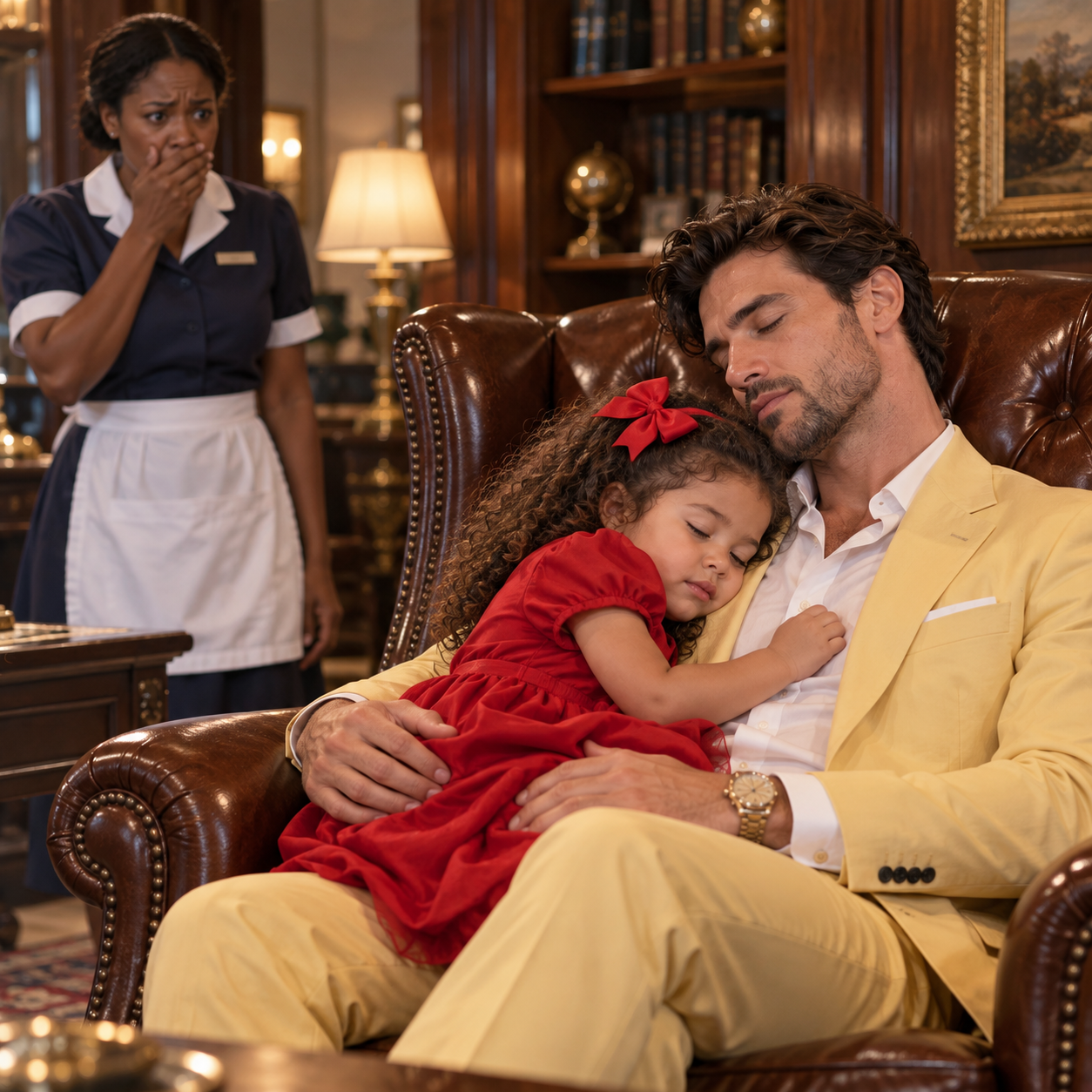
She pushed it wider, ready to apologize, to beg, to do whatever it took. What she saw stopped every word in her throat.
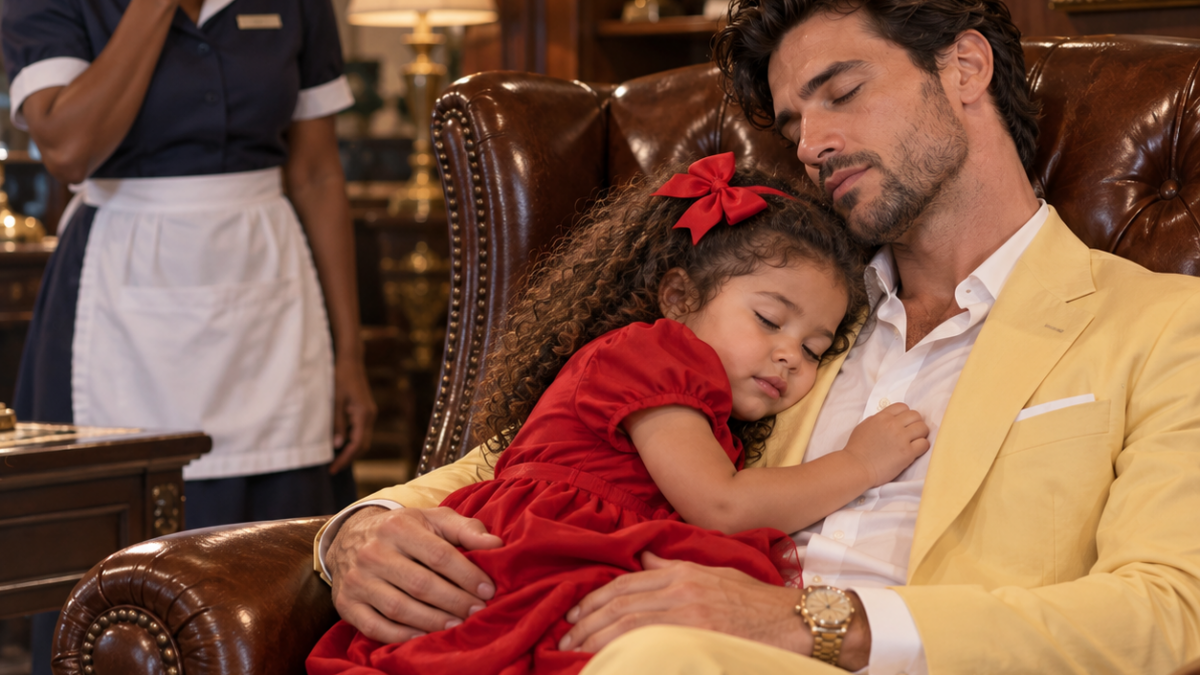
Julian Ashford, the man half the household swore hadn’t smiled in years, was asleep in his chair, tie completely undone, head tilted back.
Curled against his chest, one small fist gripping his shirt, breathing slow and deep, was Nora. Fast asleep.
Both of them. Jenna froze between relief so total it nearly buckled her knees, and terror at what this scene would mean for her job the second anyone else saw it.
She stepped forward to lift her daughter free, and Julian’s eyes opened.
“I am so sorry.
” She whispered instantly, already reaching, already rehearsing a resignation in her head.
“She wandered off.
I was searching everywhere.
I’ll get her out right now, sir.
Please, I didn’t mean “She said I looked sad.”
Julian said quietly, cutting through her panic with a voice that wasn’t angry at all.
He looked down at the sleeping child against him.
“She wasn’t wrong.
” Jenna didn’t know what to say to that.
Nobody had prepared her for a version of Julian Ashford that spoke like this. Soft, almost uncertain, like a man discovering something about his own life in real time.
“Sir, I understand if you need to speak with Mrs.Pruitt about this.”
She said carefully, still bracing for the axe.
“I broke the rules.
I take full responsibility.
I had no one else to leave her with, and I know that’s not an excuse.”
“Stop.”
He said, not unkindly, but firm enough that her words caught in her throat. He looked at her properly, maybe for the first time, not as a uniform moving through his house, but as a person exhausted, holding herself together with what little was left.
“How long have you worked here?”
“Eight months, sir.”
“And in eight months, has anyone in this house ever asked if you needed anything?”
She blinked.
“No, sir.
That’s not really how it works here.”
Julian looked down again at the small hand fisted in his shirt, trusting him completely for no reason at all, because to Nora none of the last 20 years of Ashford history existed. To her, he was just a sad man in a chair who needed someone to sit with him for a while.
“My mother left when I was 10.”
He said quietly, not looking at Jenna, looking at Nora instead.
“My father believed comfort made people weak.
He raised me the same way.
I haven’t held a child since I was one myself.”
His jaw tightened.
“I didn’t expect it to feel like this.”
That was the exact moment the door opened again, and Mrs.Pruitt stepped inside, her eyes landing on the sleeping child in her employer’s arms.
The silence that followed said everything.
“Mr.Ashford.”
She said carefully, “The household policy on children exists for good reason.
Liability, disruption.
” “There’s no issue here.”
Julian said, and something in his tone closed the conversation like a door.
“Miss Cole’s daughter had nowhere else to be today.
That’s not a policy violation.
That’s a household that failed to consider what its staff actually need.”
Mrs.Pruitt’s mouth thinned.
“Of course, sir.
I only meant to say Miss Voss.
” She stopped herself, something flickering across her face like she’d said more than intended.
Nothing, sir.
I’ll leave you to it.
She left. But the name hung in the room.
Camille Voss, Julian’s fiance, a woman who visited the estate once or twice a month, always dressed like she had somewhere more important to be.
That night, the board dinner went ahead exactly as planned. Candles, polished silver, careful conversation about quarterly earnings.
Camille arrived in red at 7:00 sharp and took her seat beside Julian with the easy grace of a woman who’d spent her whole life being watched.
Halfway through the second course, Mrs.Pruitt leaned toward her and said something quiet enough that only Camille could hear. Something that made her fork pause midair.
Something that made her painted smile go thin and cold.
“A maid brought her child into his private office.”
Camille repeated under her breath.
“And he held her himself?”
“Yes, Miss Voss.”
Camille set down her fork with deliberate precision, her eyes drifting down the table to where Julian sat laughing. Actually laughing at something a board member had said.
A sound she hadn’t heard from him in longer than she wanted to admit.
“I think,” she said softly with nothing warm in it at all, “I’d like to meet this housekeeper myself.”
Over the following weeks, something in that mansion began to change quietly at first. Julian started leaving his office door unlatched.
He started coming home an hour earlier, sometimes two. Jenna brought Nora back twice more when arrangements fell through, and each time Julian found a reason to pass through whatever room she was coloring in.
He never stayed long. He never made it obvious, but he came.
Nora, without a shred of shyness, started calling him Mr.Sad Man. Until one afternoon she decided, with the full authority of a four-year-old, that he needed a happy name, too.
“Julian,” she announced, chewing on a purple crayon.
It was, Jenna realized watching from the doorway, the first time in eight months anyone in that house had used his first name without a title in front of it. And the way his face changed when she said it, something loosening, something younger showing through, told her more than words ever could about how long it had been since anyone had simply seen him as a man instead of an empire.
She
should have felt worried. Some instinct told her this was dangerous ground for a single mother whose whole life depended on staying invisible.
But watching her daughter make a billionaire laugh in a sunroom on a Tuesday afternoon, it was very hard to feel anything except a warmth she hadn’t let herself feel in a long time.
It was in the third week that Julian found Jenna alone in the kitchen after hours scrubbing a pan that didn’t need it anymore.
“You don’t have to do that,” he said from the doorway.
“Force of habit, sir.”
“Julian,” he corrected, something almost shy in it.
“At least when it’s just us.
I wanted to thank you,” he said “for letting her be herself around me.
I haven’t felt like this in this house in a very long time.
Maybe ever.”
“She has a gift for that,” Jenna said softly.
“Finding the soft part in people who’ve forgotten they have one.”
“What about you?”
he asked.
“Who finds the soft part in you, Jenna?”
The question landed somewhere tender and unguarded, and for a moment she had no answer because the honest one was no one, not in a long time. Neither of them noticed the figure standing just beyond the swinging kitchen door, listening, red-painted nails pressed white against the frame. Camille Voss had heard enough.
Three days later, she cornered Jenna in an empty hallway, her voice calm, almost pleasant, which was exactly what made it terrifying.
“Julian Ashford is going to be my husband in 4 months,” she said.
“I’ve spent 3 years building the life that comes with that.
I am not going to watch a housekeeper and her daughter unravel it because he’s had a moment of weakness.”
She stepped closer.
“Remember your place, both of you, or I promise neither of you will be welcome in this house again.
” That evening, Jenna made a decision that broke something quiet in her chest.
She would stop bringing Nora to the estate. She would keep her distance from Julian.
Go back to invisible.
She didn’t get the chance to follow through.
Two days later, her phone rang mid-shift. Her downstairs neighbor, voice shaking.
“Jenna, it’s Nora.
She fell off the porch steps.
I think she hurt her arm.”
Jenna was already moving when she nearly collided with Julian on the staircase.
“What’s happened?”
he asked, reading it instantly off her face.
“Nora.
She’s hurt.”
“I don’t have a car.”
“I’ll drive you.”
No hesitation at all.
“Let’s go.”
Neither of them saw Camille watching from the top of the staircase.
Watching Julian abandon an afternoon of scheduled calls to race across the city for his housekeeper’s daughter.
Watching the exact thing she’d warned Jenna, in no uncertain terms, never to let happen again.
The drive took 18 minutes that felt like both 18 seconds and 18 years.
At a red light, Julian said quietly, not looking at her, “She’s going to be okay.
Kids fall.
It happens.”
Something in the steadiness of his voice held Jenna together the rest of the way. Nora was sitting on the porch steps, tear-streaked but alert, cradling her arm.
Julian crouched beside her without a second’s hesitation.
“Can you wiggle your fingers for me?”
She did.
“Good girl.
Can you move your elbow?”
She winced but managed it, and he let out a slow breath.
“I think it’s a bad bruise.
We should still get it checked.”
At the hospital, he didn’t leave.
He sat in the plastic chairs for 2 hours, holding Nora’s stuffed rabbit in his lap because she’d insisted it would get scared without him, ignoring 17 unanswered messages buzzing in his pocket.
Jenna watched a man who ran an empire cradle a stuffed animal like it was the most important task he’d ever been handed, and felt something crack open in her chest that had been sealed shut for years.
It was just a deep bruise. Nothing broken. In the parking garage afterward, Jenna told him everything.
What Camille had said, the threat, the warning.
Something in Julian’s face wasn’t surprise.
It was confirmation.
“I need to have a conversation with Camille,” he said.
“One that’s long overdue.”
That conversation happened that same night in the formal sitting room. Camille arrived expecting an apology.
She left with something else entirely.
You canceled the Hendrick’s call, she said before he’d even closed the door.
For the housekeeper’s child.
Her name is Nora, Julian said, and something in the flatness of his voice told her this wasn’t going the way she planned.
And I went because a child was hurt and I could help.
I’m not apologizing for that.
I was protecting what we’ve built.
Camille said finally, choosing not to deny the threat. Three years, Julian.
And you’re going to throw it away over a housekeeper and her child.
I don’t think you and I ever built a life together at all, he said, quiet, almost sad.
I think we built an arrangement.
In three years, you’ve never once asked how I was actually doing.
You’ve never sat with me in a waiting room.
You’ve never made me laugh in a sunroom on a Tuesday afternoon.
And a housekeeper’s daughter has.
He looked up at the portrait above the mantel.
Three generations of unsmiling men who’d built an empire and forgotten how to build anything resembling warmth.
My father told me love was a liability. I believed him for 35 years.
And then a four-year-old climbed into my lap during a thunderstorm and told me I didn’t have to be sad by myself.
I realized I’d spent my whole life being sad alone and calling it strength.
The ring on Camille’s finger, a family heirloom, cold and perfect, suddenly felt very heavy.
She left that night without another word, the ring left behind on the mantel. The mansion felt different after that. Quieter, but a different kind of quiet.
One with room in it for a small girl’s laughter echoing down halls that had never really heard it before.
Mrs.Pruitt, to everyone’s surprise, adjusted faster than anyone expected, and within a month was setting an extra plate at the kitchen table each afternoon without anyone asking.
Two weeks later, Julian found Jenna in the garden watching Nora inspect the roses with the careful restraint of a child who’d been taught not to touch things that weren’t hers.
“I keep waiting for this to fall apart,” Jenna admitted, “for someone to remind me I’m the housekeeper and you’re all this.”
“I don’t want you to be the housekeeper,” Julian said quietly.
“I don’t want that to be the only thing you are to me.
I haven’t felt like this in longer than I can remember, and I don’t want to pretend otherwise just because it’s inconvenient.
” He took her hand carefully, like he was asking permission with the gesture itself.
“I’d like the chance to find out what this could look like with you, with Nora, if you’ll let me.”
Jenna looked at their joined hands, then out at her daughter chasing a butterfly across the lawn without a single worry in the world, and thought about the terrified woman who’d stood at that service gate not so long ago, certain one mistake would end everything.
“I’d like that, too,” she said.
The old family portrait came down from above the fireplace 6 weeks later, replaced with something Julian commissioned in secret.
A painting of that same garden, roses in full bloom, a butterfly caught mid-flight above a small girl’s reaching hand.
Not a portrait of people, a portrait of a moment, the moment everything started to change.
Jenna went back to school that fall to study early childhood education, while Julian, without a trace of the man who once believed comfort was weakness, learned to braid a stubborn 4-year-old’s hair before daycare every morning, badly, but with tremendous effort, which Nora insisted mattered more than the result.
At Nora’s fifth birthday party, held beneath those very rose bushes, Julian Ashford knelt beside a small pink cake and let a room full of laughing children pin a paper crown on his head because Nora had decided the birthday queen
needed a king, and there was no one else she had in mind for the job.
That evening, after the guests had gone, Julian found Jenna standing beneath the new painting in the front hallway.
“One year ago,” she said softly, “I was terrified someone would find out my daughter was even in this house.
Now there’s a painting of her where your great-grandfather used to be.
” He slipped his arm around her, and she leaned into him without a second’s hesitation.
A gesture that would have been unimaginable a year earlier in a house that had forgotten how to hold anyone at all.
“I think that’s the whole story, really.”
He said.
“Sometimes the thing you’re most afraid will destroy everything turns out to be the thing that finally makes everything make sense.
And if there’s one thing tonight’s story leaves us with, it’s this.
The people who need love the most are usually the ones who’ve built the strongest walls against it, and it rarely takes a grand gesture to bring those walls down.
Sometimes all it takes is one small fearless voice unafraid to say the honest thing everyone else was too careful to say out loud.
You don’t have to be sad by yourself.
THE END.

