Millionaire Surgeon Sees a Poor Beggar Make His Wheelchair-Bound Daughter Laugh for the First Time in Years—Then He Discovers a Truth That Changes Their Lives Forever – PART 5
PART 5
On the other, we have a household where the child has clearly thrived emotionally and educationally. The judge looked directly at Noah.
Young man, I was deeply impressed by your maturity and thoughtfulness in our conversation yesterday.
You have endured circumstances that would challenge most adults, yet you’ve maintained a remarkable capacity for joy and compassion.
He turned to Patricia. Ms.Thompson, the court acknowledges your biological connection to Noah and believes you care for him. However, there are troubling inconsistencies in your testimony regarding the circumstances of his care during your absence.
Finally, he addressed Will. Dr.Anderson, the court recognizes the genuine bond that has formed between Noah and your household and the positive environment you have provided.
Judge Simmons folded his hands.
Vice having weighed all factors, I find that Noah’s best interests at this time would be served by remaining in the Anderson household under a legal guardianship arrangement with a review in 6 months to assess the situation.
Will felt Noah’s hand, tightening his as the boy released a shaky breath.
However, the judge continued, I am also ordering structured visitation rights for Ms.Thompson to be supervised initially and potentially expanded based on recommendations from the guardian.
I’d like them.
Patricia made a small sound of distress, her face flushing with anger or disappointment. Additionally, I am requiring that Noah continue with his current therapy to address his parental loss and that both the Andersons and Ms.Thompson participate in family counseling to determine if a healthier relationship can be established over time. The judge looked sternly at both parties.
Let me be clear. This arrangement prioritizes stability for a child who has already experienced significant disruption. It is not a victory for either party, but rather an attempt to create the most supportive environment for Noah while maintaining his connection to his biological family.
With that, he banged his gavl. Court is adjourned. The courtroom erupted in whispers and movement.
James leaned over to explain the practical implications of the ruling, but Will was focused entirely on Noah, whose face had broken into a cautious smile.
“I can stay,” the boy whispered as if afraid to believe it.
Will pulled him into a tight hug.
“You can stay.”
Across the aisle, Patricia was conferring intensely with Gloria Stevens, who had arrived just as the ruling was delivered. Their expressions suggested that this battle was far from over.
But for now, for today, their family remained intact, and as Emma wheeled herself over to join their embrace, Will allowed himself to feel for the first time in weeks a cautious sense of hope. 15 years later, Dr.William Anderson stood at the podium, squinting slightly against the bright lights of the Harvard Medical School auditorium. At 60, his hair had turned completely silver, and lines of experience etched his face, but his eyes still held the same intensity and compassion that had defined his career.
It is my extraordinary privilege, he said, his voice steady despite the emotion threatening to overwhelm him to introduce our keynote speaker. She is not only a brilliant physician who graduated Sumakum Laad from this very institution but also the driving force behind the revolutionary Anderson protocol for pediatric neuro rehabilitation.
Ladies and gentlemen, please welcome Dr.Emma Anderson. The audience erupted in applause as Emma stroed confidently to the stage.
At 21, she had become the youngest physician ever appointed to the staff of Massachusetts General Hospital’s Department of Pediatric Neurology.
Her walk, smooth and assured, with only the faintest hint of the limp that had once confined her to a wheelchair, was itself a testament to the healing journey that had shaped her life’s work.
Thank you, Dad,” she said, embracing Will briefly before turning to address the packed auditorium.
“And thank you all for being here today for the 15th anniversary celebration of the Smile Foundation.”
From his seat in the front row, Noah Thompson beamed with pride. Now 23, he had grown into a handsome young man whose charismatic presence and emotional intelligence had only deepened with age.
his recently completed doctoral dissertation in psychology at Boston University. The impact of peer facilitated joy therapy on trauma recovery in pediatric patients had already been accepted for publication in three prestigious journals.
15 years ago, Emma continued, her voice clear and confident. A chance encounter between a homeless boy and a paralyzed girl sparked what would eventually become a global movement in pediatric rehabilitation.
What began as Project Smile in a single Boston hospital has now expanded to over 200 medical facilities across 15 countries, touching the lives of more than 2 million children. Will glanced down the road to where Olivia Clark, now 22, was filming the speech on her tablet.
The first of the additional children who had eventually joined their unconventional family. Olivia had been a seven-year-old who had lost her parents in a houseire and had completely lost the ability to speak or smile. Now she was a poised young woman whose online platform connecting children in need around the world had revolutionized how resources were distributed to vulnerable populations.
Beside her sat Madison Maddie Taylor, 27, who’s exceptional.
Organizational skills had transformed the Smile Foundation from a local initiative into a global enterprise.
Once a 12-year-old who had spent years bouncing between foster homes, Maddie now served as the foundation’s chief operations officer.
Her strategic brilliance ensuring that every dollar reached those who needed it most.
Emma’s voice grew more passionate as she outlined the scientific validation that had finally silenced their critics.
The longitudinal study published in the New England Journal of Medicine last year confirmed what we’ve known intuitively all along, that peer facilitated joy therapy produces measurable neurological improvements in children with traumatic injuries.
The data doesn’t lie.
Patients in the smile protocol recover 37% faster than those in traditional therapy alone.
Will couldn’t help but think about the long difficult road that had led to this moment.
After the initial custody ruling, Patricia Thompson had indeed continued her legal battle, filing appeals and generating fresh waves of media scrutiny. But something unexpected had happened during the courtmandated family counseling sessions. Patricia had slowly begun to witness the genuine love and stability that Noah had found with the Andersons.
The turning point came 6 months after the initial ruling when Patricia arrived for a supervised visit to find Noah teaching Emma to stand without crutches for the first time.
Watching her niece’s determination and her nephew’s gentle encouragement, something had shifted in Patricia’s perception.
She never formally abandoned her legal claim, but her pursuit became increasingly half-hearted until 3 years later, she moved to Florida with a new husband, maintaining only holiday contact with Noah. Project Smile had faced its own uphill battle for legitimacy.
The medical establishment had initially dismissed it as feel-good pseudocience, and the press continued to question Will’s motives at every turn.
Conservative medical journals published scathing critiques of the unqualified children being allowed to influence treatment protocols. Hospital administrators resisted implementation, fearing liability. Schools declined participation, concerned about parental backlash.
Only through years of meticulous documentation, rigorous scientific studies, and the undeniable results demonstrated by thousands of children did the smile protocol gradually gain acceptance. The breakthrough came when the methodology was adopted by the prestigious Mayo Clinic, whose independent study confirmed the remarkable outcomes that the Andersons had been reporting for years.
Public perception shifted more dramatically after a devastating earthquake in Haiti, where Smile Foundation volunteers, including a teenage Noah, had arrived among the first responders. International news coverage showed Noah and other trained peer facilitators working with traumatized children, coaxing smiles and hope from the depths of despair.
The images of children laughing amid the rubble, finding moments of joy even in the darkest circumstances had captured the world’s imagination and finally silenced many of the cynics.
The science matters, Emma was saying now, bringing Will’s attention back to the present.
The data matters, but what matters most are the individual stories. The child who takes her first steps after being told she never would walk again. The boy who speaks his first words after months of traumatic silence.
The teenager who finds purpose in becoming, a peer facilitator for younger children facing the same challenges he once conquered. She gestured to Noah, who stood to enthusiastic applause.
My brother wasn’t just the first smile facilitator.
He was living proof that our greatest wounds can become our greatest gifts to others. His philosophy that when we make others happy, we heal ourselves has transformed not just individual lives but entire approaches to pediatric trauma recovery. Noah acknowledged the applause with a modest nod.
Never entirely comfortable in the spotlight despite his natural charisma. Will felt his chest tighten with pride for both of his remarkable children. One by birth, one by choice, both extraordinary in their own ways.
After the ceremony, the expanded Anderson family gathered at the mansion in Beacon Hill. Mrs.Jenkins, now 85, but still formidable, had insisted on preparing the celebration dinner herself, though she grudgingly accepted assistance from Maddie and Olivia.
To think I almost didn’t let that raga muffin through the front door, she remarked to Will as they watched Noah regailing a group of young Smile Foundation facilitators with one of his legendary inspirational talks in the garden.
Greatest mistake I nearly made in my life.
We’ve all come a long way, Will agreed, his gaze moving to Emma, who was deep in discussion with colleagues from around the world who had traveled to Boston for the anniversary celebration.
The mansion itself had evolved over the years, transformed from a somber monument to success into a warm, vibrant home that frequently hosted gatherings of children involved in the foundation’s programs.
The formal sitting rooms had given way to comfortable, accessible spaces where children of all abilities could play and interact. The once manicured garden now featured wheelchair accessible paths, adaptive play equipment, and the original parallel bars where Emma had taken her first post injury steps, preserved as a symbol of possibility for newly injured children visiting the home.
The most significant transformation, however, had occurred within Will himself. The driven surgeon who had once measured success in professional accolades and financial achievements had discovered a deeper purpose in nurturing not just his expanded family but the global community that had grown around them.
He had gradually reduced his surgical practice to focus on the smile foundation using his medical expertise and influence to open doors that might otherwise have remained closed to such an innovative approach. As the evening progressed, Will found himself on the terrace with Noah.
Both men gazing up at the stars, visible despite the city lights.
“Penny for your thoughts, Dr.Anderson?”
Noah asked, slipping into the formal address he sometimes used teasingly.
“Will smiled.”
“I was just thinking about that first day at the hospital.
Did you know even then what you were doing when you made Emma laugh?”
Noah considered this? Not consciously. I just saw a sad girl in a wheelchair and I knew what it felt like to be sad.
He shrugged. Making people laugh was how I survived after losing my parents.
It was the only thing that made me feel better.
You’ve turned that insight into a methodology that’s helping children around the world.
Will said, “Your parents would be incredibly proud.”
I like to think so. Noah was quiet for a moment.
You know, I used to worry that I was forgetting them, their faces, their voices.
But then I realized that every time I help a child find joy after trauma, I’m honoring their memory in the most meaningful way possible.
The French doors opened and Emma joined them, champagne flute in hand. What are you two brooding about out here? The parties inside.
Just having a moment of reflection, Will explained. 15 years is quite a milestone.
And we’re just getting started, Emma said with the characteristic determination that had fueled her remarkable recovery and subsequent achievements.
The neuroplasticity research coming out of the Singapore branch is groundbreaking.
We’re seeing evidence that joy facilitated therapy actually creates new neural pathways in injured brains.
Noah grinned. Always the scientist.
Someone has to provide the data to back up your charm,” she retorted affectionately.
Will watched his children, because that’s what they both were, regardless of biology, with a heart full of gratitude.
The journey had not been easy. They had faced legal battles, media scrutiny, professional skepticism, and personal challenges. Noah had endured bullying at school when classmates learned of his background.
Emma had fought against accusations that her medical school acceptance was due to her father’s influence rather than her own brilliance.
Olivia and Maddie had weathered their own storms of adjustment and identity. But through it all, they had persevered, supported each other, and transformed their individual traumas into a collective force for healing.
The ringing of a spoon against glass drew their attention back inside, where Mattie was calling for everyone’s attention.
The gathered crowd, foundation staff, medical professionals, former patients, current facilitators, quieted as she began to speak.
“I have an announcement,” Maddie said, her organizational efficiency evident even in this personal moment.
“We received word this morning, but we wanted to save it for tonight’s celebration.”
She paused, building anticipation. The Smile Foundation has been nominated for the Nobel Peace Prize for its pioneering work in global childhood trauma recovery. The room erupted in cheers and applause.
Will felt Noah’s hand grip his shoulder in shock while Emma’s eyes filled with tears.
While the nomination itself is an honor, Maddie continued once the noise had subsided.
What matters most is the recognition of what we’ve all known for 15 years.
That healing happens not just through medical intervention, but through human connection, through joy shared in the darkest moments, through the simple act of one child helping another remember how to smile.
Later that night, after the guests had departed and the younger facilitators had been settled in the foundation’s adjoining guest house, the core Anderson family gathered in the kitchen, the heart of their home where so many important moments had unfolded over the years.
Mrs.Jenkins, defying her age, was making her famous hot chocolate. Olivia was showing Maddie designs for a new app to connect hospitalized children with peer facilitators remotely. Emma was reviewing research data on her tablet while Noah sketched ideas for a new training program targeting adolescent facilitators.
Will leaned against the door frame, taking in the scene with profound contentment.
From the greatest tragedy of his life, the loss of Elizabeth and Emma’s injury had come this extraordinary family and the global movement they had built together.
“Dad, come look at this.”
Emma called, waving him over to see a video testimonial from a 10-year-old girl in Kenya who had regained mobility after participating in the smile protocol.
She’s walking with just one crutch now after doctors said she’d never stand again.
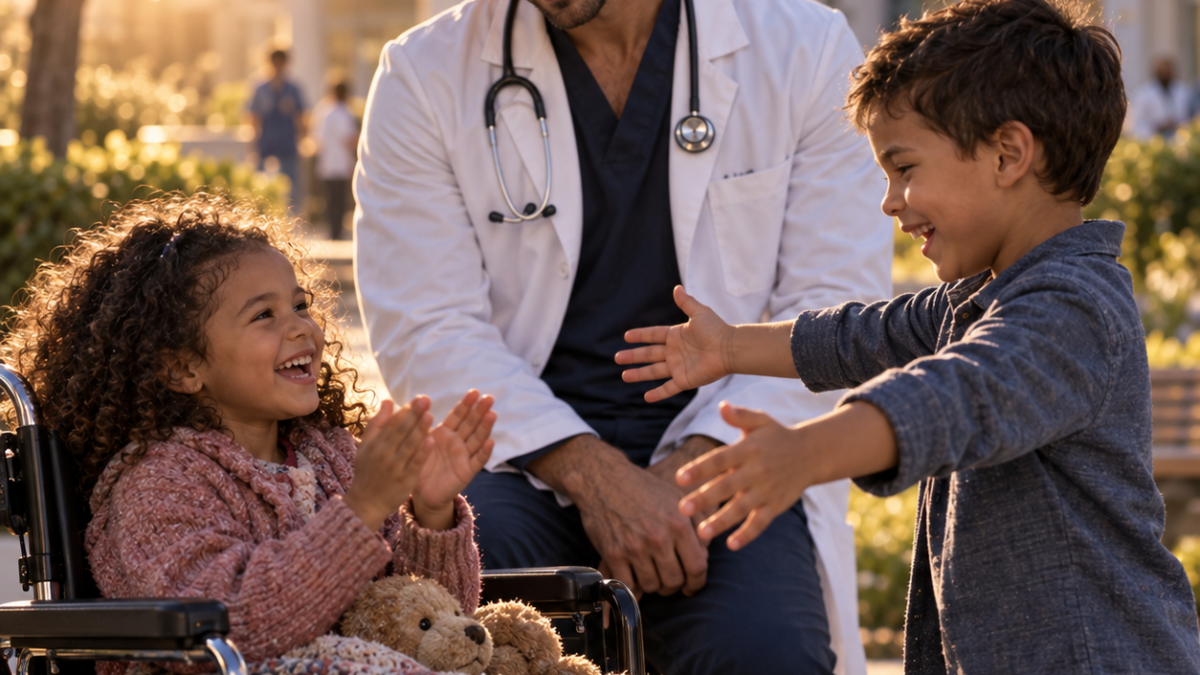
As Will watched the beaming child demonstrate her progress, he thought about the long chain of events that had led to this moment. A homeless boy making funny faces in a hospital garden.
A paralyzed girl laughing for the first time in years. A rigid housekeeper softening her heart.
A suspicious aunt gradually recognizing what was truly best for her nephew. A skeptical medical establishment finally acknowledging the power of joy in healing. You know what my dad used to say?
Noah remarked overhearing their conversation.
He said that impossible just means you haven’t found the right way yet.
He smiled.
The same infectious smile that had first broken through Emma’s depression all those years ago.
I think we found the right way. Indeed, we did, Will agreed, looking around at the extraordinary family that fate, compassion, and determination had built. One smile at a time, as the Nobel Prize nominations circulated in the press over the subsequent weeks.
Media outlets that had once questioned Will’s motives now celebrated the foundation’s achievements.
Former critics acknowledged the transformative impact of the IE smile protocol on pediatric rehabilitation worldwide. Even Dr.Harold Reynolds, now retired but still influential, published a formal retraction of his earlier criticisms, admitting that the Anderson methodology had revolutionized our understanding of the mindbody connection in trauma recovery.
The ultimate validation, however, came not from institutional recognition, but from the countless letters, emails, and social media posts from children and families whose lives had been changed through the foundation’s work.
Their stories of II, first steps taken, first words spoken, first smiles reclaimed after tragedy, formed a tapestry of hope that stretched across continents and cultures. On a crisp autumn evening, six months after the anniversary celebration, the Anderson family gathered once again in their garden.
Emma had just returned from opening a new smile center in Mumbai, Noah from a training program in Stockholm, Olivia from a tech conference in Tokyo, and Maddie from a foundation board meeting in London. Their global impact continued to expand, but they always returned to the place where it had all begun.
As twilight descended over Boston, Will raised his glass in a toast.
“To finding family in unexpected places,” he said, “and to the power of a single smile to change the world.”
Noah, now preparing to lead the foundation’s international expansion while completing his second doctorate, added his own toast to the impossible becoming possible.
Emma, whose pioneering research continued to push the boundaries of neurological rehabilitation, smiled at her brother, the boy who had taught her to walk again, to laugh again, to believe in miracles again, to making others happy as the shest path to healing ourselves.
Olivia, whose voice had returned so powerfully that she now narrated the foundation’s documentary films, raised her glass to being heard, even in silence.
Maddie, whose organizational genius had transformed a local project into a global movement, concluded simply to home wherever and however we find it.
As stars appeared in the darkening sky, Will Anderson looked at the extraordinary family created not by blood, but by love, compassion, and the unwavering belief in every child’s capacity for joy, even in the face of tremendous adversity.
from a single moment of connection between a homeless boy and a paralyzed girl had grown a worldwide movement that continued to redefine the possibilities of healing. And it had all begun with a simple universal truth that an 8-year-old orphan.
THE END.

