She Whispered, “No One Ever Chose Me First I Said, “I’ve Been Waiting for You to See I Already Did.”
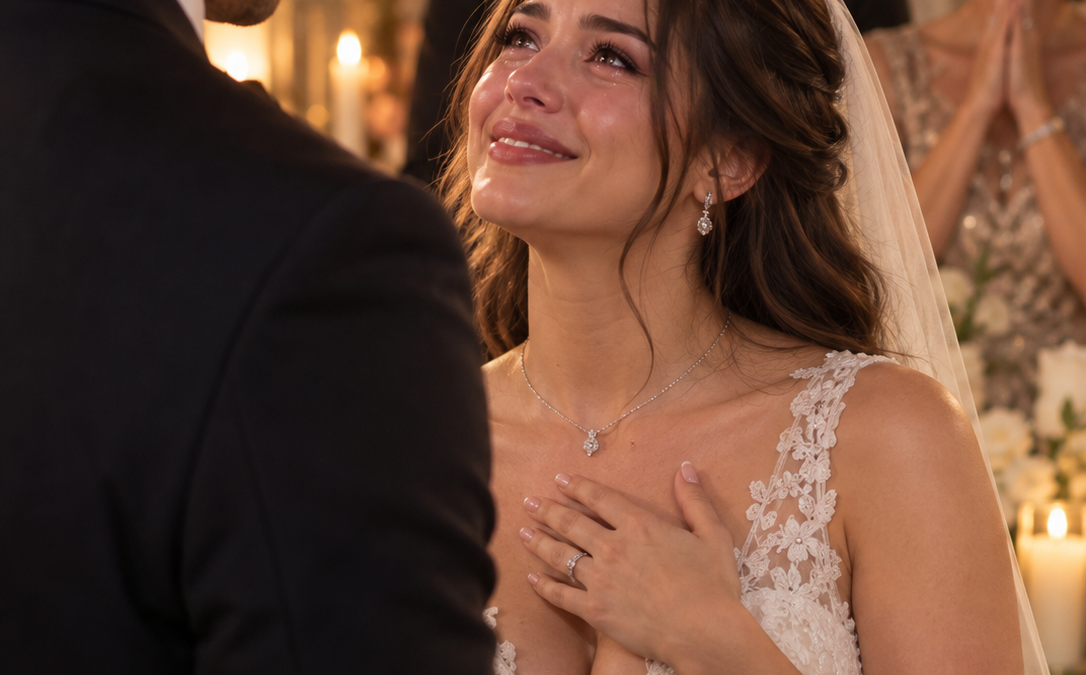
She Whispered, “No One Ever Chose Me First I Said, “I’ve Been Waiting for You to See I Already Did.”

On the wall of our cafe, right beside the cash register, there’s a shadow box.
It’s a simple one, plain black wood frame, glass front, about the size of a big book.
People waiting to pay for their gumbo lean over and look at it.
Most of them can’t figure out what they’re seeing.
Inside, on a piece of faded blue velvet, there’s a corsage, the wrist kind that girls wear to dances.
It was a white gardenia once.
Now it’s brown and papery and so dry it would crumble to dust if you breathed on it.
The ribbon was pink.
Now it’s the color of old tea.
It’s been dead for 16 years.
It was never worn, not once.
And pinned beside it on the velvet, there’s a small sheet of paper torn from a spiral notebook, wide ruled, the kind every fourth grader in Louisiana carries in their backpack.
It’s yellowed and soft with age and the fold lines are almost worn through.
There’s writing on it in pencil in the big, careful, crooked printing of a nine-year-old boy.
It’s a list, just a list of names, 10 of them.
People always ask about it. My wife usually lets me tell them.
She stands behind the counter with her arms crossed and a dish towel over her shoulder trying not to cry while I explain. She whispered something to me once, on a hot summer night on a dusty old playground, that broke my heart right in half. She said nobody in all her 34 years had ever picked her before they picked somebody else.
And I told her she was wrong, that somebody had, a long, long time ago.
That I’d just been waiting all these years for her to look back and notice.
The proof was on that sheet of notebook paper. It took 25 years for her to read it.
My name is Remy Thibodeaux. That year I was 34 years old and I was the pharmacist at Thibodeaux Pharmacy on Bridge Street in Breaux Bridge, Louisiana. Breaux Bridge is a small town in Cajun country in the south-central part of the state, about 10 minutes east of Lafayette.
It sits right on the Bayou Teche, a slow, brown, winding bayou lined with live oaks draped in Spanish moss.
There’s an old iron drawbridge over the bayou right in the middle of town.
When a boat comes through, the bridge swings open and the whole town stops and waits. They call it the crawfish capital of the world.
There’s a big festival every May with zydeco bands and crawfish races and more boiled crawfish than you can imagine.
People come from all over.
The rest of the year it’s quiet.
Old men play bourré in the back of the hardware store.
Old ladies go to mass every morning at St.Bernard’s.
Everybody knows everybody.
And on Saturday mornings there’s a zydeco breakfast at one of the cafes and people dance in the aisles at 8:00 in the morning with plates of eggs and boudin.
My grandfather opened the pharmacy in 1951.
It’s a narrow brick building with a green and white striped awning and big front windows.
Inside there’s an old marble soda fountain counter with six red stools where my grandfather used to make root beer floats for a nickel.
We don’t make floats anymore, but the counter’s still there.
Old people sit on the stools while they wait for their prescriptions and they tell me about their grandchildren and their blood pressure and who died this week. My father ran it after my grandfather. I took it over when my father retired six years before this story.
He and my mother moved to a little house on the edge of town out by the rice fields where my father fishes for bass every morning and my mother tends her roses. I lived in the apartment above the pharmacy.
Two rooms and a little kitchen with a window that looked out over Bridge Street and the drawbridge and the bayou. At night I could hear the frogs down on the water.
In the mornings I could smell the coffee from Guidry’s cafe across the street.
Everybody in Breaux Bridge knew me.
I’d filled their prescriptions.
I told them to take their blood pressure pills with food.
I’d sat up with Mr.Arseneaux when his wife was dying and helped him understand her pain medicine.
I’d driven insulin out to old Mrs.Broussard’s house in a flood.
and everybody in Breaux Bridge knew one other thing about me.
I’d never married.
At 34, in a town where most people got married at 22, that made me something of a mystery. The old ladies at mass had a theory.
They thought I was a confirmed bachelor, too set in my ways, too particular, married to the pharmacy. They tried to fix me up constantly. Their granddaughters, their nieces, their widowed daughters-in-law.
I went on a lot of polite dinners in Lafayette with a lot of perfectly nice women. None of it ever went anywhere.
The old ladies didn’t know why.
My mother did, I think.
She never said so, but I’d catch her looking at me sometimes across the Sunday dinner table with a sad sort of look in her eyes, like she knew.
The truth was simple.
I’d already chosen.
I’d chosen when I was 9 years old on a dusty kickball field behind Breaux Bridge Elementary, and I’d never been able to choose anybody else since.
She just never known it. Her name was Collette Guidry.
When we were kids, she was the girl who got picked last for everything.
She was big for her age and awkward, tall and heavy with frizzy brown hair she couldn’t do anything with and thick glasses that slid down her nose.
She was clumsy. She tripped over things.
She wore hand-me-down clothes from her cousins that never quite fit. She was quiet and shy and she read books at recess instead of playing.
She lived with her aunt Odile Guidry, who ran the cafe across the street from my father’s pharmacy.
Everybody in town knew why. Her mother had had her at 16 and left her with Odile when she was a baby and moved to Baton Rouge.
Her mother came back twice when Collette was little.
Both times she came back for Collette’s younger half-sister Amber, who’d been born in Baton Rouge.
She took Amber to Disney World. She took Amber to live with her new husband in Houston. She never took Collette.
Everybody knew that, too.
It’s a small town.
In PE, when when captains picked teams for kickball, Collette was always last. Always.
Every single time.
She’d stand there at the edge of the field in her too big t-shirt, looking at the ground while every other kid got picked one by one.
The boys, the girls, the kid with the broken arm, the kid who cried every time the ball came near him, and then her. Last, with a big groan from whichever team was stuck with her. I watched it happen for 3 years.
First grade, second grade, third grade. It made my stomach hurt every time.
I didn’t understand why.
I just knew I hated the look on her face. In fourth grade, Coach Dupuis made me a captain for the first time. It was a Friday in October.
He told us on Thursday afternoon, at the end of P. E.
, “Tomorrow,” he said, “Thibodeau and LeBlanc, you’re captains.
Think about your teams tonight.”
So, that night I thought about my team. I sat at the kitchen table in our house on Barrage Street with my spiral notebook, and I wrote down my list in pencil, in my big crooked 9-year-old printing.
10 names.
The 10 kids I’d pick, in order.
I thought about it for a long time. I erased some names.
I wrote them again. My mother came in and asked what I was doing, and I told her, and she looked over my shoulder at the list.
She didn’t say anything.
She just put her hand on my head for a second. Then she went back to the stove. The next day at P.
E. , Coach Dupuis flipped a coin.
I won. I got the first pick. All the kids were standing along the fence.
Beau LeBlanc, the other captain, was already grinning, waiting for me to pick Tyler Hebert, who could kick the ball clear over the fence. I looked down the line of kids.
At the very end, standing a little apart from everybody else, looking at the ground, was Collette Guidry.
“Collette,” I said.
The whole field went quiet. Then everybody started laughing.
Beau LeBlanc laughed so hard he fell down. Kids were pointing.
Somebody said, “Remy’s got a crush on Collette.”
Somebody else said, “He picked Moose, which was what the mean kids called her.
Collette looked up. She stared at me.
Her face went bright red, and then she did something I’ll never forget.
She looked around like she thought I must have meant somebody else. Like there must be another Collette standing behind her.
Collette, I said again, you’re on my team.
Come on. She walked across the field toward me, slowly, with her head down and her face burning while everybody laughed. She came and stood behind me.
She didn’t look at me.
We lost that game 11 to 2. Collette kicked the ball once and it went straight up in the air and came down on her own head. Everybody laughed again.
After the game, as everybody was walking back to the building, she caught up with me by the water fountain. Why did you do that?
She said. Her voice was shaking. Do what?
Pick me first. Her eyes were wet behind her thick glasses.
Everybody’s laughing at me.
Was it a joke? Did somebody dare you? No.
I just wanted you on my team. She stared at me.
I could see she didn’t believe me.
I could see her deciding right there by the water fountain that it must be a joke or pity because there was no other reason in the whole world anybody would pick her first.
Don’t do it again, she said, please.
Then she ran inside. I kept the list.
I don’t know why.
I folded it up and put it in the little wooden box in my bedroom where I kept my baseball cards and my grandfather’s pocket knife.
10 names in pencil, written the night before. The first one was Collette Guidry. I asked her to the eighth grade Mardi Gras dance.
She said no. She thought my friends had put me up to it. I asked her to the senior prom.
I’d saved up for 2 months.
I’d already bought the corsage, a white gardenia, because I’d heard her tell somebody once that her aunt grew them by the cafe door and they were her favorite flower.
She said no.
She said she wasn’t going.
She said nobody would want to dance with her anyway and she didn’t want me to have a bad time because I felt sorry for her.
“I don’t feel sorry for you,” I said.
“Everybody feels sorry for me, Remy,” she said.
“You just feel sorriest.”
I went to prom alone.
I stood by the punch bowl in the St.Bernard’s Parish Hall in my rented tuxedo and watched everybody dance.
At the end of the night, I drove home with the corsage still in its plastic box on the passenger seat. I never threw it away.
I put it in the back of the freezer at the pharmacy, behind the insulin. My father found it once. He looked at it for a long time, then he put it back and never said a word about it.
After high school, I went to pharmacy school at Louisiana Monroe.
Collette stayed in Breaux Bridge and worked at her aunt’s cafe.
I came home on weekends.
I’d sit at the counter at Guidry’s cafe and order coffee and watch her work.
She’d grown up.
She’d grown into herself.
She was tall and strong and pretty in a quiet, warm, round-faced way with her hair pulled back and her glasses pushed up on her head. She could carry six plates at once.
She knew every regular’s order by heart, and she still wouldn’t look at me for more than a second.
When I was 21, I finally decided to tell her. I wrote it all down in a letter, four pages. The kickball game, the eighth grade dance, the prom, the gardenia in the freezer.
I told her I’d picked her first when I was 9 years old and I’d never stopped.
I drove home from Monroe on a Friday night with the letter in my shirt pocket.
When I pulled onto Bridge Street, there was a pickup truck parked in front of Guidry’s cafe, a big red one with Texas plates, and Collette was standing beside it with a suitcase.
His name was Kyle Hanks. He was from Houston.
He’d come through town that summer working on an oil pipeline crew.
He’d eaten at the cafe every day for 6 weeks.
She married him 3 weeks later at the courthouse in St.Martinville. She moved to Houston with him the next morning.
I stood in the parking lot of my father’s pharmacy that Friday night and watched her climb into that red truck.
She saw me. She waved, a small wave.
The truck pulled away over the drawbridge and disappeared. I never gave her the letter.
I burned it in the sink in my father’s pharmacy that night.
She was gone for 13 years. She came home on a Tuesday at the end of January, 3 weeks before Mardi Gras.
I heard about it before I saw her.
It’s a small town.
Mrs.Broussard told me when she came in for her blood pressure pills.
“Colette Guidry’s back.”
She said leaning on the soda fountain counter.
“Odile’s girl came in last night with everything she owns in a Honda.
Divorced.
That Texas boy left her.”
My hand stopped on the pill counter.
“He left her for his high school girlfriend.
Can you believe that?
Married her 13 years and then his old girlfriend from Pasadena got divorced and he went right back to her.”
Mrs.Broussard shook her head.
“Colette’s going to help Odile with the cafe.
Odile’s knees are bad.
She’s 72.
She can’t stand up all day anymore.”
I counted out Mrs.Broussard’s pills.
I got the number wrong twice.
The next morning I walked across Bridge Street to Guidry’s Cafe at 6:30, the way I did every morning for my coffee.
It’s a small place, eight tables and a long counter with stools, checkered tablecloths, a big chalkboard with the specials written on it, a jukebox that only plays Cajun music and Zydeco.
And on the wall behind the counter, dozens of framed photographs of Breaux Bridge people from the last 50 years, crawfish festivals and weddings and Mardi Gras parades and first communions. The cafe smelled the way it always smelled, dark roast coffee with chicory, onions and bell pepper and celery sizzling in butter, and dewy sausage on the grill, and under all of it the deep nutty smell of a roux cooking slow in a big black iron pot. She was behind the counter.
She was pouring coffee for old Mr.Arceneaux. She had her brown hair pulled back in a messy knot and her glasses pushed up on her head and an apron over a gray T-shirt. She was thinner than I remembered.
Her face was tired.
There were lines around her eyes that hadn’t been there at 21.
She looked up when the bell over the door jingled. She saw me.
She stopped pouring.
Coffee went over the top of Mr.Arceneaux’s cup and onto the counter.
“Colette,” Mr.Arceneaux said, jumping back.
“Oh, oh, I’m sorry, Mr.Arceneaux.”
She grabbed a rag and mopped it up.
She didn’t look at me again.
I sat down on a stool at the other end of the counter, my usual stool. She finished with Mr.Arceneaux.
She came down the counter with the coffee pot. She stopped in front of me.
She set down a cup and filled it without asking.
Black, the way I’d always taken it.
“Remy,” she said.
“Colette, you’re still here,” she said, not a question.
“I’m still here.
The pharmacy?”
“Still the pharmacy.”
She nodded. She looked at the coffee cup instead of at me.
“I heard you never got married.”
“Nope.”
“Why not?”
I looked at her.
“13 years.”
She was standing right there in front of me, pouring my coffee, the way she had when she was 19 and I was 20, home from Monroe on the weekends.
“Never found anybody I wanted to marry,” I said.
She looked up at me then, just for a second. Her eyes were the same, brown and warm and weary behind the tiredness.
“I’m sorry about Kyle,” I said.
Her face went still.
“You heard,” she said.
“It’s Breaux Bridge.
Everybody’s heard.”
She almost laughed.
“Right.”
She set the coffee pot down on the counter. She wiped her hands on her apron.
“Well, I’m back for a while.
Tante Odile needs help.”
“I’m glad you’re back.”
She looked at me strangely, like she was trying to figure out if I meant it.
Then Tante Odile hollered from the kitchen, “Colette, the biscuits.”
And she turned and went through the swinging door. Odile brought out a basket of biscuits a minute later.
She set them on the counter in front of the regulars. Big, fluffy, golden biscuits fresh from the oven, steaming. Everybody reached for them.
Collette came back out and reached into the basket, and I noticed something. She took the worst one, not by accident, on purpose.
She dug down to the bottom of the basket, past all the good golden ones, and pulled out a biscuit from the edge of the pan, the one that had burned a little on the bottom, brown-black on one side and lopsided. She ate it standing up behind the counter.
I didn’t think much of it then, but after that, I started watching, and I saw her do it every single day.
When Odile made a pan of bread pudding, Collette took the corner piece, the dry, burned one. When she sat down for a break, she took the wobbly stool at the end of the counter, the one with the cracked seat, even when all the good ones were empty.
When somebody brought a box of donuts from the Meche’s Bakery down the road and offered her first pick, she froze.
Her hand hovered over the box.
She looked at all the donuts, and then she said, “Oh, no, y’all go first.
I’ll take whatever’s left.”
Whatever’s left, every single time.
I’d been a pharmacist for 12 years.
I’d learned to notice things about people, what they said and what they didn’t, what they took and what they left.
And watching Collette Goodry take the burned biscuit every morning, I understood something I hadn’t understood at 9 years old.
It wasn’t that nobody had ever picked her first.
It was that she’d learned not to let them.
The first week of February, Mardi Gras season was in full swing.
In Cajun country, Mardi Gras isn’t just one day, it’s weeks.
King cakes in every bakery, parties every weekend, and on the last Sunday before Fat Tuesday, the Courir de Mardi Gras, the Mardi Gras run.
It’s an old Cajun tradition.
Men dress up in bright homemade costumes with tall, pointed hats called capuchons and wire mesh masks, and ride horses in flatbed trailers from farm to farm out in the countryside. At every farm they sing and dance and beg for ingredients for a big communal gumbo, a chicken, a sack of rice, an onion.
The farmers throw a live chicken into the field and all the men chase it through the mud and whoever catches it gets to keep it for the pot.
At the end of the day everybody comes back to town and the women have been cooking all day and there’s a huge gumbo and a dance at the parish hall.
Guidry’s Cafe had cooked the Courir au Gumbo for 30 years.
Odile made it in an iron pot the size of a bathtub, but that year Odile’s knees were too bad.
She couldn’t stand at the stove for 10 hours.
“Colette will do it.”
Odile announced on the Monday before the Courir. Colette went white.
“Tante Odile, I can’t.
I’ve never made it by myself, not the big one.
You’ve watched me make it every year since you were 4 years old.
You know how.”
“What if I mess it up?
The whole town eats that gumbo.
What if it’s not as good as yours?”
“Then it’s not as good as mine.”
Odile said.
“And everybody will eat it anyway because it’s gumbo and they’re Cajuns and they’re hungry.
” Colette looked like she might cry.
I was sitting at the counter with my coffee.
I didn’t say anything.
But that afternoon when I closed the pharmacy, I walked across the street and knocked on the back door of the cafe. Colette opened it. She had flour on her face.
Behind her the kitchen was a mess. Onions everywhere, bell peppers, celery, three iron pots on the stove.
“Remy?”
she said.
“What are you doing here?”
“I heard you were making the gumbo.
I thought you might need somebody to chop onions.”
She stared at me.
“You’re a pharmacist.”
she said.
“I’m a pharmacist who’s very good at chopping things into very small, very exact pieces.
” For a second her face did something, something I hadn’t seen since she was 9 years old, standing at the edge of that kickball field, a kind of stunned, disbelieving look.
“You do that?”
she said.
“I do that.
Why?”
“Because I like gumbo,” I said, “and I like you.”
She looked at me for a long moment. Then she stepped back and held the door open.
We cooked for three nights, every night after I closed the pharmacy. We chopped 40 lb of onions and 20 lb of bell pepper and 20 lb of celery, the holy trinity, Odile called it.
We cut up chickens and andouille. We made the roux.
That was the hard part. Flour and oil in the big black iron pot, stirred slow and steady for over an hour until it turned from white to gold to peanut butter brown to the color of dark chocolate.
“You can’t stop stirring,” Collette said, standing at the stove with the long wooden paddle, “not for a second.
Tante Odile says if you stop stirring even for a second, it burns and you have to start over. So you stand there for an hour and a half. You stand there for an hour and a half.
What do you think about?”
She was quiet for a while, stirring. The roux was getting darker. The kitchen smelled like toasted nuts and something deeper, something almost like chocolate.
“Mostly,” she said, “I think about how everybody I ever loved picked somebody else.”
I stopped chopping.
She didn’t look at me.
She kept stirring, slow and steady.
“My mother,” she said, “she came back for Amber twice, never me.
My father, I never even met.
Kyle.”
She shook her head.
“Did you know that?
Kyle asked Deanna Pruitt to marry him first, his high school girlfriend, the summer before he came here. She said no. She said she wanted to wait.
So he came to Louisiana to work the pipeline and he met me and he married me 3 weeks later.”
She laughed.
It wasn’t a happy sound.
“I was his second choice for 13 years and when Deanna got divorced last spring and called him, he packed his truck the same week.
I’m sorry.”
“It’s okay.”
She kept stirring.
“I’m used to it.
I’ve been everybody’s second choice my whole life, the one after the one they really wanted.
That’s just who I am.
That’s not true.
She glanced at me, then back at the roux.
You don’t have to be nice, Remy, she said.
You were always nice to me, even when we were kids, even when you didn’t have to be.
She stirred. You always felt sorry for me.
I never felt sorry for you. You picked me first in kickball in fourth grade.
She said it lightly, like it was a funny old story. Remember, everybody laughed.
I figured Coach Dupuy made you do it because he felt bad for me. I opened my mouth to tell her the truth, and then the roux started to smoke.
Oh, no. Oh, no, no, no. She was stirring frantically.
I stopped I stopped for a second. I was looking at you and I stopped.
We saved it, barely. Odile came in from the front and took one sniff and said it was fine.
It was just dark. Dark was good.
Dark was the way her mother made it, but the moment was gone. When we finished that night, it was almost midnight. The gumbo was simmering in the giant pot.
The whole cafe smelled like heaven. Colette walked me to the back door.
She stood in the doorway with the kitchen light behind her. Thank you, Remy, she said.
Really, I couldn’t have done it without you.
Sure you could. No, she said quietly.
I couldn’t.
Nobody ever She stopped. She looked down at her hands. They were stained yellow from the onions and the bell pepper.
Nobody ever just showed up before without me asking.
I’ll show up anytime.
She looked up at me. For a second, I thought she was going to say something else.
Then she said, “Goodnight.”
and closed the door. The Coq au Vin gumbo was the best one in 30 years. Everybody said so, even Odile.
Colette stood behind the long serving table at the parish hall and ladled it out to 400 people. People kept coming back for seconds, then thirds.
Old men who’d been eating the Coq au Vin gumbo for 60 years told her it was better than her aunt’s.
She was pink in the face the whole night.
She didn’t know what to do with it.
At the end of the night, the Zydeco band started playing, the accordion and the rubboard and the drums. Everybody got up to dance.
The floor of the parish hall filled up. Kids and old people and couples, men still in their bright core air costumes with their capuchons falling off their heads.
Colette was clearing plates off the serving table. I walked over to her.
I held out my hand.
“Dance with me,” I said.
She looked at my hand, then at me. Her face went through about five different things.
“Remy,” she said.
“No, I can’t dance.”
“Neither can I.
People will laugh.”
“Let them laugh,” I said.
“They laughed in fourth grade, too.”
She stared at me. Then, slowly, she wiped her hands on her apron. She took it off.
She put her hand in mine. We danced badly.
She stepped on my feet. I stepped on hers. The band was playing a fast two-step, and neither of us could keep up, and we bumped into Mr.and Mrs.Arceneaux twice.
People were watching. Some of them were smiling.
A couple of them were laughing.
Colette didn’t seem to notice.
She was looking at me the whole time, like she’d never seen me before.
When the song ended, she didn’t let go of my hand right away.
“Why me?”
she said softly.
“Out of everybody here, why did you ask me?”
I almost told her, right there, in the middle of the parish hall, with the Zydeco playing and everybody watching. But the band started another song, and Odile called her name from across the room, something about the gumbo pot, and she let go of my hand and hurried away. After Mardi Gras came Lent, and after Lent came spring, and somewhere in there, without either of us saying anything about it, Colette and I started being together.
I’d go to the cafe every morning at 6:30.
She’d have my coffee poured before I sat down.
I’d go back every evening after I closed the pharmacy.
She’d make me a plate of whatever was left from the day, crawfish etouffee, red beans and rice, shrimp and okra gumbo, chicken and sausage jambalaya.
We’d eat together at the counter after the cafe closed with the lights low and the jukebox playing something soft.
On Sundays after mass, we’d walk along the Bayou Teche under the live oaks, the Spanish moss hanging down like gray lace, turtles sunning on the logs, egrets standing white and still in the shadows.
She talked more and more.
She told me about Houston, about the big apartment complex where she and Kyle had lived with the pool nobody ever swam in, about the job she’d had at a restaurant in the Galleria cooking in a kitchen for rich people who never came to the back to say thank you, about Kyle.
“He was nice to me,” she said.
“He wasn’t mean.
He just” She looked at the water.
“I always felt like I was standing in for somebody.
Like he was holding my hand but thinking about hers. For 13 years.
That’s not being nice.”
“It’s the nicest anybody ever was to me,” she said.
I stopped walking. She stopped, too.
She looked at me.
“That’s not true,” I said.
“Remi Collette, that’s not true and you know it.”
She looked at me for a long time under the live oaks. The bayou moved slow and brown beside us.
Somewhere across the water a mockingbird was singing. Then she reached out and took my hand. She held it very tight.
“I know,” she said quietly.
“I’m starting to know.”
In April she let me kiss her. It was a Tuesday night, late, after the cafe closed. We were sitting at the counter.
She’d made bread pudding with whiskey sauce.
She’d cut it into squares.
She’d set them out on a plate and she’d taken the corner piece, the burned one.
I reached over and took it off her plate. I set the best piece, the gooey middle one, in front of her instead.
She stared at it.
“What are you doing?”
she said.
“You always take the burned one.”
“I like the burned one.”
“No, you don’t,” I said.
“You take the burned biscuit and the wobbly stool and the last donut in the box.
Every single day.
You always take what’s left.”
She went very quiet. She looked at the bread pudding in front of her.
“Nobody ever noticed that.
” She whispered.
“I notice everything about you.”
I said.
“I always have.”
She looked up at me. Her eyes were wet.
And then she leaned across the counter and I leaned across and I kissed her. She tasted like whiskey sauce and cinnamon. She put her hand on my face.
When we pulled apart, she didn’t move away.
She just stayed there with her forehead against mine, breathing.
“Remy,” she said, “is this real?”
“It’s real.”
“Because if it’s not, if you’re just being nice.”
“I’m not being nice.”
I said.
“I’ve never once been nice to you in my whole life.
I’ve been something else.”
She laughed, a little shaky.
She didn’t ask what.
I wish she had. In May came the crawfish festival.
And after the crawfish festival, in the middle of June, came the 15-year reunion. Breaux Bridge High School, class of whatever year we were.
It was at the St.Bernard Parish Hall.
The same place where I’d stood by the punch bowl in my rented tuxedo at our senior prom.
I didn’t want to go.
I’d never been much for reunions, but Colette wanted to.
She said she hadn’t seen most of those people in 15 years.
She said she wanted them to see her. She wore a blue dress.
She’d done her hair.
She looked beautiful. When I picked her up at the cafe, Odile stood in the doorway with her hand pressed to her chest.
“Look at you, Cher.”
Odile said.
“Look at my girl.”
The reunion was loud and crowded and full of people I hadn’t talked to since high school.
Bola Blanc, who’d laughed so hard he fell down at the kickball game, was now a fat, bald insurance agent with four kids.
Tyler Hebert, who could kick the ball over the fence, sold trucks in Lafayette. Colette was nervous at first. She held onto my arm, but after a while, she started to relax.
People were nice to her. Some of them remembered her.
Some of them said she looked great. She started to laugh.
Around 10:00, I went to get us drinks. I was gone maybe 5 minutes. The line at the bar was long.
When I came back she was standing by the wall, alone. Her face was white.
Her hands were shaking.
Standing beside her, walking away, was Brandy Hebert, Tyler’s sister.
She’d been one of the popular girls in school, loud and pretty and mean in a way she didn’t even know she was being.
She’d had three glasses of wine.
“Colette,” I said, “what’s wrong?”
Colette looked at me. Her eyes were enormous.
“Is it true?”
she said.
“Is what true?”
Brandy said, her voice cracked. Brandy was telling a story about fourth grade, about the kickball game. She said everybody remembers it.
She said Coach Dupuis told the captains to pick me first that day because I was always last and he felt bad for me. She said her brother Tyler was standing right there when Coach told you.
Colette’s hands were shaking so hard she dropped her little purse.
She said you did it because Coach made you, because he told you to. She said it was the sweetest thing.
She said everybody knew it was pity.”
I stood there holding two drinks.
“Is it true?”
Colette whispered.
“Did Coach tell you to pick me?”
And the terrible thing is it was half true. Coach Dupuis had said something to me that morning before P.
E. He pulled me aside by the gym door.
He’d said, “Thibault, you’re a good kid.
Colette Gridley gets picked last every single time.
Maybe think about that today.”
That was all.
“Maybe think about that today.”
But I’d already thought about it.
The night before, at my kitchen table with my spiral notebook, I’d already written her name at the top of the list.
“Coach said something to me,” I said, “but Colette, it wasn’t” “Oh my god.”
She put her hand over her mouth.
“Oh my god, it’s true.”
“No, listen to me.
It’s not what you think.”
“It’s exactly what I think.”
She bent down and picked up her purse.
She wouldn’t look at me.
Her face had gone cold, completely cold.
It’s always exactly what I think.
It was pity. It was always pity even then, even when I was nine. Collette, the kickball game, the eighth grade dance, the prom, the gumbo, the bread pudding.
She was backing away from me. All of it.
You felt sorry for me, the fat girl who got picked last.
You felt sorry for me since fourth grade and you’ve been so nice about it and I was so stupid.
I thought, “You’re not stupid.”
I thought somebody finally picked me, she said. Her voice broke completely.
For real. First, just once in my whole life.
She turned around.
“Please take me home, Remy.
And then please don’t come to the cafe for a while.”
I drove her home.
She didn’t say a word the whole way.
When I pulled up in front of Guidry’s Cafe, she got out before I’d even stopped the truck.
She went up the stairs to the apartment over the cafe without looking back. I heard the door slam. I sat in my truck on Bridge Street in the dark.
Across the street, the pharmacy window was dark. Behind me, the drawbridge was down.
The bayou was black and still. The frogs were singing.
I’d waited 25 years to tell her and I’d waited too long.
For 2 weeks I stayed away from the cafe. It was the longest 2 weeks of my life.
I drank bad coffee from the gas station. I ate supper alone in my apartment over the pharmacy.
I could see the lights of the cafe across the street from my window. I could see her moving around inside, pouring coffee, carrying plates, taking the burned biscuit. Everybody in town knew something had happened.
Mrs.Broussard asked me about it. Mr.Arceneaux asked me about it. My mother called three times.
On the second Monday in July at 7:00 in the evening, just as I was closing the pharmacy, the bell over the door jingled. It was Tante Odile. She came in slowly with her cane.
She was 72 years old, small and round and gray-haired with bad knees and a sharp face and eyes that didn’t miss anything.
She’d run Guidry’s Cafe for 35 years.
She’d raised Collette from the time she was 8 weeks old.
She walked all the way to the soda fountain counter. She sat down on one of the red stools heavily.
She hooked her cane over the counter.
“Remy Thibodeau,” she said, “lock the door.
We need to talk.”
I locked the door. I turned the sign to closed. I came back and stood behind the counter.
Odile folded her hands on the marble.
“I’m going to say something to you,” she said, “and you’re not going to like it.”
“Okay.
Stay away from my girl.”
I didn’t move.
“I mean it,” Odile said.
“I’ve watched you, Remy, for 25 years, since you were a little boy.
I watched you pick her for that kickball team. I watched you ask her to that eighth grade dance.
I watched you sit at my counter every weekend when you came home from pharmacy school, drinking coffee and staring at her like a sick puppy.”
She shook her head.
“I watched you stand in that parking lot the night she left with Kyle Hanks.”
“You saw that?”
“I see everything on Bridge Street,” Odile said.
“I’ve been looking out that window for 35 years.”
She leaned forward.
“And I’ve always wondered, the whole time, why.
Why that boy keeps hanging around my girl, the pharmacist’s son, the good boy, the smart boy.
Why he keeps showing up for the girl everybody else picks last.”
“Because I” “I’ll tell you why I think,” Odile said, cutting me off.
“I think it’s pity.
I think you’re a kind boy, Remy, the kindest boy in this town.
I think you saw a sad, lonely, clumsy little girl standing at the edge of a kickball field, and your heart broke for her.
And it’s been breaking for her ever since.”
“That’s not” “And I don’t blame you for it,” Odile said.
“It’s a good thing, pity.
It’s a Christian thing.
Father Guidry would say so.”
Her voice got harder, “but it’s not love, and you can’t build a marriage on it.
You can’t build anything on it.”
She looked down at her folded hands on the marble counter. They were old and spotted and swollen at the knuckles from arthritis.
“Do you “You about her mother?”
she said quietly, what really happened?
“I know she left.
I know she came back for Amber. She came back for Amber twice, Odile said. The first time Colette was five.
Her mother drove up to my cafe in a white Cadillac with her new husband. She had Amber in the back seat, three years old in a pink dress.
She came in and hugged me and hugged Colette and said she was taking the girls to Disney World.”
Odile’s voice was shaking.
“Colette ran upstairs and packed her little suitcase.
She packed her pajamas and her toothbrush and her stuffed rabbit.
She came running back down so excited she couldn’t breathe.
I closed my eyes, and her mother looked at her, Odile said, and said there wasn’t room in the car.
The Cadillac only had room for one more, and she drove off with Amber.
And Colette stood on the sidewalk in front of my cafe holding her little suitcase and watched them go.”
The pharmacy was very quiet. The old clock over the prescription counter ticked.
She stood there for two hours, Odile said.
“I couldn’t get her to come inside.
She said maybe they’d come back.
Maybe they’d find room.
Five years old.”
Odile pressed her fingers to her mouth.
“They didn’t come back, not for four years, and when they did, it was the same thing.
Took Amber to live in Houston. Left Colette with me.
Odile, I’m so sorry.
That’s when she started taking the burned biscuit, Odile said.
Did you know that? After the Cadillac.
She started taking the worst of everything. The burned toast, the broken crayon, the last swing on the playground.
I asked her why. She was six.
She said, if I take what’s left, then nobody has to not pick me.
I couldn’t speak.
And then Kyle, Odile said, 13 years of being his second choice, of being the girl who wasn’t Deanna.
He never loved her, not really.
He loved that she’d take whatever he gave her.
Odile’s eyes were wet.
She came home in January, Remy, and she sat in my kitchen for two days and didn’t eat.
She said she was tired of being what’s left.
Odile reached across the counter and gripped my wrist. Her hand was strong for an old woman.
So, I’m asking you, she said, “Please, if you’re doing this because you feel sorry for her, if there’s any part of you that’s still that kind little boy standing on that kickball field feeling bad for the fat girl nobody wanted, let her go right now before she lets you in any further.
I’m not because you’ll get tired.”
Odile said and her voice broke.
“Pity gets tired.
Everybody gets tired of feeling sorry and someday you’ll look up and realize you want something else, somebody you didn’t have to save and you’ll go just like her mother, just like Kyle and she’ll be standing on that sidewalk again with her little suitcase.”
She let go of my wrist. She wiped her eyes fast and angry.
“I’m 72 years old,” she said.
“My knees are shot.
My heart’s not so good.
I’m not going to be here much longer and I can’t die knowing she’s standing on that sidewalk again.”
She took her cane off the counter.
“I raised that girl on cafe tips and prayer.
I’m the only one who ever chose her, me, an old woman who didn’t even have a choice and I’m terrified, Remy.
I’m terrified I’m the only one who ever will.”
She got up off the stool slowly leaning on her cane. She walked to the door.
She unlocked it herself. She stopped with her hand on the knob.
“If you love her,” she said without turning around, “prove it’s not pity and if you can’t then let her be.”
She went out. The bell jingled.
I watched her walk slowly across Bridge Street to the cafe leaning on her cane and go inside. I stood behind the soda fountain counter until the streetlights came on.
I didn’t sleep that night.
I lay in bed in my apartment over the pharmacy and stared at the ceiling and thought about what Odile had said. The worst part was I understood why she thought it.
From the outside it looked like pity, the good boy and the lonely girl, the captain picking the kid nobody wanted, the prom invitation she thought was charity, the gumbo, the bread pudding. And Colette believed it, too.
She believed it since she was 9 years old.
She’d stood by that water fountain and decided it had to be a joke or pity because there was no other possible reason anybody would pick her first.
I never told her the truth, not once in 25 years.
I’d written it in a letter at 21 and burned it in a sink.
I’d asked her to a prom and let her think it was charity.
I’d let her believe her whole life that she was a kindness I was doing.
Because I was a coward, because I was afraid she’d say no.
And now she thought Coach Duplessis had made me do it. I lay there in the dark and thought about Coach Duplessis by the gym door.
Maybe think about that today. I barely heard him.
I’d already made up my mind.
But how could I prove it?
It was my word against Brandy Hebert’s, against Tyler Hebert’s memory, against Odile’s fear, against 25 years of Colette believing it.
And then I remembered the little wooden box in my bedroom where I kept my baseball cards and my grandfather’s pocket knife, the list.
I got out of bed and drove to my parents’ house on the edge of town, out by the rice fields.
It was 2:00 in the morning. I let myself in with my old key.
My mother was asleep. My father was snoring.
I went up to my old bedroom. It was still mostly the same. My mother had never changed it.
My high school baseball trophies were still on the shelf. My pharmacy school diploma was still on the wall.
The little wooden box was on the top shelf of the closet. I took it down.
I opened it.
Baseball cards, my grandfather’s pocket knife, a Mardi Gras doubloon, a picture of my first dog.
And at the very bottom, folded into a small square, a sheet of paper from a spiral notebook, yellowed and soft. I unfolded it, my big crooked 9-year-old printing in pencil, 10 names.
At the top, in capital letters, I’d written “My team, Friday and under that Colette Tiff Goodry and under her name smaller in the margin, I’d written something I’d forgotten.
Something I had no memory of writing at all because she reads the best books and nobody ever picks her and she should get to be first one time.
And at the bottom of the page in my mother’s grown-up handwriting in blue ink dated Thursday, October 12th, there was a note.
She must have written it that night after I went to bed and put the list back in my backpack.
My sweet boy, I’m so proud of you.
Mama. Thursday, October 12th. The night before, before Coach Dupuis ever said a word to me.
I sat down on the edge of my old bed with that sheet of paper in my hands at 2:00 in the morning in my parents’ house and I cried like I was 9 years old.
My mother found me there.
She’d heard the car.
She stood in the doorway in her bathrobe looking at me. Looking at the paper in my hands.
She didn’t ask what it was.
She knew. You kept it, she said softly.
You wrote on it, I said. I never knew you wrote on it.
You were so serious about that list, my mother said. You sat at that kitchen table for an hour.
I’d never seen you so serious about anything.
She came and sat down beside me on the bed.
I thought you’d grow out of it liking that little girl.
You never did, did you?
No, ma’am.
I know. She put her arm around my shoulders.
I’ve always known.
Every girl we ever set you up with, every nice dinner in Lafayette, I knew you were just waiting. She thinks it was pity, I said. She thinks Coach made me do it.
My mother looked down at the paper in my hands, at her own handwriting 25 years old, at the date. Then show her, she said.
I would not argue with Colette. I would not tell her she was wrong or plead or explain.
Everybody in her life had told her who she was. Her mother, Kyle, Brandy Hebert, me even, by keeping quiet.
I would show her.
She’d believed for 25 years that she’d never been chosen first, and the whole time the proof was sitting in a wooden box in my parents’ closet.
I would put it in her hands, and I would let her decide. The next evening, a Tuesday, at 7:00, I went to the cafe.
It was closing time. The sign on the door said closed.
The lights were low. Colette was behind the counter wiping it down. Odile was in the kitchen.
I could hear her humming. I knocked on the glass. Colette looked up.
She saw me. She went still.
For a long time she didn’t move.
Then she came to the door.
She didn’t open it.
She just stood on the other side of the glass.
“Go home, Remy,” she said, muffled through the door.
“Will you come with me somewhere, just for half an hour?”
“No.”
“Please.”
“I’m not going to ask you anything.”
“I’m not going to say anything you don’t want to hear.
I just want to show you one thing, and then if you want me to leave you alone, I’ll leave you alone for good.”
She looked at me through the glass for a long, long time. Behind her, in the kitchen doorway, I saw Odile standing there with her cane, watching.
Odile looked at me, then at Colette’s back.
Then she gave me a very small nod. Colette unlocked the door.
We drove to Breaux Bridge Elementary.
It’s on the east side of town, a low brick building from the 1960s, with a flagpole out front and a big playground out back.
It was summer. School was out.
The building was dark. I parked by the fence. We got out.
We walked around behind the building through the gate onto the old kickball field. It was exactly the same. A big dusty dirt field with patches of dry grass and a chain-link backstop at one end and home plate worn into a shallow bowl in the dirt.
Live oaks around the edges, hung with Spanish moss. The sun was going down over the rice fields to the west, big and orange, and the whole field was glowing gold. The cicadas were screaming in the trees.
The air was hot and wet and heavy. It was July in South Louisiana. Collette stopped at the edge of the field right at the chain link fence.
She stood there looking out at the dusty dirt. This is where, she said quietly, right here where I used to stand. I know.
She wrapped her arms around herself even though it was 90°.
“Why did you bring me here?”
she said.
“Because this is where it started.”
She turned and looked at me. Her face was tight and guarded and tired.
“Remy,” she said, “I know you’re kind.
I know you’ve always been kind, but please don’t do this.
Don’t bring me out here and tell me it wasn’t pity.
I heard Brandy. I know what coach told you.
I know it’s true because you didn’t deny it.”
Her voice started to shake.
“And it’s okay.
It’s okay.
I’m not even mad.
You were nine. You did something nice.
You’re a nice person.
It’s not your fault that I spent my whole life thinking it meant something.
Collette, it’s just” She pressed her hand against her chest.
She looked out at the kickball field. At the dirt glowing gold in the last of the sun.
“It’s just that it was the only time.
Do you understand? The only time in my whole life.
I’ve been waiting my whole life for someone to do it again, for real.
Not because they felt bad. Not because somebody told them to.
Not because they couldn’t get who they really wanted.
” Tears were running down her face now.
“My mother picked Amber.
Kyle picked Deanna. Even you.
Even you only picked me because coach said to.”
She turned around and looked at me. And her face was the face of a nine-year-old girl standing at the edge of a kickball field looking behind her to see if there was another Collette.
“I’ve never had anyone choose me first,” she whispered.
The cicadas screamed in the live oaks. The sun was touching the edge of the rice fields. The whole world was gold.
I reached into my shirt pocket. I took out the folded square of notebook paper, yellow and soft. I held it out to her.
“I’ve been waiting for you to see that I already did.
” She stared at the paper in my hand.
She didn’t move.
“Take it,” I said.
“Please.
Just read it.
And then you can decide.”
She took it. Her hands were shaking.
She unfolded it slowly, carefully, like it might fall apart. It almost did. The fold lines were nearly worn through.
She looked down at it in the golden light. My team, Friday.
Collette Guidry. She stopped breathing.
I watched her read it. I watched her eyes go down to the margin, to the small crooked pencil writing beside her name.
Because she reads the best books and nobody ever picks her and she should get to be first one time. Her hand went up over her mouth.
She read the rest of the list, nine more names.
Bol a Blanc wasn’t on it.
Tyler Hebert was number seven.
And then her eyes went to the bottom of the page, to my mother’s handwriting in faded blue ink.
My sweet boy, I’m so proud of you.
Mama. And the date, Thursday, October 12th. Collette looked at it for a long time.
“Thursday,” she whispered.
“The night before,” I said.
“I wrote it at our kitchen table on Thursday night.
Coach told us Thursday afternoon we’d be captains.
I went home and made my list. I thought about it for an hour. My mother saw me doing it.
She wrote on it after I went to bed.”
I took a breath. Coach Dupuis did say something to me Friday morning by the gym door.
He said, “Maybe think about Collette Guidry today.
” But I’d already thought about it.
I’d already written your name at the top.
I’d already de- cided.
She looked up at me. Her eyes were swimming.
“You never said,” she whispered.
“You never told me.”
I tried. By the water fountain, you asked if somebody dared me.
I said no.
You didn’t believe me.
My voice was shaking now. And then I asked you to the eighth grade dance and you thought it was a joke. And I asked you to prom and you thought it was pity.
And I bought you a gardenia because I heard you tell Missy Arsenault your aunt grew them by the cafe door. And you said, no. Collette made a sound, small and broken.
And when I was 21, I said, I wrote you a letter, four pages. I told you everything about the list, about the kickball game. I drove home from Monroe to give it to you.
And you were standing beside Kyle Hanks’ truck with a suitcase.
You were in the parking lot, she whispered, that night at the pharmacy. You waved.
I burned the letter in the sink that night. She was crying so hard now she could barely stand.
She held onto the chain link fence with one hand. The list was crushed against her chest in the other. I chose you first when I was 9 years old, I said, before anybody told me to, before anybody else would.
And I’ve chosen you first every single day since, for 25 years.
I just never said it out loud because I was scared. That was my fault, not yours, never yours.
Remy, she sobbed. It was never pity, I said, not once, not for one second.
It was the only thing I was ever sure of. She let go of the fence.
She took one step toward me, then another. And then she walked into my arms, right there at the edge of the kickball field, in the last gold light of the sun.
And she held onto me like she was 9 years old and she’d finally been picked.
I held her.
I didn’t say anything else.
There was nothing else to say. The sun went down behind the rice fields.
The sky turned orange, then pink, then purple. The cicadas quieted.
The first fireflies came up out of the dry grass along the edge of the field. When she finally lifted her head, her face was wet and red and swollen and absolutely beautiful.
25 years, she whispered. You waited 25 years.
I’d have waited 50.
Why didn’t you just tell me?
Because you’d have taken the burned biscuit, I said.
You’d have said I deserved somebody better.
You’d have told me to pick somebody else first.
She laughed, a wet, broken, surprised laugh. I would have, she said.
I really would have.”
“I know,” I said.
“So, I waited for you to be ready to see it.”
She looked down at the list, still crushed in her hand. She smoothed it out very carefully against my chest.
“Can I keep this?”
she asked.
“It’s always been yours.
” She folded it up and held it against her heart with both hands.
She looked up at me in the twilight.
“Pick me again,” she said.
“Right now, here, out loud.”
I understood. I took a step back. I stood at the edge of the old kickball field in the dusk with the fireflies rising all around us, and I pretended there was a long line of kids standing along the fence.
“Colette,” I said.
She laughed and cried at the same time.
“Colette Goodry,” I said again.
“You’re on my team.
Come on.”
And she walked across the dusty field toward me, not slowly this time, not with her head down. She walked straight to me with her chin up and her face shining in the last of the light, and she stood beside me, and she took my hand.
“First,” she said.
“First,” I said, “every time.”
When we got back to the cafe, it was almost 10:00. The lights were still on. Tante Odile was sitting at the counter on a red stool with her cane hooked over the edge, waiting.
She’d been waiting 3 hours.
She looked up when the bell over the door jingled.
She saw Colette’s face.
She saw our hands. Colette walked over to her aunt.
She took the folded list out and laid it on the counter. She smoothed it flat.
Odile put on her reading glasses. She looked down at it.
She read it, the 10 names, the pencil note in the margin, my mother’s handwriting at the bottom, the date.
She sat there for a long time without moving. Then Tante Odile took off her reading glasses and looked up at me. Her face was wet.
“Thursday,” she said.
“Thursday,” I said.
Odile got up off her stool, slowly, leaning on her cane. She came around the end of the counter.
She stood in front of me. She was a foot shorter than me. She reached up with her swollen, spotted, old hand and put it on my face.
“I was wrong about you, Remy Thibodaux.”
she said.
“I’ve been wrong about you for 25 years.
You were trying to protect her.”
I was. She patted my cheek hard.
“Now it’s your turn.”
We were married the following April at St.Bernard’s Church 3 days before the crawfish festival.
Collette wore her aunt’s wedding dress, taken in and let out and made over.
She carried a bouquet of white gardenias from the bushes by the cafe door.
Tant Odile walked her down the aisle very slowly with her cane in one hand and Collette’s arm in the other.
It took almost 4 minutes. Nobody minded.
The whole town came, Mrs.Broussard and Mr.Arceneaux and Beau LeBlanc and his four kids. My mother cried from the first note of the organ. My father cried when he thought nobody was looking.
At the reception at the parish hall, where I’d stood alone by the punch bowl on prom night, the Zydeco band played.
And when they played the first song, I walked across the room to Collette. And in front of everybody, I held out my hand.
“Dance with me.
” I said.
She took it without hesitating, without looking around to see if there was somebody else I meant. She stepped on my feet the whole song.
I didn’t care.
At the end of the night, I gave her a small box, a plastic corsage box, the kind you get at a florist. She opened it. Inside, dry and brown and papery, was a gardenia on a faded pink ribbon.
“Your prom corsage.”
I said.
“I kept it in the pharmacy freezer behind the insulin, 16 years.”
She held it in both hands and couldn’t say a word.
She never wore it.
It’s too fragile.
It’s in the shadow box by the cash register now, next to the list.
We live over the cafe now. Tant Odile moved into the little house my parents bought her on Berard Street, three doors down from where I grew up.
She comes to the cafe every morning at 6:00 and sits on a red stool at the end of the counter and tells Collette everything she’s doing wrong.
Collette just laughs. I still run the pharmacy across the street.
Every morning at 6:30 I walk across Bridge Street for my coffee. She has it poured before I sit down.
She makes the Courier gumbo every year now.
The whole town says it’s better than Odile’s.
Odile says they’re all liars, but she says it smiling.
And every morning when she takes the first pan of biscuits out of the oven and sets the basket on the counter for the regulars, I watch her. And I watch her reach into that basket.
She takes the best one now, the biggest, fluffiest, most golden biscuit from right in the middle of the pan. And then she breaks it in half and gives half to me and takes the other half herself.
And she smiles at me across the counter like a girl who finally knows she was chosen first and always had been
THE END.

