Ten Experts Failed The Billionaire’s 1968 GTO—Then A Broke Single Dad Fixed It With Scrap Metal
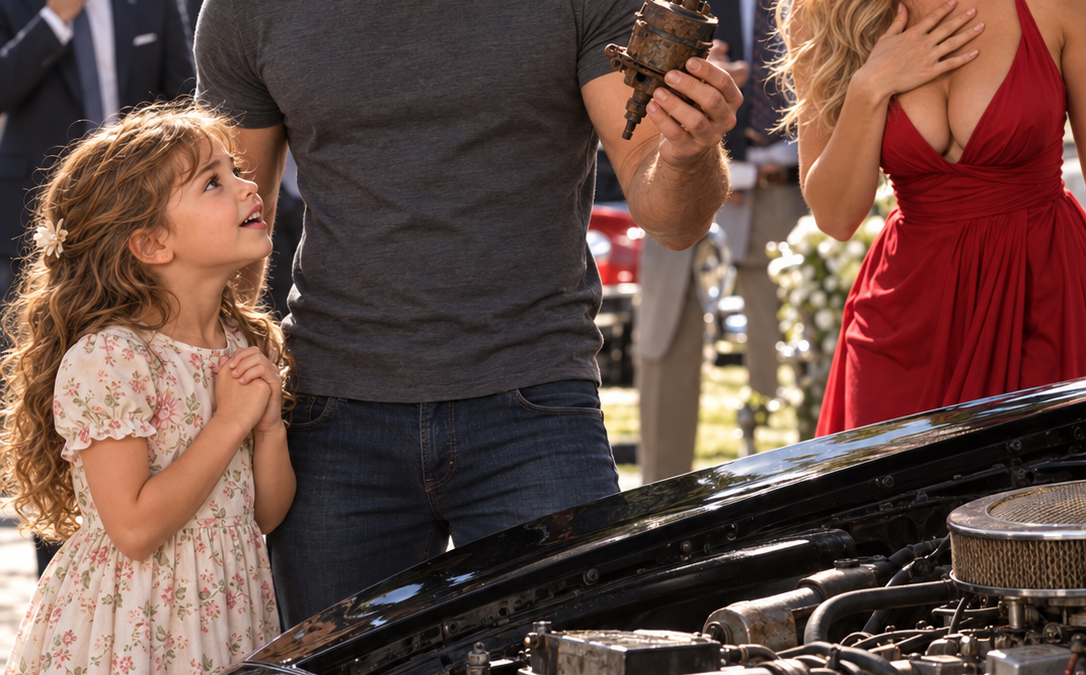
Ten Experts Failed The Billionaire’s 1968 GTO—Then A Broke Single Dad Fixed It With Scrap Metal

PART 1
10 of the world’s most celebrated restoration experts.
11 months, nearly $2 million burned through like paper in a furnace, and the most legendary muscle car ever built still wouldn’t stay alive for more than 8 seconds.
30-year-old billionaire CEO Natalie Ashford was watching her father’s empire crumble in real time, and every expert she trusted had already run out of answers.
Then, a rusted pickup truck rolled through the gate. The man behind the wheel had $12 in scrap metal and a battered toolbox. He had no credentials worth mentioning, no reputation worth defending.
What he had was something nobody in that room could recognize anymore because they’d stopped looking for it a long time ago.
They were about to find out what that cost them.
The GTO sat in the center of the workshop like something between a throne and a coffin. It was a 1968 Pontiac GTO Judge, carousel red, or it had been once, beneath the grime and the grief and the 11 months of people putting their hands inside it and pulling them back out empty.
The paint had faded to something closer to rust brown in patches. The chrome trim was pitted, but the lines were still there. That long aggressive hood, the stacked headlights, the rear spoiler that looked like it meant business, even standing still.
If you knew what you were looking at, you understood immediately why someone had paid what they paid to save it.
And if you didn’t know, you could still feel it.
That particular weight a machine carries when it’s been important to someone who is no longer alive to care for it.
Natalie Ashford knew what she was looking at.
She’d grown up watching her father circle this car the way some kids watch their fathers read the newspaper.
It was just something he did, something private and ritualistic that she was allowed to witness but never quite invited into. Richard Ashford had bought the GTO at auction when Natalie was 6 years old, outbidding three serious collectors and one museum representative to take it home.
He’d always said he would restore it himself someday.
He never got the chance. He died 22 months ago. Pancreatic cancer, fast and merciless.
He left Natalie, the company, the car, and a board of directors that had never fully believed a 30-year-old woman should be running an automotive empire worth north of $300 million. The restoration project had been her idea, her statement, her way of telling the board and the investors and everyone else watching that she understood what her father had built, that she respected it, that she intended to carry it forward with the same seriousness he
had. 11 months later, with 194 million spent and the GTO still dying every time someone tried to start it, the statement had become something else entirely.
We’ve got the Callaway Group flying in Thursday, said Derek Pollson, her head of investor relations, standing behind her left shoulder with the particular posture of a man delivering news he’d been rehearsing for 2 days.
Reginald Callaway is expecting to see the car running. That was the condition of the meeting.
I know what the condition was, Derek. The $45 million contract.
I know what’s at stake.
She didn’t turn around.
She kept her eyes on the GTO. What did Marchetti say this morning?
Franco Marchetti was the 10th restoration expert she’d hired and the most expensive.
He’d restored vehicles for private collectors in Milan, Zurich, and Monaco.
His waiting list was 2 years long. He charged $900 an hour and had a television show on a cable network that Natalie had never watched.
He’d arrived 6 weeks ago with two assistants, a shipping container full of diagnostic equipment, and the quiet confidence of a man who had never encountered a problem he couldn’t solve.
Dererick hesitated just slightly. He said the ignition system is fundamentally compromised.
His recommendation is that we source a period correct replacement from He said the same thing 3 weeks ago. Yes.
And two weeks ago. Yes. And we sourced two period correct replacements, both of which failed.
Natalie finally turned around. She was wearing a plain gray blazer over dark jeans.
her dark hair pulled back in a way that had nothing to do with style and everything to do with not thinking about it that morning. She looked, Dererick always thought privately, like someone who had been awake since 4:00 a.m.and intended to stay that way until midnight.
Where’s Marchetti right now?
He’s actually he left this morning.
Personal emergency, his office said. His assistants are still here. Natalie looked at him for a moment.
Marchetti quit, she said.
Derek’s silence confirmed it.
She turned back to the car. Behind her, she could hear the low murmur of the workshop.
Two of Marchetti’s assistants packing equipment near the diagnostic bay.
A small cluster of her own engineering staff standing to one side with the careful stillness of people who have stopped pretending to look busy.
The morning light came through the high windows at a shallow angle and landed across the GTO’s hood in a way that was almost cruel, illuminating every scratch.
Victor Holloway came through the side door at 20 9. He was 53, brought across the shoulders with silver at his temples, and the kind of easy authority that comes from spending 30 years making sure everyone in the room understood he was the most experienced person in it.
He’d been her father’s operations director for 16 years.
He was on paper the most qualified person at Asheford Automotive to be standing in this room.
“I heard about Marchetti,” he said, stopping beside her.
“Not close enough to be familiar, not far enough to be formal.
He’d always been good at that calibration.
Can’t say I’m surprised.
Man was over his head from the beginning.
Too accustomed to working on cars where the owner’s priority is aesthetics, not function.
He came highly recommended. So did the nine before him.
Victor clasped his hands behind his back, studying the GTO with an expression that managed to convey both respect for the car and a kind of grim satisfaction at the situation.
Natalie, I want to say something and I want you to hear it as someone who has nothing but loyalty to this company and to your father’s memory.
She already knew approximately what he was going to say. The Callaway meeting is 4 days away.
Victor said, “We are not going to have this car running in 4 days.
Not with any expert we can realistically get here by Thursday.
What we can do, what I think we should do is contact Callaway’s people today and reframe the presentation.
Show them the engineering documentation, the restoration process, the if we contact Callaway’s people today to reframe the presentation, Natalie said.
Callaway walks. He told us directly that he wants to see the car run before he signs anything.
That’s not a preference, Victor.
That’s his position.
Then perhaps the contract isn’t.
The contract is 45 million and 3 years of guaranteed work.
It’s also 12 jobs in the fabrication department that I’ve been holding open for 3 months waiting for it to close.
She paused.
So, I’m not reframing the presentation.
Victor was quiet for a moment. Then, what do you want to do?
I don’t know yet.
That was honest.
At least she didn’t know.
She was 30 years old, and she was standing in her dead father’s workshop looking at her dead father’s car, and she had no idea what the next move was.
The board had scheduled a confidence review for the following week. Language that everyone understood meant they were evaluating whether to keep her in the chair. The GTO was supposed to be proof.
It had become instead an argument for the opposition. She was still thinking about it at 11:00 when she heard the truck.
She didn’t see it pull in.
She was in the office at the back of the workshop working through Marchett’s final invoice with the kind of focused irritation that comes from reading line items you know you’re going to dispute.
But she heard the engine. Old American V8.
She registered automatically.
the kind of sound that doesn’t come from anything built after 1990.
A little rough on the idle, needed a valve adjustment, probably. The engine cut off, and she heard the truck door open and close.
She came out of the office because she was expecting a parts delivery, and she wanted to sign for it herself rather than leave it to the assistants, who were still quietly packing up Marchett’s equipment.
The man standing in the middle of her workshop was not a parts delivery. He was maybe an inch or two over 6 ft, lean rather than big, with the kind of build that comes from actually using your body rather than training it.
Early 30s, she’d have guessed, dark hair that needed a cut.
He was wearing a gray work shirt with the sleeves rolled to the elbow, jeans that had genuine oil stains rather than manufactured ones, and work boots that had seen significant use.
He was holding a battered metal toolbox in his left hand and a piece of, she looked twice, scrap metal in his right, something he’d cut from something else, a curved bracket maybe 8 in long.
He was looking at the GTO with the particular quality of attention that she recognized because her father had it. Not admiration exactly, not appraisal, more like reading. Her shop foreman, a compact man named Greg Lyall, was already moving toward the stranger with the expression of someone who intended to redirect him back to the parking lot.
Hey, can I help you? This is a private facility.
You can’t just I know it’s private, the man said.
He didn’t look at Greg.
He was still looking at the car. I drove past this place three times this week.
Saw the car through the window. Figured out what it was from the roof line.
He paused.
You’ve been trying to get it running.
Who are you? Greg said. Mason Carter.
He finally looked away from the car, first at Greg, then at Natalie, whom he apparently clocked as the person in charge because he addressed his next remark to her.
I’m a mechanic.
I’ve got a shop about 6 milesi from here.
Well, it’s not really a shop yet.
I’m renting a bay from a guy who does tire work, but I’ve been working on cars like this my whole life.
He held up the piece of scrap metal slightly.
I think I know what’s wrong with it.
Natalie was aware that Greg was looking at her and that the two remaining assistants had turned from their packing to watch. She looked at Mason Carter, the truck, the toolbox, the scrap metal, the oil stained jeans. And then she looked at the 194 million that had already failed.
What makes you think you know something 10 certified experts didn’t?
She asked. Not hostile, genuine.
Because I heard that engine running this morning through the wall of my friend’s shop two blocks over, Mason said.
and I heard it die. And the way it died told me something.
What did it tell you?
That everyone’s been fixing the expensive parts.
He glanced at the GTO again.
But the expensive parts aren’t the problem.
From across the workshop, Victor Holloway said, “Miss Ashford.”
She heard the tone immediately. The particular register of a man who is about to point out something embarrassing before it gets further.
Victor walked over, looked at Mason Carter with the kind of deliberate courtesy that contains no warmth, and said, “This is a secure restoration facility.
We have protocols for, “What’s the scrap metal for?”
Natalie said. Mason looked at it.
“It’s what I’ll need if I’m right.”
Victor made a quiet sound, not quite a laugh.
Young man, I don’t know what you’ve heard about this project, but we’ve had 10 of the most qualified restoration specialists in the world working on this vehicle.
Specialists with university degrees, certified training, decades of television, and Victor, Natalie said, “The idea that you’re going to walk in off the street with a piece of scrap and solve what?”
Victor, she said it flatly this time. He stopped.
She looked at Mason Carter.
You’ve got 20 minutes.
Show me what you’ve got.
The laughter started almost immediately, quiet, not quite open, the kind that lives in exchanged glances and covered mouths. Greg Lyle managed to keep his face neutral.
Marchetti’s assistance did not.
Mason set the toolbox down on the workbench without reacting to any of it.
He didn’t open the hood right away.
He stood beside the GTO for almost 2 minutes doing nothing, just listening, which struck everyone in the room as strange since the car wasn’t running.
Then he crouched beside the driver’s door and looked at something near the door frame.
Then he went around to the passenger side and did the same thing. Then he put his hand flat on the hood, left it there for a moment, and moved to the front of the car.
“Can someone start it?”
he said. Greg looked at Natalie.
She nodded.
Greg slid into the driver’s seat, turned the key, and the GTO came to life.
Rough, uneven, that familiar stutter. And then Greg let it idle. It ran for 4 seconds.
Five. Six. Mason was leaning close to the front of the engine.
Now, not touching anything. His head was slightly tilted like he was trying to catch a sound coming from one specific direction.
8 seconds. The engine died.
The silence in the workshop was the particular kind that follows something that’s happened too many times.
Again, Mason said. Greg started it again. Same thing.
Four, 5 seconds. And then the stutter deepened and it died.
One more time. This time, hold it at 1500 RPM.
It won’t stay at Hold it there as long as you can.
Greg tried. The engine caught and Greg worked the throttle carefully, holding it up, and it stayed alive for almost 12 seconds before it fell apart again.
Mason straightened up. He looked at Natalie. Who replaced the fuel delivery system?
The third expert 8 months ago. Who authorized the replacement parts?
She hesitated.
She didn’t know off the top of her head.
Victor would have that documentation. She looked at Victor. Victor looked at Mason with the careful patience of a man who has decided to let someone humiliate themselves completely before responding.
The parts were sourced through our standard procurement channels. Certified OEM specification components.
What brand? A brief pause.
I’d have to check the records.
Can you check them now? Another pause. longer.
Not immediately. No.
Mason looked back at the engine.
He said, “The fuel delivery isn’t the core problem.
It’s a symptom.
But whoever specked those replacement parts used components that are close to period correct, but not actually period correct.
They’re about 3% off in their flow characteristics, which means the system is fighting itself every time it tries to sustain an idle.
And by 8 or 9 seconds, the variance has built up enough to stall it.”
Marchetti’s senior assistant, a man named Paulo, who had been doing this work for 15 years and had the confidence that came with it, said, “That’s not how fuel delivery systems fail.
” Mason looked at him.
I didn’t say it was failing.
I said it was fighting itself. The diagnostic equipment we ran would have caught any flow variance above half a percent. Your diagnostic equipment was reading the aftermarket components as nominal because it was calibrated for aftermarket tolerances.
Mason said, “But this engine wasn’t built for aftermarket tolerances.”
He paused. It was built to specific factory specs that were tighter than anything that came before or after it because the man who originally built this cared about precision a lot more than the factory did.
The workshop was quiet.
“That’s not in any documentation,” Paulo said finally.
“No,” Mason agreed.
“It wouldn’t be.”
He opened his toolbox. What he did over the next 14 minutes was not dramatic in the way that people who watch television expect dramatic to look. There was no moment of inspiration, no single fix, no sudden revelation.
He worked methodically, moving through the engine with the unhurried focus of someone who had done this a thousand times with a thousand different configurations and who had stopped needing it to look impressive a long time ago.
He bypassed one component, adjusted a second, shimd a third with a piece of material he cut from the scrap metal he’d brought with him, and then he straightened up and wiped his hands on a shop rag from his toolbox.
“Try it now,” he said.
Greg got back in, turned the key. The GTO started. It idled.
It kept idling. 15 seconds, 20, 30.
Nobody in the workshop said anything.
At 45 seconds, Greg said from inside the car in a voice that was trying to sound casual and wasn’t quite managing it.
It’s just sitting here.
Yeah, Mason said.
At a minute and 10 seconds, Victor Holloway said, “It’s going to die.”
It didn’t die.
At 1 minute 40, Mason said, “Cut it.”
Greg turned the key. The engine stopped cleanly.
No stutter, no struggle, just off. Mason picked up his toolbox. He looked at Natalie.
That’ll hold for now, but that’s not the real problem either.
The real problem is something else entirely, and it’s going to take more than 20 minutes, he paused.
If you want to know what it is, the workshop was very quiet. Natalie looked at the GTO.
She looked at Mason Carter, the borrowed bay 6 mi away, the truck with the rough idol, the $12 in scrap metal that had just done what 194 million hadn’t.
She said, “Come back tomorrow at 7:00.”
Victor started to say something.
She didn’t look at him.
She was still looking at the car. Mason showed up at 6:53. Natalie knew this because she was already in the workshop at 6:40, standing with a cup of coffee that had gone lukewarm while she read through 11 months of restoration documentation on her tablet.
She heard the truck before she saw it.
That same rough idle she’d clocked yesterday.
The V8 that needed its valves looked at. The headlights swept across the high windows and then cut off.
A door opened and closed. Footsteps on gravel. He came through the side entrance carrying the same toolbox and wearing what she was fairly certain were the same clothes, or at least the same category of clothes.
Gray work shirt, jeans, boots. He had a paper cup of coffee from somewhere and a folded piece of paper tucked under his arm.
You’re early, she said.
So are you. He set the toolbox down on the workbench, put the coffee beside it, and unfolded the paper. It was covered in handwriting.
Not notes exactly, more like a diagram, lines and labels, and small measurements written in pencil.
I’ve been up since 4:00.
Went back through everything I could find about this engine configuration, the factory records, the option packages, the production run data. He paused, looking at the diagram. There were 6,725 GTOs built in 1968 with the Ram Air package.
But there’s variation inside that number that most people don’t account for.
Natalie set down her tablet. What kind of variation?
The kind that happens when a factory is running three shifts and different line supervisors have different tolerances for what counts as within spec. He put the diagram on the workbench and turned to the car.
This one’s different from the others I’ve seen.
The ignition timing curve is set tighter than factory standard.
The carburetor jets are a size that wasn’t in the standard parts catalog for this year.
Whoever built this car, whoever finished it, was working to a spec that wasn’t the factory spec.
My father. Mason looked at her. He modified it himself.
He was an engineer before he was a businessman. She looked at the GTO. He used to say the factory built it 90% of the way and then stopped.
He finished it. Mason was quiet for a moment processing that.
That would explain a lot.
It would also mean that every period correct replacement part anyone’s tried to source is the wrong part.
Not almost wrong. Wrong by design.
Because the design was his. Yeah.
She let that sit between them for a moment. Outside somewhere across the lot, a door opened.
Her morning security guard beginning his rounds. The workshop was still dim at the edges. The overhead lights only lit above the main bay where the GTO sat.
So, where do we start? She said.
Mason picked up his coffee. I want to pull the carburetor and the distributor, not replace them. Just look at them.
There’s something I heard yesterday when Greg was holding the RPM that I want to check.
He looked at her. Is that okay?
I’m not going to touch anything I don’t need to.
It was a careful thing to say, she thought.
He was aware he was a stranger in someone else’s space.
It’s okay, she said.
I’ll get Greg in.
Actually, he stopped. Is it okay if I work alone for the first part?
I’ll go slower, but I think better when it’s quiet.
She almost said no because protocol said she shouldn’t leave an unknown person unsupervised with a vehicle this valuable.
Then she thought about the 45 seconds of idle that had happened yesterday in front of 10 witnesses, and she said, “I’ll be in the office.
Come get me when you’ve got something.”
He nodded and turned to the car and she went back to her office and she did not actually get much done for the next hour and 40 minutes because she kept listening for sounds from the workshop. What she heard mostly was silence punctuated by very specific, very careful noise, the clink of a tool being selected, a socket turning, a long pause, the sound of something being set on a workbench with deliberate gentleness, then silence again. At 8:35, he knocked on the office door frame.
She looked up.
“Come look at this,” he said.
He’d set the carburetor on a clean shop rag on the workbench along with the distributor cap and rotor.
He’d also laid out beside them several components that she recognized as the replacement parts that had been sourced over the past 11 months.
Some in their original packaging, some already installed and removed again.
He had his diagram beside everything, and he’d added more notations in pencil.
The carburetor jets, he said, pointing. These are the originals.
He touched two small brass fittings. These are the replacements that expert number three installed. He pointed to two others.
You can see they’re dimensionally similar.
If you put a micrometer on them, you’d be looking at a difference of maybe 4,000 of an inch.
That’s nothing, she said.
In a stock application, yeah, it’s nothing in this application where the timing curve is already set tight and the fuel mixture is tuned to a specific air density.
He paused.
It’s not nothing.
It’s the difference between an engine that runs and an engine that argues with itself every time the load changes.
Can they be replaced with the right ones?
That’s the problem.
The right ones aren’t in any catalog I can find, which means your father either machined them himself or had them made to his spec by someone.
He touched the original jets carefully. These are handfinished.
You can see it if you look at the edges under a loop. A machine would have left uniform marks. These are slightly different from each other, which means someone finished them by hand to get them exactly where they needed to be.
Natalie picked up one of the original jets and looked at it. It was small, almost nothing in her palm, a tiny brass component that had spent 50 years inside an engine. She put it down carefully.
And the distributor, same story. The advanced curve is custom, not a modification you could buy, a modification someone built.
He looked at the diagram. I want to map the full advance curve before I make any calls about what to do next.
That’s going to take most of the morning.
She nodded. She was about to go back to the office when she stopped. Mason, yesterday you said the real problem was something else, that what you fixed was a symptom.
He looked at her directly and she got the sense he’d been waiting for her to circle back to that.
Yeah.
What’s the real problem?
He took a breath, not hesitating. What?
More like organizing.
There’s a component in the ignition system that I can’t account for.
It’s not in the documentation.
It’s not in any parts diagram I’ve found, and the space it’s occupying in the engine layout suggests it was added after the factory build.
It’s connected to the distributor in a way that doesn’t match any ignition architecture I know.
He paused.
I need to understand what it is before I can tell you why the car keeps dying because I think that component is the reason and I think it’s failing.
What kind of component?
That’s what I don’t know yet.
She looked at the GTO. My father never documented it.
Not in anything I’ve been given access to.
She thought about that.
I’ll pull his personal files.
I kept notebooks, engineering notebooks, separate from the company documentation. They might be in storage.
That would help. She started back toward the office, then turned again.
She wasn’t sure why she asked it, but she did.
Why are you doing this? You drove past this place three times.
You could have kept driving. Mason was quiet for a moment.
He looked at the car, then at his hands, then back at her.
I’ve got a daughter, he said.
Said she’s seven.
Her name is Riley.
He said the name the way people say the names of things they’ve built their whole lives around.
I’ve been working out of a borrowed bay for 2 years, taking whatever jobs come in, trying to put enough together to open something real, something she’ll be proud of when she’s older.
He paused. I drove past here and I heard that engine and I knew what was wrong with it before I was a block away.
And I figured I’d rather spend my shot on something real than keep waiting for a better moment that might not come.
Natalie looked at him for a moment.
That’s honest, she said.
I try to be, he said, and turned back to the car. Victor Holloway arrived at 9:15.
Natalie saw him crossing the lot from her office window, suit jacket over his arm, moving with the particular pace of a man who has already decided the shape of the conversation he’s about to have.
She was on the phone with her assistant when he walked in.
She watched through the interior window as he came through the workshop door, stopped when he saw Mason working at the engine bay, and stood there for a moment with an expression she couldn’t quite read from that distance.
She finished the call and came out. Who authorized him to disassemble components? Victor said.
He kept his voice even, but there was something tight underneath it. I did. I did, Natalie said.
Natalie, this is a vehicle with an assessed value of I know what it’s worth, Victor.
Then you understand the liability if an uninsured uncertified He’s not uninsured.
I verified his business registration this morning. He carries general liability coverage.
She’d done it at 7:00 a.m.before the day got away from her.
He also has an associates degree in automotive engineering from Rearen Technical College and worked for 6 years as a senior diagnostic engineer at a specialty manufacturer before she stopped herself because she’d been about to say before his career was destroyed and she didn’t know the full shape of that story yet and it wasn’t fair to summarize it in front of Victor.
Before he went independent, Victor looked at Mason, who had not stopped working or acknowledged either of them. Rearen Technical, not exactly MIT. MIT trained engineers have been working on this car for 11 months.
Victor turned back to her. I have concerns about the procurement records he was asking about yesterday.
What kind of concerns? Administrative concerns. Some of the early documentation is incomplete.
He said it smoothly.
the way people say things they’ve been constructing for hours.
Given the volume of the project and the number of vendors involved, it’s not unusual for pull the documentation and put it on my desk, she said.
All of it. Vendor contracts, part invoices, delivery receipts, everything from the beginning of the project.
A brief pause.
That’s going to take time to compile.
Then start now. He held her gaze for a moment longer than was comfortable.
Then he said, “Of course.”
And left. Mason waited until the door closed before he said without looking up from the engine.
He’s going to tell you those records are incomplete.
He already did.
They’re not incomplete.
He picked up a small flashlight and directed it into the engine bay. Or they are, but not because of administrative issues.
Someone pulled components from this documentation on purpose. Natalie went still.
How do you know that?
because I’ve been looking at the parts that are in this engine right now and I’ve been comparing them to the invoices you gave me yesterday and they don’t match.
Not all of them. You straightened up.
Two of the components that are invoiced as premium OEM specification parts, the kind that cost 8 or 10 times more than standard replacements are not premium parts.
They’re standard parts with the markings ground off and restamped.
The workshop felt very quiet all of a sudden. Show me, she said. He showed her.
It took 20 minutes moving through the engine with a flashlight and a magnifying glass. And by the end of it, Natalie had a very specific, very cold feeling settling into her chest.
The feeling of understanding something that she’d been standing next to for a long time without seeing it.
The restamped components were not subtle if you knew what to look for. The markings had been done carefully, but the metal underneath the stamping was the wrong grade.
The finish was wrong. And in one case, the component dimensions were off by enough that Mason could show her the variance with calipers.
How much do these cost? She said, the real ones versus the fakes.
The real ones, sourced correctly, run about $1400 each. Standard replacements, what these actually are, run about $90.
She did the math quietly.
Then she said, “This is only two components that I found so far,” Mason said.
He set the calipers down.
I’ve only been in here 2 hours.
She looked at the engine. 11 months of work, 19 different vendor contracts, parts sourced from 14 different suppliers across three countries. And Victor Holloway, who had been the operations director coordinating all of it, telling her this morning that the documentation was incomplete.
I need you to keep working, she said.
And I need you to write down everything you find, every component that doesn’t match its invoice, every marking that looks altered, everything.
Okay, he paused. You should know this is going to get complicated.
People don’t do this for small amounts.
I know. And whoever set it up is still in this building. She looked at the GTO.
I know that, too.
The engineering notebooks were in a storage unit on the south edge of the property along with most of her father’s personal effects that she hadn’t been ready to deal with in the months immediately after his death.
She drove out there herself at lunch alone and spent 40 minutes in the climate controlled unit going through cardboard boxes until she found them.
Six composition notebooks, the old kind with the black and white marbled covers filled from front to back in her father’s small, precise handwriting.
She sat on the floor of the storage unit with the notebook stacked beside her and the first one open in her lap.
Richard Ashford’s engineering notebooks were not sentimental documents.
They were working documents, calculations, diagrams, material specifications, problem descriptions followed by attempted solutions followed by results. He had the handwriting of someone who wrote to record rather than to communicate, tight and efficient, abbreviating everything that could be abbreviated. But reading through it was still in a way that caught her off guard like hearing him talk.
The exact particular way he approached a problem systematically without sentiment working outward from first principles was the same way she remembered him approaching everything, dinner table arguments, business decisions, her own teenage frustrations.
He had never been warm in the way she’d sometimes wished for, but he had always been honest.
And reading the notebooks, she felt that honesty in every line. She found the GTO section in the fourth notebook.
He had been working on the ignition system on and off for almost 3 years before his diagnosis. The entries were interspersed with other projects, other problems, other cars and components and engineering puzzles that had apparently occupied him in parallel.
But the GTO entries were the most detailed, the most densely annotated, and the most revised.
She could see where he’d crossed things out and rewritten them.
Where he’d added measurements in a different pen color, where he’d come back to a problem weeks later and started a new approach.
The component Mason had identified, the one that wasn’t in any documentation or parts diagram, appeared in the notebook beginning about halfway through the GTO section.
Her father called it simply the regulator in his notes, and it took her several pages of reading to understand what it was. a custom-designed ignition timing regulator that he had conceived, prototyped, and built himself over the course of about 18 months.
The design was his, not an adaptation of an existing component, a new design built to solve a specific problem with the tight timing curve he’d set for the engine and machine to tolerances that no off-the-shelf component could match.
He’d written on one page in handwriting slightly larger than his usual.
This is the part that makes it mine. Without this, it runs like a factory car.
With it, it runs like nothing else. She sat with that for a while. Then she took photographs of every relevant page in the notebook, sent them to her own email, put the notebooks carefully back in their box, and drove back to the workshop.
She showed Mason the photographs that afternoon. He read through them on her phone, scrolling slowly, stopping sometimes to look more closely at a diagram.
He did this standing beside the GTO without saying anything for almost 10 minutes, and she waited because she had already learned that he processed things at his own pace, and rushing him produced nothing.
“He was solving an advanced curve instability problem,” Mason said finally.
“The tight timing curve he’d set creates a resonance condition at sustained idle.
The timing wants to drift. Standard solutions cause power loss, so he built something that corrected the drift without affecting the output.
” He scrolled back to one of the diagrams.
This is genuinely clever.
It’s simple, but it’s clever.
The kind of simple that takes a long time to get to. Can you understand it well enough to rebuild it? He looked at the photograph for another moment.
I need to look at what’s actually in the engine first.
The regulator. I need to see its current condition. He handed back her phone.
If it’s just worn, some of it might be salvageable.
If it’s been tampered with, would someone have known it was there?
Anyone working closely with the engine would have seen it.
It’s not hidden.
It’s just not documented.
He paused.
If someone understood what it was and wanted the car to keep failing, he didn’t finish the sentence.
He didn’t need to.
She thought about 11 months, 10 experts, nearly $2 million. And the car still dying every 8 seconds, every single time, like clockwork.
The kind of consistency that didn’t feel like failure anymore when you thought about it from this angle.
the kind of consistency that felt instead like something carefully maintained. Look at it, she said.
Look at everything. And Mason, she waited until he met her eyes. Be careful.
It was a strange thing to say to a mechanic working on a car.
He seemed to understand she didn’t mean it that way.
Yeah, he said. I know.
The rest of that afternoon moved in the way that days move when something has shifted underneath them. outwardly normal, inwardly completely changed.
Natalie sat through two conference calls and a meeting with her legal team about the Callaway contract terms. She answered emails.
She talked to Derek about the Thursday timeline.
She did all of it with the surface of her attention while the deeper part of it stayed in the workshop with the notebooks, with the restamped components and the altered invoices and Victor Holloway’s smooth voice telling her the documentation was incomplete for administrative reasons.
At 4:15, Victor appeared in her office doorway.
“I wanted to follow up on the documentation request,” he said.
He came in without being invited, which he had always done, which she had always allowed because he’d known her father for 16 years, and she hadn’t known how to draw that line in the early months.
He sat down across from her desk.
I’ve had accounting pull what they can, but I want to be transparent with you.
There are gaps. Some of the early vendor communications happened outside the standard procurement channels, which was a judgment call I made at the time to move faster given the project timeline. Natalie looked at him.
She kept her face still. Whose judgment call?
Mine.
With your implicit authorization, given that you’d asked me to move the project forward efficiently.
I authorized standard procurement, Victor, not outside channel sourcing. The distinction seemed minor at the time.
The distinction, she said carefully, is that standard procurement creates a paper trail.
Outside channel sourcing doesn’t.
He held her gaze. I was very good at this, she noted, at the steady, reasonable expression, at the posture of a man who has nothing to hide and considerable patience for people who imply otherwise.
He’d been doing it for 30 years.
I understand this looks concerning given the current situation. I want to help resolve it however I can.
Good.
Then I’ll need a complete accounting of every vendor contact and every part purchase that went through outside channel sourcing, names, contact information, transaction records.
Of course, he stood. Give me until tomorrow morning.
After he left, she sat quietly for a moment. Then she called her personal attorney and told him she needed to speak with a forensic accounting firm by end of day.
It at 6:00, Mason knocked on her office doorframe again. He looked tired, not beaten, just the specific tiredness of someone who had been concentrating hard for 9 hours and was running on a cup of gas station coffee and will.
He had a grease smear along his left forearm and another on the side of his neck that he probably didn’t know was there.
“I found four more,” he said.
“Misrepresented components, different parts, different vendors, same pattern, cheap substitutes invoiced as premium originals.”
He leaned against the door frame.

