The Billionaire Caught His Maid’s Toddler Red-Handed With His Son—But Instead of Getting Angry, He Discovered a Shocking Secret Behind What Happened, and His Next Move Left Everyone Speechless
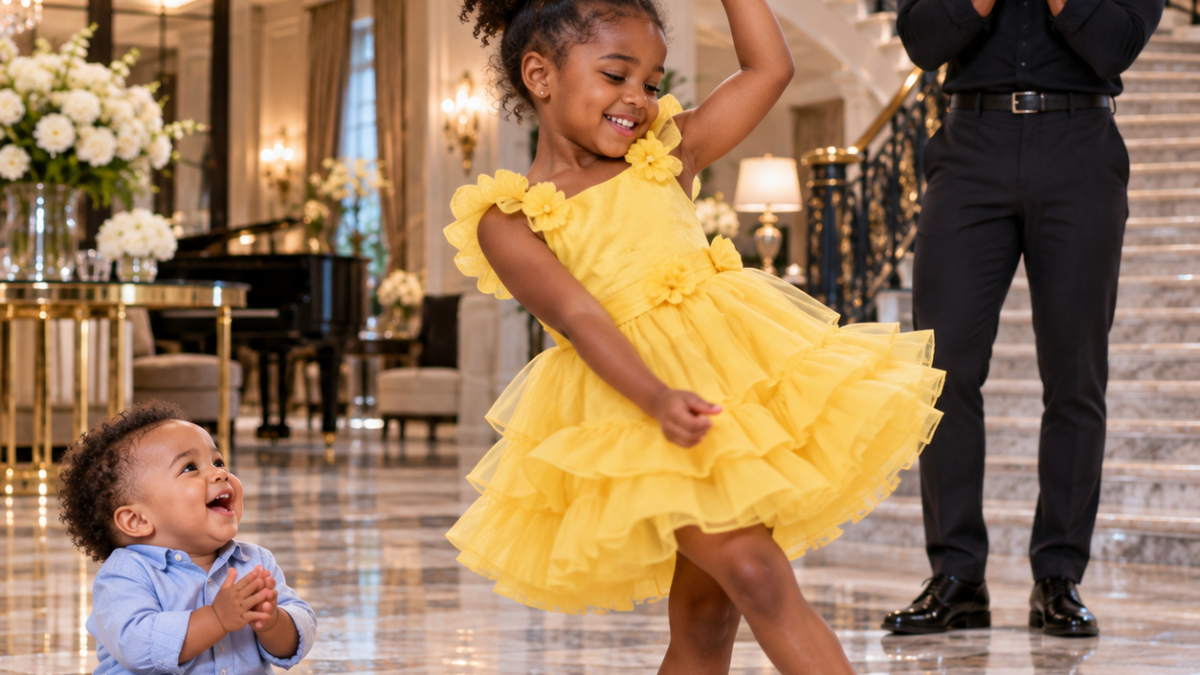
The Billionaire Caught His Maid’s Toddler Red-Handed With His Son—But Instead of Getting Angry, He Discovered a Shocking Secret Behind What Happened, and His Next Move Left Everyone Speechless
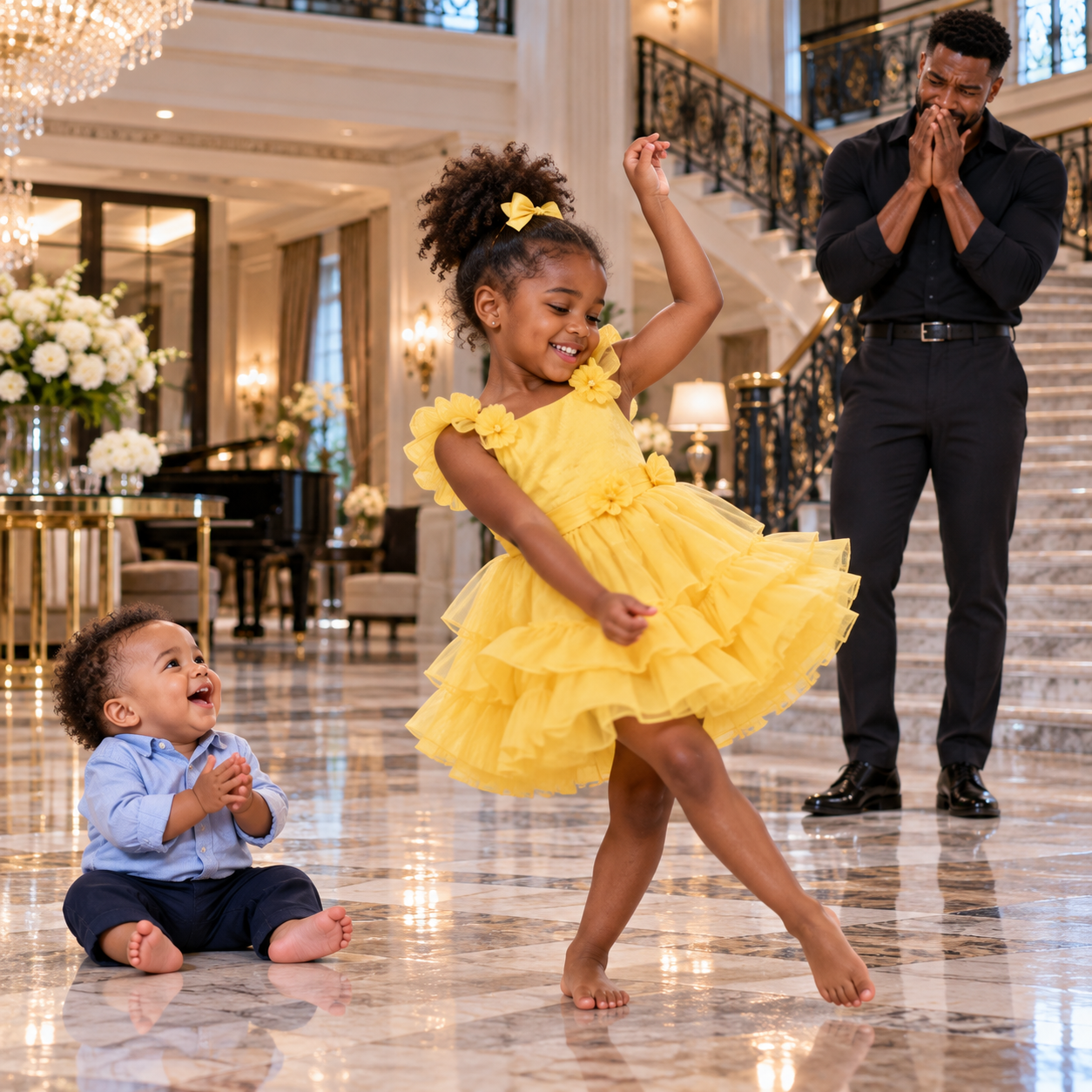
The billionaire caught his maid’s toddler red-handed with his son.
What he did next shocked everyone. The ending changed everything, not the beginning, not the middle, ending.
Because when a billionaire walked through his own front door and caught his housekeeper’s 3-year-old daughter dancing barefoot across his marble floor with his baby son laughing beside her.
He didn’t get angry.
He didn’t say a word for almost a full minute.
He just stood there, frozen, hand over his mouth, because that little girl was dancing to a song only one other person in the world used to dance to. And that person had been gone for 2 years. What happened after that moment would change three lives forever.
Nathaniel Reed had not laughed in 2 years. He would smile for cameras.
He would nod politely in boardrooms.
He would say, “Good morning.”
to his staff in a voice so steady it fooled almost everyone. But laughter, real chest-deep laughter, had left the Reed mansion the same week his wife, Evelyn, did. Their home sat at the top of a hill in Greenwich, Connecticut, the kind of house people slowed their cars down to look at.
Marble floors that caught the morning sun like water, a staircase that curved like a ribbon from the ground floor up to the family wing. Chandeliers imported from Vienna.
To the outside world, it looked like heaven. To Nathaniel, most days it felt like a museum.
Beautiful. Silent.
Full of things no one was allowed to touch. His son Eli was 2 years old now.
He had Evelyn’s eyes.
A soft hazel that seemed to hold more feeling than a 2-year-old should be capable of. Nathaniel loved him fiercely, desperately. In the exhausted, guilty way that grieving parents sometimes love the children who remind them of everything they lost.
He just didn’t always know how to show it.
He worked long hours.
He told himself it was for Eli’s future.
Some nights, lying awake, he wondered if it was really just easier to be anywhere other than home. That was where Rosa came in.
Rosa Delgado had been the Reed family’s housekeeper for almost 3 years.
Hired back when Evelyn was still alive, still humming old jazz standards while she watered the orchids in the sunroom. Rosa had loved Evelyn the way people who work in a home for years come to love the family inside it.
When Evelyn passed, Rosa had stayed, quietly, faithfully, holding the house together while Nathaniel fell apart in slow motion behind his office door. Rosa had a daughter of her own, Sophia, 3 years old with a gap-toothed smile and curls that never stayed in their clips for long.
Sophia’s father had left before she was born, and daycare was expensive.
So, on the days Rosa couldn’t find a sitter, Sophia came to work with her.
Nathaniel had never minded.
In truth, some part of him, a part he never said out loud, liked the sound of a small child’s footsteps somewhere in that too-quiet house.
Eli and Sophia had become something like siblings over the past year. She was gentle with him in the way older children sometimes are with younger ones, patient, protective, always narrating little stories to him as she played.
Rosa would find them in the sunroom or the library, or curled up in the window seat overlooking the garden, Sophia reading to Eli from books she couldn’t actually read yet, making up the words as she went.
On this particular Tuesday, Nathaniel had a board meeting scheduled to run until 7:00. It was canceled at 4:00.
He almost didn’t go home.
He almost stayed at the office, the way he usually did when he found himself with unexpected free time, because free time meant quiet, and quiet meant thinking, and thinking meant Evelyn. But something, he would later call it instinct, though he never fully believed in such things, made him get in the car.
He didn’t call ahead.
He never did. The house was unusually quiet when he stepped through the front doors just after 5:00. No television, no staff moving through the halls, just the late afternoon light pouring gold across the marble, and somewhere, faint and far off, music.
Not the radio, not a phone.
Um, a real song, one he hadn’t heard played out loud in this house in over 2 years.
He stood absolutely still in the foyer, one hand still resting on the door. He knew that song.
He followed it. Each step down the long hallway felt heavier than the last, like walking underwater, like the house itself was holding its breath along with him.
The music grew louder.
Strings, soft and sweeping, rising and falling in a melody he hadn’t allowed himself to think about in years.
It was Evelyn’s song, Clair de Lune, the piece she used to dance to in the ballroom on quiet Sunday afternoons, back when their marriage was young and the house still felt like it belonged to them and not to their grief.
She had trained as a ballerina before business school changed her path, before board meetings and mergers replaced bars and pointe shoes, but she never fully let it go.
Some nights late, Nathaniel would find her in the ballroom in her socks, arms lifted, turning slow circles across the empty floor, smiling at nothing, lost somewhere he couldn’t quite follow.
He reached the ballroom doorway and stopped. The doors were open. The evening light slanted long and gold across the parquet floor.
And there, in the middle of that enormous, echoing room, was Sophia. Three years old, barefoot, arms lifted the exact way Evelyn used to lift hers.
Soft at the elbow, fingers curved like she was holding something invisible and precious. She turned in small, wobbling circles, her curls swinging out around her.
Her face caught somewhere between total concentration and complete joy. Eli sat cross-legged a few feet away on the floor, clapping his small hands together every time she spun, shrieking with laughter each time she nearly toppled and caught herself.
Nathaniel could not move.
It wasn’t just that a child was dancing in his ballroom.
Children danced. Children spun in circles and fell down and got back up all the time. It was in itself an unremarkable thing.
It was how she moved. The tilt of her chin.
The soft curl of her wrist. The particular way she paused at the height of each turn. Just for a breath, like she was listening for something only she could hear.
It was Evelyn. Down to the smallest detail.
Down to a movement he had watched a thousand times from a doorway just like this one. Feeling like the luckiest man alive. His hand found his mouth without his permission.
His eyes burned. He told himself it was the light. He should have said something.
He should have announced himself, laughed it off, told Sophia she had wonderful moves, the way any normal man walking into his own home might do. Instead, he stood frozen in the doorway for nearly a full minute, watching a three-year-old girl he barely knew move exactly like the woman he had loved and lost.
While his son laughed like he hadn’t heard him laugh in longer than he could remember.
Rosa appeared behind him a moment later, a laundry basket balanced on her hip, and stopped short when she saw him standing there.
“Mr.Reed, I’m so sorry.
I told her not to go in there. She just loves the big room.
She says it’s like a castle.
I’ll get her right now.”
“No.”
His voice came out rougher than he meant it to.
“Don’t, please.
Just let her finish.”
Rosa blinked at him, surprised, and slowly lowered the basket to the floor. Together, silently, the two of them stood in the doorway and watched. The song rose to its final swell.
Sophia lifted onto her toes, as much as a three-year-old could manage, arms stretched wide, face tilted up toward the chandelier like she was catching starlight. And then the music ended, and she dropped her arms and giggled and ran to flop down beside Eli, completely unaware that she had just cracked something open in a man she barely knew. Nathaniel realized his hands were shaking.
“Rosa,” he said quietly, still staring at the empty spot on the floor where Sophia had been dancing.
“Where did she learn to move like that?”
Rosa hesitated, and in that hesitation, Nathaniel felt something shift.
“That’s actually something I’ve been meaning to talk to you about,” she said slowly.
It’s a little bit of a strange story.
They sat in the small kitchen off the pantry, the one Rosa used on her breaks because it was the only room in the house that felt like it belonged to real, ordinary people instead of a magazine spread. Sophia and Eli had wandered off to the playroom, Sophia narrating an elaborate story about dragons to a two-year-old who understood maybe one word in 10 and loved every second of it anyway.
Rosa wrapped her hands around a mug of coffee she hadn’t touched.
“About four months ago,” she said, “I was clearing out some boxes in the storage room off the east wing.
You told me I could donate anything from the old media closet.
Old tapes, DVDs, that kind of thing since nobody uses that equipment anymore.”
Nathaniel nodded slowly.
He remembered giving that instruction in the flattest, most business-like voice he could manage because he hadn’t been able to go through that closet himself.
“There was a box of home videos,” Rosa continued, “unlabeled.
I didn’t know what they were, so before I put them in the donation pile, I checked one just to make sure it wasn’t something private I shouldn’t be giving away.”
Nathaniel’s stomach tightened.
“It was a recording,” Rosa said gently, “of your wife dancing in this house, I think in the same ballroom, actually.
She must have set up a camera to record herself, maybe to review her form, I’m not sure.
But Sophia was with me that day, and she saw it over my shoulder before I could stop her. She looked down at her coffee.
I should have turned it off right away. I know that. But Mr.Reed, I have never seen my daughter go so still and quiet in her whole life.
She just stood there, completely silent, watching this beautiful woman turn and lift her arms like she was made of water. When the video ended, Sophia asked me to play it again and again. She started copying the movements right there in the storage room.
This tiny 3-year-old trying to hold her arms just so, trying to point her toes.
Rosa’s eyes were wet now, too.
“I didn’t know how to tell you.
I didn’t know if it would upset you knowing Sophia had found those videos or if you’d think it was strange that she’d become a little bit obsessed.”
She’s watched that same recording probably 200 times since then.
I finally let her keep the tape in the playroom because taking it away made her cry harder than I’ve ever seen her cry over anything.
Nathaniel sat very still absorbing this. Somewhere in his home, hidden in a box he had never allowed himself to open, was a recording of his wife dancing.
Something he hadn’t even known existed.
And a 3-year-old girl, a child with no formal training, no teacher, nothing but pure instinct and 200 replays of a grainy home video, had taught herself to move with more grace and feeling than most adult dancers achieve after years of lessons.
“Does she know?”
Nathaniel asked slowly.
“Who the woman in the video is?”
Rosa shook her head.
“I never told her.
I didn’t think it was my place.
I just told her it was a video of someone who used to live here.
Someone who loved to dance very much.”
Nathaniel let out a long, unsteady breath.
“She loved it more than almost anything in the world,” he said quietly.
It was the first time he had spoken about Evelyn’s dancing out loud, unprompted, in 2 years.
She used to say that when she danced, it was the only time her whole body stopped thinking and just felt.”
Rosa didn’t say anything.
She simply let the silence sit the way people do when they understand that a silence is doing important work.
“I have to see the video.”
Nathaniel finally said. Rosa nodded and rose to get it.
He did not know it yet.
Sitting in that small kitchen with his hands wrapped around a coffee mug he hadn’t touched either.
But this was the moment, not the ballroom, not the dancing itself. This quiet kitchen conversation was the exact hinge point where everything about the next year of his life would turn. The video was 11 minutes long.
Nathaniel watched it alone that night after Rosa and Sophia had gone home, after Eli was asleep, after the house had returned to its familiar echoing silence. He sat on the floor of the media room with his back against the couch, knees pulled up like a boy half his age, and pressed play. There she was, Evelyn 28 years old in the footage, hair pulled back in a simple twist, wearing an old gray t-shirt and leggings, clearly not expecting an audience beyond herself.
She had set the camera on the piano and walked to the center of the ballroom. And for 11 minutes, she simply danced. No music was audible on the recording.
She must have had it playing through headphones or simply danced to the melody in her own head. But Nathaniel knew without a doubt exactly which piece it was.
He could feel the rhythm of it in the way she moved. He watched her rise onto her toes, watched the soft deliberate curve of her wrists that Sophia had copied so precisely it had stopped his heart in the doorway that afternoon, watched her spin and pause and catch her breath, and laugh quietly at herself when she stumbled and start again. Near the end of the recording, she stopped, breathing hard, and looked directly into the camera with a smile so alive it nearly broke him in half.
“If anyone ever finds this,” she said, half laughing, clearly not expecting anyone would for a very long time.
“I just want you to know this is the happiest I ever feel, right here.
Moving like this.
I hope whoever’s watching gets to feel something like this, too, someday.”
The recording ended. Nathaniel sat on the floor of that room and cried for the first time in longer than he could remember. Not the tight, controlled tears he sometimes allowed himself late at night, but something looser, older, something that had clearly been waiting 2 years for permission to come out.
Because somehow, impossibly, his wife’s final message, spoken to no one, meant for anyone, had found its way to a 3-year-old girl who had never met her.
A little girl who had watched those 11 minutes over and over. Not because she understood loss or legacy or any of the things adults attach to moments like this, but simply because something beautiful had moved her, and she wanted to feel that beautiful thing, too.
“I hope whoever’s watching gets to feel something like this, too, someday.”
Sophia had felt it. And in feeling it, without meaning to, without any way of knowing what she was doing, she had cracked open a door in Nathaniel Reed that grief had sealed shut for 2 years.
He didn’t sleep much that night.
He sat for a long time in Eli’s doorway, watching his son sleep, thinking about all the evenings he had come home late, all the mornings he had left before Eli woke, all the small, ordinary moments of fatherhood he had quietly been avoiding
because they hurt too much without Evelyn there to share them.
By morning, he had made a decision.
He didn’t fully understand yet where it would lead.
He only knew that something in him, something that had been frozen solid for 2 years, had finally, finally started to thaw, and he was not going to let it freeze back over.
The The didn’t happen all at once.
Grief doesn’t work that way, and neither does healing.
But it started quietly the very next morning. Nathaniel came down to breakfast before his usual departure time, still in his shirt sleeves, no tie yet, and found Eli in his high chair flinging Cheerios onto the floor with a focused determination only a toddler can bring to chaos.
Rosa startled slightly to see him there. He was rarely home for breakfast. Mind if I join him?
Nathaniel asked, gesturing at the chair beside Eli. Rosa blinked. Of Of course, Mr.Reed.
He sat. He picked up a stray Cheerio from the tray, and feeling somewhat foolish, balanced it on his nose the way he vaguely remembered his own father doing decades ago.
Eli’s whole face lit up.
He laughed, that same real, unguarded laugh Nathaniel had heard drifting down the hallway the day before, and tried clumsily to copy the trick, smashing a Cheerio into his own cheek instead. It was such a small moment. Objectively, nothing about it mattered.
And yet, Nathaniel felt something in his chest loosen that hadn’t loosened in 2 years.
He was 15 minutes late to the office that morning. He did not care. Over the following weeks, small things shifted.
He started coming home earlier. Not every day, his company still needed him, but two, sometimes three evenings a week, he was back before dinner.
He learned Eli’s favorite book, a battered picture book about a bear who couldn’t sleep, and started reading it to him at night, doing the voices badly, making Eli shriek with laughter at the terrible bear impression.
And more than once, he found himself lingering in the ballroom doorway in the late afternoon, watching Sophia teach herself new movements from the old video. Eli clapping along beside her like her own personal adoring audience.
He never told Sophia who the woman in the video was. Not yet.
It didn’t feel like the right moment and some quiet protective instinct told him the timing mattered.
That a truth like that needed to be handled carefully, not dropped on a three-year-old on an ordinary Tuesday. But he started watching her more closely, really watching.
And what he saw astonished him.
She wasn’t just copying movements.
Within a few weeks, she was extending them, reaching for shapes that weren’t in the original recording, experimenting, falling, laughing, getting back up and trying again with a total fearlessness only very young children seem to possess.
There was an instinct there that no amount of instruction could manufacture. He had sat through enough shareholder meetings about innate versus trained talent in various business contexts to recognize, even as a layperson, when something in front of him was simply extraordinary. One evening, he mentioned it to Rosa as she was preparing to leave for the day.
Has Sophia ever had any actual dance training? Classes, anything like that?
Rosa laughed softly, though there was something tired underneath it. Mr.Reed, dance classes around here started $200 a month, sometimes more, plus shoes, plus recital costumes. costumes.
I clean houses for a living.
It’s just not something that’s ever been possible for us.
Nathaniel nodded slowly, filing the information away.
Though he didn’t say anything more that night.
But that weekend, for the first time in two years, he drove, alone without telling anyone, to a small building on the edge of town he hadn’t visited since Evelyn’s funeral reception.
The Whitfield School of Ballet.
Evelyn’s teacher for 15 years, from the time she was 8 years old until she left for business school, had run that studio her whole career.
Her name was Marguerite Whitfield, and she was 71 years old, and she remembered Evelyn Reed the moment Nathaniel said her name.
Marguerite’s studio smelled the way Nathaniel imagined all good dance studios must smell, like rosin and old wood and effort.
Mirrors lined one entire wall, worn smooth at the bar from decades of hands. She led him into her small office and made tea neither of them drank, and listened without interrupting as he tried, clumsily, to explain why he had come. When he finished, she was quiet for a long moment.
“Evelyn had that same quality,” she finally said, “the kind you cannot teach.
I had students who trained harder, who had better bodies for it, technically speaking, but your wife had something underneath the technique. Feeling.
It came from somewhere I never fully understood, and I taught for 40 years.”
She studied him.
“You’re telling me a 3-year-old with no training taught herself to move like that from 11 minutes of footage?”
“I know how it sounds.
It sounds,” Marguerite said slowly, “like exactly the kind of thing I would need to see for myself before I believed it.”
He arranged it for the following Saturday. Rosa was hesitant, deeply hesitant, actually, in a way that surprised Nathaniel until she explained it.
“I don’t want this to feel like charity, Mr.Reed,” she said carefully, sitting across from him in his study, her hands twisted together in her lap.
“I appreciate everything you’re offering, I do, but I’ve spent Sophia’s whole life making sure she understands that we may not have much, but we take care of ourselves.
I don’t want her growing up thinking things get handed to her because someone felt sorry for us.
Nathaniel understood the pride in that statement more than she probably realized. It was the same instinct that had made him refuse casserole after casserole from well-meaning neighbors after Evelyn died, insisting he and Eli were fine when they very much were not.
“It isn’t charity,” he said carefully.
“I watched your daughter dance to a recording of my late wife and cry for the first time in 2 years, Rosa.
If anything, I’m the one who owes something here.
Let me put it this way.
I’m not offering to fund lessons because I feel sorry for Sophia.
I’m offering because I think it would be a genuine waste, the kind you don’t get to undo later, if that girl never gets the chance to find out what she’s capable of.
” Rosa studied him for a long moment, and something in her posture softened, just slightly.
“Just lessons,” she said finally.
“Nothing more elaborate than that.
And I decide when she’s ready for anything beyond that.”
“Agreed.”
“Agreed.”
Sophia’s first lesson with Marguerite Whitfield took place on a rainy Saturday morning in October.
Nathaniel came, uninvited by anyone but himself, and sat quietly in the back row of folding chairs along the studio wall, Eli on his lap chewing on a teething ring.
He watched Marguerite kneel down to Sophia’s height and ask her, gently, to show her anything she knew.
Sophia, without a trace of shyness, walked to the center of the studio floor, lifted her arms exactly the way she had a thousand times in that ballroom, and began to move.
Marguerite did not say a word for the entire 2 minutes it took Sophia to run through everything she’d taught herself.
When Sophia finished, breathless and grinning, Marguerite simply looked over Sophia’s head at Nathaniel, and her eyes were shining.
“Mr.Reed,” she said quietly, “I would like to work with this child for free.”
Rosa refused the free lessons gently but firmly. She agreed to let Nathaniel cover the cost on a condition that it be treated as an ordinary arrangement, invoiced and paid like any other expense. Nothing that would make Sophia feel like a project or a charity case.
Nathaniel respected that boundary completely, and in truth, admired her for insisting on it. What followed was, by any measure, the busiest and most joyful season the Reed household had experienced in years.
Sophia went to the Whitfield studio twice a week after that, and within a month, Marguerite moved her up to 3 days. She was, by every account, unlike any student the older woman had trained in decades.
Not simply talented, but hungry for it in the pure, uncomplicated way only very young children can be hungry for something they love without yet understanding what it might cost them. Nathaniel found himself rearranging his schedule around recital rehearsals without ever quite deciding to.
He learned the difference between a plié and a tendu badly and with great enthusiasm, mostly so he could ask Sophia intelligent questions about her lessons on the drive home. Questions she answered with the total seriousness of a tiny, opinionated professional. One evening, several months into this new rhythm, he brought something down from the media closet he had avoided for 2 years.
A small wooden box, worn soft at the edges.
Evelyn’s first pair of pointe shoes.
Ribbons frayed with age. Satin gone the color of old ivory. She had kept them her whole adult life, tucked away.
A relic of the version of herself she’d set aside for boardrooms and mergers.
He gave them to Sophia on a Tuesday afternoon, kneeling down in the foyer to her height, the way Marguerite had done on that first rainy Saturday.
“These belonged to someone very special to me.”
he told her carefully.
“A long time ago, she loved dancing more than almost anything.
I think she’d be very happy to know they finally got to belong to someone who loves it just as much as she did.”
Sophia held the small shoes with the exaggerated gentleness of a child who understood, on some instinctive level, that she was holding something important, even if she couldn’t have explained exactly why.
“Who was she?”
Sophia asked. Nathaniel felt his throat tighten.
Rosa, standing nearby, went very still.
“Her name was Evelyn.”
he said quietly.
“She was Eli’s mommy, and mine, too, in a way.
She was my wife.”
Sophia considered this with the grave seriousness three-year-olds sometimes bring to enormous questions.
“Is that why you cried when I danced?”
“Yes.
” Nathaniel said, his voice barely holding steady.
“That’s exactly why.”
Sophia was quiet for a moment, turning the small shoes over in her hands. Then she looked up at him with a kind of clear, uncomplicated certainty only a child could offer.
“I’ll dance for her every time, then.”
she said simply.
“So she doesn’t feel far away.”
Nathaniel had to turn away for a moment, blinking hard. And Rosa reached out without a word and rested a hand gently on his shoulder.
Spring brought Marguerite’s annual studio recital, held each year in a modest community theater downtown.
Nothing like the grand venues Nathaniel was accustomed to for his business galas, but to the dozens of small families filing into those creaking seats, it was the most important stage in the world. Sophia had been given a solo. Marguerite had never given a first-year student, let alone a 4-year-old.
Sophia had had a birthday in the spring, a solo before.
It was 2 minutes long, set at Marguerite’s quiet suggestion and Nathaniel’s tearful approval, to Clair de Lune.
The weeks leading up to the recital were not without their struggles.
There was an afternoon in April when Sophia, exhausted and overwhelmed, dissolved into tears in the middle of rehearsal, insisting she couldn’t remember the steps, that she wasn’t good enough, that everyone would laugh at her.
Rosa knelt beside her daughter on the studio floor while Nathaniel and Eli watched from the doorway, Eli’s small hand gripping his father’s finger.
“You don’t have to be perfect,” Rosa told her softly, wiping Sophia’s tears with her thumb.
“You just have to dance like you did in the ballroom when you thought nobody was watching.
Remember how that felt.”
Sophia sniffled and nodded.
“That’s all anyone wants to see,” Rosa said.
“Not perfect, just real.”
On the night of the recital, the little theater was packed. Nathaniel sat in the third row between Rosa and Eli, who was perched on his lap in a small bow tie he had insisted on wearing, utterly unprompted, because he had watched his father put on a tie that morning and demanded one of his own.
When Sophia’s name was called, Nathaniel felt Rosa’s hand find his on the armrest between them, gripping tight.
Sophia walked out to the center of the stage in a simple pale blue costume, Evelyn’s old ribbons, carefully re-stitched by Marguerite, tied at her ankles.
For one long moment, she stood completely still under the lights, and Nathaniel’s heart seized with fear that frozen, that the tears from that difficult April afternoon had won after all.
Then the first notes of Claire de Lune drifted out into the theater, and Sophia began to move. It was as if two years of grief and four months of quiet healing distilled themselves into two minutes on a small community theater stage.
She danced the way her instinct had taught her, the way Marguerite had gently refined, the way Evelyn had once danced alone in an empty ballroom for no audience, but a camera she’d forgotten was recording.
There was no fear in it, no performance, exactly, just feeling offered up entirely, the way only a child who has not yet learned to be afraid of being truly seen can offer it.
Nathaniel did not realize he was crying until Eli, still on his lap, reached up with one small hand and patted his father’s wet cheek with a confused, tender concern only a two-year-old can offer.
“Daddy sad.”
Eli whispered.
“Nobody.”
Nathaniel managed, his voice cracking.
“Daddy’s happy.
Daddy’s really, really happy.”
The applause, when it came, was thunderous, far louder and longer than a small-town dance recital typically earns, but nobody in that theater seemed to care about decorum in that moment. Sophia stood at the center of the stage, chest heaving, eyes wide with the particular shock of a child who has just discovered, for the first time in her life, what it feels like to move an entire room of strangers to tears.
Backstage afterward, she ran straight into her mother’s arms, and Rosa lifted her clean off the ground, laughing and crying at the same time, spinning her in a small circle the way you spin someone you love when words simply aren’t enough.
“Did I do good, Mama?
Did I do good?”
“Baby.
” Rosa said, pressing her forehead to her daughter’s.
“You did more than good.
You did something I don’t even have the words for.
Marguerite found them a few minutes later, her own eyes still bright.
She knelt down in front of Sophia, taking both of the little girl’s hands in hers.
“I have taught dance for 43 years,” she said.
“And in all that time, I have seen maybe two students with what you have.
I would like to talk to your mother about something called a full scholarship.
Every year, every level, for as long as you want it, at the best training program I know.”
Sophia, 4 years old and utterly unconcerned with the magnitude of what was being offered, looked up with wide eyes.
“Does that mean I get to keep dancing forever?”
“Yes, sweetheart,” Marguerite said, laughing through her tears.
“That’s exactly what it means.”
Nathaniel stood a little apart from the celebration, watching Eli’s hand tucked in his.
He thought about the 11-minute video sitting in a box he had once been too afraid to open.
He thought about Evelyn’s voice, laughing unguarded, saying words she never expected anyone to hear.
“I hope whoever’s watching gets to feel something like this, too, someday.”
He hadn’t understood that night on the floor of the media room what those words would come to mean.
He understood now. Rosa caught his eye across the small, crowded backstage hallway, and for a moment, neither of them said anything. There was so much in that look, gratitude and grief that had softened into something gentler, and the quiet, growing understanding that their two small families had somehow, without either of them fully planning it, become something bigger than the sum of their separate parts.
“Thank you,” Rosa said quietly, coming to stand beside him.
“For all of it.
For seeing something in her that I always knew was there, but never thought we could afford to find out.
“Thank her,” Nathaniel said, watching Sophia twirl in a circle for Eli, who clapped and shrieked with the same delight he always did.
“She’s the one who found her way into a room I’d locked myself out of for 2 years.
” A year later, the ballroom at the top of the hill in Greenwich no longer echoed with silence.
Sophia, now five, still danced there most weekends, though her formal training had moved to a serious studio 40 minutes away.
Three afternoons a week, Marguerite’s scholarship carrying her further each season.
Eli, three now and utterly devoted to his self-appointed big sister, had taken to stomping along beside her in his own uncoordinated, joyful version of dancing, and neither Sophia nor anyone else had the heart to correct his form. Nathaniel
still worked hard.
That part of him hadn’t disappeared, and it didn’t need to, but he was home for dinner most nights now.
He had learned all the voices in Eli’s bear book.
He had learned to braid badly the front section of Sophia’s hair when Rosa’s hands were full elsewhere, a skill he’d picked up with the same stubborn determination he once brought to hostile takeovers, except this time the stakes felt somehow so much higher.
He and Rosa had never rushed anything. There had been no dramatic declaration, no single defining moment, just two people who had slowly, carefully, over the better part of a year, built something out of shared mornings and shared grief and shared joy, something neither of them had been looking for, and both of them quietly had come to treasure.
On the anniversary of that first afternoon, the day Nathaniel had walked through his front door and found a three-year-old dancing his late wife’s dance in an empty ballroom, he sat once more in the doorway, watching Sophia teach Eli a new step, her patience endless, her laughter easy and unguarded.
He thought about grief and how strange and unpredictable its exits can be. He thought about how he had spent two years believing that healing meant forgetting, that moving forward meant leaving Evelyn behind in some sealed, untouched room of his memory.
He understood now that he had been wrong.
Healing hadn’t asked him to forget her.
It had simply asked him to let her keep living ways in unexpected places, in a child’s borrowed grace, in a pair of old point shoes finally worn again, in a song that once again filled an empty ballroom instead of an empty silence.
“I hope whoever’s watching gets to feel something like this too someday.”
Evelyn had said, not knowing who would ever hear it. Somebody had.
And in feeling it, she had given an entire broken family a way back to each other.
If there’s one thing I hope you take from tonight’s story, it’s this.
Sometimes the people who save us are the ones we’d never expect.
Sometimes healing doesn’t come from moving on, but from finally letting someone new step gently into the space grief left behind.
Never underestimate the small, quiet moments in your own life. You never know which one might be the one that changes everything.
THE END.

