The Navy SEAL’s Toddler Whispered, “Don’t Drink That, Ma’am” — She Froze, Set the Glass Down, and What Happened Next Stunned Everyone…
Ava stopped there every morning. Same booth by the window, same coffee, 20 minutes before a 12-hour shift and the only 20 minutes of the day that belonged to her. That Tuesday, there were four men at the counter who had not been there before.
Leather patches loud in the way men get loud when they have decided a room belongs to them. Ava did what she always did, which was nothing at all.
She kept her eyes on her phone and waited for her cup. It came.
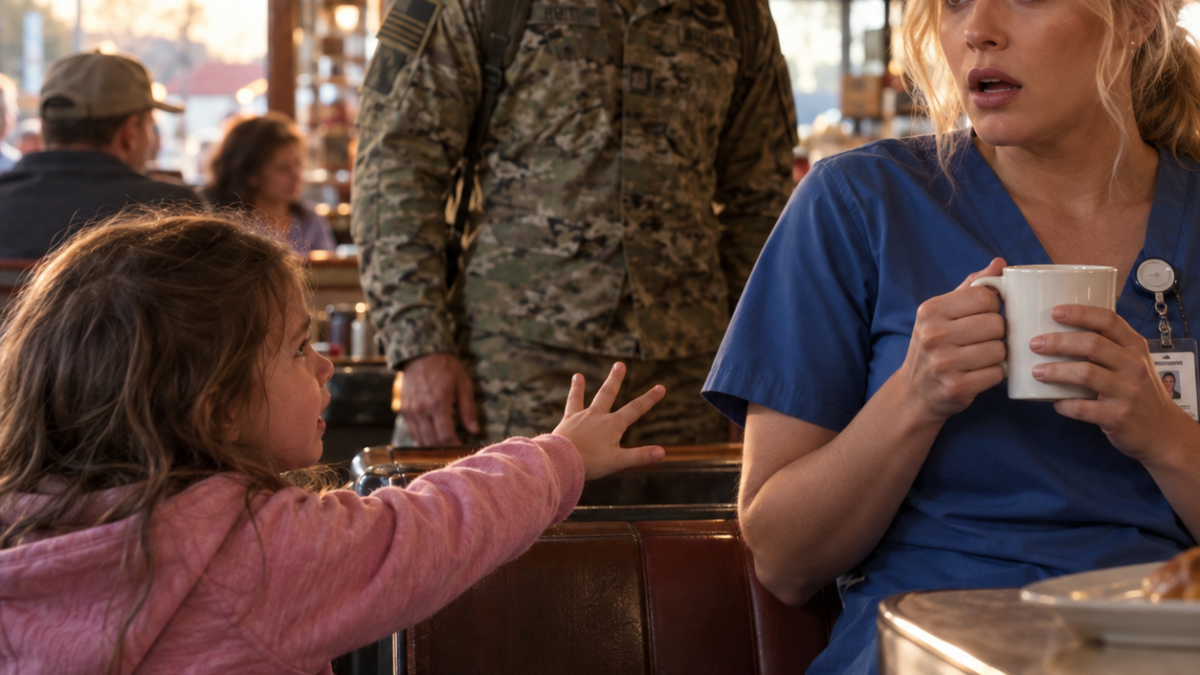
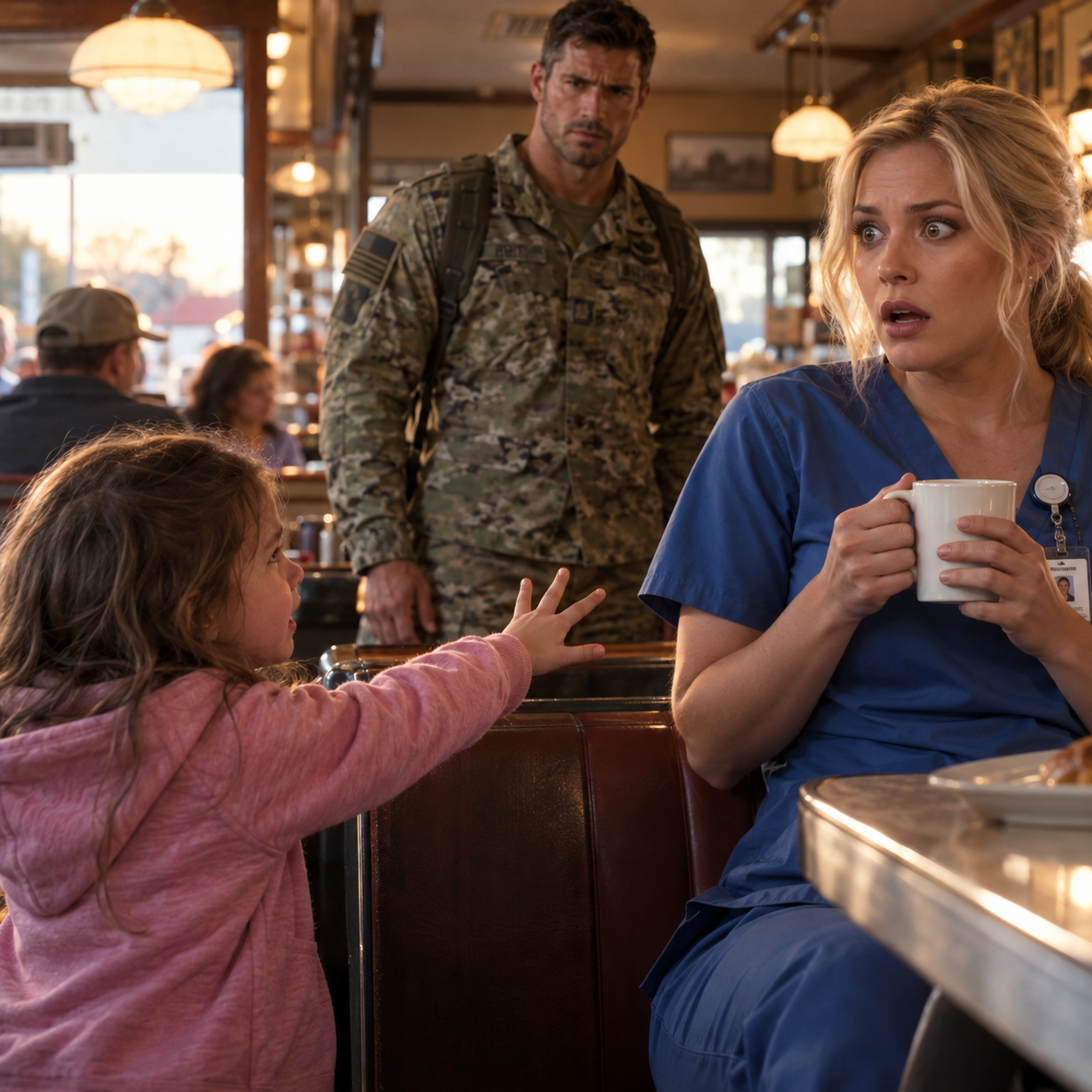
She thanked the waitress. She reached for it and a little girl appeared at the end of her table. 3 years old, blonde.
She had come from the booth behind, and she was not looking at Ava’s face.
She was looking at the cup.
Don’t drink that, ma’am.
Ava had already taken half a sip. She set it down very slowly and asked the child why.
And the little girl leaned in close, the way children do when they think a thing is a secret, and said the one sentence that changed everything about that morning. The bad men put something in it.
12 boos along the window wall, a counter with 11 stools, a pass through to a kitchen where the same two men had been cooking since before the current owner bought the place. It opened at 5 for the trucks. By 6 there would be eight or nine people in it and by half 7 it would be empty again and that hour and a half was the whole business of the day.
Ava came in at 10 6 most mornings. Same booth third from the door, the one by the window with a view of the parking lot and the road beyond it.
Same order which the waitress had stopped writing down 11 months ago.
She would sit there for 20 minutes with a coffee and her phone face down on the table and she would not talk to anybody and then she would drive the 20 minutes to St.Brennan’s and work 12 hours on a medical floor and drive home and do it again.
Those 20 minutes were the only part of the day that belonged to her. She had built her whole life around a very small amount of territory, and she defended it quietly and completely, and nobody who saw her sitting in that booth had the first idea that she had ever been anything other than a tired nurse who
liked the window seat. There were four men at the counter that Tuesday who had not been there before.
She clocked them on the way in, the way she clocked everything, which was a habit from a different life that she had never managed to switch off. leather jackets over hooded sweatshirts, patches across the back of two of them, the specific loud volume of men who have decided a room belongs to them and are waiting to see if anybody disagrees.
Four motorcycles outside at an angle across three parking spaces, not locals. She knew most of the regulars by sight and none of these passing through probably. Two of them turned around on their stools when she came through the door and looked at her the entire length of the room and did not stop when she sat down.
Ava did what she always did, which was nothing at all. She did not look up.
She did not adjust anything. She put her phone face down and she looked out the window at the parking lot and she made herself as small and uninteresting as it is possible to make a woman on her own at 6:00 in the morning because she had been doing that in one form or another since she was 19.
If you have ever made yourself smaller in a room because it seemed safer than the alternative, comment the window seat below because Ava had been doing it for years and it had always worked before. There was a family in the booth directly behind her.
She had noticed them, too. A man on his own with a small child, some kind of road trip, a duffel bag on the seat beside him, and the specific dishment of somebody 200 m into a drive, mid-30s, jeans, a plain dark jacket, 3 days unshaven.
He had been reading something on his phone with a coffee going cold in front of him, and he had not looked up once. And the little girl, three years old maybe, had spent the entire 12 minutes since they arrived, standing up on the booth seat, facing backwards with her chin on the back of the bench, watching the room the way children watch a room, which is completely and without any social awareness at all.
Ava’s coffee came at 14 minutes past.
She thanked the waitress. She reached for it, and the little girl was standing at the end of her table.
She had come around the end of the booth on her own, and she was standing there in a pink hooded sweatshirt with her hands at her sides.
And she was not looking at Ava’s face at all.
She was looking at the cup. Her expression was the flat, total seriousness that small children get when something matters to them, the kind that has nothing performed in it.
And she said it clearly enough that the man in the next booth could have heard if he had been listening.
Don’t drink that, ma’am.
Ava had already taken half a sip. She had it in her hand and she had already drunk from it. And there was a half second where her brain did nothing at all with that sentence and then a half second where it did everything with it.
She set the cup down very slowly and very carefully. The way you set down something you have just understood is not what you thought it was. And she got her voice level and she asked the little girl why.
And the child leaned in close. the way children do when they believe a thing is a secret.
With one small hand cupped beside her mouth, the bad men put something in it. Ava did not move for about 2 seconds. That was all it was.
2 seconds of sitting in a booth by a window with a cup in front of her and a three-year-old at the end of the table. And then she turned her head and looked at the counter. All four of them were already looking back.
Not one of them looked away when she met their eyes, which was the part that told her everything. Men who are caught looking at a woman in a diner look away.
It is automatic. It is universal and it happens before thought.
These four looked directly back at her. All four.
And the one nearest the passrough had one arm along the counter and his body turned toward her and he smiled. Ava got very cold and very clear.
And a part of her that she had spent three years keeping folded up and put away came online all at once. And she did the arithmetic in about a second and a half.
Half a sip. She had no idea how much was in the cup or what it was. She was 40 minutes from town, 20 from the hospital, and 9 minutes from nothing.
Her car was in the lot. Her keys were in her bag. There were four of them, two waitresses, a cook who could not see the dining room from the pass, and a man with a child in the booth behind her.
She reached down and put her hand on the little girl’s shoulder very gently, and moved her around to the far side of the table, away from the counter, with the booth between the child and the room.
Behind her, in the next booth, a chair leg scraped on the tile. She heard a phone get set face down on a table.
And then she heard the man who had not looked up once in 12 minutes stand up slowly, unhurried, the way a person stands up when they are not in any particular rush at all. He came past her booth without looking at her, which she registered later as deliberate. A man crossing a diner to deal with something does not want the woman he is dealing with it for to become part of the picture.
Because the moment she becomes part of the picture, there are sides and a reason and something for four men to push back against. So he did not look at her and he did not hurry and he had his coffee in his hand. That was the thing Ava kept coming back to afterward.
He carried the cup with him.
He walked the length of the counter and stopped beside the nearest of them, the one who had smiled, and set the coffee down on the laminate next to that man’s plate.
And then he stood there slightly too close. Close enough that the man had to turn his head rather than his eyes, which is a thing that matters more than most people realize. Nobody in that diner heard what he said.
Ava was 14 ft away and she caught the shape of it and nothing more because he did not raise his voice at any point and did not lean in and did not do a single thing with his hands. He spoke for about 4 seconds, 12 words, maybe fewer.
What she watched was the other man’s face, and the other man’s face did something she had seen perhaps three times in her life.
It was not fear exactly. Fear is loud and it moves. This was a man arriving very suddenly at an accurate assessment of a situation he had misjudged and going completely still while he finished arriving.
He did not answer. He looked at the man standing beside him for about two seconds longer at his face and then at nothing and then he reached for his jacket off the back of the stool. There was no threat in it that anybody could have repeated afterward.
That was the part Ava thought about for weeks. No badge came out, no rank, no unit, no line about who he was. He had simply told four men in flat conversational language what the next 48 hours of their lives were going to consist of and roughly how many phone calls it was going to take him to arrange it.
And he had done it in the voice a person uses to give directions to a gas station. Three of them were through the door in under 90 seconds.
Ava heard the bikes start up in the lot. The fourth one stayed at the counter long enough to pay, counting bills out slowly onto the laminate with his back very straight, which was somehow worse than the other three put together, and then he left too without looking at anybody.
Ward picked his coffee up on the way past and drank some of it. If you have ever watched somebody end a situation without raising their voice one single time, comment 12 words below because four men came into that diner acting like they owned it.
and one man emptied it in under two minutes without ever putting his cup down. By the time he got back to her booth, Ava was in trouble and she knew it, which was in some ways the worst part of the whole morning.
She had 8 years of clinical training and she could feel the exact progression of it happening inside her own body, and there was nothing she could do about any of it. Her hands had gone first, not shaking, heavier, the way your hands feel when you have been asleep on them.
Then her mouth, which would not shape the words quite right when she tried to answer the waitress. Then the light in the diner started doing something soft and wrong at the edges of her vision, and the sound came down like somebody had put a hand over the room, and Ava understood with complete clinical clarity that she had swallowed a sedative, and that she had maybe 4 minutes of being a person left. It was not poison.
She worked that out in the four minutes because that is what her brain did with information even while the rest of her was going. Poison presents differently and she had seen both.
This was a benzoazipene or something extremely like it a large amount of it ground fine enough to go into a cup of black coffee and dissolve before it reached the table. That is not something a man carries by accident. that comes out of a prescription bottle and it gets crushed in advance and it gets carried into a roadside diner at 6:00 in the morning by somebody who has done it before and expects to do it again.
She had taken half a sip. That was the only reason she was still upright at all.
The little girl’s name was Emmy and she said it very clearly when Ava asked, which Ava would not remember either.
The man’s name was Jonah Ward, and he told her that as he got her out of the booth, along with the fact that he was taking her to a hospital and that she should stop trying to get her own keys out of her bag, she argued.
She was fairly sure, she argued. She remembered the parking lot in pieces, the cold, the gravel, the sound of the diner door on its closer behind them, and then she remembered being carried, which she had not been since she was a child, and being extremely embarrassed about it in a distant floating way that was already coming apart.
The truck was a crew cab, and he put her in the front and buckled her himself, and put the child in the back, 12 minutes to St.Brennan’s on the state road, which was where she had been driving anyway.
She was going under for most of it. And somewhere in those 12 minutes, with her hand closed in the front of his jacket, because it was the only solid thing available, Ava said something to him.
She did not remember saying it. She would not remember it for 5 months.
What she would remember later was the shape of a voice answering her and the fact that whatever he said back had been short and that she had let go of his jacket afterward. She came round properly at 20 9 in a bay on the ground floor of a hospital she had worked in for 2 years with a colleague she played cards with on night shifts standing over her looking extremely unlike himself and an IV in the back of her hand.
And the whole thing came back in about 4 seconds, which is when she started thinking about the last time she had told the truth about a controlled substance. Eight years a Navy hospital corman, and seven of them entirely unremarkable in the best way. The last one was at a shore clinic, a good posting, a slow one.
And over about five weeks, Ava had worked out that the numbers in the controlled medication log did not match the numbers in the cabinet, and that they had not matched for some time, and that the person signing most of the discrepancies out was a physician assistant everybody liked. She had checked it four times before she said a word to anybody because she knew exactly what she was holding.
Then she had taken it up her chain and had been told in a room by a man being very reasonable about it that this was being handled internally and that she should consider the matter closed. It was not being handled. She checked again 3 weeks later and it was still happening.
So she went outside the chain. She was right.
That was never in dispute. The physician assistant resigned within the month quietly with a retirement date brought forward 11 years and no charge was ever filed and no record of any of it exists anywhere Ava could point to. And what happened to Ava was that the clinic she had worked at for 14 months became a place where conversations stopped when she walked into rooms and she was transferred in March and transferred again in June.
And neither of those transfers came with a single adverse word attached to it because there was nothing to attach. She was simply moved twice by people who never explained why. And she understood the message perfectly because it was not a subtle one.
She did not reinlist. She went to nursing school.
And in 3 years at St.Brennan<unks, she had never once reported anything to anybody about anything. And she had told herself that was because there had been nothing to report.
The blood work came back at 11:40.
Ava read it herself, sitting up in a bay on the ground floor with a colleague standing awkwardly beside the bed, and it said exactly what she already knew it would say, with a number beside it that made the doctor’s mouth tighten.
And there it was again, a piece of paper in her hands with the truth on it and a decision attached to it. And the last time she had made that decision correctly, it had taken 4 months and two transfer orders to end everything she had. She did not report it.
That is the honest shape of the 4 days that followed, and there is no way to make it look better than it was. The hospital had to file the toxicology result because a hospital is legally obliged to and she could not have stopped that if she had wanted to.
But the statement, the thing that would have turned a number on a lab report into an actual case with a complainant’s name on it, sat unsigned in her bag for 4 days while Ava went to work and came home and told herself she was thinking about it.
What she was actually doing was arithmetic. Four men, none of whom she could describe well enough to pick out of anything. One waitress who had been facing the pass through the entire time.
a three-year-old witness, which is not a witness at all, in any way a lawyer would recognize, and a half swallowed cup of coffee that had gone into a dishwasher at 7 that morning and did not exist anymore. Against that, she had a toxicology result that proved a woman had been sedated and proved absolutely nothing about who had done it.
She ran that in her head about 400 times across four days. And every single time it came out the same way, which was that she would be a woman making an accusation she could not support in a small county about men who had already left. And underneath the arithmetic, where she could not quite look at it, was a shore clinic and a medication log and two transfer orders in 4 months.
Ward called on the second day. He had left his number with the charge nurse and Ava had not expected him to use it. He did not ask whether she had reported it.
He asked how she was sleeping, which was an extremely specific question to ask somebody who had been sedated. And she told him the truth, which was badly.
Then he said one thing about the other matter, that if it were him, he would put it on paper today because paper is the only thing that exists in 6 months. And then he changed the subject entirely and did not come back to it. Not that call or the next one.
That was the thing that got through to her. Not what he said.
The fact that he said it once and then left it completely alone. Like a man who understood that pushing a person toward a decision is a way of taking it away from them. If you have ever had somebody give you their honest opinion once and then genuinely drop it, comment never judge below because Ava had spent three years around people who would not stop telling her what to do.
And one phone call from a man she had known for 6 hours did more than any of them. The statement was still in her bag on the Friday night.
She finished at 11, which was late because a patient in bay 6 had gone off at 10:00 and the handover had run long. And she walked out through the ground floor doors at 11:41 into the covered parking structure across the service road where staff parked because the main lot was for visitors. Level two.
Her car was in the same space it was in every night, 20 m from the stairwell door, under a light that had been flickering since August. there were two of them.
She saw one and understood immediately that there would be two because there is a geometry to that kind of thing. And she had been taught it a long time ago by people who were extremely good at it.
The first was standing near the concrete pillar four spaces down from her car, not hiding, just standing. The second she did not see at all, which told her where he was.
The one she could see said her name. That was the detail that made the whole thing very simple very quickly. Not hey, not anything a man says to a woman in a parking structure at midnight.
Her name, her actual name, first and last, the way you say a name you have looked up. Four days after a diner on a state road 40 minutes away, a woman who had been drugged and had not gone under is a woman who saw faces and four men had spent 4 days working out how much of a problem that was.
What happened next took somewhere between 9 and 14 seconds. And Ava has never been able to narrow it down further than that. She did not run for the car because the car was 20 m away and she would have been reaching for keys with both hands occupied for at least four of those seconds.
She went for the stairwell door which was the wrong direction and which is why it worked. And the second man came off the pillar behind her exactly as she had expected him to and got hold of her bag strap instead of her arm.
and Ava turned into it rather than away because that is what she had been taught in a different life by an instructor who had said the same sentence 11 times in one afternoon. She was not a fighter.
She had never been a fighter. What she was was a corman with 8 years of knowing precisely where a human body stops working.
And she put the heel of her hand into a place on the first man’s throat that she could have found with her eyes closed.
And when the second one came, she did something to the outside of his knee that she had spent four years learning in order to repair. It was not clean and it was not impressive and she was crying by the end of it, which she found out afterward from the footage.
But she got to the fire door and she got it open and the alarm on it went off across three levels of that parking structure at 11:44 at night. Security had her inside 90 seconds. The police had the two men 11 minutes later on the state road because there is exactly one road out of that hospital going east and the whole thing all 14 seconds of it was on four cameras.
That was what changed everything and not in the way Ava expected because when the detective pulled the parking structure footage on the Saturday, she also pulled the incident report attached to Ava’s toxicology result from the Tuesday and then she did the thing that nobody in that county had done in 5 weeks, which was drive out to the Rossier Diner and ask for their footage.
The diner kept 30 days on a hard drive in the back office. Nobody had ever asked for it before.
Detective Marisol Vance sat in that back office for four hours on a Saturday afternoon with a cup of the same coffee and went backwards through five weeks of Tuesday and Thursday mornings. And she found it three more times.
The same two men, the same lean over the service pass while the waitress’s back was turned, the same look over the shoulder first.
Three other mornings, three other cups. Ava had not been the first. She had been the fourth and she was the only one who was sitting near a booth with a three-year-old in it who happened to be standing up on the seat facing the wrong way.
The case stopped being about Ava somewhere around the second week, and she was more relieved about that than she expected to be. There were two other women.
The first was 31 and had woken up in her own car in the diner parking lot at 9 in the morning with 4 hours missing and had told nobody at all because she had convinced herself she had fallen asleep and had spent 5 weeks not quite believing that. Detective Vance found her through a credit card receipt. The conversation took 2 hours and the woman cried for a good deal of it, mostly out of relief that somebody had come to her door with an explanation.
The second was 19. She had reported it in March.
Walked into the county sheriff’s office 11 days after it happened on her own with no lawyer and no parent and no toxicology because 11 days is 9 days too late for toxicology.
And she had told them everything she remembered, which was not much. And she had been told, not unkindly, which is somehow worse, that there was nothing to go on, no physical evidence, no witness, no description beyond leather jackets and a patch she could not draw. The file existed, it had been opened, and it had been closed within a fortnight, and it had been sitting in a drawer for 5 months when Marisol Vance went looking for anything else at that address.
Vance drove out to her on a Tuesday evening and told her that there was footage and that there were three other women and that she had been believed the whole time by a system that simply had not had anything to work with. Ava was not in that room and does not know exactly what was said in it.
What she knows is that the girl’s mother called her two weeks later, having got the number from Vance and said one sentence that Ava has never repeated to anybody and has never forgotten.
If you have ever told the truth and been quietly filed away, comment she was believed below because a 19-year-old walked into a building in March and was not believed. And the only reason that changed five months later was a three-year-old standing up on a booth seat facing the wrong way. Four arrests, charges across three counties because the diner was not the only place they had done it.
And the footage was not the only footage once somebody knew what to look for. Ava gave her statement on a Monday and testified in November.
And Emy’s account was taken properly by a child forensic interviewer in a room with soft chairs and it lined up with the diner recording frame for frame.
A three-year-old’s memory is not admissible in the way an adults is.
It did not need to be. It matched the video and the video did not need help.
Ava’s own record came back to her sideways the way these things do.
The case file went in front of a Navy investigator because Jonah Ward was active duty and had been a material witness in a civilian prosecution, which generates paperwork.
and whoever was handling that paperwork pulled Ava’s service record as a matter of routine and found eight years of good conduct.
One medication diversion report filed outside the chain of command 8 years earlier and two transfer orders in a 4-month window with no adverse finding attached to either of them and no explanation attached to either of them. It got looked at properly for the first time. It took 5 months and it was not adversarial because there was nothing to argue about once anybody looked.
She had been right. The diversion had been real.
The physician assistant’s early retirement was a matter of record and the two transfers had been ordered by a command that had never put a single word on paper about why.
The record was amended in the spring.
The amendment stated that the corman’s report had been accurate and appropriately motivated and that no findings supported the subsequent reassignments.
Ava read it at her kitchen table and did not feel triumphant. She felt about 9 years of something set down, which is a different sensation entirely, and took her most of a week to identify.
In April, the Navy offered her a position teaching medication security and reporting protocol at the Corman School, how to document a discrepancy, how to escalate it, and what to do when the chain of command tells you it is being handled internally.
She said yes in about 4 seconds and then took two weeks pretending she was thinking about it and she kept two shifts a week at St.Brennan’s because she had found out that she liked being a nurse.
Ward was stationed 90 minutes north. It built across 5 months in the least dramatic way imaginable.
Phone calls then a Sunday then most Sundays. Emmy decided about Ava somewhere around the third visit.
the way small children decide things without consultation and without any apparent process. There was nothing owed between the two adults. That was the part Ava kept noticing.
He had never once behaved as though she was in his debt for a diner. And when she thanked him properly for it in September, he looked genuinely uncomfortable and said something about having been in the room, which was the whole of his explanation and remained the whole of it. She asked him in October what she had said in the truck.
She had wanted to ask for 5 months and had not because there is a particular kind of dread in not knowing what you said to somebody while you were not yourself. He was in her kitchen when she finally did it and he stopped what he was doing and thought about it for a second and then he told her.
She had been holding on to the front of his jacket and she had said, “Don’t let me fall asleep.”
Ava asked what he had said back and Ward said, “I won’t.”
And then he said the rest of it, which was that she had gone under about 40 seconds later anyway, and that he had stayed in the bay at the hospital until she was awake enough to be rude to a colleague, and that he had understood at the time that it was the only promise he was going to be able to make to her, and he had made it anyway. The kitchen was quiet for a while after that. She kissed him first.
That is a matter of record between the two of them, and he has never once let her forget it. That after five months of both of them being extraordinarily careful with each other, it was Ava who crossed the kitchen. It was not careful.
It had 5 months in it and a diner and a parking structure and a woman who had spent 9 years not letting anybody close enough to owe her anything. and both of them stopped being careful at exactly the same moment.
His hands in her hair and her back against the counter and the whole of it unhurried because there was nobody coming and nothing after it and for once no reason at all to stop. Emmy was asleep upstairs. Neither of them heard a thing all night and Emmy has never mentioned it, so presumably she slept through.
He asked her in February, and he did it at the Rosier diner, third booth from the door, the one by the window at 10 6 on a Tuesday morning, because he had a sense of occasion he spent a great deal of energy pretending not to have. Ava came in for the same coffee she had been ordering for 4 years, and sat down across from a man and a four-year-old who had driven 90 minutes to be in a booth before dawn, and she knew before she had her coat off. He did not make a speech.
He is not a man who makes speeches. He put it on the table beside her cup and left his hand next to it.
And he said that this was where he had first seen her and that he had thought at the time she looked like somebody who had gotten very good at being on her own and that he had been right and that he would very much like her to stop.
Emmy, standing up on the booth seat facing backwards as she had every single time Ava had ever seen her in that diner, said yes on Ava’s behalf before Ava could get a word out.
She was overruled. Ava said it herself out loud in a diner on a state road 40 minutes from anywhere at 12 minutes 6 in the morning. If this one stayed with you, subscribe to Medical Heroes Stories.
There’s more waiting.
THE END.

