“You Took My Umbrella,” He Told the Woman Outside the Hotel—She Said, “Then Come Get It ”
“You Took My Umbrella,” He Told the Woman Outside the Hotel—She Said, “Then Come Get It ”
PART 1
You took my umbrella.
Then come get it.
There’s room.
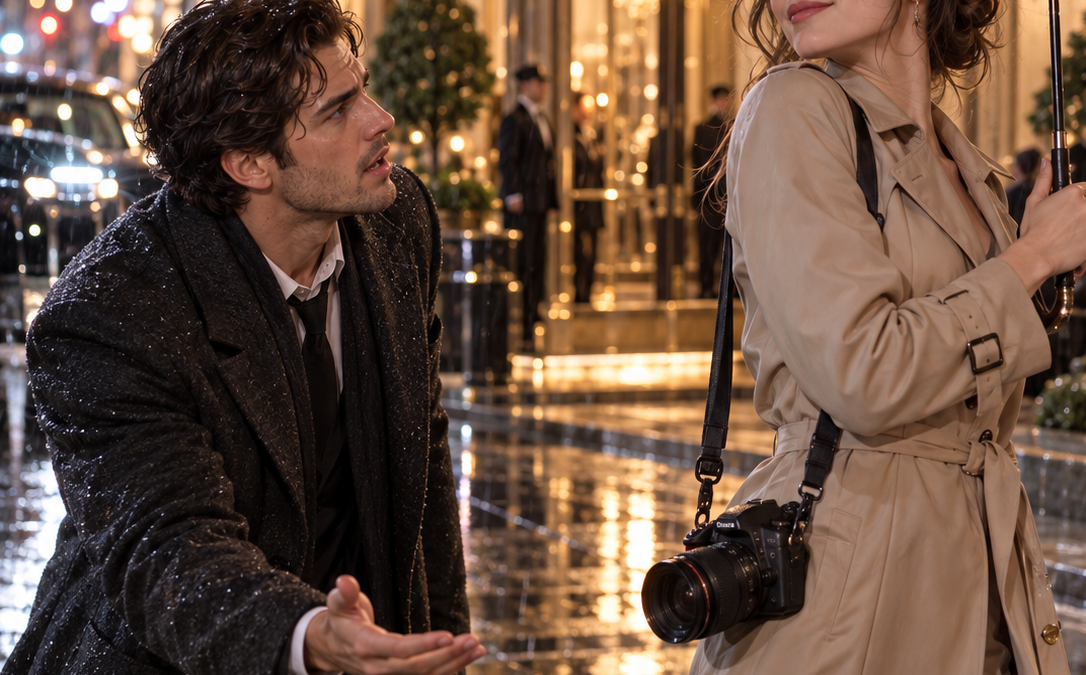
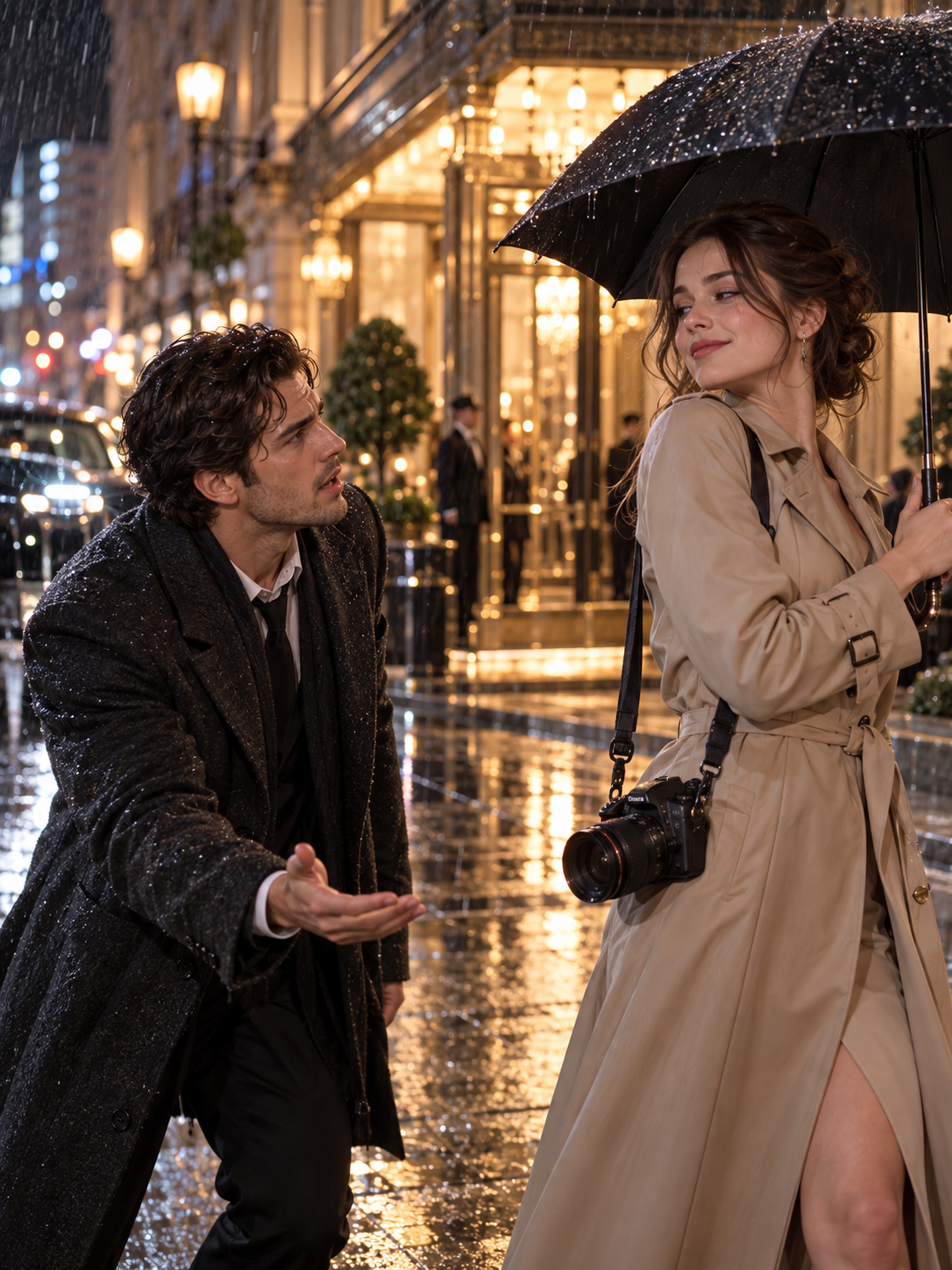
You took my umbrella, Daniel called through the rain. The woman stopped beneath the hotel lights, glanced at the black umbrella in her hand, then back at him, standing soaked on the sidewalk.
Then come get it. He stepped closer, expecting her to hand it over.
Instead, she shifted beneath the canopy and smiled.
“There’s room.”
Daniel hesitated. His phone buzzed again in his pocket. The email he had been avoiding since dinner.
One decision due Monday. The kind that could redraw the next 10 years of his life.
And somehow he stepped under the umbrella. 7 minutes earlier, Lena Brooks had been standing beneath three crystal chandeliers trying to photograph a man who refused to stop blinking. The annual Whitmore Foundation dinner had officially ended at 10:00.
But events never ended when the invitation said they did. They ended when the last donor found his coat, the last executive stopped talking, and the photographer confirmed that every memory card still existed.
Lena checked hers twice. Two cameras, three lenses, extra batteries, backup cards. Then she looked at the time.
10:18. Oh no.
Her train left in 22 minutes. She moved quickly through the ballroom, not carelessly, but with the practiced speed of someone who had packed expensive equipment in crowded rooms hundreds of times. Camera bodies into padded compartments, lenses capped, flash units off, cards separated so one lost bag could not erase an entire night.
At the coat check, a hotel employee handed her raincoat across the counter. Bad out there, he warned.
Lena glanced through the glass doors. Rain swept across the street in silver sheets, turning brake lights into long red streaks on the pavement.
Of course it is. She smiled, slung the camera bag over her shoulder, and reached toward the umbrella stand.
Two black umbrellas leaned side by side. Same curved handle, same plain fabric, same small silver button near the grip. She took the one on the right.
There was nothing dramatic about it. No dropped purse, no distracted collision, just two nearly identical umbrellas and a woman thinking about a train.
Across the lobby, Daniel Mercer was finishing a conversation with one of the firm’s senior partners.
Monday, the man said, tapping Daniel lightly on the shoulder. Think about it, but not too long. Daniel nodded.
I won’t.
His phone was already in his hand when the elevator doors closed behind the partner. The email sat unread at the top of his screen, though he knew every important number inside it.
Salary. title, relocation package, deadline. He locked the phone without opening it.
Daniel liked decisions with enough information. He liked reservations, confirmed times, written terms, and weather forecasts that were accurate to the hour.
His umbrella had been placed in the stand precisely because the forecast had shown an 86% chance of rain after 9. He reached for it. His hand closed around a different handle.
Daniel frowned. The umbrella left behind was smaller with a thin leather strap wrapped twice around the grip, not his.
He looked toward the doors. Outside, a woman with a camera bag was hurrying beneath his umbrella. For one second, Daniel simply stared.
The logical response was obvious. Let her go.
Take the other umbrella. Ask the hotel to sort it out tomorrow.
He picked up the smaller umbrella and stepped through the doors. Cold rain struck his shoulders immediately.
He almost stopped. Daniel Mercer did not run through storms. He waited under awnings.
He checked forecasts. He planned around weather, but the woman was already halfway to the corner. So Daniel ran.
By the time he caught her, his hair was wet, his coat darkened at the shoulders, and the careful order of his evening had been thoroughly ruined. Then she looked at him, realized what she had done, and smiled instead of panicking. That more than the umbrella surprised him.
“I’m sorry,” she said, lifting the handle.
“I thought this was mine.
” Daniel held up the smaller umbrella.
She looked at it, then at his, and laughed. That explains why mine felt expensive.
He should have been annoyed. 5 minutes earlier, he probably would have been instead.
Standing there dripping onto the side sidewalk, he smiled despite himself. When she shifted aside and offered him half the space beneath it, Daniel noticed the transit sign over her shoulder.
“South station?”
he asked.
“Yes,” he looked down the street.
So was he. Apparently getting his umbrella back was going to take longer than expected. Daniel stepped beneath the umbrella, though beneath was generous.
The canopy was wide enough for two people, only if both agreed to become very aware of each other’s shoulders.
Lena adjusted the handle.
You’re taller.
You hold it. He took it automatically.
That was fast, she said. What was you went from chasing me for your umbrella to carrying it for me?
Daniel looked at her. She smiled.
Fishient. They started toward South Station.
The rain had thinned slightly, but the wind pushed it sideways between the buildings.
Daniel angled the umbrella toward Lena’s side, then corrected when water began running down his own sleeve.
She noticed, “You know we can both get a little wet.
I’m aware.
You don’t sound convinced.
A puddle stretched across the next crosswalk. Daniel slowed, calculated the narrowest route around it, and stepped toward the curb.
Lena walked straight through the shallow edge. He stared at her shoes.
They’ll dry.
They’re leather.
They’ve survived weddings.
That doesn’t answer the question.
It answered mine. Daniel glanced at his phone. 10:24.
Then at the transit app, then at the rain radar. Lena watched him perform the sequence.
Are you checking three separate ways to confirm that it’s raining?
I’m checking the train.
You checked the weather. It affects walking time.
She nodded seriously. Of course, the rain has violated the schedule. Daniel looked over.
Her face was perfectly composed for about 2 seconds. Then he laughed.
Not politely. Not the small professional sound he used at dinners when someone told a predictable joke.
It came out before he had time to decide whether the joke deserved it. Lena looked pleased. There he is.
Who? The man underneath the forecast.
He shook his head, but he was still smiling. At the next corner, Lena stopped. Daniel nearly walked past her before realizing she was looking across the street.
A delivery cyclist had paused beneath the yellow light of a bakery awning. Behind him, rain glittered in the headlights of a bus, and for a few seconds, the whole scene looked strangely still. Lena reached for the camera hanging at her side, then stopped herself.
“You’re working?”
“Not everything I notice has to become work.”
She watched another second, then kept walking. Daniel found that more interesting than he expected. So you photograph events mostly corporate dinners, weddings, fundraisers, anything where someone says just make it look natural after spending 6 months planning every chair.
That sounds inefficient. That sounds like finance.
He gave her a sideways look. Daniel Mercer, Lena Brooks.
They shook hands awkwardly beneath the umbrella while walking. What kind of finance?
She asked. corporate advisory.
She nodded. That tracks what does.
You checked the rain probability before leaving the hotel, didn’t you?
86%. Lena laughed.
I knew it. And photographers never plan. She stopped walking long enough to open one pocket of her camera bag.
Three spare batteries. Another pocket.
Two backup cards. A third portable charger.
Lens cloth. Painkillers. Granola bar.
safety pins. Daniel raised an eyebrow. Flexible, Lena said, closing the bag.
Doesn’t mean careless.
That landed more quietly than the joke had. At South Station, the departure board glowed above the crowd. Daniel found his train first.
Track 7, boarding. He glanced at Lena. Yours, 11:02.
Inside the station, Lena stepped out from under the umbrella and pushed wet hair behind one ear. Without the shared canopy, Daniel suddenly noticed how close they had been.
She pointed to the smaller umbrella still hooked over his wrist. That one is mine, by the way. Daniel looked down, then handed it over.
So, we’re even.
Not quite. Yours kept me dry.
Mine? She smiled.
Fine. hours for four blocks through the pouring Boston rain. His was leaving in 4 minutes.
He could make it easily. Daniel looked toward track 7. Then back at the woman who had stolen his umbrella and somehow made four wet blocks feel shorter than the hotel lobby.
The boarding announcement sounded. He stayed where he was. Daniel missed the train.
That alone should have bothered him more than it did. He had missed flights before because of weather, meetings because clients ran late, dinners because markets refused to care about reservations. But Daniel almost never missed something because he had simply chosen not to move.
He stood beside Lena until her train was announced, talking about nothing important, a restaurant she liked near the harbor. A client who once asked her to photoshop 30 years off his face.
The fact that Boston rain always seemed to fall sideways when you were wearing decent clothes. Then Lena left.
Daniel waited another 14 minutes for the next train. 14 minutes was not a crisis. Still sitting by the window with rain sliding across the glass.
He kept thinking about how unusual it felt to have nowhere to blame the delay. He had chosen it.
Daniel Mercer had built most of his life around avoiding exactly that kind of uncertainty. When he was 11, his father had owned a small printing business outside Worcester. It was not glamorous, but it had supported the family well enough and until his father borrowed money to expand.
A larger space, new equipment, more employees. For a while, everyone called it ambitious.
Then two major clients left within the same year. Daniel remembered the changes before he understood the numbers. His mother stopped buying coffee on the way to work.
His father started opening envelopes at the kitchen table after everyone else went to bed. Vacations disappeared, then the second car, then the business. His father never became bitter.
That was almost harder to watch. He took another job, paid what he could, and once told Daniel that sometimes you could make a reasonable choice and still lose.
Daniel heard something different. Reasonable was not enough.
Certain was better. So, he became good at certainty. He studied finance because numbers behaved better than hope.
He chose a respected firm with a clear advancement track. He rented an apartment he could comfortably afford instead of the nicer one overlooking the river.
His emergency fund could cover 10 months. His retirement contributions happened automatically.
His calendar had reminders for things most people trusted themselves to remember.
At 32, nothing in Daniel’s life was technically wrong.
That was the problem. Wrong things demanded action. right things could continue forever.
When he reached his apartment, he placed the wet umbrella in the bathtub, changed his shirt, and finally opened the email he had avoided all evening.
The subject line read, “New New York opportunity confidential.”
Daniel had known the offer was coming. Now it was official.
senior director, New York office, a substantial salary increase, relocation covered, a larger client portfolio, a clearer path toward partnership. His manager had called it the obvious next step.
His colleagues had already begun congratulating him before he had accepted.
Even his mother, when he mentioned the possibility weeks earlier, had said, “That sounds exactly like what you’ve worked for.”
She was right. Everyone was right. Daniel read the offer twice.
Then a third time. Nothing in it surprised him.
The compensation was better than expected. The responsibilities were strong. The firm was stable.
The future attached to the decision was so easy to picture that he could almost see the next decade arranged in clean rows. He moved the cursor toward reply. Stopped.
The deadline was Monday. He had 3 days. Daniel closed the laptop.
For most of his life, he had believed hesitation meant he needed more information. That night, for the first time, he wondered if he already had all the information he needed and simply did not like the answer it was giving him.
The next morning, Lena discovered the umbrella problem at 7:13. She was standing in her kitchen wearing socks, an oversized gray sweater, and the expression of a woman trying to remember why something familiar suddenly looked wrong.
The umbrella leaned beside the door. Black canopy, curved handle, small silver button. Not hers.
Oh. Her own umbrella was cheaper, lighter, and had a strip of brown leather wrapped around the handle because the original strap had broken two winters earlier, which meant Daniel still had hers, and she Lena smiled. Technically, the problem could have been solved in 30 seconds.
The hotel had Daniel’s company information.
Daniel’s firm had contact details online.
she could leave the umbrella at the front desk and send a polite message. Instead, she carried it to the small table beside her camera equipment. Then, she arranged it between two camera bodies, three lenses, a flash unit, and a pile of memory cards.
She took a picture. At the hotel event, Daniel had handed her his business card when the firm needed an invoice copy.
She found it in the side pocket of her camera bag.
At 7:21, Daniel’s phone buzzed.
He was already dressed for work. Of course, he was.
He had made coffee, checked overnight market news, reviewed his calendar, and spent exactly 6 minutes pretending the New York offer was not sitting in his inbox. The message came from a number he did not recognize. Attached was a photograph.
His umbrella sat in the center of what looked like an equipment hostage situation.
The caption read, “Your umbrella is safe for now.”
Daniel stared at the screen. A second message appeared.
“Ransom negotiations begin with coffee.”
He laughed quietly.
Then he typed, “I believe that’s technically theft.”
Three dots appeared almost immediately.
“You chased me through a storm and then voluntarily left the umbrella in my custody.
That sounds like poor asset management.”
Daniel looked at the message longer than necessary.
He wrote, “My industry takes accusations like that seriously.
” Lena replied, “Then I assume you’ll want to inspect the asset personally.
There were several reasonable ways to respond. He could tell her to leave it with hotel reception.
He could send a courier. He could exchange umbrellas at the station without turning it into anything else.
Instead, Daniel opened a map. He searched coffee shops halfway between her neighborhood and his office.
Then he checked ratings, then noise levels, then opening hours, then seating photographs. After 7 minutes, he caught himself comparing two cafes based on how easy it would be to have a conversation at 8:30 in the morning. Daniel leaned back in his chair.
He had once agreed to a date because a woman suggested a restaurant three blocks from his apartment. He had spent less time thinking about that entire evening than he was currently spending choosing coffee with a photographer who had stolen his umbrella. He selected a small place near the public garden.
8:30 tomorrow.
Lena answered, “Deal.
Bring my umbrella or I call the authorities.”
He glanced toward the hallway. Her smaller umbrella stood beside his coat.
Daniel typed, “You mean the one you’ve apparently survived without?”
Her reply came quickly. Emotional damages are accumulating. The next morning, Lena was already sitting near the window when Daniel arrived.
His first thought was that she looked different without a camera around her neck. His second was that he should stop having first thoughts like that.
She lifted his umbrella from the empty chair beside her. The hostage has been fed. Daniel placed hers against the table.
No visible damage. Psychological trauma only. He sat across from her.
Coffee arrived. For a while, they talked easily about the event.
Boston traffic and a wedding Lena was photographing that weekend where the bride had sent six separate emails about candle placement. Daniel found himself relaxing. Then Lena stirred her coffee and looked at him with the same quiet curiosity she had shown under the umbrella.
So she said, “What are you avoiding?”
Daniel’s hand stopped around his cup.
He could not tell whether she meant the email or New York or something she had noticed about him before he had noticed it himself. Daniel looked at her over the rim of his coffee. avoiding.
Lena shrugged. You checked your phone four times before the coffee arrived.
Either someone owes you money or there’s something on that screen you don’t want to answer.
Daniel set the cup down. You notice a lot.
It’s literally my job.
That’s comforting.
It shouldn’t be.
He smiled despite himself. For a moment, he considered giving her the easy answer. Work, busy week, too many emails.
Instead, he said, “I was offered a promotion.”
Lena waited.
“In New York.”
“Congratulations.”
That’s what everyone keeps saying.
Her expression changed slightly.
“Do you not want it?”
Daniel looked toward the window.
“I should.”
That wasn’t the question.
He almost laughed. Most people in his life understood the offer before he finished describing it. Larger accounts, better title, more money, faster path upward.
Lena only waited.
So Daniel explained, “Not all of it.
Not his father, not the years of treating uncertainty like a problem that could be solved with enough discipline.
Just the numbers, the salary increase, the relocation package, the promotion, the reputation of the New York office.”
When he finished, Lena nodded.
“It sounds like a very good offer.
” Daniel had expected something else.
You’re not going to tell me to follow my heart.
No. Take a leap.
No. Life is short.
That one is technically true, but still no. He smiled.
Lena leaned back.
I don’t think taking risks automatically makes someone brave.
Daniel studied her. That surprised him.
Maybe she saw it because she added, “You thought I did?
I thought you were comfortable with uncertainty.”
I am.
That’s different.
Very,” she pointed toward the camera bag beside her chair.
“That bag is insured for more than my car.”
Daniel glanced down. I have separate backups for every paid shoot.
One set travels with me, one goes home, one uploads to cloud storage before I sleep. You mentioned the memory cards. I also keep 6 months of basic expenses in savings.
Daniel raised an eyebrow. My income changes every month, Lena said.
If I didn’t plan, I wouldn’t have freedom.
I’d have panic.
He said nothing.
She continued, “I schedule jobs 3 months out.
I track taxes.
I know exactly how many weddings I need each year before I can afford to take smaller projects I actually care about.”
Daniel looked at her differently now. The woman who walked through puddles did not ignore consequences.
She simply prepared for them.
“I think,” Lena said carefully.
You plan so nothing unexpected can happen and you don’t.
I plan so something unexpected can happen without destroying me. The distinction sat between them.
Daniel had spent years believing caution and responsibility were the same thing. Lena was responsible. She just used responsibility differently.
So she said New York. Daniel nodded.
What happens if you take it? I move.
larger team, better clients, more responsibility. And 5 years later, probably managing director. Do you want that?
It’s a strong position.
She smiled slightly. Still not what I asked.
Daniel looked down at his coffee. Lena did not push. That made answering harder.
Finally, she said, “Forget the title for 10 seconds.
Forget the salary.
Forget what everyone will think when you tell them.”
Daniel looked up.
“If all of that disappeared from the page,” she asked, “would you still want the life that comes with it?”
Daniel opened his mouth. Nothing came out. For years, he had asked whether choices were sensible, profitable, stable, defensible.
He had never asked whether the life on the other side was one he actually wanted. Lena took another sip of coffee.
Safe and right can be the same thing, she said, but they don’t have to be.
Daniel carried that sentence to work with him.
3 weeks later, he heard Lena’s voice before he saw her.
Please don’t move the flowers.
Daniel stopped outside the ballroom. A hotel employee froze with both hands around a large arrangement. Lena crossed the room quickly, camera hanging at her side.
If those go 6 in to the left, the uplight turns everyone behind them blue. The employee looked relieved to have specific instructions, so leave them.
Please, you’ll save me 40 minutes of editing and several innocent people from looking medically concerning.
The man laughed. Daniel did too. Lena turned for half a second.
Surprise crossed her face. Then came the smile. Umbrella man, photographer, what are you doing here?
Daniel glanced around the ballroom. My firm is hosting this. Lena looked toward the company logo projected behind the stage.
Right. That would explain all the people wearing expensive navy suits.
The hotel had recommended her after the Whitmore dinner. Daniel had known there would be a photographer. He had not known it would be her.
And this time seeing her was not an accident caused by two identical umbrellas. For the next hour, Daniel watched her work.
Not because he intended to because she was difficult not to notice. An elderly couple arrived 20 minutes early and looked confused about where to go.
Lena walked them to the registration desk herself. A six-year-old boy refused to stand still for a family photograph. She crouched, showed him how the camera worked, then challenged him to remain serious for 3 seconds.
He failed immediately. She photographed the laugh. The event schedule changed when a speaker arrived late.
Lena rearranged the group photographs without complaining. A ballroom light failed. She moved two lamps, adjusted her camera, and kept going.
Then Martin Hail, one of Daniel’s senior colleagues, approached her.
These photos need to look warmer, he said. Lena looked at the ballroom lighting.
Warmer emotionally or warmer in color. Martin hesitated. More premium.
Daniel almost smiled. Lena did not. Of course, she said calmly.
I’ll adjust the lighting balance.
No sarcasm, no frustration, just adaptation. Daniel began to understand that flexibility was not the absence of control.
Sometimes it was a different kind of control entirely. Near the end of the reception, staff began moving guests toward dinner.
Martin checked his watch. We need everyone seated in 5 minutes.
Across the ballroom, the elderly couple from earlier stood beside Lena.
The woman was fixing her husband’s tie.
“We didn’t get our picture,” she said apologetically.
Lena glanced toward the schedule. Martin stepped closer.
We don’t have time.
They can do it afterward. The woman nodded, embarrassed.
That’s all right.
Lena lowered her camera. She would have accepted the instruction.
Daniel knew it.
It was his company’s event.
Martin outranked her. Dinner was scheduled. Everything about moving forward was reasonable.
Daniel looked at the couple.
The husband had placed one hand lightly at his wife’s back.
They had probably spent longer getting ready for the evening than anyone would ever know. 2 minutes, Daniel said. Martin turned.
What? Give them 2 minutes.
We’re already behind.
Then we’ll be 2 minutes more behind.
Martin looked at him as if waiting for the joke.
There wasn’t one.
Daniel nodded toward Lena. Take the photograph. Lena looked at him only for a second.
Then she raised the camera. The couple stood together beneath the soft ballroom lights. The woman laughed when her husband whispered something into her ear.
Lena caught it. One frame, then another. Perfect, she said.
It took less than a minute. Later, when everyone had moved toward dinner, Daniel passed Lena near the ballroom doors. She was checking the photograph on her screen.
“You know,” she said without looking up.
“The schedule survived.”
Daniel adjusted his cuff barely. Lena smiled. Then she looked at him, not teasing this time.
Something quieter. Daniel walked away before he could decide what it meant.
But for once, he had let something run late, and nothing terrible had happened. The photograph happened in the few seconds after Daniel stopped thinking about being photographed. The elderly couple had thanked him twice for giving them time.
Daniel tried to wave it off, but the husband, a retired high school principal named Arthur, had already begun telling him a story about missing his own wedding pictures because the photographers’s flash had failed in 1978.
Daniel laughed. Not the careful smile he used at client dinners.
Not the polite expression that appeared whenever someone from senior leadership lifted a glass in his direction. A real laugh.
His shoulders dropped. His head turned slightly.
One hand rested in his pocket while Arthur’s wife touched her husband’s arm as if she had heard the story a hundred times and still loved the way he told it.
Lena raised her camera. One click. Daniel never noticed.
20 minutes later, the ballroom had begun to empty. Staff cleared wine glasses from white tablecloths while the final guests collected coats near the doors.
Lena sat at a small side table reviewing the night’s images.
Daniel passed behind her. Any medically concerning blue people?
Only two.
I’m sending them directly to your board.
He smiled. Then she stopped scrolling.
there. Daniel leaned closer. On the screen was the photograph.
For a second, he did not recognize himself. He was turned away from the camera, laughing at Arthur. His tie was slightly loose.
His posture was relaxed. There was no conference room behind him.
No presentation screen. No deliberate angle, no expression chosen because someone important might be watching. Just him.
Daniel frowned.
That’s not very professional.
Lena did not argue. She looked at the image again. No, she said.
Probably not. Daniel glanced at her. You agree?
I think that’s why I like it.
He looked back at the screen. Lena zoomed out enough to keep the whole moment intact. Arthur smiling, his wife watching him.
Daniel caught between them entirely unaware.
You know what’s different?
Lena asked. Daniel expected a joke about his tie.
Instead, she said, “It’s the first picture I’ve taken of you where you’re not preparing for the next moment.”
He went still. The ballroom noise seemed to move farther away.
A server pushed a cart past them. Somewhere near the entrance, someone laughed too loudly. Daniel kept looking at the photograph.
He had spent years learning how to enter rooms correctly, where to stand, when to speak, how long to hold eye contact, what kind of suit looked serious without looking ambitious, how to appear prepared without looking nervous.
The man on Lena’s screen had prepared for none of it, and somehow, Daniel thought, he looked more like himself than most photographs he had ever seen.
You don’t have to use it, Lena said.
for the company, for anything.”
Daniel straightened.
“Good.”
Lena nodded and continued scrolling. She did not tease him.
