“You’re Not Tired, Sir—You’ve Been Drugged,” the Maid’s Little Girl Whispered Calmly—Then the Billionaire CEO Realized Someone Inside His Own Home Wanted Him Dead – PART 2
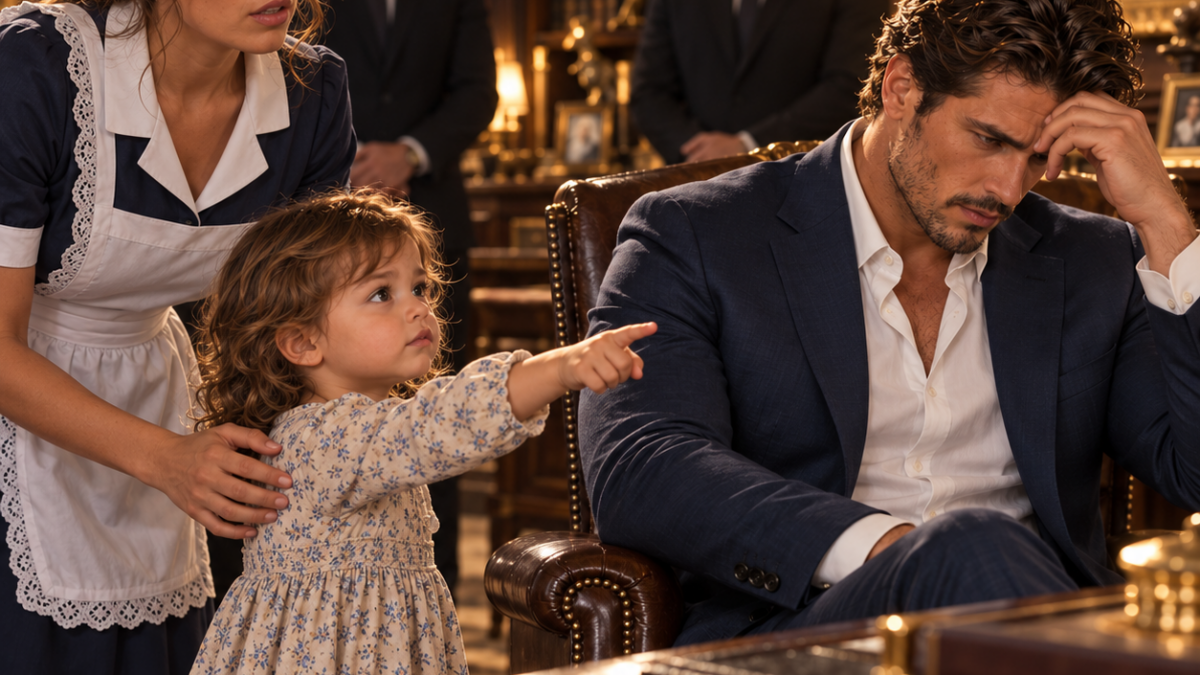
PART 2
Downstairs, Sophia was sitting at the kitchen table while Elena prepared vegetables for dinner. Her notebook remained closed.
Aleandro stopped in the doorway.
You haven’t written anything today.
Sophia looked embarrassed. Nothing happened. Nothing.
Nothing weird. Elena glanced at him, then went back to cutting carrots.
Allesandre walked in. That sounds useful. Sophia shook her head.
The test said I was wrong.
The test said the glass didn’t contain what we tested for.
That’s basically wrong.
Not necessarily.
Mom says I shouldn’t try to make things fit.
Elena immediately looked up.
I said, “Sometimes when we’re worried, we notice the things that agree with us and forget the ones that don’t.”
Alesandro considered that your mother is right.
Sophia’s face fell slightly.
So, I should stop. No, you should notice the things that prove you wrong, too.
She stared at him. He pulled out the chair across from her and sat.
If you believe something, the dangerous part is not finding evidence for it. The dangerous part is deciding every piece of evidence must support it.
Sophia looked toward Elena, perhaps checking whether this was another adult way of telling her she had imagined everything.
“So, what am I supposed to do?”
she asked.
“Write what happens, not what you think it means.”
Sophia slowly pulled the notebook from beneath her workbook. Allesandro noticed a page near the back covered in fractions.
You use this for homework? I ran out of paper. He nodded at the page.
Did you finish? Mostly.
Mostly means no. She turned the book around. One problem had been crossed out repeatedly.
Aleandro read it, took the pencil, and showed her where she had reversed the denominator. Sophia stared at the corrected answer, then at him. You knew that fast.
I did go to school. I thought you had people for math. Elena made a sound that might have been a cough hiding a laugh.
Alessandro handed the pencil back. Finish your homework, he stood, then noticed Sophia had opened the notebook to a page from several weeks earlier. There was an entry about him correcting one of her mathematics problems at the kitchen table.
Nothing remarkable. She had written it because on the same day, she had overheard someone upstairs saying he was too confused to finish a conversation. Alessandro stopped.
“What date is that?”
Sophia read it aloud. He knew the date immediately.
Russo had shown him a medical report from that evening. Dr.Raldi described Alessandro as disoriented, struggling to concentrate, repeatedly losing track of simple questions. Yet, less than 2 hours after the documented examination, Allesandro had sat in this kitchen and walked Sophia through fractions without difficulty.
That did not prove the report false. Symptoms could come and go. Fatigue could improve, but it gave Allesandro a new way to look at the problem.
Not whether Sophia’s notebook proved someone was drugging him.
Whether the official record of his decline matched the life other people had actually witnessed.
Russo returned after dinner when Dr.Raldi’s office finally transmitted what it described as the complete appointment history.
Alessandro and Russo compared it with the medical reports one line at a time. The first inconsistency could be dismissed. The second might be clerical.
The third was harder. A report described an in-person neurological assessment on a Monday for which there was no visit.
No entry at the gate, no physician vehicle on exterior cameras, no call from Raldi’s registered office number, and no appointment in either calendar.
Russo checked again. Maybe he came with someone else.
Then he still had to enter the property. They moved to the next questionable report. Same problem.
Medical notes existed. The corresponding appointment did not.
Another report contained detailed observations about Allesandro<unk’s speech, posture, and orientation on a morning when Alessandro had been outside the state until early afternoon.
Russo sat back slowly.
“That’s not a timestamp error,” Aleandro said nothing.
Someone wrote an examination that couldn’t have happened or documented observations from another time without saying so.
“Yes,” Russo opened the raw file metadata.
The reports had not all been written on the dates printed at the top. Several were created days later, then assigned earlier examination dates. That could still have an innocent explanation if Raldi documented visits late, but two reports referred to meetings that did not exist anywhere else.
Alessandro felt something settle inside him. Not certainty yet, but direction.
The clean glass no longer mattered as much. Maybe Sophia had been wrong about the drink. Maybe the glass was only where her attention had landed because the changes often happened around the same time.
But someone had been constructing a medical history in which Alessandro Moretti appeared more impaired, more confused, and more consistently unstable than the records of his actual movements could support. He turned back to the first disputed report.
Stop asking Raldi for explanations. Russo looked at him.
What do you want instead? Alessandro closed the folder.
Everything. Original appointment logs, drafts, file creation dates, billing records, messages between his office and this house.
No summaries. Russo nodded slowly.
“You think the medical record is the real evidence?”
Allessandre looked toward the kitchen floor below them, where a 9-year-old girl had spent weeks writing down what happened because she did not trust herself to remember it perfectly.
“I think someone else has been writing things down, too.”
The raw records arrived in pieces because no single system inside Dr.Raldi’s practice stored the full history Alisandra wanted.
Appointment schedules came from one server, billing records from another, pharmacy authorizations from a third. Daniel Russo spent most of the morning building a timeline across three screens while Alessandro worked through the original medical reports with a yellow pencil, marking every place where the official version of his decline depended on an event no one could independently verify.
The deeper they went, the less the problem looked like sloppy documentation. One examination had supposedly occurred while Alessandro was in a conference call with attorneys.
Another described his balance and coordination on a morning when gate records showed Raldi never entered the property. A third claimed Alessandro had been unable to remember the month.
Yet an hour later, he had signed a shipping amendment containing handwritten corrections to three dates buried in the appendix. None of these contradictions proved he had been perfectly healthy. They proved something narrower and more disturbing.
Someone had been selecting the moments that made him look weak and arranging them into a clean medical story. Russo leaned back from the screens.
If I showed this to another doctor without context, they’d think you’d been deteriorating steadily.
That’s what concerns me.
Because you weren’t?
Aleandro looked toward the window. I was having episodes.
I still am, but not like this. He tapped the reports. This makes it look continuous.
Russo nodded slowly. Continuous is easier to use. Alisandre looked at him.
Russo did not elaborate. He did not need to. Continuous decline could justify decisions, restrictions, oversight, questions about competence, a scattered collection of strange afternoons could not.
Aleandro closed the folder.
Find every delivery connected to my care, supplements, prescriptions, anything ordered through Raldi’s office or build to the house.
Russo glanced at the stack already covering the desk. That could be dozens. Then start with the dates of the questionable reports.
Before Russo could answer, Marco knocked and entered holding a tablet. We found something on the second floor camera archive. Allesandro stood.
What? Maybe nothing. Maybe not.
The footage itself was ordinary enough to be maddening.
At 2:38 in the afternoon on the day Elena’s old credential had been used, the hallway camera showed an empty corridor.
At 2:39, a maid crossed carrying folded linens.
At 240, the image showed the service door near the stairwell opening briefly, though whoever entered remained mostly outside the camera’s angle.
At 2:41, the screen froze when the picture resumed. 7 minutes had vanished. Marco replayed the sequence.
The system logged a corrupted file. Natural corruption? Aleandro asked.
It happens. How often?
Marco’s mouth tightened.
Not often on this camera. How often?
Twice in the last year. Both under a minute.
Allesandre watched the freeze again. This is seven. Yes.
Russo moved closer to the monitor. Can it be restored?
Maybe partially. The primary file was overwritten during automatic compression, but there are fragments in the buffer.
Aleandro looked at Marco. Do it without using the contractor who manages the system.
Already started. That answer earned the security chief the first approving glance Alessandro had given him in two days.
They listened to the audio track. Next, the camera image failed, but the microphone had recorded several seconds longer.
A faint metallic chime sounded twice before the signal cut. Aleandro recognized it only because Sophia had described it.
The old service bell beside the stairwell. Marco frowned. That means someone came through the side door.
Before the camera stopped, Allesandro said, “Yes, using which credential?”
Marco checked the log.
Elena’s old card registered upstairs at 241.
The service door doesn’t require a card from inside the staff corridor, so whoever came through could already have been in the house,” Russo pointed at the time, or they entered through a route the main system barely tracks.
Marco zoomed the final
intact frame. Near the far edge of a glass fronted cabinet, a distorted reflection appeared, part of a shoulder, one hand, perhaps the outline of a tray. The image was too blurred to identify a face.
Marco enhanced it until the pixels broke into blocks. A metallic flash appeared on one finger.
ring?”
Russo asked.
“Could be,” Marco said.
“Could also be the tray catching light.”
Aleandro leaned closer. He had spent most of his life being told that people saw what they wanted to see. Now he understood the inverse danger.
“Once suspicion entered a room, every blur looked like a confession.
“Save the original before anyone enhances it again,” he said.
“And no one calls that a ring in writing.”
Marco nodded.
“Understood.
We have a missing seven minutes, a service door opening, and an old credential used afterward. That is what we know. He stepped away from the screen.
Nothing more. The restraint irritated Marco, but Allesandro preferred irritation to certainty built on bad evidence.
By late afternoon, Russo had found the first delivery that matched one of the disputed medical dates. A small shipment from a private wellness pharmacy had arrived at the mansion 3 weeks earlier.
The invoice listed vitamins, electrolyte packets, and a compounded sleep aid prescribed through Raldi’s office.
Nothing illegal, nothing inherently suspicious. The recorded delivery time was 4:15.
Allesandre was reviewing the invoice when Sophia appeared at the open office door with Elena behind her. Elena looked apologetic.
She says, “This matters.”
Sophia held her notebook against her chest. Aleandro gestured for them to come in.
“What matters?”
Sophia opened to a page near the middle. The truck came earlier. Russo looked at her.
Which truck? The medicine truck.
Aleandro<unk’s eyes moved to the invoice.
How do you know what time it came? I heard it.
Marco, still near the monitor, glanced toward Aleandro as if to ask whether they were really going to build a case from another sound. Sophia saw the look.
It makes a bad noise when it turns near the gate, like metal scraping. Elena confirmed it reluctantly.
The delivery van from that company has a damaged panel. You can hear it from the kitchen if the windows are open.
What time? Allesandro asked.
Sophia pointed to her note. 350 2. Russo compared it with the invoice.
23 minutes earlier than the delivery record. Maybe the driver wrote the wrong time.
Elena said quickly. That happens.
Aleandro nodded. Yes.
He looked at Sophia. Did you see the driver?
No. Did you see anyone receive the package? No.
Then all we know is that you heard what you think was the truck at 352.
Sophia seemed disappointed by the phrasing, but that’s what happened.
Then that is enough to write down. Alessandro turned to Marco. Gate sensors.
The outer gate recorded vehicle weight and opening time independently from security badges. It took less than 10 minutes to find the relevant entry.
At 351, the gate had opened for a commercial vehicle matching the delivery company’s weight class.
At 3:54, it closed. The official delivery receipt still said 4:15.
Russo looked at Aleandro.
Now we have a timestamp discrepancy that didn’t come from Sophia’s notebook.
We have two clocks disagreeing, Allesandro said. Find out why.
Marco pulled the delivery intake log. The package had been signed for electronically, but the signature field displayed only an employee code rather than a handwritten name.
The code belonged to household administration, not medical staff. Who used that code? Allesandro asked.
Marco checked. Shared terminal. Of course, it is.
Every system that was supposed to create accountability seemed to contain one convenient corner where responsibility dissolved. The next problem was the paper receipt. Elena remembered seeing it beneath the delivery box because the driver had handed over a duplicate slip.
Sophia remembered it, too. More importantly, she had written the exact time beside it in pencil when she heard the truck because the mismatch bothered her.
“Where is it now?”
Russo asked. Sophia looked toward her mother.
Elena thought for a moment. Sophia gave it to me after Mr.Moretti started asking about the deliveries. I put it in the clear envelope with the other papers from the kitchen.
Allesandro turned to Russo. You have that envelope. Russo opened his leather case and removed a transparent evidence sleeve.
The label showed the correct date. The kitchen inventory note was inside.
A photocopy of the delivery invoice was inside. The duplicate receipt was not. Russo frowned.
I sealed this myself. Was it in there when you sealed it? Aleandro asked.
I thought so. Thought?
Russo’s face hardened.
I did not inventory each sheet individually. Elena handed me a stack. I put the stack inside.
Allesandre looked at Elena. Did you watch him?
Nosir. Sophia.
She shook her head. Marco took the envelope and examined the closure. It had not been cut or torn.
The adhesive strip, however, could have been opened carefully and recealed.
Who had access to Russo’s case?
Marco asked. For most of yesterday, me. Russo paused.
My assistant carried it from the car. It was in the conference room during lunch, then in my office. Inside the mansion for several hours.
Aleandro felt the room change. Until that moment, everything they had discovered concerned events that occurred before Sophia stopped him from drinking. Old access cards, old reports, old delivery times.
If the receipt had been removed after the investigation began, then the situation was no longer about reconstructing the past. Someone might be watching what they collected in the present. Nobody accuses anyone, Aleandro said.
We don’t even know the paper was in the envelope.
Sophia opened her notebook quickly. I wrote on it. I know.
I can show you. She flipped through the pages, then stopped. Her fingers moved backward, forward again.
Elena looked over her shoulder. What is it? Sophia did not answer.
She turned three more pages faster now. Alessandro saw the color leave her face.
Sophia, it was here. What was the page?
She held the notebook open. A thin, ragged edge ran close to the spiral binding. One sheet had been torn out so neatly that it was easy to miss unless someone knew where to look.
Sophia touched the remaining strip with one finger. I wrote the truck time here and the perfume and the receipt.
Elena took the notebook, staring at the missing page. Did you tear this out? No.
Could it have fallen? Marco asked.
Sophia shook her head immediately. It was attached.
Aleandro asked the question he did not want to ask. Where has the notebook been since yesterday? With me?
Always. Sophia thought. Mostly.
That means no. She looked frightened now. I left it in the kitchen when mom made me shower.
Then this morning it was in my backpack. Who was in the kitchen? Everybody, Elena whispered.
Staff came and went there all day. Cooks, cleaners, assistants, guards asking for coffee, drivers passing through the service corridor. The notebook was not protected evidence.
Until that moment, no adult had treated it as something worth stealing. Alisandre looked at the torn edge, then at the empty evidence sleeve, then toward the hallway beyond the office.
The same house that had seemed secure because every entrance was monitored suddenly felt full of invisible doors. Sophia, he said, keeping his voice even. From now on, you do not investigate anything.
You do not follow anyone. You do not ask questions about the glass, the deliveries, the doctor, or the cameras.
If you notice something, you tell your mother.
That’s all.
But someone took my page. Exactly.
So, I was right. No. Alisandro crouched so he was looking at her rather than down at her.
It means someone took your page. We do not know why.
Sophia’s eyes were wet, but she held his gaze.
They know I noticed. That was the first conclusion Alisandro could not dismiss.
He stood and looked at Marco, “Change her mother’s access card quietly, put a camera on the kitchen entrances, but nothing obvious.
And review every person who knew Russo was collecting records.”
Marco nodded.
“What about Sophia?”
She remains a child.
Aleandro<unk’s tone sharpened.
“Anyone on this staff forgets that they answer to me.”
After Elena led her daughter downstairs, Russo remained beside the desk.
“You think the receipt and notebook page were taken deliberately?”
Alisandre looked at the evidence sleeve. I think two items describing the same delivery are missing. That is not the same thing.
No. And if someone did take them, Aleandro turned toward the dark monitor displaying the 7-minute gap.
Until now, they had been searching for evidence of something that might have happened weeks ago. Now, an unknown person had possibly touched the investigation itself.
Then, we’ve been asking who altered the record, he said.
We should also be asking who already knows. We noticed. By the next morning, Alessandro had reduced the investigation to four people who knew enough to understand what mattered and disciplined them with a rule he should have imposed from the beginning.
Nobody received the whole picture. Marco would handle access records and physical security.
Daniel Russo would handle medical, financial, and legal documents. Allesandre would keep the cross connections to himself. Victoria would be told only what she needed to know for ordinary household and business operations.
Dr.Rinaldi would be told nothing unless a question required his direct answer. Most importantly, Sophia and Elena would no longer be allowed anywhere near the mechanics of the investigation.
That decision created the first argument Elena had ever had with Alessandro. She stood in the smaller library with her hands clasped tightly in front of her and listened while he explained that Sophia should stop keeping investigative notes, stop paying attention to staff movements, and stop carrying information between adults.
When he finished, Elena did not thank him. She was never investigating for you, she said.
She was afraid something was happening to you. Allesandro accepted the correction.
Then she should be allowed to stop being afraid. Elena looked toward the hallway where Sophia was doing homework under the supervision of another staff member.
You cannot promise her that. No.
Aleandro hesitated, then did something that came less naturally than giving an order. I owe you an apology.
Elena’s expression changed.
Sir, your name appeared on the access record. I investigated you before I told you. You investigated everyone.
That does not make it right. She studied him cautiously.
In Aleandro<unk’s world, apologies often concealed demands.
Elena seemed to be waiting for his. None came.
You had a reason to check, she finally said. I had a reason to verify. That is different from having a reason to suspect you.
Elena lowered her eyes. People like me learn not to expect that distinction.
The sentence struck harder because she did not say it bitterly. It was simply an observation, the kind Sophia might have written down. Alisandre looked at the doorway through which employees had moved around him for years.
He knew their schedules, salaries, responsibilities, even which relatives depended on them. He had believed that meant he understood the system he controlled. It had never occurred to him that the same system looked completely different from the other side.
An old access card carrying Elena’s name had been useful to whoever took it precisely because everyone knew whose version of events would carry more weight if the record were questioned.
The card was not only a security weakness, it was a social assumption turned into a tool. Your original credential was mishandled after replacement, Allesandro said. We confirmed that.
Elena looked up. So whoever used it knew where old cards went or had access to someone who did.
And Sophia’s page.
We don’t know.
He refused to say more.
Before leaving, Elena asked, “Do you still think someone is making you sick?”
Aleandro considered the question.
“I think someone wants a record that says I am getting worse.”
“That isn’t the same thing.”
“No,” he looked toward the medical files on the table.
“It may be more useful.”
Russo found the document shortly afternoon. It had not been hidden. That was what made it dangerous.
It sat inside an estate planning archive alongside ordinary succession agreements, tax structures, insurance instructions, and emergency authorizations. Alessandro had signed hundreds of papers over the years that determined what would happen if he died, became unreachable, entered surgery, or lost the ability to make decisions for himself.
Powerful men prepared for death because death was respectable. Incapacity was harder. Incapacity meant remaining alive while other people decided whether your judgment still counted.
Russo placed a document on the desk and turned it toward him. This was drafted 8 months ago. Alessandro recognized the first page.
Emergency continuity authorization. You remember signing it?
I remember discussing it. That is not what I asked.
Aleandro looked at the signature. It appeared to be his.
No, I don’t remember the signing.
Russo did not react. After the previous weeks, forgotten paperwork could mean almost anything.
The agreement does not transfer ownership. He said it temporarily reallocates signing authority if you are medically unable to perform specific duties.
To whom Russo opened the schedule. There were several names.
Victoria Romano, Daniel Russo, a senior financial adviser named Carlo Ventresca. Two trustees controlling corporate assets.
Certain powers required joint approval. Others could be exercised separately.
Aleandro read every line twice. So Victoria does not take everything.
No, you’re included.
Yes, Carlo benefits too. Administratively, yes. Russo sat opposite him.
This is why we don’t decide the answer first.
If someone wanted you declared incapable, there are several people whose authority increases. Aleandro turned another page.
The medical trigger required confirmation from two qualified physicians that he could not reliably understand or manage specified affairs. Dr.After Raldi was listed as a preferred evaluating physician, though not the only one. Beneath that was a witness certification.
Rinaldi’s name appeared again.
Aleandro felt something cold and exact settle into place. Not proof, structure.
The false medical report suddenly had a possible destination. A man did not need to die for control to change hands. He only needed to become medically questionable enough that lawyers, doctors, partners, and family members began acting for his protection.
If that happened gradually, each decision could appear reasonable. Fewer meetings, restricted access to accounts, documents signed by others, travel discouraged, authority shared temporarily.
Temporary arrangements had a habit of becoming permanent once everyone learned to function without the person they were supposedly protecting. Who asked for this agreement? Aleandro said.
Russo opened the correspondence history. The original recommendation came from the estate team after your surgery scare last year who pushed it to completion.
That is less clear. Several people had exchanged drafts. Victoria had commented on emergency access.
Carlo had asked about continuity of port operations. Russo himself had corrected the legal language. Dr.Raldi had reviewed the medical standard.
There was no single suspicious request. The document had grown the way many dangerous things grew through ordinary emails sent by reasonable people.
Can it be activated now? Alessandro asked. Not legitimately without medical findings.
And if someone had a folder full of reports saying I was steadily deteriorating. Russo did not answer immediately.
It would not be automatic, but it would make the argument easier.
Aleandro opened one of Raldi’s disputed assessments and placed it beside the authorization.
Confusion, memory, impairment, irritability, difficulty maintaining focus. Repeated episodes. The phrases that had seemed like medical language now looked like keys cut for a particular lock.
“Money?”
Aleandro asked. Russo had already anticipated the question.
He slid over a second file. The private wellness pharmacy that supplied several products to the mansion had been paid through a consulting vendor called North Bridge Health Coordination. The amounts were small by Moretti standards.
So small, in fact, that no one had looked closely. Ownership layered. How layered?
One operating company, one holding company, one management entity. Who controls the last one?
Russo pointed to a name. Alessandro read it.
The holding company had historical ties to an investment account managed through Victoria’s office.
Not Victoria personally. Not yet. Her office.
That proves she approved expenses. Russo said before Aleandro could speak. She approves dozens of household vendors.
It does not prove she owns this one, created it, or knew what it was being used for. But it connects. So do I.
Russo tapped the incapacity agreement. So does Carlo. So does Raldi.
If we start treating proximity as guilt, we’ll convict the entire house before dinner.
Aleandro closed the file. That was precisely what whoever designed this might be counting on. A conspiracy did not need to hide every connection.
It only needed to create enough connections that none of them meant anything by themselves. That evening, Alessandro sat alone in his office and wrote two questions on a sheet of paper.
The first was the question that had controlled the investigation from the beginning. Who is trying to drug me?
He drew a line through it. Beneath it, he wrote a second.
Who benefits if everyone believes I can no longer trust my own mind? The change was small, but it reorganized everything.
The clean glass no longer disproved the larger pattern. The missing notebook page no longer had to contain the secret ingredient.
Dr.Rinaldi’s false reports no longer needed to hide a poisoning attempt.
Even Alesandre<unk’s real symptoms could serve the plan without being fully manufactured.