The K9 Wouldn’t Let Anyone Near the SEAL Captain’s Daughter — But the Nurse Knew His Call Sign – Part 4
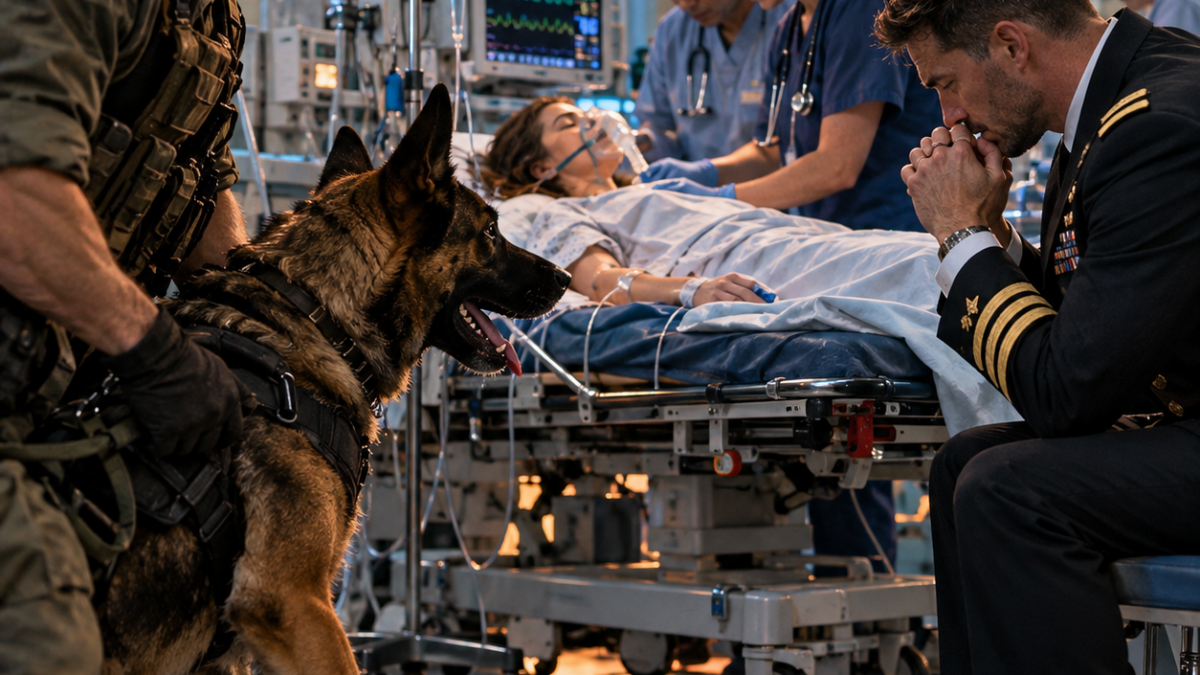
The girl and the dog were the only occupants.”
“She was a target.”
Claire said.
“We believe she was leverage.”
Voss said.
“Against Callaway.”
“Who has spent the last 8 months being the primary obstacle to Kosich’s network inside Naval Special Warfare.”
Claire looked at the photograph again. The ordinary face of a man doing extraordinary damage in the spaces between things people trust.
“He wanted Callaway to come here.”
she said.
“Yes.”
“To this hospital?”
“Yes.”
“Which means someone in this facility is working with him.”
Voss said.
“Someone who would know Callaway was coming.
Someone who could manage access to a patient in surgical recovery.”
The ER outside the alcove door moved at its steady evening pace. Ordinary.
Indifferent. Claire thought about the staff on shift.
The faces at the station. The people who had been in Bay 1 when the girl arrived. The people who had seen Callaway.
Who had seen Reyes. Who had watched Claire work and now understood at minimum that she was not what her file said she was.
One name came up. She did not say it yet.
She needed to be certain. She was not certain yet.
“What do you need from me?”
Claire said. Voss picked up the photograph and returned it to her coat.
“Callaway is upstairs in the surgical waiting area,” she said.
“Reyes is with him.
In approximately 90 minutes, the girl will be moved to recovery.
At that point, she becomes accessible.”
“To us,” Claire said.
“To everyone,” Voss said.
She straightened her coat.
“I have two assets outside the building,” she said.
“But they cannot move inside a civilian hospital without triggering protocols that will alert exactly the wrong people.
But a nurse can move anywhere,” Claire said.
Voss looked at her.
“Ghostbird,” she said quietly.
“You didn’t leave because of the injuries.
It was not a question.”
Claire said nothing.
“You left because of what happened on that last mission,” Voss said.
“What you saw, what was asked of you.”
The medication refrigerator hummed.
“That file is still sealed,” Voss said.
“It will stay sealed whatever you decide tonight.”
She moved to the door, stopped with her hand on the frame.
“But I will tell you one thing,” she said without turning around.
“The man who gave the order that night, the one that put you in that helicopter under those conditions without full authorization.”
She paused.
“He is the one who gave Kosich your name.”
Claire stood very still. The burn on her forearm was no longer cold.
It was the opposite of cold. Something old and precisely located and entirely familiar.
“His name?”
Claire said. Voss said it. One name.
Quiet. Factual.
The way a match is struck against a surface that has been waiting to catch. Claire stood in the alcove after Voss left and did not move for 11 seconds. Then she straightened, rolled her right sleeve down, pressed it once against her forearm, and walked back out to the nursing station like nothing had changed.
But everything had.
Because the name Voss had given her was not a stranger’s name.
It was not someone from the past she barely remembered. It was someone who was, at this exact moment, still inside the building.
The name was Holt. Not Raymond Holt, the trauma physician.
Raymond Holt, the former Army Medical Corps Colonel who had left active duty under a review process that was resolved quietly, quickly, and at a level that required people like Voss to make it disappear. Claire had not known that part.
She had not looked him up when she arrived at St. Augustine. She never looked anyone up.
That was the rule she had given herself when she left. No looking.
No connecting. No pulling on threads.
Because threads led back to the thing she was trying to leave behind. She understood now what that cost her. She walked back to the nursing station and sat down.
Her hands were steady on the keyboard. Her face was calm. Inside, something old and very cold had finished waking up.
Priya was gone. Torres was still on break.
The station was briefly, usefully empty. Claire pulled up the facilities internal access log on the secondary monitor.
The one that tracked staff badge movements through secured areas. She had learned the system in her first week. Old habit.
Always know the building.
She searched Holt’s badge number.
The log ran clean for most of the day. ER floor, consultation rooms, the elevator bank.
Then at 6:14 p. m.
, 40 minutes ago, his badge had accessed the floor, not the OR, not the recovery staging area, the supply corridor that ran adjacent to recovery, the one with the secondary access point to the room where the girl would be moved in approximately
40 minutes. Claire closed the log, stood up. She moved to the medication alcove, bypassed it, and continued to the stairwell at the end of the hall.
She took the stairs. Floors passed in silence. Her breathing was controlled, and even the way it was at altitude when the instruments were gone, and the only thing between six men and the ground was the steadiness of her hands.
Surgical floor. She pushed through the door.
The corridor was quieter than the ER. Soft lighting.
The muted efficiency of a floor where the acute crisis has passed, and the long work of healing has begun. Reyes was outside the surgical waiting room.
He saw her immediately. He read her face the way operators read faces.
He straightened. She walked to him and stopped close enough that her voice would not carry.
“The man who has been accessing your unit’s supply chain,” she said quietly, “the one Voss briefed me on.”
Reyes said nothing, waiting.
“He gave your location to a contact inside this building,” she said.
“That contact has accessed the surgical floor in the last 40 minutes, recovery staging, secondary corridor.
” Reyes’ jaw set.
“Where is he now?”
he said.
“I don’t know yet,” Claire said, “but he will move before the girl is transferred.
That’s the window.”
“Voss’s people can’t move inside without triggering protocols,” Claire said.
“I can.”
Reyes looked at her for one long second, then he stepped aside from the waiting room door. Callaway was inside, sitting in a chair beside the window, elbows on his knees, the Malinois against his leg.
He looked up when Claire entered. She told him in 12 sentences, flat, precise, no softening. Oh, the way you brief someone who needs information and not comfort.
Calloway listened without interrupting. When she finished, he stood.
“My daughter,” he said.
“40 minutes until transfer,” Claire said.
“Maybe less.”
He looked at Reyes. Something passed between them. Then Calloway looked at Claire.
“You don’t have to do this,” he said.
“I know,” she said.
She left the waiting room. The secondary corridor on the surgical floor ran behind the main hallway and connected the OR staging area to the three recovery rooms through a service passage used by staff transferring equipment.
Claire entered it from the north stairwell. The lighting was lower here. Functional.
The sound of the main floor was muffled through the walls. She moved without rushing.
Hospital scrubs in a hospital corridor. Invisible. She had made a career of invisible.
She heard him before she saw him. Not footsteps.
The specific sound of a badge reader being approached. She came around the bend in the corridor and stopped.
Holt was standing at the secondary access panel to recovery room two. He had his badge raised.
He had not heard her. She had been very quiet.
She was always very quiet.
“Dr. Holt,” she said.