A Plane Crash Left Her Alone With a Cold Mafia Boss — Then He Refused to Let Her Go (Part 2)
A Plane Crash Left Her Alone With a Cold Mafia Boss — Then He Refused to Let Her Go (Part 2)
PART 2
Near dawn, the storm weakened. Rain softened to a steady whisper. The fuselage creaked around us. Luca’s fever eased enough for him to focus. I gave him water from our metal container, holding it while he drank. His hand shook too much to hide.
“You scared me,” I said. “I apologize for the inconvenience.” “Do not hide behind manners.” His eyes moved to mine. “What do you want me to say?” “The truth.”
He looked away. “The truth is not always a gift.” “Neither is silence.” He absorbed that. Outside, the sky began turning gray. I gathered courage from exhaustion.
“That day in your office, you said personal tragedy does not pause business. I went to the bathroom and cried into my hand because I could not let your men hear me. My mother survived, but I never forgave you. I need you to know that.”
His face tightened like every word landed physically. “I know.” “Stop saying that.” “I do know.” “Then why?”
His throat moved. For the first time, Luca Romano looked afraid of an answer. “Because I had men in that room who would have used your mother’s name against you if they knew she mattered to me.”
The world seemed to pause. “Mattered to you?” He closed his eyes briefly. “Your work mattered. Your loyalty mattered. Your life outside my office mattered more than you realized.”
Anger rose because softness came too late. “So you humiliated me to protect me.” “I made a cruel choice because I thought cruelty would be cleaner. It was not clean. I know it was not protection. It was abandonment with better excuses.”
He looked at me then, and the pain in his eyes was open enough to hurt. “Yes.” One honest word. No defense, no strategy.
I stood because I could not breathe in the small space anymore. Rain dripped from the torn metal. My bandaged foot throbbed. “Do you understand what you did to me?” “I have understood it every day since.” “Then why did you never say anything?”
His voice dropped. “Because I did not know how to stand in front of you without the monster you already believed in.” That stole my anger’s next breath. I stepped out into the wet morning before tears could embarrass me.
The island after the storm looked wounded. Branches scattered across the beach. Our shelter leaned half-collapsed. The signal X had been ripped apart. Supplies had survived only because we had moved them higher.
The ocean glittered under a pale sky as if it had not spent the night trying to erase us. Luca followed a few minutes later, slower than usual, one arm held close to his side.
“We need a better signal,” he said. “You need rest.” “Rescue will not arrive because I rested.” “Rescue also will not arrive if you die trying to impress the sky.” He looked at me. “I am not trying to impress the sky.” “Good. It has seen planes before.”
A tired smile touched his mouth. Then his gaze moved toward the rocky rise at the far end of the beach, where dark stone climbed above the palms. “High ground. If we rebuild the signal up there using the mirror and smoke, we may have a better chance.”
“Your shoulder can barely move.” “Then you will have to do the work.” “That sounded almost like trust.” “Do not make it emotional.”
I rolled my eyes, but something warm moved through my chest. We spent the morning gathering what remained. Mirror shards, bright fabric, rope, damp wood, dry fibers from the protected part of the wreckage.
The climb to the rocks was harder than it looked. My foot slowed us. Luca’s shoulder made every reach dangerous. We moved together anyway, not smoothly, not gracefully, but with a rhythm we had not had before.
He steadied me on loose stones. I carried the lighter supplies so he would stop pretending pain was a personality. Halfway up, I slipped. Luca caught my waist with his good arm, pulling me against him. My hands landed on his chest.
For a second, the beach, the wreckage, the hunger, the fear, all fell away. His face was inches from mine. Rainwater clung to his lashes.
“Careful,” he said, voice rough. “I am.” “No, you are brave. That is different.” I could not look away. “Do you compliment all stranded employees?” “Only the ones who pull me out of fires.” “A fair transaction?”
“No.” The answer was immediate, quiet, dangerous. My heart moved hard against my ribs. “No.” His eyes dropped to my mouth, then returned to my eyes with visible effort. “Some debts cannot be balanced.”
The air changed. My hands were still on him. His arm was still around me. If I leaned closer, there would be no easy way back. Luca seemed to know it, too.
“Elena,” he said, and my name sounded less like an order now, more like a warning he was giving himself. “Don’t look at me like I’m better than I am.” My voice came out softer than I intended. “Then stop proving me wrong.”
For one breath, he almost kissed me. I felt it before it happened. The pull, the surrender, the terrible possibility. Then I stepped back. Not because I did not want it, because I did. And wanting him before I understood him felt like another crash.
Luca let me go at once. No anger, no pressure, only a shadow crossing his face. “You are right,” he said. “About what?” “It is too soon.” That gentleness almost undid me.
We reached the top of the rocks near noon. From there, the island looked small and impossible. Beach curved like a pale scar, jungle gathered dark behind it, wreckage split along the shore, ocean stretching without mercy in every direction.
I felt the truth of our isolation more sharply from above. Down below, the beach had fooled me into thinking we occupied a place. Up here, I saw we were a speck.
Luca set the mirror pieces in a shallow circle and arranged fabric strips into a bright marker across the dark stone. I collected dry fibers from the bag while he built a smoke base.
“If a plane passes, we use the mirror,” he said. “If a boat appears, we build smoke.” “And if nothing appears?” He tied a strip of fabric to a stick and planted it between rocks. “Then we keep living until something does.”
I looked at his profile, the bruises, the blood, the stubborn life in him. “You make survival sound simple.” “It is not simple. It is narrow.” “What does that mean?” “One task at a time. One hour, one breath. Panic wants the whole future at once. Survival refuses to give it.”
I remembered my mother’s hospital room. The monitor beeping, the bills, the way one hour could become an entire world when fear narrowed it. “That is the first useful thing you have ever taught me.” “I will try not to ruin the moment.”
We worked until the sun burned through clouds. Then, just as we began descending, my injured foot twisted on wet stone. I slipped sideways toward a sharp drop where waves smashed below.
Luca lunged, his hand closed around my wrist. The movement tore through his injured shoulder. I heard it in the sound he failed to swallow. He pulled me back with brutal effort, but the loose rock under him broke. He went down hard, sliding toward the edge.
“Luca!” I dropped to my knees and grabbed him with both hands. His body jerked to a stop with his boots hanging over the drop. One hand gripping a crack in the rock, the other useless from the injured shoulder. His face had gone white.
“Let go of my bad arm,” he forced out. “I’m not letting go of anything.” “Elena, listen—” “No, you cannot hold me. Watch me.”
My foot screamed. My ribs burned. My palm slid on wet stone. Below him, the ocean struck the rocks hard enough to explode white. Luca looked up at me, and for the first time since I had known him, real fear entered his eyes. Not for himself. For me.
“If I pull you down—” “You won’t.” “If I do, you let go.” Rage filled me, clean and bright. “Stop ordering me to survive without you.”
The words changed his face. I braced my knees, wrapped both hands around his wrist, and pulled with everything left in me. He pushed with his good arm. Inch by inch, pain by pain, we dragged him away from the edge.
When he finally rolled onto safe stone, I collapsed beside him, shaking so hard my teeth clicked. For several seconds, neither of us moved. The ocean roared below as if disappointed.
Luca turned his head toward me. His breath came rough. Sweat and rain mixed on his face. “You saved me again.” I stared at the sky because looking at him felt impossible. “Stop needing it.” “I am trying.” “Try harder.”
A weak sound left him. Almost laughter. Then pain folded him in half. I pushed myself up and saw his shoulder bleeding through the bandage. Panic hit me fast. “We need to get down.” “Give me a minute.” “You do not have a minute. You are bleeding.” “Elena—” “No, you don’t get to die after making me care.”
The words left my mouth before I could stop them. Luca went still. Even injured, even breathless, he caught the truth as it fell between us. His eyes searched mine. “So you care?”
My throat tightened. I wanted to take it back, dress it as anger, call it habit. I could not. Not after the fire, the storm, his fever, his hand around my wrist, my own terror when he nearly fell.
I pressed the bandage hard against his shoulder and looked away. “Shut up and breathe.” His hand, scraped and shaking, covered mine for one brief second. Not to move it, not to control it, just to feel that I was there.
“I am breathing,” he said quietly. “Because you told me to.” I hated how close that sounded to trust.
We started down from the rocks slowly, with my arm around his waist and his good arm over my shoulders. Every step hurt both of us. Neither complained.
The beach waited below, bright and ruined, our shelter damaged, our fire gone, our signal rebuilt above us like a prayer. By the time we reached camp, Luca was barely standing.
I eased him onto the sand beneath the palm shade and knelt beside him. His eyes were half-closed, his face drained of color. But when I reached for the water, he caught my wrist. “Your foot first.”
I almost laughed from exhaustion. “You are impossible.” “Efficient.” “Annoying.” “Alive.”
I looked at him then, at the cold mafia boss stripped down to blood, fever, stubbornness, and sacrifice, and felt the last clean shape of my hatred collapse. Something else stood in its place, frightening because it had no name yet.
I gave him water, held the cloth to his shoulder, and stayed beside him while the sun lowered over the empty sea. The island had taken our plane, our certainty, our distance, and almost his life. It had left us with hunger, pain, one damaged shelter, one signal on the rocks, and a truth I was no longer strong enough to deny.
I had hated Luca Romano when we fell from the sky. But somewhere between the fire, the storm, and the edge of that cliff, hating him had become harder than holding on.
The first rescue plane passed over us without seeing the signal. I was kneeling beside Luca under the palm shade, pressing a wet cloth against his fevered shoulder, when the sound cut through the afternoon like a blade.
At first, I thought the island was playing another cruel trick on me. Wind through broken metal sometimes sounded like voices. Waves against the wreckage sometimes sounded like footsteps. Hunger and fear had already taught my mind how to lie.
Then Luca’s eyes opened. “Plane,” he whispered. I looked up and saw a small white aircraft moving across the bright sky, far beyond the line of palms.
For one frozen second, I could not move. Rescue had become an idea too painful to touch. Luca pushed himself up on one elbow and nearly collapsed. “Mirror,” he said.
I grabbed the cracked cabin mirror from our supplies and ran toward the open beach, my injured foot screaming with every step. “Here!” I shouted, waving one arm, flashing sunlight with the mirror in wild, desperate bursts. “We’re here!”
The plane kept moving. It did not turn. It did not slow. It became smaller, quieter, farther away until the sky swallowed it completely.
My arm dropped. The silence that followed felt heavier than the crash. Behind me, Luca tried to stand and failed. I turned before he hit the sand and caught him badly. Both of us sinking to our knees.
“They didn’t see us,” I said, hating how small my voice sounded. Luca’s breathing was rough. His skin burned under my hands, but his eyes stayed locked on the sky. “Then we make them see us next time.” “What if there is no next time?” “There is always a next task.” “I am tired of tasks.”
His gaze came to mine, stripped of command and pride. “So am I.” That honesty nearly broke me.
I sat beside him in the sand, our shoulders touching, the dead fire between us and the ocean stretching beyond hope. For the first time since we reached the island, Luca did not tell me what to do. He did not build, plan, ration, calculate, or turn fear into instructions. He leaned his head against the palm trunk and closed his eyes, too exhausted to pretend.
I looked at him, at the bruises across his ribs, the blood dried at his temple, the bandage I had tied around his shoulder, the torn black shirt that no longer made him look untouchable. The island had taken his title first, then his suit, then his distance, and finally his silence.
Under all of it, he was still dangerous, still proud, still Luca Romano. But he was also a man who had spent days giving me the larger share of water, standing between me and storms, carrying pain like it was part of his job, and whispering truths fever had dragged from places he had locked for years.
I hated that the rescue plane had missed us. I hated more that I had looked at the sky and thought, “If they take us back, will I lose this version of him?”
That night, Luca’s fever returned, not as violently as before, but enough to keep me awake. I rebuilt the fire with shaking hands, fed it slowly, and used the last clean fabric to cool his face. He drifted in and out, speaking in fragments. Some were Italian, some were names I did not know.
Once he opened his eyes and looked at me with a clarity that made my breath stop. “If we get back,” he said, “do not let them make you feel small.” “Who?” “My world.” “Your world does not scare me.” “It should.” “It did before.”
His fingers found mine in the dark. “And now?” I looked at our joined hands. His grip was weak, but he still held on like letting go required permission. “Now I know its boss bleeds.”
A tired smile touched his mouth. “You will use that against me.” “Every chance I get.” His thumb brushed my knuckles. “Good.”
He slept after that, and I stayed awake watching the tide. Near dawn, I made a decision. Waiting was not enough. The signal on the rocks needed smoke strong enough to stain the sky.
I gathered damp leaves for thick smoke, dry fibers for flame, and pieces of black rubber from the wreckage because Luca said dark smoke carried farther. I worked until my hands blistered.
When he woke, I expected anger because I had moved without him. Instead, he watched me from the shade with something quiet in his eyes. “You made a smoke stack.” “I listened when you taught me.” “That is dangerous.” “For who?” “Anyone who underestimates you.”
I tried to smile, but my throat tightened. “You did?” “Yes.” No excuse. No elegant dodge. Just the truth.
I knelt beside him and handed him water. “Do you still?” He took the container, drank slowly, then answered with his eyes on mine. “No. Now I fear you may be stronger than I am.” “That is not a fear. That is good sense.”
He almost laughed. The sound was weak but real.
Later that morning, we saw the boat. It appeared as a white mark on the horizon, so small I thought it was sunlight at first. Then it moved against the waves.
Luca forced himself to stand, swaying once before I put my arm around his waist. Together, we climbed halfway toward the rocks, close enough to reach the smoke stack without risking the cliff again.
My foot throbbed. His body leaned heavier with each step. We lit the dry fibers. The first flame caught, then the damp leaves smoked. I added rubber. Thick black smoke twisted upward into the blue sky.
Luca took the mirror from me and angled sunlight toward the boat with slow, precise flashes. “Keep feeding it,” he said. “I am.” “More leaves.” “I know, Elena.” “If you say one more order, I will push you down the hill after rescue.”
His mouth curved. “A fair threat.”
The boat changed direction. I saw it before I believed it. It turned toward us, cutting across the water with a white trail behind it. My knees almost gave out. Luca’s arm tightened around me. Whether to steady me or himself, I could not tell.
“They see us,” I whispered. “Yes,” he said. “They really see us.” His voice was low near my ear. “I told you we would make them.”
The rescue came in pieces. Shouting men in orange jackets, a small inflatable boat fighting the surf. Hands reaching for me, medical questions I could not answer. A blanket wrapped around my shoulders, though I still wore Luca’s ruined coat.
When they tried to lift me first, I grabbed Luca’s wrist. “Together,” I said. The rescuer misunderstood and told me he would be right behind me. I shook my head hard enough to make my vision blur. “No, together.”
Luca looked down at my hand holding his wrist. Something changed in his face. Something too private for the strangers around us. “Elena, go.” “Do not start.” “You are injured.” “So are you.” “You first.” “Not anymore.”
The words rose out of the island, out of the fire, the storm, the cliff. The nights we survived by refusing to let the other disappear. Luca stared at me, then gave the smallest nod.
“Together,” he said. We left the island the same way we had survived it. One hand locked around the other, both too stubborn to let go.
The hospital felt louder than the crash. Machines beeped. Doors opened and closed. Doctors asked questions. Nurses moved around me with professional kindness that made me want to cry.
They cleaned my cuts, wrapped my foot properly, checked my ribs, scanned my head, and told me I was lucky. I knew that luck had Luca’s heartbeat and smoke in its hair.
He was taken to another room for his shoulder. Dehydration, fever, and bruised ribs. The first time they separated us. Panic rose so fast I nearly pulled the IV out of my arm. A nurse touched my shoulder and said, “He is down the hall.”
Down the hall felt like another continent.
Hours later, I saw him again through a glass panel. He was sitting upright in a private hospital room, wearing a white shirt instead of black. One arm in a sling, his face cleaner, but somehow harder.
Men in dark suits stood around him. His world had arrived. Guards, advisers, lawyers, silent men with expensive shoes and watchful eyes. They filled the room without crowding it, waiting for his voice, his glance, his permission.
Luca Romano was back among people who feared him, and I watched the island begin to disappear from his face. He saw me through the glass. For one second, the mask cracked. His eyes softened.
Then an older man stepped into my view. Tall, silver-haired, dressed in a dark suit that looked older than fashion and heavier than money. Vittorio. I knew his name from office whispers. Luca’s consigliere, his father’s old friend, the man who had helped turn a grieving boy into a feared boss.
He looked at me through the glass as if I were sand, still clinging to Luca’s shoes. The nurse guided me back before I could hear what they said.
Two days passed in that strange half-life between survival and return. Luca sent doctors, food, fresh clothes, security outside my door, and silence. He did not come. Not once.
The first day I told myself he needed treatment. The second I understood he was building the wall again, brick by brick, using protection as an excuse for distance.
On the third morning, Vittorio visited me. He entered my room after a soft knock, carrying no flowers, no apology, no warmth. “Miss Vale,” he said. “How are you recovering?” “Alive.” “Good. Luca insisted on the best doctors.” “Luca could insist on coming himself.”
Vittorio’s expression did not change. “He is managing many responsibilities.” “Of course. Personal tragedy does not pause business.” His eyes sharpened at the phrase.
“You should understand something. An island creates unusual bonds. Fear, hunger, injury, isolation. Such conditions can make survival feel like love.” My hands tightened around the blanket. “Did Luca send you to say that?” “No. Luca is not ready to hear it. But you are.”
“I am old enough to know that a man in his position cannot afford weakness.” I looked at him carefully. “You think I am weakness?” “I think you are human. That makes you more dangerous than any enemy.”
The words landed with quiet cruelty because they were not shouted. He continued, “On the island, you saw Luca without his name. Here, his name feeds families, pays debts, holds violence in balance, and keeps men loyal who would become monsters without a stronger monster above them. If he begins choosing softness, people will test him.”
“Maybe they should.” Vittorio’s mouth tightened. “You are young.” “No, I am tired.”
He studied me for a moment, then turned toward the door. “If you care for him, do not ask him to become someone his world will destroy.”
After he left, I sat in the hospital bed and felt the island pull farther away. Maybe Vittorio was right in one way. Maybe survival had made everything sharper than real life. Maybe Luca had only been soft because there was no one around to punish him for it.
That evening, a nurse brought discharge papers and a small folder of medical documents. “Your mother called twice,” she said kindly. “She sounded worried.” “We told her you were stable.”
My mother. Rosa Vale. Stubborn, warm, still alive because of a miracle payment I had never understood. I flipped through the folder while the nurse checked my IV site.
A financial receipt slipped from the papers. Most of the hospital costs were covered by Luca’s private medical account. That did not surprise me. What froze me was the old note attached below.
Previous emergency payment verified through Romano Relief Trust. Date: one year earlier. My mother’s surgery date.
My hands went cold. “Where did this come from?” I asked. The nurse glanced at it. “Billing added your previous record because both were connected to the same payer.” “Same payer?” “Yes. Romano Relief Trust. Mr. Romano’s office authorized both.”
The room went silent around me. One year of hatred shifted under my feet. Anonymous payment before midnight. My mother saved after Luca had cut me open with one sentence.
He had paid. He had paid and let me believe he had done nothing. Anger returned. But it no longer had the clean shape I trusted.
I got out of bed before the nurse finished protesting. I walked down the hall in hospital socks, one foot bandaged, ribs aching, hair still tangled from sleep, wearing a loose sweater someone from Luca’s staff had left for me.
Two guards outside Luca’s room stepped into my path. “Miss Vale, Mr. Romano is resting.” “Move.” They did not.
I looked through the glass. Luca sat at the edge of his bed while Vittorio spoke to him. His face was pale, his arm strapped, his eyes darker than I had ever seen them. He looked up and saw me.
I lifted the receipt. Something in his expression told me he understood. “Let her in,” he said through the open crack of the door.
The guards moved. Vittorio turned as I entered, displeasure written in every controlled line of him. I ignored him. “You paid my mother’s hospital bill.”
Luca stood slowly. “Elena—” “Did you silence?” I hated silence again. “Answer me.” “Yes.”
The word broke something open. “You paid it after telling me personal tragedy does not pause business.” “Yes.” “You let me hate you for a year.” “Yes.”
My voice shook. “Why would you do that?” Vittorio stepped forward. “This is not the place.” Luca did not look at him. “Leave us, Vittorio. Now.”
The old man’s face hardened, but he left. The door closed softly behind him. Luca and I stood alone in a room that smelled of antiseptic instead of smoke. The island felt impossibly far.
“Tell me,” I said. Luca looked down at his bandaged hand. “Three men were in my office that day. One had already sold information about my staff to a rival family. I knew it, but I did not know how much he had taken. If I showed him your mother mattered, if I gave you leave with concern, if I paid openly, your name could have entered a world you were not built to survive.”
“So you chose to humiliate me.” “I chose badly.” “You made me feel ashamed for needing help.” His eyes lifted, raw and steady. “I know.” “Stop saying you know.” “I cannot stop knowing it.”
The anger in me trembled because it had nowhere clean to go. “You could have told me later.” “I tried.” “No, you didn’t.”
“I stood outside your office three days after your mother’s surgery.” The memory came slowly. A shadow at my door. A pause, then nothing. “You walked away.” “Yes.” “Why?”
His voice dropped. “Because I saw you laughing on the phone with her. You sounded relieved. Free. I thought if I entered, I would bring back the worst moment of your life with my face attached to it.”
“That was not your choice to make.” “No.” “You keep making choices for me and calling it protection.” Pain crossed his face. “Yes.”
I stepped closer, tears burning now. “You did it on the island, too. You gave me food, water, your coat, your body between me and danger, then acted like it was all strategy. You do not get to decide what your care means and hide the truth because honesty scares you.”
Luca looked at me as if every word stripped him cleaner than the sea had. “I was afraid.” The admission stopped me. “Of what?” “That you would see me clearly and still choose to hate me.”
My breath caught. He took a careful step toward me, not touching, leaving the choice in the space between us. “On that island, I had nothing to offer except what I was. No money, no name, no men, no fear. You saw me bleeding, weak, useful only because I refused to let you die. That should have terrified me less than this room, but it did not.”
“Why?” His eyes held mine. “Because here I can become the man you hated again.”
The truth landed softly, devastatingly. I wanted to reach for him. I wanted to hit him. I wanted the island back because pain had been simpler there.
“Then don’t,” I whispered. His face tightened. “It is not that easy.” “No. My world will call you weakness.” “I am not weakness.” “They will use you to judge me.” “Let them.” “They will test every boundary I soften.” “Then build better boundaries. Do not become dead inside and call it strength.”
He looked away, breathing hard through pain he would have hidden from anyone else. “Vittorio is calling a family dinner tomorrow night. Advisers, captains, elders. They expect me to make it clear that what happened on the island was survival, nothing more.”
My chest went cold. “Is that what you want?” He did not answer fast enough. That was answer enough to hurt. I stepped back.
“Do not protect me by lying again.” “Elena—” “No. If you choose your mask, say it honestly. I survived a plane crash. I can survive the truth.”
I left before he could respond.
The next night, I went to the Romano estate because running would have made Vittorio right. The house sat above the water behind iron gates. All white stone, glass, and controlled beauty. Men in black suits watched me enter. None stopped me. Luca must have given orders.
Or maybe everyone wanted to see the woman from the island before she was erased from the story. The dining room was long, polished, and cold with wealth. Twelve men sat around the table. Vittorio stood near Luca’s right side.
Luca wore black again. Not a suit as perfect as before, but close enough to look like armor. His sling was hidden under his jacket. Only I knew what that cost him.
His eyes found me the moment I entered, and the room followed his gaze. No one spoke. I walked to the empty place near the end of the table.
“Miss Vale,” Vittorio said, “this is a private matter.” “Then you should not have made me part of it.”
A few men shifted. Luca’s expression did not change, but his eyes warmed by a degree only I could read. Vittorio turned to him. “Luca, this must be settled.”
Luca leaned back, silent. Vittorio took that as permission. “The island created confusion. Gratitude, fear, dependence. These are understandable after trauma, but the family needs clarity. A Romano boss cannot be ruled by an emotional accident.”
I felt every eye on me. Once that room would have made me shrink. Now, I remembered a cliff edge and Luca’s hand slipping in mine. I remembered smoke signals, fever, and the stubborn beat of his heart against my ear. I had been afraid of this world before I saw its strongest man bleed.
“An emotional accident,” I repeated. Vittorio’s gaze was cold. “Yes.” I looked at Luca. “Is that what I was?”
The question did not belong to the room, but the room held its breath for the answer. Luca stood slowly. Pain flashed across his face before he buried it. “No.”
One word, and the air changed. Vittorio’s jaw tightened. “Think carefully.” Luca’s eyes did not leave mine. “I have done nothing else since the crash.” “Then remember what you are.”
Luca turned toward him. “I remember exactly what I am. I am a man who fell from the sky with no guards, no weapons, no power, no name that mattered to the ocean. On that island, fear did not serve me. Money did not feed me. My reputation did not build fire. She did.”
The room went still. Luca stepped away from the head of the table. “She saved my life when leaving me would have been easier. She cared for me when I had given her every reason not to. She looked at the worst version of me, the wounded one, the useless one, the one none of you would respect, and she did not turn away.”
Vittorio’s voice sharpened. “Love makes a boss predictable.” Elena had never spoken in that room, but my voice rose before thought could stop it. “A boss who cannot love is already dead.”
Silence hit like thunder. Some men looked offended. Some looked away. Luca looked at me as if I had placed a weapon in his hands and called it mercy.
Vittorio’s face hardened. “You do not understand power.” “No,” I said. “I understand fear. This room is full of men calling it loyalty.”
One of the younger men moved as if to stand. Luca did not look at him. “Sit.” The man sat.
Luca came to me then, crossing the room with every eye on him. He stopped close enough that I could see the strain around his mouth. “Vittorio says I will lose respect if I choose you.” My throat tightened. “And then they will learn a new kind.”
His hand reached for mine, slow enough that I could refuse. I did not. The second our fingers locked, his whole face changed. Not into softness exactly, but into truth.
“I spent my life making people afraid of me,” he said quietly. Though every man heard him, “you were the first person who made me afraid of losing myself.”
My eyes burned. “I hated your silence.” “I know.” “I hated what you let me believe.” “I know.” “And I am still angry.” “Good.” His thumb moved over my knuckles, the same gentle motion from the falling plane. “Be angry beside me, not away from me.”
Something inside me finally gave way. Not all the hurt, not the memory of that office, not the year he let me carry pain alone. Forgiveness is not a door that opens once. It is a road. And we had only reached the beginning.
But love was there, too. Impossible and undeniable. Born not from perfection, but from fire, salt, fear, and the choice to stay.
“I loved you before I was ready to forgive you,” I whispered. Luca closed his eyes for one second as if the words hurt and healed at once. Then he lowered his forehead to mine, not caring who watched. No dramatic kiss, no performance, just breath, closeness, and a truth too strong for silence.
Vittorio said nothing. Neither did the room. They had all spent years obeying the coldest man in Miami. That night, they met the man beneath him, and no one knew what to do with that.
Three weeks later, Luca took me to the ocean, not the island. Doctors said neither of us should fly yet, and maybe we were not ready to see the place that had nearly killed us. Instead, he brought me to a quiet, private dock at sunrise, far from cameras, guards, and polished rooms.
My mother was recovering at home, angry that I had not told her more, grateful in a way that made her cry when Luca visited and apologized to her face. He did not send flowers through an assistant. He stood in her small kitchen, too tall for the room, and said, “Mrs. Vale, I failed your daughter when she needed honesty.”
My mother looked him up and down, then said, “Yes, you did.” Luca accepted it like a sentence. That was when I knew he meant to change.
On the dock, the air smelled clean. Luca wore a simple black shirt, his sling gone, but his shoulder still stiff. I wore a pale dress that moved in the wind. For once, there were no files between us, no emergency, no fire to feed, no men waiting for orders.
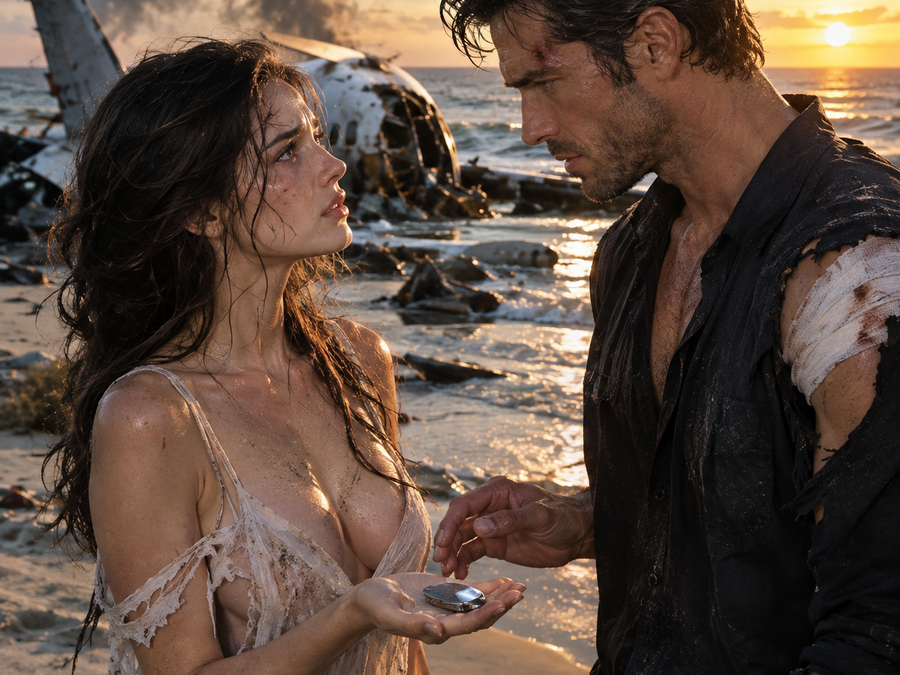
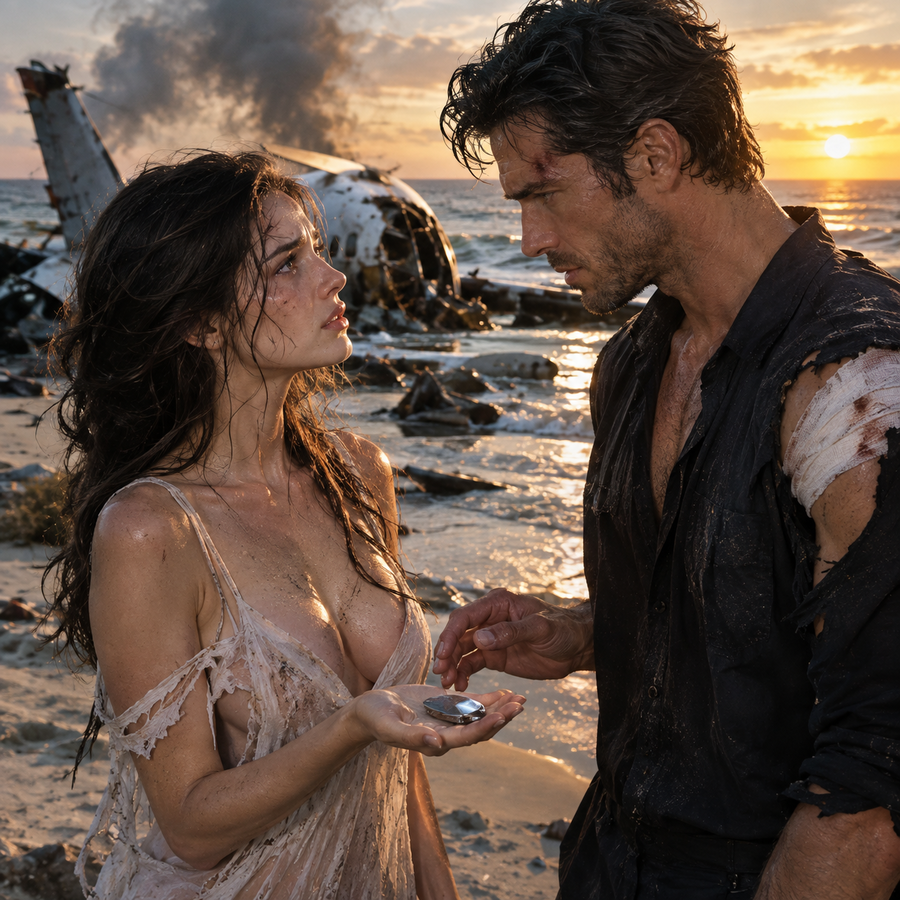
He reached into his pocket and placed something in my palm. A small piece of smooth metal, silver and curved, polished at the edges. “What is this?” I asked.
“From the wreckage. I found it in my coat after rescue.” I turned it over. It was useless. Ordinary. A scar from the plane that had fallen. “Why keep it?”
Luca looked toward the water. “Because it reminds me of the day I lost everything that made me untouchable.” I closed my fingers around the metal and stepped closer. “No, it reminds you of the day you became reachable.”
He looked at me then, and the coldness was not gone from him completely. It never would be. Luca Romano had lived too long in rooms where softness was punished. But now, when silence came, it no longer felt like a wall. Sometimes it was simply space where truth could breathe.
“Are you afraid?” he asked. “Of you? Of us?” I looked out at the ocean, bright and endless, no longer only a monster. “Yes.”
His hand found mine. “Good. Fear is strong.” I smiled despite myself. “Use it.” “No,” he said, voice low, warm, certain. “Share it.”
The sun lifted higher, turning the water gold. I thought of the woman I had been on that plane, sitting across from a man she hated, certain she understood his heart because he had once broken hers. I thought of the crash, the fire, the storm, his fevered confessions, the cliff, the rescue, the room where he chose truth in front of men who worshiped fear.
I had hated Luca Romano before the plane fell. But on that deserted island where no one could fear him and no one could obey him, I finally met the man beneath the boss.
He was wounded, stubborn, impossible, protective, flawed, lonely, and real. He did not save me perfectly. He did not love me easily. He did not become gentle overnight. But he stayed. He learned. He chose.
And when I looked at him beside the ocean, holding the broken piece of our fall in my hand, I understood something I would never have believed at 30,000 feet. Sometimes love does not arrive like rescue. Sometimes it crawls out of wreckage, bleeding and stubborn, builds a fire with shaking hands, gives you its last warmth, and waits until you are brave enough to call it by its name.








