A Snowstorm Trapped a Single Dad With an Older Billionaire – She said, “Don’t Tell Her About This.” (Part 1)
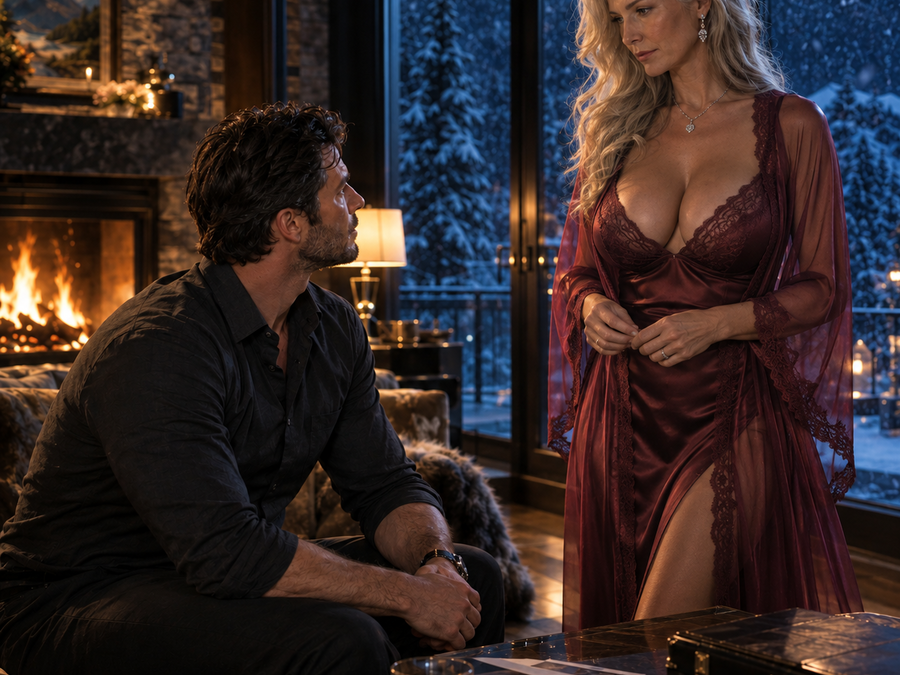
A Snowstorm Trapped a Single Dad With an Older Billionaire – She said, “Don’t Tell Her About This.” (Part 1)

PART 1
The blizzard hit without mercy. The mountain road was gone, cell service dead, and somewhere in the dark, someone was already on the property who was not supposed to be there. Cade Holleran had come to fix a heating system. He was leaving with his life if he was lucky.
Octavia Belrose had built a billion-dollar empire surviving ruthless men in expensive boardrooms. But tonight, in her own home, she was terrified because the generator had not failed. It had been destroyed, and whoever did it believed she was completely alone. They were wrong.
The drive up to the Belrose estate was the kind of road that reminded a person how small they actually were. Cade Holleran had made the trip a dozen times over the past three weeks, and it never got friendlier. Sixteen miles of switchbacks carved into the face of the Sanabella range, guardrails so old they’d rusted orange, and drop-offs on the passenger side that fell away into nothing but pale gray sky and the tops of spruce trees a thousand feet below.
In good weather, it was impressive. In winter, it was a test of nerve. This particular Thursday morning, the sky had turned the color of old pewter by the time Cade’s truck reached the upper gate. He punched in the access code, waited for the iron panel to grind open, and pulled through without stopping.
The thermometer on the dashboard read twenty-one degrees. The forecast had said snow was possible, the word “possible” doing a lot of work sometime late Friday. He figured he had a full day, maybe more, to finish replacing the faulty exchanger coils on the estate’s primary heating unit, pack his tools, and be back in Hollow Ridge by dinner.
Brin had a school project due Friday. She needed help with the poster board section, and she’d made him promise to be home before seven so they could work on it together. He’d promised. He kept his promises.
The estate appeared through the last bend the way it always did—suddenly, without warning, like something that had grown out of the mountain rather than been built on it. Three stories of dark timber and stone, broad roof lines weighted with old snow, tall windows that caught the light wrong in a way that made the glass look almost black from the outside. A beautiful house, the kind that cost more money than Cade would earn in several lifetimes.
He’d repaired a lot of expensive properties over the years, but this one still made him slow down for a second before pulling into the service lot. He wasn’t intimidated by wealth. Not anymore. He’d learned early that rich people had bad pipes and broken furnaces, just like everyone else. What he was, if he was honest, was curious about the woman who lived here.
Octavia Belrose. He’d Googled her before taking the job, not because he made a habit of that, but because the name had shown up in a business magazine his sister left at his house, and recognition had nagged at him until he looked it up. What he found was exactly what you’d expect, and nothing you could actually prepare for.
Fifty years old, self-made, started with a failing industrial supplier at age twenty-seven, built it into a holding company that now owned pieces of everything from specialty chemicals to luxury logistics. Three times on the covers of financial publications. A face that looked comfortable with authority in a way that most people never managed. In person, she was worse.
He’d met her the first day, or rather, she’d appeared while he was still pulling equipment from the truck bed, and she’d stood there in a charcoal wool coat with her arms crossed and her dark eyes moving over him, the way a person evaluates something they haven’t decided yet whether to trust. “You’re younger than I expected,” she said. “The work’s the same,” he said. She’d almost smiled. Almost.
Since then, they’d had maybe twelve minutes of conversation total. She was rarely home during working hours, and when she was, she moved through the estate like a current, always somewhere purposeful, always with a phone pressed to her ear or a folder in her hand. She said good morning the way some people signed forms. She said thank you with the efficiency of someone who’d learned it was required, but not lingered on.
Cade had fixed the east wing radiant floor loop, replaced two corroded bypass valves, and was halfway through the main heat exchanger replacement. He kept his head down, did the work, and was gone before she needed to think about him. That was the arrangement. It suited both of them.
He got through the front door, hauled his tool cases to the mechanical room in the basement level, and set up by 8:15. The exchanger coils had to come out in sequence—careful work. Not complicated, but the kind that couldn’t be rushed without making a mess. He put on the old wireless earbuds he used on job sites, found a station playing the kind of country music he’d stopped admitting he liked around age twenty-five, and started in.
By 10:30, he was two hours deep and making decent progress when he heard footsteps on the basement stairs. Octavia appeared in the doorway wearing a dark sweater and reading glasses pushed up onto her head. She looked at the dismantled components spread across the floor with the expression of someone who has decided not to be alarmed. “How much longer?” she asked. “Probably finish the main unit today. Test tomorrow morning. Then you should have full heat again.”
She nodded. Didn’t leave. Cade glanced up. “Something wrong?” “The weather report changed,” she said. She said it flatly, the way she said most things. “They’ve moved the storm window up significantly.” He set down the wrench in his hand. “How significantly?” “The updated forecast has it arriving tonight, possibly early evening.” She pulled her glasses down and looked at him over the frames. “I’m not going to pretend I understand what that means for mountain roads.”
Cade understood exactly what it meant. He stood up, moved to the narrow basement window, and looked out. The sky was darker than it had been forty-five minutes ago. The clouds had that particular low, flat look—no texture, no movement, just a ceiling pressing down. He’d grown up in these mountains. He knew what that sky meant. “It means I should probably pack up and get down the road before it starts,” he said. “Or I don’t go anywhere until it passes.” He looked at her. “How long does the forecast say?” “Twenty-four hours at minimum. Possibly thirty-six.”
He did the math without wanting to. The heating system was currently out of commission—components on the floor, circulation cut, no heat running to the upper levels. If he left now, the estate would be without heat in a serious storm. If he stayed, he’d be here through the night at minimum. He pulled out his phone to call his sister and stopped. No signal.
He moved to the doorway, held the phone higher. One bar, then none. “The cell repeater on the north tower went down this morning,” Octavia said. She was watching him with an expression he couldn’t quite read. Not worried, exactly. More like someone who had already run the calculations and wasn’t going to pretend otherwise. “There’s a satellite phone in the study. Landline in the kitchen, but I don’t know that it’s been tested recently.” “I need to make a call,” he said.
He found the landline. It worked. He called his sister, Renata, who picked up on the second ring and immediately told him not to worry about Brin. She’d already seen the updated forecast. The school had been sending weather alerts all morning, and Brinn was staying over tonight. “She’s fine,” Renata said. “She’s currently eating my cereal and arguing with my son about something I’ve given up trying to follow. Just stay put if you need to.”
“Tell her I’ll call when I can get a signal,” Cade said. “She knows, Cade. She’s eight, not fragile.” He hung up and stood there a moment with his hand still on the receiver. Brinn was fine. That was the only part that mattered. He went back to the mechanical room.
The storm hit at 4:17, not gradually, not the way weather usually introduced itself with a few flakes and some wind as a courtesy warning. This came all at once, like a door thrown open, and within thirty minutes, the visibility outside the estate windows had dropped to almost nothing. Snow moving sideways, wind loud enough to hear through two-foot stone walls.
Cade had been racing the clock. He’d gotten the main exchanger reinstalled and reconnected, started the ignition sequence, and the system had fired up with that particular groan of machinery returning to life that he genuinely liked—the sound of a problem being solved. Heat was moving through the lines again, not perfect yet, it would take an hour to fully pressurize the circulation, but functional. He was washing his hands at the utility sink when the lights flickered. Then the lights went out. Then the generator kicked in.
And thirty seconds later, the generator stopped. The house went completely quiet in the way that large spaces do when every mechanical system inside them dies simultaneously. Cade stood in the dark with wet hands and listened to the wind outside. He found his headlamp in the tool bag, clicked it on, and went to find Octavia.
She was in the main corridor on the ground floor, already holding a flashlight, already moving toward the back of the house. She did not look panicked. She looked like someone who had been inconvenienced in a way they found personally offensive. “Generator,” she said. “I heard it go. It shouldn’t have. It was fully serviced four weeks ago. Full tank.” “Where is it?” “Equipment shed. East side of the property.”
Cade was already putting his coat on. “I’m going with you.” “You don’t need to. This is my property.” She said it without anger. Just fact. “I’m going.” The shed was eighty feet from the back door across a courtyard that had in the last hour accumulated six inches of new snow on top of whatever was already there. They pushed through it with flashlights angled down, heads dropped against the wind.
The generator was a commercial-grade unit, diesel-powered, the kind installed in properties that couldn’t afford to lose power for more than minutes. Cade checked the fuel first. Tank was over half full. He checked the circuit breakers—all intact. He checked the ignition relay. Then he found the fuel line. He crouched down and brought the headlamp close. Didn’t say anything for a moment. “What is it?” Octavia asked from behind him.
The fuel line had a clean slice in it. Not a crack from age or a split from cold. A cut. Straight, deliberate, made with something sharp. “This didn’t fail,” Cade said. He kept his voice level. “It was cut.” Silence. He turned and looked up at her. In the cone of the flashlight, her face was very still. “Octavia, I need you to hear me. Someone cut this line. Probably within the last few hours.” He stood. “Have you seen anyone on the property today?” “No.” “Is there anyone who has access?” A pause. Not the pause of someone thinking—the pause of someone deciding. “There was a threat,” she said. “Three months ago. Then another. Anonymous. I didn’t—” She stopped. Started over. “I chose not to report them.”
Cade looked at her for a long moment in the dark and the cold and the howling wind. “How many threats?” “Four.” “What kind?” She turned and started back toward the house. “Let’s get inside first.”
They checked every door and every ground-floor window before she would talk. Cade did it methodically, room by room, while Octavia followed, and he noticed she didn’t argue about it. Whatever composure she normally wore like a second skin had thinned. She was still controlled, still precise, but the edges were showing. They settled in the main sitting room where the stone fireplace was already lit. Cade stacked three more logs on while Octavia stood with her arms crossed, watching the fire.
“The threat started after I declined to sell my controlling interest,” she said. “A rival group—I won’t give you names because that becomes complicated—made an offer I turned down. After that, things began happening. Documents going missing from systems that should have been secure. A driver I’d had for six years suddenly resigning without explanation. Small things, the kind that could each be explained individually.” “But together,” Cade said, “together they formed a picture.”
She unfolded her arms, folded them again. It was the most uncertainty he’d seen from her. “The threats themselves were direct enough. ‘Stop resisting the offer. Transfer the shares or there would be consequences.'” “And you didn’t report any of this?” “I told my head of security. He said he’d investigate.” A hard edge entered her voice. “I’m not certain anymore whose side he was on.”
Cade sat on the stone hearth with his hands loose between his knees. “You have an estate manager. Luther Quaid.” “Yes.” “Where is he?” “He has a cabin on the lower property. He lives there year-round.” She looked at Cade. “He’s been with me eleven years.” “Okay,” Cade said. “You don’t sound convinced.” “I’m not assuming anything yet.” He glanced toward the windows. Outside, the storm was fully operational now. The kind of snow that didn’t just fall, but accumulated with intent. “Here’s where we are. The road is closed. We have heat again—the main system I repaired is running—but no backup power if the grid fails again. We have a fireplace in this room that’ll work regardless. And we have someone who cut your generator line while the storm was hitting.”
Octavia looked at him. “You’re not afraid.” “I’m paying attention,” he said. “That’s more useful.” She was quiet for a second. “Then why are you being calm about this?” “Because one of us is going to need to be,” he said it without sharpness. “And you’ve got enough to deal with already.” Something crossed her face that wasn’t quite gratitude and wasn’t quite offense—something in between that she seemed to decide to leave alone.
“There’s food in the kitchen,” she said. “The gas range will still work.” “Then I’ll cook,” he said. She blinked. “You’ll cook?” “Unless you’d rather.” The silence stretched out for exactly two seconds before something small moved across her expression that might in different circumstances have become a smile. “I don’t cook,” she said. “I know,” he said. “I’ve seen your kitchen.”
This time it actually happened—brief, reluctant, but real. They ate canned tomato soup and bread from the pantry, sitting at opposite ends of a kitchen island that probably cost more than Cade’s truck. The fire in the sitting room was the only sound in the house beyond the storm hammering everything outside. Cade asked Octavia about the estate’s layout, exits, interior locks, rooms that could be secured from the inside, and she answered precisely, practically, without drama.
She was smart. He’d already known that. What surprised him was how methodical she was under pressure. Most people, when frightened, went either rigid or chaotic. Octavia went focused—like someone who had decided that feeling the fear was fine as long as it didn’t slow the thinking. He found himself respecting that more than he expected.
It was past nine when Cade went to check the exterior perimeter one more time before the snow got any deeper, and he found them. Footprints on the east side of the house, partially filled already by new snow, but still visible—bootprints leading from the direction of the equipment shed toward the back courtyard. Two sets coming in, one going back out, and one set that stopped directly below the study window. He stood there in the dark with snow coming down on his shoulders and his breath making short clouds in the air, and he felt something cold move through him that had nothing to do with the weather.
Whoever had cut that fuel line had come back. Cade went inside and found Octavia in the sitting room. He told her what he’d found without softening it. She didn’t flinch. She looked at him across the firelit room with those dark composed eyes and said very quietly, “What do we do?” And Cade, who had been a single father long enough to know that fear was most dangerous when you let it drive, looked back at her and said, “We make the house work for us, and we stay ready.” He didn’t tell her that his hands were completely steady. He didn’t tell her that his pulse wasn’t.
Cade didn’t sleep. He’d tried somewhere around two o’clock in the morning, stretched out on the long leather sofa in the sitting room with his coat folded under his head and his boots still on. He’d stared at the ceiling for twenty minutes, listening to the storm work itself into something genuinely ugly outside, and decided that horizontal was the best he was going to manage.
Octavia had gone upstairs around midnight. He told her to lock the bedroom door and push something heavy in front of it if she felt better doing so. She’d looked at him like that was slightly beneath her, then gone upstairs, and he was fairly certain pushed something in front of the door anyway.
He kept the fire going. Every forty minutes or so, he’d add another log, then do a slow walk through the ground floor—kitchen, library, back corridor, utility room—checking windows, checking locks, listening. The house settled and creaked in the wind the way old structures do, every joint and beam making small complaints. It took him about an hour to learn which sounds were the house and which sounds were something else. And after that, the night became slightly more manageable.
At 4:15, he heard something that was definitely something else. A single impact sound, low, muffled, coming from the east side of the house. He was off the sofa before he’d made a conscious decision to move. He didn’t use the flashlight. He moved through the dark with one hand trailing the corridor wall, going from memory of the floor plan he’d been building all evening.
The sound had come from the direction of the storage rooms, a narrow wing off the main corridor that connected to the equipment access at the back of the house. He stopped at the corner and listened. Nothing for thirty seconds. Then the soft drag of something being moved across a concrete floor. Cade exhaled slowly through his nose, kept his back to the wall. He had no weapon. He was a heating technician from a mountain town, not a security contractor, but he had a full understanding of the house layout, a headlamp, and the particular advantage of knowing that whoever was in that room did not know he was here.
He rounded the corner. The storage room door was partially open, a thin blade of light showing at the bottom—a flashlight inside, moving. He crossed the last twelve feet of hallway in six quiet steps, put his shoulder against the wall beside the doorframe, and pushed the door all the way open with his foot. The figure inside spun around. It was Luther Quaid.
Cade recognized him from the property photographs he’d seen in the estate office his first week on the job. A lean, angular man in his mid-fifties, gray-streaked hair cut close, a face that had spent decades in mountain weather and looked like it. He was holding a flashlight in one hand and a flat document case in the other. The document case had not been there when Cade had checked this room at midnight. Luther stared at him. Cade stared back.
“Luther,” Cade said. “Who are you?” His voice was controlled, not panicked. That was the first thing Cade noticed. He wasn’t startled enough. “I’m the heating tech. I’ve been working the estate for three weeks.” Cade kept his tone even. “Question is what you’re doing in here at four in the morning.” Luther lowered the flashlight slightly. “I work here.” “Your cabin’s on the lower property. You walked up through that storm in the middle of the night to work.” “I heard the generator go down. I came to check on things.” “The generator went down eight hours ago,” Cade said, “and the fuel line was cut.”
Something moved behind Luther’s eyes. Fast, controlled, gone. “Vandalism. We’ve had problems with—” “Stop,” Cade said. Luther stopped. “I’m not the police,” Cade said. “And I’m not going to stand here and let you finish that sentence because we both know where it ends.” He looked at the document case. “What’s in the bag?” “Estate records. Financial.” “Is Octavia aware you’re down here?” The pause was a fraction of a second too long.
“I’ll wake her,” Cade said. “Right now, and we’ll ask her together.” He turned to go. What happened next happened fast. Luther moved—not toward him, but toward the far wall, and Cade heard the sharp metallic click of a latch being thrown. A service panel in the wall, one Cade hadn’t fully cataloged, swung open into a narrow utility passage. Luther was through it before Cade crossed the room. Cade followed for three steps before he stopped. He knew where that passage led.
He’d traced the utility runs three weeks ago, first day on the job. It connected through the east wall to the equipment shed. And from the equipment shed, there was a side door to the exterior courtyard. Luther wasn’t trying to escape. He was trying to reach something outside. Cade turned and ran back through the corridor toward the stairs.
He took them two at a time, hit the second-floor landing, moved fast to the master bedroom, and knocked hard enough to rattle the door in the frame. “Octavia, wake up. Now.” Four seconds of silence. Then her voice, completely alert, no grogginess. “What’s happening?” “Luther Quaid is in the house. He came in through the service passage from the equipment shed. He had a document case with him.” A pause. “I think he’s not alone.” The sound of something heavy being dragged away from the door. Then the lock turned.
She opened it, standing in dark pants and a gray sweater, hair pulled back, eyes sharp. She’d never fully undressed. Whether that was instinct or her usual state of operational readiness, he couldn’t tell and didn’t ask. “Luther,” she said. Not a question. “Did you suspect him?” Her jaw tightened. “I suspected everyone. That’s different from having proof.” “We need to move you somewhere that locks from the inside and isn’t adjacent to the exterior walls.” He was already looking back down the corridor. “There’s a wine cellar on the sublevel. Stone construction. One access point, solid door.” “Yes. That’s where you’re going.”
She moved past him into the hallway without argument, and he fell in beside her, keeping her on his interior side as they went down the stairs. He handed her his headlamp at the bottom. “Keep this. I need both hands.” “Where are you going?” “To figure out how many people we’re dealing with.” She grabbed his arm briefly, firmly. “Don’t be reckless.” He looked at her in the thin beam of the headlamp. Her face was tight with something she probably didn’t give out easily. Not fear for herself—something else. “I’ve got Brin to get home to,” he said. “I’m not being reckless.”
He left her at the cellar door and went to find Luther. It took eleven minutes and cost him a bruised shoulder and a cut across his left palm from a displaced bracket in the utility passage, but he found Luther in the equipment shed with another man—shorter, heavier, wearing a contractor’s coat with no identifying marks. The second man had a two-way radio.
When Cade came through the interior door, the second man reached for something in his coat pocket, and Cade did the only thing available to him, which was to drive his forearm across the man’s chest and put him against the wall with enough force to knock the breath out of him. It wasn’t clean. It wasn’t controlled. Cade’s shoulder hit a pipe rack on the follow-through, and pain flared hot from his collarbone to his elbow.
Both men scrambled. Luther made it past him and got back into the utility passage. The second man found his footing and threw a punch that Cade caught mostly on his forearm, but partly on his ear, and the world went briefly sideways. He didn’t chase them. He didn’t need to. The equipment shed had one exterior door and one interior passage, and both of those access points had heavy bolt locks on this side. He threw both bolts.
Then he found the emergency panel on the shed’s inner wall, a weatherproof box with a hinged cover that he’d noticed during his first property walkthrough, and opened it. Inside was a satellite emergency beacon. A real one, professional-grade, pre-registered, the kind installed on remote properties exactly for situations where conventional communications failed. He activated it. The device gave a single low tone and a steady amber light. Someone would be coming. Not tonight, not in this storm, but they’d be coming.
Cade stood there for a moment with his cut hand and his throbbing shoulder and his heart running faster than he wanted to admit, and he made sure the bolt on the exterior door was thrown all the way before he went back to get Octavia. She was in the wine cellar, sitting on an overturned wooden crate with the headlamp on the floor, angled up toward the ceiling, casting everything in a pale diffused light. She looked up when he came through the door, and her eyes moved immediately to his hand. “You’re bleeding.” “Bracket edge. It’s not deep.” “Sit down.” “I’m fine.” “I did not ask you how you were. I said, ‘Sit down.'”
She was already moving. There was a utility cabinet against the far wall with a first aid kit inside. The kind of well-stocked kit that came with properties managed by people who took preparation seriously. She had it open before he’d fully settled onto the crate. He let her work on his hand. She cleaned it with the brisk efficiency of someone who dealt with worse and wasn’t interested in dramatics, pressed a gauze pad against the cut, and taped it in place with strips of medical tape applied at precise angles.
“Luther had someone with him,” Cade said. “Shorter man. Contractor coat. I don’t know who that is. There may be more. I don’t know.” He watched her hands. She pressed the last piece of tape flat with her thumb and didn’t move for a second. “I activated the emergency beacon in the shed. Rescue teams will come when the storm clears enough.”
She looked up. Close like this, with the upward light and the stone walls of the cellar around them, she looked different from how she looked in the rest of the house. The authority she wore in open spaces—the particular posture of someone accustomed to being the most powerful person in any room—had settled into something quieter down here. She still had every bit of herself. She just wasn’t performing it.
“Luther has been with me eleven years,” she said. “I know.” “I recommended him for a position on my foundation board three years ago. I attended his daughter’s graduation.” She set the roll of medical tape down on the lid of the first aid kit. “I paid for his mother’s care facility when she was ill. I didn’t ask him to pay it back.” “I know,” Cade said again. “I’m telling you this,” she said, “not because I want sympathy. I’m telling you because I need to say it out loud to someone.”
Her voice was flat, deliberate—the way someone talks when they’re managing something interior with a lot of effort. “He has been in this house when I was asleep. He has had access to everything I own on this property. And he used it.” Cade didn’t say anything. There wasn’t anything to say that would make that smaller. “How long has the storm been going?” she asked after a moment. He checked his watch. “Almost fifteen hours.” “And you haven’t slept?” “Not really.”
She sat back on the second crate and pulled her knees up slightly, wrapping her arms around them. It was an unconsciously human gesture, the kind of small, self-contained posture that people fall into when they stop performing for an audience. He didn’t think she knew she’d done it. “Tell me about Brin,” she said. He looked at her. “Why?” “Because I would like to think about something that isn’t this house and that man.” She met his eyes steadily. “And because you mention her the way people mention things that are the center of their world.”
Cade was quiet for a second. He hadn’t expected that. “She’s eight,” he said. She paused, searching for honest language instead of the easy kind. “She’s funny. Not in the way kids are funny where adults pretend to laugh. She’s actually funny. She notices things other people miss and then says the truest possible version of what she noticed at the most inconvenient time.” He looked at the floor. “She’s got her mother’s eyes. Exact same color. Sometimes I look at her and it just—” he stopped.
“Her mother,” Octavia said quietly. “Four years ago. She was thirty-one.” He said it without inflection, because that was the only way he’d found to say it without it stopping everything. “Aneurysm. Three days in the hospital. Then she was gone.” “I’m sorry.” “Yeah.” He turned his hand over and looked at the taped cut. “Brin was four. She remembers her, but not the way an adult remembers. More like impressions. Her voice, the smell of her shampoo, that her laugh was loud.” He smiled briefly, involuntarily. “Her laugh was really loud.”
Octavia didn’t fill the silence with anything. She just let it sit there. He appreciated that more than she probably knew. The number of people who responded to loss with immediate reassurance, as if the point was to close the subject, had exhausted him over the years. “I had plans,” he said. “Before. I was going to build the business into something larger. We were going to move. Elena had this whole timeline mapped out. She was a planner. She had spreadsheets for everything. After she died—” he shook his head. “The plans didn’t fit anymore. The life we’d been building was built for two people. So I made a different one.”
“One small enough to manage,” Octavia said. He looked at her sharply. Not because it was cruel. She didn’t say it cruelly. Because it was precise in a way he hadn’t expected. “Yeah,” he said. “Exactly that.” She nodded slowly. “I understand that better than you’d think.” “You built an empire.” “I built an empire so I didn’t have to think about what I wasn’t building.” She said it matter-of-factly, the way she said most true things—without decoration, as if the truth was practical information rather than confession.
“There are people around me constantly. Assistants, executives, advisers, attorneys. I fly between cities. I attend events. I am on paper one of the least lonely people in the world.” She looked at the far wall of the cellar. “Every single one of them needs something from me. Not from me—from what I control.” “That’s a specific kind of alone,” Cade said. “Yes,” she glanced at him sideways. “It is.”
Something shifted in the room. Not dramatically. Not the way it happens in movies with convenient lighting and swelling music. Just a small quiet shift in the space between two people who had been strangers twenty-four hours ago and were no longer exactly that. Cade looked at her. “Being needed and being loved are different things.” “Where did you learn that?” “Brin.” He said it simply. “I thought taking care of her was the same as—” he stopped. “She told me once when she was six that I was the best dad, but sometimes she just wanted me to sit down. Stop doing. Just sit.” He half-smiled. “Six years old.”
Octavia was quiet for a moment. “She sounds like someone I would find extremely inconvenient,” she said. “In a way I would enjoy.” He laughed. It came out a little ragged around the edges, the way laughter does after a hard night, but it was real. She smiled too—not the almost-smile from before. Something fuller, something she hadn’t managed yet. It changed her face in a way he wasn’t prepared for. He looked away first.
They stayed in the cellar for another hour. The storm was audible, even through the stone and earth, a constant pressure from outside, and occasionally the house above them would make a sound like something straining. Cade kept listening for anything that wasn’t weather. He told Octavia what he’d done in the equipment shed—the bolted doors, the beacon—and she listened with her head slightly tilted, asking questions that were specific and practical rather than anxious. She wanted to understand the situation, not be reassured about it. He respected that.
Around six in the morning, the wind shifted—had not dropped, but changed direction in a way Cade recognized from years of reading mountain weather. The worst of the pressure system was moving east. The storm would continue, but the violence of it was peaking. “We should get out of the cellar,” he said. “Go upstairs. The main system should be holding heat. We’ll have better visibility and better options up there.” “And Luther? Locked in the equipment shed.” “He’s not getting out without breaking the exterior door, and that’s solid steel in a foot and a half of snow.” Cade stood, careful with his shoulder. “He’s not going anywhere. The other man—don’t know. He went back through the passage. I have no way to know if he went outside or if he’s still in the house.” He looked at her directly. “We need to do a full sweep before we settle anywhere.”
She nodded and stood, reached out and picked up the headlamp from the floor and handed it back to him. “Together,” she said. It wasn’t a question. They went through the house room by room, starting from the sublevel and working upward. Cade in front and Octavia three steps behind. She didn’t crowd him, and she didn’t lag. She moved through her own house like she was seeing it for the first time from the wrong side—as a space with vulnerabilities rather than a space designed for comfort.
On the second floor, in the small sitting room at the far end of the east corridor, they found evidence that the second man had been there. A window latch was broken—pried from outside, probably a long-handled tool—and the curtain had been disturbed. Bootprints on the hardwood that matched neither Cade’s nor Octavia’s. He was gone. The window lock was damaged, but the window itself was closed, and the snow outside showed no fresh tracks, which meant he’d left before the storm got any worse. Or he was waiting. Cade closed the sitting room door and wedged a chair under the handle.
“We stay on the opposite side of the house,” he said. “Sitting room with the fireplace. One entrance, interior wall, fireplace for heat.” “Agreed.” Octavia was looking at the broken window latch with an expression he couldn’t fully read. Something between fury and something older and colder than fury. “They planned this.” “Yes.” “They waited for the storm. They knew the forecast had changed.” Her voice was very controlled. “Someone with access to my communications changed the forecast alert I was receiving. I thought the storm was coming Friday. I sent my security staff home Thursday morning.”
Cade absorbed this. “Someone inside your organization.” “Someone inside my organization.” She said it like she was picking up a piece of broken glass, carefully. “That narrows it to eleven people who have that level of access.” She turned and walked back toward the main corridor. “When this is over, I’m going to need to dismantle quite a few things.” “That’s for later,” Cade said. “I know.” She didn’t slow down. “I’m saying it now because if I don’t say it somewhere, I’m going to start thinking about it exclusively, and I need to not do that right now.”
He followed her back to the sitting room. He rebuilt the fire from the coals while she found a wool throw from the closet and wrapped it around her shoulders without any apparent self-consciousness about doing so. She looked, Cade thought, like someone who was cold and addressing that fact and had moved past caring how it appeared. He’d known people who couldn’t do that—people who spent so much energy on how they were perceived in difficult moments that the difficult moment did twice the damage.
He put the kettle on the trivet over the fire—there was a cast-iron one mounted there, probably decorative but functional—and found instant coffee in the emergency kit he’d assembled the night before from the pantry supplies. “You drink coffee?” he asked. “Obsessively.” “Good. This is bad coffee.” “As long as it’s hot and it exists, I’m not particular.” He handed her a mug twenty minutes later. She wrapped both hands around it and didn’t complain, which told him more about how cold she actually was than anything she’d said.
They sat on opposite ends of the main sofa with the fire going and the storm still going and the house still and locked around them. Outside, the sky had gone from black to a dark gray that suggested dawn was happening somewhere above the cloud cover. “Cade,” she said. She said his name like she was testing the weight of it. “Yeah.” “What you said earlier. About being needed and being loved being different things.” She looked at her coffee mug. “Fatherhood taught you that.” “Brin taught me that. I just showed up.”
Octavia turned the mug slowly in her hands. “I have been needed my entire adult life. By employees, by investors, by the company itself.” She paused. “I built something that requires me. I made myself indispensable by design because I thought that was the same as mattering.” Another pause. Longer. “It isn’t.” “No,” he said. “It’s not.”
She looked at him. The firelight moved across her face. “You know what the strangest part of tonight has been? Not the fear. Not Luther.” She shook her head. “The strangest part has been talking to someone who hasn’t once tried to manage me.” “I don’t work for you,” he said. “Not really. I work for the house.” She made a sound that was partway to a laugh. “That is the most honest thing anyone has said to me in at least a year.”
The fire popped. Wind drove a hard gust against the windows. Somewhere in the upper floors, a door that hadn’t been properly latched swung and clicked against its frame. And both of them heard it. And both of them were still for a half second before the pattern of sound made clear it was nothing—just the house breathing. The tension went back to where it had been rather than dissipating entirely.
“Rest,” Cade said. “I’ll take the chair. You take your end of the sofa. We’ve got hours before rescue teams can get up the mountain.” She looked like she was going to argue. Then she looked at him more carefully and apparently decided that the argument would cost more than it was worth. “You need rest, too,” she said. “I’ll get some.”
He got very little. He sat in the chair beside the fireplace and kept the fire and listened to the storm and watched the light change in the room as dawn arrived. And he thought about Brin on Renata’s sofa eating cereal and arguing with her cousin. And he thought about Elena and the plans they’d made that no longer fit. And he looked at Octavia sleeping—eventually, finally—with the wool throw pulled up and her hand curled under her chin like a child. And he thought that the world put the strangest people in the same room sometimes.
Then at 7:42 by his watch, he heard the crack of the exterior equipment shed door giving way. He was on his feet before the sound finished. Luther Quaid was out and somewhere in the house a window on the east wall shattered. The sound of breaking glass in a stone house carries differently than it does anywhere else. It doesn’t shatter and fade. It rings—sharp, flat, authoritative—and then the cold comes through behind it like something that was waiting for exactly that invitation.
Cade heard the window go on the east side and was already moving before the second sound came, which was the distinct heavy impact of someone dropping through a frame onto an interior floor. Not Luther. Luther had broken out of the equipment shed on the exterior. This was someone coming in. The second man, the one from last night who’d gotten away through the passage.
Cade crossed the sitting room in four steps and grabbed Octavia’s shoulder. She was awake before his hand landed. Not groggy—immediately, completely awake—and she was sitting up with her eyes moving to the door before he said a word. “East side,” he said quietly. “Someone came through a window. Luther’s out of the shed.” He kept his voice below conversational level. “We need to move.”
She was already on her feet, the wool throw falling away. “Where?” He’d been thinking about this since 7:30, while the fire burned down and the light in the room went from gray to something approaching actual morning. He’d been doing what he always did in unfamiliar spaces—building the floor plan in his head, running through it, looking for the angles. He did it in every house he worked. It was a habit from years of navigating other people’s structures without maps. “Library,” he said. “Interior room, no windows, one entrance, solid door with a key lock, not just a handle.” She nodded without asking how he knew about the key lock.
He had found it on his third day working the estate when he traced a heating duct that ran through the library’s east wall and needed access to the interior of the room to check the register placement. They moved into the corridor together and went left, away from the east wing, staying close to the interior wall. The house was quiet in the way that wasn’t quite the same as empty. There was a texture to the quiet that Cade had learned over the past few hours—the way the house sounded when it was holding itself together in the storm. And somewhere underneath that texture, there was now something else. Presence. Movement being suppressed.
Whoever had come through that window was trying not to be heard. They reached the library. Cade got the door open and Octavia went in first and he followed, pulling the door shut behind him. The key was on the interior side, an old brass thing, the kind that actually required effort, and he turned it and heard the tumblers engage. The library was dark. No windows meant no outside light, and the power was still out. Octavia clicked on the headlamp he’d given her back in the cellar and angled it low.
The room smelled of old paper and the particular dry warmth of books stored in a heated space. Four walls of shelving from floor to ceiling, a reading table in the center, two leather chairs, a desk in the far corner with a lamp that wasn’t working. “He’s going to check the sitting room first,” Cade said, keeping his voice at the lowest functional level. “When he doesn’t find us, he’ll start clearing rooms.” “How long do we have?” “Ten minutes. Fifteen.” “The beacon you activated. It’s registered.” “Someone’s monitoring it, but the storm hasn’t broken enough for a helicopter. And the road’s blocked.” He leaned against the door and listened. “They’re not going to make it up here in the next fifteen minutes.”
Octavia stood in the middle of the room with the headlamp and looked at him. She didn’t say anything for a moment. He could see her thinking—not panicking, actually thinking—and he appreciated that she didn’t fill silence with noise just to manage her own fear. “What do you need?” she asked. “Something heavy enough to hold the door if the lock doesn’t. And I need to know if there’s anything in this room I can use.”
She moved without hesitation. She’d spent years in this house and she knew every room, the way people know spaces they’ve lived in—not by description, but by muscle memory. She went to the desk in the corner and pulled open the bottom drawer and came back with a fire poker. Long, solid, wrought iron. She held it out to him. “There’s also a letter opener on the desk.” “That’s more letter than opener,” she said. “And a marble bookend on the second shelf that weighs approximately what a person’s arm weighs after you’ve been holding it for thirty seconds.” He almost smiled. “The poker’s good.” “I thought it might be.”
He wedged the poker through the door handle at a downward angle, the way he’d seen done and knew worked on inward-opening doors. The handle couldn’t turn if something rigid was seated beneath it at the right angle and pressed against the floor. It wasn’t a guarantee. It was a delay. Then they waited.
Waiting was the worst part. Not the danger itself, but the waiting for it. The stretch of time when imagination was doing more damage than anything real. Cade had learned this about himself when Brin was small. In the emergency room, the first time she’d run a fever high enough to frighten him. The waiting was the thing that hollowed you out. The actual crisis, when it arrived, gave you something to do with all that adrenaline.
He stood to the side of the door, away from the line the poker would travel if someone forced it. Octavia stood behind the reading table—not hiding, exactly, just putting solid furniture between herself and the door. She still had the headlamp. She clicked it off. Dark. Quiet. The storm outside pressing against the walls. They heard him at eight minutes. Footsteps in the corridor. Measured, not hurried. Someone who knew the layout or was moving carefully enough to figure it out as he went. The footsteps stopped outside the library door.
The handle turned. Held. Turned again, harder. Cade stood absolutely still with his back against the shelving and his eyes on the door and didn’t breathe. Three seconds of silence. Then a voice from the other side. Not the second man’s voice. Luther’s. “Octavia.” A pause. “I know you’re in there.” Nothing from inside the room. “I’m not going to hurt you,” Luther said. “I need you to understand that. This was never about hurting you.”
Cade watched the door. “I need the documents,” Luther said. “The ones in the estate management files. The transfer authorizations.” Another pause. “Give me those, and we leave. Both of us. You never see us again.” Octavia’s voice came from the dark beside him, steady, colder than the room. “You were in my home, Luther. You cut the generator line in a blizzard and left me without heat.” A pause on the other side of the door, longer than before. “That was a mistake,” Luther said. “The storm timing—” “Don’t.” Her voice didn’t rise. It dropped. “Don’t tell me it was a mistake. You planned every part of this. The storm gave you cover. You wanted me to evacuate down the mountain so you could access the estate without me here.” She stopped for a moment. “What I want to know is how long.”
