“Are You Good in Bed” The Older Billionaire Asked—The Single Dad’s Answer Stunned Her (Part 2)
“Are You Good in Bed” The Older Billionaire Asked—The Single Dad’s Answer Stunned Her (Part 2)

PART 2
How Graham had started after she’d ended things, appearing at events where she was speaking, not causing scenes, just being there, visible in the audience or across the room at the reception afterward, so that she was always aware of him. How he’d started calling her lawyers about unrelated business matters, just often enough to remind everyone in her professional circle that he had access.
How he’d once shown up at her apartment building in New York and waited in the lobby for 2 hours until her building manager called her. And when she’d called Graham, he’d said he was in the neighborhood and had thought they might have coffee. And the particular obscenity of that, the pretense of casualness around something that wasn’t casual at all had frightened her more than anything else he’d done.
“Did you file anything?” Cole asked. “Legally.” “My lawyers sent letters. He responded through his lawyers very politely, denying that any harassment had occurred, and technically he was right, cuz nothing he’d done was individually prosecutable. It was the pattern.” She turned her coffee cup in her hands. “Patterns are hard to prosecute.”
“Patterns are what they’re made of,” Cole said. “Men like that. One thing at a time, nothing that looks like much on its own.” She looked at him. “You sound like you’ve thought about this before.” “Been a single father in a small town for 5 years,” he said. “I’ve dealt with people who thought they knew better than me how to raise my kid. Teachers, neighbors, my own extended family for a while. Nobody threatened me, but there’s a version of pressure that doesn’t look like pressure from the outside.” He paused. “I learned to recognize the pattern.”
Vivien was quiet for a moment. “Then I hired additional security when I moved here. The woman two houses down from the Caldwell place. She’s not a neighbor. She’s been with a private firm for 11 years.” Cole blinked. “The woman with the garden, her name is actually Patricia, and she does genuinely enjoy gardening. But yes, she waved at me last week. She’s good at her job.”
Cole sat back in his chair and looked at the ceiling for a moment, processing the particular surreal quality of this information. That the woman he’d thought was a retiree with a nice beonia situation was actually a professional security person. He wasn’t sure whether to be reassured or deeply unsettled, so he landed somewhere between the two.
“Is there anything else about your current living situation I should know?” he asked. “My driver is also trained in evasive driving.” “You have a driver?” “Presented as a general contractor doing work on the Caldwell house. He’s been doing actual work on the house, so it’s not entirely a cover.”
Cole looked at her steadily. “Vivien, I know,” she said. “How many people in this town are just—” “Two,” she said. “Patricia and Marcus, I told you I was careful.” “You told me you tried to be careful. Those are different things.” She didn’t argue. She had the expression of someone who knows they’re being fairly criticized and is choosing not to waste energy defending themselves.
He looked at her across the kitchen table. This woman who had built something enormous, who had resources that made his entire conception of money look like rounding error, who had come to his small town with a security detail and a false neighbor and still somehow ended up eating Tuesday pasta with his son and burning things in his kitchen and caring, genuinely caring in ways she seemed almost surprised by herself.
“What does he want?” Cole asked. “If you went back, if you had coffee with him or answered his calls or whatever it is he’s working toward, what does he actually want?” She was quiet for a long moment.
“Control,” she said. “He wants to be the person who decides when I come and go, when I’m accessible when I’m not. He wants the status that comes with being connected to Carrington Meridian. He wants—” She stopped and looked down at the table. “He wanted me to need him. And when I didn’t, and when it became clear I wasn’t going to, he decided the next best thing was to make sure no one else had what he didn’t.”
Cole let that sit for a moment. “He’s going to do something,” Cole said. “Whatever he’s been building toward, he’s been patient, but patient people run out eventually. I know when he does, it’s going to be public. That’s how men like him work. They want an audience. They want the takedown to be witnessed.”
She looked at him. Something moved in her expression. Recognition. Maybe the realization that he understood the shape of this not from reading about it, but from the particular male knowledge of how men like Graham think and maneuver. “You’re probably right,” she said quietly.
“So when it happens,” Cole said, “And I think it’s going to happen soon. I need you to let me be where I am. Don’t protect me. Don’t manage it. Don’t try to position it so I’m handled.”
She frowned. “What does that mean?” “It means when Graham comes for this and he will, let me stand next to you as myself. Not as someone you’ve arranged a response for. Not as a piece you’ve moved into position.” He held her gaze. “Just let me be the person standing next to you.”
Viven looked at him for a long moment. He could see her thinking through it. The instinct to manage, to control the variables, to arrange outcomes in advance. It was probably how she’d survived 30 years in an industry full of people trying to take things from her.
“That’s harder than it sounds,” she said finally. “Most things are,” he said.
Ashford Creek’s annual winter charity gala was held in the first week of March at the old Hargrove estate on the edge of town, a property that had been converted into an events venue about a decade ago and that still had the slightly anxious quality of a building uncertain about its new identity.
The event raised money for the county food bank and had been a fixture in town for 20 years. Attended the same families, featuring the same catered food from the same company in Charlottesville and generally producing the same amount of money annually, which wasn’t much but was more than nothing.
This year was different because Viven had quietly through her lawyers arranged a significant donation to the food bank that would more than triple the gala’s usual impact. She’d done it anonymously at first, but the event committee had found out anyway because event committees always find out. And the result was that Viven had been asked to attend as the surprise major donor, which she had agreed to with more resignation than enthusiasm.
Cole found out from Deborah Marsh, the school principal, who mentioned it at pickup on a Wednesday with the bright energy of someone who considered this a significant local event. “You should come,” Deborah said, which was less an invitation than a declaration. “It’s a good time. They do a thing with twinkle lights.”
“I don’t really do galas,” Cole said. “It’s not really a gala,” she said. “It’s Ashford Creek. People wear whatever they own that buttons.”
He almost said no. He had a list of reasons. Eli, work the next morning, he didn’t own a suit. He’d been avoiding town events since Karen died because town events were places where people still looked at him with a particular careful sympathy that he was tired of navigating. But he thought about Viven, about what he’d said. Let me be the person standing next to you. Hard to do that from his couch.
He told his mother, who immediately volunteered to bring Eli to the event. She was going anyway, she said, which was true. She went every year, and Cole spent 20 minutes locating the jacket he’d bought for Karen’s cousin’s wedding four years ago, which still fit, but needed pressing, which he did badly with an iron that had a faulty steam function, and produced results that were acceptable in dim lighting.
The Hargrove estate was warm and crowded when he arrived, the parking lot full, and the entryway strong with the promised twinkle lights, which were actually more effective than he’d expected. He knew most of the people inside. This was his town. His whole life in a lot of ways, but he stood near the back for the first few minutes, getting his bearings, getting comfortable with being there at all.
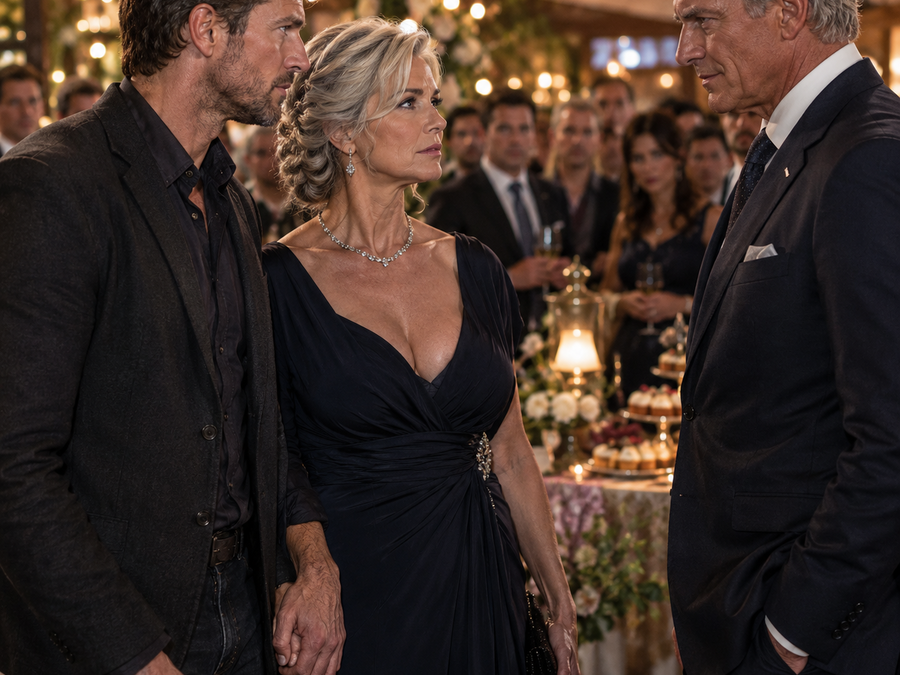
He saw Viven before she saw him. She was near the front of the room in a dark dress that was probably worth more than his truck, but didn’t perform the fact, just fit her well and let her be herself, which Cole had come to understand was the only way she was willing to dress at this point in her life.
She was talking to the food bank director with the specific attentiveness she brought to conversations she decided mattered, and she looked composed and controlled, and like a version of herself that was holding a lot of things carefully. Then she turned and saw Cole walking through the room toward her, wearing the wedding jacket with the imperfect press, and her expression changed so fast and so completely that the food bank director turned to see what she was looking at.
Cole reached her. “You came,” she said. “I said I might.” “You said you don’t do galas.” “This isn’t really a gala. There are twinkle lights.”
Something in her face. The careful composure softened at the edges. “You look—the jacket is 4 years old and I ironed it badly.” He said, “I’m aware.” “You look good.” She said and said it simply without hedging, which was the only way compliments from her ever worked.
He stood beside her and they talked to the food bank director, whose name was Robert, and who was visibly moved by the donation in a way that was entirely genuine and slightly uncomfortable for everyone, which was the particular quality of real gratitude in a room full of people more accustomed to performed gratitude.
Cole shook Robert’s hand. Viven deflected the thanks with the practiced ease of someone who had learned that accepting gratitude gracefully was its own skill. They found a spot near the wall where the noise was slightly less dense and stood close enough that their arms touched, which neither of them acknowledged, and both of them noticed.
“How’s Patricia’s beonia?” Cole asked. Vivien’s mouth curved, “Thriving, apparently. She has a genuine gift. Multi-talented. I look for that in security personnel.”
A couple Cole knew, the Hendersons from Mill Road, whose deck he’d repaired in February, stopped to say hello, and Cole introduced Viven with her name only. No explanation, and the Hendersons were friendly and curious in the mild, uncomplicated way of people, who hadn’t yet connected her name to anything larger.
Viven was gracious and warm in a way that wasn’t performance, or at least wasn’t only performance. She asked Margaret Henderson about the garden she’d mentioned, and Margaret lit up, and the conversation went 3 minutes longer than it needed to because people always expanded when someone listened to them like that.
When the Hendersons moved on, Cole looked at her. “You’re good at that.” “At what?” “People,” he said, “making them feel like the conversation matters.” “It does matter.” “I know, but most people you’re in your position don’t act like it does.”
She looked at the room. “I spent 20 years in rooms where the conversation was always instrumental. Everyone talking because they wanted something or needed to position themselves for something. After a while, you forget what it feels like to just talk.” She paused. “I remembered coming here.”
Cole was about to say something when the room shifted. He felt it before he saw it. The particular atmospheric change of a room when someone enters who requires the air to rearrange itself. Several people near the entrance turn to look. A small pocket of uncertainty moved through the crowd like a ripple.
Then Cole saw him. Graham Voss was exactly what Cole had imagined, and somehow worse. He was in his mid-60s, broad-shouldered, the kind of man who had been handsome 30 years ago, and had maintained himself with the determination of someone who considered appearance a professional asset.
He wore a suit that hadn’t been ironed. It had been handled by people who knew how. And he moved through the room with the exact deliberateness of someone who had calculated his entrance.
Cole felt Viven go still beside him. Not a physical stillness. She didn’t flinch or step back. Just something internal, something in the quality of her attention that shifted from the party to something much older and more alert.
“He’s here,” Cole said quietly. Not a question. “Yes,” she said. Same quiet. “Did you know he was coming?” “No.” A beat. “Patricia would have—” She stopped, pulled out her phone, looked at it briefly. Cole saw a text notification on the screen. “She’s outside. She saw him arrive. She’s calling the sheriff’s non-emergency line.”
Cole looked at Graham Voss moving across the room unhurried, deliberate, the practiced pace of someone who wanted to be watched and thought about what Viven had said. “He wants an audience. He wants the takedown witnessed.” He was about to get one, just probably not the kind he was expecting.
Graham reached them up close. He was more studied than imposing, the attentiveness of a man who had prepared for this, who had decided what he was going to do, and was now executing it with the confidence of someone who had never been significantly stopped. He looked at Cole first briefly, the once over, of someone assessing an obstacle. Then he looked at Viven.
“Viv,” he said, easy, familiar. The name is territory. As if familiarity was ownership. “Graham,” her voice was flat and clean. She didn’t move, didn’t step toward him, didn’t step away, just stood where she was.
“I heard you were here,” he said it pleasantly. “You should have called when you were in the area. We could have—” “I’m not in your area,” she said. “I live here.”
Small smile, he turned his gaze to Cole. “And you must be the carpenter,” he said. The way he said it was practiced, not contemptuous exactly, which would have been too obvious, but carpenter loaded with a weight that was meant to be felt.
“Cole Barrett,” Cole said. He didn’t extend his hand. He just held Graham’s gaze and said his own name plainly, which was its own kind of answer. Graham looked him over, the jacket, the calloused hands, the face that had been described once as handsome in a tired sort of way.
He was doing the calculation. And Cole could see it, measuring the gap between them in money and background and influence and deciding that it was the kind of gap you could use.
“Viven,” Graham said, turning back to her. “I think we should talk privately. There are some things—” “There’s nothing,” she said. “Viv, don’t call me that.” Quiet but very clear. His jaw tightened fractionally.
“We have a history, a long one. And I think you’re making a decision.” He glanced at Cole again. “A certain kind of decision in a certain kind of place without thinking about what it means for your actual life.” “My actual life is here,” she said, right now. “This is it.”
The room had gotten quieter around them. Not silent, the party noise continued, but the people in their immediate vicinity had registered something was happening, the way crowds do with the particular animal awareness of social danger. Cole felt that awareness spread, felt people looking.
He thought about his son, thought about Eli somewhere in this room with Cole’s mother, probably eating something from the dessert table and annotating the experience mentally for later report. He thought about what Eli would see if he looked over here.
Then Graham looked at Cole with the deliberate attention of someone about to do something he’d planned. “People in this town should probably know,” Graham said at a volume calibrated for the room, “that they’re watching Viven Carrington. As in Carrington Meridian Group.” As he named a number, a real number, the kind attached to a net worth. He said it conversationally like a person sharing useful public information.
The ripple moved through the room immediately. Cole watched faces change. Watched Margaret Henderson’s eyes go wide and then dart to him. Watched Robert from the food bank recalibrate in real time. Watched the particular town-wide recalibration of people who had just been handed information that reclassified something they thought they understood.
Graham let it land, then he kept going. “She told you who she was?” he said to Cole. “Or rather to the room using Cole as a prop.” “Did she mention the board seats, the properties, the entire corporate structure she walked away from?” Another pleasant smile. “Or did she just show up and playhouse?”
Cole said nothing. “I looked you up, Mr. Barrett,” Graham said. “Carpenter. One repair job at a time by the look of it. Truck that probably needs more work than it’s worth. House you’re still paying the note on.” Each item landed like a brick, measured and placed. “Nice story about the wife. I read about that in the county obituaries. So sorry for your loss. And the boy. Boy’s eight, nine. Smart kid, I hear.”
Cole felt something move through him. Not rage exactly, but something below rage. Something more fundamental. The mention of Eli. The deliberateness of it. He breathed and thought about his son.
Graham hadn’t finished. “You’re a broke widower.” He said it was almost gentle. “Playing house with a woman who could buy this entire town twice and tip on it. And when she gets tired of it, when she goes back to her actual life, you’ll be right here fixing somebody else’s kitchen.” A pause. “Is that what you want for your kid? This story.”
The room was quiet enough now that you could hear the twinkle lights if you concentrated. Cole stood still. He felt Vivien beside him, felt her controlled fury, felt her about to say something, and he moved his hand to her arm, not restraining her, just, “I’ve got this.”
He looked at Graham Voss and thought about every choice that had led to this room. Not bitterly, just clearly, seeing them in a row, like boards you’d cut and fit and fastened. “You’re right about most of that,” Cole said. Not loudly. He didn’t need to be loud. The room was listening.
“Truck needs work. I’ve been putting it off. The house has a mortgage. I’ll be paying for another 18 years if nothing changes and probably longer if something does. My wife is dead. My son is 8.” He paused. “You did your research.”
Graham looked like a man who had expected a different kind of response and was now recalibrating. “What you got wrong,” Cole said, “is the frame.” He wasn’t performing composure. He was actually composed, which was different. And people in rooms can tell the difference.
“You looked up everything about me that costs money or takes money or used to have money attached to it. The truck, the house, the job.” He looked at Graham steadily. “But you didn’t look up whether I’m a good father. Whether my son has a good life. Whether the people I care about would walk through a bad situation for me.”
Beat. He turned slightly enough that he was looking at Vivien rather than Graham. And he held out his hand. She took it. Not as a statement, not as performance. She just reached out and held his hand the way you hold on to something that’s been solid when things weren’t. And her grip was firm and not entirely steady, which was the most honest thing about it.
He turned back to Graham. “You wanted her to feel like she chose wrong,” Cole said. “That’s what this whole thing is. The calls, the lumberyard, tonight. You wanted her standing in a room full of people feeling like she made an embarrassing mistake.”
He looked at Graham with the same mild steadiness he’d maintained throughout. “But she knew who she was picking. She knew before she picked, and she picked anyway.”
The room was very quiet. Graham’s composure had thinned in a way that was visible to anyone paying attention, the smoothness gone slightly ragged at the edges, the jaw a little tighter than he’d meant. He looked at Vivienne with something that had dropped its pretense of pleasantness.
“Vivien,” he said. “This is over,” she said. And then to the room, to everyone who had been standing in the particular uncomfortable silence of people watching something real happen. “Cole Barrett is not with me because I have money. He was with me for 2 months before he knew I had any.” She looked at Graham. “And that is something you will never understand because you have never in your life been able to tell the difference.”
Graham’s hands opened and closed at his sides. “This isn’t—” He caught himself. Looked at Cole with something different now. Not performance, not strategy, just the raw frustration of a man whose plan had not gone the way he’d written it. “You think you know what this is? You think this—” He stepped forward.
Cole didn’t step back. And then there was a hand on Graham’s arm, not Cole’s hand, not Viven’s. And Cole looked over to see Warren Hail, who was Asheford Creek’s sheriff and had attended this gala every year for 15 years, and who had the particular quality of very large, very calm men who only have to move once for the whole room to understand something.
“Mr. Voss,” Warren said pleasantly, firmly, “I’m going to ask you to step outside.” Graham looked at Warren, looked at Cole, looked at Viven, whose expression had the quality of someone who had been holding something for a very long time and had just set it down.
“I have every right—” Graham started. “You’re welcome to explain that to me outside,” Warren said. “I’ve had a call about some concerns. We can talk through those.” He didn’t move Graham. He just stood there, which was enough.
Graham Voss, the man with the research and the calculated entrances and the vocabulary designed to diminish, looked around the room at the faces of people he didn’t know in a town he’d never been in before tonight, watching him get walked out like a disruption at a school event. He left.
Warren went with him, one hand hovering at the appropriate professional distance near Graham’s elbow. The room exhaled. Someone started talking, then someone else. Party noise rebuilt itself around the space where the silence had been. The way water fills a hole in sand quickly and completely, leaving almost no evidence of the gap.
Cole felt Vivien’s hand still in his. He looked at her. She was watching the door where Graham had gone, her expression unreadable in the way things are unreadable, when too many feelings are arriving at once and none of them have processed yet. “You okay?” he asked. She took a breath. “Ask me in 10 minutes.” “Fair.” He didn’t let go of her hand. She didn’t let go of his.
Robert from the food bank appeared beside them with a slightly shell shocked expression and two glasses of water, which he offered with the uncertain manner of a man who’d just witnessed something significant and was responding in the only way his body could think of. “Thank you,” Vivien said, and took the water with her free hand.
From across the room, Cole spotted his mother near the dessert table. And beside her, Eli standing very straight, watching Cole with those steady, too perceptive eyes he’d gotten from Karen. Cole met his son’s gaze. Eli gave him a small nod. The nod of someone who had watched something happen and had made up his own mind about it.
Cole exhaled, a slow, complete breath, the kind that carries something out with it when it goes. He looked down at Viven’s hand in his. Her grip had eased but not released, the grip of someone choosing to stay rather than someone holding on out of need.
Margaret Henderson appeared next. Then someone Cole knew from the school board. Then two women Vivienne had met through the literacy program. People arriving in ones and twos the way they do after something like that. When the smoke clears and people remember which side they’re on. There was no fanfare about it. No formal announcement of allegiance. Just people who had watched two human beings stand their ground in a hard moment and had decided quietly that they were in favor.
Outside, Cole knew Warren Hail was having a professional conversation with Graham Voss. Warren had been briefed, Vivien’s lawyers had made sure of that, a quiet notification to local law enforcement about a protective orders situation that might require attention. Graham had walked right into a room where the infrastructure was already in place to handle him. He just hadn’t known.
The gala continued. The twinkle lights stayed on. The food bank’s numbers for the evening were going to be the best they’d ever recorded. And Robert kept looking at Viven with the glazed gratitude of someone who couldn’t quite believe his luck.
Cole got a plate of food eventually because he hadn’t eaten. And his body informed him of this with the blunt practicality of a body that has been running on adrenaline for 40 minutes. He stood near the wall and ate something with pastry crust that turned out to be filled with vegetables, which was fine. Viven stood beside him.
“Are you going to tell me I handled that wrong?” she asked. “No,” he said. “I was very, you were exactly right,” he said. She looked at her water glass. “I’ve been letting him set the terms for 2 years, letting his version of things be the version I was responding to.” A pause. “I’m tired of responding.” “Yeah,” Cole said. “I know the feeling.”
She looked at him. “Does your jaw hurt?” “You were clenching it.” “Probably.” He hadn’t noticed. He rubbed a hand along his jaw. “Little bit.”
“You should have hit him,” Eli said, appearing from nowhere at Cole’s elbow with a plate of cookies and the serene authority of a child who had thought about this carefully. “Eli,” Cole said. “I’m not saying you should have. I’m saying I thought about it, and it would have felt good,” Eli said with the moral precision of someone distinguishing between fantasy and advocacy.
Vivien looked at the boy. “I thought about it, too,” she said. Seriously. “The cookie helps.” Eli considered her. Then he held out his plate, took one. “Thanks,” she said. “You’re welcome,” he said.
And then, with the conversational pivot of an 8-year-old who had processed what he needed to process, and was ready to move on. “Did you know there are moths in the lights, like living in the fixture? I counted four.” “I did not know that,” Vivian said. “It’s interesting,” Eli said. “They’re not hurting anything. They just like the warmth.”
Cole watched his son point out moth activity in the ceiling fixtures to the woman standing beside him. And the three of them stood in the warm light of the Hargrove estate while outside Graham Voss explained himself to a county sheriff who had been doing this long enough to recognize the shape of a man who had run out of moves.
Cole ate the rest of the pastry thing. Viven finished her water. And the night that had been aimed at breaking something turned out instead to be the thing that confirmed it.
Warren Hail called Cole at 8:15 the following morning. Cole was already up. He’d barely slept, which was not surprising given that his body had been running on adrenaline since roughly 9:00 the previous evening, and had apparently decided that the comedown from that required lying awake in the dark, thinking about everything at once.
He was on his second cup of coffee when the phone rang, standing at the kitchen window, watching the frost on the grass catch the early light, which was the kind of thing he noticed now in a way he hadn’t 6 months ago.
“Graham Voss left the county last night,” Warren said without preamble, which was Warren’s way. He was a direct man who had been doing a complicated job for a long time and had decided that directness was more respectful of everyone’s time than the alternative. “Drove to Charlottesville, flew out this morning. Private charter.”
“You tracked him?” Cole asked. “We kept an eye on him after the gala. Given the existing protective order situation in the conduct last night, we had reason to.” A pause. “He didn’t do anything technically criminal last night, Cole. What he said was ugly but legal. The harassment pattern over the past weeks, the calls, the person at the lumberyard, that’s where Ms. Carrington’s lawyers are going to find their footing. They already are.”
Cole said he knew because Viven had been on the phone with her legal team until nearly midnight, and he’d sat in her kitchen at the Caldwell house while she did it, drinking bad decaf she’d made without burning, only because it involved hot water and a pod machine, listening to the half of the conversation he could hear, and filling in the rest.
“Good,” Warren said. “I’d encourage them to move fast. Men like Voss, they don’t usually fold after one public moment. They regroup.” “I know.” “You handled yourself well last night,” Warren said. Compliment was delivered in the same flat register as everything else he said, which made it land more honestly than if he’d dressed it up. “I’ve seen that situation go a lot of different ways.”
“I had motivation to not make it worse,” Cole said. “Your boy was there.” “My boy was there.” Warren said he’d be in touch if anything developed and hung up with the efficiency of a man who had six other calls to make.
Cole set his phone on the counter and looked at his coffee and thought about Graham Voss on a private charter out of Charlottesville and felt something that wasn’t quite relief and wasn’t quite the absence of it either. More like the particular awareness of a problem that had changed shape without fully resolving, still present, just different now.
Eli came downstairs at 8:40 with his hair on one side and his amphibian notebook tucked under his arm, which meant he’d been awake for a while already, probably reading, and had come down when he heard Cole moving around. He poured himself cereal with the practiced independence of a kid who’d been feeding himself breakfast since he was six, added too much milk in a way that always resulted in a puddle that Cole was going to end up wiping up, and sat down across from his father.
They ate in silence for a bit. Then Eli said, “Is she okay?” Cole looked at his son. “She’s okay.” “The man last night was trying to embarrass her.” “Yes,” Cole said. “He was.” Eli stirred his cereal. “Did it work?” “No,” Cole said. Eli nodded, satisfied. “Good.”
He ate for another minute. “He knew a lot about us.” It wasn’t an accusation. It was an observation. Eli processing something that had bothered him and working through it at his own pace. The way he worked through everything with the methodical patience of someone who needed to understand the shape of a thing before he could set it down.
“He did,” Cole said. “He had people who found information. It’s a thing certain people can do when they have money and want to control situations.” Eli thought about this. “That’s a bad use of money.” “Yeah,” Cole said, “it is.” “Does Vivian know he knows stuff about us?” “She knows. Her lawyers are dealing with it.”
Another silence. Eli pushed cereal around. “Is she going to leave?” He asked. Casual in tone, not casual in content. The question of a child who has lost one person and knows exactly how it feels and is not going to pretend he doesn’t.
Cole set his cup down. He looked at his son directly the way Eli deserved to be looked at when the question was real. “No,” he said. “She’s not planning to leave.” “But she might,” Eli said, “if she thought it would keep us safe.” Cole was quiet for a moment. Eli was right. That was exactly the kind of thinking Viven did.
And Cole knew it. He had seen her turn something over in her mind the night before, sitting in her kitchen after the lawyer’s call ended. A specific kind of quiet. That was the quiet of someone calculating. “She might think about it,” Cole said honestly. “But I’m going to talk to her today. Tell her we don’t want her to.”
“Eli said simply. No drama.” “I was planning on it.” Eli looked up from his cereal. “Tell her I specifically don’t want her to,” he said. “Cuz sometimes when adults say we, they mean themselves, and the kid is just there.”
Cole looked at his son for a moment. “I’ll tell her you specifically.” Eli nodded and went back to his cereal, satisfied that this had been adequately handled, and Cole sat across from him and felt the specific painful gift of raising a child who was honest about what he needed. Painful cuz it left nowhere to hide, and a gift for the same reason.
He drove to the Caldwell house at 10:00. Vivien answered the door in the clothes she’d clearly slept in or tried to sleep in, which told him everything about how the night had gone for her. Her hair was uncombed. She had a mug of something tea again, and she looked at him with the slightly raw expression of someone whose armor had been off for a few hours and hadn’t been fully reassembled.
“You didn’t call first,” she said. “Would you have told me not to come?” “Pause.” “Probably.” “That’s why I didn’t call.” She stepped back and let him in.
The house felt different in the morning, smaller, more personal, stripped of the careful presentation it had when she was fully herself. The living room had papers on the coffee table from last night’s calls, and one of her good shoes was in the middle of the floor without its partner. Cole didn’t comment on any of it.
He followed her to the kitchen, where she topped off her mug from a kettle and didn’t offer him coffee, which meant she was distracted enough to forget. He found the coffee she kept for him. She’d started keeping it about 3 weeks ago without either of them acknowledging that this was what they were doing, and made his own. They sat at the kitchen table.
Vivien wrapped both hands around her mug and looked at the table and said, “I’m thinking about going back to New York for a while.” Cole had been expecting it. He’d been expecting it since Warren’s call that morning, maybe longer, since the moment at the gala when he’d seen her watching Graham get walked out and recognized the particular look on her face. The look of someone calculating collateral damage.
“How long is a while?” he asked. “I don’t know,” she looked up at him. “Long enough for the legal situation to get fully resolved.” “Long enough for whatever Graham is planning next to happen in a context where it affects me directly rather than—” she stopped. “Rather than affecting me and Eli,” Cole said. She didn’t deny it.
“He’s not finished. Warren’s right. He’ll regroup. And when he comes back, it won’t be as obvious as walking into a town event and saying terrible things in front of everyone. He’ll find a different angle, something that looks like it has nothing to do with him.” She set her mug down. “I know how he works. I’ve watched him work.”
“And you think the angle he’ll find is through us.” “I think you and Eli are the most exposed people in my life right now. Everyone else I’m connected to has resources, lawyers, their own protections. You have—” She looked at him in a way that was honest to the point of difficulty. “You have a small carpentry business and a mortgage and an 8-year-old.”
Cole looked at her. “Say what you actually mean.” She exhaled. “I mean, you don’t have the infrastructure to fight someone like Graham Voss if he decides to make it personal. And I am not going to sit in New York while he makes it personal.”
“So you leave,” Cole said. “He wins.” “He doesn’t win. He just—” “He wins,” Cole said again, not harshly, just factually. “Vivien, I understand what you’re doing. I know why you’re thinking it. But you leaving Ashford Creek because Graham Voss walked into a room is Graham Voss determining where you live and who you’re with. That’s exactly what he wants.”
“It is,” he said. She was quiet. He could see her working against it. The logic pulling one way, the instinct to protect pulling another. This was the thing about Viven that was genuinely hard. She was smart enough to see multiple angles and had enough self-awareness to know when she was rationalizing. That self-awareness didn’t always tell her which version of herself was the one doing the rationalizing.
“Eli wants me to tell you specifically,” Cole said, “that he doesn’t want you to leave.” She looked up. “You talked to Eli about this?” “He brought it up. He wanted me to be clear that when I say we want you to stay, I mean both of us separately and not just me using the word we to represent myself.”
Something moved in her face. Not a smile. The situation wasn’t quite a smile, but something softened in it. “He said that almost exactly.” She was quiet for a moment. Cole watched her. She was doing the things she did when she was genuinely thinking rather than just buying time. Very still, eyes unfocused, processing.
“I’ve been taking care of things alone for 30 years,” she said finally. “Every time something threatened my life or my company or my people, I was the one who managed it. I didn’t share the weight because sharing the weight meant someone else got hurt by it. That’s—” She stopped, started again. “That’s been my pattern. Not because I wanted to be isolated. Because being isolated kept the target small.”
“I know,” Cole said. “This is different. You and Eli are—” She looked at her hands. “You’re not in my professional orbit. I can’t protect you the way I can protect my board members or my lawyers. Can’t put security on you without it becoming—” She shook her head. “It changes what we are if I start managing your safety like a corporate asset.”
“Then don’t manage it like a corporate asset,” Cole said. “Manage it like a person who is in something complicated with another person.” She looked at him. “I’m not asking you to fix it,” he said. “I’m asking you to let me be in it with you. There’s a difference.”
Kitchen was quiet outside. The March morning was pale and cold. The frost from earlier still on the grass because the sun hadn’t fully reached this part of the yard. Cole could hear the refrigerator hum and the tick of a clock somewhere in the house that he’d noticed before and never identified.
“I don’t know how to do that,” Vivien said quietly. Not ashamed of it. She wasn’t a woman who was easily ashamed, but honest in the way she was honest when she’d stopped managing and was just talking. “I know how to direct. I know how to solve. I don’t—” A pause. “I don’t know how to just be scared with someone and let them stay scared with me.”
“You don’t have to know how,” Cole said. “You just have to not drive away.” She looked at him for a long moment.
“My lawyers are going to file for a formal expanded protective order this week,” she said. “Based on the harassment pattern and last night’s conduct, the Ashford Creek incident gives them documented public behavior to work with. Graham will push back through his own lawyers, which he can afford to do indefinitely, but it starts a formal record that limits his options.”
“Good,” Cole said. “Patricia is staying. Marcus is staying. I’m keeping them in place until the legal situation is fully established.” She paused. “And I’m calling someone I know at the county level to make sure Warren’s office has everything it needs to monitor the situation here.”
“Also good.” She looked at him. “I’m not leaving.” He held her gaze. “I know.” “I’m not—Cole, I want to be clear that I’m not staying because you talked me out of it. I’m staying because you’re right and because Eli is right and because I have been running from Graham Voss’s version of my life for 2 years and I’m—” Her voice went flat in the way it went flat when she was suppressing something she’d rather not show. “I’m done running.”
“Okay,” Cole said. “I just need you to understand that this is going to get harder before it gets easier. He’s not finished.” “I know he’s not finished,” Cole said. “I’m not finished either.”
She exhaled a real one, the kind that takes something with it, and looked at him with the unguarded expression she only had when she’d stopped trying to control how she looked. “Your coffee is getting cold,” she said. “I made it 2 minutes ago.” “Still,” he picked up his cup.
She picked up her mug. They sat at the kitchen table in the cold morning house and drank their respective beverages, and it wasn’t romantic, and it wasn’t resolved, and it was exactly the right thing.
March became April the way seasons do in Virginia, incrementally with setbacks, cold mornings that insisted on themselves even as the afternoon started to soften. Vivien’s lawyers filed the expanded order. Graham’s lawyers responded with a detailed counter-filing that was, according to Vivien’s attorney, exactly what they’d expected and exactly what they’d prepared for. The legal machinery ground forward in the way legal machinery does, slowly and with significant paperwork.
Graham himself was quiet. That wasn’t comfort. Cole and Vivien both understood that his quiet was the quiet of someone repositioning rather than retreating, but it created space. Breathing room. Weeks that didn’t have the specific tension of the weeks before the gala.
Cole’s work picked up in April the way it always did in spring. People emerged from winter with a list of things they’d been meaning to fix since November and a renewed sense that this was the year they were actually going to fix them. He had three active jobs through the month and leads on two more. And he worked with the focused efficiency of a man who had a reason to build his business into something rather than just maintain it.
He hadn’t spoken aloud about the construction company. Not to Viven, not to anyone. It was a thing he’d been carrying for years, the plan he and Karen had made when they were young, and building things together seemed like a natural extension of who they were. And after Karen died, he packed it somewhere internal and stopped looking at it. It felt like a thing that had belonged to that version of his life, the version with Karen in it. And accessing it felt like it required permission he hadn’t figured out how to give himself, but it was there. It had always been there.
In the second week of April, Vivien asked him about it. They were in his shop. She came to the shop sometimes now. When she was in between literacy sessions and didn’t feel like being at the Caldwell house, which she’d started describing as the rented house rather than my house, a shift he’d noticed.
She sat on the stool near the workbench and drank coffee from a travel mug she’d started bringing from home because she decided Cole’s shop coffee was, in her words, a punishment. Cole was working on a set of cabinet doors for a kitchen job across town. The particular repetitive precision of fitting hinges that required enough concentration to keep his hands busy, but not enough to stop his mind from working.
“When you were apprenticing,” Viven said, “Before the repair work, what were you planning to do eventually?” Cole glanced at her. “Who told you I apprenticed?” “You mentioned it once briefly.” He looked back at the cabinet door. “General contracting. Custom builds. My own company eventually.”
“What happened to that?” A pause. He set down the screwdriver and picked up a different one. “Life happened to it,” he said. Not a complaint, just things changed direction. “Things are you.” He looked at her. “Both, probably.”
She held her mug with both hands and looked at the cabinet doors lined up against the wall with the deliberate attention of someone who actually understood craft. She’d been in this shop enough times to have started recognizing quality. She’d asked him once with genuine curiosity how he could tell a good joint from a bad one at a glance and he’d spent 20 minutes explaining it and she’d listened the whole time.
“Is it something you still want?” she asked. He was quiet for a moment. Question was simple and it wasn’t simple. “Yeah,” he said. “I still want it.” “What would it take?” “Capital,” he said. “Equipment I don’t have. A truck that doesn’t shutter. Crew eventually. Insurance at a different level.” He paused. “Time to build it instead of just working.”
Vivien was quiet. Cole kept his eyes on the cabinet door. “I’m not asking you to fund it,” he said before she could say anything. “I know.” “I’m serious, Vivien.” “I know you are.” She wasn’t offended. She set her mug down on the workbench. “I’m asking because I want to understand what you want, not because I’m planning to write a check.”
He looked at her. She met his gaze steadily. She wasn’t managing him. She was just asking. “It’s something I want to build myself,” he said. “The whole point of it. If someone funds it, it’s not mine. It’s a thing someone gave me.”
“I understand that completely,” she said. And she did. He could hear it. The woman who had built something from the beginning and never let anyone forget that she’d built it herself.
“What if there were other ways to help that weren’t funding? Contacts, referrals, people who need significant construction work and need someone reliable.” Cole looked at her for a moment. “That’s a thin line.” “It’s a line,” she said. “Whether it’s thin is a judgment call.”
