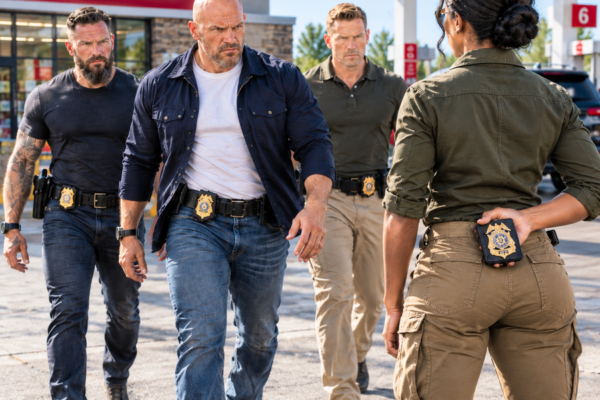
Black Belt Son Demanded a Fight —Unaware the Single Dad Led the Most Dangerous Hells Angels Gang
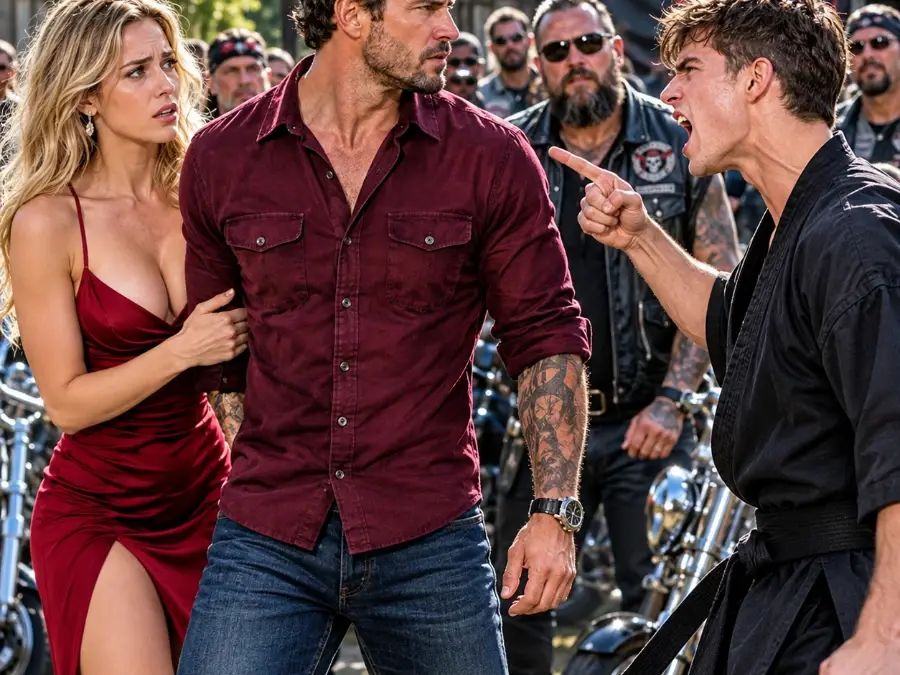
Black Belt Son Demanded a Fight —Unaware the Single Dad Led the Most Dangerous Hells Angels Gang
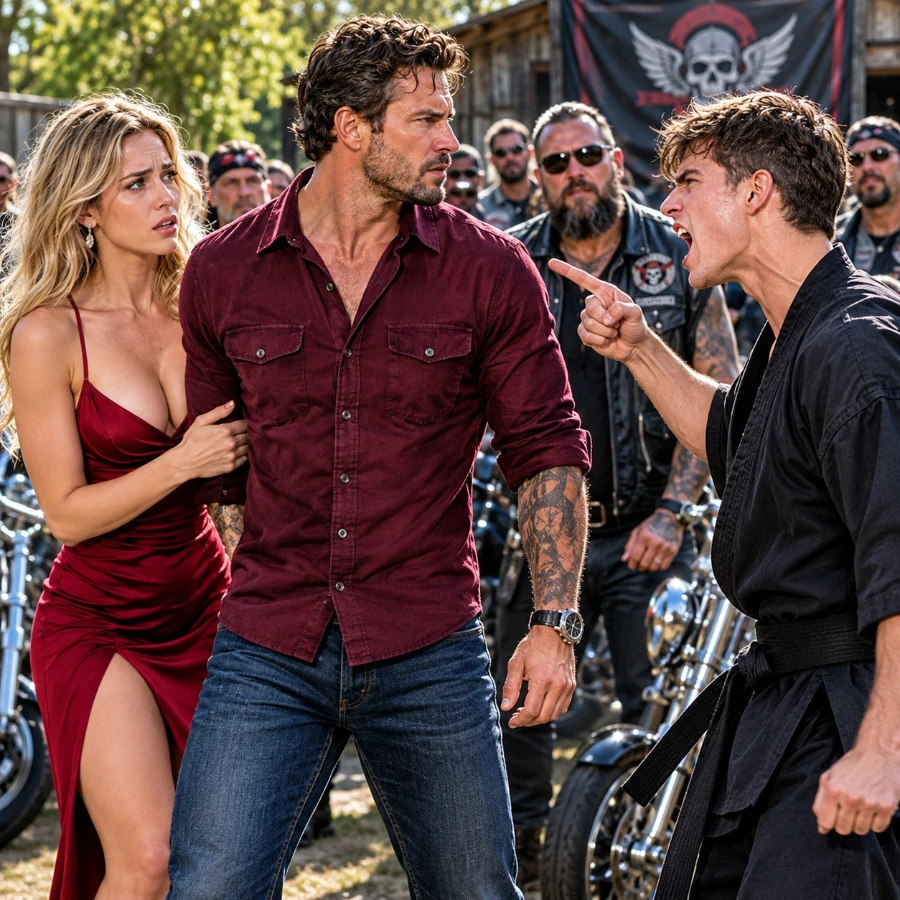
Take them up.
One fight, right here, right now.
Walk away. You put your hands on me in front of witnesses.
Now you want to leave?
My son’s a state champion.
Think carefully.
Your father only acts tough when nobody’s watching.
Step back. Smart man, keep the jewelry safe.
End this quickly.
I’ll drop you in front of your daughter.
Travis Kessler had never lost a fight he started.
A state title, a black belt, a father who erased consequences, nothing had forced him to reconsider his odds.
So when he threw those gloves at a mechanic’s feet and announced exactly what he planned to do in front of half the neighborhood, he meant every word.
He didn’t understand that those words were the most dangerous thing he’d said all day.
The man he was threatening didn’t flinch, didn’t raise his voice, just removed his watch and handed it off.
What exactly was Travis Kessler about to find out?
If this is the kind of story you want more of real consequences, real character, make sure you’re subscribed so you don’t miss what comes next.
The morning routine at Roark Cycle Works began before the sun cleared the mountains.
Damon would unlock the garage at 6:00, start a pot of coffee, he’d drink half of and spend the first hour going over whatever bike had been left the night before.
By 7:00, he’d walk back into the house, knock twice on Tessa’s door, and have breakfast ready before she finished getting dressed.
She was 16 now, old enough to make her own toast, but he did it anyway. Some habits formed without anyone deciding to form them.
Cedar Ridge was the kind of small Washington town where people noticed if your truck wasn’t in the driveway by 9:00.
Neighbors knew Damon repaired motorcycles, kept irregular hours, and raised his daughter alone.
Beyond that, they didn’t know much because Damon didn’t offer much.
He wasn’t unfriendly.
He’d wave, hold a door, show up when somebody needed a hand moving furniture.
But he kept conversations short and surface level, and after a few years, people stopped expecting anything deeper.
They’d filled in the rest of the picture themselves, quiet widower, hard working, keeps to himself.
That picture was accurate as far as it went.
What it didn’t include was the phone Damon kept in the bottom drawer of his workbench, the one that buzzed with messages he never read in front of Tessa.
It didn’t include the fact that three different businesses in the county had quietly resolved serious disputes after Damon made a single call.
And it didn’t include Black Ridge chapter, whose name alone was enough to make grown men in biker communities across the Pacific Northwest choose their words carefully.
Damon had led that chapter for 11 years.
He had not done so by being the loudest man in the room. Tessa had her own version of not asking.
She’d noticed things over the years, the hum of unfamiliar engines idling outside at odd hours, the way her father always positioned himself with his back to the wall in any restaurant they entered, the faded ink running down his forearms that
he never explained and she never questioned.
She wasn’t naive.
She was 16, not six, and she was her father’s daughter.
But there was an unspoken arrangement between them.
She didn’t push, and in return, their life in Cedar Ridge stayed uncomplicated.
She understood in the way teenagers understand things they can’t fully articulate that some questions changed everything permanently once asked.
The Kesslers arrived in early June and immediately altered the temperature of the street.
Roland Kessler had the kind of confidence that came from decades of watching money solve problems other people couldn’t.
He’d built his freight and warehousing company from a single truck he’d driven himself at 22 and somewhere along the way he’d stopped distinguishing between situations that money could fix and situations that required something else entirely.
He was not a stupid man.
That was part of what made him dangerous.
He was a man who’d been right often enough to stop seriously entertaining the possibility that he might be wrong.
His son, Travis, was 23, built wide through the shoulders, and moved through the neighborhood with the ease of someone who hadn’t yet encountered his body couldn’t handle.
He’d won a state-level kickboxing title the previous winter and treated his black belt the way some men treated expensive watches, always present, always visible.
He wasn’t entirely without substance.
He worked hard in the gym and took his training seriously.
But Travis had grown up in a world where Roland’s money insulated him from consequences, which meant he’d never had to develop the skill of reading a room for actual danger versus perceived danger.
He could read aggression.
He could not read restraint.
It started the way these things usually start, with small provocations that were almost easy to ignore.
Travis and his friends gunned their engines late at night, parked sideways across the shared turnaround at the end of the street, and generally conducted themselves as though their entertainment took priority over everyone else’s quality of life.
Damon ignored it.
He had a shop to run, a daughter to take to school, and no interest in becoming the neighborhood’s unofficial conflict resolution service.
Then came the afternoon.
Tessa was out front.
She’d been cleaning the old Sportster Damon had been slowly restoring since spring, a project she’d helped with, then cared about, then quietly claimed as her own in the way teenagers claim things that give them a sense of real competence.
She had her headphones in and was working a cloth along the gas tank when Travis and two of his friends came down the sidewalk.
They slowed without stopping the way people do when they’ve decided to manufacture a confrontation out of nothing.
When Tessa didn’t react to whatever Travis said, he reached over and pulled the headphones from around her neck and let them drop on the concrete.
She bent to pick them up and he put his hand flat against her shoulder and pushed her into the side of the bike. Damon came out of the garage.
He set down the wrench he was holding, without hurrying, walked through the door, and positioned himself between his daughter and the three young men with the particular directness that doesn’t require size to communicate intent.
Travis was taller, Travis was younger, and Damon looked at him the way you look at a problem you’ve already worked out.
He told Travis not to touch her again.
That was all he said.
Travis looked at the oil stains on Damon’s jeans, at the worn-out shirt, at the hands that had spent the morning turning bolts.
He laughed.
In Travis Kessler’s understanding of the world, real danger announced itself.
It raised its voice, postured, told you what it planned to do.
This man was doing none of those things. Travis concluded with complete confidence that the calm was fear and that reading felt good enough to walk away on.
He collected his friends and left still talking.
The second incident happened 4 days later in almost the same spot.
Travis returned with more of his friends and a more rehearsed energy. Louder angled at an audience.
When Damon stepped out and quietly asked them to move along, Travis grabbed him by the collar.
He was listing his credentials, his training, his title, the specific things he was capable of when Damon’s right hand closed around his wrist.
His weight shifted and Travis found himself on one knee on the pavement before he’d fully registered that he’d been moved.
It took less than 3 seconds. No punch was thrown, no threat was spoken.
Damon released him immediately and stepped back.
Travis stood up with concrete dust on his knee and told his friends he hadn’t been ready, that it didn’t count, that the man had gotten lucky with some cheap trick.
His friends nodded the way friends do.
But that night Travis lay awake replaying the mechanics of what had happened, not quite able to make them add up.
He’d felt his own technique fail before that happened in sparring.
What he hadn’t felt before was the certainty that the other person hadn’t actually tried.
Roland came to the garage 2 days later.
He arrived in a clean shirt with his arms crossed and informed Damon that Travis’s reputation had a value he wasn’t prepared to allow some mechanic to diminish.
Damon listened without interrupting. When Roland finished, Damon said they had nothing else to discuss.
Roland left with the stiffness of a man who’d expected a different conversation.
And on his way out, he mentioned as though it were a minor detail that he had relationships with the city council, with commercial lenders, and with every major property owner within a quarter mile. He said it the way people say things they want to pretend are not threats.
Damon went back to work.
The summer festival at Cedar Ridge Community Park was a long-standing tradition, food stalls along the path, families spread across the grass, the kind of organized neighborhood warmth that made the town feel genuinely cohesive for one afternoon.
Damon had attended every year since Tessa was old enough to eat a corn dog without catastrophe, and he arrived with no intention of anything other than walking the circuit with his daughter and going home. Travis appeared 40 minutes in.
He came with four men from his gym, all of them in training gear, and he walked through the crowd without adjusting his pace for the families around him.
He was carrying a pair of sparring gloves, and when he reached the open stretch of grass near the center of the park, he stopped in front of Damon and dropped them at his feet.
The sound wasn’t loud, but the crowd heard it anyway, and the nearest conversations went quiet in that particular way they do when people recognize that something real is about to happen.
Travis announced clearly enough for two dozen people to hear that he wanted a fair fight, just the two of them, right there. Damon said no.
Travis turned to Tessa and said what he said, the line about her father only being dangerous when no one was watching.
It wasn’t a sophisticated insult.
It was calibrated to do one specific thing, make refusing look like cowardice in front of the one person Damon had spent years protecting. Then Travis said said he would put Damon on his knees in front of his daughter right there right now.
Damon looked at Tessa.
She recognized something in his face that she didn’t have a name for.
It wasn’t anger exactly.
Her father was not an angry man.
It was closer to the expression he got when he’d been quietly working through a problem for a long time and had finally arrived at the only answer that made any sense.
He unclipped his watch and held it out.
Tessa took it without being told the leather still warm from his wrist. He asked her to step back.
Then he walked into the open grass, stopped at a measured distance from Travis, and said the only thing he said before any of it began. One time.
After today, you stay away from my daughter.
Travis smiled, rolled his shoulders, and came forward.
He came in fast, the way fighters do when they’ve decided aggression is the answer to uncertainty.
His combinations were sharp. The crowd flinched back at the speed of the first sequence, a left jab into a right cross, into a low kick that landed with a sound that made people wince.
But Damon wasn’t where the kick expected him to be.
He’d shifted his weight a half step left before Travis had committed and the kick caught air.
The crowd hadn’t noticed the movement.
Travis noticed it enough to change his approach. He threw a head kick spinning fast, the kind of technique that won him points at tournaments.
Damon stepped directly into the arc of it inside the effective range close enough that the leg caught his shoulder rather than his skull and carried no real force.
Then Damon put his own shoulder into Travis’s chest and pushed a small push almost polite in its economy.
Travis stumbled back three steps and caught himself. He stood looking at the mechanic and understood for the first time since this started that something was fundamentally wrong with his read of the situation.
Travis shot in for a takedown.
Damon dropped his center of gravity in a way that suggested this wasn’t a response he had to think about.
It was a response his body made before the thinking could slow it down.
He let Travis’s momentum carry forward, turned inside it, and brought his weight across Travis’s back in a single controlled motion that put them both on the ground with Damon controlling the position completely.
Travis’s face was against the grass.
He could move his legs. He could not move anything that mattered.
He pushed and shifted and found nothing to push against.
Damon’s voice, when it came, was even.
He said the belt had taught Travis how to fight.
He He said it hadn’t taught him when not to.
Travis’s hand came down flat on the ground twice.
Damon released him immediately and stood, then took two steps back and straightened his shirt. That was the whole fight.
The park was quiet in the specific way it gets when people have witnessed something they don’t quite have language for.
Travis stood up slowly. His gym friends were very still.
Roland Kessler stood at the edge of the grass with an expression he was working hard to control.
A man in oil-stained work clothes had just put a tournament champion on the ground in under 2 minutes almost without striking him.
Roland moved fast to recover the moment. He demanded someone call the police claiming Damon had used illegal holds that his son had been attacked, that the whole thing was a setup.
Several people were already replaying their phone footage.
The video was unambiguous.
Travis had thrown the gloves. Travis had swung first.
Travis had continued after being warned.
Two officers stationed at the far end of the festival watched the footage on two separate phones and confirmed to Roland that nothing here constituted an assault charge. Roland argued.
The officers were patient and unmoved. Roland turned back to Damon as the crowd began to drift.
He said he would find out who Damon really was.
His jaw was tight and his voice had the particular flatness of a man storing something rather than letting it go.
Damon looked at him steadily and said, “Roland didn’t want to do that.
” Roland heard those words as a bluff, cataloged them as the kind of empty threat a cornered man makes, and walked away with his hand on Travis’s shoulder.
Within days, the festival video found its way into corners of the internet Damon didn’t visit, but others monitored carefully.
Messages began arriving on the phone in the bottom drawer. The one routed through a separate account checked maybe twice a week, kept specifically because it had nothing to do with the life he maintained inside the house.
The contact label read Blackridge President.
He hadn’t thought about it as a risk because it had never been a risk before.
Tessa had come to the garage to tell him dinner was ready.
She’d walked in quietly the way she did when she knew he was in the middle of something and she was standing just inside the door when he turned around with the phone still in his hand, screen visible.
He watched her read the contact label.
He watched her face go through something that wasn’t quite surprise.
It was closer to the look of someone completing a puzzle they hadn’t realized they were already solving.
All those small things over the years, the midnight engines, the wall-facing habit in restaurants, the ink on his forearms. They had just rearranged themselves into a shape that made sense.
She didn’t say anything.
She looked at the screen for one more second, then walked back into the house. The kitchen light came on.
Damon stood in the garage for a long time. The next morning she was at the table when he came downstairs, looking out the window rather than at her phone.
Damon poured coffee and sat across from her and let her choose when to begin.
She told him she’d known for a long time that he wasn’t just a mechanic.
She’d noticed enough over the years to understand that much.
What she hadn’t understood was when she’d made the decision to stop herself from asking.
She said that somewhere in that process process she had started helping him hide it from her without anyone asking her to, and that part wasn’t okay with her.
The words landed with more precision than anger would have.
Damon didn’t reach for an easy answer.
He said he’d wanted her to have a normal life.
She told him that had been his decision to make, not hers, and that she was old enough now to have been part of it. He said he knew.
Neither of them moved to end the conversation, but neither of them continued it, and after a while she picked up her bag and went to school.
Damon sat at the kitchen table until the coffee was cold.
Meanwhile, the video had reached Travis’s gym within those same few days of fun sauce after the festival.
His head instructor watched it three times without comment and then called Travis into his office.
He asked Travis to identify the moment Damon Roark had threatened anyone before the gloves hit the ground.
Travis couldn’t.
The belt was suspended pending review and two weeks later the review concluded that the suspension was permanent. A black belt carried an obligation the instructor said that Travis had not met.
The title wasn’t given lightly.
Neither was taking it back.
Roland, who had been building a different kind of counter-attack, didn’t learn about the revocation until after he’d already filed.
Through his retainer law firm, he submitted a formal complaint alleging that Damon’s association with a known motorcycle organization constituted an unsafe environment for a minor, that affiliated individuals around the residence posed a threat to a child’s well-being and that the court should review whether current custody arrangements remained appropriate.
It was carefully worded. Nothing in it was technically false and that was the most dishonest thing about it.
Roland had hired an investigator before filing.
What came back frustrated him.
Damon’s military records were partially sealed.
The few business owners who’d had dealings with Black Ridge chapter didn’t want to discuss it and said so in terms that made the investigator uncomfortable.
One contact, a freight forwarder in Spokane who owed Roland a favor, told him flatly to leave Roark alone and wouldn’t say anything else.
Roland was not accustomed to finding a wall he couldn’t buy through.
So he used what he had, the one vulnerability that the investigator had identified clearly. Damon Roark was a single father who had built his entire life around one person.
Every decision he’d made in Cedar Ridge pointed the same direction.
Roland had spent 30 years in business finding pressure points.
He recognized this one immediately.
Damon drove to pick Tessa up from her friend’s house the evening the documents arrived and told her everything on the way home without framing it, without softening edges, without offering justifications before she’d had a chance to form her own response.
He told her what Black Ridge was, what he led, what that meant, and why he’d kept it separate.
He told her about the filing.
When he finished, she looked out the passenger window for a while and then asked the question he’d been carrying since the night in the garage.
If all those other people had known who he was for years, why had she been the one person kept outside it?
There was no version of an answer that didn’t come back to a choice he had made on her behalf alone over and over again.
He didn’t try to construct one.
A temporary review was opened.
Damon’s attorney advised that any visible presence of motorcycle club members at the Cedar Ridge property during the evaluation period would be used against him.
Roland’s legal team was counting on exactly that.
Damon sat with it for 1 day. Then he got on the phone in the drawer and gave Black Ridge a direct order no one came to Cedar Ridge.
No retaliation. No contact with Roland or anyone connected to him.
No moves of any kind.
He told them this was not a request.
The voice on the other end said, “Understood, President.”
Damon put the phone back in the drawer.
Three days later, Tessa packed a bag for her aunt’s place in the next town over.
Damon carried the bag to the car.
She hugged him at the driver’s side door, not long, and got in.
He stood at the end of the driveway until the car turned out of the street, then went back inside.
The house had the particular quality of emptiness that isn’t just absence.
It’s the negative space left by something that should be there and isn’t.
That same afternoon, Roland gave a short statement to a local news outlet in front of his warehouse.
He stood with his hands folded and said with the practiced calm of a man who had spoken to cameras before that he had a responsibility to his community and to vulnerable children within it, and that not everyone who presented themselves as a good neighbor was what they appeared to be.
He called Damon a criminal operating behind a respectable face.
The clip was 19 seconds long. Damon saw it on his phone that evening in the garage alone, the half-finished Sportster against the far wall.
He set the phone down and went back to work because there was nothing else to do and he knew it.
He had the power to end Roland Kessler’s ability to make any more moves.
He was not going to use it because the moment he did, he proved every word Roland had said about him.
Tessa deserved better than a father who won that way.
The morning of the final review hearing, Cedar Ridge woke up to a sound it hadn’t heard before.
It started as a low vibration at the edge of perception, something felt in the chest before it registered as noise.
Then it separated into individual engines, and then there were too many to count, and people who’d been eating breakfast near their front windows set down their cups and moved closer to the glass.
The first Harley appeared at the top of the main road just after 8:00 in the morning.
Then another. Then a line of them that stretched further than seemed reasonable, chrome catching the early light.
Each bike keeping measured distance from the one ahead. They moved at a deliberate pace, not the speed that signals urgency, but the kind that signals intention.
Neighbors came out onto porches. Parents called their kids inside then stood in the doorways and watched anyway.
Black Ridge chapter arrived with no weapons, no aggression, and nothing Roland Kessler had prepared for. They parked in an orderly line along the street outside the county building, removed their helmets, and walked inside in groups of three and four.
They were large men, most of them, with the kind of physical presence that made rooms reconfigure around them. But they carried folders, printed documents, bound testimonials with signatures.
One of them, a broad man in his 50s with a graying beard, carried a box of materials from organizations across three counties, Veterans Assistance programs, a nonprofit running transitional housing for people newly released from prison, a recovery group out of Tacoma that had been operating for 9 years. All of it connected in documented and verifiable ways to Damon Roark.
Roland arrived to find the waiting area occupied by people he’d expected to be afraid of him.
They weren’t.
They weren’t threatening him, either.
They simply existed in the space with the calm of people who had already decided what they were there to do.
The hearing took most of the morning.
What emerged piece by piece was a record that didn’t match the filing.
Members of Black Ridge gave testimony about what Damon had built over 11 years, not a criminal organization behind a legitimate front, but something harder to explain cleanly and easier for that reason to misrepresent.
He’d spent years mediating disputes between groups the police couldn’t reach, directing chapter resources toward veterans who’d come back without adequate support, and personally intervening in situations with violent potential, precisely because he commanded enough respect to make violence unnecessary.
The dangerous reputation Roland had cited was real. What it consistently protected was everyone who fell inside its boundary.
The filing didn’t survive scrutiny.
Roland’s attorneys had constructed it on the premise that association with a motorcycle organization was inherently disqualifying.
The association in question came with 11 years of documented community engagement, a chapter without a single violent incident under Damon’s leadership, and testimony from a county sheriff’s deputy who’d worked the region for 14 years,
and described Black Ridge’s current leadership as a stabilizing presence.
The judge asked Roland’s attorneys twice to point to specific evidence of harm to Tessa Roark.
They could not produce it. The filing was dismissed.
Tessa was back in the house by evening.
She came in with her bag, found her father at the kitchen table, and crossed the kitchen and hugged him with the directness of someone who’d had time to think and decided the conversation could wait.
He held on for a moment longer than usual. Neither of them said anything.
Some things don’t need to be said immediately to be understood completely.
Travis Kessler’s friends had largely disappeared, by then gone the way people go when the social capital that made a friendship convenient is no longer there.
He’d believed without examining it that the people around him were present because of who he was.
He found out they’d mostly been present because of what he represented.
Without the belt and without Roland smoothing the landscape in front of him, he was just a 23-year-old with a good record in a minor regional circuit and a public video that followed him everywhere he went online.
Roland told him to deny everything.
He had lawyers ready counter-narratives prepared the full machinery of damage control already running.
He told Travis that this was manageable, that everything was manageable, and Travis sat across from him and recognized with a clarity that hadn’t been available to him before that his father had been saying some version of this his entire life.
Every consequence had been manageable. Every mistake had been correctable.
Roland had built a world in which Travis never had to sit with what he’d actually done.
Travis had lived inside it without questioning it because it was comfortable and because he’d won often enough that questioning it hadn’t seemed necessary.
He told his father no.
Not dramatically.
He just said he wasn’t fighting the revocation, wasn’t doing an interview, and was going to figure out what came next on his own.
Then he picked up his keys and left. He stood outside Roark Cycle Works on a Tuesday afternoon weeks after the hearing.
The garage door was open.
Damon was working on a bike in the back and looked up when he noticed Travis on the sidewalk. Travis walked in without the gym jacket.
Without anything that indicated what he’d been or what he’d wanted people to think he was.
He told Damon he’d thought people respected him.
His voice was matter-of-fact, not looking for sympathy, just saying the thing as plainly as he could.
Damon set his wrench on the workbench and told him they hadn’t respected him.
They’d been afraid of him, and those two things weren’t the same.
Travis looked around the garage. The customer bikes lined up along the wall.
The older frame Damon had been rebuilding for months.
And then asked where Damon had learned to fight the way he fought.
Damon looked at the bikes for a moment before he answered.
He said he’d learned to fight in a lot of places.
Learning when not to fight, he said had taken longer than all of them combined. Travis nodded, not the polite kind of nod, but the kind that means something has actually landed.
He asked if there was anywhere Damon could point him toward. Not a favor.
He was specific about that.
Just a place to start over where what he’d been before didn’t follow him in through the door.
Damon wrote down an address.
A training facility run by two veterans he trusted men who’d built something serious and quiet without tournaments or social media, without interest in manufacturing champions for public consumption.
People went there to get better and were expected to put in the same work regardless of their history.
Damon didn’t tell Travis what to expect or add conditions.
Travis took the paper, folded it once, put it in his pocket, and thanked him.
Then he walked back out into the afternoon.
Roland’s consequences arrived gradually rather than all at once, which was in some ways harder than a single clean blow.
Businesses he’d counted on for local contracts found reasons to renegotiate.
The city council relationships that had seemed solid turned out to be thinner than he’d invested in maintaining.
The 19-second news clip of his statement about Damon, the one calling him a criminal operating behind a respectable face, was still online viewed alongside the festival footage, and people in Cedar Ridge had made their own assessments.
He hadn’t broken any law in filing the complaint.
The cost he paid wasn’t legal.
It was social and reputational, and those debts settled slowly in a town where people had long memories and talked to each other across back fences and at school pick-up and in the parking lot of the hardware store.
Roland had spent years believing money could buy the right version of events.
Cedar Ridge turned out to be a place where people remembered what they’d seen with their own eyes.
Months passed. The Sportster was finished.
On the first Saturday in October, Rourke Cycle Works served as the staging point for Black Ridge’s annual charity ride, a fundraiser for families of veterans that the chapter had run for seven consecutive years.
Bikes arrived through the morning and parked in the lot and along the road.
And the members moved around the property with the ease of people in a place they’d heard about for years and were finally allowed to visit.
Damon was near the garage talking through route logistics when Tessa came out through the side door with her coffee still in the oversized sweatshirt she wore when she had nowhere to be until later.
The lot settled into a particular attentive quiet, the kind large groups produce without coordinating it.
Tessa had grown up as the president’s daughter without knowing she was the president’s daughter, and the people in that lot had carried that knowledge carefully for years out of respect for Damon’s wishes.
Now she stood in the morning light and looked out at all of them and they looked back at her and the moment had an ease to it that surprised her.
It wasn’t as strange as she’d expected it to be.
One of the men near the front of the line called over to Damon and asked if they were ready.
His tone was direct and respectful in the particular way of someone addressing a person whose judgment they’d trusted for a long time.
Damon looked across the lot at Tessa. She wrapped both hands around her mug and met his eyes and smiled.
Not a small smile, not a careful one.
The kind that means something has been settled between two people who’d needed a while to get there.
She told him to go. She said she knew who he was now.
Damon pulled on his jacket and picked up his helmet.
Around him engines started one by one until the sound was layered and full and filled the whole street.
He walked to his bike, swung onto it, and brought it to life.
The line began to move pulling out of the lot and onto the road in an order that was unhurried and complete.
The neighbors who watched from their windows that morning saw something different from what they’d seen when Black Ridge first arrived.
The weight of it was still there, the size, the sound, the visual force of that many riders moving together.
But it coexisted with something that was harder to name and more difficult to dismiss. These were not men who had come looking for a fight.
They were men who followed someone who had spent years making sure a fight was the last resort and never the first. Tessa stood at the edge of the lot and watched until the last bike rounded the corner and the sound faded into the distance.
Cedar Ridge had spent months deciding who Damon Roark was.
She’d spent 16 years living with him and hadn’t fully known either, not the way she knew now.
What she understood standing there in the October morning with her coffee going cold was this, her father wasn’t frightening because of how many people stood behind him.
He was worth following because when he had every reason to use that power, he chose not to.
The strength wasn’t in what he could do.
It was in what he consistently decided not to do and how much that cost him each time and how he paid it anyway without asking anyone to notice.
There’s something in this story that stays with you after the action is over.
Travis had a belt, a title, an audience and mistook all of it for respect.
Roland had money, lawyers and leverage and mistook all of it for power. And Damon had something neither of them could buy or train for the discipline to hold back when holding back was the harder choice.
Real strength, the kind that actually protects people rarely announces itself.
It shows up in small decisions.
The watch handed off quietly, the order given to stand down, the address written on a piece of paper for a young man who needed a place to start over.