“Can I ride with you?” A Wheelchair-Bound CEO Asked a Single Father — His Answer Left Her Stunned (Part 3)
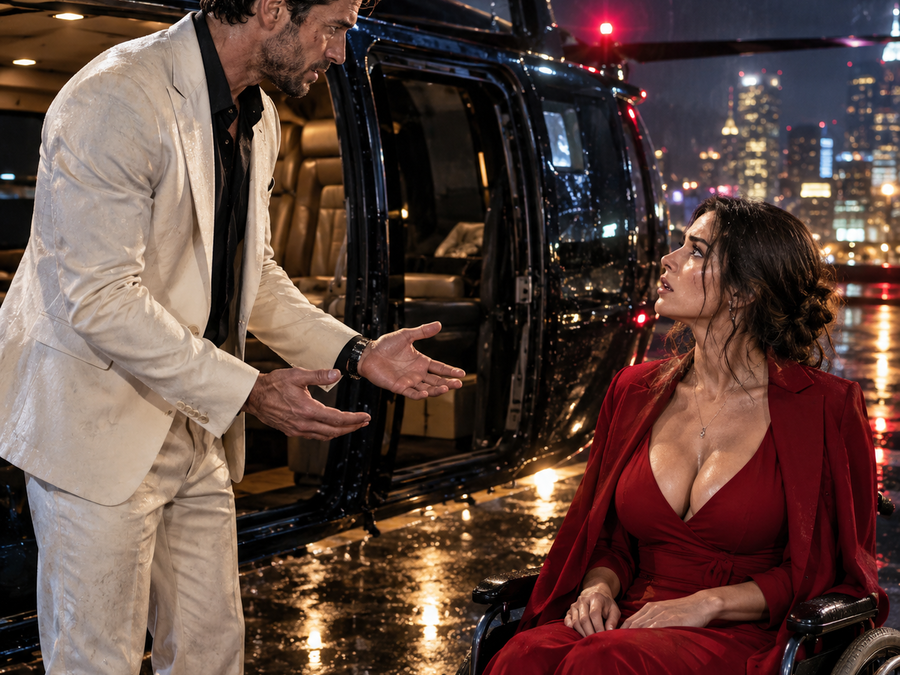
“Can I ride with you?” A Wheelchair-Bound CEO Asked a Single Father — His Answer Left Her Stunned (Part 3)
PART 3
Every sign facing a storage shed. Every ramp that technically existed but was positioned as an afterthought rather than an architectural equivalent of the front door. She had walked through and understood, with the embodied knowledge that cannot be acquired from blueprints, that she had been approving inadequacy for years because she had trusted that checking boxes meant solving problems. What she actually meant was that she needed someone who understood both the engineering and the experience. Someone who would not accept the gap between compliant and genuinely welcoming, because they had spent enough time on both sides of that gap to know the difference wasn’t academic. What she actually meant was Nathan. “Director of Accessibility and Safety Innovation,” she said. “It’s a new position. I’m creating it because it should have existed before and didn’t. You’d be responsible for redesigning accessibility standards across all Whitmore properties. Not to compliance minimum. To actual adequacy. The real version. Like you said. Not the apology.” She paused. “You’d also work with the safety inspection protocols for all our rides. Ride systems. Not as a rubber stamp. As a genuine checkpoint. Reports go to you and they go on record. And if something gets flagged, it doesn’t get un-flagged by an operations VP protecting a quarterly bonus.”
The silence on his end was different from his previous silences. More textured. “That’s a real job,” he said slowly. “It’s a very real job. There are 14 properties. Several hundred attractions.” And she stopped. “Nathan, I’m not offering you this because I feel guilty.” “I know.” “I’m offering you this because you’re the right person for it and I need it done right and I’ve spent four days trying to think of someone better and I can’t.” “I know that, too.” He said, “That’s not what I was worried about.” “What were you worried about?” A pause. “That it would feel like a fix,” he said. “Like you were solving me the way you solve a problem. Efficient. Clean.” He stopped. “I’m not a problem.” She felt that land. “No,” she said. “You’re not. I’m a person who needs the job to be real. Not compensatory. Real.” “It’s real.” Another pause. “Then I need to talk to Maggie.” “Of course.” “And I need to think about it. Independently. Without the weight of what you just did for me in the room.” “That’s exactly right,” she said. “Take the time you need.” “How much time do I have?” “As much as you need. Within reason.” She could hear him almost smile. “Define reason.” “A week,” she said. “I’m running a company.” This time he actually did laugh. Short. Real. The same laugh she’d heard twice before. The one that only happened when he forgot to guard it. “A week,” he said. “Okay.”
She was about to say goodbye when he said, “Can I ask you something?” “Yeah.” “The first day at Bluewater. When your daughter asked if she could ride with us.” A pause. “Was that planned? Did you know who I was?” She thought about the line at the river ride. About Lily pointing at the empty seats. About the particular guileless confidence of a 9-year-old who had not yet learned that asking strangers things was complicated. “I didn’t know who you were,” she said. “I didn’t know your name until that night. But after—after I made a call to Derek. Yes. Because something felt off. Because something felt right,” she corrected. “That’s different.” He was quiet for a moment. “Most people would have just enjoyed the day.” “I don’t know how to enjoy a day without understanding the things in it,” she said. “It’s a character flaw.” “It’s not a flaw,” he said. And the way he said it was simple and direct and not weighted with anything it didn’t need to carry. She held on to that for a moment. Then she said goodbye and hung up and sat in her kitchen with her coffee and the legal files and the quiet of an early morning. And she felt something she hadn’t felt in a very long time. Not happiness, exactly. Not the absence of difficulty. The difficulty was enormous. The legal process was going to be grinding and public and Nathan was going to have to relive things he’d spent eight years trying to build around. It wasn’t happiness. It was the feeling of a thing being done right.
The week passed, then another three days. Then Nathan called on a Thursday morning at 9:15 and said, “I talked to Maggie.” “And?” “She said, and I quote, ‘Dad, if you don’t take the job, I’m going to be furious with you for the rest of my life.'” A pause. “She also said she looked up the Whitmore Group properties online, and there’s one 20 minutes from a school she’s apparently been researching, and I don’t know how she found any of that, but she’s 15, so I probably should have expected it.” Clare was quiet for a moment, holding the phone. “Is that a yes?” she said. “That’s a yes.” She exhaled, long and slow. “Okay,” she said. “Good.” “I have conditions.” “Tell me.” “The job is real. I write the standards and they get implemented. Not reviewed by three layers of operations management who prioritize revenue. Implemented.” “Agreed.” “Safety reports are logged in a system I have access to that doesn’t route through operations VPs. They go directly to you and to the board safety committee.” “Done.” “And accessibility redesign starts with Bluewater. Because—” he stopped, started again, “—because that’s where I saw the entrance facing the storage shed and I want the first thing we fix to be something I can actually see.” She smiled. “Done.” “One more thing.” “What?” “Lily’s idea. She told me during the park visit that every ride should have a sign that says ‘Everyone Belongs Here’ instead of ‘Please Use This Entrance.’ She said ‘please’ makes it sound like you’re apologizing.” A pause. “She’s nine.” “She’s terrifying,” Clare said. “She’s going to run something someday.” He agreed. “So is Maggie.” “God help us both.”
The first board meeting after Nathan was formally hired was on a Tuesday in October, which meant two months after Bluewater, which meant the Virginia foothills had gone from August green to October red and gold. And Clare sat at the head of the conference table in the Arlington headquarters and watched the faces of 11 board members as she presented the Keystone findings, the corrected record, and the structural changes she was implementing across all Whitmore properties. It was not a comfortable meeting. The board had questions. Of course they had questions. What was the liability exposure? What was the cost of the accessibility redesign across 14 properties? What was the reputational risk of publicly acknowledging that the company had unknowingly retained an employee connected to a deliberate cover-up? What was the timeline? Clare answered every question directly. Without softening, without hedging, without the careful corporate language that turns accountability into a performance of accountability. She answered because she had spent two months making sure she knew the answers, and because the thing she had understood at Bluewater, sitting outside the accessibility entrance that faced a storage shed, was that the difference between checking boxes and doing things right was precisely the willingness to be uncomfortable with an honest accounting.
When the liability question came up for the third time from the board member who always asked the liability question three times, she said, “The liability exposure from doing nothing is significantly larger than the cost of doing this right. And more importantly, it’s the right thing to do. I don’t need a liability calculation to know that.” The board member looked at her. She looked back. He nodded once. Nathan attended the second board meeting in November. He presented a 32-page redesign framework for accessibility standards across Whitmore properties. Not a compliance checklist, but a document that asked in each section a single central question: “What would it feel like to need this? And does what we’ve built match that feeling?” He presented it in his work voice, which was different from his park voice. More precise, more technical. The voice of a man who had spent six years thinking about these systems at the highest professional level and had not lost that fluency even after eight years of not using it. He answered questions from the board with the patient thoroughness of someone who had spent 12 years being told his professional judgment was flawed and had emerged from that experience knowing exactly how right he was.
Afterward, in the hallway, the board chair, a woman in her 60s named Eleanor Vance, who had been on the Whitmore board for nine years, and who Clare had on two separate occasions watched reduce CFOs to professional rubble with a single question, stopped Nathan and looked at him with the direct, evaluating gaze she brought to everything. “The section on accessible queuing design,” Eleanor said. “The part where you said most accessible entrances are built to accommodate disability rather than to eliminate the experience of being accommodated.” She paused. “That’s the best articulation of the problem I’ve heard in 30 years of corporate governance.” Nathan looked at her steadily. “Thank you.” “How long have you been thinking about that?” “Eight years,” he said. “Maybe 12.” Eleanor held his gaze for a moment. Then she looked at Clare. Then she looked back at Nathan. “Don’t let her talk you out of anything,” she said. “She can be very persuasive when she thinks she knows better.” “I’ve noticed,” Nathan said. Clare, two feet away, said nothing. Eleanor moved on down the hallway with the efficiency of a woman who had delivered her point and required no further comment. Nathan looked at Clare. “She likes you,” Clare said. “She was warning me about you. That’s how she shows she likes you.” He shook his head slowly, the way he did when he was deciding not to argue. “You have interesting friends.” “I have interesting colleagues,” she corrected. “The friends are rarer.” He looked at her then, and something in his face was open in the way it had been open at the park, in the unguarded moments. “How rare,” he said. She held his gaze. “Getting less rare,” she said. He almost smiled. “Did a little good,” he said. They walked toward the elevator together.
The Westfield corrected record came in December. Patricia Okafor had estimated 60 days. It took 48. The licensing board vacated Nathan’s suspension unanimously and issued a formal finding that the original disciplinary action had been based on falsified documentation. The finding was three pages, precise, and completely public record. Nathan had asked Clare not to tell him the exact day it would be filed. He wanted to hear it when it happened, not anticipate it. She called him the morning the finding came through. He answered on the first ring. She read him the key paragraph. The board’s finding, the word “vacated,” the word “falsified,” the official, documented, public acknowledgement that Nathan Brooks had exercised sound professional judgment and had been wronged. He didn’t say anything for a moment. Then he said, “Can you read that part again?” She did. He was quiet. “Nathan,” she said. “Yeah.” His voice was rough. “Yeah, I’m here.” She waited. “I need to call Maggie,” he said. “Go,” she said. “Call me later.” He hung up. She sat at her desk for a moment, looking at the finding on her screen. Then she set it aside and picked up the next file, because there was always a next file, and that was fine. And she was good at this. But she sat with it for one more second before she opened the next file. 48 days. 12 years. The imbalance of those two numbers was something she was going to carry for a long time. And she knew it. And she thought Nathan was going to carry it, too. And she thought that was right. That was the correct response to an injustice that had compounded for 12 years. The fact that it was over did not make it not have happened. The record was corrected. The record was not erased. She opened the next file.
The Bluewater reopening was scheduled for the following spring, after the accessibility redesign was complete. Nathan had been on site three times in November and twice in December, walking through the property with a contractor team and a detailed checklist that was anything but a compliance checklist. He walked through it the way he’d walked through every problem Clare had watched him approach. Noticing what needed adjusting, adjusting it, not making it a production. The accessibility entrance to the Heritage Mill was the first thing he changed. He didn’t just widen it or reposition it. He redesigned the entire entry sequence so that there was no separate entrance at all. Every guest, regardless of mobility, used the same path in. The path was wider. It was level. It was shaded. The storage shed, which turned out to be functionally unnecessary, its contents redistributable to two existing storage areas without any operational impact, was removed entirely. He sent Clare a photo of the space once the shed was gone. She looked at it for a long time. Just a path. Wide, level, shaded, open. Going somewhere. Without telling some people to please use a different door. She texted back, “This is what it should have always looked like.” His reply came 30 seconds later. “Yeah, it is.” Then, after a pause of maybe a minute: “Lily was right, by the way. We’re putting up the signs. ‘Everyone Belongs Here.’ Every attraction entrance.” She stared at her phone. She typed. “She’s going to be insufferably proud of herself.” His reply: “She already is. Maggie told her. I shouldn’t have told Maggie.” Clare laughed. Alone in her office at 7 in the evening, with case files on her desk and the Arlington skyline going dark outside her window, she laughed. The way she’d laughed in the back of the SUV when Lily threatened to throw her phone in the fountain. Rusty. Unguarded. Like a door that was getting easier to open. She put the phone down. She picked up the next file. Outside her window, a city of people who needed space and didn’t always find it moved through the evening. And Clare Whitmore, who had spent 11 years learning to navigate a world built for a different configuration of herself, had one more thing to build. She was already thinking about how.
Spring came the way springs come after hard winters. Not gently, not with permission, but suddenly and completely, as if the cold had simply decided it was done. Bluewater reopened on a Saturday in April, and Clare was there before the gates opened. Not in the back of a private SUV through the service entrance. Not with Marcus running point and Derek running interference and an advanced team that had swept the property 20 minutes ahead of her arrival. She drove herself, something she had not done in years, in the modified vehicle she rarely used outside of Arlington, because somewhere along the way she had let convenience become avoidance. And she parked in the main lot and she wheeled herself through the front entrance at 7:45 in the morning, while the maintenance crew was still doing final checks and the concession stands were just beginning to smell like coffee and sugar. She didn’t call ahead. She didn’t tell Nathan she was coming early. She just came. Because she wanted to see it before the day began, before the crowds and the noise and the ceremony made it something that had to be performed rather than something that could simply be experienced.
She went to the Heritage Mill first. The path was exactly as Nathan had photographed it. Wide, level, shaded, unobstructed. The storage shed was gone. The entry sequence was clean and identical for every guest. No separate door. No sign saying, “Please use this entrance.” No architectural apology dressed up as accommodation. Just a path leading into something that wanted you there. The sign was there, too. Clean white background, simple lettering. “Everyone Belongs Here.” She sat in front of it for a long moment. She thought about the first time she’d seen the accessibility entrance at Bluewater, sitting in the middle of the plaza on a Tuesday in August, looking at a concrete path facing a storage shed. Feeling the specific, familiar deflation of a world that had technically accommodated her while making absolutely clear that her accommodation was an afterthought. She thought about Lily, nine years old, asking a stranger if she could ride with them. The guileless confidence of a child who had not yet learned that asking for space was something you were supposed to apologize for. She thought about Nathan saying, “It’s an apology instead of an invitation.” She stayed in front of the sign until she heard footsteps behind her. She knew it was him before she turned around. She had, over the last eight months, developed a precise familiarity with the particular cadence of Nathan Brooks moving through a space. Unhurried. Purposeful. The walk of someone who had learned to assess an environment while appearing to simply move through it.
“You’re early,” he said. “You’re earlier,” she said. He came to stand beside her, looking at the sign. He had his hands in the pockets of his jacket and his face was doing the thing it did when he was thinking without filtering it yet. Open. Unguarded. The expression he wore in the moments before the professional version arrived. “How does it look?” he said. “Like what it should have always looked like,” she said. She’d said it before in a text, but she wanted to say it out loud. “Like it was built for everyone and not adjusted for some people.” He nodded slowly. “Maggie wants to come to the reopening,” he said. “I told her it was a work event.” “She should come,” Clare said immediately. “She’ll spend the whole day telling everyone the signs were her idea.” “The signs were Lily’s idea.” “I know, but Lily told Maggie. And Maggie spent two months watching me implement the redesign. So, in her mind, there’s a collaborative authorship situation happening.” Clare smiled. “Bring her. Lily’s coming. They can argue about credit together.” He looked at her sideways. “You’re bringing Lily to a corporate event?” “It’s a family resort reopening. Lily is family. Also, she’ll be furious if she’s not here.” “Yeah.” He turned back to the sign. “Yeah, she will.”
They stood there for a moment in the quiet of the early morning, before the day arrived to claim them both. Clare said, “Not the professional. How are you? The real one.” He considered it seriously, the way he considered everything. “The licensing reinstatement came through on paper last week. The actual card. My name, my certifications, everything.” He paused. “Maggie framed it.” “She framed your license card.” “She made me take a photo of it and she put it in a frame and she put it on the wall in the hallway next to her middle school honor roll certificate.” His voice was even, but only by effort. “She said they both represented someone doing something right even when it was hard.” Clare felt something move through her chest. “She’s 15,” he said, as if that still surprised him. “She’s extraordinary,” Clare said. “She is.” A pause. “She asked me last week if I was happy.” He said it like he was still turning the question over. “Not ‘are you okay?’ Not ‘how are you doing?’ She asked if I was happy.” “What did you say?” He was quiet for a moment. “I said I was getting there,” he said. Clare looked at the sign, looked at the path, looked at eight months of work visible in a redesigned entrance that would, starting today, be used by thousands of families who would never know what it had replaced or what it had cost or what it had taken to build it the right way instead of the compliant way. “That’s an honest answer,” she said. “She didn’t love it,” he said. “She wanted a yes.” “Of course she did. She’s 15,” she said. Stopped a half second. “She said, ‘Dad, you found something real. Don’t be too careful with it.'”
The morning air was cool and smelled like the park coming alive around them. Somewhere behind them, the first maintenance check of the day ran its diagnostic cycle on the Heritage Mill. The sound it made was clean. Everything functioning correctly. Clare turned to look at him. He was looking at her. And the thing that had been true for eight months, the thing that had been true, if she was completely honest with herself, since a man in worn-out boots looked at her wheelchair and didn’t change his expression, since he’d said, “Of course,” and “Everyone deserves a place at the table,” and she’d felt something crack open in her chest that she’d spent 11 years keeping sealed, that thing was simply there. Between them. Not requiring explanation or management or any of the careful, professional framing she’d been applying to it. “She’s smarter than both of us,” Clare said. “Significantly,” Nathan agreed. She held his gaze. He held hers. “Nathan,” she said. “Yeah.” “I’m getting there, too.” Something shifted in his face. Not surprise. More like recognition. The look of someone who has been waiting to hear a specific thing confirmed and had decided to be patient about it. “Okay,” he said. “Okay,” she said.
They turned back to the path at the same time. The morning was brightening. The park would open in two hours. There was a ceremony, a ribbon, a statement Clare had written and Derek had edited and she had largely restored to its original form because Derek’s version was more polished and her version was more true. There was a board member who wanted five minutes, two journalists who had been granted access for the reopening story, and a facilities team that needed final sign-off on three outstanding items. And there were two teenage girls and one 9-year-old who were going to arrive at some point and immediately locate each other and immediately begin asserting ownership over various aspects of the day. The thought of it made her want to laugh. She didn’t have time to laugh yet, but she held on to the want of it and moved into the morning.
The reopening ceremony was scheduled for 10:00. By 9:30, the main plaza was already filling with the warm, energetic chaos of families who had been told this was the first day of something new and believed it. Clare had positioned the ceremony at the Heritage Mill entrance, specifically at the newly redesigned path, because she wanted people to see the thing that had changed while being told about the things that would change. Show, not tell. That was the principle she’d been applying to everything since August. Nathan was standing to her left during the ceremony. Not at the podium. He’d declined firmly. The invitation to speak publicly. “I don’t need the podium,” he’d told her. “I need the work to speak.” She had argued briefly and then stopped arguing because he was right and she respected right. He stood at the edge of the small raised platform that had been assembled for the occasion, in a jacket that was better than his park jacket, and boots that were the same boots, because some things don’t change. And he watched the crowd with the particular attention of someone who is always partly checking the environment and never entirely able to stop.
Lily found Maggie in the crowd 11 minutes before the ceremony began. Clare knew this because she heard Maggie’s voice before she saw them. “Oh my god, you’re here.” And turned to see the two girls navigating toward each other with the focused determination of people who have been looking forward to a reunion. Lily reached Maggie and immediately began talking, and Maggie immediately began listening, and Clare thought, good. Both of them exactly like that. Dorothy was there, too. Clare had made sure of it. Had personally called three weeks before and said, “Your statement made this possible and I want you at the reopening.” Dorothy had said she wasn’t sure that was appropriate, and Clare had said, “It’s absolutely appropriate.” And Dorothy had said she’d think about it, and then shown up today in her Bluewater supervisor’s shirt with the maintenance patch on the sleeve, like armor she decided to keep wearing. She was standing near the back of the crowd. Clare caught her eye. Dorothy nodded once. Clare nodded back.
At 10:00, Clare wheeled to the microphone. She did not read from the version Derek had edited. She spoke from the version that was true. She said, “Eight months ago, I came to this park as a mother, wanting a normal day. And what I found was that the park I owned was not built for me. Not fully. Not in the ways that mattered beyond the technical minimum. I found an entrance that told some guests they could come in, just not through the front door. I found signage that apologized instead of welcomed. I found a version of accessibility that had been designed by people who understood the compliance requirements and not the experience.” She paused. She said, “I also found something else. I found that the gap between what we’d built and what we should have built was exactly 12 years old. And closing it required understanding why it had existed in the first place. That process—finding out why, and who, and what it had cost—is part of why we’re here today. The full story is a matter of public record for anyone who wants to find it. What I want to say about it here, at this reopening, is simply this. There are people who did the right thing when doing the right thing was expensive and hard and nobody was watching. Those people deserve to be named. The work we’ve done here at Bluewater is because of Nathan Brooks, who told us 12 years ago that a ride system was unsafe and wasn’t heard, and who came back anyway, to a different park, with his daughter, on a Tuesday in August. And whose integrity is written into every accessibility standard we’re implementing across 14 Whitmore properties starting today.”
She did not look at Nathan while she said this. She looked at the crowd. At the families. At Dorothy near the back. Then she looked at the sign above the entrance. “Everyone Belongs Here,” she said. “This is what we owe each other. Not the minimum. Not the apology. The actual invitation.” Then she cut the ribbon, and the park opened, and the crowd moved forward into a space that had been built to receive all of them. Nathan was beside her when the crowd began moving. He didn’t say anything for a moment. His jaw was set and his eyes were slightly red at the rims and he was holding himself with the composure of a man managing something large and refusing to make it anyone else’s business. She let him be with it. After a moment, he said, “You didn’t tell me you were going to say that.” “Would you have let me?” A pause. “No.” “That’s why I didn’t tell you.” He looked at the crowd moving into the park. At families going through the Heritage Mill entrance. The same entrance. The same path. No separate door. “I keep waiting to feel like it’s resolved,” he said. “Like there’s a moment where it finishes and I’m on the other side of it. Does it feel that way?” He thought about it honestly. “Parts of it,” he said. “The record, the license. Some parts feel finished.” He paused. “Other parts just feel like they’ve been correctly named. Like I know what they are now and they’re not questions anymore. But they’re still there.” “That’s probably how it works,” she said. “With things that took 12 years.” “Yeah.” He exhaled. “Yeah, I think so.”
Lily appeared at Clare’s side, slightly out of breath, with Maggie two steps behind her. “We went through the entrance,” Lily announced. “The new one. The same one as everyone else.” She said it with the satisfaction of someone reporting a successful experiment. “How was it?” Clare said. Lily looked at the sign. She read it. “It says ‘Everyone,'” she said. “It means everyone.” “It does,” Clare said. Lily nodded with the gravity of someone whose idea has been correctly executed. Then she looked at Nathan. “Did you make sure the ramp by the river ride is wide enough?” “Because last time it was a little narrow.” Nathan looked at this 9-year-old with the expression of a man who had spent 40 years underestimating 9-year-olds. “I measured it four times,” he said. “Four is good,” Lily said judiciously. “Three would have been enough, but four is good.” Then she turned to Maggie and said, “Come on, I want to show you the river ride.” And both of them were gone before either adult could speak. Nathan watched them go. “Four times,” he said to no one in particular. “She takes quality control seriously,” Clare said. He shook his head slowly, but the smile was there. The real one. The unguarded one. The one that changed his whole face. It stayed longer than it usually did.
The morning moved the way good mornings move. In public. Faster than you expect. Fuller than you planned for. With more small moments than any single person can hold on to. Dorothy found Clare at 11:00 and said quietly that three of her team members had stopped her before the ceremony to say they’d noticed the changes and wanted to understand the standards behind them. “They want to know the reasoning,” Dorothy said. “Not just the policy. The why.” “Tell Nathan,” Clare said. “He’ll explain it.” Dorothy said he already has. He spent an hour with the maintenance team yesterday walking through the redesign logic. Clare said, “I know.” Dorothy looked at her for a moment and said, “He’s good.” Clare said, “I know that, too.” The board chair, Eleanor Vance, arrived at 11:30 in a town car, which was the most Eleanor thing possible, and walked through the Heritage Mill entrance and read the sign and turned to find Clare and said, “Lily’s idea?” “How did you know?” Clare said. “Because an adult would have written something more complicated.” Eleanor looked at the sign. “Simple is harder. She got it right.” A pause. “Where’s Brooks?” “Somewhere on the property. Checking the ramp measurements.” “The ramp measurements were already certified.” “He’s checking them again.” Eleanor almost smiled. “Good,” she said. “That’s the right instinct.” She looked at Clare with the direct, evaluating gaze she brought to everything. “How is he getting there?” Clare said. Eleanor studied her face for a moment with the precision of a woman who had spent 40 years in boardrooms reading what people’s faces were actually saying. “And you,” she said. Clare met her gaze. “Getting there.” Eleanor held her gaze for exactly one beat longer than was casual. Then she nodded once and moved on toward the facilities team, because Eleanor Vance had said the thing she’d come to say and required no further discussion.
The journalists were a man from the regional hospitality trade publication and a woman from a broader consumer-interest outlet who had heard about the Keystone story through the legal filings and wanted to understand the accessibility redesign in context. Clare gave them both 20 minutes each. She was precise and honest and didn’t perform anything. The consumer-interest journalist, at the end of her time, looked up from her notes and said, “Can I ask about the Keystone piece? The cover-up. Does it make you angry?” Clare thought about the question seriously. “Yes,” she said. “Not because of what it cost me personally. Because of what it cost Nathan Brooks. Because he spent 12 years not being sure of his own memory. And that’s—that’s a particular kind of damage. And the people who caused it calculated that it was acceptable.” She paused. “So, yes, I’m angry. I think the correct response to a system that treats people as acceptable losses is to be angry and then build something better.” The journalist wrote that down.
At 2:00 in the afternoon, Nathan found Clare near the East Section Food Court, the same food court where eight months ago, four of them had sat with frozen lemonades, and two teenagers had discovered they didn’t mind each other. “I checked the ramp,” he said. “I know it’s fine. It was always fine. I just needed to check it.” “I know that, too,” she said. He sat down across from her at the same table, the accessible spot in the middle, not the edge, the geometry of it automatic now. Both of them having learned, without discussing it, where the right position was. He had a cup of coffee and he wrapped both hands around it and looked at the court around them. “Can I tell you something?” he said. “Yeah.” He was quiet for a moment, organizing it. “Last night, I couldn’t sleep. Normal for me before a big day. I ended up at the kitchen table at 2:00 a.m. and I was looking at Maggie’s wall. The framed license card, the honor roll certificate. And I thought about the night 12 years ago when I drove home from the Westfield property after submitting the third safety report. I sat in the driveway for 45 minutes. Maggie was seven. She was asleep inside. I sat in that driveway and I thought, ‘I’ve done everything right. I’ve filed everything correctly. I followed every process.’ And I already knew it wasn’t going to be enough. I already knew they weren’t going to act on it. I could feel it.” He paused. “I sat in that driveway and I thought, ‘What is the point of doing the right thing if no one’s listening?'” Clare didn’t say anything. “Last night I thought about that moment,” he said, “and I thought about what the answer is. Now. Having been through it.” He looked up at her. “The answer is you do it because the alternative is becoming the kind of person who doesn’t. Because if you stop doing the right thing because it didn’t work one time, you’re not the same person anymore. And that person—” he stopped. “That person couldn’t have raised Maggie into who she is. Couldn’t have walked into Hail’s office and said what needed to be said. Couldn’t be sitting here.” He paused. “The right thing didn’t protect me 12 years ago. But it’s the reason I still have myself.”
Clare looked at him for a long time. “That should be in the training materials,” she said. He looked at her sharply. “I mean it,” she said. “The accessibility redesign handbook. Every safety inspector we train. That paragraph. Verbatim. About why you document even when you don’t think it will be heard.” She paused. “With your permission.” He stared at her. “You want to put my 2:00 a.m. kitchen table thoughts in a training manual?” “Yes.” “That’s—” he stopped, shook his head. “Is that a yes?” A pause. A long one. Then: “Yeah,” he said. “That’s a yes.” Lily and Maggie arrived at the table at 2:20, both of them carrying corn dogs, which meant they had independently reached the same conclusion about lunch that Nathan had reached eight months ago and abandoned in the chaos of the Heritage Mill incident. Lily dropped into a chair and looked at both adults with her evaluating gaze. Maggie sat next to her father and bumped his shoulder. “How many times did you check the ramp?” Maggie said. “Four,” Nathan said. “Dad, it needed checking.” Maggie looked at Clare. “Tell him it didn’t need checking.” “It definitely needed checking,” Clare said. Maggie shook her head. “You’re both the same person.” “We really are,” Nathan said, and looked at Clare when he said it. And she looked back, and there was something in that look that their daughters both noticed and both chose, with the particular grace of children who love their parents, not to comment on directly.
Lily instead looked at her corn dog and then at Maggie’s corn dog and said, with complete seriousness, “I think we should go on the river ride after this.” “Definitely,” Maggie said. “Mom and Nathan should come.” “Obviously.” Lily looked at Clare. “You in?” Clare looked at Nathan. He was looking at her with the expression of a man who has decided to stop being careful with something real. “Yeah,” she said. “I’m in.” The four of them finished their corn dogs and walked to the river ride. Same path as August. Same ride, same line. Except now the line had one entry for everyone. And the ramp was wide and the path was level and nobody had to peel off to a separate door that faced a storage shed. They loaded together. Lily and Maggie in the front, Clare and Nathan in the back. The geometry of it easy and unremarkable. Nobody making it a thing.
The ride began to move. The Virginia spring was in full possession of the afternoon. Warm, bright, the trees at the edge of the property green and new, the sky the particular shade of blue that only appears in April before summer arrives to deepen it. The river ride climbed through its early ascent. The water rushing past below. And Lily threw her arms up immediately, and Maggie, after a half second of 15-year-old calculation, threw hers up, too. And both of them laughed, and the sound of it was the most uncomplicated sound in the world. Nathan was looking at his daughter. Clare watched him watch her. She thought about what he’d said at the kitchen table at 2:00 in the morning, looking at a framed license card on a wall. You do the right thing because the alternative is becoming someone who doesn’t. Because that person couldn’t have raised the person who is currently laughing with her arms in the air next to a 9-year-old who is already planning her second corn dog. She thought about 11 years of navigating a world that had technically accommodated her without ever quite welcoming her. 11 years of entrances that faced storage sheds and looks that went to the wheelchair first and the careful, over-enunciated voices of people who were afraid of saying the wrong thing. 11 years of being treated like a problem that had been successfully managed. And she thought about a man in worn-out boots who had looked at her without any of that. Who had offered and accepted the answer and moved on. Who had asked, “What do you need?” instead of, “You’re so brave.” Who had made her feel, in the space of one afternoon, like a person rather than a consideration.
The ride crested its highest point. Below them, the full breadth of Bluewater was visible. The paths, the attractions, the families moving through a space that had been redesigned from the inside out. The Heritage Mill entrance was visible from here. Tiny at this distance. And Clare couldn’t read the sign from this high up, but she knew what it said. Nathan turned to look at her. Not with the professional directness he’d developed over eight months of working alongside each other. The efficient mutual regard of two people who respected each other’s competence. This was the other look. The unguarded one. The one from the first day, from the bench outside the Heritage Mill mechanical room, from the morning in front of the sign before the park opened. She held it. “Thank you,” he said. Not the broad, encompassing thank you that covered the legal process and the record and the job and all of it. The specific one. The two people on a ride in April one. “Don’t thank me for the right thing,” she said. “I’m not thanking you for the right thing,” he said. “I’m thanking you for the Tuesday in August.” She understood what he meant. Not the investigation, not the files, not the formal legal machinery of correction and accountability. The day itself. The corn dogs and the frozen lemonade. And the moment their daughters found each other. And the way a day that was supposed to be ordinary had become the thing that changed the shape of everything that followed. “You said everyone deserves a place at the table,” she said. “I did.” “I’m thanking you for that,” she said. “Because I’d forgotten.”
The ride began its descent. Water rushing around them. Lily shrieking in pure delight at the front of the boat. Maggie’s arms going up again without any 15-year-old calculation this time. Just up. Just joy. Just the uncomplicated pleasure of a good moment received without apology. Nathan looked forward at his daughter. His whole face was open. No guard, no filter, no professional distance. Just a father watching his kid live in a good moment. Receiving it without qualification. Is there still room for us? Clare had thought she would never ask that question again. She had spent 11 years making sure she never had to. Making herself so capable, so sufficient, so self-contained that the question never arose because the answer was always already yes. She had turned herself into someone who didn’t need to ask. But the question wasn’t about the ride. She didn’t ask it out loud. She didn’t need to. Because Nathan reached over, in the easy, unhurried way he did everything, and put his hand over hers on the edge of the boat. Not asking, not announcing, not making it a thing. Just placing it there. The way you place something where it belongs and leaving it. The water rushed, the boat moved, the park spread itself below them in the April sun. Redesigned, reopened, imperfect, and continuing the work of people who had decided that minimum was not enough.
Lily looked back from the front of the boat and saw them. She grinned. Nine years old and incandescent and utterly unsurprised. “Mom,” she called over the sound of the water. “What?” “This is my favorite part.” No, Lily pointed. Not at the park, not at the view, but at the four of them in the boat together. “This.” Clare looked at her daughter. She looked at Nathan’s hand over hers. She looked at Maggie with her arms in the air and the April sky above them and the redesigned world below. She thought about a man who had done the right thing when no one was listening. A woman who had stopped knowing she deserved a front door. Two girls who had found each other on a Tuesday in August and immediately understood something their parents had taken months to arrive at. A path that now led somewhere without asking anyone to please use a different entrance. She thought about what it meant to belong somewhere. Not to be accommodated there. Not to be technically permitted there. But to actually belong. The way you belong to a table where someone pulled out the middle chair without making it a production. The way you belong to a boat where someone’s hand is on yours without asking for credit. The way you belong to an afternoon that doesn’t require you to apologize for the space you take up in it. She looked at the sign, small in the distance, that her 9-year-old had named. She thought, “This is it. This is exactly it.”
The boat descended into the final stretch of the ride, water rising around them, Lily shrieking, Maggie laughing, the whole April afternoon ringing with the uncomplicated sound of people who were exactly where they were supposed to be. And Clare Whitmore, who had spent 11 years learning to navigate a world built for someone else, who had built an empire and lost the use of her legs and found the man who tried to prevent it, and the man who’d covered it up, and the woman who’d been carrying the truth for 12 years, Clare Whitmore, who had come to a family resort on a Tuesday in August wanting only one normal day, who had found instead the beginning of everything that needed to be found, felt something she had been waiting for without knowing she was waiting. Not the absence of difficulty. Not the resolution of everything into something clean and simple and uncomplicated. Just the feeling, clear and complete, of a place where she was not accommodated but welcomed. Not managed but known. Not brave—never brave, she had never wanted that word—but simply, fully, unreservedly herself.
The ride ended. The boat settled. The water stilled. And every empty seat that had ever been held against her, every entrance that had faced a storage shed, every look that had gone to the chair before it arrived at the person, every careful, over-enunciated voice that had spoken to her disability instead of to her—every one of those things was still true. Was still part of the record. Would always be part of the record. But the record also contained this. This boat. This April. This man’s hand. This daughter’s face. This path that led somewhere and said so plainly to everyone, without apology. The record contained all of it. And the part that was still being written was going to be different. That, Clare Whitmore knew all the way down to her bones, was not hope. That was a fact.
