“Dance As My Husband — There’s a Red Dot on Your Forehead,” She Whispered to the Mafia Boss
“Dance As My Husband — There’s a Red Dot on Your Forehead,” She Whispered to the Mafia Boss
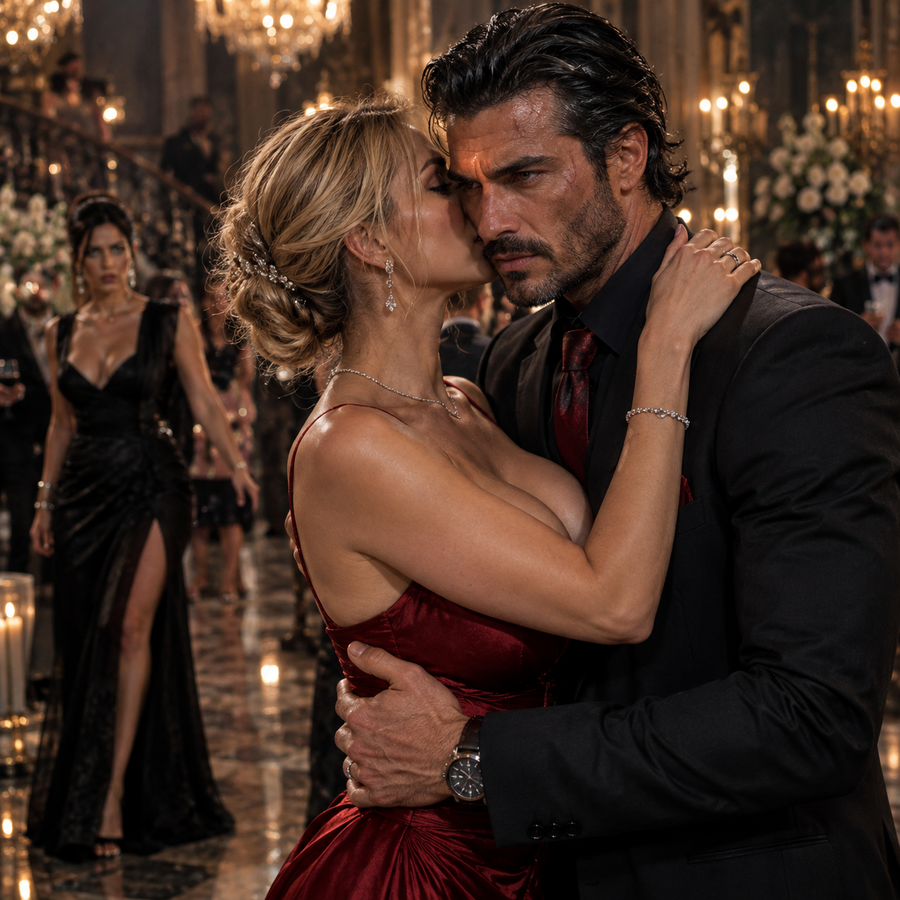
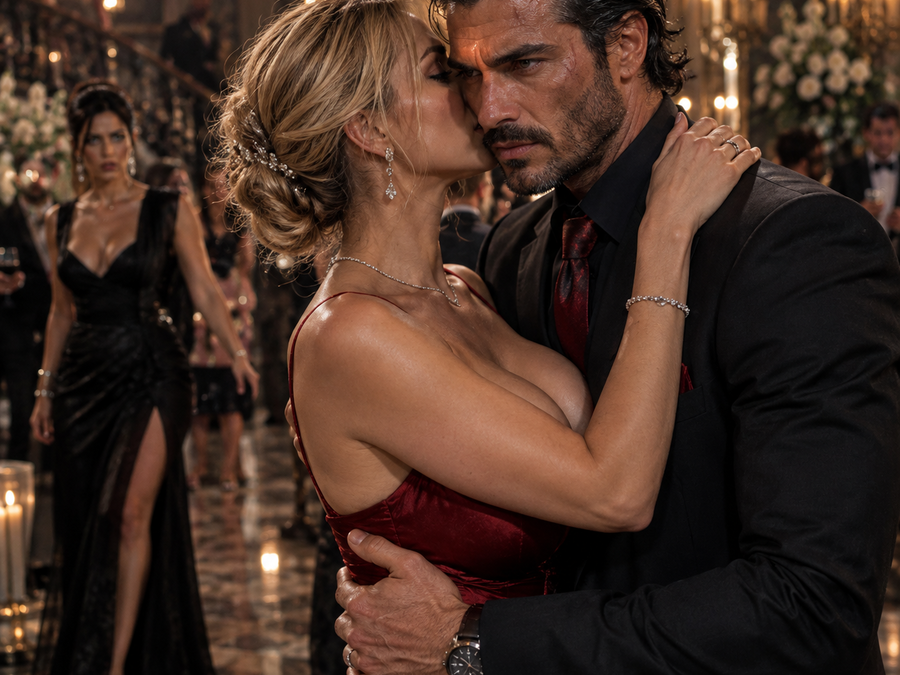
Music from the string quartet swelled into a slow, suffocating waltz as he pulled her in, his hand a heavy, possessive weight at the base of her spine. To everyone in the grand ballroom, they were the picture-perfect stars of a blood-soaked fairy tale. No one noticed the high arched windows reflecting the pitch-black night outside. Vivien leaned into his chest, inhaling the scent of bitter espresso and gun oil beneath his expensive cologne, and brushed her lips against his ear.
“Dance as my husband,” she whispered. “There’s a red dot on your forehead.”
The wedding cake cost more than the average house. A towering monstrosity of white fondant and sponge sugar. Vivien wanted to smash it. Instead, she kept her chin elevated, her posture rigid, and a carefully painted smile on her face. Her jaw ached. Her corset dug into her ribs, a cage of whalebone and silk that made drawing a full breath impossible. It was a fitting metaphor for the rest of her life.
Two hours ago, in front of a frightened priest and 500 heavily armed guests, she had become Vivien Costa. Edmund Costa stood beside her in the receiving line, shaking hands with men who would gladly slit his throat for a nickel. He was a tall man, broad-shouldered, with eyes the color of dirty ice. He didn’t look like a monster. He just looked tired. But Vivien knew better. The Costa family built their empire on shipping crates filled with things that didn’t appear on manifests, and Edmund was the architect of their violent expansion.
“Smile, Mrs. Costa,” Edmund murmured. His voice was gravel and low, vibrating in the narrow space between them.
“I am smiling,” Vivien said, not looking at him. She accepted a handshake from a sweating city councilman. The politician’s hand was clammy. He refused to make eye contact with her.
“Your eyes look dead.”
“I was sold to a mobster at 10:00 this morning to settle my father’s gambling debts. Forgive me if I lack a certain bridal glow.” Edmund didn’t flinch. He just nodded to the next guest, a rival boss from the west side who offered a forced, toothy grin.
“Your father’s debts were the least of his problems. I bought your life today. Try to act like you value it.” Vivien swallowed the bile rising in her throat. He wasn’t wrong. If Edmund hadn’t offered this alliance—a marriage to merge the remaining scraps of her family’s declining influence with his ironclad syndicate—her father would be at the bottom of the river, and she would have been sold to far worse men. Still, gratitude was a bitter pill.
The reception was held in a converted cathedral. The pews had been torn out to make room for mahogany tables and a sprawling dance floor. High above, stained glass saints looked down in silent judgment. Men in tailored tuxedos drank top-shelf whiskey while keeping their right hands suspiciously close to their suit jackets. Women in diamonds and silk laughed too loudly at jokes that weren’t funny. The air was thick with the smell of roasted meats, lilies, and nervous sweat.
A man tapped a silver fork against his champagne flute. The sharp, high ringing cut through the low hum of conversation. Silence rippled across the room.
“Ladies and gentlemen,” the best man, a broad, scarred enforcer named Tommy, announced into a microphone. “The bride and groom will now take the floor for their first dance.”
Edmund turned to her. He held out his hand. He wore no rings other than the simple gold band she had shoved onto his finger at the altar. His knuckles were bruised, the skin yellowish-purple. Vivien stared at his palm. This was the moment. The final seal on the contract. She placed her hand in his. His skin was rough, calloused—not the hands of a businessman. The hands of a butcher.
He led her to the center of the polished wood floor. The crowd parted like the sea. Hundreds of eyes tracked their every movement, analyzing, calculating, looking for weakness. If they looked like a couple in love, the alliance was strong. If they looked disgusted with each other, there would be blood in the streets by midnight.
The band struck up a slow, melancholic jazz tune, a solitary saxophone weeping over a steady upright bass. Edmund pulled her against him. Hard. Vivien gasped, her chest colliding with his solid frame.
“Too tight,” she hissed.
“We have to look like we want this,” he replied, his hands sliding down from her shoulder blades to rest firmly on her lower back. He began to move. He wasn’t a bad dancer. He was precise. Every step was calculated, measured, driving her backward and then pulling her in. He moved with the predatory grace of a man used to navigating dark alleys, not ballrooms.
“Look at me,” he ordered softly. Vivien lifted her gaze. His face was inches from hers. The harsh overhead chandelier cast sharp shadows beneath his cheekbones.
“What do you want me to say, Edmund?”
“Nothing. Just look at me like you don’t want to drive a steak knife into my neck.”
“That takes acting skills I don’t possess.” A faint, humorless smile touched the corner of his mouth.
“Try.” They spun. The heavy silk of her gown flared out around her ankles. The room became a blur of lights, faces, and shadows. For a fraction of a second, the overwhelming reality of her situation faded, replaced by the simple physical requirement of following his lead. Step, turn, glide.
Then she saw it. It was just a flicker, a microscopic flash of crimson in her peripheral vision. Vivien blinked. The ballroom was bathed in warm golden light. There was no red. She dismissed it as a trick of the chandeliers catching a diamond necklace in the crowd. Edmund stepped into her, spinning them toward the massive arched windows in the east wall.
The glass was old, thick, and slightly warped. Outside, the city was a sprawling grid of darkness and street lamps. As they rotated, Vivien looked over Edmund’s shoulder. There it was again. A tiny, brilliant ruby light. It wasn’t in the room. It was on the glass. No, it was passing through the glass.
The dot moved erratically for a split second before snapping into a steady, unblinking focus. It settled perfectly on the lapel of Edmund’s tuxedo jacket, just over his heart. Vivien’s breath caught. Her feet fumbled. She stepped heavily on Edmund’s polished shoe. He grunted, tightening his grip on her waist to keep her upright.
“Keep the rhythm, Vivien. Don’t fall apart on me now.” The dot was climbing. It moved from his chest to his collarbone, up his throat. It was deliberate. Calculated. The sniper was tracking his movements, waiting for him to settle, waiting for the rotation of the dance to expose the back of his head or a clean profile.
If Edmund died right now, chaos would erupt. The truce would dissolve instantly. The rival bosses in the room would draw their weapons. Vivien, standing directly in the line of fire, holding the dead man, would be collateral damage. A minor tragedy in a major mob war.
She had less than three seconds. Panic was a luxury she couldn’t afford. Fear was a secondary emotion. All she felt was a cold, sharp spike of absolute clarity. She couldn’t shout. If she screamed “Gun!” Edmund’s guards would surge forward. The crowd would stampede, and the shooter would pull the trigger out of reflex. She couldn’t dive for the floor. If she pulled away from Edmund abruptly, the sniper would have a clear, unobstructed shot.
The red dot found Edmund’s chin. It was inching upward. Vivien closed the distance between them. She threw her arms around his neck, burying her face into his shoulder, pressing her body completely flush against his. She broke the frame of the dance, shifting from a formal waltz into an intimate, desperate embrace.
Edmund stiffened. He was a man highly attuned to physical threat, and her sudden movement triggered his instincts. His hands dropped to her waist, fingers digging brutally into her sides as if preparing to throw her off him.
“What the hell are you doing?” he growled into her hair.
“Dance as my husband,” she whispered, her voice a rapid, breathless hiss directly into his ear. “There’s a red dot on your forehead.”
Edmund froze. It wasn’t a physical stop. To the room, they were still swaying, but Vivien felt the sudden, terrifying stillness in his muscles. His heartbeat, previously a steady thud against her chest, spiked. He didn’t look around. He didn’t flinch. He didn’t reach for the gun she knew was holstered beneath his jacket.
“Where?” he asked. His voice was completely flat, devoid of emotion.
“High east windows. Across the street.” The dot was currently resting on the back of Vivien’s head. She could feel the imaginary heat of it burning through her hair. By embracing him, she had put herself between the bullet and his skull.
“You’re in the way,” Edmund muttered.
“You’re welcome.”
“Move, Vivien.”
“If I move, he shoots you. If you go down, I’m a dead woman anyway. The Westside boys will tear this room apart.” Edmund’s hand moved from her waist, sliding up her spine with an agonizing slowness. He wrapped his hand around the back of her neck, his thick fingers tangling in her elaborate updo. He was holding her there. Keeping her as his shield, or keeping her from bolting. She wasn’t sure which.
“We need a blind spot,” Edmund said. He was already leading her. He shifted his weight. He didn’t drag her. He guided her with forceful, undeniable pressure. They were still dancing, but the steps had changed. They were no longer following the slow, weeping saxophone. They were moving to the frantic, silent metronome of survival.
They turned, keeping Vivien’s back to the window.
“Three steps right,” Edmund whispered.
“There’s a concrete pillar—”
“It’s too far. He’ll take the shot before we get there.”
“Then we make it look good.” Edmund dipped her. It was a sudden, dramatic movement. The crowd murmured in surprise and scattered applause. Vivien gasped as she went backward, staring up at the vaulted ceiling. The dip broke the line of sight entirely.
“Keep smiling,” Edmund ordered, leaning over her. His face was inches from hers, blocking out the light of the chandeliers.
“My teeth are going to crack,” she managed to say through her forced grin. He pulled her back up, spinning her violently. The momentum carried them two yards closer to the heavy stone pillar at the edge of the dance floor. The dot swept across the floorboard, searching for them. It hit the white tablecloth of a nearby table, painting a blood-red stain on the linen, then jumped back to Edmund’s shoulder.
“He’s got me again,” Edmund said. The music swelled. The drummer joined in, laying down a heavier, rolling beat. Edmund pushed Vivien out in an open turn. It was a risky move, breaking their embrace, but it was necessary to cross the final distance. As she spun away from him, the laser tracked across the empty space between them. For a horrifying fraction of a second, Edmund was entirely exposed.
Vivien finished her turn and slammed back into his chest, grabbing his lapels and dragging him sideways as if it were a passionate, theatrical climax to the dance. They crashed into the shadowed alcove behind the massive stone pillar.
Thwack. It wasn’t a loud noise. It sounded like a heavy textbook being dropped flat on a carpeted floor. The glass of the east window held for a millisecond before spiders of silver cracked across its surface. A small, neat hole appeared in the pane. A heavy crystal vase sitting on a table just inches from where Edmund’s head had been a second ago exploded into a million glittering shards. Water and shredded lilies rained down on the polished wood.
The sharp crack of the shattering vase echoed through the room. The music stopped. The saxophone let out a dying squeak. Silence descended on the ballroom, thick and heavy.
Behind the pillar, Edmund shoved Vivien against the cold stone wall, pressing his body flush against hers to keep them perfectly in the shadow. His breathing was heavy now. He drew a matte black pistol from inside his jacket with alarming speed. He didn’t point it outward. He held it close to his chest, his eyes scanning the edges of the pillar.
“Are you hit?” he demanded in a harsh whisper. Vivien patted herself down with trembling hands. Her silk dress was pristine. Her hands were shaking so badly she could barely feel her own skin.
“No. No, I’m okay. You?”
“Fine.” Edmund checked the chamber of his gun. His face was a mask of cold fury. The businessman was gone. The mobster was here.
Out on the floor, confusion was spreading. “What was that?” someone shouted. “A bulb blew,” another voice yelled back. Edmund’s best man, Tommy, was already moving. Vivien watched him through the narrow gap between the pillar and a tall fern. Tommy didn’t look at the broken vase. He looked at the window. He saw the bullet hole.
Tommy raised a hand, tapping two fingers against the side of his own head—a silent signal to the dozen security men stationed around the perimeter. Instantly, men in tuxedos began shifting. They moved smoothly, not running, but walking with aggressive purpose. Four of them headed straight for the east doors, pulling weapons from their holsters as they went.
Tommy grabbed the microphone. “Just a minor accident with the catering, folks. Everyone stay calm, and the band will pick it right back up. Grab a drink.”
The band, terrified but professional, immediately launched into an upbeat swing number. The noise covered the sound of heavy boots hitting the pavement outside.
Edmund leaned his forehead against the stone pillar, right next to Vivien’s ear. He let out a long, slow breath.
“He missed,” she whispered, her voice barely audible over the brass section.
“He didn’t miss,” Edmund said, his eyes locking onto hers. “You moved me. If you hadn’t grabbed me, my brains would be painting that table right now.” Vivien swallowed hard. The adrenaline was beginning to crash, leaving her cold and nauseous.
“Who was it?”
“I don’t know yet. But someone just made a very expensive mistake.” Edmund looked at her. Really looked at her. For the first time since she met him in her father’s suffocating, smoke-filled study a month ago, the dead-eyed contempt was gone. It was replaced by a sharp, calculating respect. She was a commodity, a piece of flesh traded for debt. She was supposed to be a victim, cowering in a corner, waiting for the men to handle the violence. Instead, she had seen the threat, calculated the odds, and used her own body to maneuver him out of the kill zone without starting a riot.
“You risked your neck,” Edmund said softly, holstering his weapon.
“I told you,” Vivien replied, lifting her chin to stop it from trembling. “If you die tonight, I die tonight. I have a vested interest in your continued heartbeat, Mr. Costa.”
Edmund reached out, his knuckles brushed against her cheek. It was a shockingly gentle gesture from a man holding a gun in his other hand. His thumb wiped away a bead of sweat near her hairline.
“Edmund.” Tommy’s voice came from the other side of the pillar. The enforcer stepped into the shadows with them. He glanced at Vivien, then at Edmund.
“Shooter was on the roof of the bank across the street. Boys are sweeping the building now, but he’s likely gone. Left a tripod. Professional.”
“Professional means paid,” Edmund said, his voice returning to its normal, gravelly calm. “Find out who holds the purse strings.”
“You want me to lock down the room?” Tommy asked.
Edmund peered around the pillar. The crowd was nervous, muttering, casting glances at the broken window and the shattered vase. The rival bosses were grouped together, speaking in low voices, their bodyguards forming tight circles around them.
“No,” Edmund said. “If we lock down, we show fear. We show them we’re rattled. The truce holds only if they think I’m untouchable.”
“They just put a bullet through your window, boss.”
“And they missed,” Edmund said coldly. He turned back to Vivien. He held out his hand again.
“What are you doing?” she asked, shrinking back against the stone.
“We haven’t finished our dance, Mrs. Costa.” Vivien stared at his extended hand.
“You’re insane. He could still be out there. He could have a backup.”
“He had one shot. He blew it. He’s running.” Edmund stepped closer. The heat of his body radiated against the chill of the stone. “If we hide back here, we look weak. If I walk out there with my new bride and finish the song, they’ll know that a bullet through the glass isn’t enough to make me blink.”
He was right. In his world, perception was reality. Weakness was an invitation to a bloodbath.
Vivien looked at his bruised hand. She took a deep breath, forcing the air past the tight, restrictive cage of her corset. She placed her hand in his. Edmund pulled her out of the shadows.
As they stepped back onto the main floor, the room fell silent again, save for the band. Hundreds of eyes locked onto them. Edmund didn’t look at the broken window. He didn’t look at the shattered crystal. He pulled Vivien into a flawless frame and began to lead her across the floor. His grip was different this time. It wasn’t just possessive. It was anchoring. He held her as if she were the only thing keeping him tethered to the earth.
Vivien kept her back straight. She pasted the smile back onto her face.
“Better,” Edmund murmured, spinning her toward the center of the room.
“I’m billing you for the dry cleaning,” she whispered back. “I think I sweat through the silk.” A low, genuine chuckle rumbled in Edmund’s chest. It was a startling sound.
“You hold up well under fire, Vivien.”
“I was raised by a man who bet our house on greyhounds. I’m used to high stakes.”
“Well,” Edmund said, his eyes darkening as he pulled her flush against him once more. “The stakes just got higher.” Someone in this room paid for that bullet. And before the night is over, we’re going to find out who.
Vivien looked around the ballroom. At the smiling politicians, the laughing mobsters, the heavily armed guards. Any one of them could be the traitor. She looked back at Edmund. He was a ruthless criminal, a killer. But right now, he was the only thing keeping her alive.
“Lead the way,” she said.
The saxophone dragged out its final, mourning note. The drummer hit the snare. The song was over. For a suffocating three seconds, the ballroom was dead silent. Then, applause broke out. It was a brittle, frantic sound. People clapped too hard, too fast, trying desperately to pretend they were just attending a wedding and not standing in a kill box.
Edmund bowed his head slightly to the crowd. He didn’t smile. He didn’t need to. He placed his hand on the small of Vivien’s back and steered her off the floor. His fingers felt like heated iron through the thin silk of her gown.
“We mingle,” Edmund muttered as they approached the head table. “Drink champagne. Accept congratulations. You don’t look at the window, and you don’t look at the door.”
“I know how to play a hand I’m dealt.”
“Edmund, this isn’t poker.”
“It’s exactly like poker,” she shot back, grabbing a flute of champagne from a passing waiter. She took a long, unladylike swallow. The bubbles burned her throat, but the alcohol steadied the violent tremor in her hands. “Half these men are bluffing. The other half are waiting to see who folds. My father lost a shipping company, two houses, and my freedom at card tables. I know what a man looks like when he’s betting with money he doesn’t have.”
Edmund stopped. He turned his head, studying her profile. The cynical edge in her voice wasn’t an act. It was bruised and real.
“All right,” he said slowly. “Who’s sweating?”
Vivien turned her gaze to the crowd. To the untrained eye, it was a sea of bespoke suits and glittering jewelry. To her, it was a room full of twitching nerves. She scanned the major players. Dominic, the head of the Westside crew, was seated at a corner table. He was 80 years old, hooked up to a portable oxygen tank, and eating a plate of manicotti with slow, mechanical precision. His bodyguards looked bored.
“Not Dominic,” Vivien murmured, bringing the glass to her lips. “He’s eating. You don’t eat a heavy meal if you’re waiting for a war to break out in the next five minutes. Digestion takes blood away from your extremities. He’s too old and too smart to be caught sluggish.”
Edmund nodded. “Agreed. Who else?” Her eyes moved to the bar. A group of younger capos had gathered there. Among them was Leo, Edmund’s own underboss. A man with a sharp jaw and cold, ambitious eyes. He was arguing with the bartender about a whiskey pour.
“Leo?” Edmund asked softly.
“No. He’s angry about the drink. It’s petty. If he had just orchestrated an assassination attempt on his boss, he’d be focused on the fallout, not a short pour of Macallan. He’s annoyed, not anxious.” Then she saw him. Carmine. He ran the docks on the south end. He was a flashy man who wore too much cologne and suits that were slightly too bright. Right now, he was standing near the ice sculpture, talking to his wife, Isabella.
“Look at Carmine,” Vivien whispered. Edmund didn’t turn his head. He adjusted his cufflinks, watching Carmine’s reflection in a silver serving tray on their table. Carmine was laughing, slapping a subordinate on the shoulder. But his other hand—the one holding his drink—was betraying him. The ice cubes in his glass were rattling furiously against the crystal. He brought the drink to his mouth, knocked it back in one violent gulp, and immediately signaled a waiter for another.
“He’s drinking fast,” Edmund observed.
“It’s not just that,” Vivien said. “Look at his feet.” Carmine’s expensive Italian loafers were pointed directly toward the grand exit doors at the back of the hall. The rest of his body was angled toward the conversation, but his center of gravity was already halfway out of the building. “His wife is holding her clutch under her arm,” Vivien added. “Not on the table. Not dangling from her wrist. It’s tucked tight. She’s ready to walk out.”
Edmund was silent for a long moment. When he spoke, his voice was hollowed out, devoid of whatever humanity had been there just moments before. It was the voice of the butcher.
“Carmine handles the import manifests,” Edmund said. “He knows the routes. If he takes over, he hands the docks to the Colombians. It makes sense.”
“You can’t shoot him here,” Vivien said quickly, her heart hammering against her ribs. “If you drop him in front of his crew, it’s a free-for-all. Dominic will side with whoever survives, and Leo won’t have enough men to hold the room.”
“I know,” Edmund said. He finally looked down at her. “I need proof. A twitchy foot isn’t enough to justify killing a capo to the commission. I need hard evidence. He ordered the shot.”
“How do we get it?”
“We don’t. I do.” Edmund gently took the empty champagne flute from her hand and set it on the table. “You go to the powder room. Lock the door. Stay there until Tommy comes to get you.”
Vivien stared at him. The protective instinct was jarring. It wasn’t born of love—they had been married for two hours—but it was genuine. She was his property now. And Edmund Costa protected what was his. But hiding in a bathroom wouldn’t keep her safe. If Carmine killed Edmund, Carmine’s men would find her. A locked door was just a temporary inconvenience.
“I’m not a spectator, Edmund,” she said.
“You’re a civilian. Go to the powder room.” He didn’t wait for her to argue. He turned his back and walked seamlessly into the crowd, clapping a heavy hand onto a passing politician’s shoulder, smiling a dead, terrifying smile.
Vivien watched him go. She looked back toward the ice sculpture. Carmine was moving through the crowd, heading toward the hallway that led to the private suites and the loading docks. His wife, Isabella, was walking in the opposite direction—toward the women’s lounge.
Vivien didn’t hesitate. She lifted the heavy skirt of her gown and followed the wife.
The women’s lounge of the converted cathedral was absurdly opulent. Black marble floors, gold-leaf mirrors, and a velvet chaise lounge that took up half the space. The air was thick with the scent of high-end hairspray and floral perfume. Vivien pushed the heavy oak door open.
Isabella was standing at the mirror. She was a striking woman, older than Vivien by ten years, with harsh, angular features and eyes that missed nothing. She was hastily applying a coat of dark red lipstick. Her hands were perfectly steady. She caught Vivien’s eye in the mirror. She didn’t smile.
“Mrs. Costa,” Isabella said. Her voice was sharp, a little too loud in the cavernous bathroom.
“Isabella,” Vivien replied. She walked to the adjacent sink and turned on the gold faucet. The cold water felt good on her skin. She wet a paper towel and pressed it against her flushed collarbone. “Quite a reception. It’s certainly memorable.”
Isabella capped her lipstick with a sharp click. She dropped it into her tightly clutched purse. “You look pale, Vivien. Are you feeling ill, or just adjusting to the reality of your new surname?”
“Just catching my breath. My corset is a bit tight.”
“You’ll get used to feeling suffocated,” Isabella said smoothly. “It’s the primary occupational hazard of marrying into this life.”
Vivien turned off the water. She leaned against the marble counter, watching Isabella. The woman was packing her things with a ruthless efficiency—not just makeup. She pulled a heavy set of car keys from a side pocket and checked them before shoving them back in.
“Leaving so soon?” Vivien asked. “The cake hasn’t even been cut.”
“Carmine has a headache. We’re going to slip out the back. Don’t tell Edmund. We don’t want to ruin the celebration.”
“Of course.” Vivien took a step toward the door. She had pushed it. She just needed to get out, find Tommy, and tell him they were bolting for the loading dock.
“Although,” Isabella said, her voice dropping a fraction of an octave, stopping Vivien in her tracks. “I suppose it’s a good thing we are leaving. Glass everywhere. It’s a miracle no one was cut when that window blew in.”
Vivien froze. Her blood ran cold.
Glass everywhere. When the sniper missed, he hit the window and the crystal vase. The vase shattered violently, raining down on the floor. But the window itself—the thick, warped cathedral glass—hadn’t shattered. The high-caliber bullet had punched a clean, neat hole through it, leaving a spiderweb of cracks, but it had remained in its frame. Unless you were standing right next to the pillar, like Vivien and Edmund had been, you wouldn’t have known the window broke at all. Tommy had called it a catering accident, a blown bulb, and dropped dishes. The only way Isabella knew about the window was if she knew a bullet was supposed to come through it.
Vivien turned slowly. “Glass from the vase. You mean when the waiter dropped it—”
Isabella stopped. She looked up. The silence stretched between them, thick and venomous. She realized her mistake instantly. The older woman’s eyes darkened, the sophisticated veneer melting away to reveal the feral survivor beneath.
“Yes,” Isabella said quietly. “The vase.”
Isabella’s hand slid into her open purse. It wasn’t a panicked movement. It was practiced. Vivien didn’t think. She reacted. She lunged. She closed the three feet between them in a split second, driving her shoulder hard into Isabella’s chest.
The older woman grunted in surprise as they crashed against the marble counter. Isabella’s hand whipped out of the purse, holding a small silver derringer. Vivien grabbed Isabella’s wrist with both hands, slamming it downward. The gun discharged with a deafening crack that echoed violently off the tile walls. The bullet shattered the gold-leaf mirror, raining sharp, glittering shards down on their heads and shoulders.
Isabella cursed, a harsh, guttural sound. She threw her weight forward, driving her knee into Vivien’s stomach. The breath exploded from Vivien’s lungs. The whalebone corset bruised her ribs, compounding the pain. She gagged, her grip slipping. Isabella ripped her arm free and raised the gun, aiming right at Vivien’s face.
Desperation is a terrifying teacher. Vivien didn’t shrink back. She threw her body weight sideways, grabbing the heavy velvet chaise lounge and shoving it hard into the back of Isabella’s knees. Isabella buckled. She fell backward, her head striking the edge of the marble counter with a sickening thud. The gun clattered across the floor. Isabella crumpled to the tile, unmoving. A small pool of dark blood began to bloom against the black marble.
Vivien collapsed against the wall, gasping for air. Her chest burned. Her hands were covered in fine glass dust. She looked at the woman on the floor. She wasn’t dead. Her chest was rising and falling in shallow, jagged breaths.
Vivien crawled forward. Her knees scraped against the hard floor. She picked up the small silver gun. It was heavy, cold, real. She grabbed Isabella’s dropped purse and tipped it over. Lipstick, a compact, keys, and a cell phone spilled out. Vivien grabbed the phone. It was unlocked. There was a text message open on the screen, sent two minutes ago to an unsaved number: “He missed. We are going to the loading bay. Get the car ready.”
Vivien stood up. Her legs were shaking, but her mind was terrifyingly clear. She had the proof. Now she needed her husband.
Vivien didn’t run. Running attracted attention. She pushed out of the women’s lounge, slipping the phone into the deep hidden pocket of her silk skirt, keeping the derringer concealed beneath the heavy folds of the fabric at her side. She walked down the hallway with her head held high, ignoring the ringing in her ears from the gunshot. The music in the main hall was loud enough that no one seemed to have heard the scuffle in the heavy-doored bathroom.
She spotted Edmund standing near the exits, talking to Tommy in low, rapid bursts. She walked straight up to him, weaving through a group of laughing politicians. Edmund looked up as she approached. His eyes narrowed instantly. He saw it. He saw the pale, bloodless shock on her face, the disheveled strands of hair falling from her updo, and the faint dusting of glass on her shoulders.
He closed the distance between them, grabbing her upper arm, pulling her out of the main thoroughfare and into the shadowed archway of the hall.
“What happened?” he demanded. His voice was a low snarl.
“Carmine,” Vivien gasped out, pressing her forehead against his chest for just a second to ground herself. “He’s leaving through the loading bay. Isabella is in the powder room. She—she had a gun.”
Edmund’s grip on her arm tightened painfully. “Are you hurt?”
“No. I hit her. She hit the counter.” Vivien pulled the phone from her pocket and shoved it into his hand. “She sent this two minutes ago. They are running, Edmund.”
Edmund read the screen. His jaw clenched so hard Vivien heard the tendons pop. The cold, dead-eyed businessman vanished completely. The monster her father had warned her about took his place.
He looked at Tommy. “Secure the perimeter. No one leaves. Lock the front doors. If anyone complains, break their jaw.” Tommy nodded once and vanished into the crowd.
Edmund turned to Vivien. He looked at the way she was holding the folds of her dress. He reached down, parting the silk, and pulled the silver derringer from her trembling grip. He clicked the safety on and slipped it into his own pocket.
“You did good,” he said softly. The juxtaposition of his gentle tone and the absolute murder in his eyes was dizzying.
“Stay here with my men.”
“No.” Vivien grabbed his lapel. “If you go down there alone and he has his crew waiting, you’re dead.”
“I won’t be alone.”
“I’m coming with you.” Edmund stared at her.
“It’s going to be ugly, Vivien. This isn’t a ballroom dance. It’s an execution.”
“I married you to survive,” she said, her voice dropping to a harsh, ragged whisper. “If he kills you in that loading bay, I don’t survive the night. I’m coming.”
Edmund didn’t have time to argue. He gave her one sharp nod. He drew his own weapon, the matte black pistol, holding it down by his thigh. He led her down the service corridor. The noise of the swing band faded, replaced by the hum of industrial refrigerators and the dripping of old pipes.
The loading bay was a cavernous concrete space at the back of the cathedral. The heavy metal roll-up doors were down. A single black Lincoln Town Car was idling near the exit ramp. Carmine was standing by the trunk, yelling at his driver.
“Where the hell is she? I told her two minutes—” Carmine was sweating profusely now, wiping his forehead with a silk handkerchief.
“She’s tied up at the moment, Carmine.” Edmund’s voice echoed off the concrete walls. Carmine spun around. The blood drained from his face, leaving him looking like a bloated corpse in a bright suit.
Edmund stepped out of the shadows, his gun raised perfectly level with Carmine’s chest. Vivien stepped out a second behind him, standing slightly to his left, her heart hammering against her ribs like a trapped bird.
Carmine’s driver reached inside his jacket. Edmund didn’t blink. He shifted his aim a fraction of an inch and pulled the trigger. The gunshot was deafening in the enclosed space. The driver dropped instantly, clutching his knee, screaming in agony as he writhed on the greasy concrete floor.
Carmine threw his hands in the air, dropping his handkerchief. “Edmund! Edmund! Wait! It’s a misunderstanding.”
“A misunderstanding?” Edmund repeated slowly, walking forward. His footsteps were heavy, measured. “A sniper on a bank roof is a misunderstanding. A bullet through my window on my wedding night is a typo.”
“I didn’t—I swear to God, Edmund, it wasn’t me. It was Dominic. He forced my hand.” Carmine was backing up, his shoulder blades hitting the trunk of the Lincoln.
“Dominic is eating manicotti,” Edmund said coldly. “He doesn’t use outside contractors. He uses his own boys. Only a coward who doesn’t want to get his hands dirty hires a ghost off the street.”
“Edmund, please. We’re family.”
“We’re business,” Edmund corrected. “And you just bankrupted yourself.”
“Isabella,” Carmine pleaded, his eyes darting to Vivien. “What did you do to my wife?”
“She has a headache,” Vivien said. Her voice was remarkably steady. She looked at the pathetic, sweating man in front of her and felt no pity. He had tried to put a bullet through her husband’s head while she was holding him. He had signed her death warrant without a second thought. “She’s resting.”
Carmine’s face contorted with rage. For a second, fear was replaced by raw, unadulterated fury. He dropped his right hand toward his waistband. Edmund didn’t hesitate. He didn’t give a speech. He didn’t gloat. He fired twice.
The heavy hollow-point bullets hit Carmine square in the chest. The impact threw him backward over the trunk of the car. He slid off the polished metal, hitting the concrete floor with a wet, heavy thud. He didn’t twitch. He didn’t groan. He was dead before he hit the ground.
The silence that followed was heavy, broken only by the whimpering of the bleeding driver and the low hum of the idling engine. Edmund lowered his gun. He stood over the body for a long moment, staring down at the blood pooling on the concrete, mixing with the grease and dirt. He didn’t look victorious. He just looked exhausted. The same bone-deep exhaustion Vivien had seen at the altar.
He turned around and walked back to her. He ejected the magazine from his pistol, checked the chamber, and slid a fresh magazine in with practiced, mechanical efficiency before holstering it. He looked at Vivien. She was staring at Carmine’s body. She had never seen a man die before. The reality of it was brutal, ugly, and devoid of any cinematic grace. It smelled like copper and burnt cordite.
Edmund stepped into her line of sight, blocking the body from her view. He reached out, his large, bruised hands gently gripping her shoulders.
“Look at me,” he commanded softly. She dragged her eyes up to his face.
“It’s done,” Edmund said. “The threat is neutralized. Leo will clean this up.”
“Is that it?” she asked, her voice cracking slightly. “You just kill him and we go back to the party?”
“Yes.” Edmund’s thumbs brushed over her bare collarbones. “We go back. We cut the cake. We smile. We show them that the Costa family doesn’t bleed. We show them that if they take a shot at the king, they better not miss.”
He paused, his eyes searching hers, looking for the breaking point, looking for the terrified girl whose father had sold her to a monster. But Vivien didn’t break. The terror was there, cold and sharp in her veins, but it was hardening into something else. Something resilient.
She looked at the blood on the floor, and then she looked at the man holding her. He had saved her life on the dance floor. She had saved his in the powder room. They were tethered now, bound by blood and survival in a way a priest’s vows could never achieve.
“My dress is ruined,” she whispered. The corner of Edmund’s mouth twitched upward. It was a dark, genuine smirk.
“I’ll buy you a new one,” he offered his arm. Vivien took a deep breath, the smell of gunpowder filling her lungs. She placed her hand in the crook of his elbow, her fingers brushed against the solid muscle beneath the tailored tuxedo.
“All right, Mr. Costa,” she said, her voice steadying. “Let’s go cut that cake.”
The transition from the slaughterhouse to the sanctuary took less than two minutes. Vivien and Edmund walked back through the heavy oak doors of the main hall, leaving the scent of copper and exhaust behind them. The air inside hit Vivien like a physical wall, heavy with roasted garlic, expensive lilies, and the cloying sweetness of spilled alcohol. The band was playing a lively, upbeat tempo. Couples were on the floor laughing, spinning in a blur of silk and sequins.
The juxtaposition was nauseating. Thirty yards away, a man lay dead on a greasy concrete floor. Here, people were complaining about the temperature of the shrimp cocktail.
Edmund’s hand remained firmly at the small of her back. It was the only thing keeping her knees from buckling.
“Breathe,” he murmured, his lips barely moving. He didn’t look at her. He looked at the room, scanning the crowd with the casual arrogance of a king surveying his court.
“I am breathing,” Vivien whispered back, forcing her facial muscles into a serene, detached mask.
“You’re holding it in your chest. Deep breath, down to the stomach. If you pass out now, they smell blood in the water.” She obeyed, forcing the air past the restrictive cage of her corset. Her lungs burned. She felt the heavy weight of Isabella’s cell phone sitting at the bottom of her concealed skirt pocket—a tangible anchor to the violence they had just committed.
Leo, Edmund’s underboss, stepped into their path. He held a fresh glass of whiskey. His sharp eyes darted from Edmund’s stoic face to Vivien’s pale collarbones, noticing the faint dusting of white plaster and glass dust she hadn’t managed to brush away.
“Boss,” Leo said, his voice dropping below the brass section of the band. “Everything secure?”
“Carmine had an emergency,” Edmund didn’t miss a beat. “He and Isabella had to leave early. A family matter.”
Leo’s eyes flickered. He wasn’t stupid. He caught the slight, fatalistic emphasis on the word emergency. He looked past Edmund toward the service doors.
“A family matter,” Leo repeated slowly. “Do you need me to look into it?”
“I need you to take three of your best, quietest guys down to the loading bay,” Edmund said, his tone conversational, as if asking for a fresh bottle of wine. “Carmine dropped a mess on his way out. Clean it up. Put his car in the river. Take him to the incinerator on Fourth Street. And check the powder room. Isabella tripped and hit her head. If she’s still breathing, put her on a private plane to Sicily and tell her if she ever sets foot in this hemisphere again, she goes into the incinerator with her husband.”
Leo didn’t flinch. He just took a slow sip of his whiskey. “Understood.”
“And Leo,” Edmund added, finally locking eyes with his underboss.
“Yeah, boss.”
“Do it before the cake is cut. I don’t want the smell of bleach ruining the dessert.”
Leo nodded once and melted back into the crowd. Edmund guided Vivien forward. The towering wedding cake sat in the center of the room, illuminated by a spotlight. It was a ridiculous five-tiered monstrosity covered in sponge sugar roses. Tommy was standing by the cake table, holding a long silver knife adorned with a white silk ribbon. He handed it to Edmund with a tight, knowing smile.
“Time for the photo op, kids,” Tommy grunted.
Edmund took the knife. He turned to Vivien, holding the heavy silver handle out to her. She stared at the blade. It was polished, spotless. It reflected the bright lights of the chandelier. For a second, her hands refused to move. The adrenaline was finally beginning to crash, leaving behind a cold, hollow ache in her bones. She had just helped kill a man. She had assaulted a woman. She had crossed a line that her father, for all his degenerate gambling, had never dared to cross. She was in it now. Completely. There was no going back to the naive, cynical girl who had walked down the aisle three hours ago.
Edmund noticed her hesitation. He didn’t rush her. He stepped close, his broad chest shielding her from the bulk of the crowd’s view.
“You hold the knife,” Edmund said, his voice a low, steady rumble designed only for her ears. “I hold your hand. We push together. That’s how this works, Vivien. You don’t have to carry the weight alone, but you do have to hold the blade.”
Vivien looked up into his dirty-ice eyes. There was no pity there, only a brutal, pragmatic understanding. She reached out and wrapped her fingers around the silver handle. Her hand was shaking. Edmund covered her hand with his. His palm was warm, rough, and perfectly steady. His grip swallowed hers completely, anchoring her tremor.
They turned to the cake. Flashbulbs erupted from the hired photographer, temporarily blinding them in bursts of stark white light. The crowd cheered, a hollow, echoing sound in the massive cathedral.
Together they drove the knife into the crisp white fondant. It was a smooth, clean cut. The cake gave way beneath the blade. Edmund guided her hand down, slicing through the tiers with calculated precision. As they pulled the knife back out, a dollop of deep, blood-red raspberry filling clung to the silver edge.
Vivien stared at the red smear. She felt Edmund’s thumb stroke the back of her knuckles.
“Smile, Mrs. Costa,” he commanded softly.
Vivien looked out at the sea of mobsters, politicians, and killers. She found Dominic, the old boss, watching them from his table. He wasn’t clapping. He was simply observing, a cold, calculating look on his weathered face. He knew something had shifted. The air in the room had changed.
Vivien met the old man’s gaze, and for the first time that night, she didn’t force it. She allowed a slow, chilling smile to spread across her face. She was still alive. Her husband was still alive. Let them wonder. Let them fear.
The penthouse of the Costa Hotel was silent. The heavy soundproofing blocked out the sirens and the relentless mechanical hum of the city below. The door clicked shut behind them, the deadbolt engaging with a heavy, final thunk.
Edmund dropped the key card onto a marble entryway table. He didn’t say a word. He walked straight to the wet bar in the corner of the expansive, dimly lit living room. Vivien stood in the foyer. The vastness of the suite—the floor-to-ceiling windows overlooking the glittering skyline, the plush velvet furniture, the sheer, oppressive luxury of it—made her feel incredibly small.
She kicked off her shoes. The strappy silk heels had blistered the backs of her ankles hours ago. She left them on the rug, sinking her bare feet into the thick wool pile.
Edmund poured two fingers of amber liquid into a heavy crystal tumbler. He didn’t offer her one. He drank it straight down, poured another, and walked over to the leather sofa. He sat heavily, resting his elbows on his knees, staring at the floor.
The king was off his throne. The butcher was off the clock. He just looked like a man who had survived a car crash.
Vivien walked slowly into the room. The rustle of her heavy silk skirt sounded unnaturally loud in the quiet space. She reached behind her, trying to grasp the heavy silk ribbon that laced the back of her gown. Her fingers were clumsy. The adrenaline crash had left her extremities feeling like lead. She tugged at the knot, but the friction of the silk held tight. She pulled harder, a sudden spike of frustrated panic rising in her chest. She couldn’t breathe. The whalebone corset was a vice squeezing the last remnants of composure out of her lungs.
“Damn it,” she hissed, yanking at the fabric.
Edmund looked up. He set his glass on the coffee table. He stood up and walked toward her. Vivien froze. Her instincts, honed by years of surviving a volatile household, screamed at her to step back. The man approaching her was a killer. The blood on his hands wasn’t even dry yet. But she held her ground.
Edmund stopped behind her.
“Drop your arms,” he instructed quietly. Vivien slowly lowered her hands. Edmund’s fingers brushed against the bare skin of her upper back. He was not gentle, but he was precise. He found the knot. He didn’t fumble. With a few deft movements, he loosened the heavy silk ribbon.
The release of tension was instantaneous. The rigid structure of the corset expanded. Vivien took her first full, deep breath in twelve hours. Her ribs expanded, pulling in oxygen like a drowning victim breaking the surface. She closed her eyes, letting out a long, shaky sigh.
Edmund didn’t step away. He stayed right behind her. His hands rested lightly on her shoulders.
“You have a bruise,” he noted. His thumb traced a faint purple shadow near her shoulder blade, likely where she had slammed against the stone pillar in the ballroom.
“Isabella kicked like a mule,” Vivien said, her voice raspy.
“You shouldn’t have gone after her.”
“If I hadn’t, you would have walked into a trap at the loading dock without knowing who was pulling the strings.”
“I handled the traps, Vivien. That’s the arrangement.” She turned around to face him. The loosened dress slipped down a fraction of an inch, revealing the red marks where the boning had dug into her skin.
“The arrangement was that you bought a pawn,” Vivien said, looking him dead in the eye. The cynicism was back, a protective armor thicker than any corset. “A piece on the board to legitimize your hold on the east side. But pawns get sacrificed, Edmund. I have no intention of being sacrificed. If someone is shooting at you, they are shooting at me. So I handle the traps, too.”
Edmund stared down at her. The dim light cast heavy shadows across his face, highlighting the brutal cut of his jaw and the faint, pale scar that intersected his left eyebrow. Slowly, he reached up and unfastened his bow tie. He pulled it loose, unbuttoning the top two buttons of his blood-spattered collar.
“Your father told me you were difficult,” Edmund mused.
“My father is an idiot who bet on horses with three legs.”
“He told me you were cold. Unmanageable. That you would fight me on everything.” Edmund slipped his tuxedo jacket off, tossing it onto a nearby chair. The white shirt beneath was tight across his shoulders, the shoulder holster stark and black against the cotton.
“I fight for survival, Mr. Costa.”
“Edmund.” He stepped closer. The scent of him—expensive cologne, stale smoke, and the metallic tang of adrenaline—enveloped her.
“My name is Edmund.”
“Edmund,” she repeated. The name felt strange on her tongue, intimate in a way she wasn’t prepared for.
He reached out. This time, he didn’t touch her shoulders or her back. He cupped her face. His large hand covered her jawline perfectly. His thumb brushed over her cheekbone, wiping away a smudge of mascara she hadn’t known was there.
“I don’t need a pawn,” Edmund said, his voice dropping to a gravelly whisper. “I need someone who sees the laser on the glass before the bullet breaks it. I need someone who doesn’t flinch when the blood hits the floor.”
“I flinched,” she admitted softly, the truth slipping out before she could stop it. “Inside, I was screaming.”
“But you didn’t run.”
“Nowhere to run.” Edmund’s eyes darkened. The cold, mechanical distance he maintained in the ballroom was gone. In the quiet of the penthouse, the wall came down. He looked at her not as a piece of property, not as a political alliance, but as a survivor who had waded into the muck right beside him and refused to drown.
He leaned down. His lips hovered a fraction of an inch from hers.
“There’s a target on my back, Vivien. Tonight proved that it’s never going to go away. This life is a meat grinder.”
“I know.”
“If you want an out, you take it tomorrow. I set you up in a house in the Hamptons. You play the quiet, distant wife. You never have to see me. And you never have to look down the barrel of a gun again. I will protect you from a distance.”
It was a genuine offer. The ultimate escape hatch. The cage door swinging open. Vivien looked at his mouth, then up into his tired, brutal eyes. She thought of the cold, isolated life of a mob wife in a gilded cage. Safe, but entirely powerless, waiting for the phone call that said her husband was dead. She thought of the way his hand had covered hers on the cake knife. We push together.
She closed the distance, pressing her lips against his. It wasn’t a soft kiss. There was no romance in it. It was a collision of teeth and heat, fueled by the leftover adrenaline of a near-death experience. It was a bruised, desperate confirmation that they were both still breathing.
Edmund’s hands dropped to her waist, gripping her tightly, pulling her flush against his solid frame. The cold metal of his shoulder holster pressed against her chest, a stark reminder of exactly who she was kissing. She kissed him back, tangling her fingers in the dark hair at the nape of his neck. When they finally broke apart, both were breathing heavily.
“I’m keeping the suite,” Vivien whispered against his jaw. “I prefer the view.”
A low sound rumbled in Edmund’s chest. A laugh, dark and genuine. He buried his face in her neck, holding her tight against him in the silent room.
“God help anyone who tries to take it from you,” he murmured.
The sunrise over the city was a violent streak of orange and bruised purple. Vivien sat at the heavy oak dining table, a cup of black coffee warming her hands. She wore one of Edmund’s discarded dress shirts, the sleeves rolled up past her elbows, the hem hitting mid-thigh. She watched the city wake up through the floor-to-ceiling glass. The traffic below looked like slow-moving veins of light. It was a beautiful, ordinary morning.
The city didn’t know the balance of power in its underworld had violently shifted twelve hours ago. The bedroom door opened. Edmund walked out wearing a clean pair of dark slacks and a fresh white shirt, unbuttoned at the collar. He looked rested, though Vivien knew he had barely slept. He’d spent most of the night on the phone in the adjacent office, speaking low, clipped Italian.
He walked to the kitchen island, poured a mug of coffee, and walked over to the table. He didn’t sit across from her. He pulled out the chair directly next to her. He dropped a thick manila folder onto the polished wood.
“Leo’s report,” Edmund said, sipping his coffee. Vivien glanced at the folder.
“Is it done?”
“Carmine’s car was found burned out in Jersey. Carmine himself is ash. Isabella boarded a private jet to Palermo at 4:00 in the morning. She refused medical treatment for her concussion, but she’ll live.”
“Good.” Vivien felt no remorse, only cold, clinical relief.
“And the sniper?”
“Vanished. Left the rifle. Untraceable ghost gun paid in cash. Carmine covered his tracks, just not well enough.” Silence settled over the table, broken only by the clanking of porcelain against wood as Vivien set her mug down.
“So,” she said, leaning back. “What happens now? Dominic knows.”
“Dominic suspects,” Edmund corrected. “He knows Carmine disappeared and I didn’t flinch when the window blew. He’s putting the pieces together, but without a body, there’s no technical breach of the commission’s rules.”
“He won’t let it slide. You took out his biggest earner on the south docks.”
“No, I didn’t.” Edmund tapped the manila folder. “Carmine took himself out. Dominic is a businessman. He cares about the bottom line, not loyalty. The South Docks are bleeding money because Carmine was skimming to pay off gambling debts.” Edmund paused, dark amusement flashing in his eyes. “Sound familiar?”
Vivien grimaced. “Gamblers are tragically predictable.”
“Exactly. Dominic knows Carmine was a liability. He’s angry I handled it on my turf without permission, but he won’t go to war over a dead thief. He just wants the cargo to keep moving.”
Before Vivien could respond, the heavy wooden door of the penthouse knocked twice. Edmund didn’t reach for the gun on the counter. “Come in.”
Leo stepped inside. He looked exhausted, dark circles prominent in the harsh morning light. He stopped when he saw Vivien sitting at the table wearing his boss’s shirt, casually drinking coffee next to a murder report. Leo’s eyes darted to Edmund, asking a silent question. Does she leave?
Edmund didn’t dismiss her. He kept his eyes on the skyline. “Report, Leo.”
Leo cleared his throat. He was speaking to both of them now—a subtle, permanent shift in the hierarchy.
“The docks are secure, boss. Carmine’s capos are confused but holding the line. They think he’s on the run from the feds. I seeded the rumor with port authority.”
“And Dominic?”
“He called ten minutes ago on the secure line. He wants a sit-down. Neutral territory. A diner in Queens at noon.” Edmund frowned, tracing the rim of his mug.
“Noon is too early. It means he’s desperate to establish dominance before the other families find out Carmine is gone.”
“If you don’t show,” Leo warned, “he takes it as an insult. He might lock down the imports.” Edmund remained silent, calculating the angles. The butcher was analyzing the cuts.
Vivien stared at her coffee. She didn’t look at Edmund. She didn’t ask permission to speak. She simply inserted herself into the vacuum.
“You don’t go to Queens,” Vivien said, her voice devoid of emotion.
Leo bristled, his jaw tightening. “Mrs. Costa, with all due respect, this is syndicate business.”
“If Dominic wants to flex his muscle, you don’t let him do it on his terms.” Vivien cut in smoothly. “Queens is his territory. You sit in his diner. You drink his bad coffee. You validate his authority.” Leo opened his mouth to argue, but Edmund held up a hand. The silence was immediate.
Edmund turned his head slowly. “What do you suggest, Vivien?”
“You don’t say no,” she said, leaning forward. “You change the venue. Tell him to meet you at the South Docks. Warehouse 4. The one Carmine used to run.”
Leo scoffed quietly. “Dominic isn’t going to drag his oxygen tank to a freezing warehouse.”
“He will if he wants to know who controls his shipments now,” Vivien countered. Her eyes burned with a cold, strategic fire. “Make him come to the scene of the crime. Show him the manifest ledgers. Show him exactly how much Carmine was skimming. Hand him back the stolen money. And tell him the Costa family is taking over port security to ensure it never happens again.”
Edmund stared at her. The silence in the room was absolute.
“You don’t apologize for Carmine?” Vivien finished, her voice dropping to a deadly whisper. “You bill him for the cleanup.”
Leo looked horrified. It was a massive insult to the old boss. A naked power grab disguised as an audit. Edmund didn’t look horrified. He looked like a man who had just struck gold. A slow, feral grin spread across Edmund’s face—the smile of the monster recognizing its reflection. He took a slow, deliberate sip of coffee. He looked at his underboss.
“You heard the lady, Leo,” Edmund said softly. “Call Dominic. Tell him to bring a heavy coat. We’re meeting at the docks.”
Leo swallowed hard. He looked at Vivien, realization dawning. The woman sitting in the oversized dress shirt wasn’t a hostage, and she wasn’t just a wife. She was the architect of the new regime.
“Yes, boss,” Leo murmured. He bowed his head slightly—not just to Edmund, but to the table. He turned and left the penthouse.
The heavy silence returned, electric and alive. Edmund reached across the table, lacing his thick, bruised fingers through hers. He didn’t say a word. He didn’t have to.
They sat together in the bright morning light, looking out over the city they were about to conquer, waiting for the blood to dry.

