“I Never Loved You” My Mafia Husband Said, So I Took Revenge—And Became His Enemy’s Obsession (Part 2)
“I Never Loved You” My Mafia Husband Said, So I Took Revenge—And Became His Enemy’s Obsession (Part 2)
PART 2
By the time I noticed, he had already noticed that I had noticed. He tilted his head slightly in a greeting no one else saw. I looked away like someone closing a door. “That’s Renato,” Renato said quietly without changing his expression. “Don’t cross the hall alone tonight.” “Are you giving me an order, Renato?” “I’m giving consilier’s advice. Mr. Malatesta doesn’t give orders to his wife at an enemy’s party.”
That stuck in my head like a splinter buried too deep to pull out with my fingers. I excused myself a little later to go to the powder room. The hall was getting hot, and the champagne I hadn’t drunk still rose to my temples from all the perfume of other people. Bastiano walked me to the door of the side hallway and waited outside, three steps as promised.
The powder room was a chamber the size of my dining room with green velvet armchairs and a mirror that covered the entire wall. The brass sconces above the mirror cast a slightly golden light over everything. The kind of light that makes any face look more rested than it is. I sat in one of the armchairs, closed my eyes, breathed. The silence in there was almost physical after the hall.
That was when they came in. Two women roughly my age in glittering dresses, excessive perfume. They didn’t see me in the corner armchair. They went straight to the mirror to touch up lipstick and whisper. “So, did you see his wife?” The first one said, laughing low. “Dress chosen by the husband. Necklace chosen by the husband.” “Rehearsed smile.” “An arrangement between families, dear. It’s not a marriage. It’s a contract.” “At least she’s pretty.” “Too pretty for an arrangement. That’s why he doesn’t even touch her. Did you know they sleep in separate rooms?”
The second woman laughed. “Escanio Malatesta will never love a contract wife. He pays. He protects. He puts the photo in the paper. But love, that man doesn’t love. That man decides.” I waited until they left. Their lipstick was still drying on the mirror when I rose from the armchair. The emerald weighing on my neck like a chain. I went out.
The side hallway gave me back to the hall with the noise returning in a wave. Voices. Crystal. The pianist playing something French at an accelerated tempo. Bastiano noticed something in my face and took a step toward me. I stopped him with a small gesture. “Where is Mr. Malatesta?” “Talking with Mr. Pellerini near the main staircase. Ma’am, are you—” “I’m fine, Bastiano.”
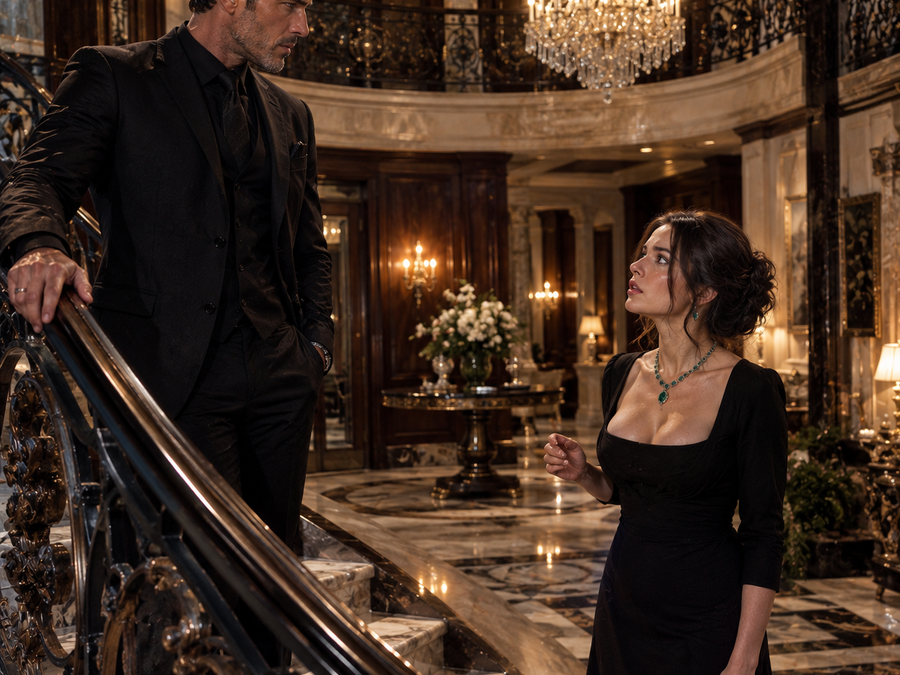
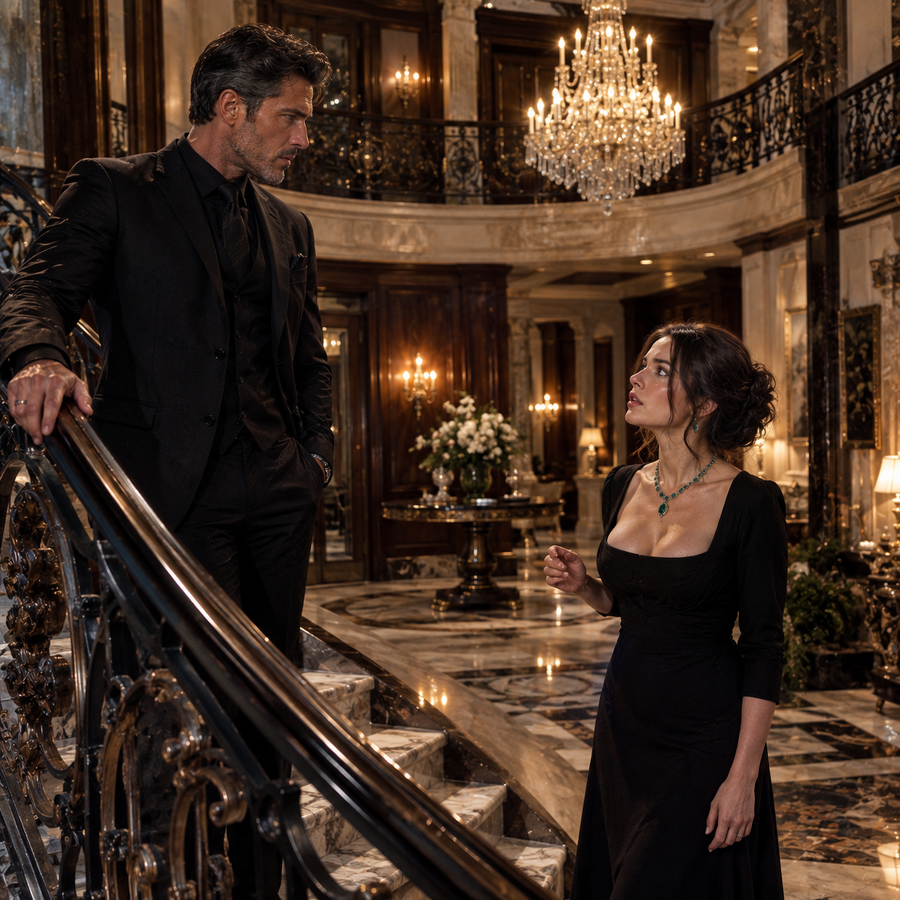
I wasn’t, but I was already crossing the hall. I saw Escanio before he saw me. He was standing near the foot of the staircase, glass in hand, listening to Renato in a low voice. The whole hall churned around them. Laughter, glasses clinking, the pianist in the corner playing something French. I crossed all of it with my eyes fixed on him, feeling the weight of each step on the marble as if the floor were about to ring out.
I stopped in front of him. I lifted my chin. “Can I ask a question?” Escanio looked at me with that trained neutrality. Renato took half a step back. “Not here,” Escanio said. “Right here.” I wasn’t shouting. I didn’t need to. I had the kind of voice that cuts through a hall without having to rise. A few heads were already starting to turn.
“Do you keep me out of convenience or out of something else?” That was what I asked. That was exactly it. I didn’t calculate the question. It came out of me the way a knife comes out of a sheath that’s too tight. I saw only his face harden the instant something out of the corner of his eye caught his attention near the main staircase. I saw his gaze touch three different points of the hall before coming back to me, as if he were checking instruments before playing. I understood none of it at the time.
I saw the jaw lock. I saw the glass in his hand tilt one millimeter more, the ice striking the crystal with a small sound no one else heard because the hall was already growing quiet around us. “I never loved you.” His voice came out clean, calm, loud enough to reach the opposite wall.
The hall went silent. It wasn’t a metaphor. The pianist stopped in the middle of a note. The bartender stopped pouring. Two matriarchs turned their heads in slow motion. Someone dropped an olive into a glass with a crack of crystal that sounded too loud. I felt the blood rise to the roots of my hair and drain back down, leaving my skin cold. I looked at him. He looked at me with eyes like wet stone, hard on the outside, with something sliding inside that I couldn’t name in that instant.
For half a second, I thought I would cry right there. For half a second, I thought I would hit him with both hands flat against his chest. I did neither. I lifted my chin one millimeter more, turned on my heels, and crossed the hall with my head high. People made way for me as if I were carrying something contagious. I saw Renato lower his head as I passed. I saw Bastiano take a step toward me and stop. I shook my head once and he understood that three steps behind was enough.
I crossed the foyer where the noise of the hall arrived muffled and the light of the chandeliers was colder. I crossed the double door. I crossed the white stone outer veranda where the magnolia air hit my face like a damp slap. The New Orleans night had the brief chill of late autumn, the kind that gets into your sleeves without warning. I rested my hands on the wrought iron railing and felt the cold metal cut through my palms like punishment.
And it was there, with my hands trembling on the iron, that I heard footsteps behind me. “Ma’am, you’ll freeze.” The voice was deep, calm, faintly amused. I didn’t need to turn around to know whose it was, but I turned anyway. Gualtiero Franipani stood two steps away, holding a black wool coat by the shoulders. His hair was slightly mussed by the wind. The smile was still small, as if he were amused by some joke only he had heard, or as if the joke were the whole night, and he the only one who knew the ending.
I said nothing. He took a step. He held out the coat. The silk of the lining gleamed yellow in the light of the veranda lamps. “I brought it for you.” “I don’t need it.” “It’s forty-five degrees, Mrs. Malatesta, and you left the hall without a coat. Whoever saw the scene imagines you’re still answering.” His hand held the coat in the air with the patience of a man who had waited for harder things.
I looked back through the double doors. I caught a glimpse of Escanio standing in the middle of the hall, glass in hand, with five men around him talking all at once. He was looking straight at the veranda, looking straight at me, looking straight at Gualtiero’s hand. And he made no gesture. He didn’t come. He didn’t call. He didn’t wave. I turned my face away.
“Thank you,” I said low, and let Gualtiero place the coat over my shoulders. The wool weighed more than I expected. His perfume, something woody, expensive, faintly citrus, settled on my shoulders like a signature I hadn’t asked for and didn’t know how to give back. I pressed the fabric against my chest with both arms crossed, less because of the cold, and more because of the need to hold on to something with hands that were still trembling.
“No woman should be treated like a leftover,” Gualtiero said. Low, too close to my hair. “By a man who’s afraid to desire her.” I closed my eyes. I wish I could say I felt nothing. I wish I could say I recognized the maneuver right away. The offered coat, the calculated sentence, the venom wrapped in silk. I wish I could say I gave the coat back, turned my back, and went back into the hall. I did none of it.
I pressed the coat closer to my body, lifted my chin again, and looked Gualtiero in the eyes for the first time up close. His eyes were light brown with something gold at the edge of the iris that the lamplight brought out. Eyes trained to look kind. “You don’t know me,” I said. “For now.” He smiled, took half a step back, made a small bow, and went down the veranda staircase toward the garden, leaving me alone with the wind, the magnolia, and the black wool on my shoulders.
When I turned my face back toward the hall, I saw Escanio still standing in the same spot. The glass in his hand had a thin crack running across the crystal from one side to the other. Not a single muscle in his face moved, but the ice inside the glass had begun to melt.
Ten days passed. The way days pass when you’ve stopped counting. I left the Malatesta mansion the morning after the party with a small suitcase, the band still on my finger, and Delphine’s address on the tip of my tongue. Bastiano drove me in silence. When we brought the bags down to her apartment, he lingered at the door a moment longer than he needed to.
“Ma’am,” he said, his voice lower than usual. “I’ll be in the car downstairs.” “Two hours. You need to sleep, Bastiano.” “I sleep in the car.” “Bastiano.” “Ma’am.” That was the whole conversation. He went down.
The black car stayed parked on the corner of her building for ten straight days. I saw it from the window every morning when I opened the curtain. The same dark car, motionless as a promise no one made out loud. The driver changed. The shift changed. It never left. Escanio never showed up, never called, never sent a note. But Bastiano stayed down there, and I knew what that meant.
Delphine’s apartment was on the third floor of an old building in the French Quarter with French windows that didn’t seal well, a wooden floor that creaked at two specific spots in the hallway, and a permanent smell of coffee and oil paint that had soaked into the walls over the years. She had turned the second room into a personal studio with easels at three angles and cans of paint stacked to the height of the window, and gave me the guest room with a yellow quilt that seemed to shout from the bed.
“The quilt’s new,” she said on the first day, leaning against the frame. “I bought it thinking of you.” “Why yellow?” “Because you’re in too black a moment. Chromatic balance, dear.” That was Delphine’s way of caring. A joke in her voice. Food on the table. A yellow quilt on the bed.
In those ten days, she tried to feed me everything. Gumbo, beignets, cinnamon, coffee, salad with five different greens. I ate half. She ate the rest and complained that I was being incompetent at grief. “I’m not grieving,” I said on the third morning, stirring coffee without drinking it. “I’m furious.” “Worse. Anger burns calories. Delphine, eat the beignet, Fiorenza.” I ate the beignet. The powdered sugar stuck to my fingertips, and I wiped it on the napkin harder than I needed to.
It was also on the third morning that the flowers began to arrive. The first delivery was to the foundation. I was in the warehouse going over the budget with Aldo, the painting monitor, a quiet man with gray hair who treated every teenager there as if they were his nephew. When the delivery man appeared with a bouquet the size of a child. Rare white orchids, the kind that only grow in a controlled greenhouse, with a dark dense foliage around them that made the white look even more absurd in that low-ceilinged warehouse.
A card sealed in cream. “For the lady who deserves flowers that don’t wilt easily. G.” Aldo looked at the bouquet. He looked at me. “Ma’am, that bouquet is worth more than the roof.” “I know.” “Do you want me to throw it out?” I looked at the orchid a moment too long. Their white was almost offensively beautiful. I thought of the Franipani veranda, the black wool, the voice too low near my hair. “Put it on the reception table,” I said. Aldo said nothing, but I saw the way he looked at me before turning his back. A look that said everything he was too kind to say out loud.
The second delivery arrived at Delphine’s apartment on Thursday. Red camellias arranged with precision, all at the same height, as if someone had cut the stems with a ruler. The card. “You were the only elegant thing at the party. G.” Delphine read the card over my shoulder and whistled low. “The man is going all out. He’s laying siege.” “It’s the same verb, dear. Be careful.”
The third delivery came on Friday. Black lilies. I didn’t even know black lilies existed. And their color was an almost bluish dark, dense, and strange, as if they’d been hand-painted. The card. “Friday, there’s a vernissage at the Bellucci Gallery. Eight o’clock. If you show up, I show up.” And I showed up.
I didn’t go for the reasons Delphine thought. I didn’t go to see Gualtiero. I didn’t go to provoke Escanio. I went because the Bellucci Gallery was one of the few that still bought work from young, nameless artists, and the foundation depended on that kind of buyer. I went for my teenagers. For the money. At least that’s what I told myself in front of the mirror while I pinned up my hair more calmly than I felt.
I put on a red dress. Mine, bought by me, without the influence of any Malatesta man. The fabric fell straight to the knee with a seriousness that contradicted the color. Delphine looked at me from the door with a raised eyebrow. “Red to a vernissage?” “It’s red, Delphine.” She didn’t believe it. Neither did I.
Bastiano drove me. He didn’t comment on the dress. He didn’t comment on the destination. He just parked in front of the gallery and said without turning his face, “I’ll be out here.” “It’ll take a while.” “I’ll stay until you get tired.”
The Bellucci Gallery was crowded with that specific heat of a closed room and too many people, expensive perfume mixed with white wine, and the soft aroma of old wood coming from the frames. Large paintings, small glasses, conversation in three languages. I greeted Bellucci personally, talked about the three pieces he had bought from the foundation the month before, thanked him with all the precision I had learned at my father’s table. I circled the paintings for ten minutes. I spoke with two known collectors. Everything normal.
Then Gualtiero came in. It wasn’t an ordinary man’s entrance. He came accompanied by two henchmen, an expensive coat draped over his forearm, the same small smile as always, and before even greeting the host, he found my red dress across the room. It took him maybe two seconds, like a man searching in a crowd for something he already knew exactly where to find. He walked toward me without hurry. People stepped aside by instinct.
“Mrs. Malatesta,” he said, giving the small bow. “You came.” “I came to see the paintings.” “The paintings survive without you. I wasn’t so sure about that.” “You survive a lot.” “From what I hear.” He laughed low. A short, contained laugh that didn’t reach his eyes but reached the corners of his mouth with the naturalness of a man who’d been practicing it for years. “Will you accept a glass?” “I’ll accept conversation. I get my own glass.”
He offered me his arm anyway. I didn’t take it, but I walked beside him across the room like someone walking beside an open window on the third floor, aware of the possible fall, unable to stop looking down. He introduced me to three European collectors who said in a slightly rehearsed tone of praise that they had heard very good things about the foundation’s work. They said they would buy three pieces, maybe. I smiled politely. I thanked them. I made a mental note of every name and every promise.
And it was at that moment that I saw on the other side of the room two men standing near a bronze sculpture. They weren’t talking. They weren’t drinking. They were looking at me with the discreet, permanent attention that Bastiano’s men devoted to doors. It took me two seconds to understand, then three more to accept it. Escanio was protecting me from afar.
I didn’t see Escanio in person that night. I didn’t see him on the other four occasions that Gualtiero appeared at events where I was during those ten days. But at every one of them, always on the other side of the room, two different men kept watch. Always two, always Malatesta. Always with that specific posture of men who hadn’t come for the party. I hated and thanked them in the same breath, and the contradiction burned somewhere in the middle of my chest that I preferred to pretend didn’t exist.
I went back to Delphine’s apartment that night at 11:30. She was still awake, painting something abstract in red paint in the studio, barefoot, and with a smear of paint on her forearm. She looked up when she saw me at the door. “Uh. How was it?” “I sold four of the foundation’s paintings.” “Good night, then.” “Gualtiero was glued to me for three hours.” “Bad night.” Then I took off my heels at the entrance, crossed the studio barefoot, and sat on the paint-stained sofa she insisted on calling vintage.
Delphine left her brush soaking in the cup of water and came to sit beside me without hurry. “Fiorenza.” “Hm.” “We need to talk about something.” I turned my face. Delphine had her eyebrow furrowed. A rare thing for her, since she usually saved seriousness for emergencies. “The man tonight at the vernissage offered you his arm in front of half the French Quarter. I’ll be blunt. The city is talking.” “Talking about what?” “That Mrs. Malatesta accepts flowers from a Franipani.”
I sat staring at the wall for a long while. The studio smelled of turpentine and cold coffee. And somewhere on the street below an old radio played music too low to identify. Delphine didn’t interrupt me. “I know what he wants,” I said finally, low. “I know he looks at me like a trophy. I know every flower is a maneuver. I know that coat on the veranda was calculation. And you accepted it anyway.” “And I accepted it anyway.” “Why?”
I swallowed hard. Delphine waited with the specific patience of someone who has heard a lot of hard things and knows that pushing doesn’t help. “Because it hurt less,” I said. “It hurt less to have a man who looked at me like an object than a husband who called me nothing in front of two hundred people.”
Delphine didn’t answer right away. She took my hand with both of hers, squeezed slowly. “Fiorenza,” she said. “You’re my best friend in the world. I love you, and I’m going to tell you something you won’t like to hear.” “Tell me.” “Gualtiero is not an alternative. He’s a different poison. And Escanio, Escanio is what he is, but you’re only going to be able to decide anything real in your life after you go there and look him in the eye one more time. Not to come back. To really end it.”
I stayed silent. The jazz kept going outside, even lower now. “There are foundation documents in his office,” I said finally. “Last quarter’s reports. I need to get them before the audit.” “Then go get them. I could send Aldo to fetch them.” “You could, but you won’t.” I looked at her. Delphine smiled. A small smile. No joke. The kind she almost never gave, and that for that reason weighed more. “Get the documents, Fiorenza. And while you get them, decide.”
I said it for Saturday afternoon. I sent word through Bastiano, who received the word, gave that minimal bow of his, and said, “Four o’clock is fine, ma’am.” On Saturday morning, I woke before the sun rose. I lay in bed listening to the building wake up slowly, the creak of the floor above, the window banging in the wind, the smell of the coffee Delphine was already making in the kitchen at six in the morning, as if the world depended on it.
After a while, I got up, put on the simplest navy dress I had, pinned up my hair without a mirror, slipped on flat shoes. It wasn’t a wife’s visit. It was an employee’s visit to pick up files. At least that’s what I told myself. The band was still on my finger. I hadn’t taken it off once in ten days. Not by conscious choice. I simply hadn’t. Taking it off meant deciding, and I still hadn’t decided anything that wasn’t provisional.
At 3:45 in the afternoon, Bastiano parked in front of the iron gate of the Malatesta mansion. The garden was still the same. Giant magnolia with that dense glossy foliage, short grass, jasmine tangled in the gate, perfuming the air in an almost excessive way. I got out of the car with my chin high. I crossed the gate. I crossed the white stone path. I climbed the three steps of the front veranda with steady steps like someone whose heart isn’t beating against the ceiling.
And it was then that from the large window at the top of the main staircase, I saw Escanio. He stood up there, hand on the banister, charcoal gray suit, no tie, looking straight at me. Looking straight at my left hand. Looking straight at the band that still gleamed on my finger. Ten days after everything. For half a second, neither of us breathed. For half a second, I knew without him having said anything, without my having asked anything, that this afternoon would be the last chance he had. I also knew in that same half second that it was the last chance I had to walk out of there still whole. I lifted my hand to open the door.
I crossed the gate of the Malatesta mansion with the band still on my finger and my courage hanging by a thread. Delphine’s driver didn’t turn off the car. I’d arranged that he would wait fifteen minutes at the end of the street and that if I didn’t come back, he would call her. It was the only rope I had tied around myself before going in there.
The afternoon air was heavy with magnolia in that New Orleans way that makes any perfume seem like an accusation. I climbed the three veranda steps with the foundation documents under my arm. The leather folder was the excuse I carried. The truth was something else, and it fit entirely inside the question I was afraid to ask.
Bastiano opened the door before I touched the bell. He wore his usual jacket with the holster hidden by the cut of the fabric. He looked at me, looked at the folder, looked up toward Escanio’s floor. “Ma’am,” he said, making space. “Bastiano.” He didn’t comment on my wrinkled dress, nor on the fact that I’d arrived unannounced, nor that my hand was trembling holding the strap. He offered me the way through.
I went in smelling furniture wax and old cigar. The smell of that house that had been mine for three weeks and that still treated me like a guest. “He’s in the office,” Bastiano said without my asking. “I know the way.” I climbed the main staircase slowly. The documents hugged to my chest. With each step, I counted a sentence I had repeated in my head since the vernissage. “At least he isn’t ashamed to desire me.” “You traded me for an audience.” “Get my name out of your mouth.” Sentences I had collected like stones to throw when the time came.
At the top of the second floor, I realized none of them served. I hadn’t gone there to fight. I had gone there to end it. The office door was ajar. I pushed it. Escanio stood behind the desk, his back to me. He looked at the window as if the view of the garden could answer something I had never managed to answer in bed. Alone those last three weeks. He had taken off his jacket. The white shirt marked his shoulders, and his dark hair caught the last sun of the afternoon, as if it wanted to be touched.
He turned before I spoke. He didn’t seem surprised. He seemed, in fact, like a man who had waited ten days for that door. “I came to get the documents,” I said, because it was the sentence that fit in my throat without tearing it. “They’re in the second drawer.” “I know.” I walked to the desk without looking at him. I opened the drawer. The foundation contracts were stacked there with their own rubber band, exactly as I had left them three weeks before.
He hadn’t touched them. He hadn’t read them. He had only kept them as if they were the last trace of a wife he still called mine in some reserved corner. I put the contracts in the folder. I closed it. I lifted my eyes. “Done,” I said. He didn’t answer. He stayed standing, one hand on the back of the chair, his knuckles white from the force he pretended he wasn’t using.
“You’re not going to say anything,” I asked. “What do you want me to say, Fiorenza?” “Anything. A word. An insult. I don’t know. Something that proves the man who knelt in front of the broken glass wasn’t an actor.” “I’m not an actor.” “Then you’re a coward.” The word came out before I could hold it back. I saw his jaw harden. “Maybe,” he said, low.
I thought I would collapse right there. I thought I would cross the room, pound his chest, scream everything I had swallowed in the Franipani hall. But what came out of my mouth was something else. “Gualtiero at least isn’t ashamed to desire me.” He moved. It wasn’t a step. It was a decision. He crossed the room in three strides. And before I could back away, he gripped my wrist firmly and pulled me out of the office toward the hallway wall beside the door frame.
He let go of my wrist the moment my back touched the plaster. He braced one hand on the wood panel beside my head. The other stayed in the air, not touching. His forehead pressed against mine. His breath came out uneven, hot, and the smell of old whiskey and cedar hit me as if I had never felt it before. “Don’t say that name again,” he growled. “Not in my house. Not in front of me.” “Or what?” “Or I lose what’s left of me.”
I felt the cold wall at my back and his breath burning my lip. His hands were trembling. I saw it out of the corner of my eye. The hands of a man who never trembled at anything, trembling now, held in the air, centimeters from my face, as if touching were a pact he still didn’t have permission to sign. “You said you never loved me,” I whispered. “In front of everyone.” “I know what I said.” “Then let me go.”
He didn’t let me go. He lowered his mouth to mine, and it was a kiss that didn’t ask permission to exist. It was deep, long, tasting of whiskey, of contained anger, and of three weeks of silence. I grabbed him by the shirt before I thought. My fingers crumpled the fabric as if it could anchor me somewhere. I felt his tongue find mine with a calculated hunger. The hunger of a man who always calculated everything, and then with a hunger that lost count.
And then I pushed myself away. Not with force. With decision. My hands on his chest. I pushed until I created fifteen centimeters of air between us. He let me push. He didn’t try to pull me back. He stayed there, his forehead still tilted, his breathing still uneven, his black eyes fixed on mine. “The truth,” I said, my voice catching. “Now. No version for an audience, no prepared sentence. The truth, Escanio, or I walk out that door and the band stays on your desk.”
He lowered his face. It was the first time I saw that man lower his face in front of me. It wasn’t shame. It was weight. As if he had spent the last weeks carrying something on his shoulders and had finally found somewhere to set it down. “There was a man by the staircase,” he began slowly. “Dark shirt, hand inside his coat, gray hair cropped close. The shooter. Marco Vaneri, paid by Franipani.”
I felt my stomach drop. “Why didn’t he shoot?” “Because he wasn’t there to kill me.” I stared at him. He met my eyes, and what I saw in them was the most naked thing I had ever seen inside Escanio Malatesta. “He was there to watch,” Escanio continued, “to see who mattered to me. Three of Franipani’s men were there too, spread across the hall, observing every gesture I made. If I had asked you to leave carefully, if I had moved you away from that side of the hall, if I had even turned my face in your direction with an expression different from the one I used to greet the port senator, they would have known. They would have known you were the piece that had to be taken off the board to break me. And then, and then you would have died before dawn.”
I leaned the back of my head against the wall and closed my eyes. The tears came. Quiet, without sound. I always knew how to cry without sound. The foundation taught me. In a thousand nights of exhaustion. “You could have gotten me out of there.” “There was no way. I had less than six seconds between you crossing the hall and asking me that question. If I apologized, if I denied it, if I hesitated, anything, he would know. I only had one sentence that erased everything. And it was the most expensive sentence I have ever paid.” “You erased me in front of all of New Orleans.” “I erased what they could use against you. I couldn’t erase the pain.” “I know.”
I opened my eyes. He was leaning against the opposite wall now, his hands shoved in his pants pockets, his chin down. He looked smaller. Not less dangerous. Less armored. An Escanio I had never seen and that I suspected for an instant no one had ever seen. “And Vaneri,” I asked. “He doesn’t breathe anymore,” he said simply. “Last night. It was quick, it was clean, it was far from the French Quarter. And the man who was selling your movements from inside the house has also been taken care of. I’ll tell you his name when you want to hear it.”
He took his phone out of his pocket, slid his finger, and held the device out. The photo was low resolution, taken by a party camera. A man with gray hair cropped close, black shirt, hand inside a dark coat, beside the marble staircase of the Franipani mansion. The same man I had passed that night without noticing because I was too busy holding my humiliation like an expensive dress. I handed the phone back without saying anything.
“You chose to break me rather than trust me,” I said. My voice came out lower than I wanted. It wasn’t an accusation. It was a statement of fact. He took a while to answer. When he did, it was to some random point on the rug. “I didn’t know another way to keep you alive.”
I sat down. Not in a chair. On the floor itself, my back against the hallway wall, the foundation documents abandoned in some corner of my memory, the wrinkled dress around my knees. He looked at me and then did something I didn’t expect. He sat down too. On the office floor on the other side of the door frame. His back against the oak desk, his Italian shoes crossed, his shirt wrinkled, his hair fallen over his forehead.
We stayed like that for a time I couldn’t measure. The sun dropped to the height of the window and crossed the hallway with honey-colored light. I looked at him. He looked at the floor. Neither of us spoke. And even in the silence, something between us settled. Not in peace, not in forgiveness, but in the shared exhaustion of two people who had spent everything they had on not telling the truth.
“I had decided to leave,” I said after a long while. “I went all the way to Delphine’s door with the band in my pocket. I even took it off.” “I saw the white mark on your finger at the vernissage.” “You were there.” “Two cars, four men. You didn’t see, but I saw everything. I knew there was someone. I didn’t trust Franipani near you.” “You don’t trust me near anyone?” “No,” he said. “I don’t trust the world near you. It’s different.”
I swallowed hard. I stood slowly, my palms on the floor. He followed the movement with his eyes but didn’t move. I crossed the hallway without hurry and stopped in front of him and bent down. I held out my hand. He looked at the hand the way you look at a loaded gun. Then he placed his fingers in mine and stood. We stood there in the hallway, too close and too far at the same time. “I’m not leaving today,” I said quietly. “But I’m not staying either.” “I know.” “You know?” “I’ve known since the veranda.”
I brought my face closer. The kiss this time was different. It was slow. It was a request he answered without urgency, without calculation, without an audience. It was the kind of kiss I had never received in my life. The kiss of a man who was tired of pretending he didn’t love me. I felt his hands rise carefully to my waist and his fingers tremble again. And this time I let them tremble. I rested my forehead against his and said with no force at all, “Come upstairs with me.”
He came up. The bedroom door closed behind us, and the rest of the night stayed on this side of the threshold where no hall, no board, and no shooter could enter. And in the morning, I woke before him. The morning light came through the linen curtains with a calm that house had never had. He slept on his stomach, his arm thrown across my waist, his breathing slow.
I watched for a while that felt generous. The scars on his back I had never seen. The line of his shoulder falling over the sheet. The onyx ring on the nightstand beside my band, which he had taken off at some point in the night. I got up without waking him. I put on one of his shirts, the kind that stayed folded on the armchair. I went down the stairs barefoot. The kitchen smelled of coffee. Bastiano had left a coffee pot ready on the stove. No note. I poured two cups before thinking.
Escanio appeared at the door a few minutes later in pajama pants and a white t-shirt. His hair tussled in a way I had never seen on that man outside the bedroom. He accepted the cup. He leaned against the frame. He looked at me with a tenderness I didn’t have the vocabulary to describe. The tenderness of a man who knew that morning was alone. He came closer. He brushed a strand of my hair away with the back of his fingers. Slowly, like someone handling something broken. He said nothing. He didn’t need to.
I drank the coffee looking at the band I had set on the table beside the sugar bowl. When I came into the kitchen, I had put it there without thinking. Or thinking too much, maybe. “You loved me,” I said after a while. “I love you.” I felt the air hit a place in my chest that had been locked. “You chose to lie before telling me,” I continued before giving him the chance. “You decided for me that I wouldn’t be able to handle the truth in the moment.” “I decided. And I don’t know if that’s love or if it’s the version that fits a man like you.”
He lowered the cup. He took a while to answer. “Maybe it’s both,” he said low. “And maybe you’re right not to want to stay today.” I held out my hand. I touched his face. My fingers spread along his jaw and he closed his eyes. I felt the stubble of one night, the warmth of recent sleep. The man who had slept beside me and whom I hadn’t been able to hate even when he broke me. “I need to learn to choose myself before I choose you again,” I said. “Otherwise, I come back out of absence. An absence passes.” “I know.”
I took the band from the table. I looked at it with my palm open. The gold caught the light from the window and gleamed in a way that seemed to ask to stay. I put it in the pocket of his shirt. “Keep it,” I said. “Don’t throw it away. When I come back, if I come back, I want to know where it is.” He pressed the fabric with his hand over the pocket. He tilted his forehead to rest it against mine. He didn’t kiss me. He just breathed with me for a few seconds as if shared air could count as a contract.
“Go,” he said. “Before I ask you to stay.” I went up, changed my clothes, got the document folder from the office. In the hallway, I stopped in front of the wall where he had pinned me the afternoon before. I rested my hand on the plaster like someone saying goodbye to a familiar corner. I went down the stairs with the folder against my chest.
Bastiano waited for me with the door open. He didn’t comment on my messy hair, the wrinkled dress, the eyes red from the short night. He just tilted his head as I passed. “Ma’am.” “Bastiano. Take care of yourself.” It was the longest sentence he had ever directed at me.
At the gate, Nell was sitting on the step, his backpack at his feet. Fifteen years old, thin, his curly hair cut short, his sketchbook under his arm. He stood up when he saw me. “Miss Fiorenza. Delphine said you’d be coming by,” he said without looking me in the eye, in his shy way. “Can I ride with you to the foundation?” “You can, Nell. Get in.”
I opened the car door for him. He got in carefully, the way he entered any expensive place, afraid of breaking something. He sat in the passenger seat with the sketchbook in his lap. I went around. Before opening my door, I looked at the veranda. Escanio stood on the threshold. No suit, no mask, no audience. Just a man holding a woman’s wedding band in the pocket of his pajama shirt. He didn’t wave. I didn’t wave either. It was better that way.
I got in the car. I closed the door. I looked at my bare left hand on the wheel, the white mark of the ring still clear on the skin, lighter than the rest of the finger. For half a second, I asked myself whether letting go had been strength or had been fear of finding out I still wanted to stay. The thought passed. I dropped the band into my pocket. I started the engine.
I looked at Nell, who had opened the sketchbook and was drawing something with a pencil that was too short. “What are you doing there?” “A sky,” he said, and finally smiled. “What color?” “Green,” he said without hesitation. “I’m in the mood.” I smiled for the first time in ten days. I pulled the car out of the street and drove on through the sleeping French Quarter toward the foundation. The morning sun came through the windshield, and I didn’t look in the rearview mirror.
