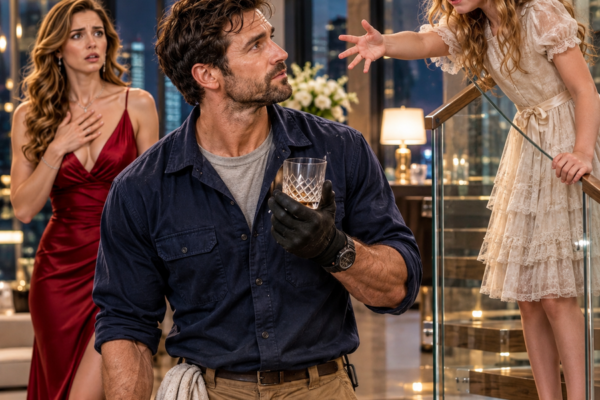
Lonely Mafia Boss Fell in Love With Her Voice—But When He Saw Her Face, Her Secret Broke Him (Part 1)
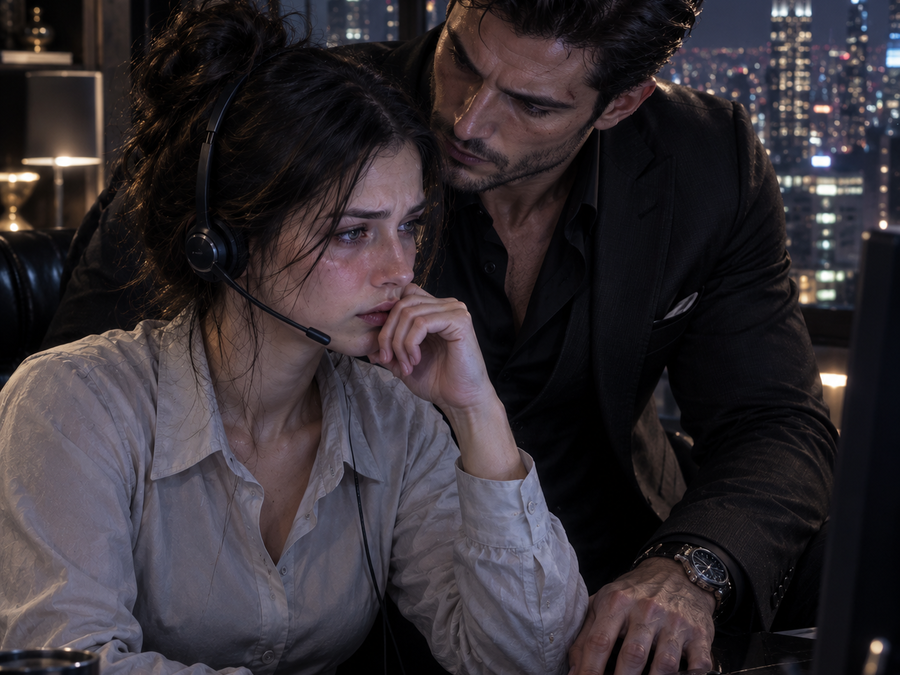
Lonely Mafia Boss Fell in Love With Her Voice—But When He Saw Her Face, Her Secret Broke Him (Part 1)

PART 1
Every night at 2:14, the most feared man in New York called just to hear me say hello. He fell in love with my voice in the dark. Then he saw my face, and the secret I had been hiding broke something inside him.
But before Enzo Salvatore ever knew my name, before he touched my hand, before he looked at me like I was the one thing in his world he could not command, I was only Operator 7 at Confidant, a woman paid to answer dangerous men after midnight and pretend their secrets could not hurt me.
The first time his code name appeared on my screen, I almost rejected the call. Il Lupo. The Wolf. No voice filter, no background mask, no emotional category selected. Just one private line opening at 2:14 a.m. like a door I should never have walked through.
I sat alone in a glass booth on the 34th floor of a private building in Manhattan, wearing a cheap black headset, drinking coffee that had gone cold beside my keyboard, with my little brother’s hospital bill folded underneath the desk because I could not bear to look at it and still keep my voice steady.
Confidant was not a normal hotline. Normal men did not pay twenty thousand dollars a month to speak anonymously to women they would never meet. Our clients were billionaires, politicians, heirs, criminals, men with marble homes and locked hearts, men who trusted encrypted lines more than priests.
We were trained to be calm, warm, professional, and forgettable. We were trained not to ask names. We were trained not to react. We were trained to understand that silence was the product and our voices were only the packaging.
I clicked accept and said the sentence I had said to hundreds of rich, lonely strangers. “Confidant private line. You’re safe here.” A low male voice came through the darkness. Calm, Italian, deadly. “No one is safe here.”
My fingers stopped above the keyboard. Behind his voice, I heard something faint. A chair scraping across marble. A man breathing too fast. Another man whispering something that sounded like a prayer.
I should have ended the call. Confidant rules were clear. If a client mentioned violence, threats, weapons, or active danger, we were supposed to alert internal security and disconnect. But I did not disconnect because the man on the line did not sound like someone asking permission to be cruel. He sounded like someone standing on the edge of cruelty, waiting for one voice to pull him back.
“Then why did you call?” I asked. Silence, heavy, controlled. The kind of silence that made me feel as if he had turned his head toward me in a room I could not see. Then he said, “There is a man kneeling in front of me. He stole from me, lied to me, sold my name to people who wanted me dead.”
My throat tightened. “And what do you want from me?” “One reason,” he said. “One reason not to make him disappear tonight.” Behind him, the kneeling man made a broken sound. My heart hit my ribs so hard it hurt.
I was twenty-four years old, sitting in a glass booth above Manhattan with no weapon, no power, no protection, and a twelve-year-old brother at home whose heart was running out of time. I had no right to challenge a man who sounded like he could order death with the same calm voice most people used to order coffee.
But something inside me moved before fear could stop it. “If you really wanted him gone,” I said softly, “you would not be asking a stranger for a reason.” The line went so quiet I heard my own pulse. Then his voice dropped lower. “What did you say?”
I swallowed, but I did not take it back. “I said you did not call because of him. You called because some part of you is tired of being the only monster in the room.” For three seconds, I thought I had killed myself with one sentence. Even the man crying in the background stopped.
Then Il Lupo gave an order, not to me, but to the men around him. “Let him go.” A door opened. Someone sobbed harder. Footsteps rushed away. And then the most dangerous client Confidant had ever placed on my screen breathed into my headset as if my voice had reached a place no bullet ever had.
“What is your name?” he asked. “You know I can’t tell you that.” “Then I will call you Voce.” “Voice?” “Yes,” he said. “Because that is what stopped me.”
I should have been afraid of him. I was, but I was also afraid of the way my own heart reacted when he stayed on the line instead of hanging up. “You should not call me anything,” I said. “I’m not supposed to become real to you.” “Too late.” The words were quiet, almost careless. But they entered me like a warning.
My supervisor, Celeste, passed outside the booth with her tablet, her heels silent on the carpet, her face lit blue by client activity. I lowered my voice. “This line is confidential, but it is not personal.” “Everything becomes personal after midnight.” “Not here.” “Especially there.”
I looked at his call timer. Two minutes and forty-one seconds. Somehow it felt like he had been inside my head for an hour. “Why did you really call?” I asked. “I told you.” “No, you told me what was happening in the room, not what was happening to you.”
Another pause. This one was different. Not dangerous. Wounded, though he would have hated that word. “I had already decided what to do with him,” he said. “Then your hand should not have been reaching for a phone.” He laughed once without humor. “You speak to wolves like you have never been bitten.”
My eyes moved to the hospital bill under my keyboard. “No, I speak like I have.” “By whom?” I almost answered. A landlord, a hospital, a man who lent money with one hand and took dignity with the other. Life itself. Instead, I said, “That is not part of the service.” “Neither was saving a man you do not know.” “Maybe I wasn’t saving him.” “Then what were you doing?”
I looked through the glass walls of my booth at the city glittering below us, full of people who could afford emergencies and people who could not. “Maybe I was saving you from becoming the kind of man who does not need a reason anymore.”
The call lasted nine minutes. He did not tell me his name. I did not tell him mine. When he finally disconnected, the screen went black and I sat still with my headset on, my hands cold, my breath uneven.
Then I pulled the folded hospital bill from beneath my keyboard. St. Agnes Children’s Hospital. Patient: Milo Voss. Age: 12. Recommended procedure: urgent corrective cardiac surgery. Deposit required before surgical scheduling: six weeks. The doctor had given us six weeks before the risk rose beyond what she was comfortable saying out loud. Six weeks sounded merciful until you were counting rent, groceries, medicine, and debt in the same cracked kitchen drawer.
At 7:12 a.m., I walked home through dirty snow with my coat wrapped tight around me and Il Lupo’s voice still sitting under my skin. Our apartment was on the fourth floor of a walk-up in Queens, above a nail salon, and beside a bakery that made the hallway smell like sugar we could not afford.
Milo was asleep on the couch when I opened the door, one hand resting on his chest like he was checking whether his heart had kept its promise through the night. His school books were open on the coffee table. His medicine bottles stood beside a plastic cup of water. A pair of sneakers waited near the couch because Milo believed emergencies should never have to wait for laces.
I stood there for a moment and watched him breathe. Twelve years old, too thin, too pale, too brave in the way sick children learn because adults keep crying in bathrooms. He opened one eye. “You’re staring again.” “You’re supposed to be asleep.” “My heart was being dramatic.”
I crossed the room too fast and he rolled his eyes before I reached him. “Alina, I’m fine.” “You’re twelve. You don’t get to decide what fine means.” “Dr. Patel says stress is bad for cardiac patients, so maybe stop looking at me like I exploded.”
I pressed my palm to his forehead. No fever. His pulse fluttered too quickly under my fingers, but lately it always did. “Did you take the blue pill?” “Yes.” “The white one.” “Yes.” “The small yellow one.” “Yes, Captain Anxiety.” I tried to smile. It hurt. “I’m serious.” His face softened. “I know.”
He glanced toward the bills near the sink. “Did the hospital call again?” “Hospitals always call.” “How much?” “Not your problem.” “I’m the one with the expensive heart.” “And I’m the one with the job.”
He looked away, ashamed, and regret hit me immediately. Milo carried enough. He did not need my fear placed in his hands, too. I sat on the edge of the couch and fixed his blanket. “Hey, look at me.” He did. His eyes were too old for twelve. “I will handle it.” “You always say that.” “Because I always do.” He nodded, but he was not convinced. Neither was I.
By noon, I stood outside Dr. Patel’s office at St. Agnes, holding a folder full of applications, denial letters, charity forms, and numbers that made my lungs feel too small. Dr. Patel was kind in the way good doctors are when they cannot save you from the system wrapped around their hands.
“Alina, his rhythm episodes are becoming more frequent. We can manage symptoms for a short period, but the surgical window matters. Six weeks is the outside edge.” “I’m applying for assistance.” “I know.” “The charity board said they’ll review.” “I know.” “I can increase the deposit. I just need time.”
Her face softened. And I hated that softness because it always came before the truth. “I wish time were something I could prescribe.”
I walked out past parents holding balloons, nurses moving fast, children wearing masks, machines beeping behind doors. Outside, New York kept moving like my brother’s heart was not a clock losing minutes.
That evening before my shift, Victor Drago waited in the alley behind my building. He wore a charcoal coat and black leather gloves. Too polished for our street. Two men stood beside a black SUV. I stopped three steps from him and felt my stomach turn cold.
Victor was not the kind of man you forgot after meeting once. I had borrowed five thousand dollars from one of his people eight months earlier when Milo’s medication changed and insurance delayed approval. Five thousand had become twelve. Twelve had become twenty-one. Interest, fees, penalties, threats.
Debt did not grow like a number with Victor. It grew like mold. “Alina Voss,” he said, smiling as if we were old friends. “You work too hard.” “I made the payment on Friday.” “A small payment.” “It was what we agreed.” “It was what you begged me to accept.”
I kept my face still. “I have another shift.” “A Confidant.” My breath stopped before I could hide it. His smile widened. “Careful. Fear makes people honest.” “I don’t know what you’re talking about.” “You answer phones for people who think secrecy makes them gods. One of those gods called last night.” He stepped closer. “Il Lupo.”
My mouth went dry. “Client names are confidential.” “So he is real.” I said nothing. The air smelled like exhaust, snow, and garbage. Victor’s eyes sharpened. “One of your night shift security analysts likes money more than confidentiality. He cannot hear the calls, but he can see code names, call times, and operator numbers. He saw Il Lupo connect to Operator 7 at 2:14. Then I saw your name attached to a debt file and suddenly the world became useful.”
My stomach turned. “You have nothing.” “I have enough.” “Even if he called, I don’t know who he is.” “Then find out.” “I can’t.” “You can.” “No, I literally can’t. We don’t see real names.” “Men like him reveal themselves even when they think they are silent. I signed contracts.”
Victor laughed softly. “Contracts! How sweet!” One of his men opened the SUV door. Inside, on the leather seat, was a brown pharmacy bag with Milo’s name printed on the label. My heart dropped so hard I almost reached for the wall. “Where did you get that?”
“Your brother’s medicine is expensive. Fragile supply chain. Things disappear.” “Don’t touch him.” The words came out sharper than fear. Victor’s smile vanished. “Then be useful. Il Lupo is someone I need to understand. You will help me.” “I don’t know anything.” “You will.”
He stepped back. “Bring me something real after your next meaningful call. His habits, his weakness, his location, his name if you can get it. Smoke will not satisfy me forever.” “I can’t get that.” “Then pray your brother’s world stays organized. Hospital grants can be influenced. Schedules can be delayed. Medication can arrive late. Forms can disappear.”
I wanted to hit him. I wanted to run. I wanted to become the kind of woman who did not have a little brother sleeping beside pill bottles. Instead, I stood there while Victor’s man tossed Milo’s medicine at my feet. “I will know if you lie,” Victor said. Then he got into the SUV and left me shaking in the alley.
That night, I arrived at Confidant early and threw up in the restroom before my shift. My reflection looked like someone had erased me badly. Dark hair twisted into a clip. Tired hazel eyes, pale face, cheap blouse buttoned to the throat because the office was always cold. I washed my mouth, fixed my lipstick, and went to booth 7.
Celeste stopped outside the glass and tapped her tablet. “You look terrible.” “Thank you.” “Elite clients tonight. Don’t improvise.” “I never improvise.” She gave me a look. “Your call with Il Lupo was flagged.” My pulse jumped. “Complaint?” “No.” She studied the screen. “He requested you again. Operator 7 at 2:14.”
My chest tightened in a way I did not want to name. “Can he do that?” “A client at his level can do almost anything.” Celeste leaned closer. “Do not get attached. Men who hide behind code names are not wounded puppies. They are men with enough money to buy silence and enough darkness to need it.” “Understood.”
I did understand. That was the problem. At 2:14, his name appeared again. Il Lupo. I clicked accept, my fingers cold. “Confidant private line. You’re safe here.” “Still childish,” he said.
I should have felt only fear. Instead, because my body was foolish and tired and desperate for one voice that was not asking me for money, I almost smiled. “Then why do you keep calling?” “You ended our last conversation badly.” “You ended it because you annoyed me.” “People usually avoid things that annoy them.” “People usually lie.”
I looked at the call timer. “Did you sleep?” “No.” “Eat?” “Is this part of the service?” “It is part of being human.” “That is not something I have been accused of often.”
His voice was dry, but there was strain beneath it. The thin edge of a blade held too long. I thought of Victor. Find out who he is. I thought of Milo’s medicine in that brown bag. I forced myself to ask, “What kept you awake?”
“A man in my organization stole from me.” My pulse jumped. “Are you angry because he stole or because he thought you would not notice?” Silence. “Then you ask dangerous questions.” “You called an anonymous hotline at 2:14 in the morning. Safe questions would insult you.”
This time, he laughed barely. One quiet breath that warmed the line for half a second. “What would you do with a thief, Voce?” The name moved through me before I could defend myself against it. “I would ask what he stole for.” “Why?” “Because hunger and greed are different crimes. And betrayal. Betrayal is usually just fear wearing someone else’s coat.”
He did not answer quickly. When he did, his voice was lower. “You sound young.” “You sound tired.” “That is not an answer.” “Neither was yours.”
Another pause. I imagined him somewhere dark and expensive. A man with enemies outside his door and no one allowed close enough to ask if he had eaten. I hated that I imagined him at all.
“You should be careful,” he said. “With what?” “Sounding as if you understand me.” My throat tightened. “Maybe you should be careful sounding like you want to be understood.”
The call lasted sixteen minutes. When it ended, I wrote the official Confidant report exactly as policy required. Client expressed insomnia, distrust, organizational stress. No actionable personal data. Then I opened the burner phone Victor’s man had forced into my coat pocket and typed the first lie that might keep Milo alive. Il Lupo. Male, wealthy, likely mid-40s, possible finance sector, paranoid about employee theft. Nothing confirmed.
Victor responded three minutes later. Not enough.
For the next three weeks, the calls became a ritual. Always 2:14. Always him. Sometimes he opened with a question. Sometimes with silence. Sometimes he sounded like he had just come from a room where every man had disappointed him. Sometimes I heard faint music in the background. Old Italian opera playing far away.
He never gave his real name. I never gave mine. He called me Voce, and I pretended the name did not make me feel seen in a way my real one rarely did.
“You never ask what I do,” he said one night. “I’m not allowed.” “That is not why.” “No,” I admitted. “It is not.” “Then why?” I looked through the glass wall of my booth at the other operators, each sealed inside her own square of blue light and secrets. “Because I think I already know enough to be afraid.”
“And yet, you answer.” “It’s my job.” “No.” His voice softened. And somehow that was more dangerous. “You answer before the second ring.” I closed my eyes. “Maybe I’m afraid of what happens if I don’t.” “To whom?”
My hand moved to the hospital bill beneath my keyboard. I pulled it back. “Everyone has someone.” “Not everyone.” “Yes,” I said quietly. “Even you. Maybe yours is just gone.”
He did not hang up that time. He stayed for thirty-one minutes. We said very little after that, but the silence changed. It stopped being empty. It became a room we were both sitting in, pretending we had not chosen the chairs.
At home, Milo noticed my distraction. He noticed everything. “You have a boyfriend,” he said one morning while poking at oatmeal he hated. I nearly dropped the spoon. “I work nights and sleep four hours. When would I get a boyfriend?” “You smile at your phone sometimes.” “I do not.” “You did yesterday.” “That was a hospital email.” “Nobody smiles at hospital emails.”
I pointed the spoon at him. “Eat.” He grinned, then winced and pressed a hand to his chest. The spoon fell from my fingers. “Milo—” “I’m okay.” “Don’t lie.” “I’m not.”
But his face had gone too pale. I sat beside him and counted his breaths until they steadied. Fear moved into the kitchen and sat between us.
Two days later, Dr. Patel called while I was on the subway to work. I knew from the first second that something had changed. Doctors have a voice for bad news even when they try not to.
“Alina, his latest results came in. I need you to bring Milo tomorrow morning.” My hand tightened around the pole. “Why?” “The arrhythmia burden is higher than expected.” “What does that mean?” “It means I am no longer comfortable with six weeks.”
The train screamed into the tunnel. For a moment, her words broke apart under the noise. “How long?” I asked. “Two weeks would be safer. Sooner if we can arrange it.”
My vision blurred. “I don’t have the deposit.” “I know.” “The grant board has not answered.” “I know.” “Please don’t say you know like that.” Dr. Patel was silent. Then softer. “Bring him in tomorrow. We will discuss options.”
Options. That was what people called walls when they did not want to admit there was no door.
That night I almost did not go to work. But missing a shift meant losing pay. Losing pay meant losing medicine. Losing medicine meant losing Milo faster. So I went.
At 2:14, Il Lupo called. I answered before the first ring finished. “Confidant private line,” I said, but my voice cracked on the last word. He heard it. Of course, he heard it. “What happened?” “Nothing.” “Do not insult me.” “I said nothing.”
“And I said, do not insult me.” I pressed my fingers against my eyes. Operators were not supposed to cry. Confidant did not pay us to be human on the wrong side of the line. “You do not get to order me around,” I whispered. “No,” he said after a pause. “I do not.”
That made it worse. If he had been cruel, I could have held myself together. “Voce.” I hated the way that name sounded in his mouth tonight. Like a hand held out in a room I was drowning in. “My brother is sick,” I said before I could stop myself.
The line went still. “How sick?” “Sick enough that time has started asking for money.” “What does he need?” “A surgery I cannot afford.” “Where?” Panic snapped me upright. “No. I shouldn’t have said anything.” “Where?” “This is anonymous.” “Not if you need help.” “Especially if I need help. Pride is a poor guardian and power is a dangerous gift.”
He exhaled slowly. “You think I would use it against you?” “I think powerful men always say help when they mean ownership.” Silence, then very quietly. “Who taught you that?”
I thought of Victor in the alley. Milo’s medicine in his car. The way debt turned love into leverage. “Life,” I said.
He did not push. That was the first time I understood how dangerous his restraint was. A man like Il Lupo could have demanded, threatened, traced, bought answers. Instead, he stayed on the line and let me keep the only thing I still controlled. My name.
“Tell me about him,” he said. “My brother?” “Yes.” I looked at Milo’s photo tucked inside my phone case. He was wearing a crooked paper crown from his eleventh birthday, smiling with frosting on his chin. “His name is Milo. He thinks he’s funnier than he is. He hates oatmeal but eats it because he thinks pretending makes me less worried. He keeps his sneakers beside the couch in case we have to run to the hospital at night. He wants to become an architect because he says sick kids deserve hospitals that don’t look sad.” My voice broke. “He is twelve.”
Il Lupo said nothing for a moment. Then, “Twelve is too young to negotiate with death.” “Death doesn’t care about age.” “No,” he said, and there was something old in his voice. “It does not.”
We stayed on the call for forty-two minutes. He did not offer money again. I did not ask. But when the call ended, I found myself crying silently in booth 7, my headset still on, my hand pressed over my mouth so no one outside the glass could see how badly I had failed at being untouchable.
My burner phone buzzed at 3:09. Victor. Parking level. Now.
I should have ignored it. I should have called security. But security at Confidant protected clients, not operators with loan sharks in their shadows. I took the service elevator down with my coat wrapped tight around me.
The parking level smelled of concrete, oil, and winter trapped underground. Victor stood beside a black car alone this time. That scared me more. “You are wasting my patience,” he said. “I gave you what I had.” “You gave me smoke.” “Because there is nothing else.”
He moved so fast I barely saw his hand before it closed around my arm. Not hard enough to break. Hard enough to remind. “Il Lupo called longer tonight.” My blood went cold. “You’re monitoring me?” “I monitor investments.” “I’m not your investment.” “Your brother is.”
I tried to pull free. He held on. “You have forty-eight hours.” “For what?” “His identity, his weakness, his location, something real.” “I can’t get that.” “Then get money.” I stared at him. “What?” “Your full balance. Forty-eight hours.” “That’s impossible.” “So is heart surgery with no deposit. Yet you keep dreaming.”
My throat closed. Victor leaned in. His cologne sharp and expensive. “Listen carefully, Alina. I know which hospital. I know which doctor. I know when your brother’s medication is delivered. I know the charity board reviewing your application. You think lives end only with bullets? No. Sometimes a form gets lost. A wire transfer fails. A doctor gets delayed. A frightened sister misses a deadline.”
“Please,” I said, and hated the word as soon as it left me. Victor smiled. “There she is.” He let go of my arm. “Forty-eight hours. Bring me Il Lupo or bring me every dollar you owe. If you do neither, Milo learns what your silence costs.”
He walked away. I stood in the parking level until the elevator doors opened behind me and someone from accounting stepped out, laughing into a phone, living in a world where the floor did not vanish under people.
I went back upstairs. I finished my shift. I smiled at Celeste when she asked if I was fine. I went home at sunrise with bruises shaped like Victor’s fingers hidden under my sleeve.
Milo was awake on the couch pretending to read. He looked up and knew immediately. “What happened?” “Nothing.” “You look like Mom did when she lied about being tired.” I froze. He almost never mentioned her like that.
I crossed the room and sat beside him. “We’re going to the hospital today.” “I heard you on the phone yesterday.” “Milo—” “Two weeks.” I could not lie. Not to his face. “Maybe less if they can schedule it.”
He swallowed, trying to be brave and failing because he was twelve and should have been allowed to fail at smaller things. “Do we have the money?” I took his hand. His fingers were cold. “I will get it.” “How?”
There it was. The question no prayer had answered yet. My phone buzzed before I could speak. Not the burner. My real phone. Unknown number. I stared at it, confused. Only three people had my real number. Milo, Dr. Patel, and Mrs. Klein downstairs in case of emergencies.
The phone buzzed again. Milo looked at me. “Answer.” I did. For one second, there was only silence. Then his voice came through. No headset between us. No Confidant greeting. No blue-lit booth pretending secrets could be contained.
“Voce,” he said. My heart stopped. I stood so fast Milo flinched. “How did you get this number?” “You are in danger.” My fingers tightened around the phone. “You traced me?” “No.” “Then how?” “Someone else did. One of Drago’s men tried to sell your file to my people. Your number was inside it.”
The apartment tilted around me. Milo sat up straighter, scared now. “What do you mean?” I whispered. Il Lupo’s voice turned colder than I had ever heard it. And for the first time, I understood that his calm was not peace. It was a weapon waiting for permission.
“I mean the man threatening you just made a mistake.” “What man?” I said, but my voice betrayed me. He heard that, too. He heard everything. “Do not go to work tonight,” he said. “Do not answer numbers you do not recognize. Do not leave your brother alone.”
“You don’t know anything about my brother.” “I know enough.” Fear and anger collided inside me. “No, you don’t get to appear in my life like this. You don’t get to turn from a voice into a command.” “Alina.”
The sound of my name in his mouth stole every word from me. He knew. Somehow he knew. Milo whispered, “Who is that?” I could not answer.
Il Lupo spoke again, quieter now, but no less dangerous. “Listen to me carefully. Victor Drago is not a debt collector. He is bait. And if he gave you forty-eight hours, then you have less.”
My knees weakened. I grabbed the back of a chair. “How do you know his name?” The silence that followed was not empty. It was full of truth, standing just outside the door. Then he said, “Because he is not hunting me by accident. He is using you to reach me.”
Milo stared at me, pale and terrified. Snow tapped against the kitchen window like small fingers. The hospital bills sat on the counter. The medicine bottles stood in their line. My whole life had narrowed into one phone call.
“Who are you?” I asked for the first time since I had heard his voice. Il Lupo did not avoid the question. “A man you should have stayed far away from.” “That is not an answer.” “No,” he said. “But it is a warning.”
The line clicked dead. Two seconds later, the burner phone on the table lit up with Victor’s message. 48 hours starts now. Then another message came through from an unknown number. Not Victor, not Il Lupo. A photo of Milo leaving St. Agnes two days earlier. Under it, six words. Choose the wolf or the boy.
I looked at my little brother sitting on our couch with fear in his eyes and a failing heart in his chest. And for the first time in weeks, I understood the truth clearly. I had not been answering a lonely man in the dark. I had been standing between two monsters, and one of them had just learned my name.
I did not sleep after Il Lupo said my name. I sat on the kitchen floor with my back against the cabinet, Milo asleep on the couch because fear had finally exhausted him, and both phones on the table like loaded guns. One belonged to Victor Drago. One belonged to my real life.
The man who had called me Voce had crossed the line between them without touching a door. He knew my name. He knew Victor. He knew I was bait. And still, the most terrifying part was not that he had found me. It was that when he told me not to go to work, some foolish corner of my heart wanted to obey him.
By noon, Milo was admitted to St. Agnes for observation because his pulse would not settle. Dr. Patel tried to sound calm, but I had learned to hear fear in careful voices. “We need to move faster, Alina.” “How fast?” She looked at Milo through the glass wall of the room. He was sitting up in bed pretending to build a paper airplane from a hospital form. “Days if possible. Two weeks is no longer where I want to be.”
The floor moved under me. “I don’t have the deposit.” “I know.” “Please stop saying that.” Her eyes softened. “I’m pushing the charity board again, but I need you to prepare yourself for the possibility that paperwork won’t move quickly enough.”
Paperwork. That was the word standing between my brother and an operating room. I kissed Milo’s forehead before leaving him with Mrs. Klein from downstairs, who had come without hesitation when I called.
Milo grabbed my wrist. “Don’t do anything stupid.” I tried to smile. “That removes most of my options.” “Alina.” He looked younger in the hospital bed, swallowed by white sheets and wires. “Promise.” I wanted to promise. I wanted to be the kind of sister whose love did not require lies. Instead, I touched his cheek and said, “I’m going to fix it.” His eyes filled with fear because he knew that was not the same thing.
At 6:40 p.m., Confidant sent an emergency alert to every operator. Mandatory attendance. Security breach. Top-tier client verification protocol activated. My blood went cold before I even reached the second line. Confidant never used the word breach unless something had gone badly enough for rich men to panic.
I almost deleted the message. Then Victor’s burner lit up. Go to work. Take whatever meeting they give you. Bring me something real. Attached beneath the message was a live photo of Milo’s hospital room door. I stopped breathing. He was not inside. He was not touching my brother. But he was close enough to prove he could.
I went to work with Victor’s threat in one pocket and Il Lupo’s warning in the other. Confidant looked different that night. The blue lights were dimmer. Two armed private security men stood near the elevators. Celeste’s face had lost all its polished boredom.
She gathered the night operators in the central conference room. Doors sealed, phones collected, tablets locked. “At 3:18 this afternoon, an external party attempted to penetrate our top-tier client shield. No identities were released, but several account pathways were exposed. Until the breach is contained, selected operators will conduct in-person verification with assigned clients under controlled security.”
One of the girls beside me whispered, “In person.” Celeste’s eyes moved over us. “This is not a social meeting. It is a crisis protocol used only when a top-tier account may have been compromised. The operator verifies voice continuity while the client verifies account control. It is rare. It is secure. It is not optional.”
“Operator 7.” I looked up. Celeste did not blink. “You have been assigned to Il Lupo.” The room blurred for half a second. “No.” The word left me before I could stop it. Every eye turned. Celeste’s mouth tightened.
“Excuse me?” I forced my voice steady. “I mean, I don’t think I’m the best choice. He’s a new client. Maybe someone senior—” “He requested you.” Of course he had. The wolf did not knock on doors. He opened them.
Celeste dismissed everyone else, then stepped close enough that only I could hear. “I do not know what you said to that man, but he refused all substitutes. You will go to the secure verification suite. You will confirm client continuity. You will not ask personal questions, and you will not leave the script.” “What if I refuse?” “Then you lose your job tonight.” She paused, and because the world enjoyed cruelty, her eyes flicked to the hospital bill poking from my bag. “And whatever problem you are trying to outrun gets heavier.”
I went cold. “You looked in my bag.” “I notice things. So do clients. Remember that.”
The car Confidant sent for me had black windows and no visible driver behind the divider. I sat in the back with my hands folded tightly, watching Manhattan lights slide across the glass. Halfway to the verification suite, Victor called the burner. I answered because Milo’s hospital door was still on my mind.
“I’m going,” I whispered. “Good girl.” His voice made my skin crawl. “You will keep your phone open.” “They took my phone.” “Not the one I gave you.” My fingers tightened around the burner hidden inside the lining of my coat. “I can’t risk that.” “You cannot risk disappointing me either. Get his face, his real name, his security pattern, anything.”
“If he catches me, I’m dead.” Victor laughed softly. “Then be charming. Men who call women at night are always weaker than they think.” I looked out at the city. “You don’t know him.” “Neither do you.”
That was the problem. I knew his silence. I knew his breath when he was angry. I knew he drank with ice but hated sounding drunk. I knew he listened harder when I stopped pretending. I knew the man under the code name better than I knew the face I was about to see.
The car stopped beneath a private building near the river, all black glass and steel. Security took me through three elevators, two scanners, and a hallway so quiet my heartbeat felt indecent. A woman in a gray suit led me to a door and said, “When you enter, stand on the mark. State your operator ID. Confirm the code phrase. Do not approach the client unless requested. And if he requests—” She looked at me as if I were stupid. “Then decide how badly you want to keep breathing.”
The door opened. I stepped inside.
The room was large, windowless, and lit with soft white light that made every corner visible. Two men stood near the back wall. One was broad, watchful, with a scar crossing one eyebrow. The other held a tablet and did not look up. And in the center of the room, beside a black table, stood the man who had been living in my ear for weeks.
Enzo Salvatore. I knew his face before anyone said his name. Everyone in New York knew the shape of his danger, even if they pretended not to. He was tall, dressed in a black suit without a tie, dark hair combed back, jaw clean but shadowed, eyes the color of a storm behind glass.
He did not look like a man who needed an anonymous hotline. He looked like the reason other men called one.
My mouth went dry. Il Lupo was not just a dangerous client. He was the Salvatore boss, the man newspapers never named directly unless lawyers had already approved every word. The man Victor Drago wanted. The man I had been ordered to betray.
I should have spoken first. I should have read the script. But Enzo looked at me. Really looked. And the room changed. His expression did not soften. It sharpened, as if every call, every silence, every almost-truth had suddenly stepped into light, wearing my face.
I found my voice because it was the only thing about me that had not learned to kneel. “Operator 7,” I said. “Confidant verification protocol. Client code name: Il Lupo.”
Enzo did not move. His eyes held mine. Then he said, very quietly, “Say that again.” The scarred man near the wall looked at him. I swallowed. “Client code name: Il Lupo.”
Enzo’s breath stopped. Not dramatically, not visibly enough for anyone else to notice, but I noticed because I knew his breathing from the dark. I had heard it angry, tired, amused, wounded. Now I heard it vanish.
“Voce,” he said. My pulse broke loose. The man with the scar looked at me like I had just become a loaded weapon. I forced myself to stand still. “This meeting is for verification only.”
Enzo took one slow step closer. “You are Alina Voss.” Hearing my name in that room felt like being touched without permission. “You already knew that.” “I knew a name.” His eyes moved over my face with a kind of controlled disbelief that made me want to step back and move closer at the same time.
“I did not know this was the face behind the voice.” I hated how the words affected me. I hated that I had imagined him so many times and every version had been safer than the truth. “And I did not know the wolf had a real throne.”
One corner of his mouth moved, barely. “Careful.” “You keep saying that.” “You keep needing it.”
The tablet man cleared his throat. “Boss. Protocol.” Enzo’s eyes did not leave mine. “Leave us.” The man with the scar stiffened. “Enzo—” “Rocco. Outside.”
So that was Rocco. His right hand. His warning system. His last reasonable thought. Rocco did not like the order, but he obeyed. He stepped outside but stayed directly beyond the door, one hand near his weapon, refusing to move farther.
The door closed. Suddenly, the room felt too quiet. Enzo stood six feet away from me, close enough for me to see the faint line of a scar near his lower lip, far enough to pretend distance still protected us.
“You should not have come,” he said. “My employer disagreed.” “I told you not to go to work.” “You don’t get to tell me what to do.” “When someone is using you to reach me—” “I do.” “No,” I said, anger rising because fear needed somewhere to go. “You don’t. You were a voice on a line. Then you became a man who knew my name. Do you understand how terrifying that is?”
His jaw tightened. “Yes.” The answer was too honest. It stole some of my anger and left me with worse things. “How did you get my number?” “One of Drago’s men tried to sell access to my people. He had your file. Your name, your apartment, your brother’s hospital. My men intercepted enough to know Drago was circling you, but not enough to know what he had already done.”
My stomach dropped. “Milo—” “He is being watched by my men now.” “What?” “From a distance. No one will touch him.” “You put men on my brother.” “Drago did first.” “That does not make it yours to fix.” His eyes darkened. “It makes it mine to stop.”
“Everything becomes yours eventually, doesn’t it?” The words hit him. I saw it. The tiny flinch he turned into stillness. “No,” he said. “Not everything.”
The lights flickered once. We both looked up. The door behind me beeped red, then green. Enzo’s face changed before the handle turned. He reached for me. “Down.”
I moved because his voice left no room for pride. The glass panel behind me shattered before I even understood what had happened. Enzo pulled me behind the black table as the room exploded into alarms, shouting, and footsteps.
Two men in Confidant security jackets rushed through the door, but something about them was wrong. Their badges were real. Their eyes were not. “Rocco!” Enzo shouted from the hallway.
The tablet man dragged himself behind the sidewall, one hand pressed to his shoulder. I hit the floor hard, palms burning, ears ringing. Enzo was above me, one arm braced near my head, his body between mine and the chaos. “Stay down,” he ordered.
I should have, but then I saw movement in the polished wall. One of the attackers was trying to move behind Rocco, using the reflection like a hidden path. I saw it because Confidant booths were made of glass, and I had spent years reading reflections while pretending not to watch anyone.
“Left!” I shouted. “Rocco, left!” Rocco turned just in time. Enzo moved with him, fast and controlled, and the attacker dropped out of sight.
The lights flickered again. A third man came through the side service panel, silent and fast, something sharp flashing in his hand. Enzo turned, but not fast enough. I grabbed the heavy metal verification lamp from the table and swung with both hands.
It connected with the man’s wrist. The weapon hit the floor. Enzo finished the rest before I could think about what I had done. Then there was silence except for alarms and someone groaning in the hallway.
My hands were shaking so badly the lamp fell from my fingers. Enzo turned to me, eyes burning. “Are you hurt?” “No.” “Alina.” He caught my wrist. Not hard. Just enough to make me focus. “Are you hurt?” “No.”
His gaze moved over me once, fast and ruthless, checking for injuries. Then Rocco cursed from the doorway. “Marco’s hurt.” The tablet man was on the floor now, pressing a useless hand to his shoulder while pain drained the color from his face.
No one moved quickly enough. Maybe they were trained for danger, not bodies afterward. But I knew bodies. I knew hospital rooms. I knew what panic wasted. I tore off my scarf and dropped beside him. “Move your hand.”
He stared at me. “What?” “Move your hand unless you want to make this worse.” Enzo crouched beside us. “You know what you’re doing?” “My brother has been in and out of hospitals since he was born. I learned the difference between panic and pressure before I learned how to drive.”
I pressed the scarf hard against the wound. Marco gasped. “Look at me,” I said, not at the blood. “At me.” He did. “You’re going to keep breathing because I do not have time for another man making my night difficult.”
Rocco gave a short, disbelieving laugh. Enzo did not. His eyes were fixed on my face like he was seeing a second person behind the first. Not just Voce, not just Alina. Someone who could stand inside danger and still choose life.
Within minutes, Enzo’s private medics arrived. Confidant security flooded the building too late to matter. Celeste appeared, pale and furious, but one look from Enzo silenced whatever complaint she had prepared.
He took my coat from a chair and placed it around my shoulders himself. I should not have noticed the gentleness. I did. “You are coming with me,” he said.
“No.” Rocco looked at me like I had lost my mind. “No,” I repeated. “My brother is in the hospital. I’m going to him.” Enzo’s expression hardened. “Drago just sent men into a secured Confidant building.” “And Milo is still my brother.” “My car will take you.”
“I can take a cab.” “Alina.” There it was again. My name in his voice. Less command this time. More restraint trying not to break. “Let me put something between you and the men hunting you.”
“A car is not protection.” “It is not control with leather seats.” His jaw flexed. For a moment, I thought he would argue. Instead, he reached inside his jacket, took out a black card, and held it toward me. No logo, no title, just one number printed in silver.
“My direct line.” Rocco stared as if Enzo had handed me a crown. “No one has that,” he muttered. Enzo ignored him. “If Drago calls, if anyone follows you, if your brother’s door opens and you do not like who enters, you call me.”
I looked at the card, but did not take it. “And what will you do?” Enzo stepped closer, voice low enough that only I could hear. “Become the reason they regret learning your name.”