Mafia Boss Neglected His Wife for Years—Until She Got Her Revenge by Showing Up in a Plunging Dress (Part 1)
Mafia Boss Neglected His Wife for Years—Until She Got Her Revenge by Showing Up in a Plunging Dress (Part 1)
PART 1
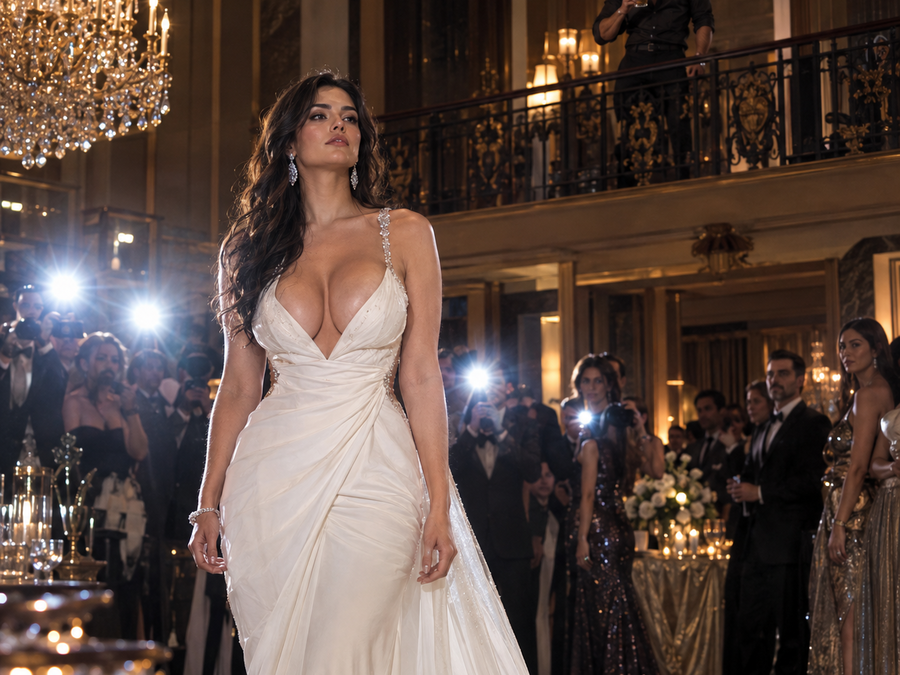
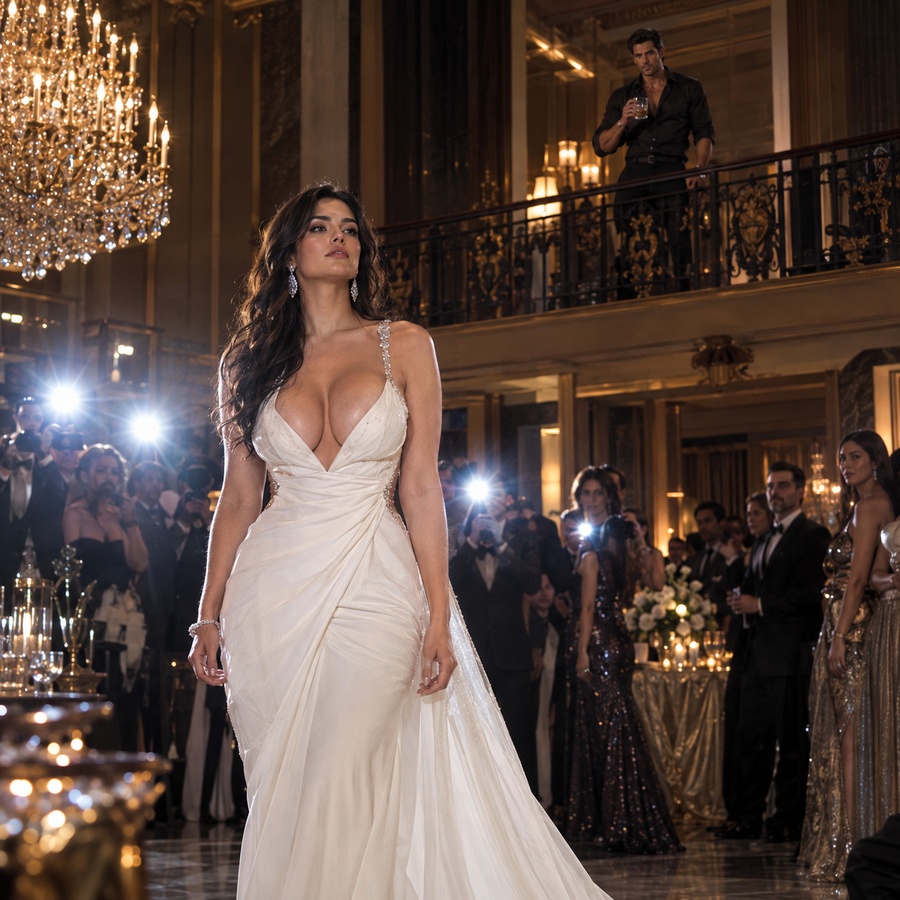
He hadn’t touched me in three years, hadn’t looked at me, hadn’t greeted me in public, hadn’t spoken my name in front of a single capo of the Santoro Familia. I was the wife the contract required, and the inconvenience he chose to pretend didn’t exist until tonight. Tonight is the annual gala, every ally, every enemy, every journalist on his payroll. And I stepped out of the car in white.
White like the bride Luciano Santoro never asked for. The camera flashes devoured me on the red carpet. From the mezzanine, Luciano went still with the whiskey glass frozen at his lips and didn’t drink. At last, I had his attention. But I hadn’t come this far just to have it.
Chapter 1. The night of the white dress.
The zipper climbed my spine and sealed itself at the top. And with it, something inside me clicked shut, irreversible, like a bolt driven to the last thread. The dress was white. The white of the bride Luciano Santoro never asked for.
A plunging neckline that dropped three inches past what any wife of the head of New York’s five families would risk at a public event. A train that pulled across the floor like spilled milk. My hair down, sweeping over bare shoulders. The long diamond earrings he’d given me for our second anniversary. Not out of love, but because the familia’s customs required a gift.
Three years. Three years draped in black. Swallowing words. Sitting beside an empty chair at dinners where every guest counted the seconds his seat stayed vacant. Three years in a separate suite on the same floor, acting as though the connecting door was just a wall. Three years wearing his surname like a brand and never once catching his eyes when he moved through a room.
For the first six months, I told myself it was reserve. For the next six, I called it calculation. By the second year, I was sure it was disdain. But in the third, I stumbled onto a fourth explanation, one nobody inside that fortress had considered. And that revelation was the reason I now stood before the mirror, sewn into this dress.
My reflection stared back, almost unrecognizable. Good. He wouldn’t know me either. I picked up the crystal clutch, the red lipstick, the phone reserved exclusively for Fama. One deep breath and I left the suite.
The Santoro penthouse occupied the top two floors of an Upper East Side tower. The 42nd, the bedroom floor, was dead quiet. Luciano had left for the gala an hour ago, flanked by two armored escorts, without so much as tapping on my door. In three years, he never once had.
I summoned the private elevator. The steel doors parted with a whisper, and I stepped inside, unhurried, watching myself in the mirrored wall as the numbers counted down to the basement garage. The doors slid open, and Orso was waiting.
Orso Falcone, Luciano’s personal shadow. Thirty-four, wide-shouldered, a pale scar bisecting his right eyebrow. In all the years I’d lived under that roof, he’d spoken fewer words to me than a stranger at a restaurant. His role was to drive, observe, and say nothing. But that night, standing beside the armored sedan, he did something I had never witnessed. His eyebrows lifted.
“Mrs. Santoro,” he said, pulling the rear door open, his voice scraped out like steel on flint. “Orso.” I slid in. He closed the door, circled the car, settled behind the wheel, and turned the engine over. Through the tinted glass, Manhattan broke apart into ribbons of gold light.
The Hotel Verenna sat in Midtown, twenty minutes away on a Saturday night. I leaned my temple against the window and let the memories unspool on their own. My 23rd birthday dinner, the penthouse dining room set for two, his chair pulled out and waiting. He arrived at 3:00 in the morning reeking of whiskey and whatever deal had kept him in Atlantic City and passed my door without slowing down.
The trip to Sicily that first summer, he dropped me at a seaside hotel in Taormina for five days. No visit, no call. I flew back to New York with sunburned skin and a pride that had blistered worse. The first gala, barely three months after the wedding, he presented me to three capos as Arturo D’Angelo’s daughter, not his wife, not Katarina.
I had swallowed every slight because the contract my father signed demanded it. Because the Santoro familia demanded it. Because I was 22 when I was handed over, and I’d convinced myself somewhere deep down that his silence was a strange form of shelter. Tonight, I stopped convincing myself.
“Everything all right, ma’am?” Orso’s gaze caught mine in the rearview mirror. I raised my chin. “Never better.” He said nothing more. The Hotel Verenna appeared two blocks later.
Red carpet unrolled from the curb to the entrance. A wall of photographers crammed behind velvet ropes. Orso pulled up, stepped out, rounded the hood, and opened my door in silence. I stepped out. The camera flashes detonated before my heel touched the ground.
I set foot on the carpet, and the shouting erupted. My name, his last name, demands to turn left, right, to look up. No Santoro wife had arrived at a gala without her husband in three decades, and none had ever arrived in white. I walked slowly. I let every one of them look.
I smiled at the lenses as though the contract I’d signed at 22 had been entirely my choice. The train swept behind me, the neckline carved through every flash, and my hair drifted in the warm draft rolling out of the illuminated lobby. I climbed the three steps and went inside.
Fama stood in the center of the lobby, emerald dress sculpted to her frame, champagne flute balanced in one hand. Fama Conte, curator of the Conte Gallery in Chelsea, my closest friend since the day her gallery was folded into the Familia’s laundering network, and the only soul on earth who knew what I intended to do tonight.
She swept her gaze from my shoes to my hair, deliberately slow, and then her shoulders began to shake. “Katarina,” Fama said, making no effort to lower her voice. “If he doesn’t collapse on the spot, I’m funding your divorce myself. Not here. Anywhere I damn well please.”
She kissed my cheek and hooked her arm through mine. “Now move. They’ve been waiting for you twenty minutes and not one of them knows you’re the one they’re waiting for.”
The Verenna ballroom lay beyond a set of tall mahogany doors, flanked by two security men in dark suits. They recognized Fama and swung the doors wide without a second glance at me. We walked through together.
The room crashed over me. Massive chandeliers descending from the ceiling. Round tables layered in gold cloth. A string quartet murmuring in the far corner. Two hundred guests orbiting one another in tuxedos and couture. The familia’s press corps filmed from the mezzanine above.
I felt the gazes land before I could pick out a single face. A silver-haired man froze with his glass halfway to his lips. A woman in red tapped her husband’s arm. An older capo near the bar squinted as though trying to confirm what his instincts already insisted was true. And up on the mezzanine, leaning against the railing, whiskey glass hanging between his fingers, there he was.
Luciano Santoro, black silk shirt, the top three buttons open, sleeves pushed to his elbows, the twin crown tattoos winding up his right forearm. Thirty-two years old, the youngest boss the five families had ever seated, the man whose name I carried, and who for three full years had never once looked at me in a room full of people.
He was mid-conversation with a capo when a burst of light from the ballroom floor reached the mezzanine. His head turned on instinct, drawn by the glare. He saw me. I caught the exact second it happened. It was like watching a fracture split down a wall of iron.
His jaw clenched. The conversation died mid-word. His hand began lifting the whiskey toward his mouth, a motion he must have repeated a hundred times already that evening, but this time the glass halted two centimeters from his lips and stayed there.
I held my ground in the center of the ballroom, my breath lodged somewhere between my throat and my collarbones, forcing my expression to surrender nothing. No smile, no shock, no quiet apology for the provocation of the dress. I hadn’t come here to apologize.
Fama’s grip tightened on my arm. “He saw you,” she murmured. “I know.” “Katarina. He’s coming down.” I lifted my chin and met his gaze head on. No flinch, no blink.
Luciano set the glass on the railing without checking where it landed. He spoke a single clipped word to the capo at his side. Then he started toward the mezzanine staircase with the unhurried stride of a man who has never needed to rush in his life.
With every step he descended, the ballroom took notice. Heads swiveled, waiters rerouted. A capo stationed along the west wall, Carmine Santoro, Luciano’s uncle, brother of the late patriarch. Silver hair slicked tight and a suit far too expensive for a man who had never risen to boss, lowered his champagne to the table and stood perfectly still, tracking his nephew’s every move as though measuring an adversary. That wasn’t the look of a relative. That was the look of a man studying an opponent.
I memorized his face. Memorized the exact expression. Then I brought my eyes back to Luciano. Already halfway down. Fifteen steps, ten, five. Fama released my arm and drifted toward the bar without a word, because Fama always knew when a scene called for two people and not three.
Luciano reached the ballroom floor and crossed it toward me in a straight line. No detours, no greetings, no glance at anyone else. He didn’t welcome me, didn’t smile, didn’t perform the obligatory husband’s gesture the cameras expected. He simply walked up and stopped half a meter away, close enough for me to catch the cedar and the whiskey and the silk he had chosen without mentioning it to me.
“Katarina,” he said, voice low, contained, the sound of a man holding a storm behind his teeth. “Luciano.” “White.” “It’s what I chose tonight.” “Tonight.” His eyes traveled over my face, dropped to my shoulders, traced the neckline, followed the length of the dress to the train pooling behind me, and climbed back up. His jaw tightened twice during the journey.
“Who drove you?” “Orso.” “Whose orders?” “Mine.” He exhaled through his nose, a slow, heavy breath. And for the first time in three years, Luciano Santoro looked at me as though I were truly standing in front of him. “We need to talk.” “We need to dance first.” I tilted my chin toward the string quartet. “You’re in a room full of allies and enemies who just watched your wife walk in alone. If we leave now, you’ll lose half the authority it took you five years to earn.”
He didn’t blink, but the corner of his mouth shifted. A fraction. Almost a smile. Almost nothing at all. “You planned everything.” “I had three years to plan.” He extended his hand. It wasn’t tenderness. It was a directive. Palm flat, fingers open, the tattooed forearm exposed to the elbow.
If I took it, I was telling two hundred people the Santoro marriage was more than a contract on paper. If I refused, I was declaring war on the dance floor. I placed my hand over his. His fingers closed around mine with a pressure that held nothing gentle. His wedding band, which I had never once seen him wear in public, dug into my skin.
He drew me one step toward the center of the room. And on that step, rising from somewhere behind me near the bar, came Carmine Santoro’s voice, pitched exactly loud enough to reach us. “Well, well,” Carmine said, just clear enough for the nearest capos to hear. “Looks like my nephew finally remembered he has a wife.”
Luciano stopped. The entire ballroom stopped with him. His grip on my hand shifted, no longer possessive, now a warning. His gaze climbed slowly across the room until it found his uncle. And what passed over Luciano’s face in that instant was something no family portrait had ever recorded. Ice. Calculation. And beneath both, something deeper, something I would only understand much later.
Carmine smiled, raised his flute, and drank. Luciano brought his eyes back to me. “Stay close,” he said, barely moving his lips. “When I call, you come. Don’t leave Fama’s side.” “Why?” No answer. He pressed my hand one final time and guided me toward the bar.
The quartet launched into a new piece. The camera flashes resumed. The ballroom started breathing again. But I had seen it. The look Luciano hurled at his uncle. The smile Carmine sent back. And I had walked into that gala carrying two names. One financial trail and a secret that, if it reached the wrong table, would tear a man from his seat before Sunday dawned. One of those names was Carmine Santoro.
Chapter 2. The color he didn’t want to see.
We didn’t dance. Luciano led me through the center of the ballroom with his fingers still locked around mine, walked right past the string quartet without slowing, and stopped at the bar. He positioned my elbow within Fama’s line of sight and said exactly one thing. “Don’t let her out of your view.”
Fama gave a single nod. No jokes this time. Luciano released my hand and crossed the ballroom in the opposite direction, heading toward Carmine, who had already gone back to laughing with three West Wing capos as though his little comment had never left his mouth.
“Katarina,” Fama murmured, tilting her head toward my shoulder. “What the hell was that?” “Carmine testing him.” “I noticed. So did everyone else.” Fama listened to me. I lifted a champagne flute off a passing tray and turned it slowly between my fingers. “Luciano told me to stay by your side. If anyone approaches this bar, we moved to the restroom together.” “You think something’s—” “I’m not thinking anything. I’m following the first useful instruction he’s given me in three years.”
Fama let out a quiet laugh. A brittle one, the kind a woman produces when she understands the weight of the moment and chooses laughter over trembling. The ballroom kept spinning around us. I tracked every face that drifted through my field of vision. A North Wing capo deep in a tense exchange with a younger soldier. A woman in midnight blue studying my neckline with a mixture of admiration and resentment. Two internal security men rotating positions near the main entrance.
Then he appeared. Juliano Delaroca, twenty-nine, son of the Delaroca capo from New Jersey, a family that had been aligned with the Santoro for two generations. He strolled up to the bar wearing a grin he’d probably been deploying since adolescence to charm his way into passenger seats and afterparties. Pale eyes, a jaw too smooth, too unmarked, the kind of innocence that survives only when a father keeps everything sharp at a safe distance.
“Katarina,” he said. “Juliano.” “My god, you—” “I what?” “You look different.” I laughed. Not a real laugh. A brief, deliberate one. The kind a young, attractive, slightly guileless man would mistake for a door cracking open. Beside me, Fama nearly choked on her champagne. “Juliano, you’ve known me since my wedding day.” I leaned toward him just enough to shift the neckline into the edge of his vision. “This is the first time you’ve actually seen me.”
“I always saw you.” “Beautiful lie.” “It’s the truth.” His voice dropped a register. “Luciano just never let anyone close.” I arched an eyebrow. “Look around the room, Juliano. Do you see him here?” Juliano looked. Luciano was on the far side of the ballroom, speaking to Carmine in a register the surrounding capos couldn’t reach. His right hand rested in his trouser pocket. I recognized that stance instantly, had watched it a hundred times from my suite window. It was the posture of a man who was armed and cataloging every word.
“He’s occupied,” Juliano concluded. “Exactly.” “Katarina, I think—” “You think what? That this is moving a little fast.” I tilted my head. A small surprise. Juliano was either sharper than I’d assumed or more cautious, which in this family amounted to the same thing. “Then stay five more minutes,” I said. “Finish that Monaco story your father cut short last time.”
“That story? That one?” He told it. He gestured with his hands, laughed at his own punchline, leaned closer to murmur the part that would have gotten him in trouble. I smiled at the right moment, grazed his arm at the right moment, and let my fingers rest there a beat longer than etiquette permitted. I knew exactly what I was doing. Across the room, the reaction I’d been waiting for began.
Luciano separated from his uncle with a decisive stride, cut through the floor on a diagonal, and moved toward me. No urgency on the surface. No glance at anyone. A straight line carved through two hundred bodies. The ballroom noticed. Conversations didn’t stop, but they dimmed. Heads followed his path in tiny, discreet rotations, as though no one wanted to admit they were watching. A waiter adjusted his route to avoid crossing Luciano’s trajectory.
Juliano was still chuckling at his own anecdote when Luciano arrived. He stopped directly behind me. I felt his warmth before I felt his hand. That broad palm settling against the exposed skin at the center of my back. Right where the dress left nothing between his fingers and my spine. A light touch to anyone watching from across the room. Perfectly husbandly. To me, it seared.
“Juliano,” Luciano said. His voice was low, nearly pleasant. “Luciano.” The color drained from Juliano’s face. “I—Mrs. Santoro was just—” “My wife.” Luciano interrupted. And those two words landed on the bar like a stone dropped into crystal. “My wife is cold.”
In one fluid, unhurried movement, he slipped his jacket off and draped it across my shoulders. He adjusted the fabric with both hands, closing the lapel at the base of my neck, so near that his breath grazed my temple. “There,” he said, his gaze still fixed on Juliano. “Better.”
Juliano understood before the last syllable faded. He retreated half a step, lifted his glass in a feeble toast, and excused himself with the stiff politeness of a man who had just realized the floor beneath him was a trap door. Luciano’s hand dropped to my elbow.
“Let’s go,” he said. Low, his mouth close to my ear. “Go where?” “The car.” “The party’s barely started.” “Katarina.” His fingers tightened around my elbow. Enough force to make the courtesy feel like a threat. “You’re going to walk to that side door with me right now, or I carry you out in front of every person in this room. Choose.”
I gave him my best smile. The polished, practiced Santoro wife at a gala smile, refined across three years of performance. In my peripheral vision, Fama was biting the inside of her cheek and losing the battle against a grin. “After you then, husband,” I said, pitching my voice just loud enough for the two nearest tables.
Luciano’s expression didn’t change, but his jaw did something I had never seen up close. It locked so tight the muscle beneath his ear twitched. He slid his grip down to my wrist, closed his fingers around it, and walked me toward the side exit, through a door I hadn’t even known existed.
The service corridor was narrow and flooded with harsh yellow light. Two security men flattened themselves against the walls as we passed. Neither looked Luciano in the eye. We followed the corridor to a rear exit that opened onto an alley. The armored car was already waiting. Orso behind the wheel, engine idling, rear door open.
Luciano guided me in by the waist, climbed in after me, and pulled the door shut. “Go,” he told Orso without turning his head. Orso pulled out before the seat belt caught. The partition glass rose, sealing the back seat from the front, and the cabin light died, leaving only the shifting glow of shopfronts sliding across our faces.
The car turned onto Park Avenue. I counted. One. Two. Three. Ten. Fifteen seconds of silence. “Three years,” I said. “Katarina—” “Three years, Luciano.” I shrugged his jacket off my shoulders and threw it onto the seat between us. “Three years without once looking at me in a room full of people. And tonight you walk up to the bar and say, ‘My wife is cold.’ You know why I did that. I know why you did it tonight. I have no idea why you didn’t do it the other thousand days.”
He turned his face toward me. Light from a storefront swept across his jaw and dissolved at the collar of his shirt. “Do you understand what you did, walking into that ballroom dressed like that?” “Perfectly.” I shifted my body toward his. “I did exactly what I needed you to see.” “Juliano Delaroca is a boy.” “Juliano Delaroca was the first man in that room to look at me in three years.” “That,” Luciano said, his voice sinking lower, “was not a good thing. Katarina, not for him. Not for you.” “Then you look.” “What?” “You look at me.” I hammered each word into the air between us. “In public. As my husband. As the man who signed his name beside mine. Because if the problem was Juliano looking, the answer was you looking first, Luciano. And you didn’t. Not once. Not for three years.”
He went quiet. The car slipped into the short tunnel before the Park Avenue stretch. Lampposts strobed past the windows in a steady rhythm. “You have no idea,” he said, voice barely above a whisper, “what I was protecting you from.” “Protecting me? I endured three years of humiliation, believing I was being protected. I was a fool, Luciano. But not anymore.”
He turned all the way toward me. His hand reached my chin before I could retreat. “You were never a fool,” he said, and his voice had gone raw at the edges. “You were mine.” “I was what?” “Mine. In a way you couldn’t even bear to look at.” He kissed me.
It wasn’t gentle. It was three years arriving all at once, late and violent. His mouth found mine as though he were shattering a rule he’d built around himself, and the taste of whiskey and something darker burned across my tongue. I fisted the collar of his shirt with one hand, the other was pinned beneath the jacket on the seat. He gripped my chin, then the back of my neck, and I felt the weight of his fingers tangling in my hair, as though letting go was the one thing he couldn’t afford.
The kiss lasted what it lasted. I pulled away first. Not because I wanted to, because if I didn’t stop now, I wouldn’t be able to. “No,” I said, my breath in ruins. “Not like this.” He rested his forehead against mine. One second. Just one. “Like this? How?” “You want to kiss me because another man looked?” I pressed my fingertips against his chest and pushed gently. “Kiss me because you’re the one looking, Luciano. Come find me when you know the difference.”
He pulled back. Neither of us spoke for the rest of the drive. Orso stopped the car in the 42nd floor garage and stayed behind the wheel. He waited for Luciano to open my door himself, which he did wordlessly, like a man still deciding whether to fight or concede.
I stepped into the private elevator first. He followed. The doors closed. The elevator stopped on 42. I walked out, crossed the interior corridor to my suite, opened the door, stepped through, and shut it hard enough to feel the frame shudder. I pressed my back against the wood and listened. He stood on the other side for exactly seven seconds. No knock, no voice.
Then his footsteps moved off toward the master bedroom. He didn’t come after me. But for the first time in three years, I knew, felt it through the door, through the vibration of his breathing still hanging on the other side, that he had stayed.
Chapter 3. The unlocked study.
I woke up at the wrong hour in both directions. Too early for a Sunday, too late to pretend I hadn’t spent half the night with my ear tuned to the corridor between my suite and his bedroom. No footsteps returned. I checked twice. I took a long shower, dressed in light tailored pants and a silk blouse that required no thought, twisted my hair into a low knot, and headed downstairs barefoot, sandals dangling from my fingers.
The penthouse split across the building’s top two floors. The 42nd held the bedrooms and suites. The 41st held the living room, the library, his study, and the main kitchen. The interior staircase coiled down in white marble, and I descended it with firm steps because I wasn’t about to creep through my own Sunday morning.
Luciano was in the kitchen, gray linen shirt, two buttons loose, hair still faintly damp. The newspaper lay open on the marble island, a coffee cup in his right hand, the tattooed forearm flat on the counter. He looked up when I walked in. “Good morning,” he said. “Good morning.”
Three years under the same roof. Maybe six Sundays when we’d crossed paths in this kitchen. Not once had either of us offered the other a greeting. I went to the machine, filled a cup, and leaned against the counter opposite him. The island between us like a negotiating table.
“You were up late,” he said. “So were you.” “I have Saturday night meetings.” “Interesting.” I sipped. “Because last night you left the gala earlier than planned.” He set his cup down, folded the paper, pushed it aside until it met the edge of the island. “About last night.” “What about it?” “The kiss.” I didn’t blink. “Which part?” “I crossed a line.” “You did.” “I’m going to make it right.” “How?”
He opened his mouth, closed it, opened it again. “I don’t know yet,” he said. That answer from that man disarmed me for a full second. Luciano Santoro didn’t say, “I don’t know.” He assessed a situation and issued a command. For him to admit uncertainty in a kitchen, barefoot, with me standing on the other side of the island, was a rupture in the natural order.
Orso materialized in the living room doorway, a black folder in his hand. “Boss, the report.” He glanced at me, then at the coffee, then back at me. “Mrs. Santoro.” “Orso.” He turned to leave, paused at the threshold without looking back. “If you decide on black for the next gala, ma’am, the whole building would appreciate it for the boss’s blood pressure.” He was gone before Luciano could respond.
I nearly choked on my coffee. Luciano stared at the empty doorway with an expression I had never seen on his face. Something caught between surprise and reluctant amusement. “I like him,” I said. “You shouldn’t.” “He’s the first person in this house in three years who’s treated me like a living person.” Luciano said nothing, but his jaw tightened in the exact same way it had at the gala, and I knew he’d absorbed every word and understood all of it.
I finished my coffee in silence. As I turned to leave, he spoke again, eyes still fixed on the paper he was no longer reading. “Katarina.” “Yes.” “Don’t go down to the garage today without Orso.” “Why?” “Just—” he paused. Chose his word. “Just give me that.” I nodded slowly, climbed the marble stairs without answering, but I filed the request away intact, right alongside Carmine’s name.
Monday afternoon, the Conte Gallery in Chelsea smelled of fresh paint and Italian coffee. Fama was barefoot on a stool adjusting a massive canvas by an Iranian painter she’d discovered the year before. “If you’re here to tell me what happened after Luciano hauled you out of the ballroom,” she said without turning around, “I’ve already opened a bottle.” “I am. Get off the stool, Fama.”
She climbed down, poured me a glass in the back room, shut the hallway door, and curled up across from me on the couch with her legs folded beneath her. “Talk.” I told her everything. The bar, Juliano, the jacket, the car, the kiss, the slammed door. Fama listened without cutting in once.
When I finished, she took a long sip and studied the ceiling. “Katarina,” she said, “he’s going to want you now.” “I know.” “And when he does, it’s going to be a problem you’re not ready for yet.” “I know, Fama. But I’ve been studying him for three years.” Her eyes came back to me. “What?” “I’ve been studying him.”
I set my glass on the low table. “I memorized the capos’ names, tracked the financial patterns of the galleries, yours included, learned what leaves the port, what comes in, who carries it, who signs off. Studied the movements of the Biancos in Brooklyn and the Kovets in Queens. I haven’t been silent these three years, Fama. I’ve been invisible. That’s not the same thing.”
Fama stared at me for a long time. “Does Luciano know?” “No.” “Are you going to tell him?” “Tomorrow.” “Katarina—” “Tomorrow, Fama. Because if I wait any longer, Carmine reaches him before I do.” She closed her eyes for a beat. Opened them. “Carmine. What?” “I’ll explain later. Right now, I need a favor.” “What?” “One of the Kovets is buying pieces through a Russian gallery in Tribeca. Double laundering. I need the buyer’s name and the date of the next delivery.”
Fama inhaled slowly. “You’ve lost your mind completely.” “I can do it,” she said. “By Wednesday.” “Perfect.”
I walked out of the gallery feeling lighter than when I’d arrived. I took the subway uptown to the Upper East Side instead of using the car. A small act of defiance against the morning’s request. Wednesday night, I walked into his study without knocking.
Luciano sat behind the dark walnut desk, a metal lamp casting light across only the right half of his face, white shirt, sleeves pushed up, two documents spread open, a glass of whiskey he hadn’t touched. He raised his eyes when I entered. “Katarina.”
I crossed the study, stopped in front of the desk, and placed a folded sheet on the wood. He looked at the paper, looked at me, unfolded it. Two names, a date, a prediction. “The Kovets are moving their shipment next Thursday. The inside man is Inspector Aaron Voss. Sector 4, overnight shift. Off-the-books payment routed through the Russian Levitzky’s gallery in Tribeca, disguised as a canvas attributed to Morandi that never existed.”
Luciano read it twice. Then he lifted his gaze slowly. “How do you know this?” “I learned.” “Katarina.” His voice dropped very low. “How do you know this?”
I sat in the chair across from the desk, crossed my legs, reached for his untouched whiskey, and drank half of it in one swallow. “You haven’t been locking your study for three years.” “What?” “Not always. Sometimes when you came back from meetings in Atlantic City, you forgot. And I’d go in.” “You’d go in.” “I’d go in. Look. Read. Memorize. Put everything back exactly where it was.”
He rose slowly from the chair. “Do you understand,” he said, his voice compressed to a thin edge, “what I’d do to any man in this organization who admitted what you just told me?” “I do.” I set the glass on the desk. “But I’m not a man in your organization. I’m your wife. And you handed me the keys to this study along with the ring. Luciano, you just never imagined I’d use both.”
He came around the desk. Slow. Deliberate. Stopped in front of me, his legs nearly touching my knees, his cologne reached me before his hands did. “Stand up.” I stood. He placed one hand on my waist, the other on my jaw, tilted my face up to the level of his mouth, and held there, two centimeters apart, his breath mingling with mine without making contact.
“I was going to kiss you right now,” Luciano said, barely above a whisper. “Sweep you across this desk, send Orso home, and make up for three years in a single afternoon. But you handed me that paper, and now I can’t. You know why?” I didn’t blink. “Because if I kiss you after you give me two names and a date, you’ll believe I stayed because of this. And you’ll always believe it, Katarina. Every time I touch you for the next fifty years.”
His hand released my jaw before my mouth could form an answer. He closed his eyes for a second. When they opened, something new lived in them. Something I only fully understood later. Something that resembled fear but not for himself. “And because,” he said, “now I have to decide what to do with a wife who knows more than half my capos. And I still can’t tell Katarina whether what I want is to protect you or lock you away.”
He let go, stepped back, picked up the paper, folded it carefully, and slid it into his shirt pocket over his chest. Then he looked at me with an expression I’d never seen on his face before. “Friday, you’re coming with me,” he said. “Where?” “Atlantic City.” And before I could ask another question, he’d crossed the study and disappeared through the far door, leaving behind the whiskey, the lamp still burning, and the empty space where the woman who had just surrendered the advantage of being underestimated had been standing.
Thursday arrived before my mind did. Three hours of sleep, maybe four. I dreamed of his voice hovering two centimeters from my mouth saying “fifty years” and woke with the phrase sealed against the roof of my mouth like a stain that wouldn’t lift. I showered, pulled on linen pants and a sleeveless blouse, and went down to the kitchen with wet hair dripping onto the fabric.
Luciano was at the island, white shirt, two buttons undone, the same newspaper he hadn’t been reading on Sunday, opened the same page. He didn’t look up. “Good morning.” “Good morning.” I went to the coffee machine, filled a cup, turned toward the island, and stopped.
The chair on my side of the counter had been pulled out. On the marble, in the exact spot where I always rested my hands while I drank, sat a small porcelain plate holding two handfuls of fresh almonds and their brown skins, a tiny spoon beside it. I looked at the plate, looked at him. “You never knew I eat those in the morning.” “I know more than you think, Katarina.” He turned a page, still not looking at me. “I just didn’t feel like acting on what I knew until yesterday.”
I sat down, picked up an almond, peeled it with my thumbnail, bit half of it, held the other half between my fingers, testing him without watching to see if he noticed the test. He didn’t turn the page. His hand, flat on the paper, contracted by a centimeter. “Planning to stare at that paper without reading it much longer until you finish your coffee.” “Why?” “Because if I look up right now, we’re not making it to Atlantic City tomorrow.”
I chewed the other half slowly, finished the coffee. When I stood, the chair scraped against the marble, and I heard, because he’d already heard, the shift in his breathing. “Luciano.” “Yeah.” “That rule you set last night in the study.” I rested my fingertips on the far edge of the marble opposite his. “How long does it hold? Until I can look at you without feeling like I’m the one collecting a debt? And how am I supposed to know when that moment arrives?” “You’ll know, Katarina. You were the only person in this house for three years who could read me when I wasn’t saying a word.”
I left the kitchen before he raised his eyes. I climbed the marble stairs with steady steps, and only when I reached the 42nd floor did I notice my hand trembling at the wrist. It wasn’t fear. It was fear’s opposite. It was my body registering that it had been seen.
I spent the whole morning on the phone with Fama. She’d closed the gallery for two days to handle a delivery in Miami and was calling from a plane, sounding like a woman pretending she wasn’t hungover. “Kata, tell me what he did in the study.” “He said he wasn’t going to kiss me.” “He said—he said.” “And you believed him?” “I respected it.” Fama laughed on the other end. A laugh full of teeth. “That’s worse.” She coughed. Swallowed something. “Kata, men like him—when they set a rule for themselves, they’re warning you they’re going to shatter it. The rule is the announcement. Understand?”
“I understood this morning in the kitchen.” “What happened in the kitchen?” “He set out almonds on a plate before I came down.” Three seconds of silence. Then Fama whispered, with a reverence only she could pull off without a trace of irony, “You’re finished, Katarina.” “I know.” “So is he.” “I know.” “Good. Don’t do anything reckless until I’m back Monday. I want to witness the funeral in person.”
I hung up. I stood in front of my bedroom mirror for a stretch of time I couldn’t measure. And then I did the most provocative thing I could think of on a Thursday afternoon. I swapped the blouse for a silk slip, layered a white linen shirt over it that fell past mid-thigh, and put nothing on underneath.
Grabbed a book from my nightstand that I hadn’t touched in eight months. Went down to the 41st floor library. I knew he was there.
Luciano’s library occupied the east wing of the 41st floor. Three walls of walnut shelves reaching the ceiling. A dark green leather sofa, two armchairs angled toward a window overlooking Park Avenue. It smelled like aged paper and some kind of wood I’d never learned to identify. He was in the right-hand chair, a folder open in his lap. Black-framed reading glasses I’d never seen on his face. Luciano didn’t wear glasses.
Luciano had flawless vision and held younger soldiers accountable when they washed out of the academy’s eye exam. I stopped in the doorway. “Since when?” He didn’t lift his head. “Always. I just don’t put them on in front of people I haven’t decided to know yet.” “And me?” “The only one.” He turned a page, didn’t look up.
I crossed the library barefoot and settled into the left-hand chair, the book in my lap. Ten minutes of silence. The afternoon light entered at a low angle, and I felt his gaze pass over the book I was pretending to read roughly every two minutes. It never quite reached my face. The glasses helped. They gave his eyes permission to drop a millimeter before they met mine. And it was inside that millimeter that he actually looked at me.
I crossed my legs. The hem of the shirt rode up about three fingers. He turned a page in the folder with sudden force. “Katarina.” “Yeah.” “If you’re trying something, I should let you know it’s working.” “I’m not trying anything.” “You crossed your legs.” “I crossed my legs. Women do that.”
He finally removed the glasses, set them on the folder, looked at me. It was a different look from the study. Yesterday had been pressure. Today was restraint. As though he were gripping a leash with both hands and telling me silently that the grip was still holding. “Why did you come down here?” “I always read here. In three years, I came three times. You were never home.” “Why today, when I am?”
I closed the book and rested it on the arm of the chair. The movement shifted the shirt up another finger, and this time I didn’t fix it. “Because I want to watch you break your own rule, Luciano.” I looked him straight in the eye. “Not because I need to. Because I want to see how long you can hold something you chose to hold.”
He leaned his head against the back of the chair, drew a long breath. “I can hold longer than you think, Katarina.” “Prove it.” “You’re playing with fire.” “I’ve been married to fire for three years, Luciano. The only thing that’s changed is that now the fire has a name.”
He laughed. A short laugh stripped of humor. The laugh of a man who recognized the argument and hated losing. Again. He leaned forward, elbows on his knees, and watched me from that low angle where he could see everything the shirt didn’t cover. “Stand up.” “Why?” “Because I need you out of this room before my rule stops belonging to me.”
I stood, walked slowly toward the library door, stopped at the threshold, looked back. He was still leaning forward, both hands clasped between his knees, his head hanging a fraction lower than usual, the posture of a man in the middle of deciding something. “Luciano.” “Yeah.” “I’m going to take a shower. In my room. In my suite.” “Katarina—” “I’m telling you so you don’t come down to the kitchen for the next fifteen minutes. Consider it a courtesy.”
I left without waiting for an answer. Behind me, I heard the muffled crack of a folder being snapped shut, and it was the most satisfying sound I’d gathered in three years of marriage.
I had dinner alone. Luciano didn’t appear in the dining room or the kitchen. The housekeeper, a woman I saw twice a week, who had been with his family since before I existed, served me a plate of pasta with butter and sage and mentioned that the master had requested his meal in the study. “Thank you, Donatella.” “You’re welcome, ma’am.” She hesitated, straightened the napkin on my right side, which didn’t need straightening. “If you’ll forgive the liberty, ma’am. In sixteen years, I’ve never once seen the master take dinner in his study on a Thursday.” I smiled at her over my wine. “Thank you, Donatella. Neither have I.”
She left. I finished dinner without rushing, drank two glasses, climbed to the 42nd floor by the interior staircase, barefoot, hair still damp from the afternoon shower, and stopped in the hallway that separated my suite from his bedroom. His door was closed, light on beneath it. The study door downstairs was also closed. I’d passed it on the way up. Light beneath that one, too. Two shut doors in the same building, two men behind them, and it was the same man. I smiled at the wall.
I went into my suite, closed the door, and lay down on the bed with the linen shirt still over the silk slip, removing neither, and listened to the penthouse. Ten minutes. Twenty. Forty. Footsteps in the hallway. His footsteps. I’d known them for three years. Measured cadence, heel before toe, a slight drag of the left foot when he was tired. Tonight, he was tired.
The footsteps stopped. Not at the master bedroom door. At mine. I stopped breathing. He stood there for seven seconds. The same seven seconds from Saturday night. I counted again. One. Two. Three. Four. Five. Six. Seven. On the eighth, the hallway floor creaked. He shifted his weight. I heard him breathe on the other side of the door. Deep. Controlled. The breathing of a man counting something down inside himself.
Then the softer sound of an object being set on the floor, and the footsteps walked away. The master bedroom door opened. Closed. The light went off. I waited two full minutes before I moved.
Went to the door, opened it slowly. On the hallway rug, leaning against the jamb, was the book I’d left in the library that afternoon. On top of the book, a sheet of paper folded in half. I picked it up, recognized his handwriting before I read a single word. The uneven letters, half in capitals, slightly rushed at the ends. The handwriting of a man who rarely wrote by hand because he had others sign things in his name.
“You forgot it. I read to the end of the chapter where you stopped. Tomorrow at 10:00 on the helipad. Try to sleep. L.”
I read it three times, folded the paper, rested my forehead against the door frame, closed my eyes. At the bottom of the page, in darker ink and a subtly different hand, as though he’d returned to his desk hours later to add it, was a single word. “No.” Just that. No.
I understood the instant I read it. Because between this man and me, the language had already shifted from English to something older that neither of us had the courage to name yet. It wasn’t a response to my provocation in the library. No, he hadn’t broken his rule. No, he wasn’t going to break it yet. It was his promise that when the break came, it would arrive in a way that a note slipped under a door was no rehearsal for.
I closed the door, pressed my forehead against the wood from the inside. That night, I didn’t sleep, but I didn’t go to his door either. Something about that handwritten no told me that when we finally crossed that hallway, it would be in the direction he chose, at the hour he decided. Because Luciano Santoro had spent sixteen years building a rule that governed everything except me. And now he was constructing a new one, and I was its only reason. I could wait. I’d waited three years for less.

