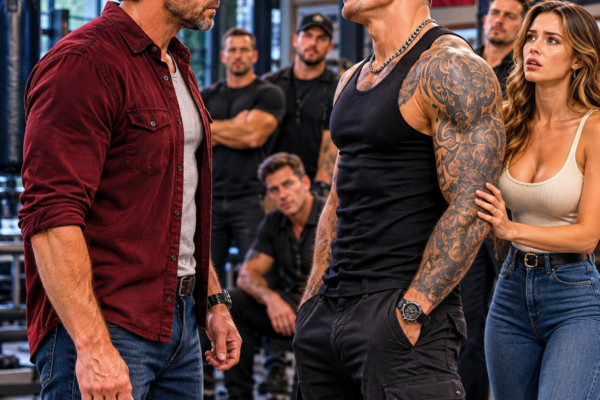
MMA Star Ignored a Father’s Final Warning—What Happened Next Left the Entire Arena Speechless!

MMA Star Ignored a Father’s Final Warning—What Happened Next Left the Entire Arena Speechless!
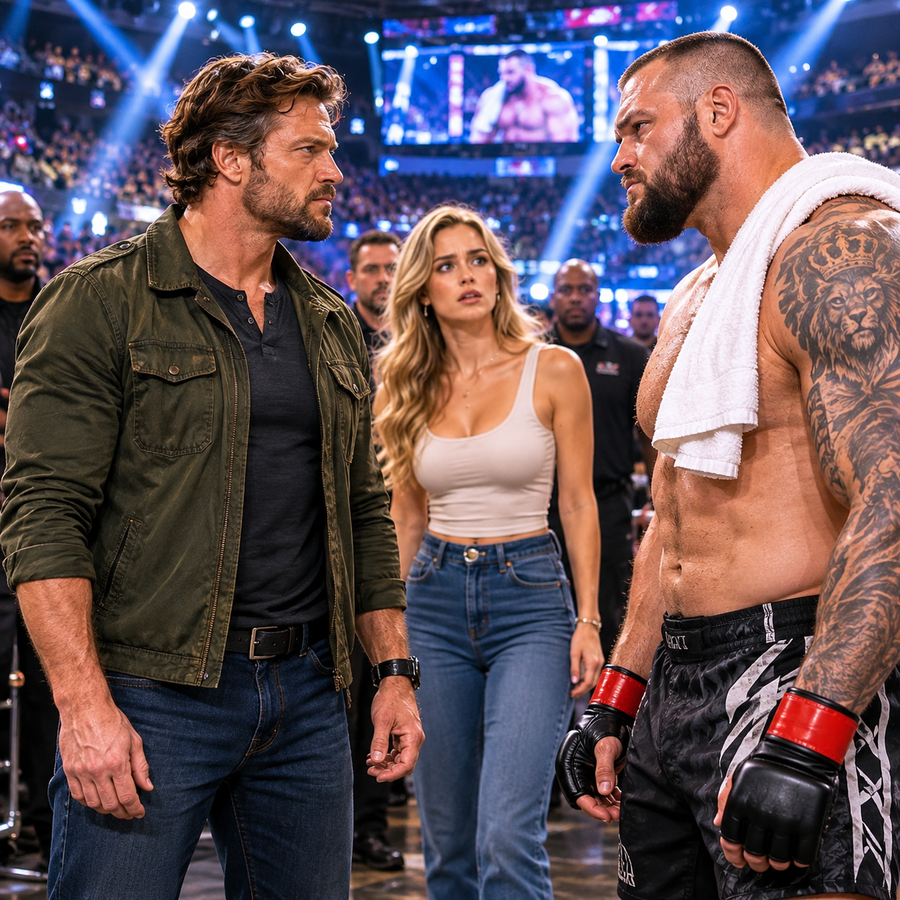
Stop.
Get your kid and go home, man.
Stop.
You don’t even know who I am.
Stop.
What’s a man like you going to do?
Three times.
Grant Mercer said the same word three times, and each time Rhett Dugan heard it as an invitation to push harder.
Red had just lost five rounds in front of 10,000 people.
He was looking for something to hit something that wouldn’t hit back.
A quiet man in a plain jacket standing between him and a 9-year-old girl seemed like exactly that.
What Rhett didn’t register was the stillness.
Not the stillness of a man who didn’t know what to do.
The stillness of a man who had already decided and was giving the other person every possible chance to choose differently.
Grant’s hand never moved.
His voice never rose.
His eyes never looked away. What kind of man stays that calm when someone grabs his collar?
If this is your first time here, consider subscribing. These are the kinds of stories we tell every week.
The answer had everything to do with who Grant Mercer had been before anyone in Belidge knew his name.
before he became the maintenance manager at the community sports center who arrived at 7 in the morning with a thermos of black coffee and didn’t leave until everything on his list was handled and sometimes several things that hadn’t been on it before he became the man who could diagnose a seized cable pulley, rewire a faulty electrical panel, and locate the source of a leak in the same afternoon without treating any of it as notable.
before he became the father who knew every teacher’s name at Sades school by September of each year, who kept her homework schedule in his head and a folded grocery list in his left jacket pocket, who had learned through trial and error which brands of shampoo she tolerated and which ones she found offensive at a molecular level.
He had been doing this version of his life for 6 years. He had gotten very good at it, at the quietness of it, at the particular discipline of a man who had decided that being unremarkable in the right ways was its own kind of achievement.
Nobody at the sports center knew much about him, and he kept it that way without appearing to try. He was polite, through, easy to work alongside.
He answered questions about himself with answers that were technically accurate and entirely incomplete.
He drove a pickup truck old enough to have rust spreading along both wheel wells, but it ran without complaint and got where it needed to go.
He lived 12 minutes from work in a house with a small yard he kept clean without making it look like appearances mattered to him.
He had not in 4 years at the sports center given anyone a real reason to ask where he had come from before this.
He had mentioned once in passing that he had spent some time around combat sports.
One of the trainers had pressed at it the way people press it, something they suspect is interesting, and Grant had said only that he had worked with professional fighters in some capacity years back, and left it exactly there. The trainer had tried once more.
Grant had smiled in the particular way that meant the subject was closed, and that had been the end of it. People learned to recognize that kind of answer for what it is.
Sadi had a harder time accepting it than most.
She was 9 years old and she had come into the world with the specific intention, apparently of finding out what was in it.
She had her mother Leah’s eyes and her father’s stubbornness and a laugh that arrived without announcement and took over whatever room it happened to land in.
She was the kind of child who walked into a space and immediately located the most interesting person present and began asking them questions. She had done this with a retired marine biologist at a farmers market, with a mechanic who turned out to have once raced motorcycles professionally, with a librarian who had spent 11 years working in archives in Washington.
Sadi had a gift for finding the thing inside people that was most worth knowing about.
She had pointed that particular gift at her father many times over the years. She had not gotten very far.
Her interest in MMA had developed the way most of her interests developed, without a clear beginning and with significant speed.
It started with a documentary she caught the tail end of one night when Grant had fallen asleep on the couch and she had quietly rearranged the television situation.
By the time he woke up, she had watched 45 minutes of footage and compiled a list of questions she wanted answered before breakfast.
Within two months, she could name the active champions in three weight classes, distinguish a rear- naked choke from a kimura from across the room, and had settled into strong, specific opinions about which styles of fighting she found most worth watching. She liked grappling.
She said it was like a puzzle that two people were solving at the same time while trying to stop the other from solving it, which she thought was more interesting than most things she had encountered so far. Grant listened to all of this over breakfasts and dinners and the 12-minute drive to school.
And he answered her the way he answered most of her questions with more accuracy than she expected. That was the thing she had established early.
When she described a technique she had seen, he would sometimes nod and say something that told her he understood. Not just what she was describing, but why it worked, what strategic purpose it served, what its weaknesses were.
It was the kind of knowledge that didn’t come from watching television.
She had asked him about it directly and he had told her he had spent time around that world a long time ago. She pressed.
He smiled in the way she recognized as a door closing and asked what she wanted on her toast. What she had noticed though was the other thing, the way he watched.
Whenever she had MMA on television and Grant came through the room and stopped to look, he didn’t watch the way most people watched.
He didn’t react to the punches.
He was tracking something else.
Weight distribution maybe, or the way a fighter’s hand dropped before a shot, or the positioning in a clinch before anything had happened yet.
She had asked him once what he was looking at, and he had said nothing in particular and gone back to the kitchen.
It was Marcus Webb who changed the particular shape of the problem Grant had been successfully managing.
Marcus ran the front desk at the sports center with the enthusiasm of a man who genuinely believed that getting people into events was a service he was providing to humanity.
He had season tickets to most things within a 100 mile radius and a scheduling conflict the week of the Hawthorne Crown Arena card.
He dropped two passes on Grant’s desk on a Tuesday afternoon with the casual confidence of someone who had already assessed the outcome and found it favorable.
Main Event Rhett Dugan 3 weeks out. Marcus said he hated to see good seats go to waste.
Grant looked at the tickets without picking them up. He knew what those arenas felt like from the inside.
The specific quality of energy that built in the two hours before a main event. the way it found its way into the walls and the corridors and the people moving through them and made everything feel louder and closer than it actually was.
He had spent years constructing a life at the precise distance from all of that.
He started to tell Marcus to offer the passes to someone who’d used them, and then he made the mistake of mentioning them to Sadi at dinner.
She went very still.
She didn’t perform excitement or ask immediately.
She just looked at him with an expression she was clearly working to keep neutral, like she was trying not to want it too much in case wanting it too much made it disappear. Grant recognized that expression.
He had seen it in the months after Leah died when Sadie had learned at 6 years old to hold things loosely because holding them too tightly didn’t seem to help.
He told her they were going before he had finished the thought. She smiled so fast she almost managed to look unsurprised.
She spent the following three weeks talking about almost nothing else. Hawthorne Crown Arena held just over 10,000 people on a full card, and the night of the fight was a full card in every sense.
Grant and Sadie found their seats 20 minutes before the main event, close enough to the floor that the cage was fully visible without obstruction. Sadi sat with her back straight and her eyes moving across every detail of the setup.
The corner teams making lastminute adjustments, the lighting rigs, the camera crews finding their positions along the walkway.
She had a water bottle in her lap and didn’t drink from it for the better part of an hour because she kept forgetting it was there.
Rhett Dugan walked out to the kind of noise that registered in the chest before the ears caught up with it.
He was 6’2″, 230 lb, and he moved like a man who had not needed to consider whether a room was impressed by him since approximately his early 20s.
Seven knockouts in his last nine fights. One victory separating him from a title shot that the entire heavyweight division had been organizing itself around for two years.
He held his hands loose at his sides and took the crowd’s noise as something that was simply his due, neither grateful nor surprised, just present in it.
The fight did not go the way Rhett’s corner had built toward.
His opponent was a patient, technically composed grappler whose strategy had apparently been constructed with Rhett’s specific tendencies in mind.
He circled away from the right hand, clinched against the cage whenever the distance closed and denied Rhett the open space he needed to generate real power. He was not spectacular.
He was relentless and precise and difficult to punish for any of it. In the third round, Rhett landed a right hand that the arena stood up for clean hard, the kind that in previous fights had ended the night early.
His opponent absorbed it, tied him up before the follow-through arrived and walked them both to the fence. That was when Grant understood how the fight was going to end.
By the fifth round, the pattern was too deeply established to reverse.
The final horn sounded over a crowd that was uncertain and three judges who were not.
unanimous decision. Rhett Dugan had lost in front of 10,000 people in the most important fight of his career, and everyone in the building could see what that information was doing to him in real time.
Grant watched the next four minutes with the quiet, automatic attention of a man who had spent years learning to read what a person’s body was doing before their mind had finished deciding.
He watched the announcement hit Rhett’s face, watched the reaction build in his shoulders and chest before it found any other outlet.
He heard the argument with the referee, heard the kick connect with the cage door with enough force to cut through the crowd noise.
He watched the glove come off and go into the corner, watched the coaching staff move in, and Rhett’s forearm come up to redirect the nearest one.
Then the fighter turned and walked toward the corridor that ran along the outside of the floor seating.
Grant touched Sadie’s shoulder and moved her toward the aisle without explaining why.
She looked up at him, caught the expression on his face and didn’t ask.
She had learned what that particular kind of move meant.
A young man two rows over had not read the situation or had decided he didn’t need to.
He raised his phone toward Rhett as the fighter passed within a few feet of the seating section.
Rhett’s hand came down and knocked the phone away in one short sharp motion, not looking at the man’s face, just removing the camera the way he would remove an obstacle in the cage.
The phone skittered across the floor and came to rest near Sades feet.
She looked at it, reached down, and picked it up before the thought had fully arrived at its conclusion. Rhett turned back.
He saw a child holding a phone pointed in his general direction.
His mind, which was not operating carefully at that moment, completed the picture using the most available materials. His voice came out like a door slamming in a hallway that had been quiet before it.
Grant was already moving. He stepped in front of Sadi in one motion and placed himself at arms reach from Rhett.
Not squaring up, not drawing back, not announcing anything, just there and clearly not interested in moving.
She picked it up.
Grant said, “The phone isn’t hers.
You should go.”
Rhett looked him over with the specific kind of assessment that professional fighters applied to people in casual settings, a quick inventory of size, posture, and whether there was anything in the presentation worth taking seriously.
Grant was wearing a dark jacket over a plain shirt. He was not large in the way Rhett was large.
He was not holding himself the way someone holds themselves when they want to fight.
He looked to anyone who didn’t know what to look for, like a man who had wandered two steps closer than he should have to something he didn’t understand.
Rhett put his palm flat against Grant’s shoulder and pushed.
It was not a full effort push. It was the kind meant to communicate hierarchy rather than cause damage.
The kind that said, “Move and save us both the rest of this.”
Grant took a half step back with the momentum rather than against it.
His expression didn’t shift.
“Stop,” he said.
Sadi heard something in that word she couldn’t name.
It was the same words spoken at a normal volume from the same man who had been making her breakfast that morning and who had driven them to the arena in the truck with the sticky passenger side window.
But it had a weight behind it that she hadn’t heard before.
Not anger, not fear, not a warning in the way warnings usually sounded. Something older than those things.
Rhett laughed.
It was the short- aimed kind directed at the people nearby who were starting to turn and look, recruiting them as witnesses to something he intended to find amusing. He told Grant to take his daughter and go home.
Then he shoved him again, both hands this time, harder, and this one was not about making a point.
It had force behind it. Grant absorbed it, took two steps back to stay balanced, and returned to where he had been standing.
Stop, he said again.
Several people in the immediate area had stopped moving. Phones were appearing along the corridor, not Sades.
A dozen others held up by people who had understood that something worth recording was developing.
Further down the corridor, a pair of security guards were pushing against the current of a crowd that was moving exactly the wrong direction to let them through. Rhett was aware of being watched.
He had spent his entire career being watched. For a man whose professional identity had been built on what he looked like in front of audiences, the presence of witnesses was not a restraint.
It was fuel.
He took one more step forward, grabbed a fistful of Grant’s collar, and pulled him close.
His voice dropped to something intended to be private. What is a man like you going to do?
Grant’s eyes moved past Rhett’s shoulder for just a moment.
Sadi was standing two steps behind him, holding the stranger’s phone against her chest with both hands, watching her father’s face with an expression he had not seen there before.
It was not the face of a child who was afraid of what was about to happen. It was the face of a child who was paying very close attention to what she was about to learn.
He looked back at Rhett Dugan.
He thought about all the distance he had put between himself in moments like this one. The years and the choices and the particular cost of a life built on the far side of a decision he had made before Sadi was born.
He thought about what he was willing to let go of to protect it and what he wasn’t.
Last time, Grant said, his voice was barely above the noise of the arena. Stop.
Rhett’s grip on his collar did not loosen, and Grant understood, not with panic, but with the same flat, accurate clarity he had once spent years trying to teach other people how to find, that he had given away every option except one.
The thing Grant had spent years
explaining to professional fighters was that panic and preparation occupied the same space.
That when fear arrived, it pushed out everything you had built.
And the only way to prevent that was to have built so deeply that fear couldn’t find the bottom of it.
He had said versions of that in gyms in four different states over more than a decade.
And he had never needed to test it against himself in a corridor in front of 10,000 people. He was testing it now.
What he was doing in the 3 seconds after Rhett grabbed his collar was not reacting.
It was observing.
The distinction mattered more than most people would ever have a practical reason to understand.
Rhett’s weight was riding too far forward.
It had been there since the second shove. The distribution of a man who was angry and accessing that anger through his chest and shoulders without thinking about his feet.
His right arm was extended, the one holding Grant’s collar, and the angle of that extension put the elbow in a position that was geometrically inconvenient for the person it belonged to.
His lead foot was planted too deep, committed in a way that would have cost him points in the cage because any competent opponent would have seen it within the first 30 seconds. It was not the Rhett Dugan who had knocked out seven men in nine fights.
It was Rhett Dugan without his discipline, which was a different person entirely.
What Grant understood quietly automatically in the way you understand something you have known for so long it no longer feels like knowledge, was that Rhett’s grip on his collar was not power.
It was leverage given away.
Grant’s old trainer had told him once during a session that had ended with Grant flat on his back staring at an industrial ceiling.
The opponent decides how much force to bring.
You decide what to do with it when it arrives. That had been in a gym in Nashville more than 15 years before the night at Hawthorne Crown Arena.
Grant had been 22 years old and had understood the words immediately and had spent the next 10 years learning what they actually meant.
He stepped into Rhett rather than away from him.
One hand found the inside of Rhett’s wrist, not grabbing, just directing.
The other hand settled above the elbow on the extended arm lightly, the way you might rest a hand on a railing to confirm it’s there.
Grant pivoted his hips left and dropped his weight by a fraction.
Not a dramatic repositioning, barely visible from more than a few feet away.
And the geometry of what Rhett had built shifted underneath him in a way he didn’t process in time to prevent.
When Rhett felt his balance going, he did what almost everyone does.
He pulled back, using his own force to try to recover the ground he’d already lost.
That pull was the last thing Rhett contributed to the next two seconds. Everything after that belonged to Grant.
The leg sweep was economical.
It covered about 8 in of floor.
It didn’t look like anything until the moment Rhett wasn’t standing anymore.
And by then, the moment had already passed. The heavy weight went down with the full weight of someone who had not chosen to fall.
And before he had finished landing, Grant had moved to his right side.
one knee controlling the shoulder, the other leg positioned to prevent the hip roll that would normally begin a ground recovery.
He took Rhett’s arm at the wrist and at the elbow, and adjusted the angle by approximately 30°, enough to make standing up an exercise in self-injury and nothing more.
And he held that position with no more apparent effort than a man leaning against a counter. The corridor went quiet in the way that very loud spaces go quiet when something unexpected stops them.
Not silence exactly, but the sudden subtraction of all the noise that had been assuming nothing would interrupt it.
Grant looked down at Red and said what he had to say in a normal voice.
I asked you to stop three times. Then he released the arm, stood up, and stepped back.
Not quickly, not dramatically, just back to the place where Sadi was standing.
Rhett lay on the corridor floor and looked at the ceiling.
The expression on his face was not the one he’d been wearing for the past 4 minutes.
The anger was still there, but something had cut through the surface of it, a confusion that was newer and more uncomfortable than losing a fight in front of 10,000 people.
Because this one he hadn’t seen coming from any direction.
He turned his head without meaning to, and for just a moment he was looking directly at Sadi, who was still holding the stranger’s phone in both hands and watching him with the calm, attentive expression of a child who was filing everything away.
Something moved across Rhett’s face that was too brief and too complicated to name.
He turned away from her and looked at the far wall instead. The security team arrived 18 seconds too late, which was the amount of time required for the situation to have fully resolved itself and for the corridor to have become a room full of people holding phones pointed at the same spot on the floor.
The recognition happened through one person saying a name out loud at the wrong moment in the wrong acoustics.
An older man had been watching from a position close to the cageide seating area. He was heavy set with the kind of face that had been weathered by decades in gym environments early mornings and bad lighting and the specific texture of a life spent standing in corners watching other people fight for things.
His name was Warren Pike and he had spent 30 years in MMA coaching in ways that had earned him a quiet authority in the regional circuit that didn’t require him to announce itself.
He had been sitting 12 feet from where Grant was now standing, and he had watched the entire sequence with an expression that moved from curiosity to recognition to something that sat between disbelief and certainty.
He stood up and said Grant’s name loud enough that the commentator, two positions over, turned his head.
Grant heard it and did not look at the man who had said it.
He kept his eyes on Sadi, who had finally set the stranger’s phone down on a nearby seat and was looking at her father with an expression that told him she had added something significant to the case she had been building about who he actually was.
Dad, she said it carefully. Was that did you do that on purpose?
Grant said, yes, she was all right and they should find the exit.
He was already moving one hand on her shoulder, not running but not stopping either.
He was aware without looking of Warren Pike watching them go. He was aware of the number of phones still pointed in his direction.
He was aware with the specific awareness of someone who has spent years successfully being unremarkable that he had just produced something that was going to be very difficult to keep contained.
He was right.
He just didn’t know yet how quickly.
By the time he had driven Sadie home and confirmed that she was in bed and the doors were locked, the first version of the video was already finding its audience.
By the time he had made himself coffee, he wasn’t going to drink and sat down at the kitchen table.
There were four different clips in circulation from four different phones. Each one capturing roughly 5 seconds from a slightly different position.
The most widely shared one opened with the moment Grant’s weight shifted.
No context before, just the movement and then Rhett going down and the corridor going still. It had been viewed 300,000 times by the hour it took Grant to notice it existed.
By morning, they were headlines, not the local news kind, the kind with numbers in them and questions at the top and comment sections that filled at a rate that made them functionally unreadable within an hour of posting.
The phrase that appeared most consistently was a version of the same formulation, single father, MMA heavyweight, 5 seconds.
Someone with archival access had already found a photograph taken 12 years earlier at a regional title bout in Memphis.
Grant in the corner of the cage behind a fighter in a black and gold uniform, arms resting on the top rope, watching the floor of the cage with the same quiet attention that the corridor footage had captured.
The photograph circulated with the headline beneath it, “Who is he?”
Warren Pike gave an interview that afternoon. He had not called Grant before doing it.
Warren confirmed that Grant Mercer had been one of the most respected grappling and close combat coaches in the regional circuit for more than a decade.
He had trained fighters who held national level titles. He had been known, Warren said, for a specific kind of knowledge, the kind that came into its own when pure strength stopped being enough.
Warren said he hadn’t seen Grant in close to 9 years, that Grant had never explained his reasons for leaving directly, and that what he had watched in that corridor was exactly consistent with what he remembered.
Sadi watched that interview in the kitchen after school. Grant came home and found her sitting at the table with the laptop open and her water glass full and untouched.
She looked at him in the way she had been looking at him for 9 years. The way that said she had already organized most of what she knew and was waiting on the last piece before she decided what to do with it.
You trained those fighters, she said.
It wasn’t quite a question.
The ones he named.
Grant put his keys on the counter and said yes. Sadi considered the shape of that.
Why did you never tell me?
Grant sat down at the table across from her and found that the answer he had been holding for 9 years didn’t come out.
He sat there with it and it stayed where it was.
And what he said instead was that it was complicated and that he had meant to tell her and that he hadn’t known how to do it in a way that made sense.
Sadi looked at him for a long moment.
Then she closed the laptop and went to her room.
And Grant sat at the table with his keys on the counter and the complicated thing that was still inside him with nowhere to go.
He was aware sitting there that Carol Finch, the sports cent’s media director, had called twice that day and left a message saying she was ready to move the moment Grant indicated he wanted to.
He had not called her back. He was not ready to indicate anything yet.
What happened next arrived in two pieces, and the second piece was worse than the first.
Rhett Dugan went live on his phone that evening from what appeared to be the back of a car.
He had about 40 seconds of controlled delivery in him before the anger reasserted itself.
But 40 seconds was enough to say the thing he had decided to say that he had just come out of a five round professional fight when a man he had never met chose to escalate a conversation in a hallway.
He used the word ambush.
He said the video didn’t show what happened before.
He said the man had been looking for something, had wanted the confrontation, had seen an opportunity to make a name for himself at Rhett’s lowest moment.
He said it with enough specific detail that it sounded like a description rather than a defense. And for the people who were already skeptical of the original footage, it landed as confirmation.
Then the cut version appeared.
Nobody established immediately who had made it or where it had come from.
It opened on the moment Grant’s hand found Rhett’s wrist.
No shves, no corridor confrontation, no child with a phone, no three warnings given one at a time to a man who had been given every possible exit.
Just the 5 seconds, just the takedown, just Rhett on the floor and Grant standing over him. That version was shared more in its first two hours than the original had been in 12 because it was a better story, cleaner, simpler, easier to be angry at from either direction.
The organization announced a formal inquiry.
The following morning, Grant’s phone had rung multiple times from numbers he didn’t recognize and twice from the sports cent’s general line, and he had answered neither.
When he called the center’s director back at 7:00 in the morning, he was told in language that was careful and apologetic and unmistakable in what it was doing that they would need him to take some time away while the situation sorted itself out.
His access card had been deactivated as a precaution.
Grant said he understood, which he did, and ended the call.
He stood at the counter with the phone in his hand, and looked at the window above the sink, which was showing him a gray November morning, and the backyard, and the rust on the bottom of the fence he had been meaning to address before the cold set in. He thought about the sequence of choices that had produced the last 36 hours.
He could trace it from any direction, and every path arrived at the same place, which was here in this kitchen, with no job, and his daughter’s trust waiting on an explanation he hadn’t found a way to give yet.
When Sadie came out, she was already dressed, which meant she had been awake for a while.
She poured herself cereal and sat down and ate about half of it without saying anything. Grant made toast and put a glass of orange juice near her hand and sat across from her with coffee he was actually drinking this time.
Sadie set her spoon down. She looked at the table then at him.
You always told me not to lie, she said.
That hiding something on purpose is the same as lying. She said it without accusation in her voice which somehow made it harder to receive.
So why did you hide this from me?
Grant looked at his daughter and found that the simple version of the answer, the one he had been protecting himself with for 9 years, was no longer available to him. Warren Pike showed up at the house two mornings after the access card stopped working.
Grant heard the knock and knew before he opened the door that it wasn’t going to be a short conversation.
Warren was the kind of man who did things in person when they mattered.
And the fact that he was standing on the porch at 8:45 in the morning with his hands in his coat pockets and no particular apology on his face told Grant that whatever had brought him here, he had already decided it needed to be said.
Grant let him in.
Sadi was at the kitchen table with a bowl of cereal and a library book she wasn’t reading.
and she looked at Warren the way she looked at most adults who appeared in her environment without prior introduction with polite attention and complete assessment. Grant told her this was Warren Pike that he and Warren had worked together a long time ago.
Warren nodded at her and said he had heard she was a serious MMA fan and Sadi said she was and for a moment the kitchen had the specific quality of a room where three people are all waiting to find out what the actual reason for the visit is. Warren sat down at the table.
He looked at Grant, then at Sadi, and then back at Grant.
He said there was something Grant needed to know.
The arena had a security system that covered the full length of the corridor, and the footage from those cameras was sitting with the event organization’s legal team.
It could be requested through the formal inquiry process. Carol Finch at the Sports Center had already been in contact with the organization and was prepared to file that request the moment Grant gave the word.
Warren said Carol had been waiting for 2 days. Grant looked at his hands on the table.
He said he wasn’t sure he wanted to turn this into something larger than it already was.
Warren let that sit for a moment.
Then he said that the question of whether it was already large had probably been settled without Grant’s input and that the only remaining question was whether Grant was going to let someone else’s version of events define it permanently.
He said it without impatience, not pushing, just placing it on the table between them. The way you place something down when you want someone to actually look at it.
Sadi had stopped pretending to read her book. She was watching her father.
Warren looked at her, then back at Grant and said something Grant hadn’t expected.
He said Sadi deserved to hear the real reason Grant had left and that she deserved to hear it from Grant, not from an interview or a comment section or from someone who had only ever known part of the story.
He said if Grant hadn’t found a way to say it yet, maybe now was when that needed to happen.
The kitchen was quiet.
Then Grant told Warren he was right.
He looked at his daughter and began.
He told her about Cal Brennan, not as a cautionary tale, not as a confession, but as a thing that had happened to a real person that Grant had been inside of and had never fully gotten outside of since. Cal had come into the gym at 23 with more raw talent than anyone Grant had worked with up to that point.
He was fast, he was strong.
His instincts in the cage were the kind you couldn’t teach because they came from somewhere the technical work only organized.
It didn’t create.
Grant had spent two years helping shape that into something Cal could deploy consistently. It had been some of the best work Grant had ever done, and he had known it at the time, which was part of what made what followed as difficult as it was.
The closer Cal got to the fights that actually mattered, the more the people around him began to treat concern for his physical state as something to manage rather than respond to. There was money involved.
There was momentum. There was a timeline that a lot of careers depended on, and Cal himself was 25 years old and certain of his own indestructibility in the way that 25-year-olds sometimes are when they have not yet been shown otherwise.
Grant had flagged the warning signs to the management team three times in the months before the incident. The first time they thanked him for his thoroughess.
The second time they assured him Cal’s medical team had cleared him.
The third time, the conversation was shorter and the thanks were absent. The sparring session in question was 6 days before a main event.
Cal had been showing asymmetrical movement for 2 weeks, favoring his left side in ways that weren’t tactical, that were compensation.
Grant told the room to stop the session.
The manager told the room to continue.
Grant walked out of the gym.
He drove to the parking lot and sat in his truck for 20 minutes trying to decide if he should go back in. And by the time he had decided he should, his phone was already ringing.
Cal took a hit from a sparring partner that ended his career. He was 25 years old.
He recovered fully from the immediate injury, but the accumulated damage from the preceding months meant the neurological risk of continuing to compete was too significant to permit. Grant had not caused that, but he had built the system that produced it alongside the people who had let it continue.
and had it stayed long enough to be part of what allowed it to happen. One decision at a time, over 18 months, Grant looked at Sadi and told her the part he had never told anyone.
When Leah was pregnant with her, he had looked at the life he had been building and understood that the version of him who had sat in a parking lot for 20 minutes when it mattered, who had not trusted himself to walk back into that room and stop what was happening, was not the person he wanted to be when she arrived.
He didn’t leave because he hated the sport.
He left because he had reached the limit of what he could be inside that world and he needed to become a different kind of person before he had a child watching him.
I didn’t want you to grow up thinking that what I did there was what strength looked like, he said.
I needed to figure out what it actually looked like before I could show you. Sadi was quiet for a while after he finished.
The quiet wasn’t the organizing information kind she usually wore.
It was the kind that meant something had landed differently than expected and she was giving it the space it needed. She asked him if he thought he had become that different person.
Grant said he thought he had spent 9 years trying to. Sadi looked at her father for a long moment.
Then she said that she thought he had.
She said it plainly without decoration and it arrived with a weight that Grant hadn’t been prepared for.
Warren, who had been sitting quietly through all of it, said only that the question was never whether Grant had made mistakes. It was whether he knew when to stop fighting and when to stop running from having fought.
He said those were two different things, and Grant had spent 9 years treating them like the same one. Grant called Carol Finch that afternoon.
The footage request went through the inquiry process within hours. The full corridor recording ran for 4 minutes and 37 seconds.
It showed Rhett coming down the hallway. It showed the phone being knocked to the floor.
It showed Sadie picking it up.
It showed Grant stepping forward and the first push and the first warning and then the second push and the second warning and then Rhett’s hands on Grant’s collar and the third warning given to a man who had been offered every available exit and had not taken any of them.
It showed Grant releasing Rhett immediately and stepping back to Sadi without a follow-up of any kind. The organization released the footage publicly with a statement that evening.
By the following morning, the narrative had shifted with the decisive speed of something that had been under pressure from the wrong direction and finally received accurate information.
The cut clip didn’t disappear, but it stopped spreading.
Rhett’s live stream began being quoted alongside the full footage as illustration of the same problem from a different angle.
The formal inquiry concluded within 72 hours.
Rhett received a significant suspension for threatening behavior toward event attendees and for publicly misrepresenting the incident. Grant was cleared without qualification.
The sports center called to say his access card had been reactivated and his position was available whenever he was ready to return. Three organizations reached out over the following week.
two regional promotions and one national level outfit each with versions of the same offer, consulting arrangements, coaching contracts, figures with more zeros than Grant’s current salary had in its entirety.
He listened to each of them and declined each of them with the same brevity.
He wasn’t returning to that world.
What he was doing with his time was already decided.
Warren’s proposal had come the same afternoon as the footage release put together quickly, but not carelessly.
a program at the community sports center, not a training camp, not a competitive development pipeline, a curriculum built around self-defense and conflict resolution for the specific people who most needed those things and had the least access to them. Parents
raising kids on their own.
Teenagers who had been on the receiving end of the kind of power Rhett had tried to use in that corridor. Women who wanted to understand their own physical capability before something forced them to find out.
Warren would bring the structure and the network. Grant would bring everything else.
Grant said yes before Warren had finished the sentence.
A reporter from a regional outlet interviewed Grant about 2 weeks after the footage was released.
The interview was brief at Grant’s request, and most of his answers were shorter than the questions.
Near the end, the reporter asked why he had allowed Rhett to push him twice before doing anything given what he was clearly capable of. Grant looked past the reporter for a moment.
Sadi was standing about 15 ft away out of the frame, wearing her coat and her backpack because they were going to get dinner after this.
She met his eyes and gave him the small specific look that meant she was paying attention.
He turned back to the reporter and said that the ability to hurt someone is not the same thing as a reason to do it.
Strength gives you a choice.
Character is how you make it.
The reporter wrote it down. It was the sentence that ended up in every piece that ran afterward, reproduced more than any part of the footage or any detail of the incident shared by people who had never heard of Rhett Dugan or Hawthorne Crown Arena and had found it entirely out of context.
Grant did not find this surprising. It was the most accurate thing he had said in a long time.
The room at the community center that Warren had arranged was small and smelled like rubber flooring and old paint.
It held about 20 people comfortably and had been holding 23 since the program’s third week.
There were no spectators, no cameras, no noise from outside. There was a mat on the floor and a whiteboard on the wall and a group of people who had come because they wanted to understand something that Grant had spent 15 years learning and 6 years waiting to find the right use for.
Sadi sat at the edge of the mat on the last session of the first month, her back straight and her eyes moving the same way they moved when something had her full attention.
When the session ended and the room cleared, she crossed the mat toward her father.
“Dad?”
“Yeah.”
“Are you going to teach me?”
Grant said, “Of course he was.”
Sadi considered the next question for a moment before committing to it the way she considered most things.
Are you going to teach me how to do what you did, the 5-second thing?
Grant looked at his daughter Leah’s eyes, his stubbornness, and a laugh that arrived without announcement, and changed every room it landed in.
He crouched down to her level, the way he had done since she was small enough that the distance between them required it, even though she was getting to the age where it no longer technically did.
“No,” he said.
She took that in. Then what are you going to teach me first?
Grant put a hand on her shoulder.
How to recognize when you don’t need to.
Sadi was quiet for a moment.
Then she smiled. Not the big arriving without warning smile, but the smaller one she reserved for things that had confirmed something she had already suspected.
She turned and picked up her backpack from the corner where she had left it. And Grant stood up and watched her go.
And the room around them was quiet and small and exactly the right size for what it was being used for. The 5 seconds in that corridor were the smallest part of what had actually happened that night.
Anyone who watched the full 4 minutes and 37 seconds understood that the real story was in the minute before the takedown and the minute before that.
The three words given one at a time, each one a door, held open for a man who kept choosing not to walk through it. Grant Mercer was not strong because he could put someone on the floor in 5 seconds.
He was strong because he had spent nine years building the kind of person who understood that having that ability and using it were two entirely different decisions and that the space between those decisions was where character actually lived. That was what Sadi had been watching all along.
She had just needed the whole story to know that’s what she was seeing.