“My Dream Is To See Him Without His Pants” She Said—Unaware The Mafia Boss Heard Everything (Part 2)

“My Dream Is To See Him Without His Pants” She Said—Unaware The Mafia Boss Heard Everything (Part 2)

PART 2
Chapter 6: What She Admits and What He Does With It. It was 2:00 in the morning when I opened the file. I hadn’t planned to open it. I had planned to sleep. Had planned to stop thinking about the break room, the earring, the tips of his fingers on my cheek, and the half second of closed eyes before he answered the phone.
But sleep didn’t come, and the ceiling of my bedroom had no answers for anything. And so I opened the laptop, almost on reflex, and the file was there the way it always was. “Things I Will Never Do.” Item number one. Black font. Firm. The way I had written it two years ago. The night I realized that working near Nicolo Angelus without a clear rule would be the kind of mistake you don’t undo.
I had written it with the certainty of someone who knows her own limits. I had kept it with the discipline of someone who knows that limits exist for a reason. I stared at the sentence for a long time. Then, without drama, without an internal speech, I selected the text and changed the font color to gray.
I didn’t delete it. I wasn’t ready to delete it. But gray wasn’t black. Gray was me admitting, at 2:00 in the morning, that the rule was under review. That three seconds of a touch in the break room had done something I could no longer pretend it hadn’t done. That my mother’s earring returned in silence, without my ever having asked, had weighed in a way no calculated gesture ever would.
I closed the laptop. Sat in the dark. Item number one. Gray font. It was a small move. It was the biggest one I had made in two years.
The next morning, my phone buzzed with a message from Gwen. “You sent me a photo of the file at 2:00 a.m. Explain.” I looked at my phone for a moment. I had sent a photo at 2 a.m. Apparently, my subconscious needed a witness.
“I changed the font on item number one to gray,” I wrote. The reply came in ten seconds. “Briella, gray isn’t deleting, but it’s—this is movement. This is you saying the rule is cracking.” “It’s a different color,” I replied. Because sometimes the denial needs to be logged even when no one believes it.
“It’s you admitting you like him,” she wrote. “You have for a while. You just stopped pretending you don’t.” I set the phone on the table and looked out the apartment window at the morning light coming through the glass. Gwen wasn’t wrong. Gwen was almost never wrong about the things I didn’t want to hear, which was a quality of hers that I loved and resented in equal measure.
I liked him. I had for a while. And my mother’s earring had been the drop that turned the font gray.
Nicolo said nothing on Monday or Tuesday. But he had changed in a way I felt before I could name. A series of small things that meant nothing on their own and everything together. The door to his office, which by default stayed closed when he was working, started staying open when I was at my desk. Not wide open, not obviously. Just ajar enough for there to be a connection between the two spaces. As if he had decided, without announcing it, that he no longer wanted the physical separation the door represented.
He started including me in meetings that had previously been just him and Doriano. Not as an assistant, not to take minutes, but as a participant, with my opinion solicited and heard. In a meeting on Wednesday, he turned to me in front of three other men and asked what I thought of the deal with the Ferrer family. And everyone in the room looked at me at once, and I gave the analysis I would have given if I had been consulted from the start, with two angles no one had raised before.
When the meeting ended and the men were filing out, Nicolo stayed standing beside me while I put away my tablet. He didn’t say anything for a moment. Just stood there, close enough that I felt the sleeve of his suit brush lightly against my arm. That minimal contact with the quality of something intentional disguised as accident.
“The analysis was right,” he said in the low voice he used when he was speaking only to me, even with other people still leaving the room. “I know,” I replied. “Because it was true.” “And because I knew,” he said. “That one. The one that had been a problem from the start.” “I know you know,” he said. “I just wanted to hear you say it.”
And he walked back to his desk with the ease of a man who has just said something completely destabilizing and doesn’t seem the least bit sorry about it.
Doriano found me in the hallway after the meeting with the expression of someone who has an observation to make and is going to make it whether invited or not. “That’s never happened before,” he said, walking beside me. “What exactly?” I asked, because I wanted to hear him say it.
“Him asking for an opinion in an operational meeting,” Doriano replied in that tone of someone passing along strategic information while refusing to call it by name. “Never. In two years, I’ve never seen him do that with anyone.”
I kept walking without answering. And Doriano kept pace beside me. And in that silence, there was the quiet understanding of two people who know the same thing and are pretending they don’t.
On Friday, everyone left early and the floor settled into that particular stillness of a weekend arriving. I was finishing a report. He was reviewing a contract. And the silence between us had that new quality. Dense. Charged. The kind of silence that isn’t the absence of sound. It’s the presence of something unsaid.
I heard his chair move. Heard his footsteps. And then he was standing in front of my desk, and I raised my eyes slowly, because raising my eyes to him at that hour of the day, with the floor empty and the light low, was the kind of thing that needed to be done carefully.
He had loosened his tie. Of course he had. “Why did you go to the restaurant that night?” I asked before I could talk myself out of asking. He stood still, looking down at me with that expression that was hard to hold when he was this close. Tie loosened. Top button of his collar open. Jacket on the back of his chair. That version of him that only appeared when it was just the two of us, which I had cataloged as private without anyone having declared it so.
“Doriano told me where you were going,” he answered directly. No detour. “And you went,” I said. “I did.” “Why?” The silence that followed wasn’t hesitation. It was a choice. Him choosing which version of the truth to give me. And me waiting with the patience of someone who has learned that his pauses carry weight.
“Because I didn’t like the idea of you being alone at dinner with someone from your past,” he said finally. “And because I didn’t like not liking it. Which is more inconvenient than the first problem.”
His honesty caught me off guard the way it always did. That was what he did. He opened up space with that quiet directness. No drama. No detour. And left me to decide what to do with what was in it.
I stood up from my chair slowly. We ended up standing face to face with the desk no longer between us, and the remaining distance was less than half a meter, and I could see the pulse in his throat, the line of his jaw, his dark eyes fixed on me with that attention that never apologized for existing.
His hand moved first. It rose slowly up my arm, palm warm through the thin fabric of my sleeve, and stopped at my shoulder with a light pressure that was equal parts restraint and promise. “You’re jealous,” I said quietly.
“I don’t use that word,” he replied, just as quietly, and his voice came out with a roughness it didn’t have when other people were around. “It’s the right word.” “Maybe,” he admitted. And his eyes dropped for a second to my face, my neck, before coming back to me. And that second lasted longer than a second should.
His hand left my shoulder with that deliberate slowness of something that didn’t want to go but went anyway, and I felt the absence before the contact even ended.
“Item number one,” I said, barely above a whisper. He went still. “What was that?” he asked, in the voice of someone who understood but wants to hear it from me. “I have a file,” I said, looking at him. “Of things I will never do. Item number one is not getting involved with my boss.”
He didn’t move. “The font has been gray for three days,” I said. “I didn’t delete it. But it’s gray.” The silence that followed had the texture of something changing shape as it existed. I saw in his face something subtle. Not relief. Not victory. Something deeper. More personal. The kind that appears when you receive something you waited for long enough to have stopped being certain it would ever come.
I went back to my chair, picked up my bag, left before either of us could complicate what was simple for now. Behind me, I heard his breathing change for a second. Just a second. But I heard it.
On Sunday, a message from Doriano came through on the number I had for work reasons. “There’s something I need to tell you about Nicolo. There’s a woman. Valentina Greco. She’s coming back to New York.”
I stared at the screen for a long time. Then I opened the laptop, opened the file, stared at item number one with the gray font, and my finger hovered over delete for three full seconds. I didn’t press it. But the gray that had been the gray of hope became the gray of something else. And I still wasn’t sure exactly what.
Chapter 7: Valentina and What Briella Didn’t Know She Felt Until She Felt It. Valentina Greco had the kind of beauty that money refined but didn’t create. She walked into the partner’s event on a Tuesday evening like someone who knows the effect she has and decided a long time ago to stop pretending she doesn’t.
Black dress. Understated jewelry. Hair pinned up with that elegance of something that took too long to look effortless. She was beautiful in a genuine way, and that made her harder to ignore than if it had all been constructed.
I saw her first. I stopped for a second in the middle of the room, tablet in hand and assistant function firmly in place, and watched with the kind of objectivity I used when I needed to catalog something painful without letting it hurt while I was doing the cataloging.
Valentina Greco. Two years in Nicolo’s past. The relationship that had ended because their worlds became incompatible. That was what Doriano had told me in his Sunday message, with that economy of words of someone who delivers only the essentials and leaves the rest for the imagination to work with. What my imagination had done with that information over the past two days was nothing I wanted to say out loud.
Then I saw her see Nicolo. And then, with that painful clarity of someone cataloging data they’d rather not have, I saw how he saw her. There was no affection in his gaze. There was something more complicated than affection. Recognition. History. The specific weight of two years of something that doesn’t end clean, even when it ends right.
Valentina went to him with the ease of someone who knows the way. And the conversation that started between them had the texture of two people who have already said everything there is to say and still find things to talk about because shared history always finds material.
I stayed four meters away with my tablet and the professional expression I had been constructing with effort for the past thirty seconds. Neutral information, I told myself. Objective data. The font of item number one went gray in my memory, and I wasn’t sure whether the gray was turning black again.
The signal came twenty minutes later. Nicolo and I had a system built over two years of events, dinners, and meetings where strategic exits were necessary. When he needed a convincing, professional interruption, he would touch my shoulder lightly. One touch. Discreet. His palm resting for half a second before lifting. That was the signal. I would create the interruption. He would exit the conversation. And no one in the room would realize it had been arranged.
I felt the touch. His palm landed on my shoulder with that familiar pressure, and I was already turning, already composing the professional line, already in efficient assistant mode, until I processed which conversation he was exiting. Valentina’s. He was using the signal to get out of Valentina.
I executed flawlessly, as always. I turned to the group, tablet in hand, and said that a representative from one of the partner families had arrived and was requesting ten minutes before the formal session. Nicolo excused himself with his usual ease, and we walked away together across the room with the naturalness of professional routine.
When we were far enough away, I spoke quietly. “There’s no representative here.” “I know,” he replied, just as quietly. “The signal is for when you need a business exit,” I said, looking ahead at the room full of people who weren’t paying attention to us. “I needed an exit,” he said. “Valentina.”
He didn’t answer, and the silence was confirmation enough. I took one slow breath before going on. “Why did you need an exit from her?” “Because conversations with her get complicated,” he said in his usual direct voice. No detour. “And I didn’t want complicated tonight.”
“Why not tonight specifically?” I asked, and there was something in my voice that I hadn’t planned to put there. He turned slightly toward me, and I felt his gaze on the side of my face before I could prepare for it. “Because you were here,” he said.
I stopped walking for half a second. He kept going in the same direction, unhurried, as if he had said something about logistics, and I needed a full moment before my legs remembered how to function again before matching his pace.
Because you were here. He had used the signal. Our signal, built over two years of work and professionalism, to exit his past because I was in the same room. And he had said it with that direct honesty. That was the most unsettling thing about him. Because there was no way to pretend I hadn’t heard it. No way to catalog it as neutral data. No box the right size to hold it.
Valentina found me near the end of the event with the elegance of someone who makes everything look accidental, including the encounters that aren’t. She stood in front of me with her wine glass in hand and a smile that held more assessment than warmth, and looked at me the way women who understand territory look at other women who have just been identified as a relevant presence.
“Briella Osborne,” she said, with the familiarity of someone who did her research before arriving. “I’ve heard about you.” “Good things, I hope,” I replied in the professional voice I used when I needed to be polite without being accessible.
“Interesting things,” she said, and there was in her tone that sophistication of a woman who chooses her words the way someone chooses weapons. For effect, not volume. “Two years with him. That’s considerable time.” “I’m efficient,” I said. “I’m sure.”
She took a sip of wine without taking her eyes off me, with the patience of someone who isn’t in a hurry because she thinks she’s already won. “He’s efficient, too. In everything he does. Including with people.”
It was a warning wrapped in elegance. But a warning. The kind that says, I know him in a way you don’t, and you should remember that before you continue with whatever you’re continuing.
I looked at her for a second, weighing what was in her words, and then replied in the quiet, firm voice that Nicolo had learned to recognize as my signal that patience had reached its limit. “Valentina, I’m not sure what you’re trying to say, but if it’s what it sounds like, you’re wasting perfectly good elegance.”
The silence that followed was brief, but it was the kind of silence that has a result. She looked at me for a moment with a different expression. Not hostile. Not defeated. Genuinely surprised, in the way people get when they find resistance where they expected open space.
“You’re different,” she said finally. And this time it was a real observation without a strategic layer from what I expected. “People usually are,” I replied. “Good night.”
I left with a steady stride and straight posture, and only let my shoulders drop two centimeters when I turned the corner of the room and moved out of her line of sight.
In the car on the way back, Nicolo and I stayed quiet for a while. Doriano drove with his usual discretion, and the city moved past the windows, lights reflecting off the wet asphalt. “She talked to you,” he said finally. Not a question.
“She did,” I confirmed. “What did she say?” “That you’re efficient with people,” I replied, looking out the window. He was quiet for a few seconds, and I felt the shift in the air of the car before he spoke again.
“What was between us was real,” he said, with that directness that appeared when he decided that detours were a waste. “But it ended because her world and mine became incompatible. She wanted a life I couldn’t give her, and I needed something she wasn’t willing to give.”
“And now she’s back,” I said. “And now she’s back,” he confirmed. “But what ended isn’t up for revision just because she came back.”
I turned toward him in the back seat. We looked at each other in the dark of the car, with the city moving past outside and Doriano pretending he was invisible in the front seat. And between us was that tension that lately had the quality of something getting too big for the space it occupied.
He was looking at me with that undivided attention that never apologized for existing. And the low light of the car caught the angle of his jaw, the line of his neck, and I was completely aware of the distance between our knees that was shrinking without either of us having moved.
“Item number one,” I said finally, in the quiet voice of someone handing something over. He went still. “I have a file of things I will never do,” I went on, looking at him. “Item number one is not getting involved with my boss. The font has been gray for two weeks. I didn’t delete it. But it’s gray.”
The car stopped. I got out before he could answer, and stopped on the sidewalk and turned around, because I had to turn around, because there was something in that car I needed to see from the outside before deciding what to do with the inside.
He was watching me through the window with that expression I had stored since the week of the Rome dinner and that I now finally had a name for. It was someone who had decided, and who was waiting for me to arrive at the same decision in my own time.
I went inside, and behind me in the car pulling away, I heard Nicolo say Doriano’s name once, quietly, and then nothing more. But there was a smile in the silence. I didn’t see it. But I felt it. And the gray font stayed gray in a different way. Not the gray of doubt. The gray of something on its way.
Chapter 8: The Dinner, the Kiss, and the World That Doesn’t Stop. On Monday morning, he asked about dinner in the same voice he used to confirm a meeting. I was at my desk with my tablet when he appeared in the doorway of my office. Not the boss in a buttoned suit with his tie in place, but him, with his sleeve slightly rolled up and that presence that fills a room before any word does.
“Dinner tonight,” he said. “You have dinner with the Ferreras at—” I started, opening the calendar. “With me,” he cut in. Voice low and direct. “Dinner with me. Not work.”
I stood there with the tablet in my hand, looking at him, and there was in his face that expression of a man who has made a decision and isn’t asking permission, but who is, for the first time, asking for something. “Okay,” I said. And I went back to my office before either of us could complicate what was simple for now.
He chose a small restaurant in the West Village I had never been to. Far from the business venues. Far from the suited men and the Italian conversations that stopped when I walked in. A place with wooden tables and low light and music that didn’t call attention to itself. The kind of place you choose when you want the person across from you to be the center of everything, not the setting.
“You researched the restaurant,” I said when I sat down. “I research when it’s worth it,” he replied, opening the menu with an ease that didn’t conceal the meaning of the sentence. I smiled at the menu before I could stop myself, and didn’t bother hiding it, because there was no longer any energy left for hiding small things.
The dinner was different from anything I had experienced with him until then. And different from anything I had experienced with anyone in a considerable amount of time. The conversation flowed without an agenda, without a structure, without the professional language that had been our idiom for two years.
He told me about his father. Not the interview version. The real version. Of a man who built an empire and forgot to teach his son how to stop when his body asked for it. I listened without interrupting, without offering solutions. Just listened. Because sometimes that’s what someone needs and no one gives.
I told him about my mother. The earring. The way some people leave their mark, not in what they say, but in what we carry after they’re gone. He listened with that undivided attention I had learned to recognize as the rarest thing he offered. And that he offered to me with a frequency I had stopped pretending was coincidence.
“You don’t laugh like that at the office,” he said at one point, looking at me with that direct expression that didn’t look away. “At the office, you’re my boss,” I replied. “I’m your boss here, too.” “Here is dinner,” I said. “It’s different.” “What changes at dinner?” he asked, and there was a low, warm quality in his voice that I didn’t hear from him in the office hallways.
I looked at him for a second before answering. “The font gets less gray,” I said. He went completely still. And then, very slowly, his hand crossed the table and his open palm came to rest over mine. Not gripping. Not holding. Just placed there. Warm and steady. With the restraint of a man who has much more to give and is choosing the pace carefully.
I didn’t pull away. That was when the music changed, and we both paused at the same time. I heard the first notes before I understood where I recognized them from. And when I did, I looked up at the ceiling for a second with that mix of disbelief and inevitability that the universe sometimes delivers.
It was the same song. The same one that had been playing on the office radio that Tuesday evening. The evening of “My dream is to see him without his pants.” The evening that had started everything. “It’s the same one,” I said quietly.
“It is,” he confirmed. Eyes on me. Not looking at the ceiling. Not looking at anything else. “The universe has terrible taste,” I said. “Or excellent taste,” he replied.
I looked at him, and there was something I hadn’t seen before with that kind of clarity. Not the boss. Not the executive. Not the man with the sharp sarcasm and calculated coolness. It was him underneath all of it. Without the armor. With the expression of someone allowing himself to be truly seen, and not yet sure how that feels.
“You’re nervous,” I said. “I don’t use that word,” he replied. “It’s the right word.” The silence that followed was the most honest confirmation he could have given. “Maybe,” he admitted finally, in the quietest voice I had ever heard from him.
I turned my hand under his palm, and we laced our fingers together, and he held on. Not tightly. Not possessively. With that steadiness of something that has found its place after too long out of it.
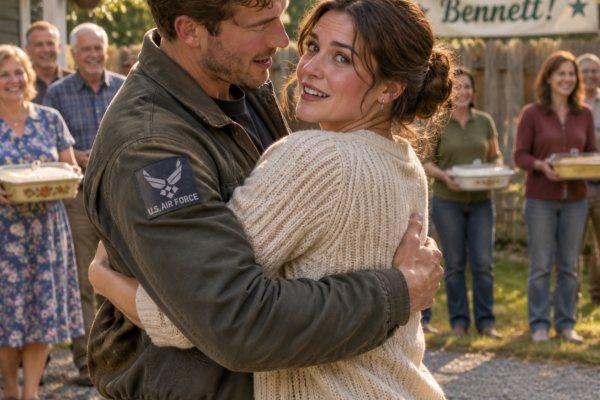
Outside the restaurant, the city was cold and alive around us, and I had stopped on the sidewalk to check a work message out of reflex, that old habit of always having the phone as an extension of my hand. He stood beside me, unhurried, hands in his coat pockets, the vapor of his breath disappearing into the cold night air.
I put the phone away, turned to face him, and he was looking at me in a way that made me forget the cold entirely. It wasn’t the office look. It wasn’t the look from the car, the break room, the late afternoon hallway. It was deeper than all of them combined. The look of a man who has arrived somewhere after a long time walking and is finally still.
“Nicolo,” I said, in a voice that came out with no volume at all. He took one hand slowly from his pocket, and his fingers rose along my neck with a lightness that was more intense than any pressure could have been. Fingertips at the line of my jaw. His thumb passing softly over my cheek. And I closed my eyes for half a second because it was too much to process at once. The warmth of his hand on my face against the cold of the night around us.
When I opened my eyes, he was closer. I don’t know at what point the distance had closed. I only know that there was an entire city around us, and it was gone. And there was the vapor of our breath mingling in the air between us, and there was his hand on my face with that steadiness that promised without pressing.
He tilted his head, and his mouth found mine. It wasn’t hesitant. It wasn’t tentative. It was direct and honest and inevitable, the way everything he did was. His mouth taking mine with a pressure that started firm and went deeper before I could catch my breath. And I felt his warmth spreading from the point of contact to every edge of my body like fire finding dry surface.
His hand left my face and moved down my neck, along the side of my shoulder, stopping at my waist with a pressure that pulled me two centimeters toward him. Two centimeters that were a world. That were two years of loosened ties and coffee at the right temperature and undivided attention that I had tried to catalog as neutral and never managed to.
I put my hands on his chest, feeling the warmth of the fabric, feeling his heart beating faster than his composure let show. And I answered with everything I had held back for too long. Because holding back had been the right choice for a long time, and letting go was the right choice now.
When the kiss ended, he didn’t pull away immediately. He stayed with his forehead against mine, hand still at my waist, his breathing slightly different from what it had been before. And I kept my eyes closed for a few seconds, because opening them meant the world would come back. And the world could wait a little longer.
“That was—” I started. His phone rang. I opened my eyes. He went still for a second, and I saw in him the same resistance I was feeling. That refusal of the body to leave where it was, to go where the world was calling.
Then he looked at the phone and his expression changed, and I recognized that change. Not coldness. It was the boss coming back. Because something had called the boss. “I have to go,” he said, in the voice that had apologized before the words came out.
“What happened?” I asked. “Work,” he said simply. Because in his world, simple was sometimes all that could be given. Doriano appeared ten minutes later with the car and looked at me with the expression of someone who has assessed and already reached a conclusion.
“You asked first if he was okay,” he said when I got in. “It’s natural,” I replied. “Before you asked what happened.” I stayed quiet, looking out the window with the taste of the kiss still on my lips and the hand at my waist still present as a physical memory my body refused to release.
You asked first if he was okay. I had asked first if he was okay, and Doriano didn’t need to say anything else, because we both knew what that meant. That the font of item number one wasn’t just gray. That it had stopped being about a rule and started being about a choice. And that I had made the choice before I realized I was making it.
In the three days that followed, he was different. More closed off. More wall than sarcasm. Present in body and absent in everything that mattered. I gave him space because I had learned to give it, and because there was a difference between pulling away and processing, and I needed to believe it was processing.
On Thursday, when I set the coffee on the desk and turned to leave, he said my name. “I don’t regret it,” he said before I could ask anything. “The kiss. I just want you to know that.”
I stopped in the doorway. “But there’s something you need to know,” he continued, in a voice that had shifted in tone. Lower. Heavier. “About what happened that night. A rival family is using people close to me as leverage.” He looked at me. “And I was foolish enough to show that you matter in the wrong places.”
The office went silent, and I understood, with that clarity that shows up at the exact moment you least want it, that the most beautiful kiss of my life had come with a price I didn’t yet know the size of.
Chapter 9: The Risk, the Distance, and What She Decides. Two weeks. Two weeks of distance built with the efficiency of someone who knows how to build something that hurts while they’re building it. I hadn’t been cold. Hadn’t been hostile. I had been calibrated. Which was worse, because calibrated looks natural if you don’t know what was there before.
I knew. He knew. And the space between us had the texture of something chosen, not something that had simply happened. The truth was that I understood what he had said on Thursday. I understood the logic. Understood the risk. Understood that a man from his world showing that someone mattered in the wrong places was information with a price, and that the price could be collected in ways I didn’t want to calculate.
But understanding with your head and feeling it in your chest were two things that didn’t sit well together, and my chest was winning the argument with an infuriating consistency. The kiss was still there. Not as a distant memory. As a physical thing the body refused to file away. His hand at my waist. The warmth of his mouth. His forehead against mine before the world came back. All of it intact, and two weeks of distance hadn’t erased a single detail. It had only added the ache that comes after tasting something good and having to stop.
In the second week, Doriano found me in the break room with the expression of someone who arrived with a purpose and is going to see it through whether they’re welcome or not. He stood in the doorway for a second, looking at me with the calm of a man who measures every word before putting it in the air.
“You stopped wearing the earring,” he said. I brought my hand to my ear on reflex. The bare ear. The way it had been every day for the past two weeks. I had put the earring away in the nightstand drawer without asking myself why, and Doriano was making me ask now.
“I put it away,” I said simply. “Why?” he asked, in the voice of someone who already knows the answer but needs it said out loud. I looked at my coffee for a moment before answering. “Because the last place I lost it was at a dinner that went wrong,” I said, with the honesty I only used with people who had proven they deserved it. “And I don’t want to lose it again.”
“The earring or him?” he started. “Both,” I cut in before he finished, because it was easier to say it outright. “I’m scared of both.”
Doriano was quiet for a few seconds, and there was in his silence the quality of a man weighing what he was going to say next with more care than usual. “He’s handling it,” Doriano said finally. “What happened that night? He’s working on it.” “I know,” I said. “And he’s not using you as a shield while he does. He’s trying to protect you without pushing you away.”
“I know,” I repeated. “But from where I’m standing, Doriano, protection and distance look the same when you’re on the outside looking at a closed door.” He stood in the break room doorway for a moment, and then did something I didn’t expect. He nodded slowly, as if I had said something he couldn’t contradict and wasn’t going to try.
“Fair enough,” he said. “And it’s stupid of him.” “Don’t call him stupid.” “Why not?” he asked in that tone. “Because—” I stopped and heard what I was about to say before saying it, and went quiet for a second. Doriano waited with the patience of someone who has already gotten where he wanted to go and is just waiting for the other person to catch up.
“Because it’s my job,” I said finally, and those two words held much more than their professional meaning. And we both knew that. And neither of us commented.
Doriano left the break room with the expression of mission accomplished, and I stayed with my coffee going cold in my hand, thinking that two weeks of calibrated distance had done nothing but confirm what the gray font had already confirmed before.
On Thursday evening, I stayed late because of a report that couldn’t wait. The floor emptied gradually, and by 8:00 p.m. it was just me and the light of my desk lamp and the silence of the office and the determination to finish what I’d started before going home.
I closed my laptop at 8:40, grabbed my bag, my coat, and headed to the elevator with the stride of someone already mentally at home. The hallway was empty, the lights dimmed, and the elevator arrived in forty seconds.
The lobby had that quiet of a commercial building after hours. Empty reception. A security light in the corner. The sound of my own steps on the marble. I was approaching the revolving door when I noticed a man standing outside. Just standing still. Looking at the building with that motionlessness that had nothing casual about it.
Something in my stomach dropped two inches before the thought reached my conscious mind. Two years alongside Nicolo Angelus had taught me the difference between someone waiting for an Uber and someone who is where they are with intent. And that man was the second kind.
I went back to the elevator, went up. Nicolo was in his office. He looked up when I walked in without knocking, and read my expression before I opened my mouth. Two seconds. Just two. And he was already on his feet. “What happened?” The voice came out low and direct.
I told him. The man in the lobby. The stillness. That instinct I had learned not to ignore. He had his phone in his hand before I finished the last sentence. “Doriano. Lobby. Now.” And then to me, in a voice that had shifted in tone but not in volume, “Stay here.”
“Nicolo—” I started. “Please,” he said. That word. The word he didn’t use. It came out direct. No drama. No negotiation. And that was exactly why I stayed.
He stayed with me. Not in the same room. He stayed in the office. I stayed in the conference room with my laptop. And the door between the two spaces stayed open. And in that open door was all the communication neither of them was putting into words. I was safe. He knew where I was. And the space between the two rooms had the quality of two people who had found the balance point that neither the two weeks of distance nor the kiss in the West Village had managed to define.
Around midnight, I fell asleep on the conference room sofa without realizing it. Laptop on my lap and the report half finished. When I opened my eyes, there was low light coming through the window and a dark wool jacket over me. The jacket smelled like his cologne.
I lay still, looking at the fabric for a second. Then got up slowly and walked to the office doorway. He had slept in the chair. The uncomfortable position of a man who hadn’t gone to the sofa because the sofa was taken. Head slightly tilted. Suit wrinkled. Tie completely loosened. And there was in that a vulnerability I wasn’t used to seeing in him. Not the boss. Not the executive. Just a man who had stayed because I was there.
He woke up when I got close. Opened his eyes. Saw me. And for a second, just one, before awareness arrived, the expression on his face was the most unguarded thing I had seen in a long time. “The earring,” he said, looking at my bare ear, his voice still thick with sleep. “I put it away,” I said. “I know.”
He straightened in the chair slowly. “Doriano told me what you said in the break room.” “Doriano talks too much sometimes,” he agreed. And there was in his tone that quality that appeared when he was being more human than the boss allowed. “Briella.” “Hm.” “I’m going to fix it,” he said, in his usual direct voice, but with a different weight. More personal. “And when I do, I won’t use protection as an excuse for distance anymore.”
“That was an admission of fault,” I said. “It was,” he confirmed without hesitating. “You rarely admit fault.” “I rarely commit it.” The corner of his mouth appeared. That one. The one that had been a problem from the start. “But when I do, I own it.”
I looked at the jacket still over my arm. Then I went to my bag, opened the small inner pocket, and took out the earring that had been put away for two weeks. I put it on. Fastened the clasp with my fingers slowly. And when I looked up, he was watching me with that expression I had learned to recognize as the most honest one he had.
“It’s okay,” I said quietly. It was the answer to the question he hadn’t asked out loud, but that was there. And those two words held more than those two words. He stayed still for a second. Then, very slowly, he raised his hand and ran his fingertips along my ear where the earring was. A minimal touch. Barely any pressure. But one I felt everywhere.
Before his hand came down along the side of my neck and stopped at my shoulder with that steadiness that was at once presence and promise. His eyes stayed on mine, and in them there was something that was no longer trying to hide.
The following Sunday, he knocked on my door without warning. I opened it, and he was there without a suit for the first time I had seen him outside the context of the night before. Dark pants. Simple shirt. No jacket. No tie. With the ease of a man who had decided to take the day off from his own character.
I stood in the doorway looking at him, and there was something about the way he was without all the armor that was simultaneously more accessible and more dangerous than in a suit. “You’re not wearing a tie,” I said. “Sunday,” he replied simply. “A walk,” he said, in the direct voice of someone who decided before arriving. “In the park. No agenda. No tablet. Just you and me.”
I stood there for two seconds. Then I grabbed my coat. “Yes,” I said. And I closed the door behind me with the lightness of a font that was getting less and less gray.
Chapter 10: Without Pants, Without the File, and Without Pretending. The walk lasted four hours, and it was the first time in a long while that I didn’t check the time once. We walked through the park without a destination, the way you do when no one is in a hurry to get anywhere, with the afternoon cold on our faces and the city making its background noise the way New York does when it’s not paying attention to your life.
He told me about his father. For real. Not the interview version. Not the version of the boss who had inherited an empire, but the version of a boy who had learned that strength was the only currency accepted in the world he grew up in, and who had taken too long to understand the cost of that.
I told him about my mother. About the earring. About the woman who had taught me that some things you carry on your body because it’s the closest way to stay near someone who is gone. He listened with that undivided attention I had learned to recognize as the rarest thing he offered. And when I finished, he stayed quiet for a moment. Not the silence of someone formulating a response, but of someone who has received something and is holding it carefully before giving anything back.
“Would you choose differently?” I asked later, when the conversation had come back to his world. “I don’t know,” he replied, with that honesty that cost something and that I had learned to recognize by its tone. “I’d choose with more information.” “What information?”
He glanced at me sideways, and there was in that glance something that was an answer before any word. “That there are things the world I built can’t protect,” he said. “Like the desire to walk through a park on a Sunday without calculating who’s watching.”
I stayed quiet for a moment. “But you’re walking,” I said. “I am,” he confirmed, with the corner of his mouth that was different from all the other corners of his mouth. “That’s the new part.”
I made dinner at the apartment because he had stayed in the kitchen with me while I cooked, leaning against the counter with a glass of water, talking about nothing specific, with a lightness I hadn’t associated with him until I started associating it. And there was something in that. In the domestic ease of a man who ran the organized crime of New York leaning against my small kitchen counter without looking out of place. That made me understand that the “new part” he had mentioned in the park was bigger than I had calculated.
We ate at the small kitchen table because the living room felt too formal for how the evening was going. Afterward, on the sofa, I opened my laptop out of habit and he picked a book off the shelf without asking. And the silence between us had the quality of something that had found its own level. Comfortable in a way I hadn’t expected it to be. Natural in a way that didn’t require any effort to sustain.
I opened the file on reflex. “Things I Will Never Do.” Item number one. Gray font. The way it had been for weeks. Waiting for the decision I still hadn’t made out loud. I read the sentence once, then once more, and then, without drama, without an internal speech, without needing any more time, I selected it and pressed delete.
I closed the file, closed the laptop, and sat looking ahead for a second with that specific lightness of something that had been heavy for too long and finally wasn’t anymore. “What was that?” he asked without looking up from his book.
“An organizational file,” I said. “Something I don’t need anymore.” He set the book down slowly, looked at me with that full attention, and I saw in his face the exact moment he understood what I was saying. Not the file, but what the file represented.
“Briella,” he said, in the quietest voice I had ever heard from him. “Item number one,” I said, looking at him. “Not getting involved with my boss. Deleted.”
The sofa stayed silent for a long time. Then he set the book on the coffee table and turned his body toward me. And I turned mine. And we sat facing each other with half a meter between us. The last distance that needed to be crossed.
“Why?” he asked, in the voice of someone who needs to hear it from me. Not as confirmation. As a declared choice. “Because rules that exist out of fear aren’t rules,” I said. “They’re walls. And I have enough walls without adding one I don’t need anymore.”
He held my gaze for too long to be casual and too briefly to be everything that look wanted to say. And then he said something I hadn’t expected. Or had expected, but hadn’t known it would arrive that way. With that weight.
“You spent two years building that wall,” he said, in the voice that had that roughness of something felt before its thought. “For reasons I respect. And you just took it down on a Sunday evening over my book. That means more to me than I’m able to express.”
“You’re nervous again,” I said. “Enormously,” he confirmed without looking away. I leaned in. This time I went first. The kiss started soft, not like the one in the West Village, which had been urgent and inevitable and full of two years of wait. This one had a different quality. It was the kiss of a choice, not an explosion.
It was me reaching for him deliberately, and him receiving it with that full attention he gave to everything that mattered. And both of us knowing that this time there was no phone going off at the wrong moment. No world calling. No door between us.
His hand rose slowly along my arm, palm warm through the thin fabric. And when it reached my shoulder, he pulled me gently toward him. Not forcefully. With that steadiness of a man who knows what he wants and doesn’t need to prove anything to have it.
I put my hands on his chest and felt his heart beating faster than his composure let show. And there was in that an intimacy greater than anything else. Knowing that on the inside he wasn’t as controlled as he appeared.
The kiss deepened, and he tilted toward me until I was against the arm of the sofa, and he was over me with one arm braced beside my head, close enough for me to feel the warmth of his body like a blanket before the touch. And I thought, with the last part of my brain still functioning analytically, that I had spent two years trying not to imagine this, and the reality was immeasurably better than anything I had imagined.
He paused. Pulled back two centimeters. Just two. Enough to look at me. Dark eyes and slightly different breathing. And there was in his gaze a question he didn’t need to ask in words, but asked anyway. “Are you sure?” he said, in the rough voice of someone holding back with considerable effort.
And I thought about two years of loosened ties and coffee at the right temperature and an earring retrieved from a restaurant at ten at night. And I smiled in a way he understood before any words. “From the beginning,” I said.
The night that followed had no adequate words, and I’m not going to try to find them. What I can say is that he was present in a way I hadn’t known existed. Attentive to every detail. Every breath. That specific place on my neck that made everything stop making sense. And there was in his hands a combination of firmness and care that I had no vocabulary for, because the two things don’t usually exist together, and in him they did without effort.
And at some point in the night, in a quiet early morning, with the city outside making its low, familiar hum, I understood that the most skeptical reader of myself, the one who had written item number one at two in the morning in a small apartment thinking she was protecting herself, had not calculated that protection and captivity are sometimes the same thing. And that letting go could be the most courageous act there is.
We woke up with the morning light coming through the apartment windows, and he was awake before me. I could tell by the way his breathing had that quality of quiet alertness of a man who never fully sleeps, even when he sleeps. “Nicolo,” I said, in the voice of someone trying out a name in that context for the first time. “Hm,” he replied, hand in my hair with the absent-minded ease of someone who does it without calculating.
“My dream was to see you without your pants,” I said. The pause that followed had the quality of contained laughter. “I know,” he said quietly. “I was there.” “And now you know it wasn’t just aesthetic.” “It was never just aesthetic,” he replied. “You just needed more time to know it, too.”
“Arrogant,” I said. “Consistent.” I stayed quiet for a moment with my head on his shoulder and my hand on his chest. And the morning arriving with that lightness I hadn’t known mornings could have.
“Nicolo.” “Hm.” “You’re going to keep being dangerous.” “Yes.” “And cold and meetings.” “Necessary.” “And item number one doesn’t exist anymore.” “It doesn’t,” he confirmed. “That’s okay,” I said. “The dangerous and the cold and the sarcastic and the world you have. It’s all okay.”
“Why?” he asked, in the voice of someone who wants the specific answer. “Because you went back for my mother’s earring,” I said. “And you loosened your tie. And you covered me with your jacket without being asked. That’s you. The version of you that exists when you stop calculating.” A pause. “And I’d choose that version over anything else I’ve ever seen.”
The silence that followed was different from every other silence I had learned to read in him. It was full. From the inside. “You’re going to ruin me,” he said very quietly, with that honesty that cost everything. “Probably,” I said. “But in a good way.” “That kind exists with you.” “Yes.”
The following Monday, there were two coffees on the desk when I arrived. He had come in before me for the first time in two years. Had made both coffees. Had left mine at the right temperature, exactly the way he knew I liked it. The way he knew because he had been paying attention long enough to know without my ever having had to ask.
“You came in early,” I said. “Exceptionally,” he replied, with the corner of his mouth. “To make the coffee.” “To make the coffee.” I picked up the cup, took a sip. Right temperature. As always. “Two years of paying attention,” I said. “From the beginning,” he confirmed.
Doriano walked past in the hallway, saw the two coffees, saw our expressions, and went straight to the elevator without coming in, with the smile of a man who no longer needs to hide that he’s rooting for this. On his phone, he sent a message to Nicolo’s group chat with two words. “Two coffees.” The phone exploded with replies.
And in the office, with the morning arriving and the calendar full and the world outside continuing to be the complicated world it was, I looked at him from across the room and he looked at me, and between us was that thing with no name that both of us recognized as right.
Then, at 11:23 a.m., I went to the break room to get water. The hallway was empty. The team in a meeting. Doriano on the floor below. The break room was quiet, with that dead-hour stillness.
I reached the counter and saw the envelope before I understood what I was seeing. White. No return address. No name. Placed on the granite with the precision of something that wasn’t forgotten. It was left.
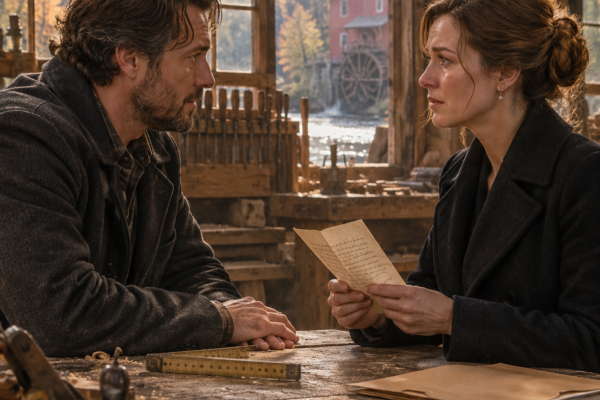
I stood in the doorway for two seconds with my instincts screaming before the thought arrived. I picked it up. Inside was a photograph. Me and Nicolo on the sidewalk in the West Village. That night. That exact moment before the first kiss. Taken from across the street at the angle of someone far enough not to be seen and close enough for every expression to be sharp.
On the back, in handwriting in an elegant script that matched nothing it should have matched: “Congratulations, Miss Osborne. You’ve finally become interesting.”
I stared at the back of the photograph for a time I couldn’t measure. The water I had gone to get was still in the pipes. The morning coffee was cold in the cup I had left on the desk. And I understood, with that objective clarity that is the worst kind of understanding, that item number one had never been about the job. It had been about this. About the moment when someone from his world decided that I existed.
And that moment had arrived.