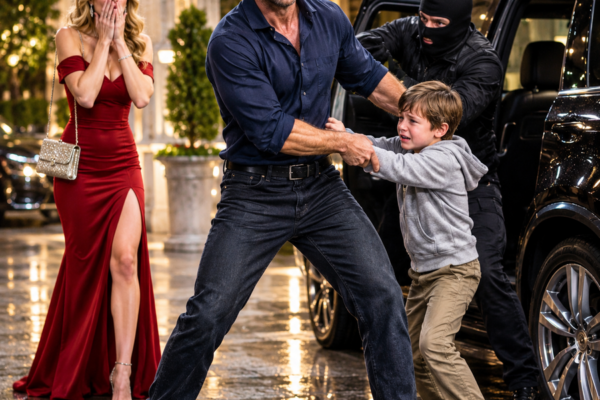
Part 1| A Single Dad Saved a Little Boy from Kidnapper—Then the Billionaire Mother Learned Who He Really Was
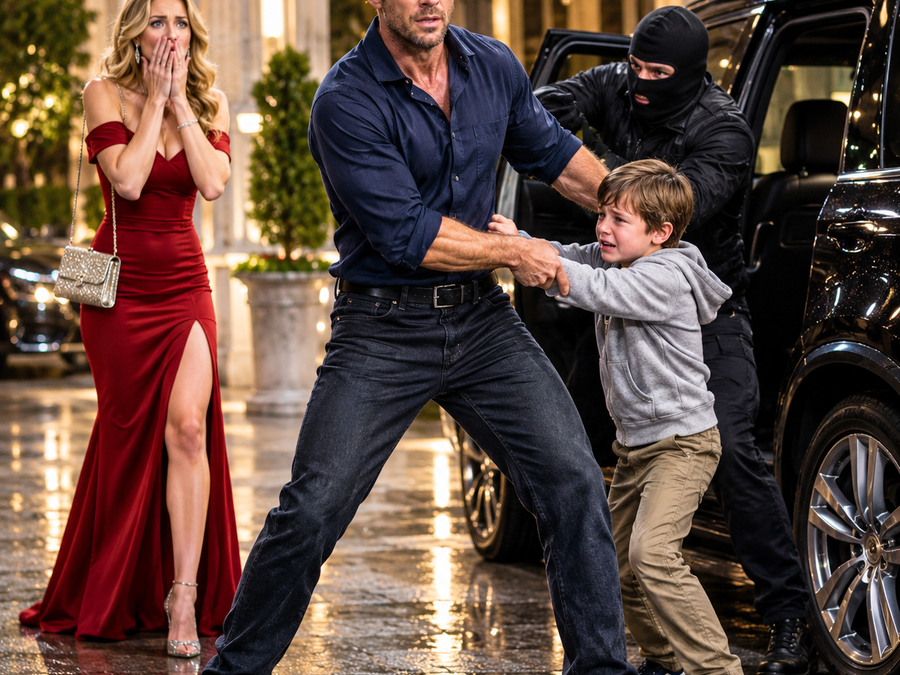
Part 1| A Single Dad Saved a Little Boy from Kidnapper—Then the Billionaire Mother Learned Who He Really Was
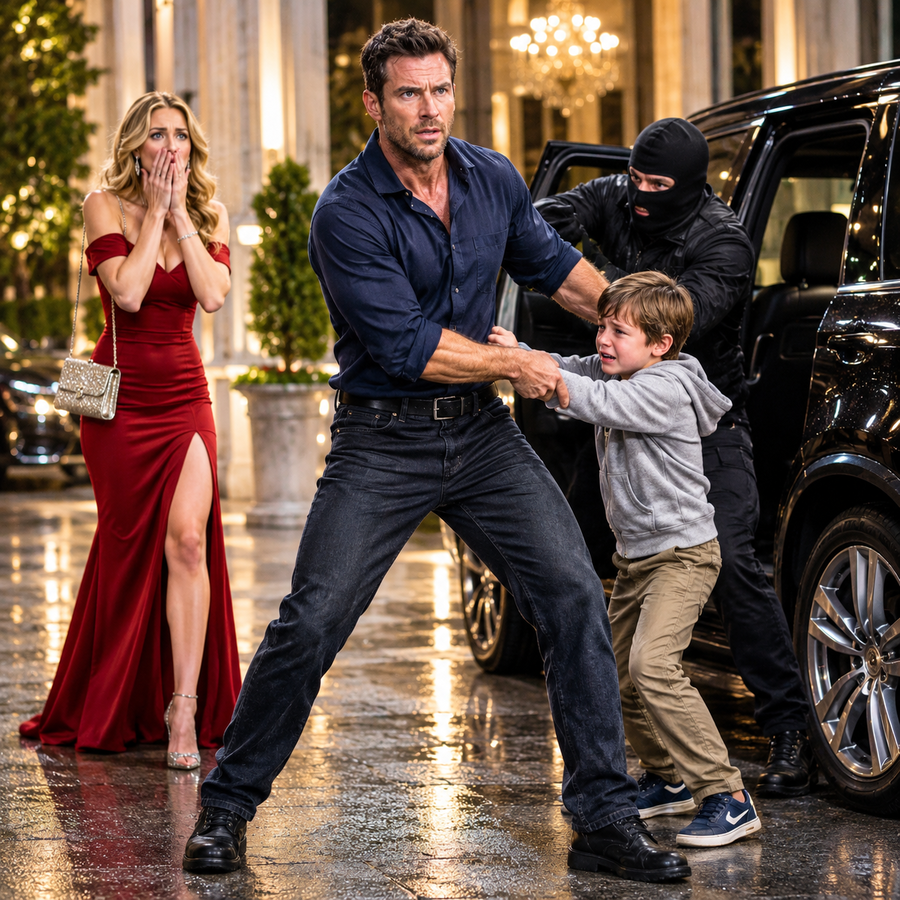
Nobody called 911. Nobody screamed.
Nobody moved. 43 people stood in a busy gas station parking lot and watched a 7-year-old boy take three steps toward the open side door of a white van and not a single adult did a thing.
Then a mechanic covered in grease and smelling like engine oil walked out from under a pickup truck, crossed the forecourt in 8 seconds flat, and put a grown man face-first against the van’s quarter panel before most people even registered what was happening.
The child was safe.
The kidnapper was pinned and 43 people were standing there with their mouths open asking the same question, “Who in the world is that man?”
Before we go any further, if this is your first time here, hit that subscribe button right now because every single week we bring you stories like this one.
Stories about ordinary-looking people who turn out to be anything but ordinary.
Drop a like on this video and tell me in the comments what city and country you’re watching from.
I love seeing how far these stories travel.
Don’t go anywhere.
You do not want to miss what comes next. The day Cole Barrett almost lost everything started the same way every other day started, with burnt toast and an argument about socks.
“Dad, these are the wrong ones.”
Ava held up a pair of ankle socks with a look of genuine betrayal on her face. She was 9 years old, brown-haired, and possessed of an opinion on every single subject known to humanity.
“I told you yesterday, I need the ones with the stripes at the top.”
Cole stood at the kitchen counter with a spatula in one hand and a dish towel thrown over his shoulder watching the toast smoke faintly in the toaster.
“Those are the ones with stripes.”
“These are ankle stripes.”
“I need cuff stripes.”
“There’s a difference.”
“Ava.”
“There’s literally a difference.”
He pulled the toast out, scraped the black off into the sink, buttered what was left, set it on the table.
“Eat your breakfast.”
She dropped into the chair, stared at the toast, and poked it once.
You burned it again. I know I burned it.
Eat it anyway. She ate it anyway.
That was the thing about Ava.
She complained constantly, then did whatever needed doing without much additional fuss.
Cole didn’t know where she’d gotten that quality.
Probably not from him.
Probably from her mother, who had been the most practical person he’d ever met in his life, and who had been gone for 3 years now, and left a hole in this apartment so large that Cole sometimes felt himself walking around the edges of it just to avoid falling in.
He poured coffee into a thermos, screwed the lid on, checked the time.
If he left in 6 minutes, he’d make it to the station by 7:40, which gave him 20 minutes before his shift technically started, which he needed because Mike Dolan, the morning dispatcher, had left him a voicemail at 9:30 last night saying pump three was acting up again and needed a pressure check before the morning rush.
He had listened to the voicemail while sitting on the edge of Ava’s bed after she fell asleep, watching her breathe the way he had when she was a baby, back when the world felt like something you could protect someone from if you just stayed close enough.
Dad.
Ava had finished the toast.
She was looking at him in that direct, slightly unnerving way she had sometimes, like she was 40 years old and just borrowing a 9-year-old’s body for convenience.
Are you okay?
I’m fine.
You’ve got the face.
What face? The thinking too hard face.
You get a line.
She pointed between her own eyebrows.
Right there. Cole touched his forehead self-consciously.
Get your backpack.
I’m just saying you should maybe not think so hard before 7:00 in the morning.
Backpack, Ava.
She got her backpack. He dropped her at school, sat in the car for a moment watching her disappear through the front doors, then drove to the gas station and got under a pickup truck before 7:30.
The station was a Sunoco on the corner of Maple and Route 9, wedged between a dry cleaner and a tire shop in the kind of mid-size town that didn’t have much to distinguish itself except a decent diner on the main strip and a 4th of July parade that took 45 minutes and involved the same three fire trucks every year.
Cole had been working there for 2 years.
The owner, a heavy-set man named Gerald, who wore the same Carhartt jacket 11 months out of 12, had hired him without asking too many questions, which was exactly the kind of employer Cole needed at that particular point in his life.
The morning passed without incident.
He fixed the pressure issue on pump three, replaced a cracked fuel line on a Dodge Ram that had clearly been driven hard and maintained minimally, and ate a gas station hot dog for lunch that he told himself he would stop doing but had not
yet stopped doing. He was on his back under a Honda Civic around 2:00 in the afternoon when he first noticed the van.
White.
Older model, maybe 10 years out, with the kind of nondescript paneling that doesn’t belong to any particular trade or service.
No logos.
No magnetic signs, just plain white with a little road rust along the wheel wells.
It had pulled into the far corner of the lot near the air pump at around 1:50. Cole noticed it the way he noticed most things, not with alarm, but with the quiet automatic attention of someone who had spent years training himself to see what other people chose not to.
He slid out from under the Civic, wiped his hands on a rag, and looked at the van. Engine running, driver visible but not doing anything.
No phone, no food, just sitting, watching.
Cole walked to the other side of the lot to grab a torque wrench from the shop cart, and on the way back, he got close enough to read the license plate without making it obvious that’s what he was doing.
He repeated it to himself twice, the same way he used to memorize grid coordinates, then went back under the Civic. It was probably nothing.
People sat in parking lots. People sat in vans.
There was nothing inherently criminal about a man sitting in a parked vehicle for 20 minutes on a Tuesday afternoon, and Cole had spent enough of his post-military life trying to stop applying war-zone logic to civilian situations. He went back to work, but he kept the van in his peripheral attention, like background software running quietly, not interfering with anything else, just tracking.
Oh, Victoria Sinclair arrived at the station at 4:17 in a charcoal gray Audi Q7 with a cracked windshield that her assistant had been telling her for 6 weeks to get repaired and that she had been putting off because she was, at any given moment, in the middle of 12 things more pressing than a windshield. She pulled to pump two, got out with her phone already at her ear, credit card in her other hand.
She was 30 years old in a tailored navy blazer over a white shirt that had acquired a faint coffee stain sometime around noon, with her dark hair pulled back in a knot that was holding on by what looked like three pins and pure determination.
She was the CEO of Sinclair Technologies, which had offices in seven cities and a market cap that financial journalists like to describe with the word staggering.
She did not look staggered.
She looked tired.
Marcus, I don’t care what their legal team says, the indemnity clause was not in the original term sheet, and I’m not signing anything with it in there.
She wedged the phone between her ear and shoulder, swiped her card, pulled up the pump handle. Push it back?
Yes, today. Marcus, it is 4:00.
We have 3 hours. Push it back.
She listened, made a sound of impatience.
Fine. Set up the call for 5:30.
I’ll be in the car.
She ended the call, started the pump, and turned around to get something from the back seat.
She didn’t see Ethan get out of the car.
He was 7 years old, gap-toothed, with a bad habit of unbuckling his seatbelt about 30 seconds before any car came to a complete stop. He had been sitting in the back seat for 45 minutes while his mother drove from a meeting and talked on her phone, and when the car stopped moving, he considered that permission.
He pushed open the door and climbed out. The van caught his attention immediately.
It was the thing in the side window, a bright orange shape, something moved deliberately across the glass, like someone waving a toy.
Ethan was seven, and orange was his current favorite color, and the shape kept moving, and the parking lot was warm and afternoon quiet, and his mother was on the other side of the car. He walked toward it.
Cole saw the boy before he saw where the boy was going.
He’d come out of the shop bay to return the torque wrench, and the motion snagged his eye.
Small kid, moving fast, alone, heading in a direction that didn’t make sense.
He followed the trajectory without meaning to, the way you track movement on a battlefield, not because you’ve decided to, but because you’ve been trained until deciding stops being part of it.
The van’s side door was sliding open.
Cole was moving before the door had opened 18 in.
He didn’t run.
Running would have caused people to look up, caused the driver to notice, caused the situation to escalate in a direction he didn’t want.
He walked fast at an angle, cutting across the lot in a line that looked purposeful and routine unless you were specifically watching for it.
His hands were still dirty with grease.
He didn’t have time to wipe them.
The kidnapper was leaning out now, arm extended.
Something orange in his hand, a small stuffed animal, a frog maybe, offered toward the boy with a smile that looked practiced and wrong.
Hey buddy, you want to see something cool? Ethan stopped 2 ft from the door, interested but uncertain.
Cole closed the last 10 ft in four steps and came in from the side.
What happened next took 11 seconds.
Cole never counted it.
Other people did, later, reviewing security footage from the station camera.
In 11 seconds, Cole intercepted the man’s extended arm, controlled the wrist, redirected the body’s momentum using its own weight, and put the kidnapper face first against the van’s rear quarter panel with his arm torqued up behind him at the specific angle that makes further movement not impossible, but very, very inadvisable.
He didn’t
say anything dramatic.
He didn’t need to.
“Don’t.”
He said it quietly, the way you say it when you mean it completely. The man made a sound of pain and stopped moving.
Ethan stood on the pavement staring up at the mechanic holding a stranger against a van, blinking.
“You okay?”
Cole said to the boy. Ethan nodded slowly.
“Good.
Go find your mom.
Right now.
Quick.”
Ethan turned and ran.
Victoria heard her son’s voice before she saw him.
“Mama!”
She came around the front of the car and Ethan hit her at full speed, arms around her waist, face pressed into her blazer.
She grabbed him on instinct, that total physical relief that only parents know, the sudden unwinding of a terror you didn’t fully know you were feeling until the threat was already over.
“Hey.
Hey, what happened?
Ethan, what?”
He was pointing.
She looked.
A mechanic, dirty uniform, dark hair, big hands, was holding a man against a white van with the calm, unhurried efficiency of someone filing paperwork. The man against the van was not calm.
He was making sounds of protest and pain and twisting uselessly.
The mechanic held him still without apparent effort, the way you hold a door open, just part of the body’s normal function, nothing exceptional about it.
Around them, the parking lot had gone completely still. A woman with grocery bags stood with her mouth open.
A man at pump four had stopped mid-swipe with his credit card suspended in the air.
“Call 911.”
The mechanic said, not loudly, just stating a fact about what needed to happen.
Someone did.
Victoria stood holding her son, watching this man, and could not identify what she was looking at.
Not the uniform, not the name tag, not the grease-covered hands.
Something else.
Something in the way he stood, like the ground under his feet was more real than the ground under everyone else’s, like he was held down by more gravity than ordinary people.
Ma’am.
He glanced over his shoulder at her.
Brief eye contact, clinical and not unkind.
Police are going to need your son’s account.
He’s not hurt?
No, she said.
He’s No.
He’s fine.
She held Ethan tighter.
Thank you.
The mechanic nodded once and looked away.
The police arrived in 4 minutes.
Two cruisers, then a third.
The kidnapper, a 44-year-old 4-year-old man, man who, it turned out, had two prior convictions for offenses against minors in a neighboring state, was taken into custody without incident, primarily because by the time the cruisers arrived, he had spent 11 minutes in a stress position that had removed most of his enthusiasm for resistance. Cole answered questions from a Detective Ruiz for about 25 minutes, patient and cooperative and economical with language in the specific way of someone accustomed to after-action debriefs.
Yes, he had noticed the van earlier. Yes, he had logged the plate.
Yes, he could describe the man’s approach in detail.
He provided these things without drama, and when Detective Ruiz said, “Sir, your situational awareness here probably prevented a kidnapping.”
Cole said, “I noticed something that didn’t add up.
That’s all.”
He went back to work after they released him, finished the Honda Civic, clocked out at 6:00.
Victoria Sinclair watched him walk back into the shop bay with her son’s hand in hers, and she thought, “That is not a regular person.
That is not someone who learned to do that from watching videos.”
She thought, “I need to know who he is.”
And she was right to think it, but she had no way of knowing yet how much the answer was going to cost her in sleep.
That night, Cole picked Ava up from the after-school program at 5:50, which was 10 minutes later than usual, and she greeted him with, “You’re late.
” “I know.”
“What happened?
You smell like you.”
She said it neutrally, meaning the grease, meaning the long day. She had opinions about most things, but not about the smell, which she had grown up around.
It was a long afternoon. She studied him, the line between his eyebrows.
The face again.
“I’m fine, Ava.
” “Did something happen at work?”
He looked down at her. Nine years old.
Three years without her mother, and still, somehow, every morning getting up and having opinions about socks and eating burnt toast without too much additional complaint. He put his hand on the top of her head.
“Nothing happened,” he said.
“Let’s get dinner.”
They went home. He made pasta, the real kind, not the boxed kind, because on days that went sideways, he had a habit of cooking something that took longer than it needed to.
Ava sat on the kitchen counter and talked about a girl named Sophie at school who had allegedly stolen her eraser and denied it comprehensively, and Cole listened and made the right sounds and stirred the sauce and did not think about the orange stuffed animal in the kidnapper’s hand, or the gap-toothed 7-year-old standing 2-ft from an open
van door, or what would have happened if he’d been inside the shop bay instead of crossing the lot.
He did not think about those things because thinking about them was not useful, and usefulness had been his primary operating principle for so long that it had become the shape of him.
After dinner, Ava showed him a drawing she’d made in art class, a house with a garden and what appeared to be a very large dog standing in front of it.
Though when he asked about the dog, she said with mild offense that it was a horse.
And how did he not see that?
He put it on the refrigerator. She went to bed without much argument, and he sat at the kitchen table for a long time after with the apartment quiet around him thinking about nothing in particular.
Outside, somewhere across town, a woman he had never met was typing his license plate number into a search engine.
But he didn’t know that yet.
And even if he had, he probably would have sat right where he was in the kitchen quiet listening to his daughter breathe through the thin wall of her bedroom. Some things you can feel coming.
Cole Barrett had always been good at that.
He felt nothing now except tired. He went to bed.
Victoria Sinclair had not built a technology empire by being the kind of person who let unanswered questions sit. She had gone home that evening, bathed Ethan, sat on the edge of his bed while he told her about the orange frog.
He’d seen it through the window, he said.
It was moving. He thought it was real.
And she had listened to every word with her full attention while something cold and methodical ran parallel in the back of her mind. The way it always did.
The part of her brain that her first business partner, years ago, had called the machine.
“You’ve got a machine back there,” he told her once.
“It never actually turns off, does it?”
She hadn’t known whether he meant it as a compliment.
She chosen to take it as one. After Ethan fell asleep, she sat at the desk in her home office with a glass of water she kept forgetting to drink and opened her laptop.
She had his name from the police report.
Detective Ruiz had mentioned it twice during the interview, and Victoria had the kind of memory that files proper nouns without being asked.
Cole Barrett. She typed it into the search bar.
The first results were thin.
A Facebook profile that hadn’t been updated in 4 years.
A mention in a local newspaper, not recently, a few years back, about a road race fundraiser for a children’s hospital.
His name in a list of participants.
Nothing that told her anything. She went deeper.
It took her 40 minutes and three different search approaches before she found the thread she was looking for, a veterans advocacy forum, a post from two years prior about family court cases involving former service members, and buried in the comments, a reference to a Cole Barrett, former Navy SEAL, who had been involved in a custody proceeding in Harwick County.
The comment hadn’t been written by Cole.
It had been written by someone who knew him.
The language was third-person and frustrated and detailed in the way of someone who had watched an injustice happen to someone else and couldn’t fully let it go.
Victoria read it three times.
Then she picked up her phone and called her head of research. His name was Daniel Park.
He was 26 years old and he answered on the second ring despite it being 10:40 at night because that was the nature of working for Victoria Sinclair.
The hours were not traditional, but the compensation was significant and Daniel had student loans and genuine curiosity in roughly equal measure.
“I need everything on a man named Cole Barrett,” Victoria said, “former Navy SEAL worked in Harwick County, involved in a family court case sometime in the last three or four years.
Everything you can find legally.”
A pause. She could hear Daniel clicking already.
“Tonight?”
“Tomorrow morning, 8:00.”
She paused.
“7:30.”
“Okay.”
Another click.
“Is this related to what happened this afternoon?
I saw it on the local newsfeed.”
“You saw it already?”
“There’s security camera footage, someone posted it.
It’s at about 60,000 views.”
Victoria closed her eyes briefly.
“60,000 views.”
Cole Barrett, who had walked back into a shop bay like he’d gone to retrieve a dropped wrench, was currently being watched by 60,000 people on the internet and almost certainly didn’t know it.
“7:30,” she said and hung up.
Daniel’s report arrived at 7:22 the next morning as a 40-page PDF in three annotated links, which was extremely Daniel.
Victoria read it at the kitchen island while Ethan ate cereal across from her, periodically asking questions she answered on autopilot without fully processing.
Mom, does milk go bad if you leave it out?
Yes.
How long? 2 hours, roughly.
What if it’s cold in the room?
Ethan.
Eat. She turned a page.
Cole Andrew Barrett, born 37 years ago in Claremont, Virginia, to a mechanic father and a school teacher mother. Second of three children.
Enlisted at 19.
Made it through BUDS on his second attempt.
The report noted this without commentary, but Victoria understood what it meant.
Most candidates who failed the first time didn’t come back.
The ones who did were a specific kind of person, not tougher necessarily, but differently configured, more comfortable with the idea that failure was a data point rather than a verdict.
12 years in the Navy. Specialized in personnel recovery.
The technical term for going into places other people had left and bringing back the people left behind. Classified operations, which meant the report had gaps.
Daniel had flagged with a small notation, record sealed, further detail unavailable through open sources.
Awards listed on public military databases included a Silver Star and two Bronze Stars, one with a Valor Device. Victoria knew enough to know what that meant.
She sat with it for a moment.
He had left the Navy 5 years ago.
His wife, Rachel Barrett, had died of a brain aneurysm 3 years later.
Sudden, no prior symptoms, 33 years old, and gone inside 48 hours.
Ethan read that part and didn’t say anything for a moment.
She meant Ava, the daughter. 9 years old now.
In the report, there was a school photo, a standard kind, and the girl had her father’s direct eyes and a gap between her front teeth she’d probably grow into.
The custody case was the last section.
Daniel had obtained public court records. He was careful and thorough, which was why she paid him what she paid him.
And the picture they painted made Victoria set down her coffee.
After Rachel died, Cole’s sister-in-law, Rachel’s older sister Patricia, had filed for partial custody of Ava, citing concern about Cole’s stability.
The court record showed that Cole had voluntarily disclosed a PTSD diagnosis.
He’d been in treatment actively with a VA-affiliated therapist.
And that this disclosure, combined with the irregular hours of his work schedule during that period when he’d been holding two jobs to cover the mortgage, had been weighed against him.
The judge had granted Patricia extended visitation rights that amounted, in practice, to every other weekend, every major holiday, and a summer month that effectively restructured Cole’s life around another family’s calendar.
Cole had not appealed.
The record showed he’d filed the paperwork and then withdrawn the appeal 2 weeks later.
There was no explanation in the record for why. Victoria thought she understood why.
Appeals cost money. Appeals cost time.
Appeals cost the specific emotional resource that gets depleted in someone already carrying a dead wife, a traumatized child, a PTSD diagnosis, and two jobs.
She closed the report.
Looked at Ethan, who had finished his cereal and was now examining something on the back of the milk carton.
“Mom,” he said without looking up.
“That man yesterday.”
“The mechanic?”
“What about him?”
“Did he get in trouble?”
“No.
I didn’t do anything wrong.
He helped you.”
Ethan considered this.
“He told me to go find you right away.
He said quick.”
“I know.”
“He didn’t yell.
Most people yell when it’s an emergency.
He finally looked up.
Why didn’t he yell?
Victoria looked at her son for a moment.
“Because he didn’t need to,” she said.
She went to the station that afternoon, alone.
No assistant, no driver, no intermediary. She parked the Audi at pump four and walked to the shop bay entrance and stood there until the man underneath a Jeep Cherokee noticed her feet and rolled out on his creeper board.
Cole looked up at her from the floor.
His face did a thing.
Not surprise, exactly, more like adjustment, recalibration, like a camera refocusing. He sat up, grabbed a rag from his hip, started on his hands.
“Ms.Sinclair.
” “You know who I am?”
“You were on the news about a trade deal six months ago.
I was eating lunch in the TV in the break room was on.”
He stood, not quickly, taking his time about it.
“How’s your son?”
“He’s fine.
He’s at school.”
She paused.
“He asked me why you didn’t yell.”
Something shifted in Cole’s expression, small, barely visible, and she would have missed it if she hadn’t been looking.
“Smart kid.”
“He is.”
She stopped.
This was not how she’d planned to start this conversation.
She’d planned to be businesslike, direct, purposeful.
What she said instead was, “I read your file.”
Silence.
The air in the shop bay smelled like oil and old rubber and something metallic. Somewhere in his back, a radio played country music at low volume.
Cole looked at her steadily.
“That’s thorough.”
“I know about your service.
I know about Rachel.
I know about the custody case.”
His jaw moved slightly.
Not anger, something more controlled than anger.
“That’s a lot to know about someone you met yesterday.”
“I’m aware.”
She held his gaze.
“I’m not apologetic about it.
I needed to understand who I was dealing with.”
“And what did you figure out?”
“That you’re a Silver Star recipient with a combat rescue specialty who is currently changing oil at a gas station in Harwich County and splitting holidays with a sister-in-law because a judge decided your PTSD treatment counted against you.
A long beat.
The radio played. A car outside pulled away from a pump.
“The court made a decision,” Cole said.
“That’s done.”
“It’s not done.”
“You withdrew your appeal.”
“I withdrew my appeal because” He stopped.
Looked away for a moment toward the back of the shop.
When he looked back his voice was leveled again.
“Because fighting it would have put Ava in the middle of it.
She was 6 years old.
I wasn’t going to do that to her.”
“That’s not justice.
That’s just absorbing an injustice quietly.”
“Sometimes those are the same thing.”
He said it without self-pity, which somehow made it worse.
“Ms.Sinclair.”
“Victoria.”
“Ms.Sinclair,” he repeated, and it wasn’t rudeness.
It was just the word he was comfortable with.
“I appreciate you coming here.
What you said yesterday” “I did what anyone would have done.”
“43 people were standing in this parking lot and you were the only one who moved.”
“That’s on them.”
“That’s on your training, your instincts.”
“12 years of going into places nobody else would go to bring people back.
” She was watching him carefully.
“You did that for strangers.”
“For a country.”
“And then the country’s legal system used your mental health treatment as evidence that you weren’t a fit parent.”
The muscle in his jaw moved again. He looked down at the rag in his hands, not because he needed to look at it, but because he needed a second.
“I have a good lawyer I can put on this,” Victoria said.
“The best family court attorney in the state.
There are also two veteran advocacy organizations I’ve worked with before on policy reform.
They’ve been looking for a case that has enough documented specifics to support a challenge to how military mental health disclosures are weighted in custody proceedings.
” She paused.
Your case is exactly that. Cole looked at her.
I’m not a cause.
No, you’re a father.
The cause is incidental.
Another silence, longer this time. He folded the rag and held it.
His hands were large and calloused and the knuckles had old scars on them in the specific pattern of someone who had spent time doing things that involved impact. What do you want out of this?
He asked.
The question was direct and without accusation, which was somehow the hardest version of it.
Victoria had been asked the question before in business context, where the implied answer was always strategy, leverage, positioning.
She wasn’t sure she’d ever been asked it by someone who genuinely wanted to know.
Nothing, she said.
You saved my son.
That’s not a transaction.
I know it’s not.
That’s not what I’m doing.
She stopped, started again. My son has been asking about you.
He asked me this morning why you didn’t yell.
He’s been She paused in a way that was slightly uncharacteristic, a small gap in the composure.
He doesn’t ask about many people.
He’s a careful kid.
She looked at the rag in his hands.
I’m not looking for a transaction.
I’m looking to fix something that shouldn’t have happened and I happen to have the resources to do it.
Cole was quiet for a long moment, then if this goes anywhere, if lawyers get involved, if there’s any kind of public component, Ava doesn’t get put in front of cameras.
She doesn’t get asked questions.
She stays out of it completely. Agreed, absolutely.
And I’m not doing interviews.
You don’t have to.
Or press things.
Understood. He looked at her.
I need to think about it.
Of course. I mean, actually think about it.
Not overnight. I need a week.
Victoria nodded.
She pulled a card from her inside jacket pocket, plain white, just her name and her number, and set it on the corner of his workbench. A week.
She left him standing in the shop bay with the radio playing and the card on the bench and the Jeep Cherokee waiting for him to get back under it, and she drove out of the lot and turned onto Route 9 and sat at the first red light for a full 30 seconds thinking about the way he’d said, “I’m not a cause.
” Like he’d said it before.
Like he’d had occasion to say it before.
Daniel called her at 3:00 that afternoon with something he’d found that wasn’t in the original report.
A detail that had turned up in a veteran’s forum thread he’d only gotten to that morning.
“The Silver Star,” he said, “I found the citation language.
It’s partially declassified.
Do you want me to read it?”
“Yes.”
He read it. Victoria listened without interrupting.
The operation had been a personnel recovery mission, a classified location which the citation language referenced only obliquely.
Cole’s team had been inserted to extract two American contractors taken by a hostile force.
The extraction had gone wrong as these things sometimes did.
The citation described Cole holding a defensive position alone for 19 minutes while his team got the contractors to the extraction point, taking fire from multiple directions, sustaining a wound to his left shoulder that he had not reported until both civilians were on the helicopter.
“19 minutes,” Daniel said, “alone, under fire.
I know what it means.
I just I know you’ve read a lot of these, but 19 minutes.”
“I know.”
She ended the call, sat at her desk. The 40-page report was still open on her desk.
She turned to the page with the custody case outcome.
“Petitioners’ disclosed psychiatric treatment and demonstrated employment instability are considered in the court’s assessment.
” She read it a third time, then a fourth.
The language was careful and legal and careful in the way that made it harder to argue against, not easier, because it didn’t say anything outright wrong.
It just weighed things in a way that produced a wrong result, and the machinery of it had moved forward, and Cole had stood in front of it and lost, and then set the appeal aside, because fighting would have cost his daughter more than losing already had.
She thought about Ethan asking why the mechanic didn’t yell.
She thought about a man holding a defensive position alone for 19 minutes, so two strangers could get on a helicopter.
She thought about Ava.
9 years old, socks with cuff stripes.
She didn’t know about the socks yet, but she would.
Cole thought about it for 3 days, not a week, which was as much time as his mind would give him before it arrived at a conclusion, whether he asked it to or not. He thought about it at the station, under various vehicles.
He thought about it while cooking dinner, while helping Ava with a homework problem about fractions that she found personally insulting.
He thought about it at 2:00 in the morning, when he woke up from the kind of dream he didn’t fully remember, but that left the room feeling compressed and airless, and he lay there staring at the ceiling until it opened back up.
He kept coming back to a single image, not a memory from the Navy, something more recent.
Ava’s face two Christmases ago, when she’d been picked up for the holiday with Patricia’s family.
The careful way Ava had packed her bag.
The way she’d said goodbye to Cole like she was practicing at it, like she was getting better at a thing she didn’t want to be good at.
9 years old, and she’d been rehearsing goodbyes.
On the fourth morning, he called the number on the card.
It rang twice.
Barrett, Victoria said.
He was mildly surprised she’d saved his name already.
I’ll do it.
The lawyer. Whatever needs to happen.
He stopped. But I meant what I said about Ava.
I know you did.
And I’m not going to pretend this feels natural.
People helping me, it doesn’t feel He stopped again.
He was standing in the parking lot of the station half an hour before his shift and the morning was gray and smelled like it might rain.
It doesn’t feel like something I know how to do.
You don’t have to know how, Victoria said.
You just have to let it happen. He thought about that.
Okay. Okay, she said.
There was a pause that wasn’t exactly uncomfortable.
It was just two people sitting with the fact that something had started and neither of them being entirely sure what it was going to become.
How’s your daughter?
Victoria asked.
She had an opinion this morning about the way I fold towels.
A small sound on the other end of the line. It might have been a laugh.
Was she right? Cole looked at the gray sky.
Probably.
My son wants to know your daughter’s name.
He didn’t answer right away.
He looked at the pavement.
He looked at his hands.
He thought about Ava’s face at Christmas two years ago, the careful packing of the bag, the practiced goodbye.
Ava, he said.
She sounds like a good kid.
She’s the best person I know, he said.
Which is why none of the rest of this can go wrong.
The line was quiet for a moment.
Then Victoria said, with a seriousness that landed differently than he expected, Then it won’t.
He didn’t say anything back to that.
He wasn’t the kind of man who accepted assurances easily.
But he stood in the parking lot for another few seconds before going inside and something in his chest, some piece of hardware that had been running quietly under load for 3 years, turned down a fraction of a degree.
Not all the way. Not even close.
But a fraction. The rain held off that morning.
He worked under a Ford F-150 with a busted transmission mount and the radio in the shop bay played something he didn’t recognize and didn’t bother to identify.
And somewhere across town a lawyer named Gwendolyn Hart was receiving a phone call from Victoria Sinclair’s personal line, and by that afternoon, the paperwork had begun to move for the first time in 2 years.
Cole didn’t know any of that yet.
He was under the truck.
He was doing what he always did.
He was showing up.
Gwendolyn Hart was 51 years old, had practiced family law for 23 of those years, and had a reputation in Harwick County legal circles for two things: winning cases that looked unwinnable on paper, and having absolutely no patience for procedural theater.
She wore reading glasses on a beaded chain that she’d inherited from her mother, kept her silver hair cut short and practical, and had a framed quote on her office wall that read, “The law is not a machine.
It is a choice made by people.”
She’d written it herself after a case that had gone wrong in a way she still thought about.
She read Cole’s file in one sitting, which was how she read everything that mattered.
No interruptions, no phone, two cups of coffee, and the door closed.
Her assistant knew not to knock during a file read. The associates she supervised knew it, too.
When she finished, she sat for a long time with her hands flat on the desk. Then she called Victoria back.
“This is worse than you described,” she said without preamble.
“I know.”
“The judge on the original case was Marcus Telford.
He retired 2 years ago.
The replacement in that court is Sandra Voss, who I know professionally, and who has a significantly different read on how mental health disclosures should function in custody determinations.
” Gwendolyn tapped her pen on the file.
“That’s not irrelevant.
Can we reopen it?
There are grounds.
The PTSD disclosure issue is the strongest.
There’s been substantial movement in state appellate guidance since this ruling, and I think we can argue that the standard applied was outdated even at the time, not just in retrospect.”
She paused.
“I need to meet him.”
“I’ll arrange it.”
“Alone,” Gwendolyn said, “not not with you in the room.
No offense.”
“None taken.
Why?”
Because I need to know what I’m working with before I commit to this.
A man who doesn’t want to fight is harder to represent than a man who does.
She picked up the file again. He withdrew his appeal.
He told me why. I know why.
It was for his daughter, which is admirable and also a problem because if he goes into a courtroom carrying that same instinct to absorb damage quietly rather than defend himself, I can’t help him.
Her voice wasn’t unkind, but it was precise.
I need to know if he can hold a position when it costs him something.
Victoria was quiet for a moment.
He held a defensive position alone for 19 minutes under fire in a classified operation so two civilians could reach an extraction point. A beat.
I’ll meet with him Thursday, Gwendolyn said.
Cole drove to Gwendolyn Hart’s office on Thursday afternoon in a truck that had 140,000 miles on it and a heater that worked intermittently depending on the temperature outside, which meant it worked fine in summer and was useless in winter, and it was currently the ambiguous edge of fall, which meant the
heat came on for 3 minutes and then stopped for five in a cycle that Cole had stopped finding frustrating some time ago and had simply started planning around.
He wore the cleanest clothes he owned that weren’t work clothes, dark jeans, a gray button-down that he’d ironed that morning with the iron Ava had informed him was doing a bad job, and boots that had been good boots once and still functioned but showed it.
He sat across from Gwendolyn Hart in a chair that was slightly too low for the desk and looked at a woman who was looking at him the way people looked at things they were trying to accurately assess.
“Thank you for coming in,” she said.
“You’re welcome.”
He looked at the framed quote on the wall, read it, looked back at her.
“Victoria told me some of your background.
I read the court record.
I want to hear from you directly.”
She opened a legal pad and uncapped a pen.
“Tell me about the day you decided not to file the appeal.
He’d been prepared for questions about the case facts, the timeline, the specifics.
Not that one. He looked at her for a moment.
“Ava was six,” he said.
“Rachel had been gone for it was about 8 months.
Patricia filed because she was worried about Ava, not because she was trying to cause problems. I believe that.
She genuinely thought Ava needed more stability than I could provide.”
He stopped.
“She wasn’t entirely wrong.
I was working two jobs.
The PTSD was it wasn’t managed the way it is now.
I was at the beginning of treatment, not the middle.
So, you agreed with the court’s assessment?
“I understood it.”
He paused on the distinction deliberately.
“I didn’t agree with it.
There’s a difference between understanding how a decision was reached and thinking it was the right decision.
” Gwendolen’s pen moved.
“Why didn’t you fight it?”
“Because the appeal process takes time.
It cost money I didn’t have.
And it would have meant more months of Ava watching her father and her aunt sit in opposite corners.”
He looked at his hands.
“I did the math.
Losing her for every other weekend and a summer month was painful, but it was survivable.
Watching my daughter navigate a prolonged legal war between two adults who both claim to love her, I wasn’t willing to put that cost on her.”
“And now?”
He looked up.
“Now, she’s nine.
She’s been doing it for 2 years.
And I watch her pack her bag to go to Patricia’s and she packs it the same way she packs for school.
Efficient, automatic, like it’s just a thing that happens.
She doesn’t argue about it.
She doesn’t cry about it.”
He stopped.
“She’s 9 years old and she’s already made peace with it.
That’s not something a 9-year-old should have to make peace with.”
Gwendolen looked at him for a long moment without writing anything.
Then she said, “If I take this case and it gets contested, if Patricia decides to fight it, if there’s a hearing, if it gets difficult and slow and expensive, can you stay in it?
Yes?
Without bending?
Yes.
People say that in this office, and then 3 months in they want to settle because they’re tired and the legal fees are climbing, and the other side’s attorney sends a letter that sounds reasonable.
And settling means giving up what they came here to get. She held his gaze.
I need to know that won’t happen.
Cole looked at her.
What I came here to get is my daughter’s full life back.
Not a better version of a partial arrangement, her full life. He said it without heat, which made it more certain, not less.
I’m not settling.
Gwendolyn uncapped a different color pen. That, apparently, was its own kind of answer.
Let’s talk about the specifics, she said.
The meeting ran 2 hours, which was longer than Cole had told Gerald he’d be gone, and he sent a text from the parking lot that said running late, back by 4, and got back a reply that was just a thumbs-up and a wrench emoji, which was very Gerald.
He sat in the truck for a moment before starting it.
The heater question was irrelevant because it wasn’t that cold yet, which was one small mercy.
He looked at the building he’d just come out of and thought about what Gwendolyn had said near the end of the meeting, when the legal pad was full of notes, and she was reviewing something on her laptop.
“The strongest argument we have,” she’d said, “isn’t actually about you.
It’s about the standard that was applied.
We’re going to argue that the court used an outdated framework for assessing how mental health treatment should factor into custody, one that effectively penalized you for seeking help.
If we win that argument, the benefit isn’t just yours, it changes how these cases get handled going forward.
” “I’m not looking to be a landmark,” he’d said.
“You don’t have to look for it.
It’ll find you if we win.”
He thought about that.
“Does it change what you do in the courtroom?
Having a bigger case?”
Gwendolyn had looked at him over her reading glasses.
“The bigger case doesn’t change what I do.
What I do is win the case in front of me.
The rest is what other people do with it afterward.”
He’d like that answer.
It made sense in a way he could respect. He started the truck.
The heater came on.
He pulled out of the parking lot and drove back to the station with the radio off and the afternoon light coming through the windshield at the specific October angle that made everything look briefly like it might be okay, so. The video had continued to accumulate views in the way that internet videos did when they landed in the specific frequency that made people share them.
Not viral in the frantic here today, gone in 48 hours sense, but steady, sustained.
The kind of sharing that happened in group chats between people in their 50s who forwarded things to each other with notes like, “Watch this.
” or “You need to see this.”
or simply the video link with no caption at all, which often meant the most.
Cole hadn’t watched it.
He knew it existed because Ava had heard about it from a kid at school who had heard about it from an older sibling, and Ava had come home and said, with the precision that was entirely characteristic of her, “Dad, a video of you is on the internet.”
He’d said, “I know.
” “Have you watched it?”
“No.”
“Do you want to?”
“No.”
She’d considered this.
“Can I watch it?”
“No.”
“That seems Ava.”
“I’m just saying it’s publicly available information.
Ava.”
She had dropped it with the specific studied patience of a child who intended to revisit the subject at a more strategic moment. Cole understood this and chose not to address it directly.
What he hadn’t told her was that Gerald had mentioned it three times in two days, and that a woman from a veterans organization called the American Service Family Network had left a message at the station asking if Cole would be willing to speak with their director.
He hadn’t called her back.
He also hadn’t thrown the message away, which meant some part of him was still deciding.
Patricia called on a Thursday evening.
He was washing dishes when his phone buzzed and her name came up.
He dried his hands and answered on the third ring. Cole.
Her voice was careful in the way it had been careful for 2 years.
Not hostile, but not the voice of someone entirely comfortable.
Patricia was 42, a paralegal, had Rachel’s cheekbones and not much of anything else in common with her sister.
They had managed a kind of functional civility for Ava’s sake, which Cole thought was about as good as it was going to get.
Patricia. I saw the video.
Okay. I mean, Cole, well, what you did.
She stopped. Started again.
I know we’ve had our things, but what you did at that gas station, I showed it to my husband and he She stopped again.
There was something in her voice Cole didn’t recognize at first and then did.
It was discomfort.