SEAL Admiral Slapped a Single Dad Before 10,000 Soldiers — Unaware He Was a Legendary Navy SEAL (Part 2)
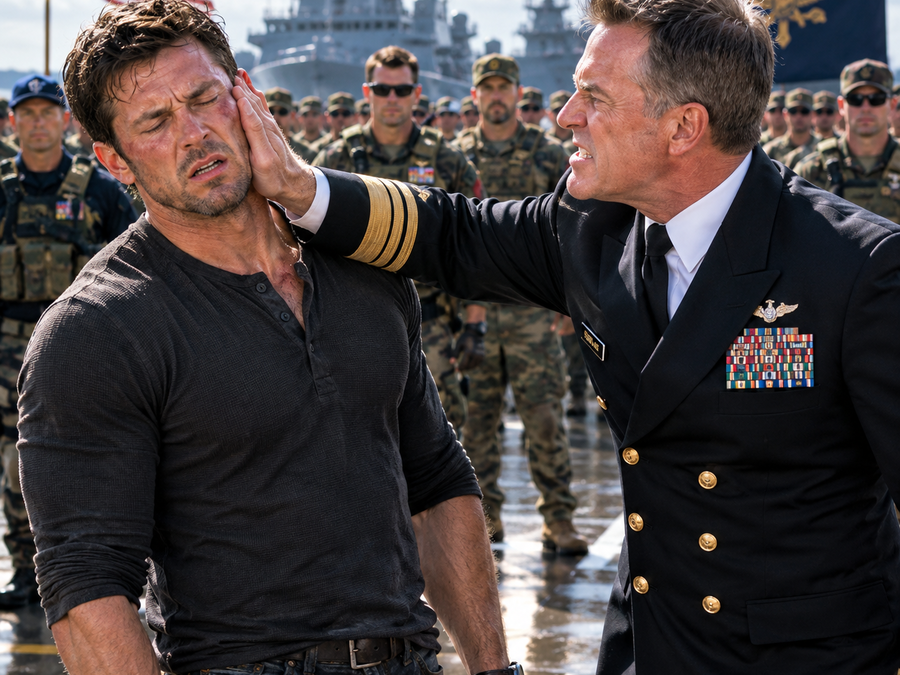
SEAL Admiral Slapped a Single Dad Before 10,000 Soldiers — Unaware He Was a Legendary Navy SEAL (Part 2)
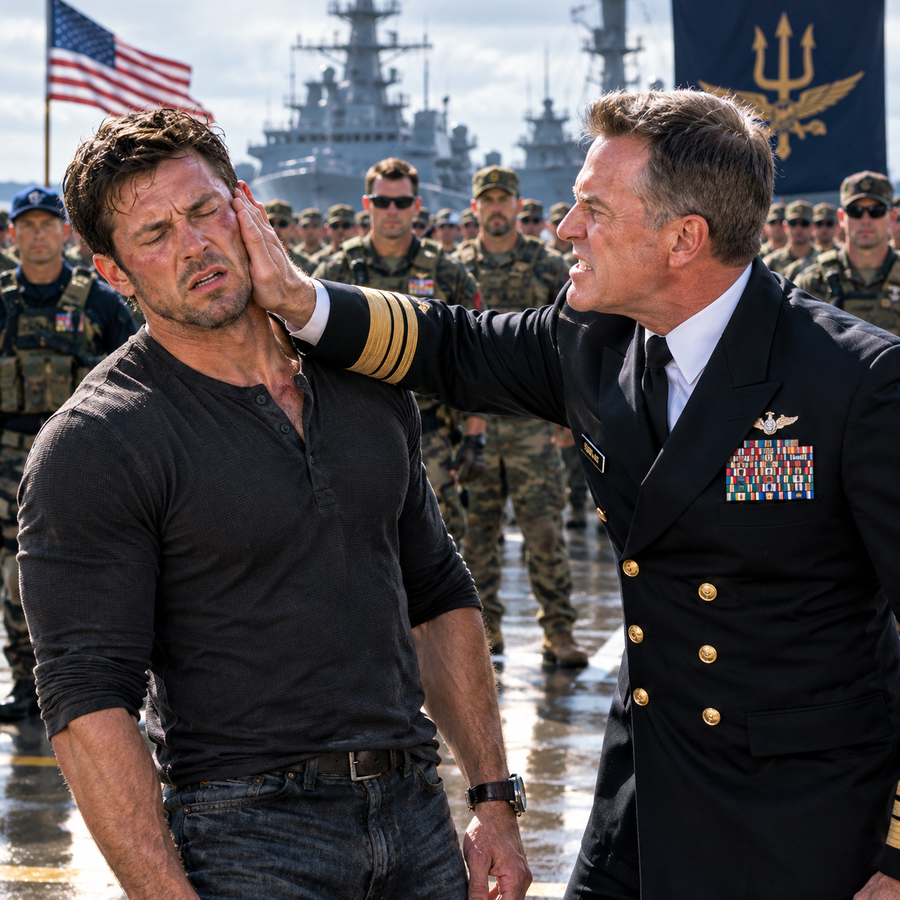
PART 2
The room was completely silent. Adrien Brooks put the paper down on the table with a hand that was not quite steady.
And Grace Holloway, watching through the small window in the door, could not hear the words.
But she saw the moment the strongest man she’d ever encountered put his face in his hands.
And she looked away. Because some things are not meant to be witnessed.
For two years, Adrien had carried the weight of three men he couldn’t save.
And that morning, in a random emergency, in a job he’d taken to be nobody, he had been placed by some impossible arithmetic of fate exactly forty yards from the dying son of one of them.
And he had run. And he had saved him.
And he had taken a slap for it. And none of it—none of it—had been random at all.
When he lifted his head, his eyes were wet, but his voice was steady. And William Cross knew the decision was made before Adrien said a word.
“I’m not running,” Adrien said.
“Not anymore.
I’ve been running from those three men for two years.
And this morning, one of them reached out of that valley and handed me his son and told me to stop.”
He wiped his face with the back of his hand, unashamed.
“Miguel would have done the same for Lily.
I know he would have.
I’m not going to dishonor that by disappearing into another false name.
I’m done, Cross.
I’m done running.”
Cross nodded slowly.
And something that might have been pride or grief or both moved across the old man’s face.
“Then we do it the hard way,” he said.
“The honest way.
And I’ll be standing next to you the whole time.”
He stood.
“But there is one piece of business left before any of that.
And it’s the reason I’m going to enjoy the next twenty minutes more than I’ve enjoyed anything in a long while.”
His expression hardened into something that made even Adrien glad it wasn’t pointed at him.
“Richard Vaughn is waiting in his quarters.
And he spent the last hour trying to build a case that you threatened him.
I’ve read the transcript his aide submitted.
He thinks he’s going to save himself.”
“Let it go,” Adrien said.
“I don’t need his downfall.
I got the only thing I wanted this morning.
That kid’s alive.”
“I know you don’t need it,” Cross said.
“That’s exactly why it has to be me and not you.
You’re going to go pick up your daughter.
And I’m going to go have a conversation with an admiral about the difference between the men who wear the medals and the men who earn them.”
He walked to the door, then stopped and turned back.
“For what it’s worth, Adrien—in fourteen years, you’re the only man I ever ordered into hell who came back out of it a better human being instead of a worse one.
Most of them, it hollows out. You, it filled up. That little girl did that.
Whatever you think you owe those three men in the valley, you’ve been paying it every single day at a two o’clock pickup.”
He paused.
“Go be her father.
I’ve got the rest.”
Adrien stood. And for a moment the two men faced each other.
And then Adrien did something he had not done in two years. Something that came from a place older than his grief, older than his running.
Straight from the marrow of the man he’d tried to bury.
He came to attention. And he saluted William Cross.
Cleanly. And without a word.
And the coldest man in the United States military—the man who felt nothing—returned it. With a hand that trembled just slightly.
And said, “Dismissed, Master Chief.”
Grace Holloway was waiting in the corridor when Adrien came out. And she took one look at his face and knew that whatever had happened in that room had changed something fundamental.
And she didn’t ask.
Because it wasn’t hers to ask.
“It’s 12:19,” she said instead.
“You’ve got a two o’clock.
Willis has the car running.”
“Then let’s not be late,” Adrien said.
But as they turned to go, Cross’s voice came from behind them.
And it was on the phone now. And it had shed every trace of the warmth it had held a moment ago. And it had become the voice of the man who ran the machine.
“Get me Admiral Vaughn’s location,” Cross said into the phone.
“And get me Captain Reyes when he arrives.
And get me the base legal officer. And get me the video. The raw file.
The whole thing.”
A pause.
“No, don’t prep a statement.
Not yet.
There’s a way this gets handled, and it’s not with a press release.
Richard Vaughn is going to answer for what he did in front of the same audience that watched him do it. Ten thousand people saw him slap that man.
Ten thousand people are going to see what happens next.”
Another pause. And when Cross spoke again, there was something almost gentle underneath the steel. Something that made Holloway understand why men had followed this cold old man into places no sane person would go.
“Because the country needs to see it, Captain.
Not for revenge. For the record.
They need to see what we do to the men who forget that the uniform is supposed to protect the people who can’t protect themselves.
They need to see that we still know the difference.”
The line went quiet.
“Set it up.
Same parade ground.
And find that airman’s mother.
I want Danny Reyes’s mother on a plane tonight.
Whatever this becomes, that woman is going to be standing in the front row when it happens.”
👉👈
Part 6
And in his quarters across the base, alone, Admiral Richard Vaughn sat with the video still playing on a loop on his tablet. Sixteen million views now. The comments a river of contempt.
And he was still, even now, drafting the statement in his head that would explain it all. Still reaching for the tool that had never once failed him in thirty years.
The tool of a man who could talk his way out of anything. He did not yet know that William Cross was in the building.
He did not yet know that the man he’d slapped was the personal charge of the most powerful figure in special operations.
Or that the airman he’d tried to block was the son of a fallen Ranger.
Or that the whole terrible machinery of consequence had already begun to turn, quietly, and without any need for his cooperation. He knew only that his phone had gone silent.
That no one was returning his calls.
That the aides who’d scrambled to obey him two hours ago had stopped answering.
And that somewhere in the building, he commanded, a decision was being made about the rest of his life in a room he had not been invited into. And for the first time in thirty years, Richard Vaughn was the one who did not understand the situation.
The clock in his quarters read 12:31. And down in the parking lot, Corporal Willis pulled the car around, and Adrien Brooks climbed into the back seat next to a rear admiral, and looked at his watch, and let himself think about the only thing that had ever really mattered.
Which was the look on his daughter’s face when she came out of that daycare and found her father waiting early.
The way he always was.
The way he’d promised he’d always be.
He was going to make his two o’clock.
Everything else could wait. The car reached the daycare at 12:52. And Adrien Brooks was early.
The way he had promised himself he would always be.
And he did not go inside, because it wasn’t pickup time yet.
And Lily’s routine was sacred to him in a way that even this impossible morning could not touch.
He sat in the car with Grace Holloway, and through the window he could see the playground where his daughter would come out at two. And he could see now, now that he knew to look for them, the men William Cross had promised him.
A groundskeeper who moved a little too deliberately.
A woman on a bench with a book she wasn’t reading.
A maintenance van parked with a view of both entrances. Cross had not exaggerated.
The daycare was sealed. Gently.
Invisibly. And no reporter or curious stranger was getting anywhere near the children inside. And knowing that let Adrien breathe.
“You could go in early,” Holloway said gently.
“I’m sure they’d understand, given the day.”
“No,” Adrien said.
“If I go in early, she’ll know something’s wrong.
Kids know.
She’s never seen me at the door before, too.
Not once.
And the first time she does, she’ll understand that today isn’t a normal day.
And I want her to have one more normal day before all of this reaches her.”
He watched the playground.
“There will be plenty of days that aren’t normal now.
Let her have this one.”
Holloway looked at him for a long moment.
“You keep doing that,” she said.
“You keep making every single decision around what’s best for her.
Even now. Even with the whole country watching a video of you.
Even with an admiral’s career burning down across the base.
Every choice you make runs through that little girl first.”
“That’s the job,” Adrien said simply.
“The only one that ever mattered.”
Across the base at 12:58, William Cross walked into Admiral Richard Vaughn’s quarters without knocking.
And the two most powerful men on the installation looked at each other for the first time. Vaughn stood up fast when he recognized who it was. And something in his stomach dropped.
Because he had spent thirty years reading rooms and reading faces. And he had never in his life seen an expression like the one William Cross was wearing. It was not anger.
Anger, Vaughn could have worked with. Anger was hot. And hot things burned out.
This was something colder and older and far more final.
And Vaughn’s practiced instincts—the ones that had carried him up the ladder for three decades—screamed at him that he was in genuine danger for the first time in his career.
“Admiral Cross,” Vaughn said, and he tried to make his voice steady, and it almost worked.
“I wasn’t told you were on the base.
If I’d known you were coming, I would have—” “Sit down, Richard.”
“Admiral, I think there’s been a serious misunderstanding about this morning’s—” “Sit down.”
And Richard Vaughn, a flag officer with thirty years of authority, sat down like a scolded lieutenant. Because the voice that had given the order was not a voice that permitted any other response.
And both men understood in that instant exactly how the rest of the conversation was going to go. Cross did not sit. He stood over the desk, and he let the silence stretch until it was unbearable.
Until Vaughn’s hands had begun to move restlessly on the surface in front of him.
And only then did he speak.
“I’ve read your statement,” Cross said.
“The one your aide submitted.
The one where you claimed the civilian threatened you in the interview room.
And that this threat justifies the charges.”
He paused.
“It’s a good piece of work, Richard.
Really. Thirty years of learning how to build a paper trail, and it shows.
There’s just one problem with it.”
He leaned down, both hands flat on the desk, and brought his face level with Vaughn’s.
“The man you’re accusing of threatening you is a man I have personally protected for two years.
Under an identity I built myself. Which means every word in that statement is now part of an official record concerning a classified protected asset.
Which means, Richard, that you have just put your name on a document that is about to be reviewed by people who make me look warm. And they are going to ask themselves a very simple question.
They are going to ask whether Admiral Richard Vaughn is a man who made an honest mistake and owned it.
Or a man who slapped a decorated veteran on camera and then tried to manufacture a case against him to save his own career.”
Cross straightened.
“Which man are you, Richard?
Because right now, on paper, you’re the second one.
And the second one doesn’t just lose his command.
The second one loses everything.”
Vaughn had gone very pale.
“I didn’t know who he was,” he said.
And it came out smaller than he intended.
“How could I have known?
He was in coveralls. He walked across the formation.
Any officer would have—” “Stop.”
Cross’s voice cut him off like a blade.
“Stop saying ‘any officer would have.’
I have spent forty years in this Navy, and I have commanded the finest men this country ever produced.
And not one of them—not a single one—would have slapped a man across the face for delivering a medical kit to a dying kid.”
He leaned in.
“You keep saying it because you need it to be true.
You need to believe that what you did was normal. That anyone in your position would have done the same.
Because if that’s not true, then the truth is something you can’t live with.
Which is that you did it because he embarrassed you.
You did it because ten thousand people were watching and one man in coveralls made you feel small and you couldn’t stand it.”
Cross’s voice dropped.
“That’s the whole story, Richard.
Strip away the protocol and the security and the paperwork, and that’s all that’s left.
A powerful man who hit someone weaker because his ego couldn’t take the alternative.
And there’s a video of it.
And sixteen million people have already decided who you are.”
The number landed on Vaughn like a physical blow.
“Sixteen—” “Twenty now.
It was sixteen an hour ago.”
Cross pulled out a chair finally and sat across from the broken man. And when he spoke again, his voice had changed. Had become something almost weary.
“I’m going to tell you something, Richard.
And I want you to actually hear it.
Because it’s the last piece of honest counsel you’re going to get from anyone in this Navy.
The man you slapped this morning has more medals in a box in his closet than you have on your chest.
He earned every one of them in places that don’t have names, doing things that will never be written down.
And you know what he did with them?”
Cross paused.
“Nothing.
He put them in a box, and he took a job driving a supply cart so he could raise his daughter. And he never told a single soul who he was. And he would have gone to his grave a nobody and been perfectly happy about it.
Because that man learned something you never did. He learned that the uniform was never about him.
It was about the people it protects.”
Cross leaned forward.
“You wore it for thirty years, and you never learned that.
And this morning, it finally caught up with you. In front of ten thousand witnesses.
And there’s no statement in the world that fixes it.”
At 1:14, there was a knock at the door. And Captain Reyes stepped in.
And behind him came the base legal officer. And Vaughn understood that the machinery had assembled itself around him while he sat there. And that it was no longer a conversation, but a proceeding.
“Admiral Vaughn,” the legal officer said, and his discomfort was plain on his face.
“Sir, I’ve been directed to inform you that you are being relieved of command, effective immediately, pending a formal investigation into the events of this morning.
You’re to surrender your authority to Rear Admiral Holloway and confine yourself to quarters until the investigating officer arrives.”
He swallowed.
“I’m sorry, sir.”
And there it was. Spoken aloud.
The sentence that ended thirty years. And Richard Vaughn heard it and felt the floor of his life give way beneath him.
And the terrible thing—the thing that made even Cross look away—was that his first instinct, even now, even in the wreckage, was to fight it.
“On what grounds?”
Vaughn said, rising.
“A single altercation?
I have thirty years of unblemished service. I have commanded three installations.
I have—” “You struck a subordinate,” the legal officer said quietly.
“On camera.
It’s not complicated, sir.
It’s the least complicated thing I’ve ever had to process.”
“He’s not a subordinate.
He’s a civilian who—” “He’s a decorated veteran,” Cross said.
And his voice was final.
“And even if he’d been nothing but a civilian logistics employee with no history at all—even if he’d been exactly the nobody you took him for, Richard—you would still be finished.
Because that’s the part you still don’t understand.
It was never about who he turned out to be.
You didn’t do anything wrong because he was secretly a legend.
You did something wrong because you hit a man who was helping someone.
The legend just means the whole country found out.”
He stood.
“If he’d been nobody, you’d have gotten away with it.
That’s the ugliest truth in this room, and you should sit with it.
The only reason you’re facing consequences is that the man you picked happened to have friends in places you can’t reach.
There are a hundred Richard Vaughns in this military who slapped a nobody and never paid for it.
You just picked the wrong nobody.”
And that sentence—more than the relief of command, more than the twenty million views—seemed finally to break something in Vaughn. Because it forced him to see himself clearly for the first time. Not as a man undone by bad luck.
But as a man who had always been capable of this. Who had simply never before been caught. He sat back down.
He didn’t argue anymore.
The legal officer laid the paperwork on the desk. And Richard Vaughn, who had commanded ten thousand men that morning, signed away his career with a hand that shook.
And it was 1:23 in the afternoon. And it was over.
But Cross wasn’t finished.
“There’s one more thing,” he said.
And he nodded to Captain Reyes, who stepped forward.
“This afternoon at 1600, there’s going to be a formation on the same parade ground where this happened.
The same ten thousand personnel, to the extent we can reassemble them.
And you’re going to be there, Richard.”
Vaughn looked up, confused and afraid.
“Why?”
“Because ten thousand people watched you slap that man,” Cross said.
“And ten thousand people are going to watch what comes after.
Not a punishment. Not a spectacle.
I’m not interested in humiliating you, whatever you may think.
I’m interested in the record.
Those young sailors and Marines out there watched a flag officer strike a good man this morning.
And if that’s the last thing they see, then the lesson they learn is that power does what it wants.
So I’m going to give them a different last thing to see.
I’m going to give them the truth about the man you slapped.
As much of it as I’m allowed to give.
And I’m going to let them draw their own conclusions about the difference between the two of you.”
He paused.
“And you’re going to stand there and let them see it.
It’s the last order you’ll take in this Navy.
And it’s the only decent thing left available to you.
Take it.”
👉👈
Part 7
At 1:47, across the base, Adrien Brooks got out of the car outside the daycare because it was almost two, and it was time, and no power on earth was going to keep him from that door.
Grace Holloway walked with him, and her phone had been buzzing steadily for the last twenty minutes, and she’d been reading the messages, and she knew what was being assembled on the parade ground.
And she knew that Cross intended for Adrien to be part of it. And she dreaded having to tell him.
Because she’d spent three hours now learning exactly how much this man wanted to be left alone.
“Mr.Brooks,” she said carefully as they walked.
“There’s going to be a formation at four.
Admiral Cross has arranged it. The same ground.
The same personnel.”
She hesitated.
“He wants you there.”
Adrien stopped walking.
“No.”
“He wants to set the record straight.
To show them who you are.
Or as much as he’s allowed to show.
He thinks the base needs to see it.”
“No,” Adrien said again.
And there was something almost pleading in it now. The first crack in his composure all day that had nothing to do with his daughter.
“Admiral, I didn’t do any of this to be seen.
That’s the whole point.
That’s the entire reason I’ve been driving a cart for two years.
I don’t want a formation.
I don’t want ten thousand people looking at me.
I’ve spent every day of the last two years making sure nobody ever looked at me.
And I did it on purpose.
And I’m not going to stand up on that ground and let them turn me into the thing I ran away from being.”
His voice was tight.
“The kid’s alive.
That’s all I wanted.
Let me pick up my daughter and go home and be nobody again, please.”
And Grace Holloway, who had delivered hard news to sailors for thirty-one years, found she had nothing to say. Because he was right. And because Cross was also right.
And because sometimes two right things collide, and someone has to lose. That was when the daycare door opened.
At 1:58. Two minutes early.
And a teacher came out.
And behind her, holding the teacher’s hand, was a small girl with a stuffed rabbit tucked under one arm.
And she saw the car. And she saw the man standing beside it. And her whole face transformed.
“Daddy!”
Lily Brooks let go of the teacher’s hand and ran across the pavement as fast as her legs would carry her.
And Adrien Brooks—the ghost, the legend, the man twenty million strangers were watching on their phones—dropped to his knees on the concrete and opened his arms and caught his daughter as she threw herself into them. And for the space of that one embrace, nothing else in the world existed. Not the slap.
Not the video. Not the admiral. Not the formation.
Not the past, reaching up out of its grave to drag him back.
Just a little girl’s arms around his neck and her voice in his ear.
“Daddy, you’re here early.
You’re never early.”
And Adrien held her and closed his eyes. And Grace Holloway had to turn away.
“I finished my work a little early today, baby,” he said into her hair.
“So I could come see you.”
“Did you deliver your boxes?”
“I delivered my boxes.”
“Were you a hero?”
And Adrien pulled back and looked at his daughter’s face.
At the absolute, uncomplicated faith in it. At the seven-year-old certainty that her father was the best man in the world.
And he felt the whole impossible morning press down on him at once. The three men in the valley.
And the son he’d saved.
And the choice Cross had laid in front of him. And he made his decision. Right there on the pavement.
Holding his little girl.
“You know what, Lily?”
he said.
“I think somebody needed help today.
And I was able to give it to them.
And that’s about the best thing a person can do.”
“See,” she beamed at him.
“I told you you were a hero anyway.”
Grace Holloway’s phone buzzed again.
It was Cross. She stepped away to answer it, and she kept her voice low, and she watched the father and daughter on the pavement while she talked.
“He doesn’t want to do the formation,” she said quietly.
“Admiral, with respect, I don’t think you should make him.
I’ve spent three hours with this man.
He didn’t run into that emergency for recognition.
Everything he’s done today, he’s done to protect that little girl and to save that airman.
And if you put him up in front of ten thousand people, you’re taking the one thing away from him that he actually asked for.
Which is to be left alone.”
She paused, listening.
“Yes, I understand the base needs to see it.
But sir, there’s more than one way to let them see it.
He doesn’t have to be there for the truth to be told.
You could tell them who he is without making him stand there and be turned into a monument. Let the man go home to his kid.
Hasn’t he earned that much?”
There was a long silence on the line. And then, at 2:04, something happened that Grace Holloway did not expect and that she would remember for the rest of her career.
Because a car had pulled up to the curb, quietly. And a woman got out of it. A woman in her forties with tired eyes and a face marked by a long flight taken on no notice.
And she stood at the edge of the daycare lot and looked at the man kneeling on the pavement with the little girl in his arms. And her hand came up to cover her mouth.
It was Danny Reyes’s mother.
Cross had put her on a plane, as he’d said he would.
And she had landed an hour ago.
And she had asked to be brought not to her son’s hospital room—though she would go there next—but here.
To this place. Because there was something she needed to do first. Something that could not wait.
And Grace Holloway watched Miguel Reyes’s widow walk slowly across the daycare parking lot toward the man who had saved her son that morning.
And fourteen years ago had tried and failed to save her husband. Adrien saw her coming. He sat Lily down gently.
And stood. And something in his face told Holloway that he knew who she was.
That Cross had shown him the paper. That he understood exactly what was walking toward him.
“Mr.Brooks,” the woman said, and her voice was shaking.
“Are you the man who saved my Danny this morning?”
Adrien’s throat worked.
“Ma’am,” he said, “I just delivered a kit.”
“That’s not what they told me.”
She was crying now. Openly.
The way a mother cries when her child has been given back to her.
“They told me you ran across a field of ten thousand people.
They told me an admiral hit you, and you saved my boy anyway.”
She stopped a few feet from him. And she was searching his face.
And Adrien saw the moment she found what she was looking for in it. The moment the recognition crossed her features.
Because she had seen that face before. In old photographs. Standing next to her husband.
In a valley on the other side of the world.
“I know you,” she whispered.
“Miguel had a picture.
The whole team.
You’re the one they never named.
You’re the one who tried to bring him home.”
Her voice broke completely.
“He wrote me about you.
He said, ‘If anything ever happened, there was a man on that team who would never stop trying to reach him.’
He said that man was the reason he wasn’t afraid.”
She was sobbing now.
“And this morning, that same man saved our son.
Do you understand what you did?
Do you understand what you gave back to me?”
And Adrien Brooks—who had held his composure through a slap and cuffs and threats and the resurrection of everything he’d buried—finally lost it.
Right there on the daycare pavement.
In front of his daughter and a rear admiral and a groundskeeper who wasn’t really a groundskeeper.
Because some weights are too heavy for even the strongest man to carry alone.
And Danny Reyes’s mother crossed the last few feet and put her arms around him.
And the two of them stood there and wept.
For a man they’d both loved and lost in a valley fourteen years ago.
And for the boy who was still alive because of what had happened that morning.
Lily watched, confused, and tugged at her father’s sleeve.
“Daddy, why is everybody crying?”
Adrien knelt back down to her, wiping his face. And he pulled his daughter close. And he looked over her shoulder at the woman.
And then at Grace Holloway, who was still holding the phone with William Cross on the other end of the line. Listening to all of it.
“Because sometimes, Adrienne said to his daughter, his voice thick, “people are so happy and so sad at the same time that it comes out the same way.”
He held her tight.
“This is Mrs.Reyes’s baby.
Her son got sick today, and I got to help him.
And she came all this way just to say thank you.”
Lily looked up at the crying woman with grave seven-year-old sympathy.
“Is your son okay now?”
“Yes, sweetheart,” Mrs.Reyes said, wiping her eyes, kneeling down, too.
“He’s okay now.
Because of your daddy.”
And Lily nodded, satisfied. As though this confirmed everything she had always known.
“My daddy helps people,” she said.
“That’s his job.”
On the phone, Grace Holloway heard William Cross let out a long breath. And when he spoke, the coldest man in the United States military sounded like something had finally reached all the way through to the bottom of him.
“Grace,” he said quietly.
“Call off the formation.”
Holloway blinked.
“Sir?”
“Call it off.
You’re right.
And more than that—she’s right.
That mother. Look at what she just did.
She flew across the country not to see her son first, but to thank the man who saved him. And she did it in a parking lot with no cameras and no audience and no formation.
And it was the most honest thing anyone’s done on that base all day.”
His voice was rough.
“I was going to put that man up in front of ten thousand people to make a point about honor.
And I never once asked whether he wanted it. I was going to do to him exactly what Vaughn did, in my own way. Turn him into a thing.
A symbol for other people’s benefit.”
He paused.
“No.
Let him go home. Let him be her father.
The base doesn’t need a formation to learn the lesson.
The story is already out there. All twenty million views of it.
And it’s teaching the lesson better than any ceremony I could stage.”
Holloway felt her throat tighten.
“What about Vaughn, sir?
You had him ready to stand there and face it.”
“Vaughn faces the investigation,” Cross said.
“That’s real accountability.
Not theater.
But I’m done using that good man as a prop.
Even to punish a bad one.”
A pause.
“Tell Adrien something for me, Grace.
Tell him the choice we talked about—road one and road two.
Tell him there’s a third road I didn’t offer him.
And it’s the one he’s already walking.
He doesn’t have to disappear.
And he doesn’t have to become a public hero.
He can just go home and be Lily’s father.
And my office will handle the video. Let it fade. Protect the identity.
Keep the reporters away. And in six months, the Coverall Hero will be an internet mystery nobody can crack.
And Adrien Brooks, the logistics employee, will still be picking up his daughter at two o’clock.”
His voice softened.
“Tell him he already made the right choice this morning when he ran across that field.
Everything since then has just been the world catching up to what he already knew.
He can go home now.”
It was 2:21 in the afternoon.
And Grace Holloway lowered the phone and looked at the man kneeling on the pavement between his daughter and the widow of the friend he couldn’t save.
And she understood that she was watching the resolution of something that had begun long before this morning. Long before the slap.
In a valley she’d never see.
And that the truest justice in the whole story was not going to happen on a parade ground in front of ten thousand people. It was going to happen right here.
Quietly. In a daycare parking lot. Where a man who had spent two years running from his own heroism finally stood still long enough to let it catch up with him.
And found that it did not drag him back into the dark after all. It set him free.
👉👈
Part 8
They drove Adrien and Lily home that afternoon. And for the first time all day, the man in the back seat let himself believe it was over.
That the past had reached up out of its grave and touched him, and then mercifully let him go again. He was wrong about that. But only in the way that all people are wrong when they think a single day has settled a lifetime.
Because the story did not end in that daycare parking lot. It had only reached the end of its loudest chapter. And in the weeks and months that followed, Adrien Brooks would learn that some things, once they climb out of the ground, do not go all the way back in.
And that this is not always the tragedy a man fears it will be. Sometimes it is the beginning of something he never knew he needed. That first night, after Lily was asleep with her one-eyed rabbit tucked under her arm, Adrien sat alone at his kitchen table with a cup of coffee going cold in front of him.
And he watched the number climb on his phone. Thirty million now. He read the comments the way a man probes a wound.
Carefully. Half flinching.
And what he found there was not what he’d feared.
He’d been afraid of exposure.
Of scrutiny. Of the machine of public attention grinding his quiet life to powder.
But that was not what thirty million strangers had done with the video of a man in coveralls running across a field. They had not torn him apart. They had fallen in love with him.
Fathers were writing about their own kids.
Veterans were writing about the guys they’d lost.
An entire nation of people who felt unseen in their own quiet lives had looked at a man who wanted nothing but to be left alone, and they had seen themselves in him. And it had broken something open in them that needed breaking. At 11:40 that first night, his phone rang.
And it was a number he didn’t recognize.
And against every instinct, he answered it.
And a young man’s voice came through.
Thin and shaky and full of tubes.
“Is this—are you the guy?
The coveralls guy. They gave me your number.
I hope that’s okay.
I made them give it to me.”
“Who is this?”
Adrien said. Though he already knew.
“It’s Danny.
Danny Reyes.
I’m the—you saved me this morning.
I woke up and my mom told me everything, and I just—” The kid’s voice cracked.
“I had to say thank you.
Nobody’s ever—I mean, you ran across ten thousand people, and an admiral hit you, and you kept coming for me.
You didn’t even know me.”
Adrien closed his eyes.
“How are you feeling, son?”
“Better.
They say I’ll be out in a couple days.”
A pause.
“Sir, my mom told me you knew my dad.
She told me you were on the team with him.
In Afghanistan.”
The kid’s breathing was ragged.
“I never got to know him.
I was five.
I don’t remember him at all.
I’ve just got pictures and the stuff Mom tells me.
And she said—she said you were the one who tried to bring him home.
Is that true?”
And Adrien Brooks sat in his dark kitchen and made a decision that he would never regret.
Which was to tell a fatherless nineteen-year-old the truth about the man he’d lost.
“Your father,” Adrien said, “was one of the bravest men I ever served with.
And I want you to hear the whole thing, Danny. Not the sad part.
The true part. When it went wrong in that valley, when we were pinned down and the odds were bad, your dad was calm.
He was the calmest man there. And you know what he was doing?
He was passing water to the wounded. He was keeping the young guys steady.
He was making jokes. Terrible jokes.
To keep everyone’s heads on straight.
That’s who your father was in the worst moment of his life.
He spent it taking care of the men around him.”
Adrien’s voice was steady and warm.
“I couldn’t reach him.
I want you to know that I tried. I tried until there was nothing left to try.
And it’s the great grief of my life that I couldn’t carry him out with the others.
But Danny, listen to me. Your father did not die afraid.
He died taking care of his men.
And this morning, when I ran across that field, I didn’t know it was you.
But I think somewhere, your dad did.
I think he’s been waiting fourteen years to put me exactly where I needed to be to pay back what I owed him.
And I’m glad it was you, son.
I’m so glad it was you.”
There was silence on the line. And then the sound of a young man crying.
The way you cry when someone finally gives you the father-shaped thing you’ve been missing your whole life.
And Adrien stayed on the phone with him until it passed. Until Danny could breathe again. And when they finally hung up, it was past midnight.
And something in both of them had healed that had been broken for a very long time. That was the first night.
There would be many more. In the days that followed, the investigation into Richard Vaughn moved with a speed that surprised everyone except the people who understood how badly the Navy wanted the whole thing behind it. The video had made a public reckoning inevitable, and the facts were not in dispute, because they were on camera.
And there was no version of them that Vaughn’s thirty years of paper-trail expertise could reshape.
He had struck a man delivering medical aid. The man had turned out to be a decorated veteran.
There was nothing left to argue. But the twist that no one saw coming—the thing that even Grace Holloway did not expect—came three weeks into the investigation. When Adrien Brooks did something that changed the entire meaning of the story.
He asked to speak to the investigating officer. And he asked that the charges against Richard Vaughn be reduced. Grace Holloway drove out to his house herself when she heard.
Because she couldn’t believe it.
And she sat at his kitchen table and looked at him like he’d lost his mind.
“Adrien, that man slapped you in front of ten thousand people.
He tried to have you charged. He tried to have you jailed.
He said he’d tell your daughter why her father wasn’t coming home.
And you want to help him?”
“I don’t want to help him,” Adrien said.
“I want to be finished with him.
There’s a difference.”
He sat down his coffee.
“Grace, I’ve watched what happens to men who get destroyed.
I’ve seen it up close more times than I can count.
And I’ve watched what happens to the men who do the destroying.
Even when the destroying is deserved, it gets into you. It changes you. Vengeance is a fire that keeps you warm for exactly one night.
And then it burns your whole house down.”
He looked at her.
“I’ve got a daughter to raise.
I don’t have room in me to carry hate for Richard Vaughn for the rest of my life.
He’s going to lose his command, and he should.
He’s going to face a real reckoning, and he should.
But I’m not going to ask for the maximum, because the maximum isn’t justice.
It’s just revenge wearing a nicer suit.
And I made a decision a long time ago about the kind of man I was going to be.”
He paused.
“Besides, there’s something you don’t know yet.
Something I found out.”
Holloway went still.
“What?”
And Adrien told her the thing that even Cross’s people had missed.
The thing he’d learned by making a phone call of his own.
One man to another.
Because he’d needed to understand the enemy who’d slapped him before he could decide what to do about him.
“Richard Vaughn has a daughter, too,” Adrien said.
“In the daycare.
Same as Lily. Six years old.
Her name’s Emma.”
He turned his cup slowly on the table.
“And her mother died last year.
Cancer. Which means Richard Vaughn is a single father, same as me. Raising a little girl alone, same as me.
And the day he slapped me—the day he lost his mind on that parade ground—was the one-year anniversary of his wife’s death.”
Adrien looked up. And there was no triumph in his face. Only a terrible, weary compassion.
“I’m not excusing what he did.
There’s no excuse.
But I understand it a little better now.
A man who’s drowning will grab anything.
And sometimes what he grabs is his own worst self. I looked at him on that field and I saw a monster.
But he’s not a monster, Grace.
He’s just a broken man who was having the worst day of his year and he took it out on the wrong person.
And now the whole world knows him as the villain in a video.”
Adrien shook his head.
“I know what it is to be defined by the worst thing you ever did.
I spent two years running from three men I couldn’t save.
I’m not going to do to Vaughn what I couldn’t stop doing to myself.”
Grace Holloway sat in that kitchen for a long time and said nothing. Because there was nothing to say.
Because she was in the presence of a kind of largeness of soul that she encountered maybe once in a career. And she understood at last why William Cross had crossed four states to protect this man. And why nineteen operators had broken formation at the mere sound of his name.
It was not because Adrien Brooks was the deadliest man any of them had ever known. Though he was. It was because he was the best of them.
The charges were reduced at Adrien’s request.
And it made the story even bigger than it already was. Because the country had been waiting to watch the villain get destroyed. And instead, they watched the hero ask for mercy on his behalf.
And something about that turned a viral video into something closer to a parable. Richard Vaughn was relieved of command permanently and quietly retired, his career over, his name forever attached to that video. But he was not sent to prison.
And he was not stripped of everything. And he got to keep enough to go home and raise his little girl.
And that, Adrien would say later, was the only outcome he’d actually cared about.
Because whatever Vaughn had done, Emma hadn’t done any of it.
And Emma needed her father the same way Lily needed hers.
Two months after the slap, on a gray Tuesday afternoon, there was a knock at Adrien’s door.
And when he opened it, Richard Vaughn was standing on his porch. The two men looked at each other for a long moment across the threshold.
And it was the first time they’d been face to face since the interview room.
And everything was different now. Because one of them had lost his whole world.
And the other had refused to take the last of it.
“I didn’t come to explain myself,” Vaughn said finally.
His voice was different. Smaller. The command was gone out of it.
And what was left was just a man.
“There’s no explaining it.
I came because they told me what you did. That you asked them to go easy on me.
And I’ve been sitting with that for three weeks, and I couldn’t understand it.
And I couldn’t live with not understanding it.
So I drove out here to ask you to your face.”
His jaw worked.
“Why?
After everything I did.
Why would you do that?”
Adrien looked at him for a long moment. And then he stepped back from the door.
“You want a cup of coffee, Richard?”
he said.
“Lily’s at a friend’s house for another hour.
Emma’s welcome, too, if she’s in the car.
Kids should know each other.”
And Richard Vaughn—who had commanded ten thousand men, who had spent thirty years never backing down—stood on a stranger’s porch and put his face in his hands and wept.
Because he had come expecting anything but kindness. And kindness was the one thing his thirty years of authority had never taught him how to withstand. They had that cup of coffee.
And another one a few weeks later. And slowly, in a way that no one who had watched the video could ever have predicted, two single fathers raising daughters alone became something like friends.
Not close. Not easy. But real.
Bound together by the worst day of both their lives, and by the strange grace that had come out of it. Emma and Lily became inseparable. And Richard Vaughn, stripped of his command and his medals and his authority, learned in his sixties the lesson that Adrien had learned in a valley in Afghanistan.
Which was that a man’s worth was never in what he commanded.
But in what he was willing to give. William Cross came to see Adrien one last time, six months after the slap, on a quiet evening in the fall. He sat in the same kitchen, and he watched Adrien help Lily with her homework at the other end of the table.
And when she’d finished and run off to play, the old man finally said what he’d driven all that way to say.
“The video’s dead,” Cross said.
“Faded out, just like I told you it would.
The Coverall Hero is an unsolved internet mystery.
Nobody’s ever going to connect Adrien Brooks, the logistics employee, to that man on the parade ground.
The identity held.
You’re safe.
You and Lily both.
All the way down.”
He paused.
“You got what you asked for.
The quiet life, back in one piece.
You can go back to being nobody, if that’s still what you want.”
Adrien was quiet for a moment.
“It’s not,” he said.
Cross looked at him sharply.
“It’s not what I want anymore,” Adrien said.
“That’s the thing I figured out these last six months.
I spent two years being nobody because I thought that was the only way to protect her.
I thought if I stayed small enough, quiet enough, invisible enough, then the past couldn’t reach us.
But the past reached us anyway, Cross. It reached across ten thousand people and a whole ocean and fourteen years.
And it put Miguel Reyes’s son forty yards in front of me on the worst morning of some admiral’s life.”
He shook his head slowly.
“And it turned out the past wasn’t coming to drag me back into the dark.
It was coming to set me free. All that running.
All that hiding. All that being nobody.
It wasn’t protecting Lily.
It was teaching her that her father was afraid.
And I don’t want to teach her that anymore.”
Cross studied him.
“So what do you want?”
And Adrien told him.
He didn’t want to go back to the teams.
That life was over, and it needed to be over, and he had no intention of leaving his daughter to chase missions in the dark ever again.
But he’d been thinking these six months.
About all the young men and women coming back the way he’d come back.
Hollowed out.
Carrying weights they couldn’t put down.
Running from things that chased them in their sleep.
He’d been thinking about Danny Reyes.
And about the nineteen men in the valley.
And about every operator he’d ever known who’d made it home in body but not in soul.
And he wanted to build something for them. A place.
A program.
Somewhere the ghosts could come and learn what he’d learned.
Which was that you don’t get past the worst thing you ever did by running from it, or hiding from it, or burying it in a box in your closet.
You get past it by finding something worth living for on the other side of it.
And then living for that thing with everything you’ve got.
“I found mine,” Adrien said, glancing toward the room where his daughter was playing.
“I want to help them find theirs.
Whatever it is. A kid. A wife.
A farm. A workshop.
A reason. I want to stand in the door. Those guys are all standing in the door between who they were and who they could be.
And I want to help them walk through it.”
He looked at Cross.
“You said two years ago that I’d come back.
That men like us always come back.
We just don’t know our way home yet.
You were right.
But I didn’t come back to the war, Cross.
I came back to the ones the war left behind.
That’s the mission now.
That’s the last one.”
And William Cross—the coldest man in the United States military, the man who felt nothing—looked across the table at the operator he’d protected for two years, and his eyes were wet, and he did not try to hide it.
“I’ll fund it,” he said.
“Whatever you need.
Every dollar. Every door. Every string I can pull.
This is the best thing anyone’s ever brought me, Adrien.
And I’ve been doing this for forty years.”
He stood, and he extended his hand, and Adrien took it.
“You know what the difference is between you and every other man I ever put in the field?
I finally figured it out six months ago, watching a video with thirty million other people.”
He held Adrien’s hand and his gaze.
“Every one of them, I taught how to run toward danger.
But you’re the only one who ever learned how to run toward people.
That’s the thing that can’t be trained.
That’s the thing that made you a legend.
And it was never the missions.
It was always that.”
He left that night. And the program was built. And in the years that followed, it saved more men than Adrien ever saved in the valley.
Quietly. Without cameras. Without formations.
One broken operator at a time. Danny Reyes grew up and joined it as a counselor, and stood in that same doorway for the next generation, paying forward what a stranger in coveralls had given him on the worst morning of his life.
Richard Vaughn, of all people, volunteered there, too.
Because a man who has lost everything has a particular gift for talking to men who are afraid they’re about to.
And he found in that work a redemption that no reduced sentence could ever have given him. And Lily Brooks grew up.
She grew up knowing, eventually, the whole truth about her father. Because he told her himself when she was old enough.
Told her about the valley, and the three men, and the box of medals in the closet he never looked at. And the morning he ran across a field of ten thousand people to save a dying boy.
And she was not afraid of it, the way he’d once feared she would be.
She was proud. But she was proudest—she told him on the day she graduated, standing in her cap and gown with her father in the front row—not of the legend. Not of the medals.
Not of the Coverall Hero the internet had once loved and forgotten. She was proudest of the notes.
Two thousand of them by then. One for every single school day of her life.
“Be brave.
Be kind.
Dad loves you more than the whole sky.”
She’d kept every one in a box of her own.
And she told him at her graduation that when she’d been small and hadn’t understood any of the rest of it, those notes had been the thing that told her every single morning exactly who her father was.
Not a warrior. Not a ghost.
Not a legend. Just a man who never once failed to show up for the people who needed him.
Adrien Brooks lived a long life. And a full one.
And when he was an old man, surrounded by the men and women his program had saved, someone finally asked him the question the whole world had wondered about since the day the video went viral.
They asked him whether he’d ever regretted it.
Walking across that parade ground. Taking that slap.
Letting the past find him and pull him out of the quiet life he’d built.
And Adrien smiled. The same small, tired, human smile that Grace Holloway had seen for the first time in an interview room a lifetime ago. And he gave the only answer he ever gave.
“A man spends his whole life thinking his strength is the thing he can do to other people,” he said.
“The missions.
The medals. The things that make you a legend. And then one day you find out that your real strength was never any of that.
It was the sandwiches. It was the notes.
It was showing up at two o’clock every single day for a little girl who was counting on you.”
He looked around at the faces of the people he’d saved.
“The world will tell you that the loud men are the strong ones.
Don’t believe it.
The strongest man I ever knew was the quietest. And he spent his whole life making sure nobody ever noticed him.
And the only thing he ever wanted was to keep one small promise to one small person, over and over, until the day he died.”
He paused.
“Be brave.
Be kind. And show up.
That’s the whole thing.
That’s the only mission that ever mattered.”
And that is exactly what he did. Every single day.
For the rest of his life. A quiet man who carried the greatest story of all, and never once needed anyone to know it. Because a true warrior never has to announce his strength.
His actions speak long before his name is ever known. And they keep speaking long after the name is forgotten. That was Adrien Brooks.
That was the man they slapped. And that was the legend the world found by accident.

