She Brought a Fake Fiancé to Her Ex’s Wedding — Then Shocked Everyone With a Single Dad Kiss (Part 1)
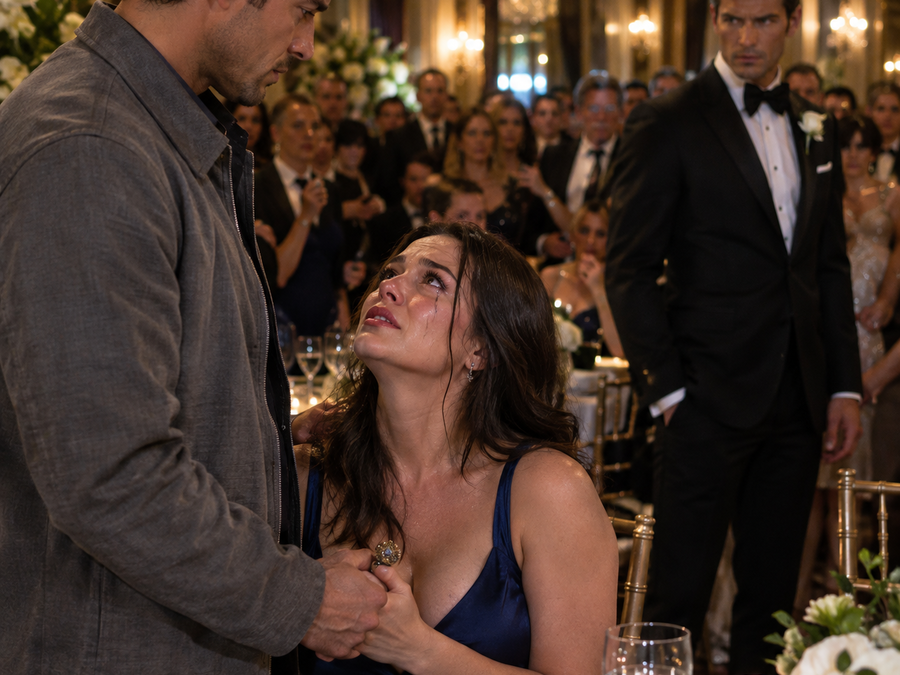
She Brought a Fake Fiancé to Her Ex’s Wedding — Then Shocked Everyone With a Single Dad Kiss (Part 1)
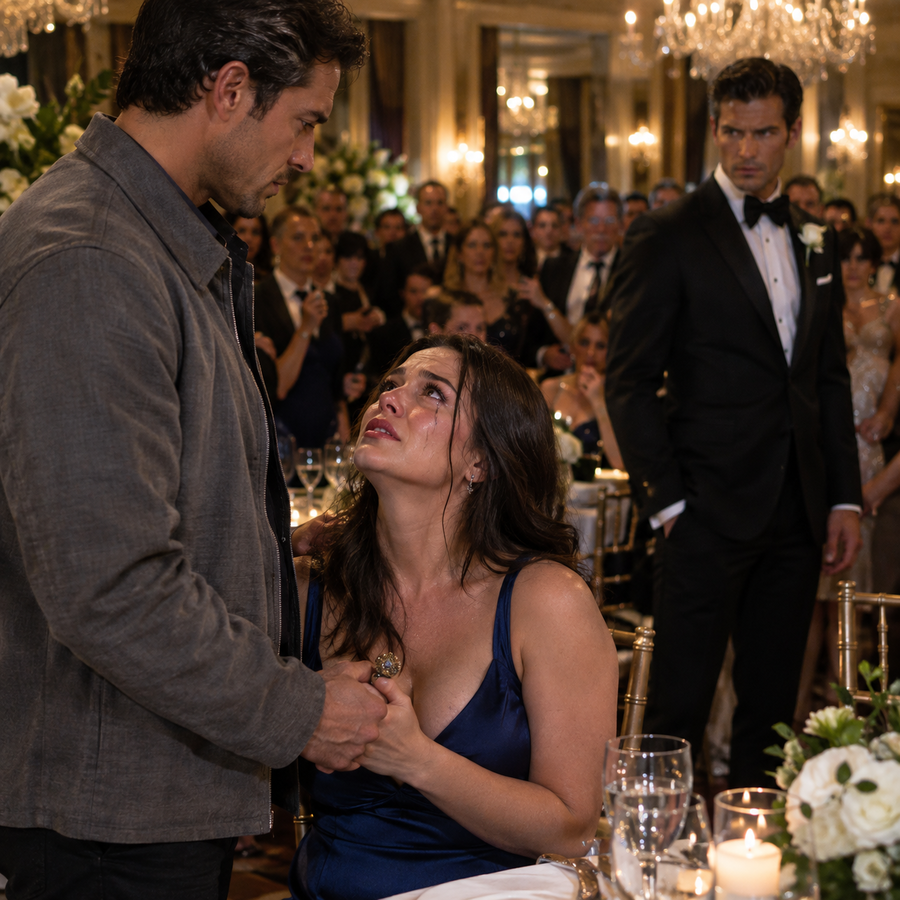
PART 1
Clare Whitmore slammed the gold embossed wedding invitation down on the bakery counter so hard the pastry glass rattled.
“I need you to pretend to be my fiancé,” she said, her voice cracking on the last word.
“Nine days, starting tonight.”
Ryan Parker, flour still on his hands, stared at the woman he’d poured coffee for every evening for a year, and saw the tears she was fighting like her life depended on hiding them.
What he didn’t know yet was that the man she was running from wasn’t only her ex—he was marrying her best friend.
And by midnight of that wedding, one honest kiss would burn their careful little lie to the ground. The rain hit the bakery windows like it had a grudge.
Ryan Parker heard the bell over the door before he saw who it was. It was 8:52 on a Tuesday night, eight minutes to close, and he had already flipped the sign, wiped down the espresso machine, and started counting the register.
He didn’t look up right away.
He figured it was someone ducking out of the storm, someone who’d take one look at the empty display case and leave.
Then he heard the sound of an expensive coat dripping onto his clean floor, and a woman’s voice said, “Ryan.”
He looked up. Clare Whitmore stood just inside the door, and she was not the Clare he knew.
The Clare he knew came in most evenings around six o’clock, ordered a black coffee and whatever pastry he recommended, sat in the corner by the window, and answered emails on a phone she never put down.
The Clare he knew wore her hair pulled back so tight it looked painful and smiled the kind of smile people learn in business school. The Clare he knew was polished, guarded, always in a hurry, always paying with a card and always tipping too much, like she was trying to make up for something. This Clare was soaked to the bone.
Her hair was stuck to her face.
Her makeup had given up somewhere between the parking lot and the door, and she was holding a thick cream-colored envelope in both hands like it was a live coal she couldn’t put down.
“We’re closing,” Ryan said.
And then, because he wasn’t the kind of man who could say that and mean it, he added, “But the coffee is still hot.
Come in.
You’re letting the rain in.”
Clare didn’t move.
“Ryan,” she said again.
“I have to ask you something, and I need you to promise me you won’t laugh.”
He set the register drawer down slow.
“I don’t laugh at people,” he said.
“You know that.”
She crossed the room. Her heels clicked hard against the tile, then went quiet on the mat.
She stopped at the counter, right where she always ordered, but this time she didn’t order anything.
She put the envelope down between them and slid it forward two inches, like she was making a move in chess.
“You know Adrien,” she said.
Ryan nodded slowly.
He knew Adrien the way you know a name you’ve heard too many times.
Clare had never said much, but over a year of six o’clock coffees, a man picks up the shape of a story, even when nobody tells it to him straight.
Adrien was the ex. Adrien was the reason her voice went flat sometimes. Adrien was the ghost that sat across from her in that corner booth, even when the seat was empty.
“He’s getting married,” Clare said.
“I’m sorry,” Ryan said, and he meant it.
“Don’t be sorry yet.”
She laughed, but it came out wrong. More like a breath punched out of her.
“You haven’t heard the good part.
There’s a good part.
He’s marrying Vanessa.”
She said the name like it tasted bad.
“Vanessa Lord.
My best friend.
My maid of honor, if I’d ever gotten that far.
The woman who held my hair back in college.
The woman who was going to be in my wedding.”
Her hands were shaking now, and she pressed them flat against the counter to stop it.
“He’s marrying her in nine days at the Ashford estate, which—do you know how much that place costs?
Of course you don’t.
Why would you?
It costs more than this building, Clare.”
“And I’m invited,” she said, cutting him off.
The words tumbling out faster now, like a dam giving way.
“I got the invitation in the mail with my name in gold letters.
Miss Clare Whitmore and guest. And guest, Ryan.
And guest.
Like it’s a kindness.
Like they sat around a table together, the two of them, and decided, ‘Oh, let’s invite Clare.
Let’s be gracious.
Let’s show everyone how well we’ve all handled this, and won’t it be lovely, and she can bring a friend?’
”
She stopped.
Her chest was heaving.
Ryan didn’t say anything.
He’d learned running a place like this that sometimes the kindest thing you can do for a person is give them a quiet room and not fill it up.
“Everyone will be there,” Clare said quieter now.
“Everyone from the old crowd.
Every person who watched us together for four years. Every person who came to the engagement party—my engagement party—the one that never turned into a wedding.
They’ll all be there, and they’ll all watch me walk in alone in some dress I’ll spend too much money on to prove I’m fine, and they’ll smile at me and hug me and ask how I’m doing, and the whole time they’ll be thinking the same thing.”
She looked up at him.
“You know what they’ll be thinking?
Tell me.”
“They’ll be thinking, ‘Poor Clare.
He traded up.’
” The rain filled the silence for a moment.
“So don’t go,” Ryan said gently.
Clare shook her head and something hard came back into her face.
“You don’t understand.
If I don’t go, that’s worse.
If I don’t go, it means I couldn’t handle it.
It means he won.
It means I’m sitting in my apartment crying while they toast champagne.
And everyone whispers about how I fell apart. No, I have to go.
I have to walk in there with my head up and—” she cleared her throat— “I have to look like the last two years happened to Adrien, not to me.”
She took a breath.
“But I can’t do it alone.
I’ve tried to imagine it a hundred times and I can’t.
I need someone next to me. I need someone real.
I need—” She stopped.
And Ryan watched her gather the last of her courage.
“I need you,” she said, “to pretend to be my fiancé.”
For a second, Ryan was sure he’d heard her wrong.
“Say that again.”
“You heard me.”
“I want to make sure I heard you.”
“I need you to be my fake fiancé for nine days,” Clare said, all in a rush, like ripping off a bandage.
“I need you to come to that wedding on my arm with a ring on my finger and a story we both know by heart.
I need you to hold my hand and smile for the cameras and look at me like—like I’m worth staying for.
I need Adrien and Vanessa and every single person in that room to look at us and think, ‘She’s happy.
She moved on.
She’s fine.
She’s more than fine.’
I need one night where I don’t lose.”
She reached into her coat and pulled out a folded stack of bills held together with a paper clip and set it on the counter next to the invitation.
“I’ll pay you,” she said.
“Five hundred dollars.
I know it’s not—I know your time is worth more.
I know this is insane.
I know I’m asking you to lie to a room full of strangers, but I didn’t know who else to ask, Ryan.
I don’t have anyone else.
And you’re the only person in this entire city who’s ever looked at me like a human being instead of a—instead of a transaction.”
“Stop,” Ryan said.
She stopped. He looked at the money on the counter.
Then he looked at her. Really looked.
The way you look at a photograph you’ve seen a hundred times and suddenly notice something in the background you never saw before.
He’d known this woman for a year.
He knew she took her coffee black. He knew she pretended not to like the almond croissants and ate them anyway.
He knew she stayed later than she needed to on the nights she seemed the most tired, like the corner booth was the only place in the world where nobody wanted anything from her. He had never once in all that time seen her ask anyone for a single thing.
And here she was, soaked to the skin, asking him.
“Put the money away,” Ryan said.
Clare’s face crumpled.
“You won’t do it.”
“I didn’t say that.
I said, ‘Put the money away.’
” “Ryan, I have to pay you.
I can’t just—” “Clare.”
His voice was firm, but not unkind.
“I’m not going to stand next to a woman for nine days and pretend to love her and take money for it.
That’s not—no.
If I do this, I’m not doing it because you paid me.
I’m not a prop you rent.
Understand?”
She stared at him. The money sat between them.
“Then why?”
she whispered.
“Why would you do it?”
It was a fair question. Ryan turned it over for a moment.
The truth was, he wasn’t sure he had a good answer.
He was a thirty-four-year-old man with a bakery that barely broke even, a seven-year-old daughter asleep in the apartment upstairs, a mountain of quiet bills, and no room in his life for someone else’s crisis.
He should have said no. Any reasonable man would have said no.
But he kept thinking about the way she’d said “he traded up,” like it was a fact.
Like she’d decided a long time ago that she was the kind of thing a man trades away when something better comes along.
Ryan knew that feeling. He knew it in his bones.
“Because I know what it’s like,” he said finally, “to walk into a room and feel like everyone already made up their mind about you before you got there.”
Clare went very still.
“And because,” Ryan went on, “in a year of you coming in here, you never once asked me for anything.
Not a discount, not a favor, nothing. And a person who never asks for anything—when they finally do ask, it means something.
So I’m not going to laugh at you, and I’m not going to take your money, and I’m not going to make you beg.”
He slid the folded bills back across the counter toward her.
“I’ll do it.
But I have one condition.”
Hope flickered across her face so fast it almost hurt to watch.
“Anything.
Name it.”
“You owe me a favor.”
Clare blinked.
“A favor?”
“One favor.
My choice. Anytime I want it.
Doesn’t expire.”
He held her gaze.
“That’s the price.
Not money.
A favor.”
“What kind of favor?”
“I don’t know yet.
That’s the point.
Someday I’ll know.
And when I do, I’ll ask, and you’ll say yes.
That’s the deal.”
She stared at him like she was trying to find the trap in it.
“That’s—Ryan, that could be anything.
You could ask me for anything.”
“I could,” he agreed.
“You could ask me for a hundred thousand dollars.”
“I could,” he said again, and almost smiled.
“But you know I won’t.
You’ve been coming here a year.
You know exactly the kind of man I am. So the only real question is whether you trust me enough to owe me one honest favor.
And if you don’t trust me that much,” he shrugged, “then you shouldn’t want me standing next to you at that wedding anyway.”
For a long moment, Clare didn’t say anything at all.
The rain drummed the windows. Somewhere in the back, the ovens ticked as they cooled.
Then she picked up the money, folded it back into her coat, and held out her hand across the counter.
“Deal,” she said.
“One favor.
Your choice.”
Ryan took her hand. Her fingers were cold from the rain, and they were still trembling. And he held them a second longer than a handshake needed, just long enough for the shaking to stop.
“Deal,” he said.
And that was the moment, though neither of them knew it, that both their lives quietly changed forever.
“Daddy.”
Ryan turned. At the bottom of the narrow staircase that led up to the apartment stood a small girl in dinosaur pajamas clutching a stuffed rabbit missing one ear.
Her dark hair was a wild mess from the pillow. She was rubbing one eye with the back of her hand.
“Lilybug,” Ryan said, and his whole voice changed.
You could hear it, the way a hard day drops off a man the second his kid walks in the room.
“What are you doing up?
It’s way past bedtime.”
“I heard the door,” Lily said.
She squinted across the room at Clare.
“Is that the coffee lady?”
Clare let out a startled laugh, the first real one all night.
“The coffee lady,” she repeated.
“That’s what I call you,” Lily said.
Matter of fact, the way seven-year-olds deliver devastating honesty.
“Because Daddy always makes your coffee different.
He makes it slow.
He doesn’t do it slow for anybody else.”
“Lily,” Ryan said.
“It’s true, you do.”
Ryan’s ears went a little red and Clare noticed.
And for a moment, neither of them looked at each other.
“Come on,” Ryan said, scooping the girl up onto his hip, even though she was getting too big for it.
“Back to bed.
Say good night to Miss Clare.”
“Good night, Miss Clare,” Lily said obediently.
Then, with the fearless curiosity of a child who hasn’t yet learned which questions you’re not supposed to ask, “Why are you all wet?
And why are you crying?”
Clare opened her mouth, closed it.
“I got caught in the rain,” she said.
“And sometimes grown-ups’ eyes water when they’re tired.
That’s all.”
Lily considered this.
She didn’t look convinced.
“Daddy says when you’re sad, you should tell somebody so it’s not so heavy,” she announced.
“That’s the rule.
He says you can’t carry heavy stuff by yourself or you’ll drop it.”
The room went quiet.
Ryan looked at his daughter like she’d handed him something breakable.
Clare looked at the little girl in the dinosaur pajamas and felt something behind her ribs come loose that she’d been holding tight for a very long time.
“That’s a good rule,” Clare said, and her voice wasn’t quite steady.
“Your daddy’s a smart man.”
“I know,” Lily said, like this was the most obvious thing in the world, and laid her head on Ryan’s shoulder.
Ryan carried her up two steps, then paused and looked back over the railing at Clare.
“Give me ten minutes to put her down,” he said.
“Don’t leave.
We’ve got a story to build, you and me, and if we’re going to sell it, we better get every piece of it right.”
Clare nodded. She watched them disappear up the stairs, the tired man and the small girl and the one-eared rabbit.
And for the first time in the nine days since the invitation had arrived and split her world clean in half, she felt something that wasn’t panic.
She wasn’t sure what to call it yet, but it felt a little like being caught before you hit the ground.
When Ryan came back down, he’d traded his flour-dusted apron for a plain gray shirt, and he’d made two coffees without asking—hers black, his with too much sugar.
He set them on the little corner table by the window, the same table Clare had sat at a hundred evenings, and pulled out the chair across from her.
“Okay,” he said.
“First rule: we keep it simple.
The more we make up, the more we’ve got to remember.
And the more we’ve got to remember, the easier it is to get caught.
So we don’t invent a fairy tale.
We tell the truth, and we just move the dates around.
Understand?”
Clare wrapped both hands around her cup.
“Move the dates around.”
“You’ve been coming to this bakery for a year.
That’s real.
Anybody who knows you knows you come here, so we don’t hide it.
We use it.
That’s where we met.”
He leaned back.
“You came in one rainy night—this rainy night, if anybody asks, keep it easy to remember—and I made you a coffee and we got to talking and it went from there.
All true.
We just say it happened a few months ago instead of tonight.”
Clare nodded slowly. She could feel her event planner brain kicking in, the part of her that organized chaos into columns for a living.
“And the engagement.
Recent, quiet, no big party, no ring you picked out at some jeweler downtown.”
Ryan turned his coffee cup in a slow circle.
“That’s the part that has to feel real, because that’s the part they’ll poke at.
So here’s the story.
I didn’t take you ring shopping because I didn’t want to hand you some flashy thing off a shelf.
I gave you a ring that meant something.”
“What ring?”
Ryan hesitated. Then he reached into his shirt pocket and took out a small, worn velvet box and set it on the table between them.
Clare looked at it.
She didn’t touch it.
“Open it,” Ryan said.
She opened it. Inside was a ring—old, delicate, a small stone set in a band gone soft and pale gold with age. It was nothing like the ring Adrien had given her.
Adrien’s ring had been enormous and cold, and chosen, she’d realized much later, mostly to be photographed.
This one looked like it had been worn by somebody’s grandmother through fifty years of dishwater and hard winters and hands held in hospital waiting rooms.
“It was my mother’s,” Ryan said quietly.
“She left it to me before she passed.
Said someday I’d know when the time was right.”
He cleared his throat.
“It’s the only real thing I’ve got that’s worth anything.
So if we’re going to do this, if you’re going to wear a ring into that room and have people stare at it, I’d rather it be an honest ring with a real story than some fake we bought to fool people.”
Clare stared at the little ring in the worn box, then up at the man across the table who barely knew her and was handing her his dead mother’s ring so she wouldn’t have to walk into a room alone.
“Ryan, I can’t wear this,” she whispered.
“This is—this is your mother’s.
This means something.
I can’t put it on to win some—some petty war with my ex.”
“That’s not what this is for.”
“It’s exactly what it’s for,” Ryan said.
“It’s a ring meant to sit on the hand of a woman who’s scared and holding her head up anyway.
My mother would have liked you.”
He almost smiled.
“She had no patience for people like your Adrien.
Men who trade up.
She used to say, ‘A man like that doesn’t lose the woman.
He loses the chance to have ever been worth her.’
”
Clare’s eyes filled.
She looked away fast and pretended to study the rain.
“Don’t do that,” she said, her voice thick.
“Do what?
Say things like that.
I’m holding it together by a thread here, Ryan.
If you say kind things to me, I’m going to fall apart on your nice, clean floor, and I already ruined it with rain.
So please, just be business-like.
Give me a fake story and a fake ring, and let’s build a wall I can hide behind for one night.
That’s all I need.
Don’t make it—” Her voice caught.
“Don’t make it feel like something real.
I can’t afford real.
Real is what got me into this.”
Ryan sat back. He watched her a moment.
The successful woman in the ruined makeup, holding his mother’s ring in a shaking hand, terrified of the exact kindness she’d walked through a storm to find.
“Okay,” he said gently.
“Business-like.
Fair enough.”
He picked up a napkin, pulled a pen from behind his ear—the pen he used to write the daily specials on the chalkboard—and started writing.
“Here’s what we do,” he said.
“We build a timeline.
Facts only. Where we met, when, what we call each other, how I proposed, who knows what. We drill it till we could recite it in our sleep.
We agree on the things we say and the things we don’t.
And we agree on one more thing.”
He looked up.
“The exit.”
“The exit?”
“The whole thing ends at midnight the night of the wedding.
Cinderella rules. When the clock hits twelve, the ring comes off.
The story’s over.
We shake hands and you go back to your life and I go back to mine. No hard feelings, no loose ends.
Clean.”
He wrote “Midnight.
Deal ends.”
on the napkin and underlined it twice.
“That way, nobody gets hurt.
You get your night, I get my favor, and we both walk away exactly like we walked in.
Deal?”
Clare looked at the words on the napkin. Midnight. Deal ends.
It was exactly what she’d wanted.
Clean, controlled, safe. A performance with a curtain that came down on schedule.
No mess, no feelings, no risk of getting attached to something that would leave. So she had no idea why the words made her chest go tight.
“Deal,” she said.
She slid the ring onto her finger. It fit like it had been waiting for her. They stayed up until almost one in the morning building their story.
And somewhere in those hours, something Clare hadn’t planned for started to happen.
It started with the small things.
Ryan asked her questions to make the story real—the kind of questions you’d have to know the answers to if you were really going to marry someone.
What do you take in your coffee?
What’s your middle name?
Are your parents alive? Do you want kids someday?
And Clare, who had spent a year giving this man nothing but her order and a good tip, found herself answering. Her middle name was Eleanor, after a grandmother she barely remembered.
Her father had died when she was nineteen.
Her mother had remarried a man Clare couldn’t stand and moved to Arizona and called on holidays.
She’d wanted kids once.
Adrien hadn’t.
Adrien had always said “someday” the way you say it about a place you have no intention of ever visiting.
“He never wanted them,” Clare heard herself say, and she hadn’t meant to say it.
It just came out.
“Kids.
He kept saying we’d talk about it later.
And then one day I realized ‘later’ was his word for no.
He’d been telling me no for four years.
I just didn’t want to hear it.”
Ryan didn’t say anything.
He just refilled her coffee.
“That’s the part nobody knows,” Clare went on, quieter.
“Everybody thinks he left me for Vanessa.
That’s the clean story.
Man gets bored, finds someone new, trades up.
But that’s not—that’s not really what happened.
What happened is I spent four years shrinking myself down to fit next to a man who never once let me be sure he’d stay.
And I called it love because I didn’t have another word for it.
And then he left anyway.
And the worst part—” Her voice dropped.
“The worst part is that some little voice in my head still says he was right to.
That I was the problem.
That if I’d just been a little more perfect, a little more beautiful, a little more enough, he’d have stayed.”
She stopped.
She looked mortified, like she’d said far too much to a near stranger at one in the morning.
“I don’t know why I’m telling you this,” she said.
“I don’t tell anyone this.”
Ryan set the coffee pot down. When he spoke, his voice was low and even.
“Lily’s mother left when Lily was two,” he said.
Clare went still.
“She didn’t die,” Ryan said.
“People assume she died because it’s easier, and I let them assume it because the truth’s worse.
She left.
She woke up one morning and decided the life we had wasn’t the life she wanted.
And she wasn’t wrong that it was hard.
It was hard. The bakery was drowning. We were broke.
The baby didn’t sleep.
But she looked at me and she looked at Lily and she decided we weren’t worth staying hard for.”
He turned his cup.
“And I spent about a year doing exactly what you’re doing.
Lying awake asking myself what I did. What was wrong with me?
If I’d just made more money, been more fun, been more enough.”
He looked up at her.
“So I know that voice.
I know it real well.
And I’m going to tell you the same thing it took me two years and a very smart therapist to learn, and you don’t have to believe it tonight, but I need you to hear it once from somebody who means it.”
Clare didn’t breathe.
“It was never about you not being enough,” Ryan said.
“People who leave don’t leave because you came up short.
They leave because they were never planning to stay in the first place. And that is a fact about them. It is not a report card on you.
You could have been the most perfect woman who ever lived and Adrien still would have left, because Adrien is a man who leaves.
That’s who he is.
You just happened to be standing next to him when he showed you.”
He held her eyes.
“The tragedy isn’t that he traded up.
The tragedy is that you’re a woman worth staying for.
And you spent four years with a man who was never capable of it, and you’re about to walk into a room full of people and let them tell you the wrong story about your own life.
And I’m not going to sit here and watch you do it alone.”
The rain had stopped at some point. The bakery was very quiet.
Clare put her face in her hands, and this time she didn’t fight it.
She cried.
Not the careful, controlled leak of tears she’d allowed herself in the car, but the real thing, the kind that comes up from somewhere old and buried.
And Ryan didn’t reach across the table and touch her.
Didn’t tell her it was okay.
Didn’t do any of the things people do that are really about making themselves comfortable.
He just sat there, steady, and let her cry, and got up quietly and brought her a stack of napkins and a glass of water, and sat back down and waited. When she finally lifted her head, her face was wrecked and her eyes were red and she looked ten years younger and about a hundred pounds lighter.
“Okay,” she said, and laughed, wiping her face.
“Okay.
Well.
So much for business-like.”
“So much for business-like,” Ryan agreed, and there was a warmth in it that made her look away again.
“I’m sorry.
You didn’t sign up to be my—whatever this is.
Therapist.
You signed up to hold my hand at a party.”
“I signed up to stand next to you and make people believe I care about you,” Ryan said.
“Seems like the job just got easier.”
The words hung there. Clare looked at him.
The tired eyes, the sugar-heavy coffee, the flour that never fully came off his hands, the dead mother’s ring now sitting on her own finger, the little girl asleep upstairs who called her the coffee lady and believed you shouldn’t carry heavy things alone.
And she felt the ground shift under her in a way that scared her far more than Adrien’s wedding ever could.
Midnight, she told herself. This ends at midnight.
Clean.
That’s the deal.
Don’t you dare.
“We should get some sleep,” she said, standing up too fast.
“We’ve got a lot of drilling to do.
Nine days isn’t much time to fake a whole relationship.”
“Nine days,” Ryan agreed, standing too.
“We’ll get there.”
At the door, she stopped, one hand on the cold glass, the rain-slicked street glowing under the streetlights outside. She turned back.
“Ryan.”
“Yeah.”
“Thank you,” she said.
“Not for the—not for agreeing to it.
For the other stuff. The stuff you said.
I don’t—” Nobody said anything like that to me in a very long time.
She swallowed.
“I’d forgotten what it sounds like when somebody’s on your side.”
Ryan leaned against the counter, arms crossed, and gave her a small, tired, real smile.
“Get used to it,” he said.
“You’ve got nine days of me being on your side.
Might as well let it be a habit.”
Clare laughed and shook her head and pushed the door open. The bell rang above her.
“Good night, coffee lady,” Ryan called after her.
She looked back over her shoulder, and for a second—just a second—she wasn’t the woman who’d walked in soaked and desperate two hours ago.
She was somebody standing at the edge of something new, terrified, and for the first time in longer than she could remember, a little bit hopeful.
“Good night,” she said, and she stepped out into the clean-washed night with a dead woman’s ring on her finger and a fake story in her heart, having absolutely no idea—none at all—how completely real it was all about to become.
The next nine days did not go the way Clare had planned.
She’d imagined it like she planned everything else—a schedule, a rehearsal, a set of talking points memorized cold, a professional arrangement between two adults who both understood the terms.
She’d shown up the next evening at closing time with a leather folder, actual index cards, and a printed timeline, and she’d set them on the corner table like a general laying out a campaign.
Ryan had taken one look at the index cards and laughed out loud.
“What?”
Clare had said, immediately defensive.
“This is how you memorize things.
You use cards.
You’ve got a card that says ‘favorite movie.’
” “Ryan doesn’t watch movies.
Says he falls asleep.”
Ryan read off the top of the stack, grinning.
“You made a flash card about me falling asleep.”
“Because it’s the kind of thing a fiancé would know.”
“It’s the kind of thing a fiancé would know because she knows me,” Ryan said, sliding the cards back across the table.
“Not because she studied me.
Clare, if we do it your way, we’re going to walk into that wedding sounding like two people who took a class about each other.
Nobody talks about their fiancé off flashcards. You want to know how you sell this?
How you actually get to know me—both of us, for real.
Then we don’t have to remember anything because we’ll just know it.”
He leaned back.
“You said we’ve got nine days.
So let’s not spend them studying.
Let’s spend them getting to be the kind of two people who could have fallen in love.
And then at the wedding, we just tell the truth about that and leave out the part where the clock’s running.”
Clare had stared at her index cards, at the neat handwriting, at the little laminated corners, and felt something in her chest that she didn’t have a card for.
“That’s terrifying,” she’d said.
“Yeah,” Ryan had agreed.
“Most real things are.”
So they’d done it his way.
It started slow. She came by every evening after work, and instead of drilling facts, they just talked.
He taught her the story of the bakery—how his father had run it before him and his grandfather before that, how it had nearly gone under twice, how the ovens were older than she was and he knew every one of their moods. She told him about her work—the weddings she planned for other people.
The irony of it, she’d never said out loud to anyone.
“I plan the most beautiful weddings in the city,” she said one night, sitting on the counter while he cleaned the espresso machine.
Because at some point in those nine days, she’d stopped sitting in the corner booth like a customer and started sitting on the counter like she belonged there.
“Six-figure weddings.
I make other people’s happiest day happen down to the last flower.
And I couldn’t hold on to my own engagement.
You want to talk about a cosmic joke?”
“You know what I think?”
Ryan said, not looking up from the machine.
“What?”
“I think you’re good at those weddings because you understand what people are really buying.
It’s not flowers.
It’s the feeling that somebody chose them in front of everybody they know.
You get that because you wanted it so bad and didn’t get it.”
He set down his rag.
“That’s not a joke on you, Clare.
That’s the reason you’re the best at what you do.
You just paid a real price to learn it.”
She was quiet for a second.
Then she said, “You do that a lot.”
“Do what?”
“Take the worst thing about me and hand it back like it’s the best thing about me.”
She shook her head.
“It’s disorienting.
I don’t know what to do with it.”
“You could try believing it,” Ryan said.
“I’m working up to it.”
Lily was there for most of it, and that changed things, too. Clare had expected the girl to be a background detail, a prop in the story, the single-dad daughter who made the whole thing photogenic. Instead, Lily attached herself to Clare like it was the most natural thing in the world.
By the third evening, Lily had appointed Clare her official homework helper.
By the fourth, Clare knew that Lily hated the crust on bread but loved the crust on pie, that she was scared of the dark but wouldn’t admit it, that she kept a list in a notebook of every animal she planned to have when she grew up—currently at forty-one animals, including two capybaras.
“Why two capybaras?”
Clare asked, lying on her stomach on the apartment floor next to Lily, both of them coloring.
Upstairs from the bakery, the apartment was small and warm and cluttered with a child’s whole life.
And Clare, who lived alone in a glass apartment where everything matched, felt more at home there than she wanted to admit.
“Because one capybara would be lonely,” Lily said, like it was obvious.
“You can’t have just one.
It’s mean.”
“That’s very thoughtful of you.”
“Daddy says you should always think about whether somebody’s lonely,” Lily said, picking a purple crayon.
“He says lonely is the worst thing and it doesn’t cost anything to fix it.
You just have to notice.”
She colored for a moment.
“Are you lonely, Miss Clare?”
Clare’s crayon stopped moving.
“Sometimes,” she admitted, because you couldn’t lie to Lily—it felt like a crime.
“You don’t have to be anymore,” Lily said, not looking up.
“You can just come here.
We’re always here.”
Then, as if she hadn’t just reached into Clare’s chest and rearranged everything: “Do you think capybaras can be friends with cats?
Because I also want six cats.”
Clare had to put her head down on the floor for a second and pretend she was reaching for a crayon. Later that night, after Lily was in bed, Ryan found Clare standing at the apartment window looking down at the empty street.
“She likes you,” he said, handing her a mug of tea.
“For what it’s worth.
And she doesn’t like everybody.
She’s a good judge.”
“Better than me, Ryan.”
Clare kept looking out the window.
“Can I ask you something, and you don’t have to answer?”
“Go ahead.”
“What are we going to tell her?
After.
When this is over.”
Clare turned to face him.
“She thinks—I don’t know what she thinks, but she’s seven and she’s got me helping with her homework and coloring on her floor, and she asked me tonight if I was lonely and told me I could just come here.
And in five days I’m supposed to walk out of her life like I was never in it.
What are you going to tell her?”
Ryan’s face went still.
It was clear from the way it went still that he’d been carefully not thinking about this.
“I’ll tell her the truth,” he said finally.
“That you were a friend who needed help and I helped and now you’ve got your own life to get back to.
Kids handle the truth better than we think.
It’s the lies that mess them up.”
“And she’ll just be okay with that?”
“She’ll be sad,” Ryan said honestly.
“She’ll be sad for a while.
She gets attached.”
He looked at Clare.
“It runs in the family, apparently.”
The words sat there between them, too honest, and they both pretended he hadn’t said them.
“We shouldn’t have let her get attached,” Clare said quietly.
“That was my fault.
I got—I came up here and I lay on the floor and I let her.
I wasn’t thinking about the end.
I should have kept my distance from her.
From—” She stopped.
“From me,” Ryan said.
Clare didn’t answer.
“Clare.”
He set his mug down.
“Can I say something, and then we’ll never talk about it again if you don’t want to.”
“That sounds ominous.”
“It’s not ominous.
It’s just—” He rubbed the back of his neck the way he did when he was choosing his words carefully.
“I set that midnight rule that first night.
The Cinderella thing. Deal ends at twelve.
Everybody goes home. And I said it because it made sense.
It’s clean.
Nobody gets hurt.
Right?”
“Right,” Clare said.
Her heart had started beating too hard.
“Right.
Except—” he exhaled.
“I set that rule nine days ago, and I said it as a stranger who was doing a favor for a customer.
And I’m not sure that guy exists anymore.
And I don’t want to make it weird, and I don’t want to make you feel like I’m—like this was some scheme to—because it wasn’t, Clare.
I swear to God it wasn’t.
I didn’t agree to this to get anything, but I—” “Ryan, don’t.”
He stopped.
“Please don’t,” Clare said, and her voice was shaking.
“Please don’t say it.
Because if you say it, then I have to decide something, and I’m not ready to decide something.
And right now I have this—I have this thing where in five days I walk into the worst room of my life and I have somebody standing next to me who’s on my side, and it’s the only thing holding me together.
And if we blow it up right now with—with feelings—then I lose the one thing that’s getting me through, and I can’t.”
She pressed the heel of her hand to her eyes.
“Can we just get through the wedding?
Can we just do the thing we agreed to do and get me through the wedding, and then after, when I can breathe again, we can—we can figure out whether there’s a—whether this is okay?”
“Okay,” Ryan said gently.
“Okay.
Yeah.
We get through the wedding.”
“I’m not saying no,” Clare said, and she looked almost desperate that he understand it.
“I’m saying not now.
I’m saying I can’t hold this and that at the same time.
Do you understand the difference?”
“I understand the difference,” Ryan said.
And he did.
“Get through the wedding.
Then we talk. Midnight rules suspended.
How’s that?”
Clare let out a breath that was half a laugh.
“Suspended, not cancelled.”
“Suspended,” he agreed.
“Pending further discussion.”
“You make it sound like a contract.”
“You brought index cards to a fake engagement, Ryan said.
“I figured contracts were your love language.”
And she laughed, really laughed, and the terrible tightness in her chest let go. And they went back downstairs and drilled their story for another hour, like nothing had happened—except everything had, and they both knew it.
The problem was Adrien.
The rehearsal dinner was two nights before the wedding, and Clare hadn’t planned on Ryan being there.
Rehearsal dinners were for the wedding party, and Clare, mercifully, was not in the wedding party. But Vanessa, in a gesture Clare recognized instantly as a power move dressed up as kindness, had extended a personal invitation.
“You simply have to come and bring your mystery man.
Everyone’s dying to meet him.”
Which meant everyone had heard. Which meant the story had already traveled.
Which meant Clare’s fake fiancé was now the subject of active speculation among people who’d known her for a decade.
“We don’t have to go,” Ryan said, watching Clare read the text for the fourth time.
“It’s not the wedding.
It’s optional.”
“It’s not optional,” Clare said.
“If we skip the rehearsal dinner, it looks like we’re hiding.
It looks like there’s something to hide.
Vanessa knows that.
That’s why she invited us.
She’s testing whether we’ll show.
If we don’t show, she wins before the wedding even starts.”
She set the phone down.
“We have to go.
And it has to be perfect. This is the dress rehearsal, Ryan.
Literally.
If we can fool them at the rehearsal dinner, the wedding’s easy.”
So they went.
The rehearsal dinner was at a restaurant Clare had actually recommended to Vanessa once, back when they were friends, back when Clare’s taste was something Vanessa borrowed instead of stole.
Ryan wore the one good jacket he owned, and Clare had straightened his collar in the car with hands that wouldn’t quite stay still, and he’d caught her wrist and held it for a second.
“Hey,” he’d said.
“Look at me.
We know our story cold.
We’ve been running at nine days.
There’s not a question they can ask that we don’t have an answer for.”
“Right.”
“Right.
So the only way we lose is if you stop breathing.
Which you’re doing right now.
Breathe.”
She’d breathed.
“There she is,” Ryan said.
“Okay.
Let’s go be disgustingly in love.”
The dinner was a battlefield disguised as a party, and Clare had known it would be. But knowing it and living it were different things.
The old crowd was all there. The couples she and Adrien used to vacation with.
The friends who’d stopped calling the second the engagement ended.
The whole social ecosystem that had quietly closed ranks around Adrien and left her standing outside. They descended on Ryan like inspectors.
“So, how did you two meet?”
This from a woman named Priscilla, who’d been at Clare’s engagement party and who Clare had once considered a friend.
“His bakery,” Clare said, and she felt Ryan’s hand find hers under the table, warm and steady.
“I’ve been going there for over a year.
I used to just get coffee and answer emails in the corner.
Total mess.”
“And one rainy night, I came in a wreck.
And Ryan—” she looked at him, and the story was so easy to tell because most of it was true— “Ryan made me a coffee and actually talked to me like a person.
Nobody’d done that in a long time.”
“A baker,” Priscilla said, in the tone of a woman filing a fact away for later.
“How charming.
And is it—I mean, is it just the one location?”
“Just the one,” Ryan said easily, before Clare could bristle.
“My father ran it before me.
Third generation.
It doesn’t make much money.”
He said it plainly, without a hint of shame, and Clare watched Priscilla’s little dig die in the air because there was nothing to poke at—a man who volunteered his own supposed weakness before you could use it.
“But I’ve got a daughter, and she’s growing up in the same rooms I grew up in, and I get to make people’s mornings a little better.
So it’s the richest poor job I can think of.”
Priscilla blinked.
She hadn’t expected that.
Nobody at that table had expected that.
“He’s got a daughter,” Clare added, and she couldn’t keep the warmth out of it, and she didn’t try.
“Lily.
She’s seven.
She’s got a plan to own forty-one animals, including two capybaras, because—and I quote—’one capybara would be lonely.’
” The table laughed, and it was a real laugh, and Clare felt the temperature shift.
Ryan wasn’t playing their game.
He wasn’t trying to prove he belonged in their world of six-figure weddings and vacation homes.
He was just being exactly, unmistakably himself, and it was landing, because there wasn’t a single false note in it.
Because there was nothing false in it at all. And then Adrien came over.
Clare felt him before she saw him—the old, sick, automatic tightening in her stomach that four years of a man’s approval and withdrawal will train into your body.
He appeared at the head of the table with a drink in his hand and a smile that didn’t reach his eyes.
And he was handsome, the way expensive things are handsome, and Clare hated that some ancient part of her still registered it.
“Clare,” Adrien said, warmly, too warmly.
“You look wonderful.
Doesn’t she look wonderful, everyone?”
“Adrien,” Clare said.
“Congratulations.
Really.
Where’s Vanessa?”
“Making an entrance.
You know how she is.”
He turned to Ryan, and his eyes did the thing Clare had watched him do to waiters and valets and anyone he decided was beneath him—a quick, dismissive sweep, pricing the jacket, the watch, the man.
“And you must be the famous fiancé.
I’ve heard so much.
Adrien Cole.”
“Ryan Parker.”
Ryan stood and shook his hand, and Clare watched the two men take each other’s measure, and she watched Adrien expect to win and not quite understand why he didn’t.
“Parker,” Adrien said, sitting down uninvited at the corner of the table, settling in like a man who owned the room.
“So, you’re the baker.
Clare’s told us so little.
We’ve been terribly curious.
A whole mystery man. Nine days ago, none of us had even heard your name.
And suddenly—” he gestured at the ring on Clare’s hand— “engaged.
That’s fast.”
The table went quiet. There it was.
The knife wrapped in a napkin.
Clare opened her mouth, but Ryan’s hand tightened on hers, and he answered first.
“Easy as anything,” Ryan said.
“We didn’t want to make a whole thing of it.
Clare’s not big on announcements, given how the last one went.”
He let that land—a gentle, surgical strike, delivered with a friendly smile—and Clare watched Adrien’s jaw tighten.
“But you’re right.
It was fast. When you know, you know.
I imagine you understand that.
You and Vanessa didn’t exactly take your time either, from what I hear.”
Somebody at the table made a sound like a swallowed laugh.
Adrien’s smile went thin.
“Touché.”
He swirled his drink.
“It’s just—you’ll forgive me, Ryan.
I’ve known Clare a very long time.
I care about her.
And a whirlwind engagement to a man nobody’s met, right before my wedding—you can see how it looks.
Almost like—” he shrugged— “like someone needed a date and found one in a hurry.
No offense.
I’m sure that’s not it.”
The table was dead silent now. This was the moment. Clare could feel every eye on her.
Could feel the whole story balanced on a knife’s edge.
Could feel two years of humiliation about to either end or double. And Ryan laughed. It was a real laugh, warm and unbothered, and it broke the tension in the room like a window thrown open.
“You know what, Adrien?
That’s fair,” Ryan said.
“It does look like that.
If I were you, I’d probably think the same thing.
But here’s the thing you’re missing.”
He turned and looked at Clare, and the look on his face was so open, so unguarded, that Clare forgot for a second that any of this was supposed to be pretend.
“You had this woman for four years.
Four years.
And in four years, you never figured out the one thing I figured out in about four minutes.”
He looked back at Adrien.
“She doesn’t need a date.
She’s never needed a date in her life.
She could walk into any room on Earth alone and own it.
What she needed was somebody who’d actually see her.
And you had four years to be that guy, and you weren’t.
So no, Adrien.
She didn’t find me in a hurry because she needed a date to your wedding.”
He picked up Clare’s hand and kissed the back of it, right over his mother’s ring.
“I found her.
And I’m not planning on making your mistake.”
The table erupted—not in laughter this time, but in that low, delighted murmur of people who have just watched someone get exactly what they had coming. Priscilla was openly grinning.
Somebody said, “Oh,” under their breath.
And Adrien sat there with his expensive drink and his handsome face, and for the first time in the entire evening, he had absolutely nothing to say. He stood up.
“Well,” he said stiffly, “welcome to the family, I suppose.”
And he walked away, and his shoulders were tight, and Clare watched him go and felt something she had genuinely not felt in two years.
She felt like she’d won.
Under the table, she squeezed Ryan’s hand so hard it must have hurt.
He squeezed back and didn’t let go.
The rest of the dinner was easy. With Adrien routed, the old crowd relaxed, and Clare remembered that some of them had actually been her friends once, and the evening became almost pleasant. Ryan told the capybara story again to a new group, and it killed again.
People asked about the bakery, and he told them, and they were charmed.
Vanessa made her entrance eventually, all diamonds and cool smiles, and air-kissed Clare and said something poisonous about how brave Clare was to come, and Clare, buoyed by Ryan’s steady presence beside her, said something so gracious and so lethal in return that Vanessa’s smile flickered for just a second.
It wasn’t until they were in the car afterward, driving back through the dark, that the adrenaline wore off and the other thing set in.
They were quiet for a long time.
Then Clare said, “You didn’t have any of that on an index card.”
“No,” Ryan admitted.
“I found her.”
She was looking out the window.
“That wasn’t in the story we built.
That wasn’t the timeline.
Where did that come from?”
Ryan drove for a moment before he answered.
“I don’t know,” he said.
“Adrien was standing there being—being him.
Being the guy who traded you away like you were nothing.
And something just came up in me and I couldn’t—Clare, I couldn’t sit there and let him talk about you like that.
Not even for the story.
It stopped being about the story.”
He glanced at her.
“I meant it.
That’s the problem.
I meant every word.”
Clare didn’t say anything.
“You told me to get you through the wedding before we talk about it,” Ryan said.
“And I’m going to keep my word on that.
I’m not going to push.
But I need you to know that in there tonight, when I said that stuff, I wasn’t acting.
And I think you know I wasn’t acting.
And I think that’s why you’ve been staring out that window for ten minutes.”
Clare finally turned to look at him. In the passing light of the streetlamps, her face was doing something complicated. Something that was equal parts terror and hope and grief and want, all fighting for the same space.
“When Adrien said it looked like I just needed a date and found one,” she said slowly, “the horrible thing is, that’s exactly how it started.
That’s the literal truth.
Nine days ago, that’s precisely what I did.
I walked into your bakery and I needed a date and I offered you five hundred dollars to be one.”
She swallowed.
“And now I’m sitting in this car and I can’t remember the last time I felt about anyone the way I— And it scares me to death, Ryan.
Because what if it’s not real?
What if it’s just—what if I’m so grateful to have someone on my side for once that I’ve confused gratitude for something else?
What if I walk into that wedding and it’s over at midnight like we said, and then two weeks later I realize I made you up?
That I invented a man to save me and mistook him for love?”
“You didn’t invent me,” Ryan said quietly.
“I’m right here.
I make bad coffee for a living and my kid wants forty-one animals and I’ve got a dead mother’s ring on your finger.
I’m the least made-up thing you’ve ever met.”
“You know what I mean?”
“I do know what you mean.”
He pulled the car over, just eased it to the curb on a quiet street, and put it in park, and turned to face her, because this wasn’t a conversation to have while watching the road.
“And here’s what I think.
I think you’re scared because Adrien taught you that love is a thing you have to earn by being perfect.
And it can get taken away the second you slip.
So real love—the kind that doesn’t keep score—you don’t trust it.
Because it doesn’t work the way the only love you’ve known works.
It feels like a trick. It feels too easy.
So your brain says it can’t be real.”
Clare stared at him.
“How do you know all this?”
she whispered.
“How do you always know exactly—” “Because I had to learn it the same way you’re learning it,” Ryan said.
“After Lily’s mom left.
Same voice, same fear.
‘Anybody who’s nice to me must want something, because the person who was supposed to love me for free left the second it got hard.’
” He reached over and carefully, like she might spook, took her hand.
“I’m not going to tell you it’s real, because you can’t hear that from me right now.
You’ve got to find it out for yourself.
All I’m going to say is this.
Get through the wedding. Do the thing we planned.
And then at midnight, when the deal’s supposed to end, don’t decide anything based on what’s real or not real or gratitude or love or any of it.
Just ask yourself one question.”
“What question?”
“When you picture midnight,” Ryan said.
“When you picture the clock hitting twelve and me taking the ring back and shaking your hand and driving home to my bakery and you driving home to your glass apartment and the two of us going back to being strangers who wave through a window—” his hand tightened on hers— “does it feel like relief?
Or does it feel like something ending that you don’t want to end?”
Clare’s eyes filled.
“That’s the only question that matters,” Ryan said.
“You don’t have to answer it now.
You’ve got two days.
But that’s the question.
And whatever the answer is, I’ll respect it.
If it’s relief, I’ll shake your hand at midnight and I’ll mean it, and I’ll wish you every good thing, and Lily and I will remember you as the coffee lady who needed a friend.
And if it’s the other thing—” he almost smiled— “well, then we’ve got a lot to talk about at 12:01.”
He let go of her hand, put the car back in drive, and pulled away from the curb.
Clare looked out the window the rest of the way home, and she didn’t say anything.
But Ryan noticed that she’d turned his mother’s ring around and around on her finger the whole way, like she was trying to decide whether it belonged there.
When he pulled up outside her building, she sat for a second before opening the door.
“Ryan,” she said.
“Yeah.”
“I already know the answer to the question.”
His heart stopped.
“You do?”
“I’ve known since the third night,” Clare said, not looking at him, staring straight ahead through the windshield.
“When Lily asked me if I was lonely and told me I could just come to your place because you’re always there.
That’s when I knew.”
She finally turned to look at him, and her eyes were bright and terrified and certain all at once.
“I’m not telling you the answer tonight.
You said two days, and I’m taking my two days, because I’m scared.
And because if I say it out loud right now, I’ll take it back tomorrow out of pure panic.
And I don’t want to do that to you.
But I wanted you to know that I know.
So you’re not sitting there for two days thinking I might shake your hand and drive away.”
She opened the car door.
“I’m not going to shake your hand, Ryan.”
And she got out and shut the door and walked into her building without looking back.
And Ryan Parker sat in his idling car on the dark street outside her glass apartment and put his hand over his mouth and laughed once, quietly, in pure disbelief, like a man who’d walked into a bakery nine days ago as one person and was about to drive home as somebody else entirely.
The two days between the rehearsal dinner and the wedding were the longest two days of Clare Whitmore’s life, and she spent most of them lying to herself about how calm she was.
She told herself she had made peace with it.
She’d said the thing in the car—”I’m not going to shake your hand, Ryan”—and she’d meant it.
And now she just had to get through one more performance, one wedding, one clock striking midnight, and then she could stop pretending and start being simple. She was a professional. She organized chaos for a living.
She could organize this.
Except she couldn’t sleep.
Except she stood in her closet for two hours the morning of the wedding, unable to choose a dress, because every dress she owned had been bought for a version of her life that no longer existed.
Except she kept picking up her phone to text Ryan and putting it down again, because what was there to say that they hadn’t already said in that car on that dark street?
Ryan, for his part, spent those two days doing what Ryan always did when he was overwhelmed, which was work. He baked more than the bakery could sell. He deep-cleaned ovens that were already clean.
And on the morning of the wedding, Lily found him in the kitchen at six a. m. , rolling out dough that nobody had ordered.
“Daddy,” Lily said, climbing up onto the stool where she always sat to watch him work.
“Are you nervous about Miss Clare’s party?”
Ryan’s hands stopped.
“Why would I be nervous, Lilybug?”
“Because you always make too much bread when you’re nervous,” Lily said, with the terrible clarity of a child who misses nothing.
“You made too much bread when the man came about the money for the ovens.
And you made too much bread the day I had my tonsils out.
And you’re making too much bread now.”
She swung her legs.
“So you’re nervous?”
Ryan looked at his daughter, and then at the racks and racks of bread he did not need, and he laughed, because there was nothing else to do.
“You’re too smart.
You know that?”
“That’s what my teacher says.”
Lily reached out and stole a pinch of dough, which she was not supposed to do, and ate it, which she was really not supposed to do.
“Is Miss Clare going to keep coming over after the party?”
And there it was. The question Ryan had been dreading for nine days, arriving on a quiet morning over a stolen pinch of dough.
He sat down the rolling pin. He came around the counter and he picked Lily up and set her on the counter so they were eye to eye, the way he did when something mattered.
“Lily, I need to talk to you about something, and I need you to be my big girl about it.”
“Okay.”
Lily’s face went serious.
“Okay.”
“When Miss Clare started coming over,” Ryan said carefully, “it was because she needed help with something.
A grown-up thing.
And I said I’d help her, and that helped the party.
Tonight is the end of it.
So after tonight, Miss Clare might not—” He stopped.
He looked at his daughter’s face, which had already started to fall, and he found that he could not finish the sentence.
Not because it was too hard to say, but because he didn’t believe it anymore.
“You know what?”
he said.
“Never mind.
I don’t actually know what happens after tonight, Lilybug.
That’s the honest truth.
I was going to tell you Miss Clare was going away, but I don’t know that.
Nobody’s decided that yet.
Sometimes grown-ups don’t know how a story ends until they get there.”
“But do you want her to keep coming over?”
Lily pressed. Because seven-year-olds go straight for the thing adults spend their whole lives avoiding. Ryan looked at his daughter.
“Yeah,” he said quietly.
“I do.”
“Then you should tell her that,” Lily said, like it was the most obvious thing in the world.
Like her father was a slightly slow student who needed a concept explained twice.
“That’s the rule.
If you don’t tell somebody how you feel, they can’t know.
You told me that when I wouldn’t tell Emma I was mad at her.
You said Emma can’t fix it if she doesn’t know it’s broken.
It’s the same.”
She hopped down off the counter.
“You should tell Miss Clare she can keep coming over.
And also,” she added, heading for the stairs, “you should tell her I said the capybara room can be her room when she visits, because it’s the nicest room.”
“There’s no capybara room, Lily.”
“We don’t have capybaras yet,” Lily said, and disappeared up the stairs.
And Ryan stood alone in a kitchen full of bread nobody had ordered, undone by a seven-year-old. Again.
The Ashford estate was everything Clare had said it would be, and worse.
It was the kind of place that cost more than Ryan’s whole building, exactly as she’d promised—a sprawling stone mansion with grounds that rolled out forever, valet and matching vests, a string quartet somewhere, and two hundred of the most expensively dressed people Ryan had ever seen in one place.
He pulled his aging car into a line of German sedans and watched a valet approach with a look that Ryan recognized from a lifetime of being sized up.
And Ryan grinned at the kid and handed him the keys and said, “She’s older than she looks.
And she pulls left, so take it easy on her.”
And the valet grinned back despite himself. Because Ryan had that effect on people who were braced to look down on him. Clare was waiting inside the entrance.
And when Ryan saw her, he actually stopped walking.
She was wearing deep blue, and her hair was down, and she looked— He didn’t have the vocabulary for how she looked.
He’d only ever seen her in her work clothes, or in the flour-dusted apartment in leggings helping Lily with fractions, or soaked to the skin that first night.
He’d never seen her like this.
Armored and beautiful and terrified, standing alone in the entrance of the room that had broken her heart, waiting for him.
“You clean up all right, Parker,” she said, but her voice was tight.
“Clare,” he said.
“You look—” “Don’t.”
She held up a hand.
“Don’t say it.
If you say something nice, I’m going to cry.
And I spent forty minutes on this makeup.”
She grabbed his hand instead, hard, and he could feel her pulse hammering through it.
“They’re all here.
Everyone. I did a lap.
Adrien’s people.
Vanessa’s people.
The old crowd. All of them.
And there’s a photographer, and there’s assigned seating.
And we’re at table nine, which is far enough from the head table that it’s an insult, but close enough that everyone can see us, which is Vanessa being Vanessa.”
She was talking fast, the way she did when she was scared.
“And I need you to not leave my side.
Not for one second. Not to get a drink, not to use the bathroom, nothing.
Because the second you’re gone, somebody’s going to come ask me if it’s serious, if it’s real, how’d we meet, and I’ll handle it, but it’s easier if—” “Hey.”
Ryan turned to face her, took both her hands, and did the thing he’d done in the car before the rehearsal dinner.
“Look at me.
Breathe.”
She breathed.
“We’ve done this once already,” he said.
“Two nights ago.
And we didn’t just survive it.
We ran the table. Adrien walked away from that dinner with his tail between his legs.
Right?”
“Right.”
“Right.
So this is just the same thing again with better lighting.
Ryan said, “You and me.
Nine days of practice.
Nothing they can throw at us we haven’t already caught.
And when it gets bad—because it’s going to get bad; Vanessa put us at table nine on purpose—you just find my hand.
That’s it.
That’s the whole plan.
It gets bad, you find my hand, and you remember there’s one person in this entire room who’s one hundred percent on your side.
Can you do that?”
Clare looked up at him, and something in her face steadied.
“Lily told me to tell you the capybara room can be your room when you visit,” Ryan added.
“In case that helps.”

