She Was Just a Quiet, VlRGlN Teacher—Until the Mafia Boss Leaned In and Whispered, ‘Be Mine’ (Part 2)
She Was Just a Quiet, VlRGlN Teacher—Until the Mafia Boss Leaned In and Whispered, ‘Be Mine’ (Part 2)

PART 2
The last class went by too fast. The students were restless with the weekend coming, and I could barely hold the thread of the discussion about the text we were reading. At five in the afternoon, I grabbed my bag, crossed the yard, and went to the teachers’ parking lot where Bastiano had been leaving the car the last few days. He was there, leaning against the hood with one hand in his pocket and the other holding a paper cup of coffee. When he saw me, he raised the cup in a small gesture of greeting, as if to say that everything was fine and I didn’t need to worry about anything. “Ready?” he asked. “Ready.”
I got in the back seat. The car was the same one from the first night—black, armored, dark windows that turned the city outside into a faded watercolor. Bastiano closed my door with a somewhat ceremonious care and went around to the driver’s side. “Where to?” I asked. “The boss’s house.” “I didn’t ask to—” “The boss asked.” I closed my mouth. I rested the bag in my lap.
The car took the avenue that went down to the street parallel to downtown. A wide artery with shops closing. And I looked out the window at the yellow light of late afternoon hitting the storefronts. A florist. A bakery with the lights already off. A woman pushing a stroller with no hurry at all, as if the world were a completely safe place. Bastiano talked little. Today he talked even less. I saw his eyes going up to the rearview mirror more often than usual. Not like someone looking at me, but like someone looking at what was coming behind.
“Everything okay?” I asked. “Everything.” “You’re watching too much for someone who’s fine.” He met my eyes in the mirror. His eyes were good. In that calm way of someone who’d chosen loyalty as a language and never needed another. “Going to apologize for noticing?” “No,” I said. “You forbade it.” He laughed quietly.
He sped up a little at the green light. He took a narrow cross street between two old buildings. It was at that moment that another car, a silver sedan coming on the parallel street, cut in front of us and stopped sideways in the middle of the road. “Severia,” said Bastiano, and his voice came out different, no longer calm, an entirely different tone. “Down.” I didn’t understand. “Down,” he repeated, and his hand was already somewhere under the driver’s seat.
I slid down. I drew up my legs. I pressed the bag against my chest as if that would do anything. As if leather and paper could protect me from whatever was outside that glass. The first shot came from outside. It hit the right window and ricocheted. The glass cracked into a web, a perfect silent spiderweb that hung without falling. I screamed. It wasn’t a loud scream. It was a short, high sound that came out without my wanting it.
“Stay down,” said Bastiano. He threw it into reverse with violence. The car backed up half a meter with a groan of the engine. More shots. I heard the dry sound of metal against metal. Bastiano made a sharp swerve, threw the wheel to the right, drove half up onto the sidewalk, and dodged the silver sedan by a margin that didn’t seem enough for anything. A second car appeared on the left, closing the angle. Bastiano cursed in Italian. He changed gears with the hand that wasn’t on the wheel.
I saw blood staining the sleeve of his shirt before he said anything. “You’re bleeding,” I said. “I know, Bastiano. I know, Severia. Stay down. Don’t lift your head for anything.” He accelerated. He took a narrow street, then another, as if he knew every shortcut in that city by heart. I couldn’t follow the route. I only heard the engine groaning, the sound of his breathing becoming shorter and shallower, and the noise of my own hands gripping the bag strap too hard.
The stain on the white sleeve grew quickly. “Hang on,” I said, not really knowing whether I was talking to him or to myself. “I’m hanging on.” The car entered a wider avenue with yellow lights blinking. Bastiano said something quick in Italian into a radio under the dashboard. His voice controlled with an effort I could hear. Voices answered. He cut through a traffic circle the wrong way and I closed my eyes.
I don’t know how much time passed. It could have been five minutes. It could have been twenty. When the car braked with an abruptness that threw me slightly forward, I opened my eyes and saw the tall iron gate opening in front of me. I recognized the Society Hill house. Bastiano drove into the inner courtyard and stopped. Before I could move, he had already opened the back door. The shirt had stuck to his arm. Blood had splattered the seat. Blood had splattered me—on my hands, on my dress, on my cheek. “Get out, Severia. Get out with me.”
I got out. My legs didn’t respond right, as if my body hadn’t yet received the notice that the danger was over. Bastiano held me by the elbow with his good hand, and that small gesture was the only reason I didn’t stop in the middle of the courtyard. The main door of the house opened. I saw Rosaria first. She crossed the courtyard, almost running, with a white towel in her hands and the eyes of someone tallying the damage before asking any question. I saw an older man behind her, thin in a dark suit with his phone against his ear, talking fast and low. I didn’t know who he was.
And I saw Achille. He was standing at the top of the three stone steps that led to the entrance. No blazer, his white shirt open at the collar. His eyes crossed the courtyard and found me first—before Bastiano, before the car, before the blood. I saw the exact second when he got it wrong. His shoulders dropped a millimeter, his mouth opened barely. The next step was almost a run. Three long, heavy steps, and he was in the middle of the courtyard, and his hand was on my face before I could say anything.
“It’s not mine,” I said quickly. “It’s not mine. It’s Bastiano’s.” He didn’t answer right away. His fingers traveled over my cheek, my neck, my shoulders, as if he needed to confirm with his own hands what his eyes had already seen. His thumb passed over the corner of my mouth where there was a splatter and stayed there a second longer than was necessary. “Look at me,” he said. “Look.” I looked. “Where does it hurt?” “Nowhere, Achille. Nowhere.”
He closed his eyes for half a second. When he opened them, something in them had broken. It wasn’t anger. It was something worse than anger, which is relief with the fright still inside it. “Rosaria,” he called without turning his face. “Take her upstairs. Bath. Clothes.” “Achille—” “Bastiano. I’ll take care of Bastiano.” Rosaria took me by the shoulder with the delicacy of someone handling something that might break.
I looked back once. I saw Achille already crouched beside Bastiano. Saw his hand tearing the sleeve of his friend’s shirt to look at the gunshot wound. Saw Bastiano’s expression saying, “It’s all good, boss.” Even with his face white with pain. I went up behind Rosaria. I showered with the water almost cold. I was afraid the hot water would make me faint in front of her. I scrubbed the blood from my neck twice, three times, until the skin was red and clean.
When I came out, there was an enormous shirt of dark silk on the bed, folded with an almost ritual care. It wasn’t mine. I knew whose it was. I put it on. The cuffs nearly reached my fingers. The silk was cold on first contact with my skin and warmed up slowly at the rhythm of my own temperature. Rosaria came back with a cup of tea. She set it on the nightstand with a soft click. She rested her hand on my cheek. “Bastiano is fine,” she said. “Bullet grazed him. The doctor’s already with him.” “Thank God.” “Child, listen to something.” “Yes.” “You won’t sleep if you can’t sleep. There’s something that comes after the fright, you know. A restlessness that seems like calm but isn’t. If it comes, my room door is at the end of the hallway.”
She left with steps that made no sound on the old floorboards. I stayed seated on the edge of the bed for a long time, looking at the cup of tea that grew cold without my touching it. It was the small hours when I gave up on sleeping. The hallways of the Alfieri house had low light at the baseboards, an amber strip that lit the floor but left the walls in shadow. I went down barefoot, stepping slowly. I followed the sound. Someone was in the study, and I followed the door left ajar at the end of the lower hallway, from which a stronger strip of yellow light came.
I pushed the door with my fingertips. Achille was sitting behind the wide mahogany desk, sleeves folded to the elbow, a low glass in front of him with two fingers of whiskey. He wasn’t drinking. His hands were stained—not with blood now, but the soap hadn’t gotten everything from under his nails. And I looked at that for a second before looking at his face. He raised his eyes. “You shouldn’t be awake.” “Neither should you.” He didn’t answer. He pointed with his chin to the armchair in front of the desk. I went. I sat.
I pulled my feet up onto the armchair, curled into his shirt, feeling that the silk was the only thing holding me upright in that moment. “Bastiano,” I asked. “Sleeping?” “It was a deep graze. He’ll be fine.” “And the man who—” “That one’s going to answer for it.” His voice came out flat, without variation, without visible emotion. I’d learned to recognize that tone. It was the tone of someone who’d already decided and no longer needed to spend energy explaining.
I looked at the glass in his hand. “Do you drink alone?” “Only today.” He turned the glass in his palm. The amber liquid reflected the low lamp in a golden patch that wouldn’t stay still. “Severia,” he said. “Look at me.” I looked. “I saw you arriving covered in blood and for two seconds I thought it was yours. I never felt anything like that in my life. Not even when I buried my father.” He spoke looking at the glass. Not at me.
I said nothing. I’d learned in those few days that Achille Alfieri said more when he wasn’t interrupted. “I once loved a woman,” he continued, lower. “A long time ago. And I lost her. I never spoke about her with anyone. I just need you to know that since that day, I swore not to touch anything I could love. Because everything I loved was torn away.” I gripped the sleeve of his shirt between my fingers. It was cold silk where his body didn’t touch it.
“My mother left in the middle of a night,” I said. “I was seven. I woke to the sound of the door. I saw the lights of her car pass by my bedroom window like two white eyes in the dark. She never came back. Do you know why? My father said that some women simply weren’t chosen. By their husband, by anyone. That was how he said it, as if it were something scientific, a law that already existed before any of us was born.”
Achille looked at me. Then he looked properly, with that attention that didn’t ask permission. “Your father lied to you.” I swallowed. “Maybe.” “Not maybe.” He stood. He came over to the armchair. He didn’t sit. He stayed standing in front of me, and I saw his shadow cover mine on the floor. He crouched slowly, resting one hand on the arm of the chair, coming to my level, close enough that I could smell him. Woody leather and something the whole day hadn’t managed to wash off.
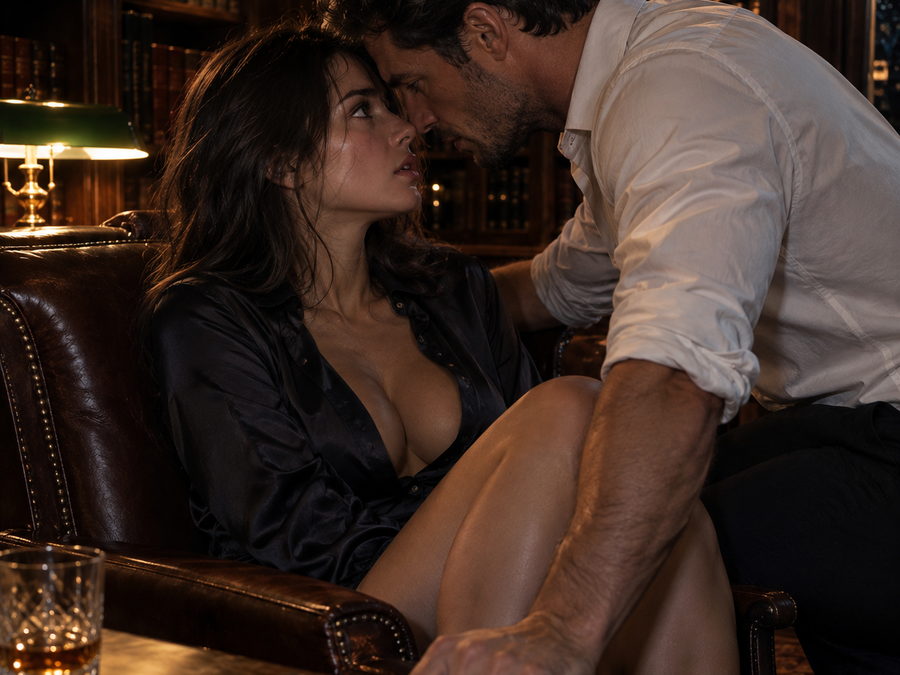
He rested his forehead against mine. He didn’t kiss me. He just stayed there with his warm forehead against mine, his breath reaching almost to my mouth without touching it. I closed my eyes and stayed very still, like someone afraid that any movement would end it. “I’m going to take care of this,” he said. “It’ll take a few days. I’ll be away some nights. You’ll stay here with Rosaria, with Dontomaso. Bastiano recovers, then comes back to your side.” “Achille—” “And when I come back, Severia, I need to ask you something.”
I opened my eyes. His eyes were closed. “Ask now.” “No.” “Why?” “Because if I ask now, you’ll answer because of the fright. I don’t want the fright’s answer. I want your answer.” I said nothing. There was nothing to say. Because he was right and I knew it. And recognizing that he knew me better than I expected was a discovery that left me breathless the same way the shots hadn’t managed to.
He pulled back half an inch. Only half. He raised his hand and ran the tip of his thumb over the corner of my mouth, in the same place where earlier in the courtyard there had been a splatter of blood that wasn’t mine. The gesture was slow, deliberate, as if he wanted to erase something only he was still seeing. He stood. He went back behind the desk. He picked up the glass. He didn’t drink. “Go to sleep,” he said. “I can’t.” “Try.”
I stood. I walked to the door. Before opening it, I turned my face. “Achille.” “Yes.” “You swore not to touch anything you could love.” “I swore.” He looked at me for a long second. The low lamp fell on the edge of his chin, the same way it had fallen in the library two days before, and I saw for the first time that he had shadows under his eyes that weren’t from here. They were from long before, from a time he hadn’t told me about yet. “Now,” he said, “I’m discovering that there are oaths we make out of fear, and that fear is not a good reason to swear anything.”
I closed the door behind me. I climbed the stairs with my open hand over the silk on my chest, feeling my own heart beneath his fabric. In the middle of the hallway, I stopped. I rested my forehead against the cold wall. I took a deep breath, then another. And I understood as I went up that I wasn’t afraid of him. I never had been. I was afraid of something much older—of discovering that this time I was the woman who was going to be chosen, and of not knowing at all what one does with that.
I woke up Saturday with gray light coming through the gap in the heavy curtain of the guest room of the Alfieri house. For a second, before memory returned, I forgot where I was. The sheet was thick, dark cotton. The pillow smelled of lavender and something I couldn’t name, and the silence was different from the silence of my apartment. Denser, more loaded with unsaid things. Then I remembered the glass cracked into a web, Bastiano’s shoulder, the blood on the shirt, Achille’s forehead against mine—and I remembered that he had left before dawn without a sound, leaving only the door ajar and the smell of his whiskey still in the hallway air.
Rosaria knocked on the door with tea. She came in barefoot as if she’d walked through the house her whole life and set the tray on the little table with the care of someone who doesn’t want to wake anyone unnecessarily. She looked at me the way she looked at everything—unhurried, without judgment. “You ate nothing yesterday,” she said. “Today you eat.” “I don’t want to be any trouble.” “Child,” she said. And the word caught me off guard again, slipping past the defense I tried to keep in this house. “The trouble is not eating.” I smiled weakly. She pulled the curtain, let in more light, and left with the quiet step of someone who learned early that doors don’t need to slam.
I drank the tea sitting on the windowsill, still wearing his dark silk shirt under the robe Rosaria had left folded on the armchair. The fabric was soft in a way my worn cotton shirt never was. Down below, the inner garden of the Alfieri house was small and contained, with a stone fountain in the middle that wasn’t running water. The edges were covered in dark moss, and there were dry leaves piled at the bottom of the basin. I tried to think about what he’d left hanging between us the night before. The question he’d asked when he came back. And my stomach tightened in a way that wasn’t fear. It was waiting. It was the uncomfortable, strange sensation of wishing someone would come back.
My phone vibrated. Leah. I answered on the second ring, quietly, as if the silence of the house needed to be preserved. “Are you alive, or do I call the police?” “I’m alive.” “Severia.” “Leah.” “You slept at his house.” “I slept.” She took a deep breath on the other end, in that way of hers that was half scolding, half hug, and I could imagine her face doing the math of everything I hadn’t told her yet. “Are you really okay or fake okay?” I looked at the waterless garden, at the leaves resting at the bottom of the fountain. “Both.” “I’m coming over.” “Don’t come. Please. I’ll tell you everything. I swear. Just don’t come now.”
There was a silence. Leah rarely granted silence. When she did, it was because she was choosing her words with a care she reserved for very few people. “Okay. But if you don’t answer a message within three hours, I’m taking an Uber and knocking on the mafia’s door. You’ve been warned.” “I’ve been warned.” We hung up. I set the phone next to the already empty cup and closed my eyes. The tea had that mild bitterness of fennel with something I couldn’t identify. For the first time in twenty-four hours, I let the air leave my chest completely.
Achille spent the morning shut in the study with Dontomaso. I knew this because I went down quietly to the kitchen to return the cup and heard the low voices behind the double door at the end of the hallway. Not the words, just the tone. Deep, contained, with long pauses between one statement and another. I went back the long way, pretending not to have heard anything. Passing through the hallway with the framed portraits on the walls that I’d never stopped to look at properly.
Dontomaso left around noon. He crossed paths with me in the entrance hall. His dark coat buttoned up to his neck despite the mild warmth coming through the windows. He was a small man, narrow-backed, with the kind of slow walk that seemed to carry more weight than hurry. His eyes found me, and he tilted his head in a short greeting. “Signorina Fioretti.” “Sir.” He paused a second. His Sicilian accent cut the vowels with a calm that wasn’t hesitation. It was choice. “He didn’t sleep. But today, for the first time in many years, the ragazzo chose to hold himself back where before he only knew how to strike.” A brief pause. His eyes were pale, faded by age, but with the precision of someone who still sees everything. “You changed something in him.” I didn’t know what to answer. He didn’t wait for me to answer. He kept walking slowly toward the main door with the step of someone who always knew where he was going.
Bastiano appeared at the end of the hallway, paler than usual, his left arm in a clean sling, walking slowly. He didn’t escort Dontomaso to the car. He just stayed in the doorway, watching with that stubbornness of someone who refuses to disappear from the map, even while standing with a fresh patch. He came back in with his good hand shoved in his pocket. He looked at me. “You okay there?” “Fine.” I looked at his arm. “And your shoulder? Punctured.” He shrugged his good shoulder with an indifference that seemed rehearsed from so much repetition. “Hey, but it drives.” I almost laughed for real. “Thank you,” I said, “for yesterday.” “Don’t apologize. Don’t thank.” He let out a dry half-smile, the kind that didn’t reach the eyes but was honest anyway. “Boss’s orders.” He turned his back and went to the kitchen.
I stood there in the hallway with the strange sensation that I’d been accepted by an entire family without having signed anything, without having asked, without having understood exactly when it had happened. Achille called for me in the late afternoon. He sent a note through Rosaria, handwritten on a small card with discrete edges. “Library when you can.” I read it twice before folding it and tucking it into the pocket of the robe. I don’t know why I kept it.
The library had its curtains open. The afternoon light fell at an angle across the floor-to-ceiling shelves, catching the spines of the books with that amber color that makes any room seem older than it is. There was a dark leather armchair near the window and a small table with two glasses turned upside down on a silver tray. He was standing near the window, no blazer, his white shirt rolled up on his forearms. When he turned his face, I saw that he had two days of beard and deep shadows under his eyes, the kind that don’t come from one bad night, but from many. “You didn’t sleep,” I said before I could swallow the sentence. “No.” “You should.” He looked at me in silence for a few seconds.
Then he walked to the armchair near the window and made a short gesture for me to sit in the one beside it. I sat. The distance between the two armchairs was small; the arms almost touched. “Vittorio Salah,” he said. “The captain of the casinos. He’s the one who handed your route to the Donatellos.” “Marco Donatello, their boss, already understands that he won’t get anything next time. That side is mine to handle. It’s the inside that still gives me trouble.” I swallowed hard. The names didn’t mean much to me, but the smiling face from Levvenia came back in a flash. Too smiling, too attentive, with that kind of attention that wasn’t generosity.
“You’re going to—” “No.” His jaw locked for a second. “I’m not going to kill him.” I raised my eyes. Achille was looking out the window at some point in the garden, at the waterless fountain that sat there still like a promise someone forgot to keep. “Before,” he continued, still in that low voice that didn’t ask to be heard, just was, “I would have. Before yesterday.” “And today?” “Today I can’t bring you into this house with blood still warm on my hands.”
The sentence came without drama, like someone confessing a calculation he’d made on his own throughout the whole night. “I’m going to expose him in front of the other captains. I’m going to take his name off the council, off the tables, and out of the masses. In that world, it’s worse than death.” He finally turned to me. His eyes were tired, but firm, like someone who’d reached a hard conclusion and isn’t sorry. “I need you to know this beforehand. That this was my choice because of you. Even if you’d never found out.”
I couldn’t speak. I reached out over the arm of the chair and touched his rolled-up sleeve with my fingertips. Just that, lightly, like someone confirming that something is real before believing it. He lowered his eyes to my touch as if he’d never seen a hand before. “And tomorrow night,” he said after a moment, “there’s going to be a big dinner. The whole extended family comes here. I want you to be there, sitting next to me.” “Achille, you don’t need to—” “Just sit and don’t apologize.” I finished with a small smile that came without intention. The corner of his mouth went up slightly. Just that, but it was enough. “You’re learning.”
Sunday dawned warm, with the sun coming differently through the guest room window. More direct, brighter, without the gray haze of Saturday. Rosaria came in early with a dress hanging on a satin-lined hanger. Dark, simple, high collar, three-quarter sleeve. The fabric had a discrete shine that wasn’t flashy. It was elegant. She said it had been ordered on Friday morning—before the shooting, before everything. She said this slowly, choosing the rhythm of the words so I would understand the size of that sentence.
I stood looking at the dress for a few seconds. He had ordered a dress for me before I even arrived, covered in blood, in his courtyard. I put it on in silence. The fabric fell weightlessly, fitting with a precision that couldn’t be coincidence. Rosaria moved a strand of my hair away from my face without saying anything, with the simple and complete gesture my mother had never made.
The main hall of the Alfieri house filled slowly, starting at seven. I watched from the gap in the inner staircase, not yet daring to go down. There were men in dark blazers, among them a wider fellow with calloused hands who greeted Achille with a brief nod, the kind only exchanged by people who’d worked together a long time. Women with discrete necklaces and eyes that assessed without seeming to assess, low voices greeting each other with the calm familiarity of people who’d known one another for generations. The air smelled of opened wine and the soft smoke of some thick candle on one of the tables.
Pellegrino was near the fireplace, hands clasped behind his back, watching the entrance with that way of his of seeming motionless even when he was attentive to everything. Rosaria circulated with a glass of water in her hands, not drinking. Dontomaso, seated in the corner, looked like a judge from another era. Vittorio Salah arrived among the last. He was smiling, too attentive, the same smile from Levvenia with the same false texture underneath.
Achille saw me at the top of the staircase. He crossed the hall unhurried, climbed three steps, held out his hand. I placed mine on top, feeling the dry heat of his palm close over my fingers. “Breathe,” he said. Low. “I’m breathing.” “You’re not.” I laughed without making a sound. I breathed for real, the air reaching the bottom of my chest this time. We went down together.
He led me to the table, pulled out the chair to his right, waited for me to sit with an attention that wasn’t ceremony. It was presence. The conversations dropped a tone. I caught a glimpse of Vittorio on the other side of the table pretending to greet someone on his left, the smile frozen on his mouth. Pellegrino, at the opposite head, tilted his head slowly as he had at the first dinner. A small gesture that carried more recognition than any word. Rosaria smiled, a small contained smile, the kind that knows the weight of what’s happening.
Achille remained standing a second longer. He rested both hands on the table, at the level of his plate, and swept the room with his eyes once. Unhurried, without explicit threat. The room fell quiet the way it only does when everyone understands that something important is about to be said. “This,” he said, with the voice in that way that made everyone fall silent. “Is Severia Fioretti.” A one-second pause. Exact, calculated. “She’s with me.”
There was no applause, no shout. There was that particular quiet that only happens when an entire room of dangerous people understands at the same time that a rule had just been written and no one is going to question it. Vittorio swallowed hard. I saw it. It was the only reaction I caught in full. The rest of the table returned the silence Achille had requested without requesting, and it took me a few seconds to understand that that silence was an answer, not awkwardness.
Achille sat. He took the napkin, unfolded it, set it in his lap with the calm gesture of someone who’d just resolved something and no longer needed to think about it. He looked at me from the side. “Fork on the right,” he whispered. I almost laughed. I took the fork on the right, and for the first time in my life, I didn’t apologize for occupying that chair.
The dinner went like any other in appearance. Underneath, I felt the electric current running through the whole table. Alliances confirming themselves in silence. Threats repositioning themselves without anyone raising their voice. Dontomaso, at some point, raised his glass in my direction without saying anything. I returned it with a nod, my heart beating faster than I’d like to admit.
Near midnight, Achille set his napkin on the table. He brought his mouth close to my ear, his voice almost inaudible in the residual murmur of the room. “I have something to finish,” he murmured. “I’ll be back before the sun.” “Tonight? Tonight?” “Vittorio.” He looked at me, slightly surprised that I’d said the name without hesitating. “And Vittorio.”
I gripped my napkin in my lap, feeling the fabric crumple between my fingers. I thought about the question suspended between us since the small hours in the study, and I wanted to ask him to stay, to wait one more day, to sleep a whole night first. But Achille looked at me like someone who needed to go now, because going now was the only way to be able to stay afterward truly, with no pending debt. “Go,” I said. “Okay.” He pressed his lips to my temple. It wasn’t a kiss. It was a promise. It was weight. And he stood.
Bastiano was already standing near the side door, his good arm tucked into his blazer and the left one resting in the sling underneath. The two left together without looking back. I stayed at the table a few more minutes, holding the glass of water in both hands so no one would see that I was trembling. Pellegrino, on the other side of the table, looked at me and tilted his head one last time that night, as if it were enough. Rosaria passed behind my chair, touched my shoulder lightly with her fingers, and went on to the kitchen without saying anything.
When the hall began to empty, I went up—not to the guest room, to the small kitchen in the back where Rosaria always left a light on. A small lamp over the counter with the yellowed tone of one made for waiting. I sat on the high stool. I rested my forehead in my hands. And I waited.
The night in the kitchen had the sound that every night of waiting has. None. I looked at the stove clock every fifteen minutes without needing to look. My body already knew how much time had passed. Dontomaso had gone with him. Bastiano too, against doctor’s orders. Rosaria came by at two, refilled my cup without asking, and said only one thing before going up. “When he comes back, he’ll be whole. Whole is what matters.” I didn’t know whether I believed her or wanted to believe her. I stayed seated. The cup grew cold again.
He came back in the small hours. I heard the gate through the silence of the kitchen. A short creek of metal, then nothing. Bastiano opened the back door. Came in first. Saw my hands around the cold cup, nodded without saying anything, and went up the side hallway. His footsteps faded on the floor above. Achille stopped in the kitchen doorway. The white shirt was wrinkled at the elbows, the sleeves folded to the middle of the forearm, with no mark of blood. His hands clean. His eyes tired in a new way—not the exhaustion of someone who had destroyed, the exhaustion of someone who had controlled himself for a long time and finally could let go.
I was barefoot, with one of Rosaria’s loose shirts over my underwear, my hair down, no makeup at all. The kitchen stone floor was cold under my feet, and the cup between my hands had stopped giving off warmth a long time ago. The light above the sink was low, almost yellowed, and cast a long shadow in the center of the room. I raised my eyes. This time, I didn’t lower them.
He crossed the kitchen slowly. He said nothing on the way. He stopped in front of me, close enough that I could smell his blazer—expensive whiskey, smoke that wasn’t his, and beneath everything, the smell of skin that I’d already begun to recognize as something resembling home. Close enough that I could hear his breathing, calmer than I expected. He raised his hand. He touched his knuckles to my chin, then opened his palm slowly and covered my face with his whole hand. His thumb went down to the corner of my mouth and stayed there still, with a pressure so light it could have been just intention.
“Severia,” his voice was low. “Be mine.” It was the question suspended since the small hours in the study. Finally said, with the words that had been missing until then. The simplest and heaviest sentence anyone had ever said to me in my entire life. I opened my mouth to answer and realized I had no voice. I said yes with my head. I said yes with my eyes, which I didn’t lower.
He leaned in. The kiss was slow, slower than everything that had happened between us until then, slower than I expected from a man like him. His hand stayed on my face, firm, unhurried. The other rose up my back to rest on the nape of my neck, beneath my hair. I closed my eyes. My heart beat so loud I was afraid he’d hear it. When the kiss ended, he pulled me against his chest, chin resting on top of my head with no word at all. And it was a silence different from that of the small hours in the study. A silence that was no longer holding anything back.
He stayed there breathing with me for a few seconds. And I realized that this too was a choice—not the violence of possessing, the patience of staying. “Come,” he said. “Okay.” He held out his hand. I placed mine on top of his. We went up the side hallway slowly, without making noise. The whole house slept. The low lamps cast yellow patches on the dark rug, and the shadows of the two of us together on the wall had a shape I didn’t recognize right away. Something that looked whole, not separate.
We stopped in front of the door of his room. He turned to me before opening it. “Are you sure?” “I am.” He opened the door. We went in together. The door closed behind us with a low click. Contained. Definitive.
I woke up with sun coming through the tall, narrow window. I didn’t know in the first instant which room of the house I was in. The ceiling was different from the room where I’d slept before—higher, with a dark wooden beam in the center. Then I recognized the low shelf on the other side, the thick natural fiber rug, the smell of clean sheets that was his. Achille was sitting on the inner balcony in a dark robe with two cups of coffee on a small tray on the iron table. He had opened the French doors, and the morning air came in slowly, carrying the smell of wet stone and something that might be jasmine from the garden. His shoulders were relaxed in a way I’d never seen during the day.
He heard me stir. He turned his face. “Good morning.” “Good morning.” I sat up in bed, pulled the sheet to my chest, and stayed there a second, recognizing myself. My body ached in a new way. Gentle. That wasn’t bad. It was just the first time it ached from having been touched, not from having been ignored. Twenty-eight years thinking that no one chose. I stayed lying down a second longer than I needed to, feeling the weight of my own head on his pillow, not understanding why my father’s sentence didn’t come back even once during the night.
He stood and came over to the edge of the bed with one of the cups. He set it on the nightstand beside me. Then he reached out and moved a strand of my hair away from my face with the back of his fingers. The same gesture as Rosaria the night before, but with an entirely different weight. A weight I still didn’t know how to name properly, but that stayed on my skin after his hand pulled away. “Come,” he said. “There’s coffee.” I put his robe over my shoulders and went. He pulled out the chair for me on the balcony. I sat.
The balcony looked out over the inner garden, and the stone fountain remained still, not running water, the basin slightly covered with fallen leaves. “Why doesn’t that fountain work?” I asked. Low. He looked out for a moment. “Because I never asked for it to be fixed.” “Why?” He took a second. “I don’t know.” A short pause. “Maybe I’ll call someone this week.” I smiled at the coffee. We drank unhurriedly, without needing to fill the silence with anything.
At some point, he turned to say something, and I looked by chance over his shoulder. On a low shelf, there was a photograph in a silver frame. Him, much younger, alone in the image. The frame was a little wide for the photo. I looked a second longer than I needed to and turned my eyes back to him. Achille was looking at me with that new way, the way of someone who’d stopped calculating the way out. “What is it?” he asked. “Nothing.” He tilted his head slightly without insisting. He squeezed my fingers under the table slowly and didn’t let go. The cup grew cold between us. Outside, the sun rose slowly over the inner garden. And for the first time in twenty-eight years, I didn’t apologize for being exactly where I was.
