Shy Waitress Greeted Mafia Boss’s Sicilian Father Perfect Sicilian, Entire Restaurant Fell Silent
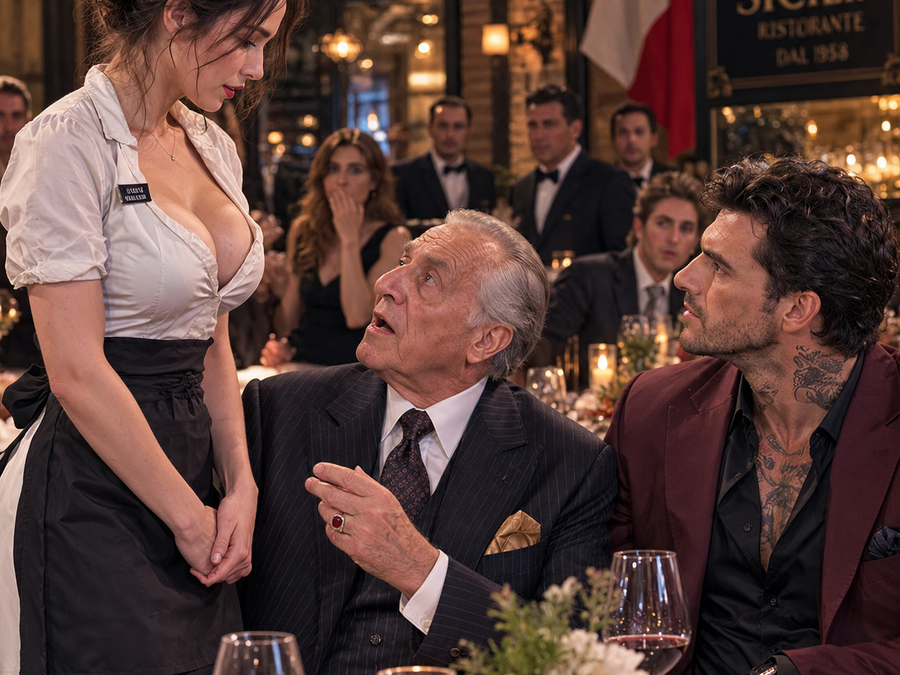
Shy Waitress Greeted Mafia Boss’s Sicilian Father Perfect Sicilian, Entire Restaurant Fell Silent
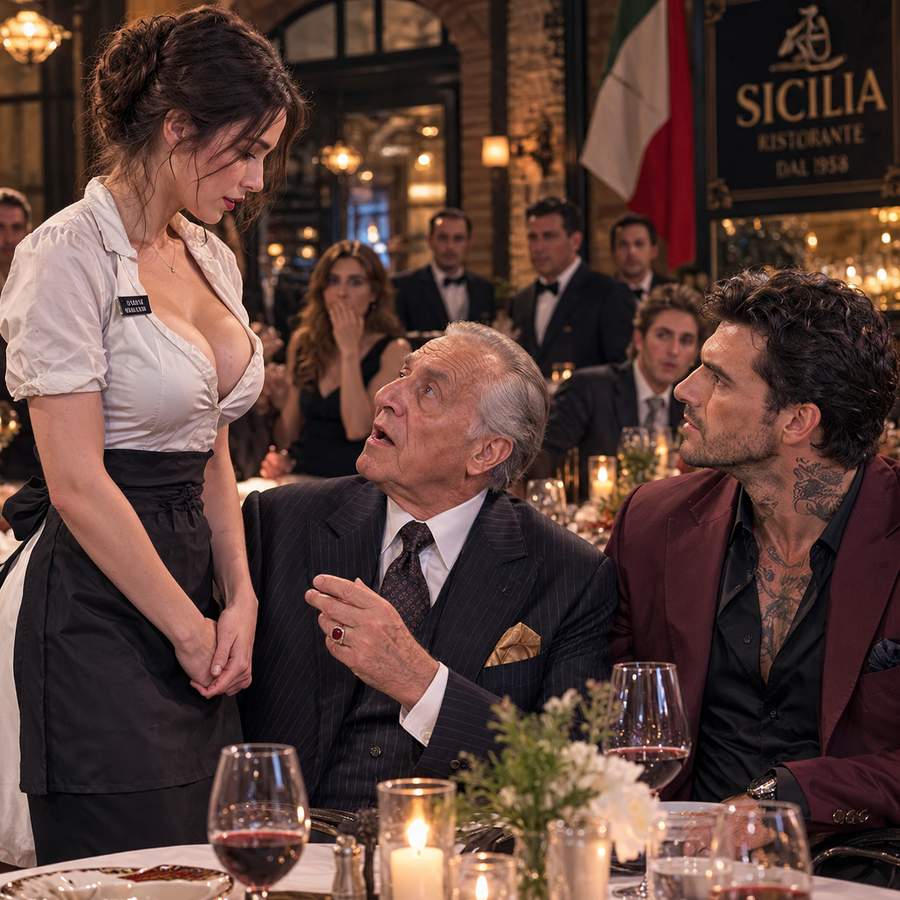
Clutched in white-knuckled grips, a feared syndicate patriarch had just walked through the glass doors of the city’s finest restaurant.
And a quiet, unremarkable waitress stood directly in his path.
She didn’t cower.
She didn’t run.
Instead, she opened her mouth and spoke a dialect so flawless, so intimately Sicilian that even the ruthless heir beside the old man stopped breathing. Tessa knew how to be invisible.
It was a survival tactic she had perfected long before she put on the starched white apron at Atlantica.
In a high-end restaurant catering to the city’s most dangerous men, invisibility was currency.
You didn’t look at the briefcases exchanged under the table.
You didn’t notice the bruised knuckles gripping the stems of crystal wine glasses.
You certainly didn’t make eye contact with Matteo Costa.
Matteo was a regular.
He commanded the corner booth every Thursday evening, flanked by men whose tailored suits couldn’t quite hide the bulk of their shoulder holsters.
He was 32, sharply handsome in a cold, angular way, and ran the Costa family’s port operations with a reputation for absolute surgical efficiency.
Tessa had served him dozens of times. She poured his sparkling water, no ice, slice of lime, and cleared his plates without saying a word. To Matteo, she was a piece of the furniture.
A ghost that brought him veal and took away empty espresso cups. That was exactly how Tessa liked it. But this Thursday was different.
The air in Atlantica felt thick, heavy with the kind of static electricity that precedes a violent storm. Mr. Bianchi, the usually unflappable floor manager, was sweating right through the collar of his bespoke shirt.
He had been pacing the floor since 3:00, adjusting tablecloths by fractions of an inch, barking at the busboys for imaginary smudges on the silverware.
“Tonight is not a normal night,” Bianchi had hissed at the staff meeting, his hands trembling slightly as he’d held the reservation book.
“Don Salvatore is joining his son, Salvatore Costa.”
The old man. He rarely left the fortified compound in the hills, preferring to let Matteo handle the street-level grit of the family business.
Salvatore was a relic of a bygone era, a man who had built an empire with bare hands and sheer, unadulterated ruthlessness. He was notoriously difficult to please, fiercely traditional, and openly contemptuous of the modern world.
Tessa stood by the espresso machine, polishing a cappuccino cup with a microfiber cloth. Her fingers were dry and cracked from the industrial soap, a dull ache settling into her lower back. She watched the clock tick past 8:00.
“I’m going to throw up,” whispered Leo, a young waiter who had only been on the floor for three weeks.
He was leaning against the counter, looking pale green under the warm amber lighting.
“Breathe,” Tessa said quietly, not looking up from the cup.
“They don’t care about us.
Just do your job.
Keep your eyes on the plates, not their faces.”
“You don’t understand,” Leo muttered.
“I spilled wine on a guy last week.
If I do that to Salvatore Costa, they’ll find me in the river.”
“So, don’t spill the wine,” she replied flatly.
Tessa wasn’t unsympathetic, but panic was a liability.
She had grown up in a neighborhood where letting your fear show was an invitation for cruelty. Her grandfather had taught her that.
“Let them think you are deaf, dumb, and blind to everything.
The unseen mouse eats the cheese while the cat chases the loud bird.”
A black Lincoln Navigator pulled up to the curb outside the floor-to-ceiling windows, then a Mercedes, then another Lincoln. The dining room went completely still.
Even the oblivious hedge fund managers at table four stopped mid-laugh, sensing the sudden shift in barometric pressure. Matteo, who had arrived twenty minutes earlier, stood up from his booth.
He buttoned his suit jacket, his expression unreadable, and walked toward the entrance to greet his father.
“Places,” Mr.Bianchi choked out, wiping his forehead with a handkerchief.
“God help us.
Everyone, take your places.”
Tessa slipped the polished cup onto the warming rack. She picked up a fresh water pitcher, intending to do a silent sweep of the far tables, keeping herself as far away from the Costa booth as humanly possible. The glass doors opened.
The first to enter were the shadows. Two massive men who scanned the room with dead, predatory eyes.
They moved aside, making way for the don. Salvatore Costa was smaller than his reputation suggested, a man in his late seventies with a slight stoop and thinning silver hair. But the moment he stepped over the threshold, the physical space in the restaurant seemed to shrink.
He wore a charcoal three-piece suit that cost more than Tessa’s yearly rent.
He leaned on a polished cane with a silver handle, though he didn’t seem to strictly need it.
“Papa,” Matteo said, his voice carrying through the deadly quiet room.
He stepped forward and kissed his father on both cheeks. Salvatore offered a curt nod, his dark eyes sweeping over the dining room. He looked at the opulent chandeliers, the modern art on the walls, and the terrified face of Mr.Bianchi hovering near the hostess stand.
The old man’s mouth twisted into a subtle grimace of distaste.
“This is where you eat, Matteo?”
Salvatore’s voice was gravel and rusted iron.
He spoke in Italian, heavily accented.
“It looks like a museum for fools.
Too bright.”
“The food is good, Papa, and it’s secure,” Matteo replied smoothly.
“Secure,” the old man scoffed, moving past his son.
Mr. Bianchi practically bowed as Salvatore approached.
“Don Costa, an absolute honor.
We have prepared our finest table.
The chef is preparing a special tasting menu for you.”
Salvatore didn’t even look at him.
He waved a dismissive, gnarled hand, silencing the manager instantly.
“I order what I want.
I don’t eat tastings like a bird.”
Bianchi swallowed hard.
“Of— of course, sir.
Right this way.”
Tessa was pinned near the wait station. She had miscalculated.
The path to the far tables was blocked by one of Salvatore’s guards.
She pressed her back against the dark mahogany paneling, holding the water pitcher to her chest, trying to blend into the shadows. The Costa men moved toward the corner booth. Matteo sat across from his father, signaling to Bianchi with a sharp flick of his fingers.
“Bring the wine, the bo, and water,” Matteo ordered.
Bianchi snapped his fingers at Leo, who was standing frozen near the bar. The young waiter jolted, grabbing a tray with two crystal water glasses. His hands were shaking violently.
Tessa watched, a knot tightening in her stomach.
Don’t do it, Leo.
Let Bianchi take it. But Bianchi had already scurried off to fetch the wine, leaving the terrified kid to handle the water.
Leo approached the table. He was trembling so hard the ice in the pitcher rattled against the glass. He reached over to place a glass in front of Salvatore.
“Excuse me, sir,” Leo squeaked, his voice cracking.
Salvatore slowly turned his head, fixing the boy with a stare that could freeze boiling water. Leo panicked, his grip slipped, the glass clattered onto the pristine white tablecloth, knocking over the small silver salt cellar. Salt spilled across the fabric.
The silence that followed was deafening. Leo stopped breathing. The guards standing ten feet away shifted, their hands dropping casually toward their waistbands.
Matteo let out a slow, irritated breath.
“Get out of my sight,” he told the waiter, his voice dangerously low.
Leo didn’t need to be told twice.
He backed away, nearly tripping over his own feet, and fled toward the kitchen. Salvatore stared at the spilled salt.
Superstition ran deep in the old blood. Spilled salt was bad luck, a bad omen. His jaw tightened, the lines on his weathered face deepening into a map of pure hostility.
He leaned back in his chair and spoke loudly, the gravel of his voice cutting through the silent dining room.
He didn’t speak in English.
He didn’t even speak in standard Italian.
He spoke in a rapid, thick Sicilian dialect, a harsh, guttural variant from the deep interior of the island.
“This is what we have become,” Salvatore spat in Sicilian, looking at Matteo with absolute disgust.
“Surrounded by trembling idiots, no respect, no competence.
They treat this place like a palace, but they have the grace of pigs.
I come here to eat, and I am served by children who bring bad omens to my table.”
Matteo opened his mouth to reply, though his slight hesitation betrayed that even he struggled to follow his father’s rapid-fire village dialect.
Before Matteo could speak, Tessa moved.
She didn’t think about it.
It was muscle memory driven by an instinct older than her need to be invisible. Her grandfather used to spill salt at the kitchen table just to make her practice the old ways.
She stepped away from the wait station, moving with quiet, fluid grace. She reached the table before Bianchi could rush back, before the guards could intervene.
Tessa set her pitcher down. She reached out and took a pinch of the spilled salt from the white tablecloth.
Without looking at the guards, without looking at Matteo, she tossed the pinch of salt over her left shoulder. Then she picked up a fresh napkin, expertly swept the remaining salt onto a small silver tray, and laid down a clean cloth over the damp spot.
Salvatore watched her, his eyes narrowing to dangerous slits. Who was this insolent girl interfering with his table?
Tessa stepped back, folded her hands in front of her apron, and looked directly into Don Salvatore’s eyes.
She didn’t hold his gaze with defiance, but with calm, unblinking respect.
Then she spoke.
“Fortuna,” Tessa said.
“Bad luck doesn’t enter where the salt is blessed.”
She didn’t speak it with the awkward, halting pronunciation of someone who had learned it from a phrase book.
The words rolled off her tongue with the exact heavy cadence, the exact guttural warmth of a Palermo Mountain village. It was flawless, archaic Sicilian.
The entire restaurant seemed to stop spinning on its axis. Salvatore froze. The anger melted off his face, replaced by a shock so profound he physically recoiled.
His mouth parted slightly. Matteo stared at Tessa.
His dark eyes, usually dead and unreadable, were wide open. He had never looked at her before.
Not really. Now his gaze was burning into the side of her face, dissecting her features, her posture, her uniform. Tessa kept her gaze on the old man, her voice steady, dropping her tone to a respectful murmur.
“Kulibabi,” she continued, seamlessly transitioning into another old proverb.
“The wise man doesn’t waste time with fools.
Forgive the boy, Don Costa. He has no roots.
He doesn’t know the weight of the ground he walks on.
But the kitchen here has respect. If the don permits, I will serve your table tonight.
The branzino is fresh, though my grandfather would say it needs a heavier hand with the garlic.”
For five agonizing seconds, nobody breathed. The air was so tense it could have been snapped with a pair of pliers. Mr.Bianchi, standing ten feet away holding a bottle of Barolo, looked like he was about to faint. Salvatore leaned forward slowly.
He rested both hands on the silver head of his cane, studying Tessa. He looked at her simple brown hair tied in a neat knot, her pale skin, the faint dark circles under her eyes, and the absolute lack of fear in her posture.
“A che sei tu?”
Salvatore rasped in the dialect.
“Who are you?”
“Sulu na cameriera, Vossia,” Tessa replied smoothly.
“Only a waitress, your honor.”
Salvatore let out a sound. It started deep in his chest, a harsh, rattling noise. The guards tensed.
Matteo leaned forward, but the sound grew louder, pushing past the old man’s lips until it echoed across the silent dining room.
He was laughing. Don Salvatore Costa was throwing his head back and laughing.
“Only a waitress,” Salvatore repeated, switching to heavily accented English, chuckling as he wiped a tear from the corner of his eye.
He slammed his cane lightly on the floor.
“Only a waitress, she says.
My God, Matteo, you come to this miserable city, you eat in this plastic restaurant, and you manage to find a girl who speaks the tongue of my grandfather.”
Matteo didn’t laugh.
His eyes remained locked on Tessa, dark and calculating.
The ghost had suddenly materialized, and she was speaking his father’s sacred language.
“Leave the wine!”
Salvatore barked at the paralyzed Mr. Bianchi, waving him off.
“Leave it and go away.
The girl serves us tonight.
Only the girl.”
Bianchi practically tripped over himself, rushing forward. He set the bottle of Barolo on the table, shot Tessa a look of pure, unadulterated bewilderment, and scurried backward.
Tessa picked up the wine key from her apron.
She moved to Salvatore’s right side, presenting the label with practiced ease, then uncorked the bottle in three swift, silent motions.
She poured a small taste for the don.
He didn’t even sip it.
He just nodded at her to pour the full glass.
“What is your name, picciridda?”
Salvatore asked softly, watching her pour.
“Tessa, sir.”
“Tessa,” he rolled the name around in his mouth.
“Where did you learn to speak like a ghost from Corleone?”
“My grandfather,” Tessa said quietly, moving to pour Matteo’s glass.
“He came over in the ’60s.
He refused to speak English in the house.
He said, ‘A man who forgets his mother tongue forgets his mother.’
” Salvatore slapped the table, delighted.
“A smart man, a man of honor.
Is he still alive?”
“No, sir.
He passed away five years ago.”
“A tragedy,” Salvatore said, genuinely mourning a man he had never met.
He picked up his glass.
“To your grandfather, Tessa.”
Tessa gave a small, respectful nod and stepped back from the table.
“I will bring the bread and oil.
Excuse me.”
As she turned to walk away, she felt a physical weight press against her spine.
It wasn’t the old man’s gaze.
She glanced back over her shoulder just before slipping behind the wait station partition. Matteo Costa was watching her walk away.
The bored, indifferent cartel heir was gone. In his place was the predator who had just spotted something completely unique in his territory. The way he looked at her made the hair on her arms stand up.
It was a look that promised consequences. By speaking up, by saving Leo and pacifying the don, Tessa had broken her own cardinal rule. She was no longer invisible.
The rest of the evening felt like walking a tightrope over an open furnace. Tessa moved back and forth between the kitchen and the corner booth, carrying plates of roasted branzino, bowls of wild mushroom risotto, and fresh bottles of mineral water.
She did it with the mechanical precision of a soldier, keeping her face blank and her movements deliberate. Every time she approached the table, the atmosphere shifted.
Salvatore Costa completely ignored the hushed, urgent business Matteo tried to discuss. The don only wanted to talk to the waitress.
He asked her about her grandfather’s village.
He asked if she knew how to properly salt-cure anchovies, complaining that modern chefs treated salt like a punishment rather than a preservative. He spoke entirely in the thick, rolling dialect.
Tessa answered him in the same tongue, keeping her responses respectful, brief, and completely devoid of the clawing flattery Salvatore was used to.
She didn’t smile to win him over.
She didn’t laugh at his complaints about the city.
She simply agreed or disagreed with a calm, stoic logic that seemed to fascinate the old man.
“They cook the pasta here until it has the spine of a jellyfish,” Salvatore grumbled, pushing his fork around his plate.
“The chef caters to the neighborhood, Don Costa,” Tessa replied quietly as she cleared his bread plate.
“Rich in this zip code like soft things.
They pay for the illusion of chewing.”
Salvatore stopped moving his fork. He looked up at her, his eyes crinkling. Then a sharp, barking laugh echoed from his chest.
Matteo, sitting across from him, did not laugh.
Tessa could feel the son’s gaze heavy on her skin.
It was entirely different from the predatory stares she sometimes endured from drunken hedge fund managers at table four. Those men looked at her like she was an item on a menu.
Matteo looked at her like she was a locked safe and he was trying to figure out which wire to cut. He watched her hands as she poured the wine.
He noted the small white scar across the knuckle of her left thumb. He watched the way she balanced a tray on her forearm, shifting her weight to spare her right knee.
A subtle limp born from standing on concrete floors for sixty hours a week. He was cataloging her, dissecting her.
“My father is not easily entertained,” Matteo said suddenly.
He spoke in English. His voice was a low baritone, smooth, but lined with razor wire. It was the first time in two years Matteo had ever spoken directly to her.
Tessa paused, holding an empty silver tray. She looked at him.
Up close, the harsh angles of his face were even more pronounced. The faint shadow of stubble along his jawline did nothing to soften the cold, dead-eyed intelligence in his dark eyes.
“I am not trying to entertain him, Mr.Costa,” Tessa said evenly.
“I am trying to serve the fish before it gets cold.”
Matteo’s jaw tightened.
A muscle twitched just beneath his ear.
It wasn’t anger.
It was surprise. Nobody spoke to him like that.
Not here. Not on the street.
Salvatore waved a hand, dismissing his son’s interference.
“Leave her alone, Matteo.
She has more sense in her little finger than your entire crew of apes.”
The old man turned back to Tessa, switching to English.
“The meal was acceptable, Tessa.
But the service was perfect.”
“Thank you, sir.”
“When I come back, you serve this table, no one else.
If that sweating pig of a manager sends anyone else, I will burn this place to the ground.
Understand?”
He said it casually, like he was promising to leave a bad Yelp review. Tessa knew it was a literal threat.
“I understand, Don Costa.”
When they finally stood to leave, the entire restaurant let out a collective, silent exhale. The bodyguards fell in behind them.
Matteo dropped a leather billfold on the table. He paused, looking at Tessa one last time.
He didn’t say a word, but the intensity in his eyes made her lungs feel tight.
He turned and followed his father out the glass doors. Mr. Bianchi practically sprinted to the table the moment the black SUVs pulled away from the curb.
“What happened?”
Bianchi demanded, his face slick with sweat.
“What did you say to him?”
“He was laughing,” Tessa said simply.
“Salvatore Costa doesn’t laugh.”
“He liked my grandfather.”
She reached for the leather billfold to close out the check. Inside was a stack of crisp, perfectly uncirculated hundred-dollar bills.
It was enough to cover the five-hundred-dollar meal. And sitting on top of the receipt was a separate folded stack of hundreds.
Two thousand dollars. Bianchi stared at the cash, swallowing hard.
He looked at Tessa, his expression shifting from terror to a sudden, calculating respect.
“Take your tip, Tessa,” Bianchi said quietly, stepping back.
“And take tomorrow off.
Paid.
You earned it.”
Tessa slipped the money into her apron.
She didn’t feel victorious.
She felt a cold, sinking dread in her stomach.
Two thousand dollars wasn’t a tip.
It was a tether. Four days later, the sky over the city broke open, dumping a freezing, torrential rain that turned the asphalt into a slick black mirror. Tessa finished her Tuesday double shift at midnight.
Her body ached in places she didn’t know could ache.
The two thousand dollars from Salvatore sat hidden in a hollowed-out coffee tin under her sink, completely altering the math of her survival. She had paid two months of rent in advance.
She had bought groceries that weren’t exclusively rice and discounted beans.
But the anxiety hadn’t faded.
It had only mutated.
She pushed out of the restaurant’s service alley, pulling the hood of her worn canvas jacket over her head.
The streetlights flickered, casting long, fractured shadows across the wet pavement. She walked three blocks to the bus stop, her boots splashing through shallow puddles. The shelter at the bus stop was shattered, the glass panels kicked out by vandals months ago.
Tessa huddled against the metal frame, shivering as the damp cold seeped through her thin jacket. She stared down the empty avenue, looking for the familiar yellow headlights of the night bus. Instead, a pair of brilliant, piercing LED headlights cut through the rain.
A black Mercedes S-Class slowed to a crawl as it approached the stop.
It didn’t pass.
It pulled flush against the curb, the tires hissing against the wet concrete. Tessa froze, her breath pluming in the freezing air.
The back window hummed down, revealing the dark interior. Matteo Costa sat in the back seat, wearing a black overcoat over a dark suit.
The ambient streetlight caught the sharp line of his cheekbone and the dull gleam of an expensive watch on his wrist.
“Get in,” Matteo said.
It wasn’t a request.
Tessa looked at him, then down the empty street.
The bus wasn’t coming for another twenty minutes.
She knew running was pointless.
If Matteo Costa wanted to find her, a bus ticket wouldn’t save her.
She stepped off the curb, pulled open the heavy armored door, and slid into the leather interior. The car smelled like cedar, expensive leather, and a faint trace of gunpowder.
The door thudded shut, sealing her in a silent, climate-controlled vault.
The driver, a massive man with a thick neck, didn’t look back.
The car pulled smoothly away from the curb.
“You’re shivering,” Matteo observed.
His voice was quiet in the enclosed space.
“It’s raining,” Tessa replied, staring straight ahead at the driver’s headrest.
“You live in the South Ward,” Matteo stated.
It was a fact, not a question. He had already pulled her file.
He knew everything there was to know about her on paper.
“It’s a thirty-minute bus ride, then a four-block walk through a neighborhood where people get stabbed for their sneakers.”
“Why?”
“Because the rent is cheap and my sneakers are ugly.”
Matteo let out a slow exhale. He turned his head, studying her profile in the passing streetlights.
“Who are you, Tessa?”
“I’m a waitress,” she said, finally turning to look at him.
“Just like I told your father.”
“My father is a paranoid, violent man who trusts absolutely no one.
He has executed men for blinking too slowly,” Matteo said, his voice flat, devoid of emotion.
“You spilled salt at his table.
You spoke to him without permission. You should have been fired at best.
At worst, I would have had to make a phone call to clean up a mess in the alley.
Instead, he hasn’t stopped talking about the girl with the Corleone tongue.”
“I can’t control what your father thinks of me,” Tessa said, keeping her voice remarkably steady despite the adrenaline spiking in her chest.
“You controlled the entire room,” Matteo corrected her softly.
He leaned slightly closer. The heat radiating off him was palpable.
“You saw a situation going bad and you diffused a bomb.
You used the exact dialect, the exact proverbs to short-circuit a man who has been terrifying this city since before you were born.
That isn’t an accident.
That is tactical.”
Tessa pressed herself back into the soft leather of the door.
“My grandfather raised me.
He was traditional. He made me speak it.
That’s the whole truth, Mr.Costa. I saw a kid about to get hurt over a mistake, and I stopped it.
There’s no conspiracy.
I’m not a threat to you.”
Matteo looked at her mouth, then up to her eyes.
“I didn’t say you were a threat.”
“Then why am I in your car?”
“Because I don’t like anomalies,” Matteo said quietly.
“In my business, anomalies get people killed.
You don’t fit.
You look like a ghost. You live in a slum, but you carry yourself like you own the floor you walk on.
You didn’t even flinch when my men reached for their guns.”
“I grew up on Fifth and Pike,” Tessa said, her voice dropping, a raw edge of bitterness bleeding into her tone.
“I’ve seen guns before.
I’ve seen men bleed out on the sidewalk while people walked past them to get to work.
Your suits are nicer, Mr. Costa, but violence is all the same.
It’s boring and it’s loud.”
Matteo went entirely still. The cynicism in her voice mirrored the dark, exhausted hollows of his own mind. He was surrounded by people who either worshiped his violence or cowered from it.
This girl in a wet canvas jacket was simply bored by it. He stared at her for a long, heavy moment.
The silence stretched, thick with attention that was rapidly shifting from suspicion to something entirely different, something electric.
“Pull over,” Matteo ordered the driver.
The Mercedes glided to the curb and stopped.
They were two blocks from Tessa’s apartment building.
Matteo reached into his coat pocket. He pulled out a sleek black business card with a single phone number embossed in silver.
He held it out to her.
“My father is hosting a dinner this Sunday at the estate,” Matteo said.
“Family only.
Capos, wives. He demanded you serve his table.
He doesn’t trust the catering staff.”
Tessa looked at the card, dread pooling in her stomach.
“I work on Sundays.”
“Not this Sunday,” Matteo said.
“Bianchi already cleared it.
You will be picked up at noon.”
Tessa didn’t take the card.
“And if I say no?”
Matteo’s eyes darkened.
He leaned in, closing the distance between them until she could feel his breath on her cheek.
“My father is an old king, Tessa.
When a king finds a new favorite bird, he puts it in a cage.
He doesn’t let it fly away.
You say no, he takes it as an insult.
And you already know what happens when he is insulted.”
He took her cold, chapped hand, pressed the card into her palm, and closed her fingers around it. His touch was burning hot against her freezing skin.
“Don’t be an anomaly on Sunday,” Matteo whispered, his voice dangerously soft.
“Serve the food.
Keep your head down.
Do not make them look at you.”
“Why?”
Tessa whispered back, unable to break his gaze.
“Because my family destroys things that catch their attention.”
Tessa swallowed hard, pulling her hand away. She opened the door and stepped out into the freezing rain.
She didn’t look back as the heavy door clicked shut and the Mercedes vanished into the dark, wet city.
The Costa compound was less of a house and more of a fortress disguised as a Tuscan villa. Situated on forty acres of private woodland just outside the city limits, it sat behind twelve-foot wrought-iron gates, surveillance cameras, and armed men walking dogs with jaws like steel traps.
Tessa sat in the back of the SUV that had picked her up at noon. She wore a clean, pressed black uniform. Her stomach was tied in a knot so tight it made her dizzy.
The vehicle pulled up a sweeping gravel driveway, stopping in front of a sprawling stone mansion. The front doors opened and a stern-faced woman in her sixties ushered Tessa inside.
“Through here.
No phones. No talking to the guests unless spoken to.
You handle the don’s table only,” the woman barked, leading Tessa through a labyrinth of marble hallways into a massive industrial kitchen.
The kitchen was a war zone. Dozens of chefs and prep cooks were screaming in Italian, hauling massive trays of antipasti, slow-roasted pork, and handmade pastas.
The air was thick with the smell of roasting garlic, rosemary, and reducing wine. At exactly 2:00, the dining room doors were thrown open. The space was cavernous, featuring a long mahogany table that seated forty people.
The room was dripping in wealth: crystal chandeliers, heavy velvet drapes, and Renaissance oil paintings. The guests were a terrifying cross-section of the Costa empire. Old men with cold eyes and expensive cigars.
Younger capos with slicked-back hair and aggressive, restless energy. The wives were dripping in diamonds, sizing each other up with venomous smiles.
At the head of the table sat Salvatore. Tessa stood by the sideboard holding a pitcher of water, making herself invisible.
She watched the brutal hierarchy of the family play out.
Men kissed Salvatore’s hand.
Wives averted their eyes. The noise was deafening, a roar of boisterous laughter and sharp arguments.
Matteo sat to his father’s right.
He looked exhausted.
He wasn’t eating.
He was scanning the room, his eyes flicking over the capos, tracking every whisper, every micro-expression. He was a man holding a pack of starving wolves at bay with nothing but a stare.
“Ah!”
Salvatore suddenly bellowed, slamming his hand on the table. The conversation in the room immediately died down. The don pointed a gnarled finger toward the sideboard.
“Là, la piccola Siciliana.”
Every head in the room snapped toward Tessa. Forty pairs of eyes, predatory, curious, jealous, locked onto her.
The wives looked at her plain face and lack of makeup with open disdain. The younger men looked at her with a much darker, far more dangerous interest.
Tessa’s blood ran cold.
“Do not make them look at you,” Matteo had warned.
She stepped forward, keeping her eyes lowered, and approached the head of the table.
“Pour the wine, Tessa,” Salvatore commanded, waving away a panicked catering manager.
“Only you.”
Tessa picked up a bottle of Amarone.
She poured the don’s glass with perfectly steady hands, completely ignoring the suffocating silence of the room.
She felt Matteo’s eyes on her.
He was gripping his fork so hard his knuckles were bone white.
“Vossia, cumanna,” Tessa murmured softly in the dialect, placing the bottle down.
“As you command.”
A murmur rippled down the long table. The older men exchanged shocked, impressed glances.
The younger men looked confused.
“You hear that?”
Salvatore crowed, looking down the table at his captains.
“She speaks the old tongue better than any of you degenerate bastards.
You all speak like Americans.
You forget where the blood comes from.”
Tessa stepped back, blending quickly into the shadows near the wall, desperate to escape the spotlight.
She spent the next three hours performing a flawless ballet of service, anticipating Salvatore’s needs before he voiced them, entirely ignoring the rest of the room.
By 5:00, the meal devolved into heavy drinking and loud arguments over business. Salvatore retired to his study, smoking a cigar. Tessa was dismissed to the kitchen to take a break.
The heat of the stoves was suffocating. She slipped out the back door into a stone courtyard, desperate for cold air. The sun was setting, casting long, bloody streaks of orange across the sky.
Tessa leaned against the cool stone wall, closing her eyes, letting out a breath she felt she had been holding for three hours.
“You shouldn’t be out here.”
Tessa gasped, her eyes flying open. Matteo stood in the doorway.
He had taken off his suit jacket and unbuttoned his collar. The harsh, calculating air was gone, replaced by a man who looked dangerously close to snapping. He stepped into the courtyard, closing the heavy wooden door behind him.
The noise of the kitchen vanished, leaving them in absolute silence.
“I was just getting air,” Tessa said, taking a step back.
The courtyard was small. He took up too much space.
“They were looking at you,” Matteo said, his voice a low, rough grate.
He closed the distance between them in two long strides, backing her up against the stone wall.
He didn’t touch her, but his proximity was a physical weight.
“Franco, Lorenzo, they looked at you.”
“I am a waitress.
They look at me to bring them bread,” Tessa said, her heart hammering wildly against her ribs.
“They looked at you like meat,” Matteo snarled, his composure fracturing.
He slammed a hand against the stone wall right next to her head.
Tessa flinched, but she didn’t look away.
Matteo stared down at her, his chest heaving slightly. The cold air rushed between them.
He looked at her dark, calm eyes, the stubborn set of her jaw. The way she refused to break under his intimidation.
“I told you not to catch their attention,” he whispered.
The anger was bleeding out of his voice, replaced by something rougher, deeper.
“Your father called for me,” Tessa whispered back, her breath catching in her throat.
“What was I supposed to do, Matteo?”
“Hide.”
It was the first time she had used his first name. The sound of it on her lips was like a match dropped in dry gasoline.
Matteo’s eyes dropped to her mouth.
The air between them thickened, heavy and charged. The cynical, violent world he lived in faded, narrowing down to the pale throat of the woman pinned against the wall.
Slowly, agonizingly, Matteo lifted his free hand.
He didn’t grab her.
He traced the line of her jaw with the back of his knuckles, his touch impossibly gentle for a man with so much blood on his hands. Tessa gasped softly, her eyes fluttering shut for a fraction of a second before she forced them open. She should push him away.
She should run. But her legs felt like lead, and the heat radiating from him was intoxicating.
“You are a ghost, Tessa,” Matteo murmured, his thumb brushing over her lower lip.
“But you’re haunting the wrong house.
My father thinks you are a pet.
My men think you are prey.”
“And what do you think I am?”
Tessa breathed, looking up into his dark, ruined eyes. Matteo leaned in, his lips hovering inches from hers.
“I think,” he whispered, “you are going to be the death of me.”
The heavy wooden door to the kitchen groaned open. The sound was like a gunshot in the quiet courtyard.
Matteo stepped back instantly. The intoxicating heat radiating from his body vanished, replaced by the freezing autumn air. His face hardened, the mask of the ruthless heir slamming down over his features so fast it gave Tessa whiplash.
A broad-shouldered capo named Carmine stepped into the dim light, a cigarette hanging from his bottom lip. He paused, looking from Matteo to Tessa, his eyes narrowing.
“Boss,” Carmine grunted.
“Your father wants you inside.
He’s arguing with the Chicago reps.”
“I’ll be there in a minute,” Matteo said.
His voice was a flat, dead draw.
He didn’t look at Carmine.
He kept his eyes fixed on the stone wall above Tessa’s head.
Carmine lingered for a second too long, his gaze dragging over Tessa’s uniform, noting the way her breathing was shallow and erratic.
Then he turned and went back inside. Matteo finally looked down at her. The raw vulnerability of the moment before was completely gone, locked away behind a vault of necessary violence.
“Go back to the restaurant tomorrow,” Matteo ordered quietly.
“Do your shifts.
Go straight home. Do not walk from the bus stop alone.
I’ll have someone watch the street.”
“I don’t need a babysitter,” Tessa managed to say, her voice shaking slightly as the adrenaline receded, leaving behind a bone-deep chill.
“You don’t have a choice,” he replied.
He walked away, leaving her standing alone against the cold stone.
For a week, Tessa tried to pretend the world was normal.
She poured coffee. She carried plates as a veal marsala.
She ignored Mr.Bianchi’s nervous glances.
But the city felt different. The shadows seemed deeper. When she walked down her block in the South Ward, she noticed a dark gray sedan parked near the corner.
The engine was always idling. The man inside never got out.
She was a ghost with a shadow. Then came Thursday night. The restaurant was closing.
The chairs were stacked on the tables. Tessa clocked out, pulling her canvas jacket tight against the biting wind.
She pushed through the alley door, her boots crunching on the loose gravel, heading for the main avenue. A figure stepped out from behind the dumpsters. Tessa stopped dead.
Her hand instinctively moved to the heavy flashlight she kept in her coat pocket. It was Lorenzo, one of the younger capos from the Sunday dinner.
He was wearing a camel-hair coat over a tailored suit, but his tie was loose, and the heavy stench of scotch hit Tessa from ten feet away.
Two massive men stood silently behind him, blocking the alley’s exit.
“Tessa, right?”
Lorenzo slurred slightly, a nasty, jagged smile stretching across his face.
“The little Sicilian bird.”
“The restaurant is closed,” Tessa said, keeping her voice even.
Her heart hammered against her ribs like a trapped bird.
“I’m not here for pasta,” Lorenzo chuckled, taking a step closer.
“I’m here because I’m curious.
The old man hasn’t shut up about you all week.
And Matteo. Well, Matteo looked like he wanted to rip my throat out just for looking at you.
That makes you very valuable.”
“I just serve food.
I don’t know anything about your business,” she said, backing up slowly until her shoulders hit the brick wall of the alley.
Lorenzo reached out and grabbed the lapel of her jacket. His grip was entirely too tight.
“You’re a wedge, sweetheart.
Matteo thinks he owns the streets, but he’s weak.
He’s distracted by a waitress.
If I put you in a car right now, I wonder what he’d trade to get you back.”
Tessa drove her heel down hard into Lorenzo’s instep.
He yelped, stumbling back and releasing her jacket. Tessa bolted for the street, but one of the massive guards caught her by the hair, yanking her backward with brutal force. She slammed against the brick wall, the breath leaving her lungs in a sharp gasp.
“You stupid bitch!”
Lorenzo snarled, recovering his balance. He raised his hand, balling it into a fist.
He never threw the punch. A sound echoed at the mouth of the alley, a wet, sickening crunch.
Lorenzo’s second guard dropped to the pavement like a sack of wet cement.
Standing over him was Matteo. He held a steel baton in his right hand. He wore no coat.
His sleeves were rolled up to the elbows, exposing thick, corded forearms. Lorenzo spun around, his face draining of color.
“Matteo, listen.
It’s not—” Matteo didn’t speak.
He moved with terrifying fluid speed. He crossed the alley in three strides. The guard holding Tessa let go and reached for his waistband.
Matteo swung the steel baton, catching the man squarely on the collarbone. The bone snapped with a sound like a breaking tree branch.
The man screamed, collapsing to his knees. Matteo kicked him in the jaw, silencing him instantly. Lorenzo was shaking, pressing his back against the dumpster.
“Matteo, are you crazy?
You’re going to break my crew over a waitress.
The don will hear about this.”
Matteo dropped the baton. It clattered loudly against the wet asphalt. He walked up to Lorenzo, grabbed him by the throat, and slammed his head back against the brick wall.
Lorenzo gagged, his eyes wide with pure, unadulterated terror.
“If you ever speak her name again,” Matteo whispered, his voice a dead, emotionless rasp, “I will cut your tongue out and feed it to my father’s dogs.
If you look at her, I will take your eyes.
Nod if you understand.”
Lorenzo gave a frantic, choking nod. Matteo let him go.
Lorenzo collapsed onto the gravel, gasping for air. Matteo turned to Tessa. His chest was heaving.
Blood was splattered across the white cuff of his shirt. He looked at her, his eyes wild and completely hollow, waiting for her to scream.
Waiting for her to run from the monster he truly was.
Tessa didn’t run.
She looked at the blood on his shirt, then up at his face.
“Your car,” Tessa said, her voice shaking, but her gaze steady.
“Take me to your car.”
They didn’t speak during the drive.
Matteo’s driver navigated the city streets with lethal precision, winding up into the high-rise district overlooking the harbor.
They pulled into an underground garage guarded by a heavy steel gate. Matteo led her into a private elevator.
It opened directly into a penthouse. It was huge, cold, and entirely devoid of personality.
Floor-to-ceiling windows offered a sprawling view of the city’s glittering skyline, but the furniture was sparse, monochromatic, and untouched.
It looked less like a home and more like a high-end holding cell. Matteo walked straight to the kitchen island, poured three fingers of scotch into a glass, and downed it in one swallow.
He leaned heavily against the marble counter, his back to her.
“I told you,” Matteo rasped, the silence in the apartment pressing down on them.
“I told you what my world was.”
Tessa stood in the center of the living room, her cheap canvas jacket dripping rainwater onto the pristine hardwood floor.
“You think I’ve never seen blood, Matteo?
You think a broken bone is what scares me?”
He turned around slowly.
“It should.
I nearly killed a made man for touching you. Do you understand what that means? Lorenzo will go to the other capos.
He will say I have gone soft.
He will say I am risking the family stability over a girl who pours coffee.”
“Then let me go,” Tessa said.
Her voice cracked, betraying the exhaustion pulling at her bones.
“Fire me from the restaurant.
Tell your father I moved away.
Let me disappear.”
Matteo slammed the empty glass onto the counter. The heavy crystal shattered, spraying shards across the marble.
“I can’t,” he shouted.
The sudden explosion of volume made Tessa flinch. Matteo closed his eyes, digging the heels of his hands into his temples, trying to shove the violence back down into its box.
When he opened his eyes, the anger was gone, replaced by a desperate, suffocating exhaustion. He walked across the room, stopping inches from her. He looked down at her pale, tired face.
“I can’t,” he repeated softly.
“My whole life is a spreadsheet of liabilities and assets.
Who is stealing from the ports? Who is lying to my father? Who needs to be put in the ground?
It is dark, Tessa. It is completely, utterly dark.
And then you stood in the middle of a room, threw salt over your shoulder, and spoke a language that reminded me I am still human.”
Tessa looked up at him. She saw the heavy dark circles under his eyes. She saw the way his hands shook with the adrenaline of the fight.
The sheer weight of holding up an empire he despised.
“I’m not a savior, Matteo,” she whispered.
“I’m just trying to survive.”
“So am I,” he breathed.
He reached out, his bloodstained fingers gently framing her face. He half expected her to pull away.
Instead, Tessa leaned into his palm.
The touch was electric, grounding them both in a reality that existed outside the syndicate, outside the old man’s rules.
Matteo lowered his head, his lips meeting hers.
It wasn’t a soft, cinematic kiss.
It was desperate. It tasted like scotch, copper, and rain.
Tessa gripped the front of his ruined shirt, pulling him closer, anchoring him. For a man who controlled half the city, Matteo kissed her like he was drowning, and she was the only breath of air he had had in a decade. He backed her slowly toward the massive leather sofa in the center of the room, his hands sliding down her back, mapping the curve of her spine through the heavy canvas jacket.
Tessa kissed him back with a fierce, quiet intensity, pouring all her fear, her cynicism, and her hidden loneliness into him. They collapsed onto the sofa. The heavy silence of the penthouse was broken only by the sound of their ragged breathing and the distant, muffled hum of the city far below.
For one night, the ghosts were kept at bay.
The empire didn’t exist.
There was only the heat of his skin against hers. A fleeting, stolen peace in a world built on war.
But morning always comes, and with it, the bill always comes due.
Morning in the penthouse did not come with warmth. It arrived as a flat, gray light that bled through the floor-to-ceiling windows, casting long, sharp shadows across the hardwood.
Tessa sat on a steel-framed bar stool in Matteo’s kitchen, wrapped in one of his heavy wool sweaters.
The sleeves swallowed her hands. The silence of the apartment was no longer a sanctuary.
It was a holding cell waiting for the executioner’s knock.
Matteo stood by the window. He had been on his phone for ten minutes.
He spoke in a low, rapid murmur, his back completely rigid. When he finally pressed the red button and set the device on the marble counter, his face was a mask of carved granite.
The man who had kissed her like a drowning victim the night before was gone. The cartel heir had returned, locking every vault in his mind.
“My father,” Matteo said.
His voice was completely flat.
“He wants us both at the compound now.”
Tessa felt a cold stone drop into her stomach.
“Lorenzo talked.”
“Lorenzo talked,” Matteo confirmed.
He didn’t look at her.
He walked past the kitchen island, his footsteps heavy, toward a framed minimalist painting hanging on the far wall. He swung the frame outward, revealing a steel wall safe. He punched in a six-digit code with rapid, muscle-memory precision.
The heavy door clicked open. Matteo reached inside and pulled out a matte black Sig Sauer pistol. Tessa watched him check the chamber.
The metallic clack of the slide echoed off the high ceilings. He slammed a full magazine home and shoved the weapon into a leather holster at the small of his back.
“I’ll have my driver take you to the bus station,” Matteo said, pulling a tailored suit jacket over his shoulders to conceal the iron.
“I have a contact in Montreal.
You’ll have a bag of cash, a new name, and a job waiting.
You leave right now.”
Tessa didn’t move.
The wool sweater suddenly felt suffocating.
“And what happens to you?”
“I deal with my father.”
“He’ll kill you, Matteo.
Or he’ll let Lorenzo do it to save face.”
“I am his blood.
He won’t kill me,” Matteo said.
He walked over to the counter, leaning over it to finally look her in the eyes. His gaze was terrifyingly calm.
“But I will kill Lorenzo.
And if you are in this city when that happens, you are a target.
Put your shoes on.”
Tessa looked down at her battered canvas boots, sitting by the door where she had left them dripping wet the night before. She thought about Montreal.
She thought about taking a new name, wearing a new uniform, pouring coffee for strangers in a city where it snowed for six months a year. She thought about returning to the wallpaper.
Keep your head down. Turn invisible.
Survive. It was the only religion she had ever known. But as she looked up at Matteo, a man who lived entirely in the dark, preparing to walk into a slaughterhouse just to buy her a ticket out, she realized her religion was dead.
She was done surviving.
“No,” Tessa said.
Matteo froze. His hand hovered over his keys on the counter.
“What?”
“I said, no.
Montreal is freezing.
I don’t speak French.
And I’m tired of being a ghost.”
Tessa slid off the bar stool. Her bare feet hit the cold floor. She walked up to him, tilting her chin up to meet his stare.
“If I run, you walk into that compound as a traitor.
A man who lost his mind over a piece of skirt. If we walk in together, I am still the girl your father respects.
I’ll use the only weapon I have.”
“Tessa, this isn’t a restaurant.”
Matteo snarled, a crack of genuine panic breaking through his stoic mask. He grabbed her shoulders, his grip tight enough to bruise.
“He will gut you.
My father does not forgive weakness, and he views you as a weakness.”
“Then we die together,” she said evenly, her voice dropping to a whisper.
“But I’m not leaving.”
Matteo stared down at her. He searched her dark eyes for any sign of hesitation, any flicker of the terrified waitress from the South Ward. He found nothing but absolute, terrifying stubbornness.
He let out a harsh, jagged breath, cursing under his breath in a string of rapid Italian. He let go of her shoulders.
“Get dressed.”
The drive to the compound took forty minutes. Neither of them spoke a single word.
The armored Mercedes glided over the wet asphalt, a black shark moving through gray water. When they reached the estate, the heavy iron gates ground open, their iron teeth pulling back to let them into the belly of the beast.
They were escorted immediately to the don’s private study by two guards who kept their hands resting casually on their belts.
The study was a cavernous room that smelled of old parchment, expensive cigar smoke, and polished leather. Salvatore Costa sat behind a massive claw-footed oak desk. To his right, standing near a towering bookshelf, was Lorenzo.
Lorenzo looked like a wreck. His jaw was violently bruised, swollen to twice its normal size, and a thick white bandage covered his left cheekbone. Despite the beating, his eyes were bright with a smug, venomous triumph.
He had cornered the heir. Three heavyset guards flanked the heavy oak doors, blocking the only exit.
“Sit,” Salvatore commanded in heavily accented English, glaring directly at his son.
Matteo ignored the heavy leather chairs placed in front of the desk. He stood in the center of the Persian rug, keeping Tessa positioned slightly behind his left shoulder.
His right hand hung loosely at his side, inches from the small of his back.
“You break one of my capos,” Salvatore rasped.
His voice wasn’t loud, but it vibrated with a lethal, concentrated fury that made the air in the room feel thick.
“You shatter the collarbone of a made man in an alley like a common street thug.
You compromise a port shipment because half of Lorenzo’s crew is in the hospital.
Over what?
A waitress.”
“He touched what is mine, Papa,” Matteo said.
The temperature in the room dropped ten degrees.
“He broke the rules of respect.”
“Respect?”
Salvatore roared. He slammed his silver-headed cane against the desk.
The sound cracked like a gunshot.
“You talk to me of respect.
You shame our family name in front of the entire crew for a girl who serves plates. She is a distraction, a liability, a wedge.
Lorenzo was right to remove the wedge.”
“If Lorenzo ever breathes her air again, I will cut his head off and leave it on his wife’s porch,” Matteo promised.
His voice was a dead, emotionless void. Lorenzo stepped forward, pointing a trembling finger.
“You see, Don Costa, he’s lost his mind.
He’s completely compromised.
He’s going to start a civil war over a piece of trash.”
Salvatore slowly shifted his gaze to Tessa. The amusement and affection he had shown her at the restaurant, the warmth he had displayed at the Sunday dinner, were entirely eradicated. He looked at her the way a butcher looks at a diseased animal, a problem that simply required a sharp blade.
“I liked you, Tessa,” Salvatore said, switching to the thick, guttural Sicilian dialect.
“You spoke the tongue of my fathers.
You had a quiet grace. But a smart bird knows when to fly away.
You stayed too long in a house that does not belong to you.”
Salvatore raised his left hand, lifting two fingers off the desk. It was a silent, microscopic signal to the guards at the door to draw their weapons.
Tessa stepped out from behind Matteo. She felt the heavy, suffocating weight of the room pressing down on her spine, the exact same crushing gravity she had felt that first night at Atlantica.
Her heart battered against her ribs, but this time she didn’t shrink into the shadows.
She didn’t look at the floor.
She walked forward until she was standing shoulder-to-shoulder with Matteo, and she looked directly into Don Salvatore’s cold, dead eyes.
“Lu lupu pansa, cui la pansa,” Tessa said.
Her voice rang out clear and sharp, slicing straight through the masculine tension in the room.
“The wolf with a bad conscience thinks others operate as he does.”
Salvatore’s hand froze midair.
The guards hesitated, their hands hovering over their holsters.
“I am no wedge, Don Costa,” Tessa continued seamlessly in the heavy, rolling dialect, her pronunciation flawless, carrying the harsh rhythm of the Palermo Mountains.
“Your men are weak.
Lorenzo went to an alley to fight a woman in the dark because he’s too cowardly to face your son in the light.
He uses my name to hide his own ambition, his own greed.
If a king listens to the whispers of a rat, he loses the throne.”
Lorenzo blinked, looking frantically between Salvatore and Tessa.
He didn’t speak the old dialect.
He had grown up in the suburbs of New Jersey.
He had no idea what she was saying, but he could feel the sudden, tectonic shift in the room’s power dynamic.
“What is she saying?”
Lorenzo demanded nervously, stepping toward the desk.
“Don Costa, don’t listen to her.
She’s manipulating you.”
“Quiet,” Salvatore barked in English.
He leaned forward, resting his forearms on the desk, his dark eyes boring into Tessa.
“You have stones, girl.
To stand in the belly of the wolf and speak to me this way in my own house.”
“Cu semina ventu, ricogghi tempesta,” Tessa fired back without missing a beat.
“He who sows discord harvests discord.
I did not ask for your son. I did not ask to be dragged into this life. But he defended my honor when your men acted like feral dogs.
A true Sicilian father would praise a son who protects his territory and his people instead of punishing him for the weakness of a capo who drinks too much and fights women.”
Silence fell over the study. It was heavy, absolute, and thick with violence. Matteo watched his father.
His posture was relaxed, but the muscles in his jaw were ticking. He was ready to draw.
He was ready to burn his own empire to the ground for the woman standing next to him.
Salvatore looked from Tessa’s defiant face to Matteo’s rigid stance.
Then he looked at Lorenzo, who was sweating through his camel-hair coat, radiating fear and incompetence. The old man leaned back in his high-backed leather chair. The silence stretched for thirty agonizing seconds.
Then slowly, Salvatore reached into the breast pocket of his suit. He pulled out a cigar.
He clipped the end, struck a match, and puffed a thick cloud of blue smoke toward the ceiling.
“Get out, Lorenzo,” Salvatore said quietly in English.
Lorenzo’s jaw dropped.
“Don Costa, wait.
You can’t—” “I said get out,” Salvatore growled, his voice dropping an octave.
“You shame me in an alley.
You get beaten by my son, and you come crying to me like a bruised child to fight your battles. You disgust me.
Leave my house before I have Carmine put a bullet in your good knee.”
Lorenzo swallowed hard. His face flushed dark red. He looked at Matteo with pure, unadulterated hatred, but he turned and scrambled out of the room.
The heavy oak doors clicked shut behind him. Salvatore took another long pull from his cigar.
He studied Tessa through the haze of smoke.
“You are not a waitress,” Salvatore murmured in the dialect.
A grim, entirely reluctant smile touched the corners of his weathered mouth.
“You are a witch.
You tied my son’s hands, and today you tied my tongue.”
He switched to English, addressing his son.
“Take her.
Get out of my sight. Go back to the ports. But understand this, Matteo.
You have shown the entire crew your heart today. A man with a heart in this business is a man wearing a target on his back.
You keep her safe, because if she falls, they will devour you.”
“I know, Papa,” Matteo said softly.
He didn’t bow.
He didn’t thank him.
He simply reached out and took Tessa’s hand.
His grip was warm, rough, and completely unyielding. They turned and walked out of the study, out of the heavy stone compound, and stepped into the pale, freezing sunlight of the afternoon. Matteo opened the passenger door of the Mercedes for her.
Tessa slid into the leather seat. Her legs felt like water.
The adrenaline that had kept her standing in the study was rapidly evaporating, leaving her entire body trembling. Matteo got in beside her, slamming his door shut.
He didn’t start the engine immediately.
He turned to her, resting his forehead against hers. His breathing was ragged.
“You’re crazy,” Matteo whispered, his hands coming up to cup her face.
“You are completely out of your mind.”
“I told you,” Tessa breathed, closing her eyes and leaning into the warmth of his palms.
“I’m tired of being invisible.”
Matteo leaned in and kissed her, fierce and deeply possessive, sealing the pact they had just made in front of the devil himself. He put the car in gear, and the armored Mercedes pulled away from the gates, driving down the winding road toward the city. They were driving into a life of constant vigilance, a life of shadows, violence, and constantly looking over their shoulders.
But as Tessa listened to the low hum of the engine and felt Matteo’s hand resting firmly on her knee, she realized she wasn’t just surviving anymore.
For the first time in her life, she was truly alive.

