Single Dad Attended His Friend’s Engagement — Then His Sister Revealed a Shocking Truth (Part 1)
Single Dad Attended His Friend’s Engagement — Then His Sister Revealed a Shocking Truth (Part 1)
PART 1
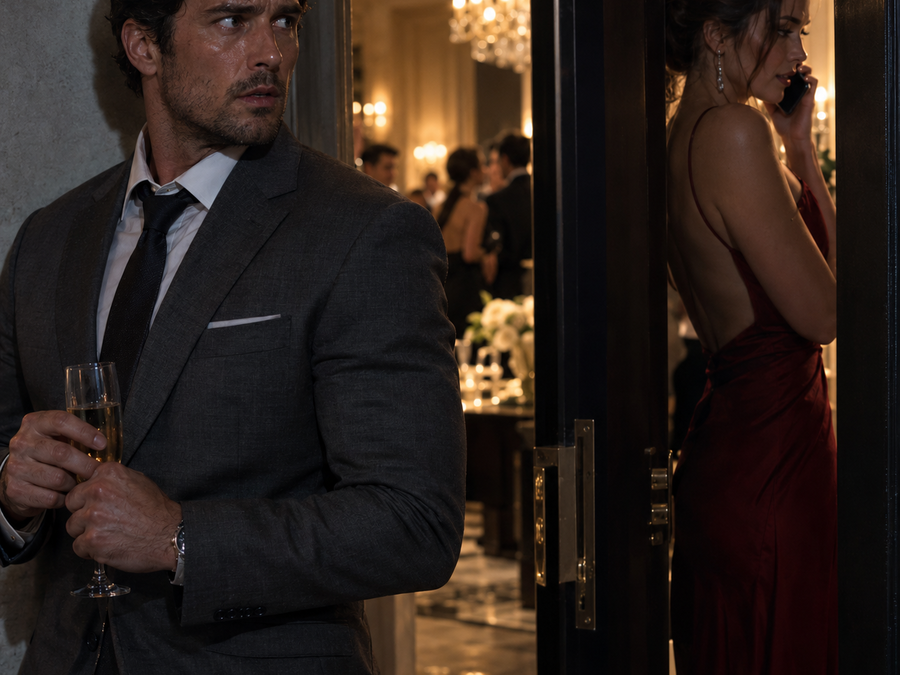
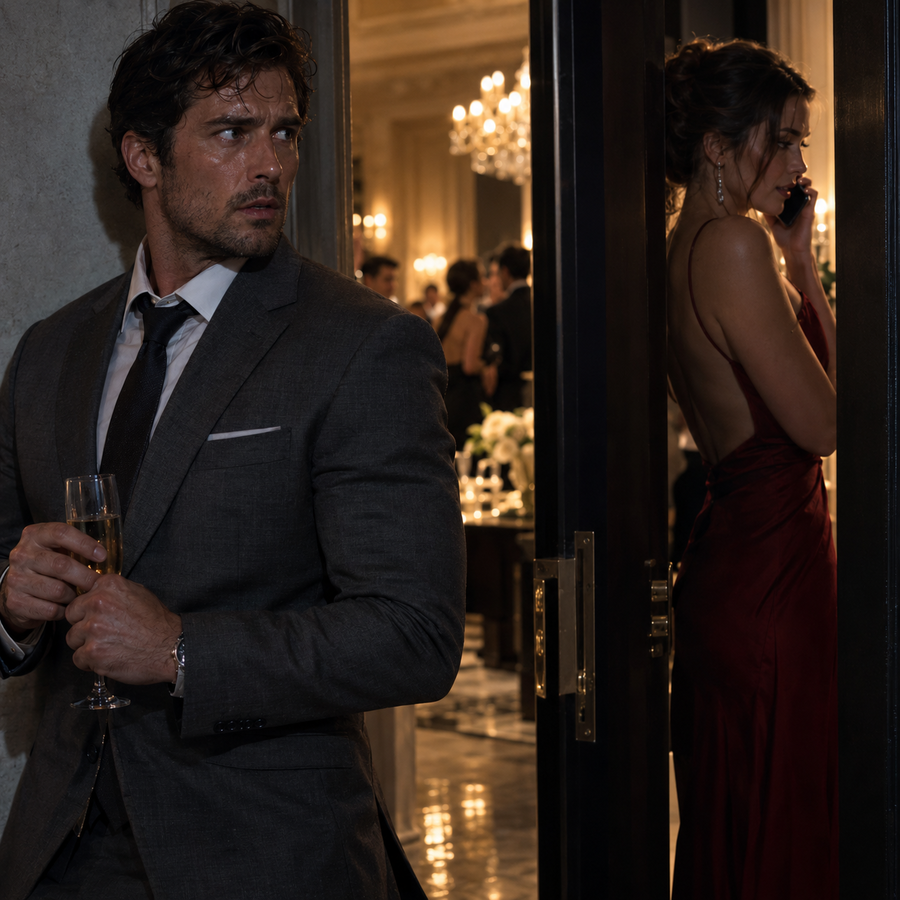
The woman smiled at Michael across the engagement party. Warm, beautiful, perfect. Then she turned around, walked straight to the bathroom, and called another man. Michael heard every word. He wasn’t supposed to be in that hallway. He wasn’t supposed to hear her voice dropped to something low and urgent and intimate in a way it never once sounded with Daniel. He wasn’t supposed to catch the name she used, the promises she made, the laugh she saved for someone who wasn’t wearing her ring.
He stood there, back against the wall, champagne going warm in his hand. Thirty feet away, his best friend was telling a room full of people he was the luckiest man alive. Michael looked down at his glass, set it carefully on a side table, and walked back into the party like he hadn’t just heard the whole thing collapse. Because the woman who blew up Daniel’s world that night wasn’t Vanessa. It was someone Daniel hadn’t spoken to in three years. Someone who had been waiting and watching since long before the ring ever came out.
The drive to Riverside took Michael 45 minutes in traffic, which gave him exactly 45 minutes to talk himself out of going. He almost succeeded. Three times he reached for the exit ramp. Three times he kept driving. Not because he wanted to be there. Not because he was in the mood to eat tiny food off little plates and watch people clink champagne glasses and pretend everything in the world was wonderful. He kept driving because Daniel had called him that morning and said, “Mike, brother, I need you there.” And Michael Carter had never once in his life been able to say no to that man. So he drove.
He pulled into the long circular driveway of the Harrington estate—because, of course, Daniel’s future in-laws had an estate—and sat in his truck for a full two minutes before he killed the engine. The truck was a 2009 Ford F-150 with a cracked dashboard and a pine tree air freshener that hadn’t smelled like anything in six months.
Around him, valets in black vests were parking Teslas and Mercedes-Benzes and at least one Bentley that probably cost more than Michael had earned in the last three years combined. He was wearing dark jeans, a charcoal gray button-down he’d ironed twice because the collar kept flipping up, and dress shoes he’d bought at Target three years ago for a job interview he didn’t get.
He stepped out of the truck. A valet kid—couldn’t have been more than 19—looked at the F-150, then looked at Michael, then very carefully arranged his face into neutral professionalism.
“Sir, I’ll take your keys.”
“Be gentle with her. She’s got feelings.”
The kid didn’t know what to do with that, so he just nodded. Michael walked toward the entrance.
Daniel Reyes had been Michael’s best friend since they were both 11 years old, sitting in the back of the same sixth-grade classroom in Pasadena, both of them pretending to understand fractions. They had grown up two streets apart, played baseball together until their knees gave out, stood beside each other at Michael’s wedding seven years ago when Michael married Sarah. Daniel had also been standing beside Michael at Sarah’s funeral four years later. That was the kind of friendship they had. The kind that didn’t need explaining.
Daniel came from a working-class Mexican-American family. His father had run a small landscaping business. His mother had worked the checkout at the same grocery store for 22 years. But Daniel had been relentlessly, almost aggressively smart, had earned a full scholarship to UCLA, and had spent the following decade turning that education into a genuinely successful career in commercial real estate. He wasn’t wealthy the way the people at this party were wealthy, but he had done well. Better than anyone who grew up on their street had ever expected.
Which was probably, Michael sometimes thought, why Daniel had started dating Vanessa Harrington in the first place. Not that he’d ever say that out loud.
Vanessa was 27, beautiful in the way that came with good bone structure and very expensive skincare, and she came from the kind of family that had a wing named after them at the local university. Her father, Richard Harrington, was the kind of man who shook hands too hard and looked at you like he was calculating your net worth while you were still talking. Her mother, Caroline, smiled constantly but never with her eyes. Michael had met Vanessa three times before tonight. She had been perfectly pleasant each time. Perfectly, like she’d been calibrated. He’d never once felt like she’d actually looked at him.
The inside of the Harrington estate was everything Michael expected and worse. Crystal chandeliers. Catering staff moving through the crowd with trays of food that cost too much and couldn’t fill you up. A string quartet in the corner playing something classical that everyone was ignoring. Flower arrangements taller than Michael’s son. Everything white and gold and carefully, deliberately beautiful.
He spotted Daniel across the room almost immediately. Daniel was standing with Vanessa, both of them surrounded by people. Michael didn’t recognize—older men in suits, women with jewelry that caught the light every time they moved. Daniel was laughing. His arm was around Vanessa’s waist. He looked happy. He looked so happy. Michael felt something shift uncomfortably in his chest, and he decided to find the bar before he analyzed it.
He got himself a beer. He almost asked for a Bud Light before he caught himself and ordered whatever craft thing they had on tap, and found a relatively quiet spot near the edge of the room where he could stand without feeling like he was in anyone’s way. He watched the party. This was what he did. He’d gotten good at it over the years, the quiet watching. After Sarah died, he’d stopped being the kind of person who moved through rooms easily. He’d become someone who stood at the edges and observed. It wasn’t loneliness, exactly. It was more like he’d learned to take up less space.
His son, Eli, was home with a babysitter tonight. Seven years old, and already too perceptive for his own good. He’d noticed Michael ironing the shirt twice and said, “Dad, are you nervous about something?” with the kind of casual accuracy that kids sometimes had. The kind that stopped you cold.
“Just trying to look nice, bud.”
“You always look nice to me.”
God, that kid. Michael took a long sip of his beer and watched the string quartet and tried not to count the hours until he could reasonably leave.
He almost missed her. She was standing near the windows on the far side of the room, not talking to anyone. That was what caught his attention first. Not her appearance, not the understated elegance of her black dress, not the way she carried herself like someone accustomed to being watched. What caught his attention was that she was still. In a room full of movement. Everyone else at this party was performing—working the room, making impressions, establishing pecking orders. This woman was just standing there, holding a glass of sparkling water she hadn’t touched, watching the room with an expression Michael couldn’t quite read from this distance.
He looked away, looked back. She was still watching the room. And now he could read the expression a little better. She was worried about something.
He didn’t approach her. That wasn’t Michael’s style. He finished his beer, checked his phone—Eli’s babysitter had sent a photo of the boy passed out on the couch with a half-eaten bag of popcorn on his chest, which was the best thing Michael had seen all week—and then went to find Daniel.
Daniel grabbed him by both shoulders when he saw him. “You came. I was starting to think you bailed on me.”
“I thought about it.”
“I know you thought about it. That’s why I called you three times this morning.”
“You called me twice.”
“The third call I thought about but didn’t make because I was giving you space to make the right decision on your own.”
“That’s very mature of you.”
“I’m a mature person.” Daniel grinned. “Mike, what do you think? Be honest.”
Michael looked around at the party, the estate, the people. “I think your in-laws have too much house.”
“They really do. You should see the East Wing. There’s a billiards room, Mike. Nobody in this family plays billiards. It’s purely decorative.”
“That’s not a billiards room. That’s a status room.”
“Exactly.” Daniel laughed. And for a moment, he sounded exactly like the 11-year-old kid from the back of sixth-grade math class.
“Listen, Vanessa wants to meet you. Properly. Officially. Come on.”
Vanessa Harrington was even more beautiful up close, which was somehow more unsettling than reassuring. She had the kind of face that photographers loved—all clean symmetry and perfect proportion. And she smiled at Michael with what appeared to be genuine warmth.
“Michael, I’ve heard so much about you. Daniel talks about you constantly.”
“He’s exaggerating whatever he told you.”
“He said you’re the most honest person he knows.”
Michael glanced at Daniel. “That part might be accurate.”
“He also said you make the best chili in California.”
“That part is completely accurate. The honest part was understated, actually.”
Vanessa laughed. It was a good laugh. Natural. Unrehearsed. The first genuinely unguarded thing Michael had seen from her. And then, for just a fraction of a second, something moved across her face. Not guilt, not quite. Something more like strain. Like someone holding a heavy thing and working very hard not to let anyone see the effort. It was gone almost instantly. She touched Daniel’s arm and said something about needing to greet her father’s colleagues. And then she was moving away through the crowd.
And Daniel was watching her go with that expression men get when they’re looking at the person they’ve decided is going to be their whole future.
“She’s great, right?” Daniel said.
“She seems great.”
Daniel heard the seams. He looked at Michael sharply. “Mike.”
“She seems great. Daniel, I mean that.”
Michael paused. “You’re happy?”
“I’m the happiest I’ve ever been.”
And he looked it. That was the problem. He looked genuinely, completely, unguardedly happy. The kind of happy that made you ache when you knew something the person didn’t. Except Michael didn’t know anything. Not yet.
He was making his way back toward the bar—switching to club soda because he was driving—when someone touched his elbow. He turned. It was the woman from the window. The still one. Up close, she was younger than he’d estimated from across the room. Late 20s, maybe 30 at the most. Dark hair pulled back simply. The black dress was expensive without announcing itself. She had the kind of face that would photograph terribly because it did all its work in person, in the small movements, in the particular way the light caught it.
“You’re Michael Carter,” she said. Not a question.
“I am. And you’re—”
“Rachel. Rachel Reyes.” She paused. “Daniel is my brother.”
Michael stared at her. In 11 years of friendship with Daniel Reyes, he had heard Daniel mention a sister exactly twice. Once when they were teenagers, when Daniel had said his sister would hate this movie they were watching. And once at Sarah’s funeral, when Daniel had said his sister couldn’t make it because she was abroad for work. He had never seen a photograph. He had never heard a name. Rachel Reyes had existed in Michael’s understanding of his best friend’s life as a vague, theoretical person somewhere in the background.
“Daniel never told me.”
“Daniel and I haven’t spoken in almost three years.” The way she said it was completely flat. Not bitter. Not sad. Just factual. The way you state something you’ve processed so thoroughly that the emotion has been worn smooth.
“I’m sorry,” Michael said. “I didn’t know.”
“Nobody here does. Except Richard Harrington.” Her eyes moved briefly across the room. “He knows exactly who I am.”
Something about the way she said that made Michael pay closer attention. “How do you know the Harringtons?”
“I work in financial compliance. I have for the last seven years.” She looked at him steadily. “Three months ago, my firm was hired to conduct an audit. Not of this family directly. Of a company connected to Vanessa’s family business. A holding company that exists on paper in the Cayman Islands and almost nowhere else.”
Michael was quiet. “What did you find?”
“A lot.” She finally took a sip of her sparkling water. “And then three weeks ago, I found something I wasn’t looking for.”
She reached into the small clutch bag on her arm and removed her phone. She held it with the screen facing her for a moment, like she was deciding something. Then she turned it toward him.
It was a photograph. Vanessa Harrington, clear as daylight, in what appeared to be a restaurant, sitting across from a man. The man’s hand was on the table, and Vanessa’s hand was on top of it. They were leaning toward each other in the particular way that people lean when they’re in the conversation that is more important than any other conversation they’re having in their lives.
“When was this taken?”
“Six weeks ago. Four weeks after Daniel announced the engagement.”
Michael handed the phone back. He looked at the party. Daniel was laughing again across the room, Vanessa at his side.
“Rachel,” he said her name slowly. “Why are you telling me this?”
“Because he’s my brother.” For the first time, something cracked slightly in her voice. Just slightly. “Because I’ve been standing outside this family for three years, and I can’t just walk back in there and tell him this. He doesn’t trust me. He doesn’t—” She stopped. Pressed her lips together. “He doesn’t know why I left. And I can’t explain it in five minutes at an engagement party. And I need someone who can actually reach him.”
“What happened between you and Daniel?”
“That’s a long conversation.”
“Then give me the short version.”
She was quiet for a moment. “I told him something. He didn’t want to hear it about someone he trusted. Years ago. He chose the other person. He was wrong, too. And eventually, he figured that out. But by then, I’d already built a life somewhere else.” She stopped again. “The pattern is familiar to me. That’s what I’m saying. And I can’t watch him make the same mistake.”
Michael looked at her. At the careful steadiness of her. At the effort it was costing her to stand in this house and hold this information.
“How much more is there?” he said. “Beyond the photograph.”
“Enough. There’s a man named Curtis Wade. He and Vanessa have been together, on and off by the looks of it, for at least two years. Before Daniel. During Daniel.” She paused. “Curtis Wade is also currently under federal investigation for wire fraud connected to the Harrington Holding Company.”
Michael said nothing.
“If Daniel marries her, his name goes on documents. His credit, his finances, his professional reputation—all of it becomes connected to people who are very carefully managing a situation that is going to become public. Maybe in a year. Maybe in three. But it’s going to—”
“You’re sure?”
“I’m a compliance auditor, Mr. Carter. Being sure is my entire job.”
“Michael.”
“Michael.” She looked at him. “Will you help me tell him?”
He looked out at the party. At Daniel’s face. At the happiness on it. At the fragility of that happiness, now that he knew what he knew. “The most honest person he knows.” That was what Vanessa had said. Daniel had called him. Michael understood, standing there with a glass of club soda in his hand at a party he hadn’t wanted to attend, that some descriptions become their own kind of burden.
“Yeah,” he said. “I’ll help you tell him.”
They spent the rest of the party not talking to each other. This was Rachel’s suggestion. “If Richard Harrington sees us together too long, he’ll know something is wrong.” And Michael had agreed, without fully understanding how she knew that Richard Harrington was paying attention to either of them specifically. But something in her certainty made him trust her read of the room.
So Michael stood at the edges and watched. And now that he knew what to watch for, he saw things he’d missed before. He saw Richard Harrington look at Rachel from across the room—twice, both times with an expression that wasn’t quite recognition and wasn’t quite threat, but lived somewhere in the territory between them. He saw Vanessa touch Daniel’s arm the way you touch someone when you’re performing affection for an audience. He saw—or thought he saw, and hated himself for noticing—the way Vanessa’s phone lit up twice in the span of an hour, and the way she stepped slightly away from Daniel each time before glancing at the screen.
He watched Daniel laugh and shake hands and be the best version of himself. The version that had clawed its way up from a working-class neighborhood and made something real. And he felt the specific sadness of knowing that someone is walking toward a wall they can’t see.
And then there was a moment. Just one. When Daniel caught Michael’s eye from across the room and grinned. The same grin he’d had at 11 years old. “Brother, you came.” Michael smiled back and thought, “I’m going to have to break your heart, and I’m going to do it because I love you. And that’s the worst kind of thing there is.”
He found Rachel near the exit as the party began winding down. “Tomorrow,” he said. “I can be at your place by 10:00, or wherever you want to meet.”
“There’s a diner on Clement Street. Harbor View. They don’t rush you out.”
“I know it.” She paused. “I grew up near there.”
Of course she did. She and Daniel had grown up two streets from Michael. He had walked past their house a hundred times without knowing she existed.
“I’ll be there at 10:00,” Rachel said. She looked like she wanted to say something else. Several things. She was clearly a person who ran calculations constantly, who processed and weighed and measured before she spoke.
“For what it’s worth,” Michael said, “it took guts to come here tonight.”
“I didn’t have a choice.”
“You had a choice. You could have mailed him the evidence anonymously and watched from a distance. You chose to be here.”
She looked at him with an expression he couldn’t fully identify. Something between surprise and the particular guardedness of someone who isn’t accustomed to being accurately perceived. “Good night, Michael.”
“Good night, Rachel.”
He drove home. He sat in the parking lot of his building for 10 minutes, engine off, the pine tree air freshener doing absolutely nothing. And he thought about Daniel’s face. About the photograph on Rachel’s phone. About the name Curtis Wade and federal investigations and paper companies in the Cayman Islands. He thought about Sarah. About how she had died not knowing any of the things that turned out to matter, and how Michael had spent four years since then wishing he’d said things differently. Sooner. Louder. He thought about honesty. About what it cost. About who it was really for.
Then he went upstairs, paid the babysitter, carried Eli from the couch to his bed, pulled the blanket up, and stood in the doorway of his son’s room for a long moment.
“Dad?” Eli’s voice, thick with sleep.
“Yeah, bud. It’s me. Go back to sleep.”
“Was the party good?”
Michael considered the question with the full seriousness it deserved. “Something important happened,” he said. “I’m not sure if it was good yet. But it was important.”
Eli processed this in the way seven-year-olds process things, which is to say he was asleep again in approximately four seconds. Michael stood there a little longer. Then he went to the kitchen and made himself a cup of coffee he didn’t need and sat at the table and thought about what came next.
He called Rachel at 9 the next morning. Not because he had anything new to say. He just needed to confirm the meeting was real. That the conversation at the party hadn’t been something he’d constructed out of beer and discomfort and the particular loneliness of standing in a room where you didn’t belong.
She answered on the second ring. “I’ll be there at 10:00,” she said, before he could speak.
“I just wanted to—”
“I know it’s real, Michael. I’ll see you at 10:00.”
He hung up, started the coffee, made Eli breakfast—scrambled eggs and toast, because it was a Saturday and Saturday meant scrambled eggs—and dropped him at his neighbor Mrs. Papadopoulos’s house, who was 73 years old and regarded Eli with the ferocious love of a grandmother who had run out of grandchildren to spoil.
“Big plans today?” Mrs. Papadopoulos asked.
“Just meeting someone for coffee.”
“A woman?”
“Someone.”
“Michael.”
“Mrs. P.”
“I’m asking because you ironed your shirt.”
“I ironed my shirts.”
“Michael Carter, I have lived next to you for four years, and I can count on one hand the number of times you have ironed a shirt. It is a Saturday morning, and you are wearing an ironed shirt, and you have done something with your hair.”
“My hair looks normal.”
“It looks like you tried. That’s different.”
She shooed him away. “Go. Take your time.”
Rachel was already at Harbor View when he arrived, sitting in a corner booth with a coffee and a folder on the table in front of her. The folder was thick. She looked different in daylight. Last night, she’d been contained, controlled, perfectly calibrated to the environment. Here, in a diner, where the coffee came in heavy ceramic mugs and the booth vinyl had cracked in exactly the way that meant something had been repaired twice and given up on the third time, she looked more like a person who was tired. Not the performance of tired. Actual tired.
“You sleep?” he asked, sliding into the booth.
“A little. You?”
“Some.”
The waitress, a woman named Gloria, who had been working at Harbor View since Michael started coming there three years ago and greeted him every time like she’d been hoping he’d show up, filled his mug without being asked. “The usual?”
“Just coffee today, thanks.”
Gloria glanced at Rachel with the particular assessment of someone who has watched a regular customer for years and knows the significance of who shows up with them. She left them alone.
Rachel opened the folder. For the next 40 minutes, she walked him through it. Not all of it—the full audit was hundreds of pages—but the relevant pieces. The Harrington Cayman Holding Company, which existed primarily to move money between entities in ways that systematically avoided reporting requirements. Curtis Wade, who appeared on documents connected to several of those entities and who had been quietly flagged by the FBI’s financial crimes unit 18 months ago. And the communication records—not hacked, nothing illegal, all properly subpoenaed in the course of the investigation—that showed a sustained, ongoing relationship between Vanessa and Curtis that had continued with what appeared to be full deliberateness throughout and after her relationship with Daniel began.
“She knew,” Michael said.
“Yes.”
“She started dating Daniel while this was going on.”
“There’s a theory—which I cannot prove, but my experience suggests is credible—that the relationship with Daniel was partially strategic. His name, his professional reputation, a certain kind of legitimacy. The Harrington business has some exposure right now. Having a well-regarded, independently successful partner in the family is useful optics.”
Michael sat with that for a moment. “You’re saying she’s using him.”
“I’m saying the evidence is consistent with that interpretation.”
“Not in a let-me-soften-this way. I need to know what you actually think.”
Rachel looked at him directly. “I think she is using him. I think she is a person who has been taught by her family that people are instruments. And I think my brother does not know that world exists.” She paused. “Yes. That’s what I think.”
“Okay.” Michael looked down at the folder and back up. “We need to tell him today.”
“I know.”
“Not tomorrow. Not after we’ve figured out the perfect way to say it. Today. Because every day we wait is a day he’s planning a wedding with someone who—”
“I know, Michael.” Her voice was quiet. “I’ve been carrying this for three weeks.”
“I know.” He stopped, looked at her. “Three weeks. You’ve had this for three weeks. Why did you wait?”
“I wasn’t sure he’d believe me. I’m not—” She stopped. “Our relationship is complicated. I told you.”
“Tell me more. Because if we sit down with him today and he doesn’t know why you’re there—why his sister he hasn’t spoken to in three years is suddenly showing up at his engagement party and tearing his life up—I know how it’ll look. He’ll think it’s personal. He’ll think you have a reason that has nothing to do with Vanessa.”
“I know.”
“So, tell me what happened between you two.”
Rachel wrapped both hands around her coffee mug. She looked out the window at the street. Two kids were riding bikes on the sidewalk. An elderly man was walking a dog that appeared to be mostly legs.
“Six years ago,” she said slowly, “Daniel was in business with a man named Greg Powell. Commercial real estate. Early in his career. They were partners. I found out—I was doing compliance work even then, lower level, but I had access to certain things—I found out that Greg Powell was falsifying numbers. Lying to their investors. The kind of thing that gets people indicted.”
“What did you do?”
“I told Daniel. And he didn’t believe me. He said I was jealous of his success. He said Greg was the best partner he’d ever had, and I was trying to sabotage something good because I’d always had a problem with watching other people be happy.” She paused. “He was wrong about the jealousy. He was right that I’d always had trouble watching other people be happy. But not for the reason he thought.”
“What happened to Greg Powell?”
“He was indicted 14 months later. Daniel lost about $60,000 and had to spend two years very carefully demonstrating to the commercial real estate community that he’d had no knowledge of what Greg was doing. He got through it. But by the time it happened, I’d already moved to Boston for work. And the call I expected never came. He never called to say I was right. He never called. Period.”
She looked back at Michael. “So when I tell you that I understand exactly why he’s going to look at me across the table today and wonder if I have an angle—yes. I understand that completely. And I’m doing this anyway. Because I am not going to let him walk into a federal mess because I was too scared of his reaction to speak up again.”
The diner hummed around them. Gloria refilled both coffees without being asked.
“He’s going to feel terrible about what happened with Greg Powell,” Michael said.
“That’s not why I’m telling him.”
“I know. But he’s going to feel it anyway. And that’s going to be part of this conversation today, whether you plan for it or not.”
She looked at him. Something shifted in her expression. Not softening, exactly. More like the slight adjustment of someone recalibrating.
“You think about these things.”
“I’ve had a lot of conversations I didn’t know how to have. The grief stuff.” He was quiet for a moment. “Part of it. Just—” He paused. “When you’re raising a kid alone, you learn that there’s no version of the hard conversation where you get to avoid the hard parts. You can pace it. You can time it. But you can’t skip the thing that hurts.”
Rachel looked at him in the way she’d looked at him the previous night. That particular quality of attention. Like she was seeing something she hadn’t expected and was deciding what to do with it.
“He’s lucky to have you,” she said.
“Daniel? He’d say the same about you if he remembered why.”
A long silence. Then she closed the folder and said, “I’ll call him.”
Daniel met them at Michael’s apartment at 3:00 in the afternoon. He was confused from the moment he walked in. Confused by the “her” specifically. By the presence of the woman standing in Michael’s living room, who was unquestionably his sister. The same eyes. The same line of the jaw. Both of them inheriting something from their mother that Daniel had told Michael about exactly once, a long time ago.
“Rachel.” Her name in his mouth sounded like something he hadn’t said in so long it had become strange. “Hey, Danny.” The old nickname.
Michael watched Daniel’s face do several things in rapid succession. Shock. Confusion. A flash of something old and painful. And then the shutting down. The controlled neutrality of someone protecting themselves.
“What is this?”
“Sit down, Daniel.”
“Mike, what—”
“Sit down. Please.”
Daniel sat. He looked at Rachel. He looked at Michael. He looked at the folder on the coffee table. “What is that, Daniel?”
Michael pulled his chair forward. “You’re my brother. You’re the person I trust most in this world. And I need you to hear me when I say that what we’re about to tell you comes entirely from that. From nothing else.”
“Okay, you’re scaring me.”
“I know. I’m sorry. Listen.”
Rachel opened the folder. What followed was the hardest 45 minutes Michael had experienced since a doctor had sat across a table from him and talked about his wife’s prognosis. The precision of that comparison wasn’t lost on him as he watched Daniel’s face move through the stages. Confusion. Rejection. Resistance. More rejection. The specific anger of someone whose defenses are working exactly as designed. And then the slow, terrible cracking as the evidence became impossible to argue with.
Daniel didn’t yell. That surprised Michael. He’d expected yelling. What he did was go very quiet. The quieter he got, the more the room seemed to contract.
“The photograph,” he said finally. “When was it?”
“Six weeks ago,” Rachel said. “I can give you the exact date.”
“Curtis Wade.”
“Yes.”
“And he’s under federal investigation.”
“Yes. The Harrington family has significant exposure in the same case.”
Daniel looked at his hands. “How long have you had this?”
“Three weeks.”
“Why didn’t you—”
“Because you haven’t spoken to me in three years, Daniel.” Her voice stayed even. “Barely. Because the last time I tried to tell you something like this, you told me I was jealous and selfish, and I watched Greg Powell destroy $60,000 of your money and two years of your reputation before you figured out I was right. I had to decide whether I was willing to do this again. Whether I could come to you knowing how you’d look at me.”
The silence in the room had texture.
“I’m here,” she said quietly. “I’m here because you’re my brother and I’m not willing to watch you walk into this.”
Daniel didn’t say anything for a long time. When he finally looked up, his eyes were red at the edges. He looked at Michael.
“You believe her?”
“I’ve seen the documentation. I believe the documentation. And I believe her. And you.”
He stopped. “You sat at my engagement party. You shook her hand. I know. She told you she was happy to meet you. Daniel, she said you were the most honest person she knew.”
His voice broke slightly on the last word. Caught itself. “What does that mean now? What does any of it?”
“Hey.” Michael leaned forward. “It means she was wrong about herself. Not about you.”
Daniel stared at him.
“Trusting her wasn’t a failure, Daniel. It’s not a character flaw that you loved someone who was lying to you. That’s her failure, not yours.”
The room was very quiet. Then Daniel put his face in his hands, and Michael put his hand on his best friend’s back, and Rachel sat across from them both with the folder closed on the table between them, and no one said anything for a while. There was nothing to say. Some truths don’t need a response. They just need time to settle into the shape of a life that has to rearrange itself around them.
Daniel sat up eventually. He wiped his face. He looked at his sister. “Three years,” he said.
“I owe you.”
“Not today,” Rachel said. “Today doesn’t need to be about us. We have time for that.”
He nodded. Sat back. Looked at the ceiling. Then he said, very quietly, into the air above him, “What am I going to do?”
Michael leaned back in his chair. “Right now, nothing. Right now, you’re going to sit here for as long as you need to. Then I’m going to make the worst cup of coffee you’ve ever had in your life, because I still haven’t learned how to use the machine properly. And then, when you’re ready, we’re going to figure out the next step. Together.”
Daniel almost laughed. The almost was painful and real and completely human. “The worst cup of coffee,” he repeated.
“Genuinely terrible. I apologize in advance.”
And Michael got up and went to the kitchen. And behind him, he could hear Daniel’s breathing slowly steady, and he could hear Rachel say something too quiet to catch, and Daniel respond in the same quiet register. And he stood at the coffee machine with his hands on the counter and felt the specific weight of doing the right thing. It didn’t feel like victory. It felt like standing in the rubble of someone’s perfect future and knowing you were the one who told the truth that brought it down. But he also knew—in the way you know things that have been earned rather than taught—that the alternative was worse.
The alternative was always worse. He made the coffee. It was, as promised, genuinely terrible. Daniel drank it anyway.
The coffee was cold by the time Daniel finally spoke again. He hadn’t touched it. He just held the mug in both hands like it was the only solid thing in the room, staring at a spot on the floor between his feet. And Michael had let him. Some silences you don’t fill. You just sit in them and let the other person find their way back to the surface on their own timeline.
Rachel had her hands folded on the table. She hadn’t moved in 20 minutes. She had the stillness of someone who had prepared for this moment for weeks and was now simply in it. The part that came after prep. The part where you couldn’t control anything anymore.
Daniel set the mug down. “She called him.” Not a question. A statement. Like he was placing something on a shelf he needed to look at directly before he could deal with it.
“At the party,” Michael said. “Yes. You heard it. I heard enough.”
Daniel nodded slowly. The kind of nodding that isn’t agreement. It’s just the body needing to do something while the mind processes something too large to process quickly.
“What did she say?”
“Daniel—”
“Tell me what she said. Mike.”
Michael looked at him. At the particular set of his jaw. The way Daniel always looked when he was holding himself together with the specific effort of a man who had decided falling apart was not an option right now, even when it absolutely should be.
“She called him baby,” Michael said. “She said she’d see him Thursday. She said—” He paused. “She said she missed him.”
The room went very quiet. Daniel’s jaw tightened, loosened. His eyes didn’t change expression so much as they lost something. A light going out. Quiet and final, like a bulb burning through its last filament.
“Thursday,” he said. “Yeah.”
“That’s three days from now.”
“I know.” Another long silence. “Then how long have you known? Before last night?”
“I didn’t know anything before last night. Rachel found me at the party. Everything I know, I learned in the last 18 hours.”
Daniel looked at his sister. “Three weeks,” he said. “You had this for three weeks?”
“Yes.”
“And you came to a party? You drove to my engagement party and—” He stopped. Started again. “Why didn’t you just call me? Why didn’t you pick up a phone and call me the day you found out?”
Rachel’s hands unfolded on the table. She flattened her palms against the surface, like she was steadying herself. “Because the last time I called you to tell you something, you didn’t want to hear. You didn’t speak to me for three years.”
The sentence landed in the room like something physical. Daniel flinched, just slightly, but Michael saw it.
“That’s not—”
“I’m not saying it to punish you. I’m saying it because it’s true. And because I needed to make sure—before I came to you—that I had everything. Everything. Because I knew that if there was a single gap in what I was showing you, one piece missing, one thing you could point to and question, you would point to it. And then we’d be here with nothing resolved and three more years of silence and a wedding date circled on your calendar.”
She met his eyes. “I wasn’t willing to risk that. So I waited until it was airtight.”
Daniel sat with that. “Greg Powell,” he said finally.
“You don’t have to—”
“I was wrong about that.” He looked at his hands. “I was wrong, and I knew it. Maybe six after it happened. And I didn’t call you because I didn’t know how to say it without it sounding like—” He exhaled. “I don’t know what I thought it would sound like. I just kept waiting for the right moment. And the right moment kept not coming. And then enough time passed that it seemed too late.”
“Yeah,” Rachel said quietly. “It wasn’t too late then. It isn’t too late now.”
Daniel looked at her. Something moved across his face. Something old and complicated and exhausted. “I have a lot to make up for.”
“You do. But that’s a different conversation. That’s a conversation for when today is over.”
He nodded. Looked back at the folder. Didn’t open it. “What do I do?” he said. Practically. “What do I actually do?”
Rachel leaned forward. “First thing—don’t contact Vanessa yet. Not until we’ve talked through how you want to handle this. If she finds out—you know—and she gets to her family’s lawyers before you’ve protected yourself—”
“I don’t care about protecting myself.”
“I know you don’t. That’s exactly why I’m saying it.” Rachel Daniel, her voice stayed steady. Careful. “Curtis Wade is under federal investigation. The Harrington Holding Company is connected to that investigation. If you confront Vanessa emotionally and unprepared, and she or her father makes decisions in the next 48 hours to manage their exposure, you could get pulled into a paper trail that takes years to untangle. I care about your heart. I also need you to protect your name.”
Daniel was quiet for a moment. Then he looked at Michael. “Is she always like this?”
“I only met her last night.”
“She’s always been like this,” Daniel said. And there was something in it. Not quite a smile, but the ghost of one. “Even when we were kids. She was always the one with the whole picture.”
Rachel looked at the table. Something around her eyes changed. Not quite emotion, but the shadow of it.
Michael said, “So, what’s the plan?”
The plan, as Rachel laid it out over the next hour, was methodical and unsparing. She had clearly built it over the three weeks she’d been sitting on this information. Refined it. Tested it against contingencies. Walked it back from every direction to find the holes.
Daniel would not call or text Vanessa. He would not change any behavior that might signal something was wrong. He had a meeting with her scheduled for dinner on Wednesday—two days away—and he would keep that meeting. But he would do it after speaking with an attorney who specialized in asset protection, whose number Rachel already had because she had already called to check on availability. The engagement itself had been formally announced in three publications. Those announcements would need to be formally retracted, which the attorney could also help navigate. Daniel owned a condo in his name only and had no joint finances with Vanessa. Yet. They had discussed combining accounts after the wedding, which meant he had not yet been woven into the financial structure that was under investigation.
“You got lucky,” Rachel said. “The timing is the one thing that works in your favor.”
“Lucky,” Daniel repeated, like the word was in a foreign language.
“I know how that sounds.”
“It sounds like a nightmare with a silver lining.”
“That’s exactly what it is.”
Michael got up and made more coffee. Still terrible. He’d accepted this about himself. But nobody complained. The act of someone getting up and doing something small and practical in the middle of a catastrophe had its own kind of comfort. It said the world is still functioning. People still make coffee. This will not kill you.
When he came back, Daniel was looking at the folder again. “Can I see the photograph?”
Rachel slid it across. Daniel looked at it for a long time. His face didn’t collapse. He’d done whatever internal work was necessary to keep it from collapsing. And Michael watched him do it and felt the particular ache of witnessing someone choose dignity in a moment when disintegration would have been completely justified.
“I’ve seen this restaurant,” Daniel said. “We drove past it once. She said she’d never been there.”
He set the photo down, face down, and pushed it back toward Rachel. “She just said it casually. Like it was nothing.”
“People who lie well have practiced lying,” Rachel said. “That doesn’t reflect on you. It reflects on—”
“That I didn’t see it.”
“Nobody sees what they’re not looking for.”
“I should have.”
“Daniel.” Michael sat back down. “Stop. I need you to stop doing that.”
Daniel looked at him.
“There’s a version of today where you spend hours telling yourself every way you failed and every sign you missed and every conversation you should have analyzed differently. And it’s a version I’m not going to let you have. Not right now.” He held Daniel’s gaze. “You can’t—she made choices. Consistent, deliberate, sustained choices to deceive you. That’s hers. You can be angry about it. You can grieve it. You can feel whatever you need to feel about it. But you do not get to put her choices on yourself. Not in this room. Not with me sitting here.”
Daniel looked at him for a long moment. Then the thing he’d been holding together started, at the edges, to come apart. Not dramatically. Nothing like the scenes in movies where someone breaks down completely. It was quieter than that. The way grief usually is when it’s real. His eyes went red and his jaw worked, and he pressed the back of his hand against his mouth and breathed through it. Slowly. Deliberately. Like a man who has been through enough hard things to know that breathing is the only tool that works every single time.
Michael didn’t say anything. He put his hand on Daniel’s shoulder and left it there. Rachel looked at her brother. Her expression was not pity. It was something much older and more complicated than pity. The specific sadness of someone watching a person they love hurt in a way they couldn’t fully prevent, even with everything they’d done.
“I loved her,” Daniel said, muffled behind his hand. “I actually loved her.”
“I know,” Michael said.
“I wasn’t—I wasn’t performing it for anyone. I actually—”
“I know, Daniel. I know.”
“And she just—the whole time she just—”
“Yeah.”
They sat there. Outside, somewhere on the street, someone was mowing a lawn. The steady mechanical drone of an ordinary Sunday. The world moving through its routines while this room held something that had broken.
Daniel left around 5 in the afternoon. He had the attorney’s number in his phone, a plan for the next 72 hours, and Rachel’s number—which he’d asked for himself. Quietly. While Michael was rinsing mugs in the kitchen. Michael walked him to the door. At the threshold, Daniel turned back.
“Thank you,” he said. “Both of you. For—” He stopped. Started again. “I know this wasn’t easy to do.”
“It wasn’t easy to not do,” Michael said. “That was the harder part.”
Daniel looked at him. Then he did something he hadn’t done in years. He pulled Michael into a hug. The kind of hug that meant something. Both arms. The kind that lasted four seconds longer than casual.
“I’ll call you tomorrow,” Daniel said.
“I’ll pick up on the first ring.”
Daniel nodded. He looked at Rachel over Michael’s shoulder. “I’ll call you, too,” he said.
She pressed her lips together. “Okay.”
“I mean it.”
“I know you do.”
He left. Michael and Rachel stood in the hallway of his apartment and listened to his footsteps on the stairs. The exterior door opened, closed. Then quiet.
Rachel let out a long breath. The kind that carries everything that’s been compressed over weeks of waiting and planning and holding. Michael turned to look at her. She looked, for the first time, genuinely exhausted. Not the controlled tiredness of the morning. Something deeper. The depletion of a person who has carried something heavy over a great distance and has finally been allowed to set it down.
“You okay?” he said.
“I don’t know yet. Ask me tomorrow.”
“You want coffee? It’s still terrible, but the offer stands.”
She almost smiled. “I should go.”
“You drove here from where?”
“Boston. I flew in Friday.”
“Where are you staying?”
“Hotel downtown.”
“Daniel’s okay, Rachel. He’s going to be okay.”
“I know.”
She picked up her bag. The folder went back inside it. All those pages of devastation tucked away again with practiced efficiency. “He’s stronger than he knows. He always has been.”
“That runs in the family, from what I can tell.”
She looked at him. That expression again. The same one from the diner, from the party. The particular look of someone being accurately perceived and not knowing quite what to do about it.
“Thank you,” she said, “for not asking me if I was sure. About any of it.”
“You were sure.”
“A lot of people would have—”
“You’re a professional. You had documentation. You’d had three weeks to question yourself before you walked into that party.” He paused. “You didn’t need me to do that for you.”
She studied him for a moment. “Daniel said you were a mechanic.”
“I am a mechanic.”
“You don’t talk like a mechanic.”
“What does a mechanic talk like?”
“I don’t mean—” She shook her head slightly. “I meant it as a compliment. Poorly executed.”
“I know you did.”
She moved toward the door. Stopped. Turned back once more. And there was something in it. Not hesitation, exactly. More like a calculation being made, and then set aside.
“Michael,” she said. “Can I ask you something?”
“Sure.”
“Why did you go to the party? Daniel said you almost didn’t come. He said he had to call you three times.”
“Twice. He called twice.”
“Why did you almost not go?”
Michael leaned against the door frame. “Because parties like that. Rooms like that. They’re not built for people like me. I know where I fit, and I know where I don’t. And I didn’t see the point in standing around in a room where I don’t fit, feeling like I don’t fit.”
“And yet.”
“And yet Daniel needed me there. So.”
Rachel looked at him. “For what it’s worth,” she said carefully, “you’re the most fitting person in any room I’ve been in this weekend. And I was in a room full of people who spent a lot of money trying to be.”
She said it straightforwardly, without performance, and then clearly decided she’d said enough, because she turned and went down the hallway, and he heard the same stairs that Daniel had taken, the same exterior door.
He stood there. Then he went and picked up Eli from Mrs. Papadopoulos’s.
The next three days were quiet in the way that the period between a storm and the news about it is quiet. Daniel texted each morning. Brief, factual updates. “Called the attorney.” “Meeting Thursday.” “Keeping the Wednesday dinner.” Michael responded to each one with something equally short. Not because there was nothing to say—there was too much to say—but because this was not the time for too much.
Rachel texted once on Monday. “He called me last night. We talked for 40 minutes. First time in three years.” Michael read it twice. Then he wrote back, “Good. How are you?” And she wrote, “Working on it.” And that was enough.
Eli, because he was seven and therefore picked up frequencies adults had long since stopped being able to hear, knew something was happening. He didn’t ask directly. He was too smart for directly. Instead, he appeared at Michael’s elbow on Monday evening while Michael was standing at the kitchen window, not particularly looking at anything, and he said, “Dad, do you want to play cards?”
“Sure, bud.”
“You’re not listening.”
“I’m listening.”
“You have the face.”
“What face?”
“The face you get when you’re thinking about something you can’t fix.”
Michael looked down at his son. At the seven-year-old face that contained entirely too much perception. “When did you get so smart?”
“Mom was smart. You’re smart. Math.” Eli shrugged. “You want to play Go Fish or War?”
“War.”
“Good. I always win War.”
“You don’t always win War. War is a game of pure chance. Winning or losing War is not a reflection of skill.”
“And yet I always win.”
They played four rounds at the kitchen table. Eli won three. Michael won one, which Eli graciously attributed to luck. Afterward, Eli climbed into his bed and Michael sat on the edge of it and Eli said, without particular preamble, “Dad, is Uncle Daniel okay?”
“He’s going through something hard right now.”
“Is the wedding still happening?”
Michael paused. “Not sure yet.”
Eli thought about this with the seriousness it deserved. “Vanessa didn’t feel like the right person,” he said finally.
“You only met her once.”
“I know. But she didn’t look at Uncle Daniel the way you looked at Mom in pictures.”
Michael was quiet for a moment. “How did I look at Mom in pictures?”
“Like she was the most important thing that was ever going to happen to you.” Eli pulled the blanket up. “Vanessa just looked like she was somewhere else.”
Michael sat on the edge of the bed for a long time after Eli’s eyes closed. There were moments—scattered, unpredictable—when his son said something that felt less like the observation of a child and more like a message from somewhere Michael couldn’t identify. He’d stopped trying to categorize them. He just received them.
“Vanessa just looked like she was somewhere else.” He thought about Rachel standing at that party. Still. Watchful. Holding information nobody else could see. He thought about how different it was to be present in a room from simply being in it.
Wednesday came. Daniel called at 11:00 in the morning, two hours before his dinner with Vanessa.
“I don’t know how to do this,” Daniel said. The words came fast, compressed. “I’ve practiced what I want to say. I’ve written it down. I’ve said it out loud in my car this morning three times. And I still don’t know how to sit across from her.”
“And you don’t have to confront her tonight,” Michael said.
“The attorney said—”
“I know what the attorney said. I’m not asking about legal strategy. I’m asking—” He exhaled. “I’m asking how you do it. How you sit across from someone and hold something that big and not—”
“Daniel. You did it at the party. You stood there and shook her hand and toasted with us.”
“How?”
Michael was quiet for a moment. He sat down. “Because the alternative,” he said slowly, “was doing it in the wrong place, at the wrong time, in front of the wrong people. And doing it wrong would have hurt you more. So I held it.”
“How?”
“I thought about you. About what you actually needed. Which wasn’t a scene at your engagement party. What you needed was the truth, delivered in a way you could actually absorb it.”
Daniel breathed. “Tonight,” Michael said, “you’re not confronting her. You’re having dinner. You’re a person going to dinner. That’s the only job you have.”
“What if she can tell something’s wrong?”
“What if she can? Then she’ll be in the same position you’ve been in. She’ll know something is coming and she won’t know exactly what, and she’ll have to sit with that. Which is considerably more than she deserves. Considering.”
A short silence. “That’s almost ruthless,” Daniel said.
“I’ve been spending time with your sister.”
Something that was almost a laugh. Small, fragile, real. “Mike. What would I do without you?”
“Let’s not find out.”
“I’ll call you after.”
“I’ll be up. Doesn’t matter how late.”
Daniel called at 10:47. Michael had put Eli to bed, done the dishes, tried to watch television, failed, and was sitting at the kitchen table with his phone on the table in front of him when it rang.
“How did it go?”
“She knew,” Daniel said. “The second I sat down. She knew something was wrong. She kept asking me if everything was okay, and I kept saying yes, and she kept—” He stopped. “She’s a good actress, Mike. She is genuinely good.”
“What happened?”
“Nothing happened. We ate dinner. We talked about nothing. And the whole time she was watching me like—” He paused. “Like someone waiting for a trap to close. Like she knew the room had changed but couldn’t find the door yet.”
“Good. The attorney called this afternoon. He said to tell you Rachel was right about everything. The exposure. The timeline. All of it. He said if we’d been married for even six months, it would have been—” Daniel’s voice went quiet. “It would have been bad.”
“But you’re not married.”
“No. We’re not.” He exhaled. “I’m going to call her tomorrow. Mike, I can’t do another dinner like tonight. I need it to be over. The attorney has cleared it. He said what I need to say and what not to say. And I can do it over the phone.” He said to record it, which I never would have thought of, but apparently—” He stopped. “Yeah.”
“Okay,” Michael said. “Okay. Call her tomorrow. Will you—can you—I’m here all day. Call me before and after.”
“Before and after,” Daniel repeated, like a man repeating an itinerary so he doesn’t forget where he’s supposed to be. “Yeah. Okay.”
“Thank you, Daniel.”
“Yeah.”
“It’s almost over. The hardest part is almost over.”
A long silence on the line. “It doesn’t feel almost over.”
“It never does from inside it.”
The call with Vanessa happened the next morning. Michael didn’t hear it. He heard about it from Daniel afterward, in pieces, over the course of two separate phone calls and a long, rambling text that came through at 2:00 in the afternoon.
Vanessa had not admitted to Curtis Wade by name. She had not admitted to anything specific. She had cried—genuinely, Daniel thought, or at least convincingly enough that he couldn’t be certain—and she had said that she had made mistakes and that she was sorry and that she loved him. Daniel had said he had reason to believe the relationship wasn’t what he’d understood it to be, and that he was ending the engagement, and that he wished her well. She’d asked if someone had told him something. He’d said he’d rather not discuss sources. She’d gone silent for a moment that Daniel described as one of the longest of his life. And then she’d said, “I hope you find someone who deserves you.”
“Was it real?” Michael asked. “When she said that.”
“I think so,” Daniel said. “I think at the end, there, for about 30 seconds, she was actually being real. And that’s the worst part. Because if she was capable of being real, then she chose not to be. Every single day. For eight months, she chose not to be.”
“I know.”
“And I don’t know what to do with that.”
“You don’t have to do anything with it today.”
“When does it get easier?”
“Slowly,” Michael said. “Not in a straight line. But it does.”
He wasn’t talking only about Daniel and Vanessa. They both knew that. Daniel had stood at Sarah’s funeral. He knew exactly what kind of experience Michael was drawing from.
“Okay,” Daniel said. “Okay.”
That evening, Rachel called. Not a text. An actual call. Which Michael had already learned was not her default mode. “He called me,” she said. “About an hour ago.”
“How was he?”
“Sad. Relieved. Some combination that doesn’t have a clean name.” She paused. “He cried. He doesn’t know that I could tell, but I could tell.”
“That’s okay.”
“I know.” Another pause. “It was good to hear his voice. Even like that. Even with all of it. Three years is a long time.”
“Too long.”
Michael carried the phone to the kitchen window. The street outside was settling into evening. The light going orange and long. The neighborhood making the particular sounds of families returning to themselves after the day.
“Rachel,” he said. It, and then wasn’t immediately sure what he meant to follow it with.
“Yeah.”
“How long are you in town?”
A beat. “I have a flight Sunday.”
“That’s four days.”
“It is.”
“You should see where you grew up, since you’re here.” Michael. “Not as a date. Not as anything. I’m just saying—you grew up two streets from where I live. And if you’ve spent three years in Boston, you probably haven’t walked those streets in a while.”
Silence.
“There’s a decent taco truck on Clement Street on Saturdays,” he added. “Eli has strong opinions about the carnitas. He would probably share those opinions with you if you were within earshot.”
Another beat. Longer. “Eli is your son. Seven years old.”
“He wins at War. Even though War is a game of pure chance.”
“It’s not pure chance. There’s strategy. When you decide to go to war when you have equal cards. That’s—” Michael stopped. “I’ve never thought about that.”
“I’ll explain it to him if I’m in earshot.”
Something settled quietly in Michael’s chest. Something he hadn’t felt in a long time. Not excitement, exactly. Smaller than that. Gentler. The specific feeling of a door that hadn’t been opened in years moving slightly on its hinges.
“Saturday,” he said.
“10:00. Clement Street.”
“I’ll find it.”
“It’s a green truck. You can’t miss it.”
“Okay.”
“Okay.”
She hung up. Michael put the phone on the counter and stood at the window for another minute. Then he went down the hall to Eli’s room. Eli was building something with Legos on his bedroom floor. Some structure of indeterminate purpose that sprawled across half the room.
“Dad, don’t step on the East Wing.”
“The East Wing?”
“It’s important.”
“It’s decorative.”
Michael stopped. “What do you know about decorative East Wings?”
“Nothing. I just like how it sounds.”
Michael leaned against the door frame and watched his son fit two small pieces together with the careful precision of a person who took seriously whatever he was doing, however small.
“Buddy,” he said.
“Yeah.”
“Saturday morning. We’re meeting someone for tacos.”
Eli looked up. “A friend?”
“Her name is Rachel.”
“Is she nice?”
Michael considered this question with genuine attention. “She’s honest,” he said.
“Which is better?”
Eli considered this in turn. “Is she the face?”
“What?”
“The face you’ve been making this week. Is she part of the face?”
Michael looked at his son for a long moment. “I don’t know yet,” he said. “But maybe.”
Eli nodded. Looked back at his Legos. Fitted another piece. “Okay,” he said, like it was simple. Like it was the most natural thing in the world. “I’ll wear my good shirt.”
Michael stood in the doorway a little longer than he needed to. Outside the window, the last of the evening light was pulling itself off the rooftops, and the neighborhood was going quiet in the way it always did. The particular settling sound of a day completing itself. Making room for whatever came next.
He had not asked for any of this. He had almost not gone to that party. He had sat in a parking lot in a truck with a useless air freshener and almost turned around and gone home. He had walked into a room where he didn’t belong and stood at the edges and watched. And somehow, in the middle of everything falling apart, something had shifted. Not fixed. Not resolved. Not neat. Just shifted. Like a door moving on hinges that were rusty from long disuse. Slow. Effortful. Uncertain. But moving.
He pushed off the door frame. “Don’t stay up too late with the East Wing,” he said.
“Twenty more minutes.”
“Fifteen.”
“Eighteen.”
“Deal.”
He went back to the kitchen and stood at the window one more time. Thought about Daniel, somewhere across the city, beginning the long, quiet work of rebuilding a life that had been renovated by the truth. Thought about Rachel in a hotel downtown. Three years of distance slowly becoming something with a different shape. Thought about Eli, fitting pieces together on the floor of his room with absolute certainty that they would eventually form something. Thought about Sarah, and the way she had always told him that the people who mattered would find their way to the table. That he didn’t have to go looking. He just had to leave the door unlocked.
He hadn’t believed that in a long time. He was starting to think—standing at his kitchen window on an ordinary Thursday evening—that he might have been wrong about that. Not certain. Just starting to think.
Saturday came the way good things sometimes do. Quietly. Without announcement. Slipping in through the side door while Michael was busy making breakfast and not thinking about it too hard.
Eli was up at 7:00, which was early even for him, and he appeared in the kitchen doorway fully dressed—jeans, a blue button-down that he had clearly ironed himself, based on the diagonal crease running across the front pocket—and announced that he was ready.
“We don’t leave for three hours.”
“I know. I’m ready early.”
“You ironed your shirt.”
“You iron your shirt, Eli.”
“Dad, you said wear the good shirt. I’m wearing the good shirt.”
He climbed onto a kitchen stool and picked up a piece of toast from the plate Michael had just made. “Are you nervous?”
“No.”
“You made coffee twice. The first one was too weak. You poured it out after one sip.”
“It was too weak.”
Eli ate his toast and studied his dad with the forensic patience of a child who has learned that waiting is more effective than pressing.
Michael poured himself the second coffee and drank it standing at the counter and tried to remember the last time he’d been nervous about meeting someone. Actually nervous. The low-frequency hum in the chest that wasn’t quite dread and wasn’t quite excitement and lived in the territory between them. He couldn’t remember. Which was, in itself, information.
Rachel was already at the taco truck when they arrived. She was standing to one side of the small line that had formed. Not on her phone. Not doing anything. Just standing, watching the street with that quality of attention he’d noticed the first night. The stillness that wasn’t emptiness. The particular alertness of someone who was always, on some level, taking inventory of the room.
She was dressed differently than the party. Differently than the diner. Jeans. A light jacket. Hair down instead of pulled back. She looked like a person on a Saturday morning rather than a person managing a situation. And the difference was significant.
Eli saw her first. He looked up at Michael, then back at Rachel, then back at Michael with an expression of rapid, private calculation.
“Is that her?”
“That’s her.”
“She looks nice.”
“I told you she was.”
“You said honest. But she also looks nice.” He considered this like it was relevant data. “Both can be true.”
Michael kept walking. Rachel spotted them, and something in her face shifted. Not quite a smile. Not yet. But the preparation for one. The way a face makes room for something before it arrives.
She looked at Eli first. “You must be the war strategist,” she said.
Eli stopped. Looked up at his father. Looked back at Rachel. “He told you about War.”
“He told me you always win.”
“I always win.”
“Your dad thinks it’s luck.”
“My dad is wrong. There’s strategy in the War cards. When you have a tie, you choose how many cards to flip. And if you know your distribution—”
“Minions?”
“You track your distribution. In my head. Loosely.”
Rachel crouched down slightly. Not in a condescending way. In the way of someone who takes the conversation seriously enough to be at eye level for it. “How loose?”
“Like, I know if I’ve seen a lot of high cards come out already, the odds shift. So I adjust.”
“That’s not loose. That’s Bayesian reasoning.”
Eli frowned. “What’s Bayesian?”
“It means you update what you believe based on new evidence as you get it. Instead of just going with your first guess.” A pause. “That’s what I do.”
Eli said, slowly, “I just didn’t know it had a name.”
“Most good things have names. People just don’t always tell kids the names.”
Eli processed this. Then he turned to Michael with an expression of complete vindication. “See,” he said.
“I see,” Michael said. “I was wrong. I’m sorry.”
Eli accepted this with the magnanimity of someone who has made his point and has no need to press it further. He turned back toward the taco truck and studied the handwritten menu board with great seriousness.
Michael looked at Rachel. She straightened up and looked back at him.
“He’s extraordinary,” she said quietly. Not performing the compliment. Just stating it.
“I’m mostly just trying not to get in his way.”
She almost smiled. “That’s more self-aware than 90% of parents I’ve encountered.”
“How many parents have you encountered professionally?”
“Quite a few. People’s financial decisions are almost never just about money.” She paused. “They’re about what they’re afraid of losing. Children change that calculus entirely.”
The line moved. They moved with it. They ate standing at one of the tall tables near the truck. Three orders of carnitas tacos, because Eli had been decisive on that point from the beginning and neither adult had seen a reason to argue. And the conversation moved the way conversations do when nobody is forcing it. Sideways. Circling. Landing on unexpected things.
Rachel told Eli about growing up two streets away. And Eli wanted to know what it was like. And she described the neighborhood as it had been 15 years ago. Smaller. Noisier. The bakery on the corner that was now a phone repair shop. The elementary school that still had the same broken water fountain it had apparently had for decades.
“Do you miss it?” Eli asked.
“Living here? Sometimes.”
“Why did you leave?”
“Eli,” Michael said.
“It’s fine,” Rachel said. She looked at Eli. “I left because something happened and it felt easier to be somewhere else. But easier and better aren’t always the same thing.”
Eli thought about this while he ate. “My dad does that sometimes,” he said. “Like, he stays busy because it’s easier than being sad. But the sad is still there.”
The table went quiet. Michael looked at his son. Rachel looked at Michael. Neither of them said anything for a moment, which was its own kind of conversation.
“You’re right,” Michael said finally. “That’s exactly right.”
Eli shrugged, like this was obvious, and reached for his third taco.
When Eli spotted a kid from his class across the street and asked if he could go say hi—with the particular vibrating urgency of a seven-year-old who has been patient long enough and needs to be released into the wild—Michael said yes. Stay on the sidewalk. And they were suddenly alone at the tall table. The shift was subtle. Not uncomfortable. Just different. The conversation recalibrating around the absence of a small person who had been carrying most of its weight.
“He’s good at that,” Rachel said. Saying the true thing.
“He gets it from his mother. Tell me about her.”
Michael looked at her. Nobody asked that directly. People who knew Sarah’s story—which, in his world, was most people—treated the subject with the careful choreography of someone navigating around a wound. They referred to her obliquely, in past tense, with a particular tone of voice that meant “I’m being respectful” and also meant “Please don’t make me say anything wrong.”
Rachel asked like it was a simple question. Like Sarah was a person worth knowing about, rather than a subject requiring management.
“Sarah was a kindergarten teacher,” Michael said. “She had this theory that most of what kids needed to learn was already in them. Her job was to give them enough space, enough safety, that it could come out. She was like that with everyone, actually. Not just kids. Eli inherited it in every possible way.” He paused. “She died four years ago. Pancreatic cancer. From diagnosis to—it was seven months.”
“Seven months is so fast.”
“It was.” He turned his coffee cup in his hands. “She handled it better than I did. She was the one who kept telling me it would be okay. Which was—the person dying kept telling the person staying behind that it would be okay. That was Sarah.”
Rachel was quiet. “I’m sorry,” she said. And then she didn’t add anything to it. Which was the right choice. The people who added things—”She sounds incredible.” “She’s watching over you.” “Everything happens for a reason.” They meant well, every one of them. But the additions always landed like small corrections. Like the grief, as stated, needed editing. Rachel just left it.
Michael appreciated that more than he could have explained.
“What about you?” he said. “Relationships.”
“That’s a direct pivot.”
“You asked me. Seemed fair.”
She wrapped both hands around her cup. “There was someone in Boston. For two years. He was a good person. We were well matched. On paper. Same field. Similar values. Compatible schedules.” She paused. “I ended it eight months ago.”
“Why?”
“Because compatible and right aren’t the same thing. And I realized I was staying because leaving felt like admitting that something else wasn’t working. That the distance from here—from Daniel, from all of it—wasn’t actually solving anything. It was just relocating it.”
“Did leaving help?”
“I’m here, aren’t I?”
He looked at her. “I don’t mean it like that,” she said. “I mean—I came back for Daniel. That’s true. But I also came back because Boston stopped feeling like it had anything in it that I couldn’t leave. And that’s not a good sign. When you can leave everything without it costing you anything.”
“No,” Michael agreed. “It’s not.”
Across the street, Eli was talking to his classmate with enormous animation. Both hands moving. Clearly deep in a topic of great importance. Baseball, probably. Or the Lego East Wing. It was difficult to tell from this distance.
“Can I ask you something?” Rachel said.
“You’ve been doing that all morning without asking.”
“This one’s different.” She looked at him steadily. “The party. After I told you about Daniel. About Vanessa. About all of it.” She paused. “You didn’t hesitate. You just said yes. Immediately. Why? You didn’t know me. You had no reason to trust what I was saying. I could have been—I don’t know. Wrong. Or lying. Trying to sabotage something for my own reasons.”
“But you weren’t.”
“You didn’t know that. At the party.”
Michael thought about how to answer this. He looked at the street. At Eli. At the ordinary Saturday happening, moving around them.
“When Sarah was sick,” he said slowly, “there was a doctor. Her primary oncologist. And on the day he told us what the scans showed—the first round of scans, after diagnosis—he came in, and he sat down, and before he said anything, he looked at Sarah and he looked at me. And he just—he took a breath. And in that breath, I knew. I knew exactly what he was going to say before he said a word.”
Rachel waited.








